EP4246268B1 - Procédé de détermination sécurisée d'un trajet de vol d'un véhicule aérien sans pilote et véhicule aérien sans pilote - Google Patents
Procédé de détermination sécurisée d'un trajet de vol d'un véhicule aérien sans pilote et véhicule aérien sans pilote Download PDFInfo
- Publication number
- EP4246268B1 EP4246268B1 EP23162077.4A EP23162077A EP4246268B1 EP 4246268 B1 EP4246268 B1 EP 4246268B1 EP 23162077 A EP23162077 A EP 23162077A EP 4246268 B1 EP4246268 B1 EP 4246268B1
- Authority
- EP
- European Patent Office
- Prior art keywords
- position data
- flying device
- unmanned flying
- determination system
- data
- Prior art date
- Legal status (The legal status is an assumption and is not a legal conclusion. Google has not performed a legal analysis and makes no representation as to the accuracy of the status listed.)
- Active
Links
Images



Classifications
-
- G—PHYSICS
- G05—CONTROLLING; REGULATING
- G05D—SYSTEMS FOR CONTROLLING OR REGULATING NON-ELECTRIC VARIABLES
- G05D1/00—Control of position, course, altitude or attitude of land, water, air or space vehicles, e.g. using automatic pilots
- G05D1/0055—Control of position, course, altitude or attitude of land, water, air or space vehicles, e.g. using automatic pilots with safety arrangements
- G05D1/0077—Control of position, course, altitude or attitude of land, water, air or space vehicles, e.g. using automatic pilots with safety arrangements using redundant signals or controls
-
- G—PHYSICS
- G08—SIGNALLING
- G08G—TRAFFIC CONTROL SYSTEMS
- G08G5/00—Traffic control systems for aircraft
- G08G5/50—Navigation or guidance aids
- G08G5/55—Navigation or guidance aids for a single aircraft
-
- G—PHYSICS
- G01—MEASURING; TESTING
- G01C—MEASURING DISTANCES, LEVELS OR BEARINGS; SURVEYING; NAVIGATION; GYROSCOPIC INSTRUMENTS; PHOTOGRAMMETRY OR VIDEOGRAMMETRY
- G01C21/00—Navigation; Navigational instruments not provided for in groups G01C1/00 - G01C19/00
- G01C21/20—Instruments for performing navigational calculations
-
- G—PHYSICS
- G06—COMPUTING OR CALCULATING; COUNTING
- G06T—IMAGE DATA PROCESSING OR GENERATION, IN GENERAL
- G06T7/00—Image analysis
- G06T7/70—Determining position or orientation of objects or cameras
-
- G—PHYSICS
- G08—SIGNALLING
- G08G—TRAFFIC CONTROL SYSTEMS
- G08G5/00—Traffic control systems for aircraft
- G08G5/30—Flight plan management
-
- G—PHYSICS
- G08—SIGNALLING
- G08G—TRAFFIC CONTROL SYSTEMS
- G08G5/00—Traffic control systems for aircraft
- G08G5/50—Navigation or guidance aids
- G08G5/57—Navigation or guidance aids for unmanned aircraft
-
- G—PHYSICS
- G06—COMPUTING OR CALCULATING; COUNTING
- G06T—IMAGE DATA PROCESSING OR GENERATION, IN GENERAL
- G06T2207/00—Indexing scheme for image analysis or image enhancement
- G06T2207/10—Image acquisition modality
- G06T2207/10032—Satellite or aerial image; Remote sensing
Definitions
- the invention relates to a method for reliably determining a flight path of an unmanned aircraft and to an unmanned aircraft.
- Methods are known for determining a flight path or trajectory of an unmanned aircraft in which the desired flight path is continuously determined using a positioning system in order to control the unmanned aircraft accordingly for movement along a three-dimensional flight path.
- a satellite navigation system for example the GPS system
- Position determination using the satellite navigation system can be disrupted or not possible at all in individual flight phases, for example if the signals from the satellites cannot be received by the corresponding sensors on the unmanned aircraft or are disrupted.
- the document WO 2020 / 006709 A1 describes a visual positioning system comprising a lens module, a matching module, a translation module, and a sensor module.
- the unmanned aircraft has a body having a lower side, and the lens module is provided on the lower side.
- the lens module has a wide field of view and captures a series of images of an area below the unmanned aircraft over time during flight.
- the matching module compares features in each image of the series of images to derive initial data, and the translation module translates the initial data into positioning data.
- the visual positioning system enables the unmanned aircraft to obtain additional/alternative positioning information.
- US 2019 / 340197 A1 discloses an image analysis system that performs machine learning using a plurality of teaching data associating a label indicating what the object is with image data to which the label is attached.
- the image analysis system includes an imaging condition analysis module that analyzes the imaging condition of teaching data, and a camera control module that controls a camera to capture an image under the analyzed imaging condition to analyze the image captured under the imaging condition.
- a method for controlling an unmanned aerial vehicle in an environment comprises receiving first and second detection signals from a visual sensor and a proximity sensor, respectively, which are coupled to the UAV.
- the document US 2018/157220 A1 shows a method in which a drone determines its position using a first positioning device, such as a GPS. The position is checked and if the position appears implausible, the position value of a second positioning device is used.
- a first positioning device such as a GPS
- the document US 2016/299231 A1 shows the positioning of a drone with two different GPS receivers, whose position data is compared with each other for plausibility purposes.
- the position values are only classified as reliable if the difference between the position values is below a threshold.
- the object of the invention is to provide a method for reliably determining a flight path of an unmanned aircraft and an unmanned aircraft which make it possible to safely control the unmanned aircraft for movement along a three-dimensional flight path even if a positioning system of the unmanned aircraft is disrupted or unavailable.
- a method for reliably determining a flight path of an unmanned aircraft, in which an unmanned aircraft is moved along a three-dimensional flight path and the following is repeatedly provided: determining first position data for a spatial position of the unmanned aircraft along the three-dimensional flight path by means of a first position determination system assigned to the unmanned aircraft as a master system; determining second position data for the spatial position of the unmanned flying object, independently of the determination of the first position data, by means of a second position determination system assigned to the unmanned aircraft, which is different from the first position determination system; carrying out a plausibility check for the first position data, wherein the first position data and the second position data are checked to see whether they satisfy at least a first test specification; Determining the first position data as the spatial position of the unmanned aircraft if the plausibility check shows that the first position data and the second position data satisfy at least the first test specification; and controlling the movement of the unmanned aircraft along the three-dimensional flight path according to the spatial position.
- the first and second position determination systems are selected from the following group of positioning systems: (i) Satellite navigation system; (ii) image-based positioning system which is configured to determine the first or the second position data from image recordings of an environment of the unmanned aircraft using an image analysis based on artificial intelligence; and (iii) lidar positioning system which is configured to determine the first or the second position data from three-dimensional optical measurements of the environment of the unmanned aircraft using a measurement data analysis based on artificial intelligence.
- an unmanned aircraft which has the following: a first positioning system which is assigned to the unmanned aircraft as a master system, and a second positioning system which is assigned to the unmanned aircraft and is different from the first positioning system.
- the first and the second positioning system are selected from the following group of positioning systems: (i) satellite navigation system; (ii) image-based positioning system which is configured to determine the first or the second position data from image recordings of an environment of the unmanned aircraft using an image analysis based on artificial intelligence; and (iii) lidar positioning system which is configured to determine the first or the second position data from three-dimensional optical measurements of the environment of the unmanned aircraft using a measurement data analysis based on artificial intelligence.
- the unmanned aircraft is configured to carry out the method for reliably determining the flight path using the first and the second positioning system.
- the (current) spatial position of the unmanned aircraft is continuously determined redundantly (over the desired period of time, for example the time of a flight from take-off to landing) in order to control the movement of the unmanned aircraft on this basis.
- the first and the second position data are determined independently of one another with the help of different positioning systems.
- the spatial position of the unmanned aircraft is determined without a fusion of the position data determined by means of the positioning systems, wherein the first position data determined with the master system (first positioning system) are determined as the position data indicating the spatial position of the unmanned aircraft and are used for the movement control if it is determined during the plausibility check that the first position data and the second position data satisfy at least the first test specification.
- the first test specification may require that the first and second position data agree within predetermined error limits. Since the first and second position data are determined independently of one another using separate and different positioning systems, this increases the reliability of determining the spatial position of the unmanned aircraft and of controlling the unmanned aircraft along the flight path based thereon.
- the position data is determined using artificial intelligence, be it for image analysis and/or the evaluation of the three-dimensional optical measurements (lidar positioning system).
- the second position data can be determined as the spatial position of the unmanned aircraft if the plausibility check shows that the first position data and the second position data do not satisfy at least the first test specification, but do satisfy the second test specification.
- the second test specification is only checked if it is determined during the plausibility check that the first and second position data do not satisfy the first test specification, for example the distance between the positions for the unmanned aircraft specified using the first and second position data lies outside specified error limits.
- a second test specification can then be used which, for example, specifies a greater error tolerance (a greater position distance).
- the spatial position of the unmanned aircraft results in accordance with the second position data.
- the unmanned aircraft is then controlled taking into account the second position data for the (current) spatial position of the unmanned aircraft. For example, an upcoming flight movement section can then be controlled and carried out based on the second position data.
- An emergency measure can be initiated for the unmanned aircraft if the plausibility check shows that the first position data and the second position data do not satisfy at least the first test requirement or the second test requirement. If, for example, a comparison of the first and second position data shows that they do not satisfy the If neither the first nor the second test specification is met, this embodiment provides for initiating an emergency measure for the unmanned aircraft, for example an emergency landing.
- the first and second test specifications can, for example, specify different error tolerance ranges for a deviation between the first and the second position data. If the first and the second position data do not meet any of the test specifications, the emergency measure is initiated. This can also consist of moving the unmanned aircraft back to an original starting point of the three-dimensional flight path.
- the emergency measure can be initiated if the first and second position data alone do not meet the first test requirement.
- the emergency measure in one example can only be initiated if it is additionally determined that the first position data and/or the second position data satisfy an error check specification. Even if the first and second position data do not satisfy the first or second check specification, the emergency measure in this example is only initiated if it is determined that the first and/or second position data satisfy an error check specification, for example if the first and/or second position data are outside an error limit specified for the position data. If the first and second position data do not satisfy the first or second check specification but do not satisfy the error check specification, it can be provided in this case that the first or second position data are used for the (current) spatial position of the unmanned aircraft, for example on the basis of a weighting specification with regard to the first and second position data.
- the satellite navigation system can be used as the first positioning system assigned to the unmanned aircraft as the master system, and the image-based positioning system or the lidar positioning system can be used as the second positioning system assigned to the unmanned aircraft.
- the satellite navigation system is provided as the master system for position determination, the first position data of which are determined as the spatial position of the unmanned aircraft if at least the first test requirement is met. If the first test requirement is met, the unmanned aircraft is continuously controlled along the three-dimensional flight path using the position data determined using the satellite navigation system, which is, for example, a GPS system. If position determination is (temporarily) not possible using the satellite navigation system, the second position data can be used, which is determined using the image-based positioning system or the lidar positioning system.
- the third position data can then be used in addition in the plausibility check. For example, in that the first position data are compared with the second and third position data in accordance with a respective test specification.
- the spatial position of the unmanned aircraft can then be determined using the first position data if the first and second test specifications are met. Otherwise, the error check specification can be carried out on this basis, for example.
- a current pose of the unmanned aircraft can be determined based on an optical flow for the image recordings previously determined using a neural network.
- the pose or spatial position is usually referred to as the combination of position and orientation of the object (unmanned aircraft) in the coordinate system used.
- the optical flow of a sequence of image recordings is usually a vector field of velocities of visible points or image pixels of the object space in the coordinate system projected into the image plane.
- the optical flow is a representation of motion information in image analysis or processing.
- a current pose of the unmanned aircraft can be determined based on an optical flow for the three-dimensional optical measurements previously determined using a neural network.
- evaluation steps in the position data determination are applied in accordance with the method in connection with the image-based positioning system.
- an optimization process can be carried out in which, taking into account disparity data, a local and a global bundle adjustment, also bundle block adjustment, carried out.
- Methods for local and global bundle adjustment in connection with three-dimensional location or position determination are known as such in various embodiments.
- Bundle adjustments serve to optimize a position trajectory over several time steps (course of successive positions for the unmanned aircraft).
- local bundle block adjustment this can be used to counteract so-called drift effects, a successive deviation of the estimated trajectory from the real position path.
- drift effects a successive deviation of the estimated trajectory from the real position path.
- the light beam bundles from different measurements for example images taken at different times, are optimized against each other.
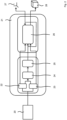
- Fig.1 shows a schematic representation of functional components for controlling an unmanned aircraft when it is moved along a three-dimensional flight path, in particular functional components for repeatedly providing (current) spatial position data for the unmanned aircraft.
- a first position determination system 1 is provided, which is a satellite navigation system, for example a GPS system.
- the first position determination system 1 is set up to continuously determine first position data for determining a (current) spatial position of the unmanned aircraft. Satellite position determination systems are known as such in various embodiments and provide position data in an associated coordinate system.
- the unmanned aircraft further comprises a second positioning system 2, which is an image-based positioning system that is designed to determine second position data for the unmanned aircraft from image recordings for the surroundings of the unmanned aircraft.
- a second positioning system 2 which is an image-based positioning system that is designed to determine second position data for the unmanned aircraft from image recordings for the surroundings of the unmanned aircraft.
- an image analysis 3 based on artificial intelligence is provided.
- the first positioning system 1 provides first position data and the second positioning system 2 provides second position data.
- the first and second position data are compared or checked according to at least one first test specification.
- the first test specification specifies a predetermined distance between the first position data and the second position data.
- the plausibility check can be carried out in different ways depending on the criticality of the application, in particular in accordance with the principles of safe systems.
- the multi-channel principle the first position data from the first positioning system 1 and the second position data from the second positioning system 2 are checked against each other and, if necessary, processed into two output signals or a safe signal (position data) by means of optimization, for example calculating the mean value of the first and second position data.
- monitoring one path, i.e. the first positioning system 1 or the second positioning system 2 forms a checker and another path forms a doer. In the event of inconsistency, the doer is switched off and forces a different state of the overall system.
- the safety gate only validated signals are forwarded by the checker.
- the first position data determine the (current) spatial position of the unmanned aircraft, i.e. the position data which were determined with the satellite navigation system (first positioning system 1) which is assigned to the unmanned aircraft as a master system.
- the control of the unmanned aircraft using a control device 5 is then carried out based on or proceeding from the spatial position, i.e. in particular based on the first position data.
- first and second position data do not satisfy the at least first test specification in the plausibility check 4
- the second test specification specifying, for example, a larger (tolerable) distance between the first and second position data compared to the first test specification. If the first and second position data satisfy the second test specification (but not the first test specification), one example provides for setting the spatial position of the unmanned aircraft to be equal to the second position data and then controlling the unmanned aircraft on this basis or based on this when moving along the three-dimensional flight path.
- the redundant and independent determination of the first and second position data by means of the first and second position determination systems 1, 2, in particular free of a fusion of measurement data and/or specific position data, enables the position data determined by means of the master system to be secured in such a way that they are checked or compared using the second position data as part of the plausibility check 4.
- an emergency measure may also be provided if the first and second position data alone do not satisfy the first test specification.
- the error check specification may specify an error limit for a distance between the first and the second position data.
- An emergency measure may, for example, only be provided if it has additionally been determined that the first and the second position data meet the error check specification, i.e. indicate a (faulty) minimum distance from each other.
- a third position determination system 6 is optionally provided, which is a lidar position determination system which is set up to determine position data from three-dimensional optical measurements of the environment of the unmanned aircraft (using a measurement data analysis based on artificial intelligence), also independently of the position data determination in the first and second position determination system 1, 2.
- the second and third position determination systems 2, 6 can each be used in combination with the first position determination system 1 when controlling the unmanned aircraft. It can also be provided that, in addition to the first and second position data, third position data are determined with the third position determination system 6 by means of a measurement data analysis 7 redundantly and independently of the other position determinations. This allows a further security level to be implemented, in particular in order to check the position data provided by the master system additionally and independently of the comparison between the first and second position data.
- the first position data provided by the master system i.e. in the embodiment shown by the first position determination system 1 are only used for the (current) spatial position and thus for controlling the unmanned aircraft if the plausibility check 4 was successful, i.e. a test requirement with regard to the second and/or third position data in relation to the first position data is met.
- position data is determined independently of one another and in a redundant manner using the position determination systems in order to then check the position data of the master system for plausibility.
- the second or third position determination system 2, 6 can be assigned to the unmanned aircraft as the master system.
- Fig.2 and 3 show schematic representations concerning the determination of the first and second position data using artificial intelligence based on the images of the environment (image-based positioning system) or the three-dimensional optical measurements (lidar positioning system).
- Fig.2 With the help of one or more cameras 20, images are taken of the surroundings of the unmanned aircraft.
- a tracking mapping module 21 which is implemented in hardware and software, two chronologically successive image recordings 22, 23 are made available to a neural network 24 as input.
- the neural network 24 thus receives, for example, two three-dimensional digital image matrices (RGB) with the resolution of the camera(s) 20.
- the neural network 24 determines an optical flow 25, i.e. a pixel-based registration of the two image recordings 22, 23, which is reflected as a vector field (pixel shift per pixel) with a grid size of the image matrix.
- the optical flow 25 serves as input for another neural network 26, which carries out a pose estimation.
- the two image recordings 22, 23 and the results of the previous pose estimation from the further neural network 26 from the previous time step also serve as input for the further neural network 26.
- the further neural network 26 receives the following input variables: two three-dimensional image matrices (image recordings 22, 23, RGB images); pose from the previous time step; a one-dimensional image matrix (depth from the previous time step); a two-dimensional image matrix (optical flow 25) which estimates the depth per pixel; and the position as a six-dimensional vector.
- the output position data 27 and disparity or depth data 28 are (optionally) fed to a local and a global bundle adjustment 29, 30 in the example shown (cf. Fig.4 below).
- Fig.3 shows a schematic representation for a position determination using artificial intelligence comparable to that in connection with Fig.2 described procedure, whereby a lidar sensor system is used to collect 40 three-dimensional optical measurement data, which are then evaluated to determine the position of the unmanned aircraft.
- Fig.3 the same reference numerals as in Fig.2 used.
- Successive measurement data 41, 42 are transmitted to the neural network 24 for determining the optical flow 25.
- the successive measurement data 41, 42 here contain a grid of Lidar measurement points, which, in comparison to camera image data, assume two values per pixel (depth and intensity), whereby the pixel coordinate represents the grid point in a Lidar measurement world.
- Fig.4 shows a schematic representation of the local and global bundle adaptation 29, 30 using the position data 27 and the disparity data 28 (cf. Fig.2 and 3 ).
- the various position data are optimized using the bundle adjustment 29, 30.
- the individual visual beam bundles of the measurements are converted into the position values optimized over several measurements.
- Methods and processes for local and/or global bundle adjustment are known as such in various embodiments (see, for example, Agarwal et al., Bundle adjustment in the large. In Computer Vision - ECCV 2010, 11th European Conference on Computer Vision, p. 29-42, 2010 ).
Landscapes
- Engineering & Computer Science (AREA)
- Physics & Mathematics (AREA)
- General Physics & Mathematics (AREA)
- Aviation & Aerospace Engineering (AREA)
- Radar, Positioning & Navigation (AREA)
- Remote Sensing (AREA)
- Automation & Control Theory (AREA)
- Computer Vision & Pattern Recognition (AREA)
- Theoretical Computer Science (AREA)
- Position Fixing By Use Of Radio Waves (AREA)
- Navigation (AREA)
Claims (9)
- Procédé pour déterminer en toute sécurité une trajectoire de vol d'un aéronef sans pilote, dans lequel un aéronef sans pilote est déplacé le long d'une trajectoire de vol tridimensionnelle et ce qui suit est prévu de manière répétée :- détermination de premières données de position pour une position spatiale de l'aéronef sans pilote le long de la trajectoire de vol tridimensionnelle au moyen d'un premier système de détermination de position (1) attribué à l'aéronef sans pilote en tant que système maître- détermination de deuxièmes données de position pour la position spatiale de l'aéronef sans pilote, indépendamment de la détermination des premières données de position, au moyen d'un deuxième système de détermination de position (2 ; 6) associé à l'aéronef sans pilote, qui est différent du premier système de détermination de position (1);- exécution d'un contrôle de plausibilité (4) pour les premières données de position, dans lequel les premières données de position et les deuxièmes données de position sont vérifiées pour voir si elles répondent à au moins une première spécification de test ;- détermination des premières données de position comme position spatiale de l'aéronef sans pilote si le contrôle de plausibilité (4) montre que les premières données de position et les deuxièmes données de position satisfont à au moins la première spécification de test ; et- commande du mouvement de l'aéronef sans pilote le long de la trajectoire de vol tridimensionnelle correspondant à la position spatiale ;dans lequel les premier et deuxième systèmes de positionnement sont sélectionnés parmi le groupe de systèmes de positionnement suivant : (i) un système de navigation par satellite ; (ii) un système de positionnement basé sur l'image, qui est configuré pour déterminer les premières ou deuxièmes données de position à partir d'enregistrements d'images d'un environnement de l'aéronef sans pilote en utilisant une analyse d'images basée sur l'intelligence artificielle ; et (iii) un système de positionnement lidar, qui est configuré pour déterminer les premières ou deuxièmes données de position à partir de mesures optiques tridimensionnelles de l'environnement de l'aéronef sans pilote à l'aide d'une analyse de données de mesure basée sur l'intelligence artificielle.
- Procédé selon la revendication 1, caractérisé en ce que- lors de l'exécution du contrôle de plausibilité (4) pour les premières données de position et les deuxièmes données de position, on vérifie si celles-ci répondent à une deuxième spécification de test ; et- les deuxièmes données de position sont déterminées comme étant la position spatiale de l'aéronef sans pilote si le contrôle de plausibilité (4) montre que les premières données de position et les deuxièmes données de position ne satisfont pas à au moins la première spécification de test, mais satisfont effectivement à la deuxième spécification de test.
- Procédé selon la revendication 2, caractérisé en ce qu'une mesure d'urgence est déclenchée pour l'aéronef sans pilote si le contrôle de plausibilité (4) montre que les premières données de position et les deuxièmes données de position ne répondent ni à au moins la première spécification de test ni à la deuxième spécification du test.
- Procédé selon la revendication 3, caractérisé en ce que la mesure d'urgence n'est déclenchée pour l'aéronef sans pilote que lorsqu'il est en outre déterminé que les premières données de position et/ou les deuxièmes données de position répondent à une spécification de contrôle d'erreur.
- Procédé selon au moins une des revendications précédentes, caractérisé en ce que comme premier système de détermination de position (1) attribué à l'aéronef sans pilote en tant que système maître, le système de navigation par satellite est utilisé et comme deuxième système de détermination de position (2 ; 6), le système de positionnement basé sur l'image ou le système de positionnement lidar est utilisé.
- Procédé selon au moins une des revendications précédentes, caractérisé en ce que dans le système de positionnement à base d'images pour déterminer les premières ou deuxièmes données de position à partir des enregistrements d'images lors de l'utilisation de l'analyse d'images basée sur l'intelligence artificielle (3), une pose actuelle de l'aéronef sans pilote est déterminée sur la base d'un flux optique pour les enregistrements d'images préalablement déterminé à l'aide d'un réseau neuronal.
- Procédé selon au moins une des revendications précédentes, caractérisé en ce que dans le système de détermination de position lidar pour déterminer la première ou la deuxième donnée de position à partir des mesures optiques tridimensionnelles lors de l'utilisation de l'analyse des données de mesure basée sur l'intelligence artificielle (7), une pose actuelle de l'aéronef sans pilote est déterminée sur la base d'un flux optique pour le flux optique tridimensionnel préalablement déterminé à l'aide d'un réseau neuronal.
- Procédé selon la revendication 6 ou 7, caractérisé en ce qu'un processus d'optimisation est exécuté pour la position spatiale, dans lequel un ajustement de faisceau local et global est effectué, en tenant compte des données de disparité.
- Aéronef sans pilote, comportant- un premier système de détermination de position (1), qui est attribué à l'aéronef sans pilote en tant que système maître ; et- un deuxième système de détermination de position (2 ; 6), qui est attribué à l'aéronef sans pilote et est différent du premier système de détermination de position (1);dans lequel les premier et deuxième systèmes de positionnement sont sélectionnés dans le groupe suivant de systèmes de positionnement : (i) un système de navigation par satellite ; (ii) un système de positionnement basé sur l'image, qui est configuré pour déterminer les premières ou deuxièmes données de position à partir d'enregistrements d'images d'un environnement de l'aéronef sans pilote en utilisant une analyse d'images basée sur l'intelligence artificielle ; et (iii) un système de positionnement lidar, qui est configuré pour déterminer les premières ou deuxièmes données de position à partir de mesures optiques tridimensionnelles de l'environnement de l'aéronef sans pilote à l'aide d'une analyse de données de mesure basée sur l'intelligence artificielle ; etdans lequel l'aéronef sans pilote est configuré pour mettre en oeuvre un procédé selon au moins une des revendications précédentes en utilisant les premier et deuxième systèmes de détermination de position.
Applications Claiming Priority (1)
| Application Number | Priority Date | Filing Date | Title |
|---|---|---|---|
| DE102022106110.8A DE102022106110A1 (de) | 2022-03-16 | 2022-03-16 | Verfahren zum sicheren Bestimmen eines Flugpfads eines unbemannten Fluggeräts und unbemanntes Fluggerät |
Publications (2)
| Publication Number | Publication Date |
|---|---|
| EP4246268A1 EP4246268A1 (fr) | 2023-09-20 |
| EP4246268B1 true EP4246268B1 (fr) | 2024-07-24 |
Family
ID=85703951
Family Applications (1)
| Application Number | Title | Priority Date | Filing Date |
|---|---|---|---|
| EP23162077.4A Active EP4246268B1 (fr) | 2022-03-16 | 2023-03-15 | Procédé de détermination sécurisée d'un trajet de vol d'un véhicule aérien sans pilote et véhicule aérien sans pilote |
Country Status (3)
| Country | Link |
|---|---|
| US (1) | US12451019B2 (fr) |
| EP (1) | EP4246268B1 (fr) |
| DE (1) | DE102022106110A1 (fr) |
Family Cites Families (12)
| Publication number | Priority date | Publication date | Assignee | Title |
|---|---|---|---|---|
| EP1762822A4 (fr) * | 2004-06-29 | 2011-06-29 | Sony Corp | Dispositif et methode de traitement d'information, programme, et systeme de traitement d'information |
| EP2871495B1 (fr) | 2013-11-11 | 2020-06-03 | Airbus Defence and Space GmbH | Système de navigation d'aéronef et procédé de navigation d'un aéronef |
| US11435482B2 (en) * | 2014-06-18 | 2022-09-06 | Continental Teves Ag & Co. Ohg | Method for verifying the plausibility of GNSS position signals |
| CN114675671B (zh) | 2014-09-05 | 2025-10-21 | 深圳市大疆创新科技有限公司 | 多传感器环境地图构建 |
| WO2017045141A1 (fr) | 2015-09-16 | 2017-03-23 | SZ DJI Technology Co., Ltd. | Procédé et appareil de fonctionnement de plateforme mobile |
| US11164149B1 (en) * | 2016-08-31 | 2021-11-02 | Corvus Robotics, Inc. | Method and system for warehouse inventory management using drones |
| US10846326B2 (en) | 2016-11-30 | 2020-11-24 | Optim Corporation | System and method for controlling camera and program |
| KR102463176B1 (ko) * | 2017-10-16 | 2022-11-04 | 삼성전자주식회사 | 위치 추정 장치 및 방법 |
| WO2020006709A1 (fr) | 2018-07-04 | 2020-01-09 | 上海峰飞航空科技有限公司 | Système de positionnement visuel, véhicule aérien sans pilote et procédé d'auto-détection de position de véhicule aérien sans pilote |
| JP7249919B2 (ja) * | 2019-09-17 | 2023-03-31 | 株式会社東芝 | 推定装置、推定方法及びプログラム |
| CN110646825B (zh) * | 2019-10-22 | 2022-01-25 | 北京国家新能源汽车技术创新中心有限公司 | 定位方法、定位系统及汽车 |
| DE102021207769A1 (de) * | 2021-07-21 | 2023-01-26 | Robert Bosch Gesellschaft mit beschränkter Haftung | Verfahren zum Generieren einer Merkmalsbasierten Lokalisierungskarte für eine GNSS- und/oder Merkmalsbasierte Lokalisierung |
-
2022
- 2022-03-16 DE DE102022106110.8A patent/DE102022106110A1/de active Pending
-
2023
- 2023-03-13 US US18/120,545 patent/US12451019B2/en active Active
- 2023-03-15 EP EP23162077.4A patent/EP4246268B1/fr active Active
Also Published As
| Publication number | Publication date |
|---|---|
| US12451019B2 (en) | 2025-10-21 |
| EP4246268A1 (fr) | 2023-09-20 |
| US20230298474A1 (en) | 2023-09-21 |
| DE102022106110A1 (de) | 2023-09-21 |
Similar Documents
| Publication | Publication Date | Title |
|---|---|---|
| EP3584663A1 (fr) | Procédé de guidage transversal automatique d'un véhicule suiveur dans un peloton de véhicules | |
| EP3271231B1 (fr) | Procédé et dispositif pour surveiller une trajectoire de consigne à parcourir par un véhicule au sujet de l'absence de collision | |
| WO2020016385A1 (fr) | Procédé et système destiné à déterminer une position d'un véhicule | |
| DE102020211971B4 (de) | Fahrzeugtrajektorienvorhersage unter verwendung von strassentopologie und verkehrsteilnehmer-objektzuständen | |
| WO2015173092A1 (fr) | Procédé et dispositif d'étalonnage d'un système de caméra de véhicule automobile | |
| EP4102486B1 (fr) | Procédé de commande d'un mouvement de vol d'un aéronef, ainsi qu'aéronef | |
| DE102019207448A1 (de) | Simultane Lokalisierung und Kartenerstellung in 2D unter Verwendung eines 3D-Scanners | |
| WO2020193273A1 (fr) | Procédé et dispositif permettant de faire fonctionner un robot avec une meilleure détection d'objet | |
| EP2381207B1 (fr) | Mesure de cible 3D et orientation de cible à partir de données IR | |
| DE112020000909T5 (de) | Objektpositionsdetektionsvorrichtung, fahrsteuersystem und fahrsteuerverfahren | |
| DE102011016521A1 (de) | Verfahren zur Flugführung eines Flugzeugs zu einem vorgegebenen Zielobjekt und Flugführungssystem | |
| EP4505211A1 (fr) | Procédé de prédiction de trajectoires d'objets | |
| EP3663881B1 (fr) | Procédé de commande d'un véhicule autonome en fonction des vecteurs de mouvement estimés | |
| EP4068223A1 (fr) | Procédé et système de détermination du niveau du sol à l'aide d'un réseau de neurones artificiels | |
| EP3904827B1 (fr) | Planification dynamique d'itinéraire d'une vérification d'infrastructures d'une voie à l'aide de drones | |
| EP4246268B1 (fr) | Procédé de détermination sécurisée d'un trajet de vol d'un véhicule aérien sans pilote et véhicule aérien sans pilote | |
| DE102017206396B4 (de) | Steuerverfahren, Steuereinheit, Umfelderfassungssystem und mobile und/oder stationäre Einrichtung | |
| DE102021123124B4 (de) | Verfahren zum Steuern eines unbemannten Fluggeräts für einen Inspektionsflug zum Inspizieren eines Objekts und unbemanntes Inspektionsfluggerät | |
| EP4148386B1 (fr) | Détermination d'une position initiale absolue d'un véhicule | |
| DE102021113111B4 (de) | Verfahren zur Kalibrierung von Sensorinformationen eines Fahrzeugs sowie Fahrassistenzsystem | |
| DE102019127322A1 (de) | Verfahren zur Erfassung von Objekten in einer Fahrzeugumgebung, Vorrichtung zur Datenverarbeitung, Computerprogrammprodukt und computerlesbarer Datenträger | |
| DE102019102672A1 (de) | Intersensorisches lernen | |
| DE102018217219B4 (de) | Verfahren zum Ermitteln einer dreidimensionalen Position eines Objekts | |
| EP4102332B1 (fr) | Procédé de commande d'un mouvement d'aéronef d'un aéronef vers l'atterrissage ou le largage d'une charge et aéronef | |
| EP4053593A1 (fr) | Traitement des données de capteur dans un moyen de transport |
Legal Events
| Date | Code | Title | Description |
|---|---|---|---|
| PUAI | Public reference made under article 153(3) epc to a published international application that has entered the european phase |
Free format text: ORIGINAL CODE: 0009012 |
|
| STAA | Information on the status of an ep patent application or granted ep patent |
Free format text: STATUS: THE APPLICATION HAS BEEN PUBLISHED |
|
| AK | Designated contracting states |
Kind code of ref document: A1 Designated state(s): AL AT BE BG CH CY CZ DE DK EE ES FI FR GB GR HR HU IE IS IT LI LT LU LV MC ME MK MT NL NO PL PT RO RS SE SI SK SM TR |
|
| STAA | Information on the status of an ep patent application or granted ep patent |
Free format text: STATUS: REQUEST FOR EXAMINATION WAS MADE |
|
| 17P | Request for examination filed |
Effective date: 20240111 |
|
| RBV | Designated contracting states (corrected) |
Designated state(s): AL AT BE BG CH CY CZ DE DK EE ES FI FR GB GR HR HU IE IS IT LI LT LU LV MC ME MK MT NL NO PL PT RO RS SE SI SK SM TR |
|
| GRAP | Despatch of communication of intention to grant a patent |
Free format text: ORIGINAL CODE: EPIDOSNIGR1 |
|
| STAA | Information on the status of an ep patent application or granted ep patent |
Free format text: STATUS: GRANT OF PATENT IS INTENDED |
|
| INTG | Intention to grant announced |
Effective date: 20240223 |
|
| RIC1 | Information provided on ipc code assigned before grant |
Ipc: G01C 21/20 20060101ALI20240209BHEP Ipc: G05D 1/00 20060101AFI20240209BHEP |
|
| INTG | Intention to grant announced |
Effective date: 20240223 |
|
| GRAS | Grant fee paid |
Free format text: ORIGINAL CODE: EPIDOSNIGR3 |
|
| GRAA | (expected) grant |
Free format text: ORIGINAL CODE: 0009210 |
|
| STAA | Information on the status of an ep patent application or granted ep patent |
Free format text: STATUS: THE PATENT HAS BEEN GRANTED |
|
| AK | Designated contracting states |
Kind code of ref document: B1 Designated state(s): AL AT BE BG CH CY CZ DE DK EE ES FI FR GB GR HR HU IE IS IT LI LT LU LV MC ME MK MT NL NO PL PT RO RS SE SI SK SM TR |
|
| REG | Reference to a national code |
Ref country code: GB Ref legal event code: FG4D Free format text: NOT ENGLISH |
|
| REG | Reference to a national code |
Ref country code: CH Ref legal event code: EP |
|
| REG | Reference to a national code |
Ref country code: IE Ref legal event code: FG4D Free format text: LANGUAGE OF EP DOCUMENT: GERMAN Ref country code: DE Ref legal event code: R096 Ref document number: 502023000082 Country of ref document: DE |
|
| REG | Reference to a national code |
Ref country code: LT Ref legal event code: MG9D |
|
| REG | Reference to a national code |
Ref country code: NL Ref legal event code: MP Effective date: 20240724 |
|
| PG25 | Lapsed in a contracting state [announced via postgrant information from national office to epo] |
Ref country code: PT Free format text: LAPSE BECAUSE OF FAILURE TO SUBMIT A TRANSLATION OF THE DESCRIPTION OR TO PAY THE FEE WITHIN THE PRESCRIBED TIME-LIMIT Effective date: 20241125 |
|
| PG25 | Lapsed in a contracting state [announced via postgrant information from national office to epo] |
Ref country code: NL Free format text: LAPSE BECAUSE OF FAILURE TO SUBMIT A TRANSLATION OF THE DESCRIPTION OR TO PAY THE FEE WITHIN THE PRESCRIBED TIME-LIMIT Effective date: 20240724 |
|
| PG25 | Lapsed in a contracting state [announced via postgrant information from national office to epo] |
Ref country code: PT Free format text: LAPSE BECAUSE OF FAILURE TO SUBMIT A TRANSLATION OF THE DESCRIPTION OR TO PAY THE FEE WITHIN THE PRESCRIBED TIME-LIMIT Effective date: 20241125 Ref country code: NL Free format text: LAPSE BECAUSE OF FAILURE TO SUBMIT A TRANSLATION OF THE DESCRIPTION OR TO PAY THE FEE WITHIN THE PRESCRIBED TIME-LIMIT Effective date: 20240724 |
|
| PG25 | Lapsed in a contracting state [announced via postgrant information from national office to epo] |
Ref country code: NO Free format text: LAPSE BECAUSE OF FAILURE TO SUBMIT A TRANSLATION OF THE DESCRIPTION OR TO PAY THE FEE WITHIN THE PRESCRIBED TIME-LIMIT Effective date: 20241024 |
|
| PG25 | Lapsed in a contracting state [announced via postgrant information from national office to epo] |
Ref country code: FI Free format text: LAPSE BECAUSE OF FAILURE TO SUBMIT A TRANSLATION OF THE DESCRIPTION OR TO PAY THE FEE WITHIN THE PRESCRIBED TIME-LIMIT Effective date: 20240724 Ref country code: GR Free format text: LAPSE BECAUSE OF FAILURE TO SUBMIT A TRANSLATION OF THE DESCRIPTION OR TO PAY THE FEE WITHIN THE PRESCRIBED TIME-LIMIT Effective date: 20241025 Ref country code: PL Free format text: LAPSE BECAUSE OF FAILURE TO SUBMIT A TRANSLATION OF THE DESCRIPTION OR TO PAY THE FEE WITHIN THE PRESCRIBED TIME-LIMIT Effective date: 20240724 |
|
| PG25 | Lapsed in a contracting state [announced via postgrant information from national office to epo] |
Ref country code: BG Free format text: LAPSE BECAUSE OF FAILURE TO SUBMIT A TRANSLATION OF THE DESCRIPTION OR TO PAY THE FEE WITHIN THE PRESCRIBED TIME-LIMIT Effective date: 20240724 |
|
| PG25 | Lapsed in a contracting state [announced via postgrant information from national office to epo] |
Ref country code: LV Free format text: LAPSE BECAUSE OF FAILURE TO SUBMIT A TRANSLATION OF THE DESCRIPTION OR TO PAY THE FEE WITHIN THE PRESCRIBED TIME-LIMIT Effective date: 20240724 |
|
| PG25 | Lapsed in a contracting state [announced via postgrant information from national office to epo] |
Ref country code: IS Free format text: LAPSE BECAUSE OF FAILURE TO SUBMIT A TRANSLATION OF THE DESCRIPTION OR TO PAY THE FEE WITHIN THE PRESCRIBED TIME-LIMIT Effective date: 20241124 |
|
| PG25 | Lapsed in a contracting state [announced via postgrant information from national office to epo] |
Ref country code: HR Free format text: LAPSE BECAUSE OF FAILURE TO SUBMIT A TRANSLATION OF THE DESCRIPTION OR TO PAY THE FEE WITHIN THE PRESCRIBED TIME-LIMIT Effective date: 20240724 |
|
| PG25 | Lapsed in a contracting state [announced via postgrant information from national office to epo] |
Ref country code: ES Free format text: LAPSE BECAUSE OF FAILURE TO SUBMIT A TRANSLATION OF THE DESCRIPTION OR TO PAY THE FEE WITHIN THE PRESCRIBED TIME-LIMIT Effective date: 20240724 Ref country code: RS Free format text: LAPSE BECAUSE OF FAILURE TO SUBMIT A TRANSLATION OF THE DESCRIPTION OR TO PAY THE FEE WITHIN THE PRESCRIBED TIME-LIMIT Effective date: 20241024 |
|
| PG25 | Lapsed in a contracting state [announced via postgrant information from national office to epo] |
Ref country code: RS Free format text: LAPSE BECAUSE OF FAILURE TO SUBMIT A TRANSLATION OF THE DESCRIPTION OR TO PAY THE FEE WITHIN THE PRESCRIBED TIME-LIMIT Effective date: 20241024 Ref country code: PL Free format text: LAPSE BECAUSE OF FAILURE TO SUBMIT A TRANSLATION OF THE DESCRIPTION OR TO PAY THE FEE WITHIN THE PRESCRIBED TIME-LIMIT Effective date: 20240724 Ref country code: NO Free format text: LAPSE BECAUSE OF FAILURE TO SUBMIT A TRANSLATION OF THE DESCRIPTION OR TO PAY THE FEE WITHIN THE PRESCRIBED TIME-LIMIT Effective date: 20241024 Ref country code: LV Free format text: LAPSE BECAUSE OF FAILURE TO SUBMIT A TRANSLATION OF THE DESCRIPTION OR TO PAY THE FEE WITHIN THE PRESCRIBED TIME-LIMIT Effective date: 20240724 Ref country code: IS Free format text: LAPSE BECAUSE OF FAILURE TO SUBMIT A TRANSLATION OF THE DESCRIPTION OR TO PAY THE FEE WITHIN THE PRESCRIBED TIME-LIMIT Effective date: 20241124 Ref country code: HR Free format text: LAPSE BECAUSE OF FAILURE TO SUBMIT A TRANSLATION OF THE DESCRIPTION OR TO PAY THE FEE WITHIN THE PRESCRIBED TIME-LIMIT Effective date: 20240724 Ref country code: GR Free format text: LAPSE BECAUSE OF FAILURE TO SUBMIT A TRANSLATION OF THE DESCRIPTION OR TO PAY THE FEE WITHIN THE PRESCRIBED TIME-LIMIT Effective date: 20241025 Ref country code: FI Free format text: LAPSE BECAUSE OF FAILURE TO SUBMIT A TRANSLATION OF THE DESCRIPTION OR TO PAY THE FEE WITHIN THE PRESCRIBED TIME-LIMIT Effective date: 20240724 Ref country code: ES Free format text: LAPSE BECAUSE OF FAILURE TO SUBMIT A TRANSLATION OF THE DESCRIPTION OR TO PAY THE FEE WITHIN THE PRESCRIBED TIME-LIMIT Effective date: 20240724 Ref country code: BG Free format text: LAPSE BECAUSE OF FAILURE TO SUBMIT A TRANSLATION OF THE DESCRIPTION OR TO PAY THE FEE WITHIN THE PRESCRIBED TIME-LIMIT Effective date: 20240724 |
|
| PG25 | Lapsed in a contracting state [announced via postgrant information from national office to epo] |
Ref country code: SM Free format text: LAPSE BECAUSE OF FAILURE TO SUBMIT A TRANSLATION OF THE DESCRIPTION OR TO PAY THE FEE WITHIN THE PRESCRIBED TIME-LIMIT Effective date: 20240724 Ref country code: RO Free format text: LAPSE BECAUSE OF FAILURE TO SUBMIT A TRANSLATION OF THE DESCRIPTION OR TO PAY THE FEE WITHIN THE PRESCRIBED TIME-LIMIT Effective date: 20240724 Ref country code: DK Free format text: LAPSE BECAUSE OF FAILURE TO SUBMIT A TRANSLATION OF THE DESCRIPTION OR TO PAY THE FEE WITHIN THE PRESCRIBED TIME-LIMIT Effective date: 20240724 |
|
| PG25 | Lapsed in a contracting state [announced via postgrant information from national office to epo] |
Ref country code: EE Free format text: LAPSE BECAUSE OF FAILURE TO SUBMIT A TRANSLATION OF THE DESCRIPTION OR TO PAY THE FEE WITHIN THE PRESCRIBED TIME-LIMIT Effective date: 20240724 |
|
| PG25 | Lapsed in a contracting state [announced via postgrant information from national office to epo] |
Ref country code: CZ Free format text: LAPSE BECAUSE OF FAILURE TO SUBMIT A TRANSLATION OF THE DESCRIPTION OR TO PAY THE FEE WITHIN THE PRESCRIBED TIME-LIMIT Effective date: 20240724 |
|
| REG | Reference to a national code |
Ref country code: DE Ref legal event code: R097 Ref document number: 502023000082 Country of ref document: DE |
|
| PG25 | Lapsed in a contracting state [announced via postgrant information from national office to epo] |
Ref country code: IT Free format text: LAPSE BECAUSE OF FAILURE TO SUBMIT A TRANSLATION OF THE DESCRIPTION OR TO PAY THE FEE WITHIN THE PRESCRIBED TIME-LIMIT Effective date: 20240724 Ref country code: SK Free format text: LAPSE BECAUSE OF FAILURE TO SUBMIT A TRANSLATION OF THE DESCRIPTION OR TO PAY THE FEE WITHIN THE PRESCRIBED TIME-LIMIT Effective date: 20240724 |
|
| PLBE | No opposition filed within time limit |
Free format text: ORIGINAL CODE: 0009261 |
|
| STAA | Information on the status of an ep patent application or granted ep patent |
Free format text: STATUS: NO OPPOSITION FILED WITHIN TIME LIMIT |
|
| 26N | No opposition filed |
Effective date: 20250425 |
|
| PG25 | Lapsed in a contracting state [announced via postgrant information from national office to epo] |
Ref country code: SE Free format text: LAPSE BECAUSE OF FAILURE TO SUBMIT A TRANSLATION OF THE DESCRIPTION OR TO PAY THE FEE WITHIN THE PRESCRIBED TIME-LIMIT Effective date: 20240724 |
|
| PG25 | Lapsed in a contracting state [announced via postgrant information from national office to epo] |
Ref country code: MC Free format text: LAPSE BECAUSE OF FAILURE TO SUBMIT A TRANSLATION OF THE DESCRIPTION OR TO PAY THE FEE WITHIN THE PRESCRIBED TIME-LIMIT Effective date: 20240724 |
|
| PG25 | Lapsed in a contracting state [announced via postgrant information from national office to epo] |
Ref country code: LU Free format text: LAPSE BECAUSE OF NON-PAYMENT OF DUE FEES Effective date: 20250315 |
|
| REG | Reference to a national code |
Ref country code: BE Ref legal event code: MM Effective date: 20250331 |
|
| PG25 | Lapsed in a contracting state [announced via postgrant information from national office to epo] |
Ref country code: BE Free format text: LAPSE BECAUSE OF NON-PAYMENT OF DUE FEES Effective date: 20250331 |
|
| PG25 | Lapsed in a contracting state [announced via postgrant information from national office to epo] |
Ref country code: IE Free format text: LAPSE BECAUSE OF NON-PAYMENT OF DUE FEES Effective date: 20250315 |
|
| PGFP | Annual fee paid to national office [announced via postgrant information from national office to epo] |
Ref country code: DE Payment date: 20260320 Year of fee payment: 4 |
|
| PGFP | Annual fee paid to national office [announced via postgrant information from national office to epo] |
Ref country code: AT Payment date: 20260301 Year of fee payment: 4 |
|
| PGFP | Annual fee paid to national office [announced via postgrant information from national office to epo] |
Ref country code: FR Payment date: 20260323 Year of fee payment: 4 |