EP4257683A1 - Nouvelles uréthanases pour la dégradation enzymatique des polyuréthanes - Google Patents
Nouvelles uréthanases pour la dégradation enzymatique des polyuréthanes Download PDFInfo
- Publication number
- EP4257683A1 EP4257683A1 EP22167501.0A EP22167501A EP4257683A1 EP 4257683 A1 EP4257683 A1 EP 4257683A1 EP 22167501 A EP22167501 A EP 22167501A EP 4257683 A1 EP4257683 A1 EP 4257683A1
- Authority
- EP
- European Patent Office
- Prior art keywords
- polypeptide
- molecular weight
- activity
- low molecular
- urethanase
- Prior art date
- Legal status (The legal status is an assumption and is not a legal conclusion. Google has not performed a legal analysis and makes no representation as to the accuracy of the status listed.)
- Withdrawn
Links
Images
Classifications
-
- C—CHEMISTRY; METALLURGY
- C12—BIOCHEMISTRY; BEER; SPIRITS; WINE; VINEGAR; MICROBIOLOGY; ENZYMOLOGY; MUTATION OR GENETIC ENGINEERING
- C12Y—ENZYMES
- C12Y305/00—Hydrolases acting on carbon-nitrogen bonds, other than peptide bonds (3.5)
- C12Y305/01—Hydrolases acting on carbon-nitrogen bonds, other than peptide bonds (3.5) in linear amides (3.5.1)
- C12Y305/01075—Urethanase (3.5.1.75)
-
- C—CHEMISTRY; METALLURGY
- C12—BIOCHEMISTRY; BEER; SPIRITS; WINE; VINEGAR; MICROBIOLOGY; ENZYMOLOGY; MUTATION OR GENETIC ENGINEERING
- C12N—MICROORGANISMS OR ENZYMES; COMPOSITIONS THEREOF; PROPAGATING, PRESERVING, OR MAINTAINING MICROORGANISMS; MUTATION OR GENETIC ENGINEERING; CULTURE MEDIA
- C12N9/00—Enzymes; Proenzymes; Compositions thereof; Processes for preparing, activating, inhibiting, separating or purifying enzymes
- C12N9/14—Hydrolases (3)
- C12N9/78—Hydrolases (3) acting on carbon to nitrogen bonds other than peptide bonds (3.5)
- C12N9/80—Hydrolases (3) acting on carbon to nitrogen bonds other than peptide bonds (3.5) acting on amide bonds in linear amides (3.5.1)
-
- C—CHEMISTRY; METALLURGY
- C12—BIOCHEMISTRY; BEER; SPIRITS; WINE; VINEGAR; MICROBIOLOGY; ENZYMOLOGY; MUTATION OR GENETIC ENGINEERING
- C12P—FERMENTATION OR ENZYME-USING PROCESSES TO SYNTHESISE A DESIRED CHEMICAL COMPOUND OR COMPOSITION OR TO SEPARATE OPTICAL ISOMERS FROM A RACEMIC MIXTURE
- C12P13/00—Preparation of nitrogen-containing organic compounds
- C12P13/001—Amines; Imines
-
- C—CHEMISTRY; METALLURGY
- C12—BIOCHEMISTRY; BEER; SPIRITS; WINE; VINEGAR; MICROBIOLOGY; ENZYMOLOGY; MUTATION OR GENETIC ENGINEERING
- C12P—FERMENTATION OR ENZYME-USING PROCESSES TO SYNTHESISE A DESIRED CHEMICAL COMPOUND OR COMPOSITION OR TO SEPARATE OPTICAL ISOMERS FROM A RACEMIC MIXTURE
- C12P7/00—Preparation of oxygen-containing organic compounds
- C12P7/02—Preparation of oxygen-containing organic compounds containing a hydroxy group
- C12P7/04—Preparation of oxygen-containing organic compounds containing a hydroxy group acyclic
- C12P7/18—Preparation of oxygen-containing organic compounds containing a hydroxy group acyclic polyhydric
-
- B—PERFORMING OPERATIONS; TRANSPORTING
- B09—DISPOSAL OF SOLID WASTE; RECLAMATION OF CONTAMINATED SOIL
- B09B—DISPOSAL OF SOLID WASTE NOT OTHERWISE PROVIDED FOR
- B09B3/00—Destroying solid waste or transforming solid waste into something useful or harmless
- B09B3/60—Biochemical treatment, e.g. by using enzymes
Definitions
- the present invention relates to new urethanases for the enzymatic degradation of polyurethanes and an enzymatic process for the complete degradation of polyurethanes into defined monomers.
- Polyurethanes are established in many areas of normal life. They can be found, for example, in soft foams (mattresses, sponges, upholstered furniture), rigid foams (insulation materials, building materials), thermoplastics (sports shoes) or coatings (varnishes, paints, adhesives). Due to the constantly increasing demand for the products, increasingly larger quantities are being produced. At the same time, there is a growing need for methods for the most sustainable recycling of polyurethane products that are no longer needed, which allows the building blocks of the polymers to be recycled. To do this, the bonds in the polyurethanes must be specifically broken down in order to obtain defined degradation products and thus make them reusable.
- enzymes fulfill in living organisms, they can be used in a variety of ways to catalyze chemical reactions outside of this context. In comparison to conventional chemical processes, the reactions can be carried out under milder conditions such as lower temperature, neutral pH and without the use of aggressive chemicals. This saves energy, minimizes the formation of by-products and protects the environment, which helps reduce operating costs.
- the use of enzymes partially makes it possible for labile starting materials to be converted ( Jaeger, K.-E. & Reetz, MT (1998) Microbial lipases form versatile tools for biotechnology. Trends in biotechnology, 16, 396-403 ).
- enzymes are often chemo-, regio-, stereo- and enantioselective, which makes the purification of the products much easier and can therefore enable the efficient synthesis of products that are difficult to access ( Hasan, F., Shah, AA & Hameed, A. (2006) Industrial applications of microbial lipases. Enzymes and Microbial Technology, 39, 235-251 ).
- polyester polyurethanes can be broken down to some extent by bacteria and fungi.
- Polyester polyurethanes are significantly more susceptible to microbial or enzymatic degradation than polyether polyurethanes ( Nakajima-Kambe, T., Shigeno-Akutsu, Y., Nomura, N., Onuma, F. & Nakahara, T. (1999) Microbial degradation of polyurethane, polyester polyurethanes and polyether polyurethanes. Applied microbiology and biotechnology, 51, 134-140 ).
- polyester polyurethanes can be easily achieved via the hydrolysis of the ester bonds.
- the relatively easy degradation of polyesters is not surprising, since ester bonds in hydrophobic substrates in nature also have to be broken down when lipids are broken down and even polyesters without urethane bonds can be broken down relatively easily by esterases and lipases ( Marten, E., Müller, R.-J. & Deckwer, W.-D. (2003) Studies on the enzymatic hydrolysis of polyesters I. Low molecular mass model esters and aliphatic polyesters. Polymer degradation and stability, 80, 485-501 ; Marten, E., Müller, R.-J. & Deckwer, W.-D. (2005) Studies on the enzymatic hydrolysis of polyesters.
- urethanase and variants of this enzyme obtained through protein engineering are described.
- the enzyme can cleave urethane oligomers based on TDA or MDA.
- WO 2019/243293 newly identified urethanases described.
- the present invention was therefore based on the object of providing further enzymes which can be used for the enzymatic cleavage of urethane bonds and preferably for use in the complete enzymatic degradation of polyurethanes. Furthermore, an enzymatic process should be provided that enables the breakdown of polyurethanes into defined monomers.
- the present invention relates to a polypeptide with an amino acid sequence as defined in SEQ ID NO.: 1 or a variant thereof, characterized in that the polypeptide has urethanase activity.
- polypeptide is well known to those skilled in the art. It refers to a chain of at least 50, preferably at least 70, amino acids that are linked to one another by peptide bonds.
- a polypeptide can contain both naturally occurring and synthetic amino acids. It preferably contains the known proteinogenic amino acids.
- a variant is preferably obtained by adding, deleting or replacing up to 15%, more preferably up to 10% and even more preferably up to 5%, of the amino acids contained in the respective polypeptide.
- the basis for calculating the sequence identity is preferably the amino acid sequence defined by SEQ ID NO.: 1.
- the person skilled in the art is aware that fusion proteins are formed by enzymes with other proteins without this affecting the activity of the enzyme. Therefore, the term “variant” also includes those amino acid sequences derived from the polypeptide defined by SEQ ID NO.: 1, which are fused at the N-terminus and/or at the C-terminus with other proteins, e.g. the Green Fluorescent Protein.
- variants of the polypeptide are obtained by adding, deleting or replacing up to 20, preferably up to 10 and even more preferably up to 5 amino acids of the disclosed sequences.
- the aforementioned modifications can occur continuously or discontinuously at any point on the polypeptide. However, they preferably occur only at the N-terminus and/or at the C-terminus of the polypeptide.
- each variant according to the invention obtained by addition, exchange or deletion of amino acids is characterized by urethanase activity as defined later in this application.
- urethanase activity refers to the ability of a polypeptide to enzymatically catalyze the cleavage of a urethane group.
- One mole of amine, one mole of alcohol and one mole of CO 2 are produced per mole of urethane group.
- the urethane group can be an aromatic, a cycloaliphatic or an aliphatically bound urethane group.
- an aromatically bonded urethane group the nitrogen atom is bonded directly to an aromatic ring.
- an aliphatically bonded urethane group the nitrogen atom is bonded to an alkyl radical, which is part of an open-chain alkyl radical. It is preferably an unbranched alkyl radical with at least one, more preferably at least two and most preferably at least three carbon atoms.
- the nitrogen atom is bonded to a carbon atom that is part of an aliphatic ring.
- This ring can be unsaturated at one or more sites as long as it does not acquire an aromatic character due to the presence of double bonds.
- the polypeptide with urethanase activity is capable of enzymatically cleaving an aromatically bound urethane group.
- Whether a polypeptide has urethanase activity can be checked by cleavage of suitable model substrates. These are preferably the substrates whose cleavage was shown in the exemplary embodiment.
- ethyl 4-nitrophenyl carbamate or the carbamate, which is obtainable by the reaction of 7-amino-4-methylcoumarin with ethyl chloroformate (EMACC) are particularly preferably used as model substrates.
- ENPC ethyl 4-nitrophenyl carbamate
- EMACC 7-amino-4-methylcoumarin with ethyl chloroformate
- the cleavage of ENPC is demonstrated by determining the increase in concentration of 4-nitroaniline. This is preferably done photometrically at a wavelength of 405 nm.
- the enzyme activity is preferably measured in a reaction buffer with 100 mM K 2 HPO 4 /KH 2 PO 4 , pH 7 with 6.25 vol.% ethanol in the presence of 0.2 mg/ L ENPC determined as substrate.
- the enzyme is incubated in the reaction buffer with ENPC preferably at room temperature and preferably for 24 hours.
- Cleavage of EMACC is demonstrated by determining the increase in concentration of 7-amino-4-methylcoumarin (AMC). This is preferably done photometrically at a wavelength of 365 nm.
- the enzyme activity is preferably measured in a reaction buffer with 50 mM Na 2 HPO 4 /NaH 2 PO 4 , pH 8.0 with 0.2 vol.% DMSO in the presence of 100 ⁇ M EMACC intended as a substrate.
- the enzyme is incubated in the reaction buffer with ENPC preferably at 30 °C and preferably for up to 24 hours.
- ethylphenethyl carbamate is preferably used as a model substrate. Cleavage is demonstrated by determining the increase in concentration of phenethylamine. This is preferably done by HPLC.
- the reaction buffer used and the reaction conditions preferably correspond to the parameters described above for ENPC.
- urethane bonds that can be cleaved by the urethanases according to the invention are formally based on the addition of a polyisocyanate with aliphatically, cycloaliphatically, araliphatically or aromatically bonded isocyanate groups and an alcohol.
- isocyanate with aliphatically bonded isocyanate groups all isocyanate groups are bonded to a carbon atom that is part of an open carbon chain. This can be unsaturated in one or more places.
- the aliphatically bound isocyanate group or - in the case of polyisocyanates - the aliphatically bound isocyanate groups are preferably bound to the terminal carbon atoms of the carbon chain.
- Preferred polyisocyanates with aliphatically bound isocyanate groups are 1,4-diisocyanatobutane (BDI), 1,5-diisocyanatopentane (PDI), 1,6-diisocyanatohexane (HDI), 2-methyl-1,5-diisocyanatopentane, 1,5-diisocyanatopentane 2,2-dimethylpentane, 2,2,4- or 2,4,4-trimethyl-1,6-diisocyanatohexane and 1,10-diisocyanatodecane.
- BDI 1,4-diisocyanatobutane
- PDI 1,5-diisocyanatopentane
- HDI 1,6-diisocyanatohexane
- 2-methyl-1,5-diisocyanatopentane 1,5-diisocyanatopentane 2,2-dimethylpentane, 2,2,4- or 2,4,4-tri
- isocyanate with cycloaliphatically bonded isocyanate groups all isocyanate groups are bonded to carbon atoms that are part of a closed ring of carbon atoms. This ring can be unsaturated at one or more sites as long as it does not acquire an aromatic character due to the presence of double bonds.
- Preferred polyisocyanates with cycloaliphatically bound isocyanate groups are 1,3- and 1,4-diisocyanatocyclohexane, 1,4-diisocyanato-3,3,5-trimethylcyclohexane, 1,3-diisocyanato-2-methylcyclohexane, 1,3-diisocyanato-4- methylcyclohexane, 1-isocyanato-3,3,5-trimethyl-5-isocyanatomethylcyclohexane isophorone diisocyanate; (IPDI), 1-isocyanato-1-methyl-4(3)-isocyanatomethylcyclohexane, 2,4'- and 4,4'-diisocyanatodicyclohexylmethane (H12MDI), 1,3-and 1,4-bis(isocyanatomethyl)cyclohexane, Bis-(isocyanatomethyl)-norbornane (NBDI), 4,4'
- Preferred polyisocyanates with araliphatically bound isocyanate groups are 1,3- and 1,4-bis-(isocyanatomethyl)benzene (xylylene diisocyanate); XDI), 1,3- and 1,4-bis(1-isocyanato-1-methylethyl)benzene (TMXDI) and bis(4-(1-isocyanato-1-methylethyl)phenyl)carbonate.
- Preferred isocyanates with aromatically bound isocyanate groups are tolylene diisocyanate (TDI), methylene diphenyl isocyanate (MDI) and naphthylene diisocyanate.
- tolylene diisocyanate refers to toluene 2,4-diisocyanate (2,4-TDI), toluene 2,6-diisocyanate (2,6-TDI) and any mixtures of the two isomers.
- methylenediphenyl isocyanate refers to all isomers of MDI, in particular 2,2'-diphenylmethane diisocyanate, 2,4'-diphenylmethane diisocyanate, 4,4'-diphenylmethane diisocyanate, all mixtures that contain at least two of the aforementioned isomers, as well as polynuclear derivatives of MDI.
- naphthylene diisocyanate refers to 1,4-naphthylene diisocyanate, 1,5-naphthylene diisocyanate and 1,6-naphthylene diisocyanate as well as any mixtures of the aforementioned isomers.
- polyisocyanates can also be present as oligomers, so that the urethane bond to be cleaved is formed between an oligomeric polyisocyanate, which is based on one of the above-mentioned monomeric diisocyanates, and an alcohol.
- oligomeric polyisocyanate refers to polyisocyanates that are composed of at least two of the above-mentioned diisocyanates.
- the oligomeric polyisocyanates can in particular have a uretdione, isocyanurate, allophanate, biuret, iminooxadiazinedione and/or oxadiazinetrione structure.
- the oligomeric polyisocyanates preferably have at least one of the following oligomeric structure types or mixtures thereof:
- Preferred substrates of the urethanase of the present invention are urethanes, which can be obtained from the aromatic polyisocyanates defined above.
- enzyme cleavage of a urethane group indicates that the above-described cleavage of a urethane group occurs faster in the presence of a polypeptide with urethanase activity than when incubated with the reaction buffer without enzyme under the same reaction conditions or when incubated with the reaction buffer under the same conditions in the presence of an inactive polypeptide .
- Bovine serum albumin is preferred as a model for an inactive polypeptide. If in the presence of a polypeptide to be tested the cleavage of the urethane group occurs more quickly than in an otherwise identical control with BSA, said polypeptide has urethanase activity as understood in this application.
- the present invention relates to a nucleic acid that encodes a polypeptide as defined in SEQ ID NO.: 1 or a variant of this polypeptide.
- the coding nucleic acid sequence is preferably under the control of a promoter which enables the expression of the polypeptide in a fungus, a yeast or a bacterium.
- the present invention relates to the use of a polypeptide with an amino acid sequence as defined in SEQ ID NO.: 1 and variants of this polypeptide, characterized in that the polypeptide has urethanase activity for the enzymatic cleavage of urethane bonds.
- the use preferably consists of bringing the enzyme according to the invention into contact with a compound which contains at least one urethane bond. This preferably occurs under conditions under which the enzyme displays its urethanase activity.
- the temperature during use is preferably in the range between 10 ° C and 70 ° C.
- a higher temperature range between 30 °C and 70 °C is preferred if the reaction rate is more important than the stability of the enzyme.
- a temperature range between 10 °C and 40 °C is preferred if the reaction rate is of less importance.
- the pH in use is preferably between 7 and 12, more preferably between 7 and 11 and most preferably between 8 and 11.
- the present invention relates to a method comprising the step of treating a low molecular weight urethane with a polypeptide which has urethanase activity and has an amino acid sequence as defined in SEQ ID No. 1 or with a variant thereof, whereby the low molecular weight urethane is cleaved .
- low molecular weight in this context means that the urethane contains at most four, preferably at most three, more preferably at most one or two urethane groups.
- the structures of the low molecular weight urethanes are preferably formally based on the formation of one or more urethane bonds between a polyisocyanate and one or more low molecular weight alcohols.
- Aromatic polyisocyanates especially toluene 2,4-diisocyanate (2,4-TDI), toluene 2,6-diisocyanate (2,6-TDI), 2,2'-diphenylmethane diisocyanate (2,2'-MDI), 2 ,4'-diphenylmethane diisocyanate (2,4'-MDI), 4,4'-diphenylmethane diisocyanate (4,4'-MDI), the polynuclear derivatives of the aforementioned diphenylmethane diisocyanates, 1,4-naphthylene diisocyanate, 1,5-naphthylene diisocyanate and 1, 6-Naphthylene diisocyanate is particularly preferred.
- any compound with at least one hydroxyl group per molecule is suitable as a low molecular weight alcohol.
- it has a molecular weight of at most 700 g/mol, more preferably at most 500 g/mol and most preferably at most 200 g/mol.
- low molecular weight alcohols with a higher polarity are preferred.
- the low molecular weight alcohol particularly preferably contains one or two hydroxyl groups per molecule.
- the low molecular weight alcohol moreover preferably has a melting point of at most 45°C, more preferably at most 20°C.
- Alcohols with two hydroxyl groups a molecular weight of at most 500 g/mol and a melting point of at most 45 ° C are therefore more preferred.
- the low molecular weight alcohol is selected from the group consisting of ethylene glycol, diethylene glycol, propylene glycol, dipropylene glycol, methyl glycol, triethylene glycol, glycerol, 2-methyl-1,3-propanediol, 1,4-butanediol, 1, 5-pentanediol, 1,6-hexanediol and polyethylene glycol 400. More preferably it is selected from the group consisting of ethylene glycol, diethylene glycol, propylene glycol, dipropylene glycol, methyl glycol and triethylene glycol.
- the low molecular weight alcohol diethylene glycol is particularly preferred.
- a low molecular weight urethane that is particularly preferred for the process according to the invention can be obtained by forming a urethane bond between one of the low molecular weight alcohols mentioned in the previous section, in particular diethylene glycol.
- the low molecular weight urethanes can be obtained in different ways.
- the ester bonds of a polyester-polyurethane are cleaved so that carboxylic acids and low molecular weight urethanes are released.
- the cleavage of the ester groups is preferably carried out enzymatically.
- Lipases EC 3.1.1.3 or cutinases (EC 3.1.1.74) are preferably used here.
- these are preferably low-molecular urethanes which are obtained by the chemical cleavage of a polyether or polyester polyurethane.
- This chemical cleavage is preferably a so-called “alcoholysis” or “glycolysis”, in which the polyether or polyester polyurethane is reacted with one of the low molecular weight alcohols mentioned above, so that the ether component of the polyether polyurethane or that Polyester polyol of a polyester polyurethane can be replaced by the low molecular weight alcohol.
- a particularly preferred embodiment for providing low molecular weight urethanes from polyether-polyurethanes is in WO 2021/032513 described.
- Polyether polyurethanes are reacted with a low molecular weight alcohol in such a way that the polyether component of the polyether polyurethane is released and a urethane bond is formed between the low molecular weight alcohol used and the isocyanates used to construct the polyether polyurethane.
- the low molecular weight urethanes to be cleaved according to the invention are therefore compounds which are formally obtained by forming a urethane bond between a polyisocyanate, preferably one of the aliphatic, aromatic, araliphatic or cycloaliphatic polyisocyanates listed above in this application, and a low molecular weight alcohol.
- polyester polyurethane refers to a polyurethane whose polyol component contains polyester polyols. Preferably, at least 40% by weight of the hydroxyl groups contained in the polyol component are components of polyester polyols. More preferably this is at least 60% by weight, even more preferably at least 80% by weight and most preferably at least 95% by weight.
- the polyester polyurethane can be foamed or non-foamed.
- the polyester-polyurethane contains at least one aromatic, aliphatic or cycloaliphatic isocyanate as the isocyanate component.
- the polyurethane preferably contains aromatic isocyanates.
- the at least one aromatic polyisocyanate is particularly preferably selected from the list given above.
- polyester polyol is known to those skilled in the art and refers to polyesters which contain, on average, at least 1.5, preferably at least 1.8 and more preferably at least 2.0 hydroxyl groups per molecule.
- the polyester polyols contained in the polyurethane to be degraded particularly preferably have a functionality of between 1.5 and 6.0. They contain aromatic and/or aliphatic polyols and aromatic and/or aliphatic polycarboxylic acids in any combination as structural components. Polyester polyols which are obtained by ring-opening polymerization of a lactone are also preferred.
- polyether polyurethane refers to a polyurethane whose polyol component contains polyether polyols.
- at least 40% by weight of the hydroxyl groups contained in the polyol component are components of polyether polyols. More preferably this is at least 60% by weight, even more preferably at least 80% by weight and most preferably at least 95% by weight.
- a polyether polyurethane it is possible for a polyether polyurethane to also contain further polyols as structural components while maintaining the aforementioned proportions of polyether polyols. These are preferably polyester polyols.
- polyether polyol is well known to those skilled in the art. These are polyethers with an average hydroxyl functionality between 1.5 and 6.0.
- the polyether polyol contained in the polyether polyurethane is preferably a polyaddition product of one or more alkylene oxides with 2 to 4 carbon atoms using at least one starter molecule which contains 2 to 8, preferably 2 to 6, bonded reactive hydrogen atoms.
- alkylene oxides are styrene oxide, ethylene oxide, propylene oxide, tetrahydrofuran, butylene oxide, epichlorohydrin. More preferred are 1,3-propylene oxide, 1,2- or 2,3-butylene oxide and styrene oxide. Ethylene oxide and 1,2-propylene oxide are particularly preferred.
- the alkylene oxides can be used individually, alternating one after the other or as mixtures.
- the “treatment” of the low molecular weight urethane takes place under conditions under which the enzyme used shows urethanase activity. Under these conditions, a low-molecular-weight alcohol or a mixture of low-molecular-weight alcohols and an amine or a mixture of amines are formed as reaction products of the enzymatic cleavage of the low-molecular-weight urethane.
- the chemical structure of the resulting amines depends on the type of polyisocyanate used to synthesize the urethane. Amines are released, which can be derived from the polyisocyanates used by addition of water and subsequent elimination of CO 2 .
- the present invention relates to the use of at least one of the polypeptides according to the invention to cleave a urethane bond in low molecular weight urethanes.
- process step a) is carried out before process step b).
- process step a) is carried out with a lipase or cutinase. More preferably, a lipase capable of cleaving tributyrin is used.
- Process step a) is preferably carried out under reaction conditions in which the lipase or cutinase used shows activity. Such conditions can be determined through routine experiments using common biochemical methods.
- process step a) takes place chemically.
- the polyurethane contains at least one aromatic, aliphatic or cycloaliphatic isocyanate as the isocyanate component.
- the polyurethane preferably contains aromatic isocyanates.
- a “polyol”, which is formed as a low molecular weight degradation product in the process defined in this section, is understood to mean any compound with at least two hydroxyl groups. Said polyol preferably has a molecular weight of at most 300 g/mol.
- Preferred polyols which are low molecular weight degradation products of the polyester-based polyurethanes, are selected from the group consisting of ethylene glycol, diethylene glycol, triethylene glycol, propylene glycol, 1,3-pentanediol, 1,4-butanediol, 1,6-hexanediol, 1,2-di -Propylene glycol, neopentyl glycol, glycerin, 1,1,1-trimethylolpropane, sucrose, sorbitol and pentaerythritol.
- a “polycarboxylic acid”, which is formed as a low molecular weight degradation product in the process defined in this section, is understood to mean any compound that contains at least two carboxyl groups.
- Said polycarboxylic acid preferably has a molecular weight of at most 300 g/mol.
- Preferred polycarboxylic acids, which are low molecular weight degradation products of the polyester-based polyurethane foams, are selected from the group consisting of succinic acid, glutaric acid, adipic acid, itaconic acid, phthalic acid, isophthalic acid, terephthalic acid and benzenetricarboxylic acid.
- a “polyamine,” which is formed as a low-molecular degradation product in the process defined in this section, is understood to mean any compound that contains at least two amino groups.
- Said polyamine preferably has a molecular weight of at most 300 g/mol.
- Preferred polyamines which are low molecular weight degradation products of the polyester-based polyurethane foams, are selected from the group consisting of 4,4'-diaminodiphenylmethane, 2,4'-diaminodiphenylmethane, 2,2'-diaminodiphenylmethane, the polynuclear derivatives of the aforementioned diaminodiphenylmethane compounds, 2,4- Toluenediamine, 2,6-toluenediamine, 1,4-naphthylenediamine, 1,5-naphthylenediamine, 1,6-naphthylenediamine, hexamethylenediamine, isophoronediamine, xylylenediamine, pentamethylenediamine, para-phenylenediamine, butyldiamine and H12-methylenediamine.
- the polyamines are particularly preferably selected from the group consisting of 4,4'-methylenediamine, 2,4'-methylenediamine, 2,2'-methylenediamine, 1,5-naphthylenediamine, 2,4-toluenediamine and 2,6-toluenediamine.
- Process step a) has two goals: (i) The polyether polyol used to synthesize the polyurethane should be released from the polyurethane as an isolable compound. (ii) The isocyanate used to synthesize the polyurethane should be present as a component of a low molecular weight urethane.
- the low molecular weight urethane in question is - in contrast to polyurethane with its high molecular weight - well suited as a substrate for the enzymatic cleavage that takes place in process step b) due to its lower molecular weight and the resulting better solubility.
- all definitions given above in this application also apply to this embodiment. This applies in particular to the enzymatic cleavage of the low molecular weight urethanes in process step b).
- process step b an amine and the low-molecular-weight alcohol used for transurethanization in process step a) are released by enzymatic cleavage of the low-molecular-weight urethanes.
- CO 2 is released in this process step.
- These compounds can be isolated using suitable separation processes and then used further. It is preferred to use the released low molecular weight alcohol again for the reurethanization that takes place in process step a).
- the released amine is available as a pure and well-defined starting material for new syntheses.
- Example 1 Activity determination with EMACC
- Urethanase genes were cloned into the pET-26 expression vector directly behind the NdeI interface.
- E. coli BL21(DE3) were transformed with the corresponding plasmids for expression.
- a single colony was used to inoculate the overnight culture in LB medium containing 1% (w/v) glucose and 50 ⁇ g/mL kanamycin.
- 200 ml of ZYP-5052 with 50 ⁇ g/mL kanamycin were inoculated with 1 mL of the overnight culture and incubated for 4 h at 37 °C at 100 rpm in baffled flasks. The temperature was then reduced to 20 °C before the cultures were harvested by centrifugation for 20 min at 4500 g and 4 °C. Cell pellets were stored at ⁇ 20 °C until proteins were purified.
- lysis buffer 50 mM sodium phosphate (NaPi), pH 8.0, 300 mM NaCl, 10 mM imidazole
- the digestion was carried out by ultrasound on ice over two cycles (3 min, 50% pulse, 50% power). To clarify the lysate, it was centrifuged at 10,000 g and 4 °C for 40 - 60 min. The supernatants were stored on ice until loading the IMAC column.
- IMAC resin (1 ml, ROTI ® Garose His Beads, nickel form) was equilibrated with lysis buffer. The lysate was then applied to the columns followed by a washing step with at least ten column volumes of washing buffer (50 mM NaPi, pH 8.0, 300 mM NaCl, 20 mM imidazole). The proteins were then eluted with 15 mL of elution buffer (50 mM NaPi, pH 8.0, 300 mM NaCl, 250 mM imidazole). The volume of the elution fraction was reduced to 2.5 mL using Vivaspin 20 ultrafiltration units (10 kDa MWCO). The proteins were then rebuffered in storage buffer (10 mM NaPi, pH 8.0, 100 mM NaCl) using PD10 columns.
- washing buffer 50 mM NaPi, pH 8.0, 300 mM NaCl, 20 mM imidazole.
- the proteins were then eluted
- a fluorogenic substrate was synthesized from 7-amino-4-methylcoumarin (AMC) and ethyl chloroformate.
- AMC 7-amino-4-methylcoumarin
- EMACC ethyl carbamate of AMC
- the specific activity was determined under standard conditions (50 mM NaPi, pH 8.0, 30 °C, 100 ⁇ M EMACC).
- EMACC was freshly added from a 50 mM stock in DMSO.
- Purified urethanases were diluted in storage buffer prior to addition to the assay, resulting in a linear increase in absorbance at 365 nm over 10–30 min. The measurement was carried out in 96-well plates in a plate photometer preheated to 30 °C and the specific activity was calculated from the linear increase in absorption in the first few minutes. The results are in
- the cells were separated by centrifugation at 20,425 g and 4 °C for 20 min in a large-capacity centrifuge.
- the cell pellets were suspended in 6 mL of digestion buffer (20 mM ammonium acetate, 0.4% n-dodedecyl- ⁇ -maltoside, 1% lysozyme, 1 ⁇ L/mL benzonase (Sigma-Aldrich Chemie GmbH, Taufkirchen)) and stored for 30 min Incubated at room temperature on the orbital shaker.
- the whole cell extract solution was then frozen at ⁇ 80 °C and freeze-dried.
- the lyophilisate was stored at 4 °C.
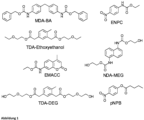
- the substrates ENPC, MDA-BA, NDA-MEG, TDA-ethoxyethanol and TDA-DEG were synthesized from the corresponding isocyanates and alcohols by reacting the isocyanates with an excess of alcohol.
- EMACC and 4-nitropenylbutyrate (pNPB) were used.
- the enzyme substrates are in error! Reference source not found. shown.
- a spatula tip ( ⁇ 3 mg) of each of the lyophilized whole cell extracts was suspended in 800 ⁇ L 100 mM KPi with 100 mM NaCl pH 7.5.
- the enzyme solution was diluted 1:10 into the reaction mixture containing the same buffer.
- Substrate stocks of the carbamates were prepared with a concentration of 5 - 340 mg/mL in DMSO. These were diluted 1:10 into the reaction mixture so that the final DMSO concentration was 10% (v/v).
- the batches were prepared with a total volume of 500 ⁇ L. Incubation took place for one day at 30°C and 800-1000 rpm followed by one day at 40°C and 800-1000 rpm in a thermoshaker.
- EMACC and pNPB the total volume of the reaction was 200 ⁇ L and the fluorescence (EMACC, excitation 365 nm, emission 440 nm) or absorption (pNPB, 410 nm) was measured at different times in the Varioskan Lux plate photometer (Thermo Fisher Scientific Inc., Waltham, Massachusetts, USA).
- the high-pressure liquid chromatography was carried out on a 1260 Infinity II series device from Agilent Technologies (Santa Clara, USA) with a multisampler and DAD ( diode array detector ) for UV and the visible range of light.
- the “Zorbax Eclipse Plus-C18” column with a particle size of 5 ⁇ m and dimensions 4.6 x 150 mm (Agilent Technologies, Santa Clara, USA) with a corresponding guard column was used for all measurements. For all methods, 5 ⁇ L of sample was injected and the column was heated to 40 °C. The flow was generally 1.0 mL/min.
- the “ER_Juni2021-2” method was used to detect aromatic amines. Aromatic amines could be quantified at 210 nm and 232 nm using this method without derivatization due to their high intrinsic absorption. ddH 2 O with 5% (v/v) acetonitrile was used as mobile phase A and acetonitrile with 5% (v/v) ddH 2 O was used as mobile phase B. The data was analyzed using the software “OpenLAB CDS 2.4” version 2.204.0.661 (Agilent Technologies, Santa Clara, USA).
- the hydrolytic activity of the urethanases towards the tested carbamates was classified into the categories no activity (-), low activity (+), medium activity (++) and high activity (+++) based on the peak area of the products formed in the chromatogram. It was shown that the urethanase UMG-8 accepts a wide range of substrates. The tested substrates are in error! Reference source not found. shown. ⁇ i>Table 3: Activity of urethanase towards various carbamates.
- Activity is divided into the categories "no activity"(-) ⁇ /i>, ⁇ i>"lowactivity” (+), “medium activity” (++) and "high activity" ⁇ /i>( ⁇ i>+++ ⁇ /i>) ⁇ i>classified based on the HPLC peak area. ⁇ /i> Substrate UMG-8 EMACC +++ pNPB +++ ENPC ++ MDA-BA ++ NDA MEG +/+++ TDA ethoxyethanol +++ TDA DEG ++
- enzyme activity was determined analogously to Example 1, with the adjustment that the reaction was carried out in different buffers (100 mM). Buffers with pH 4.0, 5.0, and 6.0 (citrate), 7.0, 8.0, and 9.0 (bis-tris-propane), and 10.0 (CHES) were used. For pH values 10, 11, 12 and 13, a buffer consisting of 100 mM sodium phosphate and 100 mM sodium carbonate and, unlike Example 1, with 200 mM EMACC and 10% (v/v) DMSO was used.
- Temperature optima were determined by measuring the release of AMC from 100 ⁇ M EMACC in 50 mM NaPi (pH 8.0) at 30, 35, 40, 45, 50, 55, 60, 65, and 70 °C. Solvent stability was determined by quantifying the hydrolysis of EMAC under the conditions given in Example 1 at 0, 10, 20, 30, 40 and 50% (v/v) DMSO. The activity optima determined here for pH, temperature and DMSO concentration are in urethanase pH optimum T optimum (°C) Optimal DMSO concentration (%v/v) UMG-SP-8 10 70 0 Table 4 summarizes.
- solutions of the purified UMG-8 with a protein concentration of 0.5 mg/mL were prepared in 100 mM KPi pH 7.5. 100 ⁇ L each were stored in the Biometra TAdvanced Basis thermocycler (Analytik Jena GmbH, Jena) at 20°C, 25.7°C, 29.4°C, 36.9°C, 40.6°C, 44.3°C and 50 °C for 12 h and then incubated at 4 °C until activity measurement. The lid heating was heated to 99°C. A reference sample was incubated at 4°C. The residual activity of the enzymes was determined using pNPB assay.
- ⁇ i>Table 6 Specific activity of urethanase towards pNPB in U ⁇ /i>/ ⁇ i>mg after incubation for 12 h at 20°C, 25.7°C, 29.4°C, 36.9°C , 40.6 °C, 44.3 °C and 50 °C and at 4 °C for reference. ⁇ /i> Incubation temperature 4°C 20°C 25.7°C 29.4°C 36.9°C 40.6°C 44.3°C 50°C enzyme Specific activity [ ⁇ mol/min/mg enzyme] UMG-8 6.73 6.50 7.12 6.42 3.23 0 0 0 0
Landscapes
- Chemical & Material Sciences (AREA)
- Organic Chemistry (AREA)
- Life Sciences & Earth Sciences (AREA)
- Engineering & Computer Science (AREA)
- Zoology (AREA)
- Wood Science & Technology (AREA)
- Health & Medical Sciences (AREA)
- Bioinformatics & Cheminformatics (AREA)
- Genetics & Genomics (AREA)
- General Health & Medical Sciences (AREA)
- General Engineering & Computer Science (AREA)
- Biochemistry (AREA)
- Microbiology (AREA)
- Biotechnology (AREA)
- General Chemical & Material Sciences (AREA)
- Chemical Kinetics & Catalysis (AREA)
- Biomedical Technology (AREA)
- Proteomics, Peptides & Aminoacids (AREA)
- Molecular Biology (AREA)
- Medicinal Chemistry (AREA)
- Polyurethanes Or Polyureas (AREA)
Priority Applications (7)
| Application Number | Priority Date | Filing Date | Title |
|---|---|---|---|
| EP22167501.0A EP4257683A1 (fr) | 2022-04-08 | 2022-04-08 | Nouvelles uréthanases pour la dégradation enzymatique des polyuréthanes |
| CA3253988A CA3253988A1 (fr) | 2022-04-08 | 2023-04-05 | Nouvelles uréthanases pour la détérioration enzymatique de polyuréthannes |
| JP2024559123A JP2025511701A (ja) | 2022-04-08 | 2023-04-05 | ポリウレタンの酵素分解用の新規ウレタナーゼ |
| CN202380030462.5A CN118984873A (zh) | 2022-04-08 | 2023-04-05 | 用于酶促降解聚氨酯的新型氨基甲酸酯酶 |
| PCT/EP2023/058947 WO2023194440A1 (fr) | 2022-04-08 | 2023-04-05 | Nouvelles uréthanases pour la dégradation enzymatique de polyuréthanes |
| US18/853,763 US20260055254A1 (en) | 2022-04-08 | 2023-04-05 | Novel urethanases for the enzymatic degradation of polyurethanes |
| EP23717889.2A EP4504931A1 (fr) | 2022-04-08 | 2023-04-05 | Nouvelles uréthanases pour la dégradation enzymatique de polyuréthanes |
Applications Claiming Priority (1)
| Application Number | Priority Date | Filing Date | Title |
|---|---|---|---|
| EP22167501.0A EP4257683A1 (fr) | 2022-04-08 | 2022-04-08 | Nouvelles uréthanases pour la dégradation enzymatique des polyuréthanes |
Publications (1)
| Publication Number | Publication Date |
|---|---|
| EP4257683A1 true EP4257683A1 (fr) | 2023-10-11 |
Family
ID=81306824
Family Applications (1)
| Application Number | Title | Priority Date | Filing Date |
|---|---|---|---|
| EP22167501.0A Withdrawn EP4257683A1 (fr) | 2022-04-08 | 2022-04-08 | Nouvelles uréthanases pour la dégradation enzymatique des polyuréthanes |
Country Status (1)
| Country | Link |
|---|---|
| EP (1) | EP4257683A1 (fr) |
Citations (9)
| Publication number | Priority date | Publication date | Assignee | Title |
|---|---|---|---|---|
| JPH09192633A (ja) | 1995-05-15 | 1997-07-29 | Rengo Co Ltd | ウレタン化合物の分解方法および該化合物を分解する菌 |
| JPH09201192A (ja) | 1996-01-24 | 1997-08-05 | Suzuki Motor Corp | ポリウレタン分解エステラーゼの精製方法 |
| JPH10271994A (ja) | 1997-03-31 | 1998-10-13 | Suzuki Motor Corp | ポリウレタンエステラーゼをコードする遺伝子 |
| EP0968300A1 (fr) | 1997-02-17 | 2000-01-05 | Bayer Ag | Decomposition de polymeres biodegradables avec des enzymes |
| US6180381B1 (en) | 1995-03-31 | 2001-01-30 | The United States Of America As Represented By The Secretary Of The Navy | Pseudomonas chlororaphis microorganism, polyurethane degrading enzyme obtained therefrom, and method of use |
| WO2006019095A1 (fr) | 2004-08-17 | 2006-02-23 | Japan Science And Technology Agency | Nouveau gène d'une uréthanase |
| WO2013134801A2 (fr) | 2012-03-12 | 2013-09-19 | Eurofoam Gmbh | Procédé de valorisation matière de polyuréthanes |
| WO2019243293A1 (fr) | 2018-06-21 | 2019-12-26 | Covestro Deutschland Ag | Nouvelles uréthanases pour la dégradation enzymatique de polyuréthanes |
| WO2021032513A1 (fr) | 2019-08-16 | 2021-02-25 | Covestro Intellectual Property Gmbh & Co. Kg | Procédé de décomposition de polyéther-polyuréthane |
-
2022
- 2022-04-08 EP EP22167501.0A patent/EP4257683A1/fr not_active Withdrawn
Patent Citations (9)
| Publication number | Priority date | Publication date | Assignee | Title |
|---|---|---|---|---|
| US6180381B1 (en) | 1995-03-31 | 2001-01-30 | The United States Of America As Represented By The Secretary Of The Navy | Pseudomonas chlororaphis microorganism, polyurethane degrading enzyme obtained therefrom, and method of use |
| JPH09192633A (ja) | 1995-05-15 | 1997-07-29 | Rengo Co Ltd | ウレタン化合物の分解方法および該化合物を分解する菌 |
| JPH09201192A (ja) | 1996-01-24 | 1997-08-05 | Suzuki Motor Corp | ポリウレタン分解エステラーゼの精製方法 |
| EP0968300A1 (fr) | 1997-02-17 | 2000-01-05 | Bayer Ag | Decomposition de polymeres biodegradables avec des enzymes |
| JPH10271994A (ja) | 1997-03-31 | 1998-10-13 | Suzuki Motor Corp | ポリウレタンエステラーゼをコードする遺伝子 |
| WO2006019095A1 (fr) | 2004-08-17 | 2006-02-23 | Japan Science And Technology Agency | Nouveau gène d'une uréthanase |
| WO2013134801A2 (fr) | 2012-03-12 | 2013-09-19 | Eurofoam Gmbh | Procédé de valorisation matière de polyuréthanes |
| WO2019243293A1 (fr) | 2018-06-21 | 2019-12-26 | Covestro Deutschland Ag | Nouvelles uréthanases pour la dégradation enzymatique de polyuréthanes |
| WO2021032513A1 (fr) | 2019-08-16 | 2021-02-25 | Covestro Intellectual Property Gmbh & Co. Kg | Procédé de décomposition de polyéther-polyuréthane |
Non-Patent Citations (17)
| Title |
|---|
| ALLEN, A. B.HILLIARD, N. P.HOWARD, G. T.: "Purification and characterization of a soluble polyurethane degrading enzyme from Comamonas acidovorans", INTERNATIONAL BIODETERIORATION & BIODEGRADATION, vol. 43, 1999, pages 37 - 41 |
| BLAKE, R.NORTON, W.HOWARD, G.: "Adherence and growth of a Bacillus species on an insoluble polyester polyurethane", INTERNATIONAL BIODETERIORATION & BIODEGRADATION, vol. 42, 1998, pages 63 - 73 |
| CRABBE, J. R.CAMPBELL, J. R.THOMPSON, L.WALZ, S. L.SCHULTZ, W. W.: "Biodegradation of a colloidal ester-based polyurethane by soil fungi", INTERNATIONAL BIODETERIORATION & BIODEGRADATION, vol. 33, 1994, pages 103 - 113, XP023923085, DOI: 10.1016/0964-8305(94)90030-2 |
| DARBY, R. T.KAPLAN, A. M.: "Fungal susceptibility of polyurethanes", APPLIED MICROBIOLOGY, vol. 16, 1968, pages 900 - 905 |
| DATABASE UniProt [online] 2 June 2021 (2021-06-02), "SubName: Full=Amidase {ECO:0000313|EMBL:MBB5697807.1}; EC=3.5.1.4 {ECO:0000313|EMBL:MBB5697807.1};", XP055965384, retrieved from EBI accession no. UNIPROT:A0A7W9ANY4 Database accession no. A0A7W9ANY4 * |
| HASAN, F.SHAH, A. A.HAMEED, A.: "Industrial applications of microbial lipases", ENZYME AND MICROBIAL TECHNOLOGY, vol. 39, 2006, pages 235 - 251, XP025095231, DOI: 10.1016/j.enzmictec.2005.10.016 |
| HOWARD, G. T.NORTON, W. N.BURKS, T.: "Growth of Acinetobacter gerneri P7 on polyurethane and the purification and characterization of a polyurethanase enzyme", BIODEGRADATION, vol. 23, 2012, pages 561 - 573 |
| JAEGER, K.-E.REETZ, M. T.: "Microbial lipases form versatile tools for biotechnology", TRENDS IN BIOTECHNOLOGY, vol. 16, 1998, pages 396 - 403, XP004173187, DOI: 10.1016/S0167-7799(98)01195-0 |
| KAPLAN, A. M.DARBY, R. T.GREENBERGER, M.RODGERS, M.: "Microbial deterioration of polyurethane systems", DEV IND MICROBIOL, vol. 82, 1968, pages 362 - 371 |
| KAY, M.MORTON, L.PRINCE, E.: "Bacterial degradation of polyester polyurethane", INTERNATIONAL BIODETERIORATION, vol. 27, 1991, pages 205 - 222, XP024162227, DOI: 10.1016/0265-3036(91)90012-G |
| MARTEN, E.MÜLLER, R.-J.DECKWER, W.-D.: "Studies on the enzymatic hydrolysis of polyesters I. Low molecular mass model esters and aliphatic polyesters", POLYMER DEGRADATION AND STABILITY, vol. 80, 2003, pages 485 - 501, XP004421264, DOI: 10.1016/S0141-3910(03)00032-6 |
| MARTEN, E.MÜLLER, R.-J.DECKWER, W.-D.: "Studies on the enzymatic hydrolysis of polyesters. II. Aliphatic-aromatic copolyesters", POLYMER DEGRADATION AND STABILITY, vol. 88, 2005, pages 371 - 381, XP025279077, DOI: 10.1016/j.polymdegradstab.2004.12.001 |
| NAKAJIMA-KAMBE, T.SHIGENO-AKUTSU, Y.NOMURA, N.ONUMA, F.NAKAHARA, T.: "Microbial degradation of polyurethane, polyester polyurethanes and polyether polyurethanes", APPLIED MICROBIOLOGY AND BIOTECHNOLOGY, vol. 51, 1999, pages 134 - 140, XP002379237, DOI: 10.1007/s002530051373 |
| SIMON ET AL., WASTE MANAGEMENT, vol. 76, 2018, pages 147 - 171 |
| TANG, Y. W.LABOW, R. S.SANTERRE, J. P.: "Enzyme induced biodegradation of polycarbonate-polyurethanes: dose dependence effect of cholesterol esterase", BIOMATERIALS, vol. 24, no. 12, 2003, pages 2003 - 2011, XP004413507, DOI: 10.1016/S0142-9612(02)00563-X |
| VEGA, R. E.MAIN, T.HOWARD, G. T.: "Cloning and expression in Escherichia coli of a polyurethane-degrading enzyme from Pseudomonas fluorescens", INTERNATIONAL BIODETERIORATION & BIODEGRADATION, vol. 43, 1999, pages 49 - 55 |
| ZRIMEC JAN ET AL: "Plastic-Degrading Potential across the Global Microbiome Correlates with Recent Pollution Trends", MBIO, vol. 12, no. 5, 26 October 2021 (2021-10-26), US, XP055965402, ISSN: 2150-7511, Retrieved from the Internet <URL:https://journals.asm.org/doi/pdf/10.1128/mBio.02155-21> DOI: 10.1128/mBio.02155-21 * |
Similar Documents
| Publication | Publication Date | Title |
|---|---|---|
| EP3810772B1 (fr) | Nouvelles uréthanases destinées à la dégradation enzymatique des polyuréthanes | |
| EP4013806B1 (fr) | Procédé de décomposition de polyéther-polyuréthane | |
| Magnin et al. | Enzymatic recycling of thermoplastic polyurethanes: Synergistic effect of an esterase and an amidase and recovery of building blocks | |
| EP0803524B1 (fr) | Vernis de polyuréthane pulvérulent ne relâchant pas de produits de décomposition et ayant une température basse de cuisson au four | |
| EP1149849B1 (fr) | Procédé pour la préparation de materieux bioactifs liées de maniere covalente à des mousses de polyuréthanne rt l'utilisation de supports de mousses polyuréthanne pour les sythèses chirales | |
| EP1521788B1 (fr) | Produits de polymerisation par addition contenant des groupes uretdione | |
| Wang et al. | Biodegradation of a poly (ester) urea‐urethane by cholesterol esterase: Isolation and identification of principal biodegradation products | |
| KR19990088243A (ko) | 1,3-비스(1-메틸-1-이소시아네이토에틸)벤젠기재카르보디이미드 | |
| EP4504931A1 (fr) | Nouvelles uréthanases pour la dégradation enzymatique de polyuréthanes | |
| EP4257683A1 (fr) | Nouvelles uréthanases pour la dégradation enzymatique des polyuréthanes | |
| EP4355820A1 (fr) | Procédé de dissociation de produits de polyuréthane | |
| US4507464A (en) | Polyisocyanates prepared by phosgenating a polyamine in the presence of a compound containing at least one hydroxyl group | |
| JPH09227648A (ja) | 2液注型用ポリウレタンエラストマー組成物、及びポリウレタンエラストマーの製造方法 | |
| JPH1060071A (ja) | 2液注型用ポリウレタンエラストマー組成物、及びポリウレタンエラストマーの製造方法 | |
| CN121699197A (zh) | 一种基于呋喃扩链剂的生物质基聚氨酯的制备方法及应用 | |
| EP4279522A1 (fr) | Polyisocyanates dispersibles dans l'eau à blocage d'aldéhyde et compositions aqueuses ainsi obtenues |
Legal Events
| Date | Code | Title | Description |
|---|---|---|---|
| PUAI | Public reference made under article 153(3) epc to a published international application that has entered the european phase |
Free format text: ORIGINAL CODE: 0009012 |
|
| STAA | Information on the status of an ep patent application or granted ep patent |
Free format text: STATUS: THE APPLICATION HAS BEEN PUBLISHED |
|
| STAA | Information on the status of an ep patent application or granted ep patent |
Free format text: STATUS: THE APPLICATION HAS BEEN WITHDRAWN |
|
| AK | Designated contracting states |
Kind code of ref document: A1 Designated state(s): AL AT BE BG CH CY CZ DE DK EE ES FI FR GB GR HR HU IE IS IT LI LT LU LV MC MK MT NL NO PL PT RO RS SE SI SK SM TR |
|
| 18W | Application withdrawn |
Effective date: 20231005 |