EP4268905B1 - Appareil d'entrainement physique - Google Patents
Appareil d'entrainement physique Download PDFInfo
- Publication number
- EP4268905B1 EP4268905B1 EP23170096.4A EP23170096A EP4268905B1 EP 4268905 B1 EP4268905 B1 EP 4268905B1 EP 23170096 A EP23170096 A EP 23170096A EP 4268905 B1 EP4268905 B1 EP 4268905B1
- Authority
- EP
- European Patent Office
- Prior art keywords
- training device
- spring
- spring element
- handle
- range
- Prior art date
- Legal status (The legal status is an assumption and is not a legal conclusion. Google has not performed a legal analysis and makes no representation as to the accuracy of the status listed.)
- Active
Links
Images


Classifications
-
- A—HUMAN NECESSITIES
- A63—SPORTS; GAMES; AMUSEMENTS
- A63B—APPARATUS FOR PHYSICAL TRAINING, GYMNASTICS, SWIMMING, CLIMBING, OR FENCING; BALL GAMES; TRAINING EQUIPMENT
- A63B23/00—Exercising apparatus specially adapted for particular parts of the body
- A63B23/035—Exercising apparatus specially adapted for particular parts of the body for limbs, i.e. upper or lower limbs, e.g. simultaneously
- A63B23/12—Exercising apparatus specially adapted for particular parts of the body for limbs, i.e. upper or lower limbs, e.g. simultaneously for upper limbs or related muscles, e.g. chest, upper back or shoulder muscles
-
- A—HUMAN NECESSITIES
- A63—SPORTS; GAMES; AMUSEMENTS
- A63B—APPARATUS FOR PHYSICAL TRAINING, GYMNASTICS, SWIMMING, CLIMBING, OR FENCING; BALL GAMES; TRAINING EQUIPMENT
- A63B21/00—Exercising apparatus for developing or strengthening the muscles or joints of the body by working against a counterforce, with or without measuring devices
- A63B21/0004—Exercising devices moving as a whole during exercise
-
- A—HUMAN NECESSITIES
- A63—SPORTS; GAMES; AMUSEMENTS
- A63B—APPARATUS FOR PHYSICAL TRAINING, GYMNASTICS, SWIMMING, CLIMBING, OR FENCING; BALL GAMES; TRAINING EQUIPMENT
- A63B21/00—Exercising apparatus for developing or strengthening the muscles or joints of the body by working against a counterforce, with or without measuring devices
- A63B21/02—Exercising apparatus for developing or strengthening the muscles or joints of the body by working against a counterforce, with or without measuring devices using resilient force-resisters
- A63B21/023—Wound springs
-
- A—HUMAN NECESSITIES
- A63—SPORTS; GAMES; AMUSEMENTS
- A63B—APPARATUS FOR PHYSICAL TRAINING, GYMNASTICS, SWIMMING, CLIMBING, OR FENCING; BALL GAMES; TRAINING EQUIPMENT
- A63B21/00—Exercising apparatus for developing or strengthening the muscles or joints of the body by working against a counterforce, with or without measuring devices
- A63B21/02—Exercising apparatus for developing or strengthening the muscles or joints of the body by working against a counterforce, with or without measuring devices using resilient force-resisters
- A63B21/026—Bars; Tubes; Leaf springs
- A63B21/027—Apparatus forced to oscillate at its resonant frequency
-
- A—HUMAN NECESSITIES
- A63—SPORTS; GAMES; AMUSEMENTS
- A63B—APPARATUS FOR PHYSICAL TRAINING, GYMNASTICS, SWIMMING, CLIMBING, OR FENCING; BALL GAMES; TRAINING EQUIPMENT
- A63B23/00—Exercising apparatus specially adapted for particular parts of the body
- A63B23/035—Exercising apparatus specially adapted for particular parts of the body for limbs, i.e. upper or lower limbs, e.g. simultaneously
- A63B23/03508—For a single arm or leg
-
- A—HUMAN NECESSITIES
- A63—SPORTS; GAMES; AMUSEMENTS
- A63B—APPARATUS FOR PHYSICAL TRAINING, GYMNASTICS, SWIMMING, CLIMBING, OR FENCING; BALL GAMES; TRAINING EQUIPMENT
- A63B23/00—Exercising apparatus specially adapted for particular parts of the body
- A63B23/035—Exercising apparatus specially adapted for particular parts of the body for limbs, i.e. upper or lower limbs, e.g. simultaneously
- A63B23/12—Exercising apparatus specially adapted for particular parts of the body for limbs, i.e. upper or lower limbs, e.g. simultaneously for upper limbs or related muscles, e.g. chest, upper back or shoulder muscles
- A63B23/14—Exercising apparatus specially adapted for particular parts of the body for limbs, i.e. upper or lower limbs, e.g. simultaneously for upper limbs or related muscles, e.g. chest, upper back or shoulder muscles for wrist joints
-
- A—HUMAN NECESSITIES
- A63—SPORTS; GAMES; AMUSEMENTS
- A63B—APPARATUS FOR PHYSICAL TRAINING, GYMNASTICS, SWIMMING, CLIMBING, OR FENCING; BALL GAMES; TRAINING EQUIPMENT
- A63B23/00—Exercising apparatus specially adapted for particular parts of the body
- A63B23/035—Exercising apparatus specially adapted for particular parts of the body for limbs, i.e. upper or lower limbs, e.g. simultaneously
- A63B23/12—Exercising apparatus specially adapted for particular parts of the body for limbs, i.e. upper or lower limbs, e.g. simultaneously for upper limbs or related muscles, e.g. chest, upper back or shoulder muscles
- A63B23/16—Exercising apparatus specially adapted for particular parts of the body for limbs, i.e. upper or lower limbs, e.g. simultaneously for upper limbs or related muscles, e.g. chest, upper back or shoulder muscles for hands or fingers
-
- A—HUMAN NECESSITIES
- A63—SPORTS; GAMES; AMUSEMENTS
- A63B—APPARATUS FOR PHYSICAL TRAINING, GYMNASTICS, SWIMMING, CLIMBING, OR FENCING; BALL GAMES; TRAINING EQUIPMENT
- A63B21/00—Exercising apparatus for developing or strengthening the muscles or joints of the body by working against a counterforce, with or without measuring devices
- A63B21/06—User-manipulated weights
- A63B21/072—Dumb-bells, bar-bells or the like, e.g. weight discs having an integral peripheral handle
-
- A—HUMAN NECESSITIES
- A63—SPORTS; GAMES; AMUSEMENTS
- A63B—APPARATUS FOR PHYSICAL TRAINING, GYMNASTICS, SWIMMING, CLIMBING, OR FENCING; BALL GAMES; TRAINING EQUIPMENT
- A63B21/00—Exercising apparatus for developing or strengthening the muscles or joints of the body by working against a counterforce, with or without measuring devices
- A63B21/40—Interfaces with the user related to strength training; Details thereof
- A63B21/4027—Specific exercise interfaces
- A63B21/4033—Handles, pedals, bars or platforms
- A63B21/4035—Handles, pedals, bars or platforms for operation by hand
-
- A—HUMAN NECESSITIES
- A63—SPORTS; GAMES; AMUSEMENTS
- A63B—APPARATUS FOR PHYSICAL TRAINING, GYMNASTICS, SWIMMING, CLIMBING, OR FENCING; BALL GAMES; TRAINING EQUIPMENT
- A63B2220/00—Measuring of physical parameters relating to sporting activity
- A63B2220/80—Special sensors, transducers or devices therefor
- A63B2220/803—Motion sensors
Definitions
- the present invention relates to a handheld training device.
- Hand-held training devices are known in the state of the art in a wide variety of designs. They are normally used to carry out movement and holding exercises in order to strengthen the human body.
- An example of such a training device is a dumbbell comprising a handle element that is designed to be grasped by a single hand of a person and weights positioned at the free ends of the handle element. Further prior art is provided by the publications DE 20 2011 106 952 U1 and US 2,396,106 A .
- the present invention provides a hand-held training device according to claim 1, comprising a handle element that is designed to be grasped by a single hand of a person, and an elongated spring element that protrudes upwards from the handle element, the length and stiffness of which are selected such that the spring element executes a pendulum movement when the handle element is moved slightly.
- the training device according to the invention serves to strengthen both body control and concentration. It is grasped by the handle element with one hand and held in front of the upper body with the arm outstretched. The aim is to keep the training device as still as possible. For control The spring element is used to keep the device steady and is triggered by the smallest of movements.
- the exercise becomes more difficult to perform and increasingly promotes muscle building in the upper body, which is beneficial for good posture.
- the spring element of the training device according to the invention only forms a motion sensor that is easily perceptible by the person doing the training.
- the handle element is preferably made of metal, wood or plastic. The choice of material also largely determines the weight of the handle element.
- the handle element is essentially cylindrical and in particular has a height of 10-15 cm and a diameter in the range of 3-5 cm. In this way, a very simple and inexpensive construction is created.
- the handle element advantageously has recesses for receiving the fingers of a person grasping the handle element, in particular in the form of four circumferential grooves arranged one above the other.
- the handle element can be gripped very comfortably and very securely along such recesses, even with sweaty hands.
- the spring element is preferably made of stainless steel.
- the advantage is that the spring element is difficult to deform, which is beneficial to the longevity of the training device.
- the spring element advantageously has a spring element length in the range of 25 to 45 cm. Accordingly, movements of the spring element can be very easily identified by the person exercising.
- the spring element is inserted into a blind hole provided on the upper side of the handle element and held therein, in particular using a fastening screw, which also serves an inexpensive and easy-to-manufacture structure.
- the spring element is a spiral spring.
- the turns of the spiral spring are preferably close together in the area of the end that is held on the handle element, and the turns have a pitch in the range of 3-8 mm over most of the length of the spiral spring. Thanks to the close-fitting turns, the spiral spring can be easily and securely attached to the handle element.
- the pitch of the turns, which they have over most of the length of the spiral spring ensures that the spiral spring deflects even with the slightest movement of the handle element and that the pendulum movement resulting from the deflection continues for a long time even after the handle element has been held still again.
- the spiral spring is generally preferably selected in such a way that a pendulum movement initiated by a lateral deflection of the spiral spring at the free end by 1 cm only comes to a standstill after 60-120 s when the handle element is held still.
- the spring element advantageously has between 80 and 150 turns.
- the wire diameter is in particular in the range of 1.3 to 1.9 mm.
- the The weight of the spiral spring is preferably in the range of 1 to 8 kg per 100 m of wire length.
- the training device consists of the handle element and the spring element.
- the training device can additionally have just one or more fastening elements for fastening the spring element to the handle element.
- no additional weight is arranged at the free end of the spring element.
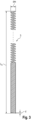
- the figures show a handheld training device 1 according to an embodiment of the present invention, which has as main components a handle element 2 and an elongated spring element 3 protruding upwards from the handle element 2.
- the handle element 2 is made of a rust-proof metal.
- the handle element 2 can also be made of wood or plastic. In the present case, it has a substantially cylindrical shape and preferably has a height H in the range of 10 to 15 cm and a diameter D in the range of 3 to 5 cm. In the embodiment shown, the height is approximately 13 cm and the diameter D is approximately 4 cm.
- recesses 4 are provided for receiving the fingers of a person holding the handle element 2, which in the embodiment shown are designed in the form of four circumferential grooves arranged one above the other.
- a blind hole 5 extends in the middle, at the bottom of which a threaded hole 6 is connected.
- the spring element 3 is a spiral spring made of stainless steel, in this case X10CrNi18-8.
- the spring element 3 preferably has a spring element length L 0 in the range of 25 to 45 cm, which in this case is 35 cm.
- the wire diameter d is in the range of 1.3 to 1.9 mm and in this case is 1.6 mm.
- the average diameter D m is preferably in the range of 8 to 12 mm and in this case is 9.8 mm.
- the spring element 3 has in particular between 80 and 150 turns, in this case 110 turns.
- the weight is preferably in the range of 1 to 8 kg per 100 m of wire length and in this case is 6.42 kg per 100 m of wire length.
- the turns of the spiral spring 2 lie close to one another, while over a predominant part of the spiral spring length they have a pitch in the range of preferably 3 to 8 mm, in the present case a pitch of 5 mm.
- the lower end of the spring element 3 is inserted into the blind hole 5 of the handle element 2 and fastened using a fastening screw (not shown in detail) which engages in the threaded hole 6.
- a fastening screw (not shown in detail) which engages in the threaded hole 6.
- other fastening means can also be used. such as adhesive or the like.
- the training device 1 serves to strengthen both body control and concentration. To perform an exercise, the training device 1 is grasped in the handle element 2 with one hand and held in front of the upper body with the arm outstretched. The aim is to keep the training device 1 as still as possible.
- the spring element 3 serves to control the steady holding, which swings out at the slightest movement, whereby the pendulum movement resulting from the swing continues for a longer time even after the handle element 2 is held still again.
- the preferred structure of the spring element 3 described above means that a pendulum movement initiated by a lateral deflection of the spiral spring at the free end by 1 cm only comes to a standstill after 60 to 120 seconds when the handle element 2 is held still.
- the training device 1 does not have a particularly high weight that would place additional strain on the body when the exercise is performed. However, if the handle element 2 is made of metal, the weight of the training device 1 is clearly noticeable, which particularly contributes to strengthening the upper body muscles.
Landscapes
- Health & Medical Sciences (AREA)
- Orthopedic Medicine & Surgery (AREA)
- General Health & Medical Sciences (AREA)
- Physical Education & Sports Medicine (AREA)
- Life Sciences & Earth Sciences (AREA)
- Biophysics (AREA)
- Rehabilitation Tools (AREA)
Claims (10)
- Appareil d'entraînement tenu à la main (1) comprenant un élément de poignée (2) adapté pour être saisi par une seule main d'une personne et un élément de ressort allongé (3) faisant saillie vers le haut à partir de l'élément de poignée (2), dont la longueur et la rigidité sont choisies de telle sorte, que l'élément de ressort (3) effectue un mouvement pendulaire lors d'un léger mouvement de l'élément de poignée (2), caractérisé en ce que l'appareil d'entraînement (1) est constitué de l'élément de poignée (2) et de l'élément de ressort (3), éventuellement en outre d'un ou plusieurs éléments de fixation pour fixer l'élément de ressort (3) à l'élément de poignée (2).
- Appareil d'entraînement (1) selon la revendication 1, caractérisé en ce que l'élément de poignée (2) est fabriqué en métal, en bois ou en matière plastique.
- Appareil d'entraînement (1) selon la revendication 1 ou 2, caractérisé en ce que l'élément de poignée (2) est essentiellement cylindrique et présente notamment une hauteur (H) de l'ordre de 10-15 cm et un diamètre (D) de l'ordre de 3-5 cm.
- Appareil d'entraînement (1) selon l'une des revendications précédentes, poignéeen ce que l'élément de préhension (2) présente des renfoncements (4) destinés à recevoir les doigts d'une personne saisissant l'élément de poignée (2), notamment sous la forme de quatre rainures périphériques superposées.
- Appareil d'entraînement (1) selon l'une des revendications précédentes, caractérisé en ce que l'élément de ressort (3) est fabriqué en acier inoxydable.
- Appareil d'entraînement (1) selon l'une des revendications précédentes, caractérisé en ce que l'élément de ressort (3) présente une longueur d'élément de ressort (L0 ) dans la plage de 25 à 45 cm.
- Appareil d'entraînement (1) selon l'une des revendications précédentes, caractérisé en ce que l'élément d ressort (3) est inséré dans un trou borgne (5) prévu sur la face supérieure de l'élément de poignée (2) et y est maintenu, notamment en utilisant une vis de fixation.
- Appareil d'entraînement (1) selon l'une des revendications précédentes, caractérisé en ce que l'élément de ressort (3) est un ressort spiral.
- Appareil d'entra nement (1) selon la revendication 8, caractérisé en ce que les spires de l'élément de ressort (3) sont étroitement adjacentes les unes aux autres dans la zone de l'extrémité qui est maintenue sur l'élément de poignée (3), et les spires présentent un pas de l'ordre de 3 à 8 mm sur une partie prépondérante de la longueur du ressort spiral (L0 ).
- Appareil d'entraînement (1) selon la revendication 8 ou 9, caractérisé en ce que l'élément de ressort (3) présente entre 80 et 150 spires et/ou le diamètre de fil (d) se situe dans la plage de 1,3 à 1,9 mm et/ou le poids se situe dans la plage de 1 à 8 kg pour 100 m de longueur de fil.
Applications Claiming Priority (1)
| Application Number | Priority Date | Filing Date | Title |
|---|---|---|---|
| DE202022102341.7U DE202022102341U1 (de) | 2022-04-29 | 2022-04-29 | Trainingsgerät |
Publications (3)
| Publication Number | Publication Date |
|---|---|
| EP4268905A1 EP4268905A1 (fr) | 2023-11-01 |
| EP4268905C0 EP4268905C0 (fr) | 2024-09-18 |
| EP4268905B1 true EP4268905B1 (fr) | 2024-09-18 |
Family
ID=82217813
Family Applications (1)
| Application Number | Title | Priority Date | Filing Date |
|---|---|---|---|
| EP23170096.4A Active EP4268905B1 (fr) | 2022-04-29 | 2023-04-26 | Appareil d'entrainement physique |
Country Status (2)
| Country | Link |
|---|---|
| EP (1) | EP4268905B1 (fr) |
| DE (1) | DE202022102341U1 (fr) |
Family Cites Families (2)
| Publication number | Priority date | Publication date | Assignee | Title |
|---|---|---|---|---|
| US2396106A (en) * | 1944-01-29 | 1946-03-05 | Phillip S Kussnir | Exercising device |
| DE202011106952U1 (de) * | 2011-10-20 | 2012-10-25 | Gwendolin Weinbrecht | Trainingsgerät zum Training der oberen Extremitäten |
-
2022
- 2022-04-29 DE DE202022102341.7U patent/DE202022102341U1/de active Active
-
2023
- 2023-04-26 EP EP23170096.4A patent/EP4268905B1/fr active Active
Also Published As
| Publication number | Publication date |
|---|---|
| EP4268905C0 (fr) | 2024-09-18 |
| DE202022102341U1 (de) | 2022-06-10 |
| EP4268905A1 (fr) | 2023-11-01 |
Similar Documents
| Publication | Publication Date | Title |
|---|---|---|
| DE10127319B4 (de) | Wellnessgerät | |
| EP2252471B1 (fr) | Crayon | |
| DE102016103072A1 (de) | Trampolin | |
| EP2909078B1 (fr) | Poignée suspendu au moyen d'un ressort pour bicyclette | |
| EP0195288A2 (fr) | Appareil de gymnastique | |
| DE19733805A1 (de) | Schwimm- und/oder Gymnastiksystem | |
| EP4268905B1 (fr) | Appareil d'entrainement physique | |
| DE3700072C1 (de) | Ballspielschlaeger,insbesondere Badmintonschlaeger | |
| EP1338308A1 (fr) | Bâton de gymnastique | |
| EP4087667B1 (fr) | Dispositif d'apprentissage de l'appui tendu renversé | |
| DE202008012928U1 (de) | Gerät | |
| DE202011106952U1 (de) | Trainingsgerät zum Training der oberen Extremitäten | |
| DE20203274U1 (de) | Trainingsgerät | |
| DE202009013102U1 (de) | Golfschläger | |
| DE2612683A1 (de) | Schlagwerkzeug | |
| DE8708336U1 (de) | Gymnastik-Gerät | |
| DE1070974B (fr) | ||
| DE1144164B (de) | Der Staerkung der Hand- und Armmuskeln dienendes UEbungsgeraet | |
| DE202006004951U1 (de) | Übungshilfe für Schlagzeuger | |
| DE8526649U1 (de) | Trainingsvorrichtung | |
| DE20307359U1 (de) | Gymnastikkeule mit variierbarem Gewicht | |
| DE8034654U1 (de) | Skiflügel | |
| DE102009053841A1 (de) | Bownee | |
| DE7333231U (de) | Trimmgerät | |
| DE202016101606U1 (de) | Gerät |
Legal Events
| Date | Code | Title | Description |
|---|---|---|---|
| PUAI | Public reference made under article 153(3) epc to a published international application that has entered the european phase |
Free format text: ORIGINAL CODE: 0009012 |
|
| STAA | Information on the status of an ep patent application or granted ep patent |
Free format text: STATUS: THE APPLICATION HAS BEEN PUBLISHED |
|
| AK | Designated contracting states |
Kind code of ref document: A1 Designated state(s): AL AT BE BG CH CY CZ DE DK EE ES FI FR GB GR HR HU IE IS IT LI LT LU LV MC ME MK MT NL NO PL PT RO RS SE SI SK SM TR |
|
| STAA | Information on the status of an ep patent application or granted ep patent |
Free format text: STATUS: REQUEST FOR EXAMINATION WAS MADE |
|
| 17P | Request for examination filed |
Effective date: 20240315 |
|
| RBV | Designated contracting states (corrected) |
Designated state(s): AL AT BE BG CH CY CZ DE DK EE ES FI FR GB GR HR HU IE IS IT LI LT LU LV MC ME MK MT NL NO PL PT RO RS SE SI SK SM TR |
|
| GRAP | Despatch of communication of intention to grant a patent |
Free format text: ORIGINAL CODE: EPIDOSNIGR1 |
|
| STAA | Information on the status of an ep patent application or granted ep patent |
Free format text: STATUS: GRANT OF PATENT IS INTENDED |
|
| INTG | Intention to grant announced |
Effective date: 20240627 |
|
| GRAS | Grant fee paid |
Free format text: ORIGINAL CODE: EPIDOSNIGR3 |
|
| GRAA | (expected) grant |
Free format text: ORIGINAL CODE: 0009210 |
|
| STAA | Information on the status of an ep patent application or granted ep patent |
Free format text: STATUS: THE PATENT HAS BEEN GRANTED |
|
| AK | Designated contracting states |
Kind code of ref document: B1 Designated state(s): AL AT BE BG CH CY CZ DE DK EE ES FI FR GB GR HR HU IE IS IT LI LT LU LV MC ME MK MT NL NO PL PT RO RS SE SI SK SM TR |
|
| REG | Reference to a national code |
Ref country code: GB Ref legal event code: FG4D Free format text: NOT ENGLISH |
|
| REG | Reference to a national code |
Ref country code: CH Ref legal event code: EP |
|
| REG | Reference to a national code |
Ref country code: IE Ref legal event code: FG4D Free format text: LANGUAGE OF EP DOCUMENT: GERMAN |
|
| REG | Reference to a national code |
Ref country code: DE Ref legal event code: R096 Ref document number: 502023000178 Country of ref document: DE |
|
| U01 | Request for unitary effect filed |
Effective date: 20241004 |
|
| U07 | Unitary effect registered |
Designated state(s): AT BE BG DE DK EE FI FR IT LT LU LV MT NL PT RO SE SI Effective date: 20241016 |
|
| PG25 | Lapsed in a contracting state [announced via postgrant information from national office to epo] |
Ref country code: NO Free format text: LAPSE BECAUSE OF FAILURE TO SUBMIT A TRANSLATION OF THE DESCRIPTION OR TO PAY THE FEE WITHIN THE PRESCRIBED TIME-LIMIT Effective date: 20241218 |
|
| PG25 | Lapsed in a contracting state [announced via postgrant information from national office to epo] |
Ref country code: GR Free format text: LAPSE BECAUSE OF FAILURE TO SUBMIT A TRANSLATION OF THE DESCRIPTION OR TO PAY THE FEE WITHIN THE PRESCRIBED TIME-LIMIT Effective date: 20241219 |
|
| PG25 | Lapsed in a contracting state [announced via postgrant information from national office to epo] |
Ref country code: HR Free format text: LAPSE BECAUSE OF FAILURE TO SUBMIT A TRANSLATION OF THE DESCRIPTION OR TO PAY THE FEE WITHIN THE PRESCRIBED TIME-LIMIT Effective date: 20240918 |
|
| PG25 | Lapsed in a contracting state [announced via postgrant information from national office to epo] |
Ref country code: RS Free format text: LAPSE BECAUSE OF FAILURE TO SUBMIT A TRANSLATION OF THE DESCRIPTION OR TO PAY THE FEE WITHIN THE PRESCRIBED TIME-LIMIT Effective date: 20241218 |
|
| PG25 | Lapsed in a contracting state [announced via postgrant information from national office to epo] |
Ref country code: RS Free format text: LAPSE BECAUSE OF FAILURE TO SUBMIT A TRANSLATION OF THE DESCRIPTION OR TO PAY THE FEE WITHIN THE PRESCRIBED TIME-LIMIT Effective date: 20241218 Ref country code: NO Free format text: LAPSE BECAUSE OF FAILURE TO SUBMIT A TRANSLATION OF THE DESCRIPTION OR TO PAY THE FEE WITHIN THE PRESCRIBED TIME-LIMIT Effective date: 20241218 Ref country code: HR Free format text: LAPSE BECAUSE OF FAILURE TO SUBMIT A TRANSLATION OF THE DESCRIPTION OR TO PAY THE FEE WITHIN THE PRESCRIBED TIME-LIMIT Effective date: 20240918 Ref country code: GR Free format text: LAPSE BECAUSE OF FAILURE TO SUBMIT A TRANSLATION OF THE DESCRIPTION OR TO PAY THE FEE WITHIN THE PRESCRIBED TIME-LIMIT Effective date: 20241219 |
|
| PG25 | Lapsed in a contracting state [announced via postgrant information from national office to epo] |
Ref country code: IS Free format text: LAPSE BECAUSE OF FAILURE TO SUBMIT A TRANSLATION OF THE DESCRIPTION OR TO PAY THE FEE WITHIN THE PRESCRIBED TIME-LIMIT Effective date: 20250118 |
|
| PG25 | Lapsed in a contracting state [announced via postgrant information from national office to epo] |
Ref country code: SM Free format text: LAPSE BECAUSE OF FAILURE TO SUBMIT A TRANSLATION OF THE DESCRIPTION OR TO PAY THE FEE WITHIN THE PRESCRIBED TIME-LIMIT Effective date: 20240918 |
|
| U20 | Renewal fee for the european patent with unitary effect paid |
Year of fee payment: 3 Effective date: 20250311 |
|
| PG25 | Lapsed in a contracting state [announced via postgrant information from national office to epo] |
Ref country code: ES Free format text: LAPSE BECAUSE OF FAILURE TO SUBMIT A TRANSLATION OF THE DESCRIPTION OR TO PAY THE FEE WITHIN THE PRESCRIBED TIME-LIMIT Effective date: 20240918 |
|
| PG25 | Lapsed in a contracting state [announced via postgrant information from national office to epo] |
Ref country code: CZ Free format text: LAPSE BECAUSE OF FAILURE TO SUBMIT A TRANSLATION OF THE DESCRIPTION OR TO PAY THE FEE WITHIN THE PRESCRIBED TIME-LIMIT Effective date: 20240918 Ref country code: PL Free format text: LAPSE BECAUSE OF FAILURE TO SUBMIT A TRANSLATION OF THE DESCRIPTION OR TO PAY THE FEE WITHIN THE PRESCRIBED TIME-LIMIT Effective date: 20240918 |
|
| PG25 | Lapsed in a contracting state [announced via postgrant information from national office to epo] |
Ref country code: SK Free format text: LAPSE BECAUSE OF FAILURE TO SUBMIT A TRANSLATION OF THE DESCRIPTION OR TO PAY THE FEE WITHIN THE PRESCRIBED TIME-LIMIT Effective date: 20240918 |
|
| PLBE | No opposition filed within time limit |
Free format text: ORIGINAL CODE: 0009261 |
|
| STAA | Information on the status of an ep patent application or granted ep patent |
Free format text: STATUS: NO OPPOSITION FILED WITHIN TIME LIMIT |
|
| 26N | No opposition filed |
Effective date: 20250619 |
|
| PG25 | Lapsed in a contracting state [announced via postgrant information from national office to epo] |
Ref country code: MC Free format text: LAPSE BECAUSE OF FAILURE TO SUBMIT A TRANSLATION OF THE DESCRIPTION OR TO PAY THE FEE WITHIN THE PRESCRIBED TIME-LIMIT Effective date: 20240918 |
|
| U20 | Renewal fee for the european patent with unitary effect paid |
Year of fee payment: 4 Effective date: 20260211 |
|
| PG25 | Lapsed in a contracting state [announced via postgrant information from national office to epo] |
Ref country code: IE Free format text: LAPSE BECAUSE OF NON-PAYMENT OF DUE FEES Effective date: 20250426 |