EP4273633A1 - Mechanischer oszillator mit isochronismuskorrektur - Google Patents
Mechanischer oszillator mit isochronismuskorrektur Download PDFInfo
- Publication number
- EP4273633A1 EP4273633A1 EP22171157.5A EP22171157A EP4273633A1 EP 4273633 A1 EP4273633 A1 EP 4273633A1 EP 22171157 A EP22171157 A EP 22171157A EP 4273633 A1 EP4273633 A1 EP 4273633A1
- Authority
- EP
- European Patent Office
- Prior art keywords
- flexible
- preload
- oscillator
- oscillator according
- inertial
- Prior art date
- Legal status (The legal status is an assumption and is not a legal conclusion. Google has not performed a legal analysis and makes no representation as to the accuracy of the status listed.)
- Granted
Links
Images
Classifications
-
- G—PHYSICS
- G04—HOROLOGY
- G04B—MECHANICALLY-DRIVEN CLOCKS OR WATCHES; MECHANICAL PARTS OF CLOCKS OR WATCHES IN GENERAL; TIME PIECES USING THE POSITION OF THE SUN, MOON OR STARS
- G04B17/00—Mechanisms for stabilising frequency
- G04B17/04—Oscillators acting by spring tension
- G04B17/045—Oscillators acting by spring tension with oscillating blade springs
-
- G—PHYSICS
- G04—HOROLOGY
- G04B—MECHANICALLY-DRIVEN CLOCKS OR WATCHES; MECHANICAL PARTS OF CLOCKS OR WATCHES IN GENERAL; TIME PIECES USING THE POSITION OF THE SUN, MOON OR STARS
- G04B17/00—Mechanisms for stabilising frequency
- G04B17/20—Compensation of mechanisms for stabilising frequency
Definitions
- the present invention relates to the field of mechanical oscillators for a watch movement. More particularly, the present invention relates to a mechanical oscillator making it possible to correct the isochronism fault of the oscillator.
- a flexible guided oscillator consists of a balance (inertia) and a flexible pivot having the dual function of elastic return and guiding the rotation of the balance.
- a flexible guided oscillator is described for example in the document EP3299905B1 .
- the flexible pivot is composed of a plurality of flexible elements, often blades, linked to each other by rigid elements.
- the elastic blades are made with manufacturing processes such as deep reactive ion etching (DRIE ) in the case of silicon which makes it possible to obtain blade thicknesses precise to ⁇ 0.5 ⁇ m.
- DRIE deep reactive ion etching
- such a variation in thickness can have an influence not only on the frequency of the oscillator but also on its lack of isochronism (variation in frequency when the amplitude of the oscillation varies). .
- the thickness defect is not systematic, it may be necessary to adjust the isochronism of the pivot.
- the blades of a flexible pivot can be distributed over several parts assembled manually or assembled at the wafer level (case of silicon). Assembly inaccuracies can also cause an isochronism defect. In all cases, this lack of isochronism manifests itself by a modification of the relationship between the elastic return torque of the flexible pivot and the angle of rotation of the pivot.
- the document EP2273323 describes a mechanical oscillator oscillating around an axis without a pivot, comprising several elastic systems connecting the serge and the fixing portion.
- This oscillator is particularly characterized in that it comprises at least one system for prestressing in traction or compression of the blades of a return member.
- the preload system allows the natural frequency of the oscillator to be adjusted via an additional spring that can be more or less tensioned
- the document EP3722888 describes a mechanical oscillator comprising a compensation system making it possible to correct the isochronism of the oscillator.
- the compensation system is an additional spring system that can be adjusted using a sliding slider.
- the document WO2017157870 presents a monolithic oscillator which comprises a support and an inertial regulating member connected to the support by an elastic suspension.
- the elastic suspension comprises an additional elastic adjustment connection having an adjustable end relative to the support, so as to modify the overall stiffness of the elastic suspension and therefore the frequency of oscillation of the inertia regulating member.
- the oscillator adjustment system described above acts asymmetrically and can unbalance the pivot axis.
- the present invention relates to a mechanical oscillator for a watch movement.
- the oscillator comprises a fixed part intended to be linked to a fixed element of the movement, a coaxial balance with a pivot axis, and at least three flexible connections configured so that the balance can oscillate in a plane of oscillation substantially perpendicular to the pivot axis.
- Each flexible connection extends radially relative to the pivot axis and connects the fixed part to the balance wheel.
- Each flexible connection comprises a first flexible element and a second flexible element, substantially coplanar in an axial plane parallel to the pivot axis.
- a first end of the first flexible element is linked to the fixed part and a first end of the second flexible element is rigidly linked to the balance wheel.
- a second end of the first flexible element and the second flexible element are connected by a rigid connection.
- the oscillator includes a preload element configured to apply a preload to at least one of the rigid links in a substantially radial direction.
- the preload applied by the preload element makes it possible to modify the elastic torque and angle of rotation relationship and to minimize the isochronism fault of the oscillator in a range of normal operating amplitude of the latter.
- the preload element acts symmetrically and does not unbalance the pivot axis.
- the sensitivity of the oscillator to gravity is preserved in the presence of the applied preload.
- the precharging element practically does not cause any additional bulk to the oscillator and is simple to produce.
- the precharge element can be added to existing oscillator without requiring complex assembly steps.
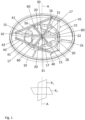
- FIG. 1 illustrates a mechanical oscillator for a watch movement, according to one embodiment.
- the oscillator comprises a fixed part 15 intended to be fixed to a fixed part of the watch movement (not shown).
- the fixed part 15 comprises a fixed central portion 30.
- An inertial element 10 (for example a balance wheel) is mounted coaxial with a pivot axis A.
- Such an oscillator is described in the patent EP3299905B1 of the present plaintiff.
- a rigid connection 16, supporting the inertial element 10, extends radially between a movable central portion 31 and the inertial element 10.
- the fixed central portion 30 and the movable central portion 31 take the form of 'a hub around the pivot axis A.
- the rigid connection comprises three arms 16, 17 arranged radially. More particularly, each arm comprises a first arm 16 connected in series with a second arm 17 via an annular structure 18. Other arrangements of the rigid connection are also possible without changing the field of application of the mechanical oscillator.
- the rigid connection may comprise only one or more arms 16 rigidly and directly connecting the mobile central portion 31 to the inertial element 10.
- the mechanical oscillator further comprises an elastic return element 20 configured so that the inertial element 10 can oscillate in an oscillation plane P o substantially perpendicular to the pivot axis A.
- the The elastic return element comprises three flexible connections 20. Each flexible connection 20 extends radially relative to the pivot axis A so as to connect the fixed part 15 to the inertial element 10 (via the portion fixed central 30).
- each flexible connection 20 comprises a first flexible element 21 and a second flexible element 22 substantially coplanar with the first flexible element 21 in an axial plane P a parallel to the pivot axis A (and perpendicular to the oscillation plane P o ).
- One end close to the pivot axis A of the first flexible element 21 is linked to the fixed central portion 30, and that of the second flexible element 22 is linked to the rigid connection 16.
- the first and second flexible elements 21, 22 are linked together at their other end by a rigid connection 50.
- the mechanical oscillator comprises a preload element 60 configured to apply a preload on at least one of the rigid connections 50 in a substantially radial direction.
- the stiffnesses of the first and second flexible elements 21, 22 must be identical.
- the first and second element flexible 21, 22 are blades
- a difference in thickness between these blades due to manufacturing tolerances, exists and produces a difference in stiffness which induces an isochronism fault which should be minimized over the typical operating amplitude of the oscillator.
- This difference in stiffness modifies the relationship between the elastic torque and the angle of rotation of the oscillator.
- the applied preload makes it possible to modify the relationship between the elastic torque and the angle of rotation, in order to minimize the isochronism fault of the oscillator in a range of normal operating amplitude of the oscillator.
- the oscillator comprises a coupling frame 40 comprising three arcs 41 connected to each other by their ends.
- Each arc 41 comprises an interior coupling blade 42 and an exterior coupling blade 43 substantially coplanar in the oscillation plane P o .
- the preload element 60 is configured to preload at least one of the arcs 41.
- the preloaded arc 41 then applies the preload to at least one of the rigid connections 50 in a substantially radial direction.
- the preload element 60 can be configured to preload only one of the arcs 41 or each of the arcs 41. Each preloaded arc 41 then applies the preload to at least one of the rigid connections 50 in a substantially radial direction (towards the central portion fixed 30).
- the preload element 60 can be configured to deform the outer coupling blade 43 in flexion.
- the coupling frame 40 makes it possible, even in the absence of the preload element 60, to prevent the flexible connections 20 from being twisted. Indeed, in the event of twisting of the flexible connections 20, for example during the rotation of the inertial element 10, the sensitivity of the oscillator to gravity is reduced.
- the preload element comprises an intermediate element 60 inserted between the inner coupling blade 42 and the outer coupling blade 43 forming the arc 41.
- the intermediate element 60 applies a preload on the arc 41 by the bending deformation of the external coupling blade 43.
- the intermediate element 60 can take the form of a volume element having a constant section. A lateral dimension of the volume element can be predetermined, so as to adjust the degree of deformation of the outer coupling blade 43 and to obtain a desired preload.
- the spacer element 60 may comprise a cylindrical element (such as a pellet) having a predetermined diameter.
- the intermediate element 60 in a continuous line has a diameter which slightly deforms the external coupling blade 43 and applies a low preload.
- the larger diameter spacer element 60' produces greater deformation of the outer coupling blade 43' and applies a higher preload.
- the intermediate element 60 can be made of silicon or any other material that can be machined with precision. Intermediate elements 60 of different diameters make it possible to preload the arc 41 depending on the extent of the isochronism defect to be corrected. Once the correction has been made, the intermediate element 60 can be fixed to the oscillator.
- the spacer element 60 may comprise a volume element having an adjustable lateral dimension.
- Such an intermediate element 60 may comprise, for example, an eccentric screw.
- the preload can be adjusted when the intermediate element 60 is inserted between the inner coupling blade 42 and the outer coupling blade 43.
- the intermediate element 60 can also include a volume element of variable section, for example a frustoconical volume.
- the applied preload can be adjusted by moving the intermediate element 60 between the inner coupling blade 42 and the outer coupling blade 43, for example in a direction substantially perpendicular to these blades 42, 43.
- the intermediate element 60 can be inserted at the level of the rigid connection 50.
- the preload force, exerted by the intermediate element 60 on the arc 41 is transmitted to the first and second flexible elements 21, 22 via the rigid connection 50.
- the intermediate element 60 can be configured to allow the preload applied to each of the flexible connections 20 to be modified independently.
- the diameter of the intermediate element 60 can be adjusted independently for each of the flexible connections 20.
- the application of a substantially identical preload on each of the flexible connections 20 is often preferable in order not to impair the sensitivity of the gravity oscillator.
- a simple axisymmetric adjustment can be obtained with elements of identical volume 60 for each flexible connection 20 can be produced in order not to unbalance the pivot and maintain a sensitivity to gravity identical to that of the pivot without preload. However, if the correction is small, it is possible to preload only one of the flexible connections 20.
- the intermediate element 60 can be configured to apply the preload on only one of the first and second flexible elements 21, 22 of the flexible connection 20.
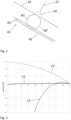
- FIG. 3 compares an isochronism curve of the oscillator comprising flexible connections 20 which do not present a thickness defect (curve C1) with an isochronism curve of the oscillator whose flexible connections 20 present a defect of ⁇ 0.5 ⁇ m d thickness and without correction (curve C2).
- each of the first and second elements flexible 21, 22 includes a blade.
- a defect of ⁇ 0.5 ⁇ m in thickness corresponds to a defect in relation to the target nominal thickness, for example, a blade of the first and/or second flexible elements 21, 22 of one of the flexible connections 20 is 0.5 ⁇ m more thick and a blade of the first and/or second flexible elements 21, 22 of another flexible connection 20 is 0.5 ⁇ m less thick.
- the isochronism curve of the oscillator indicated by C3 corresponds to the oscillator having the same thickness defect as for curve C2 and comprising the preload element 60.
- the preload element 60 makes it possible to correct the defect of isochronism of the oscillator so that the variation in operation of the oscillator is substantially zero (smaller than approximately 1%) for a range of oscillation amplitude of the oscillator in normal operation.
- the oscillation amplitude range of the oscillator in normal operation is between 16° and 20°.
Landscapes
- Physics & Mathematics (AREA)
- General Physics & Mathematics (AREA)
- Piezo-Electric Or Mechanical Vibrators, Or Delay Or Filter Circuits (AREA)
Priority Applications (1)
| Application Number | Priority Date | Filing Date | Title |
|---|---|---|---|
| EP22171157.5A EP4273633B1 (de) | 2022-05-02 | 2022-05-02 | Mechanischer oszillator mit isochronismuskorrektur |
Applications Claiming Priority (1)
| Application Number | Priority Date | Filing Date | Title |
|---|---|---|---|
| EP22171157.5A EP4273633B1 (de) | 2022-05-02 | 2022-05-02 | Mechanischer oszillator mit isochronismuskorrektur |
Publications (2)
| Publication Number | Publication Date |
|---|---|
| EP4273633A1 true EP4273633A1 (de) | 2023-11-08 |
| EP4273633B1 EP4273633B1 (de) | 2026-04-15 |
Family
ID=81579504
Family Applications (1)
| Application Number | Title | Priority Date | Filing Date |
|---|---|---|---|
| EP22171157.5A Active EP4273633B1 (de) | 2022-05-02 | 2022-05-02 | Mechanischer oszillator mit isochronismuskorrektur |
Country Status (1)
| Country | Link |
|---|---|
| EP (1) | EP4273633B1 (de) |
Citations (6)
| Publication number | Priority date | Publication date | Assignee | Title |
|---|---|---|---|---|
| EP2273323A2 (de) | 2009-07-10 | 2011-01-12 | Manufacture et fabrique de montres et chronomètres Ulysse Nardin Le Locle SA | Mechanischer Oszillator |
| WO2017157870A1 (fr) | 2016-03-14 | 2017-09-21 | Lvmh Swiss Manufactures Sa | Dispositif pour pièce d'horlogerie, mouvement horloger et pièce d'horlogerie comprenant un tel dispositif |
| EP3410229A1 (de) * | 2017-05-30 | 2018-12-05 | Patek Philippe SA Genève | Uhrkomponente mit flexiblem zapfen |
| CH715024A2 (fr) * | 2018-05-25 | 2019-11-29 | Eta Sa Mft Horlogere Sa | Oscillateur mécanique d'horlogerie. |
| EP3299905B1 (de) | 2016-09-27 | 2020-01-08 | CSEM Centre Suisse d'Electronique et de Microtechnique SA - Recherche et Développement | Mechanischer oszillator für ein uhrwerk |
| EP3722888A1 (de) | 2019-04-09 | 2020-10-14 | Ecole Polytechnique Fédérale de Lausanne (EPFL) | Mechanischer oszillator mit abstimmbarem isochronismusmangel |
-
2022
- 2022-05-02 EP EP22171157.5A patent/EP4273633B1/de active Active
Patent Citations (6)
| Publication number | Priority date | Publication date | Assignee | Title |
|---|---|---|---|---|
| EP2273323A2 (de) | 2009-07-10 | 2011-01-12 | Manufacture et fabrique de montres et chronomètres Ulysse Nardin Le Locle SA | Mechanischer Oszillator |
| WO2017157870A1 (fr) | 2016-03-14 | 2017-09-21 | Lvmh Swiss Manufactures Sa | Dispositif pour pièce d'horlogerie, mouvement horloger et pièce d'horlogerie comprenant un tel dispositif |
| EP3299905B1 (de) | 2016-09-27 | 2020-01-08 | CSEM Centre Suisse d'Electronique et de Microtechnique SA - Recherche et Développement | Mechanischer oszillator für ein uhrwerk |
| EP3410229A1 (de) * | 2017-05-30 | 2018-12-05 | Patek Philippe SA Genève | Uhrkomponente mit flexiblem zapfen |
| CH715024A2 (fr) * | 2018-05-25 | 2019-11-29 | Eta Sa Mft Horlogere Sa | Oscillateur mécanique d'horlogerie. |
| EP3722888A1 (de) | 2019-04-09 | 2020-10-14 | Ecole Polytechnique Fédérale de Lausanne (EPFL) | Mechanischer oszillator mit abstimmbarem isochronismusmangel |
Also Published As
| Publication number | Publication date |
|---|---|
| EP4273633B1 (de) | 2026-04-15 |
Similar Documents
| Publication | Publication Date | Title |
|---|---|---|
| EP4009115A1 (de) | Spiralfeder für resonatormechanismus eines uhrwerks, der mit mitteln zum ausgleichen der starrheit ausgestattet ist | |
| EP1984794B1 (de) | Stossdämpferspiralrolle | |
| EP2613206B1 (de) | Spirale mit zwei Spiralfedern mit verbessertem Isochronismus | |
| EP3502788B1 (de) | Vorrichtung zur selbstregulierung der aktiven länge einer spirale | |
| EP3217229B1 (de) | Regulierbares zusätzliches thermisches kompensationssystem | |
| EP2455825A1 (de) | Verfahren zur Paarung und Angleichung einer Untereinheit einer Uhr | |
| EP3382470B1 (de) | Oszillator einer uhr mit flexiblem zapfen | |
| EP3792700B1 (de) | Oszillator einer uhr mit flexiblem zapfen | |
| CH701783B1 (fr) | Ressort spiral de mouvement de montre. | |
| CH718113B1 (fr) | Ressort-spiral pour mécanisme résonateur d'horlogerie muni de moyens d'ajustement de la rigidité | |
| EP2067697A1 (de) | Pleuelstange für den Flugzeugbau und eine solche Schubstange umfassender Mechanismus | |
| EP4194964B1 (de) | Unruh mit trägheitsregulierung | |
| EP1843227A1 (de) | Gekoppelter Resonator für Regelsystem | |
| EP4273633B1 (de) | Mechanischer oszillator mit isochronismuskorrektur | |
| EP3430479B1 (de) | Vorrichtung für eine uhr, uhrwerk und uhr mit solch einer vorrichtung | |
| EP3948387A1 (de) | Befestigung eines spiegels an einem träger | |
| EP3391154B1 (de) | Schwingsystem für eine uhr | |
| EP4432020A1 (de) | Uhrwerk | |
| EP4236057A1 (de) | Piezoelektrische zeigevorrichtung | |
| CH717059B1 (fr) | Masselotte de réglage. | |
| CH703271B1 (fr) | Résonateur thermocompensé aux premier et second ordres. | |
| EP4428628B1 (de) | Vorrichtung zur autonomen einstellung der aktiven länge einer spiralfeder | |
| CH704149B1 (fr) | Procédé d'appairage des composants d'un sous-ensemble d'horlogerie, et d'ajustement d'inertie et/ou de fréquence d'oscillation desdits composants | |
| EP3953769B1 (de) | Elastisches halterungsorgan für die befestigung einer uhrkomponente auf verschiedenen halteelementen | |
| EP4123394A1 (de) | Ring zur mechanischen verbindung von zwei uhrenkomponenten |
Legal Events
| Date | Code | Title | Description |
|---|---|---|---|
| PUAI | Public reference made under article 153(3) epc to a published international application that has entered the european phase |
Free format text: ORIGINAL CODE: 0009012 |
|
| STAA | Information on the status of an ep patent application or granted ep patent |
Free format text: STATUS: THE APPLICATION HAS BEEN PUBLISHED |
|
| AK | Designated contracting states |
Kind code of ref document: A1 Designated state(s): AL AT BE BG CH CY CZ DE DK EE ES FI FR GB GR HR HU IE IS IT LI LT LU LV MC MK MT NL NO PL PT RO RS SE SI SK SM TR |
|
| STAA | Information on the status of an ep patent application or granted ep patent |
Free format text: STATUS: REQUEST FOR EXAMINATION WAS MADE |
|
| 17P | Request for examination filed |
Effective date: 20240517 |
|
| RBV | Designated contracting states (corrected) |
Designated state(s): AL AT BE BG CH CY CZ DE DK EE ES FI FR GB GR HR HU IE IS IT LI LT LU LV MC MK MT NL NO PL PT RO RS SE SI SK SM TR |
|
| RBV | Designated contracting states (corrected) |
Designated state(s): AL AT BE BG CH CY CZ DE DK EE ES FI FR GB GR HR HU IE IS IT LI LT LU LV MC MK MT NL NO PL PT RO RS SE SI SK SM TR |
|
| GRAP | Despatch of communication of intention to grant a patent |
Free format text: ORIGINAL CODE: EPIDOSNIGR1 |
|
| STAA | Information on the status of an ep patent application or granted ep patent |
Free format text: STATUS: GRANT OF PATENT IS INTENDED |
|
| INTG | Intention to grant announced |
Effective date: 20251121 |
|
| RAP3 | Party data changed (applicant data changed or rights of an application transferred) |
Owner name: CSEM CENTRE SUISSE D'ELECTRONIQUE ET DEMICROTECHNIQUE SA - RECHERCHE ET DEVELOPPEMENT |
|
| GRAS | Grant fee paid |
Free format text: ORIGINAL CODE: EPIDOSNIGR3 |
|
| GRAA | (expected) grant |
Free format text: ORIGINAL CODE: 0009210 |
|
| STAA | Information on the status of an ep patent application or granted ep patent |
Free format text: STATUS: THE PATENT HAS BEEN GRANTED |
|
| AK | Designated contracting states |
Kind code of ref document: B1 Designated state(s): AL AT BE BG CH CY CZ DE DK EE ES FI FR GB GR HR HU IE IS IT LI LT LU LV MC MK MT NL NO PL PT RO RS SE SI SK SM TR |
|
| REG | Reference to a national code |
Ref country code: CH Ref legal event code: F10 Free format text: ST27 STATUS EVENT CODE: U-0-0-F10-F00 (AS PROVIDED BY THE NATIONAL OFFICE) Effective date: 20260415 |