EP4277672B1 - Implantat und verfahren zu dessen herstellung - Google Patents
Implantat und verfahren zu dessen herstellung Download PDFInfo
- Publication number
- EP4277672B1 EP4277672B1 EP22703022.8A EP22703022A EP4277672B1 EP 4277672 B1 EP4277672 B1 EP 4277672B1 EP 22703022 A EP22703022 A EP 22703022A EP 4277672 B1 EP4277672 B1 EP 4277672B1
- Authority
- EP
- European Patent Office
- Prior art keywords
- porous
- layer
- order
- titanium
- implant
- Prior art date
- Legal status (The legal status is an assumption and is not a legal conclusion. Google has not performed a legal analysis and makes no representation as to the accuracy of the status listed.)
- Active
Links
Images
Classifications
-
- A—HUMAN NECESSITIES
- A61—MEDICAL OR VETERINARY SCIENCE; HYGIENE
- A61L—METHODS OR APPARATUS FOR STERILISING MATERIALS OR OBJECTS IN GENERAL; DISINFECTION, STERILISATION OR DEODORISATION OF AIR; CHEMICAL ASPECTS OF BANDAGES, DRESSINGS, ABSORBENT PADS OR SURGICAL ARTICLES; MATERIALS FOR BANDAGES, DRESSINGS, ABSORBENT PADS OR SURGICAL ARTICLES
- A61L27/00—Materials for grafts or prostheses or for coating grafts or prostheses
- A61L27/02—Inorganic materials
- A61L27/04—Metals or alloys
- A61L27/06—Titanium or titanium alloys
-
- A—HUMAN NECESSITIES
- A61—MEDICAL OR VETERINARY SCIENCE; HYGIENE
- A61L—METHODS OR APPARATUS FOR STERILISING MATERIALS OR OBJECTS IN GENERAL; DISINFECTION, STERILISATION OR DEODORISATION OF AIR; CHEMICAL ASPECTS OF BANDAGES, DRESSINGS, ABSORBENT PADS OR SURGICAL ARTICLES; MATERIALS FOR BANDAGES, DRESSINGS, ABSORBENT PADS OR SURGICAL ARTICLES
- A61L27/00—Materials for grafts or prostheses or for coating grafts or prostheses
- A61L27/28—Materials for coating prostheses
- A61L27/30—Inorganic materials
- A61L27/306—Other specific inorganic materials not covered by A61L27/303 - A61L27/32
-
- A—HUMAN NECESSITIES
- A61—MEDICAL OR VETERINARY SCIENCE; HYGIENE
- A61L—METHODS OR APPARATUS FOR STERILISING MATERIALS OR OBJECTS IN GENERAL; DISINFECTION, STERILISATION OR DEODORISATION OF AIR; CHEMICAL ASPECTS OF BANDAGES, DRESSINGS, ABSORBENT PADS OR SURGICAL ARTICLES; MATERIALS FOR BANDAGES, DRESSINGS, ABSORBENT PADS OR SURGICAL ARTICLES
- A61L27/00—Materials for grafts or prostheses or for coating grafts or prostheses
- A61L27/28—Materials for coating prostheses
- A61L27/34—Macromolecular materials
-
- A—HUMAN NECESSITIES
- A61—MEDICAL OR VETERINARY SCIENCE; HYGIENE
- A61L—METHODS OR APPARATUS FOR STERILISING MATERIALS OR OBJECTS IN GENERAL; DISINFECTION, STERILISATION OR DEODORISATION OF AIR; CHEMICAL ASPECTS OF BANDAGES, DRESSINGS, ABSORBENT PADS OR SURGICAL ARTICLES; MATERIALS FOR BANDAGES, DRESSINGS, ABSORBENT PADS OR SURGICAL ARTICLES
- A61L27/00—Materials for grafts or prostheses or for coating grafts or prostheses
- A61L27/50—Materials characterised by their function or physical properties, e.g. injectable or lubricating compositions, shape-memory materials, surface modified materials
- A61L27/54—Biologically active materials, e.g. therapeutic substances
-
- A—HUMAN NECESSITIES
- A61—MEDICAL OR VETERINARY SCIENCE; HYGIENE
- A61L—METHODS OR APPARATUS FOR STERILISING MATERIALS OR OBJECTS IN GENERAL; DISINFECTION, STERILISATION OR DEODORISATION OF AIR; CHEMICAL ASPECTS OF BANDAGES, DRESSINGS, ABSORBENT PADS OR SURGICAL ARTICLES; MATERIALS FOR BANDAGES, DRESSINGS, ABSORBENT PADS OR SURGICAL ARTICLES
- A61L2420/00—Materials or methods for coatings medical devices
- A61L2420/02—Methods for coating medical devices
-
- A—HUMAN NECESSITIES
- A61—MEDICAL OR VETERINARY SCIENCE; HYGIENE
- A61L—METHODS OR APPARATUS FOR STERILISING MATERIALS OR OBJECTS IN GENERAL; DISINFECTION, STERILISATION OR DEODORISATION OF AIR; CHEMICAL ASPECTS OF BANDAGES, DRESSINGS, ABSORBENT PADS OR SURGICAL ARTICLES; MATERIALS FOR BANDAGES, DRESSINGS, ABSORBENT PADS OR SURGICAL ARTICLES
- A61L2420/00—Materials or methods for coatings medical devices
- A61L2420/08—Coatings comprising two or more layers
-
- A—HUMAN NECESSITIES
- A61—MEDICAL OR VETERINARY SCIENCE; HYGIENE
- A61L—METHODS OR APPARATUS FOR STERILISING MATERIALS OR OBJECTS IN GENERAL; DISINFECTION, STERILISATION OR DEODORISATION OF AIR; CHEMICAL ASPECTS OF BANDAGES, DRESSINGS, ABSORBENT PADS OR SURGICAL ARTICLES; MATERIALS FOR BANDAGES, DRESSINGS, ABSORBENT PADS OR SURGICAL ARTICLES
- A61L2430/00—Materials or treatment for tissue regeneration
- A61L2430/02—Materials or treatment for tissue regeneration for reconstruction of bones; weight-bearing implants
-
- Y—GENERAL TAGGING OF NEW TECHNOLOGICAL DEVELOPMENTS; GENERAL TAGGING OF CROSS-SECTIONAL TECHNOLOGIES SPANNING OVER SEVERAL SECTIONS OF THE IPC; TECHNICAL SUBJECTS COVERED BY FORMER USPC CROSS-REFERENCE ART COLLECTIONS [XRACs] AND DIGESTS
- Y02—TECHNOLOGIES OR APPLICATIONS FOR MITIGATION OR ADAPTATION AGAINST CLIMATE CHANGE
- Y02P—CLIMATE CHANGE MITIGATION TECHNOLOGIES IN THE PRODUCTION OR PROCESSING OF GOODS
- Y02P10/00—Technologies related to metal processing
- Y02P10/25—Process efficiency
Definitions
- the present invention relates to an implant and a method for manufacturing this implant.
- the implant of the invention is intended to come into direct contact with bone tissue, without the use of cement, resin, glue, etc.
- the objective is for the bone tissue to develop and regrow on the surface and in depth of the implant by osseointegration.
- An implant is understood to mean any part, set of parts or devices intended to be implanted, partially or completely, in a human or animal body. Examples include dental implants, hip prostheses, knee prostheses, shoulder prostheses, intervertebral cages, etc.
- acetabular cups intended to be implanted in a cavity of the iliac bone.
- the titanium or titanium alloy constituting the acetabular cups is very dense: it is not porous.
- These acetabular cups generally have a hemispherical external shape intended to come into contact with the bone cavity.
- the hemispherical external surface of the acetabular cup can be structured, for example with a grid network of grooves, thus delimiting small protruding blocks. This macrostructure increases the specific surface area of contact with the bone, which reinforces the stability of the acetabular cup in the bone cavity, but is not sufficient to allow bone regrowth.
- hydroxyapatite a mineral component naturally present in bone, in order to increase its osseointegration.
- this hydroxyapatite coating does not allow a controlled host response and a "foreign body" reaction may occur.
- the present invention aims to overcome the aforementioned drawbacks by defining a titanium or alloy implant having optimal roughness, so as to be able to be coated with PolyNaSS by grafting, in order to allow controlled bone regrowth and avoid bacterial biofilm and infection.
- the implant thus formed is then coated with calcium hydroxyapatite.
- the document FR2902102A1 of 2006 also deals with the grafting of PolyNaSS onto titanium.
- the research report of this document FR2902102A1 cite a document EP0893164A2 of 1998 which already deals with NaSS grafting.
- the present invention provides an implant comprising a dense body of titanium or titanium alloy, which is coated with a porous layer of titanium or titanium alloy, similar to that of the document FR2789315A1 of 1999 , but on which PolyNaSS has been deposited by grafting, as in the document EP0893164A2 of 1998 , instead of calcium hydroxyapatite.
- the dense body can have a roughness Ra of 4 ⁇ m to 8 ⁇ m.
- the roughness of the dense body which is not porous, allows better adhesion of the porous layer.
- the porous layer may have a thickness of the order of 200 ⁇ m to 400 ⁇ m, advantageously of the order of 300 ⁇ m to 400 ⁇ m.
- the porous layer may comprise a porous inner layer in contact with the dense body and a porous outer layer in contact with the porous inner layer, the two inner and outer porous layers having different porosities, the porous outer layer advantageously having a porosity greater than that of the porous inner layer.
- the inner layer with small particles improves adhesion to the dense body and the outer layer with larger particles allows for pore diameters and therefore high volume porosity, factors essential for all-round blood vascularization and consequently optimal bone colonization.
- the porous outer layer may have a porosity of the order of 10% to 25%, advantageously of the order of 20%. Furthermore, the porous outer layer may have a thickness of the order of 150 ⁇ m to 300 ⁇ m. Furthermore, the porous outer layer may consist of titanium or titanium alloy powder having a particle size of between 90 ⁇ m and 250 ⁇ m. The porous outer layer preferably has an average roughness Ra of the order of 30 to 70 ⁇ m and a maximum roughness Rz of the order of 150 to 300 ⁇ m.
- the porous outer layer is the optimal osseointegration layer due to its roughness and porosity. It also provides an optimal impregnation layer for PolyNaSS.
- the porous inner layer can have a thickness of the order of 50 ⁇ m to 100 ⁇ m. It can be made of titanium powder or titanium alloy having a particle size between 40 ⁇ m and 100 ⁇ m.
- the porous inner layer can have an adhesion greater than or equal to 22 MPa.
- the porous inner layer can be described as an optimal adhesion layer allowing both good adhesion to the dense body and good adhesion of the porous outer layer. It should be noted that the porous inner layer can be deposited on the external surface of an acetabulum with a macrostructure, as explained above.
- the present invention also defines a method for manufacturing an implant comprising a dense body of titanium or titanium alloy, characterized in that a porous layer of titanium or titanium alloy is deposited using a plasma torch on the dense body, PolyNaSS then being deposited by grafting onto the porous layer.
- the plasma torch allows the titanium powder grains to be deposited at a temperature high enough for their external surface to be at least partially molten, so that the powder grains will stick to each other, leaving cavities between them, hence the desired porosity.
- the PolyNaSS is then deposited on the uneven external surface of the external porous layer, penetrating more or less into the cavities. It can be considered that the specific surface is at least multiplied by 2 or 3, in comparison with a classic macrostructured acetabulum coated with hydroxyapatite. Thus, a significant quantity of PolyNaSS can be deposited with quality adhesion.
- the spirit of the present invention lies in creating a rough external titanium surface, in order to be able to apply PolyNaSS, which will adhere perfectly to this external titanium surface and which will be able to fully fulfill its function of bone regrowth by osseointegration and its function of anti-bacterial adhesion.
- a cup was used to illustrate the present invention, which can be applied to all kinds of implants intended to come into contact with the bone, without the use of cement or other binder.
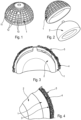
- the implant cup of the Figures 1 and 2 comprises a body 1 which is made of titanium or a very dense titanium alloy: it is not porous.
- This body 1 has a hemispherical shell shape: its thickness can be of the order of 4 to 5 mm.
- the body is hollow and contains a friction component 2 which can be made of Al 2 O 3 or PE.
- This friction component 2 therefore forms an internal cavity, which is intended to receive the femoral head mounted on a femoral stem.
- the body 1 defines a hemispherical external surface 11 which can be structured, for example with a grid network of grooves 12, thus delimiting small projecting blocks 13.
- This macrostructure increases the specific contact surface, which reinforces the stability of the acetabulum in the bone cavity of the iliac bone. This is a completely classic design for an acetabulum.
- the external surface 11 of the dense body 1 preferably has a roughness Ra of 4 ⁇ m to 8 ⁇ m.
- the external surface 11 of the acetabulum is covered by a porous layer of titanium or titanium alloy, which may have a thickness of the order of 200 ⁇ m to 400 ⁇ m, advantageously of the order of 300 ⁇ m to 350 ⁇ m.
- the roughness of the dense body 1 allows better adhesion of the porous layer.
- the porous layer may comprise a porous internal layer 3 in contact with the external surface 11 and a porous external layer 4 in contact with the porous internal layer 3.
- the two internal 3 and external 4 porous layers preferably have different porosities: the porous external layer 4 advantageously having a porosity greater than that of the porous internal layer 3.
- the porous external layer 4 may have a porosity of the order of 10% to 25%, advantageously of the order of 20%.
- the porous external layer 4 may have a thickness of the order of 150 ⁇ m to 300 ⁇ m.
- the porous external layer 4 may be made of titanium or titanium alloy powder having a particle size of the order of 90 to 250 ⁇ m.
- the porous external layer 4 preferably has an average roughness Ra of the order of 30 to 70 ⁇ m and a maximum roughness Rz of the order of 150 to 300 ⁇ m.
- the porous layer (internal and external together) may have an adhesion greater than or equal to 22 MPa.
- the porous internal layer 3 may have a thickness of the order of 50 ⁇ m to 100 ⁇ m. It may be made of titanium powder or titanium alloy having an average particle size of the order of 40 to 100 ⁇ m.
- the deposition of the outer layer 4 directly onto the outer surface 11 of the acetabulum is not possible, or at least not effective, because the adhesion of the large powder grains is difficult to achieve. Hence the implementation of the inner layer with smaller powder grains.
- PolyNaSS 5 is deposited by grafting, on this porous layer 4, given that it is made of titanium or titanium alloy.
- the plasma torch made it possible to obtain good adhesion of powder grains to each other, while maintaining optimal porosity.
- the PolyNaSS 5 chains can thus attach to the porous layer, which is also particularly rough and porous.
- Grafting PolyNaSS onto a porous titanium surface provides a dual benefit.
- Second, this disrupted relief allows for more PolyNaSS to be anchored, which promotes bone regrowth and bacterial anti-adhesion.
Landscapes
- Health & Medical Sciences (AREA)
- Chemical & Material Sciences (AREA)
- Medicinal Chemistry (AREA)
- Life Sciences & Earth Sciences (AREA)
- General Health & Medical Sciences (AREA)
- Animal Behavior & Ethology (AREA)
- Veterinary Medicine (AREA)
- Dermatology (AREA)
- Oral & Maxillofacial Surgery (AREA)
- Transplantation (AREA)
- Epidemiology (AREA)
- Public Health (AREA)
- Inorganic Chemistry (AREA)
- Engineering & Computer Science (AREA)
- Biomedical Technology (AREA)
- Molecular Biology (AREA)
- Prostheses (AREA)
- Materials For Medical Uses (AREA)
Claims (13)
- Implantat mit einem dichten Körper (1) aus Titan oder Titanlegierung, der mit einer porösen Schicht (3, 4) aus Titan oder Titanlegierung beschichtet ist, dadurch gekennzeichnet, dass die poröse Schicht (3, 4) eine PolyNaSS-Ablagerung (5) enthält, die durch Aufpfropfen aufgebracht ist.
- Implantat nach Anspruch 1,
wobei der dichte Körper (1) eine Rauigkeit Ra von 4 µm bis 8 µm aufweist. - Implantat nach einem der vorhergehenden Ansprüche,
wobei die poröse Schicht (3, 4) eine Dicke im Bereich von 200 µm bis 400 µm, vorteilhafterweise im Bereich von 300 µm bis 400 µm, aufweist. - Implantat nach einem der vorhergehenden Ansprüche,
wobei die poröse Schicht eine poröse Innenschicht (3) in Kontakt mit dem dichten Körper (1) und eine poröse Außenschicht (4) in Kontakt mit der porösen Innenschicht (3) enthält, wobei die beiden porösen Schichten, nämlich die Innenschicht (3) und die Außenschicht (4), unterschiedliche Porositäten aufweisen, wobei die poröse Außenschicht (4) vorteilhafterweise eine höhere Porosität als die poröse Innenschicht (3) aufweist. - Implantat nach einem der vorhergehenden Ansprüche,
wobei die poröse Außenschicht (4) eine Porosität im Bereich von 10 % bis 25 %, vorteilhafterweise im Bereich von 20 %, aufweist. - Implantat nach einem der vorhergehenden Ansprüche,
wobei die poröse Außenschicht (4) eine Dicke im Bereich von 150 µm bis 300 µm aufweist. - Implantat nach einem der vorhergehenden Ansprüche,
wobei die poröse Außenschicht (4) aus Titan- oder Titanlegierungspulver mit einer mittleren Korngröße im Bereich von 90 bis 250 µm besteht. - Implantat nach einem der vorhergehenden Ansprüche,
wobei die poröse Außenschicht (4) eine mittlere Rauigkeit Ra im Bereich von 30 bis 70 µm und eine maximale Rauigkeit Rz im Bereich von 150 bis 300 µm aufweist. - Implantat nach einem der vorhergehenden Ansprüche,
wobei die poröse Innenschicht (4) eine Haftfestigkeit von 22 MPa oder mehr aufweist. - Implantat nach einem der vorhergehenden Ansprüche,
wobei die poröse Innenschicht (3) eine Dicke im Bereich von 50 µm bis 100 µm aufweist. - Implantat nach einem der vorhergehenden Ansprüche,
wobei die poröse Innenschicht (3) aus Titan- oder Titanlegierungspulver mit einer mittleren Korngröße im Bereich von 40 bis 100 µm besteht. - Verfahren zur Herstellung eines Implantats mit einem dichten Körper (1) aus Titan oder Titanlegierung, wobei eine poröse Schicht (3, 4) aus Titan oder Titanlegierung mit einem Plasmabrenner auf den dichten Körper (1) aufgebracht wird und anschließend PolyNaSS (5) durch Aufpfropfen auf die poröse Schicht (3, 4) aufgebracht wird.
- Herstellungsverfahren nach Anspruch 12, umfassend die folgenden Schritte:a- Plasmabrennen von Titanpulver mit einer mittleren Korngröße im Bereich von 40 bis 100 µm, um auf dem dichten Körper (1) eine poröse Innenschicht (3) mit einer Dicke im Bereich von 50 µm bis 100 µm zu bilden,b- Plasmabrennen von Titanpulver mit einer mittleren Korngröße im Bereich von 90 bis 250 µm, um auf der porösen Innenschicht (3) eine poröse Außenschicht (4) mit einer Dicke im Bereich von 150 µm bis 300 µm zu bilden, undc- Aufpfropfen von PolyNaSS (5) auf die poröse Außenschicht (4).
Applications Claiming Priority (2)
| Application Number | Priority Date | Filing Date | Title |
|---|---|---|---|
| FR2100312A FR3118699A1 (fr) | 2021-01-13 | 2021-01-13 | Implant et son procédé de fabrication |
| PCT/FR2022/050071 WO2022153012A1 (fr) | 2021-01-13 | 2022-01-13 | Implant et son procede de fabrication |
Publications (2)
| Publication Number | Publication Date |
|---|---|
| EP4277672A1 EP4277672A1 (de) | 2023-11-22 |
| EP4277672B1 true EP4277672B1 (de) | 2025-06-18 |
Family
ID=75438972
Family Applications (1)
| Application Number | Title | Priority Date | Filing Date |
|---|---|---|---|
| EP22703022.8A Active EP4277672B1 (de) | 2021-01-13 | 2022-01-13 | Implantat und verfahren zu dessen herstellung |
Country Status (4)
| Country | Link |
|---|---|
| EP (1) | EP4277672B1 (de) |
| ES (1) | ES3041061T3 (de) |
| FR (1) | FR3118699A1 (de) |
| WO (1) | WO2022153012A1 (de) |
Family Cites Families (5)
| Publication number | Priority date | Publication date | Assignee | Title |
|---|---|---|---|---|
| EP0893164A2 (de) | 1997-06-28 | 1999-01-27 | Hüls Aktiengesellschaft | Bioaktive Beschichtung von Oberflächen unter Mitverwendung von Vernetzern |
| FR2789315B1 (fr) * | 1999-02-08 | 2001-10-05 | Jean Louis Dore | Implant femoral de prothese de hanche et procede pour la fabrication de cet implant |
| WO2002066693A1 (en) * | 2001-02-19 | 2002-08-29 | Isotis N.V. | Porous metals and metal coatings for implants |
| FR2902102B1 (fr) | 2006-06-07 | 2011-11-18 | Univ Paris 13 | Procede de greffage de polymeres bioactifs sur des materiaux prothetiques |
| FR3042715B1 (fr) * | 2015-10-22 | 2017-12-08 | Les Laboratoires Osteal Medical | Procede pour greffer un polymere bioactif sur des implants |
-
2021
- 2021-01-13 FR FR2100312A patent/FR3118699A1/fr active Pending
-
2022
- 2022-01-13 WO PCT/FR2022/050071 patent/WO2022153012A1/fr not_active Ceased
- 2022-01-13 ES ES22703022T patent/ES3041061T3/es active Active
- 2022-01-13 EP EP22703022.8A patent/EP4277672B1/de active Active
Also Published As
| Publication number | Publication date |
|---|---|
| ES3041061T3 (en) | 2025-11-06 |
| WO2022153012A1 (fr) | 2022-07-21 |
| FR3118699A1 (fr) | 2022-07-15 |
| EP4277672A1 (de) | 2023-11-22 |
Similar Documents
| Publication | Publication Date | Title |
|---|---|---|
| US8268383B2 (en) | Medical implant and production thereof | |
| CA2523167A1 (en) | Prosthetic acetabular cups | |
| US20040153154A1 (en) | Bone implant and method for manufacturing same | |
| BE1025061B1 (fr) | Implant nasal | |
| EP3547953B1 (de) | Zahnimplantat und selbstsperrendes befestigungselement mit heterogenen porösen strukturen und verfahren zu dessen herstellung | |
| WO2013134550A1 (en) | Ceramic oral implants and related apparatus, systems, and methods | |
| FR2466241A1 (fr) | Matiere composite pour protheses | |
| JP2007513736A (ja) | 骨インプラントに用いるための多孔構造上の酸化ジルコニウム | |
| WO2011130169A1 (en) | Methods for making textured ceramic implants | |
| CH672060A5 (de) | ||
| EP4277672B1 (de) | Implantat und verfahren zu dessen herstellung | |
| EP2872072B1 (de) | Gelenkpfanne für eine hüftprothese | |
| EP2816974B1 (de) | Orthopädisches implantat und verfahren zur herstellung eines solchen orthopädischen implantats | |
| CA2841336A1 (fr) | Piece composite pour implantation endo-osseuse et procede de fabrication d'une telle piece | |
| FR3036945A1 (fr) | Ensemble constitue d'un implant dentaire et d'un element de fixation autobloquant a structures poreuses heterogenes et son procede de fabrication | |
| JP4505578B2 (ja) | インプラント材料およびその製造方法 | |
| EP3122497B1 (de) | Verfahren zur herstellung von porösem metallmaterial für biomedizinische anwendungen | |
| FR2981277A1 (fr) | Materiau composite pour prothese. | |
| EP2740444B1 (de) | Hüftgelenkimplantat mit ternärer Struktur | |
| EP2635315B1 (de) | Verfahren zur herstellung eines knochenfüllermaterials und nach diesem verfahren hergestelltes material | |
| FR2928827A1 (fr) | Implant articulaire absorbeur de chocs comportant une surface de contact en carbone pyrolytique | |
| FR2789315A1 (fr) | Implant femoral de prothese de hanche et procede pour la fabrication de cet implant | |
| EP3927389B1 (de) | Membran | |
| EP2371399B1 (de) | Verbundstoffteil zur Implantation in Knochen und Herstellungsverfahren eines solchen Teils | |
| FR2975001A1 (fr) | Implant cotyloidien |
Legal Events
| Date | Code | Title | Description |
|---|---|---|---|
| STAA | Information on the status of an ep patent application or granted ep patent |
Free format text: STATUS: UNKNOWN |
|
| STAA | Information on the status of an ep patent application or granted ep patent |
Free format text: STATUS: THE INTERNATIONAL PUBLICATION HAS BEEN MADE |
|
| PUAI | Public reference made under article 153(3) epc to a published international application that has entered the european phase |
Free format text: ORIGINAL CODE: 0009012 |
|
| STAA | Information on the status of an ep patent application or granted ep patent |
Free format text: STATUS: REQUEST FOR EXAMINATION WAS MADE |
|
| 17P | Request for examination filed |
Effective date: 20230810 |
|
| AK | Designated contracting states |
Kind code of ref document: A1 Designated state(s): AL AT BE BG CH CY CZ DE DK EE ES FI FR GB GR HR HU IE IS IT LI LT LU LV MC MK MT NL NO PL PT RO RS SE SI SK SM TR |
|
| DAV | Request for validation of the european patent (deleted) | ||
| DAX | Request for extension of the european patent (deleted) | ||
| GRAP | Despatch of communication of intention to grant a patent |
Free format text: ORIGINAL CODE: EPIDOSNIGR1 |
|
| STAA | Information on the status of an ep patent application or granted ep patent |
Free format text: STATUS: GRANT OF PATENT IS INTENDED |
|
| INTG | Intention to grant announced |
Effective date: 20250117 |
|
| GRAS | Grant fee paid |
Free format text: ORIGINAL CODE: EPIDOSNIGR3 |
|
| GRAA | (expected) grant |
Free format text: ORIGINAL CODE: 0009210 |
|
| STAA | Information on the status of an ep patent application or granted ep patent |
Free format text: STATUS: THE PATENT HAS BEEN GRANTED |
|
| AK | Designated contracting states |
Kind code of ref document: B1 Designated state(s): AL AT BE BG CH CY CZ DE DK EE ES FI FR GB GR HR HU IE IS IT LI LT LU LV MC MK MT NL NO PL PT RO RS SE SI SK SM TR |
|
| REG | Reference to a national code |
Ref country code: GB Ref legal event code: FG4D Free format text: NOT ENGLISH |
|
| REG | Reference to a national code |
Ref country code: CH Ref legal event code: EP |
|
| REG | Reference to a national code |
Ref country code: DE Ref legal event code: R096 Ref document number: 602022016079 Country of ref document: DE |
|
| REG | Reference to a national code |
Ref country code: CH Ref legal event code: EP |
|
| REG | Reference to a national code |
Ref country code: IE Ref legal event code: FG4D Free format text: LANGUAGE OF EP DOCUMENT: FRENCH |
|
| PG25 | Lapsed in a contracting state [announced via postgrant information from national office to epo] |
Ref country code: FI Free format text: LAPSE BECAUSE OF FAILURE TO SUBMIT A TRANSLATION OF THE DESCRIPTION OR TO PAY THE FEE WITHIN THE PRESCRIBED TIME-LIMIT Effective date: 20250618 |
|
| REG | Reference to a national code |
Ref country code: LT Ref legal event code: MG9D |
|
| PG25 | Lapsed in a contracting state [announced via postgrant information from national office to epo] |
Ref country code: GR Free format text: LAPSE BECAUSE OF FAILURE TO SUBMIT A TRANSLATION OF THE DESCRIPTION OR TO PAY THE FEE WITHIN THE PRESCRIBED TIME-LIMIT Effective date: 20250919 Ref country code: NO Free format text: LAPSE BECAUSE OF FAILURE TO SUBMIT A TRANSLATION OF THE DESCRIPTION OR TO PAY THE FEE WITHIN THE PRESCRIBED TIME-LIMIT Effective date: 20250918 |
|
| PG25 | Lapsed in a contracting state [announced via postgrant information from national office to epo] |
Ref country code: BG Free format text: LAPSE BECAUSE OF FAILURE TO SUBMIT A TRANSLATION OF THE DESCRIPTION OR TO PAY THE FEE WITHIN THE PRESCRIBED TIME-LIMIT Effective date: 20250618 |
|
| PG25 | Lapsed in a contracting state [announced via postgrant information from national office to epo] |
Ref country code: HR Free format text: LAPSE BECAUSE OF FAILURE TO SUBMIT A TRANSLATION OF THE DESCRIPTION OR TO PAY THE FEE WITHIN THE PRESCRIBED TIME-LIMIT Effective date: 20250618 |
|
| PG25 | Lapsed in a contracting state [announced via postgrant information from national office to epo] |
Ref country code: RS Free format text: LAPSE BECAUSE OF FAILURE TO SUBMIT A TRANSLATION OF THE DESCRIPTION OR TO PAY THE FEE WITHIN THE PRESCRIBED TIME-LIMIT Effective date: 20250918 |
|
| REG | Reference to a national code |
Ref country code: NL Ref legal event code: MP Effective date: 20250618 |
|
| PG25 | Lapsed in a contracting state [announced via postgrant information from national office to epo] |
Ref country code: LV Free format text: LAPSE BECAUSE OF FAILURE TO SUBMIT A TRANSLATION OF THE DESCRIPTION OR TO PAY THE FEE WITHIN THE PRESCRIBED TIME-LIMIT Effective date: 20250618 |
|
| REG | Reference to a national code |
Ref country code: ES Ref legal event code: FG2A Ref document number: 3041061 Country of ref document: ES Kind code of ref document: T3 Effective date: 20251106 |
|
| PG25 | Lapsed in a contracting state [announced via postgrant information from national office to epo] |
Ref country code: NL Free format text: LAPSE BECAUSE OF FAILURE TO SUBMIT A TRANSLATION OF THE DESCRIPTION OR TO PAY THE FEE WITHIN THE PRESCRIBED TIME-LIMIT Effective date: 20250618 |
|
| PG25 | Lapsed in a contracting state [announced via postgrant information from national office to epo] |
Ref country code: PT Free format text: LAPSE BECAUSE OF FAILURE TO SUBMIT A TRANSLATION OF THE DESCRIPTION OR TO PAY THE FEE WITHIN THE PRESCRIBED TIME-LIMIT Effective date: 20251020 |
|
| REG | Reference to a national code |
Ref country code: AT Ref legal event code: MK05 Ref document number: 1803609 Country of ref document: AT Kind code of ref document: T Effective date: 20250618 |
|
| PG25 | Lapsed in a contracting state [announced via postgrant information from national office to epo] |
Ref country code: IS Free format text: LAPSE BECAUSE OF FAILURE TO SUBMIT A TRANSLATION OF THE DESCRIPTION OR TO PAY THE FEE WITHIN THE PRESCRIBED TIME-LIMIT Effective date: 20251018 |
|
| PG25 | Lapsed in a contracting state [announced via postgrant information from national office to epo] |
Ref country code: AT Free format text: LAPSE BECAUSE OF FAILURE TO SUBMIT A TRANSLATION OF THE DESCRIPTION OR TO PAY THE FEE WITHIN THE PRESCRIBED TIME-LIMIT Effective date: 20250618 Ref country code: SM Free format text: LAPSE BECAUSE OF FAILURE TO SUBMIT A TRANSLATION OF THE DESCRIPTION OR TO PAY THE FEE WITHIN THE PRESCRIBED TIME-LIMIT Effective date: 20250618 |
|
| PG25 | Lapsed in a contracting state [announced via postgrant information from national office to epo] |
Ref country code: CZ Free format text: LAPSE BECAUSE OF FAILURE TO SUBMIT A TRANSLATION OF THE DESCRIPTION OR TO PAY THE FEE WITHIN THE PRESCRIBED TIME-LIMIT Effective date: 20250618 |
|
| PG25 | Lapsed in a contracting state [announced via postgrant information from national office to epo] |
Ref country code: PL Free format text: LAPSE BECAUSE OF FAILURE TO SUBMIT A TRANSLATION OF THE DESCRIPTION OR TO PAY THE FEE WITHIN THE PRESCRIBED TIME-LIMIT Effective date: 20250618 |
|
| PG25 | Lapsed in a contracting state [announced via postgrant information from national office to epo] |
Ref country code: EE Free format text: LAPSE BECAUSE OF FAILURE TO SUBMIT A TRANSLATION OF THE DESCRIPTION OR TO PAY THE FEE WITHIN THE PRESCRIBED TIME-LIMIT Effective date: 20250618 |
|
| PG25 | Lapsed in a contracting state [announced via postgrant information from national office to epo] |
Ref country code: SK Free format text: LAPSE BECAUSE OF FAILURE TO SUBMIT A TRANSLATION OF THE DESCRIPTION OR TO PAY THE FEE WITHIN THE PRESCRIBED TIME-LIMIT Effective date: 20250618 |
|
| REG | Reference to a national code |
Ref country code: CH Ref legal event code: U11 Free format text: ST27 STATUS EVENT CODE: U-0-0-U10-U11 (AS PROVIDED BY THE NATIONAL OFFICE) Effective date: 20260201 |
|
| PGFP | Annual fee paid to national office [announced via postgrant information from national office to epo] |
Ref country code: GB Payment date: 20260127 Year of fee payment: 5 |
|
| PGFP | Annual fee paid to national office [announced via postgrant information from national office to epo] |
Ref country code: ES Payment date: 20260209 Year of fee payment: 5 |
|
| PG25 | Lapsed in a contracting state [announced via postgrant information from national office to epo] |
Ref country code: DK Free format text: LAPSE BECAUSE OF FAILURE TO SUBMIT A TRANSLATION OF THE DESCRIPTION OR TO PAY THE FEE WITHIN THE PRESCRIBED TIME-LIMIT Effective date: 20250618 |
|
| PGFP | Annual fee paid to national office [announced via postgrant information from national office to epo] |
Ref country code: DE Payment date: 20260114 Year of fee payment: 5 |
|
| PGFP | Annual fee paid to national office [announced via postgrant information from national office to epo] |
Ref country code: IT Payment date: 20260107 Year of fee payment: 5 |
|
| PGFP | Annual fee paid to national office [announced via postgrant information from national office to epo] |
Ref country code: FR Payment date: 20260130 Year of fee payment: 5 |
|
| PGFP | Annual fee paid to national office [announced via postgrant information from national office to epo] |
Ref country code: CH Payment date: 20260201 Year of fee payment: 5 |
|
| PLBE | No opposition filed within time limit |
Free format text: ORIGINAL CODE: 0009261 |
|
| STAA | Information on the status of an ep patent application or granted ep patent |
Free format text: STATUS: NO OPPOSITION FILED WITHIN TIME LIMIT |
|
| REG | Reference to a national code |
Ref country code: CH Ref legal event code: L10 Free format text: ST27 STATUS EVENT CODE: U-0-0-L10-L00 (AS PROVIDED BY THE NATIONAL OFFICE) Effective date: 20260430 |