EP4277888B1 - Verfahren zur zersetzung von distickstoffoxid aus einem gasstrom - Google Patents
Verfahren zur zersetzung von distickstoffoxid aus einem gasstrom Download PDFInfo
- Publication number
- EP4277888B1 EP4277888B1 EP22700018.9A EP22700018A EP4277888B1 EP 4277888 B1 EP4277888 B1 EP 4277888B1 EP 22700018 A EP22700018 A EP 22700018A EP 4277888 B1 EP4277888 B1 EP 4277888B1
- Authority
- EP
- European Patent Office
- Prior art keywords
- decomposition
- stream
- partial
- gas stream
- catalyst
- Prior art date
- Legal status (The legal status is an assumption and is not a legal conclusion. Google has not performed a legal analysis and makes no representation as to the accuracy of the status listed.)
- Active
Links
Images
Classifications
-
- B—PERFORMING OPERATIONS; TRANSPORTING
- B01—PHYSICAL OR CHEMICAL PROCESSES OR APPARATUS IN GENERAL
- B01D—SEPARATION
- B01D53/00—Separation of gases or vapours; Recovering vapours of volatile solvents from gases; Chemical or biological purification of waste gases, e.g. engine exhaust gases, smoke, fumes, flue gases, aerosols
- B01D53/34—Chemical or biological purification of waste gases
- B01D53/74—General processes for purification of waste gases; Apparatus or devices specially adapted therefor
- B01D53/86—Catalytic processes
- B01D53/8621—Removing nitrogen compounds
- B01D53/8625—Nitrogen oxides
-
- B—PERFORMING OPERATIONS; TRANSPORTING
- B01—PHYSICAL OR CHEMICAL PROCESSES OR APPARATUS IN GENERAL
- B01D—SEPARATION
- B01D53/00—Separation of gases or vapours; Recovering vapours of volatile solvents from gases; Chemical or biological purification of waste gases, e.g. engine exhaust gases, smoke, fumes, flue gases, aerosols
- B01D53/34—Chemical or biological purification of waste gases
- B01D53/343—Heat recovery
-
- B—PERFORMING OPERATIONS; TRANSPORTING
- B01—PHYSICAL OR CHEMICAL PROCESSES OR APPARATUS IN GENERAL
- B01D—SEPARATION
- B01D53/00—Separation of gases or vapours; Recovering vapours of volatile solvents from gases; Chemical or biological purification of waste gases, e.g. engine exhaust gases, smoke, fumes, flue gases, aerosols
- B01D53/34—Chemical or biological purification of waste gases
- B01D53/74—General processes for purification of waste gases; Apparatus or devices specially adapted therefor
- B01D53/86—Catalytic processes
- B01D53/8696—Controlling the catalytic process
-
- C—CHEMISTRY; METALLURGY
- C07—ORGANIC CHEMISTRY
- C07C—ACYCLIC OR CARBOCYCLIC COMPOUNDS
- C07C51/00—Preparation of carboxylic acids or their salts, halides or anhydrides
- C07C51/16—Preparation of carboxylic acids or their salts, halides or anhydrides by oxidation
- C07C51/31—Preparation of carboxylic acids or their salts, halides or anhydrides by oxidation of cyclic compounds with ring-splitting
- C07C51/316—Preparation of carboxylic acids or their salts, halides or anhydrides by oxidation of cyclic compounds with ring-splitting with oxides of nitrogen or nitrogen-containing mineral acids
-
- B—PERFORMING OPERATIONS; TRANSPORTING
- B01—PHYSICAL OR CHEMICAL PROCESSES OR APPARATUS IN GENERAL
- B01D—SEPARATION
- B01D2255/00—Catalysts
- B01D2255/20—Metals or compounds thereof
- B01D2255/207—Transition metals
- B01D2255/20761—Copper
-
- B—PERFORMING OPERATIONS; TRANSPORTING
- B01—PHYSICAL OR CHEMICAL PROCESSES OR APPARATUS IN GENERAL
- B01D—SEPARATION
- B01D2255/00—Catalysts
- B01D2255/20—Metals or compounds thereof
- B01D2255/207—Transition metals
- B01D2255/20792—Zinc
-
- B—PERFORMING OPERATIONS; TRANSPORTING
- B01—PHYSICAL OR CHEMICAL PROCESSES OR APPARATUS IN GENERAL
- B01D—SEPARATION
- B01D2257/00—Components to be removed
- B01D2257/40—Nitrogen compounds
- B01D2257/402—Dinitrogen oxide
-
- Y—GENERAL TAGGING OF NEW TECHNOLOGICAL DEVELOPMENTS; GENERAL TAGGING OF CROSS-SECTIONAL TECHNOLOGIES SPANNING OVER SEVERAL SECTIONS OF THE IPC; TECHNICAL SUBJECTS COVERED BY FORMER USPC CROSS-REFERENCE ART COLLECTIONS [XRACs] AND DIGESTS
- Y02—TECHNOLOGIES OR APPLICATIONS FOR MITIGATION OR ADAPTATION AGAINST CLIMATE CHANGE
- Y02C—CAPTURE, STORAGE, SEQUESTRATION OR DISPOSAL OF GREENHOUSE GASES [GHG]
- Y02C20/00—Capture or disposal of greenhouse gases
- Y02C20/10—Capture or disposal of greenhouse gases of nitrous oxide (N2O)
Definitions
- the invention proceeds from a process for decomposing nitrous oxide from a gas stream in which a gas stream is preheated and fed into a decomposition reactor in which the nitrous oxide is decomposed into nitrogen and oxygen.
- nitrous oxide into nitrogen and oxygen is carried out in the presence of a catalyst, particularly a fixed bed catalyst.
- adipic acid usually nitric acid is added to a mixture of cyclohexanone and cyclohexanol.
- a reaction mixture containing adipic acid nitrous oxide, nitrogen monoxide and nitrogen dioxide is formed.
- the adipic acid is removed from the reaction mixture by crystallization.
- Nitrous oxide, nitrogen monoxide and nitrogen dioxide are removed as off-gas by stripping the reaction mixture with air. Thereby, at least a part of the nitrogen monoxide reacts with oxygen forming nitrogen dioxide.
- the off-gas containing air which is enriched in nitrous oxide and nitrogen dioxide is fed to a washing unit in which nitrogen dioxide is removed from the off-gas by absorption with water.
- the nitrogen dioxide is used for producing nitric acid which then can be used in the production of the adipic acid.
- the off gas is optionally mixed with combustion gas from ammonia combustion with air, is compressed, passes a residence time reactor, is cooled in at least one heat exchanger and is absorbed in an absorber, preferably in an absorption column.
- nitrous oxide is a greenhouse gas
- processes were installed in which the nitrous oxide is decomposed into oxygen and nitrogen.
- Equipment for decomposing the nitrous oxide usually comprises a reactor, a regenerative heater and an additional heater which is used for controlling the inlet temperature of the off-gas into the reactor.
- a recycle line with a compressor is provided through which a part of the gas withdrawn from the reactor can be recycled into the off-gas which is fed into the reactor.
- the catalytic decomposition of the nitrous oxide usually is operated at a temperature in the range from 430°C to 800°C.
- concentration of nitrous oxide of the inlet stream into the decomposition unit which may be in the range from 6 to 20 vol-% may be reduced to a concentration in the outlet stream withdrawn from the decomposition unit in a range from 50 to 3000 vol-ppm.
- the temperature of the inlet stream for achieving the required decomposition rate depends inter alia on the inlet concentration and the catalyst age.
- the inlet temperature thereby usually is in the range from 430°C to 650°C with increasing inlet temperature on increasing catalyst age. If the desired concentration in the outlet stream cannot be achieved at a temperature of the inlet stream of 650°C, the catalyst must be changed.
- the challenge for decomposition of nitrous oxide from the off-gas from the production of adipic acid is the highly exothermic behavior of this reaction.
- Each percent of nitrous oxide in the off-gas stream creates an adiabatic temperature increase of 25°C.
- the temperature in the decomposition unit should remain below 800°C.
- the temperature should be as high as possible.
- a common limit is the design temperature of the inlet section in case of using standard chromium-nickel based steals, which usually is in a range from 550°C to 650°C.
- the optimum inlet temperature can be achieved by an optimum degree of heat recovery from the purified gas and/or additional preheating.
- EP-B 2 387 451 Processes and apparatus for removing nitrous oxide from a gas stream by catalytic decomposition are described for example in EP-B 2 387 451 , EP-B 1 413 349 , EP-B 2 387 450 , EP-B 2 165 756 , EP-B 2 548 629 , CN 206 064 160 U and WO 2011/146469 A2 .
- the equipment may comprise two reactors to continue the process when maintenance work is carried out, for example changing the used catalyst.
- This object is achieved by a process for decomposing nitrous oxide from a gas stream, comprising:
- the decomposition reaction of nitrous oxide into oxygen and nitrogen is carried out at elevated temperature and usually in the presence of a catalyst.
- a catalyst for carrying out the decomposition reaction at elevated temperatures, it is necessary to heat the gas stream or, if the gas stream first is split into partial streams, the partial streams.
- the gas stream is split firstly into the partial streams and then each partial stream is heated separately. This allows a higher flexibility of the process and particularly to feed the partial streams into the respective decomposition reactors with a temperature at which the decomposition reaction is optimized.
- Heating of the gas streams can be carried out by any heating process known to a skilled person.
- the purified partial stream withdrawn from the respective decomposition reactor for preheating the respective partial stream.
- the whole gas stream is preheated before splitting the gas stream into partial streams and heating the partial streams.
- the whole gas stream is preheated before splitting the gas stream into partial streams and heating the partial streams.
- the temperature of each partial stream fed into the decomposition reactors can be set individually. This allows for feeding the partial stream into a decomposition reactor containing an older catalyst at a higher temperature and into a decomposition reactor containing a fresher catalyst at a lower temperature so that the decomposition of nitrous oxide in each decomposition reactor is optimized.
- the temperature individually it is either possible to preheat the whole gas stream before splitting into the partial streams and then heat the partial streams or to firstly split the gas stream into the partial streams and then heat the partial streams separately. Particularly preferably, firstly the gas stream is split into the partial streams and then the partial streams are heated separately.
- the heat exchanger used for heating the gas stream or the partial streams by heat transfer from the combined purified streams withdrawn from the decomposition reactors or from the respective purified stream withdrawn from the respective decomposition reactor can be any heat exchanger known to a skilled person. Suitable heat exchangers for example are shell and tube heat exchangers, tube bundle heat exchangers with u-tubes, spiral tube heat exchangers or coils. If a shell and tube heat exchanger or a spiral tube heat exchanger is used, the gas stream to be heated and the gas stream withdrawn from the decomposition reactor can flow in counter-current or in co-current, wherein counter-current is preferred. If a tube bundle heat exchanger with u-tubes is used, the gas stream to be heated and the gas stream withdrawn from the decomposition reactor flows in cross-flow. The usage of a shell and tube heat exchanger is preferred.
- the heat transfer in the regenerative heat exchanger is not sufficient to heat the off-gas stream to a predefined temperature with which the off-gas stream is fed into the fixed bed reactor, it is preferred to provide an additional heater.
- the additional heater if a regenerative heat exchanger is comprised, or the heater, if no regenerative heat exchanger is used, preferably is an electrical heater.
- Direct gas fired heater means that the off gas of the gas fired heater is added to the nitrous oxide comprising off-gas stream.
- Indirect gas fired heater means that the heating the off-gas of the gas fired heater is transferred to the nitrous oxide comprising off-gas stream by an additional heat exchanger.
- a direct gas fired heater is preferred.
- the temperature to which the gas stream is heated or the partial streams are heated particularly depends on the concentration of nitrous oxide in the gas stream and the catalyst age.
- the gas stream is or the partial streams are heated to a temperature in the range from 430 to 650°C, more preferred to a temperature in the range from 450 to 550 °C and particularly to a temperature in the range from 480 to 520°C.
- the concentration of nitrous oxide in the purified stream withdrawn from the decomposition reactor is determined. If the concentration exceeds a given target, the temperature is increased until either the targeted concentration is reached or an upper limit for the temperature is reached.
- the upper limit for the temperature is a temperature with a given offset below the temperatures defined by safety interlocks of the decomposition reactor If the concentration of nitrous oxide in the purified stream withdrawn from the decomposition reactor exceeds the targeted concentration and the maximum temperature for feeding the gas stream into the decomposition reactor is reached, the catalyst must be changed.
- the thus heated off-gas stream is then fed into the fixed bed reactor for decomposing the nitrous oxide into nitrogen and oxygen.
- the fixed bed contains a suitable catalyst for the decomposition of the nitrous oxide.
- any catalyst suitable for the decomposition reaction can be used.
- Suitable catalysts particularly are catalysts based on copper oxide and zinc oxide as catalytic material.
- the catalyst comprises a mixture of 14 to 18 wt-% copper oxide and less than 20 wt% zinc oxide as catalytic active material on aluminum oxide and/or magnesium oxide as support material.
- the catalyst is provided as extrudates with a length of 2 mm to 2 cm, preferably of 4 mm to 1 cm and with a diameter of 2 mm to 10 mm, preferably of 4 to 8 mm.
- the cross sectional shape of the catalyst is a circular disc or star, preferably a star.
- the reaction in the fixed bed reactor is carried out at a temperature in a range from 430 to 800°C, more preferred in a range from 450 to 750°C and particularly in a range from 520 to 700°C.
- the temperature in the fixed bed reactor should not exceed 800°C.
- the catalyst can be contained in each decomposition reactor in any suitable form, for example as a fluidized bed or a fixed bed.
- the catalyst is a fixed bed catalyst.
- the catalyst can be a structured packing, monolith or an unstructured packing of catalyst particles.
- the fixed bed is an unstructured packing of catalyst particles.
- Changing of the catalysts preferably is carried out at regular intervals, wherein one of the catalysts is changed when the arithmetic mean of the lifetime of the catalysts in the other reactors has reached 25 to 75 %, preferably one third to two thirds of the lifetime of one catalyst.
- the intervals preferably are set such that the runtime of all reactors until one of the reactors is shut down for changing the catalyst always is substantially the same. This means, for example, if two decomposition reactors are used, that the catalyst of one decomposition reactor is changed when the catalyst of the other decomposition reactor has reached 25 to 75 %, preferably one third to two thirds, of its lifetime and particularly the half of its lifetime.
- the catalyst of one decomposition reactor is changed when the catalysts of the other reactors have reached 25 to 75 % of their lifetime and particularly when the catalysts of the other reactors have reached one third to two thirds of their lifetime.
- the catalyst of one decomposition reactor is changed when the catalyst of the second decomposition reactor has reached about one third of its lifetime and the catalyst of the third decomposition reactor has reached about two thirds of its lifetime.
- the efficiency of the catalyst reduces with continuing lifetime of the catalyst. This results in a reduced decomposition of nitrous oxide.
- Increasing the temperature of the partial stream which is fed into a decomposition reactor containing an older catalyst for optimizing the efficiency of the catalyst as described above can be carried out alternatively or additionally to reducing the amount of the gas stream fed into the decomposition reactor which contains the older catalyst.
- the temperature of the partial stream which is fed into a decomposition reactor containing an older catalyst is increased while at the same time the partial stream is reduced.
- the gas stream may originate from any process where nitrous oxide is formed or used.
- a process for example is the production of adipic acid.
- nitric acid is added to a mixture of cyclohexanone and cyclohexanol.
- a reaction mixture containing adipic acid nitrous oxide, nitrogen monoxide and nitrogen dioxide is formed.
- the nitrous oxide, nitrogen monoxide and nitrogen dioxide for example are removed from the reaction product by stripping with air.
- a crude product comprising the adipic acid is obtained and an off-gas containing the air enriched in nitrous oxide, nitrogen monoxide and nitrogen dioxide.
- nitrogen monoxide reacts with oxygen and forms nitrogen dioxide.
- the nitrogen dioxide preferably is removed by washing and reused for producing nitric acid.
- the gas stream is off-gas which originates from a process for producing adipic acid, it is particularly preferred to work up the off-gas stream for removing nitrogen oxides before feeding the gas into the process for decomposing nitrous oxide.
- the nitrogen oxides are absorbed from the off-gas stream in water by pressure absorption.
- an absorption column is used for absorbing the nitrogen oxides in water.
- the absorption column may be operated in counter current or co-current, preferably in counter current.
- the off-gas stream is fed into the absorption column at one end, preferably at the bottom and the water is fed at the other end, preferably the top of the absorption column.
- nitrogen dioxide is absorbed in water by formation of nitric acid and nitrogen monoxide.
- the nitrogen monoxide reacts with the oxygen in the off-gas stream by formation of nitrogen dioxide, which again is absorbed in water by the formation of nitric acid and nitrogen monoxide.
- the absorption column preferably comprises 10 to 80 stages, more preferred 20 to 70 stages and particularly 40 to 60 stages.
- the temperature at which the absorption is carried out preferably is in a range from 5 to70 °C, more preferred in a range from 10 to 60 °C and particularly in a range from 20 to 50°C.
- the absorption column preferably comprises internals. Suitable internals for example are packings like a packed bed or a structured packing. Further, the absorption column may comprise trays as internals. Particularly preferably, the internals in the absorption column are watercooled trays.
- the off gas stream preferably is fed to the absorption column together with an additional gas mixture from ammonia combustion, comprising mainly nitrogen monoxide and nitrogen dioxide, water, oxygen, nitrogen, argon and carbon dioxide.
- an additional gas mixture from ammonia combustion comprising mainly nitrogen monoxide and nitrogen dioxide, water, oxygen, nitrogen, argon and carbon dioxide.
- nitrogen monoxide contained in the off-gas stream is oxidized to nitrogen dioxide before feeding the off-gas stream into the absorption column.
- nitrogen monoxide it is preferred to compress the off-gas stream to a pressure in a range from 1.2 to 3 bar(abs), more preferred in a range from 1.3 to 2.7 bar(abs) and particularly in a range from 1.5 to 2.5 bar(abs).
- the off-gas stream is cooled to a temperature in a range from 20 to 50°C, more preferred in a range from 25 to 45°C and particularly in a range from 30 to 40°C.
- the off-gas stream is compressed in a second step to a pressure in a range from 3 to 12 bar(abs), more preferred in a range from 4 to 11 bar(abs) and particularly in a range from 5 to 10 bar(abs).
- the thus compressed off-gas stream and additional air are passed through a residence-time reactor, wherein the ratio of the normalized volume flows of the compressed off-gas stream and additional air preferably is in a range from 1.5 to 3.5, more preferred in a range from 1.6 to 2.9 and particularly in a range from 1.8 to 2.5.
- the inlet temperature of the off-gas stream into the residence-time reactor preferably is in a range from 120 to 300°C, more preferred in a range from 150 to 275°C and particularly in a range from 220 to 250°C
- the outlet temperature of the off-gas stream leaving the residence-time reactor preferably is in a range from 250 to 360°C, more preferred in a range from 270 to 350°C and particularly in a range from 280 to 340°C.
- the residence time of the off-gas stream in the residence-time reactor preferably is in a range from 10 to 60 sec, more preferred in a range from 15 to 50 sec and particularly in a range from 20 to 30 sec.
- the off-gas stream After passing the residence-time reactor, the off-gas stream is cooled to a temperature in the range from 10 to 50°C, more preferred in a range from 20 to 40°C and particularly in a range from 30 to 35°C.
- the off-gas stream is fed partially or completely into an N 2 O isolation in which nitrous oxide from at least a part of the off-gas stream is concentrated by a two-stage absorption/desorption process with water.
- N 2 O is absorbed in water in a first absorption column.
- the first absorption column is operated at a pressure in a range from 15 to 30 bar(abs), more preferred in a range from 17 to 28 bar(abs) and particularly in a range from 19 to 26 bar(abs) and a temperature in a range from 10 to 45°C, more preferred in a range from 20 to 42°C and particularly in a range from 30 to 35°C.
- the nitrous oxide is desorbed from the water in a first desorber which runs at a pressure in a range from 1 to 1.5 bar(abs), more preferred in a range from 1.05 to 1.3 bar(abs) and particularly in a range from 1.1 to 1.2 bar(abs) and a temperature in a range from 10 to 45°C, more preferred in a range from 20 to 42°C and particularly from 30 to 35°C.
- the resulting gas stream is fed into a second absorption column which runs at a pressure in a range from 15 to 30 bar(abs), more preferred in a range from 17 to 25 bar(abs) and particularly in a range from 19 to 23 bar(abs) and a temperature in a range from 10 to 45°C, more preferred in a range from 15 to 30°C and particularly in a range from 20 to 35°C.
- nitrous oxide is obtained which preferably is fed into a process for producing cyclododecanone and cyclopentanone.
- nitrous oxide in the off-gas stream from the pressure absorption and/or oxidation of nitrogen monoxide is absorbed in the two-stage absorption/desorption process.
- the remaining part preferably is split for being recycled into the off-gas stream comprising the mixture of the off-gas from adipic acid production and optionally off-gas from ammonia combustion, before carrying out the oxidation reaction of nitrogen monoxide and for being fed to the decomposition process of nitrous oxide.
- the off-gas stream withdrawn from the two stage absorption/desorption process still contains 5 to 18 vol% nitrous oxide.
- nitrous oxide has greenhouse-gas factor of about 300, it is necessary to remove the nitrous oxide from the off-gas stream.
- the off-gas stream is heated to a temperature in a range from 100 to 300°C, more preferred in a range from 170 to 270°C and particularly in a range from 210 to 260°C and then fed into the inventive process for decomposition of nitrous oxide.
- the pressure with which the off-gas stream is fed into the process for decomposition of nitrous oxide preferably is in a range from 5 to 10 bar(abs), more preferred in a range from 6 to 9.5 bar(abs) and particularly in a range from 7 to 9 bar(abs).
- the off-gas stream is heated in a tube bundle heat exchanger, a u-tube bundle heat exchanger or a spiral heat exchanger.
- a tube bundle heat exchanger is used for heating.
- the hot off-gas withdrawn from the residence time reactor is used.
- the thus heated gas stream then is fed into step (a) of the inventive process in which the stream is split into partial streams and heated to the temperature with which the partial streams are fed into the decomposition reactor.
- the whole gas stream before splitting into the partial streams is heated to the temperature in the range between 100 to 300°C, more preferred in a range from 170 to 270°C and particularly in a range from 210 to 260°C and then the partial streams after splitting are heated separately to the temperature with which the partial streams are fed into the decomposition reactor.
- the gas stream leaving this pressure absorption unit is the gas stream which is processed by the inventive process and which is heated in split in step (a) of the inventive process.
- the remaining off-gas containing nitrous oxide and optionally remainders of nitrogen monoxide and nitrogen dioxide is the gas stream which is fed into the inventive process.
- the gas stream which is fed into the process contains 3 to 25 vol-% nitrous oxide, more preferred 4 to 18 vol-% nitrous oxide and particularly 6 to 13 vol-% nitrous oxide.
- the off-gas stream fed into the N 2 O decomposition unit may comprise 1 to 12 vol-% oxygen, 0.5 to 5 vol-% carbon dioxide, 0 to 0.3 vol-% carbon monoxide, 0.2 to 0.8 vol-% noble gases, particularly argon, 0.1 to 2 vol-% water, and 200 to 5000 vol-ppm nitrogen oxides, more preferred 1.5 to 6 vol-% oxygen, 0.7 to 3.5 vol-% carbon dioxide, 0 to 0.25 vol-% carbon monoxide, 0.3 to 0.6 vol-% noble gases, particularly argon, more preferred 0.2 to 1.3 vol-% water and 300 to 3000 vol-ppm nitrogen oxides and particularly 2 to 4 vol-% oxygen, 1 to 2 vol-% carbon dioxide, 0 to 0.2 vol-% carbon monoxide, 0.2 to 0.5 vol-% noble gases, particularly argon, 0.3 to 1 vol-% water, and 500 to 1000 vol-ppm nitrogen oxides.
- the main component in the off-gas stream is nitrogen which is comprised in an amount from 55 to 95 vol-%, more preferred from 70 to 92 vol-% and particularly from 80 to 90 vol-%.
- the off-gas stream may contain further impurities which usually are in amount below 2 vol-%, more preferred below 1 vol-% and particularly below 0.5 vol-%.
- the concentration of nitrous oxide in the gas stream which is fed into the decomposition reactors should be below 13 vol-%, more preferred below 12 vol.-% and particularly below 11 vol-%. If the concentration of nitrous oxide in the gas stream is above these values, preferably a part of the purified gas withdrawn from the decomposition reactor is recycled into the decomposition reactor as recycle stream. The amount of the recycle stream is set such that the amount of N 2 O in the gas stream being fed into the decomposition reactor remains below these concentration values.
- the recycle stream is established by a recycle blower.
- the amount of recycled purified gas depends on the rotational speed of the recycle blower and/or on the internal recirculation rate of the recycle blower. By changing the degree of internal recirculation between the pressure and inlet side of the recycle blower the effective recycle stream can be changed without changing the rotational speed of the recycle blower.
- the recycle stream of each decomposition reactor is set independently. By setting the recycle stream of each decomposition reactor independently, it is possible to operate each decomposition reactor under optimal conditions.
- the volume flow fed into an N 2 O decomposition unit comprising the at least two decomposition reactors may be in a range from 5000 to 70000 Nm 3 /h, more preferred in a range from 7000 to 60000 Nm 3 /h and particularly in a range from 10000 to 50000 Nm 3 /h.
- the process is also possible to use the process in a process where smaller amounts of nitrous oxide off-gas occur, for example in a pilot plant or in a laboratory.
- the process is used in industrial scale.
- the catalyst loading of the the nitrous oxide comprising volume flow in normalized cubic meters per hour and per kg catalyst on the fixed bed preferably is in the range from 0.5 to 10 Nm 3 /h/kg catalyst, more preferred in a range from 1.5 to 6.5 Nm 3 /h/kg catalyst and particularly in a range from 2 to 4 Nm 3 /h/kg catalyst.
- the decomposition of nitrous oxide into nitrogen and oxygen can be performed in an ideal isothermal or an ideal adiabatic mode, or in modes in between ideal isothermal or ideal adiabatic.
- the decomposition of nitrous oxide into nitrogen and oxygen is a strong exothermal reaction. Every percent of nitrous oxide in the off gas fed to a reactor in an ideal adiabatic mode results in a temperature increase of the off gas of 25 Kelvin.
- the reactor mode between ideal isothermal and ideal adiabatic is defined by an adiabatic degree, which is 100 % minus the ratio of the heat flux passing from the catalyst bed into its environment such as confining walls, catalyst support materials by conduction and radiation divided by the reaction heat flux.
- the decomposition reaction is done with an adiabatic of larger than 55 %, preferably larger than 75 % and more preferably larger than 85 %.
- a certain inlet temperature of the off gas flow entering the catalyst bed and/or of the catalyst bed is necessary.
- gas exit temperatures which are higher than maximum allowable temperatures by safety reasons.
- safety interlocks which have a given set point for the maximum temperature.
- the selected offset preferably is between 100 and 3 K, preferably between 50 and 3 K, more preferably between 30 and 3 K and particularly between 20 and 3 K.
- gas which does not contain nitrous oxide or which contains a lower amount of nitrous oxide to achieve the preferred content of nitrous oxide.
- a content of nitrous oxide in the above range the decomposition reaction is optimized and thus the amount of remaining nitrous oxide in the purified stream removed from the decomposition reactors can be minimized.
- the purified gas stream leaving the decomposition reactors is fed into the regenerative heat exchanger for heating the gas stream which then is fed into the decomposition reactors. If only one regenerative heat exchanger is used and the gas stream is split after passing the regenerative heat exchanger, the purified gas streams are combined before being fed into the regenerative heat exchanger. On the other hand, if the gas stream is split before being heated in the regenerative heat exchanger, each partial stream leaving a decomposition reactor is fed into the respective regenerative heat exchanger in which this gas stream was heated before being fed into the decomposition reactor. In each regenerative heat exchanger, the purified gas stream is cooled by heat transfer to the gas stream fed into the process.
- Cooling preferably is carried out by heat transfer in at least one heat exchanger in which heat is transferred to a cooling medium, particularly water.
- a cooling medium particularly water.
- the water is evaporated and/or superheated by the indirect heat transfer from the purified gas withdrawn from the fixed bed reactor.
- Suitable heat exchangers for cooling the purified gas for example are tube bundle heat exchangers, u-tube bundle heat exchangers, or spiral heat exchangers or coils in the pathway of the off-gas.
- the gas stream may contain nitrogen monoxide and/or nitrogen dioxide which is not decomposed in the decomposition reactor, it is preferred to feed the purified streams into a unit for decomposing nitrogen dioxide and/or nitrogen monoxide.
- a unit for decomposing nitrogen dioxide and/or nitrogen monoxide for each purified stream or alternatively and preferably to combine the purified streams and to feed the combined purified streams into one unit for decomposing nitrogen dioxide and/or nitrogen monoxide.
- more than one unit for decomposing nitrogen dioxide and/or nitrogen monoxide are comprised, it is possible to feed the combined purified gas streams into only one unit for decomposing nitrogen dioxide and/or nitrogen monoxide.
- the second unit for decomposing nitrogen dioxide and/or nitrogen monoxide for example is a backup unit which may be used if the other unit decomposing nitrogen dioxide and/or nitrogen monoxide is subject to maintenance operations.
- the unit for decomposing nitrogen dioxide and/or nitrogen monoxide can be any unit for decomposing nitrogen dioxide and/or nitrogen monoxide known to a skilled person. Usually, in such a unit for decomposing nitrogen dioxide and/or nitrogen monoxide the nitrogen dioxide and/or nitrogen monoxide are decomposed by selective non-catalytic reduction or selective catalytic reduction. In the reaction, ammonia or urea is used as reducing agent.
- the gas stream Due to the high pressure of the gas stream which is passed through the decomposition reactors and optionally through the unit for decomposing nitrogen dioxide and/or nitrogen monoxide, it is preferred to pass the gas stream through an expansion turbine before releasing the gas into the atmosphere.
- the pressure By passing the gas stream through an expansion turbine, the pressure can be used for producing electric current or for example for driving a compressor or any other apparatus having rotating parts which shall be driven.
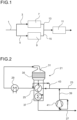
- Figure 1 shows a schematic flow diagram of the process for decomposing nitrous oxide.
- a gas stream 1 which contains nitrous oxide and optionally nitrogen monoxide and nitrogen dioxide, is split into a first partial stream 3 and a second partial stream 5.
- the first partial stream 3 is fed into a first decomposition unit 7 and the second partial stream 5 into a second decomposition unit 9.
- the nitrous oxide in the first and second partial streams 3, 5 is decomposed into nitrogen and oxygen and a first purified stream 13 and a second purified stream 15 are obtained.
- the obtained first and second purified streams 13, 15 are recombined and fed into a unit 11 for decomposing nitrogen monoxide and/or nitrogen dioxide.
- the unit 11 for decomposing nitrogen monoxide and/or nitrogen dioxide thereby can be any decomposition unit for nitric oxides known to a skilled person.
- the gas stream also can be split in more than two partial streams.
- each partial stream is fed into a separate decomposition unit.
- the purified gas can be emitted into the atmosphere. If more than one unit for decomposition of nitrogen monoxide and/or nitrogen dioxide is used, each purified stream can be emitted into the atmosphere or at least two purified streams are combined and then emitted into the atmosphere.
- gas stream 1 is split into more than two partial streams, it is possible to recombine groups of at least two of the purified streams and feed each of combined streams into a separate unit for decomposition of nitrogen monoxide and/or nitrogen dioxide.
- first and the second decomposition units 7, 9 or optionally more than two decomposition units allows for splitting the gas stream 1 in such a way that each decomposition unit is fed with an amount of gas by which the nitrous oxide which did not decompose is minimized.
- the temperature in each decomposition unit can be optimized in regard to the activity of the catalyst in the respective decomposition unit. Optimizing the temperature, for example, can be realized by setting the degree of the bypass 43 and/or by setting the power of the heater 29 and/or by setting a recycle stream from the outlet of the decomposition unit 7, 9 back into the inlet of the respective decomposition unit 7, 9.
- the at least first and second decomposition units 7, 9 allows for continuing operation even in case one decomposition unit is shut down, for example for maintenance like changing the catalyst.
- the gas streams 1 is fed into the decomposition unit 7, 9 which is not shut down if two decomposition units are comprised and, if more than two decomposition units are comprised, the gas stream is split into a number of partial streams which corresponds to the number of all decomposition units minus the number of the decomposition units which are shut down and the partial streams are fed into those decomposition units which still are in operation.
- the first decomposition unit 7 and the second decomposition unit 9 preferably have the same design which corresponds to the design of a decomposition unit 21 as shown in figure 2 . If more than two decomposition units are comprised, all decomposition units preferably have the same design which preferably corresponds to the design of the decomposition unit 21 shown in figure 2 .
- a partial stream 23 which may be the first partial stream 3 or the second partial stream 5 depending on whether the decomposition unit 21 corresponds to the first decomposition unit 7 or the second decomposition unit 9, is fed into a heat exchanger 25 in which the partial stream 23 is preheated by heat transfer from the purified stream 27 which is withdrawn from the decomposition unit 21. If the heat transferred from the purified stream 27 is not sufficient to heat the partial stream 23 to the temperature which is necessary for decomposition of nitrous oxide, the partial stream 23 after having left the heat exchanger 25 is fed into a heater 29 in which the partial stream 23 is heated to the temperature with which the partial stream 23 is fed into a decomposition reactor 31 in which the nitrous oxide is decomposed into nitrogen and oxygen.
- the heater 29 preferably is an electrical heater.
- the temperature of the partial stream 23 can be set to a predefined temperature with which the partial stream 23 is fed into the decomposition reactor 31.
- the temperature with which the partial stream 23 is fed into the decomposition reactor 31 preferably is in the range from 430 to 650°C
- the decomposition reactor 31 contains a catalyst, preferably a fixed bed catalyst 35. In the fixed bed catalyst 3, the nitrous oxide is decomposed forming oxygen and nitrogen.
- the gas stream obtained by the reaction then is fed into the heat exchanger 25 for heating the partial stream 23 which then is fed into the decomposition reactor 31.
- the purified stream 27 withdrawn from the decomposition reactor 31 is cooled.
- the purified stream 27 may be further cooled in an additional heat exchanger 37.
- the additional heat exchanger 37 preferably is a heat exchanger for producing steam by evaporation of water or for superheating water.
- the purified stream 27 withdrawn from the additional heat exchanger 37 can be fed into the unit 11 for decomposing nitrogen dioxide and/or nitrogen monoxide or released into the atmosphere.
- a recycle line 39 with a recycle blower 41 is provided, the recycle line 39 connecting a feed line for the partial stream 23 and an exit line for the purified stream 27.
- a bypass 43 may be provided, bypassing the regenerative heat exchanger 25.
- the bypass 43 may be closed so that the whole gas stream flows through the regenerative heat exchanger 25 or the bypass 43 is open and the feed line into the regenerative heat exchanger 25 is closed so that the whole gas stream flows through the bypass 43 or in a third alternative, the gas stream is split and a part flows through the regenerative heat exchanger 25 and a part through the bypass 43.
- each of the decomposition units 21 with a heat exchanger 25 and a heater 29 allows for individually setting the temperature of the partial stream 23 which enters the decomposition reactor 31.
- each decomposition reactor 23 is equipped with a recycle line 39 as shown here.
- An off-gas stream of 32000 Nm 3 /h comprising 8 vol-% nitrous oxide with a temperature of 40.5°C and a pressure of 6.8 bar(abs) which is withdrawn from a production process of adipic acid is heated in a first heat exchanger to a temperature of 273°C. Then the off-gas stream is split into two partial streams.
- the first partial stream has a volume flow of 15600 m 3 /h and enters a regenerative heat exchanger of a first nitrous oxide-decomposition unit.
- the first partial stream is heated by electrical heating to a temperature of 490°C and then the stream fed into a reactor with a fixed bed containing 8 t of a nitrous oxide-decomposition catalyst.
- catalyst the commercially available BASF-catalyst 03-81 was used.
- the first purified gas stream withdrawn from the fixed bed catalyst having a temperature of 680°C and a N 2 O-concentration of 90 vol.-ppm is fed to the regenerative heat exchanger of the first nitrous oxide-decomposition unit.
- the first purified gas stream leaves the regenerative first heat exchanger of the first nitrous oxide-decomposition unit and passes a first steam generator.
- the second partial steam having a volume flow of 16400 m 3 /h enters the regenerative heat exchanger of the second nitrous oxide-decomposition unit in which this stream is heated by electrical heating to a temperature of 490°C and then is fed to a reactor with a fixed bed with 8 t of a nitrous oxide-decomposition catalyst.
- catalyst the commercially available BASF-catalyst O3-81 was used.
- the second purified gas stream withdrawn from the fixed catalyst bed had a temperature of 675°C and a N 2 O-concentration of 70 vol-ppm and is fed to the second regenerative heat exchanger of the second nitrous oxide-decomposition unit.
- the second purified gas stream leaves the regenerative heat exchanger and passes a second steam generator.
- the first and the second purified gas streams were mixed.
- This mixed gas-stream is fed to a Denox-unit and is released after passing an expansion turbine to atmosphere.
- the concentration of nitrous oxide of the mixed off-gas flow is 80 vol.-ppm.
- An off-gas stream of 30400 Nm 3 /h comprising 8 vol-% nitrous oxide with a temperature of 34°C and a pressure of 7.2 bar(abs) which is withdrawn from a production process of adipic acid is heated in a first step in a heat exchanger to a temperature of 254°C and in a second step by regenerative heat exchange and by electrical heating to a temperature of 512°C and then fed into a reactor with a fixed bed with 8 t of a nitrous oxide-decomposition catalyst.
- catalyst the commercially available BASF-Catalyst 03-81 was used.
- the purified gas stream withdrawn from the fixed catalyst bed had a temperature of 710°C and was fed to the regenerative heat exchanger and afterwards to a steam generator.
- the off-gas of the steam generator had a concentration of 660 vol.-ppm nitrous oxide and was fed to a Denox-unit and is released after passing an expansion turbine to atmosphere.
Landscapes
- Engineering & Computer Science (AREA)
- Chemical & Material Sciences (AREA)
- Environmental & Geological Engineering (AREA)
- Oil, Petroleum & Natural Gas (AREA)
- Health & Medical Sciences (AREA)
- Biomedical Technology (AREA)
- Analytical Chemistry (AREA)
- General Chemical & Material Sciences (AREA)
- Chemical Kinetics & Catalysis (AREA)
- Organic Chemistry (AREA)
- Exhaust Gas Treatment By Means Of Catalyst (AREA)
Claims (12)
- Verfahren zum Zersetzen von Distickstoffoxid aus einem Gasstrom (1), umfassend:(a) Teilen des Gasstroms (1) in wenigstens zwei Teilströme (3, 5; 23) und Erhitzen der Teilströme (3, 5; 23);(b) Einspeisen jedes der Teilströme (3, 5; 23) in einen getrennten Zersetzungsreaktor (31), wobei jeder Reaktor (31) einen Katalysator umfasst;(c) Zersetzen des Distickstoffoxids zu Stickstoff und Sauerstoff in den Zersetzungsreaktoren (31), um gereinigte Ströme (13, 15; 27) zu erhalten;(d) gegebenenfalls Einspeisen jedes gereinigten Stroms (13, 15; 27) in eine Einheit (11) zum Zersetzen von Stickstoffdioxid und/oder Stickstoffmonoxid oder Kombinieren von wenigstens zwei gereinigten Strömen (13, 15; 27) und Einspeisen der kombinierten gereinigten Ströme in eine Einheit (11) zum Zersetzen von Stickstoffdioxid und/oder Stickstoffmonoxid,wobei die Katalysatoren der Zersetzungsreaktoren (31) alternierend gewechselt werden und wobei einer der Katalysatoren gewechselt wird, wenn der arithmetische Mittelwert der Lebensdauer der Katalysatoren in den anderen Reaktoren 25 bis 75 % der Lebensdauer eines Katalysators erreicht hat.
- Verfahren nach Anspruch 1, wobei der Katalysator ein Festbettkatalysator (35) ist.
- Verfahren nach Anspruch 1 oder 2, wobei der Gasstrom (1) in einen ersten und einen zweiten Teilstrom (3, 5) geteilt wird und der erste Teilstrom (3) in einen ersten Zersetzungsreaktor und der zweite Teilstrom (5) in einen zweiten Zersetzungsreaktor eingespeist wird.
- Verfahren nach einem der Ansprüche 1 bis 3, wobei der Teilstrom (23), der in den Zersetzungsreaktor (31), der einen älteren Katalysator enthält, eingespeist wird, verringert wird und der Teilstrom (23), der in einen Zersetzungsreaktor (31), der einen frischeren Katalysator enthält, eingespeist wird, vermehrt wird.
- Verfahren nach einem der Ansprüche 1 bis 4, wobei während des Wechselns des Katalysatore eines Zersetzungsreaktors (31) alle Teilströme (3, 5; 23) in die anderen Zersetzungsreaktoren eingespeist werden.
- Verfahren nach einem der Ansprüche 1 bis 5, wobei die Temperatur jedes Teilstroms (3, 5; 23), der in die Zersetzungsreaktoren (31) eingespeist wird, einzeln eingestellt werden kann.
- Verfahren nach einem der Ansprüche 1 bis 6, wobei vor Teilen des Gasstroms (1) in Teilströme (3, 5; 23) und Erhitzen der Teilströme (3, 5; 23) der gesamte Gasstrom (1) vorgewärmt wird.
- Verfahren nach einem der Ansprüche 1 bis 7, wobei die Teilströme (3, 5; 23) durch Wärmeübertragung aus den entsprechenden gereinigten Strömen (27), die den Zersetzungsreaktoren (23) entnommen werden, vorgewärmt werden.
- Verfahren nach einem der Ansprüche 1 bis 8, wobei die Teilströme (3, 5; 23) zusätzlich in einer Heizvorrichtung (29) erhitzt werden.
- Verfahren nach einem der Ansprüche 1 bis 9, wobei ein Teil des gereinigten Stroms (27), der aus dem Zersetzungsreaktor (31) entnommen wird, vor Erhitzen in den Teilstrom (23), der in den Zersetzungsreaktor (31) eingespeist wird, zurückgeführt wird.
- Verfahren nach Anspruch 10, wobei der Teil des gereinigten Stroms (27), der in den Teilstrom (23) zurückgeführt wird, für jeden Zersetzungsreaktor (31) einzeln eingestellt werden kann.
- Verfahren nach einem der Ansprüche 1 bis 11, wobei der Distickstoffoxid-umfassende Gasstrom bei einem Verfahren zur Herstellung von Adipinsäure erhalten wird.
Applications Claiming Priority (2)
| Application Number | Priority Date | Filing Date | Title |
|---|---|---|---|
| EP21151405 | 2021-01-13 | ||
| PCT/EP2022/050152 WO2022152608A1 (en) | 2021-01-13 | 2022-01-05 | A process for decomposing nitrous oxide from a gas stream |
Publications (2)
| Publication Number | Publication Date |
|---|---|
| EP4277888A1 EP4277888A1 (de) | 2023-11-22 |
| EP4277888B1 true EP4277888B1 (de) | 2025-02-12 |
Family
ID=74181039
Family Applications (1)
| Application Number | Title | Priority Date | Filing Date |
|---|---|---|---|
| EP22700018.9A Active EP4277888B1 (de) | 2021-01-13 | 2022-01-05 | Verfahren zur zersetzung von distickstoffoxid aus einem gasstrom |
Country Status (4)
| Country | Link |
|---|---|
| US (1) | US20240216861A1 (de) |
| EP (1) | EP4277888B1 (de) |
| CN (1) | CN116802311A (de) |
| WO (1) | WO2022152608A1 (de) |
Families Citing this family (2)
| Publication number | Priority date | Publication date | Assignee | Title |
|---|---|---|---|---|
| EP4648884A1 (de) | 2023-01-09 | 2025-11-19 | Basf Se | Verfahren zur entfernung von stickoxid, stickoxid und kohlenmonoxid aus einem gasstrom |
| CN119680376B (zh) * | 2024-11-25 | 2026-03-24 | 北京工业大学 | 一种回收净化尾气及余热的己二酸尾气氮氧化物处理工艺 |
Family Cites Families (10)
| Publication number | Priority date | Publication date | Assignee | Title |
|---|---|---|---|---|
| JPH054027A (ja) * | 1991-06-28 | 1993-01-14 | Asahi Chem Ind Co Ltd | 排一酸化二窒素ガスの処理方法 |
| WO1999025461A1 (fr) * | 1997-11-18 | 1999-05-27 | Asahi Kasei Kogyo Kabushiki Kaisha | Procede et dispositif de prevention contre le rechauffement general de la planete |
| EP1413349B1 (de) * | 2002-10-25 | 2006-03-29 | Radici Chimica Spa | Verfahren zur katalytischen Zersetzung von Distickstoffmonoxid (N2O) |
| EP2165756B2 (de) | 2008-09-19 | 2016-06-01 | Linde AG | Verfahren zur Dekomposition von Distickstoffmonoxid in einem Gasstrom |
| DE102009037882A1 (de) | 2009-01-13 | 2010-07-15 | Linde Aktiengesellschaft | Vorrichtung und Verfahren zur Zersetzung von Lachgas in einem adiabaten Festbettreaktor |
| JP5541951B2 (ja) | 2010-03-19 | 2014-07-09 | メタウォーター株式会社 | 排ガス中のn2o除去装置およびn2o除去方法 |
| KR101933227B1 (ko) * | 2010-05-19 | 2018-12-27 | 쉘 인터내셔날 리써취 마트샤피지 비.브이. | 가스 스트림에서 아산화질소의 제거 방법 |
| DE102010022775A1 (de) * | 2010-06-04 | 2011-12-08 | Uhde Gmbh | Verfahren und Vorrichtung zur Beseitigung von NOx und N2O |
| JP2013167420A (ja) * | 2012-02-16 | 2013-08-29 | Showa Denko Kk | 熱輸送装置及び熱輸送方法 |
| CN206064160U (zh) * | 2016-08-25 | 2017-04-05 | 中国天辰工程有限公司 | 一种一氧化二氮热解装置 |
-
2022
- 2022-01-05 US US18/271,875 patent/US20240216861A1/en active Pending
- 2022-01-05 WO PCT/EP2022/050152 patent/WO2022152608A1/en not_active Ceased
- 2022-01-05 CN CN202280009796.XA patent/CN116802311A/zh active Pending
- 2022-01-05 EP EP22700018.9A patent/EP4277888B1/de active Active
Also Published As
| Publication number | Publication date |
|---|---|
| CN116802311A (zh) | 2023-09-22 |
| EP4277888A1 (de) | 2023-11-22 |
| US20240216861A1 (en) | 2024-07-04 |
| WO2022152608A1 (en) | 2022-07-21 |
Similar Documents
| Publication | Publication Date | Title |
|---|---|---|
| US6056928A (en) | Method of removing nitrogen oxides from a gas flow | |
| EP3515861B1 (de) | Anlage und verfahren zur herstellung von salpetersäure | |
| KR100622167B1 (ko) | n-부탄으로부터 말레산 무수물을 제조하는 고생산성 방법 | |
| EP4277888B1 (de) | Verfahren zur zersetzung von distickstoffoxid aus einem gasstrom | |
| CN111108063B (zh) | 三级减排n2o和nox生产硝酸的方法 | |
| CA2845760A1 (en) | Improved nitric acid production | |
| EP0328280A1 (de) | Verfahren zur Herstellung von Nitrilen und Oxiden | |
| Uriarte | Nitrous oxide (N2O)—Waste to value | |
| EP4277728B1 (de) | Verfahren zur aufbereitung von distickstoffmonoxid-enthaltendem abgasstrom | |
| JPH1029809A (ja) | 硝酸の生産方法及びその設備 | |
| KR20200069286A (ko) | 질산 제조 방법 | |
| US3567367A (en) | Method of removing nitrogen oxides from gases | |
| CN119013436A (zh) | 具有热回收系统的硝酸设备和方法 | |
| JP3300427B2 (ja) | 亜酸化窒素の製造方法 | |
| Reimer et al. | Adipic Acid Industry—N2O Abatement: Implementation of Technologies for Abatement of N2O Emissions Associated with Adipic Acid Manufacture | |
| RU2151736C1 (ru) | Способ получения азотной кислоты | |
| JP3258394B2 (ja) | 亜酸化窒素の製造方法 | |
| RU2174946C1 (ru) | Способ производства азотной кислоты | |
| KR20250044010A (ko) | 일산화질소 제조 시스템 및 제조방법 | |
| OA19178A (en) | Plant and process for producing nitric acid. | |
| UA63483A (en) | A method for producing the nitric acid | |
| GB1585869A (en) | Method of producing sulphuric acid | |
| JPS5925727B2 (ja) | 硫酸の製造法 |
Legal Events
| Date | Code | Title | Description |
|---|---|---|---|
| STAA | Information on the status of an ep patent application or granted ep patent |
Free format text: STATUS: UNKNOWN |
|
| STAA | Information on the status of an ep patent application or granted ep patent |
Free format text: STATUS: THE INTERNATIONAL PUBLICATION HAS BEEN MADE |
|
| PUAI | Public reference made under article 153(3) epc to a published international application that has entered the european phase |
Free format text: ORIGINAL CODE: 0009012 |
|
| STAA | Information on the status of an ep patent application or granted ep patent |
Free format text: STATUS: REQUEST FOR EXAMINATION WAS MADE |
|
| 17P | Request for examination filed |
Effective date: 20230814 |
|
| AK | Designated contracting states |
Kind code of ref document: A1 Designated state(s): AL AT BE BG CH CY CZ DE DK EE ES FI FR GB GR HR HU IE IS IT LI LT LU LV MC MK MT NL NO PL PT RO RS SE SI SK SM TR |
|
| DAV | Request for validation of the european patent (deleted) | ||
| DAX | Request for extension of the european patent (deleted) | ||
| GRAP | Despatch of communication of intention to grant a patent |
Free format text: ORIGINAL CODE: EPIDOSNIGR1 |
|
| STAA | Information on the status of an ep patent application or granted ep patent |
Free format text: STATUS: GRANT OF PATENT IS INTENDED |
|
| INTG | Intention to grant announced |
Effective date: 20240904 |
|
| GRAS | Grant fee paid |
Free format text: ORIGINAL CODE: EPIDOSNIGR3 |
|
| P01 | Opt-out of the competence of the unified patent court (upc) registered |
Free format text: CASE NUMBER: APP_61535/2024 Effective date: 20241118 |
|
| GRAA | (expected) grant |
Free format text: ORIGINAL CODE: 0009210 |
|
| STAA | Information on the status of an ep patent application or granted ep patent |
Free format text: STATUS: THE PATENT HAS BEEN GRANTED |
|
| AK | Designated contracting states |
Kind code of ref document: B1 Designated state(s): AL AT BE BG CH CY CZ DE DK EE ES FI FR GB GR HR HU IE IS IT LI LT LU LV MC MK MT NL NO PL PT RO RS SE SI SK SM TR |
|
| REG | Reference to a national code |
Ref country code: GB Ref legal event code: FG4D |
|
| REG | Reference to a national code |
Ref country code: CH Ref legal event code: EP |
|
| REG | Reference to a national code |
Ref country code: DE Ref legal event code: R096 Ref document number: 602022010495 Country of ref document: DE |
|
| REG | Reference to a national code |
Ref country code: IE Ref legal event code: FG4D |
|
| REG | Reference to a national code |
Ref country code: NL Ref legal event code: MP Effective date: 20250212 |
|
| PG25 | Lapsed in a contracting state [announced via postgrant information from national office to epo] |
Ref country code: RS Free format text: LAPSE BECAUSE OF FAILURE TO SUBMIT A TRANSLATION OF THE DESCRIPTION OR TO PAY THE FEE WITHIN THE PRESCRIBED TIME-LIMIT Effective date: 20250512 |
|
| PG25 | Lapsed in a contracting state [announced via postgrant information from national office to epo] |
Ref country code: FI Free format text: LAPSE BECAUSE OF FAILURE TO SUBMIT A TRANSLATION OF THE DESCRIPTION OR TO PAY THE FEE WITHIN THE PRESCRIBED TIME-LIMIT Effective date: 20250212 |
|
| PG25 | Lapsed in a contracting state [announced via postgrant information from national office to epo] |
Ref country code: PL Free format text: LAPSE BECAUSE OF FAILURE TO SUBMIT A TRANSLATION OF THE DESCRIPTION OR TO PAY THE FEE WITHIN THE PRESCRIBED TIME-LIMIT Effective date: 20250212 |
|
| PG25 | Lapsed in a contracting state [announced via postgrant information from national office to epo] |
Ref country code: ES Free format text: LAPSE BECAUSE OF FAILURE TO SUBMIT A TRANSLATION OF THE DESCRIPTION OR TO PAY THE FEE WITHIN THE PRESCRIBED TIME-LIMIT Effective date: 20250212 |
|
| REG | Reference to a national code |
Ref country code: LT Ref legal event code: MG9D |
|
| PG25 | Lapsed in a contracting state [announced via postgrant information from national office to epo] |
Ref country code: IS Free format text: LAPSE BECAUSE OF FAILURE TO SUBMIT A TRANSLATION OF THE DESCRIPTION OR TO PAY THE FEE WITHIN THE PRESCRIBED TIME-LIMIT Effective date: 20250612 Ref country code: NO Free format text: LAPSE BECAUSE OF FAILURE TO SUBMIT A TRANSLATION OF THE DESCRIPTION OR TO PAY THE FEE WITHIN THE PRESCRIBED TIME-LIMIT Effective date: 20250512 |
|
| PG25 | Lapsed in a contracting state [announced via postgrant information from national office to epo] |
Ref country code: NL Free format text: LAPSE BECAUSE OF FAILURE TO SUBMIT A TRANSLATION OF THE DESCRIPTION OR TO PAY THE FEE WITHIN THE PRESCRIBED TIME-LIMIT Effective date: 20250212 |
|
| PG25 | Lapsed in a contracting state [announced via postgrant information from national office to epo] |
Ref country code: HR Free format text: LAPSE BECAUSE OF FAILURE TO SUBMIT A TRANSLATION OF THE DESCRIPTION OR TO PAY THE FEE WITHIN THE PRESCRIBED TIME-LIMIT Effective date: 20250212 |
|
| PG25 | Lapsed in a contracting state [announced via postgrant information from national office to epo] |
Ref country code: PT Free format text: LAPSE BECAUSE OF FAILURE TO SUBMIT A TRANSLATION OF THE DESCRIPTION OR TO PAY THE FEE WITHIN THE PRESCRIBED TIME-LIMIT Effective date: 20250612 Ref country code: LV Free format text: LAPSE BECAUSE OF FAILURE TO SUBMIT A TRANSLATION OF THE DESCRIPTION OR TO PAY THE FEE WITHIN THE PRESCRIBED TIME-LIMIT Effective date: 20250212 |
|
| PG25 | Lapsed in a contracting state [announced via postgrant information from national office to epo] |
Ref country code: BG Free format text: LAPSE BECAUSE OF FAILURE TO SUBMIT A TRANSLATION OF THE DESCRIPTION OR TO PAY THE FEE WITHIN THE PRESCRIBED TIME-LIMIT Effective date: 20250212 Ref country code: GR Free format text: LAPSE BECAUSE OF FAILURE TO SUBMIT A TRANSLATION OF THE DESCRIPTION OR TO PAY THE FEE WITHIN THE PRESCRIBED TIME-LIMIT Effective date: 20250513 |
|
| REG | Reference to a national code |
Ref country code: AT Ref legal event code: MK05 Ref document number: 1765964 Country of ref document: AT Kind code of ref document: T Effective date: 20250212 |
|
| PG25 | Lapsed in a contracting state [announced via postgrant information from national office to epo] |
Ref country code: SE Free format text: LAPSE BECAUSE OF FAILURE TO SUBMIT A TRANSLATION OF THE DESCRIPTION OR TO PAY THE FEE WITHIN THE PRESCRIBED TIME-LIMIT Effective date: 20250212 |
|
| PG25 | Lapsed in a contracting state [announced via postgrant information from national office to epo] |
Ref country code: SM Free format text: LAPSE BECAUSE OF FAILURE TO SUBMIT A TRANSLATION OF THE DESCRIPTION OR TO PAY THE FEE WITHIN THE PRESCRIBED TIME-LIMIT Effective date: 20250212 |
|
| PG25 | Lapsed in a contracting state [announced via postgrant information from national office to epo] |
Ref country code: DK Free format text: LAPSE BECAUSE OF FAILURE TO SUBMIT A TRANSLATION OF THE DESCRIPTION OR TO PAY THE FEE WITHIN THE PRESCRIBED TIME-LIMIT Effective date: 20250212 |
|
| PG25 | Lapsed in a contracting state [announced via postgrant information from national office to epo] |
Ref country code: IT Free format text: LAPSE BECAUSE OF FAILURE TO SUBMIT A TRANSLATION OF THE DESCRIPTION OR TO PAY THE FEE WITHIN THE PRESCRIBED TIME-LIMIT Effective date: 20250212 |
|
| PG25 | Lapsed in a contracting state [announced via postgrant information from national office to epo] |
Ref country code: AT Free format text: LAPSE BECAUSE OF FAILURE TO SUBMIT A TRANSLATION OF THE DESCRIPTION OR TO PAY THE FEE WITHIN THE PRESCRIBED TIME-LIMIT Effective date: 20250212 |
|
| PG25 | Lapsed in a contracting state [announced via postgrant information from national office to epo] |
Ref country code: EE Free format text: LAPSE BECAUSE OF FAILURE TO SUBMIT A TRANSLATION OF THE DESCRIPTION OR TO PAY THE FEE WITHIN THE PRESCRIBED TIME-LIMIT Effective date: 20250212 Ref country code: CZ Free format text: LAPSE BECAUSE OF FAILURE TO SUBMIT A TRANSLATION OF THE DESCRIPTION OR TO PAY THE FEE WITHIN THE PRESCRIBED TIME-LIMIT Effective date: 20250212 |
|
| PG25 | Lapsed in a contracting state [announced via postgrant information from national office to epo] |
Ref country code: RO Free format text: LAPSE BECAUSE OF FAILURE TO SUBMIT A TRANSLATION OF THE DESCRIPTION OR TO PAY THE FEE WITHIN THE PRESCRIBED TIME-LIMIT Effective date: 20250212 |
|
| PG25 | Lapsed in a contracting state [announced via postgrant information from national office to epo] |
Ref country code: SK Free format text: LAPSE BECAUSE OF FAILURE TO SUBMIT A TRANSLATION OF THE DESCRIPTION OR TO PAY THE FEE WITHIN THE PRESCRIBED TIME-LIMIT Effective date: 20250212 |
|
| REG | Reference to a national code |
Ref country code: DE Ref legal event code: R097 Ref document number: 602022010495 Country of ref document: DE |
|
| PLBE | No opposition filed within time limit |
Free format text: ORIGINAL CODE: 0009261 |
|
| STAA | Information on the status of an ep patent application or granted ep patent |
Free format text: STATUS: NO OPPOSITION FILED WITHIN TIME LIMIT |
|
| 26N | No opposition filed |
Effective date: 20251113 |
|
| PGFP | Annual fee paid to national office [announced via postgrant information from national office to epo] |
Ref country code: DE Payment date: 20260127 Year of fee payment: 5 |