EP4322425B1 - Modulateur de polarisation a autocompensation - Google Patents
Modulateur de polarisation a autocompensation Download PDFInfo
- Publication number
- EP4322425B1 EP4322425B1 EP23186293.9A EP23186293A EP4322425B1 EP 4322425 B1 EP4322425 B1 EP 4322425B1 EP 23186293 A EP23186293 A EP 23186293A EP 4322425 B1 EP4322425 B1 EP 4322425B1
- Authority
- EP
- European Patent Office
- Prior art keywords
- polarization
- modulator
- optical signal
- phase
- designed
- Prior art date
- Legal status (The legal status is an assumption and is not a legal conclusion. Google has not performed a legal analysis and makes no representation as to the accuracy of the status listed.)
- Active
Links
Images

Classifications
-
- H—ELECTRICITY
- H04—ELECTRIC COMMUNICATION TECHNIQUE
- H04B—TRANSMISSION
- H04B10/00—Transmission systems employing electromagnetic waves other than radio-waves, e.g. infrared, visible or ultraviolet light, or employing corpuscular radiation, e.g. quantum communication
- H04B10/11—Arrangements specific to free-space transmission, i.e. transmission through air or vacuum
- H04B10/118—Arrangements specific to free-space transmission, i.e. transmission through air or vacuum specially adapted for satellite communication
-
- H—ELECTRICITY
- H04—ELECTRIC COMMUNICATION TECHNIQUE
- H04B—TRANSMISSION
- H04B10/00—Transmission systems employing electromagnetic waves other than radio-waves, e.g. infrared, visible or ultraviolet light, or employing corpuscular radiation, e.g. quantum communication
- H04B10/25—Arrangements specific to fibre transmission
- H04B10/2587—Arrangements specific to fibre transmission using a single light source for multiple stations
-
- G—PHYSICS
- G02—OPTICS
- G02B—OPTICAL ELEMENTS, SYSTEMS OR APPARATUS
- G02B27/00—Optical systems or apparatus not provided for by any of the groups G02B1/00 - G02B26/00, G02B30/00
- G02B27/28—Optical systems or apparatus not provided for by any of the groups G02B1/00 - G02B26/00, G02B30/00 for polarising
- G02B27/283—Optical systems or apparatus not provided for by any of the groups G02B1/00 - G02B26/00, G02B30/00 for polarising used for beam splitting or combining
-
- H—ELECTRICITY
- H04—ELECTRIC COMMUNICATION TECHNIQUE
- H04B—TRANSMISSION
- H04B10/00—Transmission systems employing electromagnetic waves other than radio-waves, e.g. infrared, visible or ultraviolet light, or employing corpuscular radiation, e.g. quantum communication
- H04B10/50—Transmitters
- H04B10/516—Details of coding or modulation
-
- H—ELECTRICITY
- H04—ELECTRIC COMMUNICATION TECHNIQUE
- H04B—TRANSMISSION
- H04B10/00—Transmission systems employing electromagnetic waves other than radio-waves, e.g. infrared, visible or ultraviolet light, or employing corpuscular radiation, e.g. quantum communication
- H04B10/50—Transmitters
- H04B10/516—Details of coding or modulation
- H04B10/532—Polarisation modulation
Definitions
- the present description relates to optical signal generation and signal transmission, in particular the transmission of information by means of polarization modulation.
- the description relates to a modulator unit for modulating the polarization of an optical signal, an optical signal transmission path with such a modulator unit, and a system with such a modulator unit, for example in the form of a satellite.
- Information can be transmitted using technical means by assigning an information unit to a specific state of a carrier signal.
- the carrier signal is usually an electromagnetic wave from a specific spectral range.
- a property of the carrier signal is changed.
- the change itself or the state of the carrier signal after the change corresponds to the information to be transmitted.
- the carrier signal is usually changed at intervals in order to transmit several units of information.
- various physical characteristics of the carrier signal can be used as information carriers, for example: the amplitude, the frequency, the phase and/or the polarization. If one of these characteristics changes over time, this process is called modulation.
- Various technical components are used in the signal processing path to process the carrier signal and to incorporate the desired information into the carrier signal before the carrier signal is transmitted over the transmission path (wired or wireless).
- the components used in the preparation and processing of the carrier signal serve to modulate the carrier signal accordingly so that the information to be transmitted is correctly applied to the carrier signal and transmitted over the transmission path with as little interference and loss as possible.
- it can be considered a task to reduce or eliminate the influence of unwanted effects of a modulator unit on a carrier signal modulated for transmission.
- it can be considered a task to avoid polarization errors in a polarization-modulated optical signal.
- a modulator unit for modulating the polarization of an optical signal has a light source, a polarization-dependent phase modulator, and a reflector.
- the light source is designed to output an optical signal and to emit it as an input signal in the direction of the polarization-dependent phase modulator, wherein the optical signal contains a first polarization component with a first polarization direction and a second polarization component with a second polarization direction.
- the polarization-dependent phase modulator is designed to modulate a first phase of the first polarization component of the input signal in the first polarization direction and to forward the input signal modulated in this way to the reflector.
- the reflector is designed to retroreflect the optical signal received in the direction of the polarization-dependent phase modulator and in doing so to change the polarization of the optical signal (for example by 90°) so that the first polarization component with the first polarization direction receives the second polarization direction and the second polarization component with the second polarization direction receives the first polarization direction.
- the polarization-dependent phase modulator is designed to modulate a second phase of the second polarization component of the retroreflected optical signal in the first polarization direction.
- the modulator unit is designed to output the optical signal modulated in this way as a polarization-modulated output signal.
- the optical signal represents a superposition of two orthogonal polarization components.
- the polarization-dependent phase modulator is designed to apply different phases to both polarization components.
- the light source can be a light emitter (for example a laser) or the output of a light-guiding element.
- the optical signal travels through the same optical path of the modulator unit twice in opposite directions. On the way there, the optical signal travels from the light source through the polarization-dependent phase modulator to the reflector.
- the reflector retroreflects the optical signal and rotates the phase of the optical signal by 90° (either +90° or -90°).
- the reflector is implemented as a Faraday mirror, which is a retroreflector based on the Faraday effect that contains a crystal to which a magnetic field is applied and which rotates the polarization depending on the direction of propagation of the magnetic field.
- the reflector is therefore a combination of a Faraday rotator and a mirror.
- the optical signal first passes through the Faraday rotator and the polarization of the light is rotated by 45° (+45° or -45°).
- the optical signal is then mirrored and passes through the Faraday rotator again, rotating its polarization by another 45° (in the same direction as in the first step).
- the polarization of the retroreflected light then differs from the polarization of the incident light by 90°.
- the component of the optical signal with horizontal polarization (assumed as the first polarization direction for the example) is modulated (a first phase is applied to this component modulated) and the component with vertical polarization (assumed as the second polarization direction for the example) passes the polarization-dependent phase modulator without any changes to the phase of this component.
- the optical signal is retroreflected by the reflector and the polarization is rotated by 90°, the component with horizontal polarization is now vertically polarized, the component with vertical polarization is now horizontally polarized.
- the optical signal passes through the polarization-dependent phase modulator again, and now the (now) horizontally polarized component (which corresponds to the vertically polarized component of the outward path) is modulated in phase and the (now) vertically polarized component passes the polarization-dependent phase modulator without any further change in phase.
- the polarization-dependent phase modulator has only a single modulation axis, which remains the same on the outward and return paths, i.e. acts on the same polarization direction.
- the phase applied to the horizontally polarized component of the return path is called the second phase because on the return path the first phase is contained in the vertically polarized component of the optical signal and the first phase may be different from the second phase.
- both the vertically polarized component and the horizontally polarized component of the optical signal are modulated in a modulator unit with a single optical path.
- the resulting optical signal has received a desired polarization modulation in total by modulating the phase of the first polarization component with a first polarization direction on the outward path and the second polarization component, which has the first polarization direction on the return path, on the return path, although the polarization of the optical signal on the return path is changed by 90° compared to the outward path.
- the polarization-dependent phase modulator used here is a phase-changing modulator which acts on a polarization component of an optical signal, ie the polarization-dependent phase modulator changes the phase of two orthogonal polarization components of the optical light.
- the polarization-dependent phase modulator is an electro-optical modulator, EOM. It is to be understood that any reference to an EOM in this description is by way of example only and generally applies to a polarization-dependent phase modulator.
- the polarization-dependent phase modulator has two optical axes that are aligned orthogonally to one another. Using electrical energy, for example an applied voltage along one of these optical axes, its refractive index is modified, resulting in a phase change of the polarization component of the optical signal compared to the other or orthogonal optical axis.
- the structure of the modulator unit is very space-saving and compact.
- a polarization-dependent phase modulator can be switched very quickly, so that the modulator unit described here can be used up to high frequency ranges, for example several 10 GHz, such as up to 30 to 40 GHz or even higher frequency ranges.
- the modulator unit described here can be used to set different polarization states of an optical signal.
- different discrete states of polarization can be set by changing the phase of the horizontally polarized portion of the optical signal in relation to the phase of the vertically polarized portion of the optical signal.
- the polarization of the optical signal can be changed continuously as desired without being restricted to a limited number of polarization states.
- the polarization-dependent phase modulator comprises a crystal which is designed to be subjected to an electrical voltage and thereby to change its refractive index, whereby the phase of the first polarization component of the optical signal is changed.
- the refractive index can also be changed by applying a mechanical stress.
- the polarization-dependent phase modulator can, for example, contain a birefringent medium which, when a voltage is applied, changes the phase of an optical signal passing through the optical medium.
- the modulator unit is designed to vary the electrical voltage applied to the crystal over time.
- the modulator unit contains a power supply that provides a predeterminable electrical voltage.
- a control unit controls the power supply so that the latter provides a desired electrical voltage to the polarization-dependent phase modulator.
- the phase between differently polarized components of the optical signal is changed by the electrical voltage at the polarization-dependent phase modulator varying over time.
- an amount of the first phase of the first polarization component of the input signal in the first polarization direction differs from an amount of the second phase of the second polarization component of the retroreflected optical signal in the first polarization direction.
- the polarization-dependent phase modulator is designed to change a difference between the first phase and the second phase over time.
- the polarization of the output signal is also changed over time.
- the polarization of the output signal of the modulator unit can be freely adjusted between two linear polarizations (horizontal, vertical) and two circular polarizations (Z+ and Z-). However, the polarization can also be continuously adjusted to all elliptical states lying between the discrete states.
- the light source is designed to emit or output light with a well-defined optical mode.
- the polarization and coherence properties of the optical signal are important.
- the light source is a laser.
- Lasers are characterized by their ability to emit optical signals with a well-defined polarization. This makes them particularly suitable for applications such as those described here.
- the modulator unit is designed to control the light source such that the light source emits pulsed optical signals.
- a light pulse passes through the polarization-dependent phase modulator and a first polarization component is modulated in its phase.
- the light pulse is then passed on to the reflector, where the polarization of the light pulse is changed and the light pulse is reflected back to the polarization-dependent phase modulator.
- the polarization-dependent phase modulator again modulates a phase of a polarization component of the light pulse.
- the light pulse is designed in such a way that in the polarization-dependent phase modulator the light on the way to the reflector and the light on the way back from the reflector do not overlap.
- the light source can also emit a continuous light signal whose polarization is changed as described.
- the modulator unit may be configured to modulate and emit pulsed optical signals.
- the modulator unit may receive the pulsed optical signals from another source.
- the modulator unit further comprises a beam splitter which is arranged between the light source and the polarization-dependent phase modulator and is designed to direct at least a portion of the retroreflected optical signal phase-modulated by the polarization-dependent phase modulator in a predetermined direction.
- the beam splitter is arranged to at least partially structurally direct the optical signal output by the polarization-dependent phase modulator in a desired direction so that the optical signal output by the polarization-dependent phase modulator is not directed exclusively in the direction of the light source which supplies the input signal to the polarization-dependent Phase modulator emits.
- the output signal generated in this way carries information in its polarization that can be read and processed by a receiver.
- a circulator can be used instead of the beam splitter.
- an optical signal transmission path has a modulator unit as described herein and a receiver.
- the modulator unit functions as a signal source or part of a transmission unit which outputs an optical signal on which information is applied.
- the signal source sends the modulated optical signal in the direction of the receiver.
- the receiver is designed to receive optical signals.
- the modulator unit is arranged to emit the output signal in the direction of the receiver.
- the signal transmission path can be designed for unidirectional or bidirectional signal transmission.
- bidirectional signal transmission there are at least two communication units, both of which have both a modulator unit and a receiving unit.
- the modulator unit described here is implemented as part of an optical signal transmission path.
- the optical signal transmission path is thus set up to transmit information by means of polarization modulation of an optical carrier signal.
- the polarization modulation is introduced into the optical carrier signal by means of the modulator unit.
- the modulator unit intrinsically compensates for phase errors due to the components involved in the modulation because the optical signal passes through the same optical path twice and the orthogonal polarization components of the optical signal are modulated one after the other.
- the modulator unit is arranged in a satellite.
- the modulator unit can be arranged in any other communication system.
- a satellite having a modulator unit as described herein is provided.
- a modulator unit as described herein can be used, for example, on optical signal transmission links which are used between two mobile units (air, water or land vehicles or satellites), between a mobile unit and a counterpart on the earth's surface, or between two stationary units.
- Fig. 1 shows the structural design of a modulator unit 100.
- the modulator unit 100 contains a light source 110, a beam splitter 120, a beam absorber 125, a polarization-dependent phase modulator in the form of an electro-optical modulator, EOM, 130, and a reflector in the form of a Faraday mirror 140.
- the EOM 130 and the Faraday mirror 140 can be referred to together as a polarization modulator 105. Even if reference is made here to a Faraday mirror 140, for example, the corresponding explanations generally apply to a reflector mentioned herein.
- the light source 110 which is, for example, a laser, emits an optical signal in the form of the input signal 111.
- This input signal is fed to the other components and its polarization is modulated in order to transmit information via the optical signal.
- the information to be transmitted is modulated on the output signal 118 in the polarization of the optical signal.
- Fig. 2 the path of the optical signal through the modulator unit 100 is described. Reference is made to the state of the optical signal at different times or at different points in the modulator unit 100.
- the input signal 111 hits the beam splitter 120.
- the beam splitter 120 is designed as a non-polarizing beam splitter in this example.
- a part of the input signal 111 is directed as the first part 112 of the split input signal in the direction of the beam absorber 125 and another part of the Input signal 111 passes through beam splitter 120 as second part 113 of the split input signal in the direction of EOM 130.
- the EOM 130 now modulates a polarization component of the second part 113 of the optical signal by changing the phase of the portion of the signal 113 with a polarization.
- the optical signal is now present as a singly modulated signal 114, i.e. as an optical signal in which a polarization portion is modulated in phase.
- the Faraday mirror 140 retroreflects the singly modulated signal 114 and changes its polarization by 90°, so that the optical signal is reflected again to the EOM 130 as a mirrored signal 115.
- the horizontally polarized portion of the optical signal was modulated by the EOM on the outward path between signals 113 and 114, then on the return path this modulation is now in the vertically polarized portion of the optical signal 115 because the Faraday mirror 140 has changed the polarization by 90°. If the optical signal 115 now passes through the EOM 130 again on the return path, the now horizontally polarized portion (corresponds to the vertically polarized portion on the outward path, which did not experience any change in phase on the outward path) has its phase changed.
- the optical length between the EOM 130 and the Faraday mirror 140 is dimensioned such that an optical signal on the return path does not overlap an optical signal on the outward path within the EOM.
- the length of the optical path between the EOM and the Faraday mirror is dimensioned such that a light pulse on the return path does not overlap a light pulse on the outward path.
- the length of the optical path is matched to the duration of a light pulse and the transmission rate.
- the EOM thus applies a phase to both polarization components of the optical signal on the same optical path.
- the polarization of the optical signal can be varied.
- the optical signal 116 is now phase-modulated in both polarization components. The superposition of these two modulations results in the polarization of the optical signal 116, which contains the information to be transmitted.
- the optical signal 116 hits the beam splitter 120 again, a part 117 of the optical signal passes through the beam splitter and another part 118 is deflected in a different direction and corresponds to the output signal to be transmitted, in whose polarization the information to be transmitted is contained.
- the output signal passes through the beam splitter and the deflected signal is discarded.
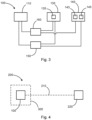
- Fig. 3 shows how the components of the modulator unit 100 are controlled in order to incorporate the information to be transmitted into the polarization of the optical signal.
- the modulator unit 100 contains a power supply 160 and a control unit 150. Both the power supply 160 and the control unit 150 are connected to the light source 110, the EOM 130 and the Faraday mirror 140. However, the control unit 150 can also be connected directly to the power supply 160 in order to specify an electrical voltage output by the power supply 160 at the respective connection.
- the power supply 160 supplies the light source 110 with electrical energy so that the light source generates the optical signal, which acts as an input signal. Furthermore, the power supply 160 supplies the EOM 130 with electrical energy, for example an electrical voltage, which is applied to a crystal 135. This electrical voltage influences the crystal 135 in such a way that the phase of a portion of a passing optical signal that is polarized in a certain way is changed. For example, variations in the electrical voltage can change the phase to different degrees.
- the control unit 150 and the energy supply 160 control the EOM in such a way that it acts on the optical signal passing through the EOM in the desired way on the outward and return paths of the optical signal and changes the phase of the influenced polarization component accordingly and as desired. The control unit and the energy supply must switch quickly enough and control the EOM.
- the polarization of a passing optical signal is changed in the Faraday rotator 143, in the present example by 45°.
- the optical signal then hits the mirror 145, is reflected by it and passes through the Faraday rotator 143 again. Now the polarization of the optical signal is changed again by 45° in the same direction, so that the polarization of the optical signal incident on the Faraday mirror and the polarization of the optical signal output by the Faraday mirror differ by 90°.
- the control unit 150 is designed to control the energy supply 160 and/or each of the components 110, 130, 140 such that these components are supplied with the energy required for their function.
- the control unit 150 can send control commands to the components 110, 130, 140 and/or control commands to the energy supply 160.
- Fig. 4 shows an optical signal transmission path 200.
- a modulator unit 100 functions as a signal source or transmitter.
- the modulator unit 100 modulates the polarization of an optical signal as described above and sends the modulated optical signal via a transmission path 210.
- the transmission path 210 is, for example, a wireless optical path.
- the modulated optical signal is received and processed by a remote station.
- the remote station is the receiver 220.
- the modulator unit 100 can be arranged on board a satellite.
- the receiver 220 can be arranged on the earth's surface or on board another satellite.
Landscapes
- Physics & Mathematics (AREA)
- Electromagnetism (AREA)
- Engineering & Computer Science (AREA)
- Computer Networks & Wireless Communication (AREA)
- Signal Processing (AREA)
- General Physics & Mathematics (AREA)
- Optics & Photonics (AREA)
- Astronomy & Astrophysics (AREA)
- Optical Communication System (AREA)
Claims (10)
- Unité de modulation (100) destinée à moduler la polarisation d'un signal optique, ladite unité comportant :une source de lumière (110) ;un modulateur de phase dépendant de la polarisation (130) ;un réflecteur (140) ;la source de lumière (110) étant conçue pour délivrer un signal optique et l'émettre comme signal d'entrée (111) en direction du modulateur de phase dépendant de la polarisation (130), le signal optique comprenant une première composante de polarisation ayant une première direction de polarisation et une deuxième composante de polarisation ayant une deuxième direction de polarisation ;le modulateur de phase dépendant de la polarisation (130) étant conçu pour moduler une première phase de la première composante de polarisation du signal d'entrée (111) dans la première direction de polarisation et transmettre le signal d'entrée ainsi modulé au réflecteur (140) ;caractérisée en ce quele réflecteur (140) est conçu pour rétro-réfléchir le signal optique obtenu en direction du modulateur de phase dépendant de la polarisation (130) et modifier ainsi sa polarisation, de sorte que la première composante de polarisation ayant la première direction de polarisation prenne la deuxième direction de polarisation et que la deuxième composante de polarisation ayant la deuxième direction de polarisation prenne la première direction de polarisation ;le modulateur de phase dépendant de la polarisation (130) étant conçu pour moduler une deuxième phase de la deuxième composante de polarisation du signal optique rétro-réfléchi dans la première direction de polarisation ;l'unité de modulation (100) étant conçue pour délivrer le signal optique ainsi modulé comme signal de sortie à polarisation modulée (118).
- Unité de modulation (100) selon la revendication 1,
le modulateur de phase dépendant de la polarisation (130) comportant un cristal (135) qui est conçu pour être soumis à une tension électrique et modifier ainsi son indice de réfraction, ce qui permet de modifier la phase de la première composante de polarisation du signal optique. - Unité de modulation (100) selon la revendication 2,
l'unité de modulation (100) étant conçue pour faire varier dans le temps la tension électrique appliquée au cristal (135). - Unité de modulation (100) selon l'une des revendications précédentes,
une valeur de la première phase de la première composante de polarisation du signal d'entrée (111) dans la première direction de polarisation différant de la valeur de la deuxième phase de la deuxième composante de polarisation du signal optique rétro-réfléchi dans la première direction de polarisation. - Unité de modulation (100) selon la revendication 4,
le modulateur de phase dépendant de la polarisation (130) étant conçu pour modifier dans le temps une différence entre la première phase et la deuxième phase. - Unité de modulation (100) selon l'une des revendications précédentes,
la source de lumière (110) étant conçue pour délivrer de la lumière avec un mode optique défini. - Unité de modulation (100) selon l'une des revendications précédentes,
l'unité de modulation (100) étant conçue pour commander la source de lumière (110) de telle sorte que la source de lumière (110) émette des signaux optiques pulsés. - Unité de modulation (100) selon l'une des revendications précédentes, ladite unité comprenant en outre un séparateur de faisceau (120), qui est disposé entre la source de lumière (110) et le modulateur de phase dépendant de la polarisation (130) et qui est conçu pour diriger au moins une partie du signal optique rétro-réfléchi, modulé en phase par le modulateur de phase dépendant de la polarisation (130), dans une direction spécifiée.
- Voie de transmission de signal optique (200), comportantune unité de modulation (100) selon l'une des revendications 1 à 8 ;un récepteur (220) conçu pour recevoir des signaux optiques ;l'unité de modulation (100) étant conçue pour émettre le signal de sortie (118) en direction du récepteur (220) .
- Satellite (300) comprenant une unité de modulation (100) selon l'une des revendications 1 à 8.
Applications Claiming Priority (1)
| Application Number | Priority Date | Filing Date | Title |
|---|---|---|---|
| DE102022119077.3A DE102022119077B3 (de) | 2022-07-29 | 2022-07-29 | Modulatoreinheit zum Modulieren der Polarisation eines optischen Signals, optische Signalübertragungsstrecke sowie Satellit |
Publications (2)
| Publication Number | Publication Date |
|---|---|
| EP4322425A1 EP4322425A1 (fr) | 2024-02-14 |
| EP4322425B1 true EP4322425B1 (fr) | 2024-11-27 |
Family
ID=87419222
Family Applications (1)
| Application Number | Title | Priority Date | Filing Date |
|---|---|---|---|
| EP23186293.9A Active EP4322425B1 (fr) | 2022-07-29 | 2023-07-19 | Modulateur de polarisation a autocompensation |
Country Status (4)
| Country | Link |
|---|---|
| US (1) | US20240039633A1 (fr) |
| EP (1) | EP4322425B1 (fr) |
| DE (1) | DE102022119077B3 (fr) |
| ES (1) | ES3017133T3 (fr) |
Families Citing this family (1)
| Publication number | Priority date | Publication date | Assignee | Title |
|---|---|---|---|---|
| DE102022131465B3 (de) * | 2022-11-29 | 2024-02-22 | Tesat-Spacecom Gmbh & Co. Kg | Modulatoreinheit zum Modulieren der Polarisation eines optischen Signals, optische Signalübertragungsstrecke sowie Satellit |
Family Cites Families (10)
| Publication number | Priority date | Publication date | Assignee | Title |
|---|---|---|---|---|
| JP3567763B2 (ja) * | 1998-06-12 | 2004-09-22 | Kddi株式会社 | 光送信装置 |
| US6333808B1 (en) | 2000-04-28 | 2001-12-25 | Alcatel | Optical signal scrambling |
| JP4738040B2 (ja) * | 2005-03-29 | 2011-08-03 | 富士通株式会社 | 光通信システム、伝送劣化補償方法 |
| US8396373B2 (en) * | 2008-03-27 | 2013-03-12 | Cubic Corporation | Modulating retro-reflector optical communication using polarization differential signaling |
| US9128242B2 (en) * | 2011-12-15 | 2015-09-08 | Mitsubishi Electric Research Laboratories, Inc. | Mode-evolution compound converter |
| US9647426B1 (en) * | 2013-06-28 | 2017-05-09 | Aurrion, Inc. | Polarization insensitive colorless optical devices |
| US10411430B1 (en) * | 2015-04-20 | 2019-09-10 | Aurrion, Inc. | Optical system and method for locking a wavelength of a tunable laser |
| US10330959B2 (en) * | 2017-05-22 | 2019-06-25 | Futurewei Technologies, Inc. | Polarization insensitive micro ring modulator |
| US11770190B1 (en) * | 2022-06-24 | 2023-09-26 | Rockwell Collins, Inc. | Multiple-sensitivity optical phase modulator |
| CN118300695A (zh) * | 2024-03-29 | 2024-07-05 | 济南量子技术研究院 | 基于扰动的qkd时间相关性光源侧信道抑制方法及其发送端 |
-
2022
- 2022-07-29 DE DE102022119077.3A patent/DE102022119077B3/de active Active
-
2023
- 2023-07-19 EP EP23186293.9A patent/EP4322425B1/fr active Active
- 2023-07-19 ES ES23186293T patent/ES3017133T3/es active Active
- 2023-07-28 US US18/227,509 patent/US20240039633A1/en active Pending
Also Published As
| Publication number | Publication date |
|---|---|
| US20240039633A1 (en) | 2024-02-01 |
| ES3017133T3 (en) | 2025-05-12 |
| DE102022119077B3 (de) | 2023-10-05 |
| EP4322425A1 (fr) | 2024-02-14 |
Similar Documents
| Publication | Publication Date | Title |
|---|---|---|
| DE69526019T2 (de) | Synchrone Polarisations-und-Phasenmodulation zur verbesserten Leistung eines optischen Übertragungssystems | |
| DE69331167T2 (de) | Optischer Impulsgeber | |
| DE69915553T2 (de) | Verfahren zur Kompensation der Polarisationsmodendispersion | |
| DE69221121T2 (de) | Programmierbare faseroptische verzögerungsleitung, und damit ausgestattetes radarzielsimulationssystem | |
| EP0461380B1 (fr) | Système de transmission de données radio, notamment système de radio mobile cellulaire | |
| DE69633816T2 (de) | Synchrone Polarisations- und Phasenmodulation mit einer periodischen Wellenform mit harmonischen Oberschwingungen zur Leistungsverbesserung von optischen Übertragungssystemen | |
| DE69332131T2 (de) | Optischer Modulator, optischer Sender und optisches Übertragungssystem | |
| DE10208712A1 (de) | Phasengesteuerte Antennengruppe mit einer verstärkungsgeschalteten Multi-Mode-Fabry-Perot-Laserdiode und einer Faser hoher Dispersion | |
| EP0354567A2 (fr) | Ensemble émission-réception pour un système de communication bidirectionnel cohérent et optique | |
| DE2140439A1 (de) | Lichtmodulationssystem fur beliebig polarisiertes Licht | |
| DE69831678T2 (de) | Optisches übertragungssystem und verfahren | |
| DE69632733T2 (de) | Dispersionskompensation | |
| DE3637809A1 (de) | Sender fuer kohaerente lichtwellen | |
| DE102017127813A1 (de) | Strahlausrichtung in unidirektionalen optischen Kommunikationssystemen | |
| DE19856586A1 (de) | Optischer Modulator mit einem Isolator und optischer Sender, der diesen umfaßt | |
| DE69801709T2 (de) | Optisches Übertragungssystem mit dynamischer Kompensation der übertragenen Leistung | |
| DE102022119077B3 (de) | Modulatoreinheit zum Modulieren der Polarisation eines optischen Signals, optische Signalübertragungsstrecke sowie Satellit | |
| EP0883253B1 (fr) | Procédé et dispositif d'optimisation de connexions optiques entre satellites | |
| DE69017359T2 (de) | Verfahren und Vorrichtung zur Übertragung eines elektromagnetischen Signals in einer optischen Faser. | |
| EP4380076B1 (fr) | Modulateur de polarisation a trajets optiques separees | |
| EP4328660B1 (fr) | Modulateur de polarisation à autocompensation utilisant un déphaseur directionnel | |
| DE69129977T2 (de) | Optischer Sender | |
| EP0612451B1 (fr) | Dispositif pour produire des signaux de retroaction pour la regulation de circuits de surveillance optiques (pll) | |
| DE69703180T2 (de) | Optisches Übertragungssystem mit optischen Verstärkern und Verstärkung abhängig von der Eingangssignalpolarisation | |
| DE69109150T2 (de) | Verfahren und Vorrichtung zum Korrigieren der Amplitudenvariation in elektrooptischen Lasersystemen. |
Legal Events
| Date | Code | Title | Description |
|---|---|---|---|
| PUAI | Public reference made under article 153(3) epc to a published international application that has entered the european phase |
Free format text: ORIGINAL CODE: 0009012 |
|
| STAA | Information on the status of an ep patent application or granted ep patent |
Free format text: STATUS: THE APPLICATION HAS BEEN PUBLISHED |
|
| STAA | Information on the status of an ep patent application or granted ep patent |
Free format text: STATUS: REQUEST FOR EXAMINATION WAS MADE |
|
| AK | Designated contracting states |
Kind code of ref document: A1 Designated state(s): AL AT BE BG CH CY CZ DE DK EE ES FI FR GB GR HR HU IE IS IT LI LT LU LV MC ME MK MT NL NO PL PT RO RS SE SI SK SM TR |
|
| 17P | Request for examination filed |
Effective date: 20240122 |
|
| RBV | Designated contracting states (corrected) |
Designated state(s): AL AT BE BG CH CY CZ DE DK EE ES FI FR GB GR HR HU IE IS IT LI LT LU LV MC ME MK MT NL NO PL PT RO RS SE SI SK SM TR |
|
| GRAP | Despatch of communication of intention to grant a patent |
Free format text: ORIGINAL CODE: EPIDOSNIGR1 |
|
| STAA | Information on the status of an ep patent application or granted ep patent |
Free format text: STATUS: GRANT OF PATENT IS INTENDED |
|
| RIC1 | Information provided on ipc code assigned before grant |
Ipc: H04B 10/00 20130101AFI20240624BHEP |
|
| INTG | Intention to grant announced |
Effective date: 20240716 |
|
| GRAS | Grant fee paid |
Free format text: ORIGINAL CODE: EPIDOSNIGR3 |
|
| GRAA | (expected) grant |
Free format text: ORIGINAL CODE: 0009210 |
|
| STAA | Information on the status of an ep patent application or granted ep patent |
Free format text: STATUS: THE PATENT HAS BEEN GRANTED |
|
| AK | Designated contracting states |
Kind code of ref document: B1 Designated state(s): AL AT BE BG CH CY CZ DE DK EE ES FI FR GB GR HR HU IE IS IT LI LT LU LV MC ME MK MT NL NO PL PT RO RS SE SI SK SM TR |
|
| REG | Reference to a national code |
Ref country code: GB Ref legal event code: FG4D Free format text: NOT ENGLISH |
|
| REG | Reference to a national code |
Ref country code: CH Ref legal event code: EP |
|
| REG | Reference to a national code |
Ref country code: IE Ref legal event code: FG4D Free format text: LANGUAGE OF EP DOCUMENT: GERMAN |
|
| REG | Reference to a national code |
Ref country code: DE Ref legal event code: R096 Ref document number: 502023000335 Country of ref document: DE |
|
| REG | Reference to a national code |
Ref country code: LT Ref legal event code: MG9D |
|
| REG | Reference to a national code |
Ref country code: NL Ref legal event code: MP Effective date: 20241127 |
|
| PG25 | Lapsed in a contracting state [announced via postgrant information from national office to epo] |
Ref country code: IS Free format text: LAPSE BECAUSE OF FAILURE TO SUBMIT A TRANSLATION OF THE DESCRIPTION OR TO PAY THE FEE WITHIN THE PRESCRIBED TIME-LIMIT Effective date: 20250327 Ref country code: PT Free format text: LAPSE BECAUSE OF FAILURE TO SUBMIT A TRANSLATION OF THE DESCRIPTION OR TO PAY THE FEE WITHIN THE PRESCRIBED TIME-LIMIT Effective date: 20250327 Ref country code: HR Free format text: LAPSE BECAUSE OF FAILURE TO SUBMIT A TRANSLATION OF THE DESCRIPTION OR TO PAY THE FEE WITHIN THE PRESCRIBED TIME-LIMIT Effective date: 20241127 |
|
| PG25 | Lapsed in a contracting state [announced via postgrant information from national office to epo] |
Ref country code: FI Free format text: LAPSE BECAUSE OF FAILURE TO SUBMIT A TRANSLATION OF THE DESCRIPTION OR TO PAY THE FEE WITHIN THE PRESCRIBED TIME-LIMIT Effective date: 20241127 Ref country code: NL Free format text: LAPSE BECAUSE OF FAILURE TO SUBMIT A TRANSLATION OF THE DESCRIPTION OR TO PAY THE FEE WITHIN THE PRESCRIBED TIME-LIMIT Effective date: 20241127 |
|
| PG25 | Lapsed in a contracting state [announced via postgrant information from national office to epo] |
Ref country code: BG Free format text: LAPSE BECAUSE OF FAILURE TO SUBMIT A TRANSLATION OF THE DESCRIPTION OR TO PAY THE FEE WITHIN THE PRESCRIBED TIME-LIMIT Effective date: 20241127 |
|
| PG25 | Lapsed in a contracting state [announced via postgrant information from national office to epo] |
Ref country code: NO Free format text: LAPSE BECAUSE OF FAILURE TO SUBMIT A TRANSLATION OF THE DESCRIPTION OR TO PAY THE FEE WITHIN THE PRESCRIBED TIME-LIMIT Effective date: 20250227 |
|
| PG25 | Lapsed in a contracting state [announced via postgrant information from national office to epo] |
Ref country code: LV Free format text: LAPSE BECAUSE OF FAILURE TO SUBMIT A TRANSLATION OF THE DESCRIPTION OR TO PAY THE FEE WITHIN THE PRESCRIBED TIME-LIMIT Effective date: 20241127 |
|
| PG25 | Lapsed in a contracting state [announced via postgrant information from national office to epo] |
Ref country code: PL Free format text: LAPSE BECAUSE OF FAILURE TO SUBMIT A TRANSLATION OF THE DESCRIPTION OR TO PAY THE FEE WITHIN THE PRESCRIBED TIME-LIMIT Effective date: 20241127 |
|
| PG25 | Lapsed in a contracting state [announced via postgrant information from national office to epo] |
Ref country code: RS Free format text: LAPSE BECAUSE OF FAILURE TO SUBMIT A TRANSLATION OF THE DESCRIPTION OR TO PAY THE FEE WITHIN THE PRESCRIBED TIME-LIMIT Effective date: 20250227 |
|
| REG | Reference to a national code |
Ref country code: ES Ref legal event code: FG2A Ref document number: 3017133 Country of ref document: ES Kind code of ref document: T3 Effective date: 20250512 |
|
| PG25 | Lapsed in a contracting state [announced via postgrant information from national office to epo] |
Ref country code: SM Free format text: LAPSE BECAUSE OF FAILURE TO SUBMIT A TRANSLATION OF THE DESCRIPTION OR TO PAY THE FEE WITHIN THE PRESCRIBED TIME-LIMIT Effective date: 20241127 |
|
| PG25 | Lapsed in a contracting state [announced via postgrant information from national office to epo] |
Ref country code: DK Free format text: LAPSE BECAUSE OF FAILURE TO SUBMIT A TRANSLATION OF THE DESCRIPTION OR TO PAY THE FEE WITHIN THE PRESCRIBED TIME-LIMIT Effective date: 20241127 |
|
| PG25 | Lapsed in a contracting state [announced via postgrant information from national office to epo] |
Ref country code: EE Free format text: LAPSE BECAUSE OF FAILURE TO SUBMIT A TRANSLATION OF THE DESCRIPTION OR TO PAY THE FEE WITHIN THE PRESCRIBED TIME-LIMIT Effective date: 20241127 |
|
| PG25 | Lapsed in a contracting state [announced via postgrant information from national office to epo] |
Ref country code: RO Free format text: LAPSE BECAUSE OF FAILURE TO SUBMIT A TRANSLATION OF THE DESCRIPTION OR TO PAY THE FEE WITHIN THE PRESCRIBED TIME-LIMIT Effective date: 20241127 |
|
| PG25 | Lapsed in a contracting state [announced via postgrant information from national office to epo] |
Ref country code: SK Free format text: LAPSE BECAUSE OF FAILURE TO SUBMIT A TRANSLATION OF THE DESCRIPTION OR TO PAY THE FEE WITHIN THE PRESCRIBED TIME-LIMIT Effective date: 20241127 |
|
| PG25 | Lapsed in a contracting state [announced via postgrant information from national office to epo] |
Ref country code: CZ Free format text: LAPSE BECAUSE OF FAILURE TO SUBMIT A TRANSLATION OF THE DESCRIPTION OR TO PAY THE FEE WITHIN THE PRESCRIBED TIME-LIMIT Effective date: 20241127 |
|
| REG | Reference to a national code |
Ref country code: DE Ref legal event code: R097 Ref document number: 502023000335 Country of ref document: DE |
|
| PG25 | Lapsed in a contracting state [announced via postgrant information from national office to epo] |
Ref country code: SE Free format text: LAPSE BECAUSE OF FAILURE TO SUBMIT A TRANSLATION OF THE DESCRIPTION OR TO PAY THE FEE WITHIN THE PRESCRIBED TIME-LIMIT Effective date: 20241127 |
|
| PLBE | No opposition filed within time limit |
Free format text: ORIGINAL CODE: 0009261 |
|
| STAA | Information on the status of an ep patent application or granted ep patent |
Free format text: STATUS: NO OPPOSITION FILED WITHIN TIME LIMIT |
|
| PGFP | Annual fee paid to national office [announced via postgrant information from national office to epo] |
Ref country code: ES Payment date: 20250828 Year of fee payment: 3 |
|
| PGFP | Annual fee paid to national office [announced via postgrant information from national office to epo] |
Ref country code: DE Payment date: 20250722 Year of fee payment: 3 |
|
| PGFP | Annual fee paid to national office [announced via postgrant information from national office to epo] |
Ref country code: IT Payment date: 20250731 Year of fee payment: 3 |
|
| PGFP | Annual fee paid to national office [announced via postgrant information from national office to epo] |
Ref country code: FR Payment date: 20250725 Year of fee payment: 3 Ref country code: AT Payment date: 20251020 Year of fee payment: 3 |
|
| 26N | No opposition filed |
Effective date: 20250828 |
|
| PG25 | Lapsed in a contracting state [announced via postgrant information from national office to epo] |
Ref country code: LU Free format text: LAPSE BECAUSE OF NON-PAYMENT OF DUE FEES Effective date: 20250719 |
|
| REG | Reference to a national code |
Ref country code: BE Ref legal event code: MM Effective date: 20250731 |
|
| PG25 | Lapsed in a contracting state [announced via postgrant information from national office to epo] |
Ref country code: BE Free format text: LAPSE BECAUSE OF NON-PAYMENT OF DUE FEES Effective date: 20250731 |