EP4339724A1 - Système et procédé de simulation de déroulement de programme proche de la machine dans des machines-outils - Google Patents
Système et procédé de simulation de déroulement de programme proche de la machine dans des machines-outils Download PDFInfo
- Publication number
- EP4339724A1 EP4339724A1 EP23196809.0A EP23196809A EP4339724A1 EP 4339724 A1 EP4339724 A1 EP 4339724A1 EP 23196809 A EP23196809 A EP 23196809A EP 4339724 A1 EP4339724 A1 EP 4339724A1
- Authority
- EP
- European Patent Office
- Prior art keywords
- machine
- machining
- data
- workpiece
- simulation
- Prior art date
- Legal status (The legal status is an assumption and is not a legal conclusion. Google has not performed a legal analysis and makes no representation as to the accuracy of the status listed.)
- Pending
Links
Images



Classifications
-
- G—PHYSICS
- G05—CONTROLLING; REGULATING
- G05B—CONTROL OR REGULATING SYSTEMS IN GENERAL; FUNCTIONAL ELEMENTS OF SUCH SYSTEMS; MONITORING OR TESTING ARRANGEMENTS FOR SUCH SYSTEMS OR ELEMENTS
- G05B19/00—Program-control systems
- G05B19/02—Program-control systems electric
- G05B19/18—Numerical control [NC], i.e. automatically operating machines, in particular machine tools, e.g. in a manufacturing environment, so as to execute positioning, movement or co-ordinated operations by means of program data in numerical form
- G05B19/406—Numerical control [NC], i.e. automatically operating machines, in particular machine tools, e.g. in a manufacturing environment, so as to execute positioning, movement or co-ordinated operations by means of program data in numerical form characterised by monitoring or safety
- G05B19/4069—Simulating machining process on screen
-
- G—PHYSICS
- G05—CONTROLLING; REGULATING
- G05B—CONTROL OR REGULATING SYSTEMS IN GENERAL; FUNCTIONAL ELEMENTS OF SUCH SYSTEMS; MONITORING OR TESTING ARRANGEMENTS FOR SUCH SYSTEMS OR ELEMENTS
- G05B2219/00—Program-control systems
- G05B2219/30—Nc systems
- G05B2219/33—Director till display
- G05B2219/33301—Simulation during machining
-
- G—PHYSICS
- G05—CONTROLLING; REGULATING
- G05B—CONTROL OR REGULATING SYSTEMS IN GENERAL; FUNCTIONAL ELEMENTS OF SUCH SYSTEMS; MONITORING OR TESTING ARRANGEMENTS FOR SUCH SYSTEMS OR ELEMENTS
- G05B2219/00—Program-control systems
- G05B2219/30—Nc systems
- G05B2219/36—Nc in input of data, input key till input tape
- G05B2219/36252—Generate machining program based on a simulation to optimize a machine parameter
Definitions
- the present disclosure relates to a system and a method for machine-level program sequence simulation in machine tools.
- a machine tool which has an operator support system that works independently of a machine control of the machine tool and is intended to enable an operator to study additional information about this workpiece or about the next workpiece to be machined in parallel with setting up or machining a workpiece.
- EP 0 671 677 B1 is a method of creating a machining program based on CAD design data and in advance in a Processing conditions stored in the database are known, with information about the processing status being obtained from a processing station. Based on the machining program and the information about the machining status, a machining state is simulated to then prepare NC machining commands.
- a virtual teach-in module for programming machine tools which provides a visual representation of a workpiece and a tool, allows the manipulation of the representation by moving the displayed workpiece and the displayed tool and creates or changes a machine control program based on the manipulation.
- a machine-related program flow simulation is a simulation in which a simulation unit interacts with a machine control unit of a machine tool. Interaction can include the transmission or exchange of information.
- a digital twin can perform simulated machining in parallel with real machining during machining. This is used, for example, for so-called collision avoidance in order to be able to detect an impending crash or other undesirable operating states at an early stage based on the behavior of the digital twin. Ideally, the real machine tool can then be stopped or otherwise influenced in order to avoid this undesirable condition or even crash. For collision avoidance it is common that the simulated Editing on the digital twin is slightly ahead of real editing. The time offset is, for example, a few tenths of a second.
- the first part should regularly be a good part. This often leads to the machine operator acting more cautiously. Overall, this leads to increased time expenditure.
- the present disclosure is based on the task of specifying a system and a method for machine-level simulation of the program flow in an NC-controlled machine tool, which allow an increase in the productivity of a machine tool and at the same time take safety aspects into account.
- Interrupting the transmission of the axis control data to the at least three axes allows the machining of the real workpiece to be interrupted.
- a run-in process can be carried out in direct simulation mode for test purposes before the actual machining.
- the direct simulation mode can be activated using the control element (e.g. software switch or hardware switch).
- the control element e.g. software switch or hardware switch.
- the processing program continues to be processed.
- the machine control data and axis control data generated in this way are not used in the real level, but in the virtual level. In this way, if an impending collision or other impending operational disruption is suspected, processing can be continued at least at the simulation level.
- direct simulation mode it is not necessarily about carrying out virtual processing on the second time level in order to detect impending collisions in the real world. Instead, it's about carrying out or completing an edit that was planned or started in the real world, at least in the virtual world. This should be done as close to the machine as possible, but without any real machining (axis movements, chip removal and the like) occurring.
- direct simulation mode it is not necessarily about completely depicting the behavior of the machine tool via the digital twin. Instead, it is a matter of continuing to carry out at least parts of the data processing by the (real) machine-side machine control unit in order to be able to access the (real) machine control data and axis control data generated in the process with the simulation unit.
- the machine control unit is usually an NC control or CNC control of the machine tool.
- the editing program is usual an NC program.
- the machine control data is usually the interpolated control data generated by the CNC control when executing the NC program.
- the machine control data is supplied to the real axes of the machine tool as axis control data.
- the simulation unit can seamlessly access the machine control data or the axis control data. In this way, the simulation can be carried out close to the machine.
- Machine-related in the sense of the present disclosure means that the data processing integrated into the machine tool is used by the machine control unit for simulation. So it's not about simulating the behavior of the machine control unit in a digital twin.
- the first time level is usually the real processing.
- the second time level is usually a slightly advanced simulation that is used in particular for collision avoidance purposes.
- the aim is to record the machine behavior (as far as possible) as accurately as possible and to reproduce it as accurately as possible in the first time level.
- the operator interface can also be referred to as an HMI module (Human-Machine Interface).
- the operator interface includes at least one control element, for example usually a touch panel and/or at least one touch screen. It goes without saying that discrete hardware switches are also conceivable.
- the simulation unit uses interpolated machine control data and axis control data for simulation in the second time level to avoid collisions.
- This usually includes target positions for the individual axes.
- This can also include feedback from (real) actual positions.
- the control of the axes is interrupted and any axis movements are prevented. Nevertheless, the machining program can be processed completely, with the machine behavior being visible and understandable in detail for the operator on the virtual level.
- feedback (real) actual positions it can be assumed for these purposes that the actual positions of the individual axes correspond to the target positions.
- the second time level precedes the first time level.
- the offset can vary depending on the selected machining task and given accelerations. For example, the offset is approximately 0.8 seconds. In this way, from a collision monitoring and collision avoidance perspective, there is usually enough time to stop axes and other degrees of freedom of the machine tool.
- the processing of the machining program by the machine control unit usually also includes filling a buffer memory (so-called look-ahead memory), which contains future machining steps.
- the simulation unit can directly or indirectly access data stored in this buffer memory. In this way, an anticipatory simulation can be provided. It goes without saying that the first time level and the second time level can also run in parallel or almost parallel if an offset parameter is defined accordingly.
- the at least three axes of the machine tool are set to inactive in the direct simulation mode.
- the movement of the axes is interrupted during operation by operating the switch.
- the axes are “dropped” in terms of control technology.
- the direct simulation mode can be activated by a machine operator using the control element designed as a hardware switch or software switch.
- a switch can be provided as a discrete element.
- the switch may also be displayed or otherwise highlighted as a virtual switch on a touch screen or touch panel.
- the direct simulation mode is activated; machine control data or axis control data that are actually intended for real machining are then processed exclusively by the simulation unit in order to carry out or continue the machining on the virtual level.
- the direct simulation mode can be activated by the machine tool before machining a workpiece before the machining program is processed, so that the workpiece is not (initially) machined in the direct simulation mode.
- the direct simulation mode can be activated during machining of a workpiece while the machining program is being processed by the machine tool, so that the machining of the workpiece is interrupted in the direct simulation mode. This applies to the real workpiece. In this way, for example, damage caused by impending collisions or the like can be prevented if the control element is actuated in good time to activate the direct simulation mode.
- the simulation unit in the direct simulation mode for simulating the machining of the virtual workpiece uses machine control data that includes axis control data in which target positions serve as actual positions when the axes are stationary.
- machine control data that includes axis control data in which target positions serve as actual positions when the axes are stationary.
- control loops and similar feedback implemented in the machine control unit can also be used in direct simulation mode.
- the aim is to carry out the processing of the machining program as completely as possible with the machine control unit, with the aim of transferring it to the simulation unit as late as possible in the process chain.
- the simulation unit in the direct simulation mode uses machine control data for simulating the machining of the virtual workpiece, which includes actual tool geometry data stored at least in the machine control unit. In this way, data can be used at the simulation level that comes directly from the machine tool.
- the simulation unit operates in direct simulation mode to simulate the processing of the virtual Workpiece based on machine control data, which includes zero offset data stored at least in the machine control unit.
- machine control data which includes zero offset data stored at least in the machine control unit.
- the machine control unit comprises a first data processing device which is integrated into the machine tool, wherein the simulation unit comprises a second data processing device which is arranged at the machine tool or away from the machine tool. At least two data processing devices are therefore provided, which can be separated functionally and/or structurally. Nevertheless, there is an exchange of information between the data processing devices so that the second data processing device (the simulation unit) can rely as much as possible on data provided by the machine tool.
- access to the data processing device of the simulation unit is made possible via an operator interface of the machine tool and/or an operator interface spaced apart from the machine tool.
- a machine operator can have access to data provided by the simulation unit when operating the machine tool.
- the operator interface of the machine tool comprises a third data processing device, which is in particular integrated into the machine tool, with access to functions of the first data processing device of the machine control for an operator using the third data processing device of the operator interface.
- the third data processing device is used in particular for visualization with the visualization unit. In this way, information can be presented to the operator via the operator interface. This information may relate to simulation data received from the second data processing device provided and visualized by the third data processing device.
- the data processing device of the machine control unit is referred to as the first data processing device
- the data processing device of the simulation unit being referred to as the second data processing device
- the data processing device of the operator interface or its visualization unit
- the designations “first,” “second,” and “third” are primarily for purposes of distinction and are not intended to define a ranking or order.
- machine control data is exchanged between the first data processing device of the machine control and the second data processing device of the simulation unit directly via the data interface, in particular bypassing the third data processing device.
- Interrupting the transmission of the axis control data to the at least three axes allows the machining of the real workpiece to be interrupted.
- the direct simulation mode can be activated before a workpiece is processed before the machining program is processed by the machine tool, so that the workpiece is not processed in the direct simulation mode.
- the direct simulation mode can be activated during machining of a workpiece while the machining program is being processed by the machine tool, so that the machining of the workpiece is interrupted in the direct simulation mode.
- machine control data in the direct simulation mode for simulating the machining of the virtual workpiece, machine control data is used, which includes axis control data in which stationary axes, target positions serve as actual positions.
- axis control data in which stationary axes, target positions serve as actual positions.
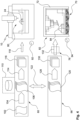
- Fig. 1 illustrates the basic structure of a machine tool designated 10 using a perspective view.
- the machine tool 10 is designed as a so-called gantry machine. This is not to be understood as limiting. Designs in a portal design (for example with a standing portal), in a traveling column design, or the like are also conceivable.
- a Cartesian coordinate system XYZ is shown.
- the coordinate system serves to illustrate basic orientations and axes of movement of the machine tool 10 and its components.
- An axis labeled X generally indicates a longitudinal extent.
- One labeled Y generally indicates a depth extension.
- the axes X and Y together define a horizontal plane.
- An axis labeled Z generally indicates a height extent.
- the XYZ coordinate system is intended primarily for illustrative purposes and is not to be construed in a limiting manner. It goes without saying that other coordinate systems can also be used to describe the machine tool 10 and its components. The expert can carry out appropriate transformations.
- the machine tool 10 has a frame 12, which can also be referred to as a base or bed.
- the frame 12 comprises two side cheeks, on the top of which guides (Y-guides) are formed.
- the machine tool 10 defines a work space 16 in which workpieces can be processed, in particular by machining.
- the workspace 16 is usually enclosed (in Fig. 1 Not shown).
- the machine tool 10 includes a tool spindle 20 with a tool holder 22 for holding a tool for machining a workpiece 24 is trained.
- the tool spindle 20 is oriented vertically.
- the tool spindle 20 is in Fig. 1 designed as a hanging spindle. With this design, tools can be driven around a vertically oriented spindle axis.
- the tool spindle 20 is movable relative to a workpiece holder 26 in order to machine a workpiece 24 arranged there.
- the workpiece holder 26 is arranged on a swivel bridge 28, which is mounted on both sides of the cheeks of the frame 12. Other designs are conceivable.
- the tool spindle 20 can be moved in three linear axes relative to the workpiece support 26.
- an X-slide 30, a Y-slide 32 and a Z-slide 34 are provided in the exemplary embodiment.
- the Y-slide 32 sits on the cheeks of the frame 12.
- the X-slide 30 is arranged on the Y-slide 32 so that it can be moved linearly.
- the Z carriage 34 is arranged to be linearly movable on the X carriage 30.
- the Z-slide carries the tool spindle 20.
- the X-slide 30 carries the Z-slide 34.
- the Y-slide 32 carries the X-slide 30.
- the X-slide 30 can be moved translationally along the Y-slide 32 in an X-axis 40 (X-direction).
- the Y carriage 32 can be moved translationally along the frame 12 in a Y axis 42 (Y direction).
- the Z carriage 34 can be moved in a Z axis 44 (Z direction) along the X carriage 30.
- the Z carriage 34 can be moved vertically.
- the X-slide 30 and the Y-slide 32 can be moved horizontally.
- the pivoting bridge 28 (A-axis 50, compare pivoting movements around the X-axis) and the workpiece support 26 (C-axis 56, compare pivoting movements around the Z-axis) provide further (rotational) movement axes.
- 5-axis machining is possible with the machine tool 10.
- Other designs of machine tool 10 are conceivable, for example with 4-axis kinematics, 3-axis kinematics or the like.
- the movement along the axes X, Y, Z can be carried out by the spindle 20 or the workpiece holder 26. It is essential that a relative movement occurs between the spindle 20 and the workpiece holder 26.
- Embodiments are also conceivable in which, for example, the movement along the Y axis (arrow 42) is realized by moving the workpiece holder 26 along the frame 12.
- a machine control unit is also indicated schematically at 60.
- the machine control unit 60 can also be referred to as a so-called NC control or CNC control.
- the machine control unit 60 is an inherent part of the machine tool 10 and controls movements of the tool spindle 20 and the workpiece 24 relative to one another.
- the machine control unit 60 usually includes a data processing device 64 and a memory 68 in which, for example, machine parameters are stored.
- the machine tool 10 further includes an operator interface 70, which is arranged adjacent to the frame 12 in the exemplary embodiment.
- the operator interface 70 is at least functionally coupled to the machine tool 10.
- the operator interface 70 includes a display 72 as well as controls/operating elements, which are designed as switches 74, for example.
- the display 72 as well as the switch or switches 74 and other operating elements can be provided, for example, by a touch screen (touch screen).
- the display 72 is designed to display graphical information, which, if necessary, includes a visualization of the processing currently taking place in the workspace 16. This can include a complex perspective display with the ability to vary the view orientation.
- a visualization unit 76 which includes a data processing device 78.
- the data processing device 64 of the machine control unit 60 and the data processing device 78 of the visualization unit 76 are implemented separately from one another. This may include structural and/or functional separation. In other words, in the exemplary embodiment, different hardware is provided for the data processing device 64 of the machine control unit 60 and the data processing device 78 of the visualization unit 76.
- Fig. 2 shows a simplified frontal schematic representation of the machine tool 10 according to Fig. 1 , wherein the display 72 of the operator interface 70 is shown enlarged.
- the machining in the working space 16 includes a drive of the tool holder 22 by the tool spindle 20 as well as relative movements between the tool spindle 20 and the workpiece 24.
- This real machining can also be referred to as actual machining 80.
- the operator interface 70 provided with the display 72 can be used to provide simulation data 82. This includes the virtual machining of a virtual workpiece 84 that is shown on the display 72.
- the operator interface 70 includes one or more switches 74 that can be used depending on the context. In the case of a touch-sensitive or proximity-sensitive display, switches 74 can be displayed if necessary. In this way, operation is simplified because only those switches are available whose use makes sense in a current situation.
- the operator interface 70 may also include other switches. This can also include discrete switches and other controls (dial, joystick, mouse, and the like).
- the simulation can be used to display simulation data 82, which allows an operator to have an overview of the actual processing 80. This is advantageous, for example, if the working space 16 is loaded with cooling lubricant, chips and the like and is not easily visible.
- the topology of the system 100 includes three data processing devices that can be differentiated from one another functionally and/or structurally.
- the machine control unit 60 in the machine tool 10 includes a first data processing device 64, which can be used to control the (real) actual processing 80.
- an operator interface 70 which includes a further data processing device 78 that is assigned to a visualization unit 76.
- the data processing device 78 is used in particular to visualize processing operations.
- simulation data 82 can be displayed on the display 72, which illustrates the machining of the real workpiece 24 based on virtual machining of a virtual workpiece 84.
- a further data processing device 88 is provided, which is associated with a simulation unit 86.
- the data processing device 64 of the machine control unit 60 is referred to as the first data processing device.
- the data processing device 88 of the simulation unit 86 is referred to as the second data processing device.
- the data processing device 78 of the visualization unit 76 is referred to as the third data processing device.
- the respective designation serves primarily to differentiate and is not to be understood as restrictive.
- the data processing device 88 of the simulation unit 86 can provide the data processing device 78 of the visualization unit 76 with simulation data 82 that can be displayed by the visualization unit 76.
- the data processing device 88 of the simulation unit 86 can exchange data with the data processing device 64 in the machine control unit 60 on the machine side.
- the data processing device 88 of the simulation unit 86 can exchange data with the data processing device 78 of the visualization 76.
- a direct data exchange can also take place between the data processing device 64 of the machine control unit 60 and the data processing device 78 of the visualization unit 76. This is, for example, information about a current operating state of the machine tool 10 and/or about the capture of operator inputs via the interface 70, which affect the operation of the machine tool 10.
- the simulation unit 86 can be used, for example, to model a so-called digital twin with the data processing device 88. In this way, the behavior of the machine tool 10 during the actual processing 80 can be visualized using simulation data 82.
- This can include a visualization of the processing of the virtual workpiece 84 in a first time level 92.
- the first time level 92 corresponds to the time level of the actual processing 80.
- the simulation data 82 also allow visualization of the processing of the virtual workpiece 84 in a second time level 94.
- the second time level 94 usually runs ahead of the first time level 92. In this way, impending collisions and the like can be detected. Furthermore, feeds 98 and other movements during machining can be visualized.
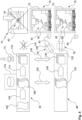
- Fig. 4 uses a schematic representation to illustrate the functional coupling between the machine control unit 60 and the simulation unit 86.
- the machine control unit 60 is used to process a machining program, compare machining program data labeled 102. These are processed by the first data processing device 64 ( Fig. 3 ) processed, compare the block arrow 104. In this way, machine control data 106 can be obtained. If necessary, the machine control data 106 can be stored in a so-called look-ahead memory 110. In this way, it is already known at a certain point in time which further processing steps will be processed immediately afterwards and how the machine tool 10 is to be controlled for this purpose.
- the machine control data 106 can be further processed, compare the block arrow 114, for example to provide axis control data 116 for individual axes of the machine tool 10.
- Axis control data 116 are transmitted to the axes of the machine tool 10 or their drives, compare the arrow 118.
- control loops and similar feedback can also be taken into account by the machine control unit 60. This includes, for example, actual positions of individuals Axes and other operating parameters of the machine tool to 14.
- the actual processing 80 of the real workpiece 24 takes place in a first time level 92.
- the simulation unit 86 is operated in parallel with the machine control unit 60 in order to simulate the real actual processing 80 using simulation data 82 or to monitor it using a digital twin.
- the simulation data 82 includes the machining of a virtual workpiece 84. This takes place, for example, in a second time level 94, which is slightly ahead of the first time level 92. In this way, impending collisions can be detected.
- the simulation unit 86 communicates with the machine control unit 60 via a data interface 122. In this way, the simulation unit 86 can access machine control data 106, for example. This can also include access to the look-ahead memory 110. In this way, the time offset between the first time level 92 and the second time level 94 is made possible.
- Machine control data 120 is from the data processing device 88 ( Fig. 3 ) processed by the simulation unit 86 and made available as simulated axis control data 130.
- a transmission (compare the arrow 132) can then take place to the operator interface 70 to the display 72. This can be done with the interposition of a visualization unit 76 with an associated data processing device 78 (see Fig. 3 ) to visualize the simulation data.
- the direct simulation mode can be triggered by operating a switch 74. This can be done, for example, by an operator who, when observing the actual processing 80, recognizes or at least fears an impending collision or other undesirable operating state.
- the transmission 118 of the axis control data 116 to the machine tool 10 can then be interrupted by actuating the switch 74. In other words, the machining of the real workpiece 24 is stopped.
- the direct simulation mode can be triggered by actuating a switch 74 (or another control element) before the actual machining of the real workpiece 24 with the machine tool 10 begins. This can be done, for example, before the actual running-in process of the machine tool 10 if an operator recognizes or at least fears an impending collision or other undesirable operating condition.
- the transmission 118 of the axis control data 116 to the machine tool 10 can then be prevented by actuating the switch 74. In other words, the real workpiece 24 is not (initially) processed.
- the direct simulation mode provides that the machine-related processing of the machining program data 102 is continued by the machine control unit 60. This is done to an extent that largely or as far as possible corresponds to the operation of the machine tool 10 in which the actual machining 80 of the real workpiece 24 corresponds.
- machine control data 106 and, on the basis of this, axis control data 116 with target positions for the individual axes of the machine tool 10 continue to be generated. However, the individual axes are no longer operated on the basis of this axis control data 116.
- the simulation unit 86 accesses data generated by the machine control unit 60 as late as possible along the data processing chain of the machine control unit 60, compare the arrow 136 in Fig. 5 . This data is then used as a basis for further simulation or visualization of the simulation data 82.
- the simulation unit 86 in the direct simulation mode foregoes certain integrated functionalities and instead uses real data from the machine control unit 60 of the machine tool 10 as far as possible.
- the data picked up by the machine control unit 60 can nevertheless be used for simulation purposes. This can include, for example, simulated axis movements based on the axis control data 116. Won in this way Data 130 can be used to provide simulation data 82 to represent the machining of the virtual workpiece in the first time level 92, compare the arrow 138 in Fig. 5 , which illustrates the transmission to the operator interface 70 or the visualization unit 76.
- the real machining of the real workpiece 24 in the first time level 92 is therefore transferred as seamlessly as possible into a virtual machining of the virtual workpiece 84, with the functionality of the machine control unit 60 being maintained as far as possible.
- simulation data 82 to represent the machining of the virtual workpiece 84 in the second (leading) time level 94 in the direct simulation mode. In principle, this can also be dispensed with if the aspect of anticipatory collision monitoring is no longer desired.
- FIG. 6 An exemplary embodiment of a method for machine-level simulation of the program flow in NC-controlled machine tools is illustrated using a block diagram.
- the method includes a step S10, which includes providing a machine tool with multiple numerically controlled axes.
- a step S12 relates to the execution of a machining program with a machine control unit of the machine tool.
- step S14 it is checked whether a control element that triggers a so-called direct simulation mode is activated or not. As long as the control element at S14 is not activated, real machining of a real workpiece takes place in a first time level in a step S16.
- the method further includes a step S18, which includes the provision of a simulation unit with the help of which the behavior of the machine tool can be monitored using a digital twin.
- the simulation unit is designed to exchange data with the machine control unit of the machine tool. This serves, for example, for collision avoidance purposes.
- the simulation unit allows virtual machining of a virtual workpiece in a second time level in a step S20.
- the second time level is usually slightly ahead of the first time level of the real processing in step S16.
- any collisions can be detected that have not yet occurred in the first time level during real processing in step S16.
- step S14 An operator can activate the direct simulation mode by operating the control element (step S14).
- the direct simulation mode the real machining of the real workpiece is interrupted in the first time level (step S16). Instead, this processing is replaced by a virtual processing in a step S22 in the same (first) time level.
- machine control data and axis control data provided by the machine control unit of the machine tool are used.
- the processing in the first time level is therefore simulated, but we deliberately refrain from comprehensively simulating the machine control unit. This allows the real processing to be continued or carried out virtually close to the machine, without the risk of collisions or the like.
Landscapes
- Engineering & Computer Science (AREA)
- Human Computer Interaction (AREA)
- Manufacturing & Machinery (AREA)
- Physics & Mathematics (AREA)
- General Physics & Mathematics (AREA)
- Automation & Control Theory (AREA)
- Numerical Control (AREA)
Applications Claiming Priority (1)
| Application Number | Priority Date | Filing Date | Title |
|---|---|---|---|
| DE102022123281.6A DE102022123281A1 (de) | 2022-09-13 | 2022-09-13 | System und Verfahren zur maschinennahen Programmablaufsimulation bei Werkzeugmaschinen |
Publications (1)
| Publication Number | Publication Date |
|---|---|
| EP4339724A1 true EP4339724A1 (fr) | 2024-03-20 |
Family
ID=88017643
Family Applications (1)
| Application Number | Title | Priority Date | Filing Date |
|---|---|---|---|
| EP23196809.0A Pending EP4339724A1 (fr) | 2022-09-13 | 2023-09-12 | Système et procédé de simulation de déroulement de programme proche de la machine dans des machines-outils |
Country Status (2)
| Country | Link |
|---|---|
| EP (1) | EP4339724A1 (fr) |
| DE (1) | DE102022123281A1 (fr) |
Families Citing this family (1)
| Publication number | Priority date | Publication date | Assignee | Title |
|---|---|---|---|---|
| DE102023136557A1 (de) | 2023-12-22 | 2025-06-26 | Homag Gmbh | Verfahren zum betrieb einer bearbeitungsmaschine sowie system |
Citations (6)
| Publication number | Priority date | Publication date | Assignee | Title |
|---|---|---|---|---|
| EP0671677B1 (fr) | 1994-03-11 | 1999-03-17 | Matsushita Electric Industrial Co., Ltd. | Méthode et appareil à finir une pièce avec une commande numérique et fonction simulation appuyé par un ordinateur |
| EP1018677B1 (fr) | 1999-01-05 | 2006-03-08 | Walter Maschinenbau GmbH | Système virtuel d'apprentissage |
| EP1762919A2 (fr) * | 2005-09-12 | 2007-03-14 | Index-Werke Gmbh & Co. KG Hahn & Tessky | Système de simulation |
| DE102007045595A1 (de) * | 2007-09-14 | 2009-03-26 | Index-Werke Gmbh & Co. Kg Hahn & Tessky | Verfahren und virtuelle Werkzeugmaschine zur Darstellung von Aktionen einer realen Werkzeugmaschine |
| WO2009037154A2 (fr) | 2007-09-14 | 2009-03-26 | Index-Werke Gmbh & Co. Kg Hahn & Tessky | Machine-outil |
| DE102009017795A1 (de) * | 2008-04-21 | 2009-10-22 | Mori Seiki Co., Ltd., Yamatokoriyama | Arbeitsvorgangssimulationsverfahren und Arbeitsvorgangssimulationsvorrichtung |
-
2022
- 2022-09-13 DE DE102022123281.6A patent/DE102022123281A1/de active Pending
-
2023
- 2023-09-12 EP EP23196809.0A patent/EP4339724A1/fr active Pending
Patent Citations (7)
| Publication number | Priority date | Publication date | Assignee | Title |
|---|---|---|---|---|
| EP0671677B1 (fr) | 1994-03-11 | 1999-03-17 | Matsushita Electric Industrial Co., Ltd. | Méthode et appareil à finir une pièce avec une commande numérique et fonction simulation appuyé par un ordinateur |
| EP1018677B1 (fr) | 1999-01-05 | 2006-03-08 | Walter Maschinenbau GmbH | Système virtuel d'apprentissage |
| EP1762919A2 (fr) * | 2005-09-12 | 2007-03-14 | Index-Werke Gmbh & Co. KG Hahn & Tessky | Système de simulation |
| DE102007045595A1 (de) * | 2007-09-14 | 2009-03-26 | Index-Werke Gmbh & Co. Kg Hahn & Tessky | Verfahren und virtuelle Werkzeugmaschine zur Darstellung von Aktionen einer realen Werkzeugmaschine |
| WO2009037154A2 (fr) | 2007-09-14 | 2009-03-26 | Index-Werke Gmbh & Co. Kg Hahn & Tessky | Machine-outil |
| EP2650741A2 (fr) * | 2007-09-14 | 2013-10-16 | Index-Werke GmbH & Co. KG Hahn & Tessky | Machine-outil |
| DE102009017795A1 (de) * | 2008-04-21 | 2009-10-22 | Mori Seiki Co., Ltd., Yamatokoriyama | Arbeitsvorgangssimulationsverfahren und Arbeitsvorgangssimulationsvorrichtung |
Also Published As
| Publication number | Publication date |
|---|---|
| DE102022123281A1 (de) | 2024-03-14 |
Similar Documents
| Publication | Publication Date | Title |
|---|---|---|
| EP1762919B1 (fr) | Système de simulation | |
| EP2188684B1 (fr) | Machine-outil virtuelle servant à représenter des actions menées par des unités d'usinage d'une machine-outil réelle | |
| DE69317540T2 (de) | Numerische Steuerung für eine Werkzeugmaschine und Verfahren zur Fortsetzung eines Bearbeitungsprogramms nach dessen Unterbrechung | |
| DE102012207916B3 (de) | Verfahren und Vorrichtung zur automatisierten Konfiguration einer Überwachungsfunktion einer Werkzeugmaschine | |
| EP0902343B1 (fr) | Procédé et système de création ou d'affichage d'instructions de commande | |
| DE102007045595A1 (de) | Verfahren und virtuelle Werkzeugmaschine zur Darstellung von Aktionen einer realen Werkzeugmaschine | |
| DE19900117A1 (de) | Virtuelles Teach-In-System | |
| DE102005027947A1 (de) | Vorrichtung zum Überprüfen einer Störung | |
| EP2837981B1 (fr) | Procédé et dispositif de configuration automatisée d'une fonction de surveillance d'un robot industriel | |
| DE10297651T5 (de) | Numerisches Steuerverfahren und numerisches Steuersystem | |
| EP2188682B1 (fr) | Machine-outil | |
| DE2940444C2 (de) | Kopiersteuerungsvorrichtung für eine Kopierfräsmaschine mit Werkzeugwechseleinrichtung | |
| DE112006003954T5 (de) | Vorrichtung mit einer numerischen Steuerung | |
| EP4339724A1 (fr) | Système et procédé de simulation de déroulement de programme proche de la machine dans des machines-outils | |
| EP1522004B1 (fr) | Machine-outil et son mode de fonctionnement | |
| EP0801340B1 (fr) | Méthode et dispositif de commande d'une machine-outil, en particulier machine d'usinage par électro-érosion | |
| DE102017222137B4 (de) | Numerische Steuervorrichtung | |
| DE102007017048A1 (de) | Vorrichtung und Verfahren zur Kontrolle eines Werkzeugs | |
| EP4150417B1 (fr) | Procédé de fonctionnement pour une machine-outil, produit programme informatique, unité de commande et machine-outil | |
| DE202007018545U1 (de) | Maschine zum Bearbeiten von Werkstücken zum maschinellen Bearbeiten von Werkstücken | |
| DE102019215497B4 (de) | Verfahren zum steuern einer numerisch gesteuerten werkzeugmaschine auf grundlage von ein nc-programm aufweisenden steuerdaten | |
| DE102006029527A1 (de) | Verfahren und Vorrichtung zum Bearbeiten eines Werkstücks | |
| EP4521178A1 (fr) | Procédé de fonctionnement d'une machine-outil à commande numérique | |
| EP3958074A1 (fr) | Évitement des collisions au moyen des données d'outil mesurées réelles |
Legal Events
| Date | Code | Title | Description |
|---|---|---|---|
| PUAI | Public reference made under article 153(3) epc to a published international application that has entered the european phase |
Free format text: ORIGINAL CODE: 0009012 |
|
| STAA | Information on the status of an ep patent application or granted ep patent |
Free format text: STATUS: THE APPLICATION HAS BEEN PUBLISHED |
|
| AK | Designated contracting states |
Kind code of ref document: A1 Designated state(s): AL AT BE BG CH CY CZ DE DK EE ES FI FR GB GR HR HU IE IS IT LI LT LU LV MC ME MK MT NL NO PL PT RO RS SE SI SK SM TR |
|
| STAA | Information on the status of an ep patent application or granted ep patent |
Free format text: STATUS: REQUEST FOR EXAMINATION WAS MADE |
|
| 17P | Request for examination filed |
Effective date: 20240912 |
|
| RBV | Designated contracting states (corrected) |
Designated state(s): AL AT BE BG CH CY CZ DE DK EE ES FI FR GB GR HR HU IE IS IT LI LT LU LV MC ME MK MT NL NO PL PT RO RS SE SI SK SM TR |
|
| STAA | Information on the status of an ep patent application or granted ep patent |
Free format text: STATUS: EXAMINATION IS IN PROGRESS |
|
| 17Q | First examination report despatched |
Effective date: 20260324 |