EP4342569A1 - Dilution d'adsorbat - Google Patents
Dilution d'adsorbat Download PDFInfo
- Publication number
- EP4342569A1 EP4342569A1 EP23197865.1A EP23197865A EP4342569A1 EP 4342569 A1 EP4342569 A1 EP 4342569A1 EP 23197865 A EP23197865 A EP 23197865A EP 4342569 A1 EP4342569 A1 EP 4342569A1
- Authority
- EP
- European Patent Office
- Prior art keywords
- adsorbent
- adsorbate
- transport container
- adsorber
- gas
- Prior art date
- Legal status (The legal status is an assumption and is not a legal conclusion. Google has not performed a legal analysis and makes no representation as to the accuracy of the status listed.)
- Pending
Links
- 239000002156 adsorbate Substances 0.000 title claims abstract description 39
- 238000010790 dilution Methods 0.000 title 1
- 239000012895 dilution Substances 0.000 title 1
- 239000003463 adsorbent Substances 0.000 claims abstract description 54
- 239000003507 refrigerant Substances 0.000 claims abstract description 21
- 238000001816 cooling Methods 0.000 claims abstract description 13
- 238000011109 contamination Methods 0.000 claims abstract description 5
- 239000000463 material Substances 0.000 claims abstract description 5
- 238000004519 manufacturing process Methods 0.000 claims abstract 2
- 238000000034 method Methods 0.000 claims description 19
- OKTJSMMVPCPJKN-UHFFFAOYSA-N Carbon Chemical group [C] OKTJSMMVPCPJKN-UHFFFAOYSA-N 0.000 claims description 14
- 230000000274 adsorptive effect Effects 0.000 claims description 5
- 238000011049 filling Methods 0.000 claims description 5
- 230000009969 flowable effect Effects 0.000 claims 1
- 230000014759 maintenance of location Effects 0.000 abstract 1
- 239000012530 fluid Substances 0.000 description 13
- 238000005057 refrigeration Methods 0.000 description 10
- 239000000126 substance Substances 0.000 description 9
- 239000002594 sorbent Substances 0.000 description 6
- 238000001179 sorption measurement Methods 0.000 description 5
- ATUOYWHBWRKTHZ-UHFFFAOYSA-N Propane Chemical compound CCC ATUOYWHBWRKTHZ-UHFFFAOYSA-N 0.000 description 4
- 238000011068 loading method Methods 0.000 description 4
- 231100000331 toxic Toxicity 0.000 description 3
- 230000002588 toxic effect Effects 0.000 description 3
- QGZKDVFQNNGYKY-UHFFFAOYSA-N Ammonia Chemical compound N QGZKDVFQNNGYKY-UHFFFAOYSA-N 0.000 description 2
- QQONPFPTGQHPMA-UHFFFAOYSA-N Propene Chemical compound CC=C QQONPFPTGQHPMA-UHFFFAOYSA-N 0.000 description 2
- 238000004880 explosion Methods 0.000 description 2
- 239000000203 mixture Substances 0.000 description 2
- 239000001294 propane Substances 0.000 description 2
- 238000000926 separation method Methods 0.000 description 2
- 238000010792 warming Methods 0.000 description 2
- 206010019233 Headaches Diseases 0.000 description 1
- 241000446313 Lamella Species 0.000 description 1
- 206010028813 Nausea Diseases 0.000 description 1
- 238000004378 air conditioning Methods 0.000 description 1
- 229910021529 ammonia Inorganic materials 0.000 description 1
- 230000009286 beneficial effect Effects 0.000 description 1
- 230000015572 biosynthetic process Effects 0.000 description 1
- 239000011248 coating agent Substances 0.000 description 1
- 238000000576 coating method Methods 0.000 description 1
- 239000000356 contaminant Substances 0.000 description 1
- 229920001577 copolymer Polymers 0.000 description 1
- 230000001419 dependent effect Effects 0.000 description 1
- 238000005137 deposition process Methods 0.000 description 1
- 238000003795 desorption Methods 0.000 description 1
- 238000001514 detection method Methods 0.000 description 1
- 230000018109 developmental process Effects 0.000 description 1
- 230000000694 effects Effects 0.000 description 1
- 238000001704 evaporation Methods 0.000 description 1
- 230000008020 evaporation Effects 0.000 description 1
- 239000002360 explosive Substances 0.000 description 1
- 239000006260 foam Substances 0.000 description 1
- 231100000869 headache Toxicity 0.000 description 1
- 229930195733 hydrocarbon Natural products 0.000 description 1
- 150000002430 hydrocarbons Chemical class 0.000 description 1
- 239000007788 liquid Substances 0.000 description 1
- 239000002184 metal Substances 0.000 description 1
- 230000003533 narcotic effect Effects 0.000 description 1
- 230000008693 nausea Effects 0.000 description 1
- 239000003973 paint Substances 0.000 description 1
- 230000008929 regeneration Effects 0.000 description 1
- 238000011069 regeneration method Methods 0.000 description 1
- 239000007787 solid Substances 0.000 description 1
- 239000007921 spray Substances 0.000 description 1
- 238000009423 ventilation Methods 0.000 description 1
- XLYOFNOQVPJJNP-UHFFFAOYSA-N water Substances O XLYOFNOQVPJJNP-UHFFFAOYSA-N 0.000 description 1
Images
Classifications
-
- B—PERFORMING OPERATIONS; TRANSPORTING
- B01—PHYSICAL OR CHEMICAL PROCESSES OR APPARATUS IN GENERAL
- B01D—SEPARATION
- B01D53/00—Separation of gases or vapours; Recovering vapours of volatile solvents from gases; Chemical or biological purification of waste gases, e.g. engine exhaust gases, smoke, fumes, flue gases, aerosols
- B01D53/02—Separation of gases or vapours; Recovering vapours of volatile solvents from gases; Chemical or biological purification of waste gases, e.g. engine exhaust gases, smoke, fumes, flue gases, aerosols by adsorption, e.g. preparative gas chromatography
-
- B—PERFORMING OPERATIONS; TRANSPORTING
- B01—PHYSICAL OR CHEMICAL PROCESSES OR APPARATUS IN GENERAL
- B01D—SEPARATION
- B01D2253/00—Adsorbents used in seperation treatment of gases and vapours
- B01D2253/10—Inorganic adsorbents
- B01D2253/102—Carbon
-
- B—PERFORMING OPERATIONS; TRANSPORTING
- B01—PHYSICAL OR CHEMICAL PROCESSES OR APPARATUS IN GENERAL
- B01D—SEPARATION
- B01D2257/00—Components to be removed
- B01D2257/70—Organic compounds not provided for in groups B01D2257/00 - B01D2257/602
- B01D2257/702—Hydrocarbons
- B01D2257/7022—Aliphatic hydrocarbons
Definitions
- the invention relates to the treatment of an adsorber with a flow-through, loading adsorbent, wherein the loading of the adsorbent consists of a working fluid which previously escaped from a refrigeration machine due to a leak and was adsorbed by the adsorbent of the adsorber.
- the adsorbent or adsorbent is the solid on whose surface the adsorption takes place, the adsorbate is the substance to be adsorbed before its adsorption, here the leaked refrigerant, the adsorbate is the adsorbate after adsorption has been completed and the desorbate is the substance released again through desorption adsorbate.
- the adsorbent can be used as a bed, the bed consisting of shaped bodies or broken pieces, or it can consist of porous foams or honeycomb bodies that are covered with activated carbon.
- the activated carbon can, for example, according to the EP 3 160 639 B1 made from vinylidene chloride copolymer.
- the adsorber can be arranged either inside a housing of a refrigeration machine or heat pump or outside, although in the present case it is only about adsorbers arranged on the outside.
- the thermodynamic cycle processes used have been known for a long time, as have the safety problems that can arise when using suitable working fluids. Aside from water, the most well-known working fluids at the time were flammable and toxic. In the last century, they led to the development of safety refrigerants made from fluorinated Hydrocarbons HFCs passed. However, it turned out that these safety refrigerants lead to global warming and that their safety-related harmlessness led to design carelessness. Up to 70% of HFC sales were attributable to the need to refill leaky systems and their leakage losses, which were accepted as long as this was perceived to be economically justifiable in individual cases and promoted the need for replacement procurement.
- climate friendliness is derived, on the one hand, from the particularly high efficiencies and, on the other hand, from the low GWP (Global Warming Potential).
- R290 only has a GWP value of 3, but it has COP values (Coefficient of Performance) of 3. 5 to 4 achievable, similar values can be achieved with R600a and R1270.
- the disadvantage is that it is highly flammable. Compromises are also being attempted, for example with R32, R443a or R441a, for which a GWP of a few hundred and a slightly reduced flammability are stated, but above all a direct replacement of existing systems is to be achieved.
- Adsorbers are now often used for safe separation in the event of a leak-related release. Examples of this are in the EP 3 486 582 A1 , the EP 3 772 369 A1 , the EP 3 693 683 A1 , the EP 3 771 905 A1 , as well as many other publications. It is also available for freezer refrigeration machines JP H11 351 7811 A known, in the event of a detected leak, to empty the refrigeration circuit into a container that contains an adsorbent. However, the refrigerant that has already escaped due to the leak cannot be recovered.
- the adsorber For the purposes of separation, it usually doesn't matter whether the adsorber is integrated into the otherwise sealed housing of a refrigeration machine or whether it is located separately outside. Also variable is the option to only start the flow through the adsorber after a leak has been detected or to ensure permanent flow.
- an adsorber it is also possible to connect an adsorber to the housing of a refrigeration machine or heat pump only if necessary. What is essential in this context is that the adsorber is open at its inlet to the interior of the housing or can be opened in response to a signal, and further that it is open to the exterior of the housing or can be opened in response to a signal. If a leak occurs in the interior of the housing, the resulting overpressure causes air contaminated with working fluid to enter the adsorber, the contamination is adsorbed in the adsorbent and cleaned air is passed into the environment. This environment is usually the interior of a building.
- An activated carbon bed as an adsorbent is used, for example, to protect against contamination of R290 in housings in which a working fluid acting as a refrigerant is conducted in a thermodynamic cycle, such as the Clausius-Rankine cycle.
- a working fluid acting as a refrigerant is conducted in a thermodynamic cycle, such as the Clausius-Rankine cycle.
- thermodynamic cycle such as the Clausius-Rankine cycle.
- the DE 10 2011 116 863 A1 describes a method for securing a device for a thermodynamic cycle, which is operated with a process fluid that contains or consists of at least one environmentally dangerous, toxic and/or flammable substance.
- a process fluid that contains or consists of at least one environmentally dangerous, toxic and/or flammable substance.
- an adsorbent is brought into contact with the process fluid, in particular ammonia, propane or propene, and the substance is selectively bound by the adsorbent.
- the adsorbent is regenerated after use.
- the adsorbent can be in the form of a bed, a shaped body, a paint, a spray film or a coating.
- the support structure of the shaped body can consist of a microstructure, lamella structure, tube bundle, tube register and sheet metal and must be mechanically stable and have a large surface area. Circulation of the potentially contaminated air usually occurs continuously, but can also be initiated by a sensor that switches on the ventilation after a threshold value is reached or when an accident is detected. Adsorption can be carried out inside or outside a closed space.
- the DE 195 25 064 C1 describes a refrigeration machine with a gas-tight housing which accommodates all refrigerant-carrying components of the machine, a space connecting the interior of the gas-tight housing with an outlet is provided, and the space is filled with a substance that absorbs the refrigerant.
- the amount of sorbing substance is dimensioned so that the entire amount of any refrigerant that may escape can be absorbed and kept away from the environment.
- the space filled with the sorbent substance is open to the surroundings. For refrigerants that are heavier than air, the space is open at the bottom; for those that are lighter, it is open at the top, so that a conveyor fan is not necessary.
- the sorbent is introduced into the housing and completely encloses the refrigeration machine or the refrigerant-carrying devices. On its way out, baffles are provided to prevent short-circuit flows and force escaping gas through the sorbent.
- a double-walled embodiment, in which the sorbent is arranged in the double jacket, is also possible.
- a measuring device for refrigerant can be provided at the outlet of the space filled with the sorbent substance to the environment.
- Cartridges with flow through them and fixed beds with retaining devices that contain activated carbon or other adsorbents in various forms are common in terms of equipment.
- Such devices are designed by determining the loading capacity of the activated carbon for each of the substances to be separated, whereby the loading capacity is generally highly dependent on temperature, and determining the flow rate. Ideally, this results in an adsorption equilibrium and a breakthrough front between the loaded and still unloaded adsorbent. This applies especially to deposition processes from the Gas phase, as with refrigerant that has escaped due to a leak. After such a process, however, it is usually not known exactly how high the load actually is. In the worst case scenario, one can assume that all of the refrigerant from the original filling of the refrigeration circuit is on the adsorbate.
- the loaded adsorbate in contrast to unloaded adsorbent, may not be transported because it is considered dangerous goods.
- ADR regulations stipulate that the danger of the adsorbed refrigerant must first be classified.
- refrigerant R290 for example, transport must be carried out in a pressure vessel that can permanently withstand 5 bar excess pressure.
- a maximum of 0.42 kg of refrigerant per liter of sorbent and no more than 5 kg absolute per transport unit may be transported. The same applies to other refrigerants.
- the object of the invention is therefore to provide a process which is capable of making the adsorbate transportable.
- the adsorbate should be able to contain an adsorbed refrigerant such as R290 and possibly other contaminants.
- the invention solves this problem by a method for preparing a contaminated adsorbate for transport from an adsorber, the adsorber having a flow-through adsorbent bed, a gas inlet and a gas outlet, a gas-permeable retaining device for adsorbent material at the gas inlet or at the gas outlet, wherein the adsorber can be opened by at least a lockable transport container is provided which is partially filled with adsorbent, and the adsorbate is at least partially filled into this transport container and a gaseous connection to the adsorbent is produced in the transport container.
- the adsorbate is mixed evenly with the adsorbent. In another embodiment, it is provided that the adsorbate is poured into the middle of the adsorbent and then covered with adsorbent and is therefore completely enclosed within the transport container. The adsorbate can also be filled into the transport container together with the adsorber and then covered with adsorbent.
- adsorptive When decanting by pouring, adsorptive can evaporate because there is no partial counter pressure for the adsorbate in the area where the decanting is taking place. It may therefore be necessary to take countermeasures in cases where such evaporation could result in the formation of an ignitable mixture.
- the adsorbent is filled into the transport container in cooled form.
- This cooling binds the adsorptive better.
- the adsorbent can be cooled in a standard freezer, reaching a temperature between minus 26 and minus 32 degrees.
- the transport container itself is also cooled together with the adsorbent.
- the adsorber is also cooled before the adsorbate is decanted, with a correspondingly shaped cooling vest being used depending on the shape and connections.
- Such cooling vests with cooling pads that can be fitted are also very common and cheaply available in sports shops. These cooling aids can also be prepared for use in a standard freezer.
- a refrigerated hopper is preferably used and the cooling vest is kept up to pulled over the opening of the transport container. It forms a cold trap for escaping vapors.
- R290 is liquid and the vapor pressure is so low that an ignitable mixture does not form. In this way it is safe to refill.
- the adsorbent and adsorbate are made of the same material, as they can then be processed together. Therefore, in one embodiment it is provided that the adsorbent is selected from the same material as the adsorbate.
- a preferred use is for activated carbon as an adsorbent and R290 as an adsorptive, but all other known adsorbents or adsorptives with hazard potential can also be made transportable in this way.
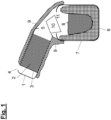
- FIG. 1 shows Fig. 1 transferring the adsorbate from the adsorber into a transport container filled with some adsorbent.
- Fig. 1 shows an adsorber 1 open at the top, which has an adsorbate bed 2, a gas-permeable basket 3 at the gas inlet 4 and an opening 5 at the gas outlet.
- the transport container 6 is filled with adsorbent 7. After filling, the adsorbate 8 is in the transport container.
- the adsorber 1 is surrounded by the cooling vest 9, which also encloses a filling aid 10 and the opening 11 of the transport container 6.
Landscapes
- Chemical & Material Sciences (AREA)
- Engineering & Computer Science (AREA)
- Analytical Chemistry (AREA)
- General Chemical & Material Sciences (AREA)
- Oil, Petroleum & Natural Gas (AREA)
- Chemical Kinetics & Catalysis (AREA)
- Separation Of Gases By Adsorption (AREA)
Applications Claiming Priority (1)
| Application Number | Priority Date | Filing Date | Title |
|---|---|---|---|
| DE102022124106.8A DE102022124106A1 (de) | 2022-09-20 | 2022-09-20 | Adsorbatverdünnung |
Publications (1)
| Publication Number | Publication Date |
|---|---|
| EP4342569A1 true EP4342569A1 (fr) | 2024-03-27 |
Family
ID=88093637
Family Applications (1)
| Application Number | Title | Priority Date | Filing Date |
|---|---|---|---|
| EP23197865.1A Pending EP4342569A1 (fr) | 2022-09-20 | 2023-09-18 | Dilution d'adsorbat |
Country Status (2)
| Country | Link |
|---|---|
| EP (1) | EP4342569A1 (fr) |
| DE (1) | DE102022124106A1 (fr) |
Citations (12)
| Publication number | Priority date | Publication date | Assignee | Title |
|---|---|---|---|---|
| DE19525064C1 (de) | 1995-07-10 | 1996-08-01 | Joachim Dr Ing Paul | Kältemaschine |
| JPH11351781A (ja) | 1998-06-11 | 1999-12-24 | Denso Corp | 熱交換器の固定構造 |
| EP1044162A1 (fr) * | 1998-01-08 | 2000-10-18 | Chematur Engineering Ab | Traitement surcritique de materiaux adsorbants |
| EP0578766B1 (fr) * | 1991-04-02 | 2001-02-28 | Norit Americas, Inc. | Procede de regeneration de charbon actif epuise et conteneur portable utilise dans ce procede |
| DE102011116863A1 (de) | 2011-10-25 | 2013-04-25 | Fraunhofer-Gesellschaft zur Förderung der angewandten Forschung e.V. | Verfahren zur Sicherung einer Vorrichtung für einen thermodynamischen Kreisprozess und abgesicherte Vorrichtung für einen thermodynamischen Kreisprozess |
| WO2015032905A1 (fr) | 2013-09-05 | 2015-03-12 | Holger König | Procédé permettant d'empêcher une fuite d'un contenant et contenant pourvu d'un dispositif anti-fuite |
| EP3486582A1 (fr) | 2017-11-16 | 2019-05-22 | Vaillant GmbH | Détection des fuites au moyen de capacité adsorbante |
| EP3160639B1 (fr) | 2014-06-30 | 2020-04-15 | Dow Global Technologies LLC | Compositions d'adsorbant de type tamis moléculaire de carbone à base de copolymère de chlorure de vinylidène, procédé de préparation de ceux-ci, ainsi que leur utilisation dans la séparation d'une mélange de propane et de propylène |
| EP3691772A1 (fr) * | 2017-10-01 | 2020-08-12 | Absolent AB | Procédé de recyclage d'un adsorbant actif saturé d'un module de filtre |
| EP3693683A1 (fr) | 2019-02-06 | 2020-08-12 | Vaillant GmbH | Barrière de diffusion au moyen de couches de protection |
| EP3771905A1 (fr) | 2019-08-01 | 2021-02-03 | Vaillant GmbH | Organe de mesure pour mesurer l'état d'adsorption et méthode de mesure correspondante |
| EP3772369A1 (fr) | 2019-08-08 | 2021-02-10 | Vaillant GmbH | Méthode et dispositif pour mesurer l'état de charge pendant l'adsorption |
Family Cites Families (1)
| Publication number | Priority date | Publication date | Assignee | Title |
|---|---|---|---|---|
| JPH11351711A (ja) * | 1998-06-11 | 1999-12-24 | Sanyo Electric Co Ltd | 冷媒回収装置を備えた冷凍装置 |
-
2022
- 2022-09-20 DE DE102022124106.8A patent/DE102022124106A1/de active Pending
-
2023
- 2023-09-18 EP EP23197865.1A patent/EP4342569A1/fr active Pending
Patent Citations (12)
| Publication number | Priority date | Publication date | Assignee | Title |
|---|---|---|---|---|
| EP0578766B1 (fr) * | 1991-04-02 | 2001-02-28 | Norit Americas, Inc. | Procede de regeneration de charbon actif epuise et conteneur portable utilise dans ce procede |
| DE19525064C1 (de) | 1995-07-10 | 1996-08-01 | Joachim Dr Ing Paul | Kältemaschine |
| EP1044162A1 (fr) * | 1998-01-08 | 2000-10-18 | Chematur Engineering Ab | Traitement surcritique de materiaux adsorbants |
| JPH11351781A (ja) | 1998-06-11 | 1999-12-24 | Denso Corp | 熱交換器の固定構造 |
| DE102011116863A1 (de) | 2011-10-25 | 2013-04-25 | Fraunhofer-Gesellschaft zur Förderung der angewandten Forschung e.V. | Verfahren zur Sicherung einer Vorrichtung für einen thermodynamischen Kreisprozess und abgesicherte Vorrichtung für einen thermodynamischen Kreisprozess |
| WO2015032905A1 (fr) | 2013-09-05 | 2015-03-12 | Holger König | Procédé permettant d'empêcher une fuite d'un contenant et contenant pourvu d'un dispositif anti-fuite |
| EP3160639B1 (fr) | 2014-06-30 | 2020-04-15 | Dow Global Technologies LLC | Compositions d'adsorbant de type tamis moléculaire de carbone à base de copolymère de chlorure de vinylidène, procédé de préparation de ceux-ci, ainsi que leur utilisation dans la séparation d'une mélange de propane et de propylène |
| EP3691772A1 (fr) * | 2017-10-01 | 2020-08-12 | Absolent AB | Procédé de recyclage d'un adsorbant actif saturé d'un module de filtre |
| EP3486582A1 (fr) | 2017-11-16 | 2019-05-22 | Vaillant GmbH | Détection des fuites au moyen de capacité adsorbante |
| EP3693683A1 (fr) | 2019-02-06 | 2020-08-12 | Vaillant GmbH | Barrière de diffusion au moyen de couches de protection |
| EP3771905A1 (fr) | 2019-08-01 | 2021-02-03 | Vaillant GmbH | Organe de mesure pour mesurer l'état d'adsorption et méthode de mesure correspondante |
| EP3772369A1 (fr) | 2019-08-08 | 2021-02-10 | Vaillant GmbH | Méthode et dispositif pour mesurer l'état de charge pendant l'adsorption |
Non-Patent Citations (4)
| Title |
|---|
| GEELEN CHARLES: "NATURAL REFRIGERANTS IN HEAT PUMPS", 1 May 2021 (2021-05-01), pages 1 - 134, XP093124588, Retrieved from the Internet <URL:https://topsectorenergie.nl/documents/610/Natural_refrigerants_in_heat_pumps_ENG_version_-_december_2022.pdf> [retrieved on 20240128] * |
| LOH WAI SOONG ET AL: "Adsorption Isotherms and Isosteric Enthalpy of Adsorption for Assorted Refrigerants on Activated Carbons", JOURNAL OF CHEMICAL AND ENGINEERING DATA., vol. 57, no. 10, 25 September 2012 (2012-09-25), US, pages 2766 - 2773, XP093124644, ISSN: 0021-9568, DOI: 10.1021/je3008099 * |
| RADERMACHER PASCAL ET AL: "Recommendations to safety guidelines and standards for the use of natural refrigerants", 1 November 2016 (2016-11-01), pages 1 - 39, XP093124576, Retrieved from the Internet <URL:https://www.umweltbundesamt.de/sites/default/files/medien/1968/publikationen/2017-01-16_leitfaden_recommendations_on_the_use_of_natural_refrigerants_en-1.pdf> [retrieved on 20240128] * |
| TOOLBOX ENGINEERING: "PROPANE VAPOUR PRESSURE VS. TEMPERATURE", 1 January 2005 (2005-01-01), pages 1 - 1, XP093125100, Retrieved from the Internet <URL:https://www.engineeringtoolbox.com/propane-vapor-pressure-d_1020.html> [retrieved on 20240130] * |
Also Published As
| Publication number | Publication date |
|---|---|
| DE102022124106A1 (de) | 2024-03-21 |
Similar Documents
| Publication | Publication Date | Title |
|---|---|---|
| EP3693683B1 (fr) | Barrière de diffusion au moyen de couches de protection | |
| EP3486582B1 (fr) | Dispositif de détection des fuites au moyen de capacité adsorbante | |
| DE69302893T2 (de) | Verfahren und Vorrichtung zur Rückgewinnung von zusammengesetzten Gasgemischen | |
| DE102011116863A1 (de) | Verfahren zur Sicherung einer Vorrichtung für einen thermodynamischen Kreisprozess und abgesicherte Vorrichtung für einen thermodynamischen Kreisprozess | |
| EP3581861B1 (fr) | Sorption du fluide | |
| EP3693078A1 (fr) | Capteur de niveau de remplissage | |
| DE2856349C3 (de) | Atemschutzgerät mit sauerstoffabgebender Chemikalpatrone | |
| WO2015032905A1 (fr) | Procédé permettant d'empêcher une fuite d'un contenant et contenant pourvu d'un dispositif anti-fuite | |
| EP4086540A1 (fr) | Régénération des adsorbants à appauvrissement en cov | |
| EP3693687A2 (fr) | Refroidissement d'adsorbant | |
| DE102019114744A1 (de) | Fluidadsorption | |
| EP3486564B1 (fr) | DISPOSITIF POUR UNE MISE EN OEUVRE SÉCURITAIRE D'UN PROCESSUS DE RANKINE CLAUSIUS THERMODYNAMIQUE À COMMUTATION GAUCHE&#xA;BASÉ SUR UNE ADSORPTION DE FLUIDE DE TRAVAIL À REFOULEMENT DE GAZ INERTE | |
| DE102022124089A1 (de) | Adsorberentladung | |
| EP3770520A1 (fr) | Dispositif de protection contre l'incendie | |
| EP4342569A1 (fr) | Dilution d'adsorbat | |
| DE69622294T2 (de) | Verfahren und Anlage zur Klimatisierung mit wenigstens für die Ozonschicht unschädlicher Kühlflüssigkeit | |
| DE102022124104A1 (de) | Adsorberentladung durch Verdrängungsdesorption | |
| DE102022124103A1 (de) | Adsorberentladung in Unterdruckkammer | |
| DE102022124090A1 (de) | Thermische Adsorberentladung | |
| EP4382193A1 (fr) | Dispositif d'adsorption | |
| DE102019121766A1 (de) | Füllstandssensor | |
| EP3647684B1 (fr) | Zone de sécurité du condenseur | |
| EP3492846B1 (fr) | Dispositif pour effectuer en toute sécurité un cycle de rankine thermodynamique en virage à gauche et sa vidange et son remplissage en toute sécurité au moyen d'un fluide de travail inflammable et procédé pour vider en toute sécurité un fluide de travail inflammable | |
| DE102023112279A1 (de) | Zweistufig adsorptiv wirksames Sicherheitskonzept | |
| DE19549271A1 (de) | Verfahren und Vorrichtung zur Aufbereitung von Narkosegasen |
Legal Events
| Date | Code | Title | Description |
|---|---|---|---|
| PUAI | Public reference made under article 153(3) epc to a published international application that has entered the european phase |
Free format text: ORIGINAL CODE: 0009012 |
|
| STAA | Information on the status of an ep patent application or granted ep patent |
Free format text: STATUS: THE APPLICATION HAS BEEN PUBLISHED |
|
| AK | Designated contracting states |
Kind code of ref document: A1 Designated state(s): AL AT BE BG CH CY CZ DE DK EE ES FI FR GB GR HR HU IE IS IT LI LT LU LV MC ME MK MT NL NO PL PT RO RS SE SI SK SM TR |
|
| STAA | Information on the status of an ep patent application or granted ep patent |
Free format text: STATUS: REQUEST FOR EXAMINATION WAS MADE |
|
| 17P | Request for examination filed |
Effective date: 20240926 |
|
| RBV | Designated contracting states (corrected) |
Designated state(s): AL AT BE BG CH CY CZ DE DK EE ES FI FR GB GR HR HU IE IS IT LI LT LU LV MC ME MK MT NL NO PL PT RO RS SE SI SK SM TR |