EP4343326B1 - Biologische konjugate mit einer fotogenerierten sauren oder basischen freisetzbaren detektionseinheit auf biologischem gewebe - Google Patents
Biologische konjugate mit einer fotogenerierten sauren oder basischen freisetzbaren detektionseinheit auf biologischem gewebe Download PDFInfo
- Publication number
- EP4343326B1 EP4343326B1 EP22196631.0A EP22196631A EP4343326B1 EP 4343326 B1 EP4343326 B1 EP 4343326B1 EP 22196631 A EP22196631 A EP 22196631A EP 4343326 B1 EP4343326 B1 EP 4343326B1
- Authority
- EP
- European Patent Office
- Prior art keywords
- moiety
- precursor
- radiation
- detection
- acid
- Prior art date
- Legal status (The legal status is an assumption and is not a legal conclusion. Google has not performed a legal analysis and makes no representation as to the accuracy of the status listed.)
- Active
Links
Images


Classifications
-
- G—PHYSICS
- G01—MEASURING; TESTING
- G01N—INVESTIGATING OR ANALYSING MATERIALS BY DETERMINING THEIR CHEMICAL OR PHYSICAL PROPERTIES
- G01N33/00—Investigating or analysing materials by specific methods not covered by groups G01N1/00 - G01N31/00
- G01N33/48—Biological material, e.g. blood, urine; Haemocytometers
- G01N33/50—Chemical analysis of biological material, e.g. blood, urine; Testing involving biospecific ligand binding methods; Immunological testing
- G01N33/53—Immunoassay; Biospecific binding assay; Materials therefor
- G01N33/543—Immunoassay; Biospecific binding assay; Materials therefor with an insoluble carrier for immobilising immunochemicals
- G01N33/54353—Immunoassay; Biospecific binding assay; Materials therefor with an insoluble carrier for immobilising immunochemicals with ligand attached to the carrier via a chemical coupling agent
-
- G—PHYSICS
- G01—MEASURING; TESTING
- G01N—INVESTIGATING OR ANALYSING MATERIALS BY DETERMINING THEIR CHEMICAL OR PHYSICAL PROPERTIES
- G01N33/00—Investigating or analysing materials by specific methods not covered by groups G01N1/00 - G01N31/00
- G01N33/48—Biological material, e.g. blood, urine; Haemocytometers
- G01N33/50—Chemical analysis of biological material, e.g. blood, urine; Testing involving biospecific ligand binding methods; Immunological testing
- G01N33/53—Immunoassay; Biospecific binding assay; Materials therefor
- G01N33/531—Production of immunochemical test materials
- G01N33/532—Production of labelled immunochemicals
-
- G—PHYSICS
- G01—MEASURING; TESTING
- G01N—INVESTIGATING OR ANALYSING MATERIALS BY DETERMINING THEIR CHEMICAL OR PHYSICAL PROPERTIES
- G01N1/00—Sampling; Preparing specimens for investigation
- G01N1/28—Preparing specimens for investigation including physical details of (bio-)chemical methods covered elsewhere, e.g. G01N33/50, C12Q
- G01N1/44—Sample treatment involving radiation, e.g. heat
-
- G—PHYSICS
- G01—MEASURING; TESTING
- G01N—INVESTIGATING OR ANALYSING MATERIALS BY DETERMINING THEIR CHEMICAL OR PHYSICAL PROPERTIES
- G01N33/00—Investigating or analysing materials by specific methods not covered by groups G01N1/00 - G01N31/00
- G01N33/48—Biological material, e.g. blood, urine; Haemocytometers
- G01N33/50—Chemical analysis of biological material, e.g. blood, urine; Testing involving biospecific ligand binding methods; Immunological testing
- G01N33/53—Immunoassay; Biospecific binding assay; Materials therefor
- G01N33/536—Immunoassay; Biospecific binding assay; Materials therefor with immune complex formed in liquid phase
-
- G—PHYSICS
- G01—MEASURING; TESTING
- G01N—INVESTIGATING OR ANALYSING MATERIALS BY DETERMINING THEIR CHEMICAL OR PHYSICAL PROPERTIES
- G01N33/00—Investigating or analysing materials by specific methods not covered by groups G01N1/00 - G01N31/00
- G01N33/48—Biological material, e.g. blood, urine; Haemocytometers
- G01N33/50—Chemical analysis of biological material, e.g. blood, urine; Testing involving biospecific ligand binding methods; Immunological testing
- G01N33/58—Chemical analysis of biological material, e.g. blood, urine; Testing involving biospecific ligand binding methods; Immunological testing involving labelled substances
- G01N33/582—Chemical analysis of biological material, e.g. blood, urine; Testing involving biospecific ligand binding methods; Immunological testing involving labelled substances with fluorescent label
Definitions
- the present invention is directed to a process for detection or identification of target moieties or target cells or from a cell sample by labelling the target moieties or target cells with a conjugate having a detection moiety and an antigen or an oligonucleotide recognizing moiety linked via an acidic or basic degradable spacer, wherein the acid, or base, used for degrading the spacer is provided in form of a spatially photoactivable precursor.
- the precursor After detecting the target moieties, the precursor is activated or photocleaved by radiation and the acid, or base, for degrading the spacer is released, thereby removing at least the detection moiety from the labelled target moiety.
- conjugates comprising a fluorescent moiety and antigen recognizing moiety. Furthermore, conjugates have been developed from which the fluorescent moiety can be removed, thereby allowing re-staining of the cells which in turn allows detecting multiple target moieties.
- fluorescently labelled oligonucleotides can be used to detect a target sequence and the fluorescent moiety can be cleaved off later to perform subsequent multiple set of hybridization and detection to increase the power of decoding or detection.
- conjugates composed of an antigen binding moiety linked via an acidic or basic degradable spacer to a detection moiety can be degraded by activating or photocleaving a precursor of an acid or a base. After release, the biological specimen can be subjected to the same or a different conjugate again without interference of the previous label.
- Object of the invention is therefore a method for detecting a target moiety in a sample of biological specimens by
- Activation of the precursor may be achieved by photocleaving the precursor into at least two subuntits wherein at least one of the subunits is an acid and/or a base.
- the antigen or oligonucleotide recognizing moiety Y is cleaved from the detection moiety.
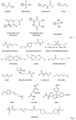
- Fig. 1 to 4 show examples of units for acidic or basic degradable spacer P.
- Fig. 2 is taken from G. Lerche et al, Bioorg Chem. 20 (2021) 571-582 )
- cleaving the detection moiety X from the conjugate means that the bond between X and P is abrogated and detection moiety X may be removed from the target for example by dissociation or washing.
- the antigen recognizing moiety Y is also be removed from the target by abrogating the bond between X and P.
- the process of the invention may be performed in one or more sequences of the steps a) to g). After each sequence, the detection moiety and optionally the antigen recognizing moiety is released (removed) from the target moiety. Especially when the biological specimens are living cells which shall be further processed or analysed, the method of the invention has the advantage of providing unlabelled cells.
- a washing step can be performed to remove unwanted material like unbound conjugates or released detection moieties from the sample.
- target moiety to be detected with the method of the invention can be on any biological specimen, like tissues slices, cell aggregates, suspension cells, or adherent cells.
- the cells may be living or dead.
- target moieties are antigens expressed intracellular or extracellular on biological specimen like whole animals, organs, tissues slices, cell aggregates, or single cells of invertebrates, (e.g., Caenorhabditis elegans, Drosophila melanogaster), vertebrates (e.g., Danio rerio (Hamilton, 1822) , Xenopus laevis, (Daudin 1802)) and mammalians (e.g., Mus musculus, Linnaeus, 1758, Homo sapiens, Linneaeus, 1758)).
- invertebrates e.g., Caenorhabditis elegans, Drosophila melanogaster
- vertebrates e.g., Danio rerio (
- the detection moiety X of the conjugate may be any moiety possessing a property or function which can be used for detection purposes like those selected from the group consisting of chromophore moiety, fluorescent moiety, phosphorescent moiety, luminescent moiety, light absorbing moiety, radioactive moiety, and transition metal isotope mass tag moiety.
- Suitable fluorescent moieties are those known from the art of immunofluorescence technologies, e.g., flow cytometry or fluorescence microscopy.
- the target moiety labeled with the conjugate is detected by exciting the detection moiety X and detecting the resulting emission (photoluminescence).
- the detection moiety X is preferable a fluorescent moiety.
- Useful fluorescent moieties might be protein-based, such as phycobiliproteins, polymeric, such as polyfluorenes, small organic molecule dyes, such as xanthenes, like fluorescein, or rhodamines, cyanines, oxazines, coumarins, acridines, oxadiazoles, pyrenes, pyrromethenes, or metallo-organic complexes, such as Ru, Eu, Pt complexes.
- nanoparticles such as quantum dots, upconverting nanoparticles, gold nanoparticles, dyed polymer nanoparticles can also be used as fluorescent moieties.
- Phosphorescent moieties include metallo-organic complexes, such as Pd, Pt, Tb, Eu complexes, or nanoparticles with incorporated phosphorescent pigments such as lanthanide doped SrAl 2 O 4 .
- the detection moiety is capable of causing chemiluminescence, i.e. horseradish peroxidase label in the presence of luminol.
- the target labeled with the conjugate is not detected by radiation emission, but by absorption of UV, visible light, or NIR radiation.
- Suitable light-absorbing detection moieties are light absorbing dyes without fluorescence emission, such as small organic molecule quencher dyes like N-aryl rhodamines, azo dyes, and stilbenes.
- the light-absorbing detection moieties X can be irradiated by pulsed laser light, generating an photoacoustic signal.
- the target labeled with the conjugate is detected by mass spectrometric detection of a transition metal isotope.
- Transition metal isotope mass tag labels might be introduced as covalently bound metallo-organic complexes or nanoparticle component.
- isotope tags of lanthanides and adjacent late transition elements are known in the art.
- the detection moiety X can be covalently or non-covalently coupled to the spacer P.
- Methods for covalently or non-covalently conjugation are known by persons skilled in the art.
- a direct reaction of an activated group either on the detection moiety or on the spacer P with a functional group on either the spacer P or on the detection moiety X or via an heterobifunctional linker molecule, which is firstly reacted with one and secondly reacted with the other binding partner is possible.
- heterobifunctional compounds are available for linking to entities.
- Illustrative entities include: azidobenzoyl hydrazide, N-[4-(p-azidosalicylamino)butyl]-3'-[2'-pyridyldithio]propionamide), bis-sulfosuccinimidyl suberate, dimethyladipimidate, disuccinimidyltartrate, N-y-maleimidobutyryloxysuccinimide ester, N-hydroxy sulfosuccinimidyl-4- azidobenzoate, N-succinimidyl [4-azidophenyl]-1,3'-dithiopropionate, N-succinimidyl [4-iodoacetyl]aminobenzoate, glutaraldehyde, succinimidyl-[(N-maleimidopropionamido) polyethyleneglycol
- a preferred linking group is 3-(2-pyridyldithio)propionic acid N-hydroxysuccinimide ester (SPDP), or 4-(N-maleimidomethyl)-cyclohexane-1-carboxylic acid N-hydroxysuccinimide ester (SMCC) with a reactive sulfhydryl group on the detection moiety and a reactive amino group on the spacer P.
- SPDP 3-(2-pyridyldithio)propionic acid N-hydroxysuccinimide ester
- SMCC 4-(N-maleimidomethyl)-cyclohexane-1-carboxylic acid N-hydroxysuccinimide ester
- a quasi-covalent binding of the detection moiety X to the spacer P can be achieved with binding systems providing a dissociation constant of ⁇ 10 -9 M, e.g., Biotin-Avidin binding interaction.
- Suitable acidic or basic degradable spacers P may comprise acidic or basic cleavable functional units selected from the group consisting of acetals, silyl esters, hydrazine, imine, esters, phosphoramidite, hydrazine, vinyl ether, trityl, aconitril, oxycarbonyl, paramethoxybenzyl, ketal, polyketal, orthoesters, thiomalemic acid, in a linker with alkyl, polyethyleneglycol, polysaccharides, proteins, peptides, depsipeptides, polyesters, nucleic acids segments and derivatives thereof.
- the radiation used for activating or photocleaving the precursor depends on the chemical nature of the precursor, but is usually in the range of 200 to 800 nm.
- Suitable precursors comprises functional units selected from the group consisting of diazonium salts, perhalomethyltriazines, Halobisphenyl, o-nitrobenzaldehyde, sulfonates, imidylsulfonyl esters, diaryliodonium salts, sulfonium salts, diazosulfonate, diarylsulfones, 1,2-diazoketones, 2-diazo 1-oxo 5 sulfonyl, 2-diazo 1-oxo 4 sulfonyl, diazomethyl ketone, diazoMeldrum's acid, arylazidederivatives, benzocarbonates, carbamates, dimethoxybenzoiinyl carbonates, dimethoxybenzoiinyl carbamates, o-nitrobenzyloxy carbonates, o-nitrobenzyloxy carbamates, nitrobenzene sulpenyl, o-nitroanilines, nitrobenzyl
- antigen recognizing moiety Y refers to any kind of antibody, fragmented antibody or fragmented antibody derivatives, directed against the target moieties expressed on the biological specimens, like antigens expressed intracellular or extracellular on cells.
- the term relates to fully intact antibodies, fragmented antibody or fragmented antibody derivatives, e.g., Fab, Fab', F(ab')2, sdAb, scFv, di-scFv, nanobodies.
- fragmented antibody derivatives may be synthesized by recombinant procedures including covalent and non-covalent conjugates containing these kind of molecules.
- antigen recognizing moieties are peptide/MHC-complexes targeting TCR molecules, cell adhesion receptor molecules, receptors for costimulatory molecules, artificial engineered binding molecules, e.g., peptides or aptamers which target, e.g., cell surface molecules.
- the "antigen recognizing moiety Y" may also comprise oligonucleotide which recognize appropriate target moieties of the biological specimens, like other nucleotides.
- the oligonucleotides comprise 10-200 nucleotides.
- the conjugate used in the method of the invention may comprise up to 100, preferable 1- 20 antigen recognizing moieties Y.
- the interaction of the antigen recognizing moiety with the target antigen can be of high or low affinity. Binding interactions of a single low-affinity antigen recognizing moiety is too low to provide a stable bond with the antigen.
- Low-affinity antigen recognizing moieties can be multimerized by conjugation to the enzymatically degradable spacer P to furnish high avidity.
- the low-affinity antigen recognizing moieties When the spacer P is enzymatically cleaved in step g), the low-affinity antigen recognizing moieties will be monomerized which results in a complete removal of the detection moiety X, the spacer P and the antigen recognizing moiety Y (Fig. 3 b). High-affinity antigen recognizing moieties provide a stable bond which results in a removal of the detection moiety X and the spacer P during step g).
- Antigen recognizing moiety Y refers to an antibody directed against antigen expressed by the biological specimens (target cells) intracellular, like IL2, FoxP3, CD154, or extracellular, like CD3, CD14, CD4, CD8, CD25, CD34, CD56, and CD133.
- the antigen recognizing moieties Y can be coupled to the spacer P through side chain amino or sufhydryl groups.
- the glycosidic side chain of the antibody can be oxidized by periodate resulting in aldehyde functional groups.
- the antigen recognizing moiety Y can be covalently or non-covalently coupled to the spacer P.
- Methods for covalent or non-covalent conjugation are known by persons skilled in the art and the same as mentioned for conjugation of the detection moiety X.
- the method of the invention is especially useful for detection and/or isolation of specific cell types from complex mixtures and may comprise more than one sequential or parallel sequences of the steps a) - g).
- the method may use a variety of combinations of conjugates.
- a conjugate may comprise antibodies specific for two different epitopes, like two different anti-CD34 antibodies.
- Different antigens may be addressed with different conjugates comprising different antibodies, for example, anti-CD4 and anti-CD8 for differentiation between two distinct T-cell-populations or anti-CD4 and anti-CD25 for determination of different cell subpopulations like regulatory T-cells.
- the amount of acid needs to be sufficient to degrade substantially the spacer in the desired period of time.
- the detection signal is at least about 80%, more usually at least about 95%, preferably at least about 99% reduced.
- the conditions for release may be empirically optimized in terms of temperature, pH, presence of metal cofactors, reducing agents, etc.
- the degradation will usually be completed in at least about 15 minutes, more usually at least about 10 minutes, and will usually not be longer than about 30 minutes.
- more than one precursor may be provided, wherein the different precursors are activated or photocleaved by radiation of different wavelengths.
- the conjugate is provided to a surface of a biological specimen and the radiation for activating the precursor is applied to spatial defined regions of the biological specimen.
- the degrading of spacer P is restricted to the spatial defined regions of the biological specimen only.
- the sample of biological specimens has a first pH and after activating the precursor by providing radiation, at least a part of the sample of biological specimens has a second pH; wherein the difference of the first and second pH is at least +-0.5, preferably at least +-1,0, more preferred at least +-2.0.
- pH range shall not exceed 4 to 10.
- the radiation for activating the precursor is applied to at least one spatial defined region of the biological specimen, wherein before providing radiation, the at least one spatial defined region has a first pH and after activating the precursor by providing radiation, the at least one spatial defined region has a second pH; wherein the difference of the first and second pH is at least +-0,5, preferably at least +-1,0, more preferred at least +-2.0.
- pH range shall not exceed 4 to 10.
- the method and equipment to detect the target labeled with the conjugate X n - P - Y m is determined by the detection moiety X.
- the detection moiety X is a fluorescent moiety.
- Targets labeled with fluorochrome-conjugate are detected by exciting the fluorescent moiety X and analysing the resulting fluorescence signal.
- the wavelength of the excitation is usually selected according to the absorption maximum of the fluorescent moiety X and provided by LASER or LED sources as known in the art. If several different detection moieties X are used for multiple colour/parameter detection, care should be taken to select fluorescent moieties having not overlapping absorption spectra, at least not overlapping absorption maxima.
- the targets may be detected, e.g., under a fluorescence microscope, in a flow cytometer, a spectrofluorometer, or a fluorescence scanner.
- Light emitted by chemiluminescence can be detected by similar instrumentation omitting the excitation.
- Radioactive detection moieties are detected though the radiation emitted by the radioactive isotopes.
- Suitable instrumentation for detection of radioactive radiation include, for example, scintillation counters. In case of beta emission electron microscopy can also be used for detection.
- Transition metal isotope mass tag moieties are detected by mass spectrometric methods such as ICP-MS, which is integrated in mass cytometry instrumentation.
- the method of the invention can be used for various applications in research, diagnostics and cell therapy.
- biological specimens like cells are detected for counting purposes i.e. to establish the amount of cells from a sample having a certain set of antigens recognized by the antigen recognizing moieties of the conjugate.
- one or more populations of biological specimens are detected from the sample and separated as target cells.
- This variant may be used for purification of target cells, for example, in clinical research, diagnostics, and immunotherapy.
- one or more sorting steps may be performed after any of the steps a) to g) and the optionally washing steps.
- Suitable for such separations are especially flow sorters, e.g., FACS or MEMS-based cell sorter systems, for example as disclosed in EP14187215.0 or EP14187214.3 .
- the location of the target moieties like antigens on the biological specimens recognized by the antigen recognizing moieties of the conjugate is determined.
- Such techniques are known as "Multi Epitope Ligand Cartography", “Chip-based Cytometry” or “Multioymx” and are described, for example, in EP 0810428 , EP1181525 , EP 1136822 or EP1224472 .
- cells are immobilized and contacted with antibodies coupled to fluorescent moiety.
- the antibodies are recognized by the respective antigens on the biological specimen (for example on a cell surface) and after removing the unbound marker and exciting the fluorescent moieties, the location of the antigen is detected by the fluorescence emission of the fluorescent moieties.
- antibodies coupled to fluorescent moieties instead of antibodies coupled to fluorescent moieties, antibodies coupled to moieties detectable for MALDI-Imaging or CyTOF can be used.
- the person skilled in the art is aware how to modify the technique based on fluorescent moiety to work with these detection moieties.
- the location of the target moieties is achieved by a digital imaging device with a sufficient resolution und sensitivity in for the wavelength of the fluorescence radiation.
- the digital imaging device may be used with or without optical enlargement for example with a fluorescence microscope.
- the resulting images are stored on an appropriate storing device like a hard drive, for example in RAW, TIF, JPEG, or HDF5 format.
- antibody-conjugates having the same or different fluorescent moiety or antigen recognizing moiety Y can be provided. Since the parallel detection of fluorescence emission with different wavelengths is limited, the antibody-fluorochrome-conjugates are utilized sequentially individually or in small groups (2-10) after the other.
- the biological specimens - especially suspension cells - of the sample are immobilized by trapping in microcavities or by adherence.
- the method of the invention can be performed in several variants.
- the conjugate not recognized by a target moiety can be removed by washing for example with buffer before the target moiety labelled with the conjugate is detected.
- At least two conjugates are provided simultaneously or in subsequent staining sequences, wherein each antigen recognizing moiety Y recognizes different antigens.
- at least two conjugates can be provided to the sample simultaneously or in subsequent staining sequences, wherein each conjugate comprises a different degradable spacer P which is cleaved by different enzymes.
- the labelled target moieties can be detected simultaneously or sequentially. Sequential detection may involve simultaneous degrading of the spacer molecules P or subsequent degrading of the spacer molecules P with optionally intermediate removing (washing) of the non-bonded moieties.
Landscapes
- Health & Medical Sciences (AREA)
- Life Sciences & Earth Sciences (AREA)
- Immunology (AREA)
- Engineering & Computer Science (AREA)
- Chemical & Material Sciences (AREA)
- Molecular Biology (AREA)
- Biomedical Technology (AREA)
- Hematology (AREA)
- Urology & Nephrology (AREA)
- Analytical Chemistry (AREA)
- Physics & Mathematics (AREA)
- Biochemistry (AREA)
- General Health & Medical Sciences (AREA)
- General Physics & Mathematics (AREA)
- Pathology (AREA)
- Microbiology (AREA)
- Cell Biology (AREA)
- Food Science & Technology (AREA)
- Medicinal Chemistry (AREA)
- Biotechnology (AREA)
- Measuring Or Testing Involving Enzymes Or Micro-Organisms (AREA)
- Investigating, Analyzing Materials By Fluorescence Or Luminescence (AREA)
Claims (11)
- Verfahren zum Nachweisen einer Zielkomponente in einer Probe von biologischen Präparaten durch:a) Bereitstellen mindestens eines Konjugats mit der allgemeinen Formel (I) Xn - P - Ym, wobei X eine Nachweiskomponente ist, P ein saurer oder basischer abbaubarer Spacer und Y eine Antigen- oder Oligonukleotid-Erkennungskomponente ist, und n, m ganze Zahlen zwischen 1 und 100 sind und wobei X und Y kovalent an P gebunden sind,b) Binden des Konjugats an die Zielkomponente über die Antigen- oder Oligonukleotid-Erkennungskomponente Y, wodurch die Zielkomponente markiert wird,c) Nachweisen der Zielkomponente, die mit dem Konjugat markiert ist, durch Nachweisen der Nachweiskomponente X,d) Bereitstellen mindestens eines Vorläufers, der in der Lage ist, eine Säure oder Base freizusetzen, wenn er bestrahlt wird, wobei die Säure oder Base in der Lage ist, P zu spalten,e) Aktivieren des Vorläufers durch Bestrahlen, wodurch die Säure oder Base, die in der Lage ist, P zu spalten, freigesetzt wird; undf) Abbauen des Spacers P mit der freigesetzten Säure oder Base, wodurch die Nachweiskomponente X von der konjugierten Nachweiskomponente abgespalten wird.
- Verfahren nach Anspruch 1, dadurch gekennzeichnet, dass der Vorläufer durch Fotospaltung in mindestens zwei Untereinheiten aktiviert wird, wobei mindestens eine der Untereinheiten eine Säure und/oder eine Base ist.
- Verfahren nach Anspruch 1 oder 2, gekennzeichnet durch das saure oder basische Abbauen des Spacer P, wobei die Antigen- oder Oligonukleotid-Erkennungskomponente Y von der Nachweiskomponente abgespalten wird.
- Verfahren nach einem der Ansprüche 1 bis 3, dadurch gekennzeichnet, dass die Nachweiskomponente ausgewählt ist aus der Gruppe bestehend aus einer chromophoren Komponente, einer fluoreszierenden Komponente, einer phosphoreszierenden Komponente, einer lumineszierenden Komponente, einer lichtabsorbierenden Komponente, einer radioaktiven Komponente, einem Übergangsmetall und einer Isotopenmassenmarkierungskomponente.
- Verfahren nach einem der Ansprüche 1 bis 4, dadurch gekennzeichnet, dass der sauer oder basisch abbaubare Spacer P sauer oder basisch spaltbare funktionelle Einheiten umfasst, ausgewählt aus der Gruppe bestehend aus Acetalen, Silylestern, Hydrazin, Imin, Estern, Phosphoramidit, Hydrazin, Vinylether, Trityl, Aconityl, Oxycarbonyl, Paramethoxybenzyl, Ketal, Polyketal, Orthoestern, Thiomaleminsäure, in einem Linker mit Alkyl, Polyethylenglykol, Polysacchariden, Proteinen, Peptiden, Depsipeptiden, Polyestern, Nukleinsäuresegmenten und Derivaten davon.
- Verfahren nach einem der Ansprüche 1 bis 5, dadurch gekennzeichnet, dass die Antigen-Erkennungskomponente Y ein Antikörper, ein fragmentierter Antikörper, ein fragmentiertes Antikörperderivat, Peptid/MHC-Komplexe, die auf TCR-Moleküle gerichtet sind, Zelladhäsionsrezeptormoleküle, Rezeptoren für kostimulatorische Moleküle oder künstlich hergestellte Bindungsmoleküle ist.
- Verfahren nach einem der Ansprüche 1 bis 6, dadurch gekennzeichnet, dass der Vorläufer funktionelle Einheiten umfasst, ausgewählt aus der Gruppe bestehend aus Diazoniumsalzen, Perhalogenmethyltriazinen, Halobisphenyl, o-Nitrobenzaldehyd, Sulfonaten, Imidylsulfonylestern, Diaryliodoniumsalzen, Sulfoniumsalzen, Diazosulfonat, Diarylsulfonen, 1,2-Diazoketonen, 2-Diazo-1-oxo-5-sulfonyl, 2-Diazo-1-oxo-4-sulfonyl, Diazomethylketon, Diazo-Meldrumsäure, Arylazid-Derivaten, Benzocarbonaten, Carbamaten, Dimethoxybenzoiinylcarbonaten, Dimethoxybenzoiinylcarbamaten, o-Nitrobenzyloxycarbonaten, o-Nitrobenzyloxycarbamaten, Nitrobenzolsulphenyl, o-Nitroanilinen, Nitrobenzylcarbamat, 3',5'-Dimethoxybenzoincarbamaten.
- Verfahren nach einem der Ansprüche 1 bis 7, dadurch gekennzeichnet, dass mehr als ein Vorläufer bereitgestellt wird, wobei die verschiedenen Vorläufer durch Bestrahlung mit unterschiedlichen Wellenlängen aktiviert werden.
- Verfahren nach einem der Ansprüche 1 bis 8, dadurch gekennzeichnet, dass die Probe der biologischen Präparate einen ersten pH-Wert aufweist und nach Aktivierung des Vorläufers durch Bestrahlen mindestens ein Teil der Probe der biologischen Präparate einen zweiten pH-Wert aufweist, wobei die Differenz zwischen dem ersten und dem zweiten pH-Wert mindestens +-0,5 beträgt.
- Verfahren nach einem der Ansprüche 1 bis 9, dadurch gekennzeichnet, dass das Konjugat auf eine Oberfläche eines biologischen Präparats bereitgestellt wird und die Bestrahlung zur Aktivierung des Vorläufers auf räumlich definierte Regionen des biologischen Präparats angewendet wird.
- Verfahren nach Anspruch 10, dadurch gekennzeichnet, dass die Bestrahlung zur Aktivierung des Vorläufers auf mindestens eine räumlich definierte Region des biologischen Präparats angewendet wird, wobei vor der Bestrahlung die mindestens eine räumlich definierte Region einen ersten pH-Wert aufweist und nach der Aktivierung des Vorläufers durch Bestrahlung die mindestens eine räumlich definierte Region einen zweiten pH-Wert aufweist; wobei die Differenz zwischen dem ersten und dem zweiten pH-Wert mindestens +-0,5 beträgt.
Priority Applications (5)
| Application Number | Priority Date | Filing Date | Title |
|---|---|---|---|
| ES22196631T ES3025190T3 (en) | 2022-09-20 | 2022-09-20 | Biological conjugates having an photogenerated acidic or basic releasable detection moiety on top of biological tissues |
| EP22196631.0A EP4343326B1 (de) | 2022-09-20 | 2022-09-20 | Biologische konjugate mit einer fotogenerierten sauren oder basischen freisetzbaren detektionseinheit auf biologischem gewebe |
| US18/369,273 US20240094198A1 (en) | 2022-09-20 | 2023-09-18 | Biological conjugates having an photogenerated acidic or basic releasable detection moiety on top of biological tissues |
| CN202311207093.0A CN117741125A (zh) | 2022-09-20 | 2023-09-19 | 在生物组织上具有光产生的酸性或碱性可释放检测部分的生物缀合物 |
| JP2023151298A JP2024045061A (ja) | 2022-09-20 | 2023-09-19 | 生体組織上に光生成された酸性または塩基性放出可能な検出部分を有する生物学的コンジュゲート |
Applications Claiming Priority (1)
| Application Number | Priority Date | Filing Date | Title |
|---|---|---|---|
| EP22196631.0A EP4343326B1 (de) | 2022-09-20 | 2022-09-20 | Biologische konjugate mit einer fotogenerierten sauren oder basischen freisetzbaren detektionseinheit auf biologischem gewebe |
Publications (2)
| Publication Number | Publication Date |
|---|---|
| EP4343326A1 EP4343326A1 (de) | 2024-03-27 |
| EP4343326B1 true EP4343326B1 (de) | 2025-03-12 |
Family
ID=83398156
Family Applications (1)
| Application Number | Title | Priority Date | Filing Date |
|---|---|---|---|
| EP22196631.0A Active EP4343326B1 (de) | 2022-09-20 | 2022-09-20 | Biologische konjugate mit einer fotogenerierten sauren oder basischen freisetzbaren detektionseinheit auf biologischem gewebe |
Country Status (5)
| Country | Link |
|---|---|
| US (1) | US20240094198A1 (de) |
| EP (1) | EP4343326B1 (de) |
| JP (1) | JP2024045061A (de) |
| CN (1) | CN117741125A (de) |
| ES (1) | ES3025190T3 (de) |
Family Cites Families (8)
| Publication number | Priority date | Publication date | Assignee | Title |
|---|---|---|---|---|
| DE3930086A1 (de) * | 1989-09-09 | 1991-03-21 | Hoechst Ag | Positiv arbeitendes strahlungsempfindliches gemisch und daraus hergestelltes strahlungsempfindliches aufzeichnungsmaterial |
| ES2216080T3 (es) | 1996-05-29 | 2004-10-16 | Walter Dr. Schubert | Dispositivo automatizado y procedimiento para medir y determinar moleculas o partes de moleculas. |
| ATE245278T1 (de) | 1999-11-04 | 2003-08-15 | Meltec Multi Epitope Ligand Te | Verfahren zur automatischen analyse von mikroskopaufnahmen |
| DE10014685B4 (de) | 2000-03-24 | 2004-07-01 | Schubert, Walter, Dr. | Verfahren zur Identifizierung von zellspezifischen Zielstrukturen |
| DE10043470B4 (de) | 2000-09-04 | 2006-01-19 | Mpb Meltec Patent- Und Beteiligungsgesellschaft Mbh | Verfahren zur Identifizierung von zellspezifischen Proteinen |
| EP3008201B1 (de) * | 2013-06-12 | 2019-08-07 | The General Hospital Corporation | Verfahren für multiplex-nachweis von zielmolekülen und verwendungen dafür |
| GB201904720D0 (en) * | 2019-04-03 | 2019-05-15 | Univ Oxford Innovation Ltd | Peptide synthesis and modification |
| WO2020207963A1 (en) * | 2019-04-12 | 2020-10-15 | Miltenyi Biotec B.V. & Co. KG | Conjugates having an enzymatically releasable detection moiety and a barcode moiety |
-
2022
- 2022-09-20 EP EP22196631.0A patent/EP4343326B1/de active Active
- 2022-09-20 ES ES22196631T patent/ES3025190T3/es active Active
-
2023
- 2023-09-18 US US18/369,273 patent/US20240094198A1/en active Pending
- 2023-09-19 JP JP2023151298A patent/JP2024045061A/ja active Pending
- 2023-09-19 CN CN202311207093.0A patent/CN117741125A/zh active Pending
Also Published As
| Publication number | Publication date |
|---|---|
| CN117741125A (zh) | 2024-03-22 |
| ES3025190T3 (en) | 2025-06-06 |
| JP2024045061A (ja) | 2024-04-02 |
| EP4343326A1 (de) | 2024-03-27 |
| US20240094198A1 (en) | 2024-03-21 |
Similar Documents
| Publication | Publication Date | Title |
|---|---|---|
| EP3037821B1 (de) | Zellerkennung mit konjugaten mit enzymatisch freisetzbarem erkennungsteil | |
| US12146188B2 (en) | Method combining single cell gene expression mapping and targeted RNA or c-DNA sequencing using padlock oligonucleotides comprising a barcode region | |
| US10890580B2 (en) | Reversible cell labelling with conjugates having two releasable binding sites | |
| CN112955508A (zh) | 具有侧基窄发射受体的聚合物串联染料 | |
| US12436151B2 (en) | Conjugates having an enzymmatically releasable detection moiety and a barcode moiety | |
| EP4343326B1 (de) | Biologische konjugate mit einer fotogenerierten sauren oder basischen freisetzbaren detektionseinheit auf biologischem gewebe | |
| EP4078178A1 (de) | Reversible zelldetektion über mhc mit konjugaten mit einer enzymatisch spaltbaren detektionseinheit | |
| EP4177607A1 (de) | Helle und freisetzbare markierungen für zellfärbung auf der basis von konjugaten mit mehreren stellen der fluorophorfreisetzung | |
| US20230349891A1 (en) | Releasable reagents for cell separation | |
| US20220252580A1 (en) | Reversible cell detection with conjugates having a linker for increased fluorescent brightness and an enzymmatically releasable fluorescent moiety | |
| US20230324399A1 (en) | Conjugates having an enzymmatically releasable detection moiety and a barcode moiety | |
| US20210018498A1 (en) | Reversible cell labelling with conjugates having two releasable binding sites | |
| CN121420033A (zh) | 聚肌氨酸增溶的染料及其使用方法 |
Legal Events
| Date | Code | Title | Description |
|---|---|---|---|
| PUAI | Public reference made under article 153(3) epc to a published international application that has entered the european phase |
Free format text: ORIGINAL CODE: 0009012 |
|
| STAA | Information on the status of an ep patent application or granted ep patent |
Free format text: STATUS: THE APPLICATION HAS BEEN PUBLISHED |
|
| AK | Designated contracting states |
Kind code of ref document: A1 Designated state(s): AL AT BE BG CH CY CZ DE DK EE ES FI FR GB GR HR HU IE IS IT LI LT LU LV MC MK MT NL NO PL PT RO RS SE SI SK SM TR |
|
| RIN1 | Information on inventor provided before grant (corrected) |
Inventor name: MARMA, MONG Inventor name: GUAN, XIAO-PEI Inventor name: SOLIMAN, SAMEH Inventor name: PERBOST, MICHEL |
|
| STAA | Information on the status of an ep patent application or granted ep patent |
Free format text: STATUS: REQUEST FOR EXAMINATION WAS MADE |
|
| 17P | Request for examination filed |
Effective date: 20240903 |
|
| RBV | Designated contracting states (corrected) |
Designated state(s): AL AT BE BG CH CY CZ DE DK EE ES FI FR GB GR HR HU IE IS IT LI LT LU LV MC MK MT NL NO PL PT RO RS SE SI SK SM TR |
|
| GRAP | Despatch of communication of intention to grant a patent |
Free format text: ORIGINAL CODE: EPIDOSNIGR1 |
|
| STAA | Information on the status of an ep patent application or granted ep patent |
Free format text: STATUS: GRANT OF PATENT IS INTENDED |
|
| INTG | Intention to grant announced |
Effective date: 20241024 |
|
| GRAS | Grant fee paid |
Free format text: ORIGINAL CODE: EPIDOSNIGR3 |
|
| GRAA | (expected) grant |
Free format text: ORIGINAL CODE: 0009210 |
|
| STAA | Information on the status of an ep patent application or granted ep patent |
Free format text: STATUS: THE PATENT HAS BEEN GRANTED |
|
| AK | Designated contracting states |
Kind code of ref document: B1 Designated state(s): AL AT BE BG CH CY CZ DE DK EE ES FI FR GB GR HR HU IE IS IT LI LT LU LV MC MK MT NL NO PL PT RO RS SE SI SK SM TR |
|
| REG | Reference to a national code |
Ref country code: GB Ref legal event code: FG4D |
|
| REG | Reference to a national code |
Ref country code: CH Ref legal event code: EP |
|
| REG | Reference to a national code |
Ref country code: DE Ref legal event code: R096 Ref document number: 602022011661 Country of ref document: DE |
|
| REG | Reference to a national code |
Ref country code: IE Ref legal event code: FG4D |
|
| REG | Reference to a national code |
Ref country code: ES Ref legal event code: FG2A Ref document number: 3025190 Country of ref document: ES Kind code of ref document: T3 Effective date: 20250606 |
|
| PG25 | Lapsed in a contracting state [announced via postgrant information from national office to epo] |
Ref country code: RS Free format text: LAPSE BECAUSE OF FAILURE TO SUBMIT A TRANSLATION OF THE DESCRIPTION OR TO PAY THE FEE WITHIN THE PRESCRIBED TIME-LIMIT Effective date: 20250612 |
|
| PG25 | Lapsed in a contracting state [announced via postgrant information from national office to epo] |
Ref country code: FI Free format text: LAPSE BECAUSE OF FAILURE TO SUBMIT A TRANSLATION OF THE DESCRIPTION OR TO PAY THE FEE WITHIN THE PRESCRIBED TIME-LIMIT Effective date: 20250312 |
|
| REG | Reference to a national code |
Ref country code: LT Ref legal event code: MG9D |
|
| PG25 | Lapsed in a contracting state [announced via postgrant information from national office to epo] |
Ref country code: NO Free format text: LAPSE BECAUSE OF FAILURE TO SUBMIT A TRANSLATION OF THE DESCRIPTION OR TO PAY THE FEE WITHIN THE PRESCRIBED TIME-LIMIT Effective date: 20250612 |
|
| PG25 | Lapsed in a contracting state [announced via postgrant information from national office to epo] |
Ref country code: HR Free format text: LAPSE BECAUSE OF FAILURE TO SUBMIT A TRANSLATION OF THE DESCRIPTION OR TO PAY THE FEE WITHIN THE PRESCRIBED TIME-LIMIT Effective date: 20250312 |
|
| REG | Reference to a national code |
Ref country code: NL Ref legal event code: MP Effective date: 20250312 |
|
| PG25 | Lapsed in a contracting state [announced via postgrant information from national office to epo] |
Ref country code: LV Free format text: LAPSE BECAUSE OF FAILURE TO SUBMIT A TRANSLATION OF THE DESCRIPTION OR TO PAY THE FEE WITHIN THE PRESCRIBED TIME-LIMIT Effective date: 20250312 |
|
| PG25 | Lapsed in a contracting state [announced via postgrant information from national office to epo] |
Ref country code: BG Free format text: LAPSE BECAUSE OF FAILURE TO SUBMIT A TRANSLATION OF THE DESCRIPTION OR TO PAY THE FEE WITHIN THE PRESCRIBED TIME-LIMIT Effective date: 20250312 Ref country code: GR Free format text: LAPSE BECAUSE OF FAILURE TO SUBMIT A TRANSLATION OF THE DESCRIPTION OR TO PAY THE FEE WITHIN THE PRESCRIBED TIME-LIMIT Effective date: 20250613 |
|
| REG | Reference to a national code |
Ref country code: AT Ref legal event code: MK05 Ref document number: 1775398 Country of ref document: AT Kind code of ref document: T Effective date: 20250312 |
|
| PG25 | Lapsed in a contracting state [announced via postgrant information from national office to epo] |
Ref country code: NL Free format text: LAPSE BECAUSE OF FAILURE TO SUBMIT A TRANSLATION OF THE DESCRIPTION OR TO PAY THE FEE WITHIN THE PRESCRIBED TIME-LIMIT Effective date: 20250312 |
|
| PG25 | Lapsed in a contracting state [announced via postgrant information from national office to epo] |
Ref country code: SE Free format text: LAPSE BECAUSE OF FAILURE TO SUBMIT A TRANSLATION OF THE DESCRIPTION OR TO PAY THE FEE WITHIN THE PRESCRIBED TIME-LIMIT Effective date: 20250312 |
|
| REG | Reference to a national code |
Ref country code: CH Ref legal event code: U11 Free format text: ST27 STATUS EVENT CODE: U-0-0-U10-U11 (AS PROVIDED BY THE NATIONAL OFFICE) Effective date: 20251001 |
|
| PG25 | Lapsed in a contracting state [announced via postgrant information from national office to epo] |
Ref country code: SM Free format text: LAPSE BECAUSE OF FAILURE TO SUBMIT A TRANSLATION OF THE DESCRIPTION OR TO PAY THE FEE WITHIN THE PRESCRIBED TIME-LIMIT Effective date: 20250312 |
|
| PG25 | Lapsed in a contracting state [announced via postgrant information from national office to epo] |
Ref country code: PT Free format text: LAPSE BECAUSE OF FAILURE TO SUBMIT A TRANSLATION OF THE DESCRIPTION OR TO PAY THE FEE WITHIN THE PRESCRIBED TIME-LIMIT Effective date: 20250714 |
|
| PGFP | Annual fee paid to national office [announced via postgrant information from national office to epo] |
Ref country code: DE Payment date: 20250919 Year of fee payment: 4 |
|
| PG25 | Lapsed in a contracting state [announced via postgrant information from national office to epo] |
Ref country code: PL Free format text: LAPSE BECAUSE OF FAILURE TO SUBMIT A TRANSLATION OF THE DESCRIPTION OR TO PAY THE FEE WITHIN THE PRESCRIBED TIME-LIMIT Effective date: 20250312 |
|
| PG25 | Lapsed in a contracting state [announced via postgrant information from national office to epo] |
Ref country code: AT Free format text: LAPSE BECAUSE OF FAILURE TO SUBMIT A TRANSLATION OF THE DESCRIPTION OR TO PAY THE FEE WITHIN THE PRESCRIBED TIME-LIMIT Effective date: 20250312 |
|
| PGFP | Annual fee paid to national office [announced via postgrant information from national office to epo] |
Ref country code: FR Payment date: 20250922 Year of fee payment: 4 |
|
| PG25 | Lapsed in a contracting state [announced via postgrant information from national office to epo] |
Ref country code: EE Free format text: LAPSE BECAUSE OF FAILURE TO SUBMIT A TRANSLATION OF THE DESCRIPTION OR TO PAY THE FEE WITHIN THE PRESCRIBED TIME-LIMIT Effective date: 20250312 Ref country code: CZ Free format text: LAPSE BECAUSE OF FAILURE TO SUBMIT A TRANSLATION OF THE DESCRIPTION OR TO PAY THE FEE WITHIN THE PRESCRIBED TIME-LIMIT Effective date: 20250312 |
|
| PG25 | Lapsed in a contracting state [announced via postgrant information from national office to epo] |
Ref country code: RO Free format text: LAPSE BECAUSE OF FAILURE TO SUBMIT A TRANSLATION OF THE DESCRIPTION OR TO PAY THE FEE WITHIN THE PRESCRIBED TIME-LIMIT Effective date: 20250312 |
|
| PG25 | Lapsed in a contracting state [announced via postgrant information from national office to epo] |
Ref country code: SK Free format text: LAPSE BECAUSE OF FAILURE TO SUBMIT A TRANSLATION OF THE DESCRIPTION OR TO PAY THE FEE WITHIN THE PRESCRIBED TIME-LIMIT Effective date: 20250312 |
|
| PG25 | Lapsed in a contracting state [announced via postgrant information from national office to epo] |
Ref country code: IS Free format text: LAPSE BECAUSE OF FAILURE TO SUBMIT A TRANSLATION OF THE DESCRIPTION OR TO PAY THE FEE WITHIN THE PRESCRIBED TIME-LIMIT Effective date: 20250712 |
|
| REG | Reference to a national code |
Ref country code: DE Ref legal event code: R097 Ref document number: 602022011661 Country of ref document: DE |
|
| PG25 | Lapsed in a contracting state [announced via postgrant information from national office to epo] |
Ref country code: DK Free format text: LAPSE BECAUSE OF FAILURE TO SUBMIT A TRANSLATION OF THE DESCRIPTION OR TO PAY THE FEE WITHIN THE PRESCRIBED TIME-LIMIT Effective date: 20250312 |
|
| PGFP | Annual fee paid to national office [announced via postgrant information from national office to epo] |
Ref country code: IT Payment date: 20250930 Year of fee payment: 4 |
|
| PLBE | No opposition filed within time limit |
Free format text: ORIGINAL CODE: 0009261 |
|
| STAA | Information on the status of an ep patent application or granted ep patent |
Free format text: STATUS: NO OPPOSITION FILED WITHIN TIME LIMIT |
|
| PGFP | Annual fee paid to national office [announced via postgrant information from national office to epo] |
Ref country code: CH Payment date: 20251001 Year of fee payment: 4 |
|
| REG | Reference to a national code |
Ref country code: CH Ref legal event code: L10 Free format text: ST27 STATUS EVENT CODE: U-0-0-L10-L00 (AS PROVIDED BY THE NATIONAL OFFICE) Effective date: 20260121 |
|
| PGFP | Annual fee paid to national office [announced via postgrant information from national office to epo] |
Ref country code: ES Payment date: 20251030 Year of fee payment: 4 |
|
| 26N | No opposition filed |
Effective date: 20251215 |