EP4389793A1 - Résine de polyuréthane photoréticulable - Google Patents
Résine de polyuréthane photoréticulable Download PDFInfo
- Publication number
- EP4389793A1 EP4389793A1 EP23218236.0A EP23218236A EP4389793A1 EP 4389793 A1 EP4389793 A1 EP 4389793A1 EP 23218236 A EP23218236 A EP 23218236A EP 4389793 A1 EP4389793 A1 EP 4389793A1
- Authority
- EP
- European Patent Office
- Prior art keywords
- photocrosslinkable
- weight
- polyol
- urethane oligomer
- formulation
- Prior art date
- Legal status (The legal status is an assumption and is not a legal conclusion. Google has not performed a legal analysis and makes no representation as to the accuracy of the status listed.)
- Pending
Links
Images

Classifications
-
- C—CHEMISTRY; METALLURGY
- C08—ORGANIC MACROMOLECULAR COMPOUNDS; THEIR PREPARATION OR CHEMICAL WORKING-UP; COMPOSITIONS BASED THEREON
- C08G—MACROMOLECULAR COMPOUNDS OBTAINED OTHERWISE THAN BY REACTIONS ONLY INVOLVING UNSATURATED CARBON-TO-CARBON BONDS
- C08G18/00—Polymeric products of isocyanates or isothiocyanates
- C08G18/06—Polymeric products of isocyanates or isothiocyanates with compounds having active hydrogen
- C08G18/70—Polymeric products of isocyanates or isothiocyanates with compounds having active hydrogen characterised by the isocyanates or isothiocyanates used
- C08G18/72—Polyisocyanates or polyisothiocyanates
- C08G18/74—Polyisocyanates or polyisothiocyanates cyclic
- C08G18/75—Polyisocyanates or polyisothiocyanates cyclic cycloaliphatic
- C08G18/758—Polyisocyanates or polyisothiocyanates cyclic cycloaliphatic containing two or more cycloaliphatic rings
-
- B—PERFORMING OPERATIONS; TRANSPORTING
- B29—WORKING OF PLASTICS; WORKING OF SUBSTANCES IN A PLASTIC STATE IN GENERAL
- B29C—SHAPING OR JOINING OF PLASTICS; SHAPING OF MATERIAL IN A PLASTIC STATE, NOT OTHERWISE PROVIDED FOR; AFTER-TREATMENT OF THE SHAPED PRODUCTS, e.g. REPAIRING
- B29C64/00—Additive manufacturing, i.e. manufacturing of three-dimensional [3D] objects by additive deposition, additive agglomeration or additive layering, e.g. by 3D printing, stereolithography or selective laser sintering
- B29C64/10—Processes of additive manufacturing
- B29C64/106—Processes of additive manufacturing using only liquids or viscous materials, e.g. depositing a continuous bead of viscous material
- B29C64/124—Processes of additive manufacturing using only liquids or viscous materials, e.g. depositing a continuous bead of viscous material using layers of liquid which are selectively solidified
-
- B—PERFORMING OPERATIONS; TRANSPORTING
- B33—ADDITIVE MANUFACTURING TECHNOLOGY
- B33Y—ADDITIVE MANUFACTURING, i.e. MANUFACTURING OF THREE-DIMENSIONAL [3D] OBJECTS BY ADDITIVE DEPOSITION, ADDITIVE AGGLOMERATION OR ADDITIVE LAYERING, e.g. BY 3D PRINTING, STEREOLITHOGRAPHY OR SELECTIVE LASER SINTERING
- B33Y70/00—Materials specially adapted for additive manufacturing
-
- C—CHEMISTRY; METALLURGY
- C08—ORGANIC MACROMOLECULAR COMPOUNDS; THEIR PREPARATION OR CHEMICAL WORKING-UP; COMPOSITIONS BASED THEREON
- C08G—MACROMOLECULAR COMPOUNDS OBTAINED OTHERWISE THAN BY REACTIONS ONLY INVOLVING UNSATURATED CARBON-TO-CARBON BONDS
- C08G18/00—Polymeric products of isocyanates or isothiocyanates
- C08G18/06—Polymeric products of isocyanates or isothiocyanates with compounds having active hydrogen
- C08G18/08—Processes
- C08G18/10—Prepolymer processes involving reaction of isocyanates or isothiocyanates with compounds having active hydrogen in a first reaction step
-
- C—CHEMISTRY; METALLURGY
- C08—ORGANIC MACROMOLECULAR COMPOUNDS; THEIR PREPARATION OR CHEMICAL WORKING-UP; COMPOSITIONS BASED THEREON
- C08G—MACROMOLECULAR COMPOUNDS OBTAINED OTHERWISE THAN BY REACTIONS ONLY INVOLVING UNSATURATED CARBON-TO-CARBON BONDS
- C08G18/00—Polymeric products of isocyanates or isothiocyanates
- C08G18/06—Polymeric products of isocyanates or isothiocyanates with compounds having active hydrogen
- C08G18/08—Processes
- C08G18/10—Prepolymer processes involving reaction of isocyanates or isothiocyanates with compounds having active hydrogen in a first reaction step
- C08G18/12—Prepolymer processes involving reaction of isocyanates or isothiocyanates with compounds having active hydrogen in a first reaction step using two or more compounds having active hydrogen in the first polymerisation step
-
- C—CHEMISTRY; METALLURGY
- C08—ORGANIC MACROMOLECULAR COMPOUNDS; THEIR PREPARATION OR CHEMICAL WORKING-UP; COMPOSITIONS BASED THEREON
- C08G—MACROMOLECULAR COMPOUNDS OBTAINED OTHERWISE THAN BY REACTIONS ONLY INVOLVING UNSATURATED CARBON-TO-CARBON BONDS
- C08G18/00—Polymeric products of isocyanates or isothiocyanates
- C08G18/06—Polymeric products of isocyanates or isothiocyanates with compounds having active hydrogen
- C08G18/08—Processes
- C08G18/16—Catalysts
-
- C—CHEMISTRY; METALLURGY
- C08—ORGANIC MACROMOLECULAR COMPOUNDS; THEIR PREPARATION OR CHEMICAL WORKING-UP; COMPOSITIONS BASED THEREON
- C08G—MACROMOLECULAR COMPOUNDS OBTAINED OTHERWISE THAN BY REACTIONS ONLY INVOLVING UNSATURATED CARBON-TO-CARBON BONDS
- C08G18/00—Polymeric products of isocyanates or isothiocyanates
- C08G18/06—Polymeric products of isocyanates or isothiocyanates with compounds having active hydrogen
- C08G18/28—Polymeric products of isocyanates or isothiocyanates with compounds having active hydrogen characterised by the compounds used containing active hydrogen
- C08G18/67—Unsaturated compounds having active hydrogen
- C08G18/671—Unsaturated compounds having only one group containing active hydrogen
- C08G18/6715—Unsaturated monofunctional alcohols or amines
-
- C—CHEMISTRY; METALLURGY
- C08—ORGANIC MACROMOLECULAR COMPOUNDS; THEIR PREPARATION OR CHEMICAL WORKING-UP; COMPOSITIONS BASED THEREON
- C08G—MACROMOLECULAR COMPOUNDS OBTAINED OTHERWISE THAN BY REACTIONS ONLY INVOLVING UNSATURATED CARBON-TO-CARBON BONDS
- C08G18/00—Polymeric products of isocyanates or isothiocyanates
- C08G18/06—Polymeric products of isocyanates or isothiocyanates with compounds having active hydrogen
- C08G18/70—Polymeric products of isocyanates or isothiocyanates with compounds having active hydrogen characterised by the isocyanates or isothiocyanates used
- C08G18/72—Polyisocyanates or polyisothiocyanates
- C08G18/721—Two or more polyisocyanates not provided for in one single group C08G18/73 - C08G18/80
- C08G18/722—Combination of two or more aliphatic and/or cycloaliphatic polyisocyanates
-
- C—CHEMISTRY; METALLURGY
- C08—ORGANIC MACROMOLECULAR COMPOUNDS; THEIR PREPARATION OR CHEMICAL WORKING-UP; COMPOSITIONS BASED THEREON
- C08G—MACROMOLECULAR COMPOUNDS OBTAINED OTHERWISE THAN BY REACTIONS ONLY INVOLVING UNSATURATED CARBON-TO-CARBON BONDS
- C08G18/00—Polymeric products of isocyanates or isothiocyanates
- C08G18/06—Polymeric products of isocyanates or isothiocyanates with compounds having active hydrogen
- C08G18/70—Polymeric products of isocyanates or isothiocyanates with compounds having active hydrogen characterised by the isocyanates or isothiocyanates used
- C08G18/72—Polyisocyanates or polyisothiocyanates
- C08G18/73—Polyisocyanates or polyisothiocyanates acyclic
-
- C—CHEMISTRY; METALLURGY
- C08—ORGANIC MACROMOLECULAR COMPOUNDS; THEIR PREPARATION OR CHEMICAL WORKING-UP; COMPOSITIONS BASED THEREON
- C08L—COMPOSITIONS OF MACROMOLECULAR COMPOUNDS
- C08L75/00—Compositions of polyureas or polyurethanes; Compositions of derivatives of such polymers
- C08L75/04—Polyurethanes
- C08L75/14—Polyurethanes having carbon-to-carbon unsaturated bonds
-
- C—CHEMISTRY; METALLURGY
- C08—ORGANIC MACROMOLECULAR COMPOUNDS; THEIR PREPARATION OR CHEMICAL WORKING-UP; COMPOSITIONS BASED THEREON
- C08L—COMPOSITIONS OF MACROMOLECULAR COMPOUNDS
- C08L75/00—Compositions of polyureas or polyurethanes; Compositions of derivatives of such polymers
- C08L75/04—Polyurethanes
- C08L75/14—Polyurethanes having carbon-to-carbon unsaturated bonds
- C08L75/16—Polyurethanes having carbon-to-carbon unsaturated bonds having terminal carbon-to-carbon unsaturated bonds
-
- C—CHEMISTRY; METALLURGY
- C09—DYES; PAINTS; POLISHES; NATURAL RESINS; ADHESIVES; COMPOSITIONS NOT OTHERWISE PROVIDED FOR; APPLICATIONS OF MATERIALS NOT OTHERWISE PROVIDED FOR
- C09D—COATING COMPOSITIONS, e.g. PAINTS, VARNISHES OR LACQUERS; FILLING PASTES; CHEMICAL PAINT OR INK REMOVERS; INKS; CORRECTING FLUIDS; WOODSTAINS; PASTES OR SOLIDS FOR COLOURING OR PRINTING; USE OF MATERIALS THEREFOR
- C09D175/00—Coating compositions based on polyureas or polyurethanes; Coating compositions based on derivatives of such polymers
- C09D175/04—Polyurethanes
- C09D175/14—Polyurethanes having carbon-to-carbon unsaturated bonds
-
- C—CHEMISTRY; METALLURGY
- C09—DYES; PAINTS; POLISHES; NATURAL RESINS; ADHESIVES; COMPOSITIONS NOT OTHERWISE PROVIDED FOR; APPLICATIONS OF MATERIALS NOT OTHERWISE PROVIDED FOR
- C09D—COATING COMPOSITIONS, e.g. PAINTS, VARNISHES OR LACQUERS; FILLING PASTES; CHEMICAL PAINT OR INK REMOVERS; INKS; CORRECTING FLUIDS; WOODSTAINS; PASTES OR SOLIDS FOR COLOURING OR PRINTING; USE OF MATERIALS THEREFOR
- C09D175/00—Coating compositions based on polyureas or polyurethanes; Coating compositions based on derivatives of such polymers
- C09D175/04—Polyurethanes
- C09D175/14—Polyurethanes having carbon-to-carbon unsaturated bonds
- C09D175/16—Polyurethanes having carbon-to-carbon unsaturated bonds having terminal carbon-to-carbon unsaturated bonds
-
- G—PHYSICS
- G03—PHOTOGRAPHY; CINEMATOGRAPHY; ANALOGOUS TECHNIQUES USING WAVES OTHER THAN OPTICAL WAVES; ELECTROGRAPHY; HOLOGRAPHY
- G03F—PHOTOMECHANICAL PRODUCTION OF TEXTURED OR PATTERNED SURFACES, e.g. FOR PRINTING, FOR PROCESSING OF SEMICONDUCTOR DEVICES; MATERIALS THEREFOR; ORIGINALS THEREFOR; APPARATUS SPECIALLY ADAPTED THEREFOR
- G03F7/00—Photomechanical, e.g. photolithographic, production of textured or patterned surfaces, e.g. printing surfaces; Materials therefor, e.g. comprising photoresists; Apparatus specially adapted therefor
- G03F7/0037—Production of three-dimensional images
-
- G—PHYSICS
- G03—PHOTOGRAPHY; CINEMATOGRAPHY; ANALOGOUS TECHNIQUES USING WAVES OTHER THAN OPTICAL WAVES; ELECTROGRAPHY; HOLOGRAPHY
- G03F—PHOTOMECHANICAL PRODUCTION OF TEXTURED OR PATTERNED SURFACES, e.g. FOR PRINTING, FOR PROCESSING OF SEMICONDUCTOR DEVICES; MATERIALS THEREFOR; ORIGINALS THEREFOR; APPARATUS SPECIALLY ADAPTED THEREFOR
- G03F7/00—Photomechanical, e.g. photolithographic, production of textured or patterned surfaces, e.g. printing surfaces; Materials therefor, e.g. comprising photoresists; Apparatus specially adapted therefor
- G03F7/004—Photosensitive materials
- G03F7/027—Non-macromolecular photopolymerisable compounds having carbon-to-carbon double bonds, e.g. ethylenic compounds
-
- G—PHYSICS
- G03—PHOTOGRAPHY; CINEMATOGRAPHY; ANALOGOUS TECHNIQUES USING WAVES OTHER THAN OPTICAL WAVES; ELECTROGRAPHY; HOLOGRAPHY
- G03F—PHOTOMECHANICAL PRODUCTION OF TEXTURED OR PATTERNED SURFACES, e.g. FOR PRINTING, FOR PROCESSING OF SEMICONDUCTOR DEVICES; MATERIALS THEREFOR; ORIGINALS THEREFOR; APPARATUS SPECIALLY ADAPTED THEREFOR
- G03F7/00—Photomechanical, e.g. photolithographic, production of textured or patterned surfaces, e.g. printing surfaces; Materials therefor, e.g. comprising photoresists; Apparatus specially adapted therefor
- G03F7/004—Photosensitive materials
- G03F7/027—Non-macromolecular photopolymerisable compounds having carbon-to-carbon double bonds, e.g. ethylenic compounds
- G03F7/032—Non-macromolecular photopolymerisable compounds having carbon-to-carbon double bonds, e.g. ethylenic compounds with binders
- G03F7/035—Non-macromolecular photopolymerisable compounds having carbon-to-carbon double bonds, e.g. ethylenic compounds with binders the binders being polyurethanes
-
- B—PERFORMING OPERATIONS; TRANSPORTING
- B33—ADDITIVE MANUFACTURING TECHNOLOGY
- B33Y—ADDITIVE MANUFACTURING, i.e. MANUFACTURING OF THREE-DIMENSIONAL [3D] OBJECTS BY ADDITIVE DEPOSITION, ADDITIVE AGGLOMERATION OR ADDITIVE LAYERING, e.g. BY 3D PRINTING, STEREOLITHOGRAPHY OR SELECTIVE LASER SINTERING
- B33Y10/00—Processes of additive manufacturing
Definitions
- the present invention relates to the field of polyurethane materials and in particular photocrosslinkable polyurethane materials printable by 3D printing processes including stereolithography.
- Thermosetting polyurethane resins are widely used in the manufacture of many consumer and industrial products. They are very good thermal insulators and have excellent mechanical properties. In order to broaden their field of application, photocrosslinkable polyurethane resins have emerged. Thanks to their photosensitive properties, these materials can be used by 3D printing, which makes it possible to carry out rapid prototyping but also to manufacture everyday consumer products with high definition. However, to date there are no photocrosslinkable polyurethane resins enabling the mechanical properties of thermoset polyurethanes conventionally obtained by molding to be found.
- the document EP1503242 describes examples of urethane-acrylate oligomer resin, acrylate monomer, and polymerization modifier for stereolithography printing.
- This resin leads to solids with variable thermal and mechanical properties (from very flexible to very rigid) depending on the precursors used.
- thermoset polyurethanes Even by varying the relative concentrations of the different components, or additives, it is difficult to find the properties of the reference thermoset polyurethanes.
- the materials obtained are sensitive to hydrolysis and their properties are closer to those of acrylate resins than to those of reference thermosetting polyurethanes.
- the resin of the invention comprises reagents which, when placed in reacting conditions, allow photopolymerization by exposure to actinide radiation - typically visible or UV radiation, and lead to a photocrosslinked polyurethane D.
- the photocrosslinked polyurethane D obtained has properties similar to those obtained by the thermoset polyurethane when the precursors present in the mother formulation of the resin of said thermosetting polyurethane are also used to form the photocrosslinkable urethane oligomer B and formulation C of at least one functionalized polyol.
- the photocrosslinkable resin according to the invention is free of acrylate monomer.
- the photocrosslinkable resin of the invention is devoid of reactive diluent.
- the photocrosslinkable resin is capable of forming a photocrosslinked polyurethane D only by photopolymerization.
- the functionalized polyols of formulation C do not react with the photocrosslinkable urethane oligomer B; obtaining a photocrosslinked polyurethane D is only obtained by photocrosslinking of the photocrosslinkable resin.
- the photocrosslinkable urethane oligomer B is devoid of isocyanate group.
- Formulation C comprises at least one polyol functionalized with photocrosslinkable groups.
- formulation C comprises at least one compound which contained hydroxyls, the hydroxyls having been functionalized beforehand.
- the at least one functionalized polyol of formulation C is obtained by the reaction of a first photocrosslinkable coupling agent, such as an acrylate compound or a methacrylate, for example MCOC (methacryloyl chloride), with at least one first polyol, for example VORANOL TM CP300.
- a first photocrosslinkable coupling agent such as an acrylate compound or a methacrylate, for example MCOC (methacryloyl chloride
- VORANOL TM CP300 available in particular from the company Dow® , designates the trialcohol 'Glycerol ethoxylate- co- propoxylate triol'.
- formulation C comprises a second functionalized polyol, obtained by the reaction of a second photocrosslinkable coupling agent, such as an acrylate compound, with at least a second polyol for example TMP (Acronym for trimethylolpropane available from BASF ® .
- a second photocrosslinkable coupling agent such as an acrylate compound
- first and second polyols cited are advantageously chosen from the reagents of the mother formulation of the thermosetting polyurethane leading to the PRC1819 ® resin available from the company Synthene ® .
- the first and/or the second coupling agent allowing the functionalization of the first and/or the second polyol is present under stoichiometric conditions with respect to the alcohol functions.
- the first coupling agent and the second coupling agent may be identical.
- the photocrosslinkable urethane oligomer B is obtained by reaction between a urethane oligomer A comprising free isocyanate functions and a third photocrosslinkable coupling agent, such as a component comprising a group photocrosslinkable, for example an acrylate group, and a group reactive with respect to isocyanates, for example a hydroxyl group.
- a third photocrosslinkable coupling agent such as a component comprising a group photocrosslinkable, for example an acrylate group, and a group reactive with respect to isocyanates, for example a hydroxyl group.
- the third photocrosslinkable coupling agent is HEMA (HydroxyEthylMethAcrylate) available from Sigma Aldrich® .
- the molar ratio between the isocyanate functions and the groups reactive with respect to the isocyanates of the third coupling agent is included in a range ranging from 1 to 2.5 and in particular in a range ranging from 1 to 2.
- the third photocrosslinkable coupling agent can be considered as a reactive diluent making it possible to increase the conversion of the isocyanates into the urethane oligomer A. In fact, the coupling leads to a mixture which becomes more and more viscous with the progress of the reaction (formation of the photocrosslinkable urethane oligomer B).
- a third coupling agent makes it possible to graft a photocrosslinkable group and also to improve the viscosity of the reaction mixture so as to promote the mobility of the molecules and the progress of the reaction.
- all the isocyanates of A have reacted with the groups reactive towards the isocyanates, so the photocrosslinkable urethane oligomer B does not present any isocyanate group.
- the third coupling agent is present in a quantity lower than that of a reactive diluent.
- the excess HEMA (50%) represents only approximately 17.5% m of the photocrosslinkable urethane oligomer B and approximately 11.5% m of the photocrosslinked polyurethane D.
- the viscosity is 700 Pa.s (25°C and frequency of one hertz). In the presence of an excess of 40% in HEMA, the viscosity is 10 Pa.s (same measurement conditions).
- the excess of HEMA of 20% leads to a viscosity of between 90-100 Pa.s (25°C and frequency of one hertz).
- the process for obtaining the photocrosslinkable urethane oligomer B is carried out at 65°C for 6 hours.
- the urethane oligomer A is obtained by reaction of a polyisocyanate, for example MDI (English acronym for Methylene Diphenyl dilsocyanate), TDI (toluene diisocyanate), H12MDI (4,4'-dicyclohexylmethane diisocyanate or hydrogenated MDI), HDI (Hexamethylene Diisocyanate) or SL000221 ® (for example from Synthene ® ), synthesized from H12MDI, HDI and polyols, with at least a third polyol, in the presence of an alcohol reaction catalyst /isocyanate, the molar ratio between the alcohol functions and the isocyanate functions is strictly less than 1 so that the reaction remains incomplete and the urethane oligomer A retains residual free isocyanate functions.
- a polyisocyanate for example MDI (English acronym for Methylene Diphenyl dilsocyanate), TDI (toluene diiso
- the process for obtaining urethane oligomer A is carried out at 90°C for 2 hours under a pressure of 200 mbar.
- the two reagents are also present in the mother formulation leading to a thermosetting polyurethane using Capa® 4101 (tetrafunctional polyol terminated with primary hydroxyl groups) available in particular from the company SpecialChem® . Consequently, the photocrosslinkable resin according to the invention could lead to a photocrosslinked polyurethane D whose chemical structure is very close to that of the thermoset polyurethane obtained from Capa ® 4101. Obtaining the two polyurethane resins is certainly carried out by different synthesis routes but the resulting polyurethanes have similar mechanical properties as can be seen later in table 2 below.
- thermoset polyurethane It is thus possible to apply the invention to commercial reagents intended for the manufacture of a well-known thermoset polyurethane to obtain a formulation of a photocrosslinkable material leading to a solid with properties similar to those of said thermoset polyurethane.
- the urethane oligomer A is obtained from a mixture consisting of polyisocyanate in a range going from 90% by weight to 100% by weight and the third polyol in a range going from a non-zero value to a value of 10% by weight and catalyst in a range going from a non-zero value to a value of 0.5% by weight, in particular EGECat ® 8-S from Ege Kimya ® , so as to obtain an urethane oligomer A with a viscosity less than 10 Pa.s at 25°C over the range 0.1-100 Hz.
- the quantity of the third polyol is also determined by the viscosity of the initial polyisocyanate.
- the photocrosslinkable resin according to the invention comprises one or more of the following optional characteristics considered alone or in combination:
- the first polyol, the second polyol and/or the third polyol are of different natures.
- the first polyol, the second polyol and/or the third polyol are identical in nature.
- the polyols among the polyols functionalized with photocrosslinkable groups, the first polyol, the second polyol and the third polyol are all liquid at room temperature.
- the first coupling agent, the second coupling agent and/or the third coupling agent are identical .
- the first coupling agent, the second coupling agent and/or the third coupling agent are different.
- the process for obtaining oligomer A comprises bringing the polyisocyanate, the third polyol and the catalyst together, as previously described, and applying a heat treatment at a temperature between 80°C and 100°C. C, in particular around 90° C for around 2 hours. Said process is carried out under a pressure of 200 mbar.
- the photocrosslinkable polyurethane resin leads to the photocrosslinked polyurethane D only by photocrosslinking.
- the functionalized polyols of formulation C do not react with photocrosslinkable urethane oligomer B.
- Stereolithography is carried out by DLP (English acronym for Digital light processing).
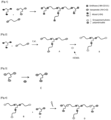
- FIG. 1 illustrates the synthesis of a reference thermoset polyurethane compound, PRC1819 ® resin from Synthene ® , the invention of which aims to reproduce the advantageous mechanical properties well known to those skilled in the art.
- the synthesis is carried out from a commercial mother formulation comprising a polyisocyanate compound SL000221 ® , and a combination of the following three polyols: VORANOIL TM CP300 (Dow ® ), trimethylolpropane and CAPA ® 4101). These reagents are mixed and subjected to a heat treatment for hardening leading to crosslinking and obtaining PRC1819 ® .
- FIG. 2 now illustrates a first step allowing the production of the resin according to the invention in which said isocyanate compound SL000221 ® resulting from said commercial mother formulation is mixed with one of said three polyols, present in default (96% by weight of isocyanate SL000221 ® and 3.70% by weight of the polyol CAPA ® 4101), and an EGECat ® 8-S catalyst approximately 0.90% by weight of the mixture, so as to obtain a urethane oligomer A ( figure 2 ).
- the molar ratio largely favorable to the isocyanate functions in the reaction mixture makes it possible to obtain the urethane A oligomer rich in free isocyanate functions.
- the urethane oligomer A is placed in the presence of a third photocrosslinkable coupling agent, for example an agent comprising a (meth)acrylate function for its photocrosslinkable property and a hydroxy function for its reactivity with the isocyanate function, in particular HEMA, to form urethane oligomer B.
- a third photocrosslinkable coupling agent for example an agent comprising a (meth)acrylate function for its photocrosslinkable property and a hydroxy function for its reactivity with the isocyanate function, in particular HEMA.
- the reagents are brought together in stoichiometric quantities (for example a proportion of approximately 47% in urethane oligomer A and approximately 53% by weight in HEMA).
- the molar ratio between the isocyanate and hydroxyl functions is between 1.1 and 2.5 so as to reduce the viscosity of the urethane oligomer A in which case the third photocrosslinkable coupling agent serves as diluent and reagent.
- formulation C is manufactured by reaction between the first polyol VORANOL TM CP300, from the commercial mother formulation, and a first photocrosslinkable coupling agent such as a (meth)acrylate derivative and comprising a function capable of reacting with hydroxyls polyol, in particular MCOC (Anglo-Saxon acronym for methacryloyl chloride available from the company Sigma Aldrich ® ), so as to obtain a functionalized and photocrosslinkable polyol.
- a first photocrosslinkable coupling agent such as a (meth)acrylate derivative and comprising a function capable of reacting with hydroxyls polyol, in particular MCOC (Anglo-Saxon acronym for methacryloyl chloride available from the company Sigma Aldrich ® ), so as to obtain a functionalized and photocrosslinkable polyol.
- formulation C also comprises a second functionalized polyol obtained by reaction between a second polyol, such as TMP (trimethylolpropane) from the commercial mother formulation and a second coupling agent which may be identical to the first coupling agent MCOC (the mass proportions are indicated in Table 1 below).
- a second polyol such as TMP (trimethylolpropane) from the commercial mother formulation
- a second coupling agent which may be identical to the first coupling agent MCOC (the mass proportions are indicated in Table 1 below).
- the MCOC or agent of coupling/functionalization of the first and second polyol is replaced by 2-isocyanatoethyl methacrylate, glycidyl methacrylate, or methacrylic anhydride.
- the synthesis conditions include a temperature less than 100°C, a pressure less than or equal to atmospheric pressure, under an inert atmosphere or in air.
- An adjustment of the pH of the reaction mixture may be necessary to reach a pH of approximately 1 as well as a purification post-treatment.
- the photocrosslinkable polyurethane resin is obtained by the combination of the urethane oligomer B (approximately 66% by weight), the polyol functionalized with photocrosslinkable groups (approximately 32% by weight), a photoinitiator, such as TPO (l phosphine diphenyl oxide (2,4,6-trimethylbenzoyl - approximately 1% by weight) and some possible additives listed in Table 1.
- TPO l phosphine diphenyl oxide (2,4,6-trimethylbenzoyl - approximately 1% by weight
- Table 1 Composition of formulation 1 of photocrosslinkable and printable polyurethane:
- Irganox ® 1010 is an antioxidant available for example from BASF ®
- Uvitex ® 0B is an optical brightening agent available for example from ChemBK ®
- Tinuvin ® 312 is a UV absorber available from BASF ®
- Tinuvin ® 765 is a UV stabilizer available from BASF ®
- WorléeAdd ® 602 is a degassing agent available from Specialchem ® .
- the viscosity of the photocrosslinkable resin according to the invention is reported on the Figure 5 illustrating shear viscosity values (Pa.s) as a function of the life time (hour) of the formulation at a loading frequency of 1 Hz, 10 Hz and 100 Hz which can correspond to the shear applied by the doctor blade during impression. As it is visible on the Figure 5 , the viscosity is stable until at least 72 hours. Thus, the resin does not change chemically during this period of time, and can be used for at least 72 hours in additive manufacturing.
- FIG. 6 represents photos illustrating standardized test pieces of transparent photocrosslinked polyurethane D, obtained by DLP printing from the formulation of the present invention described above. There is no visual difference between the test pieces of photocrosslinked polyurethane D and those of thecured polyurethane (not shown).
- the resin of the invention can be used to print objects without apparent defects (no bubbles for example), transparent, as in the case of thermosetting PU resin.
- Table 2 illustrates the mechanical properties of the test pieces of photocrosslinked polyurethane D obtained according to the invention and those obtained from thermoset polyurethane according to the commercial mother formulation.
- Table 2 Comparison of the optical, mechanical and thermal properties of photocrosslinked polyurethane D printed by DLP and developed according to the invention, with those of the reference thermoset polyurethane: As illustrated in this comparative table, the values for photocrosslinked polyurethane D are very close to those obtained with thermoset polyurethane.
- the present invention provides a photocrosslinkable resin for stereolithography printing, as well as a process for obtaining photocrosslinked polyurethane D having mechanical properties similar to those obtained with thermoset polyurethane from the same main precursors.
- the invention can also be transposed to all commercial mother formulations intended to form thermosetting polyurethanes.
Landscapes
- Chemical & Material Sciences (AREA)
- Organic Chemistry (AREA)
- Health & Medical Sciences (AREA)
- Polymers & Plastics (AREA)
- Medicinal Chemistry (AREA)
- Chemical Kinetics & Catalysis (AREA)
- Physics & Mathematics (AREA)
- Engineering & Computer Science (AREA)
- Materials Engineering (AREA)
- General Physics & Mathematics (AREA)
- Manufacturing & Machinery (AREA)
- Spectroscopy & Molecular Physics (AREA)
- Life Sciences & Earth Sciences (AREA)
- Wood Science & Technology (AREA)
- Optics & Photonics (AREA)
- Mechanical Engineering (AREA)
- Macromonomer-Based Addition Polymer (AREA)
Abstract
Résine photoréticulable adaptée à l'impression par stéréolithographie pour former un polyuréthane photoréticulé (D), la résine photoréticulable comprenant :- un oligomère uréthane photoréticulable (B),- une formulation (C) comprenant au moins un polyol fonctionnalisé par des groupements photoréticulables, et- un photoamorceur.
Description
- La présente invention concerne le domaine des matériaux polyuréthane et notamment des matériaux en polyuréthane photoréticulable imprimable par des procédés d'impression 3D dont la stéréolithographie.
- Les résines de polyuréthanes thermodurcissables sont largement utilisées dans la fabrication de nombreux produits de consommation courante ou à usage industriel. Ils sont de très bons isolants thermiques et présentent d'excellentes propriétés mécaniques. Afin d'élargir leur champ d'application, des résines de polyuréthane photoréticulable ont vu le jour. Grâce à leurs propriétés photosensibles, ces matériaux peuvent être mis en oeuvre par impression 3D, ce qui permet de réaliser des prototypages rapides mais également de fabriquer des produits de consommation courante avec une grande définition. Toutefois, il n'existe pas à ce jour de résines polyuréthane photoréticulables permettant de retrouver les propriétés mécaniques des polyuréthanes thermodurcis classiquement obtenus par moulage.
- Le document
EP1503242 décrit des exemples de résine à base d'oligomère uréthane-acrylate, de monomère d'acrylate et de modificateur de polymérisation pour une impression par stéréolithographie. Cette résine conduit à des solides de propriétés thermiques et mécaniques variables (de très souples à très rigides) selon les précurseurs utilisés. Toutefois, même en variant les concentrations relatives des différents composants, ou d'additifs, il est difficile de retrouver les propriétés des polyuréthanes thermodurcis de référence. Les matériaux obtenus sont sensibles à l'hydrolyse et leurs propriétés se rapprochent davantage de celles des résines acrylates que celle des polyuréthanes thermodurcissables de référence. - Un des buts de la présente invention est de pallier au moins l'un des inconvénients précités. A cet effet, la présente invention propose une résine photoréticulable adaptée à l'impression par stéréolithographie, telle que la technologie Digital Light Processing (DLP), pour former un polyuréthane photoréticulé D, la résine photoréticulable comprenant :
- un oligomère uréthane photoréticulable B,
- une formulation C comprenant au moins un polyol fonctionnalisé par des groupements photoréticulables, et
- un photoamorceur, par exemple du TPO (oxyde de phosphine).
- Ainsi, la résine de l'invention comprend des réactifs qui, lorsqu'ils sont placés en condition de réagir, permettent une photopolymérisation par exposition à un rayonnement actinide - typiquement un rayonnement visible ou UV, et conduisent à un polyuréthane photoréticulé D. Comme on le verra par la suite, le polyuréthane photoréticulé D obtenu présente des propriétés similaires à celles obtenues par le polyuréthane thermodurci lorsque les précurseurs présents dans la formulation mère de la résine dudit polyuréthane thermodurcissable sont également utilisés pour former l'oligomère uréthane photoréticulable B et la formulation C d'au moins un polyol fonctionnalisé.
- Il est à noter que la résine photoréticulable selon l'invention est dépourvue de monomère d'acrylate.
- La terminologie anglo-saxonne de la technologie 'Digital Light Processing' peut se traduire en français par 'Traitement numérique de la lumière'.
- Selon une autre disposition, la résine photoréticulable de l'invention est dépourvue de diluant réactif.
- Selon une disposition, la résine photoréticulable est apte à former un polyuréthane photoréticulé D uniquement par photopolymérisation.
- Les polyols fonctionnalisés de la formulation C ne réagissent pas avec l'oligomère d'uréthane photoréticulable B, l'obtention d'un polyuréthane photoréticulé D est uniquement obtenu par photoréticulation de la résine photoréticulable.
- Selon une disposition, l'oligomère d'uréthane photoréticulable B est dépourvu de groupement isocyanate.
- La formulation C comprend au moins un polyol fonctionnalisé par des groupements photoréticulables. Autrement dit, la formulation C comprend au moins un composé qui contenait des hydroxyles, les hydroxyles ayant été fonctionnalisés au préalable.
- Selon un mode de réalisation particulier, la résine photoréticulable adaptée à des impressions par stéréolithographie pour former un polyuréthane photoréticulé D, est constituée de :
- un oligomère uréthane photoréticulable B,
- une formulation C constituée d'un polyol fonctionnalisé par des groupements photoréticulables, et
- un photoamorceur.
- De manière concrète, dans la résine photoréticulable :
- la proportion d'oligomère uréthane photoréticulable B peut être comprise dans une plage allant d'une valeur de 50% en poids à une valeur strictement inférieure à 100% en poids,
- la proportion de la formulation C peut être comprise dans une plage allant d'une valeur strictement supérieure à 0% en poids à une valeur de 50% en poids,
- la proportion de photoamorceur peut être comprise dans une plage allant de 0,1% en poids à 5% en poids, et
- Selon un mode de réalisation, la résine photoréticulable adaptée à des impressions par stéréolithographie pour former un polyuréthane photoréticulé D, est constituée de :
- un oligomère d'uréthane photoréticulable B,
- une formulation C constituée d'un (ou plusieurs) polyol(s) fonctionnalisé(s) par des groupements photoréticulables,
- un photoamorceur, et
- un matériau antioxydant et /ou
- un agent azurant et /ou
- un absorbeur UV et /ou
- un stabilisant UV et /ou
- un agent dégazant.
- Selon une disposition, l'au moins un polyol fonctionnalisé de la formulation C est obtenu par la réaction d'un premier agent de couplage photoréticulable, tel qu'un composé acrylate ou un méthacrylate, par exemple du MCOC (Chlorure de méthacryloyle), avec au moins un premier polyol, par exemple du VORANOL™CP300. Le composé VORANOL™CP300, notamment disponible auprès de la société Dow®, désigne le trialcool 'Glycérol éthoxylate-co-propoxylate triol'.
- Selon une variante, la formulation C comporte un deuxième polyol fonctionnalisé, obtenu par la réaction d'un deuxième agent de couplage photoréticulable, tel qu'un composé acrylate, avec au moins un deuxième polyol par exemple du TMP (Acronyme de triméthylolpropane disponible auprès de BASF®.
- Il est à noter que les premier et deuxième polyols cités sont avantageusement choisis parmi les réactifs de la formulation mère de la polyuréthane thermodurcissable conduisant à la résine PRC1819® disponible auprès de la société Synthene®.
- Le premier et /ou le deuxième agent de couplage permettant la fonctionalisation du premier et/ou du deuxième polyol est présent dans des conditions stoechiométriques vis-à-vis des fonctions alcools.
- Le premier agent de couplage et le deuxième agent de couplage peuvent être identiques.
- Selon une disposition, l'oligomère uréthane photoréticulable B est obtenu par réaction entre un oligomère uréthane A comprenant des fonctions isocyanates libres et un troisième agent de couplage photoréticulable, tel qu'un composant comprenant un groupement photoréticulable, par exemple un groupement acrylate, et un groupement réactif vis-à-vis des isocyanates, par exemple un groupement hydroxyle.
- Selon une possibilité, le troisième agent de couplage photoréticulable est du HEMA (HydroxyEthylMéthAcrylate) disponible chez Sigma Aldrich®.
- Selon une disposition, le rapport molaire entre les fonctions isocyanates et les groupements réactifs vis-à-vis des isocyanates du troisième agent de couplage est compris dans une plage allant de 1 à 2,5 et notamment dans une plage allant de 1 à 2. Le troisième agent de couplage photoréticulable peut être considéré comme un diluant réactif permettant d'augmenter la conversion des isocyanates en l'oligomère uréthane A. En effet, le couplage conduit à un mélange qui devient de plus en plus visqueux avec l'avancement de la réaction (formation de l'oligomère uréthane photoréticulable B). Ainsi, la présence d'un troisième agent de couplage permet de greffer un groupement photoréticulable et également d'améliorer la viscosité du mélange réactionnel de sorte à favoriser la mobilité des molécules et l'avancement de la réaction. A la fin de la réaction, tous les isocyanates de A ont réagi avec les groupements réactifs vis-à-vis des isocyanates, de sorte l'oligomère uréthane photoréticulable B ne présente aucun groupe isocyanate.
- Pour autant, il faut noter que le troisième agent de couplage est présent dans une quantité inférieure à celle d'un diluant réactif. Selon un exemple de réalisation particulier, l'excès d'HEMA (50%) ne représente qu'environ 17,5% m de l'oligomère uréthane photoréticulable B et environ 11,5% m du polyuréthane photoréticulé D.
- Selon une possibilité, lorsque des quantités stœchiométriques sont utilisées en HEMA, la viscosité est de 700 Pa.s (25°C et fréquence d'un hertz). En présence d'un excès de 40% en HEMA, la viscosité est de 10 Pa.s (mêmes conditions de mesure).
- Selon une disposition, l'excès en HEMA de 20% conduit à une viscosité comprise entre 90-100 Pa.s (25°C et fréquence d'un hertz).
- Selon une disposition, le procédé d'obtention de l'oligomère uréthane photoréticulable B est réalisé à 65°C pendant 6h.
- De manière concrète, l'oligomère uréthane A est obtenu par réaction d'un polyisocyanate, par exemple du MDI (acronyme anglo-saxon de Methylene Diphenyl dilsocyanate), TDI (diisocyanate de toluène), H12MDI (4,4'-dicyclohexylmethane diisocyanate ou MDI hydrogéné), HDI (Hexamethylene Diisocyanate) ou du SL000221® (par exemple de chez Synthene®), synthétisé à partir de H12MDI, de HDI et de polyols, avec au moins un troisième polyol, en présence d'un catalyseur de réaction alcool/isocyanate, le rapport molaire entre les fonctions alcools et les fonctions isocyanates est strictement inférieur à 1 de sorte que la réaction reste incomplète et que l'oligomère uréthane A conserve des fonctions isocyanates libres résiduelles.
- Selon une possibilité, le procédé d'obtention de l'oligomère uréthane A est réalisé à 90°C pendant 2h sous une pression de 200 mbars.
- Les deux réactifs sont également présents dans la formulation mère conduisant à un polyuréthane thermodurcissable utilisant le Capa®4101 (tetrafunctional polyol terminated with primary hydroxyl groups) notamment disponible auprès de la société SpecialChem®. En conséquence, la résine photoréticulable selon l'invention pourra conduire à un polyuréthane photoréticulé D dont la structure chimique est très proche de celle du polyuréthane thermodurci obtenu à partir du Capa®4101. L'obtention des deux résines de polyuréthane est certes effectuée par des voies de synthèses différentes mais les polyuréthanes résultant présentent des propriétés mécaniques similaires comme on pourra le voir ultérieurement dans tableau 2 ci-dessous.
- Il est ainsi possible d'appliquer l'invention à des réactifs commerciaux prévus pour la fabrication d'un polyuréthane thermodurci bien connu pour obtenir une formulation d'un matériau photoréticulable conduisant à un solide aux propriétés similaires à celles dudit polyuréthane thermodurci.
- Selon une possibilité, l'oligomère uréthane A est obtenu à partir d'un mélange constitué de polyisocyanate dans une plage allant de 90% en poids à 100% en poids et du troisième polyol dans une plage allant d'un valeur non nulle à une valeur de 10% en poids et de catalyseur dans une plage allant d'une valeur non nulle à une valeur de 0,5% en poids, notamment du EGECat® 8-S de Ege Kimya®, de sorte à obtenir un oligomère uréthane A d'une viscosité inférieure à 10 Pa.s à 25°C sur la gamme 0,1-100 Hz. La quantité du troisième polyol est également déterminée par la viscosité du polyisocyanate initial.
- Selon d'autres caractéristiques, la résine photoréticulable selon l'invention comporte une ou plusieurs des caractéristiques optionnelles suivantes considérées seules ou en combinaison :
Le premier polyol, le deuxième polyol et/ou le troisième polyol sont de natures différentes. - Le premier polyol, le deuxième polyol et/ou le troisième polyol sont de natures identiques.
- Les polyols parmi les polyols fonctionnalisés par des groupements photoréticulables, le premier polyol, le deuxième polyol et le troisième polyol sont tous liquides à température ambiante.Le premier agent de couplage, le deuxième agent de couplage et/ou le troisième agent de couplage sont identiques.
- Le premier agent de couplage, le deuxième agent de couplage et/ou le troisième agent de couplage sont différents.
- La résine photoréticulable adaptée à des impressions par stéréolithographie pour former un polyuréthane photoréticulé D, est constituée de :
- un oligomère d'uréthane photoréticulable B,
- une formulation C constituée d'un polyol fonctionnalisé par des groupements photoréticulables et d'un deuxième polyol fonctionnalisé par des groupements photoréticulables,et
- un photoamorceur.
- Le procédé d'obtention de l'oligomère A comprend la mise en présence du polyisocyanate, du troisième polyol et du catalyseur, tels que précédemment décrits, et l'application d'un traitement thermique à une température comprise entre 80°C et 100°C, notamment environ 90° C pendant environ 2 heures. Ledit procédé est réalisé sous une pression de 200 mbars.
- Le procédé d'obtention de l'oligomère C de polyol fonctionnalisé comprend l'application d'une température inférieure à 100°C, une pression inférieure ou égale à la pression atmosphérique. L'atmosphère du milieu réactionnel peut être une atmosphère inerte ou de l'air. Le procédé d'obtention de polyuréthane photoréticulé D comprend les étape de :
- fournir la résine photoréticulable telle que précédemment décrite et,
- imprimer par stéréolithographie en applicant au moins un rayonnement actinide sur la résine de polyuréthane photoréticulable à sa fréquence de photoréticulation.
- Selon une disposition, la résine de polyuréthane photoréticulable conduit au polyuréthane photoréticulé D uniquement par photoréticulation.
- Les polyols fonctionnalisés de la formulation C ne réagissent pas avec l'oligomère d'uréthane photoréticulable B.
- L'obtention d'un polyuréthane photoréticulé D à partir de la résine photoréticulable est uniquement obtenu par photoréticulation.
- La stéréolithographie est réalisée par DLP (acronyme anglosaxon de Digital light processing).
- D'autres caractéristiques, buts et avantages apparaitront à la lecture de la description détaillée ci-après, d'un exemple de mise en oeuvre non limitatif, faite en référence aux figures annexées dans lesquelles :
- [
Fig.1 ] représente une vue schématique d'une réaction de polymérisation d'une formulation mère commerciale conduisant à un polyuréthane thermodurci de référence. - [
Fig.2 ] représente une vue schématique de réactions de fabrication d'un oligomère uréthane A et d'un oligomère d'uréthane photoréticulable B. - [
Fig.3 ] représente une vue schématique de la réaction de fabrication d'un oligomère C polyol photoréticulable à partir d'un troisième polyol et d'un troisième agent de couplage photoréticulable. - [
Fig.4 ] représente une vue schématique de fabrication d'un polyuréthane photoréticulé D à partir de l'oligomère d'uréthane photoréticulable B et de l'oligomère C polyol photoréticulable en présence d'au moins un photoamorceur et d'irradiation actinide. - [
Fig.5 ] représente un graphique de la viscosité en cisaillement en fonction du temps à différentes fréquences. - [
Fig.6 ] représente des photos de barreaux normés formés en polyuréthane photoréticulé D par stéréolithographie. - La
figure 1 illustre la synthèse d'un composé polyuréthane thermodurci de référence, la résine PRC1819® de Synthene®, dont l'invention vise à reproduire les propriétés mécaniques avantageuses bien connues par l'homme de l'art. La synthèse est réalisée à partir d'une formulation mère commerciale comprenant un composé polyisocyanate SL000221®, et une combinaison des trois polyols suivant : le VORANOIL™CP300 (Dow®), le triméthylolpropane et le CAPA®4101). Ces réactifs sont mélangés et soumis à un traitement thermique de durcissement conduisant à une réticulation et à l'obtention du PRC1819®. - La
figure 2 illustre maintenant une première étape permettant la réalisation de la résine selon l'invention dans laquelle ledit composé isocyanate SL000221® issu de ladite formulation mère commerciale est mélangé avec l'un desdits trois polyols, présent en défaut (96% en poids d'isocyanate SL000221® et 3,70% en poids du polyol CAPA®4101), et un catalyseur EGECat® 8-S environ 0.90% en poids du mélange, de sorte à obtenir un oligomère uréthane A (figure 2 ). Le rapport molaire largement favorable aux fonctions isocyanates dans le mélange réactionnel permettent d'obtenir l'oligomère uréthane A riche de fonctions isocyanates libres. - Puis, toujours illustré sur la
figure 2 , l'oligomère uréthane A est mis en présence d'un troisième agent de couplage photoréticulable, par exemple un agent comprenant une fonction (meth)acrylate pour sa propriété photoréticulable et une fonction hydroxy pour sa réactivité avec la fonction isocyanate, notamment de l'HEMA, pour former l'oligomère uréthane B. Les réactifs sont mis en présence selon des quantités stœchiométriques (par exemple une proportion d'environ 47 % en oligomère uréthane A et environ 53% en poids en HEMA). Selon une autre possibilité, le rapport molaire entre les fonctions isocyanates et hydroxyles sont comprises entre 1,1 et 2.5 de sorte à diminuer la viscosité de l'oligomère uréthane A auquel cas le troisième agent de couplage photoréticulable sert de diluant et de réactif. - Selon une autre étape de réalisation de la résine selon l'invention, illustrée à la
figure 3 , la formulation C est fabriquée par réaction entre le premier polyol VORANOL™CP300, issu de la formulation mère commerciale, et un premier agent de couplage photoréticulable tel qu'un dérivé de (meth) acrylate et comprenant une fonction capable de réagir avec les hydroxyles du polyol, notamment du MCOC (acronyme anglosaxon pour chlorure de méthacryloyle disponible auprès de la société Sigma Aldrich®), de sorte à obtenir un polyol fonctionnalisé et photoréticulable. Selon une variante non illustrée, la formulation C comprend également un deuxième polyol fonctionnalisé obtenu par réaction entre un deuxième polyol, tel que du TMP (triméthylolpropane) issu de la formulation mère commerciale et un deuxième agent de couplage pouvant être identique au premier agent de couplage MCOC (les proportions massiques sont indiquées dans le tableau 1 ci-dessous). Selon encore d'autres variantes non illustrées, le MCOC ou agent de couplage/ de fonctionnalisation du premier et deuxième polyol est remplacé par du 2-isocyanatoethyl méthacrylate, le glycidyl méthacrylate, ou l'anhydride méthacrylique. - Les conditions de synthèse comprennent une température inférieure à 100°C, une pression inférieure ou égale à la pression atmosphérique, sous atmosphère inerte ou à l'air. Un ajustement du pH du mélange réactionnel peut être nécessaire pour atteindre un PH d'environ 1 ainsi qu'un post traitement de purification.
- Enfin, la résine de polyuréthane photoréticulable est obtenue par la combinaison de l'oligomère uréthane B (environ 66% en poids), du polyol fonctionnalisé par des groupements photoréticulables (environ 32% en poids), un photoamorceur, tel que le TPO (l'oxyde de phosphine diphényl(2,4,6-trimethylbenzoyle - environ 1% en poids) et quelques éventuels additifs listés au tableau 1.
[Table 1] Mélange Produit Proportion (%m) Produit A SL000221® 96,0 EGE®Cat 8-S 0,297 CAPA®4101 3,69 Produit B Produit A 47,2 HEMA (150%) 52,8 Produit C TMP 2,19 VORANOL™CP300 45,2 MCOC 52,6 Produit D Produit C 32,0 Irganox® 1010 0,114 Uvitex® 0B 0,049 Tinuvin® 312 0,098 Tinuvin® 765 0,098 WorléeAdd® 602 0,130 TPO 1,00 Produit B 66,5 - Tableau 1 : Composition de la formulation 1 de polyuréthane photoréticulable et imprimable :
- Produit A : Oligomère uréthane avancé à viscosité contrôlée
- Produit B : Oligomère uréthane photoréticulable (fonction méthacrylate), contenant un excès de 50% d'HEMA (Hydroxyéthylméthacrylate)
- Produit C : Formulation comprenant au moins un polyol fonctionnalisé avec du MCOC (chlorure de méthacryloyle)
- Cette résine permet sous l'effet d'un rayonnement actinide, l'obtention d'un polyuréthane photoréticulé D présentant une structure chimique et des propriétés mécaniques similaires à celles du polyuréthane thermordurci PRC1819® obtenu à partir de la formulation mère commerciale comme indiqué au tableau 2 ci-dessous.
- Précisons que l'Irganox® 1010 est un anti-oxydant disponible par exemple auprès de BASF®, le Uvitex® 0B est un agent azurant optique disponible par exemple auprès de ChemBK®, le Tinuvin® 312 est un absorbant UV disponible auprès de BASF®,le Tinuvin® 765 est un stabilisant UV disponible auprès de BASF®,le WorléeAdd® 602 est un agent dégazant disponible auprès de Specialchem®.
- La viscosité de la résine photoréticulable selon l'invention est rapportée sur la
figure 5 illustrant des valeurs de viscosité de cisaillement (Pa.s) en fonction du temps de vie (heure) de la formulation à une fréquence de sollicitation de 1 Hz, 10 Hz et 100 Hz pouvant correspondre au cisaillement appliqué par la racle lors de l'impression. Comme il est visible sur lafigure 5 , la viscosité est stable jusqu'à au moins 72h. Ainsi, la résine n'évolue pas chimiquement durant ce laps de temps, et peut être utilisée à minima pendant 72h en fabrication additive. - La
figure 6 représente des photos illustrant des éprouvettes normalisées en polyuréthane photoréticulé D transparent, obtenues par impression DLP à partir de la formulation de la présente invention décrite ci-dessus. Il n'y a pas de différence à l'œil entre les éprouvettes de polyuréthane photoréticulé D et celles de polyuréthane themordurci (non illustrés). Ainsi, la résine de l'invention peut être utilisée pour imprimer des objets sans défaut apparent (pas de bulles par exemple), transparents, comme dans le cas de résine PU thermodurcissable. - Le tableau 2 ci-dessous illustre les propriétés mécaniques des éprouvettes en polyuréthane photoréticulé D obtenu selon l'invention et celles obtenue à partir du polyuréthane thermodurci selon la formulation mère commerciale.
[Table 2] Propriétés Résine PU thermodurcissable de référence (PRC1819®) Résine PU imprimable par DLP (Invention) Normes associées Aspect Transparent Transparent Couleur Incolore Légèrement jaune Dureté (Shore D) 85 86 ISO868:2003 Shore D1 Module de flexion (MPa) 2200 2200 ± 90 ISO178:2011 ; 2 mm/min Contrainte maximale en flexion (MPa) 80 92,5 ± 0,5 ISO178:2011 ; 2 mm/min Température de flexion sous charge (°C) 86 96 ISO75-2:2013 ; Méthode B (0,45 MPa) - Tableau 2 : Comparaison des propriétés optiques, mécaniques et thermiques du polyuréthane photoréticulé D imprimé par DLP et développé selon l'invention, avec celles du polyuréthane thermodurci de référence :
Comme illustré dans ce tableau comparatif, les valeurs concernant le polyuréthane photoréticulé D sont très proches de celles obtenues avec le polyuréthane thermodurci. - Ainsi, la présente invention propose une résine photoréticulable pour des impressions par stéréolithographie, ainsi qu'un procédé d'obtention de polyuréthane photoréticulé D présentant des propriétés mécaniques similaires à celles obtenues avec du polyuréthane thermodurci à partir des mêmes précurseurs principaux. L'invention est également transposable à toutes les formulations mères commerciales destinées à former des polyuréthanes thermodurcissables.
- Il va de soi que l'invention n'est pas limitée aux variantes de réalisation décrites ci-dessus à titre d'exemple mais qu'elle comprend tous les équivalents techniques et les variantes des moyens décrits ainsi que leurs combinaisons.
Claims (10)
- Résine photoréticulable adaptée à l'impression par stéréolithographie pour former un polyuréthane photoréticulé (D), la résine photoréticulable comprenant :- un oligomère uréthane photoréticulable (B),- une formulation (C) comprenant au moins un polyol fonctionnalisé par des groupements photoréticulables, et- un photoamorceur.
- Résine photoréticulable selon la revendication 1, dans laquelle- la proportion d'oligomère uréthane photoréticulable (B) est comprise dans une plage allant d'une valeur de 50% en poids à une valeur strictement inférieure à 100% en poids,- la proportion de la formulation (C) est comprise dans une plage allant d'une valeur strictement supérieure à 0% en poids à une valeur de 50% en poids,- la proportion de photoamorceur est comprise dans une plage allant de 0,1% en poids à 5% en poids,de sorte que la résine photoréticulable présente une viscosité inférieure ou égale à 3 Pa.s à 25°C et 100 Hz.
- Résine photoréticulable selon la revendication 1 ou 2, comprenant en outre un matériau antioxydant dans une proportion allant de 0% en poids à 2% en poids, et/ou un agent azurant dans une proportion allant de 0% en poids à 2% en poids..
- Résine photoréticulable selon l'une des revendications 1 à 3, dans laquelle l'au moins un polyol fonctionnalisé de la formulation (C) est obtenu par la réaction d'un premier agent de couplage photoréticulable avec au moins un premier polyol.
- Résine photoréticulable selon l'une des revendications 1 à 4, dans laquelle la formulation (C) comporte un deuxième polyol fonctionnalisé, obtenu par la réaction d'un deuxième agent de couplage photoréticulable avec au moins un deuxième polyol.
- Résine photoréticulable selon l'une des revendications 1 à 5, dans laquelle l'oligomère d'uréthane photoréticulable (B) est obtenu par réaction entre un oligomère uréthane (A) comprenant des fonctions isocyanates libres et un troisième agent de couplage photoréticulable.
- Résine photoréticulable selon la revendication 6, dans laquelle le rapport molaire entre les fonctions isocyanates et les groupements réactifs vis-à-vis des isocyanates du troisième agent de couplage est compris dans une plage allant de 1 à 2,5.
- Résine photoréticulable selon la revendication 6 ou 7, dans laquelle l'oligomère uréthane (A) est obtenu par réaction d'un polyisocyanate, avec au moins un troisième polyol, en présence d'un catalyseur de réaction alcool/isocyanate, le rapport molaire entre les fonctions alcools et les fonctions isocyanates est strictement inférieur à 1 de sorte que la réaction soit incomplète, et que l'oligomère uréthane (A) conserve des fonctions isocyanates libres résiduelles.
- Résine photoréticulable selon la revendication 8, dans laquelle l'oligomère uréthane (A) est obtenu à partir d'un mélange constitué de polyisocyanate dans une plage allant de 90% en poids à 100% en poids et du troisième polyol dans une plage allant d'une valeur non nulle à une valeur de 10% en poids et de catalyseur dans une plage allant d'une valeur non nulle à une valeur de 0.5% en poids, de sorte à obtenir un oligomère uréthane (A) d'une viscosité inférieure à 10 Pa.s à 25°C sur la gamme 0,1-100Hz.
- Procédé d'obtention d'une résine de polyuréthane photoréticulé (D), le procédé comprenant les étape de :- fournir la résine de polyuréthane photoréticulable selon l'une des revendications 1 à 9 et,- imprimer par stéréolithographie en applicant au moins un rayonnement actinide sur la résine de polyuréthane photoréticulable à sa fréquence de photoréticulation.
Applications Claiming Priority (1)
| Application Number | Priority Date | Filing Date | Title |
|---|---|---|---|
| FR2213780A FR3143607A1 (fr) | 2022-12-19 | 2022-12-19 | Résine de polyuréthane photoréticulable |
Publications (1)
| Publication Number | Publication Date |
|---|---|
| EP4389793A1 true EP4389793A1 (fr) | 2024-06-26 |
Family
ID=85727005
Family Applications (1)
| Application Number | Title | Priority Date | Filing Date |
|---|---|---|---|
| EP23218236.0A Pending EP4389793A1 (fr) | 2022-12-19 | 2023-12-19 | Résine de polyuréthane photoréticulable |
Country Status (2)
| Country | Link |
|---|---|
| EP (1) | EP4389793A1 (fr) |
| FR (1) | FR3143607A1 (fr) |
Citations (2)
| Publication number | Priority date | Publication date | Assignee | Title |
|---|---|---|---|---|
| EP1503242A2 (fr) | 2003-07-29 | 2005-02-02 | 3 Birds, Inc. | Résines et procédés pour la stéréolithographie |
| WO2012121884A1 (fr) * | 2011-03-09 | 2012-09-13 | 3D Systems, Inc. | Matériau de construction et applications associées |
-
2022
- 2022-12-19 FR FR2213780A patent/FR3143607A1/fr active Pending
-
2023
- 2023-12-19 EP EP23218236.0A patent/EP4389793A1/fr active Pending
Patent Citations (2)
| Publication number | Priority date | Publication date | Assignee | Title |
|---|---|---|---|---|
| EP1503242A2 (fr) | 2003-07-29 | 2005-02-02 | 3 Birds, Inc. | Résines et procédés pour la stéréolithographie |
| WO2012121884A1 (fr) * | 2011-03-09 | 2012-09-13 | 3D Systems, Inc. | Matériau de construction et applications associées |
Also Published As
| Publication number | Publication date |
|---|---|
| FR3143607A1 (fr) | 2024-06-21 |
Similar Documents
| Publication | Publication Date | Title |
|---|---|---|
| EP2044137B1 (fr) | Composition polymerisable et/ou reticulable sous irradiation par voie cationique et/ou radicalaire | |
| EP3119835B1 (fr) | Prépolymère de polyuréthane à terminaisons cyclocarbonate de faible viscosité et son utilisation dans la fabrication d'une composition adhésive multicomposant | |
| EP2134760B1 (fr) | Composition a base de (poly)isocyanate modifie et d'un solvant de type acetal ou cetone aliphatique, et utilisation de cette composition pour la fabrication de revetements | |
| FR2482606A1 (fr) | Resines polyurethannes thermoplastiques reticulables comportant des groupements ethyleniques pendants | |
| EP3286239B1 (fr) | Urethanes aminoacrylate-acrylates de haute fonctionnalite derives de l'addition d'un aminoalcool a amine secondaire sur un acrylate multifonctionnel | |
| FR3108908A1 (fr) | Matériaux élastiques préparés à partir de compositions liquides durcissables | |
| EP4389793A1 (fr) | Résine de polyuréthane photoréticulable | |
| EP3898871A1 (fr) | Composition à base de résine époxy et de polyuréthane | |
| EP0402212A1 (fr) | Procédé pour la fabrication d'une couche de polyuréthane autocicatrisable,et produit obtenu | |
| EP1073686B1 (fr) | Procede de preparation d'isocyanates polyfonctionnels tricondensats de faible viscosite | |
| JPH0780988B2 (ja) | 貯蔵安定性のnco不含ウレタン尿素アクリレートおよびその製造方法 | |
| FR2927903A1 (fr) | Nouveaux allongeurs de chaines pour formulations d'elastomeres de polyurethanes. | |
| EP3595805B1 (fr) | Composition thixotrope utilisable comme agent anti-coulure pour des mastics | |
| EP3476875A1 (fr) | Resine transparente pour recouvrir un substrat, procede de fabrication d'une telle resine et article obtenu | |
| LU83709A1 (fr) | Polyurethane durcissable,a une partie | |
| FR2893940A1 (fr) | Compose a fonctionnalite isocyanate, sa preparation et son utilisation dans un procede de preparation d'un revetement | |
| EP1819748B1 (fr) | Resines polyurethanes, leur procede de fabrication, et les lentilles optiques obtenues a partir de ces resines. | |
| CN116396519A (zh) | 赋形膜及光固化型组合物 | |
| EP2669314A1 (fr) | Procédé de synthèse d'un composé poly-hydroxy-uréthane glycérilique et composé poly-hydroxy-uréthane glycérilique | |
| EP3877393B1 (fr) | Hydroxysilanes fonctionnalises, polyurethanes silyles, et compositions les comprenant | |
| EP3609944A1 (fr) | Produit organique réactif et son utilisation comme agent réticulant dans des revêtements auto-cicatrisants | |
| EP3394144A1 (fr) | Mastics polyurethane superelastiques | |
| EP3882290A1 (fr) | Composition catalytique pour une reticulation a temperature ambiante de liants polyurethanes | |
| EP2970115B1 (fr) | Allophanate polyacrylate | |
| WO2020021187A1 (fr) | Procede de preparation de composes a groupement alkoxysilyl |
Legal Events
| Date | Code | Title | Description |
|---|---|---|---|
| PUAI | Public reference made under article 153(3) epc to a published international application that has entered the european phase |
Free format text: ORIGINAL CODE: 0009012 |
|
| STAA | Information on the status of an ep patent application or granted ep patent |
Free format text: STATUS: REQUEST FOR EXAMINATION WAS MADE |
|
| 17P | Request for examination filed |
Effective date: 20231219 |
|
| AK | Designated contracting states |
Kind code of ref document: A1 Designated state(s): AL AT BE BG CH CY CZ DE DK EE ES FI FR GB GR HR HU IE IS IT LI LT LU LV MC ME MK MT NL NO PL PT RO RS SE SI SK SM TR |
|
| RAP3 | Party data changed (applicant data changed or rights of an application transferred) |
Owner name: COMMISSARIAT A L'ENERGIE ATOMIQUE ET AUX ENERGIESALTERNATIVES |