EP4402221B1 - Composés hétérocycliques contenant du bore pour dispositifs électroluminescents organiques - Google Patents
Composés hétérocycliques contenant du bore pour dispositifs électroluminescents organiques Download PDFInfo
- Publication number
- EP4402221B1 EP4402221B1 EP22782695.5A EP22782695A EP4402221B1 EP 4402221 B1 EP4402221 B1 EP 4402221B1 EP 22782695 A EP22782695 A EP 22782695A EP 4402221 B1 EP4402221 B1 EP 4402221B1
- Authority
- EP
- European Patent Office
- Prior art keywords
- radicals
- group
- aromatic
- substituted
- atoms
- Prior art date
- Legal status (The legal status is an assumption and is not a legal conclusion. Google has not performed a legal analysis and makes no representation as to the accuracy of the status listed.)
- Active
Links
Classifications
-
- C—CHEMISTRY; METALLURGY
- C07—ORGANIC CHEMISTRY
- C07F—ACYCLIC, CARBOCYCLIC OR HETEROCYCLIC COMPOUNDS CONTAINING ELEMENTS OTHER THAN CARBON, HYDROGEN, HALOGEN, OXYGEN, NITROGEN, SULFUR, SELENIUM OR TELLURIUM
- C07F5/00—Compounds containing elements of Groups 3 or 13 of the Periodic Table
- C07F5/02—Boron compounds
-
- C—CHEMISTRY; METALLURGY
- C07—ORGANIC CHEMISTRY
- C07F—ACYCLIC, CARBOCYCLIC OR HETEROCYCLIC COMPOUNDS CONTAINING ELEMENTS OTHER THAN CARBON, HYDROGEN, HALOGEN, OXYGEN, NITROGEN, SULFUR, SELENIUM OR TELLURIUM
- C07F5/00—Compounds containing elements of Groups 3 or 13 of the Periodic Table
- C07F5/02—Boron compounds
- C07F5/027—Organoboranes and organoborohydrides
-
- C—CHEMISTRY; METALLURGY
- C09—DYES; PAINTS; POLISHES; NATURAL RESINS; ADHESIVES; COMPOSITIONS NOT OTHERWISE PROVIDED FOR; APPLICATIONS OF MATERIALS NOT OTHERWISE PROVIDED FOR
- C09K—MATERIALS FOR MISCELLANEOUS APPLICATIONS, NOT PROVIDED FOR ELSEWHERE
- C09K11/00—Luminescent materials, e.g. electroluminescent or chemiluminescent
- C09K11/06—Luminescent materials, e.g. electroluminescent or chemiluminescent containing organic luminescent materials
-
- H—ELECTRICITY
- H10—SEMICONDUCTOR DEVICES; ELECTRIC SOLID-STATE DEVICES NOT OTHERWISE PROVIDED FOR
- H10K—ORGANIC ELECTRIC SOLID-STATE DEVICES
- H10K85/00—Organic materials used in the body or electrodes of devices covered by this subclass
- H10K85/60—Organic compounds having low molecular weight
- H10K85/658—Organoboranes
-
- C—CHEMISTRY; METALLURGY
- C09—DYES; PAINTS; POLISHES; NATURAL RESINS; ADHESIVES; COMPOSITIONS NOT OTHERWISE PROVIDED FOR; APPLICATIONS OF MATERIALS NOT OTHERWISE PROVIDED FOR
- C09K—MATERIALS FOR MISCELLANEOUS APPLICATIONS, NOT PROVIDED FOR ELSEWHERE
- C09K2211/00—Chemical nature of organic luminescent or tenebrescent compounds
- C09K2211/10—Non-macromolecular compounds
- C09K2211/1003—Carbocyclic compounds
- C09K2211/1011—Condensed systems
-
- C—CHEMISTRY; METALLURGY
- C09—DYES; PAINTS; POLISHES; NATURAL RESINS; ADHESIVES; COMPOSITIONS NOT OTHERWISE PROVIDED FOR; APPLICATIONS OF MATERIALS NOT OTHERWISE PROVIDED FOR
- C09K—MATERIALS FOR MISCELLANEOUS APPLICATIONS, NOT PROVIDED FOR ELSEWHERE
- C09K2211/00—Chemical nature of organic luminescent or tenebrescent compounds
- C09K2211/10—Non-macromolecular compounds
- C09K2211/1018—Heterocyclic compounds
- C09K2211/1022—Heterocyclic compounds bridged by heteroatoms, e.g. N, P, Si or B
-
- C—CHEMISTRY; METALLURGY
- C09—DYES; PAINTS; POLISHES; NATURAL RESINS; ADHESIVES; COMPOSITIONS NOT OTHERWISE PROVIDED FOR; APPLICATIONS OF MATERIALS NOT OTHERWISE PROVIDED FOR
- C09K—MATERIALS FOR MISCELLANEOUS APPLICATIONS, NOT PROVIDED FOR ELSEWHERE
- C09K2211/00—Chemical nature of organic luminescent or tenebrescent compounds
- C09K2211/10—Non-macromolecular compounds
- C09K2211/1018—Heterocyclic compounds
- C09K2211/1025—Heterocyclic compounds characterised by ligands
- C09K2211/1044—Heterocyclic compounds characterised by ligands containing two nitrogen atoms as heteroatoms
- C09K2211/1055—Heterocyclic compounds characterised by ligands containing two nitrogen atoms as heteroatoms with other heteroatoms
-
- C—CHEMISTRY; METALLURGY
- C09—DYES; PAINTS; POLISHES; NATURAL RESINS; ADHESIVES; COMPOSITIONS NOT OTHERWISE PROVIDED FOR; APPLICATIONS OF MATERIALS NOT OTHERWISE PROVIDED FOR
- C09K—MATERIALS FOR MISCELLANEOUS APPLICATIONS, NOT PROVIDED FOR ELSEWHERE
- C09K2211/00—Chemical nature of organic luminescent or tenebrescent compounds
- C09K2211/10—Non-macromolecular compounds
- C09K2211/1018—Heterocyclic compounds
- C09K2211/1025—Heterocyclic compounds characterised by ligands
- C09K2211/1059—Heterocyclic compounds characterised by ligands containing three nitrogen atoms as heteroatoms
- C09K2211/107—Heterocyclic compounds characterised by ligands containing three nitrogen atoms as heteroatoms with other heteroatoms
-
- C—CHEMISTRY; METALLURGY
- C09—DYES; PAINTS; POLISHES; NATURAL RESINS; ADHESIVES; COMPOSITIONS NOT OTHERWISE PROVIDED FOR; APPLICATIONS OF MATERIALS NOT OTHERWISE PROVIDED FOR
- C09K—MATERIALS FOR MISCELLANEOUS APPLICATIONS, NOT PROVIDED FOR ELSEWHERE
- C09K2211/00—Chemical nature of organic luminescent or tenebrescent compounds
- C09K2211/10—Non-macromolecular compounds
- C09K2211/1018—Heterocyclic compounds
- C09K2211/1025—Heterocyclic compounds characterised by ligands
- C09K2211/1074—Heterocyclic compounds characterised by ligands containing more than three nitrogen atoms as heteroatoms
- C09K2211/1085—Heterocyclic compounds characterised by ligands containing more than three nitrogen atoms as heteroatoms with other heteroatoms
-
- H—ELECTRICITY
- H10—SEMICONDUCTOR DEVICES; ELECTRIC SOLID-STATE DEVICES NOT OTHERWISE PROVIDED FOR
- H10K—ORGANIC ELECTRIC SOLID-STATE DEVICES
- H10K50/00—Organic light-emitting devices
- H10K50/10—OLEDs or polymer light-emitting diodes [PLED]
- H10K50/11—OLEDs or polymer light-emitting diodes [PLED] characterised by the electroluminescent [EL] layers
-
- Y—GENERAL TAGGING OF NEW TECHNOLOGICAL DEVELOPMENTS; GENERAL TAGGING OF CROSS-SECTIONAL TECHNOLOGIES SPANNING OVER SEVERAL SECTIONS OF THE IPC; TECHNICAL SUBJECTS COVERED BY FORMER USPC CROSS-REFERENCE ART COLLECTIONS [XRACs] AND DIGESTS
- Y02—TECHNOLOGIES OR APPLICATIONS FOR MITIGATION OR ADAPTATION AGAINST CLIMATE CHANGE
- Y02E—REDUCTION OF GREENHOUSE GAS [GHG] EMISSIONS, RELATED TO ENERGY GENERATION, TRANSMISSION OR DISTRIBUTION
- Y02E10/00—Energy generation through renewable energy sources
- Y02E10/50—Photovoltaic [PV] energy
- Y02E10/549—Organic PV cells
Definitions
- the present invention relates to boron-containing heterocyclic compounds for use in electronic devices, in particular in organic electroluminescent devices, and to electronic devices, in particular organic electroluminescent devices, containing these heterocyclic compounds.
- electroluminescent devices In organic electroluminescent devices, phosphorescent organometallic complexes or fluorescent compounds are often used as emitting materials. In general, electroluminescent devices still have room for improvement.
- nitrogen-containing heterocyclic compounds for example for use as emitters, especially as fluorescent emitters, particularly with regard to lifetime, color purity, but also with regard to efficiency and operating voltage of the device.
- the object of the present invention is therefore to provide compounds which are suitable for use in an organic electronic device, in particular in an organic electroluminescent device, and which, when used in this device, lead to authentic device properties, as well as to provide the corresponding electronic device.
- the compounds should have excellent processability, with the compounds particularly showing good solubility.
- a further object of the present invention can be seen in providing compounds suitable for use in phosphorescent or fluorescent electroluminescent devices, particularly as emitters.
- the compounds should lead to devices with excellent color purity, especially when used as emitters in organic electroluminescent devices.
- a further object of the present invention can be seen in providing compounds suitable for use in phosphorescent or fluorescent electroluminescent devices, in particular as matrix materials.
- the compounds should lead to devices with excellent color purity, especially when used as matrix materials or as electron transport materials in organic electroluminescent devices.
- the electronic devices should be able to be used or adapted for a variety of purposes.
- the performance of the electronic devices should be maintained over a wide temperature range.
- the ring Ar b represents, on each occurrence, identically or differently, an aromatic or heteroaromatic ring system having 5 to 60, preferably 5 to 50 aromatic ring atoms, which may be substituted by one or more radicals Ar or R b , where the ring Ar b may form a ring system with a group R, Ar or Z c or the rings Ar a and Ar b together may form a ring system, and the dashed lines represent the bonds to the CO group or group Z b . It should be borne in mind that the ring Ar b in the above formula has two nitrogen atoms and one boron atom.
- the expression "aromatic ring system having 5 to 60 aromatic ring atoms” clarifies that essential parts of the ring Ar b do not have to have any heteroatoms or that the constituents not explicitly mentioned may represent an aromatic ring system having 5 to 60 aromatic ring atoms. Accordingly, it can be provided that the ring Ar b comprises a group Ar b , as well as two nitrogen atoms and one boron atom.
- the group Ar b stands on each occurrence, identically or differently, for an aromatic or heteroaromatic ring system having 5 to 50 aromatic ring atoms, which may be substituted by one or more radicals Ar or R b , where the group Ar b can form a ring system with a group R, Ar or Z c or the rings Ar a and the group Ar b together can form a ring system.
- the ring Ar b is formed by a group Ar b and the two nitrogen atoms and the boron atom, wherein this ring formed by the group Ar b , the group Ar b and the two nitrogen atoms and the boron atom preferably comprises five to eight, particularly preferably five or six ring atoms.
- the group Ar b bonds to the other atoms of the ring formed by the group Ar b and the two nitrogen atoms and the boron atom preferably via two adjacent C atoms which are part of an aromatic or heteroaromatic group. If the ring formed by the group Ar b and the two nitrogen atoms and the boron atom comprises more than 5 ring atoms, the other residues can be considered as part of the group Ar b , which does not necessarily contain only aryl or heteroaryl groups.
- An aryl group within the meaning of this invention contains 6 to 40 C atoms; a heteroaryl group within the meaning of this invention contains 2 to 40 C atoms and at least one heteroatom, with the proviso that the sum of C atoms and heteroatoms is at least 5.
- the heteroatoms are preferably selected from N, O and/or S.
- An aryl group or heteroaryl group is understood to be either a simple aromatic ring, i.e.
- benzene or a simple heteroaromatic ring, for example pyridine, pyrimidine, thiophene, etc., or a condensed (fused) aryl or heteroaryl group, for example naphthalene, anthracene, phenanthrene, quinoline, isoquinoline, etc.
- Aromatics linked to one another by a single bond, such as biphenyl, are not referred to as aryl or heteroaryl groups, but as an aromatic ring system.
- An electron-poor heteroaryl group within the meaning of the present invention is a heteroaryl group that has at least one heteroaromatic six-membered ring containing at least one nitrogen atom. Further aromatic or heteroaromatic five-membered rings or six-membered rings can be fused to this six-membered ring. Examples of electron-poor heteroaryl groups are pyridine, pyrimidine, pyrazine, pyridazine, triazine, quinoline, quinazoline, or quinoxaline.
- An aromatic ring system within the meaning of this invention contains 6 to 60 C atoms in the ring system.
- a heteroaromatic ring system within the meaning of this invention contains 2 to 60 C atoms and at least one heteroatom in the ring system, with the proviso that the sum of C atoms and heteroatoms is at least 5.
- the heteroatoms are preferably selected from N, O and/or S.
- An aromatic or heteroaromatic ring system within the meaning of this invention is to be understood as a system that does not necessarily contain only aryl or heteroaryl groups, but in which several aryl or heteroaryl groups can also be linked by a non-aromatic unit, such as a C, N or O atom.
- systems such as fluorene, 9,9'-spirobifluorene, 9,9-diarylfluorene, triarylamine, diaryl ether, stilbene, etc. are to be understood as aromatic ring systems within the meaning of this invention, as are systems in which two or more aryl groups, for example are linked by a short alkyl group.
- the aromatic ring system is preferably selected from fluorene, 9,9'-spirobifluorene, 9,9-diarylamine, or groups in which two or more aryl and/or heteroaryl groups are linked by single bonds.
- an aliphatic hydrocarbon radical or an alkyl group or an alkenyl or alkynyl group which may contain 1 to 20 C atoms and in which individual H atoms or CH 2 groups may be substituted by the abovementioned groups, preferably the radicals methyl, ethyl, n-propyl, i-propyl, n-butyl, i-butyl, s-butyl, t-butyl, 2-methylbutyl, n-pentyl, s-pentyl, neo-pentyl, cyclopentyl, n-hexyl, neo-hexyl, cyclohexyl, n-heptyl, cycloheptyl, n-octyl, cyclooctyl, 2-ethylhexyl, trifluoromethyl, pentafluoroethyl, 2,2,2-
- alkoxy group with 1 to 40 carbon atoms preference is given to methoxy, trifluoromethoxy, ethoxy, n-propoxy, i-propoxy, n-butoxy, i-butoxy, s-butoxy, t-butoxy, n-pentoxy, s-pentoxy, 2-methylbutoxy, n-hexoxy, cyclohexyloxy, n-heptoxy, Cycloheptyloxy, n-octyloxy, cyclooctyloxy, 2-ethylhexyloxy, pentafluorethoxy and 2,2,2-trifluorethoxy understood.
- a thioalkyl group with 1 to 40 carbon atoms includes, in particular, methylthio, ethylthio, n-propylthio, i-propylthio, n-butylthio, i-butylthio, s-butylthio, t-butylthio, n-pentylthio, s-pentylthio, n-hexylthio, cyclohexylthio, n-heptylthio, cycloheptylthio, n-octylthio, cyclooctylthio, 2-ethylhexylthio, trifluoromethylthio, pentafluoroethylthio, 2,2,2-trifluoroethylthio, ethenylthio, propenylthio, butenylthio, pentenylthio, cyclopentenylthi
- alkyl, alkoxy, or thioalkyl groups according to the present invention can be straight-chain, branched, or cyclic, where one or more non-adjacent CH 2 groups can be replaced by the above-mentioned groups; furthermore, one or more H atoms can also be replaced by D, F, Cl, Br, I, CN, or NO 2 , preferably F, Cl, or CN, more preferably F or CN, particularly preferably CN.
- An aromatic or heteroaromatic ring system with 5 - 60 or 5 to 40 aromatic ring atoms, which may also be substituted by the above-mentioned radicals and which may be linked to the aromatic or heteroaromatic ring via any position, is understood to mean in particular groups derived from benzene, naphthalene, anthracene, benzanthracene, phenanthrene, pyrene, chrysene, perylene, fluoranthene, naphthacene, pentacene, benzopyrene, biphenyl, biphenylene, terphenyl, triphenylene, fluorene, spirobifluorene, dihydrophenanthrene, dihydropyrene, tetrahydropyrene, cis- or trans-indenofluorene, cis- or trans-indenocarbazole, cis- or trans-indolocarbazole, truxene,
- the phrase "two or more residues can form a ring" is understood to mean, among other things, that the two residues are linked by a chemical bond with the formal elimination of two hydrogen atoms. This is illustrated by the following scheme.
- the compounds according to the invention can comprise a structure of the formulas (II-1) to (II-18), particularly preferably the compounds according to the invention can be selected from the compounds of the formulas (II-1) to (II-18), where the symbols R, Ar, Ar a and Ar b have the meanings given above, in particular for formula (I), and X on each occurrence, identically or differently, represents N or CR, preferably CR.
- the ring Ar b is preferably formed by a group Ar b , the nitrogen atom, the boron atom and the carbon atom, the further preferences of this ring corresponding to those set out above.
- Structures/compounds of the formulas (II-5) to (II-16) are preferred, structures/compounds of the formulas (II-9) to (II-16) are particularly preferred, structures/compounds of the formulas (II-13) to (II-16) are especially preferred, and Structures/compounds of formulas (II-13) and (II-14) are particularly preferred.
- structures/compounds of the formulas (II-1), (II-3), (II-5), (II-7), (II-9), (II-11), (II-13) and (II-15) are preferred over comparable structures/compounds of the formulas (II-2), (II-4), (II-6), (II-8), (II-10), (II-12), (II-14) and (II-16).
- Structures or compounds are comparable in particular when they have essentially the same substituents and/or substitution patterns, where essentially the same means that the position of the carbonyl group relative to the boron atom is disregarded. This preference also applies to the structures and/or compounds presented below; unless otherwise stated.
- nitrogen atoms are present in a compound, these nitrogen atoms are preferably not adjacent, so that no N-N bonds are present, apart from the N-N bond in formula (I) or the preferred embodiments of this structure/compound presented above and below.
- Structures/compounds of the formulas (III-3) to (III-14), (III-17) to (III-26), (III-47) and (III-48) are preferred and structures of the formulas (III-3), (III-5), (III-7), (III-9), (III-11), (III-13), (III-17), (III-19), (III-21), (III-23), (III-25) and (III-47) are particularly preferred.
- Structures/compounds of the formulas (IV-3) to (IV-14), (IV-17) to (IV-26), (IV-47) and (IV-48) are preferred and structures of the formulas (IV-3), (IV-5), (IV-7), (IV-9), (IV-11), (IV-13), (IV-17), (IV-19), (IV-21), (IV-23), (IV-25) and (IV-47) are particularly preferred.
- the sum of the indices k, j, m, n and l is at most, in particular in structures/compounds of the formulas (IV-1) to (IV-48), preferably at most 10, preferably at most 8, particularly preferably at most 6 and particularly preferably at most 4.
- At least one radical R, R a , R b represents an aromatic or heteroaromatic ring system having 5 to 60 aromatic ring atoms, which may in each case be substituted by one or more radicals R 1 , or represents an aryloxy or heteroaryloxy group having 5 to 60 aromatic ring atoms, which may be substituted by one or more radicals R 1 ; or represents a heteroarylthio group having 5 to 60 aromatic ring atoms, which may be substituted by one or more radicals R 1 , or represents a diarylamino, arylheteroarylamino, diheteroarylamino group having 5 to 60 aromatic ring atoms, which may be substituted by one or more radicals R 1 , or represents an aryl
- the structures/compounds of formulas (I), (II-1) to (II-18), (III-1) to (III-48), (IV-1) to (IV-48) and/or the preferred embodiments of these formulas set out below have at most one, preferably no, free olefin-like double bond, with aromatic 6-membered rings preferably being fused to aromatic 5-membered rings.
- the structures/compounds of the formulas (I), (II-1) to (II-18), (III-1) to (III-48), (IV-1) to (IV-48) and/or the preferred embodiments of these formulas set out below do not have structures with 7-ring atoms, with the exception of bridged structures, in particular bicycles and tricycles.
- the at least two radicals R, R a , R b form a condensed ring with the further groups to which the two radicals R, R a , R b are bonded, wherein the two radicals R, R a , R b preferably form at least one of the structures of the formulas (RA-1a) to (RA-4f) where the dashed bonds represent the attachment points via which the two radicals R, R a , R b bind to the further groups, the index m is 0, 1, 2, 3 or 4, preferably 0, 1 or 2 and the symbols R 1 , R 2 , R c and the indices s and t have the meaning set out above, in particular for formula (I) and/or formulas (RA-1) to (RA-12).
- the at least two radicals R, R a , R b which form structures of the formulae (RA-1) to (RA-12) and/or (RA-1a) to (RA-4f) and form a condensed ring, represent radicals R, R a , R b from adjacent groups X, X a , X b or represent radicals R, R a , R b which are each bonded to adjacent C atoms, these C atoms preferably being connected via a bond.
- At least two radicals R, R a , R b form a condensed ring with the further groups to which the two radicals R, R a , R b bind, wherein the two radicals R, R a , R b form structures of the formula (RB), where R 1 has the meaning given above, in particular for formula (I), the dashed bonds represent the attachment points via which the two radicals R, R a , R b bind to the further groups, the index m is 0, 1, 2, 3 or 4, preferably 0, 1 or 2, and Y 8 is C(R 1 ) 2 , NR 1 , NAr', BR 1 , BAr', O or S, preferably C(R 1 ) 2 , NAr' or O.
- the at least two radicals R, R a , R b which form structures of the formula (RB) and form a condensed ring, represent radicals R, R a , R b from adjacent groups X, X a , X b , or represent radicals R, R a , R b which are each bonded to adjacent C atoms, these C atoms preferably being connected to one another via a bond.
- the condensed ring in particular in formulas (V-1) to (V-12) and/or (VI-1) to (VI-12), is formed by at least two radicals R, R a , R b and the further groups to which the two radicals R, R a , R b bind, wherein the at least two radicals R, R a , R b form structures of the formulas (RA-1) to (RA-12) and/or of the formula (RB), preferably structures of the formulas (RA-1) to (RA-12).
- At least one of the condensed rings are formed by at least two radicals R, R a , R b and the further groups to which the two radicals R, R a , R b are bonded, wherein the at least two radicals R, R a , R b form structures of the formulas (RA-1) to (RA-12) and/or of the formula (RB), preferably structures of the formulas (RA-1) to (RA-12).
- the sum of the indices j, n and m is preferably 0, 1, 2 or 3, particularly preferably 1 or 2.
- the substituents R, R a , R b , R c , R 1 and R 2 do not form a condensed aromatic or heteroaromatic ring system with the ring atoms of the ring system to which the substituents R, R a , R b , R c , R 1 and R 2 are bonded.
- radicals which can be selected in particular from R, R a , R b , R c , R 1 and/or R 2 , form a ring system with one another, this can be mono- or polycyclic, aliphatic, heteroaliphatic, aromatic or heteroaromatic.
- the radicals that form a ring system with one another can be adjacent, ie these radicals can be bonded to the same carbon atom or to carbon atoms that are directly bonded to one another. are, or they can be further apart from each other.
- each of the corresponding bonding sites is preferably provided with a substituent R, R a , R b , R c , R 1 and/or R 2 .
- a compound according to the invention can be represented by at least one of the structures according to formulas (I), (II-1) to (II-18), (III-1) to (III-48), (IV-1) to (IV-48), (V-1) to (V-12), (VI-1) to (VI-12) and/or (VII-1) to (VII-12).
- preferred compounds according to the invention are characterized by their sublimability. These compounds generally have a molecular weight of less than approximately 1200 g/mol.
- Ar a can be selected, identically or differently on each occurrence, from phenyl, biphenyl, terphenyl, quaterphenyl, fluorene, spirobifluorene, naphthalene, indole, benzofuran, benzothiophene, carbazole, dibenzofuran, dibenzothiophene, indenocarbazole, indolocarbazole, pyridine, pyrimidine, pyrazine, pyridazine, triazine, quinoline, isoquinoline, quinazoline, quinoxaline, phenanthrene or triphenylene, which can each be substituted by one or more radicals Ar or R a .
- a structure according to formula (I) may comprise a ring Ar b which, on each occurrence, is identical or different, and represents an aromatic or heteroaromatic ring system having 5 to 60 aromatic ring atoms, which may be substituted by one or more radicals Ar or R b , where the ring Ar b may form a ring system with a group R, Ar or Z c or the rings Ar a and Ar b together can form a ring system.
- the ring Ar b can comprise a group Ar b which, on each occurrence, identically or differently, represents an aromatic or heteroaromatic ring system having 5 to 50 aromatic ring atoms, which may be substituted by one or more radicals Ar or R b .
- This group Ar b forms a ring with the two nitrogen atoms and the boron atom, preferably having five to eight, particularly preferably five or six, ring atoms. Furthermore, it can preferably be provided that the group Ar b is selected, identically or differently on each occurrence, from phenyl, biphenyl, terphenyl, quaterphenyl, fluorene, spirobifluorene, naphthalene, indole, benzofuran, benzothiophene, carbazole, dibenzofuran, dibenzothiophene, indenocarbazole, indolocarbazole, pyridine, pyrimidine, pyrazine, pyridazine, triazine, quinoline, isoquinoline, quinazoline, quinoxaline, phenanthrene or triphenylene, which may each be substituted by one or more radicals Ar or R b .
- Preferred aromatic or heteroaromatic ring systems R, R a , R b , R c , Ar' and/or Ar are selected from phenyl, biphenyl, in particular ortho-, meta- or para-biphenyl, terphenyl, in particular ortho-, meta-, para- or branched terphenyl, quaterphenyl, in particular ortho-, meta-, para- or branched quaterphenyl, fluorene, which may be linked via the 1-, 2-, 3- or 4-position, spirobifluorene, which may be linked via the 1-, 2-, 3- or 4-position, naphthalene, in particular 1- or 2-linked naphthalene, indole, benzofuran, benzothiophene, carbazole, which may be linked via the 1-, 2-, 3-, 4- or 9-position, dibenzofuran, which may be linked via the 1-, 2-, 3- or 4-position, Dibenzothiophene, which may be linked via
- Structures of the formulas (Ar-1), (Ar-2), (Ar-3), (Ar-12), (Ar-13), (Ar-14), (Ar-15), (Ar-16), (Ar-69), (Ar-70), (Ar-75) are preferred and structures of the formulas (Ar-1), (Ar-2), (Ar-3), (Ar-12), (Ar-13), (Ar-14), (Ar-15), (Ar-16) are particularly preferred.
- the substituent R 1 which is bonded to the nitrogen atom preferably represents an aromatic or heteroaromatic ring system having 5 to 24 aromatic ring atoms, which may also be substituted by one or more radicals R 2.
- this substituent R 1, identical or different on each occurrence represents an aromatic or heteroaromatic ring system having 6 to 24 aromatic ring atoms, in particular having 6 to 18 aromatic ring atoms, which does not contain any fused aryl groups and which does not contain any fused heteroaryl groups in which two or more aromatic or heteroaromatic 6-membered ring groups are directly fused to one another, and which may in each case also be substituted by one or more radicals R 2 .
- R, R a , R b are identical or different on each occurrence and are selected from the group consisting of H, D, F, CN, NO 2 , Si(R 1 ) 3 , B(OR 1 ) 2 , a straight-chain alkyl group having 1 to 20 C atoms or a branched or cyclic alkyl group having 3 to 20 C atoms, where the alkyl group may in each case be substituted by one or more radicals R 1 , or an aromatic or heteroaromatic ring system having 5 to 60 aromatic ring atoms, preferably having 5 to 40 aromatic ring atoms, which may in each case be substituted by one or more radicals R 1 .
- substituent R, R a , R b is the same or different on each occurrence and is selected from the group consisting of H, D, F, a straight-chain alkyl group having 1 to 20 C atoms or a branched or cyclic alkyl group having 3 to 20 C atoms, where the alkyl group may in each case be substituted by one or more radicals R 1 , or an aromatic or heteroaromatic ring system having 5 to 60 aromatic ring atoms, preferably having 5 to 40 aromatic ring atoms, which may in each case be substituted by one or more radicals R 1 .
- At least one substituent R, R a , R b is selected, identically or differently on each occurrence, from the group consisting of H, D, an aromatic or heteroaromatic ring system having 6 to 30 aromatic ring atoms, which may be substituted by one or more radicals R 1 , or a group N(Ar') 2 .
- the substituents R, R a , R b either form a ring according to the structures of the formulae (RA-1) to (RA-12), (RA-1a) to (RA-4f) or (RB) or the substituent R, R a , R b is selected, identically or differently on each occurrence, from the group consisting of H, D, an aromatic or heteroaromatic ring system having 6 to 30 aromatic ring atoms, which may be substituted by one or more radicals R 1 , or a group N(Ar') 2 .
- substituents R, R a , R b are the same or different on each occurrence and are selected from the group consisting of H or an aromatic or heteroaromatic ring system having 6 to 24 aromatic ring atoms, preferably having 6 to 18 aromatic ring atoms, particularly preferably having 6 to 13 aromatic ring atoms, each of which may be substituted by one or more radicals R 1 .
- At least one substituent R, R a , R b is selected from phenyl, biphenyl, terphenyl, quaterphenyl, fluorene, spirobifluorene, naphthalene, indole, benzofuran, benzothiophene, carbazole, dibenzofuran, dibenzothiophene, indenocarbazole, indolocarbazole, pyridine, pyrimidine, pyrazine, pyridazine, triazine, quinoline, isoquinoline, quinazoline, quinoxaline, phenanthrene or triphenylene, which can each be substituted by one or more radicals R 1.
- substituent means in particular that R, R a , R b are not H. Furthermore, the substituents R, R a , R b can be the same or different if two or more substituents are present which are selected from the aromatic or heteroaromatic group mentioned.
- At least one substituent R, R a , R b is selected from o-biphenyl, o,o'-terphenyl, o,o',p-quaterphenyl, 4,6-diphenylpyrimidin-2-yl, 4,6-diphenyltrianin-2-yl, naphthalene, phenanthrene, chrysene, spirobifluorene, triphenylene, anthracene, benzanthracene, fluorene and/or pyrene, which can each be substituted by one or more radicals R 1 .
- spirobifluorene, o-biphenyl, o,o'-terphenyl, o,o',p-quaterphenyl, 4,6-diphenylpyrimidin-2-yl, 4,6-diphenyltrianin-2yl radicals are preferred.
- the substituents R, R a , R b may be the same or different if two or more substituents are present which are selected from the aromatic group mentioned.
- R c is selected, identically or differently on each occurrence, from the group consisting of a straight-chain alkyl group having 1 to 20 C atoms or a branched or cyclic alkyl group having 3 to 20 C atoms, where the alkyl group may in each case be substituted by one or more radicals R 1 , or an aromatic or heteroaromatic ring system having 5 to 60 aromatic ring atoms, preferably having 5 to 40 aromatic ring atoms, which may in each case be substituted by one or more radicals R 2 .
- R c is selected, identically or differently on each occurrence, from the group consisting of a straight-chain alkyl group having 1 to 10 C atoms or a branched or cyclic alkyl group having 3 to 10 C atoms, where the alkyl group may in each case be substituted by one or more radicals R 2 , an aromatic or heteroaromatic ring system having 6 to 30 aromatic ring atoms, which may be substituted by one or more radicals R 2 .
- R c is selected, identically or differently on each occurrence, from the group consisting of a straight-chain alkyl group having 1 to 5 C atoms or a branched or cyclic alkyl group having 3 to 5 C atoms, where the alkyl group may in each case be substituted by one or more radicals R 2 or an aromatic or heteroaromatic ring system having 6 to 24 aromatic ring atoms, preferably having 6 to 18 aromatic ring atoms, particularly preferably having 6 to 13 aromatic ring atoms, which may in each case be substituted by one or more radicals R 2 .
- R c is selected on each occurrence, identically or differently, from the group consisting of a straight-chain alkyl group having 1 to 6 C atoms or a cyclic alkyl group having 3 to 6 C atoms, where the alkyl group may in each case be substituted by one or more radicals R 2 , or an aromatic or heteroaromatic ring system having 6 to 24 aromatic ring atoms, which may in each case be substituted by one or more radicals R 2 ; two radicals R c can also form a ring system with one another.
- R c is selected, identically or differently at each occurrence, from the group consisting of a straight-chain alkyl group having 1, 2, 3 or 4 C atoms or a branched or cyclic alkyl group having 3 to 6 C atoms, where the alkyl group may in each case be substituted by one or more radicals R 2 , but is preferably unsubstituted, or an aromatic ring system having 6 to 12 aromatic ring atoms, in particular having 6 aromatic ring atoms, which may in each case be substituted by one or more, preferably non-aromatic radicals R 2 , but is preferably unsubstituted; two radicals R c can here form a ring system with one another.
- R c is selected, identically or differently at each occurrence, from the group consisting of a straight-chain alkyl group having 1, 2, 3, or 4 carbon atoms, or a branched alkyl group having 3 to 6 carbon atoms.
- R c is a methyl group or a phenyl group, where two phenyl groups together can form a ring system, with a methyl group being preferred over a phenyl group.
- Preferred aromatic or heteroaromatic ring systems for which substituents R, R a , R b , R c or Ar or Ar' stand are selected from phenyl, biphenyl, in particular ortho-, meta- or para-biphenyl, terphenyl, in particular ortho-, meta-, para- or branched terphenyl, quaterphenyl, in particular ortho-, meta-, para- or branched quaterphenyl, fluorene, which can be linked via the 1-, 2-, 3- or 4-position, spirobifluorene, which can be linked via the 1-, 2-, 3- or 4-position, naphthalene, in particular 1- or 2-linked naphthalene, indole, benzofuran, benzothiophene, carbazole, which can be linked via the 1-, 2-, 3- or 4-position, dibenzofuran, which can be linked via the 1-, 2-, 3- or 4-position, Dibenzothiophene, which can be linked via
- Ar-1 to Ar-78 are particularly preferred.
- structures of the formulas (Ar-1), (Ar-2), (Ar-3), (Ar-12), (Ar-13), (Ar-14), (Ar-15), (Ar-16), (Ar-69), (Ar-70), (Ar-75) being preferred and structures of the Formulas (Ar-1), (Ar-2), (Ar-3), (Ar-12), (Ar-13), (Ar-14), (Ar-15), (Ar-16) are particularly preferred.
- R 1 substituents
- R 1 are to be replaced by R
- R c substituents R 1 are to be replaced by R 2 .
- R, R a , R b are groups of the formula -Ar 4 -N(Ar 2 )(Ar 3 ), where Ar 2 , Ar 3 and Ar 4 , identical or different on each occurrence, represent an aromatic or heteroaromatic ring system having 5 to 24 aromatic ring atoms, each of which may be substituted by one or more radicals R 1 .
- the total number of aromatic ring atoms of Ar 2 , Ar 3 and Ar 4 is a maximum of 60 and preferably a maximum of 40.
- Ar 4 and Ar 2 can be linked to one another and/or Ar 2 and Ar 3 can also be linked to one another by a group selected from C(R 1 ) 2 , NR 1 , O, or S.
- Ar 4 and Ar 2 are linked to one another, or Ar 2 and Ar 3 are linked to one another, in each case ortho to the position of the linkage to the nitrogen atom.
- none of the groups Ar 2 , Ar 3 , or Ar 4 are linked to one another.
- Ar 4 is an aromatic or heteroaromatic ring system having 6 to 24 aromatic ring atoms, preferably having 6 to 12 aromatic ring atoms, each of which may be substituted by one or more radicals R 1 .
- Ar 4 is selected from the group consisting of ortho-, meta-, or para-phenylene or ortho-, meta-, or para-biphenyl, each of which may be substituted by one or more radicals R 1 , but is preferably unsubstituted.
- Ar 4 is an unsubstituted phenylene group.
- Ar 2 and Ar 3 are identical or different on each occurrence and are an aromatic or heteroaromatic ring system having 6 to 24 aromatic ring atoms, which may each be substituted by one or more radicals R 1.
- Particularly preferred groups Ar 2 and Ar 3 are identical or different on each occurrence and are selected from the group consisting of benzene, ortho-, meta- or para-biphenyl, ortho-, meta-, para- or branched terphenyl, ortho-, meta-, para- or branched quaterphenyl, 1-, 2-, 3- or 4-fluorenyl, 1-, 2-, 3- or 4-spirobifluorenyl, 1- or 2-naphthyl, indole, benzofuran, benzothiophene, 1-, 2-, 3- or 4-carbazole, 1-, 2-, 3- or 4-dibenzofuran, 1-, 2-, 3- or 4-dibenzothiophene, indenocarbazole, indolocarbazole, 2-, 3- or 4-
- Ar 2 and Ar 3 are selected, identically or differently on each occurrence, from the group consisting of benzene, biphenyl, in particular ortho-, meta- or para-biphenyl, terphenyl, in particular ortho-, meta-, para- or branched terphenyl, quaterphenyl, in particular ortho-, meta-, para- or branched quaterphenyl, fluorene, in particular 1-, 2-, 3- or 4-fluorene, or spiro-bifluorene, in particular 1-, 2-, 3- or 4-spirobifluorene.
- R 1 is selected, identically or differently on each occurrence, from the group consisting of H, D, F, CN, a straight-chain alkyl group having 1 to 10 C atoms or a branched or cyclic alkyl group having 3 to 10 C atoms, where the alkyl group may in each case be substituted by one or more radicals R 2 , or an aromatic or heteroaromatic ring system having 6 to 24 aromatic ring atoms, which may in each case be substituted by one or more radicals R 2 .
- R 1 is selected, identically or differently on each occurrence, from the group consisting of H, a straight-chain alkyl group having 1 to 6 C atoms, in particular having 1, 2, 3 or 4 C atoms, or a branched or cyclic alkyl group having 3 to 6 C atoms, where the alkyl group may be substituted by one or more radicals R 5 , but is preferably unsubstituted, or an aromatic or heteroaromatic ring system having 6 to 13 aromatic ring atoms, each of which may be substituted by one or more radicals R 5 , but is preferably unsubstituted.
- R 2 is, identically or differently on each occurrence, H, an alkyl group having 1 to 4 C atoms or an aryl group having 6 to 10 C atoms, which may be substituted by an alkyl group having 1 to 4 C atoms, but is preferably unsubstituted.
- the alkyl groups preferably have no more than five carbon atoms, more preferably no more than 4 carbon atoms, and most preferably no more than 1 carbon atom.
- compounds that are substituted by alkyl groups in particular branched alkyl groups, with up to 10 carbon atoms, or that are substituted by oligoarylene groups, for example ortho-, meta-, para-, or branched terphenyl or quaterphenyl groups.
- the compound comprises exactly two or exactly three structures according to formula (I), (II-1) to (II-18), (III-1) to (III-48), (IV-1) to (IV-48), (V-1) to (V-12), (VI-1) to (VI-12) and/or (VII-1) to (VII-12).
- the compounds are selected from compounds of the formulas (D-1) to (D-17), where the group L' represents a linking group, preferably a bond or an aromatic or heteroaromatic ring system having 5 to 40, preferably 5 to 30 aromatic ring atoms, which may be substituted by one or more radicals R 1 , and the further symbols used have the meanings given above, in particular for formula (I) and/or formulae (II-1) to (II-18).
- L 1 represents a bond or an aromatic or heteroaromatic ring system having 5 to 14 aromatic or heteroaromatic ring atoms, preferably an aromatic ring system having 6 to 12 carbon atoms, which may be substituted by one or more radicals R 1 , but is preferably unsubstituted, where R 1 may have the meaning given above, in particular for formula (I).
- L' particularly preferably represents an aromatic ring system having 6 to 10 aromatic ring atoms or a heteroaromatic ring system having 6 to 13 heteroaromatic ring atoms, each of which may be substituted by one or more radicals R 2 , but is preferably unsubstituted, where R 2 may have the meaning given above, in particular for formula (I).
- the symbol L' shown inter alia in formula (D17) preferably represents, identically or differently on each occurrence, a bond or an aryl or heteroaryl radical having 5 to 24 ring atoms, preferably 6 to 13 ring atoms, particularly preferably 6 to 10 ring atoms, so that an aromatic or heteroaromatic group of an aromatic or heteroaromatic ring system is bonded directly, i.e. via an atom of the aromatic or heteroaromatic group, to the respective atom of the further group.
- the group L 1 shown in formula (D17) comprises an aromatic ring system with at most four, preferably at most three, particularly preferably at most two, fused aromatic and/or heteroaromatic 6-membered rings, preferably no fused aromatic or heteroaromatic ring system. Accordingly, naphthyl structures are preferred over anthracene structures. Furthermore, fluorenyl, spirobifluorenyl, dibenzofuranyl, and/or dibenzothienyl structures are preferred over naphthyl structures.
- Suitable aromatic or heteroaromatic ring systems L 1 are selected from the group consisting of ortho-, meta- or para-phenylene, ortho-, meta- or para-biphenylene, terphenylene, in particular branched terphenylene, quaterphenylene, in particular branched quaterphenylene, fluorenylene, spirobifluorenylene, dibenzofuranylene, dibenzothienylene and carbazolylene, which may each be substituted by one or more radicals R 1 , but are preferably unsubstituted.
- Examples of preferred compounds according to the embodiments listed above are the compounds listed in the following table: 1 2 3 4 5 6 7 8 9 10 11 12 13 14 15 16 20 21 22 23 24 25 26 27 28 29 30 31 32 33 34 35 36 37 38 39 40 41 42 43 44 45 46 47 48 49 50 51 52 53 54 55 56 57 58 59 60 61 62 63 64 65 66 67 68 69 70 71 72 73 74 75 76 77 78 79 80 81 82 83 84 85 86 87
- the compounds of the invention can, in principle, be prepared by various methods. However, the methods described below have proven particularly suitable.
- a further object of the present invention is a process for preparing the compounds according to the invention, in which a basic skeleton with at least one of the groups W a or a precursor of one of the groups W a is synthesized and an aromatic or heteroaromatic radical is introduced by means of a nucleophilic aromatic substitution reaction or a coupling reaction.
- Suitable compounds comprising a basic skeleton with a group W a can often be obtained commercially, the starting compounds presented in the examples being obtainable by known processes, so that reference is made thereto.
- Particularly suitable and preferred coupling reactions are those according to BUCHWALD, SUZUKI, YAMAMOTO, STILLE, HECK, NEGISHI, SONOGASHIRA, and HIYAMA. These reactions are widely known, and the examples provide further guidance to the skilled person.
- Scheme 1 specifically illustrates the preparation of compounds of the invention starting from hydrazine derivatives and the possible formation of a ring Ar b , as present in preferred compounds.
- Scheme 2 describes a synthesis via a carboxylic acid derivative that does not contain a hydrazine group. Rather, this group is formed by reacting a nitro group with an amino group.
- the compounds according to the invention can be obtained in high purity, preferably more than 99% (determined by 1 H-NMR and/or HPLC).
- the compounds according to the invention can also be mixed with a polymer. It is also possible to incorporate these compounds covalently into a polymer. This is particularly possible with compounds substituted by reactive leaving groups, such as bromine, iodine, chlorine, boronic acid or boronic acid esters, or by reactive, polymerizable groups, such as olefins or oxetanes. These can be used as monomers to produce corresponding oligomers, dendrimers, or polymers. The oligomerization or polymerization preferably takes place via the halogen functionality or the boronic acid functionality or via the polymerizable group. It is also possible to crosslink the polymers via such groups. The compounds and polymers according to the invention can be used as crosslinked or uncrosslinked layers.
- the invention therefore further provides oligomers, polymers or dendrimers comprising one or more of the above-listed structures of the formula (I) and preferred embodiments of this formula or compounds according to the invention, wherein one or more bonds of the compounds according to the invention or of the structures of the formula (I) and preferred embodiments of this formula to the polymer, oligomer or dendrimer are present.
- these therefore form a side chain of the oligomer or polymer or are linked in the main chain.
- the polymers, oligomers or dendrimers can be conjugated, partially conjugated or non-conjugated.
- the oligomers or polymers can be linear, branched or dendritic. The same preferences apply to the repeating units of the compounds according to the invention in oligomers, dendrimers and polymers as described above.
- the monomers according to the invention are homopolymerized or copolymerized with other monomers. Copolymers are preferred, wherein the units according to formula (I) or the preferred embodiments described above and below are present in an amount of 0.01 to 99.9 mol%, preferably 5 to 90 mol%, particularly preferably 20 to 80 mol%.
- Suitable and preferred comonomers which polymer backbone are selected from fluorenes (e.g. according to EP842208 or WO 2000/022026 ), spirobifluorenes (e.g. according to EP707020 , EP894107 or WO 2006/061181 ), para-phenylenes (e.g.
- WO 92/18552 carbazoles (e.g. according to WO 2004/070772 or WO 2004/113468 ), thiophenes (e.g. according to EP 1028136 ), dihydrophenanthrenes (e.g. according to WO 2005/014689 ), cis- and trans-indenofluorenes (e.g. according to WO 2004/041901 or WO 2004/113412 ), ketones (e.g. according to WO 2005/040302 ), phenanthrenes (e.g. according to WO 2005/104264 or WO 2007/017066 ) or several of these units.
- the polymers, oligomers, and dendrimers may contain further units, for example hole-transport units, particularly those based on triarylamines, and/or electron-transport units.
- compounds according to the invention that are characterized by a high glass transition temperature.
- compounds according to the invention comprising structures according to formula (I) or the preferred embodiments described above and below, which have a glass transition temperature of at least 70°C, more preferably of at least 110°C, most preferably of at least 125°C, and especially preferably of at least 150°C, determined according to DIN 51005 (version 2005-08).
- formulations of the compounds of the invention are required. These formulations can be, for example, solutions, dispersions, or emulsions. It may be preferred to use mixtures of two or more solvents for this purpose.
- Suitable and preferred solvents are, for example, toluene, anisole, o-, m- or p-xylene, methyl benzoate, mesitylene, tetralin, veratrole, THF, methyl-THF, THP, chlorobenzene, dioxane, phenoxytoluene, in particular 3-phenoxytoluene, (-)-fenchone, 1,2,3,5-tetramethylbenzene, 1,2,4,5-tetramethylbenzene, 1-methylnaphthalene, 2-methylbenzothiazole, 2-phenoxyethanol, 2-pyrrolidinone, 3-methylanisole, 4-methylanisole, 3,4-dimethylanisole, 3,5-dimethylanisole, acetophenone, ⁇ -terpineol, benzothiazole, butylbenzoate, cumene, cyclohexanol, cyclohexanone, Cyclohexylbenzene, decalin, do
- the present invention therefore further provides a formulation or a composition comprising at least one compound according to the invention and at least one further compound.
- the further compound can, for example, be a solvent, in particular one of the abovementioned solvents or a mixture of these solvents. If the further compound comprises a solvent, this mixture is referred to herein as a formulation.
- the further compound can also be at least one further organic or inorganic compound which is likewise used in the electronic device, for example an emitter and/or a matrix material, wherein these compounds differ from the compounds according to the invention. Suitable emitters and matrix materials are listed below in connection with the organic electroluminescent device.
- the further compound can also be polymeric.
- the present invention therefore further provides a composition comprising a compound according to the invention and at least one further organic functional material.
- Functional materials are generally the organic or inorganic materials that are introduced between the anode and cathode.
- the organic functional material is selected from the group consisting of fluorescent emitters, phosphorescent emitters, emitters that exhibit TADF (thermally activated delayed fluorescence), host materials, electron transport materials, electron injection materials, hole conductor materials, hole injection materials, Electron blocking materials, hole blocking materials, wide band gap materials and n-dopants.
- the present invention further provides for the use of a compound according to the invention in an electronic device, in particular in an organic electroluminescent device, preferably as an emitter, particularly preferably as a green, red, or blue emitter.
- a compound according to the invention preferably exhibit fluorescent properties and thus preferably provide fluorescent emitters.
- structures/compounds according to formulas (II-2) to (II-8), (II-17) to (II-23), (III-2) to (III-8), (III-17) to (III-23), (IV-2) to (IV-8), (IV-17) to (IV-23), (V-1), (V-2), (V-5) and/or (V-6) are used as emitters.
- compounds according to formula (I) or an oligomer, polymer, or dendrimer comprising structures according to formula (I) can be used as host materials and/or electron transport materials.
- structures/compounds with an anthracene group (Ar-76) to (Ar-78), preferably (Ar-78), and/or compounds according to formulas (II-9), (II-10), (II-24), (II-25), (III-9), (III-10), (III-24), (III-25), (IV-9), (IV-10), (IV-24) and/or (IV-25) are used as electron transport material and/or matrix material.
- the present invention further relates to an electronic device comprising at least one compound according to the invention.
- An electronic device within the meaning of the present invention is a device that contains at least one layer containing at least one organic compound.
- the component may also contain inorganic materials or layers composed entirely of inorganic materials.
- the electronic device is preferably selected from the group consisting of Particularly preferably, the electronic device is selected from the group consisting of organic electroluminescent devices (OLEDs, sOLEDs, PLEDs, LECs, etc.), preferably organic light-emitting diodes (OLEDs), organic light-emitting diodes based on small molecules (sOLEDs), organic light-emitting diodes based on polymers (PLEDs), light-emitting electrochemical cells (LECs), organic laser diodes (O-lasers), " organic plasmon emitting devices” (DM Koller et al., Nature Photonics 2008, 1-4 ); organic integrated circuits (O-ICs), organic field-effect transistors (O-FETs), organic thin-film transistors (O-TFTs), organic light-emitting transistors (O-LETs), organic solar cells (O-SCs), organic optical detectors, organic photoreceptors, organic field-quench devices (O-FQDs) and organic electrical
- the organic electroluminescent device contains a cathode, an anode, and at least one emitting layer. In addition to these layers, it may contain further layers, for example one or more hole injection layers, hole transport layers, hole blocking layers, electron transport layers, electron injection layers, exciton blocking layers, electron blocking layers, and/or charge generation layers. Interlayers, which, for example, have an exciton-blocking function, may also be introduced between two emitting layers. It should be noted, however, that not all of these layers necessarily have to be present.
- the organic electroluminescent device may contain one emitting layer or it may contain multiple emitting layers. If multiple emitting layers are present, they preferably have a total of multiple emission maxima between 380 nm and 750 nm, resulting in overall white emission.
- the organic electroluminescent device according to the invention can also be a tandem electroluminescent device, in particular for white-emitting OLEDs.
- the compound according to the invention can be used in different layers, depending on the precise structure. Preference is given to an organic electroluminescent device comprising a structure/compound according to formula (I) or the preferred embodiments described above in an emitting layer as an emitter, preferably a red, green, or blue emitter. Very preferred is an organic electroluminescent device comprising a structure/compound according to formula (I) or the preferred embodiments described above in an emitting layer as a fluorescent blue emitter.
- compounds structures/compounds according to formulas (II-9) to (II-16), (III-3) to (III-14), (III-17) to (III-26), (III-47) and (III-48) are particularly preferred and structures/compounds of the formulas (III-3), (III-5), (III-7), (III-9), (III-11), (III-13), (III-17), (III-19), (III-21), (III-23), (III-25) and (III-47) are particularly preferred.
- a suitable matrix material also called host material
- host material is preferably used, which is known as such.
- a preferred mixture of the compound according to the invention and a matrix material contains between 99 and 1 vol.%, preferably between 98 and 10 vol.%, particularly preferably between 97 and 60 vol.%, in particular between 95 and 80 vol.% of matrix material, based on the total mixture of emitter and matrix material. Accordingly, the mixture contains between 1 and 99 vol.%, preferably between 2 and 90 vol.%, particularly preferably between 3 and 40 vol.%, in particular between 5 and 20 vol.% of the emitter, based on the total mixture of emitter and matrix material.
- Suitable matrix materials which can be used in combination with the compounds according to the invention are aromatic ketones, aromatic phosphine oxides or aromatic sulfoxides or sulfones, e.g. according to WO 2004/013080 , WO 2004/093207 , WO 2006/005627 or WO 2010/006680 , triarylamines, carbazole derivatives, e.g. B.
- CBP N,N-bis-carbazolylbiphenyl
- WO 2005/039246 US 2005/0069729 , JP 2004/288381 , EP 1205527 , WO 2008/086851 or WO 2013/041176
- Indolocarbazole derivatives e.g., according to WO 2007/063754 or WO 2008/056746
- Indenocarbazole derivatives e.g.
- WO 2010/136109 WO 2011/000455 , WO 2013/041176 or WO 2013/056776 , azacarbazole derivatives, e.g., according to EP 1617710 , EP 1617711 , EP 1731584 , JP 2005/347160 , bipolar matrix materials, e.g., according to WO 2007/137725 , silanes, e.g. according to WO 2005/111172 , azaboroles or boronate esters, e.g., according to WO 2006/117052 , triazine derivatives, e.g. B.
- diazasilole or tetraazasilole derivatives e.g., according to WO 2010/054729
- diazaphosphole derivatives e.g., according to WO 2010/054730
- bridged carbazole derivatives e.g., according to WO 2011/042107 , WO 2011/060867 , WO 2011/088877 and WO 2012/143080
- triphenylene derivatives e.g. according to WO 2012/048781
- Dibenzofuran derivatives e.g.
- connection that does not participate or does not participate to a significant extent in the cargo transport can be used as a co-host, for example in WO 2010/108579
- compounds which have a large band gap and do not participate, or at least not to a significant extent, in the charge transport of the emitting layer are suitable as co-matrix material in combination with the compound according to the invention.
- Such materials are preferably pure hydrocarbons. Examples of such materials can be found, for example, in WO 2009/124627 or in the WO 2010/006680 .
- phosphorescent materials triplet emitters
- TADF host material thermalally activated delayed fluorescence
- OLEDs that contain both a phosphorescent compound and a fluorescent emitter in the emission layer, with the energy being transferred from the phosphorescent compound to the fluorescent emitter (hyperphosphorescence).
- the phosphorescent compound behaves like a host material.
- host materials have higher singlet and triplet energies than the emitters, so that the energy of the host material is transferred to the emitter as optimally as possible.
- the systems disclosed in the prior art exhibit precisely such an energy relationship.
- phosphorescence refers to luminescence from an excited state with higher spin multiplicity, i.e., a spin state > 1, in particular from an excited triplet state.
- a spin state > 1 in particular from an excited triplet state.
- all luminescent complexes with transition metals or lanthanides, in particular all iridium, platinum, and copper complexes, are to be considered phosphorescent compounds.
- Particularly suitable phosphorescent compounds are compounds that emit light upon suitable excitation, preferably in the visible range, and also contain at least one atom with an atomic number greater than 20, preferably greater than 38 and less than 84, particularly preferably greater than 56 and less than 80, in particular a metal with this atomic number.
- Compounds containing copper, molybdenum, tungsten, rhenium, ruthenium, osmium, rhodium, iridium, palladium, platinum, silver, gold, or europium are preferably used as phosphorescent emitters, in particular compounds containing iridium or platinum.
- Examples of the emitters described above can be found in the applications WO 00/70655 , WO 2001/41512 , WO 2002/02714 , WO 2002/15645 , EP1191613 , EP1191612 , EP1191614 , WO 05/033244 , WO 05/019373 , US 2005/0258742 , WO 2009/146770 , WO 2010/015307 , WO 2010/031485 , WO 2010/054731 , WO 2010/054728 , WO 2010/086089 , WO 2010/099852 , WO 2010/102709 , WO 2011/032626 , WO 2011/066898 , WO 2011/157339 , WO 2012/007086 , WO 2014/008982 , WO 2014/023377 , WO 2014/094961 , WO 2014/094960 , WO 2015/036074 , WO 2015/104045 , WO
- a compound according to the invention can preferably be used in combination with a TADF host material and/or a TADF emitter, as previously explained.
- thermally activated delayed fluorescence is used, for example, by BH Uoyama et al., Nature 2012, Vol. 492, 234 described.
- TADF thermally activated delayed fluorescence
- a comparatively small singlet-triplet separation ⁇ E(S 1 - T 1 ) of, for example, less than about 2000 cm -1 is required in the emitter.
- another compound can be provided in the matrix next to the emitter, which has a strong spin-orbit coupling, so that inter-system crossing is enabled via the spatial proximity and the resulting interaction between the molecules, or the spin-orbit coupling is generated via a metal atom contained in the emitter.
- the organic electroluminescent device according to the invention does not contain a separate hole injection layer and/or hole transport layer and/or hole blocking layer and/or electron transport layer, ie the emitting layer is directly adjacent to the hole injection layer or the anode, and/or the emitting layer is directly adjacent to the electron transport layer or the electron injection layer or the cathode, as for example in WO 2005/053051
- a metal complex that is the same or similar to the metal complex in the emitting layer directly adjacent to the emitting layer as a hole transport or hole injection material, as in WO 2009/030981 described.
- an organic electroluminescent device comprising a structure/compound according to formula (I) or the preferred embodiments described above in an electron-conducting layer as the electron-transport material.
- Compounds containing an anthracene group preferably a group according to formulas (Ar-76) to (Ar-78), are particularly preferred.
- an organic electroluminescent device characterized in that one or more layers are coated using a sublimation process.
- the materials are vapor-deposited in vacuum sublimation systems at an initial pressure of less than 10 -5 mbar, preferably less than 10 -6 mbar. However, it is also possible for the initial pressure to be even lower, for example, less than 10 -7 mbar.
- an organic electroluminescent device characterized in that one or more layers are coated using the OVPD (Organic Vapor Phase Deposition) process or by means of carrier gas sublimation.
- the materials are applied at a pressure between 10 -5 mbar and 1 bar.
- OVPD Organic Vapor Phase Deposition
- OVJP Organic Vapor Jet Printing
- an organic electroluminescent device characterized in that one or more layers are produced from solution, such as by spin coating, or by any printing process, such as screen printing, flexographic printing, offset printing, LITI (Light Induced Thermal Imaging, thermal transfer printing), inkjet printing, or nozzle printing. Soluble compounds are required for this, which are obtained, for example, by suitable substitution.
- Formulations for applying a compound according to formula (I) or the preferred embodiments thereof set out above are novel.
- a further subject of the present invention is therefore a formulation comprising at least one solvent and a compound according to formula (I) or the preferred embodiments thereof set out above.
- hybrid processes are possible, in which, for example, one or more layers are applied from solution and one or more further layers are vapor-deposited.
- the compounds of the invention and the organic electroluminescent devices of the invention are distinguished from the prior art, in particular by an improved lifetime.
- the other electronic properties of the electroluminescent devices such as efficiency or operating voltage, remain at least as good.
- the compounds of the invention and the organic electroluminescent devices of the invention are distinguished from the prior art, in particular by an improved efficiency and/or operating voltage and a longer lifetime.
- the mixture is filtered off while still hot through a Celite bed pre-slurried with dioxane, the filtrate is concentrated in vacuo, the residue is taken up in 500 ml of dichloromethane (DCM), washed three times with 200 ml of 5% aqueous EDTA solution, once with 300 ml of saturated sodium chloride solution, and dried over magnesium sulfate.
- the drying agent is filtered off through a silica gel bed pre-slurried with DCM, and the filtrate is slowly concentrated in vacuo, continuously replacing the distilled DCM with 100 ml of methanol.
- the crystallized product is filtered off with suction, washed twice with 50 ml of methanol each time, and dried in vacuo. Purification is carried out by flash chromatography (CombiFlash Torrent column machine from A. Semrau, silica gel, Cyclohexane/ethyl acetate (EE). Yield: 20.5 g (54 mmol), 54%; Purity: approximately 98% according to 1 H NMR.
- Semrau silica gel, RP silica gels, aluminum oxide, eluent: toluene/n-heptane/triethylamine, acetonitrile/THF, or DCM) and subsequent fractional sublimation or annealing under high vacuum (typically T approx. 200-400 °C, p approx. 10 -5 to 10 -6 mbar). Yield: 3.2 g (8.3 mmol), 16.6%; Purity: approx. 99.9% by 1 H NMR.
- the reaction mixture is poured onto 200 ml of ice-water, the organic phase is separated, washed twice with 100 ml of water each time, once with 100 ml of saturated sodium chloride solution and dried over sodium sulfate. The drying agent is filtered off, the filtrate is concentrated in vacuo and the residue is stirred hot with 30 ml of methanol. Yield: 3.0 g (9.0 mmol), 90%; Purity: approximately 97% according to 1 H NMR.
- OLEDs according to the invention as well as OLEDs according to the prior art is carried out according to a general process according to WO 2004/058911 which is adapted to the conditions described here (layer thickness variation, materials used).
- the emission layer always consists of at least one matrix material (host material) SMB (see Table 1) and an emissive dopant (emitter) B, which is added to the matrix material(s) by co-evaporation in a specific volume fraction.
- SMB:B 97:3%
- the electron transport layer can also consist of a mixture of two materials, see Table 1. The materials used to manufacture the OLEDs are shown in Table 5.
- the OLEDs are characterized as standard.
- the electroluminescence spectra, current efficiency (measured in cd/A), power efficiency (measured in lm/W), and external quantum efficiency (EQE, measured in percent) are determined as a function of luminance, calculated from current-voltage-luminance (IUL) curves assuming a Lambertian radiation pattern, as well as the lifetime.
- the electroluminescence spectra are determined at a luminance of 1000 cd/ m2 , and the color and full width half maximum (FWHM) are determined from these values.
- the OLEDs have the following layer structure:
- the emission layer (EML) or layers always consist of at least one matrix material (host material) TMM, a (phosphorescent) sensitizer PS, and a fluorescent emitter B.
- the sensitizer PS and fluorescent emitter B are mixed into the host material TMM by co-evaporation in a specific volume fraction.
- a specification such as TMM:PS(8%):B(1%) means that the TMM material is present in the layer at a volume fraction of 91%, PS at 8%, and fluorescent emitter B at 1%.
- the compounds of the invention exhibit narrow electroluminescence spectra, recognizable by the lower EL FWHM values ( EL electroluminescence - Full Width Half Maximum - width of the EL emission spectra in eV at half the peak height). Narrow electroluminescence spectra lead to significantly improved color purity (smaller CIE y values). Furthermore, very good EQE values ( External Quantum Efficiency ) are achieved at low operating voltages, which leads to significantly improved device performance and thus lower power consumption.
Landscapes
- Chemical & Material Sciences (AREA)
- Organic Chemistry (AREA)
- Engineering & Computer Science (AREA)
- Materials Engineering (AREA)
- Physics & Mathematics (AREA)
- Spectroscopy & Molecular Physics (AREA)
- Electroluminescent Light Sources (AREA)
- Heterocyclic Carbon Compounds Containing A Hetero Ring Having Oxygen Or Sulfur (AREA)
Claims (17)
- Composé comprenant au moins une structure de formule (I),
 Za, Zb représentent, en chaque occurrence, de manière identique ou différente, N, CR ou les groupes Za, Zb forment un cycle Ara, le cycle Ara représentant, en chaque occurrence, de manière identique ou différente, un système cyclique aromatique ou hétéroaromatique comprenant 5 à 60 atomes cycliques aromatiques, qui peut être substitué par un ou plusieurs radicaux Ar ou Ra, le cycle Ara formant, conjointement avec le groupe CO et les groupes Wa, Wb, un cycle à 5 chaînons ;Wa, Wb représentent, en chaque occurrence, de manière identique ou différente, NR, NAr, NB(R)2 ou NB(Ar)2, exactement un des groupes Wa, Wb représentant NB(R)2, NB(Ar)2 et exactement un des groupes Wa, Wb représentant NR, NAr ou les groupes Wa, Wb formant un cycle de formule
 dans laquelle Z° représente R ou Ar, le cycle Arb représente, en chaque occurrence, de manière identique ou différente, un système cyclique aromatique ou hétéroaromatique comprenant 5 à 60 atomes cycliques aromatiques, qui peut être substitué par un ou plusieurs radicaux Ar ou Rb , le cycle Arb pouvant former un système cyclique avec un groupe R, Ar ou Z° ou les cycles Ara et Arb pouvant former conjointement un système cyclique et les lignes pointillées représentant les liaisons au groupe CO ou au groupe Zb ;Ar représente, en chaque occurrence, de manière identique ou différente, un système cyclique aromatique ou hétéroaromatique comprenant 5 à 60 atomes cycliques aromatiques, qui peut être substitué par un ou plusieurs radicaux R, auquel cas le groupe Ar peut former un système cyclique avec au moins un groupe Ar, R, Ra, Rb ou avec un autre groupe ;R, Ra, Rb représentent, en chaque occurrence, de manière identique ou différente, H, D, OH, F, Cl, Br, I, CN, NO2, N(Ar')2, N(R1)2, C(=O)N(Ar')2, C(=O)N(R1)2, C(Ar')3, C(R1)3, Si(Ar')3, Si(R1)3, B(Ar')2, B(R1)2, C(=O)Ar', C(=O)R1, P (=O) (Ar')2, P (=O) (R1)2, P(Ar')2, P(R1)2, S(=O)Ar' , S(=O)R1, S (=O)2Ar', S(=O)2R1, OSO2Ar', OSO2R1, un groupe alkyle, alcoxy ou thioalcoxy linéaire comprenant 1 à 40 atomes de carbone ou un groupe alcényle ou alcynyle comprenant 2 à 40 atomes de carbone ou un groupe alkyle, alcoxy ou thioalcoxy ramifié ou cyclique comprenant 3 à 20 atomes de carbone, le groupe alkyle, alcoxy, thioalcoxy, alcényle ou alcynyle pouvant à chaque fois être substitué par un ou plusieurs radicaux R1, un ou plusieurs groupes CH2 non adjacents pouvant être remplacés par R1C=CR1, C=C, Si(R1)2, C=O, C=S, C=Se, C=NR1, -C(=O)O-,-C(=O)NR1-, NR1, P(=O)(R1), -O-, -S-, SO ou SO2 ; ou un système cyclique aromatique ou hétéroaromatique comprenant 5 à 60 atomes cycliques aromatiques, qui peut à chaque fois être substitué par un ou plusieurs radicaux R1, ou un groupe aryloxy ou hétéroaryloxy comprenant 5 à 60 atomes cycliques aromatiques, qui peut être substitué par un ou plusieurs radicaux R1 ; ou un groupe hétéroarylthio comprenant 5 à 60 atomes cycliques aromatiques, qui peut être substitué par un ou plusieurs radicaux R1, ou un groupe diarylamino, arylhétéroarylamino, dihétéroarylamino comprenant 5 à 60 atomes cycliques aromatiques, qui peut être substitué par un ou plusieurs radicaux R1, ou un groupe arylalkyle ou hétéroarylalkyle comprenant 5 à 60 atomes cycliques aromatiques et 1 à 10 atomes de carbone dans le radical alkyle, qui peut être substitué par un ou plusieurs radicaux R1 ; deux radicaux R, Ra, Rb pouvant également former, l'un avec l'autre ou avec un autre groupe, un système cyclique ;Ar' représente, en chaque occurrence, de manière identique ou différente, un système cyclique aromatique ou hétéroaromatique comprenant 5 à 60 atomes cycliques aromatiques, qui peut être substitué par un ou plusieurs radicaux R1, deux radicaux Ar', qui sont liés au même atome de C, de Si, de N, de P ou de B, également par une simple liaison ou par un pont, choisi parmi B(R1), C(R1)2, Si (R1)2, C=O, C=NR1, C=C(R1)2, O, S, S=O, SO2, N(R1), P(R1) et P(=O)R1, pouvant être pontés l'un avec l'autre ;R1 représente, en chaque occurrence, de manière identique ou différente, H, D, F, Cl, Br, I, CN, NO2, N(Ar'')2, N(R2)2, C(=O)Ar'', C(=O)R2, P(=O)(Ar")2, P(Ar'')2, B(Ar'')2, B(R2 )2, C(Ar'')3, C(R2)3, Si(Ar")3, Si(R2)3, un groupe alkyle, alcoxy ou thioalcoxy linéaire comprenant 1 à 40 atomes de carbone ou un groupe alkyle, alcoxy ou thioalcoxy ramifié ou cyclique comprenant 3 à 40 atomes de carbone ou un groupe alcényle comprenant 2 à 40 atomes de carbone, qui peut à chaque fois être substitué par un ou plusieurs radicaux R2, un ou plusieurs groupes CH2 non adjacents pouvant être remplacés par - R2C=CR2-, -C≡C-, Si(R2)2, C=O, C=S, C=Se, C=NR2, -C(=O)O-, C(=O)NR2-, NR2, P(=O)(R2), -O-, -S-, SO ou SO2 et un ou plusieurs atomes de H pouvant être remplacés par D, F, Cl, Br, I, CN ou NO2 ; ou un système cyclique aromatique ou hétéroaromatique comprenant 5 à 60 atomes cycliques aromatiques, qui peut à chaque fois être substitué par un ou plusieurs radicaux R2, ou un groupe aryloxy ou hétéroaryloxy comprenant 5 à 60 atomes cycliques aromatiques, qui peut être substitué par un ou plusieurs radicaux R2, ou un groupe aralkyle ou hétéroaralkyle comprenant 5 à 60 atomes cycliques aromatiques, qui peut être substitué par un ou plusieurs radicaux R2, ou une combinaison de ces systèmes ; deux radicaux R1 ou plus pouvant former, l'un avec l'autre, un système cyclique, un ou plusieurs radicaux R1 pouvant former un système cyclique avec une autre partie du composé ;Ar'' représente, en chaque occurrence, de manière identique ou différente, un système cyclique aromatique ou hétéroaromatique comprenant 5 à 30 atomes cycliques aromatiques, qui peut être substitué par un ou plusieurs radicaux R2, deux radicaux Ar'', qui sont liés au même atome de C, de Si, de N, de P ou de B, également par une simple liaison ou par un pont, choisi parmi B(R2), C(R2)2, Si(R2)2, C=O, C=NR2, C=C(R2)2, O, S, S=O, SO2, N(R2), P(R2) et P(=O)R2, pouvant être pontés l'un avec l'autre ;R2 est choisi, en chaque occurrence, de manière identique ou différente, dans le groupe constitué par H, D, F, CN, un radical hydrocarboné aliphatique comprenant 1 à 20 atomes de carbone ou un système cyclique aromatique ou hétéroaromatique comprenant 5 à 30 atomes de carbone, dans lequel un ou plusieurs atomes de H peuvent être remplacés par D, F, Cl, Br, I ou CN et qui peut être substitué par un ou plusieurs groupes alkyle comprenant à chaque fois 1 à 4 atomes cycliques aromatiques, deux substituants R2 ou plus pouvant former un système cyclique les uns avec les autres.
 - Composé selon la revendication 1, caractérisé en ce que les groupes Wa, Wb forment un cycle de formule

- Composé selon la revendication 1 ou 2, comprenant au moins une structure de formule (II-1) à (II-18),


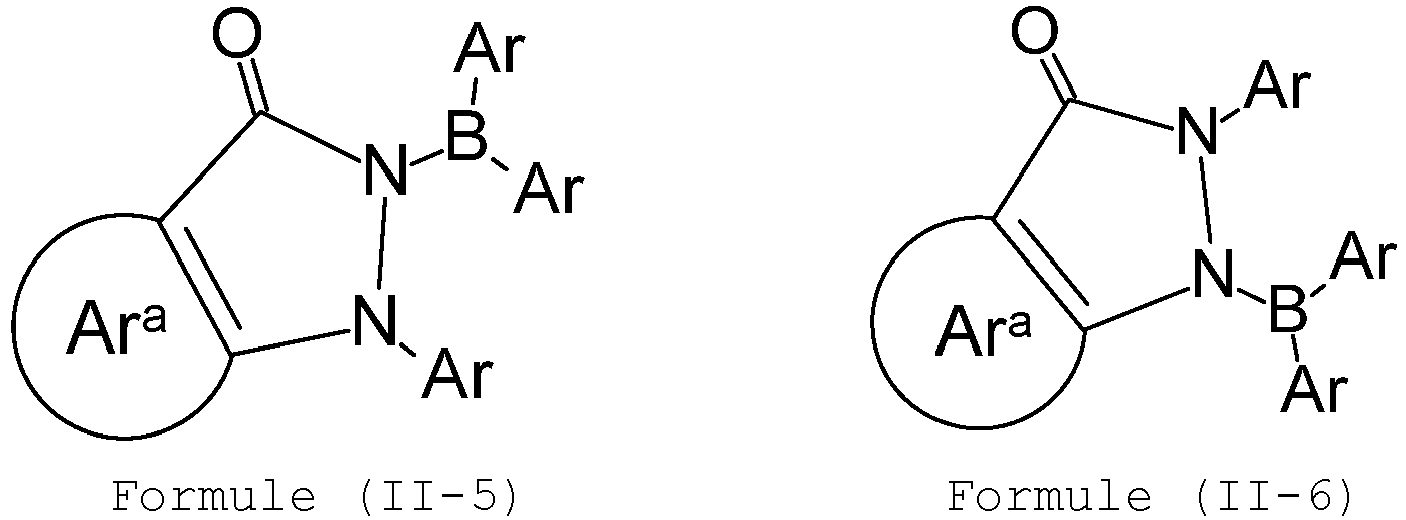

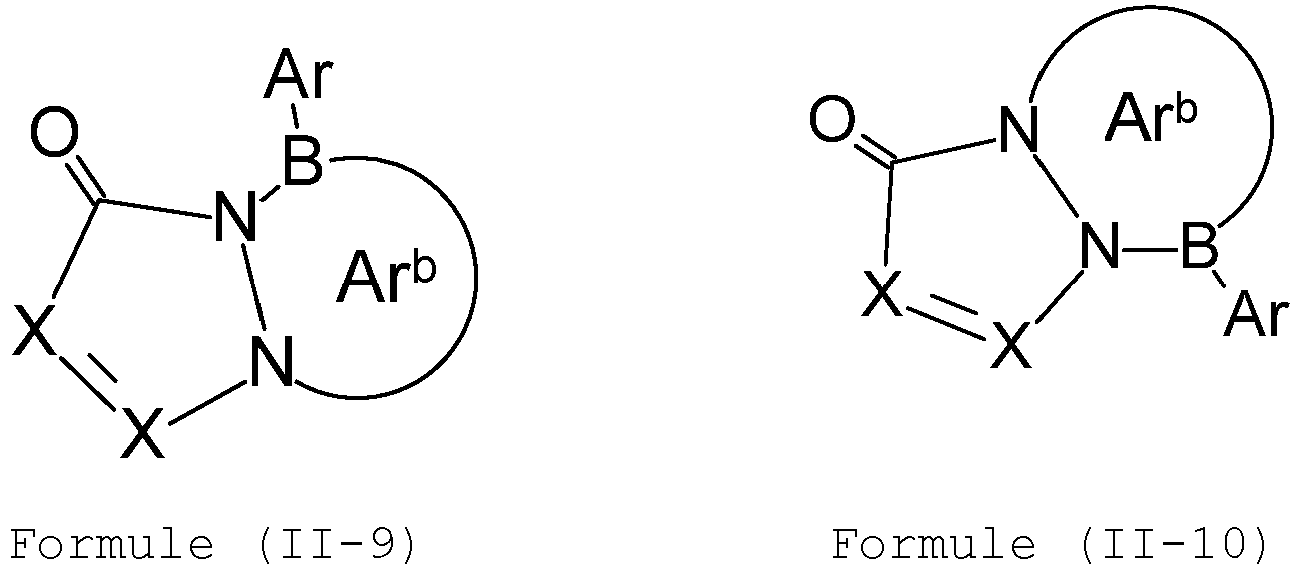


- Composé selon l'une ou plusieurs des revendications 1 à 3, comprenant au moins une structure des formules (III-1) à (III-48),


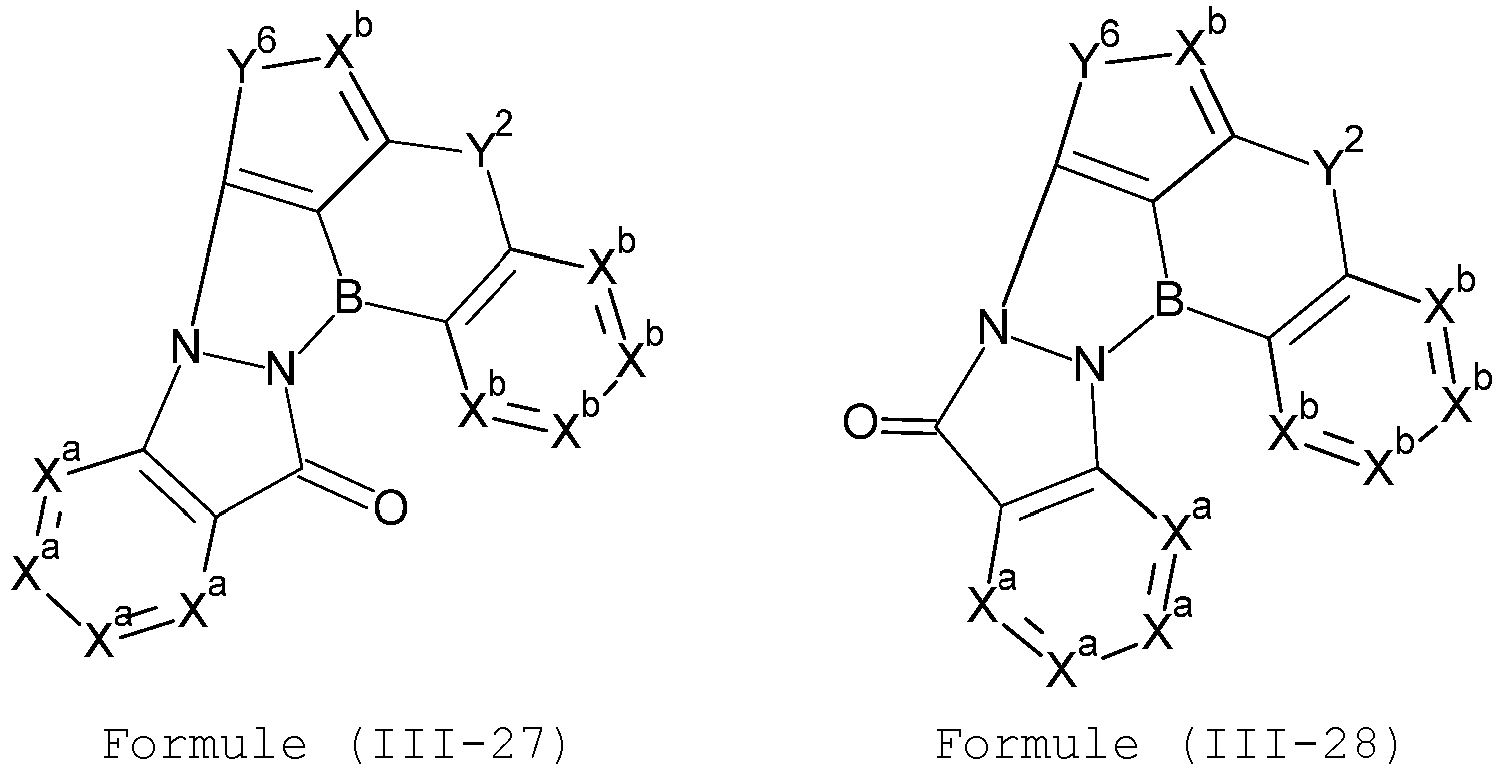


 X représente, en chaque occurrence, de manière identique ou différente, N ou CR, étant entendu que pas plus de deux des groupes X dans un cycle ne représentent N, R présentant la signification indiquée dans la revendication 1 ;Xa représente, en chaque occurrence, de manière identique ou différente, N ou CRa, étant entendu que pas plus de deux des groupes Xa dans un cycle ne représentent N, Ra présentant la signification indiquée dans la revendication 1 ;Xb représente, en chaque occurrence, de manière identique ou différente, N ou CRb, étant entendu que pas plus de deux des groupes Xb dans un cycle ne représentent N, Rb présentant la signification indiquée dans la revendication 1,Y1 représente, en chaque occurrence, de manière identique ou différente, une liaison, N(Ar), N(R), P(Ar), P(R), P(=O)Ar, P(=O)R, P(=S)Ar, P(=S)R, B(Ar), B(R), Al(Ar), Al(R), Ga(Ar), Ga(R), C=O, C(R)2, Si(R)2, Ge(R)2, C=NR, C=NAr, C=C(R)2, C=C(R)(Ar), O, S, Se, S=O ou SO2, R présentant la signification indiquée ci-dessus, en particulier pour la formule (I) ;Y2 représente, en chaque occurrence, de manière identique ou différente, une liaison, N(Ar), N(R), P(Ar), P(R), P(=O)Ar, P(=O)R, P(=S)Ar, P(=S)R, B(Ar), B(R), Al(Ar), Al(R), Ga(Ar), Ga(R), C=O, C(R)2, Si(R)2, Ge(R)2, C=NR, C=NAr, C=C(R)2, C=C(R)(Ar), O, S, Se, S=O ou SO2, R présentant la signification indiquée ci-dessus, en particulier pour la formule (I) ;Y3 représente, en chaque occurrence, de manière identique ou différente, N(Ar), N(R), P(Ar), P(R), P(=O)Ar, P(=O)R, P(=S)Ar, P(=S)R, B (Ar), B (R), Al(Ar), Al(R), Ga(Ar), Ga(R), C=O, C(R)2, Si(R)2, Ge(R)2, C=NR, C=NAr, C=C(R)2, C=C(R)(Ar), O, S, Se, S=O ou SO2, R présentant la signification indiquée ci-dessus, en particulier pour la formule (I) ;Y4 représente, en chaque occurrence, de manière identique ou différente, N(Ar), N(R), P(Ar), P(R), P(=O)Ar, P(=O)R, P(=S)Ar, P(=S)R, C(R)2, Si(R)2, O ou S, R présentant la signification indiquée ci-dessus, en particulier pour la formule (I) ;Y5 représente, en chaque occurrence, de manière identique ou différente, N(Ar), N(R), P(Ar), P(R), P(=O)Ar, P(=O)R, P(=S)Ar, P(=S)R, B(Ar), B(R), Al(Ar), Al(R), Ga(Ar), Ga(R), C=O, C(R)2, Si(R)2, Ge(R)2, C=NR, C=NAr, C=C(R)2, C=C(R)(Ar), O, S, Se, S=O ou SO2, R présentant la signification indiquée ci-dessus, en particulier pour la formule (I) ;Y6 représente, en chaque occurrence, de manière identique ou différente, N(Ar), N(R), P(Ar), P(R), P(=O)Ar, P(=O)R, P(=S)Ar, P(=S)R, B (Ar), B (R), Al(Ar), Al(R), Ga(Ar), Ga(R), C=O, C(R)2, Si(R)2, Ge(R)2, C=NR, C=NAr, C=C(R)2, C=C(R)(Ar), O, S, Se, S=O ou SO2, R présentant la signification indiquée ci-dessus, en particulier pour la formule (I).
 - Composés selon l'une ou plusieurs des revendications 1 à 4, comprenant au moins une structure des formules (IV-1) à (IV-48),


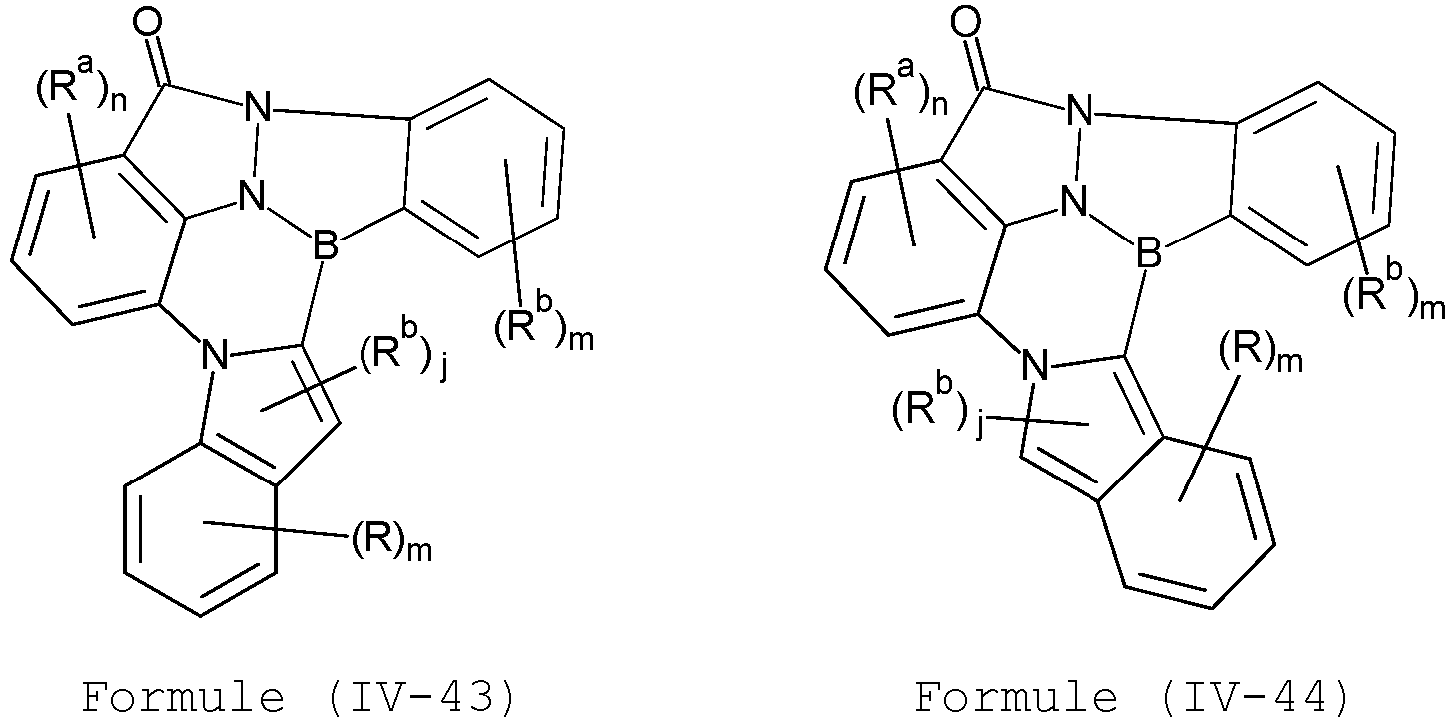

 m représente 0, 1, 2, 3 ou 4 ;n représente 0, 1, 2 ou 3 ;j représente 0, 1 ou 2 ;k représente 0 ou 1.
 - Composé selon l'une ou plusieurs des revendications 1 à 5, caractérisé en ce que les structures/composés des formules (I), (II-1) à (II-18), (III-1) à (III-48) et/ou (IV-1) à (IV-48) présentent au maximum une double liaison oléfinique.
- Composé selon l'une ou plusieurs des revendications 1 à 6, caractérisé en ce qu'au moins deux radicaux R, Ra, Rb forment, avec les autres groupes auxquels sont liés les deux radicaux R, Ra, Rb, un cycle condensé, les deux radicaux R, Ra, Rb formant au moins une structure des formules (RA-1) à (RA-12)

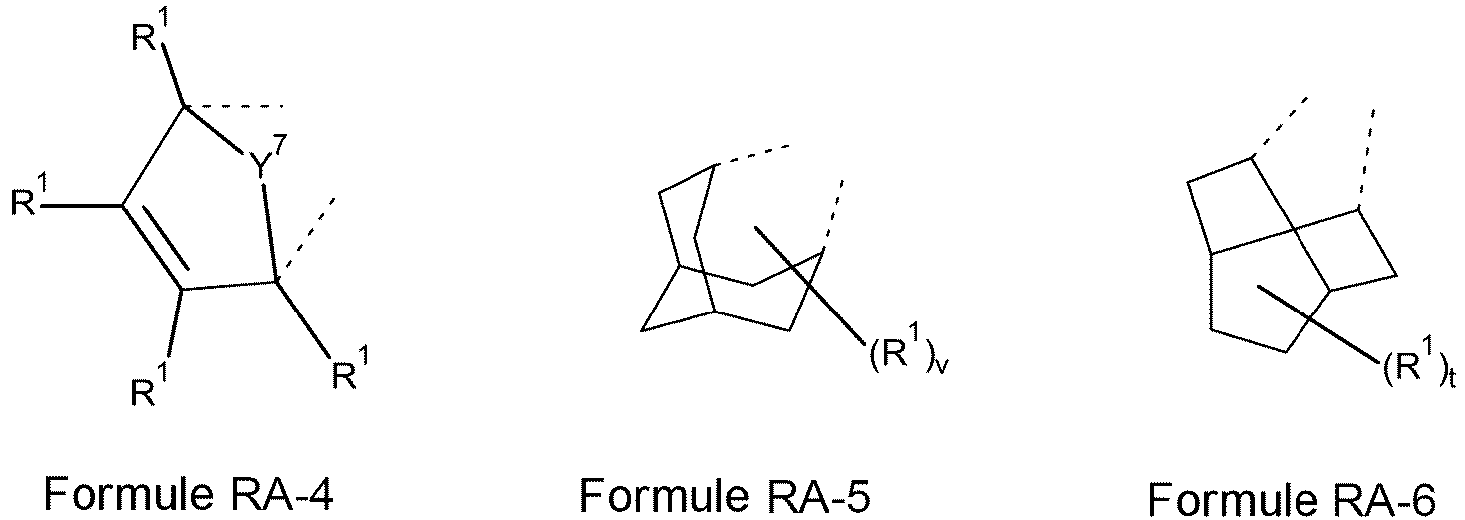

 Y7 représente, en chaque occurrence, de manière identique ou différente, C (R1)2, (R1)2C-C(R1)2, (R1)C=C(R1), NR1, NAr', O ou S ;Rc représente, en chaque occurrence, de manière identique ou différente, F, un groupe alkyle, alcoxy ou thioalcoxy linéaire comprenant 1 à 40 atomes de carbone ou un groupe alcényle ou alcynyle comprenant 2 à 40 atomes de carbone ou un groupe alkyle, alcoxy ou thioalcoxy ramifié ou cyclique comprenant 3 à 20 atomes de carbone, le groupe alkyle, alcoxy, thioalcoxy, alcényle ou alcynyle pouvant à chaque fois être substitué par un ou plusieurs radicaux R2, un ou plusieurs groupes CH2 non adjacents pouvant être remplacés par R2C=CR2, C=C, Si(R2)2, C=O, C=S, C=Se, C=NR2, -C(=O)O-,-C(=O)NR2-, NR2, P(=O)(R1), -O-, -S-, SO ou SO2 ; ou un système cyclique aromatique ou hétéroaromatique comprenant 5 à 60 atomes cycliques aromatiques, qui peut à chaque fois être substitué par un ou plusieurs radicaux R2, ou un groupe aryloxy ou hétéroaryloxy comprenant 5 à 60 atomes cycliques aromatiques, qui peut être substitué par un ou plusieurs radicaux R2 ; deux radicaux Rc pouvant également former, l'un avec l'autre ou un radical Rc pouvant former, avec un radical R1 ou avec un autre groupe, un système cyclique ;s représente 0, 1, 2, 3, 4, 5 ou 6 ;t représente 0, 1, 2, 3, 4, 5, 6, 7 ou 8 ;v représente 0, 1, 2, 3, 4, 5, 6, 7, 8 ou 9.
 - Composé selon l'une ou plusieurs des revendications 1 à 7, caractérisé en ce qu'au moins deux radicaux R, Ra, Rb forment, avec les autres groupes auxquels sont liés les deux radicaux R, Ra, Rb, un cycle condensé, les deux radicaux R, Ra, Rb formant les structures de formule (RB),

- Composé selon l'une ou plusieurs des revendications 1 à 8, comprenant au moins une structure des formules (V-1) à (V-12), les composés présentant au moins un cycle condensé,


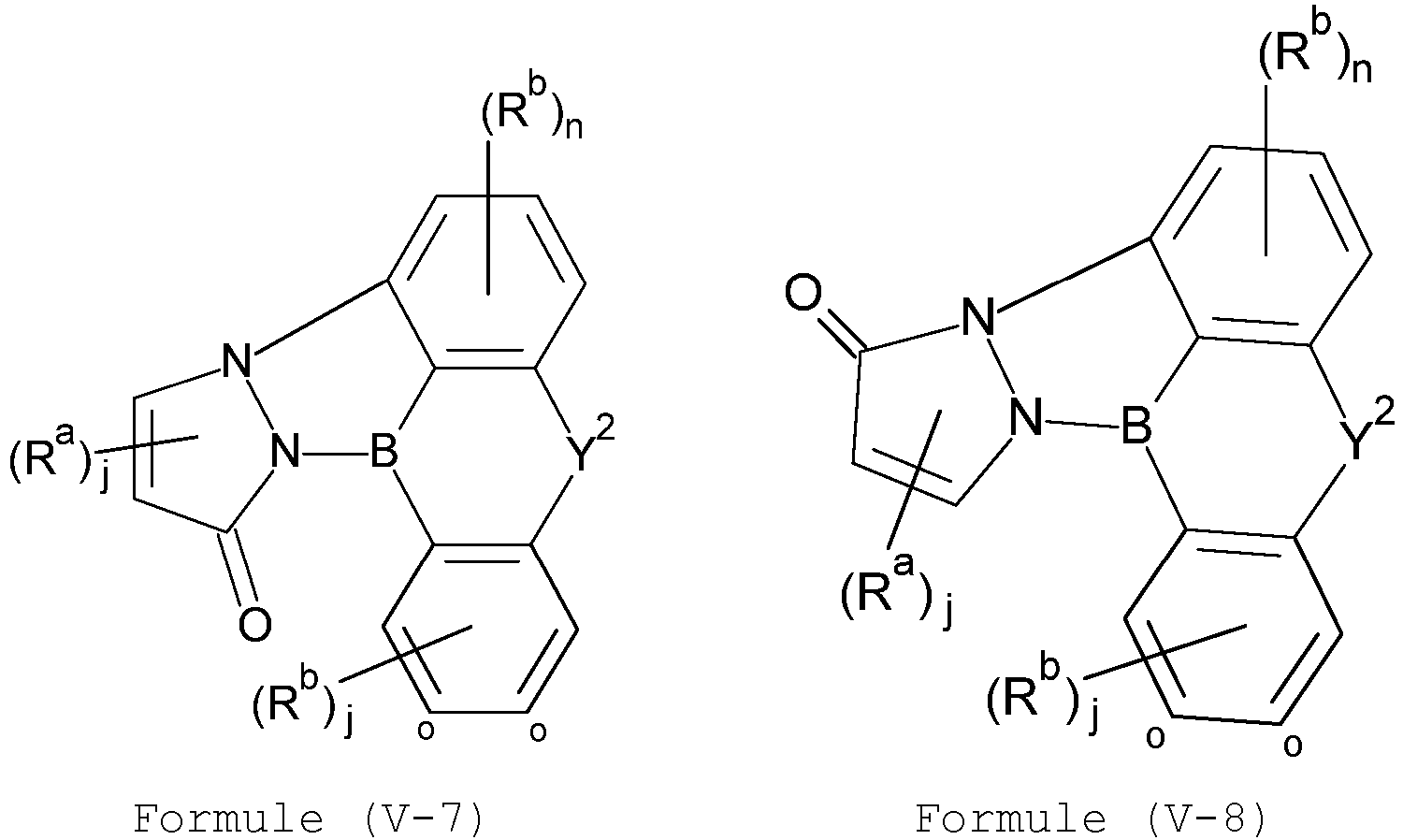
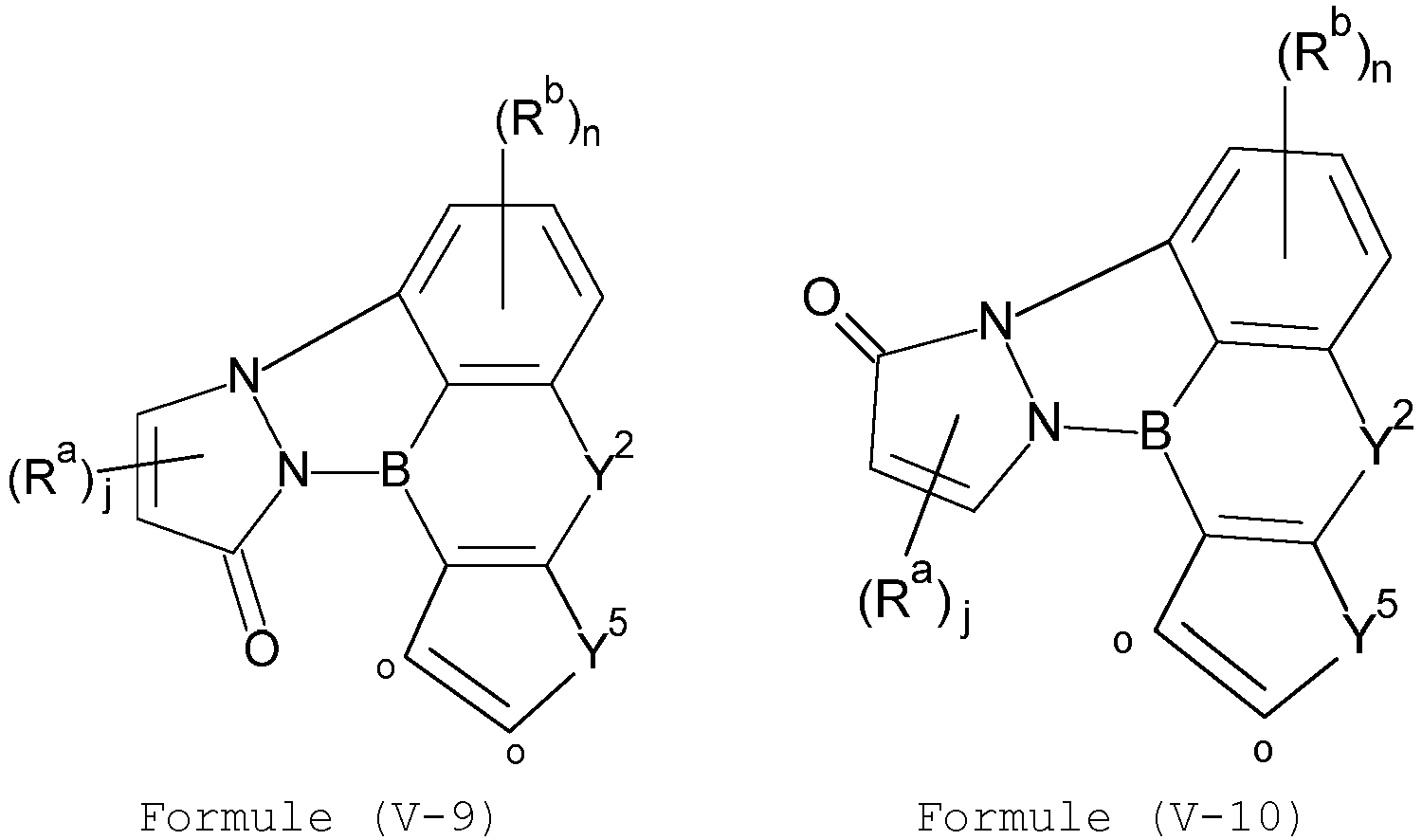
 m représente 0, 1, 2, 3 ou 4 ;n représente 0, 1, 2 ou 3 ;j représente 0, 1 ou 2.
 - Composé selon l'une ou plusieurs des revendications 1 à 9, caractérisé en ce qu'au moins un substituant R, Ra, Rb est choisi, de manière identique ou différente en chaque occurrence, dans le groupe constitué par H, D, un groupe alkyle, alcoxy ou thioalcoxy ramifié ou cyclique comprenant 3 à 20 atomes de carbone ou un système cyclique aromatique ou hétéroaromatique choisi parmi les groupes des formules suivantes Ar-1 à Ar-78,


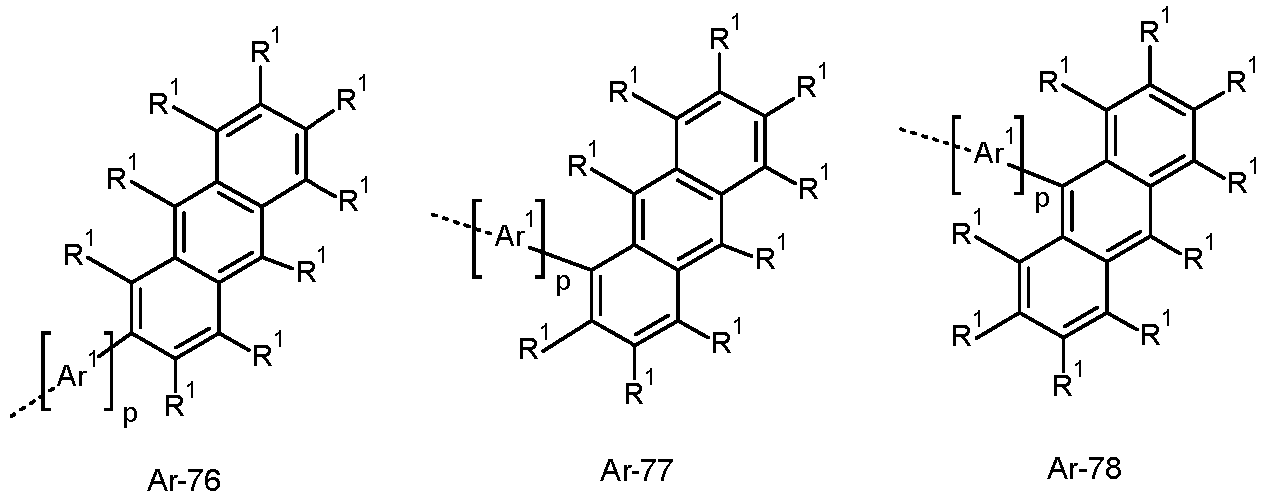 Ar1 représente, en chaque occurrence, de manière identique ou différente, un système cyclique aromatique ou hétéroaromatique bivalent comprenant 6 à 18 atomes cycliques aromatiques, qui peut à chaque fois être substitué par un ou plusieurs radicaux R1 ;A représente, en chaque occurrence, de manière identique ou différente, C(R1)2, NR1, O ou S ;p représente 0 ou 1, p = 0 signifiant que le groupe Ar1 est absent et que le groupe aromatique ou, selon le cas, hétéroaromatique correspondant est directement lié au radical correspondant ;q représente 0 ou 1, q = 0 signifiant qu'aucun groupe A n'est lié en cette position et que, à la place, des radicaux R1 sont liés aux atomes de carbone correspondants.
 - Composé selon au moins l'une des revendications 1 à 10 précédentes, caractérisé en ce que le composé comprend exactement deux ou exactement trois structures selon la formule (I), (II-1) à (II-18), (III-1) à (III-48), (IV-1) à (IV-48) et/ou (V-1) à (V-12).
- Oligomère, polymère ou dendrimère contenant un ou plusieurs composés selon l'une des revendications 1 à 10, dans lequel il existe, au lieu d'un atome d'hydrogène ou d'un substituant, une ou plusieurs liaisons des composés au polymère, à l'oligomère ou au dendrimère.
- Formulation contenant au moins un composé selon l'une ou plusieurs des revendications 1 à 11 ou un oligomère, un polymère ou un dendrimère selon la revendication 12 et au moins un autre composé, l'autre composé étant de préférence choisi parmi un ou plusieurs solvants.
- Composition contenant au moins un composé selon l'une ou plusieurs des revendications 1 à 11 ou un oligomère, un polymère ou un dendrimère selon la revendication 12 et au moins un autre composé choisi dans le groupe constitué par les émetteurs fluorescents, les émetteurs phosphorescents, les émetteurs présentant une TADF (fluorescence retardée activée thermiquement), les matériaux hôtes, les matériaux de transport d'électrons, matériaux d'injection d'électrons, les matériaux conducteurs de trous, les matériaux d'injection de trous, les matériaux de blocage d'électrons et les matériaux de blocage de trous.
- Procédé de préparation d'un composé selon l'une ou plusieurs des revendications 1 à 11, caractérisé en ce qu'on synthétise une structure de base présentant au moins l'un des groupes Wa ou un précurseur de l'un des groupes Wa et on introduit un radical aromatique ou hétéroaromatique au moyen d'une réaction de substitution aromatique nucléophile ou d'une réaction de couplage.
- Utilisation d'un composé selon l'une ou plusieurs des revendications 1 à 11 ou d'un oligomère, d'un polymère ou d'un dendrimère selon la revendication 12 dans un dispositif électronique.
- Dispositif électronique contenant au moins un composé selon l'une ou plusieurs des revendications 1 à 11 ou un oligomère, un polymère ou un dendrimère selon la revendication 12.
Applications Claiming Priority (2)
| Application Number | Priority Date | Filing Date | Title |
|---|---|---|---|
| EP21196594 | 2021-09-14 | ||
| PCT/EP2022/075198 WO2023041454A1 (fr) | 2021-09-14 | 2022-09-12 | Composés hétérocycliques contenant du bore pour dispositifs électroluminescents organiques |
Publications (2)
| Publication Number | Publication Date |
|---|---|
| EP4402221A1 EP4402221A1 (fr) | 2024-07-24 |
| EP4402221B1 true EP4402221B1 (fr) | 2025-05-07 |
Family
ID=77750157
Family Applications (1)
| Application Number | Title | Priority Date | Filing Date |
|---|---|---|---|
| EP22782695.5A Active EP4402221B1 (fr) | 2021-09-14 | 2022-09-12 | Composés hétérocycliques contenant du bore pour dispositifs électroluminescents organiques |
Country Status (5)
| Country | Link |
|---|---|
| US (1) | US20240400892A1 (fr) |
| EP (1) | EP4402221B1 (fr) |
| KR (1) | KR20240064697A (fr) |
| CN (1) | CN117980439A (fr) |
| WO (1) | WO2023041454A1 (fr) |
Family Cites Families (121)
| Publication number | Priority date | Publication date | Assignee | Title |
|---|---|---|---|---|
| DE4111878A1 (de) | 1991-04-11 | 1992-10-15 | Wacker Chemie Gmbh | Leiterpolymere mit konjugierten doppelbindungen |
| JPH07133483A (ja) | 1993-11-09 | 1995-05-23 | Shinko Electric Ind Co Ltd | El素子用有機発光材料及びel素子 |
| JP3139321B2 (ja) | 1994-03-31 | 2001-02-26 | 東レ株式会社 | 発光素子 |
| DE4436773A1 (de) | 1994-10-14 | 1996-04-18 | Hoechst Ag | Konjugierte Polymere mit Spirozentren und ihre Verwendung als Elektrolumineszenzmaterialien |
| DE19614971A1 (de) | 1996-04-17 | 1997-10-23 | Hoechst Ag | Polymere mit Spiroatomen und ihre Verwendung als Elektrolumineszenzmaterialien |
| JP2998707B2 (ja) | 1997-07-09 | 2000-01-11 | 日本電気株式会社 | 有機エレクトロルミネッセンス素子 |
| DE19846766A1 (de) | 1998-10-10 | 2000-04-20 | Aventis Res & Tech Gmbh & Co | Konjugierte Polymere, enthaltend spezielle Fluorenbausteine mit verbesserten Eigenschaften |
| US6166172A (en) | 1999-02-10 | 2000-12-26 | Carnegie Mellon University | Method of forming poly-(3-substituted) thiophenes |
| CN101312235B (zh) | 1999-05-13 | 2010-06-09 | 普林斯顿大学理事会 | 基于电致磷光的极高效有机发光器件 |
| US6310360B1 (en) | 1999-07-21 | 2001-10-30 | The Trustees Of Princeton University | Intersystem crossing agents for efficient utilization of excitons in organic light emitting devices |
| JP4357781B2 (ja) | 1999-12-01 | 2009-11-04 | ザ、トラスティーズ オブ プリンストン ユニバーシティ | 有機led用燐光性ドーパントとしての式l2mxの錯体 |
| US6660410B2 (en) | 2000-03-27 | 2003-12-09 | Idemitsu Kosan Co., Ltd. | Organic electroluminescence element |
| US20020121638A1 (en) | 2000-06-30 | 2002-09-05 | Vladimir Grushin | Electroluminescent iridium compounds with fluorinated phenylpyridines, phenylpyrimidines, and phenylquinolines and devices made with such compounds |
| JP5241053B2 (ja) | 2000-08-11 | 2013-07-17 | ザ、トラスティーズ オブ プリンストン ユニバーシティ | 有機金属化合物及び放射移行有機電気燐光体 |
| JP4154138B2 (ja) | 2000-09-26 | 2008-09-24 | キヤノン株式会社 | 発光素子、表示装置及び金属配位化合物 |
| JP4154140B2 (ja) | 2000-09-26 | 2008-09-24 | キヤノン株式会社 | 金属配位化合物 |
| JP4154139B2 (ja) | 2000-09-26 | 2008-09-24 | キヤノン株式会社 | 発光素子 |
| US6784016B2 (en) | 2001-06-21 | 2004-08-31 | The Trustees Of Princeton University | Organic light-emitting devices with blocking and transport layers |
| ITRM20020411A1 (it) | 2002-08-01 | 2004-02-02 | Univ Roma La Sapienza | Derivati dello spirobifluorene, loro preparazione e loro uso. |
| GB0226010D0 (en) | 2002-11-08 | 2002-12-18 | Cambridge Display Tech Ltd | Polymers for use in organic electroluminescent devices |
| EP1578885A2 (fr) | 2002-12-23 | 2005-09-28 | Covion Organic Semiconductors GmbH | Element electroluminescent organique |
| DE10304819A1 (de) | 2003-02-06 | 2004-08-19 | Covion Organic Semiconductors Gmbh | Carbazol-enthaltende konjugierte Polymere und Blends, deren Darstellung und Verwendung |
| JP4411851B2 (ja) | 2003-03-19 | 2010-02-10 | コニカミノルタホールディングス株式会社 | 有機エレクトロルミネッセンス素子 |
| EP1717291A3 (fr) | 2003-04-15 | 2007-03-21 | Merck Patent GmbH | Mélanges de semi-conducteurs organiques aptes à l'émission et de matières matricielles, leur utilisation et composants électroniques contenant ces mélanges |
| EP1617711B1 (fr) | 2003-04-23 | 2016-08-17 | Konica Minolta Holdings, Inc. | Dispositif organique électroluminescent et affichage |
| EP1491568A1 (fr) | 2003-06-23 | 2004-12-29 | Covion Organic Semiconductors GmbH | Polymères semi-conducteurs |
| DE10328627A1 (de) | 2003-06-26 | 2005-02-17 | Covion Organic Semiconductors Gmbh | Neue Materialien für die Elektrolumineszenz |
| DE10337346A1 (de) | 2003-08-12 | 2005-03-31 | Covion Organic Semiconductors Gmbh | Konjugierte Polymere enthaltend Dihydrophenanthren-Einheiten und deren Verwendung |
| DE10338550A1 (de) | 2003-08-19 | 2005-03-31 | Basf Ag | Übergangsmetallkomplexe mit Carbenliganden als Emitter für organische Licht-emittierende Dioden (OLEDs) |
| DE10345572A1 (de) | 2003-09-29 | 2005-05-19 | Covion Organic Semiconductors Gmbh | Metallkomplexe |
| US7795801B2 (en) | 2003-09-30 | 2010-09-14 | Konica Minolta Holdings, Inc. | Organic electroluminescent element, illuminator, display and compound |
| US7659540B2 (en) | 2003-10-22 | 2010-02-09 | Merck Patent Gmbh | Materials for electroluminescence and the utilization thereof |
| CN100536190C (zh) | 2003-11-25 | 2009-09-02 | 默克专利有限公司 | 有机电致发光元件 |
| US20050214575A1 (en) | 2004-03-26 | 2005-09-29 | Fuji Photo Film Co., Ltd. | Organic electroluminescence element |
| US7790890B2 (en) | 2004-03-31 | 2010-09-07 | Konica Minolta Holdings, Inc. | Organic electroluminescence element material, organic electroluminescence element, display device and illumination device |
| DE102004020298A1 (de) | 2004-04-26 | 2005-11-10 | Covion Organic Semiconductors Gmbh | Elektrolumineszierende Polymere und deren Verwendung |
| DE102004023277A1 (de) | 2004-05-11 | 2005-12-01 | Covion Organic Semiconductors Gmbh | Neue Materialmischungen für die Elektrolumineszenz |
| US7598388B2 (en) | 2004-05-18 | 2009-10-06 | The University Of Southern California | Carbene containing metal complexes as OLEDs |
| JP4862248B2 (ja) | 2004-06-04 | 2012-01-25 | コニカミノルタホールディングス株式会社 | 有機エレクトロルミネッセンス素子、照明装置及び表示装置 |
| ITRM20040352A1 (it) | 2004-07-15 | 2004-10-15 | Univ Roma La Sapienza | Derivati oligomerici dello spirobifluorene, loro preparazione e loro uso. |
| EP1669386A1 (fr) | 2004-12-06 | 2006-06-14 | Covion Organic Semiconductors GmbH | Polymères conjugués, leur représentation et utilisation |
| EP1888706B1 (fr) | 2005-05-03 | 2017-03-01 | Merck Patent GmbH | Dispositif electroluminescent organique, et derives d'acide boronique et d'acide borinique utilises pour produire ce dispositif electroluminescent organique |
| DE102005037734B4 (de) | 2005-08-10 | 2018-02-08 | Merck Patent Gmbh | Elektrolumineszierende Polymere, ihre Verwendung und bifunktionelle monomere Verbindungen |
| EP1956022B1 (fr) | 2005-12-01 | 2012-07-25 | Nippon Steel Chemical Co., Ltd. | Compose pour element electroluminescent organique et element electroluminescent organique |
| DE102006025777A1 (de) | 2006-05-31 | 2007-12-06 | Merck Patent Gmbh | Neue Materialien für organische Elektrolumineszenzvorrichtungen |
| EP2080762B1 (fr) | 2006-11-09 | 2016-09-14 | Nippon Steel & Sumikin Chemical Co., Ltd. | Composé pour un dispositif électroluminescent organique et dispositif électroluminescent organique |
| WO2009030981A2 (fr) | 2006-12-28 | 2009-03-12 | Universal Display Corporation | Structures de dispositifs électroluminescents organiques (oled) phosphorescents à longue durée de vie utile |
| DE102007002714A1 (de) | 2007-01-18 | 2008-07-31 | Merck Patent Gmbh | Neue Materialien für organische Elektrolumineszenzvorrichtungen |
| DE102007053771A1 (de) | 2007-11-12 | 2009-05-14 | Merck Patent Gmbh | Organische Elektrolumineszenzvorrichtungen |
| DE102008017591A1 (de) | 2008-04-07 | 2009-10-08 | Merck Patent Gmbh | Neue Materialien für organische Elektrolumineszenzvorrichtungen |
| DE102008027005A1 (de) | 2008-06-05 | 2009-12-10 | Merck Patent Gmbh | Organische elektronische Vorrichtung enthaltend Metallkomplexe |
| DE102008033943A1 (de) | 2008-07-18 | 2010-01-21 | Merck Patent Gmbh | Neue Materialien für organische Elektrolumineszenzvorrichtungen |
| DE102008036247A1 (de) | 2008-08-04 | 2010-02-11 | Merck Patent Gmbh | Elektronische Vorrichtungen enthaltend Metallkomplexe |
| DE102008036982A1 (de) | 2008-08-08 | 2010-02-11 | Merck Patent Gmbh | Organische Elektrolumineszenzvorrichtung |
| DE102008048336A1 (de) | 2008-09-22 | 2010-03-25 | Merck Patent Gmbh | Einkernige neutrale Kupfer(I)-Komplexe und deren Verwendung zur Herstellung von optoelektronischen Bauelementen |
| DE102008056688A1 (de) | 2008-11-11 | 2010-05-12 | Merck Patent Gmbh | Materialien für organische Elektrolumineszenzvorrichtungen |
| JP5701766B2 (ja) | 2008-11-11 | 2015-04-15 | メルク パテント ゲーエムベーハー | 有機エレクトロルミネセント素子 |
| DE102008057051B4 (de) | 2008-11-13 | 2021-06-17 | Merck Patent Gmbh | Materialien für organische Elektrolumineszenzvorrichtungen |
| DE102008057050B4 (de) | 2008-11-13 | 2021-06-02 | Merck Patent Gmbh | Materialien für organische Elektrolumineszenzvorrichtungen |
| DE102009007038A1 (de) | 2009-02-02 | 2010-08-05 | Merck Patent Gmbh | Metallkomplexe |
| DE102009011223A1 (de) | 2009-03-02 | 2010-09-23 | Merck Patent Gmbh | Metallkomplexe |
| DE102009013041A1 (de) | 2009-03-13 | 2010-09-16 | Merck Patent Gmbh | Materialien für organische Elektrolumineszenzvorrichtungen |
| DE102009014513A1 (de) | 2009-03-23 | 2010-09-30 | Merck Patent Gmbh | Organische Elektrolumineszenzvorrichtung |
| DE102009023155A1 (de) | 2009-05-29 | 2010-12-02 | Merck Patent Gmbh | Materialien für organische Elektrolumineszenzvorrichtungen |
| DE102009031021A1 (de) | 2009-06-30 | 2011-01-05 | Merck Patent Gmbh | Materialien für organische Elektrolumineszenzvorrichtungen |
| DE102009041414A1 (de) | 2009-09-16 | 2011-03-17 | Merck Patent Gmbh | Metallkomplexe |
| DE102009053645A1 (de) | 2009-11-17 | 2011-05-19 | Merck Patent Gmbh | Materialien für organische Elektrolumineszenzvorrichtung |
| DE102009053644B4 (de) | 2009-11-17 | 2019-07-04 | Merck Patent Gmbh | Materialien für organische Elektrolumineszenzvorrichtungen |
| DE102009048791A1 (de) | 2009-10-08 | 2011-04-14 | Merck Patent Gmbh | Materialien für organische Elektrolumineszenzvorrichtungen |
| DE102009053382A1 (de) | 2009-11-14 | 2011-05-19 | Merck Patent Gmbh | Materialien für elektronische Vorrichtungen |
| DE102009053836A1 (de) | 2009-11-18 | 2011-05-26 | Merck Patent Gmbh | Materialien für organische Elektrolumineszenzvorrichtungen |
| DE102009057167A1 (de) | 2009-12-05 | 2011-06-09 | Merck Patent Gmbh | Elektronische Vorrichtung enthaltend Metallkomplexe |
| DE102010005697A1 (de) | 2010-01-25 | 2011-07-28 | Merck Patent GmbH, 64293 | Verbindungen für elektronische Vorrichtungen |
| WO2011157339A1 (fr) | 2010-06-15 | 2011-12-22 | Merck Patent Gmbh | Complexes métalliques |
| DE102010027317A1 (de) | 2010-07-16 | 2012-01-19 | Merck Patent Gmbh | Metallkomplexe |
| DE102010048608A1 (de) | 2010-10-15 | 2012-04-19 | Merck Patent Gmbh | Materialien für organische Elektrolumineszenzvorrichtungen |
| DE102010054525A1 (de) | 2010-12-15 | 2012-04-26 | Merck Patent Gmbh | Organische Elektrolumineszenzvorrichtung |
| KR101650996B1 (ko) | 2011-03-25 | 2016-08-24 | 이데미쓰 고산 가부시키가이샤 | 유기 일렉트로 루미네선스 소자 |
| JP6215192B2 (ja) | 2011-04-18 | 2017-10-18 | メルク パテント ゲーエムベーハー | 有機エレクトロルミネッセンス素子用材料 |
| IN2014KN00846A (fr) | 2011-09-21 | 2015-10-02 | Merck Patent Gmbh | |
| WO2013056776A1 (fr) | 2011-10-20 | 2013-04-25 | Merck Patent Gmbh | Matériaux destinés à des dispositifs électroluminescents organiques |
| US9837622B2 (en) | 2012-07-13 | 2017-12-05 | Merck Patent Gmbh | Metal complexes |
| WO2014023377A2 (fr) | 2012-08-07 | 2014-02-13 | Merck Patent Gmbh | Complexes métalliques |
| WO2014094961A1 (fr) | 2012-12-21 | 2014-06-26 | Merck Patent Gmbh | Complexes métalliques |
| US20150349277A1 (en) | 2012-12-21 | 2015-12-03 | Merck Patent Gmbh | Metal complexes |
| US10862047B2 (en) | 2013-08-14 | 2020-12-08 | Kyushu University, National University Corporation | Organic electroluminescent device |
| CN105531347B (zh) | 2013-09-11 | 2018-09-11 | 默克专利有限公司 | 金属络合物 |
| KR20160100961A (ko) | 2013-12-20 | 2016-08-24 | 바스프 에스이 | 매우 짧은 감쇠 시간을 갖는 고효율 oled 장치 |
| JP5905916B2 (ja) | 2013-12-26 | 2016-04-20 | 出光興産株式会社 | 有機エレクトロルミネッセンス素子および電子機器 |
| CN105916868B (zh) | 2014-01-13 | 2020-06-23 | 默克专利有限公司 | 金属络合物 |
| CN105980519B (zh) | 2014-02-05 | 2019-06-14 | 默克专利有限公司 | 金属络合物 |
| JP6890975B2 (ja) | 2014-05-05 | 2021-06-18 | メルク パテント ゲーエムベーハー | 有機エレクトロルミネッセンス素子のための材料 |
| EP3174890B1 (fr) | 2014-07-28 | 2019-03-13 | Merck Patent GmbH | Complexes métalliques |
| KR102474330B1 (ko) | 2014-07-29 | 2022-12-05 | 메르크 파텐트 게엠베하 | 유기 전계발광 소자용 재료 |
| KR102433463B1 (ko) | 2014-08-13 | 2022-08-18 | 메르크 파텐트 게엠베하 | 유기 전계발광 소자용 재료 |
| US11329244B2 (en) | 2014-08-22 | 2022-05-10 | Arizona Board Of Regents On Behalf Of Arizona State University | Organic light-emitting diodes with fluorescent and phosphorescent emitters |
| JP6772188B2 (ja) | 2015-02-03 | 2020-10-21 | メルク、パテント、ゲゼルシャフト、ミット、ベシュレンクテル、ハフツングMerck Patent GmbH | 金属錯体 |
| US20180182980A1 (en) | 2015-06-03 | 2018-06-28 | Udc Ireland Limited | Highly efficient oled devices with very short decay times |
| US11031562B2 (en) | 2015-08-25 | 2021-06-08 | Merck Patent Gmbh | Metal complexes |
| KR102750558B1 (ko) | 2016-03-03 | 2025-01-07 | 메르크 파텐트 게엠베하 | 유기 전계발광 소자용 재료 |
| KR102404836B1 (ko) | 2016-06-30 | 2022-06-02 | 메르크 파텐트 게엠베하 | 금속 착물로부터의 거울상이성질체 혼합물의 분리 방법 |
| KR102432968B1 (ko) | 2016-07-14 | 2022-08-16 | 메르크 파텐트 게엠베하 | 금속 착물 |
| CN109476691B (zh) | 2016-07-25 | 2023-09-12 | Udc爱尔兰有限公司 | 用作有机电致发光器件中的发光体的金属络合物 |
| WO2018019687A1 (fr) | 2016-07-25 | 2018-02-01 | Merck Patent Gmbh | Complexes métalliques dinucléaires et oligonucléaires comprenant des sous-unités de ligands tripodes bidentées ainsi que leur utilisation dans des dispositifs électroniques |
| WO2018041769A1 (fr) | 2016-08-30 | 2018-03-08 | Merck Patent Gmbh | Complexes métalliques binucléaires et trinucléaires obtenus à partir de deux ligands hexadentés tripodaux liés entre eux, destinés à être utilisés dans des dispositifs électroluminescents |
| EP3515925B1 (fr) | 2016-09-21 | 2020-10-21 | Merck Patent GmbH | Complexes métalliques trouvant application comme émetteurs dans des dispositifs électroluminescents organiques |
| KR102522745B1 (ko) | 2016-10-12 | 2023-04-17 | 메르크 파텐트 게엠베하 | 이핵성 금속 착물 및 상기 금속 착물을 함유하는 전자 디바이스, 특히 유기 전계발광 디바이스 |
| JP7064487B2 (ja) | 2016-10-12 | 2022-05-10 | メルク パテント ゲゼルシャフト ミット ベシュレンクテル ハフツング | 金属錯体 |
| US11145828B2 (en) | 2016-10-13 | 2021-10-12 | Merck Patent Gmbh | Metal complexes |
| EP3601304B1 (fr) | 2017-03-29 | 2021-10-27 | Merck Patent GmbH | Complexes métalliques |
| TWI780134B (zh) | 2017-03-29 | 2022-10-11 | 德商麥克專利有限公司 | 芳族化合物 |
| TWI776926B (zh) | 2017-07-25 | 2022-09-11 | 德商麥克專利有限公司 | 金屬錯合物 |
| EP3724202B1 (fr) | 2017-12-13 | 2022-08-17 | Merck Patent GmbH | Complexes métalliques |
| US11239430B2 (en) * | 2018-01-05 | 2022-02-01 | Beijing Summer Sprout Technology Co., Ltd. | Boron and nitrogen containing heterocyclic compounds |
| CN111699192B (zh) | 2018-02-13 | 2024-03-08 | Udc爱尔兰有限公司 | 金属络合物 |
| TWI828664B (zh) | 2018-03-19 | 2024-01-11 | 愛爾蘭商Udc愛爾蘭責任有限公司 | 金屬錯合物 |
| TWI826522B (zh) | 2018-09-12 | 2023-12-21 | 德商麥克專利有限公司 | 電致發光裝置 |
| EP3850055A1 (fr) | 2018-09-12 | 2021-07-21 | Merck Patent GmbH | Matériaux pour dispositifs électroluminescents organiques |
| TW202030902A (zh) | 2018-09-12 | 2020-08-16 | 德商麥克專利有限公司 | 電致發光裝置 |
| CN114401973A (zh) * | 2019-09-24 | 2022-04-26 | 默克专利有限公司 | 用于有机电致发光器件的材料 |
| DE202019005189U1 (de) | 2019-12-19 | 2020-01-30 | Merck Patent Gmbh | Elektrolumineszierende Vorrichtung |
-
2022
- 2022-09-12 CN CN202280061541.8A patent/CN117980439A/zh active Pending
- 2022-09-12 EP EP22782695.5A patent/EP4402221B1/fr active Active
- 2022-09-12 WO PCT/EP2022/075198 patent/WO2023041454A1/fr not_active Ceased
- 2022-09-12 US US18/691,474 patent/US20240400892A1/en active Pending
- 2022-09-12 KR KR1020247012320A patent/KR20240064697A/ko active Pending
Also Published As
| Publication number | Publication date |
|---|---|
| WO2023041454A1 (fr) | 2023-03-23 |
| CN117980439A (zh) | 2024-05-03 |
| KR20240064697A (ko) | 2024-05-13 |
| EP4402221A1 (fr) | 2024-07-24 |
| US20240400892A1 (en) | 2024-12-05 |
Similar Documents
| Publication | Publication Date | Title |
|---|---|---|
| EP3744155B1 (fr) | Matériaux pour dispositifs électroluminescents organiques | |
| EP3227269B1 (fr) | Matières pour dispositifs électroluminescents organiques | |
| EP3016952B1 (fr) | Composés de lactame spirocondensés pour des dispositifs électroluminescents organiques | |
| EP3197982A1 (fr) | Matières pour dispositifs électroluminescents organiques | |
| EP4263543A1 (fr) | Composés azotés pour dispositifs électroluminescents organiques | |
| WO2022079068A1 (fr) | Composés hétérocycliques pour dispositifs électroluminescents organiques | |
| WO2021122538A1 (fr) | Composés aromatiques pour dispositifs électroluminescents organiques | |
| EP4165052A1 (fr) | Composés hétérocycliques pour dispositifs électroluminescents organiques | |
| EP4263544A1 (fr) | Dérivés d'indolo[3.2.1-jk]carbazole-6-carbonitrile utilisés en tant qu'émetteurs fluorescents bleus destinés à être utilisés dans des oled | |
| WO2021185829A1 (fr) | Composés hétérocycliques pour dispositifs électroluminescents organiques | |
| EP4172164B1 (fr) | Composés hétéroaromatiques pour dispositifs électroluminescents organiques | |
| EP4121432A1 (fr) | Composés hétéroaromatiques pour dispositifs électroluminescents organiques | |
| EP4229145B1 (fr) | Composés comprenant des hétéroatomes pour dispositifs électroluminescents organiques | |
| EP4330257B1 (fr) | Composés hétérocycliques contenant de l'azote pour des dispositifs électroluminescents organiques | |
| WO2025021855A1 (fr) | Matières pour dispositifs électroluminescents organiques et capteurs organiques | |
| EP4402221B1 (fr) | Composés hétérocycliques contenant du bore pour dispositifs électroluminescents organiques | |
| WO2022200638A1 (fr) | Matériaux pour dispositifs électroluminescents organiques | |
| EP4423209B1 (fr) | Composés hétérocycliques contenant du bore et de l'azote pour dispositifs électroluminescents organiques | |
| EP4676924A1 (fr) | Composés azotés cycliques pour dispositifs électroluminescents organiques | |
| EP4612157A2 (fr) | Hétérocycles azotés pour dispositifs électroluminescents organiques | |
| WO2025181124A1 (fr) | Matériaux pour dispositifs électroluminescents organiques | |
| WO2025181097A1 (fr) | Hétérocycles contenant de l'azote pour dispositifs électroluminescents organiques | |
| WO2025181044A1 (fr) | Composés contenant de l'azote pour dispositifs électroluminescents organiques | |
| WO2024149694A1 (fr) | Hétérocycles azotés pour dispositifs électroluminescents organiques | |
| WO2024153568A1 (fr) | Hétérocycles pour dispositifs électroluminescents organiques |
Legal Events
| Date | Code | Title | Description |
|---|---|---|---|
| STAA | Information on the status of an ep patent application or granted ep patent |
Free format text: STATUS: UNKNOWN |
|
| STAA | Information on the status of an ep patent application or granted ep patent |
Free format text: STATUS: THE INTERNATIONAL PUBLICATION HAS BEEN MADE |
|
| PUAI | Public reference made under article 153(3) epc to a published international application that has entered the european phase |
Free format text: ORIGINAL CODE: 0009012 |
|
| STAA | Information on the status of an ep patent application or granted ep patent |
Free format text: STATUS: REQUEST FOR EXAMINATION WAS MADE |
|
| 17P | Request for examination filed |
Effective date: 20240311 |
|
| AK | Designated contracting states |
Kind code of ref document: A1 Designated state(s): AL AT BE BG CH CY CZ DE DK EE ES FI FR GB GR HR HU IE IS IT LI LT LU LV MC MK MT NL NO PL PT RO RS SE SI SK SM TR |
|
| DAV | Request for validation of the european patent (deleted) | ||
| DAX | Request for extension of the european patent (deleted) | ||
| GRAP | Despatch of communication of intention to grant a patent |
Free format text: ORIGINAL CODE: EPIDOSNIGR1 |
|
| STAA | Information on the status of an ep patent application or granted ep patent |
Free format text: STATUS: GRANT OF PATENT IS INTENDED |
|
| RIC1 | Information provided on ipc code assigned before grant |
Ipc: H10K 85/60 20230101ALI20250108BHEP Ipc: C07F 5/02 20060101ALI20250108BHEP Ipc: C07B 47/00 20060101ALI20250108BHEP Ipc: C09K 11/06 20060101AFI20250108BHEP |
|
| INTG | Intention to grant announced |
Effective date: 20250127 |
|
| GRAS | Grant fee paid |
Free format text: ORIGINAL CODE: EPIDOSNIGR3 |
|
| GRAA | (expected) grant |
Free format text: ORIGINAL CODE: 0009210 |
|
| STAA | Information on the status of an ep patent application or granted ep patent |
Free format text: STATUS: THE PATENT HAS BEEN GRANTED |
|
| AK | Designated contracting states |
Kind code of ref document: B1 Designated state(s): AL AT BE BG CH CY CZ DE DK EE ES FI FR GB GR HR HU IE IS IT LI LT LU LV MC MK MT NL NO PL PT RO RS SE SI SK SM TR |
|
| REG | Reference to a national code |
Ref country code: GB Ref legal event code: FG4D Free format text: NOT ENGLISH |
|
| REG | Reference to a national code |
Ref country code: CH Ref legal event code: EP |
|
| REG | Reference to a national code |
Ref country code: DE Ref legal event code: R096 Ref document number: 502022003905 Country of ref document: DE |
|
| REG | Reference to a national code |
Ref country code: IE Ref legal event code: FG4D Free format text: LANGUAGE OF EP DOCUMENT: GERMAN |
|
| P01 | Opt-out of the competence of the unified patent court (upc) registered |
Free format text: CASE NUMBER: UPC_APP_0211_4402221/2025 Effective date: 20250711 |
|
| REG | Reference to a national code |
Ref country code: NL Ref legal event code: MP Effective date: 20250507 |
|
| PG25 | Lapsed in a contracting state [announced via postgrant information from national office to epo] |
Ref country code: ES Free format text: LAPSE BECAUSE OF FAILURE TO SUBMIT A TRANSLATION OF THE DESCRIPTION OR TO PAY THE FEE WITHIN THE PRESCRIBED TIME-LIMIT Effective date: 20250507 Ref country code: PT Free format text: LAPSE BECAUSE OF FAILURE TO SUBMIT A TRANSLATION OF THE DESCRIPTION OR TO PAY THE FEE WITHIN THE PRESCRIBED TIME-LIMIT Effective date: 20250908 Ref country code: FI Free format text: LAPSE BECAUSE OF FAILURE TO SUBMIT A TRANSLATION OF THE DESCRIPTION OR TO PAY THE FEE WITHIN THE PRESCRIBED TIME-LIMIT Effective date: 20250507 |
|
| PGFP | Annual fee paid to national office [announced via postgrant information from national office to epo] |
Ref country code: DE Payment date: 20250820 Year of fee payment: 4 |
|
| REG | Reference to a national code |
Ref country code: LT Ref legal event code: MG9D |
|
| PG25 | Lapsed in a contracting state [announced via postgrant information from national office to epo] |
Ref country code: NO Free format text: LAPSE BECAUSE OF FAILURE TO SUBMIT A TRANSLATION OF THE DESCRIPTION OR TO PAY THE FEE WITHIN THE PRESCRIBED TIME-LIMIT Effective date: 20250807 Ref country code: GR Free format text: LAPSE BECAUSE OF FAILURE TO SUBMIT A TRANSLATION OF THE DESCRIPTION OR TO PAY THE FEE WITHIN THE PRESCRIBED TIME-LIMIT Effective date: 20250808 |
|
| PG25 | Lapsed in a contracting state [announced via postgrant information from national office to epo] |
Ref country code: NL Free format text: LAPSE BECAUSE OF FAILURE TO SUBMIT A TRANSLATION OF THE DESCRIPTION OR TO PAY THE FEE WITHIN THE PRESCRIBED TIME-LIMIT Effective date: 20250507 Ref country code: PL Free format text: LAPSE BECAUSE OF FAILURE TO SUBMIT A TRANSLATION OF THE DESCRIPTION OR TO PAY THE FEE WITHIN THE PRESCRIBED TIME-LIMIT Effective date: 20250507 |
|
| PG25 | Lapsed in a contracting state [announced via postgrant information from national office to epo] |
Ref country code: BG Free format text: LAPSE BECAUSE OF FAILURE TO SUBMIT A TRANSLATION OF THE DESCRIPTION OR TO PAY THE FEE WITHIN THE PRESCRIBED TIME-LIMIT Effective date: 20250507 |
|
| PG25 | Lapsed in a contracting state [announced via postgrant information from national office to epo] |
Ref country code: HR Free format text: LAPSE BECAUSE OF FAILURE TO SUBMIT A TRANSLATION OF THE DESCRIPTION OR TO PAY THE FEE WITHIN THE PRESCRIBED TIME-LIMIT Effective date: 20250507 |
|
| PGFP | Annual fee paid to national office [announced via postgrant information from national office to epo] |
Ref country code: AT Payment date: 20251020 Year of fee payment: 4 |
|
| PG25 | Lapsed in a contracting state [announced via postgrant information from national office to epo] |
Ref country code: RS Free format text: LAPSE BECAUSE OF FAILURE TO SUBMIT A TRANSLATION OF THE DESCRIPTION OR TO PAY THE FEE WITHIN THE PRESCRIBED TIME-LIMIT Effective date: 20250807 |
|
| PG25 | Lapsed in a contracting state [announced via postgrant information from national office to epo] |
Ref country code: IS Free format text: LAPSE BECAUSE OF FAILURE TO SUBMIT A TRANSLATION OF THE DESCRIPTION OR TO PAY THE FEE WITHIN THE PRESCRIBED TIME-LIMIT Effective date: 20250907 |
|
| PG25 | Lapsed in a contracting state [announced via postgrant information from national office to epo] |
Ref country code: LV Free format text: LAPSE BECAUSE OF FAILURE TO SUBMIT A TRANSLATION OF THE DESCRIPTION OR TO PAY THE FEE WITHIN THE PRESCRIBED TIME-LIMIT Effective date: 20250507 |
|
| PG25 | Lapsed in a contracting state [announced via postgrant information from national office to epo] |
Ref country code: SM Free format text: LAPSE BECAUSE OF FAILURE TO SUBMIT A TRANSLATION OF THE DESCRIPTION OR TO PAY THE FEE WITHIN THE PRESCRIBED TIME-LIMIT Effective date: 20250507 Ref country code: DK Free format text: LAPSE BECAUSE OF FAILURE TO SUBMIT A TRANSLATION OF THE DESCRIPTION OR TO PAY THE FEE WITHIN THE PRESCRIBED TIME-LIMIT Effective date: 20250507 |
|
| PG25 | Lapsed in a contracting state [announced via postgrant information from national office to epo] |
Ref country code: CZ Free format text: LAPSE BECAUSE OF FAILURE TO SUBMIT A TRANSLATION OF THE DESCRIPTION OR TO PAY THE FEE WITHIN THE PRESCRIBED TIME-LIMIT Effective date: 20250507 |
|
| PG25 | Lapsed in a contracting state [announced via postgrant information from national office to epo] |
Ref country code: EE Free format text: LAPSE BECAUSE OF FAILURE TO SUBMIT A TRANSLATION OF THE DESCRIPTION OR TO PAY THE FEE WITHIN THE PRESCRIBED TIME-LIMIT Effective date: 20250507 |
|
| PG25 | Lapsed in a contracting state [announced via postgrant information from national office to epo] |
Ref country code: SK Free format text: LAPSE BECAUSE OF FAILURE TO SUBMIT A TRANSLATION OF THE DESCRIPTION OR TO PAY THE FEE WITHIN THE PRESCRIBED TIME-LIMIT Effective date: 20250507 |
|
| PG25 | Lapsed in a contracting state [announced via postgrant information from national office to epo] |
Ref country code: IT Free format text: LAPSE BECAUSE OF FAILURE TO SUBMIT A TRANSLATION OF THE DESCRIPTION OR TO PAY THE FEE WITHIN THE PRESCRIBED TIME-LIMIT Effective date: 20250507 |
|
| REG | Reference to a national code |
Ref country code: DE Ref legal event code: R097 Ref document number: 502022003905 Country of ref document: DE |
|
| PG25 | Lapsed in a contracting state [announced via postgrant information from national office to epo] |
Ref country code: RO Free format text: LAPSE BECAUSE OF FAILURE TO SUBMIT A TRANSLATION OF THE DESCRIPTION OR TO PAY THE FEE WITHIN THE PRESCRIBED TIME-LIMIT Effective date: 20250507 |
|
| PLBE | No opposition filed within time limit |
Free format text: ORIGINAL CODE: 0009261 |
|
| STAA | Information on the status of an ep patent application or granted ep patent |
Free format text: STATUS: NO OPPOSITION FILED WITHIN TIME LIMIT |
|
| REG | Reference to a national code |
Ref country code: CH Ref legal event code: L10 Free format text: ST27 STATUS EVENT CODE: U-0-0-L10-L00 (AS PROVIDED BY THE NATIONAL OFFICE) Effective date: 20260318 |
|
| 26N | No opposition filed |
Effective date: 20260210 |
|
| REG | Reference to a national code |
Ref country code: DE Ref legal event code: R081 Ref document number: 502022003905 Country of ref document: DE Owner name: UDC IRELAND LIMITED, BALLYCOOLIN, IE Free format text: FORMER OWNER: MERCK PATENT GESELLSCHAFT MIT BESCHRAENKTER HAFTUNG, 64293 DARMSTADT, DE |