EP4419762B1 - Panneau décoratif et revêtement de panneau décoratif - Google Patents
Panneau décoratif et revêtement de panneau décoratif Download PDFInfo
- Publication number
- EP4419762B1 EP4419762B1 EP22805872.3A EP22805872A EP4419762B1 EP 4419762 B1 EP4419762 B1 EP 4419762B1 EP 22805872 A EP22805872 A EP 22805872A EP 4419762 B1 EP4419762 B1 EP 4419762B1
- Authority
- EP
- European Patent Office
- Prior art keywords
- panel
- intermediate layer
- layer
- decorative
- core
- Prior art date
- Legal status (The legal status is an assumption and is not a legal conclusion. Google has not performed a legal analysis and makes no representation as to the accuracy of the status listed.)
- Active
Links
Images




Classifications
-
- E—FIXED CONSTRUCTIONS
- E04—BUILDING
- E04F—FINISHING WORK ON BUILDINGS, e.g. STAIRS, FLOORS
- E04F13/00—Coverings or linings, e.g. for walls or ceilings
- E04F13/07—Coverings or linings, e.g. for walls or ceilings composed of covering or lining elements; Sub-structures therefor; Fastening means therefor
- E04F13/08—Coverings or linings, e.g. for walls or ceilings composed of covering or lining elements; Sub-structures therefor; Fastening means therefor composed of a plurality of similar covering or lining elements
- E04F13/0871—Coverings or linings, e.g. for walls or ceilings composed of covering or lining elements; Sub-structures therefor; Fastening means therefor composed of a plurality of similar covering or lining elements having an ornamental or specially shaped visible surface
-
- E—FIXED CONSTRUCTIONS
- E04—BUILDING
- E04F—FINISHING WORK ON BUILDINGS, e.g. STAIRS, FLOORS
- E04F13/00—Coverings or linings, e.g. for walls or ceilings
- E04F13/07—Coverings or linings, e.g. for walls or ceilings composed of covering or lining elements; Sub-structures therefor; Fastening means therefor
- E04F13/08—Coverings or linings, e.g. for walls or ceilings composed of covering or lining elements; Sub-structures therefor; Fastening means therefor composed of a plurality of similar covering or lining elements
- E04F13/0866—Coverings or linings, e.g. for walls or ceilings composed of covering or lining elements; Sub-structures therefor; Fastening means therefor composed of a plurality of similar covering or lining elements composed of several layers, e.g. sandwich panels or layered panels
-
- E—FIXED CONSTRUCTIONS
- E04—BUILDING
- E04F—FINISHING WORK ON BUILDINGS, e.g. STAIRS, FLOORS
- E04F13/00—Coverings or linings, e.g. for walls or ceilings
- E04F13/07—Coverings or linings, e.g. for walls or ceilings composed of covering or lining elements; Sub-structures therefor; Fastening means therefor
- E04F13/08—Coverings or linings, e.g. for walls or ceilings composed of covering or lining elements; Sub-structures therefor; Fastening means therefor composed of a plurality of similar covering or lining elements
- E04F13/0889—Coverings or linings, e.g. for walls or ceilings composed of covering or lining elements; Sub-structures therefor; Fastening means therefor composed of a plurality of similar covering or lining elements characterised by the joints between neighbouring elements, e.g. with joint fillings or with tongue and groove connections
- E04F13/0894—Coverings or linings, e.g. for walls or ceilings composed of covering or lining elements; Sub-structures therefor; Fastening means therefor composed of a plurality of similar covering or lining elements characterised by the joints between neighbouring elements, e.g. with joint fillings or with tongue and groove connections with tongue and groove connections
-
- E—FIXED CONSTRUCTIONS
- E04—BUILDING
- E04F—FINISHING WORK ON BUILDINGS, e.g. STAIRS, FLOORS
- E04F13/00—Coverings or linings, e.g. for walls or ceilings
- E04F13/07—Coverings or linings, e.g. for walls or ceilings composed of covering or lining elements; Sub-structures therefor; Fastening means therefor
- E04F13/08—Coverings or linings, e.g. for walls or ceilings composed of covering or lining elements; Sub-structures therefor; Fastening means therefor composed of a plurality of similar covering or lining elements
- E04F13/18—Coverings or linings, e.g. for walls or ceilings composed of covering or lining elements; Sub-structures therefor; Fastening means therefor composed of a plurality of similar covering or lining elements of organic plastics with or without reinforcements or filling materials or with an outer layer of organic plastics with or without reinforcements or filling materials; plastic tiles
-
- E—FIXED CONSTRUCTIONS
- E04—BUILDING
- E04F—FINISHING WORK ON BUILDINGS, e.g. STAIRS, FLOORS
- E04F15/00—Flooring
- E04F15/02—Flooring or floor layers composed of a number of similar elements
- E04F15/02038—Flooring or floor layers composed of a number of similar elements characterised by tongue and groove connections between neighbouring flooring elements
-
- E—FIXED CONSTRUCTIONS
- E04—BUILDING
- E04F—FINISHING WORK ON BUILDINGS, e.g. STAIRS, FLOORS
- E04F15/00—Flooring
- E04F15/02—Flooring or floor layers composed of a number of similar elements
- E04F15/10—Flooring or floor layers composed of a number of similar elements of other materials, e.g. fibrous or chipped materials, organic plastics, magnesite tiles, hardboard, or with a top layer of other materials
- E04F15/105—Flooring or floor layers composed of a number of similar elements of other materials, e.g. fibrous or chipped materials, organic plastics, magnesite tiles, hardboard, or with a top layer of other materials of organic plastics with or without reinforcements or filling materials
-
- E—FIXED CONSTRUCTIONS
- E04—BUILDING
- E04F—FINISHING WORK ON BUILDINGS, e.g. STAIRS, FLOORS
- E04F15/00—Flooring
- E04F15/02—Flooring or floor layers composed of a number of similar elements
- E04F15/10—Flooring or floor layers composed of a number of similar elements of other materials, e.g. fibrous or chipped materials, organic plastics, magnesite tiles, hardboard, or with a top layer of other materials
- E04F15/107—Flooring or floor layers composed of a number of similar elements of other materials, e.g. fibrous or chipped materials, organic plastics, magnesite tiles, hardboard, or with a top layer of other materials composed of several layers, e.g. sandwich panels
-
- E—FIXED CONSTRUCTIONS
- E04—BUILDING
- E04F—FINISHING WORK ON BUILDINGS, e.g. STAIRS, FLOORS
- E04F2201/00—Joining sheets or plates or panels
- E04F2201/01—Joining sheets, plates or panels with edges in abutting relationship
- E04F2201/0138—Joining sheets, plates or panels with edges in abutting relationship by moving the sheets, plates or panels perpendicular to the main plane
-
- E—FIXED CONSTRUCTIONS
- E04—BUILDING
- E04F—FINISHING WORK ON BUILDINGS, e.g. STAIRS, FLOORS
- E04F2201/00—Joining sheets or plates or panels
- E04F2201/01—Joining sheets, plates or panels with edges in abutting relationship
- E04F2201/0153—Joining sheets, plates or panels with edges in abutting relationship by rotating the sheets, plates or panels around an axis which is parallel to the abutting edges, possibly combined with a sliding movement
-
- E—FIXED CONSTRUCTIONS
- E04—BUILDING
- E04F—FINISHING WORK ON BUILDINGS, e.g. STAIRS, FLOORS
- E04F2201/00—Joining sheets or plates or panels
- E04F2201/02—Non-undercut connections, e.g. tongue and groove connections
- E04F2201/023—Non-undercut connections, e.g. tongue and groove connections with a continuous tongue or groove
-
- E—FIXED CONSTRUCTIONS
- E04—BUILDING
- E04F—FINISHING WORK ON BUILDINGS, e.g. STAIRS, FLOORS
- E04F2201/00—Joining sheets or plates or panels
- E04F2201/04—Other details of tongues or grooves
- E04F2201/043—Other details of tongues or grooves with tongues and grooves being formed by projecting or recessed parts of the panel layers
Definitions
- the invention relates to a decorative panel, in particular a floor panel, ceiling panel or wall panel.
- the invention also relates to a decorative panel covering, such as a decorative floor covering, decorative ceiling covering or decorative wall covering, comprising a plurality of panels according to the invention, wherein the panels are preferably interconnected.
- Laminated panels comprise a core layer onto which a decorative top structure is applied having a printed decorative image which typically has the appearance of a wood pattern.
- the decorative image is covered by a transparent layer to preserve and protect said the image.
- impressions can be realized in the transparent layer, this in order to obtain an e.g., imitation of wood pores and other unevennesses which can be present at the surface of real wood.
- PVC is used as main constituent for composing the core.
- the decorative image is digitally printed onto a PVC film, wherein said printed PVC film is affixed to said core.
- the intermediate layer is a non-human collagen based layer.
- Skin, or animal hide is formed primarily of collagen, a fibrous protein, and serves as source for composed at least a part of said intermediate layer.
- Collagen is a generic term for a family of at least 28 distinct collagen types; animal skin is typically type I collagen, although other types of collagen may be used in forming leather.
- Collagens are characterized by repeating triplets of amino acids, -(Gly-X-Y) n -, so that approximately one-third of the amino acid residues are in collagen are glycine.
- X is typically proline and Y is typically hydroxyproline.
- the structure of collagen may consist of twined triple units of peptide chains of differing lengths.
- Collagen fiber monomers may be produced from alpha-chains of about 1050 amino acids long, so that the triple helix takes the form of a rod of about 300 nm long, with a diameter of 1.5 nm. Triple helices can be bound together in bundles called fibrils, and fibril bundles come together to create fibers. Fibers typically divide and join with each other throughout an animal skin layer. Variations of the crosslinking or linking may provide strength to the material. Fibers may have a range of diameters depending on the type of animal hide.
- non-human collagen, and (bonded) leather in particular, is not only technically driven, but also environmentally and morally driven.
- the global leather industry slaughters more than a billion animals per year.
- the leather skin resulting from this slaughtering process is often and largely treated as waste, which is typically burned afterwards.
- By reusing this leather at least partially the amount of waste is reduced and a more circular production cycle can be realised.
- these leather residues, typically offered as bonded leather is relatively inexpensive, and therefore more attractive than other natural materials, such as cork, which may be used for this purpose.
- the presence of one or more intermediate layer provides the panel improved acoustic dampening properties. Since at least the edges of at least one intermediate layer are typically exposing to the surrounding atmosphere, it is additionally favourable that the intermediate layer(s) has/have a relatively good resistance against cleaning agents. Due to the above properties it can be advantageous that (i) at least one intermediate layer is situated in between the core and the decorative top structure, and preferably affixed, either directly or indirectly, to the upper side of the core, and/or that (ii) at least one intermediate layer is embedded in the core, and/or that (iii) at least one intermediate layer is affixed, either directly or indirectly, to the lower side of the core.
- the non-human collagen present in the intermediate layer is preferably derived from cows, water buffaloes, horses, deers, crocodiles, or goats, as the tear strength of this leather types are relatively high, in particular higher than 60 N/mm.
- the intermediate layer(s) preferably comprise(s) bovine leather, which is typically preferred over ovine leather, also because there is a correlation between leather strength and fibril diameter in bovine leather.
- bovine leather the collagen fibrils are more aligned than in ovine skin, and it was found that where tissue contains highly aligned fibrils, the fibril diameter becomes a significant determinant of strength. In tissues where the fibrils are not well aligned, the influence of fibril alignment on strength is greater than that of fibril diameter. Therefore, in leather and skin, larger fibrils may lead to stronger material, but for weaker leathers, fibril diameter is secondary to fibril alignment for strength.
- the fibril length is at least 66 nm, which is typical for cows and horses.
- the amount of (genuine) leather is preferably situated between 40 and 80% and more preferably approximately 60% by weight of the intermediate layer.
- the intermediate layer is entirely (100%) composed of leather, this will commonly be considered as a rather expensive solution compared to a composite material which comprises further to leather also one or more other materials.
- the carrier layer may be either a woven or non-woven layer.
- the binding material is partially penetrated into the carrier layer. It is conceivable that the binding material is partially penetrated into the core and/or at least one other adjacent layer. Since the collagen of the intermediate layer typically has a porous structure, it typically allows penetration of other materials. It is therefore imaginable that the decorative top structure is partially penetrated into at least one intermediate layer situated in between the top structure and the core. More in particular, it is imaginable that a primer layer of the top structure, is partially penetrated into at least one intermediate layer situated in between the top structure and the core. Penetration of layers into each other typically increases the bonding strength between said layers.
- At least one intermediate layer comprises between 40-80%, more preferably at least 50% and/or less than 70%, most preferably approximately 60% (+/-3%), by weight of natural leather fibres.
- at least one intermediate layer comprises between 10-40%, more preferably at least 15% and/or less than 35%, and most preferably approximately 20% (+/- 3%), by weight of synthetic polymer and/or natural polymer, in particular natural latex.
- at least one intermediate layer comprises between 1-20%, more preferably at least 5% and/or less than 15%, and most preferably approximately 10% (+/- 3%), by weight of fat, in particular natural fat.
- At least one intermediate layer comprises at least one natural fat, such as fatty tissue derived from animals and/or vegetable oil, in particular rapeseed oil, wherein the amount of natural fat is preferably situated between 5 and 25%, and more preferably approximately 10% by weight of the intermediate layer.
- a natural fat such as natural oil, in particular rapeseed oil, acts as lubricant within the intermediate layer. The presence of one or more lubricants modulates or controls fibril-fibril bonding during dehydration to leather which improves the strength of the intermediate layer.
- Suitable lubricants include surfactants, anionic surfactants, cationic surfactants, cationic polymeric surfactants, anionic polymeric surfactants, amphiphilic polymers, fatty acids, modified fatty acids, non-ionic hydrophilic polymers, non-ionic hydrophobic polymers, poly acrylic acids, poly methacrylic, acrylics, natural rubbers, amphiphilic anionic polymer and copolymers, amphiphilic cationic polymer and copolymers and mixtures thereof as well as emulsions or suspensions of these in water, alcohol, ketones, and other solvents.
- a polymeric substance is used as lubricant, preferably a natural (bio)polymeric substance is used.
- At least one intermediate layer comprises at least one additive, such as, preferably vegetable, tanning agent and/or water, wherein the amount of additive is preferably situated between 5 and 20 % and more preferably 10% by weight of the intermediate layer.
- vegetable tanning agents are pyrogallol- or pyrocatechin-based tannins, such as valonea, mimosa, ten, tara, oak, pinewood, sumach, quebracho and chestnut tannins;
- chromium tanning agents include chromium salts like chromium sulphate;
- aldehyde tanning agents include glutaraldehyde and oxazolidine compounds, syntans include aromatic polymers, polyacrylates, polymethacrylates, copolymers of maleic anhydride and styrene, condensation products of formaldehyde with melamine or dicyandiamide, lignin and natural flours.
- the intermediate layer(s) may comprise at least one filler, preferably an inorganic filler, such and calcium carbonate and/or clays. These fillers may fill the interstitial spaces in loose leathers and in between leather particles, and make the looseness less pronounced, and hence the intermediate as such more robust.
- At least one intermediate layer comprises synthetic particles, in particular synthetic fibres, in particular polymer fibres.
- synthetic particles may e.g. be formed by glass particles, carbon particles, silicon particles or other types of polymer fibres.
- the density of at least one intermediate layer is between 0.75 and 0.95 g/cm 3 , preferably between 0.8 and 0.9 g/cm 3 , more preferably approximately 0.85 (+/- 0.02) g/cm 3 .
- the density is preferably measured by using ISO 2420.
- the thickness of at least one intermediate layer is between 0.75 and 0.95 mm, preferably between 0.77 and 0.87 mm, more preferably approximately 0.80 (+/- 0.02) mm.
- the thickness is preferably measured by using ISO2589.
- the core may be flexible, semi-rigid or substantially rigid.
- the core may be solid or at least partially foamed.
- the core is preferably at least partially, and more preferably entirely composed, of a natural material, such as wood or mineral. It is preferred that the core is at least partially, and more preferably entirely composed, of high-density fibreboard (HDF) or medium-density fibreboard (MDF).
- HDF high-density fibreboard
- MDF medium-density fibreboard
- the core is preferably at least partially, and more preferably entirely composed, of magnesium oxide and/or magnesium hydroxide.
- the core is formed by another type of mineral board, such as a cement board, in particular a fiber cement board.
- the core may comprise at least one polymer selected from the group consisting of: ethylene vinyl acetate (EVA), polyurethane (PU), polyethylene (PE), polypropylene (PP), polystyrene (PS), polyvinylchloride (PVC), polyethylene terephthalate (PET), Polyisocyanurate (PIR), or mixtures thereof.
- the polymer may be a virgin polymer, a recycled polymer, or a combination of virgin polymer and recycled polymer.
- the core may comprise at least one wood-based material.
- the core may comprise at least one composite material of at least one polymeric material and at least one non-polymeric material.
- the decorative top structure preferably comprises at least one decorative layer and at least one transparent wear layer covering said decorative layer.
- the decorative top structure may additionally comprise at least one back layer (also referred to as backing layer) situated in between said decorative layer and the core, wherein said back layer is preferably at least partially made of a vinyl compound, another polymer, wood, paper, textile, leather, such as cotton and/or recycled jeans (denim), and/or combinations thereof.
- the one or more materials used in said at least one back layer may virgin materials, recycled materials, and combinations thereof.
- the back layer comprises a mixture of wood, cotton, preferably recycled cotton, more preferably recycled cotton based upon recycled jeans (denim), and/or virgin cotton; and at least one binding agent.
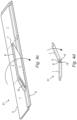
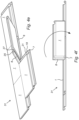
- Second coupling part 60 comprises a downward tongue 66, a downward flank 67 and a downward groove 68 formed between downward tongue 66 and downward flank 67.
- a side 66a of downward tongue 66 facing toward downward flank 67 is inclined and extends in the direction of the normal N2 of the lower side 58b of core 58.
- a tangent R2 of side 66a of downward tongue 66 and the normal of the lower side 58b of core 58 are mutually converging.
- the tangent R2 and the normal N2 enclose a mutual angle of 3-5 degrees.
- a side 66b facing away from downward flank 67 is diagonally oriented, but has a flatter orientation than the complementary side 62a of upward flank 62, whereby a gap (air space) will be formed in the coupled position, which will generally facilitate coupling between two floor panels 57.
- the inclining side 66b of downward tongue 66 also functions as aligning edge for the purpose of further facilitating coupling between two floor panels 57.
- Another side 66c facing away from downward flank 67 takes a substantially vertical form and forms a complementary stop surface for stop surface 62b of upward flank 62 (of an adjacent floor panel).
- Downward tongue 66 is further provided with a small aligning edge 66d which is facing toward downward flank 67.
- FIG. 7 shows a detailed cross-sectional view of a panel 57 according to one of Figures 1-6 and/or which can be combined (integrated) with a panel as shown in one the previous figures.
- the panel 57 shown in figure 7 comprises a core 58, wherein said core 58 comprises an upper side 58a and a lower side 58b.
- the upper side 58a of the core 58 is provided with at least one intermediate layer 71, on top of which intermediate layer 71 a decorative top structure 72 is provided.
- said core layer 58 is optionally provided with a further intermediate layer 79 that is embedded in the core 58, said further intermediate layer 79 may function as reinforcement of the core.
- said carrier layer may be composed out of a paper, fabric, and/or a polymer layer and may either be woven or non-woven.
- the binding material may partially penetrate into the carrier layer.
- At least one intermediate layer 71, 78, 79 may in particular comprise between 40-80% by weight of genuine leather fibres, preferably 60% of genuine leather fibres, between 10-40% by weight of natural latex, preferably 20% by weight of natural latex, preferably additionally between 5-25% by weight of natural fat, preferably 10% by weight of natural fat, and preferably between 5-20% by weight of miscellaneous raw material, preferably 10% by weight of miscellaneous raw material.
- Said raw material may as a non-limited example be a vegetable tanning agent, water, or the like.
- the encircled portion, A, of the panel 57 is enlarged for the sake of clarity to further elucidate the structure of the layers 73, 74, 75, 76, 77 provided onto the upper side 58a of the core 58.
- At least one carrier layer provided with leather particles 73 (which is a specific embodiment of the intermediate layer 71), as described above, is affixed directly onto the upper side 58a of the core 58.
- the carrier layer with leather particles 73 may optionally be referred to as a bonded leather layer 73.
- the side of the carrier layer comprising the leather particles preferably faces away from said upper side 58a.
- a primer 74 is provided onto said carrier layer provided with leather particles 73.
- said primer layer 74 partially penetrates the intermediate layer 71, 73, and a digital print layer 75 may as a result be affixed sufficiently to said intermediate layer 71, 73.
- said print layer 75 is, preferably digitally, printed directly on top of the intermediate layer 71, 73 and/or primer layer 74.
- at least one wear layer 76 is provided over at least a part of the print layer 75, preferably covering essentially the entire panel 57.
- a top coating 77 essentially entirely covers the wear layer 76, which top coating 77 may for example be a lacquer or the like.
- the intermediate layers 71, 78, 79 and the decorative top structure 72 are only depicted in this particular figure, it may be realized that said layers, either in this particular non-limitative configuration or separately, may be applicable to any of the embodiments according to the preceding figures. That is, all the layers elucidated in this figure, may be combined separately of one another in various embodiments according to the present invention.
- the decorative panels according to the invention may also be referred to as decorative tiles.
- complementary coupling profiles is meant that these coupling profiles can cooperate with each other.
- the complementary coupling profiles do not necessarily have to have complementary forms.
- locking in “vertical direction” is meant locking in a direction perpendicular to the plane of the panel.
- locking in “horizontal direction” is meant locking in a direction perpendicular to the respective coupled edges of two panels and parallel to or falling together with the plane defined by the panels.
Landscapes
- Engineering & Computer Science (AREA)
- Architecture (AREA)
- Civil Engineering (AREA)
- Structural Engineering (AREA)
- Laminated Bodies (AREA)
- Finishing Walls (AREA)
- Floor Finish (AREA)
Claims (14)
- Panneau décoratif (57), en particulier un panneau de plancher, un panneau de plafond ou un panneau mural, dans lequel un premier bord de panneau (5) comprend de préférence un premier profil de couplage (9), et un deuxième bord de panneau (6), de préférence opposé au premier bord de panneau (5), comprend de préférence un deuxième profil de couplage (15) conçu pour s'imbriquer étroitement avec ledit premier profil de couplage (9) d'un panneau adjacent, à la fois dans la direction horizontale et dans la direction verticale, dans lequel ledit panneau décoratif (57) comprend en outre :- un noyau (58) doté d'un côté supérieur (58a) et d'un côté inférieur (58b),- une structure supérieure décorative (72) fixée, directement ou indirectement, sur ledit côté supérieur (58a) du noyau, ladite structure supérieure décorative (72) comprenant :caractérisé en ce que ledit panneau décoratif (57) comprend en outre :o au moins une couche décorative (75), de préférence imprimée numériquement, formant au moins une image de décor, eto au moins une couche protectrice transparente et/ou translucide (76) recouvrant ladite couche décorative ;- au moins une couche intermédiaire (71, 79) comprenant du collagène non humain, ladite au moins une couche intermédiaire (71, 79) étant positionnée sous ladite structure supérieure décorative (72).
- Panneau selon la revendication 1, dans lequel au moins une couche intermédiaire (71) est fixée au côté supérieur du noyau.
- Panneau selon la revendication 1 ou 2, dans lequel au moins une couche intermédiaire (79) est incorporée dans le noyau.
- Panneau selon l'une des revendications précédentes, dans lequel le matériau du noyau en tant que tel est exempt de collagène non humain.
- Panneau selon l'une des revendications précédentes, dans lequel au moins une couche intermédiaire et le noyau sont des couches de panneau différentes.
- Panneau selon l'une des revendications précédentes, dans lequel au moins une couche intermédiaire (71) est située entre la structure supérieure décorative et le noyau.
- Panneau selon la revendication 2 ou 3, dans lequel au moins une couche intermédiaire (78) est fixée au côté inférieur du noyau.
- Panneau selon l'une des revendications précédentes, dans lequel au moins une couche intermédiaire comprend des fibres de collagène de type I et/ou dans lequel au moins une couche intermédiaire comprend du cuir, dans lequel ledit cuir comprend du collagène non humain, dans lequel la quantité de cuir est de préférence située entre 40 et 80 % en poids de la couche intermédiaire.
- Panneau selon l'une des revendications précédentes, dans lequel au moins une couche intermédiaire comprend des particules de cuir liées au moyen d'un matériau de liaison, dans lequel la quantité de matériau de liaison est de préférence située entre 10 et 40 % en poids de la couche intermédiaire.
- Panneau selon l'une des revendications précédentes, dans lequel au moins une couche intermédiaire comprend au moins une graisse naturelle, telle que du tissu gras dérivé d'animaux et/ou de l'huile végétale, en particulier de l'huile de colza, dans lequel la quantité de graisse naturelle est de préférence située entre 5 et 25 % en poids de la couche intermédiaire et/ou dans lequel au moins une couche intermédiaire comprend au moins un additif, tel qu'un agent de bronzage et/ou de l'eau, dans lequel la quantité d'additif est de préférence située entre 5 et 20 % en poids de la couche intermédiaire.
- Panneau selon l'une des revendications précédentes, dans lequel au moins une image de décor est directement imprimée sur au moins une couche intermédiaire et/ou sur au moins une couche d'apprêt de la structure décorative, et/ou dans lequel au moins une image de décor est directement imprimée sur une couche de support, telle qu'un papier et/ou un film polymère, dans lequel ladite couche de support est fixée à au moins une couche intermédiaire et/ou sur au moins une couche d'apprêt de la structure décorative.
- Panneau selon l'une des revendications précédentes, dans lequel au moins une couche protectrice transparente et/ou translucide est formée par un revêtement supérieur, tel qu'un revêtement supérieur durci aux UV, de préférence appliqué sur au moins une couche d'usure de la structure supérieure décorative.
- Panneau selon l'une des revendications précédentes, dans lequel le premier profil de couplage et le deuxième profil de couplage sont de préférence configurés de telle sorte que deux de ces panneaux puissent être couplés l'un à l'autre au moyen d'un mouvement d'abaissement et/ou au moyen d'un mouvement de rotation, et/ou dans lequel le panneau comprend au moins un troisième profil de couplage et au moins un quatrième profil de couplage situés respectivement au niveau d'un troisième bord de panneau et d'un quatrième bord de panneau, dans lequel le troisième profil de couplage comprend :· une languette latérale s'étendant dans une direction sensiblement parallèle au côté supérieur du noyau,· au moins un second flanc descendant situé à une certaine distance de la languette latérale, et· une deuxième rainure descendante formée entre la languette latérale et le second flanc descendant,dans lequel le quatrième profil de couplage comprend :· une troisième rainure configurée pour recevoir au moins une partie de la languette latérale du troisième profil de couplage d'un panneau adjacent, ladite troisième rainure étant définie par une lèvre supérieure et une lèvre inférieure, dans lequel ladite lèvre inférieure est dotée d'un élément de verrouillage ascendant,dans lequel le troisième profil de couplage et le quatrième profil de couplage sont configurés de sorte que deux de ces panneaux puissent être couplés l'un à l'autre au moyen d'un mouvement de rotation, dans lequel, à l'état couplé : au moins une partie de la languette latérale d'un premier panneau est insérée dans la troisième rainure d'un second panneau adjacent, et dans lequel au moins une partie de l'élément de verrouillage ascendant dudit second panneau est insérée dans la deuxième rainure descendante dudit premier panneau.
- Revêtement de panneau décoratif, en particulier revêtement de sol, revêtement de plafond ou revêtement de mur, comprenant une pluralité de panneaux décoratifs, de préférence des panneaux décoratifs couplés entre eux, selon l'une quelconque des revendications précédentes.
Priority Applications (1)
| Application Number | Priority Date | Filing Date | Title |
|---|---|---|---|
| EP25187918.5A EP4603659A3 (fr) | 2021-10-22 | 2022-10-21 | Panneau décoratif et revêtement de panneau décoratif |
Applications Claiming Priority (3)
| Application Number | Priority Date | Filing Date | Title |
|---|---|---|---|
| NL2029496A NL2029496B1 (en) | 2021-10-22 | 2021-10-22 | Decorative panel, and decorative panel covering |
| NL2032325 | 2022-06-29 | ||
| PCT/EP2022/079446 WO2023067174A1 (fr) | 2021-10-22 | 2022-10-21 | Panneau décoratif et revêtement de panneau décoratif |
Related Child Applications (1)
| Application Number | Title | Priority Date | Filing Date |
|---|---|---|---|
| EP25187918.5A Division EP4603659A3 (fr) | 2021-10-22 | 2022-10-21 | Panneau décoratif et revêtement de panneau décoratif |
Publications (2)
| Publication Number | Publication Date |
|---|---|
| EP4419762A1 EP4419762A1 (fr) | 2024-08-28 |
| EP4419762B1 true EP4419762B1 (fr) | 2025-07-09 |
Family
ID=84178894
Family Applications (2)
| Application Number | Title | Priority Date | Filing Date |
|---|---|---|---|
| EP25187918.5A Pending EP4603659A3 (fr) | 2021-10-22 | 2022-10-21 | Panneau décoratif et revêtement de panneau décoratif |
| EP22805872.3A Active EP4419762B1 (fr) | 2021-10-22 | 2022-10-21 | Panneau décoratif et revêtement de panneau décoratif |
Family Applications Before (1)
| Application Number | Title | Priority Date | Filing Date |
|---|---|---|---|
| EP25187918.5A Pending EP4603659A3 (fr) | 2021-10-22 | 2022-10-21 | Panneau décoratif et revêtement de panneau décoratif |
Country Status (10)
| Country | Link |
|---|---|
| US (1) | US20250223808A1 (fr) |
| EP (2) | EP4603659A3 (fr) |
| KR (1) | KR20240093588A (fr) |
| CA (1) | CA3235255A1 (fr) |
| DK (1) | DK4419762T3 (fr) |
| ES (1) | ES3038275T3 (fr) |
| FI (1) | FI4419762T3 (fr) |
| PL (1) | PL4419762T3 (fr) |
| PT (1) | PT4419762T (fr) |
| WO (1) | WO2023067174A1 (fr) |
Families Citing this family (1)
| Publication number | Priority date | Publication date | Assignee | Title |
|---|---|---|---|---|
| CN116607718A (zh) * | 2023-05-26 | 2023-08-18 | 常州市豪优杰智能科技有限公司 | 一种干法铺装瓷砖结构及铺装方法 |
Citations (1)
| Publication number | Priority date | Publication date | Assignee | Title |
|---|---|---|---|---|
| US20200362568A1 (en) * | 2019-05-18 | 2020-11-19 | Jiangsu Langyue New Materials Technology Co., Ltd. | Easy-to-Assemble Panel |
Family Cites Families (20)
| Publication number | Priority date | Publication date | Assignee | Title |
|---|---|---|---|---|
| JP2004142181A (ja) * | 2002-10-23 | 2004-05-20 | Toppan Printing Co Ltd | 化粧シートおよび化粧板 |
| BE1018632A3 (nl) * | 2009-01-26 | 2011-05-03 | Flooring Ind Ltd Sarl | Vloerpaneel, werkwijzen voor het vervaardigen van laminaatpanelen en werkwijze voor het behandelen van materiaalvellen hierbij aangewend. |
| US20100186337A1 (en) * | 2009-01-29 | 2010-07-29 | Barretto Peter M | Prefinished bonded leather paneling system |
| DK2586929T3 (da) * | 2011-10-28 | 2019-07-22 | U Windmoeller Consulting Gmbh & Co Kg | Gulvbelægning |
| BE1020722A3 (nl) * | 2012-06-01 | 2014-04-01 | Unilin Bvba | Paneel voor het vormen van een vloerbekleding en werkwijze voor het vervaardigen van dergelijke panelen. |
| UA111032C2 (uk) * | 2012-06-13 | 2016-03-10 | Кроноплюс Текнікал Аг | Спосіб друкування на панелі |
| BE1021743B1 (nl) * | 2013-12-10 | 2016-01-14 | Unilin Bvba | Vloerkleding en werkwijze voor het vervaardigen |
| US20160288447A1 (en) * | 2015-01-05 | 2016-10-06 | Eurico Januario Cordeiro | Waterproof composite core |
| BE1023779B1 (nl) * | 2015-12-31 | 2017-07-24 | Flooring Industries Limited Sarl | Vloerpaneel voor het vormen van een vloerbekleding |
| ES2927610T3 (es) * | 2016-03-23 | 2022-11-08 | Li & Co AG | Elemento de revestimiento de pared o suelo |
| BE1024617B1 (nl) * | 2016-10-03 | 2018-05-02 | Ivc Bvba | Vloerpaneel en werkwijze voor het vervaardigen van een vloerpaneel. |
| KR20190104166A (ko) * | 2017-01-12 | 2019-09-06 | 유로 트레이드 플로어링 에스.엘. | 수평 및 수직 표면을 덮기 위한 플레이트 |
| NL2021885B1 (en) * | 2018-10-26 | 2020-05-13 | I4F Licensing Nv | Multi-purpose tile system, tile covering, and tile |
| US12110692B2 (en) * | 2018-12-04 | 2024-10-08 | I4F Licensing Nv | Decorative panel, and decorative floor covering consisting of said panels |
| CA3121962A1 (fr) * | 2018-12-05 | 2020-06-11 | I4F Licensing Nv | Panneau decoratif et revetement de sol decoratif constitue de ces panneaux |
| EP3927511A4 (fr) * | 2019-02-20 | 2022-11-23 | Wellmade Floor Covering Int'l Inc. | Planche dotée d'un matériau de placage fusionné à un noyau rigide |
| EP3947849B1 (fr) * | 2019-03-25 | 2025-10-15 | Ceraloc Innovation AB | Panneau à base de minéraux comprenant des rainures |
| NL2024192B1 (en) * | 2019-11-08 | 2021-07-28 | I4F Licensing Nv | Decorative panel, and decorative floor covering consisting of said panels |
| EP4516531A3 (fr) * | 2020-10-01 | 2025-04-30 | Unilin, BV | Procédé de fabrication d'un panneau, panneau, feuille et procédé de fabrication d'une feuille |
| PL4032923T3 (pl) * | 2021-01-22 | 2025-11-12 | Unilin, Bv | Kompozycja żywicy termoutwardzalnej do panelu laminowanego, sposób wytwarzania panelu przy użyciu kompozycji żywicy termoutwardzalnej oraz panel laminowany zawierający żywicę termoutwardzalną |
-
2022
- 2022-10-21 FI FIEP22805872.3T patent/FI4419762T3/fi active
- 2022-10-21 WO PCT/EP2022/079446 patent/WO2023067174A1/fr not_active Ceased
- 2022-10-21 PL PL22805872.3T patent/PL4419762T3/pl unknown
- 2022-10-21 ES ES22805872T patent/ES3038275T3/es active Active
- 2022-10-21 CA CA3235255A patent/CA3235255A1/fr active Pending
- 2022-10-21 EP EP25187918.5A patent/EP4603659A3/fr active Pending
- 2022-10-21 EP EP22805872.3A patent/EP4419762B1/fr active Active
- 2022-10-21 KR KR1020247016049A patent/KR20240093588A/ko active Pending
- 2022-10-21 DK DK22805872.3T patent/DK4419762T3/da active
- 2022-10-21 US US18/703,079 patent/US20250223808A1/en active Pending
- 2022-10-21 PT PT228058723T patent/PT4419762T/pt unknown
Patent Citations (1)
| Publication number | Priority date | Publication date | Assignee | Title |
|---|---|---|---|---|
| US20200362568A1 (en) * | 2019-05-18 | 2020-11-19 | Jiangsu Langyue New Materials Technology Co., Ltd. | Easy-to-Assemble Panel |
Also Published As
| Publication number | Publication date |
|---|---|
| KR20240093588A (ko) | 2024-06-24 |
| EP4419762A1 (fr) | 2024-08-28 |
| EP4603659A2 (fr) | 2025-08-20 |
| EP4603659A3 (fr) | 2025-11-19 |
| DK4419762T3 (da) | 2025-08-18 |
| CA3235255A1 (fr) | 2023-04-27 |
| ES3038275T3 (en) | 2025-10-10 |
| PL4419762T3 (pl) | 2025-09-22 |
| US20250223808A1 (en) | 2025-07-10 |
| FI4419762T3 (fi) | 2025-08-27 |
| PT4419762T (pt) | 2025-08-20 |
| WO2023067174A1 (fr) | 2023-04-27 |
Similar Documents
| Publication | Publication Date | Title |
|---|---|---|
| US11859394B2 (en) | Panel | |
| US20220162862A1 (en) | Panel for forming a floor covering, method for manufacturing such panels and granulate applied herewith | |
| US11208814B2 (en) | Set of floor panels and method for installing this set of floor panels | |
| US9611659B2 (en) | Panel suitable for assembling a waterproof floor or wall covering, method of producing a panel | |
| US20070094985A1 (en) | Connecting element | |
| CN1295166A (zh) | 互连可拆卸式铺地板系统 | |
| JP7549015B2 (ja) | パネル、特に床パネルまたは壁パネル | |
| US20240068242A1 (en) | Set of floor panels and method for installing this set of floor panels | |
| US20240009974A1 (en) | A building panel and a method to produce such a building panel | |
| US11724537B2 (en) | Panel and method for producing a panel | |
| EP4603659A2 (fr) | Panneau décoratif et revêtement de panneau décoratif | |
| CN1131914C (zh) | 装饰性层压板及可拆卸互连组件系统 | |
| NL2029496B1 (en) | Decorative panel, and decorative panel covering | |
| CN118043527A (zh) | 可与类似镶板互连以形成覆盖物的镶板 | |
| CN118434948A (zh) | 装饰板和装饰板覆盖件 | |
| US8703299B2 (en) | Click plywood flooring | |
| US20240190166A1 (en) | Decorative panel and method for manufacturing a decorative panel | |
| US20260098412A1 (en) | Decorative panel | |
| US20230220684A1 (en) | Panel and Method for Producing a Panel | |
| EP4079527B1 (fr) | Panneau décoratif et procédé de fabrication d'un panneau décoratif | |
| CN115368697A (zh) | 装饰面板及其制造方法 | |
| AU2024309646A1 (en) | Tile panel, surface covering and method of manufacturing such a panel | |
| EA050632B1 (ru) | Панель, выполненная с возможностью взаимного соединения с аналогичными панелями, для формирования покрытия |
Legal Events
| Date | Code | Title | Description |
|---|---|---|---|
| STAA | Information on the status of an ep patent application or granted ep patent |
Free format text: STATUS: UNKNOWN |
|
| STAA | Information on the status of an ep patent application or granted ep patent |
Free format text: STATUS: THE INTERNATIONAL PUBLICATION HAS BEEN MADE |
|
| PUAI | Public reference made under article 153(3) epc to a published international application that has entered the european phase |
Free format text: ORIGINAL CODE: 0009012 |
|
| STAA | Information on the status of an ep patent application or granted ep patent |
Free format text: STATUS: REQUEST FOR EXAMINATION WAS MADE |
|
| 17P | Request for examination filed |
Effective date: 20240327 |
|
| AK | Designated contracting states |
Kind code of ref document: A1 Designated state(s): AL AT BE BG CH CY CZ DE DK EE ES FI FR GB GR HR HU IE IS IT LI LT LU LV MC ME MK MT NL NO PL PT RO RS SE SI SK SM TR |
|
| DAV | Request for validation of the european patent (deleted) | ||
| DAX | Request for extension of the european patent (deleted) | ||
| GRAP | Despatch of communication of intention to grant a patent |
Free format text: ORIGINAL CODE: EPIDOSNIGR1 |
|
| STAA | Information on the status of an ep patent application or granted ep patent |
Free format text: STATUS: GRANT OF PATENT IS INTENDED |
|
| INTG | Intention to grant announced |
Effective date: 20250204 |
|
| GRAJ | Information related to disapproval of communication of intention to grant by the applicant or resumption of examination proceedings by the epo deleted |
Free format text: ORIGINAL CODE: EPIDOSDIGR1 |
|
| STAA | Information on the status of an ep patent application or granted ep patent |
Free format text: STATUS: REQUEST FOR EXAMINATION WAS MADE |
|
| GRAP | Despatch of communication of intention to grant a patent |
Free format text: ORIGINAL CODE: EPIDOSNIGR1 |
|
| STAA | Information on the status of an ep patent application or granted ep patent |
Free format text: STATUS: GRANT OF PATENT IS INTENDED |
|
| GRAS | Grant fee paid |
Free format text: ORIGINAL CODE: EPIDOSNIGR3 |
|
| INTC | Intention to grant announced (deleted) | ||
| GRAA | (expected) grant |
Free format text: ORIGINAL CODE: 0009210 |
|
| STAA | Information on the status of an ep patent application or granted ep patent |
Free format text: STATUS: THE PATENT HAS BEEN GRANTED |
|
| INTG | Intention to grant announced |
Effective date: 20250519 |
|
| P01 | Opt-out of the competence of the unified patent court (upc) registered |
Free format text: CASE NUMBER: APP_22794/2025 Effective date: 20250514 |
|
| AK | Designated contracting states |
Kind code of ref document: B1 Designated state(s): AL AT BE BG CH CY CZ DE DK EE ES FI FR GB GR HR HU IE IS IT LI LT LU LV MC ME MK MT NL NO PL PT RO RS SE SI SK SM TR |
|
| REG | Reference to a national code |
Ref country code: GB Ref legal event code: FG4D |
|
| REG | Reference to a national code |
Ref country code: CH Ref legal event code: EP |
|
| REG | Reference to a national code |
Ref country code: IE Ref legal event code: FG4D |
|
| REG | Reference to a national code |
Ref country code: DE Ref legal event code: R096 Ref document number: 602022017443 Country of ref document: DE |
|
| REG | Reference to a national code |
Ref country code: DK Ref legal event code: T3 Effective date: 20250808 |
|
| REG | Reference to a national code |
Ref country code: PT Ref legal event code: SC4A Ref document number: 4419762 Country of ref document: PT Date of ref document: 20250820 Kind code of ref document: T Free format text: AVAILABILITY OF NATIONAL TRANSLATION Effective date: 20250812 |
|
| REG | Reference to a national code |
Ref country code: FI Ref legal event code: FGE |
|
| REG | Reference to a national code |
Ref country code: SE Ref legal event code: TRGR |
|
| REG | Reference to a national code |
Ref country code: NL Ref legal event code: FP |
|
| REG | Reference to a national code |
Ref country code: ES Ref legal event code: FG2A Ref document number: 3038275 Country of ref document: ES Kind code of ref document: T3 Effective date: 20251010 |
|
| REG | Reference to a national code |
Ref country code: CH Ref legal event code: U11 Free format text: ST27 STATUS EVENT CODE: U-0-0-U10-U11 (AS PROVIDED BY THE NATIONAL OFFICE) Effective date: 20251101 |
|
| PGFP | Annual fee paid to national office [announced via postgrant information from national office to epo] |
Ref country code: NL Payment date: 20251026 Year of fee payment: 4 |
|
| PGFP | Annual fee paid to national office [announced via postgrant information from national office to epo] |
Ref country code: PT Payment date: 20251006 Year of fee payment: 4 |
|
| PG25 | Lapsed in a contracting state [announced via postgrant information from national office to epo] |
Ref country code: IS Free format text: LAPSE BECAUSE OF FAILURE TO SUBMIT A TRANSLATION OF THE DESCRIPTION OR TO PAY THE FEE WITHIN THE PRESCRIBED TIME-LIMIT Effective date: 20251109 |
|
| PGFP | Annual fee paid to national office [announced via postgrant information from national office to epo] |
Ref country code: DE Payment date: 20251029 Year of fee payment: 4 |
|
| PGFP | Annual fee paid to national office [announced via postgrant information from national office to epo] |
Ref country code: NO Payment date: 20251029 Year of fee payment: 4 |
|
| REG | Reference to a national code |
Ref country code: LT Ref legal event code: MG9D |
|
| PGFP | Annual fee paid to national office [announced via postgrant information from national office to epo] |
Ref country code: AT Payment date: 20260113 Year of fee payment: 4 |
|
| PGFP | Annual fee paid to national office [announced via postgrant information from national office to epo] |
Ref country code: FI Payment date: 20251027 Year of fee payment: 4 Ref country code: DK Payment date: 20251027 Year of fee payment: 4 Ref country code: IT Payment date: 20251031 Year of fee payment: 4 |
|
| PG25 | Lapsed in a contracting state [announced via postgrant information from national office to epo] |
Ref country code: HR Free format text: LAPSE BECAUSE OF FAILURE TO SUBMIT A TRANSLATION OF THE DESCRIPTION OR TO PAY THE FEE WITHIN THE PRESCRIBED TIME-LIMIT Effective date: 20250709 |
|
| PGFP | Annual fee paid to national office [announced via postgrant information from national office to epo] |
Ref country code: FR Payment date: 20251027 Year of fee payment: 4 |
|
| PG25 | Lapsed in a contracting state [announced via postgrant information from national office to epo] |
Ref country code: GR Free format text: LAPSE BECAUSE OF FAILURE TO SUBMIT A TRANSLATION OF THE DESCRIPTION OR TO PAY THE FEE WITHIN THE PRESCRIBED TIME-LIMIT Effective date: 20251010 |
|
| PGFP | Annual fee paid to national office [announced via postgrant information from national office to epo] |
Ref country code: TR Payment date: 20251007 Year of fee payment: 4 Ref country code: BE Payment date: 20251027 Year of fee payment: 4 |
|
| PGFP | Annual fee paid to national office [announced via postgrant information from national office to epo] |
Ref country code: CH Payment date: 20251101 Year of fee payment: 4 Ref country code: SE Payment date: 20251027 Year of fee payment: 4 |
|
| PGFP | Annual fee paid to national office [announced via postgrant information from national office to epo] |
Ref country code: CZ Payment date: 20251007 Year of fee payment: 4 |
|
| PG25 | Lapsed in a contracting state [announced via postgrant information from national office to epo] |
Ref country code: LV Free format text: LAPSE BECAUSE OF FAILURE TO SUBMIT A TRANSLATION OF THE DESCRIPTION OR TO PAY THE FEE WITHIN THE PRESCRIBED TIME-LIMIT Effective date: 20250709 |
|
| PG25 | Lapsed in a contracting state [announced via postgrant information from national office to epo] |
Ref country code: BG Free format text: LAPSE BECAUSE OF FAILURE TO SUBMIT A TRANSLATION OF THE DESCRIPTION OR TO PAY THE FEE WITHIN THE PRESCRIBED TIME-LIMIT Effective date: 20250709 |
|
| PGFP | Annual fee paid to national office [announced via postgrant information from national office to epo] |
Ref country code: PL Payment date: 20251006 Year of fee payment: 4 |
|
| PG25 | Lapsed in a contracting state [announced via postgrant information from national office to epo] |
Ref country code: RS Free format text: LAPSE BECAUSE OF FAILURE TO SUBMIT A TRANSLATION OF THE DESCRIPTION OR TO PAY THE FEE WITHIN THE PRESCRIBED TIME-LIMIT Effective date: 20251009 |
|
| PGFP | Annual fee paid to national office [announced via postgrant information from national office to epo] |
Ref country code: ES Payment date: 20251103 Year of fee payment: 4 |
|
| PG25 | Lapsed in a contracting state [announced via postgrant information from national office to epo] |
Ref country code: RO Free format text: LAPSE BECAUSE OF FAILURE TO SUBMIT A TRANSLATION OF THE DESCRIPTION OR TO PAY THE FEE WITHIN THE PRESCRIBED TIME-LIMIT Effective date: 20250709 |
|
| PG25 | Lapsed in a contracting state [announced via postgrant information from national office to epo] |
Ref country code: SM Free format text: LAPSE BECAUSE OF FAILURE TO SUBMIT A TRANSLATION OF THE DESCRIPTION OR TO PAY THE FEE WITHIN THE PRESCRIBED TIME-LIMIT Effective date: 20250709 |
|
| PGFP | Annual fee paid to national office [announced via postgrant information from national office to epo] |
Ref country code: CY Payment date: 20251009 Year of fee payment: 4 |
|
| PG25 | Lapsed in a contracting state [announced via postgrant information from national office to epo] |
Ref country code: EE Free format text: LAPSE BECAUSE OF FAILURE TO SUBMIT A TRANSLATION OF THE DESCRIPTION OR TO PAY THE FEE WITHIN THE PRESCRIBED TIME-LIMIT Effective date: 20250709 Ref country code: SK Free format text: LAPSE BECAUSE OF FAILURE TO SUBMIT A TRANSLATION OF THE DESCRIPTION OR TO PAY THE FEE WITHIN THE PRESCRIBED TIME-LIMIT Effective date: 20250709 |
|
| PLBE | No opposition filed within time limit |
Free format text: ORIGINAL CODE: 0009261 |
|
| STAA | Information on the status of an ep patent application or granted ep patent |
Free format text: STATUS: NO OPPOSITION FILED WITHIN TIME LIMIT |