EP4427594A2 - Form mit variabler wand - Google Patents
Form mit variabler wand Download PDFInfo
- Publication number
- EP4427594A2 EP4427594A2 EP24183796.2A EP24183796A EP4427594A2 EP 4427594 A2 EP4427594 A2 EP 4427594A2 EP 24183796 A EP24183796 A EP 24183796A EP 4427594 A2 EP4427594 A2 EP 4427594A2
- Authority
- EP
- European Patent Office
- Prior art keywords
- mold
- food
- thickness
- wall
- zones
- Prior art date
- Legal status (The legal status is an assumption and is not a legal conclusion. Google has not performed a legal analysis and makes no representation as to the accuracy of the status listed.)
- Pending
Links
Images



Classifications
-
- A—HUMAN NECESSITIES
- A21—BAKING; EDIBLE DOUGHS
- A21B—BAKERS' OVENS; MACHINES OR EQUIPMENT FOR BAKING
- A21B3/00—Parts or accessories of ovens
- A21B3/13—Baking-tins; Baking forms
-
- A—HUMAN NECESSITIES
- A47—FURNITURE; DOMESTIC ARTICLES OR APPLIANCES; COFFEE MILLS; SPICE MILLS; SUCTION CLEANERS IN GENERAL
- A47J—KITCHEN EQUIPMENT; COFFEE MILLS; SPICE MILLS; APPARATUS FOR MAKING BEVERAGES
- A47J37/00—Baking; Roasting; Grilling; Frying
- A47J37/01—Vessels uniquely adapted for baking
-
- A—HUMAN NECESSITIES
- A47—FURNITURE; DOMESTIC ARTICLES OR APPLIANCES; COFFEE MILLS; SPICE MILLS; SUCTION CLEANERS IN GENERAL
- A47J—KITCHEN EQUIPMENT; COFFEE MILLS; SPICE MILLS; APPARATUS FOR MAKING BEVERAGES
- A47J36/00—Parts, details or accessories of cooking-vessels
- A47J36/02—Selection of specific materials, e.g. heavy bottoms with copper inlay or with insulating inlay
Definitions
- the present invention relates to the field of molds intended for food use, and in particular to molds intended for baking pastries.
- a mold intended for cooking food in particular for cooking pastries, comprising a series of cavities for receiving food to be cooked, each cavity comprising an upper edge connected to an upper wall of the mold and a food receiving wall extending from the upper edge.
- the mold is a flexible mold manufactured by molding from elastomers consisting of silicones.
- Such a mold has the advantage of having stiffening ribs connecting the receiving cavities together, making it possible to obtain stiffness in the mold to facilitate handling and storage by stacking.
- such a mold has the disadvantage of having a receiving wall that does not promote heat exchange between the outside and the inside of the receiving cavity of the mold.
- the cooking result depends greatly on the thermal behavior of the receiving wall which is on one side exposed to a heating means (for example steam, radiation, the resistors of an oven, etc.) and on the other side in contact with the food to be cooked.
- a heating means for example steam, radiation, the resistors of an oven, etc.
- the upper face of the food to be cooked directly exposed to hot air is much more cooked than the outer part of the food to be cooked which is in contact with the receiving wall.
- the heart of the food after cooking is often not sufficiently cooked or even raw.
- the user obtains uneven cooking of the food.
- such a mold has the disadvantage of not allowing a crispy character to be obtained on the outer part of the food after cooking.
- the user wishes to obtain a good crispy character on this outer part of its cake which is in contact with the receiving wall during cooking, by increasing either the cooking temperature or the cooking time, the upper face of the cake exposed to the hot air is often overcooked or even burnt.
- the aim of the present invention is to propose a baking mold which overcomes the aforementioned drawbacks, and in particular to provide uniform cooking of the food contained in the receiving cavity.
- Another object of the present invention is to promote non-enzymatic browning at the level of the external part of the food which is in contact with the receiving wall during cooking, either by caramelization when the food to be cooked is rich in sugar, or by the Maillard reaction.
- Another aim of the invention is to provide a mold which is simple in design, easy to handle by the user and economical to implement.
- the invention relates to a mold intended for cooking food, in particular for cooking pastries, comprising at least one cavity for receiving food to be cooked, this cavity comprising an upper edge connected to an upper wall of the mold and a wall for receiving food to be cooked which extends from the upper edge, the receiving wall having a substantially constant thickness E and comprising one or more zones having a thickness Er less than the thickness E and a surface Sr, the thickness Er being substantially constant on the surface Sr.
- the mold thus produced has the advantage of having a receiving cavity provided with such a receiving wall, which promotes, during cooking, the spontaneous heat transfer from the outside of the receiving cavity where the temperature is higher to the inside of the receiving cavity where the temperature is lower.
- the heat flow through the receiving wall is increased by reducing its thickness at the level of the zone(s) having a thickness Er less than the thickness E.
- the difference in the cooking result between an upper face of the food and an outer part of the food which is in contact with the receiving wall during cooking is considerably reduced.
- such a receiving wall makes it possible to make the cooking of the food contained in the receiving cavity more uniform.
- the mold according to the invention has the advantage of obtaining a good crispiness on the outer part of the food which is in contact with the receiving wall during cooking. For example, a cake having a good crispiness on the outer part is better tasting and also has an appetizing and attractive appearance.
- the mold according to the invention has the advantage of obtaining good cooking of the food having an improved crispiness of the exterior part of the food without the need to adjust the cooking time and/or temperature, and of retaining a soft center to the food after cooking.
- a good crispiness on one side of the food it is meant that an outer part of the food to be cooked hardens during cooking and is golden brown at the end of cooking.
- the crispy outer part is crunchy.
- the mold according to the present invention makes it possible to make breads, brioches, cannelés, savory or sweet cakes, muffins and other pastries with a good crisp character.
- the receiving wall comprises an inner face which is in contact with the food to be cooked and an outer face opposite the inner face and exposed to a heating means, the zone(s) having a thickness Er less than the thickness E being arranged on the outer face of the receiving wall.
- Such a feature makes it possible to present a receiving wall which promotes heat transfer by conduction from the outside of the receiving cavity to the inside of the receiving cavity, thanks to the reduction in thickness of the receiving wall at the level of the zone(s), without modifying the final shape of the food after cooking, a shape defined by the shape of the receiving cavity of the mold.
- the ratio between the total surface area of the zone(s) and the surface area of the outer face is from 0.1 to 0.9, preferably from 0.3 to 0.8.
- the minimum value of the surface ratio allows a minimum amount of heat to pass through the receiving wall in order to guarantee good cooking of the food.
- the maximum value of the surface ratio reinforces the good character crispiness of the outer part of the food that is in contact with the receiving wall during cooking, while maintaining sufficient rigidity of the mold.
- the receiving wall comprises a side wall and a bottom wall, the zone having a thickness Er less than the thickness E being located in the bottom wall.
- Such a feature has the advantage of presenting a bottom wall that improves cooking and the good crispiness of a lower face of the food after cooking.
- a well-cooked lower face of the food with a good crispiness makes it easier to unmold the food after cooking.
- a cake with a well-cooked and crispy lower face retains the shape given by the mold well once unmolded and does not collapse.
- the ratio between the total surface area of the zone(s) and the surface area of the outer face of the bottom wall is from 0.1 to 0.8, preferably from 0.3 to 0.7.
- the minimum value of the surface ratio allows a minimum amount of heat to pass through the receiving wall, especially at the bottom wall, in order to ensure good cooking of the lower side of the food.
- the maximum value of the surface ratio reinforces the crispiness of the lower side of the food, while maintaining sufficient rigidity of the mold.
- the receiving wall comprises a plurality of zones having a thickness Er less than the thickness E distributed regularly on the external face, in particular on the external face of the bottom wall.
- the zones which have a thickness Er less than the thickness E are arranged in a star shape on the bottom wall, the longitudinal axes of these zones forming the rays of a star converging towards the center or centers of the geometric shape formed by the bottom wall.
- the longitudinal axes of these zones are arranged substantially in rays.
- these rays trace straight lines from the center of the geometric shape formed by the bottom wall.
- the zones, having a thickness Er less than the thickness E are arranged concentrically starting from the geometric center of the bottom wall.
- Such features have the advantage of presenting a receiving wall which transmits a quantity of heat inside the receiving cavity in a homogeneous and regular manner.
- the result of cooking the food is more homogeneous, in particular at the heart of the food while avoiding raw parts of the food remaining.
- these have the same shape and the same thickness Er.
- these zones are circular or oval in shape, forming wells.
- Such a feature has the advantage of presenting a receiving wall which transmits a quantity of heat inside the receiving cavity in a homogeneous and regular manner.
- the result of cooking the food is more homogeneous, in particular at the heart of the food while avoiding raw parts of the food remaining.
- the ratio between the thickness Er and the thickness E is from 0.3 to 0.8, preferably from 0.5 to 0.8.
- the minimum value of the thickness ratio allows a minimum amount of heat to pass through the receiving wall in order to ensure good cooking of the food.
- the maximum value of the thickness ratio reinforces the good crispiness of the external part of the food which is in contact with the receiving wall during cooking, while maintaining sufficient rigidity of the mold.
- the zones, having a thickness Er less than the thickness E are distributed on the bottom wall and extend from regularly from the center of the bottom wall to the end of the bottom wall 13d.
- the size of these areas increases progressively from the center of the bottom wall to the end of the bottom wall 13d.
- the mold is flexible.
- the mold is made of silicone.
- Such a flexible mold for example made of silicone, has the advantage of being flexible, heat-resistant, non-stick and easy to clean.
- a silicone-based mold also facilitates the implementation of the present invention.
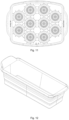
- FIG 1 illustrates a flexible mold 1 which is intended for baking pastries in the oven (not illustrated), for making breads, brioches, savory or sweet cakes, muffins, etc.
- the flexible mold 1 comprises a plurality of receiving cavities 10 of identical dimensions distributed geographically in parallel rows on an upper wall 20 of the mold 1.
- the receiving cavities 10 are intended to receive food to be cooked (food preparations).
- Each receiving cavity 10 has an opening 11 through which the food to be cooked is poured into the receiving cavity 10 before cooking and from which the cooked food (cakes or pastries) is extracted after cooking.
- the opening 11 of the receiving cavity 10 is delimited by an upper edge 12, which is connected to a first face 21 of the upper wall 20.
- Each receiving cavity 10 has a receiving wall 13 which extends from the upper edge 12 and projects onto a second face 22 of the upper wall 20, opposite the first face 21 and visible on the figure 3 .
- the receiving wall 13 comprises an inner face 13a which is in contact with the food to be cooked during cooking, and an outer face 13b which is opposite the inner face 13a and is exposed to a means heating means (not shown).
- the heating means is the oven resistance which emits heat during cooking.
- Mold 1 is preferably made of silicone material which is flexible, resistant to high cooking temperature, non-stick and easy to clean.
- the mold 1 comprises a rigid border 30 delimiting the upper wall 20.
- the mold 1 comprises two handles 40 arranged opposite each other.
- the handles 40 come from the border 30 and extend outside the mold 1.
- the receiving wall 13 comprises a side wall 13c extending from the upper edge 12 to a bottom wall 13d.
- the side wall 13c and the bottom wall 13d constitute a receiving space giving their shapes to the food during cooking.
- the receiving wall 13 has a substantially constant thickness E.
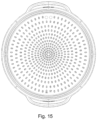
- the receiving wall 13 comprises a plurality of zones 13e distributed over the outer face 13b at the level of the bottom wall 13d.
- the plurality of zones 13e each have a thickness Er less than the thickness E and a surface Sr, the thickness Er being substantially constant over the surface Sr.
- all 13e zones have the same thickness Er.
- the surface area ratio between the total surface area of the zone(s) 13e and the surface area of the outer face of the bottom wall 13d is from 0.1 to 0.8, preferably from 0.3 to 0.7.
- the thickness ratio between the thickness Er and the thickness E is from 0.3 to 0.8, preferably from 0.5 to 0.8.
- the bottom wall 13d has a round shape.
- the zones 13e are distributed on the bottom wall 13d and extend evenly from the center of the bottom wall 13d toward the end of the bottom wall 13d.
- the zones 13e all have an oblong shape.
- the size of the zones 13e gradually increases from the center of the bottom wall 13d toward the end of the bottom wall 13d.
- the user mixes the ingredients according to a pastry recipe in a kitchen utensil to prepare the food to be baked.
- the food to be baked is in a more or less viscous liquid form. It is generally a raw dough.
- the user gradually pours the food to be baked into the receiving cavities 10 of the mold 1 via the openings 11.
- the user turns on the oven and the oven resistance is controlled to reach a set temperature inside the oven.
- the user places the mold 1 containing the food to be baked inside the oven on a rack when the set temperature is reached.
- the food in the mold 1 is baked at the set temperature for a set time according to the pastry recipe.
- the oven resistance sends a quantity of heat to the mold 1 to cook the food.
- the oven usually has a fan to achieve heat transfer by forced convection so that the heat is evenly distributed in the oven.
- the food solidifies as it cooks until it gradually obtains the desired pastries with a good crispiness.
- the presence of the zones 13e located on the outer face 13b at the level of the bottom wall 13d of the receiving wall 13 promotes during cooking the heat transfer by conduction from the outside of the receiving cavity 10 to the inside of the receiving cavity 10, thanks to the reduction in thickness of the receiving wall 13 at the level of the zone 13e, without modifying the final shape of the food after cooking defined by the receiving cavity 10 of the mold 1.
- the mold 1 according to the invention has the advantage of obtaining a good crispiness on a lower face of the food which is in contact with the bottom wall 13d during cooking, without the need to adjust the cooking time and/or temperature, and while keeping a soft center to the food after cooking.
- the good crispiness of an external part of the food is measured using a texturometer or penetrometer which defines the force required for a perforating tip to penetrate the external part of the food, if it is crispy, the penetration effort required to pass through it will be greater than that required to penetrate the inside of the food.
- the mold 1 according to the invention also has the advantage of allowing the cooking of the food contained in the receiving cavity in a more uniform manner.
- FIG 7 illustrates a second particular embodiment of the invention in which the flexible mold 1 comprises eight receiving cavities intended to make madeleines.
- the mold 1 comprises several zones 13e on the outer face 13b of the receiving wall 13.
- the zones located on the outer face of the receiving wall have a different shape and/or thickness Er.
- the zones are also present on the outer face at the level of the side wall, in order to improve the crispiness at the level of an outer lateral surface of the food after cooking.
Landscapes
- Engineering & Computer Science (AREA)
- Food Science & Technology (AREA)
- Life Sciences & Earth Sciences (AREA)
- Food-Manufacturing Devices (AREA)
- Baking, Grill, Roasting (AREA)
Applications Claiming Priority (3)
| Application Number | Priority Date | Filing Date | Title |
|---|---|---|---|
| FR1858758A FR3086139B1 (fr) | 2018-09-25 | 2018-09-25 | Moule a paroi variable |
| EP19769539.8A EP3855923A1 (de) | 2018-09-25 | 2019-09-20 | Form mit variabler wanddicke |
| PCT/EP2019/075384 WO2020064563A1 (fr) | 2018-09-25 | 2019-09-20 | Moule avec épaisseur de paroi variable |
Related Parent Applications (2)
| Application Number | Title | Priority Date | Filing Date |
|---|---|---|---|
| EP19769539.8A Division EP3855923A1 (de) | 2018-09-25 | 2019-09-20 | Form mit variabler wanddicke |
| EP19769539.8A Previously-Filed-Application EP3855923A1 (de) | 2018-09-25 | 2019-09-20 | Form mit variabler wanddicke |
Publications (2)
| Publication Number | Publication Date |
|---|---|
| EP4427594A2 true EP4427594A2 (de) | 2024-09-11 |
| EP4427594A3 EP4427594A3 (de) | 2024-10-16 |
Family
ID=65243867
Family Applications (2)
| Application Number | Title | Priority Date | Filing Date |
|---|---|---|---|
| EP19769539.8A Withdrawn EP3855923A1 (de) | 2018-09-25 | 2019-09-20 | Form mit variabler wanddicke |
| EP24183796.2A Pending EP4427594A3 (de) | 2018-09-25 | 2019-09-20 | Form mit variabler wand |
Family Applications Before (1)
| Application Number | Title | Priority Date | Filing Date |
|---|---|---|---|
| EP19769539.8A Withdrawn EP3855923A1 (de) | 2018-09-25 | 2019-09-20 | Form mit variabler wanddicke |
Country Status (3)
| Country | Link |
|---|---|
| EP (2) | EP3855923A1 (de) |
| FR (1) | FR3086139B1 (de) |
| WO (1) | WO2020064563A1 (de) |
Families Citing this family (1)
| Publication number | Priority date | Publication date | Assignee | Title |
|---|---|---|---|---|
| FR3086138B1 (fr) * | 2018-09-25 | 2021-09-10 | Seb Sa | Moule a paroi perforee |
Citations (1)
| Publication number | Priority date | Publication date | Assignee | Title |
|---|---|---|---|---|
| FR2786668B1 (fr) | 1998-11-24 | 2002-03-15 | Dartec | Moule flexible a base de silicone destine a l'industrie alimentaire |
Family Cites Families (13)
| Publication number | Priority date | Publication date | Assignee | Title |
|---|---|---|---|---|
| US3098597A (en) * | 1953-02-27 | 1963-07-23 | Kaiser Aluminium Chem Corp | Cooking and baking utensil |
| SE392825B (sv) * | 1973-12-13 | 1977-04-25 | Holmqvist Magnus Allan | Sett for tillverkning av brodformar |
| DE8305722U1 (de) * | 1983-03-01 | 1983-07-07 | Riegler, geb. Kuhn, Ingrid, 6900 Heidelberg | Brotformbehaelter |
| NL8402047A (nl) * | 1984-06-28 | 1986-01-16 | Irene Nienka Anna Hooft | Bakplaat voor poffertjes en werkwijze voor het bakken van poffertjes. |
| DE19943239C1 (de) * | 1999-09-10 | 2001-02-15 | Marion Thiele | Verfahren und Preßform zur Herstellung von gebackenen Formkörpern |
| US20090065428A1 (en) * | 2007-08-17 | 2009-03-12 | Tomaini John C | Disposable strainer |
| US20100005975A1 (en) * | 2008-07-09 | 2010-01-14 | Peter Bulkeley Mitchell | Multi-level cavitied bun molds |
| CN101429342A (zh) * | 2008-12-08 | 2009-05-13 | 美的集团有限公司 | 用于制作烤盘的复合材料及用该材料制作的烤盘 |
| AU2013336203B2 (en) * | 2012-10-25 | 2016-05-26 | Sport On The Roll Cc | Apparatus and method for baking rolls |
| FR3001106B1 (fr) * | 2013-01-24 | 2015-03-06 | Applic Des Silicones Alimentaires Soc D | Moule pour produits alimentaires, notamment en boulangerie, patisserie et biscuiterie |
| DE102013103332A1 (de) * | 2013-04-03 | 2014-10-09 | Rational Ag | Form für ein Gargut sowie Träger |
| AT514376B1 (de) * | 2013-06-10 | 2016-12-15 | Haas Food Equipment Gmbh | Verfahren und Vorrichtung zur Herstellung unter Druck ausgebackener Waffelformkörper |
| US10653153B2 (en) * | 2016-04-27 | 2020-05-19 | Dennis G. STERNBERG | Scooped out bagel product, apparatus and method of making scooped out bagel |
-
2018
- 2018-09-25 FR FR1858758A patent/FR3086139B1/fr active Active
-
2019
- 2019-09-20 EP EP19769539.8A patent/EP3855923A1/de not_active Withdrawn
- 2019-09-20 EP EP24183796.2A patent/EP4427594A3/de active Pending
- 2019-09-20 WO PCT/EP2019/075384 patent/WO2020064563A1/fr not_active Ceased
Patent Citations (1)
| Publication number | Priority date | Publication date | Assignee | Title |
|---|---|---|---|---|
| FR2786668B1 (fr) | 1998-11-24 | 2002-03-15 | Dartec | Moule flexible a base de silicone destine a l'industrie alimentaire |
Also Published As
| Publication number | Publication date |
|---|---|
| FR3086139B1 (fr) | 2021-09-10 |
| EP3855923A1 (de) | 2021-08-04 |
| FR3086139A1 (fr) | 2020-03-27 |
| WO2020064563A1 (fr) | 2020-04-02 |
| EP4427594A3 (de) | 2024-10-16 |
Similar Documents
| Publication | Publication Date | Title |
|---|---|---|
| EP1809153B1 (de) | Waffeleisen mit begrenztem überlauf | |
| EP2339946B1 (de) | Gefäss für ein elektrisches haushaltsgerät zum zubereiten und garen von nahrungsmitteln | |
| EP3706576B1 (de) | Kochgerät für backmischungen | |
| FR2504378A1 (fr) | Appareil a pizzas a micro-ondes | |
| EP3376918B1 (de) | Vorrichtung und verfahren zum auftauen, aufwärmen und/oder garen von nahrungsmitteln | |
| CA2638222C (fr) | Support de cuisson de pain et appareil associe | |
| WO2020064563A1 (fr) | Moule avec épaisseur de paroi variable | |
| WO2005115208A1 (fr) | Procede de cuisson au four et dispositif pour sa mise en oeuvre | |
| FR3066885A1 (fr) | Four d'exterieur a entree des flammes dans l'enceinte de cuisson | |
| WO2020064561A1 (fr) | Moule à paroi perforée | |
| FR2877545A1 (fr) | Gaufrier permettant un meilleur remplissage du sous-ensemble superieur de cuisson | |
| US20130276642A1 (en) | Personal Cake Pan | |
| FR2643545A1 (fr) | Moule perfore, de preference en acier, destine a l'amelioration de la cuisson des patisseries | |
| EP3730012B1 (de) | Verfahren zur herstellung einer gefüllten waffel mit einem waffelmaschine-kochgerät | |
| FR2682273A3 (en) | Utensil for performing a variety of cooking tasks | |
| KR200367495Y1 (ko) | 복합형 피자조리기구 | |
| EP4106590B1 (de) | Vielseitige form | |
| EP2335484A1 (de) | Form zum Vorbacken von Gebäck | |
| FR2492223A1 (fr) | Appareil de cuisson | |
| FR2732577A1 (fr) | Plat pour la cuisson d'aliments dans un four a micro-ondes | |
| EP1739364A2 (de) | Ofen mit einem Wasser-Verdampfer | |
| EP0811346A1 (de) | Mehrzwecktischkochgerät | |
| JPS588062Y2 (ja) | クレ−プメ−カ− | |
| KR200330198Y1 (ko) | 육류 구이기 | |
| FR3020242A1 (fr) | Dispositif de cuisson pour pate feuilletee et procede de cuisson correspondant |
Legal Events
| Date | Code | Title | Description |
|---|---|---|---|
| PUAI | Public reference made under article 153(3) epc to a published international application that has entered the european phase |
Free format text: ORIGINAL CODE: 0009012 |
|
| STAA | Information on the status of an ep patent application or granted ep patent |
Free format text: STATUS: THE APPLICATION HAS BEEN PUBLISHED |
|
| AC | Divisional application: reference to earlier application |
Ref document number: 3855923 Country of ref document: EP Kind code of ref document: P |
|
| AK | Designated contracting states |
Kind code of ref document: A2 Designated state(s): AL AT BE BG CH CY CZ DE DK EE ES FI FR GB GR HR HU IE IS IT LI LT LU LV MC MK MT NL NO PL PT RO RS SE SI SK SM TR |
|
| PUAL | Search report despatched |
Free format text: ORIGINAL CODE: 0009013 |
|
| AK | Designated contracting states |
Kind code of ref document: A3 Designated state(s): AL AT BE BG CH CY CZ DE DK EE ES FI FR GB GR HR HU IE IS IT LI LT LU LV MC MK MT NL NO PL PT RO RS SE SI SK SM TR |
|
| RIC1 | Information provided on ipc code assigned before grant |
Ipc: A47J 36/02 20060101ALN20240911BHEP Ipc: A47J 37/01 20060101ALI20240911BHEP Ipc: A21B 3/13 20060101AFI20240911BHEP |
|
| STAA | Information on the status of an ep patent application or granted ep patent |
Free format text: STATUS: REQUEST FOR EXAMINATION WAS MADE |
|
| 17P | Request for examination filed |
Effective date: 20250416 |