EP4428111A1 - Corps fritté de zircone, poudre de zircone et procédé de production de corps fritté de zircone - Google Patents
Corps fritté de zircone, poudre de zircone et procédé de production de corps fritté de zircone Download PDFInfo
- Publication number
- EP4428111A1 EP4428111A1 EP23766718.3A EP23766718A EP4428111A1 EP 4428111 A1 EP4428111 A1 EP 4428111A1 EP 23766718 A EP23766718 A EP 23766718A EP 4428111 A1 EP4428111 A1 EP 4428111A1
- Authority
- EP
- European Patent Office
- Prior art keywords
- zirconia
- oxide
- mol
- less
- sintered body
- Prior art date
- Legal status (The legal status is an assumption and is not a legal conclusion. Google has not performed a legal analysis and makes no representation as to the accuracy of the status listed.)
- Pending
Links
Images
Classifications
-
- C—CHEMISTRY; METALLURGY
- C04—CEMENTS; CONCRETE; ARTIFICIAL STONE; CERAMICS; REFRACTORIES
- C04B—LIME, MAGNESIA; SLAG; CEMENTS; COMPOSITIONS THEREOF, e.g. MORTARS, CONCRETE OR LIKE BUILDING MATERIALS; ARTIFICIAL STONE; CERAMICS; REFRACTORIES; TREATMENT OF NATURAL STONE
- C04B35/00—Shaped ceramic products characterised by their composition; Ceramics compositions; Processing powders of inorganic compounds preparatory to the manufacturing of ceramic products
- C04B35/01—Shaped ceramic products characterised by their composition; Ceramics compositions; Processing powders of inorganic compounds preparatory to the manufacturing of ceramic products based on oxide ceramics
- C04B35/48—Shaped ceramic products characterised by their composition; Ceramics compositions; Processing powders of inorganic compounds preparatory to the manufacturing of ceramic products based on oxide ceramics based on zirconium or hafnium oxides, zirconates, zircon or hafnates
- C04B35/486—Fine ceramics
-
- C—CHEMISTRY; METALLURGY
- C01—INORGANIC CHEMISTRY
- C01G—COMPOUNDS CONTAINING METALS NOT COVERED BY SUBCLASSES C01D OR C01F
- C01G25/00—Compounds of zirconium
- C01G25/02—Oxides
-
- C—CHEMISTRY; METALLURGY
- C01—INORGANIC CHEMISTRY
- C01G—COMPOUNDS CONTAINING METALS NOT COVERED BY SUBCLASSES C01D OR C01F
- C01G25/00—Compounds of zirconium
- C01G25/06—Sulfates
-
- C—CHEMISTRY; METALLURGY
- C04—CEMENTS; CONCRETE; ARTIFICIAL STONE; CERAMICS; REFRACTORIES
- C04B—LIME, MAGNESIA; SLAG; CEMENTS; COMPOSITIONS THEREOF, e.g. MORTARS, CONCRETE OR LIKE BUILDING MATERIALS; ARTIFICIAL STONE; CERAMICS; REFRACTORIES; TREATMENT OF NATURAL STONE
- C04B35/00—Shaped ceramic products characterised by their composition; Ceramics compositions; Processing powders of inorganic compounds preparatory to the manufacturing of ceramic products
- C04B35/01—Shaped ceramic products characterised by their composition; Ceramics compositions; Processing powders of inorganic compounds preparatory to the manufacturing of ceramic products based on oxide ceramics
- C04B35/48—Shaped ceramic products characterised by their composition; Ceramics compositions; Processing powders of inorganic compounds preparatory to the manufacturing of ceramic products based on oxide ceramics based on zirconium or hafnium oxides, zirconates, zircon or hafnates
- C04B35/486—Fine ceramics
- C04B35/488—Composites
- C04B35/4885—Composites with aluminium oxide
-
- C—CHEMISTRY; METALLURGY
- C04—CEMENTS; CONCRETE; ARTIFICIAL STONE; CERAMICS; REFRACTORIES
- C04B—LIME, MAGNESIA; SLAG; CEMENTS; COMPOSITIONS THEREOF, e.g. MORTARS, CONCRETE OR LIKE BUILDING MATERIALS; ARTIFICIAL STONE; CERAMICS; REFRACTORIES; TREATMENT OF NATURAL STONE
- C04B35/00—Shaped ceramic products characterised by their composition; Ceramics compositions; Processing powders of inorganic compounds preparatory to the manufacturing of ceramic products
- C04B35/622—Forming processes; Processing powders of inorganic compounds preparatory to the manufacturing of ceramic products
- C04B35/626—Preparing or treating the powders individually or as batches ; preparing or treating macroscopic reinforcing agents for ceramic products, e.g. fibres; mechanical aspects section B
- C04B35/62605—Treating the starting powders individually or as mixtures
- C04B35/6261—Milling
- C04B35/6262—Milling of calcined, sintered clinker or ceramics
-
- C—CHEMISTRY; METALLURGY
- C04—CEMENTS; CONCRETE; ARTIFICIAL STONE; CERAMICS; REFRACTORIES
- C04B—LIME, MAGNESIA; SLAG; CEMENTS; COMPOSITIONS THEREOF, e.g. MORTARS, CONCRETE OR LIKE BUILDING MATERIALS; ARTIFICIAL STONE; CERAMICS; REFRACTORIES; TREATMENT OF NATURAL STONE
- C04B35/00—Shaped ceramic products characterised by their composition; Ceramics compositions; Processing powders of inorganic compounds preparatory to the manufacturing of ceramic products
- C04B35/622—Forming processes; Processing powders of inorganic compounds preparatory to the manufacturing of ceramic products
- C04B35/626—Preparing or treating the powders individually or as batches ; preparing or treating macroscopic reinforcing agents for ceramic products, e.g. fibres; mechanical aspects section B
- C04B35/62605—Treating the starting powders individually or as mixtures
- C04B35/62645—Thermal treatment of powders or mixtures thereof other than sintering
- C04B35/62675—Thermal treatment of powders or mixtures thereof other than sintering characterised by the treatment temperature
-
- C—CHEMISTRY; METALLURGY
- C04—CEMENTS; CONCRETE; ARTIFICIAL STONE; CERAMICS; REFRACTORIES
- C04B—LIME, MAGNESIA; SLAG; CEMENTS; COMPOSITIONS THEREOF, e.g. MORTARS, CONCRETE OR LIKE BUILDING MATERIALS; ARTIFICIAL STONE; CERAMICS; REFRACTORIES; TREATMENT OF NATURAL STONE
- C04B35/00—Shaped ceramic products characterised by their composition; Ceramics compositions; Processing powders of inorganic compounds preparatory to the manufacturing of ceramic products
- C04B35/622—Forming processes; Processing powders of inorganic compounds preparatory to the manufacturing of ceramic products
- C04B35/626—Preparing or treating the powders individually or as batches ; preparing or treating macroscopic reinforcing agents for ceramic products, e.g. fibres; mechanical aspects section B
- C04B35/62605—Treating the starting powders individually or as mixtures
- C04B35/62685—Treating the starting powders individually or as mixtures characterised by the order of addition of constituents or additives
-
- C—CHEMISTRY; METALLURGY
- C04—CEMENTS; CONCRETE; ARTIFICIAL STONE; CERAMICS; REFRACTORIES
- C04B—LIME, MAGNESIA; SLAG; CEMENTS; COMPOSITIONS THEREOF, e.g. MORTARS, CONCRETE OR LIKE BUILDING MATERIALS; ARTIFICIAL STONE; CERAMICS; REFRACTORIES; TREATMENT OF NATURAL STONE
- C04B35/00—Shaped ceramic products characterised by their composition; Ceramics compositions; Processing powders of inorganic compounds preparatory to the manufacturing of ceramic products
- C04B35/622—Forming processes; Processing powders of inorganic compounds preparatory to the manufacturing of ceramic products
- C04B35/64—Burning or sintering processes
- C04B35/645—Pressure sintering
- C04B35/6455—Hot isostatic pressing
-
- C—CHEMISTRY; METALLURGY
- C01—INORGANIC CHEMISTRY
- C01P—INDEXING SCHEME RELATING TO STRUCTURAL AND PHYSICAL ASPECTS OF SOLID INORGANIC COMPOUNDS
- C01P2002/00—Crystal-structural characteristics
- C01P2002/50—Solid solutions
- C01P2002/52—Solid solutions containing elements as dopants
-
- C—CHEMISTRY; METALLURGY
- C01—INORGANIC CHEMISTRY
- C01P—INDEXING SCHEME RELATING TO STRUCTURAL AND PHYSICAL ASPECTS OF SOLID INORGANIC COMPOUNDS
- C01P2004/00—Particle morphology
- C01P2004/60—Particles characterised by their size
- C01P2004/62—Submicrometer sized, i.e. from 0.1-1 micrometer
-
- C—CHEMISTRY; METALLURGY
- C01—INORGANIC CHEMISTRY
- C01P—INDEXING SCHEME RELATING TO STRUCTURAL AND PHYSICAL ASPECTS OF SOLID INORGANIC COMPOUNDS
- C01P2006/00—Physical properties of inorganic compounds
- C01P2006/12—Surface area
-
- C—CHEMISTRY; METALLURGY
- C04—CEMENTS; CONCRETE; ARTIFICIAL STONE; CERAMICS; REFRACTORIES
- C04B—LIME, MAGNESIA; SLAG; CEMENTS; COMPOSITIONS THEREOF, e.g. MORTARS, CONCRETE OR LIKE BUILDING MATERIALS; ARTIFICIAL STONE; CERAMICS; REFRACTORIES; TREATMENT OF NATURAL STONE
- C04B2235/00—Aspects relating to ceramic starting mixtures or sintered ceramic products
- C04B2235/02—Composition of constituents of the starting material or of secondary phases of the final product
- C04B2235/30—Constituents and secondary phases not being of a fibrous nature
- C04B2235/32—Metal oxides, mixed metal oxides, or oxide-forming salts thereof, e.g. carbonates, nitrates, (oxy)hydroxides, chlorides
- C04B2235/3205—Alkaline earth oxides or oxide forming salts thereof, e.g. beryllium oxide
- C04B2235/3208—Calcium oxide or oxide-forming salts thereof, e.g. lime
-
- C—CHEMISTRY; METALLURGY
- C04—CEMENTS; CONCRETE; ARTIFICIAL STONE; CERAMICS; REFRACTORIES
- C04B—LIME, MAGNESIA; SLAG; CEMENTS; COMPOSITIONS THEREOF, e.g. MORTARS, CONCRETE OR LIKE BUILDING MATERIALS; ARTIFICIAL STONE; CERAMICS; REFRACTORIES; TREATMENT OF NATURAL STONE
- C04B2235/00—Aspects relating to ceramic starting mixtures or sintered ceramic products
- C04B2235/02—Composition of constituents of the starting material or of secondary phases of the final product
- C04B2235/30—Constituents and secondary phases not being of a fibrous nature
- C04B2235/32—Metal oxides, mixed metal oxides, or oxide-forming salts thereof, e.g. carbonates, nitrates, (oxy)hydroxides, chlorides
- C04B2235/3205—Alkaline earth oxides or oxide forming salts thereof, e.g. beryllium oxide
- C04B2235/3213—Strontium oxides or oxide-forming salts thereof
-
- C—CHEMISTRY; METALLURGY
- C04—CEMENTS; CONCRETE; ARTIFICIAL STONE; CERAMICS; REFRACTORIES
- C04B—LIME, MAGNESIA; SLAG; CEMENTS; COMPOSITIONS THEREOF, e.g. MORTARS, CONCRETE OR LIKE BUILDING MATERIALS; ARTIFICIAL STONE; CERAMICS; REFRACTORIES; TREATMENT OF NATURAL STONE
- C04B2235/00—Aspects relating to ceramic starting mixtures or sintered ceramic products
- C04B2235/02—Composition of constituents of the starting material or of secondary phases of the final product
- C04B2235/30—Constituents and secondary phases not being of a fibrous nature
- C04B2235/32—Metal oxides, mixed metal oxides, or oxide-forming salts thereof, e.g. carbonates, nitrates, (oxy)hydroxides, chlorides
- C04B2235/3205—Alkaline earth oxides or oxide forming salts thereof, e.g. beryllium oxide
- C04B2235/3215—Barium oxides or oxide-forming salts thereof
-
- C—CHEMISTRY; METALLURGY
- C04—CEMENTS; CONCRETE; ARTIFICIAL STONE; CERAMICS; REFRACTORIES
- C04B—LIME, MAGNESIA; SLAG; CEMENTS; COMPOSITIONS THEREOF, e.g. MORTARS, CONCRETE OR LIKE BUILDING MATERIALS; ARTIFICIAL STONE; CERAMICS; REFRACTORIES; TREATMENT OF NATURAL STONE
- C04B2235/00—Aspects relating to ceramic starting mixtures or sintered ceramic products
- C04B2235/02—Composition of constituents of the starting material or of secondary phases of the final product
- C04B2235/30—Constituents and secondary phases not being of a fibrous nature
- C04B2235/32—Metal oxides, mixed metal oxides, or oxide-forming salts thereof, e.g. carbonates, nitrates, (oxy)hydroxides, chlorides
- C04B2235/3217—Aluminum oxide or oxide forming salts thereof, e.g. bauxite, alpha-alumina
-
- C—CHEMISTRY; METALLURGY
- C04—CEMENTS; CONCRETE; ARTIFICIAL STONE; CERAMICS; REFRACTORIES
- C04B—LIME, MAGNESIA; SLAG; CEMENTS; COMPOSITIONS THEREOF, e.g. MORTARS, CONCRETE OR LIKE BUILDING MATERIALS; ARTIFICIAL STONE; CERAMICS; REFRACTORIES; TREATMENT OF NATURAL STONE
- C04B2235/00—Aspects relating to ceramic starting mixtures or sintered ceramic products
- C04B2235/02—Composition of constituents of the starting material or of secondary phases of the final product
- C04B2235/30—Constituents and secondary phases not being of a fibrous nature
- C04B2235/32—Metal oxides, mixed metal oxides, or oxide-forming salts thereof, e.g. carbonates, nitrates, (oxy)hydroxides, chlorides
- C04B2235/3224—Rare earth oxide or oxide forming salts thereof, e.g. scandium oxide
-
- C—CHEMISTRY; METALLURGY
- C04—CEMENTS; CONCRETE; ARTIFICIAL STONE; CERAMICS; REFRACTORIES
- C04B—LIME, MAGNESIA; SLAG; CEMENTS; COMPOSITIONS THEREOF, e.g. MORTARS, CONCRETE OR LIKE BUILDING MATERIALS; ARTIFICIAL STONE; CERAMICS; REFRACTORIES; TREATMENT OF NATURAL STONE
- C04B2235/00—Aspects relating to ceramic starting mixtures or sintered ceramic products
- C04B2235/02—Composition of constituents of the starting material or of secondary phases of the final product
- C04B2235/30—Constituents and secondary phases not being of a fibrous nature
- C04B2235/32—Metal oxides, mixed metal oxides, or oxide-forming salts thereof, e.g. carbonates, nitrates, (oxy)hydroxides, chlorides
- C04B2235/3224—Rare earth oxide or oxide forming salts thereof, e.g. scandium oxide
- C04B2235/3225—Yttrium oxide or oxide-forming salts thereof
-
- C—CHEMISTRY; METALLURGY
- C04—CEMENTS; CONCRETE; ARTIFICIAL STONE; CERAMICS; REFRACTORIES
- C04B—LIME, MAGNESIA; SLAG; CEMENTS; COMPOSITIONS THEREOF, e.g. MORTARS, CONCRETE OR LIKE BUILDING MATERIALS; ARTIFICIAL STONE; CERAMICS; REFRACTORIES; TREATMENT OF NATURAL STONE
- C04B2235/00—Aspects relating to ceramic starting mixtures or sintered ceramic products
- C04B2235/02—Composition of constituents of the starting material or of secondary phases of the final product
- C04B2235/30—Constituents and secondary phases not being of a fibrous nature
- C04B2235/32—Metal oxides, mixed metal oxides, or oxide-forming salts thereof, e.g. carbonates, nitrates, (oxy)hydroxides, chlorides
- C04B2235/3224—Rare earth oxide or oxide forming salts thereof, e.g. scandium oxide
- C04B2235/3227—Lanthanum oxide or oxide-forming salts thereof
-
- C—CHEMISTRY; METALLURGY
- C04—CEMENTS; CONCRETE; ARTIFICIAL STONE; CERAMICS; REFRACTORIES
- C04B—LIME, MAGNESIA; SLAG; CEMENTS; COMPOSITIONS THEREOF, e.g. MORTARS, CONCRETE OR LIKE BUILDING MATERIALS; ARTIFICIAL STONE; CERAMICS; REFRACTORIES; TREATMENT OF NATURAL STONE
- C04B2235/00—Aspects relating to ceramic starting mixtures or sintered ceramic products
- C04B2235/02—Composition of constituents of the starting material or of secondary phases of the final product
- C04B2235/30—Constituents and secondary phases not being of a fibrous nature
- C04B2235/32—Metal oxides, mixed metal oxides, or oxide-forming salts thereof, e.g. carbonates, nitrates, (oxy)hydroxides, chlorides
- C04B2235/3231—Refractory metal oxides, their mixed metal oxides, or oxide-forming salts thereof
- C04B2235/3244—Zirconium oxides, zirconates, hafnium oxides, hafnates, or oxide-forming salts thereof
- C04B2235/3246—Stabilised zirconias, e.g. YSZ or cerium stabilised zirconia
-
- C—CHEMISTRY; METALLURGY
- C04—CEMENTS; CONCRETE; ARTIFICIAL STONE; CERAMICS; REFRACTORIES
- C04B—LIME, MAGNESIA; SLAG; CEMENTS; COMPOSITIONS THEREOF, e.g. MORTARS, CONCRETE OR LIKE BUILDING MATERIALS; ARTIFICIAL STONE; CERAMICS; REFRACTORIES; TREATMENT OF NATURAL STONE
- C04B2235/00—Aspects relating to ceramic starting mixtures or sintered ceramic products
- C04B2235/02—Composition of constituents of the starting material or of secondary phases of the final product
- C04B2235/50—Constituents or additives of the starting mixture chosen for their shape or used because of their shape or their physical appearance
- C04B2235/54—Particle size related information
- C04B2235/5409—Particle size related information expressed by specific surface values
-
- C—CHEMISTRY; METALLURGY
- C04—CEMENTS; CONCRETE; ARTIFICIAL STONE; CERAMICS; REFRACTORIES
- C04B—LIME, MAGNESIA; SLAG; CEMENTS; COMPOSITIONS THEREOF, e.g. MORTARS, CONCRETE OR LIKE BUILDING MATERIALS; ARTIFICIAL STONE; CERAMICS; REFRACTORIES; TREATMENT OF NATURAL STONE
- C04B2235/00—Aspects relating to ceramic starting mixtures or sintered ceramic products
- C04B2235/02—Composition of constituents of the starting material or of secondary phases of the final product
- C04B2235/50—Constituents or additives of the starting mixture chosen for their shape or used because of their shape or their physical appearance
- C04B2235/54—Particle size related information
- C04B2235/5418—Particle size related information expressed by the size of the particles or aggregates thereof
- C04B2235/5436—Particle size related information expressed by the size of the particles or aggregates thereof micrometer sized, i.e. from 1 to 100 micron
-
- C—CHEMISTRY; METALLURGY
- C04—CEMENTS; CONCRETE; ARTIFICIAL STONE; CERAMICS; REFRACTORIES
- C04B—LIME, MAGNESIA; SLAG; CEMENTS; COMPOSITIONS THEREOF, e.g. MORTARS, CONCRETE OR LIKE BUILDING MATERIALS; ARTIFICIAL STONE; CERAMICS; REFRACTORIES; TREATMENT OF NATURAL STONE
- C04B2235/00—Aspects relating to ceramic starting mixtures or sintered ceramic products
- C04B2235/02—Composition of constituents of the starting material or of secondary phases of the final product
- C04B2235/50—Constituents or additives of the starting mixture chosen for their shape or used because of their shape or their physical appearance
- C04B2235/54—Particle size related information
- C04B2235/5418—Particle size related information expressed by the size of the particles or aggregates thereof
- C04B2235/5445—Particle size related information expressed by the size of the particles or aggregates thereof submicron sized, i.e. from 0,1 to 1 micron
-
- C—CHEMISTRY; METALLURGY
- C04—CEMENTS; CONCRETE; ARTIFICIAL STONE; CERAMICS; REFRACTORIES
- C04B—LIME, MAGNESIA; SLAG; CEMENTS; COMPOSITIONS THEREOF, e.g. MORTARS, CONCRETE OR LIKE BUILDING MATERIALS; ARTIFICIAL STONE; CERAMICS; REFRACTORIES; TREATMENT OF NATURAL STONE
- C04B2235/00—Aspects relating to ceramic starting mixtures or sintered ceramic products
- C04B2235/60—Aspects relating to the preparation, properties or mechanical treatment of green bodies or pre-forms
- C04B2235/604—Pressing at temperatures other than sintering temperatures
-
- C—CHEMISTRY; METALLURGY
- C04—CEMENTS; CONCRETE; ARTIFICIAL STONE; CERAMICS; REFRACTORIES
- C04B—LIME, MAGNESIA; SLAG; CEMENTS; COMPOSITIONS THEREOF, e.g. MORTARS, CONCRETE OR LIKE BUILDING MATERIALS; ARTIFICIAL STONE; CERAMICS; REFRACTORIES; TREATMENT OF NATURAL STONE
- C04B2235/00—Aspects relating to ceramic starting mixtures or sintered ceramic products
- C04B2235/65—Aspects relating to heat treatments of ceramic bodies such as green ceramics or pre-sintered ceramics, e.g. burning, sintering or melting processes
- C04B2235/656—Aspects relating to heat treatments of ceramic bodies such as green ceramics or pre-sintered ceramics, e.g. burning, sintering or melting processes characterised by specific heating conditions during heat treatment
- C04B2235/6567—Treatment time
-
- C—CHEMISTRY; METALLURGY
- C04—CEMENTS; CONCRETE; ARTIFICIAL STONE; CERAMICS; REFRACTORIES
- C04B—LIME, MAGNESIA; SLAG; CEMENTS; COMPOSITIONS THEREOF, e.g. MORTARS, CONCRETE OR LIKE BUILDING MATERIALS; ARTIFICIAL STONE; CERAMICS; REFRACTORIES; TREATMENT OF NATURAL STONE
- C04B2235/00—Aspects relating to ceramic starting mixtures or sintered ceramic products
- C04B2235/65—Aspects relating to heat treatments of ceramic bodies such as green ceramics or pre-sintered ceramics, e.g. burning, sintering or melting processes
- C04B2235/66—Specific sintering techniques, e.g. centrifugal sintering
- C04B2235/668—Pressureless sintering
-
- C—CHEMISTRY; METALLURGY
- C04—CEMENTS; CONCRETE; ARTIFICIAL STONE; CERAMICS; REFRACTORIES
- C04B—LIME, MAGNESIA; SLAG; CEMENTS; COMPOSITIONS THEREOF, e.g. MORTARS, CONCRETE OR LIKE BUILDING MATERIALS; ARTIFICIAL STONE; CERAMICS; REFRACTORIES; TREATMENT OF NATURAL STONE
- C04B2235/00—Aspects relating to ceramic starting mixtures or sintered ceramic products
- C04B2235/70—Aspects relating to sintered or melt-casted ceramic products
- C04B2235/74—Physical characteristics
- C04B2235/76—Crystal structural characteristics, e.g. symmetry
- C04B2235/765—Tetragonal symmetry
-
- C—CHEMISTRY; METALLURGY
- C04—CEMENTS; CONCRETE; ARTIFICIAL STONE; CERAMICS; REFRACTORIES
- C04B—LIME, MAGNESIA; SLAG; CEMENTS; COMPOSITIONS THEREOF, e.g. MORTARS, CONCRETE OR LIKE BUILDING MATERIALS; ARTIFICIAL STONE; CERAMICS; REFRACTORIES; TREATMENT OF NATURAL STONE
- C04B2235/00—Aspects relating to ceramic starting mixtures or sintered ceramic products
- C04B2235/70—Aspects relating to sintered or melt-casted ceramic products
- C04B2235/74—Physical characteristics
- C04B2235/77—Density
-
- C—CHEMISTRY; METALLURGY
- C04—CEMENTS; CONCRETE; ARTIFICIAL STONE; CERAMICS; REFRACTORIES
- C04B—LIME, MAGNESIA; SLAG; CEMENTS; COMPOSITIONS THEREOF, e.g. MORTARS, CONCRETE OR LIKE BUILDING MATERIALS; ARTIFICIAL STONE; CERAMICS; REFRACTORIES; TREATMENT OF NATURAL STONE
- C04B2235/00—Aspects relating to ceramic starting mixtures or sintered ceramic products
- C04B2235/70—Aspects relating to sintered or melt-casted ceramic products
- C04B2235/74—Physical characteristics
- C04B2235/78—Grain sizes and shapes, product microstructures, e.g. acicular grains, equiaxed grains, platelet-structures
- C04B2235/785—Submicron sized grains, i.e. from 0,1 to 1 micron
-
- C—CHEMISTRY; METALLURGY
- C04—CEMENTS; CONCRETE; ARTIFICIAL STONE; CERAMICS; REFRACTORIES
- C04B—LIME, MAGNESIA; SLAG; CEMENTS; COMPOSITIONS THEREOF, e.g. MORTARS, CONCRETE OR LIKE BUILDING MATERIALS; ARTIFICIAL STONE; CERAMICS; REFRACTORIES; TREATMENT OF NATURAL STONE
- C04B2235/00—Aspects relating to ceramic starting mixtures or sintered ceramic products
- C04B2235/70—Aspects relating to sintered or melt-casted ceramic products
- C04B2235/96—Properties of ceramic products, e.g. mechanical properties such as strength, toughness, wear resistance
-
- C—CHEMISTRY; METALLURGY
- C04—CEMENTS; CONCRETE; ARTIFICIAL STONE; CERAMICS; REFRACTORIES
- C04B—LIME, MAGNESIA; SLAG; CEMENTS; COMPOSITIONS THEREOF, e.g. MORTARS, CONCRETE OR LIKE BUILDING MATERIALS; ARTIFICIAL STONE; CERAMICS; REFRACTORIES; TREATMENT OF NATURAL STONE
- C04B2235/00—Aspects relating to ceramic starting mixtures or sintered ceramic products
- C04B2235/70—Aspects relating to sintered or melt-casted ceramic products
- C04B2235/96—Properties of ceramic products, e.g. mechanical properties such as strength, toughness, wear resistance
- C04B2235/9669—Resistance against chemicals, e.g. against molten glass or molten salts
Definitions
- the present invention relates to a zirconia sintered body, a zirconia powder, and a method for producing a zirconia sintered body.
- Zirconia is conventionally used for various purposes by taking advantage of its characteristics such as high mechanical strength.
- Patent Document 1 discloses a zirconia sintered body containing ZrO 2 as a main component and Y 2 O 3 as a main stabilizer, the zirconia sintered body containing 0.1 to 3 mol% of at least one rare-earth metal element selected from among La, Pr, and Nd relative to ZrO 2 containing 1.5 to 4 mol% of Y 2 O 3 and having a mixed phase of tetragonal crystal and at least one of monoclinic crystal and cubic crystal or a single phase of tetragonal crystal (see claim 1).
- Patent Document 2 discloses a sintered body having a monoclinic fraction of 0.5% or more and a stabilizer content of 1.0 mol% or more and less than 2.5 mol% and containing at least one additive component selected from the group consisting of alumina, germania, and silica (see claim 1, claim 4, and claim 6) .
- Patent Document 3 discloses a zirconia sintered body mainly containing ZrO 2 comprising baddeleyite and containing one or two or more rare-earth metal oxides selected from the group consisting of Nd 2 O 3 , Sm 2 O 3 , Gd 2 O 3 , Dy 2 O 3 , Y 2 O 3 , Ho 2 O 3 , Er 2 O 3 , and Yb 2 O 3 and Al 2 O 3 and SiO 2 , wherein a molar ratio between the rare-earth metal oxide (R 2 O 3 ) and ZrO 2 (R 2 O 3 /ZrO 2 ) is 1/99 to 5/95, an Al 2 O 3 content is 0.05 to 20 mol%, and a SiO 2 content is 0.05 to 10 mol% (see claim 1).
- An yttria-stabilized zirconia sintered body is subjected to phase transformation from a tetragonal phase to a monoclinic phase in hot water or the atmosphere (100 to 300°C) so that its mechanical characteristics are degraded.
- degradation in hot water is referred to as hydrothermal degradation
- degradation at high temperature (100 to 300°C) in the atmosphere is referred to as thermal degradation.
- thermo degradation resistance is not always high even when hydrothermal degradation resistance is high.
- a sintered body described herein as Comparative Example 5 has high hydrothermal degradation resistance but is poor in thermal degradation resistance.
- Zirconia materials are considered to be used also in the absence of water vapor under high temperature conditions, and therefore it is important to develop a zirconia sintered body having excellent thermal degradation resistance and excellent mechanical characteristics.
- Patent Document 1 describes that the zirconia sintered body disclosed in Patent Document 1 can achieve both thermal stability and mechanical characteristics (see paragraph [0043]) .
- Patent Document 1 what has actually been confirmed is not thermal stability (thermal degradation resistance) but hydrothermal degradation resistance.
- thermal stability thermal degradation resistance
- hydrothermal degradation resistance degradation condition of a sintered body is confirmed after performing an aging test in hot water or water vapor (water vapor pressure 4 MPa) at 250°C for 50 hours (see paragraph [0053]), which is intended to confirm hydrothermal degradation resistance.
- the zirconia sintered body disclosed in Patent Document 1 was confirmed to have high hydrothermal degradation resistance but have low thermal degradation resistance.
- Patent Document 2 describes that the sintered body disclosed in Patent Document 2 has a monoclinic fraction of 0.5% or more and therefore its fracture toughness and bending strength are high and that the sintered body contains at least one additive component selected from the group consisting of alumina, germania, and silica and therefore hydrothermal degradation is prevented (see paragraph [0039] and paragraph [0052]).
- thermal degradation resistance is untested. It should be noted that as described above, thermal degradation resistance is not always excellent even when hydrothermal degradation resistance is excellent.
- Patent Document 3 describes that the sintered body disclosed in Patent Document 3 has excellent thermal shock resistance and thermal stability and high mechanical characteristics that conventional zirconia sintered bodies do not have (see paragraph [0043]). However, the sintered body disclosed in Patent Document 3 cannot be regarded as having satisfactory mechanical characteristics. Specifically, sintered bodies disclosed in Examples in Patent Document 3 have a bending strength of up to as low as 49.1 kgf/mm 2 . This is not enough when the sintered body is used as a structural material, and therefore the sintered body is required to have higher strength.
- the present invention has been conceived in view of the above-described problems, and an object of the present invention is to provide a zirconia sintered body having excellent hydrothermal degradation resistance, thermal degradation resistance, and mechanical characteristics. Another object of the present invention is to provide a zirconia powder from which the zirconia sintered body can be obtained. Still another object of the present invention is to provide a method for producing a zirconia sintered body by which the zirconia sintered body can be obtained.
- the present inventors have intensively studied zirconia sintered bodies. As a result, the present inventors have found that by adopting the following configuration, it is possible to provide a zirconia sintered body having excellent hydrothermal degradation resistance, thermal degradation resistance, and mechanical characteristics, which has led to the completion of the present invention.
- the present invention is directed to a zirconia sintered body containing:
- the crystal grain diameter is 0.20 um or less.
- the fact that the crystal grain diameter is 0.20 um or less means that sintering was performed at low temperature (e.g., about 1200°C to 1350°C) .
- the zirconia sintered body has excellent hydrothermal degradation resistance because low-temperature sintering inhibits the growth of crystal grains.
- Thermal degradation of stabilized zirconia refers to transition from tetragonal to monoclinic phase.
- the thermal degradation can be prevented by increasing the free energy gap between tetragonal and monoclinic phases. That is, the tetragonal phase needs to be more stabilized. However, when the tetragonal phase is excessively stabilized, mechanical characteristics are degraded.
- Stabilized zirconia has a toughening mechanism, and therefore when stress is applied to stabilized zirconia, the tetragonal phase in the stabilized zirconia is transformed to the monoclinic phase, which is larger in volume than the tetragonal phase, so that the stress is cancelled out by volume expansion and the development of cracking is prevented.
- the stabilized zirconia has excellent mechanical characteristics by effectively exhibiting such a toughening mechanism.
- the tetragonal phase when significantly stabilized, the tetragonal phase is less likely to be transformed to the monoclinic phase, and therefore the effect of the toughening mechanism is diminished. For this reason, simply stabilizing the tetragonal phase improves thermal degradation resistance but degrades mechanical characteristics.
- the present invention is intended to solve the above problem.
- both the oxide of yttrium and the oxide of M are contained as a stabilizer.
- the oxide of yttrium can more easily impart high mechanical characteristics as compared to oxides of other elements.
- the oxide of yttrium is contained as a stabilizer, and therefore excellent mechanical characteristics are easily achieved.
- the oxide of M is contained as a stabilizer, and a molar ratio between the oxide of M and the oxide of yttrium [(oxide of M)/(oxide of yttrium)] is 0.05 or more and 1.5 or less.
- the oxide of M is contained in such a molar ratio, the tetragonal phase can appropriately be stabilized, which makes it possible to improve hydrothermal degradation resistance and thermal degradation resistance.
- the present inventors have surprisingly found that when the oxide of M is contained in the above molar ratio, mechanical characteristics are less likely to degrade so that the sintered body has mechanical characteristics comparable to those of conventional zirconia sintered bodies. That is, according to the present invention, since the oxide of M is contained in the above molar ratio, excellent hydrothermal degradation resistance, thermal degradation resistance, and mechanical characteristics are achieved.
- the content of the stabilizer in the stabilized zirconia is 1.7 mol% or more and 2.6 mol% or less in terms of oxide.
- the content of the stabilizer is 2.6 mol% or less in terms of oxide, excellent mechanical characteristics (especially, toughness) are achieved.
- the content of the stabilizer is 1.7 mol% or more in terms of oxide, excellent thermal degradation resistance is achieved.
- the above configuration of the present invention makes it possible to provide a zirconia sintered body having excellent hydrothermal degradation resistance, thermal degradation resistance, and mechanical characteristics.
- the zirconia sintered body has excellent thermal degradation resistance and is therefore less likely to be subjected to phase transformation even when used in an environment at several hundred degrees Celsius. Therefore, the zirconia sintered body is less likely to change in its mechanical characteristics and dimensions by, for example, heat generated during processing such as grinding or polishing. Further, degradation resulting from a use environment is less likely to occur.
- the zirconia sintered body disclosed in Patent Document 1 is estimated to have a crystal grain diameter larger than 0.20 ⁇ m because sintering is performed at a high sintering temperature. Further, in Patent Document 1, there is no description about the control of the above molar ratio [(oxide of M)/(oxide of yttrium)] . In the case of the zirconia sintered body disclosed in Patent Document 1, toughness is reduced when the amount of the rare-earth element added relative to Y 2 O 3 is increased, and therefore the ratio between Y 2 O 3 and the rare-earth element added needs to be controlled to exhibit high mechanical characteristics, but there is no description about such a technical idea in Patent Document 1.
- Patent Document 2 there is no description about the addition of an atom corresponding to M in the present invention.
- Patent Document 3 there is no description that both of the oxide of yttrium and the oxide of M are contained. In addition, in Patent Document 3, there is no description and suggestion that a specific combination of the oxide of yttrium and the oxide of M is contained.
- the M is preferably at least one selected from the group consisting of Ca, Dy, Tb, Nd, and La.
- the M is at least one selected from the group consisting of Ca, Dy, Tb, Nd, and La, more excellent hydrothermal degradation resistance, thermal degradation resistance, and mechanical characteristics are achieved.
- a content of the oxide of M in the stabilized zirconia is preferably 0.1 mol% or more and 1.3 mol% or less.
- the content of the oxide of M is 0.1 mol% or more and 1.3 mol% or less, more excellent hydrothermal degradation resistance, thermal degradation resistance, and mechanical characteristics are achieved.
- a ratio of a tetragonal fraction after thermal treatment at 300°C for 1 hour relative to a tetragonal fraction before thermal treatment is preferably 70% or more.
- a ratio of a tetragonal fraction after hydrothermal treatment at 134°C and 3 atmospheres for 40 hours relative to a tetragonal fraction before hydrothermal treatment is preferably 70% or more.
- hydrothermal treatment herein means treatment in hot water.
- the zirconia sintered body preferably has a toughness value of 5 MPa ⁇ m 0.5 or more as measured by IF method.
- toughness value as measured by IF method is 5 MPa ⁇ m 0.5 or more
- toughness can be regarded as being high.
- conventionally-known zirconia sintered bodies have a toughness value of about 5 MPa ⁇ m 0.5 , and therefore when the above toughness value is 5 MPa ⁇ m 0.5 or more, toughness can be regarded as being comparable to or higher than that of conventionally-known zirconia sintered bodies.
- the zirconia sintered body preferably has a three-point bending strength of 80 kgf/mm 2 or more and 150 kgf/mm 2 or less.
- the present invention is also directed to a zirconia powder containing
- the above configuration makes is possible to obtain a zirconia sintered body having excellent hydrothermal degradation resistance, thermal degradation resistance, and mechanical characteristics by low-temperature sintering (e.g., sintering at about 1200°C or higher and 1350°C or lower).
- low-temperature sintering e.g., sintering at about 1200°C or higher and 1350°C or lower.
- the M is preferably at least one selected from the group consisting of Ca, Dy, Tb, Nd, and La.
- a zirconia sintered body obtained by low-temperature sintering has more excellent hydrothermal degradation resistance, thermal degradation resistance, and mechanical characteristics.
- a content of the oxide of M is preferably 0.1 mol% or more and 1.3 mol% or less.
- a zirconia sintered body obtained by low-temperature sintering has more excellent hydrothermal degradation resistance, thermal degradation resistance, and mechanical characteristics.
- the zirconia powder preferably has a specific surface area of 15 m 2 /g or more and 50 m 2 /g or less.
- the zirconia powder preferably has a particle diameter D 50 of 0.1 um or more and 1.0 um or less.
- the particle diameter D 50 is 1.0 ⁇ m or less
- the particle diameter of particles (secondary particles) is relatively small, and therefore interparticle spaces between the secondary particles can be made small.
- the zirconia powder has excellent low-temperature sinterability. Further, since interparticle spaces between the secondary particles are small, a sintered body having a high sintered density can be obtained.
- the zirconia powder preferably has the following ⁇ Characteristic 1> when molded at a molding pressure of 2 t/cm 2 by cold isostatic pressing and then heated at 1250°C for 2 hours.
- a ratio of a tetragonal fraction after thermal treatment at 300°C for 1 hour relative to a tetragonal fraction before thermal treatment is 70% or more.
- a zirconia sintered body obtained by low-temperature sintering of the zirconia powder has more excellent thermal degradation resistance.
- the zirconia powder preferably has the following ⁇ Characteristic 2> when molded at a molding pressure of 2 t/cm 2 by cold isostatic pressing and then heated at 1250°C for 2 hours.
- a ratio of a tetragonal fraction after hydrothermal treatment at 134°C and 3 atmospheres for 40 hours relative to a tetragonal fraction before hydrothermal treatment is 70% or more.
- a zirconia sintered body obtained by low-temperature sintering of the zirconia powder has excellent hydrothermal degradation resistance.
- the zirconia powder preferably has the following ⁇ Characteristic 3> when molded at a molding pressure of 2 t/cm 2 by cold isostatic pressing and then heated at 1250°C for 2 hours.
- a toughness value as measured by IF method is 5 MPa ⁇ m 0.5 or more.
- a zirconia sintered body obtained by low-temperature sintering of the zirconia powder can be regarded as having high toughness.
- the zirconia powder preferably has the following ⁇ Characteristic 4> when molded at a molding pressure of 2 t/cm 2 by cold isostatic pressing and then heated at 1250°C for 2 hours.
- a three-point bending strength is 80 kgf/mm 2 or more and 150 kgf/mm 2 or less.
- a zirconia sintered body obtained by low-temperature sintering of the zirconia powder can be regarded as having high mechanical strength.
- the present invention is also directed to a method for producing a zirconia sintered body, including
- the above configuration makes it possible to obtain a zirconia sintered body by sintering the zirconia powder at a low temperature of 1200°C or higher and 1350°C or lower. Therefore, the production method makes it possible to obtain a zirconia sintered body having excellent hydrothermal degradation resistance, thermal degradation resistance, and mechanical characteristics.
- a zirconia sintered body having excellent hydrothermal degradation resistance, thermal degradation resistance, and mechanical characteristics. Further, it is possible to provide a zirconia powder from which the zirconia sintered body can be obtained. Further, it is possible to provide a method for producing a zirconia sintered body by which the zirconia sintered body can be obtained.
- Zirconia herein is common zirconia and contains 10 mass% or less of metal compounds including hafnia as impurities.
- the terms “comprise” and “contain” herein include the concepts of “comprise”, “contain”, “substantially consist of”, and “consist of”.
- zirconia sintered body according to an embodiment of the present invention will be described.
- the zirconia sintered body of the present invention is not limited to the following example.
- the zirconia sintered body according to the present embodiment has a crystal grain diameter of 0.20 um or less.
- the fact that the crystal grain diameter is 0.20 ⁇ m or less means that sintering was performed at low temperature (e.g., about 1200°C to 1350°C) .
- the zirconia sintered body has excellent hydrothermal degradation resistance because low-temperature sintering inhibits the growth of crystal grains.
- the crystal grain diameter is preferably 0.20 ⁇ m or less, more preferably 0.18 ⁇ m or less, even more preferably 0.16 ⁇ m or less.
- the crystal grain diameter is preferably as small as possible and may be, for example, 0.05 ⁇ m or more.
- the zirconia sintered body according to the present embodiment contains stabilized zirconia.
- the content of the stabilized zirconia is preferably 70 mass% or more, more preferably 75 mass% or more, even more preferably 80 mass% or more, particularly preferably 85 mass% or more when the entire amount of the zirconia sintered body is taken as 100 mass%.
- the content of the stabilized zirconia may be 99 mass% or less, 95 mass% or less, or the like when the entire amount of the zirconia sintered body is taken as 100 mass%.
- the zirconia sintered body may be composed of only the stabilized zirconia. That is, the zirconia sintered body may be formed by sintering only the stabilized zirconia. In this case, the content of the stabilized zirconia is 100 mass% when the entire amount of the zirconia sintered body is taken as 100 mass%.
- the stabilized zirconia contains zirconia and a stabilizer. Since the stabilizer is contained, the zirconia sintered body can be regarded as having been obtained by low-temperature sintering.
- the total content of zirconia and the stabilizer in the stabilized zirconia is preferably 80 mass% or more, more preferably 90 mass% or more when the entire amount of the stabilized zirconia is taken as 100 mass%.
- the total content of zirconia and the stabilizer may be 99 mass% or less, 95 mass% or less, or the like when the entire amount of the stabilized zirconia is taken as 100 mass%.
- the stabilized zirconia may be composed of only zirconia and a stabilizer.
- the stabilizer contains an oxide of yttrium and an oxide of M.
- the M is at least one selected from the group consisting of Ca, Ba, Sr, Dy, Tb, Gd, Eu, Sm, Nd, Pr, and La.
- the oxide of yttrium can more easily impart high mechanical characteristics as compared to oxides of other elements.
- the oxide of yttrium is contained as a stabilizer, and therefore excellent mechanical characteristics are easily achieved.
- the molar ratio between the oxide of M and the oxide of yttrium [(oxide of M)/ (oxide of yttrium)] is 0.05 or more and 1.5 or less.
- the ionic radius ratio between Zr 4+ and O 2- for coordination is smaller than 0.732 that is an ideal ionic radius ratio for 8-coordination derived from Pauling's first rule.
- the M is an element having a larger ionic radius than Zr 4+ and Y 3+ .
- the present inventors have arrived at an idea that the tetragonal phase having a Zr-O coordination number of 8 is stabilized by bringing the ionic radius ratio between O 2- and Zr 4+ and an ion species M n+ that can be substituted for Zr 4+ for coordination close to an ideal ionic radius ratio for 8-coordination so that the chemical free energy gap between the tetragonal phase and the monoclinic phase having a Zr-O coordination number of 7 is increased.
- the present inventors have further intensively studied. As a result, the present inventors have found that the tetragonal phase can be stabilized to the extent that mechanical characteristics are not significantly degraded and hydrothermal degradation resistance and thermal degradation resistance can be improved by setting the molar ratio [(oxide of M) / (oxide of yttrium)] to 0.05 or more and 1.5 or less. For the above reason, the molar ratio [(oxide of M)/(oxide of yttrium)] is set to 0.05 or more and 1.5 or less.
- the oxide of M is contained in the above molar ratio, excellent hydrothermal degradation resistance, thermal degradation resistance, and mechanical characteristics are achieved.
- the molar ratio [(oxide of M)/(oxide of yttrium)] is preferably 0.07 or more, more preferably 0.09 or more.
- the molar ratio [(oxide of M)/(oxide of yttrium)] is preferably 1.45 or less, more preferably 1.40 or less.
- the ionic radius used herein is an effective ionic radius described in Non-Patent Document ( R. D. Shannon, Acta Cryst. 1976, A32, pp. 751-767 ).
- Each ion is regarded as having a valence stable in the atmosphere. That is, Zr is regarded as a tetravalent cation, La, Nd, Tb, and Dy are regarded as trivalent cations, Ca is regarded as a divalent cation, and O is regarded as a divalent anion.
- ionic radii of all ions effective ionic radii for 8-coordination are used.
- the ionic radius of Zr 4+ is regarded as 0.84 ⁇
- the ionic radius of Y 3+ is regarded as 1.019 ⁇
- the ionic radius of La 3+ is regarded as 1.160 ⁇
- the ionic radius of Nd 3+ is regarded as 1.109 ⁇
- the ionic radius of Tb 3+ is regarded as 1.040 ⁇
- the ionic radius of Dy 3+ is regarded as 1.027 ⁇
- the ionic radius of Ca 2+ is regarded as 1.12 ⁇ .
- the ionic radius of an oxygen ion is regarded as 1.42 ⁇ .
- the M is preferably at least one selected from the group consisting of Ca, Dy, Tb, Nd, and La.
- the M is at least one selected from the group consisting of Ca, Dy, Tb, Nd, and La.
- the content of the stabilizer in the stabilized zirconia is 1.7 mol% or more and 2.6 mol% or less in terms of oxide.
- the content of the stabilizer in the stabilized zirconia is 1.7 mol% or more and 2.6 mol% or less in terms of oxide.
- the content of the stabilizer is 2.6 mol% or less in terms of oxide, excellent mechanical characteristics (especially, toughness) are achieved.
- the content of the stabilizer is 1.7 mol% or more in terms of oxide, excellent thermal degradation resistance is achieved.
- the content of the stabilizer in the stabilized zirconia is preferably 1.72 mol% or more, more preferably 1.75 mol% or more in terms of oxide.
- the content of the stabilizer in the stabilized zirconia is preferably 2.58 mol% or less, more preferably 2.55 mol% or less in terms of oxide.
- the content of the oxide of M in the stabilized zirconia is preferably 0.1 mol% or more and 1.3 mol% or less.
- the content of the oxide of M is 0.1 mol% or more and 1.3 mol% or less, more excellent hydrothermal degradation resistance, thermal degradation resistance, and mechanical characteristics are achieved.
- the content of the oxide of M is more preferably 0.12 mol% or more, even more preferably 0.15 mol% or more.
- the content of the oxide of M is more preferably 1.2 mol% or less, even more preferably 1.1 mol% or less.
- the content of the oxide of M is preferably 0.1 mol% or more, more preferably 0.12 mol% or more.
- the content of the oxide of M is more preferably 1.3 mol% or less, even more preferably 1.2 mol% or less.
- the content of the oxide of M is preferably 0.1 mol% or more, more preferably 0.12 mol% or more.
- the content of the oxide of M is more preferably 1.3 mol% or less, even more preferably 1.2 mol% or less.
- the content of the oxide of M is preferably 0.1 mol% or more, more preferably 0.12 mol% or more.
- the content of the oxide of M is more preferably 1.3 mol% or less, even more preferably 1.2 mol% or less.
- the content of the oxide of M is preferably 0.1 mol% or more, more preferably 0.12 mol% or more.
- the content of the oxide of M is more preferably 1.3 mol% or less, even more preferably 1.2 mol% or less.
- the content of the oxide of M is preferably 0.1 mol% or more, more preferably 0.12 mol% or more.
- the content of the oxide of M is more preferably 1.3 mol% or less, even more preferably 1.2 mol% or less.
- the content of the oxide of M is preferably 0.1 mol% or more, more preferably 0.12 mol% or more.
- the content of the oxide of M is more preferably 1.3 mol% or less, even more preferably 1.2 mol% or less.
- the content of the oxide of M is preferably 0.1 mol% or more, more preferably 0.12 mol% or more.
- the content of the oxide of M is more preferably 1.3 mol% or less, even more preferably 1.2 mol% or less.
- the content of the oxide of M is preferably 0.1 mol% or more, more preferably 0.12 mol% or more.
- the content of the oxide of M is more preferably 1.3 mol% or less, even more preferably 1.2 mol% or less.
- the content of the oxide of M is preferably 0.1 mol% or more, more preferably 0.12 mol% or more.
- the content of the oxide of M is more preferably 1.3 mol% or less, even more preferably 1.2 mol% or less.
- the content of the oxide of M is preferably 0.1 mol% or more, more preferably 0.12 mol% or more.
- the content of the oxide of M is more preferably 1.3 mol% or less, even more preferably 1.2 mol% or less.
- the content of the oxide of M is preferably 0.1 mol% or more, more preferably 0.12 mol% or more.
- the content of the oxide of M is more preferably 1.3 mol% or less, even more preferably 1.2 mol% or less.
- the content of the oxide of yttrium in the stabilized zirconia is preferably 0.4 mol% or more and 2.5 mol% or less.
- the content of the oxide of M is 0.4 mol% or more and 2.5 mol% or less, more excellent mechanical characteristics are easily achieved.
- the content of the oxide of yttrium in the stabilized zirconia is more preferably 0.5 mol% or more, even more preferably 0.6 mol% or more.
- the content of the oxide of yttrium is more preferably 2.2 mol% or less, even more preferably 2 mol% or less.
- the content of zirconia in the stabilized zirconia is preferably 97.4 mol% or more and 98.3 mol% or less.
- the content of zirconia in the stabilized zirconia is more preferably 97.42 mol% or more, even more preferably 97.5 mol% or more.
- the content of zirconia in the stabilized zirconia is more preferably 98.28 mol% or less, even more preferably 98.25 mol% or less.
- the zirconia sintered body may contain alumina. Alternatively, the zirconia sintered body may not contain alumina.
- the content of the alumina is preferably 0.005 mass% or more and 10 mass% or less relative to the entire amount of the zirconia sintered body.
- the content of the alumina is 0.005 mass% or more, more excellent hydrothermal degradation resistance and thermal degradation resistance are achieved.
- the content of the alumina is 10 mass% or less, low-temperature sintering can be performed without significantly reducing sinterability.
- the content of the alumina is more preferably 0.01 mass% or more, even more preferably 0.02 mass% or more.
- the content of the alumina is more preferably 8 mass% or less, even more preferably 5 mass% or less.
- the zirconia sintered body may contain sinterable ceramics, a thermosetting resin, or the like for the purpose of improving mechanical characteristics or the like.
- the zirconia sintered body may contain a colorant for the purpose of, for example, improving an aesthetic merit.
- the relative sintered density of the zirconia sintered body is preferably 95% or more, more preferably 98% or more.
- the zirconia sintered body can be regarded as having sufficiently been sintered.
- the zirconia sintered body has higher strength.
- the theoretical sintered density varies depending on the composition of the powder.
- the theoretical density of the colorant is 5.24 g/cm 3 for Fe 2 O 3 , 5.61 g/cm 3 for ZnO, 5.03 g/cm 3 for MnO 2 , 6.10 g/cm 3 for CoO, 5.22 g/cm 3 for Cr 2 O 3 , 4.23 g/cm 3 for TiO 2 , 7.80 g/cm 3 for Tb 4 O 7 , 6.31 g/cm 3 for CuO, and 3.36 g/cm 3 for V 2 O 5 .
- the sintered density is measured by Archimedes method.
- the ratio of a tetragonal fraction after thermal treatment at 300°C for 1 hour relative to a tetragonal fraction before thermal treatment is preferably 70% or more.
- the ratio A is more preferably 75% or more, even more preferably 80% or more.
- the ratio A is preferably as large as possible and may be, for example, 100% or less or 99% or less.
- the ratio A is particularly preferably 100%.
- the zirconia sintered body has more excellent thermal degradation resistance.
- the ratio of a tetragonal fraction after hydrothermal treatment at 134°C and 3 atmospheres for 40 hours relative to a tetragonal fraction before hydrothermal treatment is preferably 70% or more.
- the ratio B is more preferably 75% or more, even more preferably 80% or more.
- the ratio B is preferably as large as possible and may be, for example, 100% or less or 99% or less.
- the ratio B is particularly preferably 100%.
- the zirconia sintered body has excellent hydrothermal degradation resistance.
- Im(111) is the diffraction intensity of (111) in the monoclinic phase
- Im(11-1) is the diffraction intensity of (11-1) in the monoclinic phase.
- It(101) is the diffraction intensity of (101) in the tetragonal phase
- It (220) is the diffraction intensity of (220) in the tetragonal phase
- It(004) is the diffraction intensity of (004) in the tetragonal phase.
- Ic(004) is the diffraction intensity of (004) in the cubic phase and Ic(111) is the diffraction intensity of (111) in the cubic phase.
- the cubic phase may be distorted depending on the amount of the stabilizer added and the type of production method used, which may cause a peak position to shift.
- a peak between (004) and (220) in the tetragonal phase is calculated as the peak of the cubic phase.
- the toughness value is more preferably 6 MPa ⁇ m 0.5 or more, even more preferably 7 MPa ⁇ m 0.5 or more.
- the toughness value is preferably as large as possible and may be, for example, 30 MPa ⁇ m 0.5 or less or 25 MPa ⁇ m 0.5 or less.
- the zirconia sintered body can be regarded as having high toughness .
- the zirconia sintered body preferably has a three-point bending strength of 80 kgf/mm 2 or more and 150 kgf/mm 2 or less.
- the three-point bending strength is more preferably 90 kgf/mm 2 or more, even more preferably 100 kgf/mm 2 or more.
- the three-point bending strength is preferably as large as possible and may be, for example, 145 kgf/mm 2 or less or 140 kgf/mm 2 or less.
- the zirconia sintered body can be regarded as having high mechanical strength.
- the zirconia sintered body according to the present embodiment has been described above.
- the zirconia powder contains primary particles that are not aggregated and secondary particles in which primary particles are aggregated.
- the amount of primary particles that do not form secondary particles and are present in the state of unaggregated primary particles is very small and is, for example, less than 1 mass% of the entire primary particles (i.e., the total of unaggregated primary particles and primary particles aggregated and forming secondary particles) . That is, the zirconia powder may contain a very small amount of unaggregated primary particles, but most of the zirconia powder is composed of secondary particles.
- the zirconia powder according to the present embodiment contains stabilized zirconia.
- the content of the stabilized zirconia is preferably 70 mass% or more, more preferably 75 mass% or more, even more preferably 80 mass% or more, particularly preferably 85 mass% or more when the entire amount of the zirconia powder is taken as 100 mass%.
- the content of the stabilized zirconia may be 99 mass% or less, 95 mass% or less, or the like when the entire amount of the zirconia powder is taken as 100 mass%.
- the zirconia powder may be composed of only the stabilized zirconia. In this case, the content of the stabilized zirconia is 100 mass% when the entire amount of the zirconia powder is taken as 100 mass%.
- the stabilized zirconia contains zirconia and a stabilizer.
- the stabilizer is contained in the primary particles in the form of solid solution or the like. Since the stabilizer is contained, the zirconia powder can appropriately be sintered at low temperature.
- the total content of zirconia and the stabilizer in the stabilized zirconia is preferably 80 mass% or more, more preferably 85 mass% or more when the entire amount of the stabilized zirconia is taken as 100 mass%.
- the total content of zirconia and the stabilizer may be 99 mass% or less, 95 mass% or less, or the like when the entire amount of the stabilized zirconia is taken as 100 mass%.
- the stabilized zirconia may be composed of only zirconia and a stabilizer.
- the stabilizer contains an oxide of yttrium and an oxide of M.
- the M is at least one selected from the group consisting of Ca, Ba, Sr, Dy, Tb, Gd, Eu, Sm, Nd, Pr, and La.
- the oxide of yttrium can more easily impart high mechanical characteristics as compared to oxides of other elements.
- the oxide of yttrium is contained as a stabilizer, and therefore excellent mechanical characteristics are easily achieved.
- the molar ratio between the oxide of M and the oxide of yttrium [(oxide of M)/(oxide of yttrium)] is 0.05 or more and 1.5 or less.
- the ionic radius ratio between Zr 4+ and O 2- for coordination is smaller than 0.732 that is an ideal ionic radius ratio for 8-coordination derived from Pauling's first rule.
- the M is an element having a larger ionic radius than Zr 4+ and Y 3+ .
- the present inventors have arrived at an idea that the tetragonal phase having a Zr-O coordination number of 8 is stabilized by bringing the ionic radius ratio between O 2- and Zr 4+ and an ion species M n+ that can be substituted for Zr 4+ for coordination close to an ideal ionic radius ratio for 8-coordination so that the chemical free energy gap between the tetragonal phase and the monoclinic phase having a Zr-O coordination number of 7 is increased.
- the present inventors have further intensively studied. As a result, the present inventors have found that the tetragonal phase can be stabilized to the extent that mechanical characteristics are not significantly degraded and hydrothermal degradation resistance and thermal degradation resistance can be improved by setting the molar ratio [(oxide of M) / (oxide of yttrium)] to 0.05 or more and 1.5 or less. For the above reason, the molar ratio [(oxide of M)/(oxide of yttrium)] is set to 0.05 or more and 1.5 or less.
- a zirconia sintered body obtained by sintering the zirconia powder has excellent hydrothermal degradation resistance, thermal degradation resistance, and mechanical characteristics.
- the molar ratio [(oxide of M)/(oxide of yttrium)] is preferably 0.07 or more, more preferably 0.09 or more.
- the molar ratio [(oxide of M)/(oxide of yttrium)] is preferably 1.45 or less, more preferably 1.40 or less.
- the ionic radius used herein is an effective ionic radius described in Non-Patent Document ( R. D. Shannon, Acta Cryst. 1976, A32, pp. 751-767 ).
- Each ion is regarded as having a valence stable in the atmosphere. That is, Zr is regarded as a tetravalent cation, La, Nd, Tb, and Dy are regarded as trivalent cations, Ca is regarded as a divalent cation, and O is regarded as a divalent anion.
- ionic radii of all ions effective ionic radii for 8-coordination are used.
- the ionic radius of Zr 4+ is regarded as 0.84 ⁇
- the ionic radius of Y 3+ is regarded as 1.019 ⁇
- the ionic radius of La 3+ is regarded as 1.160 ⁇
- the ionic radius of Nd 3+ is regarded as 1.109 ⁇
- the ionic radius of Tb 3+ is regarded as 1.040 ⁇
- the ionic radius of Dy 3+ is regarded as 1.027 ⁇
- the ionic radius of Ca 2+ is regarded as 1.12 ⁇ .
- the ionic radius of an oxygen ion is regarded as 1.42 ⁇ .
- the M is preferably at least one selected from the group consisting of Ca, Dy, Tb, Nd, and La.
- a zirconia sintered body obtained by sintering the zirconia powder at low temperature has more excellent hydrothermal degradation resistance, thermal degradation resistance, and mechanical characteristics.
- the content of the stabilizer in the stabilized zirconia is 1.7 mol% or more and 2.6 mol% or less in terms of oxide.
- the content of the stabilizer in the stabilized zirconia is 1.7 mol% or more and 2.6 mol% or less in terms of oxide.
- the content of the stabilizer is 2.6 mol% or less in terms of oxide, excellent mechanical characteristics (especially, toughness) are achieved.
- the content of the stabilizer is 1.7 mol% or more in terms of oxide, a zirconia sintered body obtained by sintering the zirconia powder at low temperature has excellent thermal degradation resistance.
- the content of the stabilizer in the stabilized zirconia is preferably 1.72 mol% or more, more preferably 1.75 mol% or more in terms of oxide.
- the content of the stabilizer in the stabilized zirconia is preferably 2.58 mol% or less, more preferably 2.5 mol% or less in terms of oxide.
- the content of the oxide of M in the stabilized zirconia is preferably 0.1 mol% or more and 1.3 mol% or less.
- a zirconia sintered body obtained by sintering the zirconia powder at low temperature has more excellent hydrothermal degradation resistance, thermal degradation resistance, and mechanical characteristics.
- the content of the oxide of M is more preferably 0.12 mol% or more, even more preferably 0.15 mol% or more.
- the content of the oxide of M is more preferably 1.2 mol% or less, even more preferably 1.1 mol% or less.
- the content of the oxide of M is preferably 0.1 mol% or more, more preferably 0.12 mol% or more.
- the content of the oxide of M is more preferably 1.3 mol% or less, even more preferably 1.2 mol% or less.
- the content of the oxide of M is preferably 0.1 mol% or more, more preferably 0.12 mol% or more.
- the content of the oxide of M is more preferably 1.3 mol% or less, even more preferably 1.2 mol% or less.
- the content of the oxide of M is preferably 0.1 mol% or more, more preferably 0.12 mol% or more.
- the content of the oxide of M is more preferably 1.3 mol% or less, even more preferably 1.2 mol% or less.
- the content of the oxide of M is preferably 0.1 mol% or more, more preferably 0.12 mol% or more.
- the content of the oxide of M is more preferably 1.3 mol% or less, even more preferably 1.2 mol% or less.
- the content of the oxide of M is preferably 0.1 mol% or more, more preferably 0.12 mol% or more.
- the content of the oxide of M is more preferably 1.3 mol% or less, even more preferably 1.2 mol% or less.
- the content of the oxide of M is preferably 0.1 mol% or more, more preferably 0.12 mol% or more.
- the content of the oxide of M is more preferably 1.3 mol% or less, even more preferably 1.2 mol% or less.
- the content of the oxide of M is preferably 0.1 mol% or more, more preferably 0.12 mol% or more.
- the content of the oxide of M is more preferably 1.3 mol% or less, even more preferably 1.2 mol% or less.
- the content of the oxide of M is preferably 0.1 mol% or more, more preferably 0.12 mol% or more.
- the content of the oxide of M is more preferably 1.3 mol% or less, even more preferably 1.2 mol% or less.
- the content of the oxide of M is preferably 0.1 mol% or more, more preferably 0.12 mol% or more.
- the content of the oxide of M is more preferably 1.3 mol% or less, even more preferably 1.2 mol% or less.
- the content of the oxide of M is preferably 0.1 mol% or more, more preferably 0.12 mol% or more.
- the content of the oxide of M is more preferably 1.3 mol% or less, even more preferably 1.2 mol% or less.
- the content of the oxide of M is preferably 0.1 mol% or more, more preferably 0.12 mol% or more.
- the content of the oxide of M is more preferably 1.3 mol% or less, even more preferably 1.2 mol% or less.
- the content of the oxide of yttrium in the stabilized zirconia is preferably 0.4 mol% or more and 2.5 mol% or less.
- a zirconia sintered body obtained by sintering the zirconia powder at low temperature is likely to have more excellent mechanical characteristics.
- the content of the oxide of yttrium in the stabilized zirconia is more preferably 0.5 mol% or more, even more preferably 0.6 mol% or more.
- the content of the oxide of yttrium is more preferably 2.2 mol% or less, even more preferably 2 mol% or less.
- the content of zirconia in the stabilized zirconia is preferably 97.4 mol% or more and 98.3 mol% or less.
- the content of zirconia in the stabilized zirconia is more preferably 97.42 mol% or more, even more preferably 97.5 mol% or more.
- the content of zirconia in the stabilized zirconia is more preferably 98.28 mol% or less, even more preferably 98.25 mol% or less.
- the zirconia powder may contain alumina. Alternatively, the zirconia powder may not contain alumina.
- the content of the alumina is preferably 0.005 mass% or more and 10 mass% or less relative to the entire amount of the zirconia powder.
- the content of the alumina is 0.005 mass% or more, a zirconia sintered body obtained by sintering the zirconia powder at low temperature has more excellent hydrothermal degradation resistance and thermal degradation resistance.
- the content of the alumina is 10 mass% or less, low-temperature sintering can be performed without significantly reducing sinterability.
- the content of the alumina is more preferably 0.01 mass% or more, even more preferably 0.02 mass% or more.
- the content of the alumina is more preferably 8 mass% or less, even more preferably 5 mass% or less.
- alumina is not limited, but an alumina powder is preferred from the viewpoint of handleability during preparation of the zirconia powder (during mixing and dispersing alumina with and in the zirconia powder) and the viewpoint of reducing residual impurities.
- the average particle diameter of primary particles of alumina is not limited and is, for example, 0.02 to 0.4 um, preferably 0.05 to 0.3 um, more preferably 0.07 to 0.2 ⁇ m.
- the zirconia powder may contain sinterable ceramics, a thermosetting resin, or the like for the purpose of improving mechanical characteristics or the like.
- the zirconia powder may contain a colorant for the purpose of, for example, improving an aesthetic merit.
- the zirconia powder preferably has a specific surface area of 15 m 2 /g or more and 50 m 2 /g or less.
- the specific surface area refers to a value obtained by the method described in Examples.
- the specific surface area is more preferably 20 m 2 /g or more, even more preferably 25 m 2 /g or more.
- the specific surface area is preferably as large as possible and may be, for example, 45 m 2 /g or less or 40 m 2 /g or less.
- the zirconia powder preferably has a particle diameter D 50 of 0.1 um or more and 1.0 um or less.
- the particle diameter D 50 is preferably 0.2 um or more, more preferably 0.3 um or more.
- the particle diameter D 50 is preferably 0.8 um or less, more preferably 0.7 ⁇ m or less.
- the particle diameter D 50 refers to a value obtained by the method described in Examples.
- the particle diameter D 50 may be regarded as representing the particle diameter D 50 of the secondary particles, that is, the average particle diameter of the secondary particles.
- the particle diameter D 50 of the zirconia powder is 0.7 um or less and the particle diameter of the secondary particles is relatively small, interparticle spaces between the secondary particles can be made small. As a result, the zirconia powder has excellent low-temperature sinterability. Further, since interparticle spaces between the secondary particles are small, a sintered body having a high sintered density can be obtained.
- the zirconia powder preferably has the following ⁇ Characteristic 1> when molded at a molding pressure of 2 t/cm 2 by cold isostatic pressing and then heated at 1250°C for 2 hours.
- ratio A A ratio of a tetragonal fraction after thermal treatment at 300°C for 1 hour relative to a tetragonal fraction before thermal treatment (hereinafter also referred to as "ratio A”) is 70% or more.
- the ratio A is more preferably 75% or more, even more preferably 80% or more.
- the ratio A is preferably as large as possible and may be, for example, 100% or less or 99% or less.
- the ratio A is particularly preferably 100%.
- a zirconia sintered body obtained by sintering the zirconia powder at low temperature has more excellent thermal degradation resistance.
- the zirconia powder preferably has the following ⁇ Characteristic 2> when molded at a molding pressure of 2 t/cm 2 by cold isostatic pressing and then heated at 1250°C for 2 hours.
- ratio B A ratio of a tetragonal fraction after hydrothermal treatment at 134°C and 3 atmospheres for 40 hours relative to a tetragonal fraction before hydrothermal treatment (hereinafter also referred to as "ratio B") is 70% or more.
- the ratio B is more preferably 75% or more, even more preferably 80% or more.
- the ratio B is preferably as large as possible and may be, for example, 100% or less or 99% or less.
- the ratio B is particularly preferably 100%.
- a zirconia sintered body obtained by sintering the zirconia powder at low temperature has excellent hydrothermal degradation resistance.
- the zirconia powder preferably has the following ⁇ Characteristic 3> when molded at a molding pressure of 2 t/cm 2 by cold isostatic pressing and then heated at 1250°C for 2 hours.
- a toughness value as measured by IF method is 5 MPa ⁇ m 0.5 or more.
- the toughness value is more preferably 6 MPa ⁇ m 0.5 or more, even more preferably 7 MPa ⁇ m 0.5 or more.
- the toughness value is preferably as large as possible and may be for example, 30 MPa ⁇ m 0.5 or less or 25 MPa ⁇ m 0.5 or less.
- a zirconia sintered body obtained by sintering the zirconia powder at low temperature can be regarded as having high toughness.
- the zirconia powder preferably has the following ⁇ Characteristic 4> when molded at a molding pressure of 2 t/cm 2 by cold isostatic pressing and then heated at 1250°C for 2 hours.
- a three-point bending strength is 80 kgf/mm 2 or more and 150 kgf/mm 2 or less.
- the three-point bending strength is more preferably 90 kgf/mm 2 or more, even more preferably 100 kgf/mm 2 or more.
- the three-point bending strength is preferably as large as possible and may be, for example, 145 kgf/mm 2 or less or 140 kgf/mm 2 or less.
- a zirconia sintered body obtained by sintering the zirconia powder at low temperature can be regarded as having high mechanical strength.
- the zirconia powder according to the present embodiment has been described above.
- the method for producing a zirconia powder is not limited to the following example.
- step 1 a zirconium salt solution and a sulfating agent solution as starting materials are separately heated to 95°C or higher and 100°C or lower.
- a zirconium salt to be used for preparing the zirconium salt solution may be anyone that supplies zirconium ions, and, for example, zirconium oxynitrate, zirconium oxychloride, zirconium nitrate, and the like can be used. These may be used singly or in combination of two or more of them. Among these, zirconium oxychloride is preferred in terms of its high productivity on an industrial scale.
- a solvent to be used for preparing the zirconium salt solution may be selected according to the type of zirconium salt used etc. Usually, water (pure water or ion-exchanged water, the same applies hereinafter) is preferred.
- the concentration of the zirconium salt solution is not limited, and in general, the amount of the zirconium salt contained per 1000 g of the solvent is preferably 5 to 250 g, more preferably 20 to 150 g in terms of zirconium oxide (ZrO 2 ).
- a sulfating agent may be anyone that reacts with zirconium ions to produce a sulfate (i.e., a sulfating reagent), and examples thereof include sodium sulfate, potassium sulfate, ammonium sulfate, potassium hydrogen sulfate, sodium hydrogen sulfate, potassium disulfate, sodium disulfate, and sulfur trioxide.
- the sulfating agent may be in any form such as a powder or a solution, but a solution (especially, an aqueous solution) is preferred.
- a solvent the same solvent as used for preparing the zirconium salt solution can be used.
- the acid concentration of the zirconium salt solution is preferably set to 0.1 to 2.0 N. By setting the acid concentration to fall within the above range, the aggregation state of particles constituting the zirconia powder can be controlled to be appropriate.
- the acid concentration can be adjusted by using, for example, hydrochloric acid, nitric acid, sodium hydroxide, or the like.
- the concentration of the sulfating agent (the sulfating agent solution) is not limited, and in general, the amount of the sulfating agent is preferably 5 to 250 g, particularly preferably 20 to 150 g per 1000 g of the solvent.
- Containers for preparing the zirconium salt solution and the sulfating agent solution are not limited in their materials as long as the containers each have a capacity large enough for sufficiently stirring the zirconium salt solution or the sulfating agent solution.
- the containers preferably have equipment capable of appropriately performing heating so that the temperature of each of the solutions does not fall below 95°C.
- the heating temperature of the zirconium salt solution and the sulfating agent solution is not limited as long as it is 95°C or higher and 100°C or lower, and is preferably 97°C or higher. If step 2 is performed while the temperature of the zirconium salt solution and the sulfating agent solution is kept lower than 95°C, the zirconium salt solution and the sulfating agent do not sufficiently react with each other, resulting in a lowered yield.
- step 2 the heated zirconium salt solution and the heated sulfating agent solution are brought into contact with each other in such a manner that a concentration of a mixed liquid does not change from start to end of the contact, thereby obtaining a basic zirconium sulfate-containing reaction liquid as a mixed liquid.
- a weight ratio SO 4 2- /ZrO 2 in the mixed liquid is maintained in a range of 0.3 to 0.8, and a temperature of the mixed liquid is maintained at 95°C or higher.
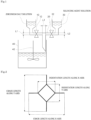
- step 2 will be described with reference to the drawings.
- Fig. 1 is a schematic diagram for illustrating the method for producing a zirconia powder according to the present embodiment.
- a container 10 is connected to one upper end (on the left side in Fig. 1 ) of a T-shaped tube 20 via a valve 12.
- a container 30 is connected to the other upper end (on the right side in Fig. 1 ) of the T-shaped tube 20 via a valve 32.
- a zirconium solution heated to 95°C or higher and 100°C or lower is stored.
- a sulfating agent solution heated to 95°C or higher and 100°C or lower is stored.
- step 2 the valve 12 is opened while the valve 32 is opened, thereby bringing the zirconium solution into contact with the sulfating agent solution.
- a mixed liquid (basic zirconium sulfate-containing reaction liquid) obtained by the contact immediately flows into an aging container 40 from the lower side of the T-shaped tube 20.
- the concentration of the reaction liquid (the concentration of the reaction liquid in the T-shaped tube 20) is prevented from changing from start to end of the contact of the zirconium solution with the sulfating agent solution.
- step 2 since the concentration change of SO 4 2- /ZrO 2 from start to end of the contact is prevented, a uniform reactant is obtained.
- step 2 the specific surface area and the particle diameter D 50 can be controlled.
- the weight ratio SO 4 2- /ZrO 2 in the mixed liquid in step 2 is preferably within a range of 0.3 to 0.8, more preferably 0.4 to 0.7, even more preferably 0.45 to 0.65.
- the weight ratio SO 4 2- /ZrO 2 in the mixed liquid is adjusted to 0.3 or more, the yield of basic zirconium sulfate as a reaction product can be increased.
- the weight ratio SO 4 2- /ZrO 2 in the mixed liquid is adjusted to 0.8 or less, production of a soluble salt of zirconium sulfate can be prevented, thereby preventing a reduction in the yield of basic zirconium sulfate.
- step 2 in order to maintain the temperature of the mixed liquid at 95°C or higher, it is preferable to install a heater in a tube (e.g., the T-shaped tube 20) or the like for supplying each of the solutions.
- a heater in order to maintain the temperature of the mixed liquid at 95°C or higher, it is preferable to install a heater in a tube (e.g., the T-shaped tube 20) or the like for supplying each of the solutions.
- step 2 will specifically be described.
- T-shaped tube 20 When 213 g of a 25 mass% aqueous sodium sulfate solution and 450 g of an aqueous zirconium oxychloride solution with a concentration of 16 mass% in terms of ZrO 2 are brought into contact with each other using, as the T-shaped tube 20, a T-shaped tube having a tube diameter L1 of 10 mm at one upper end (on the left side in Fig. 1 ), a tube diameter L2 of 10 mm at the other upper end (on the right side in Fig.
- the time (contact time) from the start of contact to the end of contact is preferably 30 seconds to 300 seconds, more preferably 60 seconds to 200 seconds, even more preferably 90 seconds to 150 seconds.
- step 3 the basic zirconium sulfate-containing reaction liquid obtained in step 2 is aged at 95°C or higher for 3 hours or more.
- step 3 for example, the basic zirconium sulfate-containing reaction liquid flowing into the aging container 40 is aged at 95°C or higher for 3 hours or more while being stirred with a stirrer 42.
- the upper limit of the aging time is not limited, and is, for example, 7 hours or less.
- the temperature (aging temperature) of the mixed liquid (the basic zirconium sulfate-containing reaction liquid) in step 3 is preferably 95°C or higher, more preferably 97°C or higher and 100°C or lower.
- the mixed liquid contains basic zirconium sulfate as a main component and is a basic zirconium sulfate slurry.
- step 4 a stabilizer is added to the aged basic zirconium sulfate-containing reaction liquid obtained in step 3.
- step 5 an alkali is added to the basic zirconium sulfate-containing reaction liquid obtained in step 4 to perform a neutralization reaction. Neutralization produces a zirconium-containing hydroxide.
- the alkali is not limited, and examples thereof include sodium hydroxide, sodium carbonate, ammonia, hydrazine, and ammonium hydrogen carbonate.
- the alkali is not limited in concentration, and one diluted with water and having a concentration of 5 to 30% is usually used.
- a method for adding the alkali there are two methods: (1) adding an alkali solution to the basic zirconium sulfate-containing reaction liquid and (2) adding the basic zirconium sulfate-containing reaction liquid to an alkali solution, but the method is not limited and either of the methods may be used.
- the slurry is filtered to obtain a zirconium-containing hydroxide.
- the zirconium-containing hydroxide is preferably washed with water such as pure water to remove impurities. If necessary, drying or the like may be performed after washing with water.
- step 6 the zirconium-containing hydroxide obtained in step 5 is subjected to thermal treatment (firing) to oxidize the zirconium-containing hydroxide, thereby obtaining a zirconia powder.
- the thermal treatment temperature (firing temperature) and the thermal treatment time (firing time) of the zirconium-containing hydroxide are not limited, but the thermal treatment is usually performed at about 600 to 1050°C for 1 hour to 10 hours.
- the firing temperature is more preferably 650°C or higher and 1000°C or lower, even more preferably 700°C or higher and 980°C or lower.
- the firing temperature is more preferably 2 hours to 6 hours, even more preferably 2 hours to 4 hours.
- the thermal treatment atmosphere is not limited and may usually be air or an oxidizing atmosphere.
- the obtained zirconia powder may be pulverized to form a slurry.
- a binder may be added in order to improve moldability.
- the binder and the zirconia powder may uniformly be mixed with a kneading machine.
- the binder is preferably an organic binder.
- the organic binder is likely to be removed from a molded body in a heating furnace filled with an oxidizing atmosphere so that a degreased body can be obtained, and therefore impurities are less likely to finally remain in a sintered body.
- organic binder examples include those that are soluble in alcohol or those that are soluble in mixed liquids of two or more selected from the group consisting of alcohols, water, aliphatic ketones, and aromatic hydrocarbons.
- the organic binder may be, for example, at least one selected from the group consisting of polyethylene glycol, glycol fatty acid ester, glycerin fatty acid ester, polyvinyl butyral, polyvinyl methyl ether, polyvinyl ethyl ether, and vinyl propionate.
- the organic binder may further contain at least one thermoplastic resin insoluble in alcohol or the mixed liquids.
- a target zirconia powder can be obtained by performing treatment such as drying or pulverization by a publicly-known method.
- the particle diameter D 50 of the zirconia powder can be controlled by the pulverization in step 7.
- pulverization is performed according to the state of the zirconia powder obtained in step 5, and the particle diameter D 50 of the zirconia powder can thereby be controlled to fall within a range of 0.1 ⁇ m or more and 0.7 ⁇ m or less.
- a zirconia powder containing the additive can be obtained by adding the additive and mixing the resultant after step 6.
- step 7 the additive may be added in step 7.
- the zirconia powder according to the present embodiment has been described above.
- a zirconia powder is prepared.
- the zirconia powder one described in the section of [Zirconia powder] can be used.
- the zirconia powder is molded to obtain a molded body (step X).
- a commercially available molding machine and cold isostatic pressing (CIP) can be employed.
- the zirconia powder may temporarily be molded by a molding machine once and then finally be molded by press molding.
- the press molding may usually be performed at a pressure in a range of 0.1 t to 3 t/cm 2 .
- the pressure is preferably 0.5 t to 2.5 t/cm 2 , more preferably 0.8 t to 2.2 t/cm 2 , even more preferably 1 t to 2 t/cm 2 .
- the molded body is sintered under conditions of 1200°C or higher and 1350°C or lower and 1 hour or more and 5 hours or less (step Y).
- the sintering temperature can be set to a low temperature of 1200°C or higher and 1350°C or lower.
- the sintering temperature is more preferably 1200°C or higher and 1300°C or lower, and 1200°C or higher and 1250°C or lower.
- the holding time during sintering is not limited, either, and is, for example, preferably about 1 to 5 hours, more preferably 1 hour to 3 hours.
- the sintering atmosphere may be air or an oxidizing atmosphere. The sintering may be performed under ordinary pressure, and it is not necessary to apply pressure.
- the zirconia sintered body according to the present embodiment can be used as an industrial part, an aesthetic part, or a dental material. More specifically, the zirconia sintered body can be used for jewelry, watch parts, watch faces, artificial teeth, members for molding processing, wear resistant members, chemical resistant members, etc.
- the zirconia powder and the zirconia sintered body in each of Examples and Comparative Examples contain hafnium oxide as an unavoidable impurity in an amount of 1.3 to 2.5 mass% (calculated by the following Formula (X) relative to zirconium oxide. ([mass of hafnium oxide]/([mass of zirconium oxide] + [mass of hafnium oxide])) ⁇ 100 (%)
- step 3 the obtained basic zirconium sulfate-containing reaction liquid was aged by maintaining it at 95°C for 4 hours to obtain basic zirconium sulfate (step 3).
- the aged solution was cooled to room temperature, and then an aqueous yttrium chloride solution with a concentration of 20 mass% in terms of Y 2 O 3 was added so that the concentration of Y 2 O 3 was 1.65 mol% and an aqueous neodymium chloride solution with a concentration of 20 mass% in terms of Nd 2 O 3 was added so that the concentration of Nd 2 O 3 was 0.15 mol%, and the resultant was uniformly mixed (step 4).
- step 5 a 25 mass% aqueous sodium hydroxide solution was added to the obtained mixed solution to neutralize the mixed solution until the pH reached 13 or higher so that a hydroxide precipitate was formed.
- the obtained hydroxide precipitate was collected by filtration and sufficiently washed with water, and the obtained hydroxide was dried at 105°C for 24 hours.
- the dried hydroxide was thermally treated at 850°C (firing temperature) in the air for 4 hours to obtain an unpulverized zirconia-based powder (stabilized zirconia-based powder) (step 6).
- An alumina powder having an average particle diameter of primary particles of 0.1 um was added to the obtained unpulverized stabilized zirconia-based powder in an amount of 0.25 mass% relative to the stabilized zirconia-based powder, and the resultant was pulverized and mixed for 40 hours with a wet ball mill using water as a dispersion medium.
- the pulverization was performed using ⁇ 5-mm zirconia beads.
- a zirconia slurry obtained after the pulverization was dried at 110°C to obtain a zirconia powder according to Example 1.
- Zirconia powders according to Example 2 to Example 20 and Comparative Example 1 to Comparative Example 6 were obtained in the same manner as in Example 1 except that the amount of the stabilizer added and the amount of alumina added were changed as shown in Table 1.
- the specific surface area of the zirconia powder of each of Examples and Comparative Examples was measured by BET method using a specific surface area meter ("Macsorb” manufactured by Mountec Co., Ltd.). The results are shown in Table 1.
- composition (in terms of oxides) of the zirconia powder of each of Examples and Comparative Examples was analyzed using a wavelength-dispersive X-ray fluorescence spectrometer ("ZSX Primus II" manufactured by Rigaku Corporation). The results are shown in Table 1.
- Example 1 Total amount of stabilizer M x O y M x O y /Y 2 O 3 Y 2 O 3 Al 2 O 3 Specific surface area Particle diameter D 50 mol% Type mol% mol%/mol% mol% wt% m 2 /g ⁇ m
- Example 1 1.80 Nd 2 O 3 0.15 0.09 1.65 0.25 32 0.5
- Example 2 1.80 Nd 2 O 3 0.20 0.13 1.60 0.25 33 0.6
- Example 3 1.80 Nd 2 O 3 0.50 0.38 1.30 0.25 37 0.5
- Example 4 1.80 Nd 2 O 3 0.60 0.50 1.20 0.25 32 0.5
- Example 5 1.80 Nd 2 O 3 0.60 0.50 1.20 0 32 0.5
- Example 6 1.80 Nd 2 O 3 0.60 0.50 1.20 5.0 31 0.5
- Example 7 1.80 Nd 2 O 3 0.60 0.50 1.20 10 30 0.4
- Example 8 1.80 Nd 2 O 3 0.90 1.00 0.90 0.25 39 0.6
- Example 9 1.80 Nd
- Example 11 2.00 Nd 2 O 3 0.70 0.54 1.30 0.25 40 0.5
- Example 12 2.40 Nd 2 O 3 0.90 0.60 1.50 0.25 20 0.6
- Example 13 2.60 Nd 2 O 3 1.30 1.00 1.30 0.25 22 0.7
- Example 14 2.00 La 2 O 3 0.50 0.33 1.50 0.25 34 0.5
- Example 15 2.00 CaO 0.50 0.33 1.50 0.25 37 0.6
- Example 16 1.75 Tb 2 O 3 0.25 0.17 1.50 0.25 32 0.3
- Example 17 2.00 Tb 2 O 3 0.50 0.33 1.50 0.25 32 0.3
- Example 18 1.80 Tb 2 O 3 0.60 0.50 1.20 0.25 32 0.4
- Example 19 1.75 Dy 2 O 3 0.25 0.17 1.50 0.25 31 0.4
- Example 20 1.80 Dy 2 O 3 0.60 0.50 1.20 0.25 30 0.4
- Example 21 1.75 Sm 2 O 3 0.25 0.17 1.50 0.25 37 0.7
- Example 22 1.75 Gd 2 O 3 0.25 0.17 1.50 0.25 37
- molded bodies were obtained from the zirconia powders of Examples and Comparative Examples by cold isostatic pressing (CIP).
- the molding pressure was set to 2 t/cm 2 .
- the molded bodies according to Example 1 to Example 20 and Comparative Examples 1 to 5 were sintered under conditions of 1250°C and 2 hours to obtain zirconia sintered bodies according to Example 1 to Example 20 and Comparative Examples 1 to 5.
- the molded body according to Comparative Example 6 was sintered under conditions of 1430°C and 2 hours to obtain a zirconia sintered body according to Comparative Example 6.
- the theoretical sintered density varies depending on the composition of the powder.
- the theoretical density of the colorant is 5.24 g/cm 3 for Fe 2 O 3 , 5.61 g/cm 3 for ZnO, 5.03 g/cm 3 for MnO 2 , 6.10 g/cm 3 for CoO, 5.22 g/cm 3 for Cr 2 O 3 , 4.23 g/cm 3 for TiO 2 , 7.80 g/cm 3 for Tb 4 O 7 , 6.31 g/cm 3 for CuO, and 3.36 g/cm 3 for V 2 O 5 .
- the sintered density was measured by Archimedes method.
- Relative molding density (%) (molding density/theoretical sintered density) ⁇ 100
- the theoretical sintered density (denoted by ⁇ 0 ) is a value calculated by the above formula (2-1).
- the crystal grain diameter of the zirconia sintered body of each of Examples and Comparative Examples was determined as follows. The results are shown in Table 2. It should be noted that in Comparative Examples 1 and 4, measurement was impossible due to poor sintering.
- the SEM observation image of sample of the sintered body obtained by scanning electron microscopy was used to determine an average crystal grain diameter.
- the sample for SEM observation was prepared in accordance with JIS R 1633.
- the number of crystal grains per visual field of the SEM observation image was set to 150 or more.
- a rectangle of any size was drawn in the SEM observation image, and the number of grains present on the sides and diagonal lines of the rectangle was counted.
- the magnification was set to 30,000x, and a rectangle of 3.497 ⁇ m ⁇ 2.375 um was drawn.
- the length of each of the sides of the rectangle was set to be equal to or more than 80% of the visual field.
- the average crystal grain diameter was calculated from the numbers of grains and the lengths of four sides and diagonal lines of the rectangle.
- X, x1, x2, Y, y1, y2, D, d1, and d2 in the formula are as follows.
- the sintered body sample was pretreated by mirror polishing and then by thermal etching.
- the mirror polishing was performed by grinding the surface of the sintered body with a surface grinder and then polishing it with a mirror polishing device while changing the average particle diameter of diamond abrasive grains used in the order of 9 um, 6 ⁇ m, and 3 ⁇ m.
- the zirconia sintered body of each of Examples and Comparative Examples was mirror-polished, and its tetragonal fraction (tetragonal fraction before thermal treatment) was determined.
- the mirror polishing was performed by grinding the surface of the sintered body with a surface grinder and then polishing it with a mirror polishing device while changing the average particle diameter of diamond abrasive grains used in the order of 9 ⁇ m, 6 ⁇ m, and 3 ⁇ m.
- the X-ray diffraction spectrum of each of the zirconia sintered bodies was obtained using an X-ray diffractometer ("RINT2500" manufactured by Rigaku Corporation). The measurement conditions were set as follows.
- Im(111) is the diffraction intensity of (111) in the monoclinic phase
- IIm(11-1) is the diffraction intensity of (11-1) in the monoclinic phase.
- It(101) is the diffraction intensity of (101) in the tetragonal phase
- It (220) is the diffraction intensity of (220) in the tetragonal phase
- It(004) is the diffraction intensity of (004) in the tetragonal phase.
- Ic (004) is the diffraction intensity of (004) in the cubic phase and Ic(111) is the diffraction intensity of (111) in the cubic phase.
- the cubic phase may be distorted depending on the amount of the stabilizer added and the type of production method used, which may cause a peak position to shift. However, in the present Examples, a peak between (004) and (220) in the tetragonal phase was calculated as the peak of the cubic phase.
- the zirconia sintered body of each of Examples and Comparative Examples was mirror-polished, and its tetragonal fraction (tetragonal fraction before hydrothermal treatment) was determined.
- the mirror polishing was performed by grinding the surface of the sintered body with a surface grinder and then polishing it with a mirror polishing device while changing the average particle diameter of diamond abrasive grains used in the order of 9 ⁇ m, 6 ⁇ m, and 3 ⁇ m.
- the measurement of toughness based on IF method was performed by a method in accordance with JIS R 1607 (Testing methods for fracture toughness of fine ceramics at room temperature) using a load of 50 kgf (490.3 N). Five quadrangular indentations formed by a Vickers hardness tester were selected, and the average of toughness values of them was used. The results are shown in Table 2. It should be noted that in Comparative Examples 1 and 4, measurement was impossible due to poor sintering.
- Kc, Hv, a, c, and E mean the following.
- the indentation lengths along the X and Y axes and the crack lengths along the X and Y axes for determining a and c are as shown in Fig. 2 .
- F and d mean the following.
- the X-axis indentation length and the Y-axis indentation length for determining d are as shown in Fig. 2 .
- 210 GPa which is known as a Young' s modulus of common yttria-stabilized zirconia, was used.
Landscapes
- Chemical & Material Sciences (AREA)
- Engineering & Computer Science (AREA)
- Ceramic Engineering (AREA)
- Manufacturing & Machinery (AREA)
- Organic Chemistry (AREA)
- Materials Engineering (AREA)
- Structural Engineering (AREA)
- Inorganic Chemistry (AREA)
- Composite Materials (AREA)
- Physics & Mathematics (AREA)
- Thermal Sciences (AREA)
- Compositions Of Oxide Ceramics (AREA)
Applications Claiming Priority (2)
| Application Number | Priority Date | Filing Date | Title |
|---|---|---|---|
| JP2022037691 | 2022-03-11 | ||
| PCT/JP2023/007937 WO2023171542A1 (fr) | 2022-03-11 | 2023-03-03 | Corps fritté de zircone, poudre de zircone et procédé de production de corps fritté de zircone |
Publications (2)
| Publication Number | Publication Date |
|---|---|
| EP4428111A1 true EP4428111A1 (fr) | 2024-09-11 |
| EP4428111A4 EP4428111A4 (fr) | 2025-11-05 |
Family
ID=87935335
Family Applications (1)
| Application Number | Title | Priority Date | Filing Date |
|---|---|---|---|
| EP23766718.3A Pending EP4428111A4 (fr) | 2022-03-11 | 2023-03-03 | Corps fritté de zircone, poudre de zircone et procédé de production de corps fritté de zircone |
Country Status (5)
| Country | Link |
|---|---|
| US (1) | US20250042819A1 (fr) |
| EP (1) | EP4428111A4 (fr) |
| JP (1) | JP7734268B2 (fr) |
| CN (1) | CN118829619A (fr) |
| WO (1) | WO2023171542A1 (fr) |
Families Citing this family (2)
| Publication number | Priority date | Publication date | Assignee | Title |
|---|---|---|---|---|
| CN118754682A (zh) * | 2024-06-11 | 2024-10-11 | 深圳锆美科技集团有限公司 | 一种低温烧结氧化锆及其在义齿制备中的应用 |
| JP7631611B1 (ja) * | 2024-10-17 | 2025-02-18 | 第一稀元素化学工業株式会社 | ジルコニア焼結体、及び、ジルコニア焼結体の製造方法 |
Family Cites Families (12)
| Publication number | Priority date | Publication date | Assignee | Title |
|---|---|---|---|---|
| JPH07187774A (ja) * | 1993-12-24 | 1995-07-25 | Shinagawa Refract Co Ltd | 高強度ジルコニア質焼結体及びその製造方法並びに粉砕用部品材料及びセラミックスダイス |
| JPH0840770A (ja) | 1994-07-30 | 1996-02-13 | Shinagawa Refract Co Ltd | ジルコニア質焼結体及びその製造方法 |
| JP2000095564A (ja) * | 1998-09-18 | 2000-04-04 | Daiichi Kigensokagaku Kogyo Co Ltd | ジルコニア質焼結体及びその製造方法ならびに粉砕部材用材料 |
| JP2004359534A (ja) * | 2003-06-02 | 2004-12-24 | Daiichi Kigensokagaku Kogyo Co Ltd | ジルコニア質焼結体 |
| JP3955901B2 (ja) * | 2005-02-17 | 2007-08-08 | 国立大学法人大阪大学 | 導電性ジルコニア焼結体及びその製造方法 |
| JP5356639B2 (ja) * | 2005-03-04 | 2013-12-04 | 東ソー株式会社 | ジルコニア微粉末及びその製造方法 |
| CH700119B1 (de) * | 2006-03-20 | 2010-06-30 | Kyocera Corp | Gefärbter gesinterter Körper auf Zirkonoxidbasis, Methode zur Herstellung desselben und Verwendung als Dekorationselement. |
| CN102686536A (zh) * | 2009-12-29 | 2012-09-19 | 3M创新有限公司 | 掺杂钇和镧的基于氧化锆的材料 |
| JP5931542B2 (ja) * | 2012-03-30 | 2016-06-08 | 株式会社ニッカトー | ジルコニア質焼結体からなる焼成用部材 |
| EP3960721A4 (fr) | 2019-04-25 | 2023-01-25 | Tosoh Corporation | Corps fritté, poudre et procédé de production associé |
| EP4039647A4 (fr) * | 2020-10-09 | 2023-11-15 | Daiichi Kigenso Kagaku Kogyo Co., Ltd. | Poudre de zircone, corps fritté en zircone et procédé de production de corps fritté en zircone |
| JP2022162546A (ja) * | 2021-04-12 | 2022-10-24 | 東ソー株式会社 | 焼結体 |
-
2023
- 2023-03-03 CN CN202380025512.0A patent/CN118829619A/zh active Pending
- 2023-03-03 US US18/717,261 patent/US20250042819A1/en active Pending
- 2023-03-03 JP JP2024506126A patent/JP7734268B2/ja active Active
- 2023-03-03 WO PCT/JP2023/007937 patent/WO2023171542A1/fr not_active Ceased
- 2023-03-03 EP EP23766718.3A patent/EP4428111A4/fr active Pending
Also Published As
| Publication number | Publication date |
|---|---|
| JP7734268B2 (ja) | 2025-09-04 |
| WO2023171542A1 (fr) | 2023-09-14 |
| US20250042819A1 (en) | 2025-02-06 |
| CN118829619A (zh) | 2024-10-22 |
| JPWO2023171542A1 (fr) | 2023-09-14 |
| EP4428111A4 (fr) | 2025-11-05 |
Similar Documents
| Publication | Publication Date | Title |
|---|---|---|
| EP4039648B1 (fr) | Poudre de zircone, corps fritté de zircone et procédé pour produire de corps fritté de zircone | |
| US12286379B2 (en) | Zirconia powder, method for producing zirconia powder, method for producing zirconia sintered body, and zirconia sintered body | |
| EP4428111A1 (fr) | Corps fritté de zircone, poudre de zircone et procédé de production de corps fritté de zircone | |
| EP4428112A1 (fr) | Poudre de zircone, objet en zircone fritté et procédé de production d'un objet en zircone fritté | |
| EP4592269A1 (fr) | Composition de zircone et son procédé de production | |
| EP4140966A1 (fr) | Corps fritté et son procédé de production | |
| Abbas et al. | Structural properties of zirconia doped with some oxides | |
| EP4023601A1 (fr) | Corps fritté de zircone stabilisée et poudre de zircone | |
| EP4039647A1 (fr) | Poudre de zircone, corps fritté en zircone et procédé de production de corps fritté en zircone | |
| EP4563548A1 (fr) | Corps fritté de zircone contenant de l'argent, poudre de zircone stabilisée contenant de l'argent, procédé de production de poudre de zircone stabilisée contenant de l'argent, et procédé de production de corps fritté de zircone contenant de l'argent | |
| US12612338B2 (en) | Zirconia powder, zirconia sintered body, and method for producing zirconia sintered body | |
| JP7631611B1 (ja) | ジルコニア焼結体、及び、ジルコニア焼結体の製造方法 | |
| WO2025070294A1 (fr) | Corps fritté en zircone, procédé de production du corps fritté en zircone et poudre de zircone | |
| JP7711857B2 (ja) | チタン及びイットリウム固溶ジルコニア焼結体 | |
| Ma et al. | Formation and mechanical properties of Y-substituted (Ce0. 2Zr0. 2La0. 2Sm0. 2Nd0. 2) O2-δ high-entropy fluorite oxide | |
| Chauhan et al. | Polymorphic transitions and phase stability of CeO2-δ·(Dy, La, Sm, Y) 2O3 high-entropy oxides consolidated by spark plasma sintering | |
| Hampshire | Comparison of Microwave and Conventionally Sintered Yttria Doped Zirconia Ceramics and Hydroxyapatite-Zirconia Nanocomposites | |
| EP4628450A1 (fr) | Poudre | |
| JP2026071480A (ja) | ジルコニア焼結体、及び、ジルコニア焼結体の製造方法 |
Legal Events
| Date | Code | Title | Description |
|---|---|---|---|
| STAA | Information on the status of an ep patent application or granted ep patent |
Free format text: STATUS: THE INTERNATIONAL PUBLICATION HAS BEEN MADE |
|
| PUAI | Public reference made under article 153(3) epc to a published international application that has entered the european phase |
Free format text: ORIGINAL CODE: 0009012 |
|
| STAA | Information on the status of an ep patent application or granted ep patent |
Free format text: STATUS: REQUEST FOR EXAMINATION WAS MADE |
|
| 17P | Request for examination filed |
Effective date: 20240607 |
|
| AK | Designated contracting states |
Kind code of ref document: A1 Designated state(s): AL AT BE BG CH CY CZ DE DK EE ES FI FR GB GR HR HU IE IS IT LI LT LU LV MC ME MK MT NL NO PL PT RO RS SE SI SK SM TR |
|
| DAV | Request for validation of the european patent (deleted) | ||
| DAX | Request for extension of the european patent (deleted) | ||
| A4 | Supplementary search report drawn up and despatched |
Effective date: 20251007 |
|
| RIC1 | Information provided on ipc code assigned before grant |
Ipc: C04B 35/486 20060101AFI20250930BHEP Ipc: C01G 25/02 20060101ALI20250930BHEP Ipc: C04B 35/626 20060101ALI20250930BHEP Ipc: C04B 35/488 20060101ALI20250930BHEP |