EP4431425A1 - Wickelmaterialrolle - Google Patents
Wickelmaterialrolle Download PDFInfo
- Publication number
- EP4431425A1 EP4431425A1 EP23162420.6A EP23162420A EP4431425A1 EP 4431425 A1 EP4431425 A1 EP 4431425A1 EP 23162420 A EP23162420 A EP 23162420A EP 4431425 A1 EP4431425 A1 EP 4431425A1
- Authority
- EP
- European Patent Office
- Prior art keywords
- wrapping material
- end edge
- material sheet
- outer end
- wound
- Prior art date
- Legal status (The legal status is an assumption and is not a legal conclusion. Google has not performed a legal analysis and makes no representation as to the accuracy of the status listed.)
- Pending
Links
Images


Classifications
-
- B—PERFORMING OPERATIONS; TRANSPORTING
- B65—CONVEYING; PACKING; STORING; HANDLING THIN OR FILAMENTARY MATERIAL
- B65H—HANDLING THIN OR FILAMENTARY MATERIAL, e.g. SHEETS, WEBS, CABLES
- B65H19/00—Changing the web roll
- B65H19/22—Changing the web roll in winding mechanisms or in connection with winding operations
- B65H19/29—Securing the trailing end of the wound web to the web roll
-
- B—PERFORMING OPERATIONS; TRANSPORTING
- B65—CONVEYING; PACKING; STORING; HANDLING THIN OR FILAMENTARY MATERIAL
- B65H—HANDLING THIN OR FILAMENTARY MATERIAL, e.g. SHEETS, WEBS, CABLES
- B65H2301/00—Handling processes for sheets or webs
- B65H2301/40—Type of handling process
- B65H2301/41—Winding, unwinding
- B65H2301/414—Winding
- B65H2301/4144—Finishing winding process
- B65H2301/41441—Finishing winding process and blocking outer layers against falling apart
- B65H2301/41442—Specified by the sealing medium sealing used
- B65H2301/414422—Adhesive tape
-
- B—PERFORMING OPERATIONS; TRANSPORTING
- B65—CONVEYING; PACKING; STORING; HANDLING THIN OR FILAMENTARY MATERIAL
- B65H—HANDLING THIN OR FILAMENTARY MATERIAL, e.g. SHEETS, WEBS, CABLES
- B65H2301/00—Handling processes for sheets or webs
- B65H2301/50—Auxiliary process performed during handling process
- B65H2301/51—Modifying a characteristic of handled material
- B65H2301/515—Cutting handled material
- B65H2301/5151—Cutting handled material transversally to feeding direction
-
- B—PERFORMING OPERATIONS; TRANSPORTING
- B65—CONVEYING; PACKING; STORING; HANDLING THIN OR FILAMENTARY MATERIAL
- B65H—HANDLING THIN OR FILAMENTARY MATERIAL, e.g. SHEETS, WEBS, CABLES
- B65H2511/00—Dimensions; Position; Numbers; Identification; Occurrences
- B65H2511/20—Location in space
- B65H2511/21—Angle
-
- B—PERFORMING OPERATIONS; TRANSPORTING
- B65—CONVEYING; PACKING; STORING; HANDLING THIN OR FILAMENTARY MATERIAL
- B65H—HANDLING THIN OR FILAMENTARY MATERIAL, e.g. SHEETS, WEBS, CABLES
- B65H2701/00—Handled material; Storage means
- B65H2701/10—Handled articles or webs
- B65H2701/13—Parts concerned of the handled material
- B65H2701/131—Edges
- B65H2701/1313—Edges trailing edge
-
- B—PERFORMING OPERATIONS; TRANSPORTING
- B65—CONVEYING; PACKING; STORING; HANDLING THIN OR FILAMENTARY MATERIAL
- B65H—HANDLING THIN OR FILAMENTARY MATERIAL, e.g. SHEETS, WEBS, CABLES
- B65H2701/00—Handled material; Storage means
- B65H2701/10—Handled articles or webs
- B65H2701/13—Parts concerned of the handled material
- B65H2701/131—Edges
- B65H2701/1315—Edges side edges, i.e. regarded in context of transport
-
- B—PERFORMING OPERATIONS; TRANSPORTING
- B65—CONVEYING; PACKING; STORING; HANDLING THIN OR FILAMENTARY MATERIAL
- B65H—HANDLING THIN OR FILAMENTARY MATERIAL, e.g. SHEETS, WEBS, CABLES
- B65H2701/00—Handled material; Storage means
- B65H2701/10—Handled articles or webs
- B65H2701/19—Specific article or web
- B65H2701/1944—Wrapping or packing material
Definitions
- the present disclosure relates to wrapping material rolls, and to a method for producing a wrapping material roll.
- Wrapping material such as wrapping paper
- the wrapping material is typically sold as an elongated wrapping material sheet wrapped around itself into a roll.
- the outer end of the sheet should be secured.
- the color and/or pattern of the wrapping material should preferably be clearly visible to a potential user.
- this if often solved by enclosing the wrapping material roll in a transparent plastic film.
- the use of plastic should preferably be reduced.
- Another known solution is to secure the outer end edge by applying an adhesive label at the middle of the outer end edge of the wrapping material roll.
- this solution could still lead to damage of the roll, and in particular to the non-attached corners of the outer end edge of the roll, as these possess the risk of getting stuck, crumpling or tearing during transportation and at the retailer.
- WO202260519 propose a solution in which an outer end edge of a wrapping material roll is folded before being attached to the wound wrapping material.
- this solution is complicated to achieve from a production point of view.
- An object of the present invention is to overcome the above-mentioned problems and to provide a solution for securing the outer end of a wrapping material roll which allows for a pleasant appearance, while being more environmentally friendly than previous solutions.
- Another object is to provide a wrapping material roll which may be efficiently produced at a comparatively low cost.
- a further object is to provide such a wrapping material roll which allows for that the entire sheet may be used by the end used for wrapping.
- a further object is to provide an improved method of producing such a wrapping material roll.
- a wrapping material roll comprising an elongated wrapping material sheet wound around itself into a wound wrapping material sheet.
- the wound wrapping material sheet comprises an inner end edge, an outer end edge, a first side edge extending between the inner end edge and the outer end edge, and a second side edge extending between the inner end edge and the outer end edge, the second side edge being essentially parallel to the first side edge.
- the outer end edge of the wrapping material sheet is cut at an acute angle relative to the first side edge, and the outer end edge of the wound wrapping material sheet is secured to the wound wrapping material sheet at, or in proximity to, an intersection between the outer end edge and the first side edge, to prevent the wound wrapping material sheet from unwinding.
- the present solution provides a wrapping material roll which may be efficiently produced at a comparatively low cost, as the process of cutting the outer end edge at an angle only demands a marginal increase in time and labor as compared to conventional solutions.
- the present solution also provides the user with a wrapping material roll in which all wrapping material can be utilized for wrapping. This is an improvement over solutions having a folded outer edge, since in those solutions, the folded part would probably be thrown away by the user as the permanent fold lines could give the wrapped gifts or items with an unpleasant appearance.
- the outer end edge of the wound wrapping material sheet is secured to the wound wrapping material sheet, at a distance from the intersection between the outer end edge and the first side edge, the distance being within 0-5% of the total distance between the first side edge and the second side edge, as measured along the inner edge.
- the outer end edge of the wrapping material sheet can be secured close enough to the first side edge to avoid tearing of the acute angled corner.
- the wrapping material roll comprises an attachment member, the attachment member being arranged to secure the outer end edge of the wrapping material sheet to the wound wrapping material sheet.
- the outer end edge could be secured without the use of any additional attachment member.
- the outer end edge could be glued directly to the wound wrapping material sheet.
- the attachment member comprises an adhesive attachment member, such as an adhesive label.
- an adhesive label is that the attachment member could double as a label to provide information to a customer at the retailer.
- a further advantage connected to this is that the adhesive label of the present disclosure is placed at, or in proximity to, an end of the wrapping material roll. As wrapping material rolls are often stored vertically at a retailer, the adhesive label can thus be arranged at an upper end of the wrapping material roll where it can be more discernable to a potential buyer than would a centrally placed label.
- a first part of a first portion of the attachment member is arranged to adhesively attach to an outer surface of the wound wrapping material sheet while a second portion of the attachment member is arranged to encircle the wound wrapping material sheet and adhesively attach to a second part of the first portion of the attachment member.
- the adhesive label only adheres to the wrapping material sheet at the outer end edge.
- a minimum amount of wrapping material is wasted, while still providing a firm securement of the outer end edge.
- the angle between the outer end edge and the first side edge of the wrapping material sheet is 60-89°, preferably70-75°.
- the adhesive label is a peel-off label which could adhere to the wrapping material without leaving any traces when being peeled-off.
- an angle can be provided which is narrow enough to avoiding tearing of the outer end of the wrapping material roll, while wasting as little wrapping material as possible due to the cutting of the outer end edge.
- the length of the wrapping material sheet, as measured along the first side edge (6), is 1.5-200 m.
- the wrapping material sheet is a wrapping paper sheet.
- the wrapping material sheet could also include other types of wrapping materials, such as cellophane or synthetic foils.
- the grammage of the wrapping paper sheet is 50-100 g/m2.
- the grammage of the wrapping paper sheet is 60-90 g/m2.
- This provides a wrapping material which is suitable for wrapping of gifts and personal items with regards to sturdiness and flexibility.
- a width of the wrapping material sheet, as measured between the first and second side edges, is 38-100 cm.
- a wrapping material roll which has enough width for wrapping of most gifts and personal items, while not being too bulky to handle.
- the wrapping material roll further comprises a core, wherein the wrapping material sheet is wound onto the core.
- the wrapping material roll remains its stability also when most of the wrapping material sheet has been wound of.
- the core could in some embodiments comprise a paper tube.
- a method for producing a wrapping material roll is provided. The method comprises:
- a wrapping material roll can be produced in a machine for producing conventional wrapping material rolls, with the addition of an angled cutting step.
- a highly efficient production can be achieved with a minimal addition of time and labor as compared to the production of conventional wrapping material rolls.
- the method further comprises unwinding the outer end edge of the wrapping material sheet prior to cutting of the outer end edge, and a further step of rewinding the outer end edge of the wrapping material sheet after cutting of the outer end edge.
- the wrapping material roll could first be produced in a conventional way, and then be transported to a cutting tool for providing the angled outer end edge.
- the outer end edge of the wrapping material sheet could be cut before winding.
- the step of securing the outer end edge of the wrapping material sheet to the wound wrapping material sheet comprises:
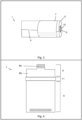
- Fig. 1 illustrates a wrapping material roll 1 in accordance with the present invention.
- the wrapping material roll 1 in Fig. 1 comprises a wound wrapping material sheet 2a.
- the wound wrapping material sheet 2a comprises an inner end edge 3 arranged at a center of the wound wrapping material roll, and an outer end edge 4.
- the outer end edge is secured at an envelope surface of the wrapping material roll 2a.
- the wrapping material sheet 2 has thus been wound from the inner end edge 3 towards the outer end edge 4.
- the wrapping material sheet 2 further comprises a first side edge 5 and a second side edge 6 constituting the longitudinal side edges of the elongated wrapping material sheet 2.
- Fig. 1 further illustrates an attachment member 7 adapted to secure the outer end edge 4 to the wound wrapping material sheet 2a.
- the attachment member 7 is in Fig.1 arranged closer to the first side edge 5, than to the second side edge 6. More specifically, the attachment member 7 is in Fig. 1 arranged in proximity to an intersection between the outer end edge 4, and the first side edge 5.
- the distance from the first side edge 5 to the attachment member 7 is dimensioned so as to avoid damage to the wrapping material sheet due to lose corners. The exact distance could be varied depending on parameters such as the angle ⁇ of the cut, and properties of the material, such as the grammage or thickness.
- Fig. 2 illustrates a wrapping material roll 1 in which the outer end edge 4 has been partly unwound.
- the angle ⁇ of the outer cut end edge 4 can be clearly seen.
- the angle ⁇ could vary depending on parameters such as material properties and production parameters. For example, a more narrow angle ⁇ is expected to enhance maintaining the entire outer end edge in close contact with the remainder of the roll and thus to lower the risk of damage to the wrapping material sheet 2 but could generate a bigger amount of waste. Furthermore, a thicker wrapping material might allow for a less narrow angle without an increased risk of damage.
- Fig. 3 illustrates a part of a wrapping material roll 1 in accordance with the present disclosure.
- the wrapping material sheet 2 is illustrated as being wound onto a core 10.
- the core could for example comprise a hollow paper tube, or any other structure suitable for increasing the stability of the wrapping material roll 1.
- Fig. 4 illustrates an attachment member 7 in the form of an adhesive label.
- the adhesive layer is illustrated from an inner side, that is, the side which is adapted to face the wound wrapping material roll 2a.
- the attachment member 7 further comprises an outer side adapted to face away from the wound wrapping material roll 2a.
- the attachment member 7 comprises a first portion 8 and a second portion 9.
- the first portion 8 comprises a first part 8a which on its inner side is provided with an adhesive adapted to adhere to the outer edge 4 of the wound wrapping material roll 2a, and a second part 8b which is not provided with an adhesive.
- the second portion 9 is also provided with an adhesive at its inner side, so that the second portion 9 can be arranged to encircle the wound wrapping material sheet 2a and adhere to the outer side of the second part 8b the first portion 8.
- Fig. 5 is a method for producing a wrapping paper roll. The method comprises a step of providing 101 an elongated wrapping material sheet 2 comprising a first end edge, a second end edge, a first side edge 5 extending between the first end edge and the second end edge, and a second side edge 6 extending between the first end edge and the second end edge.
- the method further comprises winding 102 the wrapping material sheet 2 around itself, starting from the first end edge, such that the first end edge forms an inner end edge 3 and the second end edge forms an outer end edge 4 of a wound wrapping material sheet 2a.
- the outer end edge 4 of the wrapping material sheet 2 is cut 103 at an acute angle ⁇ relative to the first side edge 5.
- the cutting 103 could be performed before the winding 102 of the wrapping material.
- the cutting could also be performed after the winding 102 of the wrapping material, in which case part of the wrapping material sheet 2 is unwound 105 prior to the cutting 103 and rewound 106 after the cutting 103.
- the method comprises a step of securing 104 the outer end edge 4 of the wrapping material sheet 2 to the wound wrapping material sheet 2a at, or in proximity to, an intersection between the outer end edge 4 and the first side edge 5 to prevent the wound wrapping material sheet 2a from unwinding.
- the securing 104 could be made by an adhesive label, in which case the securing step 104 could include providing an attachment member 7, adhesively attaching a first part 8a of a first portion 8 of the attachment member 7 to an outer surface of the wound wrapping material sheet 2a, wrapping a second portion 9 of the attachment member 7 around the wound wrapping material sheet 2a, and adhesively attaching the second portion 9 of the attachment member 7 to a second part 8b of the first portion 8 of the attachment member 7.
Landscapes
- Packaging Of Machine Parts And Wound Products (AREA)
Priority Applications (1)
| Application Number | Priority Date | Filing Date | Title |
|---|---|---|---|
| EP23162420.6A EP4431425A1 (de) | 2023-03-16 | 2023-03-16 | Wickelmaterialrolle |
Applications Claiming Priority (1)
| Application Number | Priority Date | Filing Date | Title |
|---|---|---|---|
| EP23162420.6A EP4431425A1 (de) | 2023-03-16 | 2023-03-16 | Wickelmaterialrolle |
Publications (1)
| Publication Number | Publication Date |
|---|---|
| EP4431425A1 true EP4431425A1 (de) | 2024-09-18 |
Family
ID=85724635
Family Applications (1)
| Application Number | Title | Priority Date | Filing Date |
|---|---|---|---|
| EP23162420.6A Pending EP4431425A1 (de) | 2023-03-16 | 2023-03-16 | Wickelmaterialrolle |
Country Status (1)
| Country | Link |
|---|---|
| EP (1) | EP4431425A1 (de) |
Citations (5)
| Publication number | Priority date | Publication date | Assignee | Title |
|---|---|---|---|---|
| WO1993012025A1 (en) * | 1991-12-13 | 1993-06-24 | Sequa Corporation | Splicer tape system |
| JP2007145430A (ja) * | 2005-10-27 | 2007-06-14 | Kureha Corp | ラップフィルム装置及びラップフィルムのロール |
| US20160167909A1 (en) * | 2014-12-15 | 2016-06-16 | The Procter & Gamble Company | Non-Uniform Tail Sealing and Methods Thereof |
| WO2022060519A1 (en) | 2020-09-15 | 2022-03-24 | Qualcomm Incorporated | Prioritization at cell reselection by ue of mcg and scg cells over neighbor cells configured with higher priority by the network |
| WO2022260519A1 (en) * | 2021-06-11 | 2022-12-15 | Ig Design Group B.V. | Wrapping material roll and method for production thereof |
-
2023
- 2023-03-16 EP EP23162420.6A patent/EP4431425A1/de active Pending
Patent Citations (5)
| Publication number | Priority date | Publication date | Assignee | Title |
|---|---|---|---|---|
| WO1993012025A1 (en) * | 1991-12-13 | 1993-06-24 | Sequa Corporation | Splicer tape system |
| JP2007145430A (ja) * | 2005-10-27 | 2007-06-14 | Kureha Corp | ラップフィルム装置及びラップフィルムのロール |
| US20160167909A1 (en) * | 2014-12-15 | 2016-06-16 | The Procter & Gamble Company | Non-Uniform Tail Sealing and Methods Thereof |
| WO2022060519A1 (en) | 2020-09-15 | 2022-03-24 | Qualcomm Incorporated | Prioritization at cell reselection by ue of mcg and scg cells over neighbor cells configured with higher priority by the network |
| WO2022260519A1 (en) * | 2021-06-11 | 2022-12-15 | Ig Design Group B.V. | Wrapping material roll and method for production thereof |
Similar Documents
| Publication | Publication Date | Title |
|---|---|---|
| JPH02503290A (ja) | マスキングテープ及びそのようなテープのロールを製造するための方法 | |
| US20020134497A1 (en) | Duplex label pocket | |
| CN114537886A (zh) | 包装纸 | |
| JPH1072063A (ja) | 包装作業性を改善したプラスチック気泡シート | |
| JP7062508B2 (ja) | ラベル及びこれが連接してなるラベルシート | |
| JP2020029267A (ja) | ロール状に巻き取った連続ゴミ袋体の包装用帯紙構造 | |
| CN107697468A (zh) | 一种防尘透气膜及其制备方法 | |
| US3330471A (en) | Packing unit with viewing window | |
| JPH04135900A (ja) | 立方体に装飾シート体を貼着する方法 | |
| CN110564326A (zh) | 一种防霉贴片 | |
| JP3032507B1 (ja) | 巻回粘着テープ | |
| JP3093062U (ja) | 包装用プラスチックフィルム巻取り用紙管 | |
| JPH0526607Y2 (de) | ||
| JP2001120459A (ja) | トイレットペーパロール | |
| JPS5829158Y2 (ja) | 粘着テ−プ | |
| JP2005008778A (ja) | 易剥離性粘着テープ | |
| CN207497291U (zh) | 一种防尘透气膜 | |
| CN210627673U (zh) | 一种可立体展示的标签 | |
| JPS6341336Y2 (de) | ||
| JP4462539B2 (ja) | アルミニウム箔の巻物 | |
| JPS6124546Y2 (de) | ||
| JPH09267846A (ja) | 容器入り壁紙 | |
| US20240067424A1 (en) | Perforated peel and stick wrapping paper | |
| JP4131536B2 (ja) | 物流用粘着テープ及び物流用粘着シール | |
| JPH0357507Y2 (de) |
Legal Events
| Date | Code | Title | Description |
|---|---|---|---|
| PUAI | Public reference made under article 153(3) epc to a published international application that has entered the european phase |
Free format text: ORIGINAL CODE: 0009012 |
|
| STAA | Information on the status of an ep patent application or granted ep patent |
Free format text: STATUS: THE APPLICATION HAS BEEN PUBLISHED |
|
| AK | Designated contracting states |
Kind code of ref document: A1 Designated state(s): AL AT BE BG CH CY CZ DE DK EE ES FI FR GB GR HR HU IE IS IT LI LT LU LV MC ME MK MT NL NO PL PT RO RS SE SI SK SM TR |
|
| STAA | Information on the status of an ep patent application or granted ep patent |
Free format text: STATUS: REQUEST FOR EXAMINATION WAS MADE |
|
| 17P | Request for examination filed |
Effective date: 20250317 |