EP4434461A2 - Neurostimulation de nerfs mixtes - Google Patents
Neurostimulation de nerfs mixtes Download PDFInfo
- Publication number
- EP4434461A2 EP4434461A2 EP24193678.0A EP24193678A EP4434461A2 EP 4434461 A2 EP4434461 A2 EP 4434461A2 EP 24193678 A EP24193678 A EP 24193678A EP 4434461 A2 EP4434461 A2 EP 4434461A2
- Authority
- EP
- European Patent Office
- Prior art keywords
- stimulus
- response
- recording
- fibre
- electrode
- Prior art date
- Legal status (The legal status is an assumption and is not a legal conclusion. Google has not performed a legal analysis and makes no representation as to the accuracy of the status listed.)
- Pending
Links
Images





Classifications
-
- A—HUMAN NECESSITIES
- A61—MEDICAL OR VETERINARY SCIENCE; HYGIENE
- A61N—ELECTROTHERAPY; MAGNETOTHERAPY; RADIATION THERAPY; ULTRASOUND THERAPY
- A61N1/00—Electrotherapy; Circuits therefor
- A61N1/18—Applying electric currents by contact electrodes
- A61N1/32—Applying electric currents by contact electrodes alternating or intermittent currents
- A61N1/36—Applying electric currents by contact electrodes alternating or intermittent currents for stimulation
- A61N1/3605—Implantable neurostimulators for stimulating central or peripheral nerve system
- A61N1/3606—Implantable neurostimulators for stimulating central or peripheral nerve system adapted for a particular treatment
-
- A—HUMAN NECESSITIES
- A61—MEDICAL OR VETERINARY SCIENCE; HYGIENE
- A61N—ELECTROTHERAPY; MAGNETOTHERAPY; RADIATION THERAPY; ULTRASOUND THERAPY
- A61N1/00—Electrotherapy; Circuits therefor
- A61N1/18—Applying electric currents by contact electrodes
- A61N1/32—Applying electric currents by contact electrodes alternating or intermittent currents
- A61N1/36—Applying electric currents by contact electrodes alternating or intermittent currents for stimulation
- A61N1/36014—External stimulators, e.g. with patch electrodes
- A61N1/3603—Control systems
- A61N1/36034—Control systems specified by the stimulation parameters
-
- A—HUMAN NECESSITIES
- A61—MEDICAL OR VETERINARY SCIENCE; HYGIENE
- A61B—DIAGNOSIS; SURGERY; IDENTIFICATION
- A61B5/00—Measuring for diagnostic purposes; Identification of persons
- A61B5/24—Detecting, measuring or recording bioelectric or biomagnetic signals of the body or parts thereof
-
- A—HUMAN NECESSITIES
- A61—MEDICAL OR VETERINARY SCIENCE; HYGIENE
- A61B—DIAGNOSIS; SURGERY; IDENTIFICATION
- A61B5/00—Measuring for diagnostic purposes; Identification of persons
- A61B5/24—Detecting, measuring or recording bioelectric or biomagnetic signals of the body or parts thereof
- A61B5/316—Modalities, i.e. specific diagnostic methods
- A61B5/388—Nerve conduction study, e.g. detecting action potential of peripheral nerves
-
- A—HUMAN NECESSITIES
- A61—MEDICAL OR VETERINARY SCIENCE; HYGIENE
- A61B—DIAGNOSIS; SURGERY; IDENTIFICATION
- A61B5/00—Measuring for diagnostic purposes; Identification of persons
- A61B5/40—Detecting, measuring or recording for evaluating the nervous system
- A61B5/4029—Detecting, measuring or recording for evaluating the nervous system for evaluating the peripheral nervous systems
- A61B5/4035—Evaluating the autonomic nervous system
-
- A—HUMAN NECESSITIES
- A61—MEDICAL OR VETERINARY SCIENCE; HYGIENE
- A61B—DIAGNOSIS; SURGERY; IDENTIFICATION
- A61B5/00—Measuring for diagnostic purposes; Identification of persons
- A61B5/48—Other medical applications
- A61B5/4836—Diagnosis combined with treatment in closed-loop systems or methods
-
- A—HUMAN NECESSITIES
- A61—MEDICAL OR VETERINARY SCIENCE; HYGIENE
- A61B—DIAGNOSIS; SURGERY; IDENTIFICATION
- A61B5/00—Measuring for diagnostic purposes; Identification of persons
- A61B5/48—Other medical applications
- A61B5/4848—Monitoring or testing the effects of treatment, e.g. of medication
-
- A—HUMAN NECESSITIES
- A61—MEDICAL OR VETERINARY SCIENCE; HYGIENE
- A61B—DIAGNOSIS; SURGERY; IDENTIFICATION
- A61B5/00—Measuring for diagnostic purposes; Identification of persons
- A61B5/68—Arrangements of detecting, measuring or recording means, e.g. sensors, in relation to patient
- A61B5/6846—Arrangements of detecting, measuring or recording means, e.g. sensors, in relation to patient specially adapted to be brought in contact with an internal body part, i.e. invasive
-
- A—HUMAN NECESSITIES
- A61—MEDICAL OR VETERINARY SCIENCE; HYGIENE
- A61B—DIAGNOSIS; SURGERY; IDENTIFICATION
- A61B5/00—Measuring for diagnostic purposes; Identification of persons
- A61B5/72—Signal processing specially adapted for physiological signals or for diagnostic purposes
- A61B5/7235—Details of waveform analysis
-
- A—HUMAN NECESSITIES
- A61—MEDICAL OR VETERINARY SCIENCE; HYGIENE
- A61B—DIAGNOSIS; SURGERY; IDENTIFICATION
- A61B5/00—Measuring for diagnostic purposes; Identification of persons
- A61B5/72—Signal processing specially adapted for physiological signals or for diagnostic purposes
- A61B5/7271—Specific aspects of physiological measurement analysis
- A61B5/7285—Specific aspects of physiological measurement analysis for synchronizing or triggering a physiological measurement or image acquisition with a physiological event or waveform, e.g. an ECG signal
-
- A—HUMAN NECESSITIES
- A61—MEDICAL OR VETERINARY SCIENCE; HYGIENE
- A61N—ELECTROTHERAPY; MAGNETOTHERAPY; RADIATION THERAPY; ULTRASOUND THERAPY
- A61N1/00—Electrotherapy; Circuits therefor
- A61N1/02—Details
- A61N1/04—Electrodes
- A61N1/05—Electrodes for implantation or insertion into the body, e.g. heart electrode
- A61N1/0551—Spinal or peripheral nerve electrodes
- A61N1/0553—Paddle shaped electrodes, e.g. for laminotomy
-
- A—HUMAN NECESSITIES
- A61—MEDICAL OR VETERINARY SCIENCE; HYGIENE
- A61N—ELECTROTHERAPY; MAGNETOTHERAPY; RADIATION THERAPY; ULTRASOUND THERAPY
- A61N1/00—Electrotherapy; Circuits therefor
- A61N1/02—Details
- A61N1/04—Electrodes
- A61N1/05—Electrodes for implantation or insertion into the body, e.g. heart electrode
- A61N1/0551—Spinal or peripheral nerve electrodes
- A61N1/0556—Cuff electrodes
-
- A—HUMAN NECESSITIES
- A61—MEDICAL OR VETERINARY SCIENCE; HYGIENE
- A61N—ELECTROTHERAPY; MAGNETOTHERAPY; RADIATION THERAPY; ULTRASOUND THERAPY
- A61N1/00—Electrotherapy; Circuits therefor
- A61N1/18—Applying electric currents by contact electrodes
- A61N1/32—Applying electric currents by contact electrodes alternating or intermittent currents
- A61N1/36—Applying electric currents by contact electrodes alternating or intermittent currents for stimulation
- A61N1/36003—Applying electric currents by contact electrodes alternating or intermittent currents for stimulation of motor muscles, e.g. for walking assistance
-
- A—HUMAN NECESSITIES
- A61—MEDICAL OR VETERINARY SCIENCE; HYGIENE
- A61N—ELECTROTHERAPY; MAGNETOTHERAPY; RADIATION THERAPY; ULTRASOUND THERAPY
- A61N1/00—Electrotherapy; Circuits therefor
- A61N1/18—Applying electric currents by contact electrodes
- A61N1/32—Applying electric currents by contact electrodes alternating or intermittent currents
- A61N1/36—Applying electric currents by contact electrodes alternating or intermittent currents for stimulation
- A61N1/36007—Applying electric currents by contact electrodes alternating or intermittent currents for stimulation of urogenital or gastrointestinal organs, e.g. for incontinence control
-
- A—HUMAN NECESSITIES
- A61—MEDICAL OR VETERINARY SCIENCE; HYGIENE
- A61N—ELECTROTHERAPY; MAGNETOTHERAPY; RADIATION THERAPY; ULTRASOUND THERAPY
- A61N1/00—Electrotherapy; Circuits therefor
- A61N1/18—Applying electric currents by contact electrodes
- A61N1/32—Applying electric currents by contact electrodes alternating or intermittent currents
- A61N1/36—Applying electric currents by contact electrodes alternating or intermittent currents for stimulation
- A61N1/3601—Applying electric currents by contact electrodes alternating or intermittent currents for stimulation of respiratory organs
-
- A—HUMAN NECESSITIES
- A61—MEDICAL OR VETERINARY SCIENCE; HYGIENE
- A61N—ELECTROTHERAPY; MAGNETOTHERAPY; RADIATION THERAPY; ULTRASOUND THERAPY
- A61N1/00—Electrotherapy; Circuits therefor
- A61N1/18—Applying electric currents by contact electrodes
- A61N1/32—Applying electric currents by contact electrodes alternating or intermittent currents
- A61N1/36—Applying electric currents by contact electrodes alternating or intermittent currents for stimulation
- A61N1/3605—Implantable neurostimulators for stimulating central or peripheral nerve system
- A61N1/3606—Implantable neurostimulators for stimulating central or peripheral nerve system adapted for a particular treatment
- A61N1/36064—Epilepsy
-
- A—HUMAN NECESSITIES
- A61—MEDICAL OR VETERINARY SCIENCE; HYGIENE
- A61N—ELECTROTHERAPY; MAGNETOTHERAPY; RADIATION THERAPY; ULTRASOUND THERAPY
- A61N1/00—Electrotherapy; Circuits therefor
- A61N1/18—Applying electric currents by contact electrodes
- A61N1/32—Applying electric currents by contact electrodes alternating or intermittent currents
- A61N1/36—Applying electric currents by contact electrodes alternating or intermittent currents for stimulation
- A61N1/3605—Implantable neurostimulators for stimulating central or peripheral nerve system
- A61N1/3606—Implantable neurostimulators for stimulating central or peripheral nerve system adapted for a particular treatment
- A61N1/36071—Pain
-
- A—HUMAN NECESSITIES
- A61—MEDICAL OR VETERINARY SCIENCE; HYGIENE
- A61N—ELECTROTHERAPY; MAGNETOTHERAPY; RADIATION THERAPY; ULTRASOUND THERAPY
- A61N1/00—Electrotherapy; Circuits therefor
- A61N1/18—Applying electric currents by contact electrodes
- A61N1/32—Applying electric currents by contact electrodes alternating or intermittent currents
- A61N1/36—Applying electric currents by contact electrodes alternating or intermittent currents for stimulation
- A61N1/3605—Implantable neurostimulators for stimulating central or peripheral nerve system
- A61N1/3606—Implantable neurostimulators for stimulating central or peripheral nerve system adapted for a particular treatment
- A61N1/36082—Cognitive or psychiatric applications, e.g. dementia or Alzheimer's disease
- A61N1/36096—Mood disorders, e.g. depression, anxiety or panic disorder
-
- A—HUMAN NECESSITIES
- A61—MEDICAL OR VETERINARY SCIENCE; HYGIENE
- A61N—ELECTROTHERAPY; MAGNETOTHERAPY; RADIATION THERAPY; ULTRASOUND THERAPY
- A61N1/00—Electrotherapy; Circuits therefor
- A61N1/18—Applying electric currents by contact electrodes
- A61N1/32—Applying electric currents by contact electrodes alternating or intermittent currents
- A61N1/36—Applying electric currents by contact electrodes alternating or intermittent currents for stimulation
- A61N1/3605—Implantable neurostimulators for stimulating central or peripheral nerve system
- A61N1/3606—Implantable neurostimulators for stimulating central or peripheral nerve system adapted for a particular treatment
- A61N1/36114—Cardiac control, e.g. by vagal stimulation
-
- A—HUMAN NECESSITIES
- A61—MEDICAL OR VETERINARY SCIENCE; HYGIENE
- A61N—ELECTROTHERAPY; MAGNETOTHERAPY; RADIATION THERAPY; ULTRASOUND THERAPY
- A61N1/00—Electrotherapy; Circuits therefor
- A61N1/18—Applying electric currents by contact electrodes
- A61N1/32—Applying electric currents by contact electrodes alternating or intermittent currents
- A61N1/36—Applying electric currents by contact electrodes alternating or intermittent currents for stimulation
- A61N1/3605—Implantable neurostimulators for stimulating central or peripheral nerve system
- A61N1/36128—Control systems
- A61N1/36135—Control systems using physiological parameters
-
- A—HUMAN NECESSITIES
- A61—MEDICAL OR VETERINARY SCIENCE; HYGIENE
- A61N—ELECTROTHERAPY; MAGNETOTHERAPY; RADIATION THERAPY; ULTRASOUND THERAPY
- A61N1/00—Electrotherapy; Circuits therefor
- A61N1/18—Applying electric currents by contact electrodes
- A61N1/32—Applying electric currents by contact electrodes alternating or intermittent currents
- A61N1/36—Applying electric currents by contact electrodes alternating or intermittent currents for stimulation
- A61N1/3605—Implantable neurostimulators for stimulating central or peripheral nerve system
- A61N1/36128—Control systems
- A61N1/36135—Control systems using physiological parameters
- A61N1/36139—Control systems using physiological parameters with automatic adjustment
-
- A—HUMAN NECESSITIES
- A61—MEDICAL OR VETERINARY SCIENCE; HYGIENE
- A61N—ELECTROTHERAPY; MAGNETOTHERAPY; RADIATION THERAPY; ULTRASOUND THERAPY
- A61N1/00—Electrotherapy; Circuits therefor
- A61N1/18—Applying electric currents by contact electrodes
- A61N1/32—Applying electric currents by contact electrodes alternating or intermittent currents
- A61N1/36—Applying electric currents by contact electrodes alternating or intermittent currents for stimulation
- A61N1/3605—Implantable neurostimulators for stimulating central or peripheral nerve system
- A61N1/36128—Control systems
- A61N1/36146—Control systems specified by the stimulation parameters
- A61N1/3615—Intensity
- A61N1/36157—Current
-
- A—HUMAN NECESSITIES
- A61—MEDICAL OR VETERINARY SCIENCE; HYGIENE
- A61N—ELECTROTHERAPY; MAGNETOTHERAPY; RADIATION THERAPY; ULTRASOUND THERAPY
- A61N1/00—Electrotherapy; Circuits therefor
- A61N1/18—Applying electric currents by contact electrodes
- A61N1/32—Applying electric currents by contact electrodes alternating or intermittent currents
- A61N1/36—Applying electric currents by contact electrodes alternating or intermittent currents for stimulation
- A61N1/3605—Implantable neurostimulators for stimulating central or peripheral nerve system
- A61N1/36128—Control systems
- A61N1/36146—Control systems specified by the stimulation parameters
- A61N1/36167—Timing, e.g. stimulation onset
- A61N1/36171—Frequency
-
- A—HUMAN NECESSITIES
- A61—MEDICAL OR VETERINARY SCIENCE; HYGIENE
- A61N—ELECTROTHERAPY; MAGNETOTHERAPY; RADIATION THERAPY; ULTRASOUND THERAPY
- A61N1/00—Electrotherapy; Circuits therefor
- A61N1/18—Applying electric currents by contact electrodes
- A61N1/32—Applying electric currents by contact electrodes alternating or intermittent currents
- A61N1/36—Applying electric currents by contact electrodes alternating or intermittent currents for stimulation
- A61N1/3605—Implantable neurostimulators for stimulating central or peripheral nerve system
- A61N1/36128—Control systems
- A61N1/36146—Control systems specified by the stimulation parameters
- A61N1/36167—Timing, e.g. stimulation onset
- A61N1/36175—Pulse width or duty cycle
-
- G—PHYSICS
- G16—INFORMATION AND COMMUNICATION TECHNOLOGY [ICT] SPECIALLY ADAPTED FOR SPECIFIC APPLICATION FIELDS
- G16H—HEALTHCARE INFORMATICS, i.e. INFORMATION AND COMMUNICATION TECHNOLOGY [ICT] SPECIALLY ADAPTED FOR THE HANDLING OR PROCESSING OF MEDICAL OR HEALTHCARE DATA
- G16H20/00—ICT specially adapted for therapies or health-improving plans, e.g. for handling prescriptions, for steering therapy or for monitoring patient compliance
- G16H20/40—ICT specially adapted for therapies or health-improving plans, e.g. for handling prescriptions, for steering therapy or for monitoring patient compliance relating to mechanical, radiation or invasive therapies, e.g. surgery, laser therapy, dialysis or acupuncture
-
- A—HUMAN NECESSITIES
- A61—MEDICAL OR VETERINARY SCIENCE; HYGIENE
- A61B—DIAGNOSIS; SURGERY; IDENTIFICATION
- A61B5/00—Measuring for diagnostic purposes; Identification of persons
- A61B5/72—Signal processing specially adapted for physiological signals or for diagnostic purposes
- A61B5/7203—Signal processing specially adapted for physiological signals or for diagnostic purposes for noise prevention, reduction or removal
-
- A—HUMAN NECESSITIES
- A61—MEDICAL OR VETERINARY SCIENCE; HYGIENE
- A61N—ELECTROTHERAPY; MAGNETOTHERAPY; RADIATION THERAPY; ULTRASOUND THERAPY
- A61N1/00—Electrotherapy; Circuits therefor
- A61N1/02—Details
- A61N1/025—Digital circuitry features of electrotherapy devices, e.g. memory, clocks, processors
-
- A—HUMAN NECESSITIES
- A61—MEDICAL OR VETERINARY SCIENCE; HYGIENE
- A61N—ELECTROTHERAPY; MAGNETOTHERAPY; RADIATION THERAPY; ULTRASOUND THERAPY
- A61N1/00—Electrotherapy; Circuits therefor
- A61N1/02—Details
- A61N1/04—Electrodes
- A61N1/05—Electrodes for implantation or insertion into the body, e.g. heart electrode
- A61N1/0507—Electrodes for the digestive system
- A61N1/0514—Electrodes for the urinary tract
-
- A—HUMAN NECESSITIES
- A61—MEDICAL OR VETERINARY SCIENCE; HYGIENE
- A61N—ELECTROTHERAPY; MAGNETOTHERAPY; RADIATION THERAPY; ULTRASOUND THERAPY
- A61N1/00—Electrotherapy; Circuits therefor
- A61N1/02—Details
- A61N1/04—Electrodes
- A61N1/05—Electrodes for implantation or insertion into the body, e.g. heart electrode
- A61N1/0526—Head electrodes
- A61N1/0529—Electrodes for brain stimulation
-
- A—HUMAN NECESSITIES
- A61—MEDICAL OR VETERINARY SCIENCE; HYGIENE
- A61N—ELECTROTHERAPY; MAGNETOTHERAPY; RADIATION THERAPY; ULTRASOUND THERAPY
- A61N1/00—Electrotherapy; Circuits therefor
- A61N1/02—Details
- A61N1/04—Electrodes
- A61N1/05—Electrodes for implantation or insertion into the body, e.g. heart electrode
- A61N1/0551—Spinal or peripheral nerve electrodes
-
- A—HUMAN NECESSITIES
- A61—MEDICAL OR VETERINARY SCIENCE; HYGIENE
- A61N—ELECTROTHERAPY; MAGNETOTHERAPY; RADIATION THERAPY; ULTRASOUND THERAPY
- A61N1/00—Electrotherapy; Circuits therefor
- A61N1/18—Applying electric currents by contact electrodes
- A61N1/32—Applying electric currents by contact electrodes alternating or intermittent currents
- A61N1/36—Applying electric currents by contact electrodes alternating or intermittent currents for stimulation
- A61N1/3605—Implantable neurostimulators for stimulating central or peripheral nerve system
- A61N1/36053—Implantable neurostimulators for stimulating central or peripheral nerve system adapted for vagal stimulation
-
- A—HUMAN NECESSITIES
- A61—MEDICAL OR VETERINARY SCIENCE; HYGIENE
- A61N—ELECTROTHERAPY; MAGNETOTHERAPY; RADIATION THERAPY; ULTRASOUND THERAPY
- A61N1/00—Electrotherapy; Circuits therefor
- A61N1/18—Applying electric currents by contact electrodes
- A61N1/32—Applying electric currents by contact electrodes alternating or intermittent currents
- A61N1/36—Applying electric currents by contact electrodes alternating or intermittent currents for stimulation
- A61N1/3605—Implantable neurostimulators for stimulating central or peripheral nerve system
- A61N1/36057—Implantable neurostimulators for stimulating central or peripheral nerve system adapted for stimulating afferent nerves
-
- A—HUMAN NECESSITIES
- A61—MEDICAL OR VETERINARY SCIENCE; HYGIENE
- A61N—ELECTROTHERAPY; MAGNETOTHERAPY; RADIATION THERAPY; ULTRASOUND THERAPY
- A61N1/00—Electrotherapy; Circuits therefor
- A61N1/18—Applying electric currents by contact electrodes
- A61N1/32—Applying electric currents by contact electrodes alternating or intermittent currents
- A61N1/36—Applying electric currents by contact electrodes alternating or intermittent currents for stimulation
- A61N1/3605—Implantable neurostimulators for stimulating central or peripheral nerve system
- A61N1/3606—Implantable neurostimulators for stimulating central or peripheral nerve system adapted for a particular treatment
- A61N1/36062—Spinal stimulation
-
- A—HUMAN NECESSITIES
- A61—MEDICAL OR VETERINARY SCIENCE; HYGIENE
- A61N—ELECTROTHERAPY; MAGNETOTHERAPY; RADIATION THERAPY; ULTRASOUND THERAPY
- A61N1/00—Electrotherapy; Circuits therefor
- A61N1/18—Applying electric currents by contact electrodes
- A61N1/32—Applying electric currents by contact electrodes alternating or intermittent currents
- A61N1/36—Applying electric currents by contact electrodes alternating or intermittent currents for stimulation
- A61N1/3605—Implantable neurostimulators for stimulating central or peripheral nerve system
- A61N1/3606—Implantable neurostimulators for stimulating central or peripheral nerve system adapted for a particular treatment
- A61N1/36082—Cognitive or psychiatric applications, e.g. dementia or Alzheimer's disease
-
- A—HUMAN NECESSITIES
- A61—MEDICAL OR VETERINARY SCIENCE; HYGIENE
- A61N—ELECTROTHERAPY; MAGNETOTHERAPY; RADIATION THERAPY; ULTRASOUND THERAPY
- A61N1/00—Electrotherapy; Circuits therefor
- A61N1/18—Applying electric currents by contact electrodes
- A61N1/32—Applying electric currents by contact electrodes alternating or intermittent currents
- A61N1/36—Applying electric currents by contact electrodes alternating or intermittent currents for stimulation
- A61N1/3605—Implantable neurostimulators for stimulating central or peripheral nerve system
- A61N1/3606—Implantable neurostimulators for stimulating central or peripheral nerve system adapted for a particular treatment
- A61N1/3611—Respiration control
-
- A—HUMAN NECESSITIES
- A61—MEDICAL OR VETERINARY SCIENCE; HYGIENE
- A61N—ELECTROTHERAPY; MAGNETOTHERAPY; RADIATION THERAPY; ULTRASOUND THERAPY
- A61N1/00—Electrotherapy; Circuits therefor
- A61N1/18—Applying electric currents by contact electrodes
- A61N1/32—Applying electric currents by contact electrodes alternating or intermittent currents
- A61N1/36—Applying electric currents by contact electrodes alternating or intermittent currents for stimulation
- A61N1/3605—Implantable neurostimulators for stimulating central or peripheral nerve system
- A61N1/36125—Details of circuitry or electric components
-
- A—HUMAN NECESSITIES
- A61—MEDICAL OR VETERINARY SCIENCE; HYGIENE
- A61N—ELECTROTHERAPY; MAGNETOTHERAPY; RADIATION THERAPY; ULTRASOUND THERAPY
- A61N1/00—Electrotherapy; Circuits therefor
- A61N1/18—Applying electric currents by contact electrodes
- A61N1/32—Applying electric currents by contact electrodes alternating or intermittent currents
- A61N1/36—Applying electric currents by contact electrodes alternating or intermittent currents for stimulation
- A61N1/3605—Implantable neurostimulators for stimulating central or peripheral nerve system
- A61N1/36128—Control systems
- A61N1/36146—Control systems specified by the stimulation parameters
-
- G—PHYSICS
- G16—INFORMATION AND COMMUNICATION TECHNOLOGY [ICT] SPECIALLY ADAPTED FOR SPECIFIC APPLICATION FIELDS
- G16H—HEALTHCARE INFORMATICS, i.e. INFORMATION AND COMMUNICATION TECHNOLOGY [ICT] SPECIALLY ADAPTED FOR THE HANDLING OR PROCESSING OF MEDICAL OR HEALTHCARE DATA
- G16H20/00—ICT specially adapted for therapies or health-improving plans, e.g. for handling prescriptions, for steering therapy or for monitoring patient compliance
- G16H20/30—ICT specially adapted for therapies or health-improving plans, e.g. for handling prescriptions, for steering therapy or for monitoring patient compliance relating to physical therapies or activities, e.g. physiotherapy, acupressure or exercising
Definitions
- the present invention relates to neuromodulation delivered to mixed nerve fibres comprising multiple fibre types, and in particular to a method and device for assessing recruitment of a desired subset of the fibre types from electrophysiological response measurements.
- a neuromodulation system applies an electrical pulse to tissue in order to generate a therapeutic effect.
- Such a system typically comprises an implanted electrical pulse generator, and a power source such as a battery that may be rechargeable by transcutaneous inductive transfer.
- An electrode array is connected to the pulse generator, and is positioned adjacent the target neural pathway(s).
- An electrical pulse applied to the neural pathway by an electrode causes the depolarisation of neurons, and generation of propagating action potentials.
- a mixed nerve nerves containing more than one type of fibre (referred to herein as a "mixed nerve"). It is often the case that a large proportion of the fibres of a mixed nerve, when stimulated, do not produce an effect that is directly and immediately perceivable by the subject or an outside observer (such as a surgeon or clinician). For example, stimulation of fibres of the autonomic nervous system is often not perceptible by the subject.
- the power consumption of the stimulation paradigm employed has a direct effect on battery requirements which in turn affects the device's physical size and lifetime.
- increased power consumption results in more frequent charging and, given that batteries only permit a limited number of charging cycles, ultimately this reduces the implanted lifetime of the device.
- SNS sacral nerve stimulation
- stimulation frequencies are typically low ( ⁇ 20 Hz) and the charge can be quite high (for example, each stimulus may comprise a current of up to 7 mA or more, at pulse widths of 210us).
- SNS has been shown to be therapeutically effective for faecal incontinence (FI), Urinary Retention (UR), Urinary Urge Incontinence (UUI, also referred to as overactive bladder (OAB)), intractable constipation, and chronic pelvic pain, with further indications likely.
- FI faecal incontinence
- UR Urinary Retention
- UUI Urinary Urge Incontinence
- OAB overactive bladder
- This method relies on a theory that SNS acts to re-establish sphincter control through stimulation of the efferent motor fibres, or via an afferent reflex arc.
- SNS acts to re-establish sphincter control through stimulation of the efferent motor fibres, or via an afferent reflex arc.
- One theory is that SNS induces a reflex inhibitory effect on the detrusor muscle of the urinary bladder through afferent and efferent fibres in the sacral nerves.
- Another proposed mechanism, especially for genitourinary disorders is via inhibition of bladder contractions via afferent or central mechanisms.
- the present invention provides a method of neurostimulation of a mixed nerve comprising a plurality of nerve fibre types, the method comprising:
- the present invention provides a non-transitory computer readable medium for neurostimulation of a mixed nerve comprising a plurality of nerve fibre types, comprising instructions which, when executed by one or more processors, causes performance of the following:
- a neurostimulation device comprising:
- the present invention thus utilises one or more recordings of electrically evoked electrophysiological response(s) obtained from a nerve proximal to a stimulation site as a means to selectively deliver neurostimulation to a selected fibre type selected from a plurality of fibre types existing in the nerve.
- the term "electrophysiological response” is to be understood as including one or more neural responses (CAPs), myoelectric responses (such as motor unit action potentials and compound muscle action potentials (CMAPs)), and/or interneuron activity (the firing of neurons that do not possess long axonal projections such as sensory fibres).
- a neural response evoked by an applied stimulus is also referred to herein as an evoked compound action potential (ECAP).
- ECAP evoked compound action potential
- a recording of an electrophysiological response to a stimulus can also include myoelectric activity, also referred to in some instances herein as a late response.
- Some embodiments of the present invention may additionally or alternatively be advantageous over past approaches which target for example activation of a particular muscle, or muscle group, such as the anal sphincter, such as by intraoperative observation of muscle activation for the purpose of assessing the proximity of the stimulus electrode to the mixed nerve.
- target for example activation of a particular muscle, or muscle group such as the anal sphincter
- intraoperative observation of muscle activation for the purpose of assessing the proximity of the stimulus electrode to the mixed nerve.
- the present invention's approach of targeting one or more specific fibre types on the basis of observed electrophysiological response measurements avoids the obfuscating effect of the propagation of the stimulated neural response away from the stimulus site to a muscle, as such propagation typically passes a range of neural branches, synapses, terminations, and further involves muscle fibre activation by motor neurons, all of which results in muscle observations being at least partly blinded to the nature of the neural recruitment occurring at the stimulus site.
- the present invention's approach of targeting specific fibre types on the basis of observed electrophysiological response measurements further opens the possibility of, in some embodiments, delivering therapy on the basis of recruitment of fibres unrelated to muscle activation and thus wholly undetectable by muscle observations.
- the stimulus parameters which are refined to effect selective recruitment of one or more fibre types may comprise any one or more of: intraoperative electrode placement; intraoperative electrode array type selection, including lead, paddle or cuff array selection; stimulus frequency; stimulus amplitude; stimulus waveform; stimulus pulse width; stimulus electrode(s) selection, including interposition of a stimulus site between electrodes by way of current steering; stimulus shape (biphasic, triphasic, etc); stimulus polarity (monopolar, bipolar, tripolar, etc), stimulus electrode size, stimulus electrode shape, and the like.
- the stimulus parameters are refined in a manner to effect selective recruitment of one or more desired fibre types while further effecting selective non-recruitment or diminished recruitment of at least one non-selected fibre type.
- the one or more selected characteristics of the recording from which the level of recruitment of at least the first fibre type recruited by the electrical stimulus is identified may comprise any one or more of: one or more ECAP inflexion points; one or more ECAP peak positions; one or more ECAP peak amplitudes; ECAP propagation velocity; propagation or non-propagation of an electrophysiological response as observed at a recording site; ECAP duration; refractory period; strength-duration curve characteristics including chronaxie or rheobase; growth curve characteristics including threshold and slope; number of ECAP peaks with increasing stimulus current; presence, amplitude and/or latency of a late response, amplitude and shape of the electrophysiological response with varying stimulus frequency.
- the fibre type recruited may be determined from a priori knowledge of the linear relationship between the diameter of a myelinated fibre and the conduction velocity.
- the conduction velocity may be measured by determining a propagation time from the stimulus site to a single measurement electrode a known distance from the stimulus site. More preferably, the conduction velocity may be measured by observing a neural response at a first measurement electrode and at a second measurement electrode, and determining a propagation time between the first and second measurement electrodes. Determining conduction velocity from two or more measurement electrodes allows inspection of particular elements of the ECAP waveform, such as a peak arrival time or a zero crossing arrival time of the ECAP, improving accuracy of the conduction velocity determination and in turn improving accuracy of identification of the recruited fibre type.
- models can be used to solve the reverse problem of retrieving the fibre distribution from one or more obtained recordings of electrophysiological responses evoked by electrically stimulating a mixed nerve.
- the teachings of the present Applicant's International Patent Publication No. WO2016161484 ( PCT/AU2016/050263 ) relating to fibre distribution modelling may be applied to this purpose.
- the selected characteristic may be determined by assessment of recordings obtained from two or more spaced apart measurement electrodes, the recordings being of a single electrophysiological response event. Obtaining spatially distinct recordings of the same electrophysiological response for example allows determination of whether, relative to the vicinity of the recording electrodes, the selected characteristics of the recordings are a propagating neural response upon the mixed nerve or a non-propagating response such as myoelectric activity in the far field of the electrodes, thereby assisting fibre type determination.
- an existence of such a non-propagating component in the recording may be taken to arise from the myoelectric activity produced by the stimulus by, for example, stimulating motor neurons.
- the muscle activation may thus be deduced to arise from activation of A ⁇ efferent fibres, which having a high conduction velocity may not be directly observable in the recordings, as A ⁇ responses may have concluded at the recording electrode before the stimulus is complete or before stimulus artefact has settled sufficiently to permit direct observation of A ⁇ fibre responses.
- selective A ⁇ recruitment may be observed by reference to the non-propagating component arising 4-10ms after stimulus in the recording (for SNS, at least).
- the amplitude of such a non-propagating component may thus be taken as a measure of the number of A ⁇ fibres recruited, permitting selective recruitment of A ⁇ fibres.
- FIG. 1 For example, without intending to be limited by theory, it is noted that activation of A ⁇ fibres may be the result of either direct activation by the electrical stimulus, or the result of indirect activation via a reflex arc such as the H-reflex elicited when stimulating Ia proprioceptive fibres.
- the mode of activation can be difficult to ascertain given that Ia fibres have substantially the same conduction velocity as A ⁇ fibres and thus cannot be distinguished by this measure.
- some embodiments of the invention may provide for identifying a mode of activation of one or more fibre types, by applying varied stimulation rates, identifying a threshold frequency above which activation declines, and determining from the threshold frequency a mode of activation.
- the selected characteristic may comprise a propagating response arising in the recording less than 1 ms after the stimulus and/or having a conduction velocity in the range 80-120 m/s, taken to indicate activation of A ⁇ fibres.
- the selected characteristic may comprise a propagating response arising in the recording less than 6 ms after the stimulus and/or having a conduction velocity in the range 3-15 m/s, taken to indicate activation of B fibres.
- the selected characteristic may comprise a propagating response arising in the recording less than 6 ms after the stimulus and/or having a conduction velocity in the range 0.5-2 m/s, and/or having a duration of over 10 ms, taken to indicate activation of C fibres.
- the selected characteristic may comprise a propagating response arising in the recording within 3 ms after the stimulus and/or having a conduction velocity in the range 30-80 m/s, taken to indicate activation of A ⁇ fibres.
- the selected characteristic may correspond to any fibre type of interest based on known characteristics of such a fibre type, as defined by any suitable fibre classification system.
- more than one selected characteristic of the recording of the electrophysiological response may be assessed in order to determine a level of recruitment of each of one or more fibre types recruited by the electrical stimulus.
- a level of recruitment of motor fibres may be determined by reference to both an amplitude of a late response in the recording, and also by reference to whether the late response is non-propagating between multiple recording electrodes.
- two or more fibre types may be targeted for example for the purpose of more effectively treating a single condition, and/or to simultaneously treat two or more co-existing or comorbid conditions, for example where each fibre type is therapeutic in relation to a respective condition.
- one of a sympathetic nerve fibre type and a parasympathetic nerve fibre type may be targeted to excite activity of a selected organ or body system at a first time, and the other of the sympathetic nerve fibre type and the parasympathetic nerve fibre type may be targeted to inhibit activity of the selected organ or body system at a second time.
- a plurality of selected characteristics, or in some embodiments all of the above described selected characteristics, may be monitored in the recording(s) of the electrophysiological response(s).
- a machine learning classifier may be applied in order to classify observed electrophysiological responses by fibre type(s) present.
- the at least one nominal recording electrode, and the at least one nominal stimulus electrode are positioned adjacent to a single branch of the mixed nerve, being a segment of the mixed nerve in which no neural branching or neural merging occurs upon the nerve between the nominal recording electrode(s) and the nominal stimulus electrode(s).
- the nominal recording electrode(s) and the nominal stimulus electrode(s) are positioned less than 60 mm apart. In some embodiments of the invention, the nominal recording electrode(s) and the nominal stimulus electrode(s) are positioned less than 30 mm apart. In some embodiments of the invention, the nominal recording electrode(s) and the nominal stimulus electrode(s) are positioned less than 20 mm apart. Positioning the recording electrodes close to the stimulus site is advantageous in improving understanding of the recruitment of the one or more fibre types resulting from the stimulus, before the nerve response passes to another vertebral segment or passes a synapse or ganglion, for example.
- a mixed nerve is defined herein as including a nerve comprising at least two fibre types.
- Fibre types are defined herein as fibres having distinct diameter, conduction velocity, myelination, efference or afference, nervous sub-system (e.g. sympathetic, parasympathetic) or other such distinguishable characteristic.
- the fibre types may be distinct based on comprising two or more of A ⁇ , A ⁇ , A ⁇ , A ⁇ , B, and C fibre types, or Ia, Ib, II, III and IV fibre types.
- the mixed nerve may comprise part of the central nervous system, or a part of the peripheral nervous system.
- the mixed nerve may comprise part of the somatic nervous system, or part of the autonomic nervous system, or both.
- the mixed nerve may be wholly afferent or wholly efferent, or may comprise both afferent and efferent fibres.
- the mixed nerve may comprise fibres which carry sensory information, motor information, or both.
- the mixed nerve may comprise fibres which are part of one or more of the sympathetic nervous system, the parasympathetic nervous system and the enteric nervous system.
- the mixed nerve may comprise more than one nerve, such as a plurality of adjacent nerves comprising a plurality of nerve fibre types.
- some embodiments of the invention may comprise determining which nerve within a plurality of adjacent nerves contains the fibres that a given neuromodulation applications aims to stimulate.
- the plurality of adjacent nerves may comprise a nerve plexus, such as the sacral plexus or the brachial plexus. Electrode placement and stimulus parameters can in such embodiments then be adapted to optimally recruit the desired fibre types while minimising recruitment of undesired fibre types.
- the human anatomy can differ from person to person and some differences in innervation is common.
- the present invention instead provides for an objective determination of which stimulus site is most effectively recruiting one or more fibres types of interest, so that a location of stimulation may be refined accordingly.
- Such embodiments of the present invention therefore allow personalised therapies to be developed that take into consideration the subject's anatomy.
- the mixed nerve may comprise the vagus nerve.
- the first fibre type preferentially recruited may comprise parasympathetic fibres, such as B fibres, to provide a therapy for a brain related condition such as refractory epilepsy or depression.
- vagus nerve stimulation may be configured to preferentially recruit B fibres in order to serve a therapeutic effect in the periphery or viscera such as an anti-inflammatory effect, for example to influence the spleen to alter the immune response, such as to treat Crohn's disease or rheumatoid arthritis, or a condition of the liver.
- the stimulation may be configured to reduce or avoid recruitment of any one or more of: A ⁇ fibres to avoid tingling throat side effects; A ⁇ fibres to avoid hoarseness and voice alteration (difficulty speaking, dysphonia, etc) side effects; C fibres to avoid pain side effects, and A ⁇ fibres to avoid pain side effects.
- Preferred embodiments selectively recruit each of these plurality of fibre types of the vagus nerve only to a degree which is therapeutic while avoiding or minimising side effects.
- one or more fibre types of the vagus nerve may be targeted in order to treat one or more of: obesity, epilepsy, paced stomach (gastric reflux), pancreatitis, diabetes, inflammatory bowel disease, rheumatoid arthritis, Crohn's disease, fibromyalgia, other inflammatory disease, depression, sepsis, or pain (fibromyalgia, migraines).
- one or more proprioceptive or motor fibre types of the dorsal roots and/or dorsal columns may be targeted in order to treat one or more of spasticity, Parkinson's disease, or other motor control disorders.
- one or more fibre types may be targeted in order to treat a disorder of the autonomic nervous system, such as dysregulation of the bladder, the digestive system, the heart or the blood vessels.
- one or more fibre types of the phrenic nerve may be targeted in order to treat a breathing disorder to induce paced diaphragm contractions.
- one or more fibre types of the tibial nerve may be targeted in order to treat bladder control disorders.
- one or more motor fibre types may be targeted through functional electrical stimulation in order to treat a motor control dysfunction or to effect rehabilitation.
- the relative activation of the postsynaptic dorsal column pathway and the primary sensory afferents may be optimised in order to treat neuropathic pain.
- the mixed nerve may in some embodiments comprise the sacral nerve.
- the first fibre type preferentially recruited may comprise parasympathetic fibres, or other fibre types. Sacral nerve stimulation may be provided to selected fibre types to provide a therapy for one or more of faecal incontinence (FI), Urinary Retention (UR), Urinary Urge Incontinence (UUI, also referred to as overactive bladder (OAB)), intractable constipation, and chronic pelvic pain.
- FI faecal incontinence
- UR Urinary Retention
- UUI Urinary Urge Incontinence
- intractable constipation a chronic pelvic pain.
- the mixed nerve may in some embodiments comprise a preganglionic mixed nerve such as the vagus nerve, a ventral root, or the sacral nerve.
- a preganglionic mixed nerve such as the vagus nerve, a ventral root, or the sacral nerve.
- Such embodiments are advantageous in permitting stimulation to occur at a site which is relatively easy to access, and at which relatively low stimulation intensity is required, while selectively recruiting only the fibres of interest. This is in contrast to past approaches targeting post-ganglionic C nerves which are difficult to access and which require high stimulus intensity.
- the mixed nerve may comprise a root of a spinal nerve such as a ventral root.
- the ventral root may comprise motor fibres and parasympathetic fibres.
- the stimulation may in some embodiments be configured in order to preferentially recruit the motor fibres of the ventral root in order to directly activate motor neuron fibre(s) of interest.
- the stimulation may in some embodiments be configured in order to preferentially recruit parasympathetic and/or sympathetic fibres of a preganglionic mixed nerve.
- Parasympathetic stimulation may be targeted to any one or more of the heart, larynx, trachea, bronchi, oesophagus, stomach, liver, pancreas, small intestine, spleen, large intestine or kidney, all originating from the 10th cranial nerve, also referred to as the vagus nerve.
- Parasympathetic stimulation may be targeted to any one or more of the large intestine, bladder, and genitalia all originating from the sacral segments of the spinal cord.
- Sympathetic nerve stimulation may be targeted to the heart and/or larynx by stimulating the sympathetic fibres in one or more of the ventral roots of thoracic segments T1-T4.
- Sympathetic nerve stimulation may be targeted to the stomach, liver, pancreas, adrenal gland, spleen, and/or small intestine by stimulating the sympathetic fibres in one or more of the ventral roots of thoracic segments T5-T12.
- Sympathetic nerve stimulation may be targeted to the kidney, bladder, genitalia, and/or lower intestine by stimulating the sympathetic fibres in one or more of the ventral roots of thoracic segments T11-T12 and the lumbar segments L1-L3.
- some embodiments may provide sympathetic and parasympathetic stimulation of the liver by stimulating the sympathetic fibres in the thoracic ventral roots T5-T12 and the parasympathetic fibres originating in the vagus nerve.
- refining the stimulus parameters comprises a clinical fitting process of stimulus parameters by clinician trial and error or the like.
- Refining the stimulus parameters may in some embodiments comprise intraoperative repositioning of the electrodes.
- Refining the stimulus parameters in other embodiments may comprise an automated feedback process administered by a processor of the implanted device.
- Some embodiments may spatially target the selected fibre type, by applying a supramaximal stimulus from a first electrode to recruit all fibres of the nerve, and observing the recruited responses at selected circumferential positions by using a selected electrode segment for recording at the selected circumferential position, analysing the recorded response to determine one or more fibre types which are adjacent to that position, and subsequently applying stimuli from the selected electrode segment at times when it is desired to recruit the one or more fibre types so identified.
- Other embodiments may spatially target the selected fibre type by using a selected electrode segment at a selected circumferential position to apply stimuli which are only just above a stimulus threshold to recruit fibres proximal to that segment, observing recruited responses at a second electrode, and analysing the recordings to determine the type of fibres being recruited by the stimuli from the selected electrode segment.
- Such embodiments may survey multiple electrode segments in this manner to determine the fibre type(s) adjacent to all such electrode segments.
- Other embodiments may apply equivalent spatial targeting by using electrodes which spatially differ other than in a circumferential manner, such as in a grid pattern or any other form of spatial electrode variations which permit distinct electrodes to recruit distinct subgroups of fibres.
- the device is fully implantable and comprises an implantable pulse generator configured to deliver the stimuli via the stimulus electrodes, and to capture and analyse the recordings of the evoked electrophysiological responses to effect fibre type targeting.
- the electrode array alone may be temporarily implantable, with an external control device effecting the fibre type targeting.
- a time of occurrence of electrophysiological responses in a recording is generally referred to herein by reference to an amount of time after the stimulus.
- this amount of time depends on both the conduction velocity of the fibre(s) being observed, and the distance of the respective recording electrode from the stimulus site.
- time periods presented herein may be particularly applicable to a single implanted lead having recording electrodes spaced about 6mm, 12mm and 18mm from the stimulus electrode.
- alternative electrode array geometries and configurations may provide electrodes at other distances from the stimulus site, and a simple calculation based on conduction velocity allows an alternative expected time of arrival of responses of each given fibre type to be determined, and such alternatives are within the scope of the present invention.
- a time of occurrence of the late response will depend on a distance from the stimulus site to the muscle, and variations in a time of occurrence of such a late response are thus also simply determined from the stimulus site and associated anatomy, and such variations in the time of occurrence of the late response are within the scope of the present invention.
- control unit is further configured to refine the stimulus parameters in a manner to effect selective recruitment of one or more fibre types relative to other fibre types of the mixed nerve.
- the device is an implantable device, while in other embodiments the device may be an external device for trial or intraoperative use.
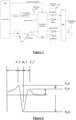
- FIG. 1 schematically illustrates an implanted sacral nerve stimulator 100.
- Stimulator 100 comprises an electronics module 110 implanted at a suitable location in the patient's lower abdominal area or posterior superior gluteal region, and an electrode assembly 150 implanted within the sacrum and connected to the module 110 by a suitable lead.
- Numerous aspects of operation of implanted neural device 100 are reconfigurable by an external control device 192.
- implanted neural device 100 serves a data gathering role, with gathered data being communicated to external device 192.
- FIG. 2 is a block diagram of the implanted neurostimulator 100.
- Module 110 contains a battery 112 and a telemetry module 114.
- any suitable type of transcutaneous communication 190 such as infrared (IR), electromagnetic, capacitive and inductive transfer, may be used by telemetry module 114 to transfer power and/or data between an external device 192 and the electronics module 110.
- Module controller 116 has an associated memory 118 storing patient settings 120, control programs 122 and the like. Controller 116 controls a pulse generator 124 to generate stimuli in the form of current pulses in accordance with the patient settings 120 and control programs 122. Electrode selection module 126 switches the generated pulses to the appropriate electrode(s) of electrode array 150, for delivery of the current pulse to the tissue surrounding the selected electrode(s). Other electrode arrays may also be provided and may be similarly addressed by electrode selection module 126, for example as in the case of Figures 5 and 6 , discussed further below.
- one or more electrodes of array 150 may be selected to serve as nominal stimulus electrodes at a given time, while one or more electrodes of the array 150 may be selected to serve as nominal sense electrodes at a given time, even though the electrodes may be physically the same and may serve a different role at other times.
- Measurement circuitry 128 is configured to capture measurements of neural responses sensed at sense electrode(s) of the electrode array as selected by electrode selection module 126. Such measurements will often comprise differential measurements between two sense electrodes upon array 150. However the measurements may additionally or alternatively be obtained from a single sense electrode of array 150 electrically referenced to a reference electrode upon a case of the module 110, or referenced to a system ground of the controller 116, for example.
- the sense electrodes are also referred to herein as recording electrodes.
- FIG. 3 is a schematic illustrating interaction of the implanted stimulator 100 with a nerve 180, in this case the sacral nerve however alternative embodiments may be positioned adjacent any desired neural tissue including a peripheral nerve, visceral nerve, spinal nerve or a brain structure.
- Electrode selection module 126 selects a stimulation electrode 2 of electrode array 150 to deliver an electrical current pulse to surrounding tissue including nerve 180, and also selects a return electrode 4 of the array 150 for stimulus current recovery to maintain a zero net charge transfer.
- an appropriate stimulus to the nerve 180 evokes a neural response comprising a compound action potential which will propagate along the nerve 180 as illustrated, for therapeutic purposes which in the case of a sacral nerve stimulator might be to stimulate motor function of desired muscle fibres of the detrusor.
- the stimulus electrodes are used to deliver stimuli at ⁇ 20 Hz.
- the device 100 is further configured to sense the existence and intensity of compound action potentials (CAPs) propagating along nerve 180, whether such CAPs are evoked by the stimulus from electrodes 2 and 4, or otherwise evoked.
- CAPs compound action potentials
- any electrodes of the array 150 may be selected by the electrode selection module 126 to serve as measurement electrode 6 and measurement reference electrode 8.
- Signals sensed by the measurement electrodes 6 and 8 are passed to measurement circuitry 128, which for example may operate in accordance with the teachings of International Patent Application Publication No. WO2012155183 by the present applicant, the content of which is incorporated herein by reference.
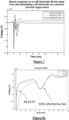
- Figure 4 illustrates the typical form of an electrically evoked compound action potential (ECAP) when comprised of the contributions from action potentials of recruited fibres with similar properties.
- ECAP electrically evoked compound action potential
- the shape and duration of the compound action potential shown in Figure 4 is predictable because it is a result of the ion currents produced by the ensemble of axons generating action potentials in response to stimulation.
- the action potentials generated among a large number of fibres sum to form a compound action potential (CAP).
- the CAP is the sum of responses from a large number of single fibre action potentials.
- the CAP recorded is the result of a large number of different fibres depolarising.
- the propagation velocity of the action potential on each fibre is determined largely by the diameter of that fibre.
- the CAP generated from the firing of a group of similar fibres is measured as a positive peak potential P1, then a negative peak N1, followed by a second positive peak P2. This is caused by the region of activation passing the recording electrode as the action potentials propagate along the individual fibres.
- An observed electrically evoked CAP signal from A ⁇ fibres will typically have a maximum amplitude in the range of microvolts and a duration of 2-3 ms.
- the CAP profile takes a typical form and can be characterised by any suitable parameter(s) of which some are indicated in Figure 4 .
- a normal recorded profile may take an inverse form to that shown in Figure 4 , i.e. having two negative peaks N1 and N2, and one positive peak P1.
- the CAP evoked by a given stimulus can be characterised by the parameters of the inflexion points in the curves of Figure 4 , Figure 8a or Figure 8b , for example.
- the positions and amplitudes of the peaks can be used alone or in combination to generate a correlation between them and the state and severity of a CNS disorder.
- Other electrophysiological data can be used to supplement the ECAP data.
- masker-probe studies can be used to determine the refractory period and the relative refractory period. The measurement of refractory periods allows an estimate of the frequency response of the fibres being stimulated.
- a shorter refractory period correlates with higher conduction velocity, thus allowing a determination of which fibre type(s) was/were recruited to give rise to the observed ECAP, and can thus provide a guide for setting stimulation frequency parameters. All these neurophysiological properties can be used to identify the stimulated nerves and can be used to guide fibre type targeting and stimulus parameter selection.
- VN vagus nerve
- VN vagus nerve
- FIG. 5 is a schematic representation of the functional separation of fibres in the ventral rootlets of a human S2 nerve in cross-section.
- the root consists of 2 rootlets.
- Three different nerve distribution patterns arise: the somatic type (S) with predominant large, thickly myelinated fibres and absence of parasympathetic fibres; the vegetative type (V) with abundance of parasympathetic fibres; and the mixed type (M). Note the topographic aggregation of the fascicles of vegetative and somatic types.
- fascicles with predominance of parasympathetic fibres are concentrated in the right rootlet of either root.
- purely somatic fascicles are found in the left rootlets. It appears that the nerve fibres do not simply follow a random distribution, but rather some sort of functional organization.
- Stimulation of any given subsection of a mixed nerve for example by applying stimuli only from one side of the nerve at an amplitude which only recruits fibres in fascicles proximal to the stimulus electrode, will therefore activate a particular portion of fibres that serve a distinct function.
- the present invention recognises that targeting the appropriate fibres of a mixed nerve is of great importance for many neuromodulation applications.
- FIG. 6 is a three-dimensional (3D) reconstruction of median nerve fascicles.
- Figure 6a is a 3D model of a median nerve at an arbitrary position, showing some changing patterns of different functional fascicles. Green represents motor nerve fascicles, yellow represents sensory nerve fascicles, and purple represents mixed (sensory and motor) nerve fascicles.
- Figure 6b is an enlarged partial view of Figure 6a , while Figure 6c presents one transverse cross section image.
- Figure 6 demonstrates that fibre type targeting is difficult to address based only on anatomy because a desired fibre type takes significantly varying positions within the nerve at different parts of the nerve. Further, inter-patient variability of the content and disposition of fascicles within a nerve exists. These changes occur on scales which are significantly smaller than a typical neurostimulation electrode spacing, as typical implanted electrode arrays utilise electrodes which are 3mm long, and are 4mm apart from each other, i.e. positioned on a 7mm pitch. However, in the space of 7mm along the nerve shown in Figure 6 , any given nerve fascicle could take any or all positions within the bundle making it impossible to selectively target that fascicle based on surrounding anatomical orientations. Simplistically utilising smaller electrodes would not resolve these uncertainties.
- nerve fibres can be classified based on their physiological properties, such as myelination state and diameter. These properties result in differences in electrophysiological properties that allow the classification of stimulated nerve fibres through measures of, among others, the conduction velocity of the generated action potentials, their refractory period, and their strength-duration curves. For example, a linear relationship exists between the diameter of a myelinated fibre and the conduction velocity.
- a range of nerve fibre type classification systems exist, however regardless of nomenclature or classification used throughout this document, it is to be understood that it is the measures of differences in electrophysiological properties which permit differentiation of fibre types in accordance with the present invention, irrespective of nomenclature.
- Figure 7 shows the neural responses recorded from the cervical vagus nerve of a pig from a recording cuff electrode which was located about 25 mm away from the stimulating cuff electrode around the same nerve, for various currents.
- Figures 8a and 8b show electrophysiological responses obtained from the S3 sacral nerves of 2 human patients undergoing SNS therapy. Although the electrodes were placed using the same surgical technique for each human patient, the observed responses were markedly different between Fig. 8a and Fig. 8b .
- the sacral responses of Figures 8a and 8b were obtained by stimulating from standard cylindrical electrodes therefore preferentially activating the fibres on the side of the nerve which was in closest proximity with the electrode.
- FIG. 8a Note also that in Figure 8a electrode 4 was used for stimulation, so that CH3 was closest to the stimulus site and CH1 was furthest from the stimulus site, in contrast to Figure 8b in which electrode 1 was used for stimulation so that CH2 was closest to the stimulus site and CH4 was furthest from the stimulus site.
- the response amplitude in Figure 8b is noted to be tens of times larger than that of Figure 8a , despite a slightly smaller stimulus. Such variation is common in practice and may well be attributed to differences in the position of each respective electrode array relative to the nerve.
- FIG. 8b illustrate how much power saving can be achieved by applying the present invention in order to reduce the stimulus as much as possible to the minimum level where the desired therapeutic effect is achieved, which may also have a further benefit of avoiding inappropriately high recruitment levels which may be painful, injurious, or could cause unwanted side effects.
- vagal responses of Figure 7 were obtained by stimulating from cuff electrodes surrounding the nerve, so that all fibre types were recruited based on their thresholds independently of their location around the circumference of the nerve. This difference in recruitment based on nerve fascicle position explains the difference in the responses obtained from the vagus and the sacral nerves as seen when comparing Figure 7 on the one hand to Figures 8a and 8b on the other hand.
- FIG 8a we observe an A ⁇ ECAP in the timeframe around 1-2 ms, and a myoelectric response.
- the ECAP in the timeframe around 1-2 ms can be specifically identified as an A ⁇ ECAP because of the conduction velocity and the distance of each respective recording electrode from the stimulus site.
- the signal component observed in the timeframe around 4-10 ms can be specifically associated with an A ⁇ response (either from direct activation or via a reflex arc by means of for example Ia fibre activation). While the fast conduction velocity of the A ⁇ response mean that this neural response itself is obscured in the very early part of the recording (e.g.
- the present invention recognises that selectively targeting these fibre types may be of utility in therapy for incontinence, in contrast to prior approaches of targeting remote muscle responses as a proxy for therapy.
- Such embodiments of the invention may thus provide techniques for measuring evoked compound action potentials (ECAPs) from the sacral nerve to improve SNS both by better targeting the appropriate nerves, and by applying closed-loop stimulation in chronic implants based on the ECAP observations.
- ECAPs evoked compound action potentials
- FIG. 9 illustrates a multiplicity of such sympathetic (red) and parasympathetic (blue) efferent pathways, which form part of mixed nerves upon which the approach of the present invention may be applied.
- the interrupted red lines indicate postganglionic rami to the cranial and spinal nerves.
- the upper and lower parts of the large intestine are innervated from different parts, the upper part from the vagus nerve, the lower part from the sacral nerves.
- the sacral nerve is a mixed nerve containing the full spectrum of fibre types and functions. It contains C fibres as well as myelinated fibres ranging from B (parasympathetic) to A ⁇ motor neurons and carries both afferent as well as efferent neural signals.
- the sacral nerve is not homogenous and is made up of rootlets, further subdivided into fascicles, which preserve some degree of functional separation of the fibre types.
- Nerve fibres are classified by their function as well as their physical properties (mostly myelination state and fibre diameter). It is important to note that this separation of physical properties and function is not absolute, and neural signals of a variety of functions are carried via fibres of similar properties (there are more functions than there are classes of fibres).
- the diameter of myelinated fibres (in ⁇ m) is correlated to the conduction velocity (in m/s) by a factor of about 6. Thanks to this property, it is possible to use ECAPs measured from SNS electrodes to determine conduction velocity, and in turn to determine which fibres are being recruited by the stimulation paradigm. This can improve the therapy on 2 levels: aetiology-specific targeting of the appropriate nerves as well as closed-loop feedback control to maintain a stable therapy and improve effectiveness.
- the location of the lead with respect to the nerve fibres plays a large role in determining which fibre types are activated by SNS.
- the recordings of the electrophysiological response made from SNS electrodes can differentiate whether muscle efferents, sensory afferents, somatic afferents and efferents, parasympathetic fibres, or C fibres are being activated. Both the ECAP properties as well as the late response properties can be used to determine which fibres are activated by the stimulation.
- the presence of a non-propagating late response indicates activation of A ⁇ efferents (either directly or indirectly), and the presence of an A ⁇ response indicates sensory fibres are activated.
- the presence of a B fibre response can indicate the activation of parasympathetic fibres. Due to the segmented nature of the sacral nerve (separation into fascicles in which bundles of fibres with similar function are clustered), the responses observed from SNS are not homogeneous (see Figure 8 ). Further, inter-patient variability in the sacral plexus likely leads to variations in fibre types present in each sacral nerve.
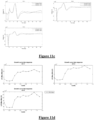
- FIG. 10a illustrates changes in amplitude of the A ⁇ response (example in Fig. 8a around 1-2ms), denoted FAST in Fig. 10a.
- Figure 10b illustrates changes in amplitude of the myoelectric response (example in Fig. 8a around 4-10 ms), denoted LR in Fig. 10b .
- This data was obtained for a patient undergoing a SNS trial in the S3 sacral nerve root. The patient was sitting at the beginning of the experiment of Fig.
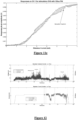
- Figure 11a illustrates measurements of the growth curve of the neural A ⁇ response of the same human SNS patient as Fig 10 .
- Figure 11b illustrates measurements of the myoelectric response growth curve.
- the growth curve herein refers to measures of electrophysiological response amplitude in response to increasing stimulus intensity.
- a recording of an electrophysiological response comprises multiple components, such as comprising both an ECAP and a myoelectric response, separate growth curves of each such component may be obtained.
- Both the A ⁇ response of Fig 11a and the myoelectric response of Fig 11b display threshold behaviour, in that for the application of stimuli at current levels below a certain threshold, no response arises.
- the threshold in Figure 11a by inspection appears around 1.5 mA
- the threshold in Figure 11b by inspection appears at around 2mA.
- each growth curve exhibits a linear section in which linearly increasing the stimulus current leads to an approximately linear increase in both the neural A ⁇ response and the myoelectric response. Both curves are expected to plateau at higher stimulus amplitudes as maximum recruitment is achieved, however these higher stimulus values were not applied in this experiment as it would have been painful to the patient.
- Figure 11 thus illustrates that the myoelectric and A ⁇ responses each have a linear part which can be separately or jointly exploited by a feedback loop operating within the respective linear range shown in Fig. 11 .
- Fig. 11c illustrates recordings from a human patient treated for urinary incontinence with S3 sacral nerve stimulation. Clear late responses are visible on all recording channels CH1, CH2 and CH4, during the time period around 3-10 ms, at both 0.7 mA stimulation and 1.3 mA stimulation. A fast response (ECAP) is not visible in these recordings as the stimulus pulse width obscures the ECAP.
- Figure 11d shows the growth curve for the late response amplitude in response to increasing stimulus amplitude, as measured at each respective recording electrode. As seen in Fig. 11d , this is an example of a plateauing myoelectric response. Such recordings enable a useful range of stimulation to be ascertained, as no therapeutic benefit occurs below the threshold, and no additional fibres are recruited beyond the plateau in the growth curve.
- Figure 11e is a plot of a plateauing growth curve for a slow response thought to be a B fibre response. Indicated on the curve is the part of the growth curve at which the patient started to feel the stimulation. Notably, this patient threshold was at the plateau of this B fibre response, meaning that the slow B fibre response observed in Fig. 11e was not linked to sensation, and that a first fibre type was recruited without recruiting others.
- Some embodiments may further provide for staged fibre targeting, whereby in a first stage of operation a level of recruitment of a desired fibre type is monitored and maintained within a desired range of the curve of Figs. 1 1a, 1 1b or 1 1e , and wherein a second stage of operation is adopted when recruitment or observation of the desired fibre type is lost (as can be common with postural changes or lead migration), in which a recruitment of a secondary fibre type is instead monitored and maintained within a desired range so as to ensure continued neural recruitment in general even when recruitment of the selected fibre type in particular becomes untraceable.
- An alternative response to a loss of recruitment or observation of the desired fibre type may be to trigger any other suitable event, such as a warning signal or an automatic reprogramming procedure.
- linearity testing may be undertaken in response to a loss of recruitment or observation of the desired fibre type, whereby the stimulation amplitude is varied to explore whether the recruitment responds linearly; absence of a linear response of recruitment to such stimulus amplitude variations may indicate a loss of therapeutic efficacy which may be used to trigger reprogramming or a warning signal or the like.
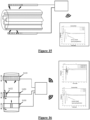
- FIG. 12 illustrates changes in the amplitude of myoelectric responses observed in a human SNS patient over time (upper trace), together with the associated control variable (lower trace) over a period of time covering both open and closed loop modes. Fig. 12 thus illustrates successful closed loop control based on a myoelectric response.
- embodiments of the invention may thus provide for aetiology specific fibre targeting in a mixed nerve.
- aetiology specific fibre targeting in a mixed nerve recognises that in most cases when stimulating a mixed nerve, only a subset of fibres are relevant to the condition being treated by stimulation. Stimulating all fibres of the mixed nerve will inevitably lead to unwanted side effects or inefficient stimulation.
- these particular embodiments optimise neuromodulation therapy on a mixed nerve by using electrophysiological measurements to selectively target a subset of fibre types in a mixed nerve. This will consist in optimising the stimulus parameters such that the responses of desired fibre types are obtained whilst minimising the responses of unwanted fibre types. In the ideal case, only the desired fibres will be activated by the device, although in many embodiments simply achieving preferential targeting of the desired fibre type(s) and/or preferentially minimising recruitment of other fibre types may nevertheless deliver the benefits of the present invention.
- this invention proposes a device that can stimulate and record electrophysiological signals obtained from electrodes placed near a mixed nerve.
- the neural response can then be analysed to indicate the nature of the stimulated fibres.
- the electrophysiological response may indicate the presence or absence of specific nerve fibres.
- this information is used to optimise the therapy. For example, various parameters for administering the therapy such as, but not limited to, stimulation waveform and lead position may be adjusted to recruit the desired fibre types.
- several causes can be treated simultaneously, each requiring stimulation of a different subset of fibres (such as B fibres for incontinence and sensory fibres for pelvic pain, both located in the sacral nerve).
- the method and device will use electrophysiological measurements to continuously optimise the delivered stimulation regime, in order to elicit responses of the desired fibres while minimising the responses from unwanted fibres.
- a method consisting of 2 or more electrodes implanted near a target mixed nerve of which only a subset of fibres are desired stimulus targets, and an implantable control unit device capable of recording the electrophysiological response to the stimulation.
- the stimulated fibre populations are assessed via the recorded response and the electrode placement, the electrode selection, as well as the stimulus parameters (including, but not limited to, pulse width, stimulus frequency, stimulus waveform, stimulus amplitude) are optimised such that the desired fibre types are preferentially targeted.
- the recorded responses can be used to optimise stimulus parameters in order to minimise power consumption. As long as the desired responses are observed, the parameters requiring the least power to achieve this should be used.
- B fibres were observed to be fully recruited at a stimulus amplitude which was only around a quarter of the amplitude being used as defined by reference to the past approach of the muscle activation threshold. This observation indicates that therapeutic benefits provided by B fibre recruitment could be achieved at a fraction of the power of current state of the art SNS techniques which operate blind to fibre type.
- the characteristics of the neural response are used in order to assess which fibre types are activated by the stimulus paradigm.
- ECAP evoked compound action potential
- the ECAP characteristics that can be used to assess the type of the stimulated fibres includes the conduction velocity (including latency), strength-duration characteristics, and the refractory period.
- myoelectric responses can be used as a proxy measure for A ⁇ efferent activation (either directly or indirectly) based on their presence and latency.
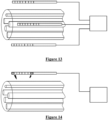
- the electrodes are placed near the S3 sacral nerve as shown in figure 14 .
- a first electrode is used for stimulation and neural recordings are obtained from 1 or more electrodes of the same array, close to the target nerve.
- the conduction velocity of the stimulated fibres is obtained from the neural recordings and the electrodes are placed such that the B fibres response is maximised and all other responses minimised.
- the stimulation parameters are varied such that the B fibre responses are maximised and all other responses minimised.
- a device is provided to optimise lead positioning and stimulus parameter selection for stimulation of a mixed nerve using a plurality of electrodes with different characteristics. This uses more than 1 lead placed near the target nerve. The selection of stimulus parameters is then carried out for more than 1 lead.
- electrode selection will be done so that either 1 or several electrodes on either one or several leads maximises the B fibre activation (for OAB relief) and the A ⁇ fibre activation (for pain relief).
- the nerves of a plexus can be stimulated in turn to determine which branch of the plexus contains the desired fibres using recordings of evoked electrophysiological responses. The therapy is then optimised on the best candidate branch of the plexus.
- the recording of ECAPs for a given stimulus electrode does not have to be done on the same lead.
- the recording site can be optimised (maximising signal amplitude) and any electrode close to the target nerve can be chosen. This is useful as the fascicles in mixed nerves do not run parallel inside the nerve (as is shown simply for illustrative simplicity in figures 13 to 15 , but cross, merge, and split as shown in Figure 6 .
- FIG. 16 Another embodiment of this device will consist in implanting cuff electrodes instead of epidural leads, as shown in figure 16 .
- the cuff electrodes will consist of several distinct contacts each (as opposed to some cuff electrodes that have one continuous electrode running along the entire cuff), and the 2 or more cuff electrodes can be rotated and moved up and down along the mixed nerve to find a position that optimises the discrete stimulation and recording of separate fascicles.
- the arrangement of Fig. 16 can be used for spatial targeting of a selected fibre type. This involves the cuff electrode 1610 applying a supramaximal stimulus around substantially an entire circumference of the nerve, in order to recruit all fibres of the nerve.
- Electrode 1610 may be a non-segmented electrode extending continuously around the nerve or may be a segmented electrode with the stimulus being applied simultaneously by all segments of the electrode 1610 to ensure all fibres are recruited.
- the recruited responses resulting from the stimulus can then be observed at selected circumferential positions by using a selected segment (e.g. segment 1622 of a segmented cuff electrode 1620 (other segments not shown for clarity).
- the response observed at segment 1622 in particular can then be analysed to determine a dominant fibre type which is adjacent to that segment 1622. This knowledge can then be used to identify which fibre type(s) are adjacent all segments of each segmented cuff electrode.
- this knowledge can be used to preferentially use a given segment, such as segment 1622, to deliver stimulation which will preferentially recruit the fibre type which is known to be adjacent to that segment.
- Other embodiments may derive the same knowledge by instead using segment 1622 to apply stimuli which are only just above a stimulus threshold and which therefore only recruit fibres proximal to segment 1622.
- the responses may then be observed at cuff electrode 1610 and analysed to determine the type of fibres being recruited by segment 1622 and thus the types of fibres which are adjacent to 1622.
- a survey may be carried out over multiple segments to thereby determine the fibre type(s) adjacent to all such electrode segments, and spatial fibre type targeting may then be applied by using such knowledge as a lookup table.
- the responses can be used to optimise stimulus parameters in order to minimise power consumption. As long as the desired responses are observed, the parameters requiring the least power to achieve this should be used.
- lead shapes can be used, paddle leads, percutaneous leads, cuff electrodes, while effecting fibre type targeting in accordance with the present invention.
- the device is connected externally to the electrodes, in other embodiments, the device is fully implantable.
- the electrodes can be on a single lead, or multiple leads placed in proximity to the stimulus target, each lead can contain a multitude of electrodes.
- some electrodes can be located distally to the target nerve to serve as reference electrode for the measurement or return electrode for the stimulation.
- the body of the implant can be used as one electrode.
- the leads can be epidural, similar to those used in sacral nerve stimulation or spinal cord stimulation.
- the leads can be paddle leads, or cuff electrodes.
- the electrodes can further be segmented.
- a cuff electrode can in some cases be a ring electrode surrounding the nerve, and in some cases it can be a segmented ring whereby electrically distinct portions of the cuff electrode take distinct positions around the circumference of the nerve, allowing distinct circumferential positions around the nerve to be selectively targeted by stimulating from a selected segment or to be selectively observed by recording from a selected segment.
- an epidural lead can have circular electrode contacts, in other examples the contacts can be segmented.
- the stimulation and recording are performed on the same electrodes, in other embodiments the stimulation and recording are done on distinct electrodes whether on the same electrode lead or electrode array, or a different electrode lead or array.
- some electrodes implanted near the target span an area small enough to avoid merging or branching of fibre tracts within the nerve.
- electrodes implanted near the sacral nerve can span a distance of less than 5 centimetres, preferably less than 2 centimetres.
- the external device may be used to analyse neural response during lead insertion.
- the external device may be used to deliver stimulation pulses to a target nerve in a patient.
- the external device may include a control unit, a display module and a stimulation module.
- the stimulation unit is configured to deliver stimulation pulses to a desired nerve and analyse the neural response generated. Thereafter, the control unit is adapted to analyse the neural response and differentiate the recruited nerves based on one or more parameters.
- the control unit is configured to transmit information to display the neural recruitment in one or more modes. In a first mode, the neural recruitment is displayed in the form of a collection of ECAP waveforms and myoelectric waveforms. In a second mode, the neural recruitment is displayed as waveforms which are labelled with the corresponding fibre types. In a third mode, the neural recruitment is displayed as waveforms with timing partitions to indicate the fibre types which were recruited. In a fourth mode, the neural recruitment is displayed along with characteristics of the fibres such as conduction velocity etc.
- the external device is adapted to operate one or more electrodes.
- the external device is adapted to deliver pulses via paddle leads, cylindrical leads and cuff electrodes. Further, the external device is configured to operate in any combination of the aforementioned electrodes.
- Implantable device In some embodiments, the implantable device is configured to perform all the functions as the external device except that it is implanted within the body of the patient.
- the electrophysiological responses elicited by the stimulation can be displayed in real time.
- these responses can further be processed to increase the signal to noise ratio. For example, averaging can be used to decrease the random noise found on each individual response, and fit-and-remove algorithms can be used to decrease the artefact component in the signal.
- These signals can be used to recognise the activation of a certain fibre type or certain fibre types.
- the stimulus parameters can then be modified whether by trial and error, brute force exploration or any suitable search technique of the stimulus parameter space, so as to optimise fibre activation of the desired subsets of fibres as indicated by the displayed responses.
- the axes of the electrophysiological response graph can be labelled to facilitate the interpretation of the responses. For example, based on the stimulus and recording electrode configurations, the axes of the response graph can be labelled to indicate the times at which the response of a given fibre type should be recorded if present.
- the neural responses can be marked and/or labelled to help identify the fibre types being recruited by the stimulation.
- the peaks of the response can be labelled with their time and amplitude parameters.
- a change in morphology of the response with varying stimulus parameters can be used to identify fibre type contributions in an ECAP in which the peaks are poorly defined.
- the current is slowly ramped up and the ECAP shape observed or automatically processed. Initially, the largest fibres will respond to external stimuli first, a change in ECAP morphology at higher amplitudes could indicate the recruitment of a second, slower fibre type.
- the frequency of the stimulation can be increased to an appropriate level, and the responses observed over time. The small fibres will fatigue first, the larger fibres last. The change in morphology over time can be used to determine which part of the ECAP is associated with which fibre type. Further, a decrease in amplitude of the myoelectric response at increasing stimulus frequency could be due to muscle fatigue, or depression of the H-reflex. These properties and others can be used to determine the fibre types being stimulated.
- processing can be done on the recorded neural responses to display an estimate of the conduction velocity of the different elements of the recording of the electrophysiological response.
- the recording(s) of the electrophysiological response can be processed such that an estimate of the number of fibres of each type being recruited is displayed.
- the estimate could in some instances give a proportion of fibre types or an absolute estimate of the number of fibres being activated.
- stimulation can be performed in a way to approach a constant neural recruitment by adapting the stimulus parameters automatically in a feedback arrangement in order to approach a target electrophysiological response.
- B fibres are preferentially targeted in a mixed nerve.
- the current or another parameter
- the late response can be used as a proxy measure for motor fibre activation, the stimulus can then be automatically adjusted to maintain a constant late response amplitude.
- the amplitude of the electrophysiological response or a part of it could be done by assessing peak amplitudes, peak-peak amplitudes, the area under the curve, a convolution with a filter, or any other method.
- an implantable device may be configured to establish closed-loop stimulation on a targeted fibre type.
- the feedback loop may be established on the neural response of the B fibres in a mixed nerve.
- the methods disclosed herein enable the implantable device to establish a feedback loop on the neural response of certain fibre types. Since the implantable device is configured to determine the fibre types based on the neural response, the implantable device can maintain closed loop stimulation based on the response of the targeted fibre type.
- the implantable device may maintain closed-loop stimulation on at least one or more of the fibre types which include, but not limited to, A ⁇ , A ⁇ , A ⁇ , B and C fibres. In some cases, closed-loop stimulation may be maintained on the myoelectric response elicited by the stimulation. If the desired response is not observable, another response can be used as a proxy measure for establishing and maintaining closed-loop stimulation.
- the neural recruitment can be automatically monitored for large variations that could be indicative of, for example, lead migration.
- a change in electrode position that would lead to loss of efficacy could be tested by the device by varying the current amplitude to a small degree and monitoring the response profile. If no change is observed with variations in stimulus amplitude, a warning signal is sent to the user, or stimulation is stopped or other suitable action occurs.
- the implantable device may be configured to check the fibre types which are recruited by the stimulation pulses. This feature may be used to ensure that the desired fibre types are recruited for the majority of the stimulus duration.
- the implantable device may trigger an alert to the patient that the desired fibre type is no longer recruited. In such a case, the physician may consider the possible causes and take remedial action.
- alternative actions may be triggered in such an event, such as automatic reconfiguration of the stimulus paradigm. Such functions may alternatively be carried out by an external device such as a clinician's programmer device.
- continuous monitoring can be used to both maintain a near constant neural recruitment, as well as to warn of a substantial change in lead placement or nerve properties.
- Further embodiments may provide for testing the feedback loop integrity before applying the next corrective stim pulse. This could be done by making sure that if the current is increased, the response also increases. This would keep the loop from diverging when the signal is lost (as can occur when the signal is lost when changing posture, or when the charger or another interfering source is applied).
- the method and device may be applied to vagus nerve stimulation, dorsal root stimulation, sacral nerve stimulation, or ventral root stimulation.
- the method and device can be used in more than one location, simultaneously or in tandem.
- the device could be used in the sacral nerve and the lower thoracic or upper lumbar ventral roots which innervate the bladder and bowel. Without being limited by theory, it is proposed that such a device can stimulate both the sympathetic and parasympathetic nervous system in locations specific for bladder and bowel control.
- Stimulating the ventral roots of the spinal cord and/or the vagus nerve, and/or the sacral nerve can lead to similar embodiments in which the target is different from the bladder and bowel, such as any one or more of the heart, larynx, trachea, bronchi, oesophagus, stomach, liver, pancreas, small intestine, spleen, large intestine, kidney or sexual organs.
- the target is different from the bladder and bowel
- the target is different from the bladder and bowel
- the target is different from the bladder and bowel
- the target is different from the bladder and bowel
- the target is different from the bladder and bowel
- the target is different from the bladder and bowel
- the target is different from the bladder and bowel
- the target is different from the bladder and bowel
- the target is different from the bladder and bowel
- the target is different from the bladder and bowel
- the target is different from the bladder and bowel
- the target is different from the bladder and bowel
- Vagus nerve stimulation may be improved by some embodiments of the present invention may selectively avoiding stimulation of fibre types which in past solutions cause fatigue of the throat, swallowing muscles, vocal chords, and the like, which in past solutions are unnecessarily recruited. Note also partial lesions of the spinal cord might be best healed by targeting specific fibres.
- the programming and display module does not have to be part of the implanted device.
- the implanted stimulator itself only executes the program that was set by the control module, and the responses are observed in real time or later only on an external programmer, and not on the implanted device.
- the fibre targeting of the present invention allowed some subjects to achieve effective therapy at stimulation levels which were orders of magnitude less than a muscle response threshold or sensory response threshold which would conventionally have been used to set a stimulation level. This would lead to a many multiples increase in battery lifetime.
- Embodiments undertaking fibre type targeting on an ongoing basis to control a feedback process have the further advantage of being responsive to lead movement relative to the nerve, as occurs with posture changes, coughs, sneezes and the like.
- the use of feedback based on electrophysiological measurements allows stimulation to be constantly revised to ensure that the desired fibre type continues to be recruited by suitably refining the stimulation parameters on an ongoing basis. Similar benefits can be obtained even in simpler embodiments which simply detect a loss of recruitment of the desired fibre type and issue an alert to the user to, for example, seek clinical assistance.
- automatic modification of the stimulus paradigm could be performed in some embodiments in the event in which the determined stimulus paradigm fails to recruit the desired fibre types.
- the described electronic functionality can be implemented by discrete components mounted on a printed circuit board, and/or by a combination of integrated circuits, and/or by an application-specific integrated circuit (ASIC).
- ASIC application-specific integrated circuit
Landscapes
- Health & Medical Sciences (AREA)
- Life Sciences & Earth Sciences (AREA)
- Engineering & Computer Science (AREA)
- Public Health (AREA)
- General Health & Medical Sciences (AREA)
- Animal Behavior & Ethology (AREA)
- Veterinary Medicine (AREA)
- Biomedical Technology (AREA)
- Nuclear Medicine, Radiotherapy & Molecular Imaging (AREA)
- Neurology (AREA)
- Radiology & Medical Imaging (AREA)
- Neurosurgery (AREA)
- Heart & Thoracic Surgery (AREA)
- Biophysics (AREA)
- Surgery (AREA)
- Medical Informatics (AREA)
- Molecular Biology (AREA)
- Physics & Mathematics (AREA)
- Pathology (AREA)
- Physiology (AREA)
- Psychiatry (AREA)
- Cardiology (AREA)
- Hospice & Palliative Care (AREA)
- Orthopedic Medicine & Surgery (AREA)
- Psychology (AREA)
- Signal Processing (AREA)
- Computer Vision & Pattern Recognition (AREA)
- Artificial Intelligence (AREA)
- Child & Adolescent Psychology (AREA)
- Primary Health Care (AREA)
- Epidemiology (AREA)
- Developmental Disabilities (AREA)
- Pain & Pain Management (AREA)
- Pulmonology (AREA)
- Gastroenterology & Hepatology (AREA)
- Physical Education & Sports Medicine (AREA)
- Urology & Nephrology (AREA)
- Electrotherapy Devices (AREA)
- Measurement And Recording Of Electrical Phenomena And Electrical Characteristics Of The Living Body (AREA)
Applications Claiming Priority (3)
| Application Number | Priority Date | Filing Date | Title |
|---|---|---|---|
| AU2018901410A AU2018901410A0 (en) | 2018-04-27 | Neurostimulation of Mixed Nerves | |
| PCT/AU2019/050384 WO2019204884A1 (fr) | 2018-04-27 | 2019-04-29 | Neurostimulation de nerfs mixtes |
| EP19793420.1A EP3784338B1 (fr) | 2018-04-27 | 2019-04-29 | Neurostimulation de nerfs de types mixtes |
Related Parent Applications (1)
| Application Number | Title | Priority Date | Filing Date |
|---|---|---|---|
| EP19793420.1A Division EP3784338B1 (fr) | 2018-04-27 | 2019-04-29 | Neurostimulation de nerfs de types mixtes |
Publications (2)
| Publication Number | Publication Date |
|---|---|
| EP4434461A2 true EP4434461A2 (fr) | 2024-09-25 |
| EP4434461A3 EP4434461A3 (fr) | 2025-03-05 |
Family
ID=68293365
Family Applications (2)
| Application Number | Title | Priority Date | Filing Date |
|---|---|---|---|
| EP19793420.1A Active EP3784338B1 (fr) | 2018-04-27 | 2019-04-29 | Neurostimulation de nerfs de types mixtes |
| EP24193678.0A Pending EP4434461A3 (fr) | 2018-04-27 | 2019-04-29 | Neurostimulation de nerfs mixtes |
Family Applications Before (1)
| Application Number | Title | Priority Date | Filing Date |
|---|---|---|---|
| EP19793420.1A Active EP3784338B1 (fr) | 2018-04-27 | 2019-04-29 | Neurostimulation de nerfs de types mixtes |
Country Status (7)
| Country | Link |
|---|---|
| US (2) | US11944820B2 (fr) |
| EP (2) | EP3784338B1 (fr) |
| JP (1) | JP2021521985A (fr) |
| CN (1) | CN112334184A (fr) |
| AU (1) | AU2019259564B2 (fr) |
| ES (1) | ES2993811T3 (fr) |
| WO (1) | WO2019204884A1 (fr) |
Families Citing this family (69)
| Publication number | Priority date | Publication date | Assignee | Title |
|---|---|---|---|---|
| US12172017B2 (en) | 2011-05-09 | 2024-12-24 | Setpoint Medical Corporation | Vagus nerve stimulation to treat neurodegenerative disorders |
| US9974455B2 (en) | 2011-05-13 | 2018-05-22 | Saluda Medical Pty Ltd. | Method and apparatus for estimating neural recruitment |
| US9386934B2 (en) | 2011-05-13 | 2016-07-12 | Saluda Medical Pty Ltd. | Method and apparatus for measurement of neural response |
| WO2012155185A1 (fr) | 2011-05-13 | 2012-11-22 | National Ict Australia Ltd | Méthode et appareil de mesure de la réponse neuronale |
| US9872990B2 (en) | 2011-05-13 | 2018-01-23 | Saluda Medical Pty Limited | Method and apparatus for application of a neural stimulus |
| DK2908904T3 (da) | 2012-11-06 | 2020-12-14 | Saluda Medical Pty Ltd | System til styring af vævs elektriske tilstand |
| ES3033225T3 (en) | 2013-11-15 | 2025-07-31 | Closed Loop Medical Pty Ltd | Monitoring brain neural potentials |
| CA2929874C (fr) | 2013-11-22 | 2023-06-13 | Saluda Medical Pty Ltd | Procede et dispositif de detection d'une reponse neurale dans une mesure neurale |
| EP3122247B1 (fr) | 2014-03-28 | 2025-05-07 | Saluda Medical Pty Ltd | Évaluation de l'état neuronal à partir de potentiels d'action |
| WO2015168735A1 (fr) | 2014-05-05 | 2015-11-12 | Saluda Medical Pty Ltd | Mesure neuronale amelioree |
| EP3838331B1 (fr) | 2014-07-25 | 2024-05-22 | Saluda Medical Pty Limited | Dosage de stimulation neurale |
| US11006846B2 (en) | 2014-11-17 | 2021-05-18 | Saluda Medical Pty Ltd | Method and device for detecting a neural response in neural measurements |
| AU2015362091B2 (en) | 2014-12-11 | 2020-11-26 | Saluda Medical Pty Ltd | Method and device for feedback control of neural stimulation |
| WO2016090420A1 (fr) | 2014-12-11 | 2016-06-16 | Saluda Medical Pty Ltd | Positionnement d'électrode implantable |
| EP3280487B1 (fr) | 2015-04-09 | 2021-09-15 | Saluda Medical Pty Limited | Estimation de distance électrode-nerf |
| JP7071257B2 (ja) | 2015-05-31 | 2022-05-18 | クローズド・ループ・メディカル・ピーティーワイ・リミテッド | 脳神経刺激装置電極の取付け |
| AU2016269843B2 (en) | 2015-06-01 | 2021-03-04 | Closed Loop Medical Pty Ltd | Motor fibre neuromodulation |
| US11471681B2 (en) | 2016-01-20 | 2022-10-18 | Setpoint Medical Corporation | Batteryless implantable microstimulators |
| US10583304B2 (en) | 2016-01-25 | 2020-03-10 | Setpoint Medical Corporation | Implantable neurostimulator having power control and thermal regulation and methods of use |
| US11045649B2 (en) | 2016-02-19 | 2021-06-29 | Medtronic, Inc. | Incontinence therapy |
| AU2017246242B2 (en) | 2016-04-05 | 2022-06-23 | Saluda Medical Pty Ltd | Improved feedback control of neuromodulation |
| WO2017219096A1 (fr) | 2016-06-24 | 2017-12-28 | Saluda Medical Pty Ltd | Stimulation neurale pour un artéfact réduit |
| EP3532154B1 (fr) | 2016-10-28 | 2023-08-23 | Medtronic, Inc. | Autotitrage d'une thérapie à l'aide de l'activité électrique détectée |
| US10639479B2 (en) | 2016-11-11 | 2020-05-05 | Medtronic, Inc. | Stimulation vector selection using pulse width data |
| CN110402161A (zh) | 2017-04-21 | 2019-11-01 | 美敦力公司 | 用于神经刺激的引线放置 |
| US20190060647A1 (en) | 2017-08-31 | 2019-02-28 | Medtronic, Inc. | Sacral nerve stimulation |
| ES2993811T3 (en) | 2018-04-27 | 2025-01-09 | Saluda Medical Pty Ltd | Neurostimulation of mixed nerves |
| US11260229B2 (en) | 2018-09-25 | 2022-03-01 | The Feinstein Institutes For Medical Research | Methods and apparatuses for reducing bleeding via coordinated trigeminal and vagal nerve stimulation |
| AU2020272128B9 (en) | 2019-04-12 | 2025-11-20 | Setpoint Medical Corporation | Vagus nerve stimulation to treat neurodegenerative disorders |
| US11439825B2 (en) | 2019-12-19 | 2022-09-13 | Medtronic, Inc. | Determining posture state from ECAPs |
| US11179567B2 (en) | 2019-12-19 | 2021-11-23 | Medtronic, Inc. | Hysteresis compensation for detection of ECAPs |
| US11202912B2 (en) * | 2019-12-19 | 2021-12-21 | Medtronic, Inc. | Posture-based control of electrical stimulation therapy |
| WO2021146778A1 (fr) * | 2020-01-23 | 2021-07-29 | Saluda Medical Pty Ltd | Neuromodulation de neurones primaires et/ou postsynaptiques |
| US12551702B2 (en) | 2020-02-21 | 2026-02-17 | Boston Scientific Neuromodulation Corporation | Selective stimulation of peripheral nerves |
| WO2021236977A1 (fr) | 2020-05-21 | 2021-11-25 | The Feinstein Institutes For Medical Research | Systèmes et méthodes de stimulation du nerf vague |
| US11857793B2 (en) | 2020-06-10 | 2024-01-02 | Medtronic, Inc. | Managing storage of sensed information |
| US12097373B2 (en) | 2020-06-10 | 2024-09-24 | Medtronic, Inc. | Control policy settings for electrical stimulation therapy |
| US11786734B2 (en) | 2020-08-07 | 2023-10-17 | Medtronic, Inc. | Implantable lead migration monitoring using ECAP |
| CN116547035A (zh) | 2020-08-28 | 2023-08-04 | 萨鲁达医疗有限公司 | 对姿势有反应的神经刺激 |
| US11529517B2 (en) | 2020-09-29 | 2022-12-20 | Medtronic, Inc. | Electrode movement detection |
| US12070603B2 (en) * | 2021-02-12 | 2024-08-27 | Boston Scientific Neuromodulation Corporation | Neural feedback assisted DBS |
| US11975200B2 (en) | 2021-02-24 | 2024-05-07 | Medtronic, Inc. | Directional stimulation programming |
| AU2022239636B2 (en) | 2021-03-18 | 2025-01-30 | Boston Scientific Neuromodulation Corporation | Methods and systems for target localization and dbs therapy |
| EP4323058A1 (fr) * | 2021-04-15 | 2024-02-21 | Medtronic, Inc. | Réponse et contrôle de neurostimulation |
| WO2022245878A1 (fr) | 2021-05-17 | 2022-11-24 | Setpoint Medical Corporation | Système d'authentification et d'expiration de paramètre de neurostimulation pour neurostimulation |
| CN117396248A (zh) * | 2021-06-03 | 2024-01-12 | 美敦力公司 | 用于编程引导的完全植入式医疗感测装置中的单极记录 |
| US20220387794A1 (en) * | 2021-06-07 | 2022-12-08 | Motility Medical Inc. | Device and Method to Acutely Control Colonic Function, Fecal Propulsion, and Defecation |
| EP4351460A1 (fr) * | 2021-06-07 | 2024-04-17 | Boston Scientific Neuromodulation Corporation | Détection d'anomalie pour données électrophysiologiques détectées |
| US20220401737A1 (en) * | 2021-06-17 | 2022-12-22 | Medtronic, Inc. | Latency compensation for detection of ecaps |
| WO2023281749A1 (fr) * | 2021-07-09 | 2023-01-12 | シャープ株式会社 | Procédé d'évaluation, dispositif d'évaluation, et programme informatique d'évaluation de signaux de neurotransmetteurs conduits à travers des faisceaux d'axones |
| US12377274B2 (en) | 2021-07-22 | 2025-08-05 | Boston Scientific Neuromodulation Corporation | Interpolation methods for neural responses |
| CN113730809B (zh) * | 2021-10-09 | 2024-08-16 | 科悦医疗(苏州)有限公司 | 一种非侵入式迷走神经联合骶神经刺激装置 |
| WO2023129840A1 (fr) | 2021-12-28 | 2023-07-06 | Boston Scientific Neuromodulation Corporation | Stimulation cérébrale profonde adaptative basée sur des signaux neuronaux avec une dynamique |
| US20250229086A1 (en) | 2022-01-20 | 2025-07-17 | Setpoint Medical Corporation | Treatment of inflammatory disorders |
| CN115337549A (zh) * | 2022-01-27 | 2022-11-15 | 上海交通大学 | 用于痉挛性脑瘫患者肌张力异常的电刺激调控装置及方法 |
| US12496449B2 (en) | 2022-02-14 | 2025-12-16 | Saluda Medical Pty Ltd | Detection of neural responses to neurostimulation |
| CN114699087B (zh) * | 2022-05-23 | 2023-01-10 | 国家纳米科学中心 | 神经电极结构及其植入方法和制作方法 |
| AU2023284476A1 (en) * | 2022-06-07 | 2025-01-02 | Saluda Medical Pty Limited | Method and system for configuring electrodes for evoked neural response measurement |
| US20240016437A1 (en) * | 2022-07-14 | 2024-01-18 | Advaned Neuromodulation Systems, Inc. | Systems and methods for detecting evoked compound action potential (ecap) and/or stimulation artifact features in response to neurostimulation |
| US12567495B2 (en) | 2022-10-19 | 2026-03-03 | Boston Scientific Neuromodulation Corporation | Neuroanatomy-based search to optimize trajectory selection during DBS targeting |
| AU2023371466A1 (en) * | 2022-11-04 | 2025-05-29 | Closed Loop Medical Pty Ltd | Programming closed-loop spinal cord stimulation for spasticity relief |
| WO2024249748A1 (fr) * | 2023-06-01 | 2024-12-05 | Nuxcel2, L.L.C. | Identification de crise d'épilepsie à l'aide d'informations d'activité neuronale |
| WO2025015371A1 (fr) * | 2023-07-14 | 2025-01-23 | Saluda Medical Pty Ltd | Analyse améliorée de réponses électrophysiologiques mixtes à une stimulation neuronale |
| CN116712672B (zh) * | 2023-08-10 | 2023-11-10 | 北京析芒医疗科技有限公司 | 面向意识障碍康复的促醒电刺激方案确定方法及设备 |
| WO2025117633A1 (fr) * | 2023-12-01 | 2025-06-05 | Iveacare, Inc. | Neurostimulation coordonnée pour le traitement de l'épilepsie et de la dépression |
| WO2025158342A1 (fr) * | 2024-01-26 | 2025-07-31 | Medtronic, Inc. | Détection de signaux présentant une activité musculaire à l'aide d'un système de neuromodulation |
| CN118022168B (zh) * | 2024-04-15 | 2024-06-21 | 未来脑律(湖南)医疗科技有限公司 | 一种缓解慢性疼痛的闭环控制装置及电刺激系统 |
| WO2026062417A1 (fr) * | 2024-09-20 | 2026-03-26 | Inopase, Inc. | Systèmes et procédés de comptabilisation d'application de stimulus pour migration de sonde |
| CN119015605B (zh) * | 2024-10-28 | 2025-02-14 | 中国康复研究中心 | 一种脑机接口胫神经电刺激闭环调控系统 |
Citations (2)
| Publication number | Priority date | Publication date | Assignee | Title |
|---|---|---|---|---|
| WO2012155183A1 (fr) | 2011-05-13 | 2012-11-22 | National Ict Australia Ltd | Méthode et appareil de mesure de la réponse neuronale -a |
| WO2016161484A2 (fr) | 2015-04-09 | 2016-10-13 | Saluda Medical Pty Ltd | Estimation de distance électrode-nerf |
Family Cites Families (352)
| Publication number | Priority date | Publication date | Assignee | Title |
|---|---|---|---|---|
| US3724467A (en) | 1971-04-23 | 1973-04-03 | Avery Labor Inc | Electrode implant for the neuro-stimulation of the spinal cord |
| US3736434A (en) | 1971-06-07 | 1973-05-29 | Westinghouse Air Brake Co | Fail-safe electronic comparator circuit |
| US3817254A (en) | 1972-05-08 | 1974-06-18 | Medtronic Inc | Transcutaneous stimulator and stimulation method |
| US3898472A (en) | 1973-10-23 | 1975-08-05 | Fairchild Camera Instr Co | Occupancy detector apparatus for automotive safety system |
| US4158196A (en) | 1977-04-11 | 1979-06-12 | Crawford George E Jr | Man-machine interface system |
| FR2419720A1 (fr) | 1978-03-14 | 1979-10-12 | Cardiofrance Co | Stimulateur cardiaque implantable a fonctions therapeutique et diagnostique |
| US4474186A (en) | 1979-07-17 | 1984-10-02 | Georgetown University | Computerized electro-oculographic (CEOG) system with feedback control of stimuli |
| US4807643A (en) | 1982-08-16 | 1989-02-28 | University Of Iowa Research Foundation | Digital electroneurometer |
| US4628934A (en) | 1984-08-07 | 1986-12-16 | Cordis Corporation | Method and means of electrode selection for pacemaker with multielectrode leads |
| CA1279101C (fr) | 1985-10-10 | 1991-01-15 | Christopher Van Den Honert | Stimulateur electrique multicanal a isolement des canaux ameliore |
| US4817628A (en) | 1985-10-18 | 1989-04-04 | David L. Zealear | System and method for evaluating neurological function controlling muscular movements |
| DE3831809A1 (de) | 1988-09-19 | 1990-03-22 | Funke Hermann | Zur mindestens teilweisen implantation im lebenden koerper bestimmtes geraet |
| US5143081A (en) | 1990-07-27 | 1992-09-01 | New York University | Randomized double pulse stimulus and paired event analysis |
| US5172690A (en) | 1990-10-26 | 1992-12-22 | Telectronics Pacing Systems, Inc. | Automatic stimulus artifact reduction for accurate analysis of the heart's stimulated response |
| US5139020A (en) | 1991-03-08 | 1992-08-18 | Telectronics Pacing Systems, Inc. | Method and apparatus for controlling the hemodynamic state of a patient based on systolic time interval measurements detecting using doppler ultrasound techniques |
| US5184615A (en) | 1991-03-08 | 1993-02-09 | Telectronics Pacing Systems, Inc. | Apparatus and method for detecting abnormal cardiac rhythms using evoked potential measurements in an arrhythmia control system |
| US5156154A (en) | 1991-03-08 | 1992-10-20 | Telectronics Pacing Systems, Inc. | Monitoring the hemodynamic state of a patient from measurements of myocardial contractility using doppler ultrasound techniques |
| US5188106A (en) | 1991-03-08 | 1993-02-23 | Telectronics Pacing Systems, Inc. | Method and apparatus for chronically monitoring the hemodynamic state of a patient using doppler ultrasound |
| US5215100A (en) | 1991-04-29 | 1993-06-01 | Occupational Preventive Diagnostic, Inc. | Nerve condition monitoring system and electrode supporting structure |
| EP0594627B2 (fr) | 1991-07-15 | 2000-03-29 | Medtronic, Inc. | Stimulateur medical utilisant le circuit de sortie de l'amplificateur operationnel |
| US5324311A (en) | 1992-09-04 | 1994-06-28 | Siemens Pacesetter, Inc. | Coaxial bipolar connector assembly for implantable medical device |
| US5497781A (en) | 1992-10-30 | 1996-03-12 | Chen; Yunquan | Recording biological signals using Hilbert transforms |
| EP0676930B1 (fr) | 1992-12-22 | 2000-03-22 | Cochlear Limited | Appareil et systeme de telemetrie |
| GB9302335D0 (en) | 1993-02-05 | 1993-03-24 | Macdonald Alexander J R | Electrotherapeutic apparatus |
| US5417719A (en) | 1993-08-25 | 1995-05-23 | Medtronic, Inc. | Method of using a spinal cord stimulation lead |
| US5431693A (en) | 1993-12-10 | 1995-07-11 | Intermedics, Inc. | Method of verifying capture of the heart by a pacemaker |
| US5458623A (en) | 1994-03-04 | 1995-10-17 | Telectronics Pacing Systems, Inc. | Automatic atrial pacing threshold determination utilizing an external programmer and a surface electrogram |
| US5476486A (en) | 1994-03-04 | 1995-12-19 | Telectronics Pacing Systems, Inc. | Automatic atrial pacing pulse threshold determination utilizing an external programmer and a V-sense electrode |
| JP2596372B2 (ja) | 1994-04-21 | 1997-04-02 | 日本電気株式会社 | 誘発電位測定装置 |
| AUPM883794A0 (en) | 1994-10-17 | 1994-11-10 | University Of Melbourne, The | Multiple pulse stimulation |
| US5785651A (en) | 1995-06-07 | 1998-07-28 | Keravision, Inc. | Distance measuring confocal microscope |
| US6463328B1 (en) | 1996-02-02 | 2002-10-08 | Michael Sasha John | Adaptive brain stimulation method and system |
| US6066163A (en) | 1996-02-02 | 2000-05-23 | John; Michael Sasha | Adaptive brain stimulation method and system |
| US5702429A (en) | 1996-04-04 | 1997-12-30 | Medtronic, Inc. | Neural stimulation techniques with feedback |
| WO1997037720A1 (fr) | 1996-04-04 | 1997-10-16 | Medtronic, Inc. | Technique de stimulation et d'enregistrement pour tissus vivants |
| FR2796562B1 (fr) | 1996-04-04 | 2005-06-24 | Medtronic Inc | Techniques de stimulation d'un tissu vivant et d'enregistrement avec commande locale de sites actifs |
| US6493576B1 (en) | 1996-06-17 | 2002-12-10 | Erich Jaeger Gmbh | Method and apparatus for measuring stimulus-evoked potentials of the brain |
| CA2258008A1 (fr) | 1996-06-20 | 1997-12-24 | Advanced Bionics Corporation | Systeme d'implant cochleaire autoajustable et procede d'adaptation |
| US6246912B1 (en) | 1996-06-27 | 2001-06-12 | Sherwood Services Ag | Modulated high frequency tissue modification |
| US5792212A (en) | 1997-03-07 | 1998-08-11 | Medtronic, Inc. | Nerve evoked potential measurement system using chaotic sequences for noise rejection |
| US5895416A (en) | 1997-03-12 | 1999-04-20 | Medtronic, Inc. | Method and apparatus for controlling and steering an electric field |
| US5873898A (en) | 1997-04-29 | 1999-02-23 | Medtronic, Inc. | Microprocessor capture detection circuit and method |
| US7628761B2 (en) | 1997-07-01 | 2009-12-08 | Neurometrix, Inc. | Apparatus and method for performing nerve conduction studies with localization of evoked responses |
| US5851191A (en) | 1997-07-01 | 1998-12-22 | Neurometrix, Inc. | Apparatus and methods for assessment of neuromuscular function |
| US5999848A (en) | 1997-09-12 | 1999-12-07 | Alfred E. Mann Foundation | Daisy chainable sensors and stimulators for implantation in living tissue |
| US6522932B1 (en) | 1998-02-10 | 2003-02-18 | Advanced Bionics Corporation | Implantable, expandable, multicontact electrodes and tools for use therewith |
| CA2223668C (fr) | 1998-02-23 | 2000-07-11 | James Stanley Podger | Bati d'antenne quad renforce |
| US6421566B1 (en) | 1998-04-30 | 2002-07-16 | Medtronic, Inc. | Selective dorsal column stimulation in SCS, using conditioning pulses |
| US6027456A (en) | 1998-07-10 | 2000-02-22 | Advanced Neuromodulation Systems, Inc. | Apparatus and method for positioning spinal cord stimulation leads |
| US7231254B2 (en) | 1998-08-05 | 2007-06-12 | Bioneuronics Corporation | Closed-loop feedback-driven neuromodulation |
| US7277758B2 (en) | 1998-08-05 | 2007-10-02 | Neurovista Corporation | Methods and systems for predicting future symptomatology in a patient suffering from a neurological or psychiatric disorder |
| US6212431B1 (en) | 1998-09-08 | 2001-04-03 | Advanced Bionics Corporation | Power transfer circuit for implanted devices |
| US20060217782A1 (en) | 1998-10-26 | 2006-09-28 | Boveja Birinder R | Method and system for cortical stimulation to provide adjunct (ADD-ON) therapy for stroke, tinnitus and other medical disorders using implantable and external components |
| US7062330B1 (en) | 1998-10-26 | 2006-06-13 | Boveja Birinder R | Electrical stimulation adjunct (Add-ON) therapy for urinary incontinence and urological disorders using implanted lead stimulus-receiver and an external pulse generator |
| US6253109B1 (en) | 1998-11-05 | 2001-06-26 | Medtronic Inc. | System for optimized brain stimulation |
| US6114164A (en) | 1998-12-07 | 2000-09-05 | The Regents Of The University Of Michigan | System and method for emulating an in vivo environment of a muscle tissue specimen |
| US6898582B2 (en) | 1998-12-30 | 2005-05-24 | Algodyne, Ltd. | Method and apparatus for extracting low SNR transient signals from noise |
| US6909917B2 (en) | 1999-01-07 | 2005-06-21 | Advanced Bionics Corporation | Implantable generator having current steering means |
| ATE265796T1 (de) | 1999-07-21 | 2004-05-15 | Med El Elektromed Geraete Gmbh | Mehrkanaliges cochleares implantat mit neuraler antworttelemetrie |
| US6516227B1 (en) | 1999-07-27 | 2003-02-04 | Advanced Bionics Corporation | Rechargeable spinal cord stimulator system |
| US6381496B1 (en) | 1999-10-01 | 2002-04-30 | Advanced Bionics Corporation | Parameter context switching for an implanted device |
| EP1244496A1 (fr) | 1999-12-17 | 2002-10-02 | Advanced Bionics Corporation | Programmation de magnitude pour stimulateur electrique implantable |
| US6473649B1 (en) | 1999-12-22 | 2002-10-29 | Cardiac Pacemakers, Inc. | Rate management during automatic capture verification |
| US20020055688A1 (en) | 2000-05-18 | 2002-05-09 | Jefferson Jacob Katims | Nervous tissue stimulation device and method |
| AU2001268473A1 (en) | 2000-06-20 | 2002-01-02 | Advanced Bionics Corporation | Apparatus for treatment of mood and/or anxiety disorders by electrical brain stimulation and/or drug infusion |
| US7831305B2 (en) | 2001-10-15 | 2010-11-09 | Advanced Neuromodulation Systems, Inc. | Neural stimulation system and method responsive to collateral neural activity |
| US7305268B2 (en) | 2000-07-13 | 2007-12-04 | Northstar Neurscience, Inc. | Systems and methods for automatically optimizing stimulus parameters and electrode configurations for neuro-stimulators |
| AU2001237911A1 (en) | 2000-10-30 | 2002-05-21 | Neuropace, Inc. | System and method for determining stimulation parameters for the treatment of epileptic seizures |
| US7089059B1 (en) | 2000-11-03 | 2006-08-08 | Pless Benjamin D | Predicting susceptibility to neurological dysfunction based on measured neural electrophysiology |
| US6594524B2 (en) | 2000-12-12 | 2003-07-15 | The Trustees Of The University Of Pennsylvania | Adaptive method and apparatus for forecasting and controlling neurological disturbances under a multi-level control |
| US6600954B2 (en) | 2001-01-25 | 2003-07-29 | Biocontrol Medical Bcm Ltd. | Method and apparatus for selective control of nerve fibers |
| US8060208B2 (en) | 2001-02-20 | 2011-11-15 | Case Western Reserve University | Action potential conduction prevention |
| WO2002082982A1 (fr) | 2001-04-18 | 2002-10-24 | Cochlear Limited | Procede et appareil de mesure de reponses neuronales evoquees |
| US6658293B2 (en) | 2001-04-27 | 2003-12-02 | Medtronic, Inc. | Method and system for atrial capture detection based on far-field R-wave sensing |
| CN1287729C (zh) | 2001-05-29 | 2006-12-06 | 生殖健康技术公司 | 用于检测和分析产妇子宫,及产妇和胎儿心脏与胎儿脑活动的系统 |
| US6936012B2 (en) | 2001-06-18 | 2005-08-30 | Neurometrix, Inc. | Method and apparatus for identifying constituent signal components from a plurality of evoked physiological composite signals |
| EP2275959A3 (fr) | 2001-07-11 | 2011-04-06 | CNS Response, Inc. | Procédé de criblage d'un agent thérapeutique pour la détermination de l'efficacité thérapeutique |
| US6449512B1 (en) | 2001-08-29 | 2002-09-10 | Birinder R. Boveja | Apparatus and method for treatment of urological disorders using programmerless implantable pulse generator system |
| US7778703B2 (en) | 2001-08-31 | 2010-08-17 | Bio Control Medical (B.C.M.) Ltd. | Selective nerve fiber stimulation for treating heart conditions |
| US7778711B2 (en) | 2001-08-31 | 2010-08-17 | Bio Control Medical (B.C.M.) Ltd. | Reduction of heart rate variability by parasympathetic stimulation |
| US20140046407A1 (en) | 2001-08-31 | 2014-02-13 | Bio Control Medical (B.C.M.) Ltd. | Nerve stimulation techniques |
| US8571653B2 (en) | 2001-08-31 | 2013-10-29 | Bio Control Medical (B.C.M.) Ltd. | Nerve stimulation techniques |
| IL145700A0 (en) | 2001-09-30 | 2002-06-30 | Younis Imad | Electrode system for neural applications |
| DE10151020A1 (de) | 2001-10-16 | 2003-04-30 | Infineon Technologies Ag | Schaltkreis-Anordnung, Sensor-Array und Biosensor-Array |
| US7493157B2 (en) | 2001-10-24 | 2009-02-17 | Gozani Shai N | Devices and methods for the non-invasive detection of spontaneous myoelectrical activity |
| US7286876B2 (en) | 2001-10-26 | 2007-10-23 | Cardiac Pacemakers, Inc. | Template-based capture verification for multi-site pacing |
| US7286878B2 (en) | 2001-11-09 | 2007-10-23 | Medtronic, Inc. | Multiplexed electrode array extension |
| US6993384B2 (en) | 2001-12-04 | 2006-01-31 | Advanced Bionics Corporation | Apparatus and method for determining the relative position and orientation of neurostimulation leads |
| US7881805B2 (en) | 2002-02-04 | 2011-02-01 | Boston Scientific Neuromodulation Corporation | Method for optimizing search for spinal cord stimulation parameter settings |
| US7317948B1 (en) | 2002-02-12 | 2008-01-08 | Boston Scientific Scimed, Inc. | Neural stimulation system providing auto adjustment of stimulus output as a function of sensed impedance |
| US20030153959A1 (en) | 2002-02-12 | 2003-08-14 | Thacker James R. | Neural stimulation system providing auto adjustment of stimulus output as a function of sensed coupling efficiency |
| US6931281B2 (en) | 2002-04-12 | 2005-08-16 | Pacesetter, Inc. | Method and apparatus for monitoring myocardial conduction velocity for diagnostics of therapy optimization |
| AU2003231354A1 (en) | 2002-06-05 | 2003-12-22 | Nervetrack Ltd. | Method and apparatus for measuring nerve signals in nerve fibers |
| US7203548B2 (en) | 2002-06-20 | 2007-04-10 | Advanced Bionics Corporation | Cavernous nerve stimulation via unidirectional propagation of action potentials |
| EP1523368A1 (fr) | 2002-07-17 | 2005-04-20 | Remedi (UK) Limited | Appareil permettant d'appliquer des impulsions electriques sur le corps humain |
| AU2002951218A0 (en) | 2002-09-04 | 2002-09-19 | Cochlear Limited | Method and apparatus for measurement of evoked neural response |
| US7328068B2 (en) | 2003-03-31 | 2008-02-05 | Medtronic, Inc. | Method, system and device for treating disorders of the pelvic floor by means of electrical stimulation of the pudendal and associated nerves, and the optional delivery of drugs in association therewith |
| US7415307B2 (en) | 2002-10-31 | 2008-08-19 | Medtronic, Inc. | Ischemia detection based on cardiac conduction time |
| WO2004041069A2 (fr) | 2002-11-01 | 2004-05-21 | George Mason Intellectual Properties, Inc. | Procedes et dispositifs pour determiner un etat cerebral |
| US7206640B1 (en) | 2002-11-08 | 2007-04-17 | Advanced Bionics Corporation | Method and system for generating a cochlear implant program using multi-electrode stimulation to elicit the electrically-evoked compound action potential |
| EP1575664B1 (fr) | 2002-12-06 | 2010-02-17 | Boston Scientific Neuromodulation Corporation | Procede de determination de parametres de stimulation |
| US20040122482A1 (en) | 2002-12-20 | 2004-06-24 | James Tung | Nerve proximity method and device |
| US7171261B1 (en) | 2002-12-20 | 2007-01-30 | Advanced Bionics Corporation | Forward masking method for estimating neural response |
| AU2004226596C1 (en) | 2003-04-02 | 2010-09-16 | Neurostream Technologies General Partnership | Implantable nerve signal sensing and stimulation device for treating foot drop and other neurological disorders |
| DE10318071A1 (de) | 2003-04-17 | 2004-11-25 | Forschungszentrum Jülich GmbH | Vorrichtung zur Desynchronisation von neuronaler Hirnaktivität |
| US20040254494A1 (en) | 2003-06-11 | 2004-12-16 | Spokoyny Eleonora S. | Method and appartaus for use in nerve conduction studies |
| US7582062B2 (en) | 2003-09-12 | 2009-09-01 | Medical Research Council | Methods of neural centre location and electrode placement in the central nervous system |
| US20050107674A1 (en) | 2003-09-30 | 2005-05-19 | Jayant Parthasarathy | DC offset cancellation techniques |
| US7930037B2 (en) | 2003-09-30 | 2011-04-19 | Medtronic, Inc. | Field steerable electrical stimulation paddle, lead system, and medical device incorporating the same |
| US8489196B2 (en) | 2003-10-03 | 2013-07-16 | Medtronic, Inc. | System, apparatus and method for interacting with a targeted tissue of a patient |
| US7236834B2 (en) | 2003-12-19 | 2007-06-26 | Medtronic, Inc. | Electrical lead body including an in-line hermetic electronic package and implantable medical device using the same |
| US7412287B2 (en) | 2003-12-22 | 2008-08-12 | Cardiac Pacemakers, Inc. | Automatic sensing vector selection for morphology-based capture verification |
| US7783349B2 (en) | 2006-04-10 | 2010-08-24 | Cardiac Pacemakers, Inc. | System and method for closed-loop neural stimulation |
| US7295881B2 (en) | 2003-12-29 | 2007-11-13 | Biocontrol Medical Ltd. | Nerve-branch-specific action-potential activation, inhibition, and monitoring |
| US20060020291A1 (en) | 2004-03-09 | 2006-01-26 | Gozani Shai N | Apparatus and method for performing nerve conduction studies with multiple neuromuscular electrodes |
| US20050203600A1 (en) | 2004-03-12 | 2005-09-15 | Scimed Life Systems, Inc. | Collapsible/expandable tubular electrode leads |
| US7542803B2 (en) | 2004-03-16 | 2009-06-02 | Medtronic, Inc. | Sensitivity analysis for selecting therapy parameter sets |
| US8224459B1 (en) | 2004-04-30 | 2012-07-17 | Boston Scientific Neuromodulation Corporation | Insertion tool for paddle-style electrode |
| GB0409806D0 (en) | 2004-04-30 | 2004-06-09 | Univ Brunel | Nerve blocking method and system |
| US7369900B2 (en) | 2004-05-08 | 2008-05-06 | Bojan Zdravkovic | Neural bridge devices and methods for restoring and modulating neural activity |
| US8078284B2 (en) | 2004-05-25 | 2011-12-13 | Second Sight Medical Products, Inc. | Retinal prosthesis with a new configuration |
| US7993906B2 (en) | 2004-05-28 | 2011-08-09 | The Board Of Trustees Of The Leland Stanford Junior University | Closed-loop electrical stimulation system for cell cultures |
| CA2569724A1 (fr) | 2004-06-15 | 2005-12-29 | Cochlear Americas | Determination automatique du seuil d'une reponse neuronale evoquee |
| US8249698B2 (en) | 2004-08-31 | 2012-08-21 | The University Of Akron | General diagnostic and real-time applications of discrete hermite functions to digital data |
| WO2006057734A1 (fr) | 2004-10-21 | 2006-06-01 | Advanced Neuromodulation Systems, Inc. | Nouvelle conception de stimulation pour la neuromodulation |
| US8332047B2 (en) * | 2004-11-18 | 2012-12-11 | Cardiac Pacemakers, Inc. | System and method for closed-loop neural stimulation |
| US8103352B2 (en) | 2004-12-03 | 2012-01-24 | Second Sight Medical Products, Inc. | Mimicking neural coding in retinal ganglion cells with short pulse electrical stimulation |
| US10537741B2 (en) | 2004-12-03 | 2020-01-21 | Boston Scientific Neuromodulation Corporation | System and method for choosing electrodes in an implanted stimulator device |
| US20110307030A1 (en) | 2005-03-24 | 2011-12-15 | Michael Sasha John | Methods for Evaluating and Selecting Electrode Sites of a Brain Network to Treat Brain Disorders |
| US7702502B2 (en) | 2005-02-23 | 2010-04-20 | Digital Intelligence, L.L.C. | Apparatus for signal decomposition, analysis and reconstruction |
| US20070185409A1 (en) | 2005-04-20 | 2007-08-09 | Jianping Wu | Method and system for determining an operable stimulus intensity for nerve conduction testing |
| US20060264752A1 (en) | 2005-04-27 | 2006-11-23 | The Regents Of The University Of California | Electroporation controlled with real time imaging |
| US7818052B2 (en) | 2005-06-01 | 2010-10-19 | Advanced Bionics, Llc | Methods and systems for automatically identifying whether a neural recording signal includes a neural response signal |
| US7343200B2 (en) | 2005-06-01 | 2008-03-11 | Advanced Bionics, Llc | Methods and systems for automatically determining a neural response threshold current level |
| US7450992B1 (en) | 2005-08-18 | 2008-11-11 | Advanced Neuromodulation Systems, Inc. | Method for controlling or regulating therapeutic nerve stimulation using electrical feedback |
| US8639329B2 (en) | 2005-08-30 | 2014-01-28 | Georgia Tech Research Corporation | Circuits and methods for artifact elimination |
| US20070073354A1 (en) | 2005-09-26 | 2007-03-29 | Knudson Mark B | Neural blocking therapy |
| US9168383B2 (en) | 2005-10-14 | 2015-10-27 | Pacesetter, Inc. | Leadless cardiac pacemaker with conducted communication |
| US8929991B2 (en) | 2005-10-19 | 2015-01-06 | Advanced Neuromodulation Systems, Inc. | Methods for establishing parameters for neural stimulation, including via performance of working memory tasks, and associated kits |
| US7616990B2 (en) | 2005-10-24 | 2009-11-10 | Cardiac Pacemakers, Inc. | Implantable and rechargeable neural stimulator |
| US7957796B2 (en) | 2005-10-28 | 2011-06-07 | Cyberonics, Inc. | Using physiological sensor data with an implantable medical device |
| US7853322B2 (en) | 2005-12-02 | 2010-12-14 | Medtronic, Inc. | Closed-loop therapy adjustment |
| WO2007087560A2 (fr) | 2006-01-26 | 2007-08-02 | The Board Of Trustees Of The University Of Illinois | Systeme de declenchement et de surveillance d’accidents vasculaires cerebraux et son procede d’utilisation |
| US20070287931A1 (en) | 2006-02-14 | 2007-12-13 | Dilorenzo Daniel J | Methods and systems for administering an appropriate pharmacological treatment to a patient for managing epilepsy and other neurological disorders |
| US7894905B2 (en) | 2006-03-13 | 2011-02-22 | Neuropace, Inc. | Implantable system enabling responsive therapy for pain |
| US7689289B2 (en) | 2006-03-22 | 2010-03-30 | Medtronic, Inc. | Technique for adjusting the locus of excitation of electrically excitable tissue with paired pulses |
| US8190251B2 (en) | 2006-03-24 | 2012-05-29 | Medtronic, Inc. | Method and apparatus for the treatment of movement disorders |
| US7835804B2 (en) | 2006-04-18 | 2010-11-16 | Advanced Bionics, Llc | Removing artifact in evoked compound action potential recordings in neural stimulators |
| DE102006018851A1 (de) | 2006-04-22 | 2007-10-25 | Biotronik Crm Patent Ag | Aktives medizinisches Geräteimplantat mit mindestens zwei diagnostischen und/oder therapeutischen Funktionen |
| US7792584B2 (en) | 2006-04-25 | 2010-09-07 | Medtronic, Inc. | System and method for characterization of atrial wall using digital signal processing |
| US9084901B2 (en) | 2006-04-28 | 2015-07-21 | Medtronic, Inc. | Cranial implant |
| US7515968B2 (en) | 2006-04-28 | 2009-04-07 | Medtronic, Inc. | Assembly method for spinal cord stimulation lead |
| US8099172B2 (en) | 2006-04-28 | 2012-01-17 | Advanced Neuromodulation Systems, Inc. | Spinal cord stimulation paddle lead and method of making the same |
| US20080051647A1 (en) | 2006-05-11 | 2008-02-28 | Changwang Wu | Non-invasive acquisition of large nerve action potentials (NAPs) with closely spaced surface electrodes and reduced stimulus artifacts |
| US20070282217A1 (en) | 2006-06-01 | 2007-12-06 | Mcginnis William J | Methods & systems for intraoperatively monitoring nerve & muscle frequency latency and amplitude |
| WO2008004204A1 (fr) | 2006-07-06 | 2008-01-10 | University Of Limerick | Dispositif de stimulation électrique des nerfs ou des muscles |
| US8532741B2 (en) | 2006-09-08 | 2013-09-10 | Medtronic, Inc. | Method and apparatus to optimize electrode placement for neurological stimulation |
| US9162051B2 (en) | 2006-09-21 | 2015-10-20 | Neuropace, Inc. | Treatment of language, behavior and social disorders |
| EP2069011B1 (fr) | 2006-10-06 | 2013-11-20 | Neurostream Technologies General Partnership | Générateur d'impulsions implantable |
| US7881803B2 (en) | 2006-10-18 | 2011-02-01 | Boston Scientific Neuromodulation Corporation | Multi-electrode implantable stimulator device with a single current path decoupling capacitor |
| US8280514B2 (en) | 2006-10-31 | 2012-10-02 | Advanced Neuromodulation Systems, Inc. | Identifying areas of the brain by examining the neuronal signals |
| EP1935449B1 (fr) | 2006-12-19 | 2011-10-19 | Greatbatch Ltd. | Fil électrique tressé |
| US8057390B2 (en) | 2007-01-26 | 2011-11-15 | The Regents Of The University Of Michigan | High-resolution mapping of bio-electric fields |
| US8224453B2 (en) | 2007-03-15 | 2012-07-17 | Advanced Neuromodulation Systems, Inc. | Spinal cord stimulation to treat pain |
| US8406877B2 (en) | 2007-03-19 | 2013-03-26 | Cardiac Pacemakers, Inc. | Selective nerve stimulation with optionally closed-loop capabilities |
| US8083685B2 (en) | 2007-05-08 | 2011-12-27 | Propep, Llc | System and method for laparoscopic nerve detection |
| US9042978B2 (en) | 2007-05-11 | 2015-05-26 | Neurometrix, Inc. | Method and apparatus for quantitative nerve localization |
| US7742810B2 (en) | 2007-05-23 | 2010-06-22 | Boston Scientific Neuromodulation Corporation | Short duration pre-pulsing to reduce stimulation-evoked side-effects |
| US7634315B2 (en) | 2007-05-31 | 2009-12-15 | Pacesetter, Inc. | Techniques to monitor and trend nerve damage and recovery |
| KR100897528B1 (ko) | 2007-06-22 | 2009-05-15 | 주식회사 사이버메드 | 디비에스 전극의 위치 판단 방법 |
| US8649858B2 (en) | 2007-06-25 | 2014-02-11 | Boston Scientific Neuromodulation Corporation | Architectures for an implantable medical device system |
| US8417342B1 (en) | 2007-07-03 | 2013-04-09 | University Of Mississippi Medical Center | Gastrointestinal electrical stimulation device and method for treating gastrointestinal disorders |
| US8880180B2 (en) | 2007-07-13 | 2014-11-04 | Cochlear Limited | Assessing neural survival |
| US8063770B2 (en) | 2007-08-01 | 2011-11-22 | Peter Costantino | System and method for facial nerve monitoring |
| US9173585B2 (en) | 2007-08-29 | 2015-11-03 | Cochlear Limited | Method and device for intracochlea impedance measurement |
| US7978062B2 (en) | 2007-08-31 | 2011-07-12 | Cardiac Pacemakers, Inc. | Medical data transport over wireless life critical network |
| CN101848677B (zh) | 2007-09-26 | 2014-09-17 | 麦德托尼克公司 | 生理信号的频率选择监视 |
| US9248274B2 (en) | 2007-10-10 | 2016-02-02 | Sorin Crm Sas | Neurostimulator and method for regulating same |
| DE102007051847B4 (de) | 2007-10-30 | 2014-07-17 | Forschungszentrum Jülich GmbH | Vorrichtung zur Stimulation von Neuronen mit einer krankhaft synchronen und oszillatorischen neuronalen Aktivität |
| EP2217323B1 (fr) | 2007-11-14 | 2017-02-01 | Med-El Elektromedizinische Geräte GmbH | Artéfacts de stimulation d'implant cochléaire |
| US8195287B2 (en) | 2007-12-05 | 2012-06-05 | The Invention Science Fund I, Llc | Method for electrical modulation of neural conduction |
| US20090157155A1 (en) | 2007-12-18 | 2009-06-18 | Advanced Bionics Corporation | Graphical display of environmental measurements for implantable therapies |
| GB0800797D0 (en) | 2008-01-16 | 2008-02-27 | Cambridge Entpr Ltd | Neural interface |
| JPWO2009119236A1 (ja) | 2008-03-26 | 2011-07-21 | テルモ株式会社 | 治療装置 |
| GR1006568B (el) | 2008-04-22 | 2009-10-13 | Αλεξανδρος Μπερης | Μεθοδος και συστημα για την καταγραφη και υποβοηθηση της αναγεννησης περιφερικου νευρου |
| US9492655B2 (en) | 2008-04-25 | 2016-11-15 | Boston Scientific Neuromodulation Corporation | Stimulation system with percutaneously deliverable paddle lead and methods of making and using |
| WO2009134478A1 (fr) | 2008-04-29 | 2009-11-05 | Medtronic, Inc. | Modification de programme de thérapie |
| US8315703B2 (en) | 2008-04-30 | 2012-11-20 | Advanced Neuromodulation Systems, Inc. | Methods for targeting deep brain sites to treat mood and/or anxiety disorders |
| EP2318091B1 (fr) | 2008-05-09 | 2016-09-14 | Medtronic, Inc. | Contrôle de la stimulation du domaine du nerf périphérique |
| US7890182B2 (en) | 2008-05-15 | 2011-02-15 | Boston Scientific Neuromodulation Corporation | Current steering for an implantable stimulator device involving fractionalized stimulation pulses |
| US20090287277A1 (en) | 2008-05-19 | 2009-11-19 | Otologics, Llc | Implantable neurostimulation electrode interface |
| WO2009146427A1 (fr) | 2008-05-29 | 2009-12-03 | Neurometrix, Inc. | Procédé et appareil de localisation quantitative de nerfs |
| US8346368B2 (en) | 2008-05-30 | 2013-01-01 | Cochlear Limited | Sound processing method and system |
| US20090306491A1 (en) | 2008-05-30 | 2009-12-10 | Marcus Haggers | Implantable neural prosthetic device and methods of use |
| US8755901B2 (en) | 2008-07-11 | 2014-06-17 | Medtronic, Inc. | Patient assignment of therapy parameter to posture state |
| US8200340B2 (en) | 2008-07-11 | 2012-06-12 | Medtronic, Inc. | Guided programming for posture-state responsive therapy |
| WO2010013170A1 (fr) | 2008-07-29 | 2010-02-04 | Koninklijke Philips Electronics N.V. | Système et procédé de communication d'informations entre des dispositifs implantables |
| US8954153B2 (en) | 2008-12-05 | 2015-02-10 | Ndi Medical, Llc | Systems and methods to place one or more leads in tissue to electrically stimulate nerves of passage to treat pain |
| US7941713B2 (en) | 2008-08-27 | 2011-05-10 | Taiwan Semiconductor Manufacturing Company, Ltd. | Programmable self-test for random access memories |
| AU2009294312B2 (en) | 2008-09-17 | 2012-09-20 | Med-El Elektromedizinische Geraete Gmbh | Stimulus artifact removal for neuronal recordings |
| EP2361113A2 (fr) | 2008-09-17 | 2011-08-31 | National Ict Australia Limited (NICTA) | Cathéter tricoté |
| US8428733B2 (en) | 2008-10-16 | 2013-04-23 | Medtronic, Inc. | Stimulation electrode selection |
| US20110204811A1 (en) | 2008-10-27 | 2011-08-25 | Koninklijke Philips Electronics N.V. | Method of driving a short-arc discharge lamp |
| US9987493B2 (en) | 2008-10-28 | 2018-06-05 | Medtronic, Inc. | Medical devices and methods for delivery of current-based electrical stimulation therapy |
| US8301263B2 (en) | 2008-10-31 | 2012-10-30 | Medtronic, Inc. | Therapy module crosstalk mitigation |
| WO2010051382A1 (fr) | 2008-10-31 | 2010-05-06 | Medtronic, Inc. | Surveillance du circuit de l'humeur en vue de la régulation de l'administration d'un traitement |
| US8560060B2 (en) | 2008-10-31 | 2013-10-15 | Medtronic, Inc. | Isolation of sensing and stimulation circuitry |
| US8688210B2 (en) | 2008-10-31 | 2014-04-01 | Medtronic, Inc. | Implantable medical device crosstalk evaluation and mitigation |
| US8255057B2 (en) | 2009-01-29 | 2012-08-28 | Nevro Corporation | Systems and methods for producing asynchronous neural responses to treat pain and/or other patient conditions |
| JP2012508624A (ja) | 2008-11-13 | 2012-04-12 | プロテウス バイオメディカル インコーポレイテッド | 多重化複数電極神経刺激装置 |
| US8504160B2 (en) | 2008-11-14 | 2013-08-06 | Boston Scientific Neuromodulation Corporation | System and method for modulating action potential propagation during spinal cord stimulation |
| US9463321B2 (en) | 2008-11-14 | 2016-10-11 | Boston Scientific Neuromodulation Corporation | System and method for adjusting automatic pulse parameters to selectively activate nerve fibers |
| US9084551B2 (en) | 2008-12-08 | 2015-07-21 | Medtronic Xomed, Inc. | Method and system for monitoring a nerve |
| US20100179626A1 (en) | 2009-01-09 | 2010-07-15 | Medtronic, Inc. | System and method for implanting a paddle lead |
| US20100222858A1 (en) | 2009-02-27 | 2010-09-02 | Meloy T Stuart | Method and system for neurally augmenting sexual function during sexual activity |
| EP2405823A4 (fr) | 2009-03-13 | 2012-07-04 | Baxano Inc | Dispositifs et procédés souples de localisation neurale |
| US10286212B2 (en) | 2009-03-20 | 2019-05-14 | Electrocore, Inc. | Nerve stimulation methods for averting imminent onset or episode of a disease |
| US10252074B2 (en) | 2009-03-20 | 2019-04-09 | ElectroCore, LLC | Nerve stimulation methods for averting imminent onset or episode of a disease |
| US8504154B2 (en) | 2009-03-30 | 2013-08-06 | Medtronic, Inc. | Physiological signal amplifier with voltage protection and fast signal recovery |
| EP2416840B1 (fr) | 2009-04-08 | 2015-09-16 | Saluda Medical Pty Limited | Composants cousus d'un dispositif médical implantable actif |
| US20100262208A1 (en) | 2009-04-08 | 2010-10-14 | National Ict Australia Limited | Electronics package for an active implantable medical device |
| AU2009344197A1 (en) | 2009-04-08 | 2011-12-01 | Saluda Medical Pty Limited | Bonded hermetic feed through for an active implantable medical device |
| ES2624748T3 (es) | 2009-04-22 | 2017-07-17 | Nevro Corporation | Modulación de alta frecuencia selectiva de la médula espinal para la inhibición del dolor con efectos secundarios reducidos, y sistemas y métodos asociados |
| US8744588B2 (en) | 2009-05-07 | 2014-06-03 | Hani Midani | Method and system for connecting an impaired nervous system to a muscle or a group of muscles based on template matching and intelligent end points |
| WO2010138915A1 (fr) | 2009-05-29 | 2010-12-02 | University Of Washington | Implant vestibulaire |
| US20100331926A1 (en) | 2009-06-24 | 2010-12-30 | Boston Scientific Neuromodulation Corporation | Reversing recruitment order by anode intensification |
| EP2456515A4 (fr) | 2009-07-20 | 2013-01-23 | Nat Ict Australia Ltd | Neuro-stimulation |
| US8498710B2 (en) | 2009-07-28 | 2013-07-30 | Nevro Corporation | Linked area parameter adjustment for spinal cord stimulation and associated systems and methods |
| US20110028859A1 (en) | 2009-07-31 | 2011-02-03 | Neuropace, Inc. | Methods, Systems and Devices for Monitoring a Target in a Neural System and Facilitating or Controlling a Cell Therapy |
| CN102946797B (zh) | 2009-08-14 | 2016-12-07 | D·伯顿 | 麻醉和意识深度监测系统 |
| US20110093042A1 (en) | 2009-10-21 | 2011-04-21 | Medtronic, Inc. | Stimulation with utilization of case electrode |
| US11045221B2 (en) | 2009-10-30 | 2021-06-29 | Medtronic, Inc. | Steerable percutaneous paddle stimulation lead |
| US9072910B2 (en) | 2009-11-26 | 2015-07-07 | Saluda Medical Pty Limited | Methods for forming feedthroughs for hermetically sealed housings using powder injection molding |
| US8886323B2 (en) | 2010-02-05 | 2014-11-11 | Medtronic, Inc. | Electrical brain stimulation in gamma band |
| WO2011112773A2 (fr) | 2010-03-11 | 2011-09-15 | Mainstay Medical, Inc. | Stimulateur modulaire pour le traitement des douleurs dorsales, système d'ablation rf implantable et procédés d'utilisation |
| WO2011112843A1 (fr) | 2010-03-12 | 2011-09-15 | Inspire Medical Systems, Inc. | Procédé et système d'identification d'un emplacement pour stimulation nerveuse |
| CA2829189A1 (fr) | 2010-03-22 | 2011-09-29 | Research Foundation Of The City University Of New York | Systeme de stimulation electrique neuronal avec amelioration de charge |
| US9814885B2 (en) | 2010-04-27 | 2017-11-14 | Medtronic, Inc. | Stimulation electrode selection |
| US8406868B2 (en) | 2010-04-29 | 2013-03-26 | Medtronic, Inc. | Therapy using perturbation and effect of physiological systems |
| US20110288391A1 (en) | 2010-05-19 | 2011-11-24 | Purdue Research Foundation | Titanium-Based Multi-Channel Microelectrode Array for Electrophysiological Recording and Stimulation of Neural Tissue |
| JP5464072B2 (ja) | 2010-06-16 | 2014-04-09 | ソニー株式会社 | 筋活動診断装置および方法、並びにプログラム |
| WO2011159545A2 (fr) | 2010-06-18 | 2011-12-22 | Cardiac Pacemakers, Inc. | Système de neurostimulation avec régulation utilisant des réponses évoquées |
| AU2013277009B2 (en) | 2010-06-18 | 2016-01-07 | Cardiac Pacemakers, Inc. | Neurostimulation system with control using evoked responses |
| EP3485808A1 (fr) | 2010-07-29 | 2019-05-22 | MED-EL Elektromedizinische Geräte GmbH | Mesures des potentiels évoqués auditifs du tronc cérébral par l'intermédiaire de prothèse d'implant |
| AU2011293575A1 (en) | 2010-08-23 | 2013-04-11 | Rafael Development Corporation Ltd. | Synchronizing defibrillation pulse delivery with the breathing cycle |
| WO2012027791A1 (fr) | 2010-08-31 | 2012-03-08 | National Ict Australia Ltd | Systèmes d'implants répartis |
| EP2443995A3 (fr) | 2010-10-21 | 2013-02-27 | Syncrophi Systems Ltd. | Appareil ECG avec détection de l'état des contacts à la demande |
| US9420960B2 (en) | 2010-10-21 | 2016-08-23 | Medtronic, Inc. | Stereo data representation of biomedical signals along a lead |
| US8805697B2 (en) | 2010-10-25 | 2014-08-12 | Qualcomm Incorporated | Decomposition of music signals using basis functions with time-evolution information |
| US9155503B2 (en) | 2010-10-27 | 2015-10-13 | Cadwell Labs | Apparatus, system, and method for mapping the location of a nerve |
| JPWO2012056882A1 (ja) | 2010-10-27 | 2014-03-20 | 株式会社村田製作所 | 検出回路 |
| US8788047B2 (en) * | 2010-11-11 | 2014-07-22 | Spr Therapeutics, Llc | Systems and methods for the treatment of pain through neural fiber stimulation |
| KR101198515B1 (ko) | 2010-12-15 | 2012-11-06 | 에스케이하이닉스 주식회사 | 반도체 메모리 소자의 동작 방법 |
| US9326698B2 (en) | 2011-02-18 | 2016-05-03 | The Trustees Of The University Of Pennsylvania | Method for automatic, unsupervised classification of high-frequency oscillations in physiological recordings |
| KR101241943B1 (ko) | 2011-03-29 | 2013-03-11 | 한국과학기술연구원 | 손상된 신경의 기능을 복구하기 위한 인공신경 네트워킹 시스템 및 방법 |
| US9155879B2 (en) | 2011-04-08 | 2015-10-13 | University Of Utah Research Foundation | Virtual electrodes for high-density electrode arrays |
| US9789307B2 (en) | 2011-04-29 | 2017-10-17 | Medtronic, Inc. | Dual prophylactic and abortive electrical stimulation |
| US10448889B2 (en) | 2011-04-29 | 2019-10-22 | Medtronic, Inc. | Determining nerve location relative to electrodes |
| US8515545B2 (en) | 2011-04-29 | 2013-08-20 | Greatbatch Ltd. | Current steering neurostimulator device with unidirectional current sources |
| DK3357533T3 (da) | 2011-05-13 | 2021-11-15 | Saluda Medical Pty Ltd | Apparat til kontrol af en neural stimulus |
| WO2012155190A1 (fr) | 2011-05-13 | 2012-11-22 | National Ict Australia Ltd | Procédé et appareil pour mesure de réponse neuronale |
| US9974455B2 (en) * | 2011-05-13 | 2018-05-22 | Saluda Medical Pty Ltd. | Method and apparatus for estimating neural recruitment |
| EP3434324B1 (fr) | 2011-05-13 | 2022-11-02 | Saluda Medical Pty Ltd | Dispositif d'application d'un stimulus neural |
| US9872990B2 (en) | 2011-05-13 | 2018-01-23 | Saluda Medical Pty Limited | Method and apparatus for application of a neural stimulus |
| WO2012155185A1 (fr) | 2011-05-13 | 2012-11-22 | National Ict Australia Ltd | Méthode et appareil de mesure de la réponse neuronale |
| EP2716073B1 (fr) | 2011-05-24 | 2016-08-24 | Med-El Elektromedizinische Geraete GmbH | Balayage par paramètres progressifs pour implants cochléaires |
| US20130172774A1 (en) | 2011-07-01 | 2013-07-04 | Neuropace, Inc. | Systems and Methods for Assessing the Effectiveness of a Therapy Including a Drug Regimen Using an Implantable Medical Device |
| WO2013018088A1 (fr) | 2011-08-04 | 2013-02-07 | Ramot At Tel-Aviv University Ltd | Électrode revêtue d'un antagoniste de récepteur il-1 et ses utilisations |
| US9888861B2 (en) | 2011-08-25 | 2018-02-13 | Medtronic, Inc. | Method and apparatus for detecting a biomarker in the presence of electrical stimulation |
| US8483836B2 (en) | 2011-09-07 | 2013-07-09 | Greatbatch Ltd. | Automated search to identify a location for electrical stimulation to treat a patient |
| US10335547B2 (en) | 2011-10-24 | 2019-07-02 | Purdue Research Foundation | Method and apparatus for closed-loop control of nerve activation |
| WO2013075171A1 (fr) | 2011-11-24 | 2013-05-30 | National Ict Australia Ltd | Ensemble d'électrodes pour un dispositif médical implantable actif |
| WO2013116161A1 (fr) | 2012-01-30 | 2013-08-08 | The Regents Of The University Of California | Système et procédés pour implant cochléen en boucle fermée |
| FR2988996B1 (fr) | 2012-04-06 | 2015-01-23 | Uromems | Methode et dispositif de controle d'un dispositif implantable |
| JP6070828B2 (ja) | 2012-04-27 | 2017-02-01 | ボストン サイエンティフィック ニューロモデュレイション コーポレイション | 埋込可能刺激デバイスでパルスを生成するためのタイミングチャネル回路 |
| WO2013173551A1 (fr) | 2012-05-16 | 2013-11-21 | University Of Utah Research Foundation | Matrice d'électrodes à haute densité pilotée par la charge |
| WO2013188871A1 (fr) | 2012-06-15 | 2013-12-19 | Case Western Reserve University | Brassard implantable et procédé de surveillance et stimulation électrique fonctionnelle |
| EP2863990B1 (fr) | 2012-06-21 | 2017-08-09 | Neuronano AB | Microélectrode médicale |
| TWI498101B (zh) | 2012-08-30 | 2015-09-01 | 國立交通大學 | 神經纖維分佈之分析方法及標準化誘發復合動作電位之量測方法 |
| DE102012218057A1 (de) | 2012-10-02 | 2014-04-03 | Forschungszentrum Jülich GmbH | Vorrichtung und verfahren zur untersuchung einer krankhaften interaktion zwischen verschiedenen hirnarealen |
| DK2908904T3 (da) | 2012-11-06 | 2020-12-14 | Saluda Medical Pty Ltd | System til styring af vævs elektriske tilstand |
| WO2014071446A1 (fr) | 2012-11-06 | 2014-05-15 | Saluda Medical Pty Ltd | Procédé et système destiné à vérifier les conditions électriques d'un tissu ii |
| US8880167B2 (en) * | 2013-02-13 | 2014-11-04 | Flint Hills Scientific, Llc | Selective recruitment and activation of fiber types in nerves for the control of undesirable brain state changes |
| US9533148B2 (en) | 2013-02-22 | 2017-01-03 | Boston Scientific Neuromodulation Corporation | Neurostimulation system and method for automatically adjusting stimulation and reducing energy requirements using evoked action potential |
| US20140276925A1 (en) | 2013-03-12 | 2014-09-18 | Spinal Modulation, Inc. | Methods and systems for use in guiding implantation of a neuromodulation lead |
| US10105091B2 (en) | 2013-03-12 | 2018-10-23 | The Cleveland Clinic Foundation | Methods of using nerve evoked potentials to monitor a surgical procedure |
| US9446235B2 (en) | 2013-03-14 | 2016-09-20 | Medtronic, Inc. | Low frequency electrical stimulation therapy for pelvic floor disorders |
| EP2968933B1 (fr) | 2013-03-15 | 2019-06-12 | Boston Scientific Neuromodulation Corporation | Systèmes pour administrer une thérapie infraliminaire à un patient |
| US9610444B2 (en) | 2013-03-15 | 2017-04-04 | Pacesetter, Inc. | Erythropoeitin production by electrical stimulation |
| CN105120946B (zh) | 2013-03-15 | 2017-05-17 | 波士顿科学神经调制公司 | 用于神经刺激系统中的电流引导方向编程的技术 |
| US9427581B2 (en) | 2013-04-28 | 2016-08-30 | ElectroCore, LLC | Devices and methods for treating medical disorders with evoked potentials and vagus nerve stimulation |
| US20140350634A1 (en) | 2013-05-21 | 2014-11-27 | Duke University | Devices, systems and methods for deep brain stimulation parameters |
| US11083402B2 (en) | 2013-06-04 | 2021-08-10 | Medtronic, Inc. | Patient state determination based on one or more spectral characteristics of a bioelectrical brain signal |
| AU2014290505B2 (en) | 2013-07-19 | 2017-05-25 | Med-El Elektromedizinische Geraete Gmbh | Triphasic pulses to reduce undesirable side-effects in cochlear implants |
| US9545516B2 (en) | 2013-07-19 | 2017-01-17 | Med-El Elektromedizinische Geraete Gmbh | Triphasic pulses to reduce undesirable side-effects in cochlear implants |
| JP6181307B2 (ja) | 2013-07-26 | 2017-08-16 | ボストン サイエンティフィック ニューロモデュレイション コーポレイション | 知覚なしに変調治療を与えるシステム |
| US9775530B2 (en) | 2013-11-01 | 2017-10-03 | Medtronic Xomed, Inc. | Foley catheter with ring electrodes |
| ES3033225T3 (en) | 2013-11-15 | 2025-07-31 | Closed Loop Medical Pty Ltd | Monitoring brain neural potentials |
| CA2929874C (fr) | 2013-11-22 | 2023-06-13 | Saluda Medical Pty Ltd | Procede et dispositif de detection d'une reponse neurale dans une mesure neurale |
| WO2015109239A1 (fr) | 2014-01-17 | 2015-07-23 | Medtronic, Inc. | Maîtrise des symptômes des troubles du comportement |
| EP3122247B1 (fr) | 2014-03-28 | 2025-05-07 | Saluda Medical Pty Ltd | Évaluation de l'état neuronal à partir de potentiels d'action |
| WO2015168735A1 (fr) | 2014-05-05 | 2015-11-12 | Saluda Medical Pty Ltd | Mesure neuronale amelioree |
| US9302112B2 (en) | 2014-06-13 | 2016-04-05 | Pacesetter, Inc. | Method and system for non-linear feedback control of spinal cord stimulation |
| EP3838331B1 (fr) | 2014-07-25 | 2024-05-22 | Saluda Medical Pty Limited | Dosage de stimulation neurale |
| WO2016048756A1 (fr) | 2014-09-23 | 2016-03-31 | Boston Scientific Neuromodulation Corporation | Système d'étalonnage de stimulation de corne dorsale |
| AU2015321576B2 (en) | 2014-09-23 | 2018-11-08 | Boston Scientific Neuromodulation Corporation | Systems and methods for receiving user-provided selection of electrode lists |
| JP6564851B2 (ja) | 2014-09-23 | 2019-08-21 | ボストン サイエンティフィック ニューロモデュレイション コーポレイション | 短パルス幅刺激 |
| EP3206745A1 (fr) | 2014-10-13 | 2017-08-23 | Cardiac Pacemakers, Inc. | Systèmes et procédés d'administration de thérapie vagale |
| US10471268B2 (en) | 2014-10-16 | 2019-11-12 | Mainstay Medical Limited | Systems and methods for monitoring muscle rehabilitation |
| US9597507B2 (en) | 2014-10-31 | 2017-03-21 | Medtronic, Inc. | Paired stimulation pulses based on sensed compound action potential |
| US9610448B2 (en) | 2014-11-12 | 2017-04-04 | Pacesetter, Inc. | System and method to control a non-paresthesia stimulation based on sensory action potentials |
| US11006846B2 (en) | 2014-11-17 | 2021-05-18 | Saluda Medical Pty Ltd | Method and device for detecting a neural response in neural measurements |
| US10603484B2 (en) | 2014-11-25 | 2020-03-31 | Medtronic Bakken Research Center B.V. | System and method for neurostimulation and/or neurorecording |
| AU2015362091B2 (en) | 2014-12-11 | 2020-11-26 | Saluda Medical Pty Ltd | Method and device for feedback control of neural stimulation |
| US20160166164A1 (en) | 2014-12-11 | 2016-06-16 | Saluda Medical Pty Limited | Method and Apparatus for Detecting Neural Injury |
| WO2016090420A1 (fr) | 2014-12-11 | 2016-06-16 | Saluda Medical Pty Ltd | Positionnement d'électrode implantable |
| US9387325B1 (en) * | 2014-12-19 | 2016-07-12 | Pacesetter, Inc. | System and method to control dorsal root stimulation parameters based on frequency decomposition |
| WO2016115596A1 (fr) | 2015-01-19 | 2016-07-28 | Saluda Medical Pty Ltd | Procédé et dispositif de communication d'implant neural |
| WO2016168798A1 (fr) | 2015-04-17 | 2016-10-20 | Micron Devices Llc | Circuit flexible destiné à un dispositif implantable |
| CN107613860B (zh) | 2015-05-31 | 2022-01-11 | 闭环医疗私人有限公司 | 脑神经活动监测 |
| JP7071257B2 (ja) | 2015-05-31 | 2022-05-18 | クローズド・ループ・メディカル・ピーティーワイ・リミテッド | 脳神経刺激装置電極の取付け |
| AU2016269843B2 (en) * | 2015-06-01 | 2021-03-04 | Closed Loop Medical Pty Ltd | Motor fibre neuromodulation |
| WO2017053504A1 (fr) | 2015-09-22 | 2017-03-30 | Cardiac Pacemakers, Inc. | Systèmes et procédés de surveillance de la santé neurovégétative |
| CN108367153A (zh) | 2015-12-04 | 2018-08-03 | 波士顿科学神经调制公司 | 用于在神经调制系统中共享治疗范例的系统和方法 |
| EP4378520A1 (fr) | 2015-12-22 | 2024-06-05 | Ecole Polytechnique Fédérale de Lausanne (EPFL) | Système de stimulation spatio-temporelle sélective de la moelle épinière |
| US9925379B2 (en) | 2015-12-22 | 2018-03-27 | Pacesetter, Inc. | System and method for managing stimulation of select A-beta fiber components |
| CA3014317C (fr) | 2016-02-19 | 2024-07-02 | Nalu Medical, Inc. | Appareil presentant des formes d'onde de stimulation amelioree |
| AU2017246242B2 (en) | 2016-04-05 | 2022-06-23 | Saluda Medical Pty Ltd | Improved feedback control of neuromodulation |
| WO2017210352A1 (fr) | 2016-05-31 | 2017-12-07 | The Regents Of The University Of California | Systèmes et procédés de réduction du bruit causé par des artefacts de stimulation dans des signaux neuronaux reçus par des dispositifs de neuromodulation |
| WO2017219096A1 (fr) | 2016-06-24 | 2017-12-28 | Saluda Medical Pty Ltd | Stimulation neurale pour un artéfact réduit |
| US10576265B2 (en) | 2016-09-10 | 2020-03-03 | Boston Scientific Neuromodulation Corporation | Pulse definition circuitry for creating stimulation waveforms in an implantable pulse generator |
| US20180104493A1 (en) | 2016-10-19 | 2018-04-19 | Boston Scientific Neuromodulation Corporation | Methods to program sub-perception spinal cord stimulation |
| CN110072590B (zh) | 2016-10-28 | 2023-03-28 | 美敦力公司 | 基于低频滴定仪的高频刺激 |
| EP4223358A1 (fr) | 2016-12-21 | 2023-08-09 | Duke University | Procédé de conception de motifs temporels de stimulation du système nerveux |
| WO2018160992A1 (fr) | 2017-03-02 | 2018-09-07 | Cornell University | Diagnostic sensoriel provoqué destiné à l'évaluation de la fonction cérébrale cognitive |
| EP3595769B1 (fr) | 2017-03-15 | 2024-07-03 | The Regents of the University of California | Élimination d'artefacts de stimulation dans des enregistrements neuronaux multicanaux |
| EP3434321A1 (fr) | 2017-07-26 | 2019-01-30 | BIOTRONIK SE & Co. KG | Stimulation et enregistrement neuronaux, en particulier pour commande en boucle fermée de neuromodulation |
| WO2019157559A1 (fr) | 2018-02-15 | 2019-08-22 | Saluda Medical Pty Limited | Stimulateurs à faible consommation d'énergie |
| US20210001133A1 (en) | 2018-03-23 | 2021-01-07 | Saluda Medical Pty Ltd | System for Managing Clinical Data |
| ES2993811T3 (en) | 2018-04-27 | 2025-01-09 | Saluda Medical Pty Ltd | Neurostimulation of mixed nerves |
| WO2019210371A1 (fr) | 2018-05-03 | 2019-11-07 | The Bionics Institute Of Australia | Systèmes et procédés de surveillance de l'activité neurale |
| WO2019231796A1 (fr) | 2018-06-01 | 2019-12-05 | Boston Scientific Neuromodulation Corporation | Réduction d'artefacts dans une réponse neuronale détectée |
| US20210393964A1 (en) | 2018-10-23 | 2021-12-23 | Saluda Medical Pty Ltd | Neurostimulation Artefact Minimisation |
| ES2966511T3 (es) | 2018-10-23 | 2024-04-22 | Saluda Medical Pty Ltd | Dispositivo para estimulación neural controlada |
| WO2020082128A1 (fr) | 2018-10-23 | 2020-04-30 | Saluda Medical Pty Ltd | Source de courant pour neurostimulation |
| WO2020087123A1 (fr) | 2018-10-30 | 2020-05-07 | Saluda Medical Pty Ltd | Estimation de vitesse de conduction neuronale automatisée |
| EP3873335B1 (fr) | 2018-11-02 | 2025-12-31 | Saluda Medical Pty Ltd | Caractérisation de l'efficacité thérapeutique d'une neurostimulation |
| US20220039724A1 (en) | 2018-12-17 | 2022-02-10 | Saluda Medical Pty Ltd | Improved Detection of Action Potentials |
| WO2021007615A1 (fr) | 2019-07-12 | 2021-01-21 | Saluda Medical Pty Ltd | Surveillance d'une qualité d'enregistrements neuronaux |
| WO2021146778A1 (fr) | 2020-01-23 | 2021-07-29 | Saluda Medical Pty Ltd | Neuromodulation de neurones primaires et/ou postsynaptiques |
| CN116547035A (zh) | 2020-08-28 | 2023-08-04 | 萨鲁达医疗有限公司 | 对姿势有反应的神经刺激 |
| CN117062649A (zh) | 2021-02-09 | 2023-11-14 | 萨鲁达医疗有限公司 | 刺激内募集控制 |
-
2019
- 2019-04-29 ES ES19793420T patent/ES2993811T3/es active Active
- 2019-04-29 EP EP19793420.1A patent/EP3784338B1/fr active Active
- 2019-04-29 CN CN201980043497.6A patent/CN112334184A/zh active Pending
- 2019-04-29 WO PCT/AU2019/050384 patent/WO2019204884A1/fr not_active Ceased
- 2019-04-29 AU AU2019259564A patent/AU2019259564B2/en active Active
- 2019-04-29 EP EP24193678.0A patent/EP4434461A3/fr active Pending
- 2019-04-29 JP JP2020560160A patent/JP2021521985A/ja active Pending
- 2019-04-29 US US17/050,788 patent/US11944820B2/en active Active
-
2024
- 2024-02-16 US US18/443,609 patent/US20240269470A1/en active Pending
Patent Citations (2)
| Publication number | Priority date | Publication date | Assignee | Title |
|---|---|---|---|---|
| WO2012155183A1 (fr) | 2011-05-13 | 2012-11-22 | National Ict Australia Ltd | Méthode et appareil de mesure de la réponse neuronale -a |
| WO2016161484A2 (fr) | 2015-04-09 | 2016-10-13 | Saluda Medical Pty Ltd | Estimation de distance électrode-nerf |
Also Published As
| Publication number | Publication date |
|---|---|
| AU2019259564A1 (en) | 2020-11-19 |
| US20240269470A1 (en) | 2024-08-15 |
| EP3784338A1 (fr) | 2021-03-03 |
| CA3098468A1 (fr) | 2019-10-31 |
| US11944820B2 (en) | 2024-04-02 |
| WO2019204884A1 (fr) | 2019-10-31 |
| JP2021521985A (ja) | 2021-08-30 |
| US20210121696A1 (en) | 2021-04-29 |
| CN112334184A (zh) | 2021-02-05 |
| EP4434461A3 (fr) | 2025-03-05 |
| EP3784338B1 (fr) | 2024-08-14 |
| ES2993811T3 (en) | 2025-01-09 |
| EP3784338A4 (fr) | 2022-01-19 |
| AU2019259564B2 (en) | 2025-02-13 |
Similar Documents
| Publication | Publication Date | Title |
|---|---|---|
| US20240269470A1 (en) | Neurostimulation of mixed nerves | |
| US11413460B2 (en) | Method and apparatus for application of a neural stimulus | |
| AU2022203097B2 (en) | Artifact reduction in a sensed neural response | |
| US20230414949A1 (en) | Automatic Adjustment of Sub-Perception Therapy in an Implantable Stimulator Using Detected Compound Action Potentials | |
| AU2024204525A1 (en) | Method and apparatus for application of a neural stimulus | |
| US10080899B2 (en) | Systems and methods for treating autonomic instability and medical conditions associated therewith | |
| US20260041913A1 (en) | Determining location of medical lead during implant | |
| CA3098468C (fr) | Neurostimulation de nerfs mixtes |
Legal Events
| Date | Code | Title | Description |
|---|---|---|---|
| PUAI | Public reference made under article 153(3) epc to a published international application that has entered the european phase |
Free format text: ORIGINAL CODE: 0009012 |
|
| STAA | Information on the status of an ep patent application or granted ep patent |
Free format text: STATUS: THE APPLICATION HAS BEEN PUBLISHED |
|
| AC | Divisional application: reference to earlier application |
Ref document number: 3784338 Country of ref document: EP Kind code of ref document: P |
|
| AK | Designated contracting states |
Kind code of ref document: A2 Designated state(s): AL AT BE BG CH CY CZ DE DK EE ES FI FR GB GR HR HU IE IS IT LI LT LU LV MC MK MT NL NO PL PT RO RS SE SI SK SM TR |
|
| REG | Reference to a national code |
Ref country code: DE Ref legal event code: R079 Free format text: PREVIOUS MAIN CLASS: A61B0005240000 Ipc: A61N0001360000 |
|
| RIC1 | Information provided on ipc code assigned before grant |
Ipc: A61B 5/00 20060101ALN20241107BHEP Ipc: A61B 5/24 20210101ALI20241107BHEP Ipc: A61N 1/05 20060101ALI20241107BHEP Ipc: A61N 1/36 20060101AFI20241107BHEP |
|
| PUAL | Search report despatched |
Free format text: ORIGINAL CODE: 0009013 |
|
| AK | Designated contracting states |
Kind code of ref document: A3 Designated state(s): AL AT BE BG CH CY CZ DE DK EE ES FI FR GB GR HR HU IE IS IT LI LT LU LV MC MK MT NL NO PL PT RO RS SE SI SK SM TR |
|
| RIC1 | Information provided on ipc code assigned before grant |
Ipc: A61B 5/00 20060101ALN20250128BHEP Ipc: A61B 5/24 20210101ALI20250128BHEP Ipc: A61N 1/05 20060101ALI20250128BHEP Ipc: A61N 1/36 20060101AFI20250128BHEP |
|
| P01 | Opt-out of the competence of the unified patent court (upc) registered |
Free format text: CASE NUMBER: APP_5249/2025 Effective date: 20250131 |
|
| STAA | Information on the status of an ep patent application or granted ep patent |
Free format text: STATUS: REQUEST FOR EXAMINATION WAS MADE |
|
| 17P | Request for examination filed |
Effective date: 20250904 |
|
| STAA | Information on the status of an ep patent application or granted ep patent |
Free format text: STATUS: EXAMINATION IS IN PROGRESS |
|
| 17Q | First examination report despatched |
Effective date: 20260327 |