EP4455541A2 - Réservoir sous pression pour véhicule fonctionnant au gaz - Google Patents
Réservoir sous pression pour véhicule fonctionnant au gaz Download PDFInfo
- Publication number
- EP4455541A2 EP4455541A2 EP24194451.1A EP24194451A EP4455541A2 EP 4455541 A2 EP4455541 A2 EP 4455541A2 EP 24194451 A EP24194451 A EP 24194451A EP 4455541 A2 EP4455541 A2 EP 4455541A2
- Authority
- EP
- European Patent Office
- Prior art keywords
- bushing
- boss
- liner
- pressure ring
- spring element
- Prior art date
- Legal status (The legal status is an assumption and is not a legal conclusion. Google has not performed a legal analysis and makes no representation as to the accuracy of the status listed.)
- Pending
Links
Images




Classifications
-
- F—MECHANICAL ENGINEERING; LIGHTING; HEATING; WEAPONS; BLASTING
- F17—STORING OR DISTRIBUTING GASES OR LIQUIDS
- F17C—VESSELS FOR CONTAINING OR STORING COMPRESSED, LIQUEFIED OR SOLIDIFIED GASES; FIXED-CAPACITY GAS-HOLDERS; FILLING VESSELS WITH, OR DISCHARGING FROM VESSELS, COMPRESSED, LIQUEFIED, OR SOLIDIFIED GASES
- F17C13/00—Details of vessels or of the filling or discharging of vessels
- F17C13/04—Arrangement or mounting of valves
-
- F—MECHANICAL ENGINEERING; LIGHTING; HEATING; WEAPONS; BLASTING
- F17—STORING OR DISTRIBUTING GASES OR LIQUIDS
- F17C—VESSELS FOR CONTAINING OR STORING COMPRESSED, LIQUEFIED OR SOLIDIFIED GASES; FIXED-CAPACITY GAS-HOLDERS; FILLING VESSELS WITH, OR DISCHARGING FROM VESSELS, COMPRESSED, LIQUEFIED, OR SOLIDIFIED GASES
- F17C13/00—Details of vessels or of the filling or discharging of vessels
- F17C13/002—Details of vessels or of the filling or discharging of vessels for vessels under pressure
-
- B—PERFORMING OPERATIONS; TRANSPORTING
- B29—WORKING OF PLASTICS; WORKING OF SUBSTANCES IN A PLASTIC STATE IN GENERAL
- B29D—PRODUCING PARTICULAR ARTICLES FROM PLASTICS OR FROM SUBSTANCES IN A PLASTIC STATE
- B29D22/00—Producing hollow articles
- B29D22/003—Containers for packaging, storing or transporting, e.g. bottles, jars, cans, barrels, tanks
-
- F—MECHANICAL ENGINEERING; LIGHTING; HEATING; WEAPONS; BLASTING
- F17—STORING OR DISTRIBUTING GASES OR LIQUIDS
- F17C—VESSELS FOR CONTAINING OR STORING COMPRESSED, LIQUEFIED OR SOLIDIFIED GASES; FIXED-CAPACITY GAS-HOLDERS; FILLING VESSELS WITH, OR DISCHARGING FROM VESSELS, COMPRESSED, LIQUEFIED, OR SOLIDIFIED GASES
- F17C1/00—Pressure vessels, e.g. gas cylinder, gas tank, replaceable cartridge
- F17C1/16—Pressure vessels, e.g. gas cylinder, gas tank, replaceable cartridge constructed of plastics materials
-
- F—MECHANICAL ENGINEERING; LIGHTING; HEATING; WEAPONS; BLASTING
- F17—STORING OR DISTRIBUTING GASES OR LIQUIDS
- F17C—VESSELS FOR CONTAINING OR STORING COMPRESSED, LIQUEFIED OR SOLIDIFIED GASES; FIXED-CAPACITY GAS-HOLDERS; FILLING VESSELS WITH, OR DISCHARGING FROM VESSELS, COMPRESSED, LIQUEFIED, OR SOLIDIFIED GASES
- F17C2201/00—Vessel construction, in particular geometry, arrangement or size
- F17C2201/01—Shape
- F17C2201/0104—Shape cylindrical
- F17C2201/0109—Shape cylindrical with exteriorly curved end-piece
-
- F—MECHANICAL ENGINEERING; LIGHTING; HEATING; WEAPONS; BLASTING
- F17—STORING OR DISTRIBUTING GASES OR LIQUIDS
- F17C—VESSELS FOR CONTAINING OR STORING COMPRESSED, LIQUEFIED OR SOLIDIFIED GASES; FIXED-CAPACITY GAS-HOLDERS; FILLING VESSELS WITH, OR DISCHARGING FROM VESSELS, COMPRESSED, LIQUEFIED, OR SOLIDIFIED GASES
- F17C2201/00—Vessel construction, in particular geometry, arrangement or size
- F17C2201/05—Size
- F17C2201/054—Size medium (>1 m3)
-
- F—MECHANICAL ENGINEERING; LIGHTING; HEATING; WEAPONS; BLASTING
- F17—STORING OR DISTRIBUTING GASES OR LIQUIDS
- F17C—VESSELS FOR CONTAINING OR STORING COMPRESSED, LIQUEFIED OR SOLIDIFIED GASES; FIXED-CAPACITY GAS-HOLDERS; FILLING VESSELS WITH, OR DISCHARGING FROM VESSELS, COMPRESSED, LIQUEFIED, OR SOLIDIFIED GASES
- F17C2201/00—Vessel construction, in particular geometry, arrangement or size
- F17C2201/05—Size
- F17C2201/056—Small (<1 m3)
-
- F—MECHANICAL ENGINEERING; LIGHTING; HEATING; WEAPONS; BLASTING
- F17—STORING OR DISTRIBUTING GASES OR LIQUIDS
- F17C—VESSELS FOR CONTAINING OR STORING COMPRESSED, LIQUEFIED OR SOLIDIFIED GASES; FIXED-CAPACITY GAS-HOLDERS; FILLING VESSELS WITH, OR DISCHARGING FROM VESSELS, COMPRESSED, LIQUEFIED, OR SOLIDIFIED GASES
- F17C2201/00—Vessel construction, in particular geometry, arrangement or size
- F17C2201/05—Size
- F17C2201/058—Size portable (<30 l)
-
- F—MECHANICAL ENGINEERING; LIGHTING; HEATING; WEAPONS; BLASTING
- F17—STORING OR DISTRIBUTING GASES OR LIQUIDS
- F17C—VESSELS FOR CONTAINING OR STORING COMPRESSED, LIQUEFIED OR SOLIDIFIED GASES; FIXED-CAPACITY GAS-HOLDERS; FILLING VESSELS WITH, OR DISCHARGING FROM VESSELS, COMPRESSED, LIQUEFIED, OR SOLIDIFIED GASES
- F17C2203/00—Vessel construction, in particular walls or details thereof
- F17C2203/06—Materials for walls or layers thereof; Properties or structures of walls or their materials
- F17C2203/0602—Wall structures; Special features thereof
- F17C2203/0604—Liners
-
- F—MECHANICAL ENGINEERING; LIGHTING; HEATING; WEAPONS; BLASTING
- F17—STORING OR DISTRIBUTING GASES OR LIQUIDS
- F17C—VESSELS FOR CONTAINING OR STORING COMPRESSED, LIQUEFIED OR SOLIDIFIED GASES; FIXED-CAPACITY GAS-HOLDERS; FILLING VESSELS WITH, OR DISCHARGING FROM VESSELS, COMPRESSED, LIQUEFIED, OR SOLIDIFIED GASES
- F17C2203/00—Vessel construction, in particular walls or details thereof
- F17C2203/06—Materials for walls or layers thereof; Properties or structures of walls or their materials
- F17C2203/0602—Wall structures; Special features thereof
- F17C2203/0609—Straps, bands or ribbons
-
- F—MECHANICAL ENGINEERING; LIGHTING; HEATING; WEAPONS; BLASTING
- F17—STORING OR DISTRIBUTING GASES OR LIQUIDS
- F17C—VESSELS FOR CONTAINING OR STORING COMPRESSED, LIQUEFIED OR SOLIDIFIED GASES; FIXED-CAPACITY GAS-HOLDERS; FILLING VESSELS WITH, OR DISCHARGING FROM VESSELS, COMPRESSED, LIQUEFIED, OR SOLIDIFIED GASES
- F17C2203/00—Vessel construction, in particular walls or details thereof
- F17C2203/06—Materials for walls or layers thereof; Properties or structures of walls or their materials
- F17C2203/0602—Wall structures; Special features thereof
- F17C2203/0612—Wall structures
- F17C2203/0614—Single wall
- F17C2203/0619—Single wall with two layers
-
- F—MECHANICAL ENGINEERING; LIGHTING; HEATING; WEAPONS; BLASTING
- F17—STORING OR DISTRIBUTING GASES OR LIQUIDS
- F17C—VESSELS FOR CONTAINING OR STORING COMPRESSED, LIQUEFIED OR SOLIDIFIED GASES; FIXED-CAPACITY GAS-HOLDERS; FILLING VESSELS WITH, OR DISCHARGING FROM VESSELS, COMPRESSED, LIQUEFIED, OR SOLIDIFIED GASES
- F17C2203/00—Vessel construction, in particular walls or details thereof
- F17C2203/06—Materials for walls or layers thereof; Properties or structures of walls or their materials
- F17C2203/0634—Materials for walls or layers thereof
- F17C2203/0658—Synthetics
- F17C2203/066—Plastics
-
- F—MECHANICAL ENGINEERING; LIGHTING; HEATING; WEAPONS; BLASTING
- F17—STORING OR DISTRIBUTING GASES OR LIQUIDS
- F17C—VESSELS FOR CONTAINING OR STORING COMPRESSED, LIQUEFIED OR SOLIDIFIED GASES; FIXED-CAPACITY GAS-HOLDERS; FILLING VESSELS WITH, OR DISCHARGING FROM VESSELS, COMPRESSED, LIQUEFIED, OR SOLIDIFIED GASES
- F17C2203/00—Vessel construction, in particular walls or details thereof
- F17C2203/06—Materials for walls or layers thereof; Properties or structures of walls or their materials
- F17C2203/0634—Materials for walls or layers thereof
- F17C2203/0658—Synthetics
- F17C2203/0663—Synthetics in form of fibers or filaments
-
- F—MECHANICAL ENGINEERING; LIGHTING; HEATING; WEAPONS; BLASTING
- F17—STORING OR DISTRIBUTING GASES OR LIQUIDS
- F17C—VESSELS FOR CONTAINING OR STORING COMPRESSED, LIQUEFIED OR SOLIDIFIED GASES; FIXED-CAPACITY GAS-HOLDERS; FILLING VESSELS WITH, OR DISCHARGING FROM VESSELS, COMPRESSED, LIQUEFIED, OR SOLIDIFIED GASES
- F17C2203/00—Vessel construction, in particular walls or details thereof
- F17C2203/06—Materials for walls or layers thereof; Properties or structures of walls or their materials
- F17C2203/0634—Materials for walls or layers thereof
- F17C2203/0658—Synthetics
- F17C2203/0663—Synthetics in form of fibers or filaments
- F17C2203/0673—Polymers
-
- F—MECHANICAL ENGINEERING; LIGHTING; HEATING; WEAPONS; BLASTING
- F17—STORING OR DISTRIBUTING GASES OR LIQUIDS
- F17C—VESSELS FOR CONTAINING OR STORING COMPRESSED, LIQUEFIED OR SOLIDIFIED GASES; FIXED-CAPACITY GAS-HOLDERS; FILLING VESSELS WITH, OR DISCHARGING FROM VESSELS, COMPRESSED, LIQUEFIED, OR SOLIDIFIED GASES
- F17C2205/00—Vessel construction, in particular mounting arrangements, attachments or identifications means
- F17C2205/03—Fluid connections, filters, valves, closure means or other attachments
- F17C2205/0302—Fittings, valves, filters, or components in connection with the gas storage device
- F17C2205/0305—Bosses, e.g. boss collars
-
- F—MECHANICAL ENGINEERING; LIGHTING; HEATING; WEAPONS; BLASTING
- F17—STORING OR DISTRIBUTING GASES OR LIQUIDS
- F17C—VESSELS FOR CONTAINING OR STORING COMPRESSED, LIQUEFIED OR SOLIDIFIED GASES; FIXED-CAPACITY GAS-HOLDERS; FILLING VESSELS WITH, OR DISCHARGING FROM VESSELS, COMPRESSED, LIQUEFIED, OR SOLIDIFIED GASES
- F17C2209/00—Vessel construction, in particular methods of manufacturing
- F17C2209/21—Shaping processes
- F17C2209/2109—Moulding
- F17C2209/2127—Moulding by blowing
-
- F—MECHANICAL ENGINEERING; LIGHTING; HEATING; WEAPONS; BLASTING
- F17—STORING OR DISTRIBUTING GASES OR LIQUIDS
- F17C—VESSELS FOR CONTAINING OR STORING COMPRESSED, LIQUEFIED OR SOLIDIFIED GASES; FIXED-CAPACITY GAS-HOLDERS; FILLING VESSELS WITH, OR DISCHARGING FROM VESSELS, COMPRESSED, LIQUEFIED, OR SOLIDIFIED GASES
- F17C2209/00—Vessel construction, in particular methods of manufacturing
- F17C2209/22—Assembling processes
-
- F—MECHANICAL ENGINEERING; LIGHTING; HEATING; WEAPONS; BLASTING
- F17—STORING OR DISTRIBUTING GASES OR LIQUIDS
- F17C—VESSELS FOR CONTAINING OR STORING COMPRESSED, LIQUEFIED OR SOLIDIFIED GASES; FIXED-CAPACITY GAS-HOLDERS; FILLING VESSELS WITH, OR DISCHARGING FROM VESSELS, COMPRESSED, LIQUEFIED, OR SOLIDIFIED GASES
- F17C2209/00—Vessel construction, in particular methods of manufacturing
- F17C2209/23—Manufacturing of particular parts or at special locations
- F17C2209/234—Manufacturing of particular parts or at special locations of closing end pieces, e.g. caps
-
- F—MECHANICAL ENGINEERING; LIGHTING; HEATING; WEAPONS; BLASTING
- F17—STORING OR DISTRIBUTING GASES OR LIQUIDS
- F17C—VESSELS FOR CONTAINING OR STORING COMPRESSED, LIQUEFIED OR SOLIDIFIED GASES; FIXED-CAPACITY GAS-HOLDERS; FILLING VESSELS WITH, OR DISCHARGING FROM VESSELS, COMPRESSED, LIQUEFIED, OR SOLIDIFIED GASES
- F17C2221/00—Handled fluid, in particular type of fluid
- F17C2221/01—Pure fluids
- F17C2221/012—Hydrogen
-
- F—MECHANICAL ENGINEERING; LIGHTING; HEATING; WEAPONS; BLASTING
- F17—STORING OR DISTRIBUTING GASES OR LIQUIDS
- F17C—VESSELS FOR CONTAINING OR STORING COMPRESSED, LIQUEFIED OR SOLIDIFIED GASES; FIXED-CAPACITY GAS-HOLDERS; FILLING VESSELS WITH, OR DISCHARGING FROM VESSELS, COMPRESSED, LIQUEFIED, OR SOLIDIFIED GASES
- F17C2223/00—Handled fluid before transfer, i.e. state of fluid when stored in the vessel or before transfer from the vessel
- F17C2223/01—Handled fluid before transfer, i.e. state of fluid when stored in the vessel or before transfer from the vessel characterised by the phase
- F17C2223/0107—Single phase
- F17C2223/0123—Single phase gaseous, e.g. CNG, GNC
-
- F—MECHANICAL ENGINEERING; LIGHTING; HEATING; WEAPONS; BLASTING
- F17—STORING OR DISTRIBUTING GASES OR LIQUIDS
- F17C—VESSELS FOR CONTAINING OR STORING COMPRESSED, LIQUEFIED OR SOLIDIFIED GASES; FIXED-CAPACITY GAS-HOLDERS; FILLING VESSELS WITH, OR DISCHARGING FROM VESSELS, COMPRESSED, LIQUEFIED, OR SOLIDIFIED GASES
- F17C2223/00—Handled fluid before transfer, i.e. state of fluid when stored in the vessel or before transfer from the vessel
- F17C2223/03—Handled fluid before transfer, i.e. state of fluid when stored in the vessel or before transfer from the vessel characterised by the pressure level
- F17C2223/036—Very high pressure (>80 bar)
-
- F—MECHANICAL ENGINEERING; LIGHTING; HEATING; WEAPONS; BLASTING
- F17—STORING OR DISTRIBUTING GASES OR LIQUIDS
- F17C—VESSELS FOR CONTAINING OR STORING COMPRESSED, LIQUEFIED OR SOLIDIFIED GASES; FIXED-CAPACITY GAS-HOLDERS; FILLING VESSELS WITH, OR DISCHARGING FROM VESSELS, COMPRESSED, LIQUEFIED, OR SOLIDIFIED GASES
- F17C2270/00—Applications
- F17C2270/01—Applications for fluid transport or storage
- F17C2270/0165—Applications for fluid transport or storage on the road
- F17C2270/0168—Applications for fluid transport or storage on the road by vehicles
-
- Y—GENERAL TAGGING OF NEW TECHNOLOGICAL DEVELOPMENTS; GENERAL TAGGING OF CROSS-SECTIONAL TECHNOLOGIES SPANNING OVER SEVERAL SECTIONS OF THE IPC; TECHNICAL SUBJECTS COVERED BY FORMER USPC CROSS-REFERENCE ART COLLECTIONS [XRACs] AND DIGESTS
- Y02—TECHNOLOGIES OR APPLICATIONS FOR MITIGATION OR ADAPTATION AGAINST CLIMATE CHANGE
- Y02E—REDUCTION OF GREENHOUSE GAS [GHG] EMISSIONS, RELATED TO ENERGY GENERATION, TRANSMISSION OR DISTRIBUTION
- Y02E60/00—Enabling technologies; Technologies with a potential or indirect contribution to GHG emissions mitigation
- Y02E60/30—Hydrogen technology
- Y02E60/32—Hydrogen storage
Definitions
- the invention relates to a pressure tank for storing gas for installation in a gas-powered vehicle, wherein the pressure tank has a rotationally symmetrical, elongated shape that is cylindrical in the middle area and closed at both ends with curved pole caps.
- the pressure tank has a wall that encloses a cavity for storing the gas, as well as a metal connecting piece, a so-called boss, on each of the pole caps, wherein the wall comprises a reinforcing layer made of fiber-reinforced plastic and an internal liner for sealing.
- the invention relates to a method for producing such a pressure tank or a precursor for such a pressure tank, wherein a liner is produced in a blow molding process for the construction of the wall of the pressure tank, which encloses the cavity for storing the gas.
- Gas-powered vehicles for example, have a gas engine or a fuel cell with an electric motor as a drive.
- the gas which can be hydrogen
- the tank under high pressure. Pressures of over 200 bar, often up to 600 bar and sometimes even up to 700 or 800 bar are typical for such pressure tanks. This means that the pressure tank not only has to be gas-tight under this pressure, but also that it needs to be highly mechanically stable.
- Pressure tanks for gas-powered vehicles are known in the prior art. These pressure tanks have a wall that includes an internal liner, for example made of thermoplastic, for sealing and a reinforcing layer made of fiber-reinforced plastic to create mechanical stability.
- the reinforcing layer is preferably wound and designed as a CFRP layer.
- CFRP stands for carbon fiber reinforced plastic.
- the boss has a through hole and a connection thread. At least one of the two bosses has a tank fitting connected to it, which allows the pressure tank to be filled or gas to be removed in a controlled manner. On the other boss, the through hole is sealed with a cap or another tank fitting or safety valve is provided there.
- a clamping sleeve is provided between the reinforcement layer and the liner.
- the clamping sleeve is intended to transfer external loads that act via the boss to the reinforcement layer and thus protect the liner from overloading, which can lead to leaks.
- the DE 102010021667 A1 provides a sealing ring between boss and liner to ensure tightness.
- a sealing ring is pressed by a locking sleeve into a gap between the boss and the liner to achieve a seal between the liner and the boss.
- the object of the invention is to develop a pressure tank which has better tightness and a long service life with low leakage, as well as to demonstrate a method in which such pressure tanks can be manufactured simply and reliably.
- the pressure tank according to claim 1 is characterized in that a bushing connected to the boss, a pressure ring and a spring element are provided for sealing, designed in such a way that the spring element is supported on the bushing and presses the pressure ring onto the liner and thereby presses the latter onto the boss in one area.
- This area is a surface and is preferably designed as an annular surface.
- a significant advantage of the design according to the invention is that, due to the spring element and the two-part design with bushing and pressure ring, a preload can be applied to the sealing surface between the liner and boss for sealing.
- the sealing surface is located in the area where the liner is pressed against the boss. Due to the preload generated in this way, sufficient sealing is always ensured, for example, even with low internal pressure or expansion due to temperature differences.
- By adjusting the spring force In addition, over-pressing of the liner and thus deformation, which leads to leaks, can be avoided.
- a spring element is understood here to be an element that can apply sufficient elastic spring force when compressed.
- it can be designed as a ring-shaped element made of spring steel, which has so-called spring wings; in particular, the spring element can have a U-shaped or V-shaped cross-section.
- the spring element can also be formed from several leaf springs or spiral springs, which are arranged between the bushing and the pressure ring. Other types and shapes of springs can also be used here.
- the spring element can be designed as a so-called disc spring.
- the disc spring can have one or more spring plates. The spring strength can be adjusted, among other things, by the number of spring plates arranged one behind the other.
- spring materials that can be used include elastic polymers (elastomers or cross-linked thermoplastics) or spring elements made of fiber-reinforced plastics.
- the spring element is designed in such a way that it has a direction in which the spring force acts to press, which forms an angle of no more than +/- 20° with the longitudinal axis L of the pressure tank and which is aligned essentially parallel to the longitudinal axis L.
- Such an alignment offers the possibility of being able to adjust and change the spring preload from the outside through the central hole in the boss. It also offers advantages during assembly.
- the pressure ring contacts the liner with a surface that forms an angle to the longitudinal axis L of between 70° and 110° and that is in particular aligned substantially perpendicular to the longitudinal axis L. This is also advantageous for assembly and adjustability.
- the bushing is arranged in such a way that it has no surface contact with the liner.
- the pressure for sealing is only transmitted via the surface of the pressure ring.
- the pressure ring is preferably designed in its contour facing the spring element in such a way that the spring element rests positively on the contour. This makes use of a large contact surface between the spring element and the pressure ring, which ensures even force transmission to the sealing surface.
- the bushing is attached to the boss via a screw thread, in particular in such a way that the force with which the pressure ring is pressed can be changed.
- the bushing can have an external thread that engages an internal thread on the boss.
- the socket can be attached to the boss using a clamp.
- the clamp must be designed in such a way that it cannot be released by the spring force.
- the bushing can have a collar on which the spring element is supported, wherein the collar is arranged essentially perpendicular to the longitudinal axis L of the pressure tank. This ensures good assembly and good power transmission.
- the boss has an external thread that is in contact with the liner. This creates a good mechanical connection between the liner and boss, which offers good stability when producing the reinforcement layer.
- the reinforcement layer is usually produced using a winding process in which high radial forces occur.
- the surface of the pressure ring that is pressed against the liner extends at least 20 mm, preferably at least 30 mm, in the radial direction R.
- an extension of a maximum of 100 mm is sensible in order not to require too much installation space.
- the tightness of the pressure tank can be further improved if the boss has raised areas on the surface of the boss against which the liner is pressed by the pressure ring. This area of the boss is also known as the sealing surface.
- the raised areas are preferably designed as concentric rings around the longitudinal axis L. When the pressure ring is pressed onto the liner by the spring element, the raised areas on the boss on the side opposite the pressure ring are pressed into the liner. This significantly increases the tightness between the liner and the boss. This improvement is particularly effective when the internal pressure in the pressure tank is low. This means that the pressure tank can be emptied to a lower pressure level without having to worry about leaks.
- the elevations are only a few tenths of a millimeter high, preferably between 0.3 and 1.5 mm, particularly preferably between 0.5 and 1 mm. This means that although they press into the liner a little, they do not damage it or even cause cracks.
- the elevations can, for example, have a semicircular or triangular or similar cross-section.
- the sealing can be further improved by having a groove in the boss in which a sealing ring is provided, the groove being arranged so that the sealing ring comes into contact with the liner.
- the groove is located in the area of the boss in which the liner is pressed against the boss by the pressure ring.
- the liner is also pressed against the sealing ring by the pressure ring.
- the sealing ring can therefore compensate for small changes in the position of the liner without reducing the seal.
- a support ring can preferably be used. Due to the internal pressure in the container and the spring preload, the liner clings to the support ring and ensures that no gap can form between the two. This means that the sealing ring cannot be pressed into a gap between the liner and the boss.
- the pressure ring can be moved relative to the bushing in the direction of the longitudinal axis L. This means that the pressure ring can be made so rigid that an even pressure is applied across the surface and thus a reliable seal is achieved.
- any initial flow of the liner material after assembly ensures that a small gap is created between the stop(s) and the respective counter surface, thus reducing the contact force during operation to the value of the spring force.
- This value is designed so that the liner can withstand this permanently. Due to the increased contact force that acts during assembly, the elevations on the boss are pressed well into the liner and ensure improved sealing.
- a rigid force transmission between the bushing and the pressure ring can also be advantageous during blow molding to hold the components in the desired position.
- the object is also achieved by a method for producing a previously described pressure tank according to the invention or a preliminary product for such a tank according to claim 12. Further advantageous features are mentioned in the respective dependent method claims.
- the method is characterized in that a bushing that can be connected to a boss, a pressure ring and a spring element are arranged on a so-called blow mandrel, while the liner is manufactured using the blow molding process, such that the pressure ring and the spring element are located on the inside of the liner after the liner has been manufactured, whereby the spring element can be supported on the bushing and press the pressure ring onto the liner and this onto a surface of a boss when the bushing is connected to a boss.
- the plastic for the liner is extruded from a nozzle, initially creating a tube. Then two or more parts of the blow molding tool are brought together to form a cavity in the shape of the liner to be formed for the pressure tank. In this cavity is the extruded hose. Gas is blown into the hose via the so-called blow mandrel, a mouthpiece, which causes it to adhere to the inside of the blow molding tool. This gives the liner the desired shape. After the plastic material has solidified, the liner can be demolded. The blow mandrel is removed.
- the liner is preferably made from a thermoplastic material, for example polyamide. Thermoplastic plastic solidifies after cooling.
- the bushing, pressure ring and spring element are already inserted at the desired location inside the liner during the manufacture of the liner, so that they can later be connected to a boss and take on the inventive function for improved sealing.
- the pressure ring and the spring element are located on the inside of the liner after the liner has been manufactured, whereby the spring element can be supported on the bushing and press the pressure ring onto the liner and this onto a surface of a boss when the bushing is connected to a boss.
- a second bushing, a second pressure ring and a second spring element can be arranged on a holder or on the blow molding tool while the liner is being produced in the blow molding process such that the second pressure ring and the second spring element are also located on the inside of the liner after the liner has been produced, wherein the second spring element can be supported on the second bushing and press the second pressure ring against the liner and the liner against a surface of a second boss when the second bushing is connected to a second boss.
- the boss In order to create a stable connection between boss and liner, the boss preferably has an external thread that engages with a corresponding internal thread in the liner.
- the internal thread in the liner is preferably created by machining, for example by milling, after demolding from the blow molding tool. This prevents the boss from cutting into the surface when screwing into the liner, thus damaging the liner. This creates a stable connection between boss and liner that can withstand the high load when producing the reinforcement layer, especially when winding.
- such a thread enables precise and repeatable screwing to the liner, so that both components are always positioned the same relative to each other.
- boss-liner connections can absorb higher rotational forces in a common direction of rotation and are thus better protected against unscrewing during the subsequent winding process.
- the pressure ring can be displaced in the direction of the longitudinal axis L relative to the bushing to such an extent that it completely compresses the spring element, so that a rigid force transmission between the bushing and the pressure ring is possible via the spring element, and in particular via a stop on the pressure ring and/or a stop on the bushing.
- a boss is connected to the liner and to the bushing, whereby the connection between the boss and the bushing is made by screwing the boss onto an external thread of the bushing.
- the boss is screwed onto the bushing to such an extent that the pressure ring is displaced in the direction of the longitudinal axis L relative to the bushing and that it completely compresses the spring element until a rigid force transmission between the bushing and the pressure ring is possible via the spring element and in particular via a stop on the pressure ring and/or a stop on the bushing.
- the pre-product made of liner and boss is wrapped with tapes made of fiber-reinforced plastic, in particular CFRP (carbon fiber reinforced plastic), to form the reinforcement layer of the pressure tank.
- the tapes are preferably already impregnated with a suitable plastic resin (so-called Towpreg), which is cured after wrapping.
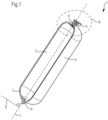
- the Fig.1 shows the pressure tank 1 with a boss 4,4' on each of the two pole caps.
- a tank fitting 5 is screwed into the boss 4 for filling and controlled removal of gas.
- the boss 4' is sealed with a cap. Alternatively, it can accommodate a safety valve.
- the wall of the pressure tank 1 encloses the cavity 2 and is formed by an internal liner 3 and a reinforcing layer 6.
- the liner 3 is preferably made of thermoplastic such as polyamide and is produced in the blow molding process according to the invention.
- the reinforcing layer 6 is produced by a winding process with tapes made of fiber-reinforced plastic, preferably CFRP.
- the pressure tank 1 is rotationally symmetrical about the longitudinal axis L. With such pressure tanks, special attention must be paid to the seal between the boss 4,4' and the liner 3. Good sealing is a difficult challenge, particularly with large pressure tanks, as required in commercial vehicles to enable sufficient range.
- Fig.2a and 2b show the section B of the pressure tank 1 in an enlarged manner, so that the inventive design for improved sealing can be seen. Two different designs are shown.
- the pressure ring 8 and the spring element 9 are located inside the liner 3, i.e. in the cavity 2.
- the Spring element 9 is pre-tensioned and presses the pressure ring 8 onto the liner 3 and thus the liner 3 onto the boss 4.
- the connection between the boss 4 and the bushing 7 is made via the screw connection 12, whereby there is a corresponding external thread on the bushing 7.
- the liner 3 is pressed onto the boss only via the pressure ring 8.
- This pressure ring 8 is movable relative to the bushing 7 and can be moved in the direction of the longitudinal axis L. Together they enclose the spring element 9, which is thus well protected.
- the components can be easily assembled. A special tool is used for this, which can be inserted through the central hole of the boss 4.
- the spring element 9 is designed as a spring ring with a U-shaped cross-section.
- the pressure ring 8 is preferably shaped on the side against which the spring element 9 rests so that the largest possible contact surface is used for force transmission.
- the pressure ring 8 has a curved shape that corresponds to the arc of the spring ring with a U-shaped cross-section.
- the pressure ring 8 has a collar 23 on the side facing the liner 3.
- the spring element 9 is designed as a disc spring in this version. A disc spring with two spring plates is shown, but just one spring plate or several spring plates can also be provided.
- the spring force can be set to the desired level using the strength, material and number.
- the pressure ring 8 is preferably shaped on the side on which the spring element 9 rests so that good force transmission is possible.
- the pressure ring 8 has a stop 22 which rests on the bushing 7 when the spring element 9 is sufficiently compressed.
- the bushing 7 has a stop 21 which rests on the pressure ring 8 when the spring element 7 is sufficiently compressed. In this way, a rigid force transmission can be established between the pressure ring 8 and the bushing 7, which is advantageous for the assembly of the boss or during the blow molding of the liner.
- the surface of the pressure ring 8, which is pressed against the liner 3, and the surface of the liner 3, which is pressed against the boss 4, are essentially aligned perpendicular to the longitudinal axis L.
- the collar of the bushing 7, on which the spring element 9 is supported is arranged essentially perpendicular to the longitudinal axis L.
- the screw connection 12 thus transfers the spring force of the spring element 9 completely via the pressure ring 8 to the sealing surface between the boss 4 and the liner 3.
- the area of the boss 4 in which the pressure ring 8 presses the liner 3 onto the boss 4 is referred to as the sealing surface or throttling point.
- the sealing and thus the throttling of the internal gas pressure in the pressure tank is achieved by pressing the liner 3 onto the boss 4 due to the spring force of the spring element 9 and due to the internal gas pressure itself.
- the liner 3 is attached to the boss 4 via a thread 10. On the boss it is an external thread 10 and on the liner it is an internal thread 10. The internal thread 10 on the liner is machined to fit accordingly.
- the Boss 4 has an internal thread 11, through which a tank fitting, a safety valve or a closure can be screwed in.
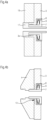
- Section A is shown in the following Fig. 3a -c . These figures show further embodiments of how the boss 4 can be advantageously designed in the area in which the liner 3 is pressed against the boss by the pressure ring 8.
- the Boss 4 has elevations 13 instead of a smooth surface ( Fig.3a and 3b ).
- the elevations 13 are in this case designed as concentric rings on the surface and are only a few tenths of a millimetre, preferably between 0.3 and 1.5 mm, particularly preferably between 0.5 and 1 mm high.
- the elevations 13 press into the surface of the liner 13 and improve the sealing effect. They are designed with a rounded or semi-circular cross-section and with a triangular cross-section. Other shapes are also possible.
- Fig.3c shows another variant for improving the seal. This can also be used in combination with the elevations.
- the sealing ring 15, for example an O-ring, is placed in a groove 14 on the boss.
- the groove 14 is preferably located in the area of the boss 4, against which the liner 3 is pressed by the pressure ring 8. However, the groove can also be provided outside this area.
- the support ring 16 can be provided so that the sealing ring 15 is not pressed into the gap between the boss 4 and the liner 3 under greater loads.
- the internal gas pressure in the pressure tank and the pressure from the spring element 9 ensure that the liner 3 is evenly and well sealed against the support ring 16.
- Fig. 3d and 3e Another variant is shown. These figures show in Fig.3d what the arrangement looks like during operation of the pressure tank, and in Fig.3e what it looks like after the assembly of the Boss 4, which takes place after the liner has been produced by blow molding.
- the enlargement shows the elevations 13, which in Fig.2 are not shown for the sake of clarity.
- the elevations 13 are present on the surface of the boss 4, against which the liner 3 is pressed by the pressure ring 8.
- the elevations 13 are not to scale, otherwise they would not be visible.
- the elevations 13 are in this case designed as concentric rings on the surface and are only a few tenths of a millimeter high, preferably between 0.3 and 1.5 mm, particularly preferably between 0.5 and 1 mm.
- the elevations 13 press into the surface of the liner 13 and improve the sealing effect. They can, for example, be designed with a rounded or semi-circular or triangular cross-section. Other shapes are also possible.
- In the operating state as in Fig.3a As shown, there is a gap between the stops 21, 22 and the respective counter surfaces on the pressure ring or on the bushing.
- the pressure of the pressure ring 8 on the liner 3 and thus on the boss 4 corresponds to the spring force of the spring element 9, for example in the order of 5 kN.
- the gap width can change slightly.
- a sealing ring for example an O-ring
- the groove is preferably located in the area of the boss 4, against which the liner 3 is pressed by the pressure ring 8. However, the groove can also be provided outside of this area.
- a support ring can be provided so that the sealing ring is not pressed into the gap between the boss 4 and the liner 3 under greater loads. The internal gas pressure in the pressure tank and the pressure from the spring element 9 ensure that the liner 3 is evenly and well sealed against the support ring.
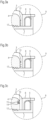
- FIG. 4a shows an arrangement as used in the manufacture of the liner in .
- the bushing 7 with the pressure ring 8 and the spring element 9 is mounted on the blow mandrel 17.
- the two- or multi-part blow molding tool 18 presses the liner material onto the blow mandrel 17 and onto the bushing 7 and the pressure ring 8.
- the liner material preferably a thermoplastic
- the liner material is first extruded as a tube from a nozzle. Once the blow molding tool is closed, gas is blown in via the blow mandrel, which acts as a mouthpiece, so that the liner material is pressed into the blow mold and the desired shape of the liner 3 is created. After solidification, the blow molding tool is opened and the liner 3 is demolded. The pressure ring 8 and the spring element 9 are then located on the inside of the liner 3 in the cavity 2 and the bushing 7 is arranged so that it can later be connected to the boss 4. To do this, part 3a of the liner 3 is removed to expose the external thread on the bushing 7. In addition, the liner 3 can be further processed. For example, a thread can be cut or milled into the surface of the liner 3 to connect to an external thread on the boss.
- a second bushing, a second pressure ring and a second spring element can be introduced during production.
- the second bushing, the second pressure ring and the second spring element are positioned on the side opposite the blow mandrel 17 on a holder or the blow molding tool so that they are also arranged inside, similar to the components on the blow mandrel 17 when the liner is manufactured.
- a boss can then also be connected to the second bushing on this side.
- the pressure ring 8 can compress the spring element 9;9 ⁇ to such an extent that the arrangement is rigidly fixed and held in the desired position during blow molding.
- the stops 21 and 22 rest against the respective counter surface on the pressure ring or on the bushing.
- the spring element 9' is completely compressed so that the stops 24 and 25 result in a rigid force transmission via the spring element 9'.
- Fig.4b shows the section after the boss 4 has been screwed onto the bushing 7.
- the screw connection compresses the spring element 9 and presses the pressure ring 8 onto the liner 3 and this onto the boss 4.
- the preload generated can be adjusted via the screw-in depth and the spring stiffness of the spring element 9.
- the raised areas on the boss 4 in the area of the sealing surface press into the surface of the liner 3 and thus increase the tightness.
- the raised areas are designed as concentric rings with a rounded cross-section.
- the variants not shown can be used according to Fig.2b or Fig.6a /b advantages.
- the spring elements 9,9' can be compressed to such an extent that the bushing 7 and pressure ring 8 enable rigid force transmission independent of the elasticity of the spring element.
- the shaped liner 3 with the two screwed-on bosses 4 is the preliminary product for the further manufacture of the pressure tank.
- this preliminary product is wrapped with tapes made of fiber-reinforced plastic to form the reinforcement layer of the wall. After wrapping, the fiber-reinforced plastic is cured.
- CFRP tapes that are impregnated with a suitable resin are preferably used for this purpose.
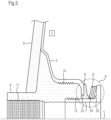
- Fig.5 shows again the detail B of the pressure tank 1 in an enlarged view, but for a further embodiment according to the invention for improved sealing.
- the pressure ring 8' and the spring element 9' are located inside the liner 3, i.e. in the cavity 2.
- the spring element 9' is pre-tensioned via the bushing 7', which is connected to the boss 4, and presses the pressure ring 8' onto the liner 3 and thus the liner 3 onto the boss 4.
- the connection between the boss 4 and the bushing 7' is made via the screw connection 12, with a corresponding external thread on the bushing 7'.
- the liner 3 is pressed onto the boss only via the pressure ring 8'.
- This pressure ring 8' is movable relative to the bushing 7' and can be moved in the direction of the longitudinal axis L. the pressure ring 8 ⁇ on the bushing 7 ⁇ over its inner diameter.
- the pressure ring 8' and the bushing 7' can be made very slim and space-saving in this design.
- the pressure ring 8 has a collar 23 on the side facing the liner 3.
- the spring element 9' is designed as a disc spring.
- a disc spring with four spring plates is shown, but only one spring plate or several spring plates can be provided.
- the spring force can be set to the desired level using the thickness, material and number.
- the surface of the pressure ring 8', which is pressed against the liner 3, and the surface of the liner 3, which is pressed against the boss 4, are essentially aligned perpendicular to the longitudinal axis L.
- the collar of the bushing 7', on which the spring element 9' is supported is arranged essentially perpendicular to the longitudinal axis L.
- the spring force of the spring element 9' is thus transferred completely via the pressure ring 8 to the sealing surface between the boss 4 and the liner 3 by the screw connection 12.
- the area of the boss 4 in which the pressure ring 8' presses the liner 3 onto the boss 4 is referred to as the sealing surface or throttling point.
- the sealing and thus the throttling of the internal gas pressure in the pressure tank is achieved by pressing the liner 3 onto the boss 4 due to the spring force of the spring element 9' and due to the internal gas pressure itself.
- the pressure ring 8' is preferably shaped on the side against which the spring element 9' rests so that good force transmission is possible.
- the stop 24 can be provided on the pressure ring against which the spring element 9' rests.
- the liner 3 is attached to the boss 4 via a thread 10. On the boss it is an external thread 10 and on the liner it is an internal thread 10. The internal thread 10 on the liner is machined to fit accordingly.
- the Boss 4 has an internal thread 11, through which a tank fitting, a safety valve or a closure can be screwed in.
- Fig. 6a and 6b show in Fig.6a what the arrangement looks like during operation of the pressure tank, and in Fig.6b what it looks like after the assembly of the Boss 4, which takes place after the production of the liner in blow molding. Further details apply analogously to those already mentioned above in the figure description for the similar Fig.3a and 3b are mentioned.
- the main difference in the variant shown here is that the bushing 7' and especially the pressure ring 8' are slimmer and more space-saving. This is a great advantage in applications where little installation space and the lowest possible weight are required.
- Fig.6a shows that during operation the pressure between the pressure ring 8' and the liner 3 is exerted by the spring element 9', which is supported on the collar of the bushing 7'. There is a gap between the stop 25 on the bushing and the spring element 9'.
- the bushing 7' is connected to the boss 4 via the external thread 12, which is not shown in full.
- the pressure force on the surface to the liner 3 can be adjusted.
- Fig.6b the spring element 9' is fully compressed, so that a rigid force transmission from the bushing 7' to the pressure ring 8' takes place.
- this is achieved by the stop 25 of the bushing over the Spring element 9 ⁇ presses on the stop 24 on the pressure ring 8'.
- the boss 4 is screwed onto the bushing 7' or the bushing 7' into the boss 4 so far that the stops 24,25 completely compress the spring element 9' and enable a rigid force transmission via the spring element 9' without elastic influence.
- a high pressure force can be applied in order to press the elevations 13 well into the liner 3 during assembly.
- the contact surface for sealing between the pressure ring 8' and liner 3 is inclined relative to the perpendicular to the longitudinal axis L.
- An inclination of up to 20° is particularly advantageous. Any air pockets between liner 3 and pressure ring 8' can be radially pressed out of the sealing surface due to the inclination when screwing into the boss 4. This facilitates reliable assembly.
- a sealing ring for example an O-ring
- the groove is preferably located in the area of the boss 4, against which the liner 3 is pressed by the pressure ring 8. However, the groove can also be provided outside of this area.
- a support ring can be provided so that the sealing ring is not pressed into the gap between the boss 4 and the liner 3 under greater loads. The internal gas pressure in the pressure tank and the pressure from the spring element 9 ensure that the liner 3 is evenly and well sealed against the support ring.
Landscapes
- Engineering & Computer Science (AREA)
- Mechanical Engineering (AREA)
- General Engineering & Computer Science (AREA)
- Filling Or Discharging Of Gas Storage Vessels (AREA)
- Pressure Vessels And Lids Thereof (AREA)
Applications Claiming Priority (3)
| Application Number | Priority Date | Filing Date | Title |
|---|---|---|---|
| DE102020134633.6A DE102020134633A1 (de) | 2020-12-22 | 2020-12-22 | Drucktank für gasbetriebenes Fahrzeug |
| PCT/EP2021/085836 WO2022136045A1 (fr) | 2020-12-22 | 2021-12-15 | Réservoir sous pression pour véhicule fonctionnant au gaz |
| EP21839889.9A EP4267882B1 (fr) | 2020-12-22 | 2021-12-15 | Réservoir sous pression pour véhicule fonctionnant au gaz |
Related Parent Applications (2)
| Application Number | Title | Priority Date | Filing Date |
|---|---|---|---|
| EP21839889.9A Division-Into EP4267882B1 (fr) | 2020-12-22 | 2021-12-15 | Réservoir sous pression pour véhicule fonctionnant au gaz |
| EP21839889.9A Division EP4267882B1 (fr) | 2020-12-22 | 2021-12-15 | Réservoir sous pression pour véhicule fonctionnant au gaz |
Publications (2)
| Publication Number | Publication Date |
|---|---|
| EP4455541A2 true EP4455541A2 (fr) | 2024-10-30 |
| EP4455541A3 EP4455541A3 (fr) | 2025-02-26 |
Family
ID=79287844
Family Applications (2)
| Application Number | Title | Priority Date | Filing Date |
|---|---|---|---|
| EP24194451.1A Pending EP4455541A3 (fr) | 2020-12-22 | 2021-12-15 | Réservoir de pression pour véhicule fonctionnant au gaz |
| EP21839889.9A Active EP4267882B1 (fr) | 2020-12-22 | 2021-12-15 | Réservoir sous pression pour véhicule fonctionnant au gaz |
Family Applications After (1)
| Application Number | Title | Priority Date | Filing Date |
|---|---|---|---|
| EP21839889.9A Active EP4267882B1 (fr) | 2020-12-22 | 2021-12-15 | Réservoir sous pression pour véhicule fonctionnant au gaz |
Country Status (8)
| Country | Link |
|---|---|
| EP (2) | EP4455541A3 (fr) |
| JP (1) | JP2024500178A (fr) |
| KR (1) | KR20230119236A (fr) |
| CN (2) | CN120969711A (fr) |
| DE (1) | DE102020134633A1 (fr) |
| ES (1) | ES3029284T3 (fr) |
| PL (1) | PL4267882T3 (fr) |
| WO (1) | WO2022136045A1 (fr) |
Families Citing this family (6)
| Publication number | Priority date | Publication date | Assignee | Title |
|---|---|---|---|---|
| DE102020134624A1 (de) * | 2020-12-22 | 2022-06-23 | Voith Patent Gmbh | Boss für einen Drucktank und Drucktank für gasbetriebenes Fahrzeug |
| FR3139372B1 (fr) * | 2022-09-06 | 2025-01-17 | Plastic Omnium New Energies France | Réservoir destiné à contenir un gaz sous pression |
| CN116928587B (zh) * | 2023-09-14 | 2024-04-26 | 陕西中源氢能新能源有限公司 | 一种气态储氢电池的安全供氢装置 |
| DE102024123051A1 (de) * | 2024-08-13 | 2026-02-19 | Voith Hystech Gmbh | Drucktank für gasbetriebenes Fahrzeug |
| DE102024123048A1 (de) * | 2024-08-13 | 2026-02-19 | Voith Hystech Gmbh | Drucktank für gasbetriebenes Fahrzeug |
| DE102024123049A1 (de) | 2024-08-13 | 2026-02-19 | Voith Hystech Gmbh | Drucktank für gasbetriebenes Fahrzeug |
Citations (4)
| Publication number | Priority date | Publication date | Assignee | Title |
|---|---|---|---|---|
| DE102010021667A1 (de) | 2009-06-15 | 2010-12-16 | Magna Steyr Fahrzeugtechnik Ag & Co Kg | Druckbehälter für gasförmige oder flüssige Medien |
| DE102014009343A1 (de) | 2014-06-27 | 2015-12-31 | Kautex Textron Gmbh & Co. Kg | Druckbehälter |
| WO2017020026A1 (fr) | 2015-07-30 | 2017-02-02 | Modernatx, Inc. | Arn épitopes peptidiques concatémériques |
| DE102016219638A1 (de) | 2015-12-16 | 2017-06-22 | Hyundai Motor Company | Mehrfach abgedichtete Düse und Druckbehälter mit dieser |
Family Cites Families (11)
| Publication number | Priority date | Publication date | Assignee | Title |
|---|---|---|---|---|
| US4614279A (en) * | 1984-12-13 | 1986-09-30 | Essef Industries, Inc. | Side tap opening for a filament-wound tank |
| BE902543A (nl) | 1985-05-30 | 1985-09-16 | Duktrad Internat | Halsafsluitring voor kunststof druktanks. |
| US5376200A (en) * | 1993-08-30 | 1994-12-27 | General Dynamics Corporation | Method for manufacturing an integral threaded connection for a composite tank |
| US5938209A (en) * | 1997-02-14 | 1999-08-17 | Alternative Fuel Systems, Inc. | Seal system for fluid pressure vessels |
| WO2009129530A1 (fr) | 2008-04-18 | 2009-10-22 | Ferus Inc. | Récipient de structure composite et système de transport pour gaz liquéfiés |
| US9151447B2 (en) * | 2010-03-10 | 2015-10-06 | GM Global Technology Operations LLC | Liner for a pressure vessel and method |
| CN102906484B (zh) * | 2010-05-19 | 2014-06-11 | 八千代工业株式会社 | 压力容器的口承部件与吹塑杆的卡合构造、具有该卡合构造的压力容器的口承构造及压力容器的制造方法 |
| KR20170130649A (ko) * | 2016-05-18 | 2017-11-29 | 일진복합소재 주식회사 | 압력용기 |
| KR101856334B1 (ko) | 2016-06-29 | 2018-05-09 | 현대자동차주식회사 | 기밀한 노즐 구조를 갖는 복합재 용기 |
| US10746354B2 (en) * | 2017-05-24 | 2020-08-18 | Hexagon Technology, As | Threaded boss for pressure vessel |
| CN108953985B (zh) * | 2018-08-06 | 2021-02-26 | 亚普汽车部件股份有限公司 | 具有密封结构的高压复合容器 |
-
2020
- 2020-12-22 DE DE102020134633.6A patent/DE102020134633A1/de active Pending
-
2021
- 2021-12-15 CN CN202511030397.3A patent/CN120969711A/zh active Pending
- 2021-12-15 EP EP24194451.1A patent/EP4455541A3/fr active Pending
- 2021-12-15 WO PCT/EP2021/085836 patent/WO2022136045A1/fr not_active Ceased
- 2021-12-15 JP JP2023538111A patent/JP2024500178A/ja active Pending
- 2021-12-15 KR KR1020237024930A patent/KR20230119236A/ko active Pending
- 2021-12-15 ES ES21839889T patent/ES3029284T3/es active Active
- 2021-12-15 CN CN202180085132.7A patent/CN116601424A/zh active Pending
- 2021-12-15 PL PL21839889.9T patent/PL4267882T3/pl unknown
- 2021-12-15 EP EP21839889.9A patent/EP4267882B1/fr active Active
Patent Citations (4)
| Publication number | Priority date | Publication date | Assignee | Title |
|---|---|---|---|---|
| DE102010021667A1 (de) | 2009-06-15 | 2010-12-16 | Magna Steyr Fahrzeugtechnik Ag & Co Kg | Druckbehälter für gasförmige oder flüssige Medien |
| DE102014009343A1 (de) | 2014-06-27 | 2015-12-31 | Kautex Textron Gmbh & Co. Kg | Druckbehälter |
| WO2017020026A1 (fr) | 2015-07-30 | 2017-02-02 | Modernatx, Inc. | Arn épitopes peptidiques concatémériques |
| DE102016219638A1 (de) | 2015-12-16 | 2017-06-22 | Hyundai Motor Company | Mehrfach abgedichtete Düse und Druckbehälter mit dieser |
Also Published As
| Publication number | Publication date |
|---|---|
| CN116601424A (zh) | 2023-08-15 |
| CN120969711A (zh) | 2025-11-18 |
| US20240044455A1 (en) | 2024-02-08 |
| PL4267882T3 (pl) | 2025-09-08 |
| EP4267882C0 (fr) | 2025-04-02 |
| EP4267882B1 (fr) | 2025-04-02 |
| EP4267882A1 (fr) | 2023-11-01 |
| WO2022136045A1 (fr) | 2022-06-30 |
| ES3029284T3 (en) | 2025-06-23 |
| DE102020134633A1 (de) | 2022-06-23 |
| JP2024500178A (ja) | 2024-01-04 |
| EP4455541A3 (fr) | 2025-02-26 |
| KR20230119236A (ko) | 2023-08-16 |
Similar Documents
| Publication | Publication Date | Title |
|---|---|---|
| EP4267882B1 (fr) | Réservoir sous pression pour véhicule fonctionnant au gaz | |
| EP1977153B1 (fr) | Réservoir sous pression | |
| EP2954249B1 (fr) | Dispositif de stockage et de distribution de fluides liquides et/ou gazeux sous pression et dispositif de conversion de l'énergie d'un carburant, et procédé de montage d'un dispositif de stockage et de distribution de fluides liquides et/ou gazeux sous pression | |
| DE3331021A1 (de) | Stangenfoermiger hohlkoerper zur uebertragung von druck-, zug-, biege- und verdrehkraeften, verfahren zu seiner herstellung sowie vorrichtung zur durchfuehrung des beschriebenen verfahrens | |
| EP3786511B1 (fr) | Récipient sous pression | |
| EP2895317A1 (fr) | Rouleau presseur destiné à déposer un demi-produit en forme de bande | |
| WO2013020694A1 (fr) | Dispositif pour accumuler et distribuer des milieux liquides et/ou gazeux sous pression, ainsi que dispositif de conversion d'énergie de carburant et procédé pour le montage d'un dispositif pour l'accumulation et la distribution de milieux liquide et/ou gazeux sous pression | |
| EP2742272B1 (fr) | Dispositif pour l'accumulation et la distribution de milieux liquides et/ou gazeux sous pression, ainsi que dispositif de transformation d'énergie de carburant et procédé pour le montage d'un dispositif pour l'accumulation et la distribution de milieux liquides et/ou gazeux sous pression | |
| EP4174358A1 (fr) | Récipient sous pression avec plusieurs orifices latéraux d'évacuation | |
| DE102014013249B4 (de) | Druckbehälter | |
| EP4455536A2 (fr) | Bouchon pour réservoir sous pression et réservoir sous pression pour véhicule à gaz | |
| DE202012101004U1 (de) | Vorrichtung zur Speicherung und Abgabe von flüssigen und/oder gasförmigen Medien unter Druck sowie Kraftstoffenergieumwandlungsvorrichtung | |
| DE102013019810A1 (de) | Vorrichtung zum Speichern von Gas | |
| DE102019007550A1 (de) | Druckgasbehälter | |
| EP2644930B1 (fr) | Palier et son procédé de fabrication | |
| DE202021105982U1 (de) | Druckbehälter | |
| DE102017215191A1 (de) | Druckbehälter zur Speicherung von flüssigen und/oder gasförmigen Medien | |
| DE10359609A1 (de) | Drosselklappenstutzen | |
| EP3786512B1 (fr) | Procédé de fabrication d'un récipient sous pression et récipient sous pression | |
| DE102022134801A1 (de) | Restdruckhalteventil für eine Gasdruckfeder | |
| EP2559929B1 (fr) | Traversée de conduite avec volume de contrôle | |
| DE102023104640A1 (de) | Drucktank für gasbetriebenes Fahrzeug | |
| DE102024123048A1 (de) | Drucktank für gasbetriebenes Fahrzeug | |
| WO2026037577A1 (fr) | Réservoir sous pression pour véhicule fonctionnant au gaz | |
| DE102024123051A1 (de) | Drucktank für gasbetriebenes Fahrzeug |
Legal Events
| Date | Code | Title | Description |
|---|---|---|---|
| PUAI | Public reference made under article 153(3) epc to a published international application that has entered the european phase |
Free format text: ORIGINAL CODE: 0009012 |
|
| STAA | Information on the status of an ep patent application or granted ep patent |
Free format text: STATUS: THE APPLICATION HAS BEEN PUBLISHED |
|
| AC | Divisional application: reference to earlier application |
Ref document number: 4267882 Country of ref document: EP Kind code of ref document: P |
|
| AK | Designated contracting states |
Kind code of ref document: A2 Designated state(s): AL AT BE BG CH CY CZ DE DK EE ES FI FR GB GR HR HU IE IS IT LI LT LU LV MC MK MT NL NO PL PT RO RS SE SI SK SM TR |
|
| PUAL | Search report despatched |
Free format text: ORIGINAL CODE: 0009013 |
|
| AK | Designated contracting states |
Kind code of ref document: A3 Designated state(s): AL AT BE BG CH CY CZ DE DK EE ES FI FR GB GR HR HU IE IS IT LI LT LU LV MC MK MT NL NO PL PT RO RS SE SI SK SM TR |
|
| RIC1 | Information provided on ipc code assigned before grant |
Ipc: F17C 13/04 20060101AFI20250117BHEP |
|
| RAP1 | Party data changed (applicant data changed or rights of an application transferred) |
Owner name: VOITH HYSTECH GMBH |
|
| STAA | Information on the status of an ep patent application or granted ep patent |
Free format text: STATUS: REQUEST FOR EXAMINATION WAS MADE |
|
| 17P | Request for examination filed |
Effective date: 20250826 |