EP4471507A2 - Verfahren zur herstellung einer gruppe von uhren mit einer schleuse - Google Patents
Verfahren zur herstellung einer gruppe von uhren mit einer schleuse Download PDFInfo
- Publication number
- EP4471507A2 EP4471507A2 EP24200105.5A EP24200105A EP4471507A2 EP 4471507 A2 EP4471507 A2 EP 4471507A2 EP 24200105 A EP24200105 A EP 24200105A EP 4471507 A2 EP4471507 A2 EP 4471507A2
- Authority
- EP
- European Patent Office
- Prior art keywords
- watch
- balance springs
- silicon
- manufacturing
- wafer
- Prior art date
- Legal status (The legal status is an assumption and is not a legal conclusion. Google has not performed a legal analysis and makes no representation as to the accuracy of the status listed.)
- Pending
Links
Images







Classifications
-
- F—MECHANICAL ENGINEERING; LIGHTING; HEATING; WEAPONS; BLASTING
- F16—ENGINEERING ELEMENTS AND UNITS; GENERAL MEASURES FOR PRODUCING AND MAINTAINING EFFECTIVE FUNCTIONING OF MACHINES OR INSTALLATIONS; THERMAL INSULATION IN GENERAL
- F16F—SPRINGS; SHOCK-ABSORBERS; MEANS FOR DAMPING VIBRATION
- F16F1/00—Springs
- F16F1/02—Springs made of steel or other material having low internal friction; Wound, torsion, leaf, cup, ring or the like springs, the material of the spring not being relevant
- F16F1/04—Wound springs
- F16F1/10—Spiral springs with turns lying substantially in plane surfaces
-
- B—PERFORMING OPERATIONS; TRANSPORTING
- B33—ADDITIVE MANUFACTURING TECHNOLOGY
- B33Y—ADDITIVE MANUFACTURING, i.e. MANUFACTURING OF THREE-DIMENSIONAL [3D] OBJECTS BY ADDITIVE DEPOSITION, ADDITIVE AGGLOMERATION OR ADDITIVE LAYERING, e.g. BY 3D PRINTING, STEREOLITHOGRAPHY OR SELECTIVE LASER SINTERING
- B33Y80/00—Products made by additive manufacturing
-
- B—PERFORMING OPERATIONS; TRANSPORTING
- B81—MICROSTRUCTURAL TECHNOLOGY
- B81C—PROCESSES OR APPARATUS SPECIALLY ADAPTED FOR THE MANUFACTURE OR TREATMENT OF MICROSTRUCTURAL DEVICES OR SYSTEMS
- B81C1/00—Manufacture or treatment of devices or systems in or on a substrate
- B81C1/00388—Etch mask forming
- B81C1/00404—Mask characterised by its size, orientation or shape
-
- B—PERFORMING OPERATIONS; TRANSPORTING
- B81—MICROSTRUCTURAL TECHNOLOGY
- B81C—PROCESSES OR APPARATUS SPECIALLY ADAPTED FOR THE MANUFACTURE OR TREATMENT OF MICROSTRUCTURAL DEVICES OR SYSTEMS
- B81C1/00—Manufacture or treatment of devices or systems in or on a substrate
- B81C1/00436—Shaping materials, i.e. techniques for structuring the substrate or the layers on the substrate
- B81C1/00555—Achieving a desired geometry, i.e. controlling etch rates, anisotropy or selectivity
- B81C1/00626—Processes for achieving a desired geometry not provided for in groups B81C1/00563 - B81C1/00619
-
- B—PERFORMING OPERATIONS; TRANSPORTING
- B81—MICROSTRUCTURAL TECHNOLOGY
- B81C—PROCESSES OR APPARATUS SPECIALLY ADAPTED FOR THE MANUFACTURE OR TREATMENT OF MICROSTRUCTURAL DEVICES OR SYSTEMS
- B81C99/00—Subject matter not provided for in other groups of this subclass
- B81C99/0075—Manufacture of substrate-free structures
- B81C99/0095—Aspects relating to the manufacture of substrate-free structures, not covered by groups B81C99/008 - B81C99/009
-
- G—PHYSICS
- G04—HOROLOGY
- G04B—MECHANICALLY-DRIVEN CLOCKS OR WATCHES; MECHANICAL PARTS OF CLOCKS OR WATCHES IN GENERAL; TIME PIECES USING THE POSITION OF THE SUN, MOON OR STARS
- G04B17/00—Mechanisms for stabilising frequency
- G04B17/04—Oscillators acting by spring tension
- G04B17/06—Oscillators with hairsprings, e.g. balance
- G04B17/066—Manufacture of the spiral spring
-
- G—PHYSICS
- G04—HOROLOGY
- G04B—MECHANICALLY-DRIVEN CLOCKS OR WATCHES; MECHANICAL PARTS OF CLOCKS OR WATCHES IN GENERAL; TIME PIECES USING THE POSITION OF THE SUN, MOON OR STARS
- G04B17/00—Mechanisms for stabilising frequency
- G04B17/20—Compensation of mechanisms for stabilising frequency
- G04B17/22—Compensation of mechanisms for stabilising frequency for the effect of variations of temperature
- G04B17/227—Compensation of mechanisms for stabilising frequency for the effect of variations of temperature composition and manufacture of the material used
-
- G—PHYSICS
- G04—HOROLOGY
- G04D—APPARATUS OR TOOLS SPECIALLY DESIGNED FOR MAKING OR MAINTAINING CLOCKS OR WATCHES
- G04D3/00—Watchmakers' or watch-repairers' machines or tools for working materials
- G04D3/0069—Watchmakers' or watch-repairers' machines or tools for working materials for working with non-mechanical means, e.g. chemical, electrochemical, metallising, vapourising; with electron beams, laser beams
-
- G—PHYSICS
- G04—HOROLOGY
- G04D—APPARATUS OR TOOLS SPECIALLY DESIGNED FOR MAKING OR MAINTAINING CLOCKS OR WATCHES
- G04D3/00—Watchmakers' or watch-repairers' machines or tools for working materials
- G04D3/0074—Watchmakers' or watch-repairers' machines or tools for working materials for treatment of the material, e.g. surface treatment
- G04D3/0089—Watchmakers' or watch-repairers' machines or tools for working materials for treatment of the material, e.g. surface treatment for components of the regulating mechanism, e.g. coil springs
-
- B—PERFORMING OPERATIONS; TRANSPORTING
- B81—MICROSTRUCTURAL TECHNOLOGY
- B81C—PROCESSES OR APPARATUS SPECIALLY ADAPTED FOR THE MANUFACTURE OR TREATMENT OF MICROSTRUCTURAL DEVICES OR SYSTEMS
- B81C2201/00—Manufacture or treatment of microstructural devices or systems
- B81C2201/01—Manufacture or treatment of microstructural devices or systems in or on a substrate
- B81C2201/0101—Shaping material; Structuring the bulk substrate or layers on the substrate; Film patterning
- B81C2201/0128—Processes for removing material
- B81C2201/013—Etching
- B81C2201/0132—Dry etching, i.e. plasma etching, barrel etching, reactive ion etching [RIE], sputter etching or ion milling
-
- B—PERFORMING OPERATIONS; TRANSPORTING
- B81—MICROSTRUCTURAL TECHNOLOGY
- B81C—PROCESSES OR APPARATUS SPECIALLY ADAPTED FOR THE MANUFACTURE OR TREATMENT OF MICROSTRUCTURAL DEVICES OR SYSTEMS
- B81C2201/00—Manufacture or treatment of microstructural devices or systems
- B81C2201/01—Manufacture or treatment of microstructural devices or systems in or on a substrate
- B81C2201/0101—Shaping material; Structuring the bulk substrate or layers on the substrate; Film patterning
- B81C2201/0156—Lithographic techniques
-
- F—MECHANICAL ENGINEERING; LIGHTING; HEATING; WEAPONS; BLASTING
- F16—ENGINEERING ELEMENTS AND UNITS; GENERAL MEASURES FOR PRODUCING AND MAINTAINING EFFECTIVE FUNCTIONING OF MACHINES OR INSTALLATIONS; THERMAL INSULATION IN GENERAL
- F16F—SPRINGS; SHOCK-ABSORBERS; MEANS FOR DAMPING VIBRATION
- F16F2226/00—Manufacturing; Treatments
- F16F2226/02—Surface treatments
-
- G—PHYSICS
- G04—HOROLOGY
- G04D—APPARATUS OR TOOLS SPECIALLY DESIGNED FOR MAKING OR MAINTAINING CLOCKS OR WATCHES
- G04D7/00—Measuring, counting, calibrating, testing or regulating apparatus
- G04D7/10—Measuring, counting, calibrating, testing or regulating apparatus for hairsprings of balances
Definitions
- the present invention relates to the field of watchmaking. More specifically, it relates to a method of manufacturing a batch of watch balance springs, which may in particular be watch balance springs with thermocompensation.
- an oscillator In a clock movement, an oscillator has the function of providing a reference frequency, from which the measurement of the flow of time is made. This oscillator is often called the regulating organ of the clock movement. It can be mechanical, particularly when it is intended for a mechanical clock movement.
- a mechanical oscillator classically used in watchmaking results from the association of a watch balance spring and a balance wheel, which is pivotally mounted and which plays the role of a flywheel, while the watch balance spring is a spring designed to produce a return torque on this balance wheel.
- the document EP 3 181 938 A1 proposes a method for manufacturing a watch hairspring having a predetermined elastic torque.
- a watch hairspring blank cut to dimensions greater than the final target dimensions is adjusted after cutting by removing material to a thickness calculated from a measurement on the watch hairspring blank.
- the solution proposed in this document EP 3 181 938 gives sufficiently accurate results when applied individually, i.e. when only one watch hairspring is treated at a time, which is expensive and complicated to implement.
- the invention aims at least to improve the precision of the manufacture of a batch of watch balance springs whose elastic torques have an average in a predetermined range.
- this aim is achieved by means of a method of manufacturing a batch of watch balance springs whose elastic torques have an average in a predetermined range.
- the measurement(s) used in step e) to determine the quantity of silicon-based material to be removed are carried out on one or more watch balance springs each already provided with a predefined thermal compensation portion.
- the elastic torques of the watch balance springs at the end of the manufacturing method according to the invention have their average in the predetermined range, while these watch balance springs are each already provided with the predefined thermal compensation portion.
- the residual thickness removed from the thermal compensation portion corresponds to the amount of silicon-based material to be removed and it may not be equal to the thickness of that amount of silicon-based material to be removed.
- the residual thickness removed in step x) is made of the oxidized silicon-based material, which constitutes the thermal compensation portion and which may be silicon dioxide in the case where the silicon-based material is silicon.
- the residual thickness removed from the thermal compensation portion in step x) is not made of the same material as the amount of silicon-based material to be removed.
- the residual thickness removed from the thermal compensation portion in step x) is made of the material resulting from the oxidation of the silicon-based material to be removed.
- the residual thickness removed from the thermal compensation portion in step x) is made of silicon dioxide. In the case where the silicon-based material to be removed is silicon (doped or undoped), the residual thickness removed from the thermal compensation portion in step x) is equal to approximately 227% of the thickness of the amount of silicon-based material to be removed.
- the residual thickness removed in step x) is such that the quantity of silicon-based material consumed during a second oxidation regenerating the thermal compensation portion in step y) is equal to the quantity of silicon-based material to be removed in step x).
- step d) the watch hairsprings are produced by engraving.
- step d) is carried out by deep reactive ion etching.
- step w) is carried out collectively on the watch balance springs still attached to the plate.
- step x) is carried out collectively on the watch balance springs still attached to the plate.
- step y) is carried out collectively on the watch balance springs still attached to the plate.
- the quantity of silicon-based material to be removed is determined from a measurement carried out on a sacrificial sample taken from the watch balance springs of the wafer and which is dissociated from the wafer.
- the quantity of silicon-based material to be removed is determined by means of a correspondence table indicating the thickness of silicon-based material to be removed for each of several average elastic torques or for each of several quantities linked to such average elastic torques.
- the quantity of silicon-based material to be removed is a thickness of silicon-based material to be removed on the watch hairsprings produced in step d).
- the silicon-based material is silicon, for example doped silicon.
- the invention and another invention may be combined and are respectively referred to as the first invention and the second invention in the following.
- the second invention has at least the aim of allowing a geometric dispersion between watch springs to be collectively reduced on several watch springs cut by engraving from the same plate.
- this aim is achieved by means of a method for manufacturing watch hairsprings in a wafer, comprising a step in which: b) between at least one source emitting radiation and a photosensitive resin carried by one face of the wafer, a reusable mask stops at least part of the radiation except at the level of areas comprising several windows which define the contours of the watch balance springs and which this reusable mask includes.
- the reusable mask is a reusable mask corrected in that at least some of the windows are dimensionally different from each other so as to reduce an extent of a dispersion of the elastic couples of at least some of the watch balance springs made in the same plate.
- the manufacturing method according to the second invention may incorporate one or more other advantageous characteristics, alone or in combination, in particular among those defined below.
- step f) is carried out collectively on the watch balance springs still attached to the plate.
- the quantity of material to be removed is determined from a measurement carried out on a sacrificial sample taken from the watch balance springs of the wafer and which is dissociated from the wafer.
- the quantity of material to be removed is determined by means of a correspondence table indicating the thickness of material to be removed for each of several average elastic couples or for each of several quantities linked to such average elastic couples.
- the quantity of material to be removed is a thickness of material to be removed from the watch hairsprings produced in step d).
- step d) is carried out by deep reactive ion etching.
- the manufacturing method according to the second invention comprises a step in which: g) on each of several or all of the watch springs, a thermal compensation portion is formed modifying the sensitivity to temperature variations of the elastic torque of the corresponding watch spring.
- test structures are test watch balance springs.
- the measurements for correction include measurements of the frequencies of oscillators each comprising a balance wheel of predetermined inertia and one of the test watch balance springs.
- the windows of the uncorrected mask are dimensionally identical to each other.
- step d) is carried out using the sacrificial mask.
- test structures are test watch balance springs.
- the measurements for correction include measurements of the frequencies of oscillators each comprising a balance wheel of predetermined inertia and one of the test watch balance springs.
- the windows of the uncorrected mask are dimensionally identical to each other.
- the corrected reusable mask is produced in such a way that, in addition to being sized according to the mapping produced in sub-step a1), the windows are sized so that in step d), the watch balance springs are produced according to dimensions greater than the dimensions necessary to obtain the batch of watch hairsprings whose elastic torques have the average in the predetermined range.
- a watch hairspring 1 which includes a collet 2 intended to be secured to a pivoting shaft.
- the watch hairspring 1 also comprises an elastically flexible strand 3 connected at one end to the ferrule 2 and wound in a spiral so as to form several consecutive turns, the last of which is extended by an attachment segment 4 intended to be attached to a fixed balance bridge (not shown), for example by means of a stud (not shown).
- a mechanical oscillator 6 which is of a type called a "balance-spiral" and which comprises the watch balance spring 1, a balance 8 and a shaft 9 carrying this balance 8 as well as the collet 2.
- the watch balance spring 1 is coupled to the balance 8 by the fact that the collet 2 and the balance 8 are both integral with the shaft 9.
- the watch hairspring 1 is part of a batch of watch hairsprings 1 that were produced in the same wafer by implementing a manufacturing method 10 according to a first embodiment of the second invention, which has many advantages.
- This manufacturing method 10 comprises several steps following one another as shown in the figure 3 .
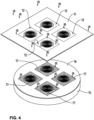
- a corrected reusable mask 11 is used, visible at the figure 4 .
- This corrected reusable mask 11 comprises several windows 12 which define the contours of watch balance springs.
- the windows 12 define the external contours of watch balance springs.
- the windows 12 could define the internal contours of watch balance springs (depending on the type of photosensitive resin used, see below).
- the number of windows 12 may be other than 4.
- the number of windows 12 in the corrected reusable mask 11 may be several tens.
- the number of windows 12 in the corrected reusable mask 11 is greater than 100. Even more preferably, the number of windows 12 in the corrected reusable mask 11 is several hundreds.
- the corrected reusable mask 11 is used in a photolithography forming part of the manufacturing process 10. Except at the windows 12, the corrected reusable mask 11 forms a screen capable of stopping at least a portion of radiation intended to transform a photosensitive resin. In other words, at least a portion of such radiation is stopped by the corrected reusable mask 11 except at the windows 12.
- the windows 12 are the only areas where the corrected reusable mask 11 does not form a screen capable of stopping at least part of a radiation intended to transform a photosensitive resin.
- the corrected reusable mask could comprise one or more areas which define the contours (internal and/or external) of characterization structures and where the screen capable of stopping at least part of a radiation intended to transform a photosensitive resin is absent.
- Such characterization structures may be different from the watch balance springs 1 and may be used to quantify an engraving by being measured and to determine a level of adjustment to be carried out by removing material from the watch balance springs 1, in a manner which will be explained later.
- the corrected reusable mask 11 may comprise a glass plate which is transparent so as to be able to be passed through by the aforementioned radiation and one of the two main faces of which bears a chromium-based coating except in certain areas comprising the windows 12.
- the chromium-based coating is capable of stopping all or part of the aforementioned radiation.
- Each window 12 is an area where this chromium-based coating is absent.
- step 100 which is the one illustrated in figure 4 .
- a wafer 15 has two main faces, one of which is covered with a photosensitive resin 16.
- wafer 15 is a multilayer structure, which is not shown in the figure 4 for the sake of clarity.
- the wafer 15 is a multilayer structure, but it could be otherwise.
- the wafer 15 could be single-layer and made up of the plate which, further on, is referenced 22.
- the corrected reusable mask 11 is placed between a source emitting radiation R and the assembly constituted by the photosensitive resin 16 and the wafer 15.
- the radiation R can in particular be radiation comprising UV, that is to say ultra-violet, or even consist of UV.
- At least a portion of the radiation R is capable of transforming the photosensitive resin 16 so as to make it soluble or insoluble in a suitable chemical bath.
- the photosensitive resin 16 is chosen so that its irradiation by the radiation R makes this photosensitive resin 16 soluble in a suitable chemical bath.
- the photosensitive resin is chosen so that its irradiation by radiation similar or identical to the radiation R makes this photosensitive resin insoluble in a suitable chemical bath, in which case the corrected reusable mask 11 is transformed accordingly.
- step 100 the corrected reusable mask 11 stops the radiation R except at the windows 12.
- the photosensitive resin 16 is irradiated in the areas facing the windows 12.
- the reference 17 designates the photosensitive resin 16 which has been irradiated by the radiation R through the windows 12 and which has thus become soluble in a suitable chemical bath.
- step 101 follows step 100.
- the irradiated photosensitive resin 17 is removed by solubilizing it in a suitable chemical bath, which is called development.
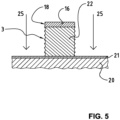
- the photosensitive resin 16 which has not been irradiated and transformed by the radiation R resists the chemical bath, thus remaining in place on the wafer 15 and forming a sacrificial mask, which is referenced 18 at the figure 5 .
- sacrificial mask 18 is made in step 101.
- Step 102 is illustrated in figure 5 , in which it can be seen that the multilayer structure of the wafer 15 comprises a support 20, a stop layer 21 and a wafer 22.
- the wafer 22 is made of a material capable of being etched, for example a silicon-based material.
- the wafer 22 is made of silicon.
- the silicon of the wafer 22 may be polycrystalline.
- the wafer 22 is made of monocrystalline silicon.
- the silicon of the wafer 22 may not be doped.
- the wafer 22 is made of doped silicon, which is electrically conductive, more dimensionally stable and of better mechanical strength.
- the wafer 22 is made of phosphorus-doped silicon.
- the wafer 22 is made of silicon which is of ⁇ 1,1,1 ⁇ orientation and/or which is doped.
- the wafer 22 is made of silicon which is of ⁇ 1,1,1> orientation and/or which is doped so as to have a resistivity less than or equal to 0.1 ⁇ .cm -1 , for example a resistivity equal to 0.05 ⁇ .cm -1 .
- the wafer 11 is of the silicon-silicon oxide-silicon type, that is to say of the type commonly designated by the English acronym “SOI”. This is the case in the manufacturing method 10.
- the support 20 is made of silicon
- the stop layer 21 is made of silicon dioxide
- the wafer 22 is made of silicon.
- step 102 several watch hairsprings 1 are cut collectively, together and at the same time, all in the wafer 22, by means of an etching 25, which is a directional etching occurring where the wafer 22 is not protected by the sacrificial mask 18.
- the etching 25 is a deep reactive ion etching, also called DRIE etching (acronym for “deep reaction ion etching”) or etching according to the Bosch process.
- the wafer 22 is not etched.
- the stop layer 21 is insensitive to the etching 25 which therefore does not affect it.
- the stop layer 21 therefore has the function of stopping the etching 25.
- Sacrificial mask 18 is sacrificial in that it is ephemeral and is destroyed once engraving 25 is complete.
- FIG 6 represents the state of wafer 15 once etching 25 is complete.
- the plate 22 and the watch balance springs 1 cut therein are still connected to the support 20 by the stop layer 21.
- the support 20 and the stop layer 21 can be removed locally.
- the support 20 and the stop layer 21 are completely removed, for example by etching, so that the watch balance springs 1 and the plate 22 are released, after which the plate 22 and the watch balance springs 1 cut therein are as shown in figure 7 .
- the watch hairsprings 1 cut from the plate 22 are still attached to this plate 22, so that they can easily be moved together and processed collectively and at the same time.
- the corrected reusable mask 11 is corrected in that at least a portion of the windows 12 are dimensionally different from each other so as to reduce an extent of a dispersion of the elastic couples of the watch balance springs 1 cut by engraving in the same plate 12.
- the elastic torque M is on the abscissa, while numbers n of watch hairsprings among all the watch hairsprings made in the same plate 22 are on the ordinate. Still on the graph of the figure 9 , curves C1 and C2 are normally histograms but they have been smoothed for clarity. Again on the graph of the figure 9 , increasing classes of elastic torque are also indicated along the abscissa axis. In the example shown in the figure 9 , the number of classes is equal to 80, but it could be other by means of another segmentation into classes. For example, the number of classes could be equal to 20 as was the custom in the past.
- curve C1 is the graphic representation of the dispersion of the elastic couples of watch hairsprings produced in the same plate 22 using an uncorrected reusable mask.
- curve C2 is the graphic representation of the dispersion of the elastic torques of the watch balance springs 1 produced in the same plate 22 using the corrected reusable mask 11, during an implementation of the manufacturing method 10.
- the correction incorporated in the corrected reusable mask 11 allows us to move from curve C1 to curve C2.
- the extent D2 is sufficiently small so that all or practically all of the watch balance springs 1 produced in the same wafer 22 using the corrected reusable mask 11 can be classified into a reduced number of classes and matched with balances distributed in a reduced number of classes.
- a class of watch hairsprings is intended to receive all watch hairsprings having an elastic torque located between two predefined terminals.
- a class of balance wheels is intended to receive all balances having an inertia located between two predefined limits.
- the corrected reusable mask 11 is produced during a preparatory step 500. Since the corrected reusable mask 11 is reusable and can be used a very large number of times, the preparatory step 500 can be carried out only once and for all, after which the manufacturing method 10 starting directly with step 100 can be carried out a very large number of times, without repeating the preparatory step 500.
- the corrected reusable mask 11 is suitable for a specific engraving installation, namely the engraving installation with and for which it was developed. This engraving installation may evolve over time. From the measurements taken on the watch balance springs 1 produced using the engraving installation, it is possible to detect an evolution requiring the design and production of a new corrected reusable mask 11.
- the preparatory step 500 comprises a substep 520, in which a mapping of degrees of correction to be applied at different positions on a wafer plane is carried out to reduce a spatial heterogeneity of an etching carried out by the etching device.
- a mapping 30 is shown in the figure 8 .
- Substep 520 includes an operation 522, which is identical to step 100 except that the wafer 22 is replaced by a test wafer and except that an uncorrected mask is used in place of the corrected reusable mask 11.
- This uncorrected mask is used in photolithography.
- this uncorrected mask there are windows which, like the windows 12, are areas where there is no screen capable of stopping at least part of the radiation R.
- the windows of the uncorrected mask define the contours (internal and/or external) of test watch balance springs or the contours (internal and/or external) of other test structures.
- the windows of the uncorrected mask are dimensionally identical to each other and define the contours of test watch balance springs.
- the uncorrected mask is located between the source emitting the radiation R in the etching installation considered and a photosensitive resin carried by one face of the test wafer. Still in operation 522, the corrected mask stops at least part of the radiation from the source except at the windows, opposite which the photosensitive resin is irradiated and transformed.
- the photosensitive resin is chosen so that its irradiation by the radiation R makes this photosensitive resin soluble in an appropriate chemical bath.
- the photosensitive resin is chosen so that its irradiation by radiation similar or identical to the radiation R makes this photosensitive resin insoluble in an appropriate chemical bath, in which case the reusable uncorrected mask is transformed accordingly.
- an operation 524 follows operation 522.
- Operation 524 is identical to step 101 except that the photosensitive resin that is then removed is that which was irradiated during operation 522 and which the test wafer carries.
- a sacrificial mask is therefore formed from the photosensitive resin.
- an operation 526 follows operation 524.
- Operation 526 is identical to step 102 except that the cutting by etching in this operation 526 is a cutting of test watch balance springs and that it is carried out by means of the sacrificial mask produced during operation 524.
- test watch balance springs are cut from the same test wafer, by DRIE etching, in the etching installation, in positions distributed on a wafer plane.
- an operation 528 follows operation 526.
- measurements are carried out for correction on the hairsprings.
- watchmakers test performed in the test wafer during operation 526.
- these measurements for correction are measurements of the frequencies of oscillators each consisting of a predetermined inertia balance and one of the test watchhairsprings coupled to this predetermined inertia oscillator.
- the test watchhairspring has been detached from the test wafer before being coupled to the predetermined inertia balance and before the frequency measurement is performed.
- the frequency measurement can also be performed while the test watchhairspring is still attached to the test wafer. In this case, the frequency measurement can be performed according to the teachings of the document EP 2 423 764 .
- the degrees of correction are determined from the correction measurements made on the test watch balance springs made in the same test wafer.
- a plate plane 35 indicates the position of cells 36, each of which is a region in which to cut a single watch hairspring.
- Each cell 36 is assigned the degree of correction deduced from the measurement for correction carried out on the test watch hairspring cut at the level of this cell 36.
- the shape of a watch hairspring is such that the error (due to DRIE engraving) which affects the elastic modulus M much more than the other errors is the error on the width l of the watch hairspring. We can therefore neglect the error on the height h of the hairspring, as well as the error on the length L of the hairspring.
- the width of the window 12 at the level of the corresponding elastically flexible strand 3, which must have approximately the width l 6 , will be reduced by the quantity ⁇ l .
- the width of the window 12 at the level of the corresponding elastically flexible strand 3, which must have approximately the width l 6 , will be increased by the quantity ⁇ l .
- the width of the window 12 at the level of the elastically flexible strand 3 corresponding which must have approximately the width l 6 , will not be corrected, that is to say it will not be modified.
- Each cell 36 can be associated with an individual degree of correction.
- the degree of correction applied at the A cell level is greater than the degree of correction applied at the B cell level.
- the degree of correction applied at the B cell level is greater than the degree of correction applied at the C cell level.
- the degree of correction applied at the C cell level is greater than the degree of correction applied at the D cell level.
- the degree of correction increases overall from the inside to the outside (A cells are rather on the periphery while C cells are rather in the center of the platelet plane 35).
- the figure 8 is only an example and is in no way limiting. Indeed, the distribution of the degrees of correction on the plate plane 35 can be any. In other words, the distribution of the degrees of correction on the plate plane 35 can be very different from that shown in the figure 8 as being very similar.
- Each degree of correction is a modification of at least one dimension of the window 12 of the corrected reusable mask 11, relative to a window of the uncorrected reusable mask used in operation 522.
- a degree of correction may result in an increase or decrease in the width of the portion of the corrected reusable mask 11 corresponding to an elastically flexible strand 3 of a watch balance spring 1.
- the change in width may be constant over the entire length of the portion corresponding to an elastically flexible strand 3.
- the increase in width or the decrease in width may also not be constant over the entire length of the portion corresponding to an elastically flexible strand 3.
- Operations 522, 524, 526 and 528 can be repeated several times so that several degrees of correction obtained experimentally are available for each cell 36 and so that an average degree of correction can be calculated for each cell 36 and a mapping 30 determined on the basis of the averages of degrees of correction each obtained for a cell 36 of the wafer plane 35.
- test watch hairsprings are cut out from the test wafer, during step 526.
- test structures that are not watch hairsprings may be cut out from the test wafer.
- These test structures may be configured to allow a measurement of the modulus of elasticity M and so that the variation in the moduli of elasticity between two wafers 22 is proportional to the correction to be made on the watch hairsprings 1.
- the test structures cut out during operation 526 from the test wafer may also be geometric figures, in which case the measurements for correction made during operation 528 may be dimensional measurements on these geometric figures.
- the preparatory step 500 comprises a sub-step 540 which follows step 520.
- the corrected reusable mask 11 is produced in such a way that the windows 12 of this corrected reusable mask 11 are sized according to the mapping 30 produced in the sub-step 520.
- the correction integrated in the corrected reusable mask 11 constitutes a first correction, which aims to reduce the dispersion of the elastic couples of watch balance springs 1 produced together and at the same time by engraving in the same wafer 22, in an engraving installation.
- the manufacturing method 10 according to a first embodiment of the second invention includes a second correction, which aims to reduce the heterogeneity between two engravings carried out in the same engraving installation, by means of the same corrected reusable mask 11, but at two different times and each on a different wafer 22.
- the second correction aims to reduce the dispersion between the elastic couples of a first set of watch balance springs 1 and a second set of watch balance springs 1, the watch balance springs 1 of the first set having been engraved in a first wafer, while the watch balance springs 1 of the second set have been engraved in a second wafer, before or after the watch balance springs 1 of the first set.
- the manufacturing method 10 is a method for manufacturing a batch of watch balance springs 1 whose elastic torques have an average in a predetermined range.
- the corrected reusable mask 11 is produced in such a way that, in addition to being sized according to the mapping 30 produced in the sub-step 520, the windows 12 are sized so that in the step 102, the watch balance springs 1 are cut by engraving according to dimensions greater than the dimensions necessary for obtaining the batch of watch balance springs 1 whose elastic torques have the average in the predetermined range.
- the manufacturing method 10 comprises two steps which follow step 102 and which are a step 110 and a step 120 following this step 110.
- step 110 a quantity of material to be removed from the watch balance springs 1 produced in step 102 in the same wafer 22 is determined. This quantity of material to be removed is more precisely that which must be removed from these watch balance springs 1, after step 102, to obtain the batch of watch balance springs 1 having the elastic torques whose average is in the predetermined range.
- this quantity of material to be removed is a thickness of material to be removed on the watch balance springs 1 produced in step 102.
- the procedure is preferably as follows. First, several watch hairsprings 1 constituting a sacrificial sample are detached from the wafer 22. This sacrificial sample is referred to as “sacrificial” because the watch hairsprings 1 constituting it will be used to perform measurements, after which, for the sake of efficiency and profitability, they may not be kept among the watch hairsprings 1 to which step 120 is applied.
- the watch hairsprings of the sacrificial sample may number from 5 to 15 and are advantageously chosen at locations distributed over the entire plane of the wafer 35.
- each of the watch balance springs 1 of the sacrificial sample is coupled to a predetermined inertia balance in order to form with it a mechanical oscillator whose frequency f is measured, still in step 110. After this, there are as many measurements of frequency f as there are watch balance springs 1 in the sacrificial sample. The average is then calculated f of these frequencies f measured on the mechanical oscillators comprising the watch balance springs 1 of the sacrificial sample.
- the above-mentioned correspondence table was obtained experimentally. To establish this above-mentioned correspondence table, one can proceed as follows: first, one determines experimentally by how much a removal of a thickness of one micron over the entire surface of a watch hairspring reduces the class attributable to this watch hairspring 1. Then, using a rule of three, that is to say by proportionality, one calculates the number of microns of thickness to be removed for each of several average elastic couples.
- a look-up table can be used indicating the thickness of material to be removed for each of several average frequencies. f .
- a mathematical model can also be used instead of the correspondence table.
- the frequency measurement can be carried out on watch balance springs 1 which have not been detached from the plate 22.
- the frequency measurement can be carried out according to the teachings of the document EP 2 423 764 .
- the thickness of material to be removed from the watch balance springs 1 produced in step 102 can be determined from a measurement of a quantity other than the frequency of an oscillator consisting of a watch balance spring 1 and a balance wheel of predetermined inertia.
- the thickness of material to be removed from the watch balance springs 1 produced in step 102 may be determined from dimensional measurements of portions cut by engraving in the wafer 22, these portions cut by engraving by the wafer 22 possibly being portions of the watch balance springs 1 or else geometric figures cut from the wafer in addition to the watch balance springs 1.
- the quantity of material to be removed from the watch balance springs 1 produced in step 102 may also be determined from a stiffness measurement carried out on qualification structures which were cut from the wafer 22 at the same time as the watch balance springs 1.
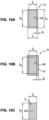
- FIG. 10A On the Figure 10A is shown the cross section of an elastically flexible strand 3 of a watch hairspring 1 which has just been cut by engraving in step 102 but which has not yet undergone oxidation.
- the inaccuracy of a watch balance spring 1 at the end of step 102 may be considered to be mainly due to steps 100, 101 and 102, and to mainly concern the width l 1 of the elastically flexible strand 3 of this watch balance spring 1.
- step 120 in the case of the manufacturing method 10 according to a first embodiment of the second invention, the thickness of material to be removed e determined in step 110 is removed from the watch balance springs 1 still attached to the plate 22 and, for the sake of economy, it may not be removed from the watch balance springs 1 belonging to the sacrificial sample.
- Step 120 can be accomplished by following the teachings in the document WO 2015/113973 A1 . More specifically, in the case of the manufacturing method 10 according to a first embodiment of the second invention, the watch balance springs 1 still attached to the plate 22 are collectively subjected, at the same time, to step 120. In step 120 in the case of the manufacturing method 10 according to a first embodiment of the second invention, the thickness of material to be removed e determined in step 110 is removed over the entire surface of the elastically flexible strand 3 of each of the watch balance springs 1 produced in step 102 and remaining attached to the plate 22.
- step 120 comprises a sub-step 122 and a sub-step 124 following step 122.
- the watch balance springs 1 after step 102 are made of silicon, which is the silicon of the wafer 22.
- the watch balance springs 1 made in the wafer 22 in step 102 are subjected to oxidation such that the thickness of silicon transformed into silicon oxide is equal to the thickness of material to be removed e determined in step 110.
- the oxidation may in particular be a thermal oxidation carried out between 800°C and 1200°C in an oxidizing atmosphere, in a furnace where silicon dioxide is formed from the silicon.
- the thermal oxidation may be a wet oxidation obtained in the presence of water vapor in the furnace or a dry oxidation obtained in the presence of dioxygen in the furnace.
- the oxidation time may be determined by appropriate formulas well known to those skilled in the art or it may be determined from calculators available online, for example at the following address: http://lelandstanfordjunior.com/thermaloxide.html.
- the thickness of silicon oxide (silicon dioxide) formed varies slightly depending on the crystallographic orientation of the silicon, but the differences are negligible.
- the thickness of material to be removed e typically corresponds to about 44% of the thickness (referenced e' on the Figure 10B mentioned later) of silicon oxide formed.
- the watch hairsprings 1 remaining attached to the wafer 22 are subjected together and collectively to oxidation, while they are still attached to the wafer 22.
- the watch hairsprings 1 of the sacrificial sample may not be subjected to step 120 and the following steps, for the sake of efficiency and profitability.
- all of the watch hairsprings 1 produced in step 102 in the wafer 22 are subjected together and collectively to oxidation while they are still attached to the wafer 22.
- the elastically flexible strand 3 shown in the Figure 10B is the same as that shown in the Figure 10A .
- this elastically flexible strand 3 is superficially oxidized, after having undergone sub-step 122.
- reference 40 designates the unoxidized silicon
- reference 41 designates the silicon dioxide which was formed during sub-step 122.
- the thickness e' of the layer made of the silicon dioxide 41 resulting from the oxidation in sub-step 122 is greater than the thickness e of the unoxidized silicon 40 whose oxidation led to this silicon dioxide 41.
- the silicon dioxide 41 is removed from at least part of the watch balance springs 1 cut from the wafer 22 during step 102.
- the silicon dioxide can be removed by etching, or by chemical attack, for example with hydrofluoric acid.
- the watch balance springs 1 remaining attached to the wafer 22 are subjected together and collectively to the sub-step 124.
- all of the watch balance springs 1 cut by engraving in the step 102 are subjected together and collectively to the sub-step 124.
- FIG. 10C represents the same elastically flexible strand 3 as the Figures 10A and 10B .
- this elastically flexible strand 3 is freed from silicon dioxide 41, after having undergone sub-step 124.
- the elastically flexible strand 3 of the Figure 10C has a height h 2 less than the height h 1 and a width l 2 less than the width l 1 .
- Step 120 may comprise substeps 122 and 124 also when the wafer 22 is not made of silicon.
- step 120 may comprise substeps 122 and 124 when the wafer 22 is made of a silicon-based material.
- Step 120 may be performed in a manner other than that described above.
- the reduction in cross-section of the elastically flexible strand 3 of the watch balance springs 1 may be performed by means of a plasma, and this may be while the watch balance springs 1 are in the state of the figure 6 , that is to say not yet released from the support 20 and from the stop layer 21, i.e. while the watch balance springs 1 or part of the watch balance springs 1 are in the state shown in the figure 7 , that is to say released from the stop layer 21 and the support 20, but still attached to the plate 22.
- the reduction in section by means of a plasma can be carried out even when the sacrificial mask 18 is still present on one face of the watch balance springs 1, in which case only the lateral flanks of the watch balance springs 1 are affected.
- the hairspring can be oxidized with an oxide thickness w before step 110.
- This oxide thickness w corresponds to the final thermocompensation thickness or to a chosen thickness.
- the hairspring is measured after oxidation.
- the elastic torque is reduced by partially or completely deoxidizing the hairspring and reoxidizing it to the value w.
- the figure 13 represents the successive steps of a manufacturing method 10a according to a second embodiment of the second invention.
- the manufacturing method 10a is a method for manufacturing a batch of watch balance springs 1.
- the manufacturing method 10a comprises a manufacturing method 1000 according to an embodiment of the first invention mentioned above.
- the manufacturing process 1000 is part of the manufacturing process 10a.
- it may be otherwise.
- the manufacturing process 1000 can be implemented without implementing all or part of the other steps of the manufacturing process 10a.
- the manufacturing method 1000 is a method of manufacturing a batch of watch balance springs (1) whose elastic torques have an average in a predetermined range.
- the manufacturing method 1000 comprises steps 150, 152 and 153, in addition to steps 102 and 110 already described above.
- Step 150 follows step 102, at the end of which the elastically flexible strand 3 of each of the watch balance springs 1 cut from the plate 22 is as shown in the figure. Figure 14A .
- step 150 the elastically flexible strand 3 of each of the watch hairsprings 1 cut from the plate 22 is as shown in the Figure 14B .
- step 150 several or all of the watch balance springs 1 are subjected to a first oxidation so as to be transformed into watch balance springs each superficially oxidized in a zone where, from the silicon-based material, the first oxidation creates a thermal compensation portion 50'a provided to modify the sensitivity to temperature variations of the elastic torque of the corresponding watch balance spring 1.
- the reference w designates the thickness of the thermal compensation portion 50'a.
- Step 150 is followed by step 110, in which, from at least one measurement on at least part of the oxidized watch balance springs 1, the quantity of silicon-based material (referenced w' on the figure 14C ) to remove oxidized watch hairsprings 1, to obtain the batch of watch hairsprings 1 having the elastic torques whose average is in the predetermined range. Examples of measurements that can be used in step 110 have been described above.
- Step 152 follows step 110.
- the elastically flexible strand 3 of each of the watch balance springs 1 cut from the plate 22 is as shown in the figure 14C at the end of step 152, in which, of the thermal compensation portion 50'a of several or all of the spirals watchmakers 1, a residual thickness is removed which corresponds to the quantity of silicon-based material to be removed w'.
- the residual thickness removed from the thermal compensation portion 50'a corresponds to the quantity of silicon-based material to be removed w' and it may not be equal to the thickness of this quantity of silicon-based material to be removed w'.
- the residual thickness removed in step 152 is made of the oxidized silicon-based material, which constitutes the thermal compensation portion 50'a and which may be silicon dioxide 41 in the case where the silicon-based material is silicon.
- the residual thickness removed from the thermal compensation portion 50'a in step 152 is not made of the same material as the amount of silicon-based material to be removed w'.
- the residual thickness removed from the thermal compensation portion in step 152 is made of the material resulting from the oxidation of the silicon-based material to be removed w'.
- the residual thickness removed from the thermal compensation portion 50'a in step 152 is made of silicon dioxide 41.
- the residual thickness removed from the thermal compensation portion 50'a in step 152 is equal to approximately 227% of the thickness of the amount of silicon-based material to be removed w'.
- the residual thickness removed in step 152 is such that the amount of silicon-based material consumed during a second oxidation regenerating the thermal compensation portion in step 153 is equal to the amount of silicon-based material to be removed in step 152.
- the residual thickness which corresponds to the amount of silicon-based material to be removed w' can be removed from the thermal compensation portion 50'a by means of chemical etching, for example by using hydrochloric acid.
- the duration of this chemical etching is a controlled duration, previously determined according to the quantity of silicon-based material to be removed w'.
- Step 153 follows step 152.
- the elastically flexible strand 3 of each of the watch balance springs 1 cut from the plate 22 is as shown in the figure 14D at the end of step 153, in which several or all of the oxidized watch balance springs 1 are subjected to a second oxidation such that the thermal compensation portion is regenerated.
- the reference w denotes the thickness of the thermal compensation portion 50a as it is after being regenerated.
- reference 40 designates the silicon-based material, which may in particular be doped or undoped silicon, which is the case in the manufacturing method 1000 according to an embodiment of the first invention.
- reference 41 designates the material based on oxidized silicon, which may in particular be silicon dioxide, which is the case in the manufacturing method 1000 according to an embodiment of the first invention.
- the manufacturing method 10a according to a second embodiment of the second invention differs from the method 10 in that it comprises the succession of steps 150, 110, 152 and 153, instead of the succession of steps 110, 120 and 130.
- the manufacturing method 10a can be identical to the manufacturing method 10, which is the case in the second embodiment of the second invention.
- steps 152 and 153 are not performed.
- step 150 is carried out collectively on the watch balance springs 1 still attached to the plate 22.
- step 152 is carried out collectively on the watch balance springs 1 still attached to the plate 22.
- step 153 is carried out collectively on the watch balance springs 1 still attached to the plate 22.
- the quantity of silicon-based material to be removed w' is determined from a measurement carried out on a sacrificial sample taken from the watch balance springs 1 of the wafer 22 and which is dissociated from the wafer 22.
- the quantity of silicon-based material to be removed w' is determined by means of a correspondence table indicating the thickness of silicon-based material to be removed w' for each of several average elastic torques or for each of several quantities linked to such average elastic torques.
- the elastic torque M is on the abscissa, while the number n of watch balance springs 1 among all the watch balance springs 1 produced in the same plate 22 at step 102 during an implementation of the manufacturing method 10 are on the ordinate.
- curves C3, C4 and C5 are normally histograms but they have been smoothed for clarity.
- curves C'3, C'4 and C'5 are normally histograms but they have been smoothed for clarity.
- the C3 curve on the Figure 11A and curve C'3 on the Figure 11B are each a graphical representation of the dispersion of elastic torques of watch hairsprings 1 made in the same first wafer 22, during a first implementation of the manufacturing method 10 or 10a in which the corrected reusable mask 11 is used.
- the measurements used for curve C3 were carried out on the watch hairsprings 1 before these watch hairsprings 1 were subjected to steps 110 and 120, or to steps 110, 152 and 153.
- the measurements used for curve C'3 were carried out on the watch hairsprings 1 after these watch hairsprings 1 were subjected to steps 110 and 120, or to steps 110, 152 and 153.
- the C4 curve on the Figure 11A and curve C'4 on the Figure 11B are each a graphical representation of the dispersion of the elastic couples of watch hairsprings 1 produced in the same second wafer 22, during a second implementation of the manufacturing method 10 or 10a in which the same corrected reusable mask 11 is used as in the first implementation of the manufacturing method 10 or 10a.
- the measurements used for curve C4 were carried out on the watch hairsprings 1 before these watch hairsprings 1 were subjected to steps 110 and 120, or to steps 110, 152 and 153.
- the measurements used for curve C'4 were carried out on the watch hairsprings 1 after these watch hairsprings 1 were subjected to steps 110 and 120, or to steps 110, 152 and 153.
- the C5 curve on the Figure 11A and curve C'5 on the Figure 11B are each a graphical representation of the dispersion of the elastic couples of watch balance springs 1 produced in the same third wafer 22, during a third implementation of the manufacturing method 10 or 10a in which the same corrected reusable mask 11 is used as in the first and second implementations of the manufacturing method 10 or 10a.
- the measurements used for curve C5 were carried out on the watch balance springs 1 before these watch balance springs 1 were subjected to steps 110 and 120, or to steps 110, 152 and 153.
- the measurements used for curve C'5 were carried out on the watch balance springs 1 after these watch balance springs 1 were subjected to steps 110 and 120, or to steps 110, 152 and 153.
- the watch hairsprings 1 having been produced in the first, second and third wafers 22 and having been subjected to steps 110 and 120, or to steps 110, 152 and 153, that is to say the watch hairsprings 1 on which the measurements used to produce the curves C'3, C'4 and C'5 were carried out, can all be classified each in one of classes 0 to 40.
- a watch hairspring when a watch hairspring is classified in any of classes 1 to 40, it can be paired with a balance belonging to one of classes 1 to 40, which constitute a reduced number of classes.
- Steps 110 and 120 can be repeated one or more times, until the average of the elastic torques of the watch balance springs 1 made in the same plate 22 is within the predetermined range.
- Steps 110, 152 and 153 can be repeated one or more times, until the average of the elastic torques of the watch balance springs 1 produced in the same plate 22 is within the predetermined range.
- step 120 may be followed by a step 130 in which, on each of several watch balance springs 1 constituting at least part of the watch balance springs 1 produced in the wafer 22 in step 102, a thermal compensation portion is formed.
- a thermal compensation portion 50 has the form of a peripheral layer covering the elastically flexible strand 3 of a watch hairspring 1.
- the thermal compensation portion 50 reduces, cancels or reverses the sensitivity to temperature variations of the elastic torque of the watch balance spring 1. In the case where steps 110 and 120 are not present, step 130 can be carried out directly after step 102.
- step 130 in the case of the manufacturing method 10 according to a first embodiment of the second invention the thermal compensation portion 50 is formed on the watch balance springs 1 still attached to the wafer 22 and, for the sake of economy, it may not be formed on the watch balance springs 1 belonging to the sacrificial sample.
- the watch balance springs 1 still attached to the wafer 22 are subjected collectively, together and at the same time, to step 130.
- the thermal compensation portion is formed over the entire length and the entire surface of the elastically flexible strand 3 of each of the watch balance springs 1 produced in step 102 and remaining attached to the wafer 22.
- the watch balance springs 1 after step 102 are made of silicon, which is the silicon of the wafer 22.
- step 130 at least a portion of the watch balance springs 1 made in the wafer 22 in step 102 are subjected to oxidation so as to be superficially oxidized over a thickness that is a function of the desired degree of thermal compensation.
- the oxidation may in particular be a thermal oxidation carried out between 800°C and 1200°C in an oxidizing atmosphere, in a furnace where silicon dioxide is formed from the silicon.
- the thermal oxidation of step 130 may be a wet oxidation obtained in the presence of water vapor in the furnace or a dry oxidation obtained in the presence of dioxygen in the furnace.
- the watch balance springs 1 remaining attached to the plate 22 are subjected together and collectively to oxidation. of step 130, while they are still attached to the wafer 22.
- the watch balance springs 1 of the sacrificial sample may not be subjected to step 130, for the sake of efficiency and cost-effectiveness.
- all of the watch balance springs 1 made in step 102 in the wafer 22 are subjected together and collectively to the oxidation of step 130 while they are still attached to the wafer 22.
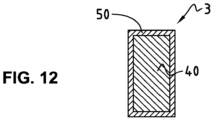
- FIG 12 is a cross-section of an elastically flexible strand 3 of a watch hairspring 1 as it is after step 130.
- the elastically flexible strand 3 comprises a silicon core 40 and the thermal compensation portion 50 which coats this silicon core 40.
- the silicon 40 of the core has a thermoelastic coefficient which is negative.
- the silicon dioxide of the thermal compensation portion 50 has a thermoelastic coefficient which is positive. This is why the thermal compensation portion 50 reduces or cancels or even reverses the sensitivity to temperature variations of the elastic torque of the watch balance spring 1.
- the watch balance springs 1 After being detached from the plate 22, the watch balance springs 1 are classified, for example each by means of an Omégamétric type device (protected trademark) in a step 200, which follows step 130, or step 120, or even step 110. After being classified in step 200, the watch balance springs 1 coming from the same plate 22 are paired with balances 8, in a step 250. In this step 250, the watch balance springs 1 coming from the same plate 22 are paired with balances 8 chosen from those of a batch that was obtained in a step 210 and which is made up of classified balances 8.
- Omégamétric type device protected trademark
Landscapes
- Engineering & Computer Science (AREA)
- Physics & Mathematics (AREA)
- Manufacturing & Machinery (AREA)
- General Physics & Mathematics (AREA)
- Microelectronics & Electronic Packaging (AREA)
- Geometry (AREA)
- General Engineering & Computer Science (AREA)
- Metallurgy (AREA)
- Materials Engineering (AREA)
- Optics & Photonics (AREA)
- Plasma & Fusion (AREA)
- Mechanical Engineering (AREA)
- Chemical & Material Sciences (AREA)
- Micromachines (AREA)
- Acyclic And Carbocyclic Compounds In Medicinal Compositions (AREA)
- Organic Low-Molecular-Weight Compounds And Preparation Thereof (AREA)
- Plural Heterocyclic Compounds (AREA)
- Springs (AREA)
Applications Claiming Priority (3)
| Application Number | Priority Date | Filing Date | Title |
|---|---|---|---|
| CH01165/19A CH716603A1 (fr) | 2019-09-16 | 2019-09-16 | Procédé de fabrication de spiraux horlogers. |
| EP21187318.7A EP3915788B1 (de) | 2019-09-16 | 2020-08-21 | Verfahren zur herstellung eines loses von uhrwerk-spiralfedern |
| EP20192120.2A EP3845770B1 (de) | 2019-09-16 | 2020-08-21 | Verfahren zur herstellung von uhrwerk-spiralfedern |
Related Parent Applications (2)
| Application Number | Title | Priority Date | Filing Date |
|---|---|---|---|
| EP21187318.7A Division EP3915788B1 (de) | 2019-09-16 | 2020-08-21 | Verfahren zur herstellung eines loses von uhrwerk-spiralfedern |
| EP20192120.2A Division EP3845770B1 (de) | 2019-09-16 | 2020-08-21 | Verfahren zur herstellung von uhrwerk-spiralfedern |
Publications (2)
| Publication Number | Publication Date |
|---|---|
| EP4471507A2 true EP4471507A2 (de) | 2024-12-04 |
| EP4471507A3 EP4471507A3 (de) | 2025-03-12 |
Family
ID=68066512
Family Applications (3)
| Application Number | Title | Priority Date | Filing Date |
|---|---|---|---|
| EP20192120.2A Active EP3845770B1 (de) | 2019-09-16 | 2020-08-21 | Verfahren zur herstellung von uhrwerk-spiralfedern |
| EP24200105.5A Pending EP4471507A3 (de) | 2019-09-16 | 2020-08-21 | Verfahren zur herstellung einer gruppe von uhren mit einer schleuse |
| EP21187318.7A Active EP3915788B1 (de) | 2019-09-16 | 2020-08-21 | Verfahren zur herstellung eines loses von uhrwerk-spiralfedern |
Family Applications Before (1)
| Application Number | Title | Priority Date | Filing Date |
|---|---|---|---|
| EP20192120.2A Active EP3845770B1 (de) | 2019-09-16 | 2020-08-21 | Verfahren zur herstellung von uhrwerk-spiralfedern |
Family Applications After (1)
| Application Number | Title | Priority Date | Filing Date |
|---|---|---|---|
| EP21187318.7A Active EP3915788B1 (de) | 2019-09-16 | 2020-08-21 | Verfahren zur herstellung eines loses von uhrwerk-spiralfedern |
Country Status (2)
| Country | Link |
|---|---|
| EP (3) | EP3845770B1 (de) |
| CH (1) | CH716603A1 (de) |
Families Citing this family (8)
| Publication number | Priority date | Publication date | Assignee | Title |
|---|---|---|---|---|
| EP4273632B1 (de) * | 2022-05-06 | 2026-04-29 | Sigatec SA | Verfahren zur herstellung von uhrenkomponenten |
| EP4303668B1 (de) * | 2022-07-05 | 2026-02-11 | Richemont International S.A. | Verfahren zur bestimmung der steifigkeit einer spiralfeder |
| EP4310598A1 (de) * | 2022-07-18 | 2024-01-24 | Richemont International S.A. | Verfahren zur kontrolle und herstellung von uhrwerk-spiralfedern |
| EP4372479A1 (de) * | 2022-11-18 | 2024-05-22 | Richemont International S.A. | Verfahren zur herstellung von uhrenspiralfedern |
| EP4428621A1 (de) * | 2023-03-10 | 2024-09-11 | Breitling SA | Verfahren zur herstellung einer reihe von uhrwerken |
| EP4575665A1 (de) * | 2023-12-19 | 2025-06-25 | Nivarox-FAR S.A. | Verfahren zur herstellung von spiralfedern einer uhr |
| CN118151513B (zh) * | 2024-03-27 | 2024-11-05 | 深圳市宇珀黄金钟表科技有限公司 | 机械表的摆轮和游丝稳定性检测方法、装置和计算机设备 |
| EP4656900A1 (de) | 2024-05-28 | 2025-12-03 | Sercalo Microtechnology Ltd. | Verfahren zur herstellung von silizium-spiralfeder |
Citations (4)
| Publication number | Priority date | Publication date | Assignee | Title |
|---|---|---|---|---|
| EP1422436A1 (de) | 2002-11-25 | 2004-05-26 | CSEM Centre Suisse d'Electronique et de Microtechnique SA | Spiraluhrwerkfeder und Verfahren zu deren Herstellung |
| EP2423764A1 (de) | 2010-08-31 | 2012-02-29 | Rolex S.A. | Vorrichtung zum Messen des Drehmomentes einer Spirale |
| WO2015113973A1 (fr) | 2014-01-29 | 2015-08-06 | Cartier Création Studio Sa | Ressort spiral thermocompensé en céramique comprenant l' élément silicium dans sa composition et son procédé de réglage |
| EP3181938A1 (de) | 2015-12-18 | 2017-06-21 | CSEM Centre Suisse d'Electronique et de Microtechnique SA - Recherche et Développement | Herstellungsverfahren einer spiralfeder mit einer vorbestimmten steifigkeit durch wegnahme von material |
Family Cites Families (13)
| Publication number | Priority date | Publication date | Assignee | Title |
|---|---|---|---|---|
| TW486753B (en) | 1997-08-22 | 2002-05-11 | Toshiba Corp | Method for aligning pattern of optical mask and optical mask used in the method |
| US7444616B2 (en) | 1999-05-20 | 2008-10-28 | Micronic Laser Systems Ab | Method for error reduction in lithography |
| AU5261200A (en) | 1999-05-20 | 2000-12-12 | Micronic Laser Systems Ab | A method for error reduction in lithography |
| FR2797060B1 (fr) | 1999-07-29 | 2001-09-14 | Commissariat Energie Atomique | Structure pour masque de lithographie en reflexion et procede pour sa realisation |
| CN1997878A (zh) | 2003-07-18 | 2007-07-11 | Uclt有限责任公司 | 在光掩膜中修正临界尺寸偏差的方法 |
| JP2011114844A (ja) | 2009-11-30 | 2011-06-09 | Seiko Instruments Inc | 圧電振動片の製造方法及び圧電振動片、圧電振動子、発振器、電子機器並びに電波時計 |
| US8782572B1 (en) | 2013-03-13 | 2014-07-15 | United Microelectronics Corp. | Method of optical proximity correction |
| JP6486697B2 (ja) | 2014-02-26 | 2019-03-20 | シチズン時計株式会社 | ひげぜんまいの製造方法及びひげぜんまい |
| CN105223773B (zh) | 2014-05-30 | 2020-02-07 | 中芯国际集成电路制造(上海)有限公司 | 一种光掩模图案透光强度修正的方法 |
| EP3412625A1 (de) * | 2017-06-05 | 2018-12-12 | Nivarox-FAR S.A. | Herstellungsverfahren eines mikromechanischen bauteils |
| EP3457224B1 (de) * | 2017-09-14 | 2020-10-28 | The Swatch Group Research and Development Ltd | Piezoelektrisches element für einen schaltkreis zur frequenzselbstregulierung, schwingendes mechanisches system und dieses umfassende vorrichtung, und herstellungsverfahren eines solchen piezoelektrischen elements |
| EP3543796A1 (de) * | 2018-03-21 | 2019-09-25 | Nivarox-FAR S.A. | Verfahren zur herstellung einer siliziumfeder |
| CH716605A1 (fr) * | 2019-09-16 | 2021-03-31 | Richemont Int Sa | Procédé de fabrication d'une pluralité de résonateurs sur une plaquette. |
-
2019
- 2019-09-16 CH CH01165/19A patent/CH716603A1/fr unknown
-
2020
- 2020-08-21 EP EP20192120.2A patent/EP3845770B1/de active Active
- 2020-08-21 EP EP24200105.5A patent/EP4471507A3/de active Pending
- 2020-08-21 EP EP21187318.7A patent/EP3915788B1/de active Active
Patent Citations (4)
| Publication number | Priority date | Publication date | Assignee | Title |
|---|---|---|---|---|
| EP1422436A1 (de) | 2002-11-25 | 2004-05-26 | CSEM Centre Suisse d'Electronique et de Microtechnique SA | Spiraluhrwerkfeder und Verfahren zu deren Herstellung |
| EP2423764A1 (de) | 2010-08-31 | 2012-02-29 | Rolex S.A. | Vorrichtung zum Messen des Drehmomentes einer Spirale |
| WO2015113973A1 (fr) | 2014-01-29 | 2015-08-06 | Cartier Création Studio Sa | Ressort spiral thermocompensé en céramique comprenant l' élément silicium dans sa composition et son procédé de réglage |
| EP3181938A1 (de) | 2015-12-18 | 2017-06-21 | CSEM Centre Suisse d'Electronique et de Microtechnique SA - Recherche et Développement | Herstellungsverfahren einer spiralfeder mit einer vorbestimmten steifigkeit durch wegnahme von material |
Also Published As
| Publication number | Publication date |
|---|---|
| CH716603A1 (fr) | 2021-03-31 |
| EP3915788B1 (de) | 2024-09-18 |
| EP4471507A3 (de) | 2025-03-12 |
| EP3845770A1 (de) | 2021-07-07 |
| EP3845770B1 (de) | 2023-06-28 |
| EP3915788A1 (de) | 2021-12-01 |
Similar Documents
| Publication | Publication Date | Title |
|---|---|---|
| EP3915788B1 (de) | Verfahren zur herstellung eines loses von uhrwerk-spiralfedern | |
| EP4031936B1 (de) | Verfahren zur herstellung einer mehrzahl von resonatoren in einem wafer | |
| EP3181938B1 (de) | Herstellungsverfahren einer spiralfeder mit einer vorbestimmten steifigkeit durch wegnahme von material | |
| EP4492160B1 (de) | Trägerorgan zur wärmebehandlung eines wafers | |
| EP1519250B1 (de) | Spiralfeder-Unruh-Resonator mit Thermokompensation | |
| EP3543796A1 (de) | Verfahren zur herstellung einer siliziumfeder | |
| EP3181940B2 (de) | Herstellungsverfahren einer spiralfeder mit einer vorbestimmten steifigkeit durch lokalisierte wegnahme von material | |
| EP2337221A1 (de) | Thermokompensierter Resonator mindestens ersten und zweiten Grades | |
| EP1422436A1 (de) | Spiraluhrwerkfeder und Verfahren zu deren Herstellung | |
| EP2791739B1 (de) | Stosssicheres lager für uhr | |
| EP3457224B1 (de) | Piezoelektrisches element für einen schaltkreis zur frequenzselbstregulierung, schwingendes mechanisches system und dieses umfassende vorrichtung, und herstellungsverfahren eines solchen piezoelektrischen elements | |
| EP2690506B1 (de) | Antischwingungsspirale für Uhr | |
| WO2019180558A1 (fr) | Procede de fabrication de spiraux horlogers thermocompenses de raideur precise | |
| EP3982205B1 (de) | Verfahren zur herstellung einer uhrfeder mit einer präzisen steifigkeit | |
| EP3865954B1 (de) | Herstellungsverfahren einer monoblock-vorrichtung mit federzungen aus silizium, für uhrwerk | |
| EP4030242A1 (de) | Verfahren zur herstellung von uhrwerks-spiralfedern | |
| WO2013079810A1 (fr) | Montre-bracelet à complication mécanique comprenant au moins une capsule anéroïde | |
| WO2022253983A1 (fr) | Procédé de fabrication d'un composant de mouvement horloger | |
| EP4273632B1 (de) | Verfahren zur herstellung von uhrenkomponenten | |
| EP1121622A1 (de) | Reflexionsmaske für die photolithographie und verfahren zu deren herstellung | |
| CH717124A2 (fr) | Procédé de fabrication d'un dispositif à lames flexibles monobloc en silicium, notamment pour l'horlogerie. | |
| EP4650883A1 (de) | Verfahren zur herstellung von uhrenhandspirans | |
| CH716696A2 (fr) | Procédé de fabrication de spiraux horlogers. | |
| EP4372479A1 (de) | Verfahren zur herstellung von uhrenspiralfedern | |
| EP3839642A1 (de) | Herstellungsverfahren von uhrenfedern und ätzmaske für ein solches verfahren |
Legal Events
| Date | Code | Title | Description |
|---|---|---|---|
| PUAI | Public reference made under article 153(3) epc to a published international application that has entered the european phase |
Free format text: ORIGINAL CODE: 0009012 |
|
| STAA | Information on the status of an ep patent application or granted ep patent |
Free format text: STATUS: THE APPLICATION HAS BEEN PUBLISHED |
|
| AC | Divisional application: reference to earlier application |
Ref document number: 3845770 Country of ref document: EP Kind code of ref document: P Ref document number: 3915788 Country of ref document: EP Kind code of ref document: P |
|
| AK | Designated contracting states |
Kind code of ref document: A2 Designated state(s): AL AT BE BG CH CY CZ DE DK EE ES FI FR GB GR HR HU IE IS IT LI LT LU LV MC MK MT NL NO PL PT RO RS SE SI SK SM TR |
|
| REG | Reference to a national code |
Ref country code: DE Ref legal event code: R079 Free format text: PREVIOUS MAIN CLASS: G04D0003000000 Ipc: B33Y0080000000 |
|
| PUAL | Search report despatched |
Free format text: ORIGINAL CODE: 0009013 |
|
| AK | Designated contracting states |
Kind code of ref document: A3 Designated state(s): AL AT BE BG CH CY CZ DE DK EE ES FI FR GB GR HR HU IE IS IT LI LT LU LV MC MK MT NL NO PL PT RO RS SE SI SK SM TR |
|
| RIC1 | Information provided on ipc code assigned before grant |
Ipc: G04D 3/00 20060101ALI20250205BHEP Ipc: G04B 17/22 20060101ALI20250205BHEP Ipc: G04B 17/06 20060101ALI20250205BHEP Ipc: F16F 1/10 20060101ALI20250205BHEP Ipc: B33Y 80/00 20150101AFI20250205BHEP |
|
| P01 | Opt-out of the competence of the unified patent court (upc) registered |
Free format text: CASE NUMBER: APP_21515/2025 Effective date: 20250506 |
|
| STAA | Information on the status of an ep patent application or granted ep patent |
Free format text: STATUS: REQUEST FOR EXAMINATION WAS MADE |
|
| 17P | Request for examination filed |
Effective date: 20250904 |