EP4474143A1 - Stahlblech und verfahren zur herstellung davon - Google Patents
Stahlblech und verfahren zur herstellung davon Download PDFInfo
- Publication number
- EP4474143A1 EP4474143A1 EP23774710.0A EP23774710A EP4474143A1 EP 4474143 A1 EP4474143 A1 EP 4474143A1 EP 23774710 A EP23774710 A EP 23774710A EP 4474143 A1 EP4474143 A1 EP 4474143A1
- Authority
- EP
- European Patent Office
- Prior art keywords
- steel sheet
- film
- wax
- less
- coating weight
- Prior art date
- Legal status (The legal status is an assumption and is not a legal conclusion. Google has not performed a legal analysis and makes no representation as to the accuracy of the status listed.)
- Pending
Links
Images


Classifications
-
- C—CHEMISTRY; METALLURGY
- C09—DYES; PAINTS; POLISHES; NATURAL RESINS; ADHESIVES; COMPOSITIONS NOT OTHERWISE PROVIDED FOR; APPLICATIONS OF MATERIALS NOT OTHERWISE PROVIDED FOR
- C09D—COATING COMPOSITIONS, e.g. PAINTS, VARNISHES OR LACQUERS; FILLING PASTES; CHEMICAL PAINT OR INK REMOVERS; INKS; CORRECTING FLUIDS; WOODSTAINS; PASTES OR SOLIDS FOR COLOURING OR PRINTING; USE OF MATERIALS THEREFOR
- C09D5/00—Coating compositions, e.g. paints, varnishes or lacquers, characterised by their physical nature or the effects produced; Filling pastes
- C09D5/008—Temporary coatings
-
- C—CHEMISTRY; METALLURGY
- C09—DYES; PAINTS; POLISHES; NATURAL RESINS; ADHESIVES; COMPOSITIONS NOT OTHERWISE PROVIDED FOR; APPLICATIONS OF MATERIALS NOT OTHERWISE PROVIDED FOR
- C09D—COATING COMPOSITIONS, e.g. PAINTS, VARNISHES OR LACQUERS; FILLING PASTES; CHEMICAL PAINT OR INK REMOVERS; INKS; CORRECTING FLUIDS; WOODSTAINS; PASTES OR SOLIDS FOR COLOURING OR PRINTING; USE OF MATERIALS THEREFOR
- C09D7/00—Features of coating compositions, not provided for in group C09D5/00; Processes for incorporating ingredients in coating compositions
- C09D7/40—Additives
- C09D7/65—Additives macromolecular
-
- B—PERFORMING OPERATIONS; TRANSPORTING
- B05—SPRAYING OR ATOMISING IN GENERAL; APPLYING FLUENT MATERIALS TO SURFACES, IN GENERAL
- B05D—PROCESSES FOR APPLYING FLUENT MATERIALS TO SURFACES, IN GENERAL
- B05D3/00—Pretreatment of surfaces to which liquids or other fluent materials are to be applied; After-treatment of applied coatings, e.g. intermediate treating of an applied coating preparatory to subsequent applications of liquids or other fluent materials
- B05D3/02—Pretreatment of surfaces to which liquids or other fluent materials are to be applied; After-treatment of applied coatings, e.g. intermediate treating of an applied coating preparatory to subsequent applications of liquids or other fluent materials by baking
- B05D3/0254—After-treatment
-
- B—PERFORMING OPERATIONS; TRANSPORTING
- B05—SPRAYING OR ATOMISING IN GENERAL; APPLYING FLUENT MATERIALS TO SURFACES, IN GENERAL
- B05D—PROCESSES FOR APPLYING FLUENT MATERIALS TO SURFACES, IN GENERAL
- B05D7/00—Processes, other than flocking, specially adapted for applying liquids or other fluent materials to particular surfaces or for applying particular liquids or other fluent materials
- B05D7/14—Processes, other than flocking, specially adapted for applying liquids or other fluent materials to particular surfaces or for applying particular liquids or other fluent materials to metal, e.g. car bodies
-
- B—PERFORMING OPERATIONS; TRANSPORTING
- B05—SPRAYING OR ATOMISING IN GENERAL; APPLYING FLUENT MATERIALS TO SURFACES, IN GENERAL
- B05D—PROCESSES FOR APPLYING FLUENT MATERIALS TO SURFACES, IN GENERAL
- B05D7/00—Processes, other than flocking, specially adapted for applying liquids or other fluent materials to particular surfaces or for applying particular liquids or other fluent materials
- B05D7/24—Processes, other than flocking, specially adapted for applying liquids or other fluent materials to particular surfaces or for applying particular liquids or other fluent materials for applying particular liquids or other fluent materials
-
- C—CHEMISTRY; METALLURGY
- C08—ORGANIC MACROMOLECULAR COMPOUNDS; THEIR PREPARATION OR CHEMICAL WORKING-UP; COMPOSITIONS BASED THEREON
- C08L—COMPOSITIONS OF MACROMOLECULAR COMPOUNDS
- C08L91/00—Compositions of oils, fats or waxes; Compositions of derivatives thereof
- C08L91/06—Waxes
-
- C—CHEMISTRY; METALLURGY
- C09—DYES; PAINTS; POLISHES; NATURAL RESINS; ADHESIVES; COMPOSITIONS NOT OTHERWISE PROVIDED FOR; APPLICATIONS OF MATERIALS NOT OTHERWISE PROVIDED FOR
- C09D—COATING COMPOSITIONS, e.g. PAINTS, VARNISHES OR LACQUERS; FILLING PASTES; CHEMICAL PAINT OR INK REMOVERS; INKS; CORRECTING FLUIDS; WOODSTAINS; PASTES OR SOLIDS FOR COLOURING OR PRINTING; USE OF MATERIALS THEREFOR
- C09D133/00—Coating compositions based on homopolymers or copolymers of compounds having one or more unsaturated aliphatic radicals, each having only one carbon-to-carbon double bond, and at least one being terminated by only one carboxyl radical, or of salts, anhydrides, esters, amides, imides, or nitriles thereof; Coating compositions based on derivatives of such polymers
-
- C—CHEMISTRY; METALLURGY
- C09—DYES; PAINTS; POLISHES; NATURAL RESINS; ADHESIVES; COMPOSITIONS NOT OTHERWISE PROVIDED FOR; APPLICATIONS OF MATERIALS NOT OTHERWISE PROVIDED FOR
- C09D—COATING COMPOSITIONS, e.g. PAINTS, VARNISHES OR LACQUERS; FILLING PASTES; CHEMICAL PAINT OR INK REMOVERS; INKS; CORRECTING FLUIDS; WOODSTAINS; PASTES OR SOLIDS FOR COLOURING OR PRINTING; USE OF MATERIALS THEREFOR
- C09D133/00—Coating compositions based on homopolymers or copolymers of compounds having one or more unsaturated aliphatic radicals, each having only one carbon-to-carbon double bond, and at least one being terminated by only one carboxyl radical, or of salts, anhydrides, esters, amides, imides, or nitriles thereof; Coating compositions based on derivatives of such polymers
- C09D133/04—Homopolymers or copolymers of esters
- C09D133/06—Homopolymers or copolymers of esters of esters containing only carbon, hydrogen and oxygen, the oxygen atom being present only as part of the carboxyl radical
- C09D133/08—Homopolymers or copolymers of acrylic acid esters
-
- C—CHEMISTRY; METALLURGY
- C09—DYES; PAINTS; POLISHES; NATURAL RESINS; ADHESIVES; COMPOSITIONS NOT OTHERWISE PROVIDED FOR; APPLICATIONS OF MATERIALS NOT OTHERWISE PROVIDED FOR
- C09D—COATING COMPOSITIONS, e.g. PAINTS, VARNISHES OR LACQUERS; FILLING PASTES; CHEMICAL PAINT OR INK REMOVERS; INKS; CORRECTING FLUIDS; WOODSTAINS; PASTES OR SOLIDS FOR COLOURING OR PRINTING; USE OF MATERIALS THEREFOR
- C09D7/00—Features of coating compositions, not provided for in group C09D5/00; Processes for incorporating ingredients in coating compositions
- C09D7/40—Additives
- C09D7/66—Additives characterised by particle size
- C09D7/67—Particle size smaller than 100 nm
-
- C—CHEMISTRY; METALLURGY
- C09—DYES; PAINTS; POLISHES; NATURAL RESINS; ADHESIVES; COMPOSITIONS NOT OTHERWISE PROVIDED FOR; APPLICATIONS OF MATERIALS NOT OTHERWISE PROVIDED FOR
- C09D—COATING COMPOSITIONS, e.g. PAINTS, VARNISHES OR LACQUERS; FILLING PASTES; CHEMICAL PAINT OR INK REMOVERS; INKS; CORRECTING FLUIDS; WOODSTAINS; PASTES OR SOLIDS FOR COLOURING OR PRINTING; USE OF MATERIALS THEREFOR
- C09D7/00—Features of coating compositions, not provided for in group C09D5/00; Processes for incorporating ingredients in coating compositions
- C09D7/40—Additives
- C09D7/66—Additives characterised by particle size
- C09D7/68—Particle size between 100-1000 nm
-
- C—CHEMISTRY; METALLURGY
- C22—METALLURGY; FERROUS OR NON-FERROUS ALLOYS; TREATMENT OF ALLOYS OR NON-FERROUS METALS
- C22C—ALLOYS
- C22C38/00—Ferrous alloys, e.g. steel alloys
- C22C38/002—Ferrous alloys, e.g. steel alloys containing In, Mg, or other elements not provided for in one single group C22C38/001 - C22C38/60
-
- C—CHEMISTRY; METALLURGY
- C22—METALLURGY; FERROUS OR NON-FERROUS ALLOYS; TREATMENT OF ALLOYS OR NON-FERROUS METALS
- C22C—ALLOYS
- C22C38/00—Ferrous alloys, e.g. steel alloys
- C22C38/06—Ferrous alloys, e.g. steel alloys containing aluminium
-
- B—PERFORMING OPERATIONS; TRANSPORTING
- B05—SPRAYING OR ATOMISING IN GENERAL; APPLYING FLUENT MATERIALS TO SURFACES, IN GENERAL
- B05D—PROCESSES FOR APPLYING FLUENT MATERIALS TO SURFACES, IN GENERAL
- B05D2202/00—Metallic substrate
- B05D2202/10—Metallic substrate based on Fe
Definitions
- the present invention relates to a steel sheet that excels in sliding characteristics at press forming and to a method for producing such a steel sheet.
- the present invention relates to a steel sheet with a lubricant film that exhibits excellent formability even under severe drawing conditions, and to a method for producing such a steel sheet.
- Cold rolled steel sheets and hot rolled steel sheets are widely used in a broad range of fields mainly based on automobile bodies. In such applications, those steel sheets are used after being press formed. In recent years, parts are integrated to simplify the process and more sophisticated designs are demanded. Thus, steel sheets require more complex formability.
- Complex press forming may cause significant adverse effects on automobile productivity.
- the steel sheet may fail to withstand the forming and be ruptured, or die galling may occur during continual press forming.
- press-formed steel sheets may not be degreased completely and may exhibit low paintability.
- Patent Literature 1 describes a metal sheet that is coated with a lubricant film in which a solid lubricant protrudes 0.01 to 1.5 ⁇ m from the surface of a resin film.
- Patent Literature 2 describes a surface-lubricated metal article with excellent press formability that is coated with a 0.5 to 5 ⁇ m film containing a polyurethane resin and a lubricant.
- Patent Literature 3 describes a technique in which an alkali-soluble organic film containing an epoxy resin and a lubricant is formed on a steel sheet.
- Patent Literatures 1 to 3 offer lubricity by the lubricating effect of, for example, the lubricant that is contained, the press formability is not necessarily sufficient when the forming is complicated.
- an object of the present invention is to provide a steel sheet for complicated and difficult press forming which exhibits low sliding resistance when there is a risk of cracking during press forming and which exhibits excellent press formability when a high contact pressure is applied and thus die galling is expected to occur.
- Steel sheets used for automobiles are required to be sufficiently cleaned of a lubricant film in an alkaline degreasing step during a painting process. It is a further object of the present invention that the steel sheet used for such an application also has good film removability.
- the present inventors carried out intensive studies directed to solving the problems discussed above. As a result, the present inventors have found that press formability is dramatically improved and the problems described above can be solved by forming on a surface of a base steel sheet an organic resin film that contains a polyolefin wax with a melting point of 120°C or above and 140°C or below and an average particle size of 3.0 ⁇ m or less and by controlling the surface roughness of the base steel sheet and the film coating weight distribution to specific ranges so that the standard deviation ⁇ of the film coating weight distribution of the organic resin film per side will be less than 0.9 g/m 2 . Furthermore, the present inventors have found that press formability can be further improved by controlling the film coating weight, the arithmetic average roughness Ra of the base steel sheet, the average particle size of the wax, and the fraction of the wax in the film to suitable ranges.
- the present invention has been completed based on the above findings.
- the gist of the present invention is as follows.
- the base steel sheet is the steel sheet serving as the base on which the film containing an organic resin and a wax is present, that is, the portion excluding the film.
- the base steel sheet may be a cold rolled steel sheet or a hot rolled steel sheet.
- the steel sheet obtained according to the present invention has a markedly low coefficient of friction with respect to a die or the like and thus exhibits excellent press formability. That is, the present invention enables a steel sheet with relatively low strength to undergo complicated forming while stably exhibiting excellent press formability.
- the present invention allows the steel sheet to exhibit low sliding resistance when there is a risk of cracking during press forming and to exhibit excellent press formability when a high contact pressure is applied and thus die galling is expected to occur.
- the steel sheet obtained herein has good film removability.
- TS tensile strength
- a steel sheet of the present invention includes a base steel sheet and a film disposed on at least one side of the base steel sheet.
- the film includes an organic resin and a wax.
- the arithmetic average roughness Ra of the base steel sheet is 0.4 ⁇ m or more.
- the organic resin is at least one resin selected from acrylic resins, epoxy resins, urethane resins, phenolic resins, vinyl acetate resins, and polyester resins.
- the wax is a polyolefin wax with a melting point of 120°C or above and 140°C or below and an average particle size of 3.0 ⁇ m or less.
- the fraction of the wax in the film is 10 mass% or more.
- the standard deviation ⁇ of the film coating weight distribution per side is less than 0.9 g/m 2 .
- the wax used in the present invention is not limited as long as it is a polyolefin wax having a melting point of 120°C or above and 140°C or below and an average particle size of 3.0 ⁇ m or less.
- the polyolefin wax is used as the wax is because it is low in surface energy and has self-lubricating properties to offer good lubricity. Furthermore, the melting point of the polyolefin may be controlled to 120°C or above and 140°C or below relatively easily by controlling the density or the molecular weight.
- the polyolefin wax not only exhibits self-lubricating properties of the wax itself but also is semi-melted by sliding during press forming and is mixed together with the organic resin to form a lubricant film component, which coats the die surface and keeps the steel sheet away from direct contact with the die to realize excellent lubricating effects. If the melting point is below 120°C, the wax is completely melted by the frictional heat produced by sliding during press forming, and fails to offer its lubricating effects sufficiently and also fails to coat the die effectively. If the melting point is above 140°C, the wax is not melted during sliding, and fails to offer sufficient lubricating effects and also fails to coat the die effectively.
- the melting point of the wax is 120°C or above and 140°C or below, it is probable that the wax in the film adheres efficiently to and is persistent on the die during a sliding motion at the time of press forming, thus offering high lubricating effects. If the melting point of the wax is below 120°C, the film that has transferred to the die exhibits such low adhesion that the film comes off easily when slid. If the melting point of the wax is above 140°C, the film will not transfer to the die efficiently. It is preferable that the melting point of the wax be 125°C or above and 135°C or below.
- the melting point of the wax is the melting temperature measured based on JIS K 7121: 1987 "Testing Methods for Transition Temperatures of Plastics”. If the average particle size of the wax exceeds 3.0 ⁇ m, the wax is less miscible with the organic resin during sliding, and fails to coat the die effectively and does not offer sufficient lubricity.
- the average particle size of the wax is preferably 1.5 ⁇ m or less.
- the average particle size of the wax is more preferably 0.5 ⁇ m or less, and still more preferably 0.3 ⁇ m or less.
- the particle size of the wax is preferably 0.01 ⁇ m or more. If the average particle size of the wax is less than 0.01 ⁇ m, the wax tends to be dissolved into a lubricating oil during sliding and sometimes fails to produce sufficient effects in lubricity enhancement. Furthermore, such a wax tends to be aggregated in a paint for forming the film and thus destabilizes the paint.
- the average particle size of the wax is more preferably 0.03 ⁇ m or more.
- the average particle size is the volume-average median diameter and is determined by a laser diffraction/scattering method.
- the average particle size may be determined by analyzing a sample diluted with pure water using laser diffraction/scattering particle size distribution analyzer Partica (registered trademark) LA-960V2 (manufactured by HORIBA, Ltd.).
- polyethylene wax is preferably used because the lubricating effects are best obtained by the use of polyethylene wax.
- the mass fraction of the wax in the film is limited to 10 mass% or more. If the mass fraction of the wax in the film is less than 10 mass%, sufficient lubricating effects cannot be obtained. Particularly good lubricating effects can be obtained when the mass fraction of the wax in the film is 15 mass% or more.
- the mass fraction of the wax in the film is preferably less than 50 mass%. If the mass fraction of the wax in the film is 50 mass% or more, the wax is detached easily due to the lack of the base resin component, and the film exhibits poor adhesion to the base steel sheet and may not stay stably.
- such a steel sheet when used for automobiles, may not be degreased sufficiently in an alkaline degreasing step during a painting process, and, in some cases, the steel sheet may not be cleaned of the film sufficiently in the alkaline degreasing step even when the organic resin that is used is alkali-soluble, and the paintability may be deteriorated by the film residues.
- the mass fraction of the wax in the film is more preferably 30 mass% or less.
- the fraction of the wax in the film is the ratio of the mass of the solids in the wax in the film to the total mass combining the mass of the solids in the organic resin in the film and the mass of the solids in the wax in the film.
- the mass fraction is measured as follows. Test specimens having known coating weights of the resin and of the wax on base steel sheets are prepared and analyzed with an FT-IR measurement device to capture infrared absorption spectra. Respective calibration curves of the coating weights of the resin and of the wax are prepared based on the peak intensities respectively assigned to the resin and the wax. Next, the lubricant-coated steel sheet of interest of measurement is analyzed to capture an infrared absorption spectrum. The coating weights of the resin and of the wax are determined from the calibration curves, and the mass fraction of the wax in the film can be thus calculated.
- the organic resin serves as a binder that holds the wax on the surface of the base steel sheet.
- the wax and the organic resin are mixed with each other during sliding to coat the die and provide a sliding effect.
- An inorganic binder has low affinity for polyolefins and does not produce such an effect.
- At least one resin selected from acrylic resins, epoxy resins, urethane resins, phenolic resins, vinyl acetate resins, and polyester resins can be used as the organic resin.
- the acrylic resins used in the present invention are polymers or copolymers of one or more selected from unsaturated monocarboxylic acids having one carboxyl group in the molecule, such as acrylic acid and methacrylic acid, esters of the unsaturated monocarboxylic acids, and styrene; or derivatives thereof, such as sodium salts, potassium salts, ammonium salts, and amine salts.
- the acrylic resins used in the present invention are those from fatty acid monomers having one carboxyl group in the molecule, or esters of such fatty acids.
- the paint stability may be deteriorated if the acrylic resins are from a fatty acid monomer having two or more carboxyl groups in the molecule.
- epoxy resins examples include, but are not particularly limited to, bisphenol A epoxy resins, bisphenol F epoxy resins, and novolac epoxy resins.
- the urethane resins are not particularly limited but preferably have a carboxyl group in the molecule.
- the phenolic resins are not particularly limited. Resol-type phenolic resins that are soluble or dispersible in aqueous solvents are preferable.
- the vinyl acetate resins are not particularly limited. Polyvinyl acetate is preferably used.
- the polyester resins are not particularly limited. Those polyester resins containing a carboxyl-containing monomer as a constituent component are preferable.
- Two or more of the above resins may be used as a mixture. Furthermore, the use of an alkali-soluble organic resin allows for film removal by alkaline degreasing in the painting process and offers good paintability after the film removal.
- the components used in the present invention may include a surface modifier, an antifoaming agent, and a dispersant in addition to the organic resin and the wax. Furthermore, a rust inhibitor that enhances antirust properties may be added.
- the film described above was formed with a wide range of coating weight on the surface of the base steel sheets having a wide range of surface roughness, and the press formability was evaluated.
- the films were also analyzed with a SEM equipped with an X-ray spectrometer or an EPMA to determine their conditions. The present inventors have then found that good press formability is attained stably only when the standard deviation ⁇ of the film coating weight distribution on the steel sheet is less than 0.9 g/m 2 .
- the thickness of a film coating on projections of a base steel sheet tends to be smaller with increasing surface roughness of the base steel sheet. At the time of press forming, such thin film portions tend to be scraped off by the slide on the die to expose the underlying base steel sheet, thus producing little lubricating effects.
- the technique of the present invention promotes the transfer of the film component to the die during sliding and provides protection on the die to ensure that the lubricity is not impaired even in the case where the base steel sheet has large roughness.
- the contribution of the film to slidability is mainly made by the film components present on projections of the base steel sheet that are brought into contact with the die during press working.
- a coating paint that is applied tends to accumulate in depressions of a base steel sheet.
- the film coating weight tends to be nonuniform between on projections of the base steel sheet and on depressions of the base steel sheet.
- the film thickness tends to be smaller on projections of the base steel sheet and tends to be larger on depressions of the base steel sheet.
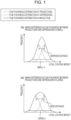
- the states of the film coating weight on projections of a base steel sheet (hereinafter, also written simply as projections) and on depressions of the base steel sheet (hereinafter, also written simply as depressions) vary depending on the magnitude of the film coating weight and the roughness of the underlying base steel sheet.
- a large difference of the film coating weight between projections and depressions may be caused due to any variations in paint characteristics or conditions, such as application conditions.
- the film coating weight is small on projections that are brought into contact with a die during press forming, and consequently press formability is lowered.
- the peak showing the film coating weight distribution in the whole film expands in width, and the value of the standard deviation ⁇ is also large.
- a change in average film coating weight alters the profile of the peak showing the film coating weight distribution in the whole film as described below.
- the average film coating weight is large, a sufficient film coating weight can be obtained on projections, and consequently press formability is enhanced.
- the positions of both peaks of the film coating weight distributions at projections and at depressions shift to the higher coating weight side, and the distance between the peaks of the projections and the depressions is narrow.
- the peak width of the whole film coating weight distribution is reduced, and the value of the standard deviation ⁇ is also small.
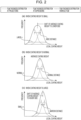
- the width of the peak showing the film coating weight in the whole film is altered also by a change in the roughness of an underlying base steel sheet.
- the roughness of a base steel sheet is small, the variations of the film coating weight distributions at projections and at depressions are small. That is, the film coating weight on projections is stabilized. Consequently, press formability is enhanced.
- the peak widths of the film coating weight distributions at projections and at depressions are small. As a result, the peak width of the whole film coating weight distribution is small, and the value of the standard deviation ⁇ is also small.
- the standard deviation ⁇ of the film coating weight distribution of the whole film is small.
- the standard deviation ⁇ is large.
- the quality of press formability can be estimated by evaluating the magnitude of the standard deviation ⁇ of the film coating weight distribution.
- the standard deviation ⁇ of the film coating weight distribution may be evaluated by measuring a map of the intensity of C-K ⁇ radiation from the main component of the film, and a map of the intensity of Fe-K ⁇ radiation from the main component of the underlying base steel sheet with SEM equipped with an X-ray spectrometer, and calculating the average value ⁇ C/Fe and the standard deviation ⁇ C/Fe from the intensity ratio map obtained from these maps.
- the average value ⁇ C/Fe is approximately proportional to the film coating weight.
- the standard deviation ⁇ C/Fe in the C-K ⁇ /Fe-K ⁇ intensity ratio map may be converted into the standard deviation ⁇ of the film coating weight distribution by comparing ⁇ C/Fe to the film coating weight.
- the calibration curve for converting the characteristic X-ray intensity ratio into the film coating weight assumes that the film coating weight measured by a gravimetric method is 0 when the average ⁇ C/Fe of the characteristic X-ray intensity ratios is 0. That is, the intercept is at the origin.
- the calibration curve is a straight line connecting the origin and a point obtained based on the film coating weight measured by a gravimetric method and the average ⁇ C/Fe of the characteristic X-ray intensity ratios.
- the film coating weight is measured by a gravimetric method in such a manner that the steel sheet coated with the organic resin is submerged in an alkaline solution to dissolve only the organic resin, and the film coating weight is calculated from the change in steel sheet weight before and after the submerge, and the area of the base steel sheet free of the film.
- the average ⁇ C/Fe of the characteristic X-ray intensity ratios is the average value of all the data obtained to measure the standard deviation ⁇ C/Fe of the film coating weight distribution within the sample.
- the acceleration voltage needs to be sufficiently high in order to ensure that the incident electrons can reach even depressions of the underlying base steel sheet where the film coating weight is high and also to ensure that Fe-K ⁇ radiation will be generated with a sufficient intensity.
- the measurement may be performed at an acceleration voltage of 10 kV or more.
- the measurement range and the analysis point size in the measurement of the intensity maps used in the evaluation need to be such that the sizes are statistically significant in relation to the shapes of projections and depressions on the steel sheet surface.
- the surface roughness of the base steel sheet in the steel sheet is approximately 1 pm
- the diameter of projections is approximately 50 ⁇ m. It is therefore desirable that the size be 200 ⁇ m ⁇ 200 ⁇ m so that the measurement range will include 10 or more projections.
- the analysis point size is desirably 10 ⁇ m or less so that the measurement can be made with respect to 10 or more points for each of the projections.
- the field of view for the measurement of the intensity map may be continuous or randomly selected fields may be measured so that the measurement range and the analysis point size will satisfy the above conditions.
- the present inventors studied the relationship between the standard deviation ⁇ of the film coating weight distribution calculated as described hereinabove and the coefficient of friction of the film separately measured. As a result, the present inventors have found that a good coefficient of friction is obtained when the standard deviation ⁇ is less than 0.9 g/m 2 .
- the film coating weight W per side is preferably 2.0 g/m 2 or less. If the film coating weight W per side exceeds 2.0 g/m 2 , film removability may be deteriorated.
- the film coating weight W per side is more preferably 1.5 g/m 2 or less, and particularly preferably 0.9 g/m 2 or less. Outstanding film removability is obtained when the film coating weight W per side is 0.9 g/m 2 or less.
- the film coating weight may be determined by dividing the difference in weight of the steel sheet before and after the film formation by the area, or by completely removing the film from the film-coated steel sheet with an aqueous alkali solution or an organic solvent and dividing the difference in weight of the steel sheet before and after the film removal by the area.
- the arithmetic average roughness Ra of the base steel sheet is 0.4 ⁇ m or more.
- the arithmetic average roughness Ra of the base steel sheet is preferably 2.5 ⁇ m or less.
- the arithmetic average roughness Ra of the base steel sheet is less than 0.4 ⁇ m, minute scratches that can occur during press forming may become more noticeable, and galling may occur during press forming. If the arithmetic average roughness Ra exceeds 2.5 ⁇ m, a larger film coating weight is required to raise the production cost and the sharpness after painting may be deteriorated.
- the arithmetic average roughness Ra (pm) of the base steel sheet may be measured in accordance with JIS B 0633: 2001 (ISO 4288: 1996).
- Ra will be greater than 0.1 and 2 or less
- the arithmetic average roughness is determined from a roughness curve measured while setting the cutoff value and the reference length to 0.8 mm, and the evaluation length to 4 mm.
- Ra will be more than 2 and 10 or less
- the arithmetic average roughness is determined from a roughness curve measured while setting the cutoff value and the reference length to 2.5 mm, and the evaluation length to 12.5 mm.
- the steel sheet production method of the present invention is a method for producing a steel sheet including an organic resin film on a surface of the base steel sheet, the organic resin film containing a polyolefin wax with a melting point of 120°C or above and 140°C or below and an average particle size of 3.0 ⁇ m or less.
- a paint that is a solution or a dispersion of the organic resin in a solvent or further contains a wax is applied to a surface of the base steel sheet and is dried.
- the mass fraction of the film components (the organic resin and the polyolefin wax) in the paint is preferably 1 mass% or more and 25 mass% or less.
- the solvent used in the paint is water or an organic solvent.
- the application may produce an uneven coating.
- the application may be performed by any method without limitation. Examples of the application methods include the use of a roll coater or a bar coater, spraying, dipping, and brush coating.
- the steel sheet may be dried by a common method, for example, hot-air drying, IH heater drying, or infrared heating.
- the maximum temperature of the steel sheet reached during the drying is preferably 60°C or above and 140°C or below. If the maximum temperature is below 60°C, the drying may take a long time and rust inhibition may be lowered. If the maximum temperature exceeds 140°C, the wax particles are melted and combine and the coarsening of particles may deteriorate the lubricity; in addition, the resin is polymerized excessively and the film removability may be deteriorated.
- good press formability can be obtained when the final steel sheet that is produced has a standard deviation ⁇ of the film coating weight distribution of less than 0.9 g/m 2 .
- the application step may be performed during operation while controlling the film coating weight W (g/m 2 ) of the film per side, the paint viscosity, and the coating conditions so that ⁇ will be less than 0.9 g/m 2 .
- This production conditions determination process may be implemented as a step constituting the steel sheet production method or may be performed as an individual step.
- the film coating weight W per side is preferably 0.3 g/m 2 or more, and particularly preferably 0.5 g/m 2 or more.
- the film coating weight W per side is preferably 2.0 g/m 2 or less.
- the film coating weight W per side is more preferably 1.5 g/m 2 or less, and particularly preferably 0.9 g/m 2 or less.
- the paint viscosity of the paint be 1.5 mPa ⁇ s or more. If, on the other hand, the paint viscosity is too high, the paint that is applied tends to be nonuniform and may form a film with a poor appearance, such as streaks. Thus, it is preferable that the viscosity of the paint be 8.0 mPa ⁇ s or less.
- the area fraction of thinner portions of the film may be increased to 25% or more.
- the area fraction of thinner portions of the film may be reduced to 25% or less by elevating the drying temperature as much as possible and shortening the drying time while ensuring that the film satisfies the desired characteristics.
- the drying temperature is preferably 60°C or above, and particularly preferably 80°C or above. As described hereinabove, if the drying temperature exceeds 140°C, the wax particles are melted and combine and the coarsening of particles may deteriorate the lubricity. Thus, it is preferable that the drying temperature be 140°C or below.
- the drying time is preferably 150 seconds or less, more preferably 120 seconds or less, and particularly preferably 60 seconds or less. However, excessively short drying does not fully dry the paint and may result in poor corrosion resistance. Thus, the drying time is preferably 2 seconds or more, and particularly preferably 4 seconds or more.
- the standard deviation ⁇ of the film coating weight distribution may be reduced to less than 0.9 g/m 2 by appropriately controlling the film coating weight of the film per side, the paint viscosity, and the paint drying time.
- Fig. 4 is a schematic front view illustrating a friction coefficient measuring device.
- a friction coefficient measurement sample 1 taken from the steel sheet is fixed on a sample stage 2, and the sample stage 2 is fixed on the upper face of a horizontally movable slide table 3.
- a vertically movable slide table support 5 is provided that has rollers 4 in contact with the lower face of the slide table 3.
- a first load cell 7 is attached to the slide table support 5 to serve as a pusher for the slide table support to measure the pressing load N of a bead 6 to the friction coefficient measurement sample 1.
- a second load cell 8 is attached to one end of the slide table 3 and is used to measure the sliding resistance force F required to move the slide table 3 in the horizontal direction under the application of the pressing force.
- the test was conducted after press cleaning oil PRETON (registered trademark) R352L manufactured by SUGIMURA Chemical Industrial Co., Ltd. was applied as a lubricating oil to the surface of the sample 1.
- Fig. 5 is a schematic perspective view illustrating the shape and the dimensions of the bead used.
- the sample 1 is slid while the lower face of the bead 6 is pressed against the surface of the sample.
- the bead 6 illustrated in Fig. 5 is 10 mm in width and 59 mm in length in the sample sliding direction, and the lower portions at both ends in the sliding direction are curved with a curvature of 4.5 mm R.
- the lower face of the bead that pushes the sample is a flat face having a width of 10 mm and a length in the sliding direction of 50 mm.
- the friction coefficient measurement test was performed using the bead illustrated in Fig. 5 with a pressing load N of 400 kgf and a sample withdrawal speed (a horizontal speed of the slide table 3) of 20 cm/min.
- the slidability was evaluated as excellent ( ⁇ ) when the coefficient of friction was 0.119 or less.
- the slidability was evaluated as good (o) when the coefficient of friction was more than 0.119 and 0.130 or less, and was evaluated as insufficient ( ⁇ ) when the coefficient of friction was more than 0.130.
- test specimens sampled from the steel sheets were degreased with alkaline degreasing agent Fine Cleaner (registered trademark) E6403 (manufactured by Nihon Parkerizing Co., Ltd.).
- the test specimen was immersed in a degreasing liquid having a degreasing agent concentration of 20 g/L and a temperature of 40°C for a predetermined amount of time, and was washed with tap water.
- Removed film ratio (%) [(carbon intensity before degreasing - carbon intensity after degreasing)/(carbon intensity before degreasing - carbon intensity of unlubricated steel sheet)] ⁇ 100
- the film removability of the steel sheet was evaluated in accordance with the criteria below based on the immersion time in the alkaline degreasing liquid required until the removed film ratio reached 98% or more.
- the film removability was judged as acceptable when the rating was ⁇ , o, and ⁇ .
- the standard deviation ⁇ of the film coating weight in the steel sheets was measured as follows.
- the steel sheets obtained above were each cut to give five pieces of 10 mm square size as test materials.
- a Schottky field emission type SEM ⁇ igma manufactured by Carl Zeiss
- an energy dispersive X-ray spectrometer XFlash5
- Central portions of the five test materials sampled from each steel sheet were analyzed to obtain intensity maps of C-K ⁇ radiation and Fe-K ⁇ radiation with respect to 800 ⁇ 600 measurement points at a magnification of 300 times and an acceleration voltage of 15 kV.
- the C-K ⁇ radiation intensities in the measured map were divided by the corresponding Fe-K ⁇ radiation intensities in the map to calculate the C-K ⁇ /Fe-K ⁇ intensity ratio map.
- the average value ⁇ C/Fe of the C-K ⁇ /Fe-K ⁇ intensity ratios and the standard deviation ⁇ C/Fe were determined from the intensity ratio map. The average value of the five fields of view was used for the evaluation.
- the standard deviation ⁇ C/Fe of the C-K ⁇ /Fe-K ⁇ intensity ratio was converted into the standard deviation ⁇ of the film coating weight.
- the standard deviation was evaluated as good (o) when ⁇ determined as described above was less than 0.9 g/m 2 and as poor ( ⁇ ) when ⁇ was 0.9 g/m 2 or more.
- Paint viscosit y (mPa ⁇ s) Maximum temperatur e of base steel sheet reached during drying (°C) Dryin g time (sec) Film coating weight W (g/m 2 ) Standard deviation ⁇ of film coating weight distributio n (g/m 2 ) ⁇ c/Fe ratin g Evaluation items Remarks Coefficient of friction Film removabilit y Coefficient of friction Ratin g 1 B 1 5.6 80 30 0.90 0.19 ⁇ 0.116 ⁇ ⁇ INV. EX. 2 B 2 5.5 80 30 0.90 0.13 ⁇ 0.112 ⁇ ⁇ INV. EX. 3 B 3 5.6 80 30 0.90 0.11 ⁇ 0.111 ⁇ ⁇ INV. EX.
- the steel sheet of the present invention excels in press formability and film removability, and can be used in a broad range of fields mainly based on automobile bodies.
- Reference Signs List
Landscapes
- Chemical & Material Sciences (AREA)
- Engineering & Computer Science (AREA)
- Life Sciences & Earth Sciences (AREA)
- Wood Science & Technology (AREA)
- Organic Chemistry (AREA)
- Materials Engineering (AREA)
- Nanotechnology (AREA)
- Mechanical Engineering (AREA)
- Metallurgy (AREA)
- Oil, Petroleum & Natural Gas (AREA)
- Health & Medical Sciences (AREA)
- Chemical Kinetics & Catalysis (AREA)
- Medicinal Chemistry (AREA)
- Polymers & Plastics (AREA)
- Laminated Bodies (AREA)
Applications Claiming Priority (2)
| Application Number | Priority Date | Filing Date | Title |
|---|---|---|---|
| JP2022049831 | 2022-03-25 | ||
| PCT/JP2023/010198 WO2023182114A1 (ja) | 2022-03-25 | 2023-03-15 | 鋼板およびその製造方法 |
Publications (2)
| Publication Number | Publication Date |
|---|---|
| EP4474143A1 true EP4474143A1 (de) | 2024-12-11 |
| EP4474143A4 EP4474143A4 (de) | 2025-05-28 |
Family
ID=88100809
Family Applications (1)
| Application Number | Title | Priority Date | Filing Date |
|---|---|---|---|
| EP23774710.0A Pending EP4474143A4 (de) | 2022-03-25 | 2023-03-15 | Stahlblech und verfahren zur herstellung davon |
Country Status (6)
| Country | Link |
|---|---|
| EP (1) | EP4474143A4 (de) |
| JP (1) | JP7616392B2 (de) |
| KR (1) | KR20240154021A (de) |
| CN (1) | CN119156281A (de) |
| MX (1) | MX2024011567A (de) |
| WO (1) | WO2023182114A1 (de) |
Family Cites Families (16)
| Publication number | Priority date | Publication date | Assignee | Title |
|---|---|---|---|---|
| JPH0577357A (ja) * | 1991-09-20 | 1993-03-30 | Sumitomo Metal Ind Ltd | 加工後外観に優れた樹脂被覆複合鋼板 |
| JPH05237449A (ja) * | 1992-02-27 | 1993-09-17 | Kawasaki Steel Corp | プレス成形性、加工部耐食性に優れた潤滑樹脂処理鋼板 |
| JPH0780403A (ja) * | 1993-09-16 | 1995-03-28 | Kobe Steel Ltd | プレス成形性、塗装性及び耐食性にすぐれる樹脂塗装鋼板及びその製造方法 |
| JP3143046B2 (ja) * | 1995-07-31 | 2001-03-07 | 日本鋼管株式会社 | プレス成形性および耐孔あき腐食性に優れた有機複合被覆鋼板 |
| JP3088948B2 (ja) * | 1995-12-18 | 2000-09-18 | 日新製鋼株式会社 | 接着剤による接着性の優れたアルカリ可溶型樹脂皮膜被覆亜鉛系めっき鋼板 |
| JP3174503B2 (ja) * | 1996-04-01 | 2001-06-11 | 新日本製鐵株式会社 | プレス加工性の優れた表面処理鋼板の製造方法 |
| JPH1052881A (ja) | 1996-08-09 | 1998-02-24 | Kobe Steel Ltd | 耐型かじり性および耐食性に優れた樹脂被覆金属板およびその製造方法 |
| JPH10109376A (ja) * | 1996-10-08 | 1998-04-28 | Kawasaki Steel Corp | 非アルカリ脱膜型潤滑樹脂処理鋼板およびその製造方法 |
| JP3400366B2 (ja) | 1998-12-04 | 2003-04-28 | 日本鋼管株式会社 | 接着性、耐型カジリ性に優れたアルカリ可溶型有機皮膜被覆鋼板 |
| JP4324296B2 (ja) | 1999-02-26 | 2009-09-02 | 新日本製鐵株式会社 | プレス成形性、耐かじり性に優れたアルカリ可溶型潤滑皮膜を形成可能な塗料組成物およびこの組成物を使用した潤滑表面処理金属製品 |
| JP2001140080A (ja) * | 1999-11-12 | 2001-05-22 | Nippon Steel Corp | 潤滑ステンレス鋼板及び潤滑ステンレス鋼管、並びに潤滑ステンレス鋼管製造方法 |
| JP2008069413A (ja) * | 2006-09-14 | 2008-03-27 | Nippon Steel & Sumikin Stainless Steel Corp | 潤滑鋼板 |
| JP5861823B2 (ja) * | 2011-10-28 | 2016-02-16 | Jfeスチール株式会社 | 潤滑性と脱脂性に優れる鋼板 |
| JP6512204B2 (ja) | 2015-12-04 | 2019-05-15 | Jfeスチール株式会社 | ステンレス鋼板用潤滑塗料および潤滑ステンレス鋼板 |
| WO2017094893A1 (ja) * | 2015-12-04 | 2017-06-08 | Jfeスチール株式会社 | ステンレス鋼板用潤滑塗料および潤滑ステンレス鋼板 |
| JP6933294B2 (ja) * | 2018-08-07 | 2021-09-08 | Jfeスチール株式会社 | 潤滑皮膜を有する鋼板およびその製造方法 |
-
2023
- 2023-03-15 KR KR1020247031190A patent/KR20240154021A/ko active Pending
- 2023-03-15 JP JP2023539323A patent/JP7616392B2/ja active Active
- 2023-03-15 EP EP23774710.0A patent/EP4474143A4/de active Pending
- 2023-03-15 MX MX2024011567A patent/MX2024011567A/es unknown
- 2023-03-15 CN CN202380028546.5A patent/CN119156281A/zh active Pending
- 2023-03-15 WO PCT/JP2023/010198 patent/WO2023182114A1/ja not_active Ceased
Also Published As
| Publication number | Publication date |
|---|---|
| JP7616392B2 (ja) | 2025-01-17 |
| CN119156281A (zh) | 2024-12-17 |
| US20250215248A1 (en) | 2025-07-03 |
| EP4474143A4 (de) | 2025-05-28 |
| KR20240154021A (ko) | 2024-10-24 |
| WO2023182114A1 (ja) | 2023-09-28 |
| JPWO2023182114A1 (de) | 2023-09-28 |
| MX2024011567A (es) | 2024-09-30 |
Similar Documents
| Publication | Publication Date | Title |
|---|---|---|
| EP4431635B1 (de) | Mit schmierfilm beschichtetes verzinktes stahlblech und verfahren zur herstellung davon | |
| US12595390B2 (en) | Steel sheet and production method therefor | |
| EP4512616A1 (de) | Beschichtetes stahlblech und herstellungsverfahren dafür | |
| EP4474143A1 (de) | Stahlblech und verfahren zur herstellung davon | |
| US12617951B2 (en) | Steel sheet and method for producing the same | |
| EP4238764B1 (de) | Stahlblech und verfahren zur herstellung davon | |
| EP4538421A1 (de) | Galvanisiertes stahlblech und herstellungsverfahren dafür | |
| JP2023059205A (ja) | 金属板塗布用塗料 | |
| JP7552576B2 (ja) | 鋼板およびその製造方法 | |
| EP4477410A1 (de) | Stahlblech und verfahren zur herstellung davon | |
| JP7616365B2 (ja) | 有機樹脂被覆鋼板 | |
| JP7380963B1 (ja) | 被覆鋼板およびその製造方法 | |
| EP4509309A1 (de) | Beschichtetes stahlblech und verfahren zur herstellung davon | |
| JP7838724B1 (ja) | 皮膜付き亜鉛系めっき鋼板およびその製造方法 | |
| EP4382589A1 (de) | Beschichtungsmaterial zur beschichtung von metallplatten | |
| WO2023238612A1 (ja) | 被覆鋼板およびその製造方法 | |
| WO2023238610A1 (ja) | 被覆鋼板およびその製造方法 | |
| KR20240093806A (ko) | 냉간 압연 강판 | |
| CN118076703A (zh) | 金属板涂布用涂料 |
Legal Events
| Date | Code | Title | Description |
|---|---|---|---|
| STAA | Information on the status of an ep patent application or granted ep patent |
Free format text: STATUS: THE INTERNATIONAL PUBLICATION HAS BEEN MADE |
|
| PUAI | Public reference made under article 153(3) epc to a published international application that has entered the european phase |
Free format text: ORIGINAL CODE: 0009012 |
|
| STAA | Information on the status of an ep patent application or granted ep patent |
Free format text: STATUS: REQUEST FOR EXAMINATION WAS MADE |
|
| 17P | Request for examination filed |
Effective date: 20240905 |
|
| AK | Designated contracting states |
Kind code of ref document: A1 Designated state(s): AL AT BE BG CH CY CZ DE DK EE ES FI FR GB GR HR HU IE IS IT LI LT LU LV MC ME MK MT NL NO PL PT RO RS SE SI SK SM TR |
|
| A4 | Supplementary search report drawn up and despatched |
Effective date: 20250428 |
|
| RIC1 | Information provided on ipc code assigned before grant |
Ipc: C09D 7/40 20180101ALI20250422BHEP Ipc: C09D 7/61 20180101ALI20250422BHEP Ipc: C09D 7/65 20180101ALI20250422BHEP Ipc: C08L 23/06 20060101ALI20250422BHEP Ipc: C09D 133/08 20060101ALI20250422BHEP Ipc: C23C 26/00 20060101ALI20250422BHEP Ipc: C09D 5/08 20060101ALI20250422BHEP Ipc: B32B 15/18 20060101AFI20250422BHEP |
|
| DAV | Request for validation of the european patent (deleted) | ||
| DAX | Request for extension of the european patent (deleted) |