EP4481616A1 - Procédé de simulation d'une colonne de distillation au moyen d'un dispositif de calcul électronique, produit programme informatique, support de stockage lisible par ordinateur et dispositif de calcul électronique - Google Patents
Procédé de simulation d'une colonne de distillation au moyen d'un dispositif de calcul électronique, produit programme informatique, support de stockage lisible par ordinateur et dispositif de calcul électronique Download PDFInfo
- Publication number
- EP4481616A1 EP4481616A1 EP23181132.4A EP23181132A EP4481616A1 EP 4481616 A1 EP4481616 A1 EP 4481616A1 EP 23181132 A EP23181132 A EP 23181132A EP 4481616 A1 EP4481616 A1 EP 4481616A1
- Authority
- EP
- European Patent Office
- Prior art keywords
- distillation
- computing device
- electronic computing
- tray
- distillation column
- Prior art date
- Legal status (The legal status is an assumption and is not a legal conclusion. Google has not performed a legal analysis and makes no representation as to the accuracy of the status listed.)
- Withdrawn
Links
Images

Classifications
-
- G—PHYSICS
- G06—COMPUTING OR CALCULATING; COUNTING
- G06F—ELECTRIC DIGITAL DATA PROCESSING
- G06F30/00—Computer-aided design [CAD]
- G06F30/20—Design optimisation, verification or simulation
- G06F30/27—Design optimisation, verification or simulation using machine learning, e.g. artificial intelligence, neural networks, support vector machines [SVM] or training a model
-
- B—PERFORMING OPERATIONS; TRANSPORTING
- B01—PHYSICAL OR CHEMICAL PROCESSES OR APPARATUS IN GENERAL
- B01D—SEPARATION
- B01D3/00—Distillation or related exchange processes in which liquids are contacted with gaseous media, e.g. stripping
- B01D3/42—Regulation; Control
-
- F—MECHANICAL ENGINEERING; LIGHTING; HEATING; WEAPONS; BLASTING
- F25—REFRIGERATION OR COOLING; COMBINED HEATING AND REFRIGERATION SYSTEMS; HEAT PUMP SYSTEMS; MANUFACTURE OR STORAGE OF ICE; LIQUEFACTION SOLIDIFICATION OF GASES
- F25J—LIQUEFACTION, SOLIDIFICATION OR SEPARATION OF GASES OR GASEOUS OR LIQUEFIED GASEOUS MIXTURES BY PRESSURE AND COLD TREATMENT OR BY BRINGING THEM INTO THE SUPERCRITICAL STATE
- F25J3/00—Processes or apparatus for separating the constituents of gaseous or liquefied gaseous mixtures involving the use of liquefaction or solidification
- F25J3/02—Processes or apparatus for separating the constituents of gaseous or liquefied gaseous mixtures involving the use of liquefaction or solidification by rectification, i.e. by continuous interchange of heat and material between a vapour stream and a liquid stream
- F25J3/04—Processes or apparatus for separating the constituents of gaseous or liquefied gaseous mixtures involving the use of liquefaction or solidification by rectification, i.e. by continuous interchange of heat and material between a vapour stream and a liquid stream for air
- F25J3/04763—Start-up or control of the process; Details of the apparatus used
- F25J3/04769—Operation, control and regulation of the process; Instrumentation within the process
- F25J3/04848—Control strategy, e.g. advanced process control or dynamic modeling
-
- G—PHYSICS
- G06—COMPUTING OR CALCULATING; COUNTING
- G06F—ELECTRIC DIGITAL DATA PROCESSING
- G06F2119/00—Details relating to the type or aim of the analysis or the optimisation
- G06F2119/22—Yield analysis or yield optimisation
Definitions
- the invention relates to a method for simulating a distillation column by means of an electronic computing device according to the applicable patent claim 1. Furthermore, the invention relates to a computer program product, a computer-readable storage medium and an electronic computing device.
- a mixture of liquid substances is separated by evaporation and subsequent condensation.
- a mixture of two or more components with different boiling points in particular a so-called low boiler and a high boiler, is heated to defined temperatures in a so-called distillation column until one of the two substances evaporates.
- the vapor rises, is cooled and collected as a liquid in a collecting container.
- parts of the separated substance can be fed back into the distillation column, which is also known as reflux.
- the high boiler is skimmed off at the lowest level of the distillation column, which is known as the sump.
- VLE complex vapor-liquid equilibrium
- the proportion of high and low boilers in the gas and liquid phase is determined for each tray.
- a flow calculation is carried out for each tray, in particular, which proportion of the liquid substance drops onto the tray below and which proportion of gaseous substances rises to the tray above.
- the mass balances are also calculated and a total mass per tray is determined, as well as the energy balances.
- the VLE is based on the solution of high-dimensional, non-linear systems of equations; the mass and energy balances are systems of ordinary differential equations, which means a very high overall calculation effort for each individual tray.
- the object of the present invention is to provide a method, a computer program product, a computer-readable storage medium and an electronic computing device by means of which a simulation of a distillation column can be carried out in a computationally efficient manner.
- One aspect of the invention relates to a method for simulating a distillation column by means of an electronic computing device, with the steps of specifying a number of distillation trays within the distillation column by means of the electronic computing device.
- Dependencies between individual distillation trays are determined by means of the electronic computing device.
- a mathematical model for a distillation tray is provided by means of the electronic computing device.
- At least one respective tray parameter of a respective distillation tray is determined by means of the electronic computing device. This is followed by concatenating the respective tray parameters depending on the determined dependencies of the individual distillation trays to form an overall model of the distillation column by means of the electronic computing device and simulating the distillation column depending on the overall model by means of the electronic computing device.
- distillation column consists of several distillation trays on which the same chemical and physical processes always take place, it is intended that a corresponding mathematical model is provided for each tray/distillation tray and that these tray models are subsequently concatenated.
- the calculated amounts of substance and enthalpies can be used again as input for the combination of all tray models if a static model is desired.
- the calculated ascending gas flows and outflowing liquid flows from the previous steps are now inflows for the tray above and below, respectively.
- This process can be repeated iteratively until all physical processes are balanced and a steady state has been reached.
- it can also be advantageous not to carry out this iteration and to obtain a dynamic model, for example for operator training of such a distillation column.
- the mathematical model can be compiled from data already collected in the past from at least one real distillation column.
- the mathematical model can provide historical data for the chemical and physical processes within a real distillation column.
- operating data of the at least one real distillation column are preferably measured or otherwise recorded.
- the operating data or data derived therefrom are preferably stored in the mathematical model.
- the simulation The simulated distillation column can then be operated depending on the stored operating data or the data derived from it.
- this has the advantage that the evaluation of the simulation requires significantly less computing power than the calculation in the state of the art. This facilitates the simulation of the system in real time. Furthermore, there is no need for rigorous modeling of the entire system based on expert knowledge of physics, chemistry and thermodynamics, provided that corresponding data can be obtained from the real system. This data can also be referred to as training data, in particular if the mathematical model is provided in the form of artificial intelligence, for example. The limitation of the application area of linear models to the area around a fixed operating point is also eliminated.
- the learning task can be significantly simplified by the hierarchical architecture by using the structure of the problem, in particular the structure of the column from numerous similar trays, and the system dynamics for one tray only have to be learned once. If a rigorous model is available, no expensive sensors are necessary to obtain measurement data, as these are obtained from the rigorous simulation model.
- the mixture of substances simulated in the distillation column is benzene, which is in particular a low boiler or low boiler with a boiling point of 80 °C, and toluene, which is a high boiler or high boiler with a boiling point of 100 °C.
- This mixture of substances is purely exemplary and by no means exhaustive.
- the simulation can also be used for other mixtures of substances.
- the mathematical model is trained using training data and used for the simulation.
- corresponding values for the simulated distillation column can be determined/estimated and output, for example, on an output device.
- different environmental parameters can be adjusted or changed by input and corresponding changes in the simulation can be determined on the basis of these input values, for example recorded by an input device.
- a top product concentration and/or a top product mass flow and/or a bottom product concentration and/or a bottom product mass flow and/or a temperature profile of the individual distillation trays and/or a temperature profile of the distillation column are determined by means of the simulation.
- these are the corresponding system variables which can be determined or calculated by means of the simulation.
- the simulation model created in this way can be used, for example, for operator training, for virtual commissioning or for detecting abnormal system states.
- optimized controls for a real distillation column can also be determined using special optimization methods on a simulation model, for example through reinforcement learning.
- the corresponding system variables which are simulated are in particular the decisive variables in a distillation process.
- the top product can in particular also be referred to as distillate. The corresponding distillation process can thus be reliably simulated.
- the system variables can, for example, be output to a corresponding output device of the electronic computing device.
- a mass flow inlet as input parameter for the simulation and/or an inlet temperature and/or a heating steam quantity and/or an inlet concentration and/or a return mass flow are taken into account.
- these parameters are so-called input parameters that influence the distillation process.
- a further advantageous embodiment provides that a flowing liquid flow is taken into account in a respective mathematical model of the distillation trays.
- flowing liquid flows for example onto an underlying tray, can thus be taken into account accordingly in the mathematical model.
- the simulation can thus be carried out in a simple manner.
- an ascending gas flow is taken into account in a respective mathematical model of the distillation trays.
- the ascending gas flow can also be considered as a drain because the ascending gas flow reaches, for example, a distillation tray above. In this way, a reliable mathematical model can be provided.
- a feed value is set to zero in a mathematical model for a distillation tray without an external feed.
- the distillation column can have at least one distillation tray which has an external feed into which the mixture of substances is introduced.
- the mathematical model for distillation trays is in particular a general model which applies to all distillation trays. In the case of a distillation tray without an external feed, the feed value is set to zero, whereby a distillation tray without a feed can be simulated in a simple manner.
- a single general distillation tray model is sufficient to simulate the corresponding distillation trays.
- a further advantageous embodiment provides that in a mathematical model for a distillation tray without an external outlet, an outlet value is set to zero.
- the distillation column can have at least one distillation tray which has an external outlet from which in particular the high boiler is skimmed off (bottom) or the distillate is removed.
- the mathematical model for distillation trays is in particular a general model which applies to all distillation trays.
- the outlet value is set to zero, whereby a distillation tray without an outlet can be simulated in a simple manner. It is therefore not necessary to provide individual mathematical models for different distillation trays, but a single general distillation tray model is sufficient to be able to simulate the corresponding distillation trays.
- the mathematical model is provided as artificial intelligence.
- the mathematical model is a so-called AI model.
- the artificial intelligence can be designed, for example, as a neural network, for example in the form of a convolutional neural network (CNN) or as a recurrent neural network (RNN).
- CNN convolutional neural network
- RNN recurrent neural network
- the physical processes on and between the individual distillation trays can thus be regarded as equivalent for all trays, which suggests that to train a single AI model that models each tray. This receives the material and energy quantities of all inlets and outlets of each tray as input variables.
- Inlets here are primarily the vapors rising from the tray below and the liquids dripping down from the tray above.
- at least three trays have an external inlet.
- the mixture enters the distillation tower through an inlet in the middle section of the column, the reflux through an inlet in the upper section, and the vapor from the evaporator is fed into the lower tray.
- Outlets are the vapors flowing to the tray above and the liquids dripping down to the tray below. In the case of the top tray, the vapors flowing upwards are the distillate obtained. In this way, a simulation can be reliably implemented using artificial intelligence.
- an enthalpy and/or a density of a phase equilibrium and/or a pressure of the phase equilibrium are determined as a soil parameter for a respective distillation tray.
- the output variables from the mathematical model are the enthalpy of the tray, the density and the pressure of the phase equilibrium, for example from liquid to vapor, on the respective tray.
- the temperature for the respective tray can be calculated from the density and the enthalpy. Density and pressure in turn serve as input variables for the flow calculation. This can be done classically, for example, by means of the numerical solution of the so-called Navier-Stokes equations or alternatively also by means of a model based on artificial intelligence.
- the flow calculation determines the amounts of gases evaporated to the tray above or the liquids dripping to the tray below.
- the mass flows can then be determined from the material flows of all components of a mixture using the molar masses of the components.
- a position of the distillation trays in the distillation column is determined as a dependency of the distillation trays on one another.
- the individual distillation trays form a so-called stack of the distillation trays.
- the distillate is removed from the top distillation tray, while the bottom distillation tray forms the sump.
- Based on the corresponding positions relative to one another it is possible to determine in particular which outflows and inflows are to be recorded on the respective distillation tray. The simulation can therefore be carried out reliably depending on the position.
- a liquid flow flowing out of an overlying distillation tray is taken into account in the mathematical model as an inflow for an underlying distillation tray and/or an ascending gas flow flowing out of an underlying distillation tray is taken into account in the mathematical model as an inflow for an overlying distillation tray.
- This allows corresponding physical properties to be taken into account depending on the position of the respective distillation tray.
- This allows a respective distillation tray to be reliably modeled and, overall, the overall model for the distillation column to be reliably determined.
- a further aspect of the invention relates to a computer program product with program code means which cause an electronic computing device to carry out a method according to the previous aspect when the program code means are processed by the electronic computing device.
- Yet another aspect of the invention relates to a computer-readable storage medium with at least one computer program product according to the preceding aspect.
- the invention also relates to an electronic computing device for simulating a distillation column, wherein the electronic computing device is designed to carry out a method according to the preceding aspect. In particular, the method is carried out by means of the simulation.
- the electronic computing device here additionally has in particular an input device for recording input parameters and an output device for outputting system variables.
- a computing unit/electronic computing device can be understood in particular as a data processing device that contains a processing circuit.
- the computing unit can therefore in particular process data to carry out computing operations. This may also include operations to carry out indexed access to a data structure, for example a conversion table, LUT (English: "look-up table").
- the computing unit may in particular comprise one or more computers, one or more microcontrollers and/or one or more contain several integrated circuits, for example one or more application-specific integrated circuits, ASIC (English: “application-specific integrated circuit"), one or more field-programmable gate arrays, FPGA, and/or one or more single-chip systems, SoC (English: "system on a chip”).
- the computing unit can also contain one or more processors, for example one or more microprocessors, one or more central processing units, CPU (English: “central processing unit"), one or more graphics processing units, GPU (English: “graphics processing unit”) and/or one or more signal processors, in particular one or more digital signal processors, DSP.
- the computing unit can also contain a physical or virtual network of computers or other of the aforementioned units.
- the computing unit includes one or more hardware and/or software interfaces and/or one or more memory units.
- a memory unit can be a volatile data storage device, such as a dynamic random access memory (DRAM) or a static random access memory (SRAM), or a non-volatile data storage device, such as a read-only memory (ROM), a programmable read-only memory (PROM), an erasable programmable read-only memory (EPROM), an electrically erasable programmable read-only memory (EEPROM), a flash memory or flash EEPROM, a ferroelectric random access memory (FRAM), a magnetoresistive random access memory (MRAM) or a phase change memory with random access, PCRAM (English: "phase-change random access memory”).
- DRAM dynamic random access memory
- SRAM static random access memory
- ROM read-only memory
- PROM programmable read-only memory
- EPROM erasable programmable read-only memory
- EEPROM electrically erasable programmable read-only memory
- flash memory or flash EEPROM a ferroelectric random access memory (FRAM),
- an artificial neural network can be understood as software code that is stored on a computer-readable storage medium and represents one or more networked artificial neurons or can simulate their function.
- the software code can also contain several software code components that can, for example, have different functions.
- an artificial neural network can implement a non-linear model or a non-linear algorithm that maps an input to an output, where the input is given by an input feature vector or an input sequence and the output can, for example, contain an output category for a classification task, one or more predicted values or a predicted sequence.
- an error message and/or a request to enter user feedback is issued and/or a default setting and/or a predetermined initial state is set.
- a real distillation column can be controlled depending on the simulation.
- a mass flow inlet, a feed temperature, a heating steam quantity, a feed concentration and/or a return mass flow can be measured on the real distillation column and fed into the simulation as input parameters.
- the real distillation column can then be controlled depending on the simulation results derived from the input parameters.
- These simulation results can in particular be a top product concentration, a top product mass flow, a bottom product concentration, a bottom product mass flow, a temperature profile of the individual distillation trays (14a - 14d) and/or a temperature profile (T1 - T4) of the distillation column.
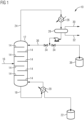
- FIG 1 shows a schematic block diagram according to an embodiment of a real distillation system 10.
- the distillation system 10 has at least one distillation column 12.
- the distillation column 12 has a large number of trays/distillation trays 14. For example, there can be 80 trays 14 in the distillation column 12.
- the distillation column 12 has an external inlet 16, through which, for example, a mixture of substances is introduced into the distillation column 12.
- the distillation column 12 also has an external outlet 18, which can also be referred to in particular as a sump.
- an evaporator 20 can be connected via the outlet 18 in order to bring steam back into the distillation column 12.
- a collecting container 22 for the sump is also shown in the sump.
- FIG 1 a further outlet 24, via which in particular the distillate can be obtained.
- a cooler 26 is also provided, as well as a reflux tank 28.
- an exhaust line 30 and a water outlet 32 can be provided.
- Corresponding valves 34 are also shown.
- a reflux 36 can in turn be provided back into the distillation column 12, for example in order to increase the quality of the distillate.
- a collecting tank 38 can be provided, which collects the distillate.
- FIG 1 for example, that a mixture of substances consisting of two or more components with different boiling points, in particular a so-called low boiler and a high boiler, is heated to defined temperatures in the distillation column 12 until one of the two substances evaporates. The vapor rises, is cooled and collected in the collecting container 38 as a liquid/distillate. In order to achieve a higher degree of purity, parts of the substance mentioned can be fed back into the distillation column 12, which is referred to as reflux 36. At the lowest level of the distillation column 12, the bottom is again the sump, where the high boiler is skimmed off.
- a mixture of benzene and toluene can be considered as a mixture of substances.
- other mixtures of substances can also be introduced into the distillation column 12.
- the mass flow inlet, the inlet temperature, a heating steam quantity, an inlet concentration and a return mass flow can be considered as physical input variables.
- System variables, in particular as output variables, which are to be simulated, can be considered or calculated in particular as a head product concentration, a head product mass flow, a bottom product concentration, a bottom product mass flow and temperatures for the temperature profile within the distillation column 12 from bottom to top.
- the distillate can also be referred to as the head product.
- the simulation model created in this way can be used, for example, for operator training, for virtual commissioning or for detecting abnormal system states.
- optimized controls can also be achieved using special optimization methods on the simulation model. for the system, for example through reinforcement learning.
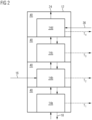
- FIG 2 shows a schematic block diagram according to an embodiment of a distillation column 12.
- a schematic representation of a respective tray model is shown as an AI model 40, which later leads to a mathematical model 44 ( FIG. 3 ) is shown for individual distillation trays 14.
- Some distillation trays 14 are provided with additional inlets, such as feed, return and steam. Furthermore, some are provided with corresponding outlets.
- a first distillation tray 14a has a first temperature T1
- a second distillation tray 14b has a second temperature T2
- a third distillation tray 14c has a third temperature T3
- a fourth distillation tray 14d has a fourth temperature T4.
- the FIG 2 purely exemplary, a model of a distillation tower, in particular the distillation column 12, with four distillation trays 14a to 14d.
- the number of distillation trays 14a to 14d within the distillation column 12 is determined by means of an electronic computing device 42 ( FIG 3 ) is specified.
- the dependencies of the individual distillation trays 14a to 14d, in particular their position relative to one another, are then determined by means of the electronic computing device 42.
- the mathematical model 44 for a distillation tray 14a to 14d is then provided by means of the electronic computing device 42.
- At least one respective tray parameter 46a to 46c ( FIG 3 ) of a respective distillation tray 14a to 14d is determined by means of the electronic computing device 42.
- the respective tray parameters 46a to 46c or the individual tray models of the distillation trays 14a to 14d are then concatenated depending on the determined dependencies the individual distillation trays 14a to 14d to form an overall model of the distillation column 12 by means of the electronic computing device 42 and simulating the distillation column 12 as a function of the overall model by means of the electronic computing device 42.
- a simulation is carried out for a continuous operation of the distillation column 12.
- continuous operation is to be understood in particular as meaning that a continuous feed 16 and a continuous outlet 24 are recorded.
- FIG 3 shows a schematic block diagram according to an embodiment of the electronic computing device 42.
- the mathematical model 44 is shown, which in the present embodiment is provided in particular as an artificial intelligence model.
- the physical processes on and between the distillation trays 14a to 14d are the same for all distillation trays 14a to 14d, which is why a single AI model 40, in particular the mathematical model 44, for example in the form of a neural network, is combined, which models one distillation tray 14a to 14d in each case. This receives as input the amounts of substance 48 and the amounts of energy 50 of all inlets and outlets of the respective distillation tray 14a to 14d.
- Inlets here are primarily the vapors rising from the distillation tray 14a to 14d below, for example, and the liquids dripping down from the distillation tray 14a to 14d above.
- at least three distillation trays 14a to 14d have an external inlet 16.
- the mixture of substances enters the distillation tower or distillation column 12 through an external inlet 16 in the middle region of the distillation column 12.
- the return 36 is formed by an inlet in the upper region, and the evaporator 20 then feeds the lower tray or distillation tray 14a to 14d.
- the outlets are the vapors flowing to the distillation tray 14a to 14d above and the vapors flowing to the lower Liquids dripping down from distillation trays 14a to 14d.
- the vapors flowing upwards are the distillate obtained.
- the mathematical model 44 calculates the enthalpy 46a, the density 46b of the phase equilibrium and the pressure 46c of the phase equilibrium as output variables.
- the temperature T for the respective distillation tray 14a to 14d can then be determined from the density 46b and the pressure 46c as well as the enthalpy 46a.
- a flow calculation 52 can in turn be carried out from the density 46b and the pressure 46c. This can be done classically using the numerical solution of the Navier-Stokes equation or alternatively also using another artificial intelligence model.
- the flow calculation 52 determines the amount of substance 54 of the gases evaporating to the distillation tray 14a to 14d above or the liquids dripping to the distillation tray 14a to 14d below.
- the mass flows can then be determined from the material flows of all components of a mixture using the molar masses of the components.
- FIG 4 shows a further schematic block diagram according to an embodiment of a distillation column 12.
- the distillation tray 14c has an external inlet 16 and an external outlet 24.
- the distillation tray 14c is designed in particular as an overlying distillation tray 14c
- the distillation tray 14b is designed in particular as an underlying distillation tray 14b.
- the distillation tray 14b has no external inlet 16 and no external outlet 24.
- the same mathematical models 44 can be provided for both distillation trays 14b, 14c.
- a drain value for the external drain 24 can also be set to zero.
- FIG 4 further shows that a downflowing liquid flow 56 is taken into account in the mathematical model 44. Furthermore, an upflowing gas flow 58 is also taken into account.
- the mathematical model 44 and the corresponding flow calculations 52 are determined or estimated or carried out for all distillation trays 14a to 14d.
- the calculated amounts of substance and enthalpies can be used again as input for the combination of all tray models if a static overall model is desired.
- the calculated ascending gas flows and outflowing liquid flows from the previous step are now inlets for the distillation trays 14a to 14d above and below. This process can be repeated iteratively until all physical processes are balanced and a stationary state has been achieved as an overall model. However, it can also be advantageous not to carry out this iteration and to obtain a dynamic model, for example for operator training.
- the advantage of using a neural network as a mathematical model 44 lies in the rapid evaluation of the network compared to iterative solutions of a nonlinear differential equation system and algebraic equations. This means that the computing time can be significantly reduced.
- the mathematical model 44 can be concatenated multiple times depending on the design of the plant, with the number of tray models corresponding to the number of distillation trays 14a to 14d in the plant.
Landscapes
- Engineering & Computer Science (AREA)
- Physics & Mathematics (AREA)
- General Engineering & Computer Science (AREA)
- Theoretical Computer Science (AREA)
- Evolutionary Computation (AREA)
- Computer Vision & Pattern Recognition (AREA)
- Thermal Sciences (AREA)
- Artificial Intelligence (AREA)
- Chemical & Material Sciences (AREA)
- Mechanical Engineering (AREA)
- Medical Informatics (AREA)
- Software Systems (AREA)
- Computer Hardware Design (AREA)
- Geometry (AREA)
- General Physics & Mathematics (AREA)
- Chemical Kinetics & Catalysis (AREA)
- Vaporization, Distillation, Condensation, Sublimation, And Cold Traps (AREA)
Priority Applications (1)
| Application Number | Priority Date | Filing Date | Title |
|---|---|---|---|
| EP23181132.4A EP4481616A1 (fr) | 2023-06-23 | 2023-06-23 | Procédé de simulation d'une colonne de distillation au moyen d'un dispositif de calcul électronique, produit programme informatique, support de stockage lisible par ordinateur et dispositif de calcul électronique |
Applications Claiming Priority (1)
| Application Number | Priority Date | Filing Date | Title |
|---|---|---|---|
| EP23181132.4A EP4481616A1 (fr) | 2023-06-23 | 2023-06-23 | Procédé de simulation d'une colonne de distillation au moyen d'un dispositif de calcul électronique, produit programme informatique, support de stockage lisible par ordinateur et dispositif de calcul électronique |
Publications (1)
| Publication Number | Publication Date |
|---|---|
| EP4481616A1 true EP4481616A1 (fr) | 2024-12-25 |
Family
ID=87047878
Family Applications (1)
| Application Number | Title | Priority Date | Filing Date |
|---|---|---|---|
| EP23181132.4A Withdrawn EP4481616A1 (fr) | 2023-06-23 | 2023-06-23 | Procédé de simulation d'une colonne de distillation au moyen d'un dispositif de calcul électronique, produit programme informatique, support de stockage lisible par ordinateur et dispositif de calcul électronique |
Country Status (1)
| Country | Link |
|---|---|
| EP (1) | EP4481616A1 (fr) |
-
2023
- 2023-06-23 EP EP23181132.4A patent/EP4481616A1/fr not_active Withdrawn
Non-Patent Citations (3)
| Title |
|---|
| "Distillation Processes - From Solar and Membrane Distillation to Reactive Distillation Modelling, Simulation and Optimization", 31 August 2022, INTECHOPEN, ISBN: 978-1-83962-808-5, article SANCHEZ-RUIZ FRANCISCO J.: "Reactive Distillation Modeling Using Artificial Neural Networks", XP093109784, DOI: 10.5772/intechopen.101261 * |
| FERNANDEZ DE CANETE J ET AL: "Object-oriented approach applied to ANFIS modeling and control of a distillation column", EXPERT SYSTEMS WITH APPLICATIONS, ELSEVIER, AMSTERDAM, NL, vol. 40, no. 14, 19 April 2013 (2013-04-19), pages 5648 - 5660, XP028561753, ISSN: 0957-4174, DOI: 10.1016/J.ESWA.2013.04.012 * |
| PARK HYUNDO ET AL: "A framework for energy optimization of distillation process using machine learning-based predictive model", ENERGY SCIENCE & ENGINEERING, vol. 10, no. 6, 25 March 2022 (2022-03-25), pages 1913 - 1924, XP093109786, ISSN: 2050-0505, Retrieved from the Internet <URL:https://onlinelibrary.wiley.com/doi/full-xml/10.1002/ese3.1134> DOI: 10.1002/ese3.1134 * |
Similar Documents
| Publication | Publication Date | Title |
|---|---|---|
| DE69315291T2 (de) | Regelungssystem das ein selbstadaptives neuronales Netzwerk benutzt um das Ziel und die Wegeauswahl zu optimieren in einem mehrgrössen/nichtlinearen System | |
| DE69511991T2 (de) | Verfahren und Vorrichtung zur Steuerung von Mehrgrössen-/nichtlinearen Systemen | |
| EP2106576B1 (fr) | Procédé de commande et/ou de régulation d'un système technique assistées par ordinateur | |
| DE69701878T2 (de) | Auf nichtlinearer annäherungsmethode basierende automatische vorrichtung | |
| DE10362369B3 (de) | Integrierte Modell-Vorhersagesteuerung und -optimierung innerhalb eines Prozesssteuerungssystems | |
| DE102004026979B4 (de) | Vielfacheingabe- /Vielfachausgabe-Steuer-/Regelblöcke mit nichtlinearen Vorhersagefähigkeiten | |
| DE69328956T2 (de) | Anlage zum Schätzen des Zustands eines Systems auf der Grundlage von aufgezeichneten Eingabe-Ausgabedaten für das System | |
| DE69425100T2 (de) | Dynamisches neuronales Netzwerk | |
| DE69511291T2 (de) | Mehrgrössenprozesssteuermethode und gerät | |
| DE102019126310A1 (de) | System und Verfahren zum Optimieren der Verbrennung eines Kessels | |
| DE102014205627B3 (de) | Zustandsbeobachter für einen Dampferzeuger eines Dampfkraftwerks | |
| DE68922567T2 (de) | Neuronales Netzwerksystem. | |
| EP0559043A1 (fr) | Méthode de contrôle des échangeurs de chaleur | |
| EP1145192B1 (fr) | Configuration d'elements informatiques interconnectes, procede de determination assistee par ordinateur d'une dynamique a la base d'un processus dynamique et procede d'apprentissage assiste par ordinateur d'une configuration d'elements informatiques interconnectes | |
| WO2023194492A1 (fr) | Procédé de surveillance d'un système électrochimique, et système électrochimique | |
| EP1021793A2 (fr) | Ensemble d'elements de calcul relies les uns aux autres, procede de determination assistee par ordinateur d'une dynamique a la base d'un processus dynamique, et procede d'entrainement assiste par ordinateur pour un ensemble d'elements de calcul relies les uns aux autres | |
| DE102007026314A1 (de) | Verfahren zur Steuerung und/oder Regelung eines Brennstoffzellensystems | |
| EP4481616A1 (fr) | Procédé de simulation d'une colonne de distillation au moyen d'un dispositif de calcul électronique, produit programme informatique, support de stockage lisible par ordinateur et dispositif de calcul électronique | |
| WO2018091592A1 (fr) | Dispositif et procédé de détermination des paramètres d'un dispositif de régulation | |
| EP0762245B1 (fr) | Méthode de détection d'une prédiction défectueuse dans une commande de processus à réseaux neuronaux | |
| WO2001057648A2 (fr) | Configuration d'elements de calcul interconnectes et procede de determination assistee par ordinateur du deuxieme etat d'un systeme dans un premier espace d'etat a partir d'un premier etat du systeme dans le premier espace d'etat | |
| WO1990009831A1 (fr) | Systeme de diagnostic et de regulation de colonnes de rectification a l'aide d'un modele | |
| EP3489773B1 (fr) | Procédé de commande assisté par ordinateur d'un système technique, en particulier d'une installation de production d'énergie | |
| DE4434294C2 (de) | Verfahren zur Steuerung eines nichtlinearen, technischen Prozesses | |
| EP1071999B1 (fr) | Procede et systeme pour la determination assistee par ordinateur d'une specification de representation |
Legal Events
| Date | Code | Title | Description |
|---|---|---|---|
| PUAI | Public reference made under article 153(3) epc to a published international application that has entered the european phase |
Free format text: ORIGINAL CODE: 0009012 |
|
| STAA | Information on the status of an ep patent application or granted ep patent |
Free format text: STATUS: THE APPLICATION HAS BEEN PUBLISHED |
|
| AK | Designated contracting states |
Kind code of ref document: A1 Designated state(s): AL AT BE BG CH CY CZ DE DK EE ES FI FR GB GR HR HU IE IS IT LI LT LU LV MC ME MK MT NL NO PL PT RO RS SE SI SK SM TR |
|
| STAA | Information on the status of an ep patent application or granted ep patent |
Free format text: STATUS: THE APPLICATION IS DEEMED TO BE WITHDRAWN |
|
| 18D | Application deemed to be withdrawn |
Effective date: 20250626 |