EP4495085A1 - Antimonoxid-substitut-zinkoxid-element - Google Patents
Antimonoxid-substitut-zinkoxid-element Download PDFInfo
- Publication number
- EP4495085A1 EP4495085A1 EP23770564.5A EP23770564A EP4495085A1 EP 4495085 A1 EP4495085 A1 EP 4495085A1 EP 23770564 A EP23770564 A EP 23770564A EP 4495085 A1 EP4495085 A1 EP 4495085A1
- Authority
- EP
- European Patent Office
- Prior art keywords
- oxide
- zinc oxide
- zinc
- fired body
- mol
- Prior art date
- Legal status (The legal status is an assumption and is not a legal conclusion. Google has not performed a legal analysis and makes no representation as to the accuracy of the status listed.)
- Pending
Links
Images


Classifications
-
- C—CHEMISTRY; METALLURGY
- C04—CEMENTS; CONCRETE; ARTIFICIAL STONE; CERAMICS; REFRACTORIES
- C04B—LIME, MAGNESIA; SLAG; CEMENTS; COMPOSITIONS THEREOF, e.g. MORTARS, CONCRETE OR LIKE BUILDING MATERIALS; ARTIFICIAL STONE; CERAMICS; REFRACTORIES; TREATMENT OF NATURAL STONE
- C04B35/00—Shaped ceramic products characterised by their composition; Ceramics compositions; Processing powders of inorganic compounds preparatory to the manufacturing of ceramic products
- C04B35/01—Shaped ceramic products characterised by their composition; Ceramics compositions; Processing powders of inorganic compounds preparatory to the manufacturing of ceramic products based on oxide ceramics
- C04B35/453—Shaped ceramic products characterised by their composition; Ceramics compositions; Processing powders of inorganic compounds preparatory to the manufacturing of ceramic products based on oxide ceramics based on zinc, tin, or bismuth oxides or solid solutions thereof with other oxides, e.g. zincates, stannates or bismuthates
-
- B—PERFORMING OPERATIONS; TRANSPORTING
- B32—LAYERED PRODUCTS
- B32B—LAYERED PRODUCTS, i.e. PRODUCTS BUILT-UP OF STRATA OF FLAT OR NON-FLAT, e.g. CELLULAR OR HONEYCOMB, FORM
- B32B18/00—Layered products essentially comprising ceramics, e.g. refractory products
-
- C—CHEMISTRY; METALLURGY
- C04—CEMENTS; CONCRETE; ARTIFICIAL STONE; CERAMICS; REFRACTORIES
- C04B—LIME, MAGNESIA; SLAG; CEMENTS; COMPOSITIONS THEREOF, e.g. MORTARS, CONCRETE OR LIKE BUILDING MATERIALS; ARTIFICIAL STONE; CERAMICS; REFRACTORIES; TREATMENT OF NATURAL STONE
- C04B35/00—Shaped ceramic products characterised by their composition; Ceramics compositions; Processing powders of inorganic compounds preparatory to the manufacturing of ceramic products
- C04B35/622—Forming processes; Processing powders of inorganic compounds preparatory to the manufacturing of ceramic products
- C04B35/64—Burning or sintering processes
-
- C—CHEMISTRY; METALLURGY
- C04—CEMENTS; CONCRETE; ARTIFICIAL STONE; CERAMICS; REFRACTORIES
- C04B—LIME, MAGNESIA; SLAG; CEMENTS; COMPOSITIONS THEREOF, e.g. MORTARS, CONCRETE OR LIKE BUILDING MATERIALS; ARTIFICIAL STONE; CERAMICS; REFRACTORIES; TREATMENT OF NATURAL STONE
- C04B41/00—After-treatment of mortars, concrete, artificial stone or ceramics; Treatment of natural stone
- C04B41/009—After-treatment of mortars, concrete, artificial stone or ceramics; Treatment of natural stone characterised by the material treated
-
- C—CHEMISTRY; METALLURGY
- C04—CEMENTS; CONCRETE; ARTIFICIAL STONE; CERAMICS; REFRACTORIES
- C04B—LIME, MAGNESIA; SLAG; CEMENTS; COMPOSITIONS THEREOF, e.g. MORTARS, CONCRETE OR LIKE BUILDING MATERIALS; ARTIFICIAL STONE; CERAMICS; REFRACTORIES; TREATMENT OF NATURAL STONE
- C04B41/00—After-treatment of mortars, concrete, artificial stone or ceramics; Treatment of natural stone
- C04B41/45—Coating or impregnating, e.g. injection in masonry, partial coating of green or fired ceramics, organic coating compositions for adhering together two concrete elements
- C04B41/50—Coating or impregnating, e.g. injection in masonry, partial coating of green or fired ceramics, organic coating compositions for adhering together two concrete elements with inorganic materials
- C04B41/5022—Coating or impregnating, e.g. injection in masonry, partial coating of green or fired ceramics, organic coating compositions for adhering together two concrete elements with inorganic materials with vitreous materials
-
- C—CHEMISTRY; METALLURGY
- C04—CEMENTS; CONCRETE; ARTIFICIAL STONE; CERAMICS; REFRACTORIES
- C04B—LIME, MAGNESIA; SLAG; CEMENTS; COMPOSITIONS THEREOF, e.g. MORTARS, CONCRETE OR LIKE BUILDING MATERIALS; ARTIFICIAL STONE; CERAMICS; REFRACTORIES; TREATMENT OF NATURAL STONE
- C04B41/00—After-treatment of mortars, concrete, artificial stone or ceramics; Treatment of natural stone
- C04B41/45—Coating or impregnating, e.g. injection in masonry, partial coating of green or fired ceramics, organic coating compositions for adhering together two concrete elements
- C04B41/52—Multiple coating or impregnating multiple coating or impregnating with the same composition or with compositions only differing in the concentration of the constituents, is classified as single coating or impregnation
-
- C—CHEMISTRY; METALLURGY
- C04—CEMENTS; CONCRETE; ARTIFICIAL STONE; CERAMICS; REFRACTORIES
- C04B—LIME, MAGNESIA; SLAG; CEMENTS; COMPOSITIONS THEREOF, e.g. MORTARS, CONCRETE OR LIKE BUILDING MATERIALS; ARTIFICIAL STONE; CERAMICS; REFRACTORIES; TREATMENT OF NATURAL STONE
- C04B41/00—After-treatment of mortars, concrete, artificial stone or ceramics; Treatment of natural stone
- C04B41/80—After-treatment of mortars, concrete, artificial stone or ceramics; Treatment of natural stone of only ceramics
- C04B41/81—Coating or impregnation
- C04B41/89—Coating or impregnation for obtaining at least two superposed coatings having different compositions
- C04B41/90—Coating or impregnation for obtaining at least two superposed coatings having different compositions at least one coating being a metal
-
- H—ELECTRICITY
- H01—ELECTRIC ELEMENTS
- H01C—RESISTORS
- H01C7/00—Non-adjustable resistors formed as one or more layers or coatings; Non-adjustable resistors made from powdered conducting material or powdered semi-conducting material with or without insulating material
- H01C7/10—Non-adjustable resistors formed as one or more layers or coatings; Non-adjustable resistors made from powdered conducting material or powdered semi-conducting material with or without insulating material voltage responsive, i.e. varistors
- H01C7/12—Overvoltage protection resistors; Arresters
-
- C—CHEMISTRY; METALLURGY
- C04—CEMENTS; CONCRETE; ARTIFICIAL STONE; CERAMICS; REFRACTORIES
- C04B—LIME, MAGNESIA; SLAG; CEMENTS; COMPOSITIONS THEREOF, e.g. MORTARS, CONCRETE OR LIKE BUILDING MATERIALS; ARTIFICIAL STONE; CERAMICS; REFRACTORIES; TREATMENT OF NATURAL STONE
- C04B2235/00—Aspects relating to ceramic starting mixtures or sintered ceramic products
- C04B2235/02—Composition of constituents of the starting material or of secondary phases of the final product
- C04B2235/30—Constituents and secondary phases not being of a fibrous nature
- C04B2235/32—Metal oxides, mixed metal oxides, or oxide-forming salts thereof, e.g. carbonates, nitrates, (oxy)hydroxides, chlorides
- C04B2235/3217—Aluminum oxide or oxide forming salts thereof, e.g. bauxite, alpha-alumina
-
- C—CHEMISTRY; METALLURGY
- C04—CEMENTS; CONCRETE; ARTIFICIAL STONE; CERAMICS; REFRACTORIES
- C04B—LIME, MAGNESIA; SLAG; CEMENTS; COMPOSITIONS THEREOF, e.g. MORTARS, CONCRETE OR LIKE BUILDING MATERIALS; ARTIFICIAL STONE; CERAMICS; REFRACTORIES; TREATMENT OF NATURAL STONE
- C04B2235/00—Aspects relating to ceramic starting mixtures or sintered ceramic products
- C04B2235/02—Composition of constituents of the starting material or of secondary phases of the final product
- C04B2235/30—Constituents and secondary phases not being of a fibrous nature
- C04B2235/32—Metal oxides, mixed metal oxides, or oxide-forming salts thereof, e.g. carbonates, nitrates, (oxy)hydroxides, chlorides
- C04B2235/3224—Rare earth oxide or oxide forming salts thereof, e.g. scandium oxide
-
- C—CHEMISTRY; METALLURGY
- C04—CEMENTS; CONCRETE; ARTIFICIAL STONE; CERAMICS; REFRACTORIES
- C04B—LIME, MAGNESIA; SLAG; CEMENTS; COMPOSITIONS THEREOF, e.g. MORTARS, CONCRETE OR LIKE BUILDING MATERIALS; ARTIFICIAL STONE; CERAMICS; REFRACTORIES; TREATMENT OF NATURAL STONE
- C04B2235/00—Aspects relating to ceramic starting mixtures or sintered ceramic products
- C04B2235/02—Composition of constituents of the starting material or of secondary phases of the final product
- C04B2235/30—Constituents and secondary phases not being of a fibrous nature
- C04B2235/32—Metal oxides, mixed metal oxides, or oxide-forming salts thereof, e.g. carbonates, nitrates, (oxy)hydroxides, chlorides
- C04B2235/3224—Rare earth oxide or oxide forming salts thereof, e.g. scandium oxide
- C04B2235/3225—Yttrium oxide or oxide-forming salts thereof
-
- C—CHEMISTRY; METALLURGY
- C04—CEMENTS; CONCRETE; ARTIFICIAL STONE; CERAMICS; REFRACTORIES
- C04B—LIME, MAGNESIA; SLAG; CEMENTS; COMPOSITIONS THEREOF, e.g. MORTARS, CONCRETE OR LIKE BUILDING MATERIALS; ARTIFICIAL STONE; CERAMICS; REFRACTORIES; TREATMENT OF NATURAL STONE
- C04B2235/00—Aspects relating to ceramic starting mixtures or sintered ceramic products
- C04B2235/02—Composition of constituents of the starting material or of secondary phases of the final product
- C04B2235/30—Constituents and secondary phases not being of a fibrous nature
- C04B2235/32—Metal oxides, mixed metal oxides, or oxide-forming salts thereof, e.g. carbonates, nitrates, (oxy)hydroxides, chlorides
- C04B2235/3231—Refractory metal oxides, their mixed metal oxides, or oxide-forming salts thereof
- C04B2235/3241—Chromium oxides, chromates, or oxide-forming salts thereof
-
- C—CHEMISTRY; METALLURGY
- C04—CEMENTS; CONCRETE; ARTIFICIAL STONE; CERAMICS; REFRACTORIES
- C04B—LIME, MAGNESIA; SLAG; CEMENTS; COMPOSITIONS THEREOF, e.g. MORTARS, CONCRETE OR LIKE BUILDING MATERIALS; ARTIFICIAL STONE; CERAMICS; REFRACTORIES; TREATMENT OF NATURAL STONE
- C04B2235/00—Aspects relating to ceramic starting mixtures or sintered ceramic products
- C04B2235/02—Composition of constituents of the starting material or of secondary phases of the final product
- C04B2235/30—Constituents and secondary phases not being of a fibrous nature
- C04B2235/32—Metal oxides, mixed metal oxides, or oxide-forming salts thereof, e.g. carbonates, nitrates, (oxy)hydroxides, chlorides
- C04B2235/3262—Manganese oxides, manganates, rhenium oxides or oxide-forming salts thereof, e.g. MnO
-
- C—CHEMISTRY; METALLURGY
- C04—CEMENTS; CONCRETE; ARTIFICIAL STONE; CERAMICS; REFRACTORIES
- C04B—LIME, MAGNESIA; SLAG; CEMENTS; COMPOSITIONS THEREOF, e.g. MORTARS, CONCRETE OR LIKE BUILDING MATERIALS; ARTIFICIAL STONE; CERAMICS; REFRACTORIES; TREATMENT OF NATURAL STONE
- C04B2235/00—Aspects relating to ceramic starting mixtures or sintered ceramic products
- C04B2235/02—Composition of constituents of the starting material or of secondary phases of the final product
- C04B2235/30—Constituents and secondary phases not being of a fibrous nature
- C04B2235/32—Metal oxides, mixed metal oxides, or oxide-forming salts thereof, e.g. carbonates, nitrates, (oxy)hydroxides, chlorides
- C04B2235/327—Iron group oxides, their mixed metal oxides, or oxide-forming salts thereof
- C04B2235/3275—Cobalt oxides, cobaltates or cobaltites or oxide forming salts thereof, e.g. bismuth cobaltate, zinc cobaltite
-
- C—CHEMISTRY; METALLURGY
- C04—CEMENTS; CONCRETE; ARTIFICIAL STONE; CERAMICS; REFRACTORIES
- C04B—LIME, MAGNESIA; SLAG; CEMENTS; COMPOSITIONS THEREOF, e.g. MORTARS, CONCRETE OR LIKE BUILDING MATERIALS; ARTIFICIAL STONE; CERAMICS; REFRACTORIES; TREATMENT OF NATURAL STONE
- C04B2235/00—Aspects relating to ceramic starting mixtures or sintered ceramic products
- C04B2235/02—Composition of constituents of the starting material or of secondary phases of the final product
- C04B2235/30—Constituents and secondary phases not being of a fibrous nature
- C04B2235/32—Metal oxides, mixed metal oxides, or oxide-forming salts thereof, e.g. carbonates, nitrates, (oxy)hydroxides, chlorides
- C04B2235/327—Iron group oxides, their mixed metal oxides, or oxide-forming salts thereof
- C04B2235/3279—Nickel oxides, nickalates, or oxide-forming salts thereof
-
- C—CHEMISTRY; METALLURGY
- C04—CEMENTS; CONCRETE; ARTIFICIAL STONE; CERAMICS; REFRACTORIES
- C04B—LIME, MAGNESIA; SLAG; CEMENTS; COMPOSITIONS THEREOF, e.g. MORTARS, CONCRETE OR LIKE BUILDING MATERIALS; ARTIFICIAL STONE; CERAMICS; REFRACTORIES; TREATMENT OF NATURAL STONE
- C04B2235/00—Aspects relating to ceramic starting mixtures or sintered ceramic products
- C04B2235/02—Composition of constituents of the starting material or of secondary phases of the final product
- C04B2235/30—Constituents and secondary phases not being of a fibrous nature
- C04B2235/32—Metal oxides, mixed metal oxides, or oxide-forming salts thereof, e.g. carbonates, nitrates, (oxy)hydroxides, chlorides
- C04B2235/3284—Zinc oxides, zincates, cadmium oxides, cadmiates, mercury oxides, mercurates or oxide forming salts thereof
-
- C—CHEMISTRY; METALLURGY
- C04—CEMENTS; CONCRETE; ARTIFICIAL STONE; CERAMICS; REFRACTORIES
- C04B—LIME, MAGNESIA; SLAG; CEMENTS; COMPOSITIONS THEREOF, e.g. MORTARS, CONCRETE OR LIKE BUILDING MATERIALS; ARTIFICIAL STONE; CERAMICS; REFRACTORIES; TREATMENT OF NATURAL STONE
- C04B2235/00—Aspects relating to ceramic starting mixtures or sintered ceramic products
- C04B2235/02—Composition of constituents of the starting material or of secondary phases of the final product
- C04B2235/30—Constituents and secondary phases not being of a fibrous nature
- C04B2235/32—Metal oxides, mixed metal oxides, or oxide-forming salts thereof, e.g. carbonates, nitrates, (oxy)hydroxides, chlorides
- C04B2235/3289—Noble metal oxides
- C04B2235/3291—Silver oxides
-
- C—CHEMISTRY; METALLURGY
- C04—CEMENTS; CONCRETE; ARTIFICIAL STONE; CERAMICS; REFRACTORIES
- C04B—LIME, MAGNESIA; SLAG; CEMENTS; COMPOSITIONS THEREOF, e.g. MORTARS, CONCRETE OR LIKE BUILDING MATERIALS; ARTIFICIAL STONE; CERAMICS; REFRACTORIES; TREATMENT OF NATURAL STONE
- C04B2235/00—Aspects relating to ceramic starting mixtures or sintered ceramic products
- C04B2235/02—Composition of constituents of the starting material or of secondary phases of the final product
- C04B2235/30—Constituents and secondary phases not being of a fibrous nature
- C04B2235/32—Metal oxides, mixed metal oxides, or oxide-forming salts thereof, e.g. carbonates, nitrates, (oxy)hydroxides, chlorides
- C04B2235/3293—Tin oxides, stannates or oxide forming salts thereof, e.g. indium tin oxide [ITO]
-
- C—CHEMISTRY; METALLURGY
- C04—CEMENTS; CONCRETE; ARTIFICIAL STONE; CERAMICS; REFRACTORIES
- C04B—LIME, MAGNESIA; SLAG; CEMENTS; COMPOSITIONS THEREOF, e.g. MORTARS, CONCRETE OR LIKE BUILDING MATERIALS; ARTIFICIAL STONE; CERAMICS; REFRACTORIES; TREATMENT OF NATURAL STONE
- C04B2235/00—Aspects relating to ceramic starting mixtures or sintered ceramic products
- C04B2235/02—Composition of constituents of the starting material or of secondary phases of the final product
- C04B2235/30—Constituents and secondary phases not being of a fibrous nature
- C04B2235/32—Metal oxides, mixed metal oxides, or oxide-forming salts thereof, e.g. carbonates, nitrates, (oxy)hydroxides, chlorides
- C04B2235/3298—Bismuth oxides, bismuthates or oxide forming salts thereof, e.g. zinc bismuthate
-
- C—CHEMISTRY; METALLURGY
- C04—CEMENTS; CONCRETE; ARTIFICIAL STONE; CERAMICS; REFRACTORIES
- C04B—LIME, MAGNESIA; SLAG; CEMENTS; COMPOSITIONS THEREOF, e.g. MORTARS, CONCRETE OR LIKE BUILDING MATERIALS; ARTIFICIAL STONE; CERAMICS; REFRACTORIES; TREATMENT OF NATURAL STONE
- C04B2235/00—Aspects relating to ceramic starting mixtures or sintered ceramic products
- C04B2235/02—Composition of constituents of the starting material or of secondary phases of the final product
- C04B2235/30—Constituents and secondary phases not being of a fibrous nature
- C04B2235/34—Non-metal oxides, non-metal mixed oxides, or salts thereof that form the non-metal oxides upon heating, e.g. carbonates, nitrates, (oxy)hydroxides, chlorides
- C04B2235/3409—Boron oxide, borates, boric acids, or oxide forming salts thereof, e.g. borax
-
- C—CHEMISTRY; METALLURGY
- C04—CEMENTS; CONCRETE; ARTIFICIAL STONE; CERAMICS; REFRACTORIES
- C04B—LIME, MAGNESIA; SLAG; CEMENTS; COMPOSITIONS THEREOF, e.g. MORTARS, CONCRETE OR LIKE BUILDING MATERIALS; ARTIFICIAL STONE; CERAMICS; REFRACTORIES; TREATMENT OF NATURAL STONE
- C04B2235/00—Aspects relating to ceramic starting mixtures or sintered ceramic products
- C04B2235/02—Composition of constituents of the starting material or of secondary phases of the final product
- C04B2235/30—Constituents and secondary phases not being of a fibrous nature
- C04B2235/34—Non-metal oxides, non-metal mixed oxides, or salts thereof that form the non-metal oxides upon heating, e.g. carbonates, nitrates, (oxy)hydroxides, chlorides
- C04B2235/3418—Silicon oxide, silicic acids or oxide forming salts thereof, e.g. silica sol, fused silica, silica fume, cristobalite, quartz or flint
-
- C—CHEMISTRY; METALLURGY
- C04—CEMENTS; CONCRETE; ARTIFICIAL STONE; CERAMICS; REFRACTORIES
- C04B—LIME, MAGNESIA; SLAG; CEMENTS; COMPOSITIONS THEREOF, e.g. MORTARS, CONCRETE OR LIKE BUILDING MATERIALS; ARTIFICIAL STONE; CERAMICS; REFRACTORIES; TREATMENT OF NATURAL STONE
- C04B2235/00—Aspects relating to ceramic starting mixtures or sintered ceramic products
- C04B2235/02—Composition of constituents of the starting material or of secondary phases of the final product
- C04B2235/30—Constituents and secondary phases not being of a fibrous nature
- C04B2235/44—Metal salt constituents or additives chosen for the nature of the anions, e.g. hydrides or acetylacetonate
- C04B2235/443—Nitrates or nitrites
-
- C—CHEMISTRY; METALLURGY
- C04—CEMENTS; CONCRETE; ARTIFICIAL STONE; CERAMICS; REFRACTORIES
- C04B—LIME, MAGNESIA; SLAG; CEMENTS; COMPOSITIONS THEREOF, e.g. MORTARS, CONCRETE OR LIKE BUILDING MATERIALS; ARTIFICIAL STONE; CERAMICS; REFRACTORIES; TREATMENT OF NATURAL STONE
- C04B2235/00—Aspects relating to ceramic starting mixtures or sintered ceramic products
- C04B2235/02—Composition of constituents of the starting material or of secondary phases of the final product
- C04B2235/50—Constituents or additives of the starting mixture chosen for their shape or used because of their shape or their physical appearance
- C04B2235/54—Particle size related information
- C04B2235/5418—Particle size related information expressed by the size of the particles or aggregates thereof
- C04B2235/5436—Particle size related information expressed by the size of the particles or aggregates thereof micrometer sized, i.e. from 1 to 100 micron
-
- C—CHEMISTRY; METALLURGY
- C04—CEMENTS; CONCRETE; ARTIFICIAL STONE; CERAMICS; REFRACTORIES
- C04B—LIME, MAGNESIA; SLAG; CEMENTS; COMPOSITIONS THEREOF, e.g. MORTARS, CONCRETE OR LIKE BUILDING MATERIALS; ARTIFICIAL STONE; CERAMICS; REFRACTORIES; TREATMENT OF NATURAL STONE
- C04B2235/00—Aspects relating to ceramic starting mixtures or sintered ceramic products
- C04B2235/02—Composition of constituents of the starting material or of secondary phases of the final product
- C04B2235/50—Constituents or additives of the starting mixture chosen for their shape or used because of their shape or their physical appearance
- C04B2235/54—Particle size related information
- C04B2235/5418—Particle size related information expressed by the size of the particles or aggregates thereof
- C04B2235/5445—Particle size related information expressed by the size of the particles or aggregates thereof submicron sized, i.e. from 0,1 to 1 micron
-
- C—CHEMISTRY; METALLURGY
- C04—CEMENTS; CONCRETE; ARTIFICIAL STONE; CERAMICS; REFRACTORIES
- C04B—LIME, MAGNESIA; SLAG; CEMENTS; COMPOSITIONS THEREOF, e.g. MORTARS, CONCRETE OR LIKE BUILDING MATERIALS; ARTIFICIAL STONE; CERAMICS; REFRACTORIES; TREATMENT OF NATURAL STONE
- C04B2235/00—Aspects relating to ceramic starting mixtures or sintered ceramic products
- C04B2235/65—Aspects relating to heat treatments of ceramic bodies such as green ceramics or pre-sintered ceramics, e.g. burning, sintering or melting processes
- C04B2235/656—Aspects relating to heat treatments of ceramic bodies such as green ceramics or pre-sintered ceramics, e.g. burning, sintering or melting processes characterised by specific heating conditions during heat treatment
- C04B2235/6562—Heating rate
-
- C—CHEMISTRY; METALLURGY
- C04—CEMENTS; CONCRETE; ARTIFICIAL STONE; CERAMICS; REFRACTORIES
- C04B—LIME, MAGNESIA; SLAG; CEMENTS; COMPOSITIONS THEREOF, e.g. MORTARS, CONCRETE OR LIKE BUILDING MATERIALS; ARTIFICIAL STONE; CERAMICS; REFRACTORIES; TREATMENT OF NATURAL STONE
- C04B2235/00—Aspects relating to ceramic starting mixtures or sintered ceramic products
- C04B2235/65—Aspects relating to heat treatments of ceramic bodies such as green ceramics or pre-sintered ceramics, e.g. burning, sintering or melting processes
- C04B2235/656—Aspects relating to heat treatments of ceramic bodies such as green ceramics or pre-sintered ceramics, e.g. burning, sintering or melting processes characterised by specific heating conditions during heat treatment
- C04B2235/6565—Cooling rate
-
- C—CHEMISTRY; METALLURGY
- C04—CEMENTS; CONCRETE; ARTIFICIAL STONE; CERAMICS; REFRACTORIES
- C04B—LIME, MAGNESIA; SLAG; CEMENTS; COMPOSITIONS THEREOF, e.g. MORTARS, CONCRETE OR LIKE BUILDING MATERIALS; ARTIFICIAL STONE; CERAMICS; REFRACTORIES; TREATMENT OF NATURAL STONE
- C04B2235/00—Aspects relating to ceramic starting mixtures or sintered ceramic products
- C04B2235/65—Aspects relating to heat treatments of ceramic bodies such as green ceramics or pre-sintered ceramics, e.g. burning, sintering or melting processes
- C04B2235/656—Aspects relating to heat treatments of ceramic bodies such as green ceramics or pre-sintered ceramics, e.g. burning, sintering or melting processes characterised by specific heating conditions during heat treatment
- C04B2235/6567—Treatment time
-
- C—CHEMISTRY; METALLURGY
- C04—CEMENTS; CONCRETE; ARTIFICIAL STONE; CERAMICS; REFRACTORIES
- C04B—LIME, MAGNESIA; SLAG; CEMENTS; COMPOSITIONS THEREOF, e.g. MORTARS, CONCRETE OR LIKE BUILDING MATERIALS; ARTIFICIAL STONE; CERAMICS; REFRACTORIES; TREATMENT OF NATURAL STONE
- C04B2235/00—Aspects relating to ceramic starting mixtures or sintered ceramic products
- C04B2235/70—Aspects relating to sintered or melt-casted ceramic products
- C04B2235/72—Products characterised by the absence or the low content of specific components, e.g. alkali metal free alumina ceramics
-
- C—CHEMISTRY; METALLURGY
- C04—CEMENTS; CONCRETE; ARTIFICIAL STONE; CERAMICS; REFRACTORIES
- C04B—LIME, MAGNESIA; SLAG; CEMENTS; COMPOSITIONS THEREOF, e.g. MORTARS, CONCRETE OR LIKE BUILDING MATERIALS; ARTIFICIAL STONE; CERAMICS; REFRACTORIES; TREATMENT OF NATURAL STONE
- C04B2235/00—Aspects relating to ceramic starting mixtures or sintered ceramic products
- C04B2235/70—Aspects relating to sintered or melt-casted ceramic products
- C04B2235/80—Phases present in the sintered or melt-cast ceramic products other than the main phase
-
- C—CHEMISTRY; METALLURGY
- C04—CEMENTS; CONCRETE; ARTIFICIAL STONE; CERAMICS; REFRACTORIES
- C04B—LIME, MAGNESIA; SLAG; CEMENTS; COMPOSITIONS THEREOF, e.g. MORTARS, CONCRETE OR LIKE BUILDING MATERIALS; ARTIFICIAL STONE; CERAMICS; REFRACTORIES; TREATMENT OF NATURAL STONE
- C04B2235/00—Aspects relating to ceramic starting mixtures or sintered ceramic products
- C04B2235/70—Aspects relating to sintered or melt-casted ceramic products
- C04B2235/80—Phases present in the sintered or melt-cast ceramic products other than the main phase
- C04B2235/85—Intergranular or grain boundary phases
-
- H—ELECTRICITY
- H01—ELECTRIC ELEMENTS
- H01C—RESISTORS
- H01C7/00—Non-adjustable resistors formed as one or more layers or coatings; Non-adjustable resistors made from powdered conducting material or powdered semi-conducting material with or without insulating material
- H01C7/10—Non-adjustable resistors formed as one or more layers or coatings; Non-adjustable resistors made from powdered conducting material or powdered semi-conducting material with or without insulating material voltage responsive, i.e. varistors
- H01C7/105—Varistor cores
- H01C7/108—Metal oxide
- H01C7/112—ZnO type
Definitions
- the present invention relates to a zinc oxide element used for an overvoltage protection device such as a lightning arrester, and particularly to a zinc oxide element using tin oxide instead of antimony oxide as a raw material oxide.
- Zinc oxide lightning arresters are widely used for suppressing overvoltage due to lightning stroke surge or the like to transmission and distribution lines and transformation facilities, or as protection devices for various power apparatus such as transformers.
- a sintered body which is prepared by mixing zinc oxide powder as a main component with several types of oxides as additives, for example, bismuth(III) oxide, antimony(III) oxide, cobalt(III) oxide, nickel(II) oxide, manganese dioxide (MnO 2 ) and the like, pressure-molding the mixture into a cylindrical shape or the like using an organic binder such as polyvinyl alcohol, and then firing the molded mixture at a high temperature of 1000°C or higher.
- oxides for example, bismuth(III) oxide, antimony(III) oxide, cobalt(III) oxide, nickel(II) oxide, manganese dioxide (MnO 2 ) and the like
- organic binder such as polyvinyl alcohol
- a current-voltage nonlinear resistor adopted in an overvoltage protection device exhibits almost an insulation characteristic under a normal voltage, but has nonlinear resistance characteristics exhibiting a low resistance characteristic when an abnormal voltage is applied, and is effective for suppressing overvoltage. Therefore, the current-voltage nonlinear resistor is a protection level itself in the overvoltage protection device, and is an extremely important technical element that affects downsizing of the overvoltage protection device, eventually, downsizing of the transmission and transformation facilities. Therefore, various current-voltage nonlinear resistors to which various improvements have been made by limiting constituent components have been proposed.
- Patent Literature 1 discloses a current-voltage nonlinear resistor that is excellent in current-voltage nonlinear characteristics, life characteristics, and surge energy resistance after being downsized by adjusting the content of accessory components, and is capable of contributing to downsizing of an overvoltage protection device by reducing the degree of decrease in the resistance value when the temperature of the current-voltage nonlinear resistor rises, that is, by improving thermal stability at a high temperature. It is also described that by containing 0.5 to 2.5 mol% of antimony oxide (Sb 2 O 3 ) as an accessory component, zinc oxide and spinel particles are formed to suppress grain growth of the sintered body, and the nonlinear resistance characteristics are improved by the function of making the particles uniform.
- Sb 2 O 3 antimony oxide
- Patent Literature 1 JP 5065688 B1
- an element used in an overvoltage protection device or the like it is required to provide an element that does not contain antimony oxide which requires health and environmental consideration.
- an element that does not contain antimony oxide it tends to be difficult to maintain the above-described nonlinear resistance characteristics.
- an object of the present invention is to provide a zinc oxide element which avoids health and environmental problems due to the use of antimony oxide, controls the particle size of zinc oxide particles in a fired body, and has good nonlinear resistance characteristics (V10 kA/V1 mA nonlinearity).
- the present inventors have found that by using tin oxide (SnO 2 ) instead of antimony oxide (Sb 2 O 3 ), the particle size of zinc oxide particles in a fired body can be controlled, whereby a zinc oxide element having good nonlinear resistance characteristics can be obtained, and have completed the present invention.
- tin oxide SnO 2
- antimony oxide Sb 2 O 3
- a preferred aspect of the present invention is a zinc oxide element having the following configuration and a method for producing the same.
- zinc stannate segregates at grain boundaries of fired zinc oxide without using antimony oxide, whereby a zinc oxide element excellent in nonlinear resistance characteristics and thermal stability can be obtained.
- the symbol “mA” represents milliamperes
- “kA” represents kiloamperes
- “V” represents volt
- “kV” represents kilovolt
- “W” represents watt
- “mm” represents millimeters
- “um” represents micrometers
- “ ⁇ s” represents microseconds.
- antimony oxide is synonymous with “antimony(III) oxide”
- bismuth oxide is synonymous with “bismuth(III) oxide”
- cobalt oxide is synonymous with “cobalt(III) oxide”
- nickel oxide is synonymous with “nickel(II) oxide”
- “manganese oxide” is synonymous with “manganese(II) oxide”.
- the zinc oxide element of the present invention includes a fired body containing zinc oxide (ZnO), bismuth oxide (Bi 2 O 3 ), and zinc stannate (Zn 2 SnO 4 ).
- ZnO zinc oxide
- Bi 2 O 3 bismuth oxide
- Zn 2 SnO 4 zinc stannate
- tin oxide (SnO 2 ) is used instead of antimony oxide (Sb 2 O 3 ) which is generally used as a raw material oxide.
- the fired body is obtained by firing tin oxide together with zinc oxide, bismuth oxide, or the like.
- Zinc stannate is produced by zinc oxide and tin oxide forming spinel particles during firing, and segregates at grain boundaries of zinc oxide. Part or all of tin oxide is converted into zinc stannate by firing.
- the zinc oxide element of the present invention may contain tin oxide (SnO 2 ) derived from a raw material oxide.
- tin oxide SnO 2
- the present inventors have surprisingly found that zinc stannate produced by addition of tin oxide suppresses the growth of zinc oxide particles in a fired body, and zinc oxide particles having a uniform and small particle size are obtained, whereby a zinc oxide element having good nonlinear resistance characteristics (V10 kA/V1 mA nonlinearity) is obtained.
- the contents of zinc oxide, bismuth oxide, and tin oxide in the raw material oxide are preferably 90 to 99.4 mol%, 0.3 to 1 mol%, and 0.1 to 5 mol%, respectively, when the total amount of metal elements is 100 mol%.
- the content of zinc stannate produced in the fired body is preferably 0.1 to 5 mol%, 0.1 to 2.5 mol%, or 0.1 to 1 mol%.
- Bismuth oxide contained in the zinc oxide element segregates at the grain boundaries of zinc oxide of the fired body, thereby forming a high-resistance grain boundary, and the nonlinear resistance characteristics of the zinc oxide element are exhibited. Moreover, bismuth oxide is known to promote densification of fired body even at a relatively low firing temperature.
- antimony oxide is generally added for the purpose of improving nonlinear resistance characteristics and the like, but the zinc oxide element of the present invention preferably does not contain antimony oxide in the zinc oxide element.
- "does not contain" antimony oxide means that the content of antimony oxide in the zinc oxide element is equal to or less than the detection limit, or 0.1 mol% or less.
- the fired body constituting the zinc oxide element of the present invention may contain an oxide compound such as cobalt oxide (Co 2 O 3 ), nickel oxide (NiO), manganese oxide (MnO), chromium oxide (Cr 2 O 3 ), silver oxide (Ag 2 O), silicon oxide (SiO 2 ), or boron oxide (B 2 O 3 ) as an accessory component, in addition to the zinc oxide, bismuth oxide, zinc stannate, and tin oxide described above. It is known that an oxide compound is solid-solved in zinc oxide crystal particles in a firing step.
- an oxide compound such as cobalt oxide (Co 2 O 3 ), nickel oxide (NiO), manganese oxide (MnO), chromium oxide (Cr 2 O 3 ), silver oxide (Ag 2 O), silicon oxide (SiO 2 ), or boron oxide (B 2 O 3 ) as an accessory component, in addition to the zinc oxide, bismuth oxide, zinc stannate, and tin oxide described above. It is known
- the zinc oxide element preferably contains the oxide compound in addition to bismuth oxide.
- cobalt oxide, manganese oxide, nickel oxide, chromium oxide, and silicon oxide are particularly preferable from the viewpoint of easily obtaining good current nonlinear characteristics and discharge withstand characteristics.
- the content of the oxide compound in the fired body of the zinc oxide element is each preferably 0.01 to 7.0 mol%, more preferably 0.05 to 6.0 mol%, and still more preferably 0.1 to 5.0 mol% (mol% means mol% of the metal element of each oxide compound when the total amount of metal elements is 100 mol%) in terms of metal element.
- mol% means mol% of the metal element of each oxide compound when the total amount of metal elements is 100 mol%) in terms of metal element.
- the phrase "when the total amount of metal elements is 100 mol%” means that the total amount of metal elements including metalloids such as Si and B is 100 mol%.
- the fired body of the zinc oxide element may optionally contain other additives.
- a rare earth oxide may be contained for the purpose of, for example, increasing the resistance of the zinc oxide element.
- an oxide (R 2 O 3 ) of at least one rare earth element (R) such as yttrium (Y), europium (Eu), erbium (Er), thulium (Tm), gadolinium (Gd), dysprosium (Dy), holmium (Ho), or ytterbium (Yb) may be contained.
- the content of the rare earth oxide in the fired body of the zinc oxide element is each preferably 0.01 to 5.0 mol% and more preferably 0.1 to 1.0 mol% (mol% means mol% of the metal element of each rare earth oxide when the total amount of metal elements is 100 mol%) in terms of metal element.
- the raw material oxide, zinc oxide, bismuth oxide, and tin oxide, and if necessary, the oxide compound, the rare earth oxide, and the like are charged into a mixing and pulverizing apparatus together with an organic binder and the like, and pulverized and mixed for a predetermined time to prepare a slurry.
- the organic binder used in the present invention is not particularly limited, and for example, polyvinyl alcohol (PVA) or the like can be used.
- the prepared slurry is sprayed and granulated by, for example, a rotary disc method or a pressure nozzle method to prepare granulated powder.
- the obtained granulated powder is filled in a mold and pressure-molded into a cylindrical shape or the like by, for example, a hydraulic press forming machine or the like to prepare a molded body.
- the prepared molded body is subjected to binder removal by firing while being maintained at a temperature of 400 to 950°C for 1 to 3 hours in the atmosphere, and fired while being maintained at a temperature of 1000 to 1300°C for 1 to 15 hours to prepare a fired body.
- the side surface of the fired body is coated or sprayed with an inorganic insulator (glass fit or the like) and then heated at 480 to 650°C to form an insulating layer.
- upper and lower surfaces of the fired body may be polished, and a conductive material (aluminum, silver, or the like) may be thermally sprayed on the polished surface to form an electrode.
- the method for producing the zinc oxide element of the present invention includes the following steps.
- the raw material oxide contains an oxide compound of zinc oxide as a main component, bismuth oxide (0.3 to 1 mol%), tin oxide (0.1 to 5 mol%), cobalt oxide (0.3 to 1.5 mol%), manganese oxide (0.2 to 2 mol%), and nickel oxide (0.5 to 3 mol%) [mol% represents mol% of the metal element of each of the oxide compounds when the total amount of metal elements (including metalloids) is 100 mol%], and silver oxide (0.005 to 0.05 wt%), and boron oxide (0.005 to 0.05 wt%) [wt% represents wt% of the metal or metalloid element of each of the oxide compounds when the total amount of metal elements (including metalloids) is 100 wt%] as accessory components.
- the raw material oxide a raw material oxide that is tightly sealed and stored, and managed so as not to be mixed with impurities is used.
- raw material oxide excluding zinc oxide, bismuth oxide, tin oxide, cobalt oxide, manganese oxide, nickel oxide, silver oxide, and boron oxide are fractionated in the above mixing ratio in any order, and then placed in a ball mill container together with pure water in an amount equal to the total amount of the raw material oxides in terms of weight ratio, and pulverized using zirconia balls with a diameter of 3 mm while changing the pulverization time such that the particle size D50 of the pulverized slurry is approximately 0.7 um or less.
- the particle size of the pulverized slurry is a particle size measured using a laser diffraction particle size analyzer.
- the pulverized slurry is sufficiently mixed together with zinc oxide of 90 mol% or more in terms of metal element, water, an organic binder of 1 wt% with respect to the weight of zinc oxide, and an aluminum nitrate (Al(NO 3 ) 3 ⁇ 9H 2 O) aqueous solution (corresponding to 10 to 30 ppm by weight as Al 3+ ions), and then granulated with a spray dryer or the like, and the obtained granulated granules are uniaxially molded using a mold with a diameter of 51.9 mm so as to be within a density in a range of 2.5 to 3.50 g/cm 3 .
- Al(NO 3 ) 3 ⁇ 9H 2 O aluminum nitrate
- the obtained molded body is subjected to calcination under the condition of being held at a maximum holding temperature of 800 to 950°C for 3 to 20 hours. At that time, the organic binder added is removed by holding at 350 to 700°C.
- the obtained calcined body is allowed to stand in a sagger made of alumina or the like, and fired under the conditions of a maximum holding temperature of 1000 to 1200°C, a holding time of 1 to 15 hours, a temperature raising rate of 10 to 70°C/hour, and a temperature lowering rate of 10 to 70°C/hour.
- the firing step has a descending inflection point of 700 to 950°C, and the temperature is lowered at 70 to 100°C/hour in the subsequent sections.
- An amount 0.5 to 3.0 g of a side insulating layer slurry composed of bismuth glass, a filler for thermal expansion adjustment, and an organic binder is spray-coated on the obtained fired body side surface, and subjected to heat treatment under heat treatment conditions of a maximum holding temperature of 450 to 600°C and a holding time of 0.5 to 3.0 hours to provide an insulating layer on the fired body side surface. At this time, the organic binder added is removed by holding at 350°C for 1 to 3 hours.
- Fig. 1 is a cross-sectional view of a zinc oxide element 1, in which an insulating layer 13 is provided on a side surface of a fired body 11, and electrodes 12 are provided on upper and lower end surfaces of the fired body 11.
- antimony oxide is not used as an element raw material
- tin oxide is used as a substitute material for antimony oxide
- the conditions for pulverizing the oxide compound as an accessory component, the firing conditions, and the heat treatment conditions are appropriately selected, whereby a nonlinear resistor excellent in nonlinear resistance characteristics and thermal stability can be obtained. That is, by using tin oxide as an element raw material, tin oxide during firing forms spinel particles Zn 2 SnO 4 ( Figs. 2 and 4 ) at a zinc oxide grain boundary, and grain growth of zinc oxide particles in the fired body is suppressed.
- the particle size of zinc oxide is made uniform, and the value obtained by dividing the standard deviation ( ⁇ ) based on the distribution of cross-sectional areas of zinc oxide particles by the average particle diameter (D) of zinc oxide particles ( ⁇ /D) is suppressed to 0.4 or less, and preferably 0.3 or less.
- the current distribution in the element is made uniform due to this, the nonlinear resistance characteristics can be improved.
- the ratio of an operation starting voltage (V1 mA) to a voltage when an 8 ⁇ 20 us impulse current of 10 kA is passed (V10 kA) (V10 kA/V1 mA) is evaluated as a nonlinearity coefficient. In the element of the present invention, a value of 1.8 or less is obtained.
- the operation starting voltage (voltage when 1 mA of alternating current is passed, V1 mA) of the prepared zinc oxide element is measured.
- the voltage when an 8 ⁇ 20 us impulse current of 10 kA is passed (V10 kA) is measured, and the ratio to the operation starting voltage (V1 mA) (V10 kA/V1 mA) is evaluated as a nonlinearity coefficient.
- the Watt loss value when an AC voltage of 80% of the operation starting voltage is applied is measured using a thermostatic chamber at 170°C. The smaller the Watt loss value at 170°C, the more excellent the thermal stability.
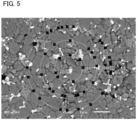
- the average particle diameter (D) of zinc oxide particles and the standard deviation ( ⁇ ) are measured by an intercept method.
- thermal etching is performed in an electric furnace or the like to prepare an observation surface in which a zinc oxide grain boundary is emphasized.
- a reflected electron image is acquired with a scanning electron microscope, three concentric circles with a constant total circumferential length are drawn at the center of the image as shown in Fig. 5 , and then the average particle diameter (D) of zinc oxide particles and the standard deviation ( ⁇ ) based on the distribution of cross-sectional areas are measured.
- the value of ⁇ /D is obtained by dividing the standard deviation ( ⁇ ) calculated by the above measurement by the average particle diameter (D).
- Raw material oxides composed of zinc oxide as a main component, bismuth oxide, tin oxide, cobalt oxide, manganese oxide, and nickel oxide, and silver oxide and boron oxide as accessory components were prepared, and the respective components were weighed so that bismuth oxide was 0.3 to 0.7 mol%, tin oxide was 0.60 mol%, cobalt oxide was 0.3 to 1.0 mol%, manganese oxide was 0.2 to 1.0 mol%, and nickel oxide was 0.5 to 1.5 mol% [mol% represents mol% of the metal element of each of the oxide compounds when the total amount of metal elements (including metalloids) is 100 mol%], and silver oxide was 0.01 to 0.05 wt%, and boron oxide was 0.005 to 0.03 wt% [wt% represents wt% of the metal or metalloid element of each of the oxide compounds when the total amount of metal elements (including metalloids) is 100 wt%].
- the weighed raw material oxide excluding zinc oxide was placed in a ball mill container together with pure water in an amount equal to the total amount of the raw material oxides in terms of weight ratio, and pulverized using zirconia balls with a diameter of 3 mm.
- the raw material oxide was pulverized so that the particle size D50 of the pulverized slurry was approximately 0.7 um or less when measured using a laser diffraction particle size analyzer.
- the pulverized slurry was sufficiently mixed together with zinc oxide of 90 mol% or more in terms of metal element, water, an organic binder (PVA) of 1 wt% with respect to the weight of zinc oxide, and an aluminum nitrate (Al(NO 3 ) 3 ⁇ 9H 2 O) aqueous solution (corresponding to 10 to 30 ppm by weight as Al 3+ ions), and then granulated with a spray dryer or the like, and uniaxially molded using a mold with a diameter of 51.9 mm.
- PVA organic binder
- Al(NO 3 ) 3 ⁇ 9H 2 O aluminum nitrate
- the prepared molded body was calcined at a maximum holding temperature of 800 to 950°C for 3 to 20 hours. At that time, the organic binder added was removed by holding at 350 to 700°C.
- the obtained calcined body was allowed to stand in a sagger and fired under the conditions of a maximum holding temperature of 1000 to 1100°C, a holding time of 1 to 10 hours, a temperature raising rate of 20 to 70°C/hour, and a temperature lowering rate of 20 to 70°C/hour.
- a zinc oxide element was prepared under the same conditions as in Example 1 except that tin oxide (0.60 mol%) contained in the raw material oxide was replaced with antimony oxide (0.53 mol%)
- the electrical performance of the obtained zinc oxide element is shown in Table 1, and the average particle diameter of zinc oxide particles and ⁇ /D are shown in Table 2.
- a zinc oxide element was prepared under the same conditions as in Example 1 except that neither tin oxide nor antimony oxide was added to the raw material oxide.
- Example No. Raw material oxide Electrical performance Antimony oxide mol% Tin oxide mol% Operation starting voltage V1 mA V/mm Nonlinearity V10 kA/V1 mA High temperature watt loss [W/kV] Comparative Example 1 0.53 0 218 1.770 0.50 Comparative Example 2 0 0 95 2.150 0.85 Example 1 0 0.60 167 1.760 0.74 [Table 2] Average particle diameter D [ ⁇ m] Standard deviation ⁇ [ ⁇ m] ⁇ /D Comparative Example 1 4.59 1.02 0.22 Comparative Example 2 6.19 5.61 0.91 Example 1 5.49 1.45 0.26
- Example 1 had nonlinearity (V10 kA/V1 mA) of 1.760, and exhibited good nonlinear resistance characteristics. In addition, the Watt loss value was also 0.74, indicating good thermal stability at a practical level. On the other hand, in the element of Comparative Example 2 in which neither tin oxide nor antimony oxide was added, both the nonlinearity (V10 kA/V1 mA) and the Watt loss value were significantly high, indicating that the element was inferior in performance.
- Fig. 2 shows a cross section of a fired body of Example 1 in which tin oxide was added instead of antimony oxide
- Fig. 3 shows a cross section of a fired body of Comparative Example 2 in which neither tin oxide nor antimony oxide was added.
- particles of zinc stannate Zn 2 SnO 4
- Fig. 4 X-ray diffraction graph
Landscapes
- Chemical & Material Sciences (AREA)
- Engineering & Computer Science (AREA)
- Ceramic Engineering (AREA)
- Organic Chemistry (AREA)
- Structural Engineering (AREA)
- Materials Engineering (AREA)
- Manufacturing & Machinery (AREA)
- Microelectronics & Electronic Packaging (AREA)
- Physics & Mathematics (AREA)
- Inorganic Chemistry (AREA)
- Electromagnetism (AREA)
- Compositions Of Oxide Ceramics (AREA)
- Thermistors And Varistors (AREA)
Applications Claiming Priority (2)
| Application Number | Priority Date | Filing Date | Title |
|---|---|---|---|
| JP2022043992 | 2022-03-18 | ||
| PCT/JP2023/008714 WO2023176608A1 (ja) | 2022-03-18 | 2023-03-08 | 酸化アンチモン代替酸化亜鉛素子 |
Publications (2)
| Publication Number | Publication Date |
|---|---|
| EP4495085A1 true EP4495085A1 (de) | 2025-01-22 |
| EP4495085A4 EP4495085A4 (de) | 2026-02-18 |
Family
ID=88023087
Family Applications (1)
| Application Number | Title | Priority Date | Filing Date |
|---|---|---|---|
| EP23770564.5A Pending EP4495085A4 (de) | 2022-03-18 | 2023-03-08 | Antimonoxid-substitut-zinkoxid-element |
Country Status (5)
| Country | Link |
|---|---|
| US (1) | US12415760B2 (de) |
| EP (1) | EP4495085A4 (de) |
| JP (1) | JP7359329B1 (de) |
| CN (1) | CN118891237A (de) |
| WO (1) | WO2023176608A1 (de) |
Family Cites Families (10)
| Publication number | Priority date | Publication date | Assignee | Title |
|---|---|---|---|---|
| JPS6143404A (ja) * | 1984-08-08 | 1986-03-03 | サンケン電気株式会社 | 酸化物電圧非直線抵抗体 |
| US5739742A (en) | 1995-08-31 | 1998-04-14 | Matsushita Electric Industrial Co., Ltd. | Zinc oxide ceramics and method for producing the same and zinc oxide varistors |
| JPH09312203A (ja) * | 1996-05-23 | 1997-12-02 | Matsushita Electric Ind Co Ltd | 酸化亜鉛系磁器組成物とその製造方法及び酸化亜鉛系バリスタ |
| JP3223830B2 (ja) * | 1997-02-17 | 2001-10-29 | 株式会社村田製作所 | バリスタ素子の製造方法 |
| JP2007173313A (ja) * | 2005-12-19 | 2007-07-05 | Toshiba Corp | 電流−電圧非直線抵抗体 |
| JP5065688B2 (ja) | 2007-01-11 | 2012-11-07 | 株式会社東芝 | 電流−電圧非直線抵抗体 |
| JP5208703B2 (ja) * | 2008-12-04 | 2013-06-12 | 株式会社東芝 | 電流−電圧非直線抵抗体およびその製造方法 |
| JP2010238882A (ja) * | 2009-03-31 | 2010-10-21 | Tdk Corp | バリスタ材料、バリスタ素体及び複合積層型電子部品 |
| JP5337073B2 (ja) * | 2010-02-22 | 2013-11-06 | 株式会社東芝 | 電流−電圧非直線抵抗体およびその製造方法 |
| JP6677095B2 (ja) * | 2015-11-20 | 2020-04-08 | 住友金属鉱山株式会社 | Sn−Zn−O系酸化物焼結体とその製造方法 |
-
2023
- 2023-03-08 WO PCT/JP2023/008714 patent/WO2023176608A1/ja not_active Ceased
- 2023-03-08 EP EP23770564.5A patent/EP4495085A4/de active Pending
- 2023-03-08 US US18/848,084 patent/US12415760B2/en active Active
- 2023-03-08 CN CN202380028019.4A patent/CN118891237A/zh active Pending
- 2023-03-08 JP JP2023516048A patent/JP7359329B1/ja active Active
Also Published As
| Publication number | Publication date |
|---|---|
| US20250109073A1 (en) | 2025-04-03 |
| CN118891237A (zh) | 2024-11-01 |
| JP7359329B1 (ja) | 2023-10-11 |
| EP4495085A4 (de) | 2026-02-18 |
| WO2023176608A1 (ja) | 2023-09-21 |
| US12415760B2 (en) | 2025-09-16 |
| JPWO2023176608A1 (de) | 2023-09-21 |
Similar Documents
| Publication | Publication Date | Title |
|---|---|---|
| EP1150306B1 (de) | Strom/Spannung nichtlinearer Widerstand und Sinterkörper dafür | |
| EP2599759A1 (de) | Verfahren zur Herstellung eines Zinkoxidvaristors mit hohem Potentialgradienten und hohem Nichtlinearitätskoeffizienten | |
| KR20010022821A (ko) | 기계적인 분쇄에 의해 생성된 나노 결정체 분말을 기초로 한 배리스터 | |
| EP2194541B1 (de) | Strom-Spannung nichtlinearer Widerstand und Herstellungsverfahren dafür | |
| JPH11340009A (ja) | 非直線抵抗体 | |
| EP0762438B1 (de) | Verfahren zur Herstellung eines elektrischen Widerstandelements mit nichtlinearen spannungsabhängigen Eigenschaften | |
| EP4495085A1 (de) | Antimonoxid-substitut-zinkoxid-element | |
| EP1798741B1 (de) | Strom/Spannung nichtlinearer Widerstand | |
| CA1315092C (en) | Voltage non-linear type resistors | |
| JP5337073B2 (ja) | 電流−電圧非直線抵抗体およびその製造方法 | |
| JP4282243B2 (ja) | 非直線抵抗体 | |
| JP6937390B2 (ja) | 電流−電圧非直線抵抗体用材料、電流−電圧非直線抵抗体およびその製造方法 | |
| JP2010103440A (ja) | 電流−電圧非直線抵抗体およびその製造方法 | |
| EP0535773A1 (de) | Varistormaterial und Verfahren zu seiner Herstellung | |
| KR102612982B1 (ko) | 고전압 ZnO 바리스터 및 그의 조성물 | |
| JP2024131732A (ja) | 酸化亜鉛素子およびその製造方法 | |
| JP2024157203A (ja) | 電流-電圧非直線抵抗体、および、その製造方法 | |
| US11315709B2 (en) | Metal oxide varistor formulation | |
| JPH07201531A (ja) | 電圧非直線性抵抗体磁器組成物および電圧非直線性抵抗体磁器 | |
| JP4461510B2 (ja) | 電圧非直線性抵抗体磁器およびバリスタ | |
| JP4183100B2 (ja) | 電圧非直線性抵抗体磁器組成物 | |
| CN121171731A (zh) | 高老化稳定性氧化锌压敏电阻制备方法及氧化锌压敏电阻 | |
| JP2013251385A (ja) | 電流−電圧非直線抵抗体およびその製造方法 | |
| JP2014183272A (ja) | 電流−電圧非直線抵抗体 | |
| JPH06151115A (ja) | 非直線抵抗体 |
Legal Events
| Date | Code | Title | Description |
|---|---|---|---|
| STAA | Information on the status of an ep patent application or granted ep patent |
Free format text: STATUS: THE INTERNATIONAL PUBLICATION HAS BEEN MADE |
|
| PUAI | Public reference made under article 153(3) epc to a published international application that has entered the european phase |
Free format text: ORIGINAL CODE: 0009012 |
|
| STAA | Information on the status of an ep patent application or granted ep patent |
Free format text: STATUS: REQUEST FOR EXAMINATION WAS MADE |
|
| 17P | Request for examination filed |
Effective date: 20241017 |
|
| AK | Designated contracting states |
Kind code of ref document: A1 Designated state(s): AL AT BE BG CH CY CZ DE DK EE ES FI FR GB GR HR HU IE IS IT LI LT LU LV MC ME MK MT NL NO PL PT RO RS SE SI SK SM TR |
|
| DAV | Request for validation of the european patent (deleted) | ||
| DAX | Request for extension of the european patent (deleted) | ||
| A4 | Supplementary search report drawn up and despatched |
Effective date: 20260115 |
|
| RIC1 | Information provided on ipc code assigned before grant |
Ipc: C04B 35/453 20060101AFI20260109BHEP Ipc: H01C 7/112 20060101ALI20260109BHEP Ipc: C04B 41/90 20060101ALI20260109BHEP |