EP4502109A1 - Composition d'émulsion - Google Patents
Composition d'émulsion Download PDFInfo
- Publication number
- EP4502109A1 EP4502109A1 EP23775081.5A EP23775081A EP4502109A1 EP 4502109 A1 EP4502109 A1 EP 4502109A1 EP 23775081 A EP23775081 A EP 23775081A EP 4502109 A1 EP4502109 A1 EP 4502109A1
- Authority
- EP
- European Patent Office
- Prior art keywords
- emulsified composition
- mass
- water
- oil
- cyclodextrin
- Prior art date
- Legal status (The legal status is an assumption and is not a legal conclusion. Google has not performed a legal analysis and makes no representation as to the accuracy of the status listed.)
- Pending
Links
Images
Classifications
-
- A—HUMAN NECESSITIES
- A61—MEDICAL OR VETERINARY SCIENCE; HYGIENE
- A61K—PREPARATIONS FOR MEDICAL, DENTAL OR TOILETRY PURPOSES
- A61K8/00—Cosmetics or similar toiletry preparations
- A61K8/02—Cosmetics or similar toiletry preparations characterised by special physical form
- A61K8/04—Dispersions; Emulsions
- A61K8/06—Emulsions
-
- C—CHEMISTRY; METALLURGY
- C09—DYES; PAINTS; POLISHES; NATURAL RESINS; ADHESIVES; COMPOSITIONS NOT OTHERWISE PROVIDED FOR; APPLICATIONS OF MATERIALS NOT OTHERWISE PROVIDED FOR
- C09K—MATERIALS FOR MISCELLANEOUS APPLICATIONS, NOT PROVIDED FOR ELSEWHERE
- C09K23/00—Use of substances as emulsifying, wetting, dispersing, or foam-producing agents
- C09K23/52—Natural or synthetic resins or their salts
-
- C—CHEMISTRY; METALLURGY
- C09—DYES; PAINTS; POLISHES; NATURAL RESINS; ADHESIVES; COMPOSITIONS NOT OTHERWISE PROVIDED FOR; APPLICATIONS OF MATERIALS NOT OTHERWISE PROVIDED FOR
- C09K—MATERIALS FOR MISCELLANEOUS APPLICATIONS, NOT PROVIDED FOR ELSEWHERE
- C09K23/00—Use of substances as emulsifying, wetting, dispersing, or foam-producing agents
-
- A—HUMAN NECESSITIES
- A61—MEDICAL OR VETERINARY SCIENCE; HYGIENE
- A61K—PREPARATIONS FOR MEDICAL, DENTAL OR TOILETRY PURPOSES
- A61K8/00—Cosmetics or similar toiletry preparations
- A61K8/02—Cosmetics or similar toiletry preparations characterised by special physical form
- A61K8/04—Dispersions; Emulsions
- A61K8/06—Emulsions
- A61K8/062—Oil-in-water emulsions
-
- A—HUMAN NECESSITIES
- A61—MEDICAL OR VETERINARY SCIENCE; HYGIENE
- A61K—PREPARATIONS FOR MEDICAL, DENTAL OR TOILETRY PURPOSES
- A61K8/00—Cosmetics or similar toiletry preparations
- A61K8/18—Cosmetics or similar toiletry preparations characterised by the composition
- A61K8/72—Cosmetics or similar toiletry preparations characterised by the composition containing organic macromolecular compounds
- A61K8/73—Polysaccharides
-
- A—HUMAN NECESSITIES
- A61—MEDICAL OR VETERINARY SCIENCE; HYGIENE
- A61K—PREPARATIONS FOR MEDICAL, DENTAL OR TOILETRY PURPOSES
- A61K8/00—Cosmetics or similar toiletry preparations
- A61K8/18—Cosmetics or similar toiletry preparations characterised by the composition
- A61K8/72—Cosmetics or similar toiletry preparations characterised by the composition containing organic macromolecular compounds
- A61K8/73—Polysaccharides
- A61K8/735—Mucopolysaccharides, e.g. hyaluronic acid; Derivatives thereof
-
- A—HUMAN NECESSITIES
- A61—MEDICAL OR VETERINARY SCIENCE; HYGIENE
- A61K—PREPARATIONS FOR MEDICAL, DENTAL OR TOILETRY PURPOSES
- A61K8/00—Cosmetics or similar toiletry preparations
- A61K8/18—Cosmetics or similar toiletry preparations characterised by the composition
- A61K8/72—Cosmetics or similar toiletry preparations characterised by the composition containing organic macromolecular compounds
- A61K8/73—Polysaccharides
- A61K8/737—Galactomannans, e.g. guar; Derivatives thereof
-
- A—HUMAN NECESSITIES
- A61—MEDICAL OR VETERINARY SCIENCE; HYGIENE
- A61K—PREPARATIONS FOR MEDICAL, DENTAL OR TOILETRY PURPOSES
- A61K8/00—Cosmetics or similar toiletry preparations
- A61K8/18—Cosmetics or similar toiletry preparations characterised by the composition
- A61K8/72—Cosmetics or similar toiletry preparations characterised by the composition containing organic macromolecular compounds
- A61K8/73—Polysaccharides
- A61K8/738—Cyclodextrins
-
- A—HUMAN NECESSITIES
- A61—MEDICAL OR VETERINARY SCIENCE; HYGIENE
- A61Q—SPECIFIC USE OF COSMETICS OR SIMILAR TOILETRY PREPARATIONS
- A61Q19/00—Preparations for care of the skin
-
- C—CHEMISTRY; METALLURGY
- C09—DYES; PAINTS; POLISHES; NATURAL RESINS; ADHESIVES; COMPOSITIONS NOT OTHERWISE PROVIDED FOR; APPLICATIONS OF MATERIALS NOT OTHERWISE PROVIDED FOR
- C09K—MATERIALS FOR MISCELLANEOUS APPLICATIONS, NOT PROVIDED FOR ELSEWHERE
- C09K23/00—Use of substances as emulsifying, wetting, dispersing, or foam-producing agents
- C09K23/08—Sulfation or sulfonation products of fats, oils, waxes, or higher fatty acids or esters thereof with monovalent alcohols
-
- C—CHEMISTRY; METALLURGY
- C09—DYES; PAINTS; POLISHES; NATURAL RESINS; ADHESIVES; COMPOSITIONS NOT OTHERWISE PROVIDED FOR; APPLICATIONS OF MATERIALS NOT OTHERWISE PROVIDED FOR
- C09K—MATERIALS FOR MISCELLANEOUS APPLICATIONS, NOT PROVIDED FOR ELSEWHERE
- C09K23/00—Use of substances as emulsifying, wetting, dispersing, or foam-producing agents
- C09K23/56—Glucosides; Mucilage; Saponins
-
- A—HUMAN NECESSITIES
- A61—MEDICAL OR VETERINARY SCIENCE; HYGIENE
- A61K—PREPARATIONS FOR MEDICAL, DENTAL OR TOILETRY PURPOSES
- A61K2800/00—Properties of cosmetic compositions or active ingredients thereof or formulation aids used therein and process related aspects
- A61K2800/10—General cosmetic use
-
- A—HUMAN NECESSITIES
- A61—MEDICAL OR VETERINARY SCIENCE; HYGIENE
- A61K—PREPARATIONS FOR MEDICAL, DENTAL OR TOILETRY PURPOSES
- A61K2800/00—Properties of cosmetic compositions or active ingredients thereof or formulation aids used therein and process related aspects
- A61K2800/40—Chemical, physico-chemical or functional or structural properties of particular ingredients
- A61K2800/48—Thickener, Thickening system
-
- A—HUMAN NECESSITIES
- A61—MEDICAL OR VETERINARY SCIENCE; HYGIENE
- A61K—PREPARATIONS FOR MEDICAL, DENTAL OR TOILETRY PURPOSES
- A61K2800/00—Properties of cosmetic compositions or active ingredients thereof or formulation aids used therein and process related aspects
- A61K2800/40—Chemical, physico-chemical or functional or structural properties of particular ingredients
- A61K2800/59—Mixtures
- A61K2800/592—Mixtures of compounds complementing their respective functions
-
- A—HUMAN NECESSITIES
- A61—MEDICAL OR VETERINARY SCIENCE; HYGIENE
- A61K—PREPARATIONS FOR MEDICAL, DENTAL OR TOILETRY PURPOSES
- A61K2800/00—Properties of cosmetic compositions or active ingredients thereof or formulation aids used therein and process related aspects
- A61K2800/80—Process related aspects concerning the preparation of the cosmetic composition or the storage or application thereof
-
- A—HUMAN NECESSITIES
- A61—MEDICAL OR VETERINARY SCIENCE; HYGIENE
- A61K—PREPARATIONS FOR MEDICAL, DENTAL OR TOILETRY PURPOSES
- A61K2800/00—Properties of cosmetic compositions or active ingredients thereof or formulation aids used therein and process related aspects
- A61K2800/80—Process related aspects concerning the preparation of the cosmetic composition or the storage or application thereof
- A61K2800/805—Corresponding aspects not provided for by any of codes A61K2800/81 - A61K2800/95
Definitions
- the present invention relates to an emulsified composition containing water, fat and oil, cyclodextrin, and a prescribed water-soluble gelling agent.
- Emulsified compositions containing fat and oil, water, cyclodextrin, and a water-soluble gelling agent are widely used in various fields of, for example, pharmaceuticals, cosmetics, and foods and drinks.
- Patent Literature 1 discloses an emulsified composition containing water, an oily component, ⁇ -cyclodextrin, and one or more of agar, low-strength agar, a combination of galactomannan or glucomannan and xanthan gum, carrageenan, furcelleran, gellan gum, and native gellan gum as gel-forming components.
- Patent Literature 2 discloses an emulsified composition characterized by containing fat and oil, water, cyclodextrin, and the like, and also discloses that gums such as xanthan gum, guar gum, gum arabic CMC, carrageenan, and locust bean gum may be used as stabilizers.
- Patent Literature 3 discloses an emulsified cosmetic obtained by mixing an aqueous raw material in which a water-soluble polymer compound such as pectin, tragacanth gum, gelatin, casein, sodium alginate, hydroxypropyl cellulose, hydroxyethyl cellulose, hydroxypropylmethyl cellulose, methyl cellulose, sodium polyacrylate, or carboxyvinyl polymer is dissolved with an oily raw material for a cosmetic, adding cyclodextrin thereto, and emulsifying the mixture.
- a water-soluble polymer compound such as pectin, tragacanth gum, gelatin, casein, sodium alginate, hydroxypropyl cellulose, hydroxyethyl cellulose, hydroxypropylmethyl cellulose, methyl cellulose, sodium polyacrylate, or carboxyvinyl polymer
- Non Patent Literature 1 describes that emulsion stability increased when xanthan gum and tragacanth gum were each added as an emulsion stabilizer to an oil-drops-in-water type emulsion obtained by emulsifying a sample of soybean oil and an aqueous cyclodextrin solution at a volume ratio of 1:1.
- Non Patent Literature 1 Nippon Shokuhin Kogyo Gakkaishi, Vol. 38, No. 1, 16-20 (1991 )
- the present inventors have found that in a conventionally known emulsified composition containing fat and oil, water, cyclodextrin, and a water-soluble gelling agent, the oil and water may be easily separated from each other because emulsion stability of the emulsified composition is not sufficient.
- an object of the present invention is to provide an emulsified composition containing fat and oil, water, cyclodextrin, and a water-soluble gelling agent, which has high emulsion stability.
- an emulsified composition which has high emulsion stability can be obtained by blending at least one water-soluble gelling agent selected from the group consisting of carboxymethyl cellulose (CMC), xanthan gum, locust bean gum, guar gum, glucomannan, K-carrageenan, t-carrageenan, ⁇ -carrageenan, tamarind gum, and gellan gum together with fat and oil, water, and cyclodextrin.
- CMC carboxymethyl cellulose
- the present inventors have also found that when a mass ratio of a blending amount of the fat and oil to the total blending amount of the cyclodextrin and the water-soluble gelling agent (blending amount of the fat and oil:total blending amount of the cyclodextrin and the water-soluble gelling agent) is in a range of 1 or more and less than 9:9 or less and more than 1, the form (e.g., powder) obtained by drying the emulsified composition has excellent heat resistance and moisture resistance without discoloration or dissolution even in the case of being subjected to high temperature and high humidity conditions.
- a mass ratio of a blending amount of the fat and oil to the total blending amount of the cyclodextrin and the water-soluble gelling agent blending amount of the fat and oil:total blending amount of the cyclodextrin and the water-soluble gelling agent
- an emulsified composition obtained by re-emulsifying the dried form in a solvent such as water also maintains high emulsion stability.
- an emulsified composition containing fat and oil, water, cyclodextrin, and a water-soluble gelling agent, which has excellent emulsion stability.
- fat and oil commonly used in an emulsified composition is available, and both polar and non-polar fats and oils may be used.
- examples of such fat and oil include, but are not limited to, plant-derived fat and oil (e.g., canola oil, refined rapeseed oil, soybean oil, corn oil, cottonseed oil, peanut oil, sesame oil, rice oil, rice bran oil, camellia oil, safflower oil, olive oil, linseed oil, Japanese basil oil, perilla oil, sunflower oil, palm oil, tea oil, coconut butter, avocado oil, Aleurites moluccanus seed oil, grapeseed oil, cocoa butter, coconut oil, wheatgerm oil, almond oil, evening primrose oil, castor oil, hazelnut oil, macadamia nut oil, rosehip oil, grape oil, cacao oil, jojoba oil, palm kernel oil, Japan wax, candelilla wax, and carnauba wax), paraffin, microcrystalline wax, ceresin,
- plant-derived fat and oil
- the emulsified composition of the present invention may contain fat and oil in any amount as long as the ratio of the blending amount of the fat and oil to the total blending amount of the cyclodextrin and the water-soluble gelling agent falls within a predetermined range in mass ratio, for example, in an amount of 1 mass% or more, 3 mass% or more, 5 mass% or more, or 7 mass% or more.
- the upper limit thereof is not particularly limited, but may be, for example, 50 mass% or less, 40 mass% or less, 30 mass% or less, 20 mass% or less, or 10 mass% or less.
- the range of the amount of fat and oil in the emulsified composition of the present invention can be expressed using two numerical values selected from each of the lower and upper numerical values.
- the emulsified composition of the present invention may contain the fat and oil in an amount appropriately selected from the range of 1 mass% to 50 mass%, 1 mass% to 30 mass%, 1 mass% to 20 mass%, or 1 mass% to 10 mass%, preferably 5 mass% to 50 mass%, 5 mass% to 30 mass%, or 5 mass% to 20 mass%, and more preferably 5 mass% to 10 mass%, or 7 mass% to 10 mass%. If the amount of fat and oil is less than 1 mass%, emulsification may be insufficient, or the emulsified composition may give a creaky feeling when applied. On the other hand, if the amount of the fat and oil is more than 50 mass%, the emulsified composition may give strong oiliness such as stickiness or sliminess when applied. The composition may not provide a desired feeling of use in the utilization form in the intended application.
- the amount of each component is expressed as an amount of mass%, where the amount of the emulsified composition of the present invention is 100 mass%.
- water may be contained in any amount capable of emulsifying fat and oil to form an oil-in-water emulsion together with cyclodextrin and a prescribed water-soluble gelling agent.
- the emulsified composition of the present invention may contain water in an amount of 15 mass% or more, 20 mass% or more, 30 mass% or more, 40 mass% or more, 45 mass% or more, 50 mass% or more, 60 mass% or more, or 70 mass% or more.
- the upper limit thereof is not particularly limited, but may be, for example, 90 mass% or less, or 85 mass% or less.
- the range of the amount of the water in the emulsified composition of the present invention can be expressed using two numerical values selected from each of the lower and upper numerical values.
- the emulsified composition of the present invention may contain water in an amount appropriately selected from the range of 15 mass% to 90 mass%, 45 mass% to 90 mass%, or 70 mass% to 85 mass%.
- the amount of water contained in the emulsified composition of the present invention is preferably more than that of fat and oil in volume ratio.
- the content of fat and oil and water can be 1: greater than 1 (fat and oil: water) in volume ratio, such as 1:2 or more, 1:3 or more, 1:4 or more, 1:5 or more, 1:6 or more, 1:10 or more, 1:15 or more, or 1:20 or more.
- the upper limit of the amount of water is not particularly limited, but can be 1:90 or less, 1:80 or less, 1:70 or less, 1:60 or less, or 1:50 or less.
- Cyclodextrin means a cyclic non-reducing maltooligosaccharide having glucose as a constituent unit, and examples thereof include ⁇ -cyclodextrin having six glucose units, ⁇ -cyclodextrin having seven glucose units, and ⁇ -cyclodextrin having eight glucose units.
- ⁇ -, ⁇ -, and ⁇ -cyclodextrins, cyclodextrin derivatives, and any combination thereof can be used.
- the upper limit thereof is not particularly limited, but may be, for example, 15 mass% or less, 10 mass% or less, 9 mass% or less, 8 mass% or less, 7 mass% or less, or 6 mass% or less.
- the range of the amount of the cyclodextrin in the emulsified composition of the present invention can be expressed using two numerical values selected from each of the lower and upper numerical values.
- the emulsified composition of the present invention may contain the cyclodextrin in an amount appropriately selected from the range of 0.5 mass% to 15 mass%, for example, 1 mass% to 15 mass%, 2.5 mass% to 10 mass%, 2.5 mass% to 9 mass%, 3 mass% to 9 mass%, 4 mass% to 8 mass%, 4.5 mass% to 9 mass%, or 5 mass% to 7 mass%, and preferably 2.5 mass% to 9 mass% or 4.5 mass% to 9 mass%. If the amount of the cyclodextrin is less than 0.5 mass%, the emulsion stability of the composition may be insufficient.
- the composition may have too high viscosity or give a strong creaky feeling. In either case, the composition may not provide a desired feeling of use in the utilization form in the intended application.
- the "water-soluble gelling agent” generally means a substance that dissolves in water and imparts viscosity (sometimes also referred to as a thickener, a thickening stabilizer, or an adhesive, for example).
- examples of the water-soluble gelling agent available in the present invention include carboxymethyl cellulose (CMC), xanthan gum, locust bean gum, guar gum, glucomannan, K-carrageenan, t-carrageenan, ⁇ -carrageenan, tamarind gum, and gellan gum.
- CMC carboxymethyl cellulose
- xanthan gum locust bean gum
- guar gum glucomannan
- K-carrageenan K-carrageenan
- t-carrageenan t-carrageenan
- ⁇ -carrageenan tamarind gum
- gellan gum a substance that dissolves in water and imparts viscosity
- the water-soluble gelling agent available in the present invention include carboxymethyl cellulose (CMC
- the emulsified composition of the present invention may contain a water-soluble gelling agent in an amount capable of imparting emulsion stability to an oil-in-water emulsion together with cyclodextrin and providing a desired feeling of use in the utilization form in the intended application as long as the ratio of the blending amount of the fat and oil to the total blending amount of the cyclodextrin and the water-soluble gelling agent falls within a predetermined range in mass ratio.
- the emulsified composition of the present invention may contain the water-soluble gelling agent in an amount of 0.05 mass% or more, 0.1 mass% or more, 0.2 mass% or more, or 0.3 mass% or more.
- the upper limit thereof is not particularly limited, but may be, for example, 1 mass% or less, 0.8 mass% or less, 0.7 mass% or less, 0.6 mass% or less, or 0.5 mass% or less.
- the range of the amount of the water-soluble gelling agent in the emulsified composition of the present invention can be expressed using two numerical values selected from each of the lower and upper numerical values.
- the emulsified composition of the present invention may contain the water-soluble gelling agent in an amount appropriately selected from the range of 0.05 mass% to 1 mass%, 0.1 mass% to 1 mass%, 0.2 mass% to 1 mass%, or 0.3 mass% to 1 mass%, preferably 0.2 mass% to 0.8 mass% or 0.2 mass% to 0.5 mass%, and more preferably 0.3 mass% to 0.8 mass% or 0.3 mass% to 0.5 mass%. If the amount of the water-soluble gelling agent is less than 0.1 mass%, the emulsion stability of the composition may be insufficient. On the other hand, if the amount of the water-soluble gelling agent is more than 1 mass%, the composition may have too high viscosity. In either case, the composition may not provide a desired feeling of use in the utilization form in the intended application.
- the ratio of the blending amount of the fat and oil to the total blending amount of the cyclodextrin and the water-soluble gelling agent is in a range of 1 or more and less than 9:9 or less and more than 1 in mass ratio.
- the blending amount of the fat and oil: total blending amount of the cyclodextrin and the water-soluble gelling agent is 1:9, 2:8, 3:7, 4:6, 5:5, 6:4, 7:3, or 8:2, and preferably 5:5 in mass ratio.
- the emulsification and emulsion stability of the emulsified composition may be insufficient.
- the emulsified composition may give strong oiliness such as stickiness or sliminess, and in the form of a dried body, the emulsified composition does not have sufficiently high heat resistance or moisture resistance. In either case, the composition may not provide a desired feeling of use in the utilization form in the intended application.
- the emulsified composition of the present invention can contain the fat and oil in an amount appropriately selected from the range of 1 mass% to 50 mass%, preferably 1 mass% to 30 mass%, and more preferably 5 mass% to 30 mass%; the cyclodextrin in an amount appropriately selected from the range of 0.5 mass% to 15 mass%, preferably 2.5 mass% to 10 mass%, and more preferably 3 mass% to 10 mass%; and the water-soluble gelling agent in an amount appropriately selected from the range of 0.05 mass% to 1 mass%, preferably 0.1 mass% to 1 mass%, and more preferably 0.3 mass% to 1 mass%.
- the emulsified composition of the present invention has high emulsion stability, and more preferably, the emulsified composition of the present invention has excellent emulsion stability with high heat resistance that allows the emulsified state to be maintained even after being subjected to high temperature (e.g., about 100°C to 130°C) conditions without causing demulsification.
- high temperature e.g., about 100°C to 130°C
- the emulsified composition of the present invention has high emulsion stability regardless of the pH value, more preferably excellent emulsion stability with high heat resistance that allows the emulsified state to be maintained even after being subjected to high temperature (e.g., about 100°C to 130°C) conditions without causing demulsification.
- high temperature e.g., about 100°C to 130°C
- the emulsified composition of the present invention is not limited to any particular form and may be provided in a form of a semi-solid/semi-liquid (e.g., a gel or a sol) or a dried body (e.g., a powder or a flake) prepared by reducing the water content, in addition to a form having the above-described water content.
- a semi-solid/semi-liquid e.g., a gel or a sol
- a dried body e.g., a powder or a flake
- Such a form of a semi-solid/semi-liquid (e.g., a gel or a sol) or a dried body (e.g., a powder or a flake) can be formed after obtaining an emulsified composition in a form having the above water content by subjecting the emulsified composition to the conventionally known drying method to reduce the water content of the emulsified composition.
- a drying method include, but are not limited to, freeze drying, heat drying, air drying, spray drying, drum drying, hot air drying, and vacuum drying.
- the water content of the emulsified composition after being subjected to the drying method can be appropriately selected depending on the intended form, and may be, for example, less than 15 mass%, 10 mass% or less, 5 mass% or less, or 1 mass% or less in the form of a dried body.
- the lower limit of the water content of the emulsified composition after being subjected to the drying method is not particularly limited but can be 0 mass% or more, more than 0 mass%, 0.1 mass% or more, 0.5 mass% or more, 0.6 mass% or more, 0.7 mass% or more, or 0.8 mass% or more.
- the range of the water content of the form of the dried body can be expressed using two numerical values selected from each of the lower and upper numerical values.
- the water content of the emulsion composition may be 0 mass% to less than 15 mass%, more than 0 mass% and less than 15 mass%, 0.1 mass% to less than 15 mass%, 0.1 mass% to 10 mass%, 0.5 mass% to 5 mass%, 0.5 mass% to 1 mass%, 0.6 mass% to 1 mass%, 0.7 mass% to 1 mass%, or 0.8 mass% to 1 mass%.
- the emulsified composition after being subjected to the drying method may be used as it is or may be re-emulsified by adding an appropriate solvent (e.g., water, hot water, or a mixture of a water-soluble organic solvent and water) thereto/adding the composition to an appropriate solvent at the time of use (as used herein, sometimes referred to as a "re-emulsified composition").
- an appropriate solvent e.g., water, hot water, or a mixture of a water-soluble organic solvent and water
- the emulsified composition after being subjected to the drying method has high heat resistance and high moisture resistance without discoloration or dissolution even after being subjected to high temperature (e.g., about 100°C to 200°C) conditions and/or high humidity (e.g., about 95% humidity) conditions.
- high temperature e.g., about 100°C to 200°C
- high humidity e.g., about 95% humidity
- the re-emulsified composition has high emulsion stability, more preferably excellent emulsion stability with high heat resistance that allows the emulsified state to be maintained even after being subjected to high temperature (e.g., about 100°C to 130°C) conditions without causing demulsification.
- high temperature e.g., about 100°C to 130°C
- the re-emulsified composition has high emulsion stability regardless of the pH value, more preferably excellent emulsion stability with high heat resistance that allows the emulsified state to be maintained even after being subjected to high temperature (e.g., about 100°C to 130°C) conditions without causing demulsification.
- high temperature e.g., about 100°C to 130°C
- the "emulsified composition of the present invention” includes, in addition to the form having the above water content, the form of a semi-solid/semi-liquid (e.g., gel or sol) or a dried body (e.g., a powder or a flake), and the form of a re-emulsified composition.
- a semi-solid/semi-liquid e.g., gel or sol
- a dried body e.g., a powder or a flake
- the emulsified composition of the present invention can be used and contained as a base in applications for foods and beverages, cosmetics, topical drugs, pharmaceuticals (including quasi-drugs), chemical agents, chemical products, agrochemicals, toiletries, spray products, paints, industrial thin film materials, surface modifying materials, or the like, and can be provided in a utilization form (e.g., a form of a prescribed product or the like) in the intended application.
- a utilization form e.g., a form of a prescribed product or the like
- the emulsified composition of the present invention can exhibit excellent heat resistance, which allows the utilization form in the intended application using the emulsified composition of the present invention as a base to be subjected to high-temperature conditions in processes of production, sterilization, storage, use, or the like.
- the utilization form of the emulsified composition of the present invention as a base in the intended application can be subjected to a heat sterilization treatment, more specifically to a high-temperature sterilization treatment (e.g., retort sterilization treatment) at 100°C to 130°C, thus providing a highly safe product with low/no antiseptic content.
- the emulsified composition of the present invention can be subjected to high-temperature conditions together with other raw material or can be immediately combined with other raw materials subjected to high-temperature conditions, which not only contributes to the efficiency of the production process and operation but also enables the production of utilization forms (e.g., prescribed products) that could not be achieved before due to the avoidance of high-temperature conditions.
- utilization forms e.g., prescribed products
- the emulsified composition of the present invention has high emulsion stability regardless of the pH value, more preferably excellent emulsion stability with high heat resistance that allows the emulsified state to be maintained even after being subjected to high temperature (e.g., about 100°C to 130°C) conditions without causing demulsification.
- the pH value of the emulsified composition of the present invention is not particularly limited and may be appropriately set to a desired pH value in the utilization form in the intended application.
- the pH value of the emulsified composition of the present invention can be adjusted using a conventionally known and generally used pH adjuster.
- the pH value of the emulsified composition of the present invention means a value measured at 25°C according to JIS Z8802: 2011.
- the utilization form in the intended application using the emulsified composition of the present invention as a base can be subjected to various pH conditions in processes of production, sterilization, storage, use, or the like, which enables the production of utilization forms (e.g., prescribed products) in various applications without being limited to a pH value.
- the emulsified composition of the present invention may further contain, if necessary, components usually used in the production of the utilization form in the intended application, which can be appropriately blended in an amount according to the desired utilization form, as long as the effects of the present invention are not impaired.
- Such components include, but are not limited to, excipients, disintegrators, lubricants, binders, diluents, buffers, suspending agents, thickeners, preservatives, antibacterial agents, antiseptics, antioxidants, ultraviolet absorbers, coloring agents, pigments, dyes, colorants, lubricants, plasticizers, solvents, solubilizers, isotonic agents, correctives, perfumes, sweeteners, taste components, acidulants, seasonings, humectants, vitamins, surfactants, chelating agents, antibacterial agents, emulsifiers, and water-soluble organic solvents.
- the cyclodextrin may be used in combination with a water-soluble gelling agent to impart emulsion stability of an oil-in-water emulsion.
- the emulsion stability of the oil-in-water emulsion provided by the combined use of the cyclodextrin and the water-soluble gelling agent does not depend on a three-dimensional matrix gel formed by dissolving a general water-soluble gelling agent in water, followed by cooling (preferably, not including a three-dimensional matrix gel), but is considered to be due to the existence of an interaction by hydrogen bonds generated between the cyclodextrin and the water-soluble gelling agent, as will be described in detail by the following Examples.
- the emulsified composition of the present invention can impart high emulsion stability to the oil-in-water emulsion by the combined use of the cyclodextrin and the water-soluble gelling agent
- the emulsified composition may be substantially free of an emulsifier, which is generally used in the production of a conventional emulsified composition, in addition to the cyclodextrin and the water-soluble gelling agent.
- the phrase "substantially free of an emulsifier” means that the emulsified composition of the present invention does not contain an emulsifier in such a manner as to exhibit an emulsifying effect, which is not intended to mean that the emulsified composition does not contain an emulsifier at all.
- the present invention can provide an advantageous emulsified composition with high safety and less irritation to the skin by being substantially free of an emulsifier, for example, when the emulsified composition of the present invention is applied to the skin.
- the emulsified composition of the present invention can provide a silky and moist feeling, for example, when the emulsified composition of the present invention is applied to the skin, by washing after application because the emulsified composition is substantially free of an emulsifier.
- emulsifier generally used in the production of a conventional emulsified composition include, but are not limited to, glycerin fatty acid esters, organic acid monoglycerides, polyglycerin fatty acid esters, polyoxyethylene glycerin fatty acid esters, sorbitan fatty acid esters, propylene glycol fatty acid esters, polyoxyethylene fatty acid esters, polyglycerin condensed ricinoleic acid esters, sorbitan fatty acid esters, polyoxyethylene sorbitol fatty acid esters, sucrose fatty acid esters, lecithin, enzymatically decomposed lecithin, polyethylene glycol, and polypropylene glycol.
- an emulsifier generally used in the production of a conventional emulsified composition may be appropriately selected and blended in the emulsified composition of the present invention according to the utilization form in the intended application, as long as the above-described desired effects of the present invention are not impaired.
- the emulsified composition of the present invention may contain the emulsifier in an amount capable of providing a desired feeling of use in the utilization form in the intended application as long as the above-described desired effects of the present invention are not impaired.
- the emulsified composition of the present invention may contain an emulsifier in an amount of 0.005 mass% or more or 0.01 mass% or more.
- the upper limit thereof is not particularly limited, but may be, for example 0.5 mass% or less or 0.1 mass% or less.
- the range of the amount of the emulsifier in the emulsified composition of the present invention can be expressed using two numerical values selected from each of the lower and upper numerical values.
- the emulsified composition of the present invention may contain the emulsifier in an amount appropriately selected from the range of 0.005 mass% to 0.5 mass% or less or 0.01 mass% to 0.1 mass%.
- Adhesion of the emulsified composition can be suppressed/eliminated by blending the emulsifier in the emulsified composition of the invention.
- the emulsified composition of the present invention is resistant to water-soluble organic solvents, thereby maintaining an emulsified state and excellent emulsion stability without causing demulsification in the presence of a water-soluble organic solvent, more preferably in the presence of a water-soluble organic solvent even after being subjected to high-temperature conditions.
- water-soluble organic solvent generally means an organic solvent which when mixed with water, dissolves in water to form a homogeneous phase without forming a two-phase system (consisting of an organic phase and an aqueous phase), and examples thereof include, but are not limited to, alcohols (e.g., methanol, ethanol, propanol, isopropanol, butanol, isobutanol, 2-butanol, or tert-butanol), polyalcohols (e.g., ethylene glycol, diethylene glycol, polyethylene glycol, propylene glycol, dipropylene glycol, polypropylene glycol, glycerin, or glucose), glycol ethers (e.g., ethylene glycol monomethyl ether, ethylene glycol monoethyl ether, diethylene glycol monomethyl ether, or diethylene glycol monoethyl ether), alkanediols (e.g., 1,2-butanediols (
- the emulsified composition of the present invention can be produced by mixing and stirring the water, fat and oil, cyclodextrin, and the prescribed water-soluble gelling agent, as well as other components, if necessary, in the above-described amounts. All of the components may be mixed and stirred together, or each component may be added separately or sequentially in any combination (in any order), then mixed and stirred.
- the emulsified composition obtained by mixing and stirring may be subjected to a heat sterilization treatment.
- the emulsified composition obtained by mixing and stirring may be further subjected to a drying method, if necessary.
- the drying method can be performed by the conventionally known drying method, and the water content of the emulsified composition can be appropriately adjusted according to the intended form of a semisolid/semi-liquid (e.g., gel or sol) or a dried body.
- the resulting dried body may be further subjected to crushing, grinding, or abrasion treatment, if necessary, to be in the form of a powder, a flake, or the like.
- the emulsified composition obtained by being subjected to the drying method may be mixed and stirred with other components in the above-described amounts, if necessary, and/or subjected to a heat sterilization treatment.
- the emulsified composition obtained by being subjected to the drying method can be used in the form of an oil-in-water emulsion without causing phase transition.
- the emulsified composition obtained by being subjected to the drying method can be further mixed, stirred, and re-emulsified with an appropriate solvent, if necessary, to produce a re-emulsified composition.
- the solvent can be appropriately selected according to the utilization form in the intended application of the re-emulsified composition, and examples thereof include water and a mixture of a water-soluble organic solvent and water, which may be included in an amount appropriately selected from the range of 15 mass% to 90 mass%, preferably 45 mass% to 90 mass%, and more preferably 70 mass% to 85 mass%.
- the resulting re-emulsified composition may be mixed and stirred with other components in the above-described amounts, if necessary, and/or subjected to a heat sterilization treatment.
- each component was added and mixed to prepare an emulsified composition.
- the water-soluble gelling agent any one of carboxymethyl cellulose (CMC), sodium alginate, gum arabic, glucomannan, guar gum, pectin, ⁇ -carrageenan, tamarind gum, gellan gum, xanthan gum, t-carrageenan, locust bean gum, ⁇ -carrageenan, distarch phosphate, hydroxypropyl starch, hydroxypropylated distarch phosphate, tragacanth gum, carboxyvinyl polymer, sodium polyacrylate, hydroxypropyl cellulose, methyl cellulose, hydroxypropylmethyl cellulose, and hydroxyethyl cellulose was blended.
- CMC carboxymethyl cellulose
- Each component was mixed and stirred using a hand blender at 20,000 rpm for 10 minutes.
- Each composition (50 mL) obtained was transferred to a conical tube (Falcon (R) Conical Tube 50 mL) and centrifuged at 3,000 rpm for 1 minute. Subsequently, the thicknesses (depths) of water phase, micelles, and oil phase were visually observed, and the proportion of each phase (%) was measured, thereby evaluating the emulsion stability of each composition.
- the evaluation was made as " ⁇ " when the proportion of micelles was 100%, as " ⁇ " when the proportion of micelles was 70% or more and less than 100%, and as " ⁇ " when the proportion of micelles was less than 70%.
- the amount of each component in the following table is expressed as an amount of mass%, where the amount of the obtained emulsified composition is 100 mass%. All of the fat and oil, ⁇ -cyclodextrin, and water-soluble gelling agents used were food additives (food grade). [Table 1] Component Blending amount (mass%) Fat and oil (Canola oil + 1% oil red) 25 ⁇ -cyclodextrin 2.5 Water-soluble gelling agent 0.35 Water 72.15 Total 100
- the water-soluble gelling agent added to the emulsified composition the measured proportion of each phase, and the evaluation results are shown in Table 2.
- the emulsion stability of the emulsified composition varied depending on the water-soluble gelling agent added.
- CMC glucomannan, guar gum, ⁇ -carrageenan, tamarind gum, gellan gum, xanthan gum, i-carrageenan, locust bean gum, or ⁇ -carrageenan was added, the micelle phase was maintained and the emulsified composition exhibited high emulsion stability.
- enthalpy change was determined by isothermal titration calorimetry (ITC) in accordance with a conventionally known method.
- an isothermal titration calorimeter (NANO ITC SV; TA Instruments)
- 10 ⁇ L of an aqueous solution of water-soluble gelling agent (0.05 g/100 mL) was added dropwise to an aqueous solution of ⁇ -cyclodextrin(25 g/100 mL) 25 times at intervals of 180 seconds (75 minutes) to determine an enthalpy value ( ⁇ J) from the area of the titration peak at the 25th (final) titration.
- each component was added and mixed to prepare emulsified compositions of Examples 1 to 4 and Comparative Examples 1 to 4. Each component was mixed and stirred using a hand blender at 20,000 rpm for 10 minutes. Each emulsified composition obtained was evaluated for the following evaluation items based on the criteria. The evaluation was made on four human subjects.
- Viscosity creaminess: when the emulsified compositions are each spread on the palm, " ⁇ ” in the case of having a good feeling of use such that the cream is lightly spread; “ ⁇ ” in the case of having a feeling of use such that the cream is spread; and “X” in the case of providing no feeling of use such that the cream is spread (too low viscosity or too high viscosity).
- Emulsifying ability after storage "O” in the case where emulsification is maintained after storage at 40°C for 7 days; "X” in the case where separation of water and oil is observed.
- the amount of each component in the following table is expressed as an amount of mass%, where the amount of the obtained emulsified composition is 100 mass%.
- the fat and oil is not limited to specific ones, and various fat and oil can be used.
- the emulsified compositions of Examples had a good feeling of use such that the cream was lightly spread
- the emulsified compositions of Examples 1 to 3 had particularly excellent performance and showed good results in all evaluation items.
- Examples 1 to 3 Examples 1 and 2 in which the content of ⁇ -cyclodextrin was relatively high gave a slight feeling of tightness (creaky feeling) when applied as compared with Example 3 in which the content of ⁇ -cyclodextrin was relatively low, but not to the extent of interfering with the good feeling of use.
- each component was added and mixed to prepare an emulsified composition.
- Each component was mixed and stirred using a hand blender at 20,000 rpm for 5 minutes.
- the resulting emulsified composition was freeze-dried (vacuum state after freezing, followed by freeze-drying at 20°C for 16 hours) and crushed to obtain a powder emulsified composition.
- the powder emulsified composition had a form of a free-flowing powder, whereas the control composition had a form of a paste in which fat and oil as liquids and a powder were mixed together, and thus a form of a free-flowing powder was not obtained.
- the obtained powder emulsified composition was evaluated as " ⁇ " in all of "viscosity (creaminess)", “emulsification ability after storage”, “slimy feeling immediately after application”, and “feeling of use after washing”.
- the powder emulsified composition of Experiment 3 had a good feeling of use, in which the composition could be spread in a transparent state such that an oil film was quickly formed when spread on the palm.
- the powder emulsified composition also simultaneously provided a smooth feeling as if a powder was applied and a moist feeling as if a cream was applied when washed after application.
- the control composition did not provide a good feeling of use when applied to the palm because the liquid and the solid were separated from each other, giving a rough and creaky feeling.
- each component was added and mixed to prepare an emulsified composition.
- Each component was mixed and stirred using a hand blender at 20,000 rpm for 5 minutes.
- the resulting emulsified composition was spray-dried (190°C) to obtain a powder emulsified composition.
- the spray-dried powder emulsified composition also had a form of free-flowing powder and was evaluated as "O" in all of "viscosity (creaminess)", “emulsification ability after storage”, “slimy feeling immediately after application”, and “feeling of use after washing".
- the spray-dried powder emulsified composition had a good feeling of use, in which the composition could be spread in a transparent state such that an oil film was quickly formed when spread on the palm.
- the powder emulsified composition also simultaneously provided a smooth feeling as if a powder was applied and a moist feeling as if a cream was applied when washed after application. It was confirmed that even when the drying treatment was performed in a different manner, the same characteristics were obtained.
- an emulsified composition having high emulsion stability and a good cream-like texture can be obtained by blending cyclodextrin and a prescribed water-soluble gelling agent in combination with an oil-in-water emulsion containing water and fat and oil. It has been confirmed that when the emulsified composition is spread, the feeling of use is unprecedented, and the emulsified composition has a good cream-like texture and simultaneously provided a smooth feeling as if a powder was applied and a moist feeling as if a cream was applied when washed with water or the like after application.
- a dried form (powder emulsified composition) obtained by subjecting the emulsified composition to a drying treatment also could be spread in a transparent state such that an oil film was quickly formed when spread, and thus provided the same characteristics.
- these characteristics were not obtained for the dried form obtained by subjecting the emulsified composition to a drying treatment without passing through the emulsified composition having the high emulsion stability. Therefore, the good characteristics in dried form are also due to the maintenance of the emulsified state without solid-liquid separation, which is attributed to the high emulsion stability of the emulsified composition before being subjected to a drying treatment.
- each component was added and mixed to prepare an emulsified composition.
- Each component was mixed and stirred using a hand blender at 20,000 rpm for 5 minutes.
- the resulting emulsified composition was freeze-dried (vacuum state after freezing, followed by freeze-drying at 20°C for 16 hours) and crushed to obtain white powder emulsified compositions.
- the obtained powder emulsified compositions were each put in a dry heat sterilizer (manufactured by HIRAYAMA Manufacturing Corporation) and heat-treated at 105°C (product temperature) for 13 hours. After completion of the heat treatment, each of the powder emulsified compositions was removed from the dry heat sterilizer and allowed to cool to room temperature, and the changes in the powder emulsified compositions were visually evaluated.
- conventionally known white powdered fats and oils N Neopowder A and N Neopowder P (NOF CORPORATION) were used and heat-treated in the same manner, and the change thereof was visually evaluated.
- Tables 8 to 10 also show the measurement results of the water content (mass%) of the powder emulsified composition after being subjected to the heat treatment, which was determined in the same manner as described in "Experiment 4: Powder Emulsified Composition (Freeze-dried)".
- the amount of each component in the tables is expressed as an amount of mass%, where the amount of the obtained emulsified composition is 100 mass%.
- the "mass before drying” and the “mass after drying” indicate the total mass of the weighing can and the powder emulsified composition.
- a dried form (powder emulsified composition) obtained by subjecting the emulsified composition obtained by blending cyclodextrin and a prescribed water-soluble gelling agent in combination in an oil-in-water emulsion containing water and fat and oil to a drying treatment has excellent heat resistance without dissolving or yellowing even when subjected to high temperature conditions.
- Such excellent heat resistance was also confirmed when the powder emulsified composition of Example 23 was further subjected to a heat treatment under a high temperature condition (200°C (product temperature) for 13 hours).
- Comparative Example 25 is an example in which the ratio of the blending amount of the fat and oil to the total blending amount of the ⁇ -cyclodextrinand the water-soluble gelling agent (blending amount of the fat and oil: total blending amount of the ⁇ -cyclodextrinand the water-soluble gelling agent) is 9:1 in mass ratio, and it was confirmed that heat treatment under high temperature conditions resulted in an overall yellow color, strong appearance of the properties of fats and oils causing stickiness, adhesion causing lumps, the form of powder was not maintained, and heat resistance was poor (Table 8).
- Comparative Examples 212 and 213 are examples of using "gum arabic” and “dextrin", which are not included in the prescribed water-soluble gelling agent in the present invention, and it was confirmed that the form of the powder before heat treatment was not maintained and heat resistance was poor, as yellowing and properties of fats and oils were strongly expressed, causing stickiness (Table 10).
- each of the powder emulsified compositions (Examples 21 to 211, Comparative Examples 25 to 213) prepared in "Experiment 6: Evaluation of Heat Resistance of Powder Emulsified Composition" and the conventionally known white powdered fats and oils (N Neopowder A and N Neopowder P (NOF CORPORATION)) were left in a constant temperature and humidity test chamber (PR-4KP, manufactured by ESPEC CORP.) at 40°C and 90% humidity for 1 week for humidification. After completion of the treatment, each of the powder emulsified compositions was removed from the constant temperature and humidity test chamber and allowed to cool to room temperature, and the changes in the powder emulsified compositions were visually evaluated.
- PR-4KP constant temperature and humidity test chamber
- Table 11 also shows the measurement results of the water content (mass%) of the powder emulsified composition after being subjected to the moisture treatment, which was determined in the same manner as described in "Experiment 4: Powder Emulsified Composition (Freeze-dried)".
- a dried form (powder emulsified composition) obtained by subjecting the emulsified composition obtained by blending cyclodextrin and a prescribed water-soluble gelling agent in combination in an oil-in-water emulsion containing water and fat and oil to a drying treatment has excellent moisture resistance without yellowing or caking even when subjected to high humidity conditions.
- Comparative Example 25 is an example in which the ratio of the blending amount of the fat and oil to the total blending amount of the ⁇ -cyclodextrin and the water-soluble gelling agent (blending amount of the fat and oil: total blending amount of the ⁇ -cyclodextrin and the water-soluble gelling agent) is 9:1 in mass ratio, and it was confirmed that the moisture treatment resulted in an overall yellow color, caking to form lumps, failure to maintain the form of powder, and poor moisture resistance (Table 11).
- Comparative Examples 212 and 213 are examples of using "gum arabic” and “dextrin", which are not included in the prescribed water-soluble gelling agent in the present invention, and it was confirmed that the form of the powder before moisture treatment was not maintained and moisture resistance was poor, as yellowing and high hygroscopicity, resulting in caking (Table 13).
- Example 23 prepared in "Experiment 6: Evaluation of Heat Resistance of Powder Emulsified Composition" above was added to water in a glass beaker to a concentration of 10 mass%, mixed, and re-emulsified to prepare an emulsified composition.
- the powder emulsified composition was mixed with water by stirring at 300 rpm for 1 hour at room temperature using a magnetic stirrer (RS-4AN, manufactured by AS ONE Corporation).
- the resulting re-emulsified compositions were each adjusted to have a pH value (25°C) of 2, 3, 4, 7, 9, and 10 using a potassium phosphate buffer, and the demulsification state (or emulsion stability) of each of the re-emulsified compositions and the occurrence of adhesion to the glass beaker wall surface were visually evaluated.
- the demulsification state (or emulsion stability) was evaluated according to the following criteria.
- a re-emulsified composition prepared by adding the powder emulsified composition to water, followed by re-emulsification maintained an emulsified state at any pH value (25°C) of 2,3,4,7,9 and 10 and did not cause demulsification, indicating that the re-emulsified composition had excellent emulsion stability with high pH resistance.
- a re-emulsified composition may be useful in applications where adhesion is required, such as, but not limited to, paints.
- Sucrose palmitate (P-1670, manufactured by Mitsubishi Chemical Corporation) was added as an emulsifier in an amount of 0.01 mass% to re-emulsified compositions having a pH value (25°C) of 2, 3, 4, 7, 9, or 10, each of which was prepared in "Experiment 8; Re-emulsified Composition of Powder Emulsified Composition" above, and then mixed and stirred at room temperature for 1 hour.
- Each of the obtained re-emulsified compositions was evaluated for the demulsified state (or emulsion stability), the occurrence of adhesion to the wall surface of the glass beaker, and the demulsified state (or emulsion stability) after the heat treatment in the same manner as described in "Experiment 8; Re-emulsified Composition of Powder Emulsified Composition" above.
- ethanol, acetone, or acetonitrile was further added to each of the re-emulsified compositions in an amount of 5 mass%, followed by mixing and stirring.
- Each of the obtained re-emulsified compositions was evaluated for the demulsified state (or emulsion stability) and the demulsified state (or emulsion stability) after the heat treatment in the same manner as described above.
- a re-emulsified composition having any of the above pH values (25°C), indicating that the adhesion could be suppressed/eliminated by the addition of an emulsifier.
- a re-emulsified composition may be useful, for example, in applications different from those in which adhesion is required, such as, but not limited to, foods and beverages.
- the re-emulsified composition having any of the above pH values (25°C) maintained the emulsified state in the presence of ethanol, acetone, or acetonitrile without causing demulsification and had excellent emulsion stability with high water-soluble organic solvent resistance.
- any of the above re-emulsified compositions to which ethanol, acetone, or acetonitrile was added maintained the emulsified state after heat treatment without causing demulsification, indicating that excellent emulsion stability with high heat resistance was maintained even in the presence of a water-soluble organic solvent.
- each component was added and mixed to prepare an emulsified composition.
- Each component was mixed and stirred using a hand blender at 20,000 rpm for 5 minutes.
- the resulting emulsified composition was freeze-dried (at 20°C for 48 hours) and crushed to obtain a salt-containing powder emulsified composition.
- the amount of each component in the table is expressed as an amount of mass%, where the amount of the obtained emulsified composition is 100 mass%.
- [Table 16] Blending Fat and oil (palm oil) 5 ⁇ -cyclodextrin 4.7 Water-soluble gelling agent (Xanthan gum) 0.3 Sodium chloride 10 Water 80 Total 100
- the evaluation results of the first impression and second impression of the control saline and the re-emulsified composition by the respective panelists are shown in Table 17 below. Furthermore, the evaluation results are shown in the following Table 18 in which the values of the first impression of the control saline were set to "100%" and the respective values were expressed as relative values, and in the following Table 19 in which the values of the second impression of the control saline were set to "100%" and the values of the second impression of the re-emulsified composition were expressed as relative values. [Table 17] Panelist No.
- Control saline Re-emulsified composition of salt-containing powder emulsified composition Note First impression Second impression First impression Second impression 1 6.6 0.5 5.6 2.4
- the re-emulsified composition was mellow.
- the re-emulsified composition spread throughout the mouth. 2 6.7 2 4.3 1.6 3 6.5 1.8 5 0.8
- the re-emulsified composition was mild. 4 7.3 1.9 8.3 2.5
- the re-emulsified composition had a sea salt-like off-flavor and mineral feeling. 5 2.1 0.3 4 1.5 6 6.5 1.9 5 1.5
- the re-emulsified composition expanded in the mouth. 7 8 0.1 5.7 3.3 8 8 0.1 9.6 0.3 [Table 18] Panelist No.
- Control saline Re-emulsified composition of salt-containing powder emulsified composition Note First impression Second impression First impression Second impression 1 100% 7.6% 84.8% 36.4%
- the re-emulsified composition was mellow.
- the re-emulsified composition spread throughout the mouth. 2 100% 29.9% 64.2% 23.9% 3 100% 27.7% 76.9% 12.3%
- the re-emulsified composition was mild. 4 100% 26.0% 113.7% 34.2%
- the re-emulsified composition had a sea salt-like off-flavor and mineral feeling. 5 100% 14.3% 190.5% 71.4% 6 100% 29.2% 76.9% 23.1%
- the re-emulsified composition expanded in the mouth.
- the re-emulsified composition of the salt-containing powder emulsified composition tended to have a stronger salty taste in each of the first impression and the second impression, as compared to the control saline.
- the second impression showed a stronger salty taste as compared to the control saline.
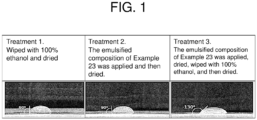
- Example 23 prepared according to the composition in Table 8 was used in the following test.
- Figure 1 shows the state of the liquid droplets dropped on the surface of the polyethylene resin that has been subjected to each treatment.
- the magnitude of the contact angle in distilled water droplets dropped on the surface of the polyethylene resin that had been subjected to Treatment 3. was larger than that in the other resins, confirming that the surface of the polyethylene resin had good wettability (i.e., high hydrophilicity). It is suggested that the hydrophilic part of the emulsified composition remained on the surface of the polyethylene resin by wiping with 100% ethanol after the emulsified composition of Example 23 was applied through Treatment 3., thereby enhancing the hydrophilicity of the surface.
- Example 23 prepared according to the composition in Table 8 was used in the following test.
- the whole hand of the subject was thoroughly washed with a hand soap to remove oil on the skin surface as much as possible. Although the same result can be obtained when only water is used or when soaps such as a hand soap is used for washing, the hand soap was used for washing in this experiment.
- the surface of the pad of the index finger of the left hand was subjected to any of the following treatments 1. to 3., and then the skin of the surface was observed with a stereomicroscope, followed by a sensory examination of the feeling.
- the sensory test results also showed similar results: the skin surface was hard and felt more resistant and rough when untreated (treatment 1.), but when the emulsified composition of Example 23 was applied to the skin surface (treatment 2., treatment 3.), the skin surface remained moist and felt silky and smooth.
- the emulsified composition obtained by blending cyclodextrin and a prescribed water-soluble gelling agent in combination in an oil-in-water emulsion containing water and fat and oil, the dried form obtained by subjecting the same to a drying treatment (powder emulsified composition), and the re-emulsified composition in the dried form have excellent stability with various resistances and can be used in various applications.
Landscapes
- Chemical & Material Sciences (AREA)
- Health & Medical Sciences (AREA)
- Life Sciences & Earth Sciences (AREA)
- Animal Behavior & Ethology (AREA)
- Veterinary Medicine (AREA)
- Public Health (AREA)
- General Health & Medical Sciences (AREA)
- Engineering & Computer Science (AREA)
- Materials Engineering (AREA)
- Organic Chemistry (AREA)
- Epidemiology (AREA)
- Birds (AREA)
- Dispersion Chemistry (AREA)
- Dermatology (AREA)
- Oil, Petroleum & Natural Gas (AREA)
- Cosmetics (AREA)
- Emulsifying, Dispersing, Foam-Producing Or Wetting Agents (AREA)
Applications Claiming Priority (2)
| Application Number | Priority Date | Filing Date | Title |
|---|---|---|---|
| JP2022049699A JP7707506B2 (ja) | 2022-03-25 | 2022-03-25 | 乳化組成物 |
| PCT/JP2023/011763 WO2023182488A1 (fr) | 2022-03-25 | 2023-03-24 | Composition d'émulsion |
Publications (2)
| Publication Number | Publication Date |
|---|---|
| EP4502109A1 true EP4502109A1 (fr) | 2025-02-05 |
| EP4502109A4 EP4502109A4 (fr) | 2026-03-25 |
Family
ID=88101653
Family Applications (1)
| Application Number | Title | Priority Date | Filing Date |
|---|---|---|---|
| EP23775081.5A Pending EP4502109A4 (fr) | 2022-03-25 | 2023-03-24 | Composition d'émulsion |
Country Status (6)
| Country | Link |
|---|---|
| US (1) | US20250127691A1 (fr) |
| EP (1) | EP4502109A4 (fr) |
| JP (2) | JP7707506B2 (fr) |
| KR (1) | KR20240163605A (fr) |
| CN (1) | CN118871549A (fr) |
| WO (1) | WO2023182488A1 (fr) |
Families Citing this family (1)
| Publication number | Priority date | Publication date | Assignee | Title |
|---|---|---|---|---|
| JP2026005529A (ja) * | 2024-06-27 | 2026-01-16 | ハウスウェルネスフーズ株式会社 | 有効成分の滞留剤 |
Family Cites Families (16)
| Publication number | Priority date | Publication date | Assignee | Title |
|---|---|---|---|---|
| JPS6138166A (ja) | 1984-07-28 | 1986-02-24 | Fuji Electric Co Ltd | バルブ式チユ−ブラ水車発電機 |
| JPS61133138A (ja) * | 1984-11-30 | 1986-06-20 | Sunstar Inc | 乳化組成物 |
| JPH06138166A (ja) | 1992-09-10 | 1994-05-20 | Tokyo Electron Yamanashi Kk | 液晶検査装置 |
| JP2915741B2 (ja) * | 1993-03-26 | 1999-07-05 | ホーユー株式会社 | 染毛剤組成物または脱色剤組成物 |
| JPH10262560A (ja) | 1997-03-28 | 1998-10-06 | Kao Corp | 乳化組成物及びその製造法 |
| FR2774261B1 (fr) * | 1998-02-02 | 2000-03-31 | Rhodia Chimie Sa | Composition a usage alimentaire sous forme d'une emulsion seche, son procede de fabrication et son utilisation |
| DE10039063A1 (de) * | 2000-08-10 | 2002-02-21 | Beiersdorf Ag | Kosmetische und dermatologische Zubereitung mit einem Gehalt an Cyclodextrinen zur Beseitigung von Sebum |
| KR100435921B1 (ko) * | 2000-12-29 | 2004-06-12 | 주식회사 태평양 | 동수역학적 이중 안정화에 의한 안정한 수-유-수 다중에멀젼 시스템 및 이의 제조방법 |
| JP5246734B2 (ja) * | 2007-05-17 | 2013-07-24 | 伊那食品工業株式会社 | 油脂硬化剤、それが添加された硬化油代替物及びそれが用いられた食品 |
| JP2011041512A (ja) * | 2009-08-21 | 2011-03-03 | Sanei Gen Ffi Inc | 改質アラビアガムを含有する乳化組成物 |
| JP2016204311A (ja) | 2015-04-23 | 2016-12-08 | 伊那食品工業株式会社 | 乳化組成物 |
| FR3075604B1 (fr) * | 2017-12-21 | 2020-07-03 | Roquette Freres | Composition emulsionnante et procede de fabrication d'une composition de type emulsion de pickering h/e. |
| US11523629B2 (en) * | 2018-04-23 | 2022-12-13 | San-Ei Gen F.F.I., Inc. | Emulsion composition |
| JP7465477B2 (ja) * | 2020-01-28 | 2024-04-11 | クニミネ工業株式会社 | 乳化性粘土油複合粉末 |
| JP7225356B2 (ja) | 2020-09-16 | 2023-02-20 | 誠 植村 | オープンシールド工法用プレスバーおよびストラット |
| EP4218714A4 (fr) * | 2020-09-28 | 2024-11-06 | House Wellness Foods Corporation | Composition émulsifiée pour la peau |
-
2022
- 2022-03-25 JP JP2022049699A patent/JP7707506B2/ja active Active
-
2023
- 2023-03-24 KR KR1020247026996A patent/KR20240163605A/ko active Pending
- 2023-03-24 US US18/730,641 patent/US20250127691A1/en active Pending
- 2023-03-24 WO PCT/JP2023/011763 patent/WO2023182488A1/fr not_active Ceased
- 2023-03-24 EP EP23775081.5A patent/EP4502109A4/fr active Pending
- 2023-03-24 CN CN202380026554.6A patent/CN118871549A/zh active Pending
- 2023-04-25 JP JP2023071393A patent/JP2023143897A/ja active Pending
Also Published As
| Publication number | Publication date |
|---|---|
| US20250127691A1 (en) | 2025-04-24 |
| CN118871549A (zh) | 2024-10-29 |
| JP2023142681A (ja) | 2023-10-05 |
| JP7707506B2 (ja) | 2025-07-15 |
| EP4502109A4 (fr) | 2026-03-25 |
| WO2023182488A1 (fr) | 2023-09-28 |
| KR20240163605A (ko) | 2024-11-19 |
| JP2023143897A (ja) | 2023-10-06 |
Similar Documents
| Publication | Publication Date | Title |
|---|---|---|
| JP4236064B2 (ja) | 低結晶性のセルロース微粒子を含む化粧料組成物 | |
| JP7383867B2 (ja) | 皮膚用乳化組成物 | |
| US6416751B1 (en) | Cosmetic and/or dermatological powder, process for its preparation and its uses | |
| JP2018087148A (ja) | γ−オリザノール含有化粧料 | |
| JPWO2002051939A1 (ja) | ゲル状組成物 | |
| CN105473185A (zh) | 可以以水包油乳液的形式施用至湿皮肤的保湿组合物;保湿护理方法 | |
| KR102381622B1 (ko) | 쌀겨왁스의 안정화 방법 및 고 함량의 쌀겨왁스를 안정화한 나노에멀젼을 함유하는 화장료 조성물 | |
| EP4502109A1 (fr) | Composition d'émulsion | |
| US6117434A (en) | Humectant composition, base containing the same, and cosmetic material or external preparation containing said humectant composition | |
| WO2022181744A1 (fr) | Composition de liposomes | |
| JPH01117815A (ja) | 皮膚外用剤 | |
| KR900007308B1 (ko) | 화장재료 | |
| JP7778337B2 (ja) | 水中油滴型乳化物 | |
| JP2023177420A (ja) | バイセル含有組成物 | |
| JP5140913B2 (ja) | コエンザイムq10含有化粧料用リポソーム | |
| CN115569088B (zh) | 一种化妆品用预处理组合物及其制备方法和应用 | |
| JP4142057B2 (ja) | 美容用送達システムおよびこの製造のための方法 | |
| JP7349048B1 (ja) | 水非膨潤性の皮膜形成型外用剤基剤 | |
| KR102248265B1 (ko) | 안정성이 우수한 세라마이드 볼의 제조방법 및 상기 제조방법에 의해 제조된 안정성이 우수한 세라마이드 볼 | |
| EP4501131A1 (fr) | Composition d'émulsion résistante à la chaleur | |
| JPH09124437A (ja) | 乳化組成物及び皮膚外用剤 | |
| WO2023064836A1 (fr) | Mélange sous forme de pré-émulsion pour soins personnels | |
| WO2024204872A1 (fr) | Inhibiteur de composant cible | |
| AU2023418031A1 (en) | Active ingredient-retaining agent | |
| JP2025154677A (ja) | 皮膚外用剤 |
Legal Events
| Date | Code | Title | Description |
|---|---|---|---|
| STAA | Information on the status of an ep patent application or granted ep patent |
Free format text: STATUS: THE INTERNATIONAL PUBLICATION HAS BEEN MADE |
|
| PUAI | Public reference made under article 153(3) epc to a published international application that has entered the european phase |
Free format text: ORIGINAL CODE: 0009012 |
|
| STAA | Information on the status of an ep patent application or granted ep patent |
Free format text: STATUS: REQUEST FOR EXAMINATION WAS MADE |
|
| 17P | Request for examination filed |
Effective date: 20241015 |
|
| AK | Designated contracting states |
Kind code of ref document: A1 Designated state(s): AL AT BE BG CH CY CZ DE DK EE ES FI FR GB GR HR HU IE IS IT LI LT LU LV MC ME MK MT NL NO PL PT RO RS SE SI SK SM TR |
|
| DAV | Request for validation of the european patent (deleted) | ||
| DAX | Request for extension of the european patent (deleted) | ||
| A4 | Supplementary search report drawn up and despatched |
Effective date: 20260224 |
|
| RIC1 | Information provided on ipc code assigned before grant |
Ipc: C09K 23/00 20220101AFI20260218BHEP Ipc: A61K 8/06 20060101ALI20260218BHEP Ipc: A61K 8/73 20060101ALI20260218BHEP Ipc: A61Q 19/00 20060101ALI20260218BHEP Ipc: C09K 23/52 20220101ALI20260218BHEP Ipc: C09K 23/56 20220101ALI20260218BHEP |