EP4506021A1 - Matériau antiadhésif et procédé de production de matériau antiadhésif - Google Patents
Matériau antiadhésif et procédé de production de matériau antiadhésif Download PDFInfo
- Publication number
- EP4506021A1 EP4506021A1 EP22933690.4A EP22933690A EP4506021A1 EP 4506021 A1 EP4506021 A1 EP 4506021A1 EP 22933690 A EP22933690 A EP 22933690A EP 4506021 A1 EP4506021 A1 EP 4506021A1
- Authority
- EP
- European Patent Office
- Prior art keywords
- gelatin
- adhesion
- adhesion material
- mixture
- material according
- Prior art date
- Legal status (The legal status is an assumption and is not a legal conclusion. Google has not performed a legal analysis and makes no representation as to the accuracy of the status listed.)
- Pending
Links
Images






Classifications
-
- A—HUMAN NECESSITIES
- A61—MEDICAL OR VETERINARY SCIENCE; HYGIENE
- A61P—SPECIFIC THERAPEUTIC ACTIVITY OF CHEMICAL COMPOUNDS OR MEDICINAL PREPARATIONS
- A61P7/00—Drugs for disorders of the blood or the extracellular fluid
- A61P7/04—Antihaemorrhagics; Procoagulants; Haemostatic agents; Antifibrinolytic agents
-
- A—HUMAN NECESSITIES
- A61—MEDICAL OR VETERINARY SCIENCE; HYGIENE
- A61K—PREPARATIONS FOR MEDICAL, DENTAL OR TOILETRY PURPOSES
- A61K38/00—Medicinal preparations containing peptides
- A61K38/16—Peptides having more than 20 amino acids; Gastrins; Somatostatins; Melanotropins; Derivatives thereof
- A61K38/17—Peptides having more than 20 amino acids; Gastrins; Somatostatins; Melanotropins; Derivatives thereof from animals; from humans
- A61K38/39—Connective tissue peptides, e.g. collagen, elastin, laminin, fibronectin, vitronectin, cold insoluble globulin [CIG]
-
- A—HUMAN NECESSITIES
- A61—MEDICAL OR VETERINARY SCIENCE; HYGIENE
- A61K—PREPARATIONS FOR MEDICAL, DENTAL OR TOILETRY PURPOSES
- A61K35/00—Medicinal preparations containing materials or reaction products thereof with undetermined constitution
- A61K35/56—Materials from animals other than mammals
- A61K35/60—Fish, e.g. seahorses; Fish eggs
-
- A—HUMAN NECESSITIES
- A61—MEDICAL OR VETERINARY SCIENCE; HYGIENE
- A61K—PREPARATIONS FOR MEDICAL, DENTAL OR TOILETRY PURPOSES
- A61K47/00—Medicinal preparations characterised by the non-active ingredients used, e.g. carriers or inert additives; Targeting or modifying agents chemically bound to the active ingredient
- A61K47/50—Medicinal preparations characterised by the non-active ingredients used, e.g. carriers or inert additives; Targeting or modifying agents chemically bound to the active ingredient the non-active ingredient being chemically bound to the active ingredient, e.g. polymer-drug conjugates
- A61K47/51—Medicinal preparations characterised by the non-active ingredients used, e.g. carriers or inert additives; Targeting or modifying agents chemically bound to the active ingredient the non-active ingredient being chemically bound to the active ingredient, e.g. polymer-drug conjugates the non-active ingredient being a modifying agent
- A61K47/54—Medicinal preparations characterised by the non-active ingredients used, e.g. carriers or inert additives; Targeting or modifying agents chemically bound to the active ingredient the non-active ingredient being chemically bound to the active ingredient, e.g. polymer-drug conjugates the non-active ingredient being a modifying agent the modifying agent being an organic compound
-
- A—HUMAN NECESSITIES
- A61—MEDICAL OR VETERINARY SCIENCE; HYGIENE
- A61K—PREPARATIONS FOR MEDICAL, DENTAL OR TOILETRY PURPOSES
- A61K9/00—Medicinal preparations characterised by special physical form
- A61K9/14—Particulate form, e.g. powders, Processes for size reducing of pure drugs or the resulting products, Pure drug nanoparticles
- A61K9/16—Agglomerates; Granulates; Microbeadlets ; Microspheres; Pellets; Solid products obtained by spray drying, spray freeze drying, spray congealing,(multiple) emulsion solvent evaporation or extraction
-
- A—HUMAN NECESSITIES
- A61—MEDICAL OR VETERINARY SCIENCE; HYGIENE
- A61K—PREPARATIONS FOR MEDICAL, DENTAL OR TOILETRY PURPOSES
- A61K9/00—Medicinal preparations characterised by special physical form
- A61K9/48—Preparations in capsules, e.g. of gelatin, of chocolate
- A61K9/50—Microcapsules having a gas, liquid or semi-solid filling; Solid microparticles or pellets surrounded by a distinct coating layer, e.g. coated microspheres, coated drug crystals
- A61K9/51—Nanocapsules; Nanoparticles
- A61K9/5107—Excipients; Inactive ingredients
- A61K9/513—Organic macromolecular compounds; Dendrimers
- A61K9/5169—Proteins, e.g. albumin, gelatin
-
- A—HUMAN NECESSITIES
- A61—MEDICAL OR VETERINARY SCIENCE; HYGIENE
- A61L—METHODS OR APPARATUS FOR STERILISING MATERIALS OR OBJECTS IN GENERAL; DISINFECTION, STERILISATION OR DEODORISATION OF AIR; CHEMICAL ASPECTS OF BANDAGES, DRESSINGS, ABSORBENT PADS OR SURGICAL ARTICLES; MATERIALS FOR BANDAGES, DRESSINGS, ABSORBENT PADS OR SURGICAL ARTICLES
- A61L31/00—Materials for other surgical articles, e.g. stents, stent-grafts, shunts, surgical drapes, guide wires, materials for adhesion prevention, occluding devices, surgical gloves, tissue fixation devices
- A61L31/04—Macromolecular materials
- A61L31/041—Mixtures of macromolecular compounds
-
- A—HUMAN NECESSITIES
- A61—MEDICAL OR VETERINARY SCIENCE; HYGIENE
- A61L—METHODS OR APPARATUS FOR STERILISING MATERIALS OR OBJECTS IN GENERAL; DISINFECTION, STERILISATION OR DEODORISATION OF AIR; CHEMICAL ASPECTS OF BANDAGES, DRESSINGS, ABSORBENT PADS OR SURGICAL ARTICLES; MATERIALS FOR BANDAGES, DRESSINGS, ABSORBENT PADS OR SURGICAL ARTICLES
- A61L31/00—Materials for other surgical articles, e.g. stents, stent-grafts, shunts, surgical drapes, guide wires, materials for adhesion prevention, occluding devices, surgical gloves, tissue fixation devices
- A61L31/14—Materials characterised by their function or physical properties, e.g. injectable or lubricating compositions, shape-memory materials, surface modified materials
-
- A—HUMAN NECESSITIES
- A61—MEDICAL OR VETERINARY SCIENCE; HYGIENE
- A61L—METHODS OR APPARATUS FOR STERILISING MATERIALS OR OBJECTS IN GENERAL; DISINFECTION, STERILISATION OR DEODORISATION OF AIR; CHEMICAL ASPECTS OF BANDAGES, DRESSINGS, ABSORBENT PADS OR SURGICAL ARTICLES; MATERIALS FOR BANDAGES, DRESSINGS, ABSORBENT PADS OR SURGICAL ARTICLES
- A61L31/00—Materials for other surgical articles, e.g. stents, stent-grafts, shunts, surgical drapes, guide wires, materials for adhesion prevention, occluding devices, surgical gloves, tissue fixation devices
- A61L31/14—Materials characterised by their function or physical properties, e.g. injectable or lubricating compositions, shape-memory materials, surface modified materials
- A61L31/145—Hydrogels or hydrocolloids
-
- A—HUMAN NECESSITIES
- A61—MEDICAL OR VETERINARY SCIENCE; HYGIENE
- A61P—SPECIFIC THERAPEUTIC ACTIVITY OF CHEMICAL COMPOUNDS OR MEDICINAL PREPARATIONS
- A61P17/00—Drugs for dermatological disorders
- A61P17/02—Drugs for dermatological disorders for treating wounds, ulcers, burns, scars, keloids, or the like
-
- A—HUMAN NECESSITIES
- A61—MEDICAL OR VETERINARY SCIENCE; HYGIENE
- A61P—SPECIFIC THERAPEUTIC ACTIVITY OF CHEMICAL COMPOUNDS OR MEDICINAL PREPARATIONS
- A61P41/00—Drugs used in surgical methods, e.g. surgery adjuvants for preventing adhesion or for vitreum substitution
-
- A—HUMAN NECESSITIES
- A61—MEDICAL OR VETERINARY SCIENCE; HYGIENE
- A61K—PREPARATIONS FOR MEDICAL, DENTAL OR TOILETRY PURPOSES
- A61K38/00—Medicinal preparations containing peptides
Definitions
- the present invention relates to an anti-adhesion material and a method of manufacturing the anti-adhesion material.
- Postoperative adhesion in which an organ adheres to the abdominal wall during the healing process or due to infection at a surgical area, occurs frequently after surgical procedures.
- the incidence rate is as high as 67% to 93%, of which 15% to 18% are estimated to require re-operation.
- Postoperative adhesion causes pain and intestinal obstruction, and makes re-operation difficult.
- Postoperative adhesion may be caused by overabundant deposition of fibrin between the abdominal wall and the organs due to severe inflammation at a wound area and subsequent migration of inflammatory cells including fibroblast cells and macrophages migrate 3 to 5 days later. Therefore, one of the promising strategies to prevent postoperative adhesion is to introduce a physical barrier material which can prevent fibrin deposition and the migration of inflammatory cells from other wound areas.
- Reported anti-adhesion materials are roughly classified into 3 types: (1) a solution type; (2) a film type; (3) a hydrogel type.
- solution-type anti-adhesion materials such as hyaluronic acid solutions have been shown to prevent adhesion of organs to the peritoneum
- film-type anti-adhesion materials are also widely used in clinical practice.
- films made of carboxy methyl cellulose/sodium hyaluronate (HA/CMC) are often used to prevent postoperative adhesion.
- hydrogel-type anti-adhesion materials are characterized by excellent injectability, quick gelation behavior in situ, and good followability with tissue geometries. Carboxymethyl dextrin, amino group-/aldehyde-modified hyaluronic acid, and the like have been reported as the hydrogel-type anti-adhesion materials.
- tissue adhesive microparticles (gelatin derivative microparticles) based on a decyl group modified Alaska pollock gelatin (for example, Patent Document 1). These particles can be used as an anti-adhesion material because of their excellent adhesive strength to living tissues when applied to wound dressings and other materials.
- Patent Document 1 WO2020/137903
- the solution-type anti-adhesion materials have low stability on tissues, resulting in premature absorption.
- the film-type anti-adhesion materials are inflexible and may stick to surgical gloves. Particularly in laparoscopic surgery, their introduction into the abdominal cavity has been reported to be difficult due to their fragility.
- the hydrogel-type anti-adhesion materials form hydrogel in situ by mixing two solutions together using a dual syringe. The preparation of hydrogel requires two solutions, a pre-gel solution and a cross-linking solution, as well as a dedicated syringe, making the preparation process complicated.
- Patent Document 1 discloses that gelatin derivative microparticles have excellent tissue adhesiveness, underwater stability, and the like. Nonetheless, further improvements were needed for application in anti-adhesion materials. In addition, anti-adhesion materials need to be easily mass produced in industrial settings.
- an object of the present invention is to provide an anti-adhesion material which is excellent in adhesiveness on tissues and adhesion stability in aqueous environments, and has simple operability, and, in addition, can be easily mass produced in industrial settings.
- the anti-adhesion material according to the present invention is excellent in adhesiveness on tissue and adhesion stability in aqueous environments, and has simple operability, and, in addition, can be easily mass produced in industrial settings.
- alkyl group encompasses not only alkyl groups without substituents (unsubstituted alkyl groups) but also alkyl groups with substituents (substituted alkyl groups). This also apples to other compounds as well.
- the anti-adhesion material according to the present invention comprises a particle, the particle including a cross-linked gelatin mixture.
- the gelatin mixture includes a raw material gelatin (an example of a "first gelatin") and a hydrophobized gelatin (an example of a "second gelatin") having a hydrocarbon group introduced into the raw material gelatin.
- the raw material gelatin may be naturally-occurring or synthesized (including fermented, genetically modified, and the like).
- the raw material gelatin may be a naturally-occurring or synthesized gelatin subjected to some kind of modification.
- Specific examples include naturally-occurring gelatins obtainable from skin, bone, and tendon, and the like of mammal, bird, fish, and the like; modified gelatins prepared by treating naturally-occurring gelatins with acid or alkali (heat extracted if necessary); and the like.
- an alkali-treated gelatin is preferred because a particle showing a superior effect of the invention can be obtained.
- a gelatin with a low endotoxin content is preferred.
- the low-endotoxinized gelatins any known gelatin with a low endotoxin content can be used. Examples include those described in Japanese Patent Application Laid Open No. 2007-231225 , the contents of which are incorporated herein by reference.
- Gelatins derived from mammal include those derived from porcine and bovine. There is no particular limitation for gelatins derived from fish, but among these, gelatins derived from cold-water fish (cold-water fishes) such as salmon, trout, cod, Alaska pollock, sea bream, tilapia, and tuna, and the like (hereinafter referred to as "gelatins derived from cold-water fish") are preferred.
- Gelatins derived from cold-water fish are macromolecules having two or more amino acids connected in a linear fashion. Gelatins derived from cold-water fish have 190 or less imino acid per 1000 constituent amino acids. More specifically, they have 80 or less hydroxyprolines and 110 or less prolines. It is thought that the room temperature fluidity of gelatins derived from cold-water fish may be attributed to the number of hydroxyprolines being 80 or less, or the number of prolines being 110 or less. It is thought that when either of the conditions is met, they undergo denaturation at around room temperature or lower, leading to flowability at room temperature.
- a sea-bream gelatin has 73 hydroxyprolines and 108 prolines, and has a denaturation temperature of 302.5 K.
- a tilapia gelatin has 82 hydroxyprolines and 110 prolines, and has a denaturation temperature of 309 K.
- a porcine gelatin has 95 hydroxyprolines and 121 prolines, and has a denaturation temperature of 316 K.
- gelatins derived from cold-water fish have amino acid sequences similar to those of animal gelatins, and may be easily decomposed by enzyme. They also have high biocompatibility.
- the weight average molecular weight (Mw) thereof is preferably 5,000 to 100,000, more preferably 10,000 to 50,000, and even more preferably 20,000 to 40,000. It is noted that the term "weight average molecular weight” as used herein means a weight average molecular weight determined by gel permeation chromatography (GPC).
- the raw material gelatin may consist of only one type of gelatin, or may be a mixture of two or more types of gelatins.
- hydrophobized gelatin as used herein means a gelatin derivative having a hydrocarbon group introduced into the raw material gelatin.
- the hydrophobized gelatin has a structure represented by the following formula (1): GltnNH-L-CHR 1 R 2 (1), wherein Gltn represents a residue of a gelatin, and L represents a single bond or a divalent linking group, and R 1 represents an alkyl group having 1 to 20 carbon atoms, and R 2 represents a hydrogen atom or an alkyl group having 1 to 20 carbon atoms.
- GltnNH- represents a structure derived from the raw material gelatin as described above. Therefore, the raw material gelatin is represented by GltnNH 2 .
- -CHR 1 R 2 represents a hydrocarbon group introduced into the raw material gelatin, and is introduced into the raw material gelatin through L (a single bond or a divalent linking group).
- divalent linking group for L there is no particular limitation for the divalent linking group for L, but examples include -C(O)-; -C(O)O-; - OC(O)-; -O-; -S-; -N(R)- wherein R represents a hydrogen atom or a monovalent organic group, preferably a hydrocarbon group having 1 to 20 carbon atoms; an alkylene group, preferably an alkylene group having 2 to 10 carbon atoms; an alkenylene group, preferably an alkenylene group having 2 to 10 carbon atoms; combinations thereof; and the like. Among them, -C(O)- is preferred.
- L is preferably a single bond or -C(O)-.
- -CHR 1 R 2 (a hydrocarbon group) is preferably bound to an ⁇ -amino group of the raw material gelatin, more preferably bound to ⁇ -amino group of lysine (Lys) in the raw material gelatin.
- a method of attaching *-CHR 1 R 2 to an amino group, preferably the amino group of lysine with or without a linking group include, for example, a so-called reductive amination reaction (a method using aldehyde or ketone), the Schotten-Baumann reaction (a method using acid chloride), and the like.
- the -NH- structure (a secondary animo group) in the formula (1) can be detected, for example, by the presence of a band near 3300 cm -1 in an FT-IR (Fourier transform infrared absorption) spectrum.
- FT-IR Fastier transform infrared absorption
- hydrocarbon groups having 1 to 20 carbon atoms for R 1 and R 2 in the formula (1), but they include, for example, a chain hydrocarbon group having 1 to 20 carbon atoms, an alicyclic hydrocarbon group having 3 to 20 carbon atoms, an aromatic hydrocarbon group having 6 to 14 carbon atoms, and groups of combinations thereof.
- R 2 When R 2 is 1 to 20 hydrocarbon groups, R 2 may or may not be identical to R 1 .
- An alkyl group in R 1 and R 2 may be a linear chain, or may be a branched chain.
- chain hydrocarbon group having 1 to 20 carbon atoms examples include a methyl group, an ethyl group, a propyl group, a butyl group, a hexyl group, an octyl group (or a capryl group), a nonyl group (or a pelargonyl group), a decyl group, a dodecyl group (or a lauryl group), a tetradecyl group (or a myristyl group), and the like.
- R 1 is preferably an alkyl group having 1 to 13 carbon atoms, more preferably an alkyl group having 7 to 12 carbon atoms, even more preferably an alkyl group having 8 to 11 carbon atoms, and in particular preferably an alkyl group having 9 to 11 carbon atoms because a particle having superior adhesiveness can easily be obtained.
- R 2 is preferably a hydrogen atom.
- Examples of the alicyclic hydrocarbon group having 3 to 20 carbon atoms include, for example, a cyclopropyl group, a cyclopentyl group, a cyclohexyl group, an adamantyl group, a norbornyl group, and the like.
- aromatic hydrocarbon group having 6 to 14 carbon atoms there is no particular limitation for the aromatic hydrocarbon group having 6 to 14 carbon atoms, but examples include a phenyl group, a tolyl group, a naphthyl group, and the like.
- aralkyl group having 6 to 12 carbon atoms such as a benzyl group, a phenethyl group, a naphthylmethyl group, and a naphthylethyl group, and the like.
- the total of carbon atoms in the hydrocarbon group (-CHR 1 R 2 ) is preferably 9 to 20, 9 to 18, or 9 to 14.
- R 1 be a linear alkyl group
- R 2 be a hydrogen atom or a linear alkyl group
- R 1 be a linear alkyl group
- R 2 be a hydrogen atom
- the hydrophobized gelatin represented by the formula (1) is preferably at least one selected from the group consisting of the following formulas (2) and (3), and is more preferably a gelatin derivative represented by the formula (2).
- GltnNH-CHR 1 R 2 (2)
- the formula (2) represents a case where L is a single bond in the formula (1).
- the hydrocarbon group (-CHR 1 R 2 ) is introduced into a gelatin residue Gltn of a raw material gelatin via an imino bond (-NH-).
- the formula (3) represents a case where L is -C(O)- in the formula (1).
- the hydrocarbon group (-CHR 1 R 2 ) is introduced into a gelatin residue Gltn of a raw material gelatin via an amido bond (-NHCO-).
- the hydrophobized gelatin may consist of only one type of gelatin derivative, or may be a mixture of two or more types of gelatin derivatives.
- the molar ratio of the content of imino groups to which alkyl groups are bound (*-NH-CHR 1 R 2 ) in the hydrophobized gelatin to the content of amino groups (-NH2) in the gelatin before hydrophobization (the raw material gelatin) is defined as a "hydrocarbon group introduction ratio.”
- hydrocarbon group introduction ratio of the hydrophobized gelatin there is no particular limitation for the hydrocarbon group introduction ratio of the hydrophobized gelatin as long as it has a value higher than that of the gelatin mixture described below.
- the hydrocarbon group introduction ratio of the hydrophobized gelatin may be 35 mol% to 80 mol%, 40 mol% to 70 mol%, or 45 mol% to 60 mol%.
- the ratio (molar ratio) of imino group/amino group in the hydrophobized gelatin may be 35/65 to 80/20, 40/60 to 70/30, or 45/55 to 60/40. If the hydrocarbon group introduction ratio of the hydrophobized gelatin is within the above range, the hydrocarbon group introduction ratio of the gelatin mixture described below can be easily adjusted to a specific range. As a result, appropriate hydrophobicity can be conferred on the anti-adhesion material (particles) according to the present embodiment.
- the hydrocarbon group introduction ratio may be computed by the following formula by substituting values obtained by quantifying the number of amino groups in the raw material gelatin and the number of amino groups in the hydrophobized gelatin using the 2,4,6-trinitrobenzenesulfonic acid method (the TNBS method).
- Hydrocarbon group introduction ratio (mol%) of hydrophobized gelatin [Number of amino groups in raw material gelatin - Number of amino groups in hydrophobized gelatin] / [Number of amino groups in raw material gelatin] ⁇ 100
- the number hydrocarbon groups (-CHR 1 R 2 ) introduced into one molecule of the hydrophobized gelatin there is no particular limitation for the number hydrocarbon groups (-CHR 1 R 2 ) introduced into one molecule of the hydrophobized gelatin.
- the number of hydrocarbon groups may be suitably adjusted so that the hydrocarbon group introduction ratio has a predetermined value.
- the number of hydrocarbon groups in one molecule of the hydrophobized gelatin may be 5 to 10, 6 to 9, or 6 to 8.
- the molecular weight of the hydrophobized gelatin is determined by the molecular weight of the raw material gelatin and the type and amount (number) of hydrocarbon groups introduced. Therefore, the range of a possible weight average molecular weight (Mw) of the hydrophobized gelatin is almost the same as the range of a possible weight average molecular weight of the raw material gelatin described above.
- the hydrophobized gelatin as described above may be commercially available, or may be synthesized in house.
- a hydrophobized gelatin may be synthesized by introducing hydrophobic groups (hydrocarbon groups) into a raw material gelatin, for example, by the synthesis method disclosed in Patent Document 1.
- the content of the method for synthesizing a hydrophobized gelatin (a gelatin derivative) disclosed in Patent Document 1 is incorporated herein by reference.
- a particle according to the present embodiment comprises a cross-linked product of a gelatin mixture.
- the gelatin mixture is a mixture of the raw material gelatin (the first gelatin) and the hydrophobized gelatin (the second gelatin) described above (see FIG. 1 ).
- the raw material gelatin and the hydrophobized gelatin share the identical basic backbone. This may facilitate uniform proceeding of a cross-linking reaction in the mixture and a composition of the resulting particle (a cross-linked product) becomes uniform, making it easy to achieve an effect of the present embodiment as described below.
- the hydrocarbon group introduction ratio of a gelatin mixture may be 30 mol% to 50 mol%, or may be 35 mol% to 45 mol%. If the hydrocarbon group introduction ratio of a gelatin mixture is in this range, appropriate hydrophobicity can be conferred on the anti-adhesion material (particles), and an effect of the present embodiment described below can be easily achieved.
- a mixing ratio of the raw material gelatin and the hydrophobized gelatin there is no particular limitation for a mixing ratio of the raw material gelatin and the hydrophobized gelatin.
- the mixing ratio may be adjusted based on the hydrocarbon group introduction ratio of a hydrophobized gelatin.
- the hydrocarbon group introduction ratio of a gelatin mixture can be appropriately adjusted to have a specific value.
- the percentage of the mass of the second gelatin (Xc) to the total mass of the raw material gelatin and the hydrophobized gelatin can be 35 mass% to 90 mass%, 35 mass% to 70 mass%, or 35 mass% to 50 mass%.
- the particle according to the present embodiment comprises a cross-linked gelatin mixture (a cross-linked product of a gelatin mixture).
- cross-linked does not include reversible physical cross-linked structures, but means cross-linked structures obtained by irreversible cross-linking reactions. Therefore, the term "cross-linked gelatin mixture (cross-linked product of a gelatin mixture)" has an irreversible cross-linked structure obtained by a cross-linking reaction.
- the cross-linking reaction may be induced by conferring energy on a gelatin mixture via heat, light, energy rays, and the like.
- the cross-linking reaction may also be induced by a cross linking agent.
- the cross-linking reaction for a cross-linked gelatin mixture can be induced by one or both of the above.
- the particle may be produced by cross-linking a gelatin mixture with a cross-linking agent (a compound different from the raw material gelatin and the hydrophobized gelatin). It is preferred that no cross-linking agent be used. This is safe because no impurities are derived from the cross-linking agent. In this case, cross-linking is induced, for example, via a reaction between functional groups (-NH2, -OH, -SH, -COOH, and the like) in gelatin side chains.
- a particle containing a cross-linked gelatin mixture shows enhanced adhesive strength, and are thus more suitable for an anti-adhesion material and the like.
- the particle may consist only of a cross-linked product of a gelatin mixture.
- Other components may also be included to the extent that an effect of the present invention can be obtained.
- the percentage (content) of the cross-linked product of a gelatin mixture may be 100 mass%, 98 mass% or more, or 90 mass% or more, as it is easier to obtain a particle having a superior effect of the present invention.
- the other components which may be included in the particle include, for example, solvents, buffering agents, colorants, preservatives, excipients, agents (antithrombotic agents, antibacterial agents, and growth factors, and the like), and the like.
- average particle diameter of the particles there is no particular limitation for the average particle diameter of the particles according to the present embodiment, but it is, for example, 0.5 ⁇ m to 50 ⁇ m, preferably 1 ⁇ m to 30 ⁇ m, more preferably 1 ⁇ m to 10 ⁇ m.
- average particle diameter refers to a value obtained by measuring and averaging the particle diameters (longest diameters) of 100 randomly selected particles under an electron microscope.
- Anti-adhesion materials are defined as bioabsorbable synthetic materials directly used at an application area during surgery for the purpose of mitigating postoperative adhesion. ("Special treatment materials and material prices (standard material prices)" Heisei 28 Ministry of Health, Labour and Welfare notification No. 402). Anti-adhesion materials are generally called “anti-adhesion absorptive barriers.”
- the anti-adhesion material according to the present embodiment has the following advantages.
- the anti-adhesion material according to the present embodiment which is in a form of particles, can be more easily handled as compared with sheet-type anti-adhesion materials.
- the anti-adhesion material (power) according to the present embodiment is a single-solution type, and does not require a cross-linking agent and the like. For this reason, it is less expensive and more easily handled as compared with a two-solution type.
- the anti-adhesion material according to the present embodiment can be applied to an affected area (defective area) using a general-purpose spray system. Therefore, it can be easily used not only in laparoscopic surgery but also in endoscopic surgery.
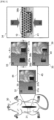
- FIG. 4 shows a schematic diagram illustrating an application of the anti-adhesion material (particles) according to the present embodiment using a spray system.
- a defective area 37 is present at a tissue 41 in a living body.
- particles 10 for example, "C10-MPs" as an anti-adhesion material are applied using a spray device (indicated by "Spray” in the figure).
- the anti-adhesion material (particles) according to the present embodiment can be characterized by being "spray applicable" to the defective area 37.
- the anti-adhesion material (particles) according to the present embodiment comprises a cross-linked product of a gelatin mixture.
- the gelatin mixture has a hydrocarbon group introduction ratio in a specific range as described above.
- the particles according to the present embodiment have appropriate hydrophobicity.
- the particles applied on a tissue of an affected area during a surgical operation are hydrated, and, for example, are fused due to hydrophobic interactions between the particles to form a colloidal gel layer.
- This colloidal gel layer serves as a physical barrier to give anti-adhesion capability.
- Fig. 2 is a schematic diagram illustrating a function of the anti-adhesion material (particles).
- the particles 10 as the anti-adhesion material adhere to a tissue (A).
- the tissue has a laminate structure of a serosa layer 22, a muscle layer 23, a submucous layer 24, and a mucosa layer 25, and has a surface on which an aqueous layer 26 is present.
- the particles 10 When adhering to the tissue, the particles 10 are gradually hydrated by the aqueous layer 26 (B). The particles 10 adhering to the surface of the tissue form a layer of a colloidal gel 38 (a colloidal gel layer) on the serosa layer 22 (C). The layer of the colloidal gel 38 strongly adheres to the serosa layer 22 by hydrophobic interactions 21. On the other hand, the colloidal gel 38 shows non-adhesiveness 20 with another tissue.
- FIG. 3 shows a schematic diagram illustrating a function of the anti-adhesion material (particles) according to the present embodiment in a living body (rat).
- the defective areas 37 37a, 37b) are present at an inside of the abdomen 31 (an abdominal cavity 36) and a cecum 39 of a rat 30, respectively.
- An image 32 represents a state before the treatment with the anti-adhesion material (the particles 10).
- the anti-adhesion material (the particles 10) is applied to the defective area 37 (an arrow 44).
- An image 33 represents a state after the anti-adhesion material (the particles 10) is applied.
- the particles 10 are applied to both of the defective areas 37a and 37b, and hydrated. Thereby, the layers of the colloidal gels 38a and 38b are formed on the defective areas 37a and 37b.
- An image 34 shows a schematic diagram of a cross section of the tissue at the A-B portion.
- the layer of the colloidal gel 38b is formed on the tissue 41 with the hydrated particles 10.
- the layer of the colloidal gel 38b shows non-adhesiveness as a physical barrier against another tissue (an arrow 42). In contrast, it shows tissue adhesiveness due to hydrophobic interactions between the particles 10 and the tissue 41 at the side of the tissue 41 (an arrow 43). This can prevent adhesion between the tissue 41 and another tissue.
- An image 35 represents a state where the anti-adhesion material (the particles 10) is not used.
- the defective areas 37a and 37b adhere each other to form an adhesion 40.
- the colloidal gel layer of the particles having appropriate hydrophobicity absorbs water at the surface of the affected tissue, and forms hydrophobic interactions between the particles and the affected tissue, resulting in strong adhesion to the surface of the affected area.
- the colloidal gel layer is no longer adhesive to another tissue due to the presence of water on the surface of the colloidal gel layer and on the surface of the tissue (the surface of another tissue, different from the tissue where the colloidal gel layer is formed).
- the anti-adhesion material (particles) according to the present embodiment has both adhesiveness to an affected tissue and non-adhesiveness (anti-adhesion capability) to other tissues (see FIGs 2 and 3 ).
- anti-adhesion material function as physical barriers, but they are less adhesive to soft tissues in moist conditions, showing a problem of easy detachment from tissue defective areas (affected areas).
- the anti-adhesion material according to the present embodiment can solve this problem as described above.
- Anti-adhesion materials need to remain stable at an affected area under moist conditions for a certain period of time. If an anti-adhesion material does not stably adhere to an affected area under physiological conditions (moist conditions), postoperative adhesion may be induced by fibrin deposition and fibroblast migration.
- the anti-adhesion material having appropriate hydrophobicity according to the present invention forms hydrophobic interactions between a colloidal gel layer and an affected tissue, thereby showing high stability even in the moist conditions.
- the followability of an anti-adhesion material is important on a tissue which changes its shape.
- the colloidal gel layer adheres firmly to an affected tissue and shows excellent followability to a deforming tissue.
- the anti-adhesion material according to the present embodiment may be characterized by that the colloidal gel layer is quickly decomposed and absorbed after the colloidal gel layer has completed its anti-adhesion function.
- the anti-adhesion material (particles) according to the present invention has an advantage in this respect because a mixture of the raw material gelatin (the first gelatin) and the hydrophobized gelatin (the second gelatin) can be used.
- the anti-adhesion material (particles) according to the present invention only requires adjusting a mixing ratio (A) of the raw material gelatin and the hydrophobized gelatin based on the hydrocarbon group introduction ratio (Xc) of the hydrophobized gelatin. Consequently, the hydrocarbon group introduction ratio (Xm) of the gelatin mixture, i.e., the hydrophobicity of the anti-adhesion material (particles) can be adjusted easily (see the Equation (I) above).
- a less amount of a hydrophobized gelatin may be required as compared with a case where an anti-adhesion material is produced from only one type of hydrophobized gelatin. This is because the anti-adhesion material according to the present embodiment is prepared by mixing the raw material gelatin with the hydrophobized gelatin.
- the hydrophobized gelatin which is synthesized from the raw material gelatin, requires more time and efforts for synthesis, and also suffers from a production cost higher than that of the raw material gelatin.
- the anti-adhesion material is also superior in that the amount of the hydrophobized gelatin required for producing particles having predetermined hydrophobicity tends to be relatively small. This is because time and efforts required for synthesis and the production cost depend not on the amount of the hydrophobized group introduced into the raw material gelatin, but on the amount of the hydrophobized gelatin to be synthesized and the number of times for synthesis. As a result, the synthesis requires less time and effort, enabling a reduced production cost.
- the anti-adhesion material according to the present embodiment which has the advantages as described above, is suitable for mass production in industrial settings. Mass production can further reduce a production cost.
- the particles according to the present embodiment may be used as an anti-adhesion material, but can also be used as a wound dressing material at the same time. That is, they can be used as an article having two functions: wound dressing and anti-adhesion. For example, when applied to a postoperative damaged area, a film having a wound dressing effect and an anti-adhesion effect may be formed. Compared with the conventional separate application of a wound dressing material and an anti-adhesion material, the both effects can be achieved more conveniently. Further, the particles according to an embodiment of the present invention have excellent blood coagulation ability and can be used as a hemostatic material. In addition to the functions of wound dressing and anti-adhesion, it can also be used to form an article having blood coagulation ability.
- the method of manufacturing the particles according to the present embodiment may be manufactured by using the coacervation method disclosed in Patent Document 1.
- the contents of the method of manufacturing particles disclosed in Patent Document 1 is incorporated herein by reference. Below, an example of the method of manufacturing the particles according the present embodiment will be described.
- the method of manufacture according to the present embodiment comprises, for example, the following steps.
- the step 1 is a step of dissolving the gelatin mixture as already described in a good solvent to obtain a gelatin mixture solution.
- the term "good solvent” means a solvent in which the gelatin mixture can easily be dissolved.
- the type of the good solvent examples include water, glycerin, acetic acid, a mixture thereof, and the like. Among them, it preferably contains water.
- the above good solvent may be heated. There is no particular limitation for a heating temperature, but it is preferably 50°C to 70°C.
- a method of dissolving the gelatin mixture in a good solvent there is no particular limitation for a method of dissolving the gelatin mixture in a good solvent, but a publicly known method can be used.
- a method comprising adding a good solvent at low temperature (e.g., room temperature) to a gelatin mixture to swell the gelatin mixture, and heating the resulting swollen material to obtain a gelatin mixture solution (a swelling and dissolution method); and a method comprising charging a gelatin mixture into the above good solvent which is preheated to obtain a gelatin mixture solution (a direct dissolution method).
- the content of the gelatin mixture in the gelatin mixture solution is preferably 0.01 mass/vol% to 30 mass/vol%, more preferably 1 mass/vol% to 25 mass/vol%, even more preferably 5 mass/vol% to 20 mass/vol%, and in particular preferably 5 mass/vol% to 15 mass/vol% relative to the total volume of the gelatin mixture solution.
- the step 2 is a step of adding a poor solvent to the gelatin mixture solution to precipitate a first intermediate particle containing the gelatin mixture in the gelatin mixture solution (coacervation).
- a poor solvent means a solvent in which the gelatin mixture is more difficult to be dissolved as compared with in the good solvent used in the step 1. That is, good and poor solvents are not defined by the absolute solubility of the gelatin mixture, but defined relatively with respect to the relationship between a poor solvent and a good solvent.
- the poor solvent examples include organic solvents, and it is preferably, among them, a water-miscible organic solvent, more preferably alcohols, for example, methanol, ethanol, propanol, isopropanol, butanol, t-butyl alcohol, and the like.
- the first intermediate particle When a poor solvent is added to the gelatin mixture solution, the first intermediate particle precipitates in the gelatin mixture solution.
- the first intermediate particle is a particulate material containing the above gelatin mixture.
- the particle diameter of the first intermediate particle precipitated in this step is preferably 0.1 ⁇ m to 100 ⁇ m, more preferably 1 ⁇ m to 50 ⁇ m, and even more preferably 1 ⁇ m to 10 ⁇ m. If the particle diameter is in the above ranges, sedimentation of the intermediate particle which precipitated in the gelatin mixture solution is more difficult. As a result, during a process in the step 3 of lyophilization described below, aggregation of the intermediate particles can be better prevented.
- a temperature at the time of adding the poor solvent is preferably 10°C to 30°C, more preferably 15°C to 25°C.
- a temperature at the time of adding the poor solvent is preferably 10°C to 30°C, more preferably 15°C to 25°C.
- the poor solvent When the poor solvent is added dropwise, it is preferred to agitate the gelatin mixture solution.
- agitation There is no particular limitation for a method of agitation, but a publicly known method can be used.
- the step 3 is a step of lyophilizing a dispersed solution of uncross-linked gelatin particle precipitated by the above coacervation (the first intermediate particle) to obtain the second intermediate particle.
- a method of freezing the gelatin mixture solution but more rapid freezing is preferred. This enables the particles containing the uncross-linked gelatin mixture to be less likely to aggregate upon freezing.
- the atmosphere temperature upon freezing it is preferably -20°C or less, more preferably -30°C or less.
- a method of lyophilization but a publicly known method can be used.
- the second intermediate particle includes the first intermediate particle.
- the second intermediate particle may also include a component other than the first intermediate particle. Examples of such a component include, for example, the good solvent and the poor solvent described above, and the like.
- the step 4 is a step of cross-linking the gelatin mixture of the second intermediate particle to obtain a particle containing the cross-linked gelatin mixture (the cross-linked product).
- the gelatin mixture of the particle irreversibly undergoes inter- and/or intramolecular cross-linking in this step. As a result, the particle containing the cross-linked product of the gelatin mixture can be obtained.
- the cross-linking method includes a method comprising applying thermal energy to the gelatin mixture or irradiating the gelatin mixture with an active ray or radiation (e.g., an electron beam and the like).
- a method thermal cross-linking
- thermal energy in other words, heating
- an amino group reacts with other reactive groups (for example, a carboxy group, a mercapto group, and the like) in the gelatin mixture to form a cross-linked structure.
- thermal cross-linking there is no particular limitation for a method of thermal cross-linking, but a publicly known method can be used.
- Examples of the method of thermal cross-linking include a method comprising placing a entire container with the second intermediate particles in a heated atmosphere (e.g., in an oven) and maintaining it for a predetermined time.
- the heating temperature in the thermal cross-linking is, in general, preferably 80°C to 200°C, more preferably 100°C to 200°C.
- the heat time in the thermal cross-linking is, in general, preferably 0.1 hour to 20 hours, more preferably 0.5 hour to 10 hours, even more preferably 1 hour to 6 hours, still more preferably 2 hours to 5 hours, and in particular preferably 2.5 hours to 4 hours. If the heating time is within the above numerical ranges, the resulting particles tend to have superior adhesiveness.
- the cross-linked product of the gelatin mixture may be obtained by allowing the gelatin mixture to react with a cross-linking agent.
- a cross-linking agent there is no particular limitation for the cross-linking agent, but examples include polybasic acids, aldehyde compounds, acid anhydrides, dithiocarbonates, di-isothiocyanates activated by genipin, N-hydroxysuccinimide, N-sulfoxysuccinimide, and the like.
- the cross-linking agent for example, compounds described in the paragraphs 0021 to 0024 of WO2018/079538 can also be used, the content of which is incorporated herein by reference.
- Example below Materials, usage amounts, percentages, treatment details, treatment procedures, and the like which are shown in Example below can be appropriately altered without departing the spirits of the present invention. Therefore, the scope of the present invention should not be construed as limited to Example as shown below.
- a gelatin derived from Alaska pollock (hereinafter may be referred to as "Org-ApGltn” or simply “Org” as appropriate) was used as the raw material gelatin.
- a gelatin derivative (hereinafter may be referred to as "C10-ApGltn” as appropriate) in which a decyl group was introduced to Org-ApGltn was used as the hydrophobized gelatin.
- the hydrophobized gelatin was obtained by allowing decanal to react with an amino group in the raw material gelatin to form a Schiff base, and then reducing the resulting Schiff base into a stable secondary amine with a reducing agent. Below, the synthesis of the hydrophobized gelatin are described in detail.
- a gelatin from Alaska pollock (Org-ApGltn) (from Nitta Gelatin Inc.; weight average molecular weight (Mw): 38,552 Da; the content of amino groups: 339 ⁇ mol/g) in an amount of 100 g was dissolved in 105 mL of ultrapure water. The resulting solution was heated to 50°C, and two equivalents of decanal (Tokyo Chemical Industry Co., Ltd., 67.8 mmol) with respect to the amino groups (339 ⁇ mol/g) of Org-ApGltn was added along with ethanol (Junsei Chemical Co., Ltd.). By this, an imine bond was formed between the amino groups of decanal and Org-ApGltn.
- the mixed solution (150 mL) after the reaction was added dropwise to 1500 mL of cold ethanol (-7 to 4°C) to purify C10-ApGltn.
- the resulting re-precipitated material was washed (1 hour ⁇ 3 times) with 1500 mL of ethanol to remove unreacted decanal and 2-picoline borane. Subsequently, it was dried in a vacuum for 3 days to obtain C10-ApGltn at a yield of 92.9 mass%.
- the introduction of decyl groups into the resulting C10-ApGltn was able to be confirmed by Fourier transform infrared spectroscopy and 1 H-NMR.
- the hydrocarbon group introduction ratio of C10-ApGltn (hereinafter may be referred to as the "decyl group introduction ratio DS" or simply "DS" as appropriate) was computed.
- DS was computed from the number of amino groups in the raw material gelatin and the number of amino groups in the hydrophobized gelatin quantified by the 2,4,6-trinitrobenzenesulfonic acid method (the TNBS method).
- the computed DS of C10-ApGltn was 49 mol%. This means that 6.4 decyl groups are introduced into amino groups in a single molecule of C10-ApGltn.
- a hydrophobized gelatin having a DS of 49 mol% may be denoted as 49C10-ApGltn (or simply "49C10").
- the DS values of the resulting 49C10-ApGltn are summarized in Table 1. [Table 1] Abbreviation ApGltn Theoretical DS DS Yield (g) (mol%) (mol%) (mass%) 49C10-ApGltn 100 200 49 92.9
- the synthesized 49C10-ApGltn was dissolved in ultrapure water at 50°C to obtain a 5 mass/vol% aqueous solution of C10-ApGltn.
- aliquots of ethanol were added dropwise to the solution in small quantities with agitating (400 rpm) at room temperature (25°C).
- the resulting solution was preliminarily frozen at -30°C for 24 hours and then lyophilized.
- the resulting dried particles were thermally cross-linked by heating under vacuum conditions (less than 3 mbar) at 150°C for 3 hours to form an amide bond between a carboxy group and an amino group in 49C10-ApGltn. This yielded particles (49C10-MPs) as a cross-linked product of only 49C10-ApGltn.
- the sample 2 was produced as in the sample 1, except that the raw material gelatin (Org-ApGltn) was used instead of the hydrophobized gelatin (49C 10-ApGltn).
- the hydrophobized gelatin (49C10-ApGltn) was used alone in the sample 1, but mixtures of the raw material gelatin and the hydrophobized gelatin in the mixing ratios as shown in Table 2 was used in the sample 3 to 8 instead. Except for this, the samples 3 to 8 (10C10-MPs to 45C10-MPs) were produced as in the sample 1.
- Org-ApGltn mass 49C10-ApGltn mass DS Total mass Yield (g) (g) (mol%) (g) (mass%) 2 Org-MPs 5.00 0 0 5.00 84.1 3 10C10-MPs 3.98 1.02 10 5.00 82.5 4 2OC10-MPs 2.96 2.04 20 5.00 84.4 5 30C10-MPs 1.94 3.06 30 5.00 83.3 6 35C10-MPs 1.43 3.57 35 5.00 84.3 7 40C10-MPs 0.92 4.08 40 5.00 80.9 8 45C10-MPs 0.41 4.59 45 5.00 84.3 1 49C10-MPs 0 5.00 49 5.00 85.3
- the resulting samples 1 to 8 was observed by SEM, and particle diameter distribution was analyzed with "Image J.” As shown in FIG. 5A , all of the samples 1 to 8 were spheres (microparticles) having microscale particle diameters. Moreover, as shown in FIG. 5B , the average particle diameters of the samples 1 to 8 were 2 to 3 ⁇ m, and the particle diameter distribution of each sample did not change with DS.
- the samples 1 to 8 produced were subjected to spray tests using an endoscopic spray device (the spray system). As shown in FIG. 6 , the samples 1 to 8 were sprayable with the endoscopic spray device, confirming that they were directly sprayable to, for example, a surface of an internal organ tissue during surgery.
- the sample 8 (45C10-MPs) in an amount of 50 mg was packed into a silicon mold with a thick of 1 mm and a diameter of 10 mm and leveled using a spatula.
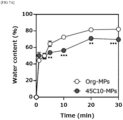
- FIG. 7A shows the time dependent water content of a colloidal gel (the relationship between hydration time and water content) for sample 8 (45C10-MPs).
- the time dependent water content of a colloidal gel was also evaluated for the sample 2 (Org-MPs) in a similar manner. The results are shown together in FIG. 7A .
- the sample 2 (Org-MPs) and the sample 8 (45C10-MPs) gradually absorbed water and formed colloidal gels, reaching the equilibrium of swelling after 30 minutes.
- the water content (53 to 69%) of the sample 8 (45C10-MP) with higher DS was lower than that of the sample 2 (Org-MPs) (64 to 82%), confirming that the sample 8 has higher hydrophobicity.
- Particles were observed for their aggregation behavior under moist conditions.
- the sample 2 (Org-MPs) and the sample 8 (45C10-MPs) each in an amount of 10 mg were added to 200 ⁇ L of physiological saline to prepare suspensions. After incubating these suspensions for up to 2 hours, the particles were observed for their aggregation behavior under a bright field microscope (KEYENCE CORPORATION, BZ-X710). Bright field micrographs are shown in FIG. 7B .
- Org-MPs was isolated from each other at any hydration time, and fusion of particles was not able to be observed.
- 45C10-MPs aggregated over hydration time and formed a colloidal gel due to hydrophobic interactions.
- 45C10-MPs showed a tightly packed structure after 30 minutes of hydration. Almost all 45C10-MP were then fused with each other to form large assemblies after hydration for 60 minutes.
- a serosa tissue (81) which is a submucous tissue.
- the resulting serosa tissue (81) was cut into tissue pieces of 2.5 cm squared, which were then fixed on each stage of the upper and lower jigs (80) of a test apparatus (a texture analyzer TA-XT2i from Stable Micro Systems) with a cyanoacrylate glue (Henkel Japan Ltd.).
- a hot plate (83) was used to maintain the temperature of the porcine stomach lining tissue at 37°C during the measurements.
- an industrial paper rag (82) (under the trade name of "Kimwipe") was pressed against the surfaces at 80 kPa for 3 minutes to remove water. Then, 100 mg of the sample 8 (45C10-MPs) was sprinkled so as to cover the tissue on the stage of the lower jig and hydrated for a predetermined time (hydration time: 1 to 30 minutes) under moist environments. This resulted in formulation of the layer of the colloidal gel (38). Specifically, physiological saline (84) (7 mL) was filled around the tissue to bring the humidity around the tissue surfaces and the sample 8 (45C10-MPs) closer to that of the intestinal environment, and a plastic cover (85) was used to cover the tissue.
- FIG. 8B shows the relationship between hydration time and adhesive strength.
- the sample 2 (Org-MPs) was also evaluated in a similar way, and results are shown in FIG. 8B .
- the adhesive strength between two tissues that were not sprayed with the particles is also shown in FIG. 8B .
- tissue sections were fixed with 10% formalin buffer (Wako Pure Chemical Industries, Ltd.) and stained with hematoxylin-eosin (HE). The interface between the colloidal gel and the tissue was then observed. Bright field micrographs are shown in FIG. 8C .
- the adhesive strength of the colloidal gel of the sample 2 did not change significantly as hydration time increased (the maximum strength: 2.73 kPa, the minimum strength: 1.48 kPa).
- the adhesive strength of the colloidal gel of the sample 8 decreased from 5.24 kPa to 2.41 kPa with the hydration time, and dropped to around the adhesive strength of the colloidal gel of the sample 2 (Org-MPs) after 30 minutes of hydration.
- the sample 8 (45C10-MPs) can absorb water from the tissue surfaces and form hydrophobic interactions between the particles and the tissue, resulting in strong adhesion. Then, after complete hydration, the colloidal gel layer is considered to be no longer adhesive (showing anti-adhesion effects) due to the presence of water on the surfaces of the colloidal gel and the tissue (see FIG. 2 ).
- the underwater stability of the colloidal gel of the particles was evaluated by immersion in physiological saline after the colloidal gel was allowed to adhere to the stomach tissue (the submucosal layer).
- a porcine stomach tissue was cut into 2.5 ⁇ 2.5 cm pieces.
- the sample 8 (45C10-MPs) in an amount of 50 mg was sprinkled roundly in a 10 mm diameter on the tissue and hydrated with 300 ⁇ L of physiological saline for 30 minutes to form a colloidal gel.
- the colloidal gel adhered to the stomach tissue was immersed into physiological saline containing 0.05 mass/vol% of sodium azide (Wako Pure Chemical Industries, Ltd.), and incubated at 37°C for two days.
- each sample is represented by the first half part (a part before -MPs) of the corresponding particle name.
- the particles 45C10-MPs are designated as "45C10.”
- an abdominal wall-cecum defect model of SD (Sprague-Dawley) rats purchased from Jackson Laboratory Japan, Inc., 7 weeks old male) was created as follows.
- a rat was anesthetized by introduction of 2.5% isoflurane, and abdominal hair was shaved, and ethanol was used to prevent infection.
- the abdomen was opened about 5 cm to expose the abdominal wall and the cecum ( (a) in FIG. 10A ).
- Cecum abrasion cecum defective area
- An abdominal wall defect was created by excising an abdominal wall tissue (1 cm ⁇ 2 cm, including the mesothelial layer) at a location where it abuts the cecum defective area using a surgical knife ( (b) in FIG. 10A ).
- FIG. 10B shows photographs of the area around the cecum and peritoneal immediately before abdominal closure (W0), one week after abdominal closure (W1), and two weeks after abdominal closure (W2). Black arrows in the photographs indicate an adhesion area between the abdominal wall and the cecum. It is noted that the sample 8 (45C10-MPs) was indicated as "C10" in FIG. 10B , and as “C10-MPs" in FIGs. 10C and 10D .
- sample 2 In place of the sample 8 (45C10-MPs), the sample 2 (Org-MPs) and a hyaluronic acid/carboxymethylcellulose sheet (HA/CMC) (a commercially available anti-adhesion material, Seprafilm ® from Kaken Pharmaceutical Co. Ltd.) were each used to perform the evaluation in the same way. Untreated rats that were not given the anti-adhesion material (Untreated) were also evaluated in the same way. These evaluation results are shown together in FIGs. 10B to 10D . It is noted that the sample 2 (Org-MPs) was indicated as "Org" in FIG. 10B .
- H/CMC hyaluronic acid/carboxymethylcellulose sheet
- the present invention can provide an anti-adhesion material which is excellent in adhesiveness on tissues and adhesion stability under aqueous environments, and has simple operability, and, in addition, can be easily mass produced in industrial settings.
Landscapes
- Health & Medical Sciences (AREA)
- Life Sciences & Earth Sciences (AREA)
- Veterinary Medicine (AREA)
- Public Health (AREA)
- General Health & Medical Sciences (AREA)
- Animal Behavior & Ethology (AREA)
- Engineering & Computer Science (AREA)
- Chemical & Material Sciences (AREA)
- Bioinformatics & Cheminformatics (AREA)
- Pharmacology & Pharmacy (AREA)
- Medicinal Chemistry (AREA)
- Epidemiology (AREA)
- Surgery (AREA)
- Nuclear Medicine, Radiotherapy & Molecular Imaging (AREA)
- General Chemical & Material Sciences (AREA)
- Chemical Kinetics & Catalysis (AREA)
- Organic Chemistry (AREA)
- Vascular Medicine (AREA)
- Heart & Thoracic Surgery (AREA)
- Biomedical Technology (AREA)
- Proteomics, Peptides & Aminoacids (AREA)
- Marine Sciences & Fisheries (AREA)
- Zoology (AREA)
- Gastroenterology & Hepatology (AREA)
- Immunology (AREA)
- Physics & Mathematics (AREA)
- Nanotechnology (AREA)
- Optics & Photonics (AREA)
- Dermatology (AREA)
- Dispersion Chemistry (AREA)
- Diabetes (AREA)
- Hematology (AREA)
- Materials For Medical Uses (AREA)
Applications Claiming Priority (2)
| Application Number | Priority Date | Filing Date | Title |
|---|---|---|---|
| JP2022046287 | 2022-03-23 | ||
| PCT/JP2022/047729 WO2023181563A1 (fr) | 2022-03-23 | 2022-12-23 | Matériau antiadhésif et procédé de production de matériau antiadhésif |
Publications (2)
| Publication Number | Publication Date |
|---|---|
| EP4506021A1 true EP4506021A1 (fr) | 2025-02-12 |
| EP4506021A4 EP4506021A4 (fr) | 2026-03-18 |
Family
ID=88100483
Family Applications (1)
| Application Number | Title | Priority Date | Filing Date |
|---|---|---|---|
| EP22933690.4A Pending EP4506021A4 (fr) | 2022-03-23 | 2022-12-23 | Matériau antiadhésif et procédé de production de matériau antiadhésif |
Country Status (4)
| Country | Link |
|---|---|
| US (1) | US20250134965A1 (fr) |
| EP (1) | EP4506021A4 (fr) |
| JP (1) | JP7802409B2 (fr) |
| WO (1) | WO2023181563A1 (fr) |
Families Citing this family (1)
| Publication number | Priority date | Publication date | Assignee | Title |
|---|---|---|---|---|
| CN117384548B (zh) * | 2023-10-13 | 2025-02-14 | 广州大学 | 一种防粘附功能涂层及其制备方法和应用 |
Family Cites Families (6)
| Publication number | Priority date | Publication date | Assignee | Title |
|---|---|---|---|---|
| JP4404866B2 (ja) | 2006-03-03 | 2010-01-27 | ゼライス株式会社 | エンドトキシン含有量を低減したゼラチンの製造方法および低エンドトキシンゼラチン |
| JP5594633B2 (ja) * | 2010-10-05 | 2014-09-24 | 独立行政法人物質・材料研究機構 | 2成分系組織接着剤及びその製造方法 |
| JP2019216755A (ja) | 2016-10-26 | 2019-12-26 | 国立研究開発法人物質・材料研究機構 | 止血材 |
| CN111065421B (zh) * | 2017-09-04 | 2022-04-29 | 国立研究开发法人物质·材料研究机构 | 含有交联明胶衍生物粒子的伤口敷料 |
| WO2020050102A1 (fr) * | 2018-09-05 | 2020-03-12 | 国立研究開発法人物質・材料研究機構 | Matériau anti-adhérence |
| CN113227129B (zh) | 2018-12-26 | 2026-02-06 | 国立研究开发法人物质·材料研究机构 | 粉体、创伤被覆材料、防粘连材料、止血材料及粉体的制造方法 |
-
2022
- 2022-12-23 EP EP22933690.4A patent/EP4506021A4/fr active Pending
- 2022-12-23 JP JP2024509770A patent/JP7802409B2/ja active Active
- 2022-12-23 US US18/834,938 patent/US20250134965A1/en active Pending
- 2022-12-23 WO PCT/JP2022/047729 patent/WO2023181563A1/fr not_active Ceased
Also Published As
| Publication number | Publication date |
|---|---|
| JPWO2023181563A1 (fr) | 2023-09-28 |
| JP7802409B2 (ja) | 2026-01-20 |
| EP4506021A4 (fr) | 2026-03-18 |
| WO2023181563A1 (fr) | 2023-09-28 |
| US20250134965A1 (en) | 2025-05-01 |
Similar Documents
| Publication | Publication Date | Title |
|---|---|---|
| JP5796860B2 (ja) | 架橋マトリックスの特性を調節するための酵素的架橋剤の改変 | |
| US6943154B2 (en) | Water insoluble derivatives of polyanionic polysaccharides | |
| RU2442612C2 (ru) | Быстродействующий герметик и способы его применения и изготовления | |
| Nishiguchi et al. | Hotmelt tissue adhesive with supramolecularly-controlled sol-gel transition for preventing postoperative abdominal adhesion | |
| JPH05508161A (ja) | ヒアルロン酸の非水溶性誘導体 | |
| JP2022504623A (ja) | 多様な湿潤表面用の生体から着想を得た分解性の強靭な接着剤 | |
| Du et al. | Mussel-Inspired epoxy bioadhesive with enhanced interfacial interactions for wound repair | |
| Ito et al. | Prevention of postoperative adhesion with a colloidal gel based on decyl group-modified Alaska pollock gelatin microparticles | |
| JP2003192597A (ja) | 癒着防止剤 | |
| EP3904377B1 (fr) | Poudre, matériau de couverture de plaie, matériau de prévention d'adhérence, matériau hémostatique et procédé de production de poudre | |
| Guo et al. | Naturally derived highly resilient and adhesive hydrogels with application as surgical adhesive | |
| EP4506021A1 (fr) | Matériau antiadhésif et procédé de production de matériau antiadhésif | |
| WO2019007400A1 (fr) | Film biodégradable, procédé de préparation s'y rapportant et son utilisation | |
| US20060078962A1 (en) | Polysaccharide-based polymers and methods of making the same | |
| Li et al. | Bioinspired hierarchical porous tough adhesive to promote sealing of high-pressure bleeding | |
| WO2016117569A1 (fr) | Agent d'étanchéité chirurgical | |
| WO2025200807A1 (fr) | Adhésif dégradable sensible à la pression in vivo prenant un matériau de matrice décellularisé en tant que matériau de base et son procédé de préparation | |
| CN116159192B (zh) | 一种可注射止血防黏连水凝胶及其制备方法 | |
| Yang et al. | Catechol-modified wet-adhesive hydrogel for the repair of the gastric epithelium | |
| CN114748677B (zh) | 一种抗粘连的水凝胶粘合剂及制备方法、应用 | |
| JP4669919B2 (ja) | 医療用組成物 | |
| Miyata et al. | Effects of phenolic hydroxyl group structures of Alaska pollock gelatin-based adhesives on soft tissue adhesion and biocompatibility | |
| JP4397015B2 (ja) | ゲル化組成物 | |
| JP7448944B2 (ja) | 癒着防止材及び癒着防止材の製造方法 | |
| EP4032558B1 (fr) | Feuille adhésive de tissu biologique, kit de matériau de renforcement de tissu biologique et procédé de fabrication de feuille adhésive de tissu biologique |
Legal Events
| Date | Code | Title | Description |
|---|---|---|---|
| STAA | Information on the status of an ep patent application or granted ep patent |
Free format text: STATUS: THE INTERNATIONAL PUBLICATION HAS BEEN MADE |
|
| PUAI | Public reference made under article 153(3) epc to a published international application that has entered the european phase |
Free format text: ORIGINAL CODE: 0009012 |
|
| STAA | Information on the status of an ep patent application or granted ep patent |
Free format text: STATUS: REQUEST FOR EXAMINATION WAS MADE |
|
| 17P | Request for examination filed |
Effective date: 20240712 |
|
| AK | Designated contracting states |
Kind code of ref document: A1 Designated state(s): AL AT BE BG CH CY CZ DE DK EE ES FI FR GB GR HR HU IE IS IT LI LT LU LV MC ME MK MT NL NO PL PT RO RS SE SI SK SM TR |
|
| DAV | Request for validation of the european patent (deleted) | ||
| DAX | Request for extension of the european patent (deleted) | ||
| A4 | Supplementary search report drawn up and despatched |
Effective date: 20260216 |
|
| RIC1 | Information provided on ipc code assigned before grant |
Ipc: A61L 31/04 20060101AFI20260210BHEP Ipc: A61P 7/04 20060101ALI20260210BHEP Ipc: A61P 17/02 20060101ALI20260210BHEP Ipc: A61P 41/00 20060101ALI20260210BHEP Ipc: A61L 31/14 20060101ALI20260210BHEP Ipc: A61K 9/51 20060101ALI20260210BHEP Ipc: A61K 38/00 20060101ALI20260210BHEP |