EP4524567A2 - Modulation par imipriidones du recepteur couple a la proteine g (gpcr) - Google Patents
Modulation par imipriidones du recepteur couple a la proteine g (gpcr) Download PDFInfo
- Publication number
- EP4524567A2 EP4524567A2 EP24210288.7A EP24210288A EP4524567A2 EP 4524567 A2 EP4524567 A2 EP 4524567A2 EP 24210288 A EP24210288 A EP 24210288A EP 4524567 A2 EP4524567 A2 EP 4524567A2
- Authority
- EP
- European Patent Office
- Prior art keywords
- compound
- cancer
- subject
- therapeutic agent
- tumor
- Prior art date
- Legal status (The legal status is an assumption and is not a legal conclusion. Google has not performed a legal analysis and makes no representation as to the accuracy of the status listed.)
- Pending
Links
Images



















Classifications
-
- A—HUMAN NECESSITIES
- A61—MEDICAL OR VETERINARY SCIENCE; HYGIENE
- A61K—PREPARATIONS FOR MEDICAL, DENTAL OR TOILETRY PURPOSES
- A61K31/00—Medicinal preparations containing organic active ingredients
- A61K31/33—Heterocyclic compounds
- A61K31/395—Heterocyclic compounds having nitrogen as a ring hetero atom, e.g. guanethidine or rifamycins
- A61K31/495—Heterocyclic compounds having nitrogen as a ring hetero atom, e.g. guanethidine or rifamycins having six-membered rings with two or more nitrogen atoms as the only ring heteroatoms, e.g. piperazine or tetrazines
- A61K31/505—Pyrimidines; Hydrogenated pyrimidines, e.g. trimethoprim
- A61K31/519—Pyrimidines; Hydrogenated pyrimidines, e.g. trimethoprim ortho- or peri-condensed with heterocyclic rings
-
- A—HUMAN NECESSITIES
- A61—MEDICAL OR VETERINARY SCIENCE; HYGIENE
- A61P—SPECIFIC THERAPEUTIC ACTIVITY OF CHEMICAL COMPOUNDS OR MEDICINAL PREPARATIONS
- A61P1/00—Drugs for disorders of the alimentary tract or the digestive system
- A61P1/16—Drugs for disorders of the alimentary tract or the digestive system for liver or gallbladder disorders, e.g. hepatoprotective agents, cholagogues, litholytics
-
- A—HUMAN NECESSITIES
- A61—MEDICAL OR VETERINARY SCIENCE; HYGIENE
- A61P—SPECIFIC THERAPEUTIC ACTIVITY OF CHEMICAL COMPOUNDS OR MEDICINAL PREPARATIONS
- A61P25/00—Drugs for disorders of the nervous system
-
- A—HUMAN NECESSITIES
- A61—MEDICAL OR VETERINARY SCIENCE; HYGIENE
- A61P—SPECIFIC THERAPEUTIC ACTIVITY OF CHEMICAL COMPOUNDS OR MEDICINAL PREPARATIONS
- A61P25/00—Drugs for disorders of the nervous system
- A61P25/18—Antipsychotics, i.e. neuroleptics; Drugs for mania or schizophrenia
-
- A—HUMAN NECESSITIES
- A61—MEDICAL OR VETERINARY SCIENCE; HYGIENE
- A61P—SPECIFIC THERAPEUTIC ACTIVITY OF CHEMICAL COMPOUNDS OR MEDICINAL PREPARATIONS
- A61P25/00—Drugs for disorders of the nervous system
- A61P25/24—Antidepressants
-
- A—HUMAN NECESSITIES
- A61—MEDICAL OR VETERINARY SCIENCE; HYGIENE
- A61P—SPECIFIC THERAPEUTIC ACTIVITY OF CHEMICAL COMPOUNDS OR MEDICINAL PREPARATIONS
- A61P31/00—Antiinfectives, i.e. antibiotics, antiseptics, chemotherapeutics
-
- A—HUMAN NECESSITIES
- A61—MEDICAL OR VETERINARY SCIENCE; HYGIENE
- A61P—SPECIFIC THERAPEUTIC ACTIVITY OF CHEMICAL COMPOUNDS OR MEDICINAL PREPARATIONS
- A61P31/00—Antiinfectives, i.e. antibiotics, antiseptics, chemotherapeutics
- A61P31/04—Antibacterial agents
-
- A—HUMAN NECESSITIES
- A61—MEDICAL OR VETERINARY SCIENCE; HYGIENE
- A61P—SPECIFIC THERAPEUTIC ACTIVITY OF CHEMICAL COMPOUNDS OR MEDICINAL PREPARATIONS
- A61P31/00—Antiinfectives, i.e. antibiotics, antiseptics, chemotherapeutics
- A61P31/12—Antivirals
-
- A—HUMAN NECESSITIES
- A61—MEDICAL OR VETERINARY SCIENCE; HYGIENE
- A61P—SPECIFIC THERAPEUTIC ACTIVITY OF CHEMICAL COMPOUNDS OR MEDICINAL PREPARATIONS
- A61P31/00—Antiinfectives, i.e. antibiotics, antiseptics, chemotherapeutics
- A61P31/12—Antivirals
- A61P31/14—Antivirals for RNA viruses
- A61P31/18—Antivirals for RNA viruses for HIV
-
- A—HUMAN NECESSITIES
- A61—MEDICAL OR VETERINARY SCIENCE; HYGIENE
- A61P—SPECIFIC THERAPEUTIC ACTIVITY OF CHEMICAL COMPOUNDS OR MEDICINAL PREPARATIONS
- A61P35/00—Antineoplastic agents
-
- A—HUMAN NECESSITIES
- A61—MEDICAL OR VETERINARY SCIENCE; HYGIENE
- A61P—SPECIFIC THERAPEUTIC ACTIVITY OF CHEMICAL COMPOUNDS OR MEDICINAL PREPARATIONS
- A61P35/00—Antineoplastic agents
- A61P35/02—Antineoplastic agents specific for leukemia
-
- A—HUMAN NECESSITIES
- A61—MEDICAL OR VETERINARY SCIENCE; HYGIENE
- A61P—SPECIFIC THERAPEUTIC ACTIVITY OF CHEMICAL COMPOUNDS OR MEDICINAL PREPARATIONS
- A61P37/00—Drugs for immunological or allergic disorders
-
- A—HUMAN NECESSITIES
- A61—MEDICAL OR VETERINARY SCIENCE; HYGIENE
- A61P—SPECIFIC THERAPEUTIC ACTIVITY OF CHEMICAL COMPOUNDS OR MEDICINAL PREPARATIONS
- A61P37/00—Drugs for immunological or allergic disorders
- A61P37/02—Immunomodulators
-
- A—HUMAN NECESSITIES
- A61—MEDICAL OR VETERINARY SCIENCE; HYGIENE
- A61P—SPECIFIC THERAPEUTIC ACTIVITY OF CHEMICAL COMPOUNDS OR MEDICINAL PREPARATIONS
- A61P37/00—Drugs for immunological or allergic disorders
- A61P37/02—Immunomodulators
- A61P37/04—Immunostimulants
-
- A—HUMAN NECESSITIES
- A61—MEDICAL OR VETERINARY SCIENCE; HYGIENE
- A61P—SPECIFIC THERAPEUTIC ACTIVITY OF CHEMICAL COMPOUNDS OR MEDICINAL PREPARATIONS
- A61P43/00—Drugs for specific purposes, not provided for in groups A61P1/00-A61P41/00
-
- C—CHEMISTRY; METALLURGY
- C07—ORGANIC CHEMISTRY
- C07D—HETEROCYCLIC COMPOUNDS
- C07D471/00—Heterocyclic compounds containing nitrogen atoms as the only ring hetero atoms in the condensed system, at least one ring being a six-membered ring with one nitrogen atom, not provided for by groups C07D451/00 - C07D463/00
- C07D471/12—Heterocyclic compounds containing nitrogen atoms as the only ring hetero atoms in the condensed system, at least one ring being a six-membered ring with one nitrogen atom, not provided for by groups C07D451/00 - C07D463/00 in which the condensed system contains three hetero rings
- C07D471/14—Ortho-condensed systems
-
- C—CHEMISTRY; METALLURGY
- C12—BIOCHEMISTRY; BEER; SPIRITS; WINE; VINEGAR; MICROBIOLOGY; ENZYMOLOGY; MUTATION OR GENETIC ENGINEERING
- C12Q—MEASURING OR TESTING PROCESSES INVOLVING ENZYMES, NUCLEIC ACIDS OR MICROORGANISMS; COMPOSITIONS OR TEST PAPERS THEREFOR; PROCESSES OF PREPARING SUCH COMPOSITIONS; CONDITION-RESPONSIVE CONTROL IN MICROBIOLOGICAL OR ENZYMOLOGICAL PROCESSES
- C12Q1/00—Measuring or testing processes involving enzymes, nucleic acids or microorganisms; Compositions therefor; Processes of preparing such compositions
- C12Q1/68—Measuring or testing processes involving enzymes, nucleic acids or microorganisms; Compositions therefor; Processes of preparing such compositions involving nucleic acids
- C12Q1/6876—Nucleic acid products used in the analysis of nucleic acids, e.g. primers or probes
- C12Q1/6883—Nucleic acid products used in the analysis of nucleic acids, e.g. primers or probes for diseases caused by alterations of genetic material
- C12Q1/6886—Nucleic acid products used in the analysis of nucleic acids, e.g. primers or probes for diseases caused by alterations of genetic material for cancer
-
- G—PHYSICS
- G01—MEASURING; TESTING
- G01N—INVESTIGATING OR ANALYSING MATERIALS BY DETERMINING THEIR CHEMICAL OR PHYSICAL PROPERTIES
- G01N33/00—Investigating or analysing materials by specific methods not covered by groups G01N1/00 - G01N31/00
- G01N33/48—Biological material, e.g. blood, urine; Haemocytometers
- G01N33/50—Chemical analysis of biological material, e.g. blood, urine; Testing involving biospecific ligand binding methods; Immunological testing
- G01N33/5005—Chemical analysis of biological material, e.g. blood, urine; Testing involving biospecific ligand binding methods; Immunological testing involving human or animal cells
- G01N33/5008—Chemical analysis of biological material, e.g. blood, urine; Testing involving biospecific ligand binding methods; Immunological testing involving human or animal cells for testing or evaluating the effect of chemical or biological compounds, e.g. drugs, cosmetics
-
- G—PHYSICS
- G01—MEASURING; TESTING
- G01N—INVESTIGATING OR ANALYSING MATERIALS BY DETERMINING THEIR CHEMICAL OR PHYSICAL PROPERTIES
- G01N33/00—Investigating or analysing materials by specific methods not covered by groups G01N1/00 - G01N31/00
- G01N33/48—Biological material, e.g. blood, urine; Haemocytometers
- G01N33/50—Chemical analysis of biological material, e.g. blood, urine; Testing involving biospecific ligand binding methods; Immunological testing
- G01N33/53—Immunoassay; Biospecific binding assay; Materials therefor
- G01N33/575—Immunoassay; Biospecific binding assay; Materials therefor for cancer
- G01N33/5758—Immunoassay; Biospecific binding assay; Materials therefor for cancer involving compounds serving as markers for tumours, cancers or neoplasias, e.g. cellular determinants, receptors, heat shock/stress proteins, A-protein, oligosaccharides or metabolites
-
- G—PHYSICS
- G01—MEASURING; TESTING
- G01N—INVESTIGATING OR ANALYSING MATERIALS BY DETERMINING THEIR CHEMICAL OR PHYSICAL PROPERTIES
- G01N33/00—Investigating or analysing materials by specific methods not covered by groups G01N1/00 - G01N31/00
- G01N33/48—Biological material, e.g. blood, urine; Haemocytometers
- G01N33/50—Chemical analysis of biological material, e.g. blood, urine; Testing involving biospecific ligand binding methods; Immunological testing
- G01N33/58—Chemical analysis of biological material, e.g. blood, urine; Testing involving biospecific ligand binding methods; Immunological testing involving labelled substances
- G01N33/60—Chemical analysis of biological material, e.g. blood, urine; Testing involving biospecific ligand binding methods; Immunological testing involving labelled substances involving radioactive labelled substances
-
- G—PHYSICS
- G01—MEASURING; TESTING
- G01N—INVESTIGATING OR ANALYSING MATERIALS BY DETERMINING THEIR CHEMICAL OR PHYSICAL PROPERTIES
- G01N33/00—Investigating or analysing materials by specific methods not covered by groups G01N1/00 - G01N31/00
- G01N33/48—Biological material, e.g. blood, urine; Haemocytometers
- G01N33/50—Chemical analysis of biological material, e.g. blood, urine; Testing involving biospecific ligand binding methods; Immunological testing
- G01N33/68—Chemical analysis of biological material, e.g. blood, urine; Testing involving biospecific ligand binding methods; Immunological testing involving proteins, peptides or amino acids
- G01N33/6872—Intracellular protein regulatory factors and their receptors, e.g. including ion channels
-
- A—HUMAN NECESSITIES
- A61—MEDICAL OR VETERINARY SCIENCE; HYGIENE
- A61K—PREPARATIONS FOR MEDICAL, DENTAL OR TOILETRY PURPOSES
- A61K39/00—Medicinal preparations containing antigens or antibodies
- A61K2039/505—Medicinal preparations containing antigens or antibodies comprising antibodies
-
- A—HUMAN NECESSITIES
- A61—MEDICAL OR VETERINARY SCIENCE; HYGIENE
- A61K—PREPARATIONS FOR MEDICAL, DENTAL OR TOILETRY PURPOSES
- A61K2300/00—Mixtures or combinations of active ingredients, wherein at least one active ingredient is fully defined in groups A61K31/00 - A61K41/00
-
- A—HUMAN NECESSITIES
- A61—MEDICAL OR VETERINARY SCIENCE; HYGIENE
- A61K—PREPARATIONS FOR MEDICAL, DENTAL OR TOILETRY PURPOSES
- A61K39/00—Medicinal preparations containing antigens or antibodies
- A61K39/39—Medicinal preparations containing antigens or antibodies characterised by the immunostimulating additives, e.g. chemical adjuvants
-
- C—CHEMISTRY; METALLURGY
- C12—BIOCHEMISTRY; BEER; SPIRITS; WINE; VINEGAR; MICROBIOLOGY; ENZYMOLOGY; MUTATION OR GENETIC ENGINEERING
- C12Q—MEASURING OR TESTING PROCESSES INVOLVING ENZYMES, NUCLEIC ACIDS OR MICROORGANISMS; COMPOSITIONS OR TEST PAPERS THEREFOR; PROCESSES OF PREPARING SUCH COMPOSITIONS; CONDITION-RESPONSIVE CONTROL IN MICROBIOLOGICAL OR ENZYMOLOGICAL PROCESSES
- C12Q2600/00—Oligonucleotides characterized by their use
- C12Q2600/106—Pharmacogenomics, i.e. genetic variability in individual responses to drugs and drug metabolism
-
- C—CHEMISTRY; METALLURGY
- C12—BIOCHEMISTRY; BEER; SPIRITS; WINE; VINEGAR; MICROBIOLOGY; ENZYMOLOGY; MUTATION OR GENETIC ENGINEERING
- C12Q—MEASURING OR TESTING PROCESSES INVOLVING ENZYMES, NUCLEIC ACIDS OR MICROORGANISMS; COMPOSITIONS OR TEST PAPERS THEREFOR; PROCESSES OF PREPARING SUCH COMPOSITIONS; CONDITION-RESPONSIVE CONTROL IN MICROBIOLOGICAL OR ENZYMOLOGICAL PROCESSES
- C12Q2600/00—Oligonucleotides characterized by their use
- C12Q2600/156—Polymorphic or mutational markers
-
- C—CHEMISTRY; METALLURGY
- C12—BIOCHEMISTRY; BEER; SPIRITS; WINE; VINEGAR; MICROBIOLOGY; ENZYMOLOGY; MUTATION OR GENETIC ENGINEERING
- C12Q—MEASURING OR TESTING PROCESSES INVOLVING ENZYMES, NUCLEIC ACIDS OR MICROORGANISMS; COMPOSITIONS OR TEST PAPERS THEREFOR; PROCESSES OF PREPARING SUCH COMPOSITIONS; CONDITION-RESPONSIVE CONTROL IN MICROBIOLOGICAL OR ENZYMOLOGICAL PROCESSES
- C12Q2600/00—Oligonucleotides characterized by their use
- C12Q2600/158—Expression markers
-
- G—PHYSICS
- G01—MEASURING; TESTING
- G01N—INVESTIGATING OR ANALYSING MATERIALS BY DETERMINING THEIR CHEMICAL OR PHYSICAL PROPERTIES
- G01N2500/00—Screening for compounds of potential therapeutic value
- G01N2500/04—Screening involving studying the effect of compounds C directly on molecule A (e.g. C are potential ligands for a receptor A, or potential substrates for an enzyme A)
-
- G—PHYSICS
- G01—MEASURING; TESTING
- G01N—INVESTIGATING OR ANALYSING MATERIALS BY DETERMINING THEIR CHEMICAL OR PHYSICAL PROPERTIES
- G01N2800/00—Detection or diagnosis of diseases
- G01N2800/52—Predicting or monitoring the response to treatment, e.g. for selection of therapy based on assay results in personalised medicine; Prognosis
Definitions
- GPCR G rotein-coupled receptors
- the human genome has approximately 30,000 genes, as many as 1,000 of which encode GPCRs.
- GPCRs have been grouped into five classes. The first class is the rhodopsin receptor family or "Class A GPCR” with 670 receptor proteins.
- the rhodopsin receptor family can react with various ligands including amines (alpha group), peptides (beta group), lipid-like substances (gamma group), nucleotides, and glycoproteins (delta group), and comprises a lot of drug target receptors.
- the second class is the secretin receptor family, and has binding domains for peptide hormones. Receptors in this family are associated with homeostasis and have been arising as important targets for drug development.
- the third class is the adhesion receptor family, characterized by a GPCR proteolytic site (GPS). Development of drugs targeting this family of GPCRs has not yet taken place because they exhibit various N-terminal moieties and little is known about their ligands.
- the fourth class is the glutamate receptor family with 22 GPCR members have so far been identified. Relatively little is known about the specificity of each protein.
- Frizzled/Taste2 The last class is the Frizzled/Taste2 family that encompasses 10 Frizzled receptors for which Wnt glycoproteins serve as ligands, 5 SMO (smoothened) receptors which need no ligands, and 25 Taste2 receptors which are required for sensing various tastes.
- Receptors including GPCRs are also classified on the basis of the identification of endogenous ligands. Receptors bind with known endogenous compounds or are classified as orphan receptors whose endogenous ligands have not yet been identified.
- GPCRs are found in a broad range of tissue and cell types and associated with many different physiological mechanisms. They are activated by a wide range of ligands, e.g., hormones such as thyroid-stimulating hormone (TSH), adrenocorticotropic hormone, glucagon and vasopressin, amines such as 5-HT, acetylcholine (muscarinic AchR), and histamines, lipids such as LPA and S1P, and signal transmitters such as amino acids, Ca 2+ , nucleic acids, peptides and light.
- TSH thyroid-stimulating hormone
- adrenocorticotropic hormone e.g., adrenocorticotropic hormone, glucagon and vasopressin
- amines such as 5-HT
- histamines lipids such as LPA and S1P
- signal transmitters such as amino acids, Ca 2+ , nu
- GPCRs are involved in various diseases including bronchoconstriction, hypertension, diabetes, inflammation, cell death, hormone disorders, cancer, neurotransmission and behavioral disorders. GPCRs are therefore an important area for the development of pharmaceutical products. Approximately 360 GPCRs are now considered available for drug development. Of these, 46 have already been used for drug development. There are approximately an estimated 150 Orphan GPCRs (oGPCRs). In the drug development field, cell membrane receptors act as selective sites for drug action and are responsible for 50% of all drug targets; GPCR activity modulating drugs account for 30% of the most frequently used top 100 drugs (40 billion dollars, 9% of the total drug market). Therefore, GPCRs are among the most significant targets for new drug development.
- GPCRs have common structural features. They have seven hydrophobic membrane-spanning domains, each 20-30 amino acids long, which are connected by hydrophilic amino acid sequences of various lengths. The receptors have an extracellular N-terminus while the C-terminus is located in the cytoplasm. GTP-binding proteins (G proteins) act as mediators transmitting to intracellular effectors the signals that are generated by binding hormones or other chemical ligands that stimulate GPCR. After ligand binding, the GPCR intracellular domain undergoes a conformational change to allow the receptor to interact with a G protein, which in turn activates intracellular signal transmitters such as adenylate cyclase, phospholipase C or ion channels.
- G proteins GTP-binding proteins
- This system generates a signaling cascade in which many secondary transmitters act in response to the binding of one ligand to GPCR.
- Cells use this mechanism to detect extracellular environmental changes and to properly react in response to the changes.
- endogenous ligands activate receptors with the concomitant generation of a conformational change, which allows association between the receptors and G proteins.
- GPCRs associate with various proteins such as GRK or SH2 (Src Homology 2) domain-containing proteins, and adaptor Grb2 as well as G protein to participate in signaling transduction.
- GPCRs exist in equilibrium between their inactive and active states in the cell membrane. Inactive receptors cannot exert a biological response in conjunction with cellular signal transduction pathways. The receptors exhibit biological responses via a signal transduction pathway (through G proteins) only when they have structurally changed to their active form. The receptor may be stabilized into an active form by compounds such as endogenous ligands or drugs. Therefore, functional studies, such as cloning such gene families, and the identification of new ligands thereof, have the same meaning as the development of new drug candidates, that is, siRNA, antibodies, polypeptides, effectors, inhibitors, agonists, antagonists.
- ONC201 (7-benzyl-4-(2-methylbenzyl)-1,2,6,7,8,9-hexahydroimidazo [1,2-a]pyrido [3,4-e]pyrimidin-5(1H)-one) is the founding member of a class of anti-cancer compounds called imipridones that is in Phase II clinical trials in multiple advanced cancers. Since the discovery of ONC201 as a p53-independent inducer of TRAIL gene transcription, preclinical studies have determined that ONC201 has anti-proliferative and pro-apoptotic effects against a broad range of tumor cells but not normal cells.
- ONC201 The mechanism of action of ONC201 involves engagement of PERK-independent activation of the integrated stress response, leading to tumor upregulation of DR5 and dual Akt/ERK inactivation, and consequent Foxo3a activation leading to upregulation of the death ligand TRAIL.
- ONC201 is orally active with infrequent dosing in animal models, causes sustained pharmacodynamic effects, and is not genotoxic.
- the first-in-human ONC201 clinical trial in advanced aggressive refractory solid tumors confirmed that it is well-tolerated.
- the imipridone family that comprises ONC201 and its chemical analogs represent a new class of therapeutic agents.
- R 1 and R 2 are independently selected from H, alkyl, cycloalkyl, cycloalkylalkyl, heterocycloalkyl, heterocycloalkylalkyl, aryl, heteroaryl, arylalkyl, heteroarylalkyl, alkoxyalkyl, alkoxycarbonyl, aralkoxy, aralkylthio, and acyl radicals.
- Ri is CH 2 Ph
- R 2 is not CH 2 -(2-CH 3 -Ph).
- R 1 is CH 2 Ph and R 2 is CH 2 -(2-CH 3 -Ph) (i.e., ONC201).
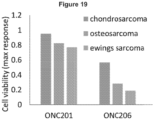
- Ri is CH 2 Ph and R 2 is CH 2 -(2,4-di F-Ph) (i.e., ONC206).
- R 1 is CH 2 Ph and R 2 is CH 2 -(4-CF 3 -Ph) (i.e., ONC212).
- R 1 is CH 2 Ph and R 2 is CH 2 -(3,4-di F-Ph) (i.e., ONC213).
- R 1 is CH 2 (3,4-di-Cl-Ph and R 2 is CH 2 -(4-CF 3 -Ph) (i.e., ONC234).
- R 1 is CH 2 -3-thienyl and R 2 is CH 2 -(4-CF 3 -Ph) (i.e., ONC236).
- the cancer is selected from a central nervous system tumor, a brain tumor, a peripheral nervous system tumor, a pheochromocytoma, a paraganglioma, a neuroendocrine tumor, ewings sarcoma, a pancreatic cancer, a prostate cancer, an endometrial cancer, a hematological malignancy, a bone cancer, and a lymphatic system tumor.
- the cancer is selected from meningioma, ependymoma, glioma, neuroblastoma, or diffuse intrinsic pontine glioma.
- the cancer is selected from an acute leukemia selected from an acute lymphotyte leukemia, acute myeloid leukemia, myelodysplastic syndrome, or myeloproliferative disease.
- the cancer has a histone H3 mutation (e.g., the mutation H3.3 K27M) or an epigentically silenced unmethylated O(6)-methylguanine-DNA methyltransferase (MGMT) gene.
- the subject has, or is at risk of having, a psychiatric disorder.
- the psychiatric disorder is selected from a psychosis, schizophrenia, bipolar disorder, or major depressive disorder.
- the subject has, or is at risk of having, an infection.
- the infection is a bacterial infection. In one embodiment, the infection is a gram-negative bacterial infection. In one embodiment, the infection is a gram-positive bacterial infection. In one embodiment, the bacterial infection is an infection of a bacteria selected from the group consisting of Enterococcus faecium, Staphylococcus aureus, Klebsiella pneumoniae, Acinetobacter baumannii, Pseudomonas aeruginosa, and Enterobacter species. In one embodiment, the bacterial infection is a Staphylococcus infection. In one embodiment, the Staphylococcus infection is an S. aureus infection (e.g., a methicillin-resistant S . aureus (MRSA) infection).
- MRSA methicillin-resistant S . aureus
- kits for treating or preventing a disease, disorder, or condition in a subject in need of selective modulation of the activity of a G protein-coupled receptor (GPCR) or of a G protein-coupled receptor (GPCR) signaling pathway comprising, but is not lmited to, agonism, partial agonism, inverse agonism, partial antagonism, antagonism, bivalent modulation, or bitopic modulation.
- the methods comprise administering to the subject in need of such treatment a pharmaceutical composition comprising a therapeutically effective amount a compound of formula (10) or an analog thereof, or a pharmaceutically acceptable salt thereof.
- the subject has, or is at risk of having, cancer.
- the subject has, or is at risk of having, a psychiatric disorder.
- the psychiatric disorder is psychosis.
- the psychiatric disorder is schizophrenia.
- the subject has, or is at risk of having, an infection.
- the infection is a bacterial infection.
- the infection is a gram-negative bacterial infection.
- the infection is a gram-positive bacterial infection.
- the bacterial infection is an infection of a bacteria selected from Enterococcus faecium, Staphylococcus aureus, Klebsiella pneumoniae, Acinetobacter baumannii, Pseudomonas aeruginosa, or Enterobacter species.
- the bacterial infection is a Staphylococcus infection.
- the Staphylococcus infection is an S. aureus infection (e.g., a methicillin-resistant S. aureus (MRSA) infection).
- the treatment regimen comprises administering an effective amount of a therapeutic, such as compound of formula (10), a pharmaceutically acceptable salt thereof, or an analog thereof.
- the GPCR is a Class A GPCR.
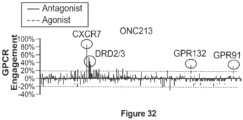
- the GPCR is GPR132, GPR91, MTNR1A, GPR162, GPR137, BAI3, LGR4, PTGIR, CXCR7 or a combination thereof.
- the GPCR is GPR132 (also called G2A).
- the GPCR is GPR91.
- the GPCR is MTNR1A.
- the GPCR is CXCR7.
- the subject has, or is at risk of having, an infection.
- the infection is a bacterial infection.
- the infection is a gram-negative bacterial infection.
- the infection is a gram-positive bacterial infection.
- the bacterial infection is an infection of a bacteria selected from the group consisting of Enterococcus faecium, Staphylococcus aureus, Klebsiella pneumoniae, Acinetobacter baumannii, Pseudomonas aeruginosa, and Enterobacter species.
- the bacterial infection is a Staphylococcus infection.
- the Staphylococcus infection is an S.
- the treatment regimen comprises administering an effective amount of a therapeutic, such as compound of formula (10), a pharmaceutically acceptable salt thereof, or an analog thereof.
- a therapeutic such as compound of formula (10), a pharmaceutically acceptable salt thereof, or an analog thereof.
- the dopamine receptor is from the D2-like family of dopamine receptors.
- a pharmaceutical composition comprising a therapeutically effective amount a compound of formula (10) or a compound of formula (100) (e.g., TIC-10), or an analog thereof, or a pharmaceutically acceptable salt thereof.
- the compound is a CXCR7 agonist.
- kits for stimulating the immune system comprising: administering to the subject a pharmaceutical composition comprising a therapeutically effective amount a compound of formula (10) or an analog thereof, or a pharmaceutically acceptable salt thereof.
- the compound is a GPR91 agonist.
- the compound is ONC213.
- the subject has cancer and the method is a method of cancer immunotherapy.
- the subject has a viral infection (e.g ., HIV).
- the subject has systemic lupus erythematosus.
- the method further comprises administering a vaccine (e.g., a cancer vaccine) to the subject, and the compound is administered as an adjuvant.
- the methods comprise (i) obtaining a biological sample from the subject; (ii) measuring expression levels of at least one dopamine receptor or G protein-coupled receptor (GPCR) in the sample; (iii) comparing the levels measured in the sample to those for a pre-determined standard; and (iv) determining whether the subject is likely to be responsive to the treatment regimen, based on the levels measured in the sample to those for the pre-determined standard.
- the subject has, or is at risk of having, cancer.
- the subject has, or is at risk of having, a psychiatric disorder.
- the subject has, or is at risk of having, an infection.
- the treatment regimen further comprises administering an effective amount of a therapeutic, such as compound of formula (10), a pharmaceutically acceptable salt thereof, or an analog thereof.
- the dopamine receptor is from the D2-like family of dopamine receptors.
- the GPCR is a Class A GPCR.
- the GPCR is GPR132, GPR91, MTNR1A, GPR162, GPR137, BAI3, LGR4, PTGIR, CXCR7 or a combination thereof.
- the GPCR is GPR132, GPR91, MTNR1A, CXCR7 or a combination thereof.
- the GPCR is GPR132.
- the methods comprises (i) obtaining a biological sample from the subject; (ii) measuring expression levels of at least one dopamine receptor or G protein-coupled receptor (GPCR) in the sample; (iii) comparing the levels measured in the sample to those for a pre-determined standard; and (iv) determining a prognosis or determining whether the subject is responsive to the treatment regimen, based on the levels measured in the sample to those for the pre-determined standard.
- GPCR G protein-coupled receptor
- the methods comprises (i) obtaining a biological sample from the subject; (ii) measuring gene copy number or mutations in at least one dopamine receptor in the sample; (iii) comparing the copy number measured or mutations found in the sample to those for a pre-determined standard; and (iv) determining whether the subject is responsive to the treatment regimen, based on the copy number measured or mutations found in the sample to those for the pre-determined standard.
- the subject has, or is at risk of having, cancer.
- the subject has, or is at risk of having, a psychiatric disorder.
- the subject has, or is at risk of having, an infection.
- the treatment regimen comprises administering an effective amount of a therapeutic, such as compound of formula (10), a pharmaceutically acceptable salt thereof, or an analog thereof.
- the dopamine receptor is selected from DRD2, DRD2S, DRD2L, and DRD3.
- the dopamine receptor is from the D2-like family of dopamine receptors
- the GPCR is a Class A GPCR.
- the GPCR is GPR132, GPR91, MTNR1A, GPR162, GPR137, BAI3, LGR4, PTGIR, CXCR7 or a combination thereof.
- the method comprises (i) contacting at least one G protein-coupled receptor (GPCR) with a test molecule suspected of being a therapeutic for a condition; (ii) measuring the binding affinity, interaction or GPCR signalling of the test compound to the GPCR; and (iii) comparing the binding affinity, interaction or signalling of the test molecule to a pre-determined threshold.
- GPCR modulation or GPCR signaling modulation by the test molecule comparable to or greater than the threshold is indicative of a therapeutic for the condition.
- the condition is cancer.
- the pre-determined threshold is the GPCR modulation or GPCR signaling modulation of a therapeutic, such as a compound of formula (10) or a pharmaceutically acceptable salt thereof, or an analog thereof.
- the GPCR is a Class A GPCR.
- the GPCR is GPR132.
- the GPCR is GPR132, GPR91, MTNR1A, GPR162, GPR137, BAI3, LGR4, PTGIR, CXCR7 or a combination thereof.
- the GPCR is GPR132.
- the GPCR is GPR91.
- the GPCR is MTNR1A.
- the GPCR is CXCR7.
- the method comprises (i) contacting at least one dopamine receptor with a test molecule suspected of being a therapeutic for a condition; (ii) measuring the binding affinity, interaction or signalling of the test molecule to the at least one dopamine receptor; and (iii) comparing the binding affinity or interaction of the test molecule to a pre-determined threshold.
- modulation of the dopamine receptor by the test molecule comparable to or greater than the threshold is indicative of a therapeutic for the condition.
- the condition is cancer.
- the dopamine receptor is a member of the D2-like family of dopamine receptors.
- the pre-determined threshold is the modulation of the dopamine receptor or dopamine receptor signalling by a therapeutic, such as a compound of formula (10) or a pharmaceutically acceptable salt thereof, or an analog thereof.
- the method comprises (i) using a computational docking method to model binding or interaction, if any, of one or more 3-dimensional structures (conformations) of a test molecule suspected of being a therapeutic for the condition to a 3-dimensional structure or model of at least one dopamine receptor; (ii) using the computational method to estimate the binding affinity or interaction of the test molecule structure to the structure or model of the at least one dopamine receptor; and (iii) using the computational method to compare the binding affinity or interaction of the test molecule to a pre-determined threshold, wherein modulation of the dopamine receptor by the test molecule comparable to or greater than the threshold is indicative of a therapeutic for the condition.
- the condition is cancer.
- the dopamine receptor is a member of the D2-like family of dopamine receptors.
- the method comprises administering an effective amount of a therapeutic agent that targets at least one dopamine receptor or G protein-coupled receptor (GPCR).
- the therapeutic agent is a neutralizing agent.
- the therapeutic agent is an antagonist of the receptor.
- the therapeutic agent is an agonist of the receptor.
- the therapeutic agent is a competitive inhibitor of the receptor with respect to dopamine.
- the therapeutic agent is a non-competitive inhibitor of the receptor with respect to dopamine.
- the therapeutic agent is selective for the D2-like family of dopamine receptors with respect to the D 1-like family of dopamine receptors.
- the subject has, or is at risk of having, cancer. In one embodiment, the subject has, or is at risk of having, a psychiatric disorder. In one embodiment, the subject has, or is at risk of having, an infection.
- the dopamine receptor is a member of the D2-like family of dopamine receptors.
- the GPCR is a Class A GPCR. In one embodiment, the GPCR is GPR132. In one embodiment, the GPCR is GPR91. In one embodiment, the GPCR is MTNR1A.
- the GPCR is CXCR7.
- the GPCR is GPR132, GPR91, MTNR1A, GPR162, GPR137, BAI3, LGR4, PTGIR, CXCR7 or a combination thereof.
- the therapeutic agent is a monoclonal antibody (e.g., a chimerized or humanized monoclonal antibody), polyclonal antibody (e.g., a chimerized or humanized polyclonal antibody), or a bispecific antibody.
- the therapeutic agent is a drug or active agent, such as an anti-cancer agent, conjugated to an antibody.
- the therapeutic agent is a radioactively-conjugated antibody or a small molecule-conjugated antibody.
- the therapeutic agent is a vector that expresses a recombinant antibody to the dopamine receptor or GPCR.
- the therapeutic agent is a fusion protein or a peptide that targets the dopamine receptor or GPCR.
- the therapeutic agent is an siRNA, shRNA, or an antisense oligonucleotide that targets the dopamine receptor or GPCR.
- the dopamine receptor or GPCR is targeted by CRISPR interference.
- the method comprises (i) treating the subject according to a treatment method described herein (ii) assessing as decribed herein the treatment's efficacy.
- the subject has, or is at risk of having, cancer.
- the treatment regimen comprises administering an effective amount of a therapeutic, such as a compound of formula (10) or a pharmaceutically acceptable salt thereof or an analog thereof.
- the dosage of a therapeutic administered, the frequency of administration of the compound ( e.g ., a compound of formula (10 )), or both, is selected or adjusted based on the levels of gene expression or gene copy number measured or mutations found.
- RNA Interference Nuts and Bolts of RNAi Technology, DNA Press LLC, Eagleville, PA, 2003 ; Herdewijn, P. (Ed.), Oligonucleotide Synthesis: Methods and Applications, Methods in Molecular Biology, Humana Press, 2004 ; A. Nagy, M. Gertsenstein, K. Vintersten, R. Behringer, Manipulating the Mouse Embryo: A Laboratory Manual, 3rd edition, Cold Spring Harbor Laboratory Press; Dec. 15, 2002, ISBN-10: 0879695919 ; Kursad Turksen (Ed.), Embryonic stem cells: methods and protocols in Methods Mol Biol.
- substituted means that any one or more hydrogens on the designated atom is replaced with a selection from the indicated group, provided that the designated atom's normal valency is not exceeded, and that the substitution results in a stable compound.
- 2 hydrogens on the atom are replaced.
- variable e.g., R 4
- its definition at each occurrence is independent of its definition at every other occurrence.
- R 4 at each occurrence is selected independently from the definition of R 4 .
- substituents and/or variables are permissible, but only if such combinations result in stable compounds.
- C 1-6 alkyl is meant to include alkyl groups with 1, 2, 3, 4, 5, 6, 1-6, 1-5, 1-4, 1-3, 1-2, 2-6, 2-5, 2-4, 2-3, 3-6, 3-5, 3-4, 4-6, 4-5, and 5-6 carbons.
- alkyl includes both branched and straight-chain saturated aliphatic hydrocarbon groups having the specified number of carbon atoms.
- C 1-6 alkyl is intended to include C 1 , C 2 , C 3 , C 4 , C 5 , and C 6 alkyl groups.
- alkyl include, but are not limited to, methyl, ethyl, n-propyl, i-propyl, n-butyl, isobutyl s-butyl, t-butyl, n-pentyl, s-pentyl, neopentyl and n-hexyl.
- a straight chain or branched chain alkyl has six or fewer carbon atoms in its backbone (e.g., C 1 -C 6 for straight chain, C 3 -C 6 for branched chain), and in other cases, a straight chain or branched chain alkyl has four or fewer carbon atoms.
- cycloalkyls have from three to eight carbon atoms in their ring structure, and in other cases, cycloalkyls have five or six carbons in the ring structure. Most preferred is C 1-6 alkyl, particularly ethyl, methyl, isopropyl, isobutyl, n-pentyl, n-hexyl and cyclopropylmethyl.
- lower alkyl is an alkyl group, as defined above, but having from one to six carbon atoms, preferably one to four, in its backbone structure.
- Lower alkenyl and “lower alkynyl” have chain lengths of 2-6 carbon atoms and preferably 2-4 carbon atoms.
- alkenyl includes unsaturated aliphatic groups analogous in length and possible substitution to the alkyls described above, but that contain at least one double bond.
- alkenyl includes straight-chain alkenyl groups (e.g., ethenyl, propenyl, butenyl, pentenyl, hexenyl, heptenyl, octenyl, nonenyl, decenyl), branched-chain alkenyl groups, cycloalkenyl (e.g., alicyclic) groups (e.g., cyclopropenyl, cyclopentenyl, cyclohexenyl, cycloheptenyl, cyclooctenyl), alkyl or alkenyl substituted cycloalkenyl groups, and cycloalkyl or cycloalkenyl substituted alkenyl groups.
- Alkynyl includes unsaturated aliphatic groups analogous in length and possible substitution to the alkyls described above, but which contain at least one triple bond.
- alkynyl includes straight-chain alkynyl groups (e.g., ethynyl, propynyl, butynyl, pentynyl, hexynyl, heptynyl, octynyl, nonynyl, decynyl), branched-chain alkynyl groups, and cycloalkyl or cycloalkenyl substituted alkynyl groups.
- heterocycloalkyl refers to a non-aromatic heterocycle where one or more of the ring-forming atoms is a heteroatom such as an O, N, or S atom.
- Heterocycloalkyl groups include mono- or polycyclic (e.g., having 2, 3 or 4 fused rings) ring systems, as well as spirocycles.
- alkoxy or "alkoxyl” includes substituted and unsubstituted alkyl, alkenyl, and alkynyl groups covalently linked to an oxygen atom.
- C 1 -C 6 alkoxy refers to moieties having six or fewer carbon atoms in the hydrocarbon backbone.
- alkoxy groups or alkoxyl radicals
- alkoxy groups include methoxy, ethoxy, isopropyloxy, propoxy, butoxy, and pentoxy groups.
- Preferred are (C 1 -C 3 ) alkoxy, particularly ethoxy and methoxy.
- substituted alkoxy groups include halogenated alkoxy groups.
- such salts can be prepared by reacting a free acid or base form of these compounds with a stoichiometric amount of the appropriate base or acid in water or in an organic solvent, or in a mixture of the two; generally, nonaqueous media like ether, ethyl acetate, ethanol, isopropanol, or acetonitrile are preferred.
- nonaqueous media like ether, ethyl acetate, ethanol, isopropanol, or acetonitrile are preferred.
- Lists of suitable salts can be found in Remington's Pharmaceutical Sciences, 17th ed., Mack Publishing Company, Easton, PA, 1985, p. 1418 , Journal of Pharmaceutical Science, 66, 2 (1977 ), and P. H. Stahl and C. G. Wermuth, editors, Handbook of Pharmaceutical Salts: Properties, Selection and Use, 2nd Revised edition, Weinheim/Zürich:Wiley-VCH/VHCA (2011 ), each of which is incorporated herein
- suitable inorganic bases include sodium hydroxide, potassium hydroxide and ammonia
- suitable organic bases include amines, e.g., tertiary amines, such as trimethylamine, triethylamine, pyridine, N,N -dimethylaniline, quinoline, isoquinoline, ⁇ -picoline, ⁇ -picoline, ⁇ -picoline, quinaldine, or pyrimidine.
- amines e.g., tertiary amines, such as trimethylamine, triethylamine, pyridine, N,N -dimethylaniline, quinoline, isoquinoline, ⁇ -picoline, ⁇ -picoline, ⁇ -picoline, quinaldine, or pyrimidine.
- antibody encompasses the structure that constitutes the natural biological form of an antibody.
- intact antibodies can be assigned to different "classes.” There are five-major classes (isotypes) of intact antibodies: IgA, IgD, IgE, IgG, and IgM, and several of these may be further divided into "subclasses,” e.g ., IgG1, IgG2, IgG3, IgG4, IgA, and IgA2.
- the heavy-chain constant domains that correspond to the different antibody classes are called alpha, delta, epsilon, gamma, and mu, respectively.
- the subunit structures and three-dimensional configurations of different classes of immunoglobulins are well known to one skilled in the art.
- high affinity is for a ligand that binds to an antibody or other molecule having an affinity constant (K a ) of greater than 10 4 M -1 , typically 10 5 -10 11 M -1 ; as determined by inhibition ELISA or an equivalent affinity determined by comparable techniques, such as Scatchard plots or using K d /dissociation constant, which is the reciprocal of the K a .
- binding with respect to binding, inhibition, stimulation, or modulation means preferential binding, inhibition, stimulation, or modulation, respectively, of a first activity relative to a second activity (e.g., preferential binding of one receptor to another receptor; preferential inhibition relative to other receptors; or preferential inhibition of a mutant to a wild-type or vice versa).
- binding is greater than two times more selective, greater than five times more selective, greater than ten times more selective, greater than fifty times more selective, greater than 100 times more selective, or greater than 1000 times more selective for the desired molecular target or pathway versus an undesired molecular target or pathway.
- a compound will bind a first molecular target or affect a pathway by at least 2-fold, at least 5-fold, at least 10-fold, at least 20-fold, at least 50-fold, at least 100-fold relative to a second target or pathway under the same conditions. It will be appreciated that in preferred embodiments, binding to the D2-like family of dopamine receptors or a member thereof, will be selective with respect to the D1-like family of dopamine receptors or a member thereof by any of the foregoing amounts.
- the in vitro or in vivo activity of a molecular target or pathway may be measured by any suitable reproducible means.
- a composition modulates the activity of a molecular target or pathway if it stimulates or inhibits the activity of that target or pathway by at least 10%, by at least about 20%, by at least about 25%, by at least about 30%, by at least about 40%, by at least about 50%, by at least about 60%, by at least about 70%, by at least about 75%, by at least about 80%, by at least about 90%, by at least about 95%, by at least about 98%, or by about 99% or more relative to the activity of that molecular target or pathway under the same conditions but lacking only the presence of the composition.
- a composition modulates the activity of a molecular target or pathway if it stimulates or inhibits the activity of that target or pathway by at least 2-fold, at least 5 -fold, at least 10-fold, at least 20-fold, at least 50-fold, at least 100-fold relative to the activity of that target or pathway under the same conditions but lacking only the presence of the composition.
- the activity of a molecular target or pathway may be measured by any reproducible means.
- the activity of a molecular target or pathway may be measured in vitro or in vivo by a suitable assay known in the art for measuring the activity. Control samples (untreated with the composition) can be assigned a relative activity value of 100%.
- an antibody, antigen-binding fragment, or affinity tag binds its target with a K D of 0.1 nM - 10 mM, 0.1 nM - 1 mM, or within the 0.1 nM range. In one embodiment, an antibody, antigen-binding fragment, or affinity tag binds its target with a K D of 0.1-2 nM, 0.1-1 nM, 0.05-1 nM, 0.1-0.5 nM, or 0.1-0.2 nM. In one embodiment, an antibody, antigen-binding fragment, or affinity tag bind its target directly. In one embodiment, an antibody, antigen-binding fragment, or affinity tag bind its target indirectly, for example, binding as a secondary antibody that binds to an antibody bound to the target.
- label refers to a compound or composition which is conjugated or fused directly or indirectly to a reagent such as a nucleic acid probe or an antibody and facilitates detection of the reagent to which it is conjugated or fused.
- the label may itself be detectable (e.g ., radioisotope or fluorescent labels) or, in the case of an enzymatic label, may catalyze chemical alteration of a substrate compound or composition, which is detectable.
- probe refers to synthetic or biologically produced nucleic acids that contain specific nucleotide sequences which hybridize under stringent conditions to target nucleic acid sequences.
- labeled probe refers to a probe which is prepared with a marker moiety or "detectable label” for detection.
- the marker moiety is attached at either the 5' end, the 3' end, internally, or a combination thereof. That is, one probe may be attached to multiple marker moieties.
- a preferred moiety is an identifying label such as a fluorophore.
- a labeled probe may also comprise a plurality of different nucleic acid sequences each labeled with one or more marker moieties. Each marker moiety may be the same or different. It may be beneficial to label different probes (e.g ., nucleic acid sequences) each with a different marker moiety. This can be achieved by having a single distinguishable moiety on each probe. For example, probe A is attached to moiety X and probe B is attached to moiety Y. Alternatively, probe A is attached to moieties X and Y while probe B is attached to moiety Z and W. Alternatively, probe A is attached to moieties X and Y, while probe B is attached to moieties Y and Z. All probes "A" and "B” above would be distinguishable and uniquely labeled.
- tissue sample is meant a collection of similar cells obtained from a tissue of a subject or patient, preferably containing nucleated cells with chromosomal material.
- the four main human tissues are (1) epithelium; (2) connective tissues, including blood vessels, bone and cartilage; (3) muscle tissue; and (4) nerve tissue.
- the tissue sample source may be solid tissue as from a fresh, frozen and/or preserved organ or tissue sample or biopsy or aspirate; blood or a blood constituent; bodily fluids such as cerebral spinal fluid, amniotic fluid, peritoneal fluid, or interstitial fluid; cells from a time in gestation or development of the subject.
- a tissue sample may be primary or cultured cells or cell lines.
- a tissue sample may contain compounds that are not naturally intermixed with the tissue in nature such as preservatives, anticoagulants, buffers, fixatives, nutrients, or antibiotics.
- a section of a tissue sample is meant a single part or piece of a tissue sample, e.g ., a thin slice of tissue or cells cut from a tissue sample. Multiple sections of tissue samples may be taken and subjected to analysis.
- a "cell line” refers to a permanently established cell culture that will proliferate given appropriate fresh medium and space.
- a target receptor e.g ., a dopamine receptor or a GPCR
- Targets are detected by contacting the sample with a target detection reagent, e.g ., an antibody or fragment thereof, and a labeling reagent.
- a target detection reagent e.g ., an antibody or fragment thereof
- a labeling reagent e.g ., an antibody or fragment thereof
- the presence or absence of targets are detected by the presence or absence of the labeling reagent.
- a sample is contacted with the target detection and the labeling reagents concurrently e.g ., the detection reagent is a primary antibody and the labeling reagent is a fluorescent dye conjugated to it.
- the biological sample is contacted with the target detection and labeling reagents sequentially, e.g ., the detection reagent is a primary antibody and the labeling reagent includes a secondary antibody.
- the detection reagent is a primary antibody and the labeling reagent includes a secondary antibody.
- a sample is incubated with a detection reagent, in some cases together with a labeling reagent, under conditions that allow a complex between the detection reagent (and labeling reagent) and target to form. After complex formation the sample is optionally washed one or more times to remove unbound detection reagent (and labeling reagent).
- the sample When the sample is further contacted with a labeling reagent that specifically binds the detection reagent bound to the target, the sample can optionally be washed one or more times to remove unbound labeling reagent. The presence or absence of the target in the sample is then determined by detecting the labeling reagent.
- the methods described here provide for detection of multiple targets in a sample. Multiple targets are identified by contacting the biological sample with additional detection reagents followed by additional labeling reagent specific for the additional detection reagents using the methods described.
- a detection moiety i.e., detectable label
- Detection moieties are directly observed or measured or indirectly observed or measured. Detection moieties include, but are not limited to, radiolabels that can be measured with radiation-counting devices; pigments, dyes or other chromogens that can be visually observed or measured with a spectrophotometer; spin labels that can be measured with a spin label analyzer; and fluorescent moieties, where the output signal is generated by the excitation of a suitable molecular adduct and that can be visualized by excitation with light that is absorbed by the dye or can be measured with standard fluorometers or imaging systems.
- the detection moiety can be a luminescent substance such as a phosphor or fluorogen; a bioluminescent substance; a chemiluminescent substance, where the output signal is generated by chemical modification of the signal compound; a metal-containing substance; or an enzyme, where an enzyme-dependent secondary generation of signal occurs, such as the formation of a colored product from a colorless substrate.
- the detection moiety may also take the form of a chemical or biochemical, or an inert particle, including colloidal gold, microspheres, quantum dots, or inorganic crystals such as nanocrystals or phosphors.
- detection moiety or detectable label can also refer to a "tag" or hapten that can bind selectively to a labeled molecule such that the labeled molecule, when added subsequently, is used to generate a detectable signal.
- a tag or hapten that can bind selectively to a labeled molecule such that the labeled molecule, when added subsequently, is used to generate a detectable signal.
- HRP horseradish peroxidase
- a chromogenic substrate e.g., tetramethylbenzidine
- fluorogenic substrate such as Amplex Red or Amplex Gold (Molecular Probes, Inc.
- the tag can be a hapten or antigen (e.g., digoxigenin), and an enzymatically, fluorescently, or radioactively labeled antibody can be used to bind to the tag.
- hapten or antigen e.g., digoxigenin
- an enzymatically, fluorescently, or radioactively labeled antibody can be used to bind to the tag.
- Numerous labels are known by those of skill in the art and include, but are not limited to, particles, fluorescent dyes, haptens, enzymes and their chromogenic, fluorogenic, and chemiluminescent substrates.
- a fluorophore is a chemical moiety that exhibits an absorption maximum beyond 280 nm, and when covalently attached in a labeling reagent retains its spectral properties.
- Fluorophores include a pyrene, an anthracene, a naphthalene, an acridine, a stilbene, an indole or benzindole, an oxazole or benzoxazole, a thiazole or benzothiazole, a porphyrin, a cyanine, a perylene, a 4-amino-7-nitrobenz-2-oxa-1,3-diazole (NBD), a carbocyanine, a carbostyryl, a salicylate, an anthranilate, an azulene, a pyridine, a quinoline, a borapolyazaindacene, a xanthene, an oxazine or a benzox
- the fluorophore when the fluorophore is a xanthene, the fluorophore may be a fluorescein, a rhodol, or a rhodamine.
- Fluorescein includes benzo- or dibenzofluoresceins, seminaphthofluoresceins, or naphthofluoresceins.
- rhodol includes seminaphthorhodafluors.
- the fluorophore is a xanthene that is bound via a single covalent bond at the 9-position of the xanthene.
- Preferred xanthenes include derivatives of 3H-xanthen-6-ol-3-one, derivatives of 6-amino-3H-xanthen-3-one, or derivatives of 6-amino-3H-xanthen-3-imine.
- Fluorophores include xanthene (rhodol, rhodamine, fluorescein and derivatives thereof) coumarin, cyanine, pyrene, oxazine and borapolyazaindacene.
- the fluorophore can be sulfonated xanthenes, fluorinated xanthenes, sulfonated coumarins, fluorinated coumarins and sulfonated cyanines.
- fluorophore in the labeling reagent will determine the absorption and fluorescence emission properties of the labeling reagent.
- Physical properties of a fluorophore label include spectral characteristics (absorption, emission and stokes shift), fluorescence intensity, lifetime, polarization and photo-bleaching rate can all be used to distinguish one fluorophore from another.
- a fluorophore contains one or more aromatic or heteroaromatic rings that are optionally substituted by one or more of a variety of substituents, including halogen, nitro, cyano, alkyl, perfluoroalkyl, alkoxy, alkenyl, alkynyl, cycloalkyl, arylalkyl, acyl, aryl or heteroaryl ring system, benzo, or other substituents typically present on fluorophores known in the art.
- substituents including halogen, nitro, cyano, alkyl, perfluoroalkyl, alkoxy, alkenyl, alkynyl, cycloalkyl, arylalkyl, acyl, aryl or heteroaryl ring system, benzo, or other substituents typically present on fluorophores known in the art.
- the detection moiety is a fluorescent dye.
- Fluorescent dyes include, for example, Fluorescein, Rhodamine, Texas Red, Cy2, Cy3, Cy5, Cy0, Cy0.5, Cy1, Cy1.5, Cy3.5, Cy7, VECTOR Red, ELF TM (Enzyme-Labeled Fluorescence), FluorX, Calcein, Calcein-AM, CRYPTOFLUOR TM 'S, Orange (42 kDa), Tangerine (35 kDa), Gold (31 kDa), Red (42 kDa), Crimson (40 kDa), BHMP, BHDMAP, Br-Oregon, Lucifer Yellow, Alexa dye family, N-(6-(7-nitrobenz-2-oxa-1,3-diazol-4-yl)amino)caproyl) (NBD), BODIPY TM , boron dipyrromethene difluoride, Oregon Green, MITOTRACKER TM Red, DiOC7 (3), Di
- enzymes In addition to fluorophores, enzymes also find use as detectable moieties. Enzymes are desirable detectable moieties because amplification of a detectable signal can be achieved resulting in increased assay sensitivity. The enzyme itself does not produce a detectable response but breaks down a substrate when it is contacted by an appropriate substrate such that the converted substrate produces a fluorescent, colorimetric or luminescent signal. Enzymes amplify a detectable signal because one enzyme on a labeling reagent can result in multiple substrates being converted to a detectable signal. This is advantageous where there is a low quantity of target present in the sample or a fluorophore does not exist that will give comparable or stronger signal than the enzyme.
- fluorophores are preferred because they do not require additional assay steps, and thus reduce the overall time to complete an assay.
- the enzyme substrate is selected to yield the preferred measurable product, e.g. colorimetric, fluorescent or chemiluminescence. Such substrates are extensively used in the art.
- a preferred colorimetric or fluorogenic substrate and enzyme combination uses oxidoreductases such as horseradish peroxidase and a substrate such as 3,3'-diaminobenzidine (DAB) and 3-amino-9-ethylcarbazol-e (AEC), which yield a distinguishing color (brown and red, respectively).
- oxidoreductases such as horseradish peroxidase and a substrate such as 3,3'-diaminobenzidine (DAB) and 3-amino-9-ethylcarbazol-e (AEC), which yield a distinguishing color (brown and red, respectively).
- DAB 3,3'-diaminobenzidine
- AEC 3-amino-9-ethylcarbazol-e
- colorimetric oxidoreductase substrates that yield detectable products include, but are not limited to: 2,2-azino-bis(3-ethylbenzothiaz-oline-6-sulfonic acid) (ABTS), o-phenylenediamine (OPD), 3,3',5,5'-tetramethylbenzidine (TMB), o-dianisidine, 5-aminosalicylic acid, 4-chloro-1-naphthol.
- ABTS 2,2-azino-bis(3-ethylbenzothiaz-oline-6-sulfonic acid)
- OPD o-phenylenediamine
- TMB 3,3',5,5'-tetramethylbenzidine
- o-dianisidine 5-aminosalicylic acid
- 4-chloro-1-naphthol 4-chloro-1-naphthol.
- Fluorogenic substrates include, but are not limited to, homovanillic acid or 4-hydroxy-3-methoxyphenylacetic acid, reduced phenoxazines and reduced benzothiazines, including Amplexe Red reagent and its variants and reduced dihydroxanthenes, including dihydrofluoresceins and dihydrorhodamines including dihydrorhodamine 123.
- Peroxidase substrates that are tyramides represent a unique class of peroxidase substrates in that they can be intrinsically detectable before action of the enzyme but are "fixed in place" by the action of a peroxidase in the process described as tyramide signal amplification (TSA). These substrates are extensively utilized to label targets in samples that are cells, tissues or arrays for their subsequent detection by microscopy, flow cytometry, optical scanning and fluorometry.
- TSA tyramide signal amplification
- Additional colorimetric (and in some cases fluorogenic) substrate and enzyme combination use a phosphatase enzyme such as an acid phosphatase, an alkaline phosphatase or a recombinant version of such a phosphatase in combination with a colorimetric substrate such as 5-bromo-6-chloro-3-indolyl phosphate (BCIP), 6-chloro-3-indolyl phosphate, 5-bromo-6-chloro-3-indolyl phosphate, p-nitrophenyl phosphate, or o-nitrophenyl phosphate or with a fluorogenic substrate such as 4-methylumbelliferyl phosphate, 6,8-difluoro-7-hydroxy4-methylcoumarinyl phosphate (DiFMUP) fluorescein diphosphate, 3-0-methylfluorescein phosphate, resorufin phosphate, 9H-(1,3-dichloro-9,9-dimethylacridin-2-
- Glycosidases in particular ⁇ -galactosidase, ⁇ -glucuronidase and ⁇ -glucosidase, are additional suitable enzymes.
- Appropriate colorimetric substrates include, but are not limited to, 5-bromo4-chloro-3-indolyl ⁇ -D-galactopyranoside (X-gal) and similar indolyl galactosides, glucosides, and glucuronides, o-nitrophenyl ⁇ -D-galactopyranoside (ONPG) and p-nitrophenyl ⁇ -D-galactopyranoside.
- Preferred fluorogenic substrates include resorufin ⁇ -D-galactopyranoside, fluorescein digalactoside (FDG), fluorescein diglucuronide and their structural variants, 4-methylumbelliferyl ⁇ -D-galactopyranoside, carboxyumbelliferyl ⁇ -D-galactopyranoside and fluorinated coumarin ⁇ -D-galactopyranosides.
- Additional enzymes includehydrolases such as cholinesterases and peptidases, oxidases such as glucose oxidase and cytochrome oxidases, and reductases for which suitable substrates are known.
- Enzymes and their appropriate substrates that produce chemiluminescence are preferred for some assays. These include, but are not limited to, natural and recombinant forms of luciferases and aequorins. Chemiluminescence-producing substrates for phosphatases, glycosidases and oxidases such as those containing stable dioxetanes, luminol, isoluminol and acridinium esters are additionally useful.
- the enzyme is luciferase or aequorin.
- the substrates are luciferine, ATP, Ca ++ and coelenterazine.
- haptens such as biotin are useful detectable moieties.
- Biotin is useful as it is in an enzyme system that can further amplify a detectable signal, and it can serve as a tag in affinity chromatography for isolation purposes.
- an enzyme conjugate that has affinity for biotin is used, such as avidin-HRP.
- a peroxidase substrate is added to produce a detectable signal.
- Haptens also include hormones, naturally occurring and synthetic drugs, pollutants, allergens, affector molecules, growth factors, chemokines, cytokines, lymphokines, amino acids, peptides, chemical intermediates, or nucleotides.
- a detectable moiety is a fluorescent protein.
- fluorescent proteins include green fluorescent protein (GFP), phycobiliproteins and their derivatives, luciferase or aequorin.
- GFP green fluorescent protein
- Fluorescent proteins, especially phycobiliprotein are particularly useful for creating tandem dye labeled labeling reagents. These tandem dyes comprise a fluorescent protein and a fluorophore to obtain a larger stokes shift where the emission spectra is farther shifted from the fluorescent protein's absorption spectra. This is particularly advantageous to detect a low amount of target in a sample where the emitted fluorescent light is maximally optimized, in other words the fluorescent protein reabsorbs little to none of the emitted light.
- the fluorescent protein and fluorophore function as an energy transfer pair where the fluorescent protein emits at a wavelength the fluorophore absorbs, and the fluorphore then emits at a wavelength farther from the fluorescent protein than could be obtained with only the fluorescent protein.
- a particularly useful combination is phycobiliproteins and sulforhodamine fluorophores, or sulfonated cyanine fluorophores; or sulfonated xanthene derivatives.
- the fluorophore is an energy donor and the fluorescent protein is an energy acceptor.
- a sample is illuminated with a light wavelength selected to give a detectable optical response, and observed with a means for detecting that response.
- Equipment useful for illuminating fluorescent compounds include hand-held ultraviolet lamps, mercury arc lamps, xenon lamps, lasers and laser diodes. These illumination sources are optically integrated into laser scanners, fluorescent microplate readers or standard or microfluorometers. The degree or location of signal, compared to a standard or expected response, indicates whether and to what degree the sample possesses a given characteristic or desired target.
- An optical response is detected by visual inspection, or by using one of the following devices: CCD camera, video camera, photographic film, laser-scanning devices, fluorometers, photodiodes, quantum counters, epifluorescence microscopes, scanning microscopes, flow cytometers, fluorescence microplate readers, or by means for amplifying the signal such as photomultiplier tubes.
- CCD camera CCD camera
- video camera photographic film
- laser-scanning devices fluorometers, photodiodes, quantum counters, epifluorescence microscopes, scanning microscopes, flow cytometers, fluorescence microplate readers, or by means for amplifying the signal such as photomultiplier tubes.
- illuminating typically includes adding a reagent to produce a detectable signal such as a colorimetric enzyme substrate.
- Radioisotopes are also considered indirectly detectable where an additional reagent is not needed, rather the radioisotope is exposed to X-ray film or other mechanism to record and measure the signal. This is true for some chemiluminescent signals that are observed after exposure to film.
- ONC201 (compound ( 1 )) and its analogs, and their pharmaceutically acceptable salts, as well as syntheses for them, are provided herein.
- ONC201 has broad anti-cancer activity, low toxicity including few, if any, adverse effects, low genotoxicity, and high bioavailability including orally. These features allow ONC 201 and various analogs to be well suited for a variety of applications.
- ONC201 can be made by the synthesis shown in Scheme 1.
- Synthesis of an ONC201 dihydrochloride salt starts with commercially available intermediary N-Benzyl-3-carbomethoxy-4-piperidone hydrochloride, compound (3).
- the synthesis includes neutralizing compound (3) with a base (Step 1 ) to produce compound (4), a free base.
- compound (3) is neutralized with an inorganic base to produce compound (4).
- compound (3) is neutralized with an organic base to produce compound (4).
- compound (3) is neutralized in the presence of an alcohol, for example, n-butanol.
- compound (3) is neutralized in the presence of at least one organic solvent, for example, n-butanol and/or ethyl acetate.
- compound (3) is neutralized in the presence of a base and at least one organic solvent, for example, NaHCO 3 and n-butanol. In one embodiment, compound (3) is neutralized in the presence of n-butanol and triethyl amine (Et 3 N).
- the synthesis includes reacting compound (4) with compound (5) (Step 2 ) to produce intermediary compound (1).
- the reaction in Step 2 includes heating compound (4) with compound (5).
- the reaction in Step 2 includes refluxing heating compound (4) and compound (5) in the presence of a solvent.
- the reaction in Step 2 includes use of Dean-stark trap to remove water and/or methanol (MeOH) formed in the reaction.
- an ONC201 dihydrochloride salt is synthesized (Step 3 ) .
- this reaction includes treating ONC201 with HCl in dioxane.
- Step 3 includes treating ONC201with 4N HCl in dioxane.
- the synthesis optionally includes recrystallizing the ONC201 di-salt.
- the ONC201 di-hydrochloride salt is synthesized as shown in Scheme 2.
- TRAIL protein can be assayed in a sample obtained from a subject to detect TRAIL expression induced by compounds and their salts described herein.
- Immunoassays can be used to assay TRAIL in a sample, including enzyme-linked immunosorbent assay (ELISA), enzyme-linked immunofiltration assay (ELIFA), flow cytometry, immunoblot, immunoprecipitation, immunohistochemistry, immunocytochemistry, luminescent immunoassay (LIA), fluorescent immunoassay (FIA), and radioimmunoassay. Assays may be used to obtain qualitative and/or quantitative results. Specific details of suitable methods for both qualitative and quantitative sample assays are described in standard references, including E. Harlow & D.
- TRAIL assays are used to monitor a subject.
- a sample is obtained from a subject before treatment with a pharmaceutical composition and at one or more times during and/or following treatment to assess the treatment's effectiveness.
- a sample is obtained from a subject at various times to assess the course or progress of disease or healing.
- death receptors from circulating tumor cells are assayed to see if a treatment described here increases the amount or type of death receptors.
- Cancers treated using methods and compositions described herein are characterized by abnormal cell proliferation including pre-neoplastic hyperproliferation, cancer in-situ, neoplasms and metastasis. Methods and compositions described herein can be used for prophylaxis, as well as amelioration of cancer signs or symptoms.
- Treatment of a cancer in a subject includes: preventing, inhibiting or ameliorating cancer in the subject, such as slowing cancer progression or reducing or ameliorating a cancer sign or symptom.
- Examples of cancers treated using methods and compositions described herein include breast cancer, CNS cancers, colon cancer, ovarian cancer, prostate cancer, leukemia, lung cancer, and lymphoma.
- R 1 and R 2 are independently selected from H, alkyl, aryl, cycloalkyl, cycloalkylalkyl, heterocycloalkyl, heterocycloalkylalkyl, heteroaryl, arylalkyl, heteroarylalkyl, alkoxyalkyl, alkoxycarbonyl, aralkoxy, aralkylthio, and acyl radicals.
- R 1 is CH 2 Ph and R 2 is CH 2 -(2-CH 3 -Ph) (i.e., ONC201).
- R 1 is CH 2 Ph and R 2 is CH 2 -(2,4-di F-Ph) (i.e., ONC206). In one embodiment, R 1 is CH 2 Ph and R 2 is CH 2 -(4-CF 3 -Ph) (i.e., ONC212). In one embodiment, R 1 is CH 2 Ph and R 2 is CH 2 -(3,4-di F-Ph) (i.e., ONC213). In one embodiment, R 1 is CH 2 (3,4-di-Cl-Ph and R 2 is CH 2 -(4-CF 3 -Ph) (i.e., ONC234). In one embodiment, R 1 is CH 2 -3-thienyl and R 2 is CH 2 -(4-CF 3 -Ph) (i.e., ONC236).
- R 1 and R 2 are independently selected from the group consisting of H, C 1-4 alkyl, C 1-4 alkylphenyl, C 1-4 alkylphenylketone, C 1-4 benzyl-piperazine, C 1-4 alkylthienyl, C 1-4 alkylpyridinyl, C 1-4 alkylisoxazolidinyl, C 1-4 alkylmorpholinyl, C 1-4 alkylthiazolyl, and C 1-4 alkylpyrazinyl wherein C 1-4 alkyl, C 1-4 alkylphenyl, C 1-4 alkylphenylketone, C 1-4 benzyl-piperazine, C 1-4 alkylthienyl, C 1-4 alkylpyridinyl, C 1-4 alkylisoxazolidinyl, C 1-4 alkylmorpholinyl, C 1-4 alkylthiazolyl, and C 1-4 alkylpyrazinyl are optionally substituted with C
- Ri and/or R 2 is a substituted or unsubstituted, arylalkyl or heteroarylalkyl.
- the heteroarylalkyl is selected from C 1-4 alkylpyrrolyl, C 1-4 alkylfuryl, C 1-4 alkylpyridyl, C 1-4 alkyl-1,2,4-thiadiazolyl, C 1-4 alkylpyrimidyl, C 1-4 alkylthienyl, C 1-4 alkylisothiazolyl, C 1-4 alkylimidazolyl, C 1-4 alkyltetrazolyl, C 1-4 alkylpyrazinyl, C 1-4 alkylpyrimidyl, C 1-4 alkylquinolyl, C 1-4 alkylisoquinolyl, C 1-4 alkylthiophenyl, C 1-4 alkylbenzothienyl, C 1-4 alkylisobenzofuryl, C 1-4 alkylpyrazoly
- R 1 and/or R 2 is a benzyl optionally substituted with one or more of the following substituents on the benzyl ring: X, -CH 3 , -NO 2 , -OCH 3 , -CN, -CXH 2 , - CX 2 H, C 2 -C 4 alkyl, -CX 3 , -CH 2 (CX 3 ), -CH(CX 3 ) 2 , -C(CX 3 ) 3 , -C p X 2p+1 , -OCX 3 , -OC p H 2p+1 ,OC p X 2p+1 , OR m , SR m , NR m R n , NR m C(O)R n , SOR m , SO 2 R m , C(O)R m , and C(O)OR m ; R m and R n are independently selected from H or a C 1
- Ri is selected from H, CH 3 , CH 2 Ph, CH 2 -(4-CF 3 -Ph), CH 2 -(4-F-Ph), CH 2 -(4-Cl-Ph), CH 2 -(OCH 3 -Ph), CH 2 -((2-Cl)-Ph), CH 2 -(2-thienyl), CH 2 -(3-thienyl), CH 2 -2-pyridinyl, CH 2 -4-methyl-2-thiazolyl, CH 2 -2-pyrazinyl, CH 2 CH 2 Ph, CH 2 CH 2 (4-N-benzyl-piperazine), CH 2 -(2,4-di F-Ph), CH 2 -(3,4-di Cl-Ph), CH 2 -(3,4-di F-Ph), CH 2 -(3,5-di F-Ph), CH 2 -((2-CH 3 )-Ph), CH 2 CH(OH)Ph, (4-F-Ph)
- R 2 is selected from H, CH 3 , CH 2 Ph, CH 2 -(4-CF 3 -Ph), CH 2 -((2-Cl)-Ph), CH 2 -((2-F)-Ph), CH 2 -(2-thienyl), CH 2 CH 2 Ph, CH 2 CH 2 (4-N-benzyl-piperazine), CH 2 -(2,4-di F-Ph), CH 2 -(2,4-di Cl-Ph), CH 2 -(3,4-di Cl-Ph), CH 2 -(3,4-di F-Ph), CH 2 -(3,5-di F-Ph), CH 2 -((2-CH 3 )-Ph), CH 2 (2-CH 3 , 4-F-Ph), CH 2 -((4-OCH 3 )-Ph), CH 2 -(3-pyridinyl), CH 2 -(3-isoxazolidinyl), CH 2 CH 2 -(4-morpholiny
- Ri is H.
- Ri is a substituted or unsubstituted arylalkyl, e.g., a benzyl (CH 2 Ph) or phenylethyl group.
- the arylalkyl is substituted with C 1-4 alkyl, C 1-4 alkoxyl, hydroxyl, perhalogenated C 1-4 alkyl, or halo.
- R 2 is a substituted or an unsubstituted arylalkyl, e.g., benzyl or phenylethyl.
- the arylalkyl is substituted with C 1-4 alkyl, C 1-4 alkoxyl, hydroxyl, perhalogenated C 1-4 alkyl, or halo.
- the arylalkyl is substituted with one or more substituents selected from halo, CH 3 , CF 3 or OCH 3 .
- R 2 is a substituted or an unsubstituted heterocycloalkylalkyl, e.g., piperazinylalkyl or morpholinoalkyl.
- R 2 is a substituted or an unsubstituted heteroarylalkyl, e.g ., pyridylmethyl or isoxazolidinylmethyl.
- the heterocycloalkylalkyl or heteroarylalkyl is substituted with C 1-4 alkyl, C 1-4 alkoxyl, hydroxyl, perhalogenated C 1-4 alkyl, or halo.
- the heterocycloalkylalkyl or heteroarylalkyl is substituted with at least one substituent selected from halo, CH 3 , CF 3 or OCH 3 .
- compound (10) has the structure of formula (80): wherein R a1 , R a2 , R a3 , R a4 , R a5 , R b1 , R b2 , R b3 , R b4 , and R b5 are each independently selected from the group consisting of H, X, -CH 3 , -NO 2 , -OCH 3 , -CN, -CXH 2 , -CX 2 H, C 2 -C 4 alkyl, -CX 3 , -CH 2 (CX 3 ), -CH(CX 3 ) 2 , - C(CX 3 ) 3 , -C p X 2p+1 , -OCX 3 , -OC p H 2p+1 , -OC p X 2p+1 , OR m , SR m , NR m R n , NR m C(O)R n
- compound (10) has the structure of formula (90) wherein R 2 is as defined above, and wherein R b1 , R b2 , R b3 , R b4 , and R b5 are each independently selected from the group consisting of H, X, - CH 3 , -NO 2 , -OCH 3 , -CN, -CXH 2 , -CX 2 H, C 2-4 alkyl, -CX 3 , -CH 2 (CX 3 ), -CH(CX 3 ) 2 , -C(CX 3 ) 3 , -C p X 2p+1 , -OCX 3 , -OC p H 2p+1 , -OC p X 2p+1 , OR m , SR m , NR m R n , NR m C(O)R n , SOR m , SO 2 R m , C(O)R m , and
- compound (10) has the structure of formula (40) where Ri is as defined above, and where R a1 , R a2 , R a3 , R a4 , and R a5 are each independently selected from the group consisting of H, X, - CH 3 , -NO 2 , -OCH 3 , -CN, -CXH 2 , -CX 2 H, C 2-4 alkyl, -CX 3 , -CH 2 (CX 3 ), -CH(CX 3 ) 2 , -C(CX 3 ) 3 , -C p X 2p+1 , -OCX 3 , -OC p H 2p+1 , -OC p X 2p+1 , OR m , SR m , NR m R n , NR m C(O)R n , SOR m , SO 2 R m , C(O)R m , and C(O
- Ri is H.
- Ri is a substituted or unsubstituted arylalkyl, such as benzyl or phenylethyl.
- the arylalkyl is substituted with C 1-4 alkyl, C 1-4 alkoxyl, hydroxyl, perhalogenated C 1-4 alkyl, or halo.
- the benzyl is substituted with one or more halo.
- the benzyl is substituted with one or more substituents selected from halo, CH 3 , CF 3 , and OCH 3 .
- the benzyl is substituted with one halo, e.g., F at an ortho or para position.
- the benzyl is substituted with two halogen, e.g., F at both meta positions.
- compound (40) has the structure of compound (45): where R a1 , R a2 , R a3 , R a4 , and R a5 are as defined above.
- the benzyl is substituted with one or more halogens.
- the benzyl is substituted with one or more substituents selected from halo, CH 3 , CF 3 , and OCH 3 .
- R a1 or R a5 is a halo, e.g., F.
- both R a2 and R a3 are halo, e.g., F.
- compound (10) has the structure of compound (50) wherein Ri is as defined above, and wherein R b is selected from the group consisting of H, X, -CH 3 , -NO 2 , -OCH 3 , -CN, -CXH 2 , -CX 2 H, C 2-4 alkyl, -CX 3 , -CH 2 (CX 3 ), -CH(CX 3 ) 2 , -C(CX 3 ) 3 , -C p X 2p+1 , -OCX 3 , -OC p H 2p+1 , -OC p X 2p+1 , OR m , SR m , NR m R n , NR m C(O)R n , SOR m , SO 2 R m , C(O)R m , and C(O)OR m ; R m and R n are independently selected from H or C 1-4 alkyl;
- Ri is H.
- Ri is a substituted or unsubstituted arylalkyl, such as a benzyl or phenylethyl group.
- the arylalkyl is substituted with C 1-4 alkyl, C 1-4 alkoxyl, hydroxyl, perhalogenated C 1-4 alkyl, or halo.
- R b is selected from halo, CH 3 , CF 3 , and OCH 3 .
- one or more of R a1 , R a2 , R a4 , and R a5 is selected from halo, CH 3 , CF 3 , and OCH 3 .
- R a1 , R a2 , R a4 , and R a5 are H, and R b is selected from halo, CH 3 , CF 3 , and OCH 3 .
- R b is a halogen, e.g., F, and R a1 is CH 3 .
- R b is F or Cl
- R a2 is F or Cl.
- R b is CF 3 .
- R b is OCH 3 .
- R b and R a1 are Cl.
- compound (50) has the structure of compound (55): where R a1 , R a2 , R a4 , R a5 , and R b are as defined above.
- R b is selected from halo, CH 3 , CF 3 , and OCH 3 .
- one or more of R a1 , R a2 , R a4 , and R a5 is selected from halo, CH 3 , CF 3 , and OCH 3 .
- R a1 , R a2 , R a4 , and R a5 are H, and R b is selected from halo, CH 3 , CF 3 , and OCH 3 .
- R b is halo, e.g., F, and R a1 is CH 3 . In one embodiment, R b is F or Cl, and R a2 is F or Cl. In one embodiment, R b is CF 3 . In one embodiment, R b is OCH 3 . In one embodiment, R b and R a1 are Cl.
- compound (10) has the structure of compound (60)
- Ri is H.
- Ri is a substituted or unsubstituted arylalkyl, such as benzyl or phenylethyl.
- Ri is a substituted or unsubstituted heterocycloalkylalkyl or a substituted or unsubstituted heteroarylalkyl, such as CH 2 -(2-thienyl), CH 2 -(3-thienyl), CH 2 -4-methyl-2-thiazolyl, CH 2 -2-pyrazinyl, CH 2 CH 2 (4-N-benzyl-piperazine), CH 2 -(3-isoxazolidinyl), CH 2 -2-pyridinyl, CH 2 -3-pyridinyl, and CH 2 CH 2 -(4-morpholinyl).
- the arylalkyl is substituted with C 1-4 alkyl, C 1-4 alkoxyl, hydroxyl, perhalogenated C 1-4 alkyl, or halo.
- the benzyl is substituted with one or more halogens.
- the benzyl is substituted with one or more substituents selected from halo ( e.g., F), CH 3 , CF 3 , and OCH 3 .
- the benzyl is substituted at the para position with a halo, CH 3 , CF 3 , or OCH 3 substituent.
- Ri is fluorophenyloxobutyl or hydroxyphenylethyl Scheme 3 illustrates the synthesis of compounds of formula (10):
- Crude products may be purified by column chromatography eluting with methylene chloride:methanol or by HPLC using acetonitrile:TFA:HzO to produce final products as either free bases or as TFA salts.
- Treatment of free bases with HCl in dioxane or lyophilization of TFA salts generates products (10) as HCl or TFA salts.
- the free base may be treated with another inorganic or organic acid to form other salts, generally selected from those known to be pharmaceutically acceptable.
- Salts of compound (10) are usually solids and examples have been crystallized from ethanol or other solvents to give high quality crystals.
- the tricyclic structure has been definitively confirmed in the case of compound (1) by an X-ray crystal structure and NMR.
- Compounds described herein can be used, with or without an aminoalkyl linker (e.g ., compound (33)), to identify molecules (e.g. , proteins) that interact with them in a cellular context. Expression of these binding targets may be used to predict response to imipridones or analogs thereof (i.e. serve as biomarkers). These compounds can also be used to screen for structurally unrelated molecules using competition assays known in the art to identify drugs able to outcompete the target interaction with a higher affinity. In addition, these molecules may have improved drug properties or allow additional applications by altering drug properties including safety, potency, pharmacokinetics, biodistribution, or metabolism. TABLE 1:EXAMPLES OF COMPOUNDS OF FORMULA (10) No.
- Measuring expression, gene mutation, or gene copy number of a dopamine receptor or another G protein-coupled receptor (GPCR) may be used to predict response or sensitivity to a method of treatment described herein and to identify subjects likely to be responsive to a method of treatment described herein, such as treatment with a compound of formula (10), a pharmaceutically acceptable salt thereof, or an analog thereof.
- GPCR G protein-coupled receptor
- the methods comprises (i) obtaining a biological sample from the subject; (ii) measuring expression levels of at least one dopamine receptor or G protein-coupled receptor (GPCR) in the sample; (iii) comparing the levels measured in the sample to those for a pre-determined standard; and (iv) determining whether the subject is likely to be responsive to the treatment regimen, based on the levels measured in the sample to those for the pre-determined standard.
- GPCR G protein-coupled receptor
- the step of measuring an expression level of a dopamine receptor or GPCR in the sample include the steps of (i) contacting the sample with an antibody or antigen-binding fragment that specifically binds to the receptor to form a complex of the antibody or antigen-binding fragment with the receptor; and (ii) measuring the amount of the complex.
- the subject has, or is at risk of having, cancer.
- the cancer is a neuro-oncology disease.
- the cancer is a neuroendocrine tumor.
- the cancer is selected from the group consisting of meningioma, ependymoma, glioma, neuroblastoma, and diffuse intrinsic pontine glioma.
- the subject has, or is at risk of having, a psychiatric disorder.
- the psychiatric disorder is selected from the group consisting of psychosis, bipolar disorder, and major depressive disorder.
- the subject has, or is at risk of having, an infection.
- the infection is a bacterial infection.
- the infection is a gram-negative bacterial infection.
- the infection is a gram-positive bacterial infection.
- the bacterial infection is an infection of a bacteria selected from the group consisting of Enterococcus faecium, Staphylococcus aureus, Klebsiella pneumoniae, Acinetobacter baumannii, Pseudomonas aeruginosa, and Enterobacter species.
- the gram-positive bacterial infection is a Staphylococcus infection.
- the Staphylococcus infection is an S. aureus infection (e.g., a methicillin-resistant S. aureus (MRSA) infection).
- the treatment regimen comprises administering an effective amount of a therapeutic, such as a compound of formula (10), a pharmaceutically acceptable salt thereof, or an analog thereof.
- the dopamine receptor is from the D2-like family of dopamine receptorsIn one embodiment, the dopamine receptor is DRD2. In one embodiment, the dopamine receptor is DRD3. In one embodiment, the dopamine receptor is DRD4. In one embodiment, the dopamine receptor is DRD2, DRD3, or both. In one embodiment, the GPCR is a Class A GPCR. In one embodiment, the GPCR is GPR132. In one embodiment, the GPCR is selected from the group consisting of GPR132, GPR91, MTNR1A, GPR162, GPR137, BAI3, LGR4, PTGIR, CXCR7, and combinations thereof.
- the dopamine receptor is DRD5
- the treatment regimen comprises administering an effective amount of a therapeutic, such as a compound of formula (10) or a pharmaceutically acceptable salt thereof, and an increased level of expression of DRD5 measured in the sample relative to the pre-determined standard indicates that the subject is or is not likely to be responsive to the treatment regimen.
- the methods comprises (i) obtaining a biological sample from the subject; (ii) measuring expression levels of at least one dopamine receptor or G protein-coupled receptor (GPCR) in the sample; (iii) comparing the levels measured in the sample to those for a pre-determined standard; and (iv) determining a prognosis or determining whether the subject is responsive to the treatment regimen, based on the levels measured in the sample to those for the pre-determined standard.
- GPCR G protein-coupled receptor
- the step of measuring an expression level of a dopamine receptor or GPCR in the sample include the steps of (i) contacting the sample with an antibody or antigen-binding fragment that specifically binds to the receptor to form a complex of the antibody or antigen-binding fragment with the receptor; and (ii) measuring the amount of the complex.
- the methods comprise (i) obtaining a biological sample from the subject; (ii) measuring gene copy number or mutations in at least one dopamine receptor in the sample; (iii) comparing the copy number measured or mutations found in the sample to those for a pre-determined standard; and (iv) determining whether the subject is responsive to the treatment regimen, based on the copy number measured or mutations found in the sample to those for the pre-determined standard.
- the subject has, or is at risk of having, cancer.
- the cancer is a neuro-oncology disease.
- the cancer is a neuroendocrine tumor.
- the cancer is selected from the group consisting of meningioma, ependymoma, glioma, neuroblastoma, and diffuse intrinsic pontine glioma.
- the subject has, or is at risk of having, a psychiatric disorder.
- the psychiatric disorder is selected from the group consisting of psychosis, bipolar disorder, and major depressive disorder.
- the subject has, or is at risk of having, an infection.
- the infection is a bacterial infection.
- the infection is a gram-negative bacterial infection.
- the infection is a gram-positive bacterial infection.
- the bacterial infection is an infection of a bacteria selected from the group consisting of Enterococcus faecium, Staphylococcus aureus, Klebsiella pneumoniae, Acinetobacter baumannii, Pseudomonas aeruginosa, and Enterobacter species.
- the gram-positive bacterial infection is a Staphylococcus infection.
- the Staphylococcus infection is an S. aureus infection (e.g., a methicillin-resistant S. aureus (MRSA) infection).
- the treatment regimen comprises administering an effective amount of a therapeutic, such as a compound of formula (10), a pharmaceutically acceptable salt thereof, or an analog thereof.
- the dopamine receptor is selected from DRD2, DRD2S, DRD2L, and DRD3. In one embodiment, the dopamine receptor is from the D2-like family of dopamine receptors. In one embodiment, the dopamine receptor is from the D1-like family of dopamine receptors. In one embodiment, the dopamine receptor is DRD1. In one embodiment, the dopamine receptor is DRD2. In one embodiment, the dopamine receptor is DRD3. In one embodiment, the dopamine receptor is DRD4. In one embodiment, the dopamine receptor is DRD5. In one embodiment, the dopamine receptor is DRD2, DRD3, or both. In one embodiment, the GPCR is a Class A GPCR. In one embodiment, the GPCR is GPR132. In one embodiment, the GPCR is selected from the group consisting of GPR132, GPR91, MTNR1A, GPR162, GPR137, BAI3, LGR4, PTGIR, CXCR7, and combinations thereof.
- the dopamine receptor is DRD5
- the treatment regimen comprises administering an effective amount of a compound of formula (10) or a pharmaceutically acceptable salt thereof, and an increased level of expression of DRD5 measured in the sample relative to the pre-determined standard indicates that the treatment regimen is or is not effective.
- the dopamine receptor is DRD5
- the treatment regimen comprises administering an effective amount of a therapeutic, such as a compound of formula (10) or a pharmaceutically acceptable salt thereof, and mutation in the DRD5 gene measured in the sample indicates that the treatment regimen is or is not effective.
- the dopamine receptor is DRD5
- the treatment regimen comprises administering an effective amount of a therapeutic, such as a compound of formula (10) or a pharmaceutically acceptable salt thereof, and the misense mutation Q366R in the DRD5 gene measured in the sample indicates that the treatment regimen is or is not effective.
- the methods comprises (i) obtaining a biological sample from the subject; (ii) measuring gene copy number or mutations in at least one dopamine receptor in the sample; (iii) comparing the copy number measured or mutations found in the sample to those for a pre-determined standard; and (iv) determining whether the subject is likely to be responsive to the treatment regimen, based on the copy number measured or mutations found in the sample to those for the pre-determined standard.
- the subject has, or is at risk of having, cancer.
- the cancer is a neuro-oncology disease.
- the cancer is a neuroendocrine tumor. In one embodiment, the cancer is selected from the group consisting of meningioma, ependymoma, glioma, neuroblastoma, and diffuse intrinsic pontine glioma. In one embodiment, the subject has, or is at risk of having, a psychiatric disorder. In one embodiment, the psychiatric disorder is selected from the group consisting of psychosis, schizophrenia, bipolar disorder, and major depressive disorder. In one embodiment, the subject has, or is at risk of having, an infection. In one embodiment, the infection is a bacterial infection. In one embodiment, the infection is a gram-negative bacterial infection.
- the infection is a gram-positive bacterial infection.
- the bacterial infection is an infection of a bacteria selected from the group consisting of Enterococcus faecium, Staphylococcus aureus, Klebsiella pneumoniae, Acinetobacter baumannii, Pseudomonas aeruginosa, and Enterobacter species.
- the gram-positive bacterial infection is a Staphylococcus infection.
- the Staphylococcus infection is an S. aureus infection (e.g., a methicillin-resistant S. aureus (MRSA) infection).
- MRSA methicillin-resistant S. aureus
- the treatment regimen comprises administering an effective amount of a therapeutic, such as a compound of formula (10), a pharmaceutically acceptable salt thereof, or an analog thereof.
- the dopamine receptor is from the D2-like family of dopamine receptors.
- the dopamine receptor is DRD1.
- the dopamine receptor is DRD2.
- the dopamine receptor is DRD3.
- the dopamine receptor is DRD4.
- the dopamine receptor is DRD5.
- the dopamine receptor is DRD2, DRD3, or both.
- the dopamine receptor is DRD5
- the treatment regimen comprises administering an effective amount of a therapeutic, such as a compound of formula (10) or a pharmaceutically acceptable salt thereof, and mutation in the DRD5 gene measured in the sample indicates that the subject is or is not likely to be responsive to the treatment regimen.
- the dopamine receptor is DRD5
- the treatment regimen comprises administering an effective amount of a therapeutic, such as a compound of formula (10) or a pharmaceutically acceptable salt thereof, and the misense mutation Q366R in the DRD5 gene measured in the sample indicates that the subject is or is not likely to be responsive to the treatment regimen.
- measuring expression, post-translational modifications, or activity levels of or mutations in eIF2- ⁇ , ATF4, CHOP, DRS, or cleaved or total cytokeratin 18 may be used to predict response or sensitivity to a method of treatment described herein and to identify subjects likely to be responsive to a method of treatment described herein, such as treatment with a compound of formula (10), a pharmaceutically acceptable salt thereof, or an analog thereof.
- measuring expression, post-translational modifications, or activity levels of or mutations in eIF2- ⁇ , ATF4, CHOP, DRS, or cleaved or total cytokeratin 18 can be used to assess the effectiveness of or monitor a method of treatment described herein.
- measuring expression, post-translational modifications, or activity levels of or mutations in eIF2- ⁇ , ATF4, CHOP, DRS, or cleaved or total cytokeratin 18 can be used to screen in vivo, in vitro, or in silico for structurally unrelated anti-cancer molecules.
- competition and other assays known in the art may be used to identify drugs able to outcompete the target interaction with a higher affinity to compare changes in those levels to the respective changes produced by a compound of formula (10) or an analog thereof.
- Assays can also be performed on living mammalian cells, which more closely approximate the effects of a particular serum level of drug in the body, or on microsomal extracts prepared from cultured cell lines.
- the subject has, or is at risk of having, cancer.
- the treatment regimen comprises administering an effective amount of an imipridone, such as ONC201, or an analog thereof.
- the treatment regimen comprises administering an effective amount of ONC201.
- the treatment regimen comprises administering an effective amount of a compound of formula (10).
- the compound of formula (10) is a compound of formula (40), e.g., a compound of formula (45).
- a compound of formula (10) is a compound of formula (50), e.g., a compound formula (55).
- the compound of formula (10) is a compound of formula (80).
- the compound of formula (10) is a compound of formula (90).
- the compound of formula (10) is a compound of formula (60).
- analogs of compound (1) have a structure selected from the structures of formula (25), formula (26), formula (27), formula (28), formula (29), formula (30), or formula (31).
- Levels for a pre-determined standard can be, e.g., the average or median levels measured in samples from subjects.
- the levels for a pre-determined standard can be measured under the same or substantially similar experimental conditions as in measuring a sample from a subject.
- the levels for the pre-determined standard may be obtained from subjects who are responsive to treatment with an imipridone, such as ONC201, or an analog thereof.
- the pre-determined standard is obtained from subjects who are responsive to treatment with the compound, and if the levels in a sample from a subject are similar to those in the standard, then the subject can be classified as likely to be responsive to treatment.
- the levels for the pre-determined standard may be obtained from subjects who are not responsive to treatment with the compound.
- the pre-determined standard is obtained from subjects who are not responsive to treatment with the compound, and if the levels in a sample from a subject are different (e.g. , up- or down-regulated) than in the pre-determined standard, then the subject can be classified as likely to be responsive to treatment.
- the levels for the pre-determined standard may be obtained from normal healthy subjects.
- Immunoassays can be used to assay protein or methylation levels in a sample, including enzyme-linked immunosorbent assay (ELISA), enzyme-linked immunofiltration assay (ELIFA), flow cytometry, immunoblot, immunoprecipitation, immunohistochemistry, immunocytochemistry, luminescent immunoassay (LIA), fluorescent immunoassay (FIA), and radioimmunoassay.
- ELISA enzyme-linked immunosorbent assay
- ELIFA enzyme-linked immunofiltration assay
- flow cytometry immunoblot, immunoprecipitation, immunohistochemistry, immunocytochemistry, luminescent immunoassay (LIA), fluorescent immunoassay (FIA), and radioimmunoassay.
- m 6 A mRNA methylation levels can be obtained by methylated RNA immunoprecipitation (Me-RIP) ) or other quantitative biochemical assays known in the art.
- Nucleic acid mutations can be determined by any of a number of known procedures.
- a biologic sample from an individual can first be obtained.
- biological samples include, but are not limited to, a bodily fluid (such as urine, saliva, plasma, or serum) or a tissue sample (such as a buccal tissue sample or buccal cell).
- the biologic sample can then be sequenced or scanned using known methods.
- DNA arrays can be used to analyze at least a portion of the subject's genomic sequence.
- whole or partial genome sequence information can be used.
- sequences can be determined using standard sequencing methods including chain-termination (Sanger dideoxynucleotide), dye-terminator sequencing, and SOLID TM sequencing (Applied Biosystems).
- DNA sequences can be cut by restriction enzymes or sheared (mechanically) into shorter fragments for sequencing.
- DNA sequences can also be amplified using known methods such as PCR and vector-based cloning methods (e.g., Escherichia coli ) .
- vector-based cloning methods e.g., Escherichia coli
- at least a portion of a subject's genetic material e.g ., DNA, RNA, mRNA, cDNA, other nucleotide bases or derivatives of these
- the method comprises (i) identifying whether a subject having a condition is likely to be responsive to a treatment regimen described herein; and (ii) treating with the treatment regimen a subject determined likely to be responsive to that treatment regimen.
- the subject has, or is at risk of having, cancer.
- the treatment regimen comprises administering an effective amount an imipridone, e.g., ONC201 or an analog thereof.
- the treatment regimen comprises administering an effective amount of compound (1).
- the treatment regimen comprises administering an effective amount of a compound of formula (10).
- the compound of formula (10) is a compound of formula (40), e.g., a compound of formula (45). In one embodiment, a compound of formula (10) is a compound of formula (50), e.g., a compound formula (55). In one embodiment, the compound of formula (10) is a compound of formula (80). In one embodiment, the compound of formula (10) is a compound of formula (90). In one embodiment, the compound of formula (10) is a compound of formula (60). In one embodiment, analogs of compound (1) have a structure selected from the structures of formula (25), formula (26), formula (27), formula (28), formula (29), formula (30), or formula (31).
- Levels for a pre-determined standard can be, e.g., the average or median levels measured in samples from subjects.
- the levels for a pre-determined standard can be measured under the same or substantially similar experimental conditions as in measuring a sample from a subject.
- the levels for the pre-determined standard may be obtained from subjects who are responsive to treatment with an imipridone, such as ONC201 or an analog thereof.
- the pre-determined standard is obtained from subjects who are responsive to treatment with the compound, and if the levels in a sample from a subject are similar to those in the standard, then the subject can be classified as likely to be responsive to treatment.
- the levels for the pre-determined standard may be obtained from subjects who are not responsive to treatment with the compound.
- the pre-determined standard is obtained from subjects who are not responsive to treatment with the compound, and if the levels in a sample from a subject are different (e.g., up- or down-regulated) than those in the pre-determined standard, then the subject can be classified as likely to be responsive to treatment.
- the levels for the pre-determined standard may be obtained from normal healthy subjects. Immunoassays can be used to assay protein levels in a sample.
- a compound of formula (10) is a compound of formula (50), e.g., a compound formula (55). In one embodiment, the compound of formula (10) is a compound of formula (80). In one embodiment, the compound of formula (10) is a compound of formula (90). In one embodiment, the compound of formula (10) is a compound of formula (60). In one embodiment, analogs of compound (1) have a structure selected from the structures of formula (25), formula (26), formula (27), formula (28), formula (29), formula (30), or formula (31).
- Other conditions that may be suitable for the methods described herein include Attention Deficit Disorder; Addiction; Epilepsy; Viral infection; Inflammation; Neurodegenerative diseases such as Alzheimer's disease, Parkinson's disease, Huntington's disease, Amyotrophic lateral sclerosis; Cardiovascular diseases such as coronary artery disease, cardiomyopathy, hypertensive heart disease, heart failure, pulmonary heart disease, cardiac dysrhythmias, inflammatory heart disease, endocarditis, inflammatory cardiomegaly, myocarditis, valvular heart disease, cerebrovascular disease, peripheral arterial disease, congenital heart disease, rheumatic heart disease; Diabetes; and light chain amyloidosis.
- ADHD Attention Deficit Disorder
- Addiction Epilepsy
- Viral infection Inflammation
- Neurodegenerative diseases such as Alzheimer's disease, Parkinson's disease, Huntington's disease, Amyotrophic lateral sclerosis
- Cardiovascular diseases such as coronary artery disease, cardiomyopathy, hypertensive heart disease, heart failure, pulmonary
- compositions comprising compounds of formula (10): or of formula (1): and their pharmaceutically acceptable salts
- the salt is a pharmaceutically acceptable mono-salt of the compound.
- the salt is a pharmaceutically acceptable di-salt of the compound.
- the salt is a salt selected from the group consisting of p-toluene-sulfonate, benzenesulfonate, citrate, methanesulfonate, oxalate, succinate, tartrate, fumarate and maleate.
- the salt is a salt selected from the group consisting of ammonium, sodium, potassium, calcium, magnesium, zinc, lithium, and/or with counter-ions such as methylamino, dimethylamino, diethylamino and triethylamino counter-ions.
- the salt is a. di-hydrochloride salt or a di-hydrobromide salt.
- Compound (1) (ONC201) has the same chemical structure that would be revealed by structural analysis (e.g., NMR, X-ray diffraction) of compound NSC 350625, available from the National Cancer Institute's Developmental Therapeutics Program Repository.
- the pharmaceutical composition includes a di-salt (e.g., a di-hydrochloride salt) of ONC201 or an analog thereof (e.g., an imipridone).
- Salts (e.g., di-salts or tri-salts) of an ONC201 analog can be prepared from an ONC201 analog, which can be synthesized as described herein, or using standard chemical synthetic methodology known to one of ordinary skill in the art.
- the pharmaceutical composition includes at least one pharmaceutically acceptable carrier.
- suitable pharmaceutically acceptable carriers include, but are not limited to, those in Handbook of Pharmaceutical Excipients, 7th ed., edited by Raymond C. Rowe et al., American Pharmaceutical Association, Washington, USA and Pharmaceutical Press, Lond on; and earlier editions.
- Exemplary pharmaceutically acceptable carriers, methods for making pharmaceutical compositions and various dosage forms, as well as administration modes are well-known in the art, for example as detailed in Pharmaceutical Dosage Forms: Tablets, edited by Larry L. Augsburger & Stephen W. Hoag., London: Informa Healthcare, 2008 ; and in L.V. Allen, Jr.
- pharmacuetical compositions are formulated for ocular administration.
- pharmaceutical compositions are formulated for topical administration.
- pharmaceutical compositions are formulated as drops, ointments, or liquids.
- pharmaceutical compositions include conventional pharmaceutical carriers such as aqueous, powdery or oily bases, thickeners.
- the intravenous formulation includes the compound or its salt as a 1 % solution in a concentration of about 10 mg/mL.
- the intravenous formulation is a solution with a pH of about 3.3. In one embodiment, the pH is less than 4.0.
- the pharmaceutical composition further includes a pharmaceutically acceptable carrier.
- a suitable pharmaceutically acceptable carrier includes an aqueous carrier.
- the aqueous carrier includes sterile water.
- the formulation includes dextrose and/or sodium.
- the pharmaceutically acceptable carrier includes an oil.
- antioxidants used for aqueous formulations typically include: sodium sulphite, sodium metabisulphite, sodium formaldehyde sulphoxylate and ascorbic acid and combinations thereof, whereas antioxidants used in oil-based solutions, organic solvents, include butylated hydroxytoluene (BHT), butylated hydroxyanisole (BHA) and propyl gallate and combinations thereof.
- BHT butylated hydroxytoluene
- BHA butylated hydroxyanisole
- the other therapeutic agent comprises a hormone analog, an antihormone or both selected from tamoxifen, toremifene, raloxifene, fulvestrant, megestrol acetate, flutamide, nilutamide, bicalutamide, aminoglutethimide, cyproterone acetate, finasteride, buserelin acetate, fludrocortisone, fluoxymesterone, medroxy-progesterone, octreotide, and combinations thereof.
- a hormone analog an antihormone or both selected from tamoxifen, toremifene, raloxifene, fulvestrant, megestrol acetate, flutamide, nilutamide, bicalutamide, aminoglutethimide, cyproterone acetate, finasteride, buserelin acetate, fludrocortisone, fluoxymesterone, medroxy-progester
- the other therapeutic agent comprises one or more antimetabolites which are antifolates selected from methotrexate, raltitrexed, and pyrimidine analogs. In one embodiment, the other therapeutic agent comprises one or more antimetabolites which are pyrimidine analogs selected from 5-fluorouracil, capecitabin and gemcitabin. In one embodiment, the other therapeutic agent comprises one or more antimetabolites which are purine and/or adenosine analogs selected from mercaptopurine, thioguanine, cladribine and pentostatin, cytarabine, fludarabine, and combinations thereof.
- the other therapeutic agent comprises one or more Vinca alkaloids selected from vinblastine, vindesin, vinorelbin, vincristine, and combinations thereof.
- the other therapeutic agent comprises one or more topoisomerase inhibitors which are epipodophyllotoxins.
- the other therapeutic agent comprises one or more epipodophyllotoxins selected from etoposide and etopophos, teniposide, amsacrin, topotecan, irinotecan, mitoxantron, and combinations thereof.
- the other therapeutic agent comprises one or more serine/threonine kinase inhibitors selected from PDK 1 inhibitors, B-Raf inhibitors, mTOR inhibitors, mTORC1 inhibitors, PI3K inhibitors, dual mTOR/PI3K inhibitors, STK 33 inhibitors, AKT inhibitors, PLK 1 inhibitors, inhibitors of CDKs, Aurora kinase inhibitors, and combinations thereof.
- the other therapeutic agent comprises one or more tyrosine kinase inhibitors which are PTK2/FAK inhibitors.
- the other therapeutic agent comprises one or more protein protein interaction inhibitors selected from IAP, Mcl-1, MDM2/MDMX and combinations thereof.
- the other therapeutic agent comprises a steroid, including dexamethasone, prednisolone, methyl prednisolone, prednisone, hydrocortisone, triamcinolone, betamethasone, and cortivazol.
- the other therapeutic agent comprises an anti-emetic
- Anti-emetics include, but are not limited to, 5-HT3 receptor agonists (e.g ., dolasetron, granisetron, ondansetron, tropisetron, palonosetron, and mirtazapine), dopamine agonists (e.g ., domperidone, olanzapine, droperidol, haloperidol, chlorpromazine, prochlorperazine, alizapride, prochlorperazine, and metoclopramide), NK1 receptor antagonists ( e.g ., aprepitant and casopitant), antihistamines (such as cyclizine, diphenhydramine, dimenhydrinate, doxylamine, meclizine, promethazine, hydroxyzine), cannabinoids (e.g ., cannabis, dronabinol, nabilone, and sativex), benzodia
- the other therapeutic agent comprises an anti-cancer agent, which includes a mitotic inhibitor.
- the mitotic inhibitor includes a taxane.
- the mitotic inhibitor includes a taxane selected from paclitaxel and docetaxel.
- Suitable anti-cancer agents include those described Goodman and Gilman's The Pharmacological Basis of Therapeutics, 12th Ed., edited by Laurence Brunton, Bruce Chabner, Bjorn Knollman, McGraw Hill Professional, 2010 .
- the anti-angiogenic agent is selected from aflibercept, axitinib, angiostatin, endostatin, 16kDa prolactin fragment, laminin peptides, fibronectin peptides, tissue metalloproteinase inhibitors (TIMP 1, 2, 3, 4), plasminogen activator inhibitors (PAI-1, -2), tumor necrosis factor ⁇ , (high dose, invitro), TGF- ⁇ 1, interferons (IFN- ⁇ , - ⁇ , ⁇ ), ELR-CXC chemokines, IL-12; SDF-1; MIG; platelet factor 4 (PF-4); IP-10, thrombospondin (TSP), SPARC, 2-methoxyoestradiol, proliferin-related protein, suramin, sorafenib, regorafenib, thalidomide, cortisone, linomide, fumagillin (AGM-1470; TNP-470), tam
- a pharmaceutical combination can include first and second therapeutic agents in any desired proportions provided that the synergistic or cooperative effect still occurs.
- a synergistic pharmaceutical combination preferably contains the first and second therapeutic agents in a ratio of from about 1:9 to about 9:1.
- a synergistic combination contains the first and second therapeutic agents in a ratio of from about 1:8 to about 8:1, from about 1:7 to about 7:1, from about 1:6 to about 6:1, from about 1:5 to about 5:1, from about 1:4 to about 4: 1, from about 1:3 to about 3: 1, or from about 1:2 to about 2:1.
- the synergistic combination contains the therapeutic agents in a ratio of approximately 1:1.
- the second therapeutic agent is selected from Allopurinol, Arsenic Trioxide, Azacitidine, Bortezomib, Bevacizumab, Capecitabine, Carboplatin, Celecoxib, Chlorambucil, Clofarabine, Cytarabine, dacarbazine, Daunorubicin HCl, Docetaxel, Doxorubicin HCl, Floxuridine, Gemcitabine HCl, Hydroxyurea, Ifosfamide, Imatinib Mesylate, Ixabepilone, Lenalidomide, Megestrol acetate, Methotrexate, Mitotane, Mitoxantrone HCl, Oxaliplatin, Paclitaxel, Pralatrexate, Romidepsin, Sorafenib, Streptozocin, Tamoxifen Citrate, Topotecan HCl, Tretinoin, Vandetanib, Vismodegib, Vor
- the second therapeutic agent comprises a small molecule multi-kinase inhibitor, e.g ., sorafenib or regorafenib.
- the second therapeutic agent comprises a Hedgehog Pathway Inhibitor, e.g ., vismodegib.
- the second therapeutic agent includes a drug selected from Table 2 below.
- Table 2 Classes Of Drugs Classes of drugs Examples Purine analogs allopurinol, oxypurinol, clofarabine, and tisopurine Pyrimidine analogs 5-fluorouracil, Floxuridine (FUDR), capecitabine, cytarabine, 6-azauracil (6-AU), and gemcitabine (Gemzar) Proteasome inhibitors bortezomib, carfilzomib, cediranib, disulfiram, epigallocatechin-3-gallate, salinosporamide A, ONCX 0912, CEP-18770, MLN9708, epoxomicin, and MG132.
- Platinum-based antineoplastic drugs cisplatin, carboplatin, oxaliplatin, satraplatin, picoplatin, nedaplatin, and triplatin.
- COX-2 inhibitors celecoxib, valdecoxib (Bextra), parecoxib (Dynastat), lumiracoxib, etoricoxib, and rofecoxib.
- Nitrogen mustards cyclophosphamide, chlorambucil, uramustine, ifosfamide, melphalan, bendamustine, and mustine.
- Taxanes Paclitaxel (Taxol), Docetaxel (Taxotere), and albumin-bound paclitaxel (Abraxane). Nucleotide synthesis inhibitor methotrexate, pralatrexate, hydroxyurea, and 5-fluorodeoxyuridine, 3,4-dihydroxybenzylamine.
- Bcr-abl inhibitors imatinib, nilotinib, dasatinib, bosutinib and ponatinib. Other arsenic trioxide, thalidomide, revlimid, and mitotane.
- Topoisomerase inhibitor amsacrine, etoposide, etoposide phosphate, teniposide, doxorubicin, Topotecan (Hycamtin), Irinotecan (CPT-11, Camptosar), Exatecan, Lurtotecan, ST 1481, CKD 602, ICRF-193, and genistein.
- HDAC inhibitors Vorinostat (SAHA), Romidepsin (Istodax), Panobinostat (LBH589), Valproic acid (as Mg valproate), Belinostat (PXD101), Mocetinostat (MGCD0103), Abexinostat (PCI-24781), Entinostat (MS-275), SB939, Resminostat (4SC-201), Givinostat, Quisinostat (JNJ-26481585), CUDC-101, AR-42, CHR-2845, CHR-3996, 4SC-202, CG200745, ACY-1215, ME-344, sulforaphane, Kevetrin, and ATRA.
- Multi-kinase inhibitors sorafenib, regorafenib, and vandetanib Hormone therapies tamoxifen, toremifene, Arimidex (anastrozole), Aromasin (exemestane), Femara (letrozole), and Fulvestrant (Faslodex). Hedgehog signaling Inhibitors vismodegib, BMS-833923, IPI-926, LDE-225, PF-04449913, LEQ 506, and TAK-441.
- the second therapeutic agent includes drugs that target tumor necrosis factor-related apoptosis-inducing ligand (TRAIL) receptors.
- the second therapeutic agent includes a recombinant TRAIL or an agonistic antibody that activates one or more TRAIL receptors.
- the second therapeutic agent includes one or more antibodies or recombinant TRAIL that activate signaling by DR4, DR5 or both.
- the second therapeutic agent includes one or more of AMG-655, LBY-135, mapatumumab, lexatumumab, Apomab, and rhApo2L/TRAEL.
- the second therapeutic agent includes an active agent selected from Camptothecin, 5-FU, capecitabine, cisplatin, doxorubicin, irinotecan, paclitaxel, cisplatin, bortezomib, BH3I-2, rituximab, radiation, triterpenoids, sorafenib, gemcitabine, HDAC inhibitors, carboplatin, T-101 (a gossypol derivate), ABT-263, ABT-737, and GX-15-070 (obatoclax), vorinostat, cetuximab, panitumumab, bevacizumab, ganitumab, interferon gamma, sorafenib, XIAP antagonists, Bcl-2 antagonists, and Smac mimetics.
- an active agent selected from Camptothecin, 5-FU, capecitabine, cisplatin, doxorubicin, irinotecan
- a pharmaceutical composition comprises an imipridone, such as ONC201, or an analog thereof, or a pharmaceutically acceptable salt thereof in a dose ranging from about 40, 50, 60, or 100 mg to about 2000 mg; from about 4, 5, 6, or 10 mg to about 200 mg; or from about 0.4, 0.5, 0.6, or 1 mg to about 20 mg where the weight can be based on the compound in its free base form.
- an imipridone such as ONC201, or an analog thereof
- a pharmaceutically acceptable salt thereof in a dose ranging from about 40, 50, 60, or 100 mg to about 2000 mg; from about 4, 5, 6, or 10 mg to about 200 mg; or from about 0.4, 0.5, 0.6, or 1 mg to about 20 mg where the weight can be based on the compound in its free base form.
- a pharmaceutical composition comprises an imipridone, such as ONC201, or an analog thereof, or a pharmaceutically acceptable salt thereof in a dose level ranging from about 50 mg to about 200, 300, 400, 500, 600, 700, 800, 900, 1000, 1100, 1200, 1300, 1400, 1500, 1600, 1700, 1800, 1900, or 2000 mg; from about 5 mg to about 20, 30, 40, 50, 60, 70, 80, 90, 100, 110, 120, 130, 140, 150, 160, 170, 180, 190, and 200 mg; or from about 0.5 mg to about 2, 3, 4, 5, 6, 7, 8, 9, 10, 11, 12, 13, 14, 15, 16, 17, 18, 19, and 20 mg.
- a pharmaceutical composition comprises an imipridone, such as ONC201, or an analog thereof, or a pharmaceutically acceptable salt thereof in a dose level ranging from about 40 mg to about 200, 300, 400, 500, 600, 700, 800, 900, 1000, 1100, 1200, 1300, 1400, 1500, 1600, 1700, 1800, 1900, or 2000 mg; from about 4 mg to about 20, 30, 40, 50, 60, 70, 80, 90, 100, 110, 120, 130, 140, 150, 160, 170, 180, 190, or 200 mg; or from about 0.4 mg to about 2, 3, 4, 5, 6, 7, 8, 9, 10, 11, 12, 13, 14, 15, 16, 17, 18, 19, and 20 mg.
- a pharmaceutical composition comprises an imipridone, such as ONC201, or an analog thereof, or a pharmaceutically acceptable salt thereof in a dose level ranging from about 60 mg to about 200, 300, 400, 500, 600, 700, 800, 900, 1000, 1100, 1200, 1300, 1400, 1500, 1600, 1700, 1800, 1900, or 2000 mg; from about 6 mg to about 20, 30, 40, 50, 60, 70, 80, 90, 100, 110, 120, 130, 140, 150, 160, 170, 180, 190, or 200 mg; or from about 0.6 mg to about 2, 3, 4, 5, 6, 7, 8, 9, 10, 11, 12, 13, 14, 15, 16, 17, 18, 19, or 20 mg.
- a pharmaceutical composition comprises an imipridone, such as ONC201, or an analog thereof, or a pharmaceutically acceptable salt thereof in a dose level ranging from about 100 mg to about 200, 300, 400, 500, 600, 700, 800, 900, 1000, 1100, 1200, 1300, 1400, 1500, 1600, 1700, 1800, 1900 mg, or 2000 mg; from about 10 mg to about 20, 30, 40, 50, 60, 70, 80, 90, 100, 110, 120, 130, 140, 150, 160, 170, 180, 190, or 200 mg; or from about 1 mg to about 2, 3, 4, 5, 6, 7, 8, 9, 10, 11, 12, 13, 14, 15, 16, 17, 18, 19, or 20 mg.
- an imipridone such as ONC201, or an analog thereof, or a pharmaceutically acceptable salt thereof in a dose level ranging from about 100 mg to about 200, 300, 400, 500, 600, 700, 800, 900, 1000, 1100, 1200, 1300, 1400, 1500, 1600, 1700, 1800, 1900 mg, or 2000 mg; from about 10
- a pharmaceutical composition comprises an imipridone, such as ONC201, or an analog thereof, or a pharmaceutically acceptable salt thereof in a dose level ranging from about 400 mg to about 500, 600, 700, 800, 900, 1000, 1100, 1200, 1300, 1400, 1500, 1600, 1700, 1800, 1900, or 2000 mg; from about 40 mg to about 50, 60, 70, 80, 90, 100, 110, 120, 130, 140, 150, 160, 170, 180, 190, or 200 mg; or from about 4 mg to about 5, 6, 7, 8, 9, 10, 11, 12, 13, 14, 15, 16, 17, 18, 19, or 20 mg based on the compound in its free base form.
- an imipridone such as ONC201, or an analog thereof, or a pharmaceutically acceptable salt thereof in a dose level ranging from about 400 mg to about 500, 600, 700, 800, 900, 1000, 1100, 1200, 1300, 1400, 1500, 1600, 1700, 1800, 1900, or 2000 mg
- a pharmaceutical composition comprises an imipridone, such as ONC201, or an analog thereof, or a pharmaceutically acceptable salt thereof thereof in a dose level ranging from about 50 mg to about 60, 70, 80, 90, or 100 mg; from about 60 mg to about 70, 80, 90, or 100 mg; from about 70 mg to about 80, 90 or 100 mg, from about 80 mg to about 90 or 100 mg; from about 90 mg to about 100 mg; from about 5 mg to about 6, 7, 8, 9, or 10 mg; from about 6 mg to about 7, 8, 9, or 10 mg; from about 7 mg to about 8, 9 or 10 mg, from about 8 mg to about 9 or 10 mg; from about 9 mg to about 10 mg; from about 0.5 mg to about 0.6, 0.7, 0.
- a pharmaceutical composition comprises an imipridone, such as ONC201, or an analog thereof, or a pharmaceutically acceptable salt thereof in a dose ranging from about 1 mg/kg to about 40 mg/kg; 0.1 mg/kg to about 4 mg/kg; or 0.01 mg/kg to about 0.40 mg/kg.
- a pharmaceutical composition comprises an imipridone, such as ONC201, or an analog thereof, or a pharmaceutically acceptable salt thereof in a dose level ranging from about 1, 2, 3, 4, 5, 6, 7, 8, or 9 mg/kg to about 10, 20, 30, or 40 mg/kg; from about 10, 11, 12, 13, 14, 15, 16, 17, 18, or 19 mg/kg to about 20, 30, or 40 mg/kg; from about 20, 21, 22, 23, 24, 25, 26, 27, 28, or 29 mg/kg to about 30 or 40 mg/kg; from about 30, 31, 32, 33, 34, 35, 36, 37, 38, or 39 mg/kg to about 40 mg/kg; from about 0.1, 0.2, 0.3, 0.4, 0.5, 0.6, 0.7, 0.8, or 0.9 mg/kg to about 1, 2, 3, or 4 mg/kg; from about 1.0, 1.1, 1.2, 1.3, 1.4, 1.5, 1.6, 1.7, 1.8, or 1.9 mg/kg to about 2, 3, or 4 mg/kg; from about 2.0, 2.1, 2.2, 2.3, 2.4, 2.5, 2.6
- a pharmaceutical composition comprises an imipridone, such as ONC201, or an analog thereof, or a pharmaceutically acceptable salt thereof in a dose ranging from about 37.5 mg/m 2 to about 1500 mg/m 2 ; from about 3.75 mg/m 2 to about 150 mg/m 2 ; or from about 0.4 mg/m 2 to about 15 mg/m 2
- a pharmaceutical composition comprises comprises an imipridone, such as ONC201, or an analog thereof, or a pharmaceutically acceptable salt thereof in a dose ranging from about 40, 45, 50, 55, 60, 65, 70, 75, 80, 85, 90, 95, 100, 105, 110, 115, 120, 125, 130, 135, 140, 145, 150, 155, 160, 165, 170, 175, 180, 185, 190, 195, 200, 205, 210, 215, 220, 225, 230, 235, 240, 245, 250, 255, 260, 265, 270, 275, 280, 285,
- Suitable pharmaceutical compositions for use in the methods described herein can be formulated into a dosage form that can be administered to a patient.
- a pharmaceutical composition is in the form of an oral dosage unit or parenteral dosage unit.
- a pharmaceutical composition is in the form of an oral dosage unit.
- an oral dosage unit is fractionated into several, smaller doses, which are administered to a subject over a predetermined period of time in order to reduce toxicity of a therapeutic agent being administered.
- an oral dosage unit is administered by a tablet or capsule comprising a controlled release formulation that can include a plurality of particles, granules, pellets, minitablets or tablets.
- the pharmaceutical composition is in the form of a parenteral dosage unit.
- the parenteral dosage unit is selected from the group consisting of intravenous (IV), subcutaneous (SC), and intramuscular (M), rectal (PR) and transdermal dosage units.
- the composition is in a dosage form selected from the group consisting of sterile solutions, suspensions, suppositories, tablets and capsules.
- the composition is an oral dosage form selected from the group consisting of a tablet, caplet, capsule, lozenge, syrup, liquid, suspension and elixir.
- the composition is in an oral dosage form selected from the group consisting of tablets, hard shell capsules, soft gelatin capsules, beads, granules, aggregates, powders, gels, solids and semi-solids.
- suitable forms of pharmaceutical compositions for use in the methods described herein include dermatological compositions adapted for cutaneous topical administration.
- dermatological compositions include a cosmetically or pharmaceutically acceptable medium.
- Dermatological compositions for topical administration can include ointments, lotions, creams, gels, drops, suppositories, sprays, liquids and powders.
- conventional pharmaceutical carriers, aqueous, powder or oily bases, thickeners, skin enhancers can be necessary or desirable and therefore used.
- Suitable enhancers include ethers such as diethylene glycol monoethyl ether (available commercially as TRANSCUTOL ® ) and diethylene glycol monomethyl ether; surfactants such as sodium laurate, sodium lauryl sulfate, cetyltrimethylammonium bromide, benzalkonium chloride, Poloxamer (231, 182, 184), Tween (20, 40, 60, 80), and lecithin ( US Pat.
- ethers such as diethylene glycol monoethyl ether (available commercially as TRANSCUTOL ® ) and diethylene glycol monomethyl ether
- surfactants such as sodium laurate, sodium lauryl sulfate, cetyltrimethylammonium bromide, benzalkonium chloride, Poloxamer (231, 182, 184), Tween (20, 40, 60, 80), and lecithin ( US Pat.
- alcohols such as ethanol, propanol, octanol, benzyl alcohol; polyethylene glycol and esters thereof such as polyethylene glycol monolaurate; amides and other nitrogenous compounds such as urea, dimethylacetamide (DMA), dimethylformamide (DMF), 2-pyrrolidone, l-methyl-2-pyrrolidone, ethanolamine, diethanolamine and triethanolamine; terpenes; alkanones; and organic acids, particularly citric acid and succinic acid.
- AZONE ® and sulfoxides such as DMSO and C 0MSO may also be used, but are less preferred.
- the pharmaceutical composition is in a dosage form selected from the group consisting of sustained release forms, controlled release forms, delayed release forms and response release forms.
- compositions and methods described herein have utility in treating many disease conditions, including cancer (e.g., colorectal, brain, and glioblastoma).
- cancer e.g., colorectal, brain, and glioblastoma
- the compositions and methods described herein are used to treat diseases such as ocular melanoma, desmoplastic round cell tumor, chondrosarcoma, leptomengial disease, diffuse large B-cell lymphoma, Acute Lymphoblastic Leukemia, Acute Myeloid Leukemia, Adrenocortical Carcinoma, AIDS-Related Cancers, AIDS-Related Lymphoma, Anal or Rectal Cancer, Appendix Cancer, Astrocytomas, and Atypical Teratoid/Rhabdoid Tumor.
- diseases such as ocular melanoma, desmoplastic round cell tumor, chondrosarcoma, leptomengial disease, diffuse large B-cell lymphom
- compositions and methods described herein are used to treat diseases such as Basal Cell Carcinoma, Basal Cell Nevus Syndrome, Gorlin-Nevus Syndrome, Bile Duct Cancer, Bladder Cancer, Bone Cancer, Osteosarcoma and Malignant Fibrous Histiocytoma, Brain Tumor, Breast Cancer, Bronchial Tumors, Burkitt Lymphoma, and Spinal Cord Tumors.
- diseases such as Basal Cell Carcinoma, Basal Cell Nevus Syndrome, Gorlin-Nevus Syndrome, Bile Duct Cancer, Bladder Cancer, Bone Cancer, Osteosarcoma and Malignant Fibrous Histiocytoma, Brain Tumor, Breast Cancer, Bronchial Tumors, Burkitt Lymphoma, and Spinal Cord Tumors.
- compositions and methods described herein are used to treat diseases such as Carcinoid Tumor, Carcinoma of Unknown Primary, Central Nervous System Atypical Teratoid/Rhabdoid Tumor, Leptomeningeal Disease, Central Nervous System Embryonal Tumors, Central Nervous System Lymphoma, Cervical Cancer, Chordoma, Chronic Lymphocytic Leukemia, Chronic Myelogenous Leukemia, Chronic Myeloproliferative Disorders, Colon Cancer, Colorectal Cancer, Craniopharyngioma, and Cutaneous T-Cell Lymphoma (including Sezary syndrome and mycosis fungoides (MF)).
- diseases such as Carcinoid Tumor, Carcinoma of Unknown Primary, Central Nervous System Atypical Teratoid/Rhabdoid Tumor, Leptomeningeal Disease, Central Nervous System Embryonal Tumors, Central Nervous System Lymphoma, Cervical Cancer, Chordoma, Chronic Lymphocytic
- compositions and methods described herein are used to treat cdiseases such as Embryonal Tumors of Central Nervous System, Endometrial Cancer, Ependymoblastoma, Ependymoma, Esophageal Cancer, Ewing Sarcoma Family of Tumors, Extracranial Germ Cell Tumor, Extragonadal Germ Cell Tumor, Extrahepatic Bile Duct Cancer, and Eye Cancer, including Intraocular Melanoma and Retinoblastoma.
- cdiseases such as Embryonal Tumors of Central Nervous System, Endometrial Cancer, Ependymoblastoma, Ependymoma, Esophageal Cancer, Ewing Sarcoma Family of Tumors, Extracranial Germ Cell Tumor, Extragonadal Germ Cell Tumor, Extrahepatic Bile Duct Cancer, and Eye Cancer, including Intraocular Melanoma and Retinoblastoma.
- compositions and methods described herein are used to treat diseases such as Gallbladder Cancer, Gastric (Stomach) Cancer, Gastrointestinal Carcinoid Tumor, Gastrointestinal Stromal Tumor (GIST), Germ Cell Tumor, Gestational Trophoblastic Tumor, and Glioma.
- diseases such as Gallbladder Cancer, Gastric (Stomach) Cancer, Gastrointestinal Carcinoid Tumor, Gastrointestinal Stromal Tumor (GIST), Germ Cell Tumor, Gestational Trophoblastic Tumor, and Glioma.
- the compositions and methods described herein are used to treat a cancer selected from the group consisting of Hairy Cell Leukemia, Head and Neck Cancer, Hepatocellular (Liver) Cancer, Histiocytosis, Hodgkin Lymphoma, and Hypopharyngeal Cancer.
- the compositions and methods described herein are used to treat diseases such as Kaposi Sarcoma and Kidney (Renal Cell) Cancer.
- compositions and methods described herein are used to treat diseases such as Langerhans Cell Histiocytosis, Laryngeal Cancer, Lip and Oral Cavity Cancer, Liver Cancer, Lung Cancer, including Non-Small Cell Lung Cancer, and Small Cell Lung Cancer, Non-Hodgkin Lymphoma, and Primary Central Nervous System Lymphoma.
- diseases such as Langerhans Cell Histiocytosis, Laryngeal Cancer, Lip and Oral Cavity Cancer, Liver Cancer, Lung Cancer, including Non-Small Cell Lung Cancer, and Small Cell Lung Cancer, Non-Hodgkin Lymphoma, and Primary Central Nervous System Lymphoma.
- compositions and methods described herein are used to treat diseases such as Waldenström's macroglobulinemia (lymphoplasmacytic lymphoma), Malignant Fibrous Histiocytoma of Bone and Osteosarcoma, Medulloblastoma, Medulloepithelioma, Melanoma, Merkel Cell Carcinoma, Mesothelioma, Metastatic Squamous Neck Cancer with Occult Primary, Multiple Endocrine Neoplasia Syndrome, Mouth Cancer, Multiple Myeloma/Plasma Cell Neoplasm, Mycosis Fungoides, Myelodysplastic Syndromes, complex karyotype, blastic phase leukemia, Myelodysplastic/Myeloproliferative Neoplasms, Multiple Myeloma, and Myeloproliferative Disorders.
- diseases such as Waldenström's macroglobulinemia (lymphoplasmacytic lymphoma), Malignant Fibrous Histiocytoma of Bon
- compositions and methods described herein are used to treat cancer.
- the compositions and methods described herein are used to treat diseases such as Nasal Cavity and Paranasal Sinus Cancer, Nasopharyngeal Cancer, and Neuroblastoma.
- the compositions and methods described herein are used to treat diseases such as Oral Cancer,Lip and Oral Cavity Cancer, Oropharyngeal Cancer, Osteosarcoma and Malignant Fibrous Histiocytoma of Bone, Ovarian Cancer, Ovarian Germ Cell Tumor, Ovarian Epithelial Cancer, and Ovarian Low Malignant Potential Tumor.
- compositions and methods described herein are used to treat diseases such as Pancreatic Cancer, Papillomatosis, Paranasal Sinus and Nasal Cavity Cancer, Parathyroid Cancer, Penile Cancer, Pharyngeal Cancer, Pineal Parenchymal Tumors of Intermediate Differentiation, Pineoblastoma and Supratentorial Primitive Neuroectodermal Tumors, Pituitary Tumor, Pleuropulmonary Blastoma, Pregnancy and Breast Cancer, Primary Central Nervous System Lymphoma, and Prostate Cancer.
- diseases such as Pancreatic Cancer, Papillomatosis, Paranasal Sinus and Nasal Cavity Cancer, Parathyroid Cancer, Penile Cancer, Pharyngeal Cancer, Pineal Parenchymal Tumors of Intermediate Differentiation, Pineoblastoma and Supratentorial Primitive Neuroectodermal Tumors, Pituitary Tumor, Pleuropulmonary Blastoma, Pregnancy and Breast Cancer, Primary Central Nervous System Lymphoma,
- compositions and methods described herein are used to treat a cancer selected from the group consisting of Rectal Cancer, Renal Cell (Kidney) Cancer, Renal Pelvis and Ureter, Respiratory Tract Carcinoma Involving the NUT Gene on Chromosome 15, Retinoblastoma, and Rhabdomyosarcoma.
- the compositions and methods described herein are used to treat high grade prostate cancer.
- the compositions and methods described herein are used to treat medium grade prostate cancer.
- the compositions and methods described herein are used to treat low grade prostate cancer.
- the compositions and methods described herein are used to treat castration-resistant prostate cancer.
- compositions and methods described herein are used to treat a nervous system tumor. In one embodiment, the compositions and methods described herein are used to treat a central nervous system tumor. In one embodiment, the compositions and methods described herein are used to treat a peripheral nervous system tumor. In one embodiment, the compositions and methods described herein are used to treat a paraganglioma. In one embodiment, the compositions and methods described herein are used to treat a pheochromocytoma.
- ONC201 In in vitro models, in animal models, and in human clinical trials compound ( 1 ) (ONC201) has broad anti-cancer activity, low toxicity including few, if any, adverse effects, low genotoxicity, and high bioavailability including oral bioavailability. These features allow ONC 201 and various analogs to be particularly well suited for pediatric patients. These features also make ONC 201 and various analogs particularly well suited for chronic therapy, for high risk patients, and to ensure long-lasting responses or stable disease or to prevent disease recurrence.
- compositions and methods described herein are used to treat a pediatric cancer (e.g ., pediatric solid tumors, pediatric sarcomas, pediatric Ewing's sarcomas, pediatric gliomas, pediatric central nervous system cancers, pediatric neuroblastoma, pediatric leukemia and pediatric lymphoma).
- a pediatric cancer e.g ., pediatric solid tumors, pediatric sarcomas, pediatric Ewing's sarcomas, pediatric gliomas, pediatric central nervous system cancers, pediatric neuroblastoma, pediatric leukemia and pediatric lymphoma.
- compositions and methods described herein are used to treat a proliferative skin disorder such as psoriasis.
- a cancer selected from the group consisting of Salivary Gland Cancer, Sarcoma, Sézary Syndrome, Skin Cancer, Ocular Cancer, Skin Carcinoma, Small Intestine Cancer, Soft Tissue Sarcoma, Squamous Cell Carcinoma, Squamous Neck Cancer with Occult Primary, and Supratentorial Primitive Neuroectodermal Tumors.
- compositions and methods described herein are used to treat a cancer selected from the group consisting of T-Cell Lymphoma, Testicular Cancer, Throat Cancer, Thymoma and Thymic Carcinoma, Thyroid Cancer, Transitional Cell Cancer of the Renal Pelvis and Ureter, and Gestational Trophoblastic Tumor.
- the compositions and methods described herein are used to treat a cancer selected from the group consisting of Carcinoma of Unknown Primary Site, Cancer of Unknown Primary Site, Unusual Cancers of Childhood, Transitional Cell Cancer of the Renal Pelvis and Ureter, Urethral Cancer, and Uterine Sarcoma.
- compositions and methods described herein are used to treat cancer selected from the group consisting of Vaginal Cancer and Vulvar Cancer. In one embodiment, the compositions and methods described herein are used to treat a cancer selected from the group consisting of Wilms Tumor and Women's Cancers.
- the compositions and methods described herein are used as a first-line therapy (sometimes called primary therapy). In one embodiment, the compositions and methods described herein are used as a second-line therapy. In one embodiment, the compositions and methods described herein are used as a third-line therapy. In one embodiment, the compositions and methods described herein are used as a salvage therapy.
- the term "salvage therapy" means a therapeutic agent that can be taken with any regimen after a subject's initial treatment regimen has failed or after the subject's condition has not responded to an initial treatment.
- the compositions and methods described herein are used as a rescue therapy. In one embodiment of the rescue therapy, the compositions are used as a rescue agent to counteract the action of an initial treatment.
- the compositions are used as rescue agent which is administered to a subject who has developed resistance to a standard or an initial treatment.
- the compositions and methods described herein are used as a neoadjuvant therapy.
- the neoadjuvant therapy comprises administration of one or more of the therapeutic agents described herein to a subject before a main or first line treatment.
- the neoadjuvant therapy reduces the size or extent of the cancer being treated before a main or first line treatment is administered to the subject undergoing treament.
- the compositions and methods described herein are used as an adjuvant therapy.
- the adjuvant therapy comprises administration of one or more therapeutic agents described herein to a subject, wherein the one or more therapeutic agent that modify the effect of other therapeutic agents that are already administered to the subject or are concurrently administered to the subject or subsequently administered to the subject.
- compositions and methods described herein exhibit reduced chance of drug-drug interactions.
- an imipridone such as ONC201, or an analog thereof are eliminated from the patient's body before it can interact with another pharmaceutically active agent.
- a subject treated according to methods and using compositions described herein can be mammalian or non-mammalian.
- a mammalian subject mammal includes, but is not limited to, a human; a non-human primate; a rodent such as a mouse, rat, or guinea pig; a domesticated pet such as a cat or dog; a horse, cow, pig, sheep, goat, or rabbit.
- a non-mammalian subject includes, but is not limited to, a bird such as a duck, goose, chicken, or turkey.
- the subject is a human.
- subjects can be either gender and any age.
- the composition and methods can also be used to prevent cancer.
- the composition and methods can also be used to stimulate the immune system.
- treatment methods which comprise administering to a subject in need of such treatment a combination of a first therapeutic agent including an imipridone, such as ONC201, an analog thereof, or a pharmaceutically acceptable salt thereof (e.g., a di-salt or tri-salt) and a second therapeutic agent, the method comprising:
- the predetermined waiting time substantially equals the time required for systemic clearance of the compound of the first therapeutic agent or a metabolite thereof from the subject's body. In one embodiment of the treatment method, the predetermined waiting time substantially equals the time required for renal clearance of the compound of the first therapeutic agent or a metabolite thereof from the subject's body. In one embodiment of the treatment method, the predetermined waiting time substantially equals the time required for hepatic clearance of the compound of the first therapeutic agent or a metabolite thereof from the subject's body. In one embodiment of the treatment method, the predetermined waiting time substantially equals the time required for total clearance of the compound of the first therapeutic agent or a metabolite thereof from the subject's body.
- the treatment method further comprises monitoring levels of the compound of the first therapeutic agent or a metabolite thereof in the subject using pharmacokinetic profiling.
- monitoring levels of the compound of the first therapeutic agent or a metabolite thereof in the subject using pharmacokinetic profiling comprises constructing a pharmacokinetic profile of the compound of the first therapeutic agent or a metabolite thereof for the subject using concentrations of the compound of the first therapeutic agent or a metabolite thereof in at least two samples obtained from the subject at time points suitable to construct a pharmacokinetic profile.
- the pharmacokinetic profile includes pharmacokinetic parameters suitable for guiding dosing of the first therapeutic agent for the subject being treated.
- the C max of the first therapeutic agent following its administration to the subject ranges from about 1000 ng/dL to 1500 ng/dL for a therapeutic time period. In one embodiment, C max is less than 1500 ng/dL and greater than 85 ng/dL for a therapeutic time period. In one embodiment, the C max of the first therapeutic following its administration to the subject ranges from about 1000 ng/mL to 1500 ng/mL for a therapeutic time period. In one embodiment, C max is less than 1500 ng/mL and greater than 85 ng/mL for a therapeutic time period.
- maximum concentration of the first therapeutic agent in blood (whole blood, plasma, or serum) is a C max of from about 1000, 1010, 1020, 1030, 1040, 1050, 1060, 1070, 1080, 1090, 1100, 1110, 1120, 1130, 1140, 1150, 1160, 1170, 1180, 1190, 1200, 1210, 1220, 1230, 1240, 1250, 1260, 1270, 1280, 1290, 1300, 1310, 1320, 1330, 1340, 1350, 1360, 1370, 1380, 1390, 1400, 1410, 1420, 1430, 1440, 1450, 1460, 1470, 1480, or 1490 ng/mL to about 1500 ng/mL; from about 100, 101, 102, 103, 104, 105, 106, 107, 108, 109, 110, 111, 112, 113, 114, 115, 116,
- maximum concentration of the first therapeutic agent in blood (whole blood, plasma, or serum) (“C max ") of a subject following its administration is selected from about 1000, 1010, 1020, 1030, 1040, 1050, 1060, 1070, 1080, 1090, 1100, 1110, 1120, 1130, 1140, 1150, 1160, 1170, 1180, 1190, 1200, 1210, 1220, 1230, 1240, 1250, 1260, 1270, 1280, 1290, 1300, 1310, 1320, 1330, 1340, 1350, 1360, 1370, 1380, 1390, 1400, 1410, 1420, 1430, 1440, 1450, 1460, 1470, 1480, or 1490 ng/dL.
- the C max of the first therapeutic agent in blood (whole blood, plasma, or serum) ("C max ") of a subject following its administration is selected from about 100, 101, 102, 103, 104, 105, 106, 107, 108, 109, 110, 111, 112, 113, 114, 115, 116, 117, 118, 119, 120, 121, 122, 123, 124, 125, 126, 127, 128, 129, 130, 131, 132, 133, 134, 135, 136, 137, 138, 139, 140, 141, 142, 143, 144, 145, 146, 147, 148, or 149 ng/dL.
- the C max of the first therapeutic agent following its administration is selected from about 10, 10.5, 11, 11.5, 120, 12.5, 13, 13.5, 14, or 14.5 ng/dL.
- the C max of the first therapeutic agent following its administration is selected from about 1000, 1010, 1020, 1030, 1040, 1050, 1060, 1070, 1080, 1090, 1100, 1110, 1120, 1130, 1140, 1150, 1160, 1170, 1180, 1190, 1200, 1210, 1220, 1230, 1240, 1250, 1260, 1270, 1280, 1290, 1300, 1310, 1320, 1330, 1340, 1350, 1360, 1370, 1380, 1390, 1400, 1410, 1420, 1430, 1440, 1450, 1460, 1470, 1480, or 1490 ng/mL.
- the C max of the first therapeutic agent following its administration is selected from about 100, 101, 102, 103, 104, 105, 106, 107, 108, 109, 110, 111, 112, 113, 114, 115, 116, 117, 118, 119, 120, 121, 122, 123, 124, 125, 126, 127, 128, 129, 130, 131, 132, 133, 134, 135, 136, 137, 138, 139, 140, 141, 142, 143, 144, 145, 146, 147, 148, or 149 ng/mL.
- the C max of the first therapeutic agent following its administration is selected from about 10, 10.5, 11, 11.5, 120, 12.5, 13, 13.5, 14, or 14.5 ng/mL.
- the C max of the first therapeutic agent following its administration is selected from about 85, 95, 105, 115, 125, 135, 145, 155, 165, 175, 185, 195, 205, 215, 225, 235, 245, 255, 265, 275, 285, 295, 305, 315, 325, 335, 345, 355, 365, 375, 385, 395, 405, 415, 425, 435, 445, 455, 465, 475, 485, 495, 505, 515, 525, 535, 545, 555, 565, 575, 585, 595, 605, 615, 625, 635, 645, 655, 665, 675, 685, 695, 705, 715, 725, 735, 745, 755, 765, 775, 785, 795, 805, 815, 825, 835, 845, 855, 865, 875, 885, 895, 905, 915, 925
- the C max of the first therapeutic agent following its administration is selected from about 8, 9, 10, 11, 12, 13, 14, 15, 16, 17, 18, 19, 20, 21, 22, 23, 24, 25, 26, 27, 28, 29, 30, 31, 32, 33, 34, 35, 36, 37, 38, 39, 40, 41, 42, 43, 44, 45, 46, 47, 48, 49, 50, 51, 52, 53, 54, 55, 56, 57, 58, 59, 60, 61, 62, 63, 64, 65, 66, 67, 68, 69, 70, 71, 72, 73, 74, 75, 76, 77, 78, 79, 80, 81, 82, 83, 84, 85, 86, 87, 88, 89, 90, 91, 92, 93, 94, 95, 96, 97, 98, 99, 100, 101, 102, 103, 104, 105, 106, 107, 108, 109, 110, 111, 112, 113, 114, 115,
- the C max of the first therapeutic agent following its administration is selected from about 85, 95, 105, 115, 125, 135, 145, 155, 165, 175, 185, 195, 205, 215, 225, 235, 245, 255, 265, 275, 285, 295, 305, 315, 325, 335, 345, 355, 365, 375, 385, 395, 405, 415, 425, 435, 445, 455, 465, 475, 485, 495, 505, 515, 525, 535, 545, 555, 565, 575, 585, 595, 605, 615, 625, 635, 645, 655, 665, 675, 685, 695, 705, 715, 725, 735, 745, 755, 765, 775, 785, 795, 805, 815, 825, 835, 845, 855, 865, 875, 885, 895, 905, 915, 925
- the C max of the first therapeutic following its administration is selected from about 8, 9, 10, 11, 12, 13, 14, 15, 16, 17, 18, 19, 20, 21, 22, 23, 24, 25, 26, 27, 28, 29, 30, 31, 32, 33, 34, 35, 36, 37, 38, 39, 40, 41, 42, 43, 44, 45, 46, 47, 48, 49, 50, 51, 52, 53, 54, 55, 56, 57, 58, 59, 60, 61, 62, 63, 64, 65, 66, 67, 68, 69, 70, 71, 72, 73, 74, 75, 76, 77, 78, 79, 80, 81, 82, 83, 84, 85, 86, 87, 88, 89, 90, 91, 92, 93, 94, 95, 96, 97, 98, 99, 100, 101, 102, 103, 104, 105, 106, 107, 108, 109, 110, 111, 112, 113, 114, 115,
- the C max of the first therapeutic agent following its administration is selected from about 1, 1.5, 2, 2.5, 3, 3.5, 4, 4.5, 5, 5.5, 6, 6.5, 7, 7.5, 8, 8.5, 9, 9.5, 10, 10.5, 11, 11.5, 12, 12.5, 13, 13.5, 14, or 14.5 ng/mL.
- the C max of the first therapeutic agent after administering it to the subject ranges from about 85 ng/dL to 1500 ng/dL; from about 8.5 ng/dL to 150 ng/dL; or from about 0.85 ng/dL to 15 ng/dL.
- the C max of the first therapeutic agent in a subject's blood (whole blood, plasma, or serum) after its administration is selected from about 85, 95, 105, 115, 125, 135, 145, 155, 165, 175, 185, 195, 205, 215, 225, 235, 245, 255, 265, 275, 285, 295, 305, 315, 325, 335, 345, 355, 365, 375, 385, 395, 405, 415, 425, 435, 445, 455, 465, 475, 485, 495, 505, 515, 525, 535, 545, 555, 565, 575, 585, 595, 605, 615, 625, 635, 645, 655, 665, 675, 685, 695, 705, 715, 725, 735, 745, 755, 765, 775, 785, 795, 805, 815, 825, 835, 845, 855, 865, 865
- the C max of the first therapeutic agent following its administration ranges from about 85 ng/mL to 1500 ng/mL; from about 8.5 ng/mL to 150 ng/mL; or from about 0.85 ng/mL to 15 ng/mL.
- the C max of the first therapeutic following its administration is selected from about 85, 95, 105, 115, 125, 135, 145, 155, 165, 175, 185, 195, 205, 215, 225, 235, 245, 255, 265, 275, 285, 295, 305, 315, 325, 335, 345, 355, 365, 375, 385, 395, 405, 415, 425, 435, 445, 455, 465, 475, 485, 495, 505, 515, 525, 535, 545, 555, 565, 575, 585, 595, 605, 615, 625, 635, 645, 655, 665, 675, 685, 695, 705, 715, 725, 735, 745, 755, 765, 775, 785, 795, 805, 815, 825, 835, 845, 855, 865, 875, 885, 895, 905, 915, 925,
- the total drug exposure over time measured as the area under the curve ("AUC") of a plot of the concentration of the drug in blood (whole blood, plasma, or serum) of a subject following administration of the drug against time after administration of the drug ranges from about 150 ng hr/mL to about 8000 ng hr/mL; from about 15 ng hr/mL to about 800 ng hr/mL; or from about 1.5 ng hr/mL to about 80 ng hr/mL. In one embodiment, AUC is less than 8000 ng hr/mL and is greater than or equal to 150 ng hr/mL.
- AUC is less than 800 ng hr/mL and is greater than or equal to 15 ng hr/mL. In one embodiment, AUC is less than 80 ng hr/mL and is greater than or equal to 1.5 ng hr/mL.
- the total drug exposure over time is an AUC of from about 100 ng hr/mL to about 8000 ng hr/mL; from about 10 ng hr/mL to about 800 ng hr/mL; or from about 1 ng hr/mL to about 80 ng hr/mL.
- the total drug exposure over time is an AUC of from about from about 150, 200, 400, 600, 800, 1000, 1200, 1400, 1600, 1800, 2000, 2200, 2400, 2600, 2800, 3000, 3200, 3400, 3600, 3800, 4000, 4200, 4400, 4600, 4800, 5000, 5200, 5400, 5600, 5800, 6000, 6200, 6400, 6600, 6800, 7000, 7200, 7400, 7600, or 7800 ng hr/mL to about 8000 ng hr/mL.
- the total drug exposure over time is an AUC of from about 15, 20, 40, 60, 80, 100, 120, 140, 160, 180, 200, 220, 240, 260, 280, 300, 320, 340, 360, 380, 400, 420, 440, 460, 480, 500, 520, 540, 560, 580, 600, 620, 640, 660, 680, 700, 720, 740, 760, or 780 ng hr/mL to about 800 ng hr/mL.
- the total drug exposure over time is an AUC of from about 100 ng hr/mL to about 8000 ng hr/mL, from about 10 ng hr/mL to about 800 ng hr/mL; or from about 1 ng hr/mL to about 80 ng hr/mL.
- the total drug exposure over time is an AUC of from about from about 150 ng hr/mL to about 7800, 7600, 7400, 7200, 7000, 6800, 6600, 6400, 6200, 6000, 5800, 5600, 5400, 5200, 5000, 4800, 4600, 4400, 4200, 4000, 3800, 3600, 3400, 3200, 3000, 2800, 2600, 2400, 2200, 2000, 1800, 1600, 1400, 1200, 1000, 800, 600, 400, or 200 ng hr/mL.
- the total drug exposure over time is an AUC of from about from about 15 ng hr/mL to about 780, 760, 740, 720, 700, 680, 660, 640, 620, 600, 580, 560, 540, 520, 500, 480, 460, 440, 420, 400, 380, 360, 340, 320, 300, 280, 260, 240, 220, 200, 180, 160, 140, 120, 100, 80, 60, 40, or 20 ng hr/mL.
- the total drug exposure over time is an AUC of from about from about 1.5 ng hr/mL to about 78, 76, 74, 72, 70, 68, 66, 64, 62, 60, 58, 56, 54, 52, 50, 48, 46, 44, 42, 40, 38, 36, 34, 32, 30, 28, 26, 24, 22, 20, 18, 16, 14, 12, 10, 8, 6, 4, or 2 ng hr/mL.
- the total drug exposure over time is an AUC of from about 100 ng hr/mL to about 200 ng hr/mL; from about 10 ng hr/mL to about 20 ng hr/mL; or from about 1 ng hr/mL to about 2 ng hr/mL.
- the total drug exposure over time is an AUC selected from about 100, 150, 200, 400, 600, 800, 1000, 1200, 1400, 1600, 1800, 2000, 2200, 2400, 2600, 2800, 3000, 3200, 3400, 3600, 3800, 4000, 4200, 4400, 46000, 4800, 5000, 5200, 5400, 5600, 5800, 6000, 6200, 6400, 6600, 6800, 7000, 7200, 7400, 7600, 7800, and 8000 ng hr/mL.
- the total drug exposure over time is an AUC selected from about 10, 15, 20, 40, 60, 80, 100, 120, 140, 160, 180, 200, 220, 240, 260, 280, 300, 320, 340, 360, 380, 400, 420, 440, 4600, 480, 500, 520, 540, 560, 580, 600, 620, 640, 660, 680, 700, 720, 740, 760, 780, and 800 ng hr/mL.
- the total drug exposure over time is an AUC selected from about 1, 15, 2, 4, 6, 8, 10, 12, 14, 16, 18, 20, 22, 24, 26, 28, 30, 32, 34, 36, 38, 40, 42, 44, 460, 48, 50, 52, 54, 56, 58, 60, 62, 64, 66, 68, 70, 72, 74, 76, 78, and 80 ng hr/mL.
- compositions to treat a disease state which comprises administering to a subject in need of such treatment a combination of a first therapeutic agent and a second therapeutic agent, the method comprising:
- multimodal therapeutic methods in which administration of an imipridone, such as ONC201, an analog thereof, or a pharmaceutically acceptable salt thereof to a subject in need of such treatment is supplemented by administration of other therapeutic modalities.
- the multimodal therapeutic method comprises administering to a subject a pharmaceutical composition comprising an imipridone, such as ONC201, an analog thereof, or a pharmaceutically acceptable salt thereof in conjunction with radiation therapy or after radiation is determined to not have been efficacious.
- the multimodal therapeutic method comprises administering to a subject a pharmaceutical composition comprising an imipridone, such as ONC201, an analog thereof, or a pharmaceutically acceptable salt thereof in conjunction with radiation therapy, wherein the pharmaceutical composition comprising theimipridone, such as ONC201, the analog thereof, or pharmaceutically acceptable salt thereof and the radiation therapy are administered concurrently or sequentially in any order.
- the multimodal therapeutic method comprises administering to a subject a pharmaceutical composition comprising an imipridone, such as ONC201, an analog thereof, or a pharmaceutically acceptable salt thereof in conjunction with radiation therapy in a sequential arrangement.
- the multimodal therapeutic method comprises administering to a subject in need of such treatment a pharmaceutical composition comprising an imipridone, such as ONC201, an analog thereof, or a pharmaceutically acceptable salt thereof thereof concurrently with radiation therapy.
- the multimodal therapeutic method is used for the treatment of cancer.
- the multimodal therapeutic method includes administering to a cancer subject in need of such treatment a pharmaceutical composition comprising an imipridone, such as ONC201, an analog thereof, or a pharmaceutically acceptable salt thereof and irradiating cancer cells with a radiation beam.
- the multimodal therapeutic method uses the technique of conformal radiotherapy (CRT) to deliver a dose volume histogram (DVH) prescribed to a cancer subject.
- CTR conformal radiotherapy
- DVDH dose volume histogram
- the multimodal therapeutic method uses the technique of intensity modulated radiation therapy (IMRT) to deliver radiation to cancer cells.
- IMRT intensity modulated radiation therapy
- the multimodal therapeutic method uses techniques that compensate for motion of tumors in the subject during treatment (e.g., where doses of radiation must be administered to a thoracic tumor which moves as the patient breathes).
- the multimodal therapeutic method use Four Dimensional Computed Tomography (4D CT) scanning techniques to adjust the delivered radiation field to compensate for tumor motion over the breathing cycle.
- 4D CT Four Dimensional Computed Tomography
- any suitable type of radiation including gamma radiation which is given fractionated, IMRT (intensity modulated radiation therapy), gamma knife, proton therapy and brachytherapy can be used with the multimodal therapeutic method.
- Radiation therapy and administering an imipridone, such as ONC201, an analog thereof, or a pharmaceutically acceptable salt thereof can be used to treat brain tumors such as glioblastoma or disease that has metastasized to the brain from lung cancer.
- the multimodal therapeutic method can be used to treat lung cancer, pancreatic cancer, rectal cancer, breast cancer, sarcoma, prostate cancer, gynecological malignancies, and lymphoma.
- the gamma knife is used frequently to treat brain metastases.
- the multimodal therapeutic method includes use of proton therapy to treat cancer, including brain tumors, prostate cancer and any tumor proximate vital organs where it is very important to minimize toxicity to nearby normal tissue.
- a multimodal therapeutic method includes administering to a cancer subject in need of such treatment a pharmaceutical composition comprising an imipridone, such as ONC201, an analog thereof, or a pharmaceutically acceptable salt thereof in combination with adoptive cell therapy (e.g., CAR-T (JCAR 14, 15, 16, 17, KTE-C19, or CTL019); other T Cell (AFM13); or NK (CDNO-109 or NK-92)) either simultaneously or in combination.
- adoptive cell therapy e.g., CAR-T (JCAR 14, 15, 16, 17, KTE-C19, or CTL019
- adoptive cell therapy e.g., CAR-T (JCAR 14, 15, 16, 17, KTE-C19, or CTL019
- adoptive cell therapy e.g., CAR-T (JCAR 14, 15, 16, 17, KTE-C19, or CTL019
- AMF13 T Cell
- NK CDNO-109 or NK-92
- the multimodal therapeutic method eliminates minimal residual disease without adding to toxicity resulting from treatment by an imipridone, such as ONC201, an analog thereof, or a pharmaceutically acceptable salt thereof. In one embodiment, the multimodal therapeutic method improves prognosis and/or reduces adverse side-effects associated with a disease state or condition in a subject undergoing treatment.
- the analogs have the structure of compound ( 25 ): wherein Y is NR 4 or O, and wherein R 1 , R 2 , R 3 , and R 4 independently represent H, alkyl, cycloalkyl, cycloalkylalkyl, carboxyl, haloalkyl, alkenyl, cycloalkenyl, alkynyl, aryl, aralkyl, hydroxyalkyl, alkoxy, aryloxy, alkoxyalkyl, alkoxycarbonyl, aralkoxy, aralkylthio, alkanoyl, mercapto, alkylthio, arylthio, alkylsulfinyl, arylsulfinyl, alkylsulfonyl, arylsulfonyl, heteroaryl, acyl, and heterocycle radicals.
- R 1 , R 2 , R 3 , and R 4 are optionally substituted In one embodiment, some or all hydrogens in R 1 , R 2 , R 3 , and R 4 are substituted by deuterium. In other embodiments, R 1 , R 2 , R 3 , and R 4 are independently selected from the group consisting of H, C 1-4 alkyl, C 1-4 alkylphenyl, C 1-4 alkylphenylketone, C 1-4 benzyl-piperazine, and C 1-4 alkylthienyl, wherein C 1-4 alkyl, C 1-4 alkylphenyl, C 1-4 alkylphenylketone, and C 1-4 benzyl-piperazine are optionally substituted with C 1-4 alkyl, hydroxyl, or halo.
- R 1 , R 2 , R 3 , and R 4 are independently selected from the group consisting of H, CH 3 , CH 2 Ph, CH 2 -((2-Cl)-Ph), CH 2 -(2-thienyl), CH 2 CH 2 Ph, CH 2 CH 2 (4-N-benzyl-piperazine), CH 2 -(2,4-di F-Ph), CH 2 -((2-CH 3 )-Ph), CH 2 CHOHPh, and (CH 2 ) 3 CO-4F-Ph.
- the analogs have the structure of compound ( 26 ): wherein R 1 and R 2 independently represent H, alkyl, cycloalkyl, cycloalkylalkyl, carboxyl, haloalkyl, alkenyl, cycloalkenyl, alkynyl, aryl, aralkyl, hydroxyalkyl, alkoxy, aryloxy, alkoxyalkyl, alkoxycarbonyl, aralkoxy, aralkylthio, alkanoyl, mercapto, alkylthio, arylthio, alkylsulfinyl, arylsulfinyl, alkylsulfonyl, arylsulfonyl, heteroaryl, acyl, and heterocycle radicals.
- R 1 and R 2 are independently selected from the group consisting of H, C 1-4 alkyl, C 1-4 alkylphenyl, C 1-4 alkylphenylketone, C 1-4 benzyl-piperazine, and C 1-4 alkylthienyl, wherein C 1-4 alkyl, C 1-4 alkylphenyl, C 1-4 alkylphenylketone, and C 1-4 benzyl-piperazine are optionally substituted with C 1-4 alkyl, C 1-4 alkoxyl, hydroxyl, perhalogenated C 1-4 alkyl, or halo.
- R 1 is selected from the group consisting of H, CH 3 , CH 2 Ph, CH 2 -((2-Cl)-Ph), CH 2 -(2-thienyl), CH 2 CH 2 Ph, CH 2 CH 2 (4-N-benzyl-piperazine), CH 2 -(2,4-di F-Ph), CH 2 -((2-CH 3 )-Ph), CH 2 CHOHPh, and (CH 2 ) 3 CO-4F-Ph.
- R 2 is selected from the group consisting of H, CH 3 , CH 2 Ph, CH 2 -((2-Cl)-Ph), CH 2 -(2-thienyl), CH 2 CH 2 Ph, CH 2 CH 2 (4-N-benzyl-piperazine), CH 2 -(2,4-di F-Ph), CH 2 -((2-CH 3 )-Ph), CH 2 CHOHPh, and (CH 2 ) 3 CO-4F-Ph.
- R 1 is a benzyl optionally substituted with one or more of the following substituents alone or in combination in the ortho, meta, and/or para positions of the benzyl ring: -CH 3 , -NO 2 , -OCH 3 , -CXH 2 , -CX 2 H, -CX 3 , -CH 2 (CX 3 ), -CH(CX 3 ) 2 , -C(CX 3 ) 3 , - C p X 2p+1 , -OCX 3 , or -OC p X 2p+1 , where p is an integer from 2 to 20 and where X is a halogen including F, Cl, Br, or I; preferably, F, Cl, or Br; more preferably, F or Cl.
- R 2 is a benzyl substituted with one or more of the following substituents alone or in combination in the ortho, meta, and/or para positions of the benzyl ring: -CH 3 , -NO 2 , - OCH 3 , -CXH 2 , -CX 2 H, -CX 3 , -CH 2 (CX 3 ), -CH(CX 3 ) 2 , -C(CX 3 ) 3 , -C p X 2p+1 , -OCX 3 , or - OC p X 2p+1 , where p is an integer from 2 to 20 and where X is a halogen.
- R 1 is a H.
- R 1 is a substituted or an unsubstituted arylalkyl, such as a benzyl or phenylethyl group.
- the arylalkyl is substituted with C 1-4 alkyl, C 1-4 alkoxyl, hydroxyl, perhalogenated C 1-4 alkyl, or halo.
- R 2 is a substituted or an unsubstituted arylalkyl, such as a benzyl or phenylethyl group.
- the arylalkyl is substituted with C 1-4 alkyl, C 1-4 alkoxyl, hydroxyl, perhalogenated C 1-4 alkyl, or halo.
- the arylalkyl is substituted with one or more substituents selected from the group consisting of halo, -CH 3 , - CF 3 , and -OCH 3 .
- R 2 is a substituted or an unsubstituted heterocycloalkylalkyl, such as a morpholinoalkyl or piperazinylalkyl group.
- R 2 is a substituted or an unsubstituted heteroarylalkyl, such as an isoxazolidinylmethyl or pyridylmethyl group.
- the heterocycloalkylalkyl or heteroarylalkyl is substituted with C 1-4 alkyl, C 1-4 alkoxyl, hydroxyl, perhalogenated C 1-4 alkyl, or halo.
- the heterocycloalkylalkyl or heteroarylalkyl is substituted with one or more substituents selected from the group consisting of halo, -CH 3 , -CF 3 , and - OCH 3 .
- the analogs have the structure of compound ( 27 ): wherein R 1 is H, alkyl, cycloalkyl, cycloalkylalkyl, carboxyl, haloalkyl, alkenyl, cycloalkenyl, alkynyl, aryl, aralkyl, hydroxyalkyl, alkoxy, aryloxy, alkoxyalkyl, alkoxycarbonyl, aralkoxy, aralkylthio, alkanoyl, mercapto, alkylthio, arylthio, alkylsulfinyl, arylsulfinyl, alkylsulfonyl, arylsulfonyl, heteroaryl, acyl, and heterocycle radicals.
- R 1 is H, alkyl, cycloalkyl, cycloalkylalkyl, carboxyl, haloalkyl, alkenyl, cycloalkenyl, al
- R 1 is selected from the group consisting of H, C 1-4 alkyl, C 1-4 alkylphenyl, C 1-4 alkylphenylketone, C 1-4 benzyl-piperazine, and C 1-4 alkylthienyl, wherein C 1-4 alkyl, C 1-4 alkylphenyl, C 1-4 alkylphenylketone, and C 1-4 benzyl-piperazine are optionally substituted with C 1-4 alkyl, C 1-4 alkoxyl, hydroxyl, perhalogenated C 1-4 alkyl, or halo.
- R 1 is selected from the group consisting of H, CH 3 , CH 2 Ph, CH 2 -((2-Cl)-Ph), CH 2 -(2-thienyl), CH 2 CH 2 Ph, CH 2 CH 2 (4-N-benzyl-piperazine), CH 2 -(2,4-di F-Ph), CH 2 -((2-CH 3 )-Ph), CH 2 CHOHPh, and (CH 2 ) 3 CO-4F-Ph.
- R 1 is a benzyl optionally substituted with one or more of the following substituents alone or in combination in the ortho, meta, and/or para positions of the benzyl ring: -CH 3 , -NO 2 , -OCH 3 , -CXH 2 , -CX 2 H, -CX 3 , -CH 2 (CX 3 ), -CH(CX 3 ) 2 , -C(CX 3 ) 3 , - C p X 2p+1 , -OCX 3 , or -OC p X 2p+1 , where p is an integer from 2 to 20 and where X is a halogen including F, Cl, Br, or I; preferably, F, Cl, or Br; more preferably, F or Cl.
- R 1 is a H.
- R 1 is a substituted or an unsubstituted arylalkyl, such as a benzyl or phenylethyl group.
- the arylalkyl is substituted with C 1-4 alkyl, C 1-4 alkoxyl, hydroxyl, perhalogenated C 1-4 alkyl, or halo.
- the analogs have the structure of compound ( 28 ): wherein R 1 and R 2 independently represent H, alkyl, cycloalkyl, cycloalkylalkyl, carboxyl, haloalkyl, alkenyl, cycloalkenyl, alkynyl, aryl, aralkyl, hydroxyalkyl, alkoxy, aryloxy, alkoxyalkyl, alkoxycarbonyl, aralkoxy, aralkylthio, alkanoyl, mercapto, alkylthio, arylthio, alkylsulfinyl, arylsulfinyl, alkylsulfonyl, arylsulfonyl, heteroaryl, acyl, and heterocycle radicals.
- R 1 and R 2 are independently selected from the group consisting of H, C 1-4 alkyl, C 1-4 alkylphenyl, C 1-4 alkylphenylketone, C 1-4 benzyl-piperazine, and C 1-4 alkylthienyl, wherein C 1-4 alkyl, C 1-4 alkylphenyl, C 1-4 alkylphenylketone, and C 1-4 benzyl-piperazine are optionally substituted with C 1-4 alkyl, C 1-4 alkoxyl, hydroxyl, perhalogenated C 1-4 alkyl, or halo.
- R 1 is selected from the group consisting of H, CH 3 , CH 2 Ph, CH 2 -((2-Cl)-Ph), CH 2 -(2-thienyl), CH 2 CH 2 Ph, CH 2 -(2,4-di F-Ph), CH 2 -((2-CH 3 )-Ph), CH 2 CHOHPh, CH 2 CH 2 (4-N-benzyl-piperazine), and (CH 2 ) 3 CO-4F-Ph.
- R 2 is selected from the group consisting of H, CH 3 , CH 2 Ph, CH 2 -((2-Cl)-Ph), CH 2 -(2-thienyl), CH 2 CH 2 Ph, CH 2 CH 2 (4-N-benzyl-piperazine), CH 2 -(2,4-di F-Ph), CH 2 -((2-CH 3 )-Ph), CH 2 CHOHPh, and (CH 2 ) 3 CO-4F-Ph.
- R 1 is CH 2 Ph
- R 2 is not CH 2 -(2-CH 3 -Ph).
- R 1 is CH 2 Ph and R 2 is CH 2 -(2-CH 3 -Ph).
- R 1 is CH 2 Ph and R 2 is CH 2 -(2,4-di F-Ph).
- R 1 is CH 2 Ph and R 2 is CH 2 -(4-CF 3 -Ph).
- R 1 is a benzyl optionally substituted with one or more of the following substituents alone or in combination in the ortho, meta, and/or para positions of the benzyl ring: -CH 3 , -NO 2 , -OCH 3 , -CXH 2 , -CX 2 H, -CX 3 , -CH 2 (CX 3 ), -CH(CX 3 ) 2 , -C(CX 3 ) 3 , - C p X 2p+1 , -OCX 3 , or -OC p X 2p+1 , where p is an integer from 2 to 20 and where X is a halogen including F, Cl, Br, or I; preferably, F, Cl, or Br; more preferably, F or Cl.
- R 2 is a benzyl substituted with one or more of the following substituents alone or in combination in the ortho, meta, and/or para positions of the benzyl ring: -CH 3 , -NO 2 , - OCH 3 , -CXH 2 , -CX 2 H, -CX 3 , -CH 2 (CX 3 ), -CH(CX 3 ) 2 , -C(CX 3 ) 3 , -C p X 2p+1 , -OCX 3 , or - OC p X 2p+1 , where p is an integer from 2 to 20 and where X is a halogen.
- R 1 is a H.
- R 1 is a substituted or an unsubstituted arylalkyl, such as a benzyl or phenylethyl group.
- the arylalkyl is substituted with C 1-4 alkyl, C 1-4 alkoxyl, hydroxyl, perhalogenated C 1-4 alkyl, or halo.
- R 2 is a substituted or an unsubstituted arylalkyl, such as a benzyl or phenylethyl group.
- the arylalkyl is substituted with C 1-4 alkyl, C 1-4 alkoxyl, hydroxyl, perhalogenated C 1-4 alkyl, or halo.
- the arylalkyl is substituted with one or more substituents selected from the group consisting of halo, -CH 3 , - CF 3 , and -OCH 3 .
- R 2 is a substituted or an unsubstituted heterocycloalkylalkyl, such as a morpholinoalkyl or piperazinylalkyl group.
- R 2 is a substituted or an unsubstituted heteroarylalkyl, such as an isoxazolidinylmethyl or pyridylmethyl group.
- the heterocycloalkylalkyl or heteroarylalkyl is substituted with C 1-4 alkyl, C 1-4 alkoxyl, hydroxyl, perhalogenated C 1-4 alkyl, or halo.
- the heterocycloalkylalkyl or heteroarylalkyl is substituted with one or more substituents selected from the group consisting of halo, -CH 3 , -CF 3 , and - OCH 3 .
- the analogs have the structure of compound ( 29 ): wherein R 1 and R 2 independently represent H, alkyl, cycloalkyl, cycloalkylalkyl, carboxyl, haloalkyl, alkenyl, cycloalkenyl, alkynyl, aryl, aralkyl, hydroxyalkyl, alkoxy, aryloxy, alkoxyalkyl, alkoxycarbonyl, aralkoxy, aralkylthio, alkanoyl, mercapto, alkylthio, arylthio, alkylsulfinyl, arylsulfinyl, alkylsulfonyl, arylsulfonyl, heteroaryl, acyl, and heterocycle radicals.
- R 1 and R 2 are independently selected from the group consisting of H, C 1-4 alkyl, C 1-4 alkylphenyl, C 1-4 alkylphenylketone, C 1-4 benzyl-piperazine, and C 1-4 alkylthienyl, wherein C 1-4 alkyl, C 1-4 alkylphenyl, C 1-4 alkylphenylketone, and C 1-4 benzyl-piperazine are optionally substituted with C 1-4 alkyl, C 1-4 alkoxyl, hydroxyl, perhalogenated C 1-4 alkyl, or halo.
- R 1 is selected from the group consisting of H, CH 3 , CH 2 Ph, CH 2 -((2-Cl)-Ph), CH 2 -(2-thienyl), CH 2 CH 2 Ph, CH 2 CH 2 (4-N-benzyl-piperazine), CH 2 -(2,4-di F-Ph), CH 2 -((2-CH 3 )-Ph), CH 2 CHOHPh, and (CH 2 ) 3 CO-4F-Ph.
- R 2 is selected from the group consisting of H, CH 3 , CH 2 Ph, CH 2 -((2-Cl)-Ph), CH 2 -(2-thienyl), CH 2 CH 2 Ph, CH 2 CH 2 (4-N-benzyl-piperazine), CH 2 -(2,4-di F-Ph), CH 2 -((2-CH 3 )-Ph), CH 2 CHOHPh, and (CH 2 ) 3 CO-4F-Ph.
- R 1 is CH 2 Ph
- R 2 is not CH 2 -(2-CH 3 -Ph).
- R 1 is CH 2 Ph and R 2 is CH 2 -(2-CH 3 -Ph).
- R 1 is CH 2 Ph and R 2 is CH 2 -(2,4-di F-Ph).
- R 1 is CH 2 Ph and R 2 is CH 2 -(4-CF 3 -Ph).
- R 1 is a benzyl optionally substituted with one or more of the following substituents alone or in combination in the ortho, meta, and/or para positions of the benzyl ring: -CH 3 , -NO 2 , -OCH 3 , -CXH 2 , -CX 2 H, -CX 3 , -CH 2 (CX 3 ), -CH(CX 3 ) 2 , -C(CX 3 ) 3 , - C p X 2p+1 , -OCX 3 , or -OC p X 2p+1 , where p is an integer from 2 to 20 and where X is a halogen including refers to F, Cl, Br, or I; preferably, F, Cl, or Br; more preferably, F or Cl.
- R 2 is a benzyl substituted with one or more of the following substituents alone or in combination in the ortho, meta, and/or para positions of the benzyl ring: -CH 3 , -NO 2 , - OCH 3 , -CXH 2 , -CX 2 H, -CX 3 , -CH 2 (CX 3 ), -CH(CX 3 ) 2 , -C(CX 3 ) 3 , -C p X 2p+1 , -OCX 3 , or - OC p X 2p+1 , where p is an integer from 2 to 20 and where X is a halogen.
- R 1 is a H.
- R 1 is a substituted or an unsubstituted arylalkyl, such as a benzyl or phenylethyl group.
- the arylalkyl is substituted with C 1-4 alkyl, C 1-4 alkoxyl, hydroxyl, perhalogenated C 1-4 alkyl, or halo.
- R 2 is a substituted or an unsubstituted arylalkyl, such as a benzyl or phenylethyl group.
- the arylalkyl is substituted with C 1-4 alkyl, C 1-4 alkoxyl, hydroxyl, perhalogenated C 1-4 alkyl, or halo.
- the arylalkyl is substituted with one or more substituents selected from the group consisting of halo, -CH 3 , - CF 3 , and -OCH 3 .
- R 2 is a substituted or an unsubstituted heterocycloalkylalkyl, such as a morpholinoalkyl or piperazinylalkyl group.
- R 2 is a substituted or an unsubstituted heteroarylalkyl, such as an isoxazolidinylmethyl or pyridylmethyl group.
- the heterocycloalkylalkyl or heteroarylalkyl is substituted with C 1-4 alkyl, C 1-4 alkoxyl, hydroxyl, perhalogenated C 1-4 alkyl, or halo.
- the heterocycloalkylalkyl or heteroarylalkyl is substituted with one or more substituents selected from the group consisting of halo, -CH 3 , -CF 3 , and - OCH 3 .
- the analogs have the structure of compound ( 30 ): wherein R 1 and R 2 independently represent H, alkyl, cycloalkyl, cycloalkylalkyl, carboxyl, haloalkyl, alkenyl, cycloalkenyl, alkynyl, aryl, aralkyl, hydroxyalkyl, alkoxy, aryloxy, alkoxyalkyl, alkoxycarbonyl, aralkoxy, aralkylthio, alkanoyl, mercapto, alkylthio, arylthio, alkylsulfinyl, arylsulfinyl, alkylsulfonyl, arylsulfonyl, heteroaryl, acyl, and heterocycle radicals.
- R 1 and R 2 are independently selected from the group consisting of H, C 1-4 alkyl, C 1-4 alkylphenyl, C 1-4 alkylphenylketone, C 1-4 benzyl-piperazine, and C 1-4 alkylthienyl, wherein C 1-4 alkyl, C 1-4 alkylphenyl, C 1-4 alkylphenylketone, and C 1-4 benzyl-piperazine are optionally substituted with C 1-4 alkyl, C 1-4 alkoxyl, hydroxyl, perhalogenated C 1-4 alkyl, or halo.
- R 1 is selected from the group consisting of H, CH 3 , CH 2 Ph, CH 2 -((2-Cl)-Ph), CH 2 -(2-thienyl), CH 2 CH 2 Ph, CH 2 CH 2 (4-N-benzyl-piperazine), CH 2 -(2,4-di F-Ph), CH 2 -((2-CH 3 )-Ph), CH 2 CHOHPh, and (CH 2 ) 3 CO-4F-Ph.
- R 2 is selected from the group consisting of H, CH 3 , CH 2 Ph, CH 2 -((2-Cl)-Ph), CH 2 -(2-thienyl), CH 2 CH 2 Ph, CH 2 CH 2 (4-N-benzyl-piperazine), CH 2 -(2,4-di F-Ph), CH 2 -((2-CH 3 )-Ph), CH 2 CHOHPh, and (CH 2 ) 3 CO-4F-Ph.
- R 1 is CH 2 Ph
- R 2 is not CH 2 -(2-CH 3 -Ph).
- R 1 is CH 2 Ph and R 2 is CH 2 -(2-CH 3 -Ph).
- R 1 is CH 2 Ph and R 2 is CH 2 -(2,4-di F-Ph).
- R 1 is CH 2 Ph and R 2 is CH 2 -(4-CF 3 -Ph).
- R 1 is a benzyl optionally substituted with one or more of the following substituents alone or in combination in the ortho, meta, and/or para positions of the benzyl ring: -CH 3 , -NO 2 , -OCH 3 , -CXH 2 , -CX 2 H, -CX 3 , -CH 2 (CX 3 ), -CH(CX 3 ) 2 , -C(CX 3 ) 3 , - C p X 2p+1 , -OCX 3 , or -OC p X 2p+1 , where p is an integer from 2 to 20 and where X is a halogen including refers to F, Cl, Br, or I, preferably, F, Cl, or Br, more preferably, F or Cl.
- R 2 is a benzyl substituted with one or more of the following substituents alone or in combination in the ortho, meta, and/or para positions of the benzyl ring: -CH 3 , -NO 2 , - OCH 3 , -CXH 2 , -CX 2 H, -CX 3 , -CH 2 (CX 3 ), -CH(CX 3 ) 2 , -C(CX 3 ) 3 , -C p X 2p+1 , -OCX 3 , or - OC p X 2p+1 , where p is an integer from 2 to 20 and where X is a halogen.
- R 1 is a H.
- R 1 is a substituted or an unsubstituted arylalkyl, such as a benzyl or phenylethyl group.
- the arylalkyl is substituted with C 1-4 alkyl, C 1-4 alkoxyl, hydroxyl, perhalogenated C 1-4 alkyl, or halo.
- R 2 is a substituted or an unsubstituted arylalkyl, such as a benzyl or phenylethyl group.
- the arylalkyl is substituted with C 1-4 alkyl, C 1-4 alkoxyl, hydroxyl, perhalogenated C 1-4 alkyl, or halo.
- the arylalkyl is substituted with one or more substituents selected from the group consisting of halo, -CH 3 , - CF 3 , and -OCH 3 .
- R 2 is a substituted or an unsubstituted heterocycloalkylalkyl, such as a morpholinoalkyl or piperazinylalkyl group.
- R 2 is a substituted or unsubstituted heteroarylalkyl, such as an isoxazolidinylmethyl or pyridylmethyl group.
- the heterocycloalkylalkyl or heteroarylalkyl is substituted with C 1-4 alkyl, C 1-4 alkoxyl, hydroxyl, perhalogenated C 1-4 alkyl, or halo.
- the heterocycloalkylalkyl or heteroarylalkyl is substituted with one or more substituents selected from the group consisting of halo, -CH 3 , -CF 3 , and - OCH 3 .
- the analogs have the structure of compound ( 31 ): wherein R 1 and R 2 independently represent H, alkyl, cycloalkyl, cycloalkylalkyl, carboxyl, haloalkyl, alkenyl, cycloalkenyl, alkynyl, aryl, aralkyl, hydroxyalkyl, alkoxy, aryloxy, alkoxyalkyl, alkoxycarbonyl, aralkoxy, aralkylthio, alkanoyl, mercapto, alkylthio, arylthio, alkylsulfinyl, arylsulfinyl, alkylsulfonyl, arylsulfonyl, heteroaryl, acyl, and heterocycle radicals.
- R 1 and R 2 are independently selected from the group consisting of H, C 1-4 alkyl, C 1-4 alkylphenyl, C 1-4 alkylphenylketone, C 1-4 benzyl-piperazine, and C 1-4 alkylthienyl, wherein C 1-4 alkyl, C 1-4 alkylphenyl, C 1-4 alkylphenylketone, and C 1-4 benzyl-piperazine are optionally substituted with C 1-4 alkyl, C 1-4 alkoxyl, hydroxyl, perhalogenated C 1-4 alkyl, or halo.
- R 1 is selected from the group consisting of H, CH 3 , CH 2 Ph, CH 2 -((2-Cl)-Ph), CH 2 -(2-thienyl), CH 2 CH 2 Ph, CH 2 CH 2 (4-N-benzyl-piperazine), CH 2 -(2,4-di F-Ph), CH 2 -((2-CH 3 )-Ph), CH 2 CHOHPh, and (CH 2 ) 3 CO-4F-Ph.
- R 2 is selected from the group consisting of H, CH 3 , CH 2 Ph, CH 2 -((2-Cl)-Ph), CH 2 -(2-thienyl), CH 2 CH 2 Ph, CH 2 CH 2 (4-N-benzyl-piperazine), CH 2 -(2,4-di F-Ph), CH 2 -((2-CH 3 )-Ph), CH 2 CHOHPh, and (CH 2 ) 3 CO-4F-Ph.
- R 1 is CH 2 Ph
- R 2 is not CH 2 -(2-CH 3 -Ph).
- R 1 is CH 2 Ph and R 2 is CH 2 -(2-CH 3 -Ph).
- R 1 is CH 2 Ph and R 2 is CH 2 -(2,4-di F-Ph).
- R 1 is CH 2 Ph and R 2 is CH 2 -(4-CF 3 -Ph).
- R 1 is a benzyl optionally substituted with one or more of the following substituents alone or in combination in the ortho, meta, and/or para positions of the benzyl ring: -CH 3 , -NO 2 , -OCH 3 , -CXH 2 , -CX 2 H, -CX 3 , -CH 2 (CX 3 ), -CH(CX 3 ) 2 , -C(CX 3 ) 3 , - C p X 2p+1 , -OCX 3 , or -OC p X 2p+1 , where p is an integer from 2 to 20 and where X is a halogen including F, Cl, Br, or I; preferably, F, Cl, or Br; more preferably, F or Cl.
- R 2 is a benzyl substituted with one or more of the following substituents alone or in combination in the ortho, meta, and/or para positions of the benzyl ring: -CH 3 , -NO 2 , - OCH 3 , -CXH 2 , -CX 2 H, -CX 3 , -CH 2 (CX 3 ), -CH(CX 3 ) 2 , -C(CX 3 ) 3 , -C p X 2p+1 , -OCX 3 , or - OC p X 2p+1 , where p is an integer from 2 to 20 and where X is a halogen.
- R 1 is a H.
- R 1 is a substituted or an unsubstituted arylalkyl, such as a benzyl or phenylethyl group.
- the arylalkyl is substituted with C 1-4 alkyl, C 1-4 alkoxyl, hydroxyl, perhalogenated C 1-4 alkyl, or halo.
- R 2 is a substituted or an unsubstituted arylalkyl, such as a benzyl or phenylethyl group.
- the arylalkyl is substituted with C 1-4 alkyl, C 1-4 alkoxyl, hydroxyl, perhalogenated C 1-4 alkyl, or halo.
- the arylalkyl is substituted with one or more substituents selected from the group consisting of halo, -CH 3 , - CF 3 , and -OCH 3 .
- R 2 is a substituted or an unsubstituted heterocycloalkylalkyl, such as a morpholinoalkyl or piperazinylalkyl group.
- R 2 is a substituted or an unsubstituted heteroarylalkyl, such as an isoxazolidinylmethyl or pyridylmethyl group.
- the heterocycloalkylalkyl or heteroarylalkyl is substituted with C 1-4 alkyl, C 1-4 alkoxyl, hydroxyl, perhalogenated C 1-4 alkyl, or halo.
- the heterocycloalkylalkyl or heteroarylalkyl is substituted with one or more substituents selected from the group consisting of halo, -CH 3 , -CF 3 , and - OCH 3 .
- R 1 and R 2 are independently selected from H, alkyl, cycloalkyl, cycloalkylalkyl, heterocycloalkyl, heterocycloalkylalkyl, aryl, heteroaryl, arylalkyl, heteroarylalkyl, alkoxyalkyl, alkoxycarbonyl, aralkoxy, aralkylthio, and acyl radicals.
- R 1 is CH 2 Ph and R 2 is CH 2 -(2-CH 3 -Ph), which is an ONC201 linear isomer (i.e., TIC-10) which lacks anti-cancer activity ( Jacob et al., Angew.
- TIC-10 is a CXCR7 agonist.
- CXCR7 agonists can be used for liver regeneration and preventing or treating liver fibrosis ( Nature (2014) 505:97 ).
- R 1 and R 2 are independently selected from the group consisting of H, C 1-4 alkyl, C 1-4 alkylphenyl, C 1-4 alkylphenylketone, C 1-4 benzyl-piperazine, C 1-4 alkylthienyl, C 1-4 alkylpyridinyl, C 1-4 alkylisoxazolidinyl, C 1-4 alkylmorpholinyl, C 1-4 alkylthiazolyl, and C 1-4 alkylpyrazinyl wherein C 1-4 alkyl, C 1-4 alkylphenyl, C 1-4 alkylphenylketone, C 1-4 benzyl-piperazine, C 1-4 alkylthienyl, C 1-4 alkylpyridinyl, C 1-4 alkylisoxazolidinyl, C 1-4 alkylmorpholinyl, C 1-4 alkylthiazolyl, and C 1-4 alkylpyrazinyl are optionally substituted with C
- R 1 and/or R 2 is a substituted or unsubstituted, arylalkyl or heteroarylalkyl.
- the heteroarylalkyl is selected from C 1-4 alkylpyrrolyl, C 1-4 alkylfuryl, C 1-4 alkylpyridyl, C 1-4 alkyl-1,2,4-thiadiazolyl, C 1-4 alkylpyrimidyl, C 1-4 alkylthienyl, C 1-4 alkylisothiazolyl, C 1-4 alkylimidazolyl, C 1-4 alkyltetrazolyl, C 1-4 alkylpyrazinyl, C 1-4 alkylpyrimidyl, C 1-4 alkylquinolyl, C 1-4 alkylisoquinolyl, C 1-4 alkylthiophenyl, C 1-4 alkylbenzothienyl, C 1-4 alkylisobenzofuryl, C 1-4 alkylpyrazo
- R 1 and/or R 2 is a benzyl optionally substituted with one or more of the following substituents on the benzyl ring: X, -CH 3 , -NO 2 , -OCH 3 , -CN, -CXH 2 , - CX 2 H, C 2 -C 4 alkyl, -CX 3 , -CH 2 (CX 3 ), -CH(CX 3 ) 2 , -C(CX 3 ) 3 , -C p X 2p+1 , -OCX 3 , -OC p H 2p+1 , - OC p X 2p+1 , OR m , SR m , NR m R n , NR m C(O)R n , SOR m , SO 2 R m , C(O)R m , and C(O)OR m ; R m and R n are independently selected from H or
- the resulting cold mixture was diluted with water (10mL) and adjusted to pH 8 with 5% sodium hydroxide solution.
- the toluene layer was separated and the aqueous layer was extracted with toluene (20 mL).
- the combined organic layer was dried over anhydrous sodium sulfate, and concentrated under reduced pressure.
- the compound was dried in vacuum to give methyl-1-tert-butoxycarbonyl- 4-oxo-3-piperidine carboxylate (5.0 g, 80%).
- the compound obtained was carried to the next reaction without any further purification.
- Compound ONC216 was prepared from ONC215 by treatment with TFA.
- Compound ( 72 ) was prepared by reacting the precursor NH compound prepared in analogy to Example 5 and treating it with styrene oxide.
- the reaction mixture from Example 8 was washed with water (500 mL) and diluted with methyl tert-butyl ether (MTBE) (800 mL).
- the organic phase was washed with water (500 mL ⁇ 2) and transferred to a 3 L three-neck round bottom flask equipped with mechanical stirring, N 2 inlet, a thermocouple, a condenser and a Dean-Stark trap.
- compound ( 52 ) ONC212
- oral or intraperitoneal administration to human colon cancer xenograft-bearing mice resulted in significant reduction of tumor volume compared to vehicle-treated control cohorts ( Figure 24 ).
- Compound ( 52 ) has a wide therapeutic window, as it is well tolerated at doses at least up to 225 mg/kg in mice.
- ONC212 demonstrated efficacy in ONC201-resistant AML xenograft model ( Figure 30 ).
- MV411 AML cells (5 ⁇ 10 6 ) were subcutaneously implanted in the flanks of athymic nude.
- ONC212 and ONC201 were administered orally (PO) as indicated.
- Tumor volume (A and B) and body weight (C) (n 10) was measured on indicated days.
- ONC212 efficacy in AML was evaluated in vitro and was upto 400 fold more potent compared to ONC201 (Table 11).
- ONC212 was also efficacious in AML cells resistant to standard of care cytarabine ( Fig 29A ).
- Fig 29B Despite robust improvement in efficacy ONC212 maintains a wide therapeutic window in vitro and is non-toxic to normal cells at efficacious concentrations ( Fig 29B ).
- An 8 hr exposure of ONC212 at 250nM was sufficient to cause robust reduction in cell viability in MOLM14 and MV411 AML cells ( Fig 29C ). At least 24-48h exposure was required with ONC201 for efficacy.
- ONC212 efficacy was determined in a leukemia xenograft model with MV411 AML cells resistant to standard-of-care cytarabine ( Fig 30 ).
- ONC212 50 mg/kg significantly reduced leukemia xenograft tumor growth with oral weekly administration while ONC201 was not efficacious in this model at similar doses ( Fig 30A ).
- Fig 30B biweekly ONC212 dosing with 25 mg/kg and weekly/biweekly dosing with 5 mg/kg was not efficacious. None of these ONC212 administration regimens were associated with body weight loss ( Fig 30C ) or gross observations.
- ONC212 25 mg/kg represents NOAEL in mouse and rat non-GLP oral single dose studies which is also the efficacious dose in mouse xenograft studies. ONC212 is approximately 10 fold more toxic compared to ONC201 (NOAEL 225 mg/kg in rat non-GLP oral single dose study).
- ONC206 demonstrated efficacy in a Ewing's sarcoma xenograft model ( FIG. 31 ).
- NEHE-ES-1 Ewing's sarcoma cells (5 ⁇ 10 6 ) were subcutaneously implanted in the flanks of athymic nude mice.
- ONC206 (PO) and methotrexate (IV) were administered on day 1 and day 13 as indicated.
- Tumor volume ( Fig. 31A ) and body weight ( Fig. 31B ) (n 4) was measured on indicated days.
- ONC213 selectively targets DRD2/3 and GPR132/91 ( Figure 32 ). Dual targeting of DRD2/3 and GPR132/91 represents a novel strategy for anti-cancer efficacy without toxicity.
- ONC213 is a DRD2/3 inhibitor and a GPR132/91 agonist.
- DRD2/3 potency of ONC213 is more than ONC201 but less than ONC206.
- GPR132 potency of ONC213 is less than ONC212.
- ONC237 selectively targets DRD5 and GPR132 ( Figure 34 ).
- ONC237 is a GPR132 agonist and DRD5 antagonist and has reduced anticancer efficacy (IC 50 31.2 ⁇ M) compared to ONC201.
- This data show that combining GPR132 agonist activity with DRD5 (D1-like dopamine receptor) antagonist activity results in poor anti-cancer effects compared to ONC213 which combines GPR132 agonist and DRD2/3 antagonist activity.
- ONC236 is a highly selective GPR132 agonist ( Figure 35 ).
- ONC236 has anticancer efficacy (IC 50 88nM) comparable to ONC212 (10nM) better than ONC206/ONC201, completeness of response is better than ONC201 but not ONC212 in HCT116 cells.
- ONC234 In vitro profiling of GPCR activity using a hetereologous reporter assay for arrestin recruitment, a hallmark of GPCR activation, indicated that ONC234 is a broad spectrum and potent GPCR targeting small molecule ( Figures 36 and 38 ).
- ONC234 hits several GPCRs including activity as an antagonist activity for adrenergic, histamine, serotonin, CHRM, CCR, DRD2/5 receptors, as well as CXCR7 agonist activity.
- ONC236 has anticancer efficacy (IC 50 234nM) similar to ONC206, completeness of response same as ONC212, and better than ONC201 in HCT116 cells.
- TIC-10 ONC201 linear isomer
- Figure 37 CXCR7 agonists can be used for liver regeneration and preventing/treating fibrosis, such as liver fibrosis ( Nature 505:97 (2014 )). Fibrosis is the formation of excess fibrous connective tissue in an organ or tissue, including as a result of wound healing.
- fibrosis includes, pulmonary fibrosis, including cystic fibrosis and idiopathic pulmonary fibrosis; radiation-induced lung injury following treatment for cancer; liver fibrosis (cirrhosis); heart fibrosis, including atrial fibrosis, endomyocardial fibrosis, and old myocardial infarction; glial scar; arthrofibrosis; Crohn's Disease; dupuytren's contracture; keloids; mediastinal fibrosis; myelofibrosis; Peyronie's disease; nephrogenic systemic fibrosis; progressive massive fibrosis; retroperitoneal fibrosis; scleroderma/systemic sclerosis; and adhesive capsulitis.
- pulmonary fibrosis including cystic fibrosis and idiopathic pulmonary fibrosis
- radiation-induced lung injury following treatment for cancer liver fibrosis (cirrhosis); heart fibrosis, including atrial fibros
- ONC201 was evaluated in a whole cell, functional assay of ⁇ -Arrestin G protein-coupled receptor (GPCR) activity that directly measures dopamine receptor activity by detecting the interaction of ⁇ -Arrestin with the activated GPCR that serves as a reporter.
- GPCR G protein-coupled receptor
- DRD1, DRD2S, DRD2L, DRD3, DRD4, and DRD5 dopamine receptor
- cell lines overexpressing reporter constructs were expanded from freezer stocks. Cells were seeded in a total volume of 20 ⁇ L into white walled, 384-well microplates and incubated at 37°C prior to testing, with antagonist followed by agonist challenge at the EC 80 concentration. Intermediate dilution of sample stocks was performed to generate 5 ⁇ sample in assay buffer.
- % Antagonism 100% ⁇ (1 - (mean RLU of test sample - mean RLU of vehicle control) / (mean RLU of EC 80 control - mean RLU of vehicle control).
- Example 12 Selective Antagonism of DRD2 by ONC201.
- ONC201 is a first-in-class small molecule discovered in a phenotypic screen for p53-independent inducers of tumor selective proapoptotic pathways. Oral ONC201 is being evaluated as a new therapeutic agent in five early phase clinical trials for select advanced cancers based on pronounced efficacy in aggressive and refractory tumors and excellent safety.
- ONC201 selectively antagonizes the D2-like, but not D1-like, dopamine receptor subfamily.
- Reporter assays in a heterologous expression system revealed that ONC201 selectively antagonizes both short and long isoforms of DRD2 and DRD3, with weaker potency for DRD4 and no antagonism of DRD1 or DRD5.
- Increased secretion of prolactin is a clinical hallmark of DRD2 antagonism by several psychiatric medications that potently target this receptor.
- ELISA measurements in peripheral blood of patients treated with ONC201 in the first-in-human trial with advanced solid tumors determined that 10/11 patients evaluated exhibited induction of prolactin (mean of 2-fold).
- DRD2 D2-like dopamine receptor subfamily, particularly DRD2
- DRD2 inhibition imparts antitumor efficacy, without killing normal cells, via induction of ATF4/CHOP and inhibition of Akt and ERK signaling that are all attributes of ONC201.
- ONC201 dihydrochloride was obtained from Oncoceutics.
- Kinase inhibition assays for the kinome were performed as described ( see Anastassiadis et al., Nat Biotech 29:1039 (2011 )).
- GPCR arrestin recruitment and cAMP modulation reporter assays were performed as described ( see McGuinness et al., Journal of Biomolecular Screening 14:49 (2009 )).
- PathHunterTM DiscoveRx
- ⁇ -arrestin cells expressing one of several GPCR targets were plated onto 384-well white solid bottom assay plates (Corning 3570) at 5000 cells per well in a 20 ⁇ L volume in an appropriate cell plating reagent.
- ONC201 is a small molecule in phase II clinical trials for select advanced cancers. It was discovered in a phenotypic screen for p53-independent inducers of the pro-apoptotic TRAII, pathway. Although the contribution of ONC201-induced ATF4/CHOP upregulation and inactivation of Akt/ERK signaling ( Allen et al., Science translational medicine 5, 171ra117-171ra117 (2013 )) to its anti-cancer activity has been characterized, its molecular binding target has remained elusive.
- ONC201 selectively antagonizes the D2-like (DRD2/3/4), but not D1-like (DRD1/5), dopamine receptor subfamily ( Figures 4B and 5A ). Antagonism of adrenoceptor alpha receptors or other GPCRs was not observed under the evaluated conditions.
- ONC201 antagonized both short and long isoforms of DRD2 and DRD3, with weaker potency for DRD4.
- ONC201-mediated antagonism of arrestin recruitment to DRD2L was assessed by a Gaddum/Schild EC 50 shift analysis, which determined a dissociation constant of 2.9 ⁇ M for ONC201 that is equivalent to its effective dose in many human cancer cells ( Figure 4C ). Confirmatory results were obtained for cAMP modulation in response to ONC201, which is another measure of DRD2L activation ( Figure 4D ). The ability of dopamine to reverse the dose-dependent antagonism of up to 100 ⁇ M ONC201 suggests direct, competitive antagonism of DRD2L ( Figures 5B and 5C ).
- ONC201 In agreement with the ONC201 specificity predicted by BANDIT, no significant interactions were identified between ONC201 and nuclear hormone receptors, the kinome, or other drug targets of FDA-approved cancer therapies ( Figures 5D and 5E ). Interestingly, a biologically inactive constitutional isomer of ONC201 ( Wagner et al., Oncotarget 5:12728 (2014 )) did not inhibit DRD2L, suggesting that antagonism of this receptor could be linked to its biological activity ( Figure 5F ). In summary, these studies establish that ONC201 selectively antagonizes the D2-like dopamine receptor subfamily, which appears to be a promising therapeutic target in oncology, and ONC201 is the first compound to exploit this treatment paradigm in several ongoing Phase II clinical studies.
- Example 13 Shotgun Mutagenesis Epitope Mapping of DRD2.
- Shotgun Mutagenesis uses a high-throughput cellular expression technology to express and analyze large libraries of mutated target proteins within eukaryotic cells. Every residue in a protein is individually mutated to an alanine, or other specified residue, to assay changes in function. Proteins are expressed within standard mammalian cell lines, therefore even difficult proteins that require eukaryotic translational or post-translational processing can be mapped.
- a DRD2-specific calcium flux assay was successfully optimized for DRD2 expressed in human cells.
- An agonist dose-response assay was used to identify a suitable dopamine concentration for use in optimizing the inhibition of DRD2-specific calcium flux by antagonist ONC201.
- Subsequent dose-response inhibition assays identified a concentration of ONC201 that inhibited the DRD2 dopamine response by >95%.
- DRD2 activity was assessed using a published GPCR assay ( Greene, T.A. et al., (2011) PLoS One 6, e20123 ). Briefly, HEK-293T cells were transfected with expression constructs for wild-type DRD2 or a negative control GPCR, in 384-well format. After 22 hr, calcium flux experiments were performed over a range of dopamine concentrations (300 pM - 100 nM), using a Flexstation II- 384 fluorescence reader (Molecular Devices). Data sets were analyzed and represented as percentage over baseline signal using Prism 5.0 software (GraphPad Software, Inc).
- the ONC201 inhibition of DRD2 was compared to that by the DRD2 antagonists spiperone and domperidone ( Figure 10 ), which have been described as inhibiting DRD2 at concentrations lower than the 100 ⁇ M required for inhibition by ONC201.
- DRD2 antagonists spiperone and domperidone ( Figure 10 )
- spiperone and domperidone Figure 10
- Optimal screening conditions were determined for ONC201 inhibition of DRD2-specific calcium flux in response to dopamine. These conditions give a robust response to dopamine, this response is reduced by >95% by addition of ONC201 to 100 ⁇ M, and the assay demonstrated low variability between replicates. These data indicate that the selected conditions are suitable for successful high-throughput screening. Further screening of the DRD2 mutation library was at a dopamine concentration of 1 nM and an ONC201 concentration of 100 ⁇ M.
- the DRD2 alanine-scan mutation library (and with alanines changed to serines) comprised 442 clones, covering residues 2 - 443 of the DRD2 protein, 100% of target residues.
- the DRD2 mutation library was first screened by calcium flux assay with dopamine (1 nM) in the absence of ONC201 to identify residues whose mutation diminished dopamine-induced calcium flux. We identified 28 amino acid residues that were critical for dopamine-induced DRD2 flux ( Figure 11 ).
- the DRD2 alanine-scan mutation library was screened by the calcium flux assay for the ability to respond to dopamine in the presence of an inhibiting concentration of ONC201, using dopamine at 1 nM and ONC201 at 100 ⁇ M. Eight residues critical for ONC201 inhibitory activity were identified ( Figure 12 ). All residues identified by this screen showed high calcium flux with dopamine alone (Table 5). Clones were considered to be critical for inhibition by ONC201 at 100 ⁇ M if they demonstrated flux values greater than 2 standard deviations above the average calcium flux value (AV + 2SD) for the entire library.
- the DRD2 alanine-scan mutation library was screened by calcium flux assay with dopamine and 100 ⁇ M ONC201. These screens identified 8 residues as critical for ONC201 inhibition of DRD2-dependent dopamine-induced calcium flux - L81, V91, E95, T165, A177, Y192, V196, and I397. Residues V91, E95, and I397 were also identified as critical for resistance to DRD2 inhibition by 250 ⁇ M ONC201, suggesting that they are key ONC201-interacting residues.
- residues define a relatively large ligand binding site, which is not unexpected due to the larger size of ONC201 compared to dopamine and eticlopride.
- the locations of these residues are generally consistent with a role in mediating ONC201 inhibition of DRD2-dependent dopamine-induced calcium flux.
- Residues critical for inhibition of a GPCR taste receptor by probenecid were previously identified (Greene et al., 2011), with the location of the residues consistent with a non-competitive mechanism of inhibition.
- the residues identified here for DRD2 are consistent with competitive inhibition by ONC201 at the dopamine binding site.
- the kon / koff rates of unlabeled ONC201 dihydrochloride on the D2S receptor was determined.
- the kon / koff rate estimation was performed by competitive ligand binding according to the method described in: M.R. Dowling & S.J. Charlton (2006) Brit. J. Pharmacol. 148:927-937 and H.J. Motulsky & L.C. Mahan (1984) Mol. Pharmacol. 25:1-9 .
- the k on / k off rates of the unlabeled test compounds were calculated from its K i value (competition binding) and its effect on the binding kinetics of the radioligand (competition kinetics).
- the reference compound, (+) Butaclamol, and the test compound, ONC201-2HCL successfully competed for [ 3 H]Methylspiperone, with IC 50 values of 2.5 nM and 21 ⁇ M, respectively.
- the compound ONC201-2HCL yielded a similar IC 50 value of 16 ⁇ M.
- the competition binding assay the following 6 concentrations of ONC201-2HCL were selected: 5 / 10 / 20 / 40 / 60 / 80 ⁇ M.
- the binding kinetics of [ 3 H]Methylspiperone on the D2S receptor was determined.
- [ 3 H]Methylspiperone (at one concentration of 0.3 nM) was incubated with the D2S receptor membranes for 12 different incubation times to measure the association rate.
- the non-specific binding was measured with Butaclamol (10 ⁇ M) for each incubation time.
- the dissociation was initiated by addition of an excess of Butaclamol (10 ⁇ M) after 60 minutes incubation of [ 3 H]Methylspiperone (0.3 nM) with the D2S receptor membranes, and the signal decrease was measured after 12 different incubation times.
- [3H]Methylspiperone displayed a k on value of 2.3 ⁇ 10 8 M -1 min -1 and a k off value of 0.009506 min -1 (and thus a t 1/2 value of 73 minutes) on the D2S receptor.
- the K d calculated from the results of the association / dissociation experiment (0.04 nM) is in the same range as compared to the K d observed in the saturation experiment (0.15 nM), thereby validating the experiment.
- ONC201-2HCl displayed a k on value of 4.1 ⁇ 10 5 M -1 min -1 and a k off value of 1.32 min -1 (and thus a t 1/2 value of 0.53 minutes) on the D2S receptor.
- the K i calculated from the results of the association / dissociation experiment (3.2 ⁇ M) is in the same range as compared to the K i observed in the saturation experiment (7 ⁇ M), thereby validating the experiment.
- ONC201-2HCl displays a much slower association and a much
- Example 15 Bactericidal Activity of Imipridones.
- Test material ONC201 dihydrochloride
- Control Microcrystalline Cellulose.
- MIC Minimal Inhibitory Concentration
- ONC201 and ONC206 were previously solubilized at 40 mM in DMSO.
- ONC212, ONC207 and ONC213 were solubilized at 20 mg/mL in DMSO and an ONC201 linear isomer (TIC-10) was solubilized at 10 mg/mL in DMSO.
- TIC-10 ONC201 linear isomer
- Methicillin and/or vancomycin were evaluated in parallel as positive control antibiotics and were purchased from Sigma-Aldrich and solubilized in deionized H 2 O at a concentration of 10 mg/mL.
- the bacterial strains employed in these assays were obtained from the American Type Culture Collection (ATCC). All bacterial strains were propagated as recommended by the ATCC. Each strain was stored as a frozen glycerol stock at -80°C and a 10 ⁇ L loop of the frozen stock was used to inoculate each culture for these assays. The strains with their classification and properties are listed in Table 8 below.
- the susceptibility of the bacterial organisms to the test compounds was evaluated by determining the MIC of each compound using a micro-broth dilution analysis according to the methods recommended by the Clinical and Laboratory Standards Institute CLSI. All microbial strains were obtained from American Type Culture Collections (ATCC) and cultured according to the supplier's recommendations. Evaluation of the susceptibility of each organism against the test compounds included a positive control antibiotic(s). For each organism, a standardized inoculum was prepared by direct suspension of freshly plated colonies in the appropriate media as indicated in Table 8 to an optical density 625 nm (OD 625 ) of 0.1 (equivalent to a 0.5 McFarland standard).
- the suspended inoculum was diluted to a concentration of approximately 1 ⁇ 10 6 colony forming units per milliliter (CFU/mL) and 100 ⁇ L placed into triplicate wells of a 96-well plate containing 100 ⁇ L of test compound serially diluted 2-fold in the appropriate broth.
- One hundred microliters (100 ⁇ L) of the inoculum was also added to triplicate wells containing 100 ⁇ L of two-fold serial dilutions of a positive control antibiotic and to wells containing 100 ⁇ L of media only. This dilution scheme yielded final concentrations for each microbial organism estimated to be 5 ⁇ 10 5 CFU/mL.
- Test compound concentrations ranged from a high-test of 100 to a low test of 0.2 ⁇ M using a two-fold dilution scheme.
- the plates were incubated for 24 or 48 hours ( Staphylococcus aureus 700699) at 37°C and the microbial growth at each concentration of compound was determined by measuring the optical density at 625 nm on a Molecular Devices SpectraMax Plus-384 plate reader and visually by scoring the plates +/- for bacterial growth.
- the MIC for each compound was determined as the lowest compound dilution that completely inhibited microbial growth.
- ONC201, ONC207, and an ONC201 linear isomer were inactive against all three strains up to a concentration of 100 ⁇ g/mL.
- ATCC 29213 wild type Staphylococcus aureus
- the MIC of ONC206, ONC212 and ONC213 was 6.25 ⁇ g/mL, 3.13 ⁇ g/mL and 25 ⁇ g/mL, respectively.
- the MIC of ONC206, ONC212 and ONC213 was 12.5 ⁇ g/mL, 3.13 ⁇ g/mL and 3.13 ⁇ g/mL, respectively.
- the activity was similar against the MDR Staphylococcus aureus (ATCC 700699) with all three compounds having a MIC of 12.5 ⁇ g/mL.
- Vancomycin, the positive control compound was active at the expected concentration and methicillin was found to be inactive up to a concentration of 100 ⁇ g/mL against the two methicillin resistant strains of bacteria. Data are presented in Table 9.
Landscapes
- Health & Medical Sciences (AREA)
- Life Sciences & Earth Sciences (AREA)
- Chemical & Material Sciences (AREA)
- Organic Chemistry (AREA)
- General Health & Medical Sciences (AREA)
- Medicinal Chemistry (AREA)
- Engineering & Computer Science (AREA)
- Public Health (AREA)
- Veterinary Medicine (AREA)
- Animal Behavior & Ethology (AREA)
- Pharmacology & Pharmacy (AREA)
- General Chemical & Material Sciences (AREA)
- Chemical Kinetics & Catalysis (AREA)
- Nuclear Medicine, Radiotherapy & Molecular Imaging (AREA)
- Immunology (AREA)
- Bioinformatics & Cheminformatics (AREA)
- Biomedical Technology (AREA)
- Molecular Biology (AREA)
- Oncology (AREA)
- Hematology (AREA)
- Urology & Nephrology (AREA)
- Communicable Diseases (AREA)
- Analytical Chemistry (AREA)
- Pathology (AREA)
- Proteomics, Peptides & Aminoacids (AREA)
- Microbiology (AREA)
- Biotechnology (AREA)
- Physics & Mathematics (AREA)
- Biochemistry (AREA)
- Cell Biology (AREA)
- Virology (AREA)
- General Physics & Mathematics (AREA)
- Food Science & Technology (AREA)
- Neurology (AREA)
- Neurosurgery (AREA)
- Genetics & Genomics (AREA)
- Zoology (AREA)
- Wood Science & Technology (AREA)
- Psychiatry (AREA)
- Epidemiology (AREA)
Applications Claiming Priority (5)
| Application Number | Priority Date | Filing Date | Title |
|---|---|---|---|
| PCT/US2016/015817 WO2016123571A1 (fr) | 2015-01-30 | 2016-01-29 | 7-benzyl-4-(2-méthylbenzyl)-2,4,6,7,8,9-hexahydroimidazo[1,2-a]pyrido[3,4-e]pyrimidin-5(1h)-one, analogues et sels de ce composé et leur utilisation en thérapie |
| US201662308325P | 2016-03-15 | 2016-03-15 | |
| US201662425403P | 2016-11-22 | 2016-11-22 | |
| EP17745078.0A EP3408298B1 (fr) | 2016-01-29 | 2017-01-30 | Modulation des récepteurs couplés aux protéines g (rcpg) par les imipridones |
| PCT/US2017/015608 WO2017132661A2 (fr) | 2016-01-29 | 2017-01-30 | Modulation des récepteurs couplés aux protéines g (rcpg) par les imipridones |
Related Parent Applications (1)
| Application Number | Title | Priority Date | Filing Date |
|---|---|---|---|
| EP17745078.0A Division EP3408298B1 (fr) | 2016-01-29 | 2017-01-30 | Modulation des récepteurs couplés aux protéines g (rcpg) par les imipridones |
Publications (2)
| Publication Number | Publication Date |
|---|---|
| EP4524567A2 true EP4524567A2 (fr) | 2025-03-19 |
| EP4524567A3 EP4524567A3 (fr) | 2025-07-23 |
Family
ID=59398848
Family Applications (2)
| Application Number | Title | Priority Date | Filing Date |
|---|---|---|---|
| EP24210288.7A Pending EP4524567A3 (fr) | 2016-01-29 | 2017-01-30 | Modulation par imipriidones du recepteur couple a la proteine g (gpcr) |
| EP17745078.0A Active EP3408298B1 (fr) | 2016-01-29 | 2017-01-30 | Modulation des récepteurs couplés aux protéines g (rcpg) par les imipridones |
Family Applications After (1)
| Application Number | Title | Priority Date | Filing Date |
|---|---|---|---|
| EP17745078.0A Active EP3408298B1 (fr) | 2016-01-29 | 2017-01-30 | Modulation des récepteurs couplés aux protéines g (rcpg) par les imipridones |
Country Status (25)
| Country | Link |
|---|---|
| US (2) | US11116771B2 (fr) |
| EP (2) | EP4524567A3 (fr) |
| JP (3) | JP7030701B2 (fr) |
| KR (2) | KR102801670B1 (fr) |
| CN (2) | CN115844895B (fr) |
| AU (2) | AU2017211423B2 (fr) |
| BR (1) | BR112018015590A2 (fr) |
| CA (2) | CA3013044A1 (fr) |
| DK (1) | DK3408298T3 (fr) |
| ES (1) | ES3012491T3 (fr) |
| FI (1) | FI3408298T3 (fr) |
| HR (1) | HRP20250207T1 (fr) |
| HU (1) | HUE070208T2 (fr) |
| IL (3) | IL316540A (fr) |
| LT (1) | LT3408298T (fr) |
| MA (1) | MA43879B1 (fr) |
| MX (2) | MX2018009227A (fr) |
| NZ (1) | NZ745425A (fr) |
| PL (1) | PL3408298T3 (fr) |
| PT (1) | PT3408298T (fr) |
| RS (1) | RS66519B1 (fr) |
| SG (2) | SG11201806401YA (fr) |
| SI (1) | SI3408298T1 (fr) |
| SM (1) | SMT202500086T1 (fr) |
| WO (1) | WO2017132661A2 (fr) |
Families Citing this family (18)
| Publication number | Priority date | Publication date | Assignee | Title |
|---|---|---|---|---|
| RS66519B1 (sr) * | 2016-01-29 | 2025-03-31 | Oncoceutics Inc | Modulacija g protein-spregnutog receptora (gpcr) pomoću imipridona |
| US10172862B2 (en) * | 2017-01-30 | 2019-01-08 | Oncoceutics, Inc. | Imipridones for gliomas |
| EP3682035B1 (fr) * | 2017-09-15 | 2025-02-05 | The Regents of the University of California | Détection de variants mononucléotidiques somatiques à partir d'acide nucléique acellulaire avec application à une surveillance de maladie résiduelle minimale |
| WO2019067709A1 (fr) * | 2017-09-27 | 2019-04-04 | The Regents Of The University Of California | Gpcr dans des fibroblastes associés au cancer |
| EP3745862B1 (fr) | 2018-01-31 | 2024-06-26 | Mayo Foundation for Medical Education and Research | Agonistes des récepteurs dopaminergiques d1 pour traiter les pathologies fibrotiques |
| EP3773520A4 (fr) * | 2018-04-09 | 2021-12-22 | Orgenesis Inc. | Particules de bioxomes, redoxomes, procédé et composition |
| CN109157656B (zh) * | 2018-10-15 | 2021-08-27 | 重庆医科大学附属永川医院 | 一种双靶标肿瘤疫苗及其制备方法和应用 |
| US20220143024A1 (en) * | 2019-02-22 | 2022-05-12 | Board Of Regents, The University Of Texas System | Methods of using imipridones |
| CA3148598A1 (fr) | 2019-07-30 | 2021-02-04 | Mayo Foundation For Medical Education And Research | Composes et methodes de traitement de pathologies fibrotiques |
| KR102403686B1 (ko) | 2020-05-15 | 2022-05-31 | 뉴로핏 주식회사 | 뇌자극 위치 제공장치 및 방법 |
| EP4192467A1 (fr) | 2020-08-06 | 2023-06-14 | Eötvös Loránd Tudományegyetem | Synthèse de nouveaux dérivés d'imipridone et leur évaluation concernant leur activité anticancéreuse |
| CN112402439A (zh) * | 2020-11-18 | 2021-02-26 | 西安组织工程与再生医学研究所 | miR-325核酸类似物在制备改善肝胶原沉积相关产品中的应用 |
| US11648248B1 (en) | 2022-01-12 | 2023-05-16 | King Abdulaziz University | Potent antimicrobial compounds with a pyridazine nucleus |
| JP2025525131A (ja) * | 2022-08-03 | 2025-08-01 | シ,シャンドン | Drd1及び/又はdrd5に基づいて精神状態を決定する定量的方法、及びその適用 |
| CN115531378B (zh) * | 2022-10-19 | 2023-10-13 | 中国医学科学院医药生物技术研究所 | Pht427作为ndm-1与kpc-2双重抑制剂的应用 |
| WO2024157207A1 (fr) * | 2023-01-25 | 2024-08-02 | Gpcr Therapeutics, Inc. | Inhibiteurs de gpcr et leurs utilisations |
| EP4698146A1 (fr) * | 2023-04-20 | 2026-02-25 | Institut Gustave-Roussy | Compositions liquides et solides de dérivés de l'imipridone |
| CN116731136B (zh) * | 2023-08-04 | 2023-12-05 | 齐鲁工业大学(山东省科学院) | H3k23a组蛋白点突变在提高酿酒酵母乙酸耐受性及木糖发酵性能中的应用 |
Family Cites Families (20)
| Publication number | Priority date | Publication date | Assignee | Title |
|---|---|---|---|---|
| DE2150062A1 (de) | 1971-10-07 | 1973-04-12 | Boehringer Sohn Ingelheim | Imidazo- eckige klammer auf 1,2-a eckige klammer zu -pyrido- eckige klammer auf 4,3-d eckige klammer zu -pyrimidine, deren saeureadditionssalze und verfahren zu deren herstellung |
| US4867973A (en) | 1984-08-31 | 1989-09-19 | Cytogen Corporation | Antibody-therapeutic agent conjugates |
| US4783450A (en) | 1987-04-13 | 1988-11-08 | Warner-Lambert Company | Use of commercial lecithin as skin penetration enhancer |
| AU2003253186A1 (en) | 2002-08-13 | 2004-02-25 | Warner-Lambert Company Llc | Fused tetrahydropyridine derivatives as matrix metalloproteinase inhibitors |
| WO2004082570A2 (fr) * | 2003-03-17 | 2004-09-30 | Bayer Healthcare Ag | Diagnostics et traitements contre des maladies associees au recepteur d2 de la dopamine (drd2) |
| US20070026402A1 (en) * | 2003-07-08 | 2007-02-01 | Noble Ernest P | Genetic marker of response to atypical antipsychotics and antidepressants methods for use thereof |
| US8088895B2 (en) | 2006-10-18 | 2012-01-03 | Chemocentryx, Inc. | Antibodies that bind CXCR7 epitopes |
| US8463365B2 (en) | 2007-09-19 | 2013-06-11 | Oncofluor, Inc. | Method for imaging and treating organs and tissues |
| JP2014509323A (ja) | 2011-02-28 | 2014-04-17 | マックマスター ユニヴァーシティ | ドーパミン受容体遮断薬による癌の処置 |
| EP3679934B1 (fr) | 2011-04-29 | 2024-06-05 | The Penn State Research Foundation | Induction de gènes de trail à petites molécules par des cellules normales et tumorales comme thérapie anticancéreuse |
| US9376437B2 (en) * | 2013-03-13 | 2016-06-28 | Oncoceutics, Inc | 7-benzyl-4-(2-methylbenzyl)-2,4,6,7,8,9-hexahydroimidazo[1,2-a]pyrido[3,4-e]pyrimidin-5(1H)-one, salts thereof and methods of using the same in combination therapy |
| US9688679B2 (en) | 2013-03-13 | 2017-06-27 | Oncoceutics, Inc. | 7-benzyl-4-(methylbenzyl)-2,4,6,7,8,9-hexahydroimidazo[1,2-A]pyrido[3,4-E]pyrimidin-5 (1H)-one, salts thereof and methods of using the same in combination therapy |
| WO2015073072A1 (fr) * | 2013-11-15 | 2015-05-21 | Oncoceutics, Inc. | 7-benzyl-4-(2-méthylbenzyl)-2,4,6,7,8,9-hexahydroimidazo[1,2-a]pyrido[3,4-e]pyrimidin-5(1h)-one |
| SI2968294T1 (sl) | 2013-03-13 | 2019-08-30 | Oncoceutics, Inc. | 7-benzil-10-(2-metilbenzil)-2,6,7,8,9,10-heksahidroimidazo(1,2-A)pirido (4,3-D)pirimidin-5(3H)-on za uporabo pri zdravljenju raka |
| KR102318238B1 (ko) * | 2013-11-15 | 2021-10-26 | 온코슈틱스 인코포레이티드 | 7-벤질-4-(2-메틸벤질)-2,4,6,7,8,9-헥사하이드로이미다조[1,2-a]피리도[3,4-e]피리미딘-5(1H)-온, 이의 염 및 이의 용도 |
| JP6756435B2 (ja) * | 2014-03-31 | 2020-09-16 | ザ スクリプス リサーチ インスティテュート | Trail誘導のためのファーマコフォア |
| HUE052821T2 (hu) * | 2015-01-30 | 2021-05-28 | Oncoceutics Inc | 7-benzil-4-(4-trifluormetil)benzil-1,2,6,7,8,9-hexahidroimidazo[1,2-a]pirido[3,4-e]pirimidin-5(4H)-on és sói és azok terápiában történõ alkalmazása |
| CN104860948B (zh) | 2015-05-15 | 2017-09-26 | 南京盖特医药技术有限公司 | 咪唑并嘧啶酮类化合物及其制备方法和应用 |
| RS66519B1 (sr) | 2016-01-29 | 2025-03-31 | Oncoceutics Inc | Modulacija g protein-spregnutog receptora (gpcr) pomoću imipridona |
| US10172862B2 (en) | 2017-01-30 | 2019-01-08 | Oncoceutics, Inc. | Imipridones for gliomas |
-
2017
- 2017-01-30 RS RS20250172A patent/RS66519B1/sr unknown
- 2017-01-30 CA CA3013044A patent/CA3013044A1/fr active Pending
- 2017-01-30 EP EP24210288.7A patent/EP4524567A3/fr active Pending
- 2017-01-30 DK DK17745078.0T patent/DK3408298T3/da active
- 2017-01-30 SI SI201731593T patent/SI3408298T1/sl unknown
- 2017-01-30 IL IL316540A patent/IL316540A/en unknown
- 2017-01-30 US US16/073,228 patent/US11116771B2/en active Active
- 2017-01-30 JP JP2018540011A patent/JP7030701B2/ja active Active
- 2017-01-30 CN CN202211658374.3A patent/CN115844895B/zh active Active
- 2017-01-30 KR KR1020187024948A patent/KR102801670B1/ko active Active
- 2017-01-30 CA CA3294566A patent/CA3294566A1/en active Pending
- 2017-01-30 SM SM20250086T patent/SMT202500086T1/it unknown
- 2017-01-30 HR HRP20250207TT patent/HRP20250207T1/hr unknown
- 2017-01-30 WO PCT/US2017/015608 patent/WO2017132661A2/fr not_active Ceased
- 2017-01-30 CN CN201780015327.8A patent/CN109311980B/zh active Active
- 2017-01-30 LT LTEPPCT/US2017/015608T patent/LT3408298T/lt unknown
- 2017-01-30 BR BR112018015590-0A patent/BR112018015590A2/pt not_active Application Discontinuation
- 2017-01-30 SG SG11201806401YA patent/SG11201806401YA/en unknown
- 2017-01-30 FI FIEP17745078.0T patent/FI3408298T3/fi active
- 2017-01-30 PL PL17745078.0T patent/PL3408298T3/pl unknown
- 2017-01-30 PT PT177450780T patent/PT3408298T/pt unknown
- 2017-01-30 SG SG10202108306UA patent/SG10202108306UA/en unknown
- 2017-01-30 EP EP17745078.0A patent/EP3408298B1/fr active Active
- 2017-01-30 ES ES17745078T patent/ES3012491T3/es active Active
- 2017-01-30 MX MX2018009227A patent/MX2018009227A/es unknown
- 2017-01-30 NZ NZ745425A patent/NZ745425A/en unknown
- 2017-01-30 MA MA43879A patent/MA43879B1/fr unknown
- 2017-01-30 AU AU2017211423A patent/AU2017211423B2/en active Active
- 2017-01-30 KR KR1020257013550A patent/KR20250065717A/ko active Pending
- 2017-01-30 IL IL286923A patent/IL286923B2/en unknown
- 2017-01-30 HU HUE17745078A patent/HUE070208T2/hu unknown
-
2018
- 2018-07-26 IL IL260815A patent/IL260815B/en unknown
- 2018-07-27 MX MX2023004443A patent/MX2023004443A/es unknown
-
2021
- 2021-07-29 US US17/388,551 patent/US20220072001A1/en active Pending
- 2021-12-10 JP JP2021200772A patent/JP7825984B2/ja active Active
-
2022
- 2022-01-28 AU AU2022200583A patent/AU2022200583B2/en active Active
-
2025
- 2025-10-20 JP JP2025176252A patent/JP2026016502A/ja active Pending
Also Published As
Similar Documents
| Publication | Publication Date | Title |
|---|---|---|
| AU2022200583B2 (en) | G protein-coupled receptor (GPCR) modulation by imipridones | |
| US20240366613A1 (en) | Impridones for gliomas | |
| AU2023320122A2 (en) | Pharmaceutical compositions and uses thereof for the treatment of glioma | |
| HK40088296A (zh) | 用於胶质瘤的依米立酮 | |
| EA048259B1 (ru) | Способ лечения глиомы средней линии, имеющей мутацию гистона h3 k27m | |
| MD3408298T2 (ro) | Modulare a receptorului cuplat cu proteina G (GPCR) prin imipridone | |
| HK40003825B (en) | G protein-coupled receptor (gpcr) modulation by imipridones | |
| EA043367B1 (ru) | Модуляция рецептора, сопряженного с g-белком (gpcr), при помощи имипридонов | |
| BR122026000349A2 (pt) | Uso de um composto, composição farmacêutica e regime de dosagem |
Legal Events
| Date | Code | Title | Description |
|---|---|---|---|
| PUAI | Public reference made under article 153(3) epc to a published international application that has entered the european phase |
Free format text: ORIGINAL CODE: 0009012 |
|
| STAA | Information on the status of an ep patent application or granted ep patent |
Free format text: STATUS: THE APPLICATION HAS BEEN PUBLISHED |
|
| AC | Divisional application: reference to earlier application |
Ref document number: 3408298 Country of ref document: EP Kind code of ref document: P |
|
| AK | Designated contracting states |
Kind code of ref document: A2 Designated state(s): AL AT BE BG CH CY CZ DE DK EE ES FI FR GB GR HR HU IE IS IT LI LT LU LV MC MK MT NL NO PL PT RO RS SE SI SK SM TR |
|
| REG | Reference to a national code |
Ref country code: DE Ref legal event code: R079 Free format text: PREVIOUS MAIN CLASS: G01N0033566000 Ipc: C07K0016280000 |
|
| PUAL | Search report despatched |
Free format text: ORIGINAL CODE: 0009013 |
|
| AK | Designated contracting states |
Kind code of ref document: A3 Designated state(s): AL AT BE BG CH CY CZ DE DK EE ES FI FR GB GR HR HU IE IS IT LI LT LU LV MC MK MT NL NO PL PT RO RS SE SI SK SM TR |
|
| RIC1 | Information provided on ipc code assigned before grant |
Ipc: C07K 16/28 20060101AFI20250616BHEP Ipc: C07K 14/705 20060101ALI20250616BHEP Ipc: C07K 14/72 20060101ALI20250616BHEP Ipc: C07D 401/04 20060101ALI20250616BHEP Ipc: C07D 257/04 20060101ALI20250616BHEP Ipc: G01N 33/566 20060101ALI20250616BHEP Ipc: A61P 1/16 20060101ALI20250616BHEP Ipc: A61P 31/04 20060101ALI20250616BHEP |
|
| REG | Reference to a national code |
Ref country code: HK Ref legal event code: DE Ref document number: 40125147 Country of ref document: HK |
|
| STAA | Information on the status of an ep patent application or granted ep patent |
Free format text: STATUS: REQUEST FOR EXAMINATION WAS MADE |
|
| 17P | Request for examination filed |
Effective date: 20260116 |
|
| RAV | Requested validation state of the european patent: fee paid |
Extension state: MA Effective date: 20260116 Extension state: MD Effective date: 20260116 |
|
| RAX | Requested extension states of the european patent have changed |
Extension state: BA Payment date: 20260116 Extension state: ME Payment date: 20260116 |