EP4524878A2 - Median-bestimmung - Google Patents
Median-bestimmung Download PDFInfo
- Publication number
- EP4524878A2 EP4524878A2 EP25155515.7A EP25155515A EP4524878A2 EP 4524878 A2 EP4524878 A2 EP 4524878A2 EP 25155515 A EP25155515 A EP 25155515A EP 4524878 A2 EP4524878 A2 EP 4524878A2
- Authority
- EP
- European Patent Office
- Prior art keywords
- data
- data values
- subset
- values
- median
- Prior art date
- Legal status (The legal status is an assumption and is not a legal conclusion. Google has not performed a legal analysis and makes no representation as to the accuracy of the status listed.)
- Pending
Links
Images




Classifications
-
- G—PHYSICS
- G06—COMPUTING OR CALCULATING; COUNTING
- G06T—IMAGE DATA PROCESSING OR GENERATION, IN GENERAL
- G06T5/00—Image enhancement or restoration
- G06T5/70—Denoising; Smoothing
-
- G—PHYSICS
- G06—COMPUTING OR CALCULATING; COUNTING
- G06F—ELECTRIC DIGITAL DATA PROCESSING
- G06F7/00—Methods or arrangements for processing data by operating upon the order or content of the data handled
- G06F7/02—Comparing digital values
- G06F7/026—Magnitude comparison, i.e. determining the relative order of operands based on their numerical value, e.g. window comparator
-
- G—PHYSICS
- G06—COMPUTING OR CALCULATING; COUNTING
- G06F—ELECTRIC DIGITAL DATA PROCESSING
- G06F17/00—Digital computing or data processing equipment or methods, specially adapted for specific functions
- G06F17/10—Complex mathematical operations
- G06F17/18—Complex mathematical operations for evaluating statistical data, e.g. average values, frequency distributions, probability functions, regression analysis
-
- G—PHYSICS
- G06—COMPUTING OR CALCULATING; COUNTING
- G06F—ELECTRIC DIGITAL DATA PROCESSING
- G06F7/00—Methods or arrangements for processing data by operating upon the order or content of the data handled
- G06F7/02—Comparing digital values
-
- G—PHYSICS
- G06—COMPUTING OR CALCULATING; COUNTING
- G06F—ELECTRIC DIGITAL DATA PROCESSING
- G06F7/00—Methods or arrangements for processing data by operating upon the order or content of the data handled
- G06F7/06—Arrangements for sorting, selecting, merging, or comparing data on individual record carriers
- G06F7/08—Sorting, i.e. grouping record carriers in numerical or other ordered sequence according to the classification of at least some of the information they carry
-
- G—PHYSICS
- G06—COMPUTING OR CALCULATING; COUNTING
- G06T—IMAGE DATA PROCESSING OR GENERATION, IN GENERAL
- G06T5/00—Image enhancement or restoration
- G06T5/20—Image enhancement or restoration using local operators
-
- G—PHYSICS
- G11—INFORMATION STORAGE
- G11B—INFORMATION STORAGE BASED ON RELATIVE MOVEMENT BETWEEN RECORD CARRIER AND TRANSDUCER
- G11B20/00—Signal processing not specific to the method of recording or reproducing; Circuits therefor
- G11B20/24—Signal processing not specific to the method of recording or reproducing; Circuits therefor for reducing noise
-
- G—PHYSICS
- G06—COMPUTING OR CALCULATING; COUNTING
- G06T—IMAGE DATA PROCESSING OR GENERATION, IN GENERAL
- G06T2207/00—Indexing scheme for image analysis or image enhancement
- G06T2207/20—Special algorithmic details
- G06T2207/20024—Filtering details
- G06T2207/20032—Median filtering
-
- G—PHYSICS
- G06—COMPUTING OR CALCULATING; COUNTING
- G06T—IMAGE DATA PROCESSING OR GENERATION, IN GENERAL
- G06T2207/00—Indexing scheme for image analysis or image enhancement
- G06T2207/20—Special algorithmic details
- G06T2207/20172—Image enhancement details
Definitions
- each comparison and swap that is performed consumes power. Furthermore, when the algorithm is implemented in fixed function hardware, each comparison that is performed is implemented with a block of hardware implementing the comparison and optional swap functionality. The routing of the correct signals to the different comparison blocks can become complicated when the number of comparisons increases. Therefore, for a multitude of reasons (e.g. to reduce the size of the hardware and to reduce the power consumption of the hardware), it can be beneficial to reduce the number of comparisons that are performed. If the hardware is used to determine a median value, but not used to perform a full sort of all of the input values, then some of the comparisons might not need to be implemented in some of the examples described above.
- the number of inputs to a median determining unit can be greater than nine.
- a typical operation in a camera pipeline e.g. denoising or defective pixel detection/correction
- the block of pixel values may for example be a 3x3 block, a 5x5 block, a 7x7 block, a 3x5 block, a 5x7 block, a 7x9 block or a 9x9 block to give just some examples.
- a 3x3 block of pixel values is simply too small to provide acceptable image processing results.
- a 5x5 block of pixel values includes 25 pixel values and a 7x7 block of pixel values includes 49 pixel values.
- Embodiments described herein relate to a method of determining median values in a data processing system (e.g. an image processing system), in which a stream of data values is received.
- a first median value of the received data values within a first window (or “subset of data values") of the received stream is determined, and intermediate data used for determining the first median value is stored.
- the stored intermediate data is used to determine a median value of the received data values within a second window of the received stream, wherein the second window at least partially overlaps with the first window.
- the determined median values are outputted for use in the data processing system, e.g. for further processing.
- a median determining unit for use in a data processing system which processes a stream of data values, wherein the median determining unit is configured to receive data values of the stream, the median determining unit comprising:
- the intermediate data for a subset of data values may comprise, for each pairing of data values within the subset, an indication (e.g. a single bit flag) of which of the data values of the pairing is greater.
- the processing logic may comprise a plurality of comparison modules configured to determine a respective plurality of the indications for pairings involving one or more data values of the current subset which do not overlap with the previous subset.
- the processing logic may be configured to replace the indications for pairings involving one or more data values of the previous subset which do not overlap with the current subset of data values with the plurality of indications determined by the plurality of comparison modules for the pairings involving one or more data values of the current subset which do not overlap with the previous subset.
- the processing logic may be configured to determine a median value of the data values within a subset of data values by: for each respective data value within the subset, determining the result of a sum based on indications for the pairings involving the respective data value to thereby determine an indication of the number of other data values in the subset that the respective data value is greater than; and selecting, based on the determined results of the sums, one of the data values in the subset, thereby determining the median value of the data values within the subset.
- the intermediate data for a subset of data values may comprise, for each of the data values in the subset, an index value indicating a sorted position of the data value within the subset.
- the processing logic may be configured to determine a median value of the data values within a subset of data values by selecting one of the data values in the subset based on the index values.
- the processing logic may be configured to use the retrieved intermediate data for the previous subset of data values to determine intermediate data for use in determining a median value of the current subset of received data values of the stream by: identifying index values of one or more data values of the previous subset which overlap with the current subset of data values; for each of one or more data values of the current subset which overlap with the previous subset, determining whether or not to increment or decrement the index value for the data value based on: (i) a comparison of the data value with the one or more data values of the previous subset which do not overlap with the current subset, and (ii) a comparison of the data value with the one or more data values of the current subset which do not overlap with the previous subset; and identifying one or more index values to be assigned to the one or more data values of the current subset which do not overlap with the previous subset by finding gaps in the sequence of index values of the data values in the current subset, such that the index values in the current subset form a contiguous sequence.
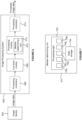
- FIG. 6 shows an example in which the data processing system is an image processing system, but it is to be understood that the median determining unit could be implemented in other types of data processing system, such as an audio processing system or a signal processing system to give just two examples.
- the image sensor 602 may provide the pixel values to the image processing system 604 in a raster scan order, such that pixel values for lines of pixels (e.g. rows of pixels) are received and processed in the image processing system 604 as they are received from the image sensor 602 in real-time.
- pixel values for lines of pixels e.g. rows of pixels
- the image processing system 604 may comprise a number of processing modules 606, 610 and 614 for applying respective processing functions to the image data.
- the processing modules may, for example, be implemented in dedicated hardware modules (e.g. in fixed function circuitry) such that they can be optimised for performing specific processing functions on the pixel values in an efficient manner (e.g. efficient in terms of at least one of latency, power consumption and silicon area).
- the processing module(s) 606 and 614 are represented with dashed boxes because the number of these modules may vary in different implementations and that number may be zero in some implementations.
- the processing module(s) 606 and 614 may perform any suitable functions on pixel values, e.g.
- the processing module 610 includes a median determining unit 612 configured to determine median values for pixel values.
- the line store module 608 is implemented to store pixel values for multiple lines of pixels and can provide pixel values from multiple lines to the processing module 610.
- Processed image data is output from the image processing system 604, and may be used in any suitable manner, e.g. output to a display, stored in memory, etc.
- the image processing system 604 receives image data, e.g. pixel intensity values for different pixels within an image. Techniques for capturing these pixel intensity values at the image sensors are known in the art and the details of this process are beyond the scope of this description.
- the image processing system 604 receives a stream of data values from the image sensor 602. The pixel values are fed from the image sensor 602 to the image processing system 604 in a particular order, thereby forming a stream of pixel values, e.g. raster scan order in which rows of pixel values are received in turn at the image processing system 604.
- the pixel values could be passed to the image processing system 604 in a different order, e.g. Boustrophedon order, and it is possible for multiple lines of pixel values to be passed to the image processing system 604 at once, in parallel.
- a different order e.g. Boustrophedon order
- multiple lines of pixel values may be passed to the image processing system 604 at once, in parallel.
- the image sensor 602 and the image processing system 604 may be designed by different parties, it is convenient for there to be a presumed, or standard, order in which pixel values are passed from the image sensor 602 to the image processing system 604, and raster scan order is the usual order used.
- the image processing system 604 may, or may not, perform some processing on the pixel values in the processing module(s) 606 before the pixel values are stored in the line store module 608.
- the line store module 608 allows pixel values from multiple rows to be provided to the processing module 610 together.
- the processing module 610 may be arranged to perform a median filtering operation (e.g. to remove impulsive noise) using the median determining unit 612.
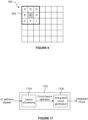
- Figure 9 shows a very simple example in which the stream of pixel values represents a two-dimensional array of pixel values 902 forming an image, wherein the array includes six rows of pixel values, with each row including seven pixel values.
- the stream of pixel values represents a two-dimensional array of pixel values 902 forming an image, wherein the array includes six rows of pixel values, with each row including seven pixel values.
- there may be many more pixel values within an image e.g. millions of pixel values arranged such that there are hundreds or thousands of rows and hundreds or thousands of columns of pixels.
- the processing module 610 For each pixel value in the image, the processing module 610 aims to find the median value within a 3x3 kernel which is, where possible, centred on the particular pixel value in question.
- the kernel 904 includes pixel values A, B, C, D, E, F, G, H and I and is centred on pixel value E, and can be used to determine a median value for pixel value E.
- pixel values on the edge of the array 902 e.g. pixel values A, B, C, D and G
- different kernels could be used, as appropriate.
- the image can be extended, e.g.
- the nine pixel values (A to I) are fed from the line store module 608 into the median determining unit 612 of the processing module 610.
- a median value "for" a particular pixel value there are references to a median value "for" a particular pixel value, and it is to be understood that this is referring to a median value determined for the position corresponding to the particular pixel value, e.g. a median value determined from the pixel values within a kernel which includes and is typically centred on the particular pixel value.
- step S804 the median determining unit 612 receives data values of the stream (e.g. the subset of nine data values A to I of the stream).
- the median determining unit 612 operates as described below to determine the median value of the received data values.
- step S806 the processing logic 702 determines intermediate data for use in determining the median value of the subset of data values (A to I).
- the intermediate data is stored in the data storage logic 704.
- the intermediate data stored in the data storage logic 704 can be subsequently used for determining other median values for other data values of the stream.
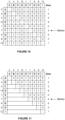
- Figure 10 shows an example of the form that the intermediate data could take.
- the table in Figure 10 has a row for each of the nine pixel values and a column for each of the nine pixel values. For each entry in the table shown in Figure 10 , if the pixel value for the row is greater than the pixel value for the column then a one is stored, whereas if the pixel value for the column is greater than the pixel value for the row then a zero is stored. Therefore, in this example, each of the indications can be represented with a single bit, i.e. they each comprise a one-bit flag.
- step S808 the processing logic 702 of the median determining unit 612 determines a median value for the subset of data values 904 using the intermediate data determined in step S806.
- Figure 10 shows the sum of the indications across each of the rows. These summed values indicate, for each respective data value, how many of the other data values in the subset are less than the respective data value.
- the median value determined for the pixel value E is 7 (i.e. the median value is given by the pixel value F).
- the median value is the data value which is greater than n ⁇ 1 2 of the other values. If n is an odd number then there is a single, middle data value (i.e. the median value), but if n is an even number then there are two data values which could be considered to be in the middle of the sorted data values.
- Different implementations may determine the median value from these two middle data values in different ways, e.g. the median value could be determined to be the average (i.e. the mean) of the two middle data values, or one of the two middle values could be selected (e.g.
- the number of zeros in the column for the particular data value e.g. there are five zeros in the column for data value G
- the number of ones in the row for the particular data value e.g. there is one one in the row for data value G.
- a standard hardware operation is a selection operation ("select one from a set of many") which can be used to select the median value from the data values in a subset. For example, if the n th item is to be selected from a list of m data items, then a standard demultiplexer can be implemented. In this case, one hardware solution would be to use tristate logic, with only one of the m inputs enabled. This implementation would be efficient in terms of the size of the hardware (i.e. a small silicon area) and in terms of power consumption.
- the determination of the median value using the table shown in Figure 11 does not involve swapping data between different inputs and therefore it consumes less power than the bubble sort approach described in the background section above.
- the determination of the median value using the table shown in Figure 11 (or Figure 10 ) is still difficult to implement in hardware because of the routing difficulty in connecting every input to every other input for performing the comparisons to determine all of the indications in the table shown in Figure 11 (or Figure 10 ).
- the number of comparisons that are performed is given by n 2 n ⁇ 1 , and each one of these comparisons is performed by a respective comparator coupled to a respective pairing of the inputs.
- n 9
- the latency and power consumption of the median determining unit may be a problem if a table of indications (e.g. as shown in Figure 11 ) was determined independently for determining each median value.
- the indications determined for determining one median value may be used for determining one or more subsequent median values.
- the image processing system 604 is determining a median value for each data value within a stream of data values the subsets of data values which are considered for each median determination partially overlap with each other.
- Figure 12 shows the 2D array of pixel values 902. Having determined the median value for the pixel value E, the processing module 610 now uses the median determining unit 612 to determine a median value for the pixel value H. So the median determining unit 612 determines the median value of the pixel values within the kernel 1204, which includes pixel values D, E, F, G, H, I, J, K and L. It can be appreciated that the kernel 1204 partially overlaps with the kernel 904. This means that the current subset of data values from which a median value is being determined at least partially overlaps with the previous subset of data values from which a median value is determined.
- the data values of a subset may be referred to as the data values within a "window" of the data stream.
- Each of the subsets of data values within the stream of data values represents a contiguous block of data values within the 2D array 902.
- step S811 the subset index i is incremented, such that on the first iteration step S811 involves setting the subset index to 1.
- step S812 the intermediate data (e.g. the table shown in Figure 11 ) stored for the previous subset (i.e. the ( i - 1) th subset) is retrieved from the data storage logic 704.
- the intermediate data e.g. the table shown in Figure 11
- the previous subset i.e. the ( i - 1) th subset
- the stream of data values may represent a one-dimensional (1D) array of data values.
- the process may take the intermediate data from 1 st 2 nd 3 rd 4 th 5 th 6 th 7 th 8 and 9 th data values on one iteration, and then in the next iteration substitute the 10 th data value for the 1 st data value in the subset of data values from which a median value is selected.
- the complexity is reduced from ⁇ n 2 to ⁇ n , and for 9 data values just eight comparisons would be performed on each iteration. All the comparisons can be done in parallel, and the changes to each of the row sums could also be done in parallel. Therefore, the intermediate results can be produced very quickly.
- the updating of the table shown in Figure 11 to arrive at the table shown in Figure 13 could be implemented in multiple (e.g. three) phases, e.g. by substituting one data value at a time.
- the indications (e.g. as shown in Figure 13 ) for the pairings involving one or more data values of the current subset which do not overlap with the previous subset may be determined in multiple phases.
- a single one of the data values of the current subset which does not overlap with the previous subset replaces one of the data values of the previous subset which does not overlap with the current subset.
- data value J may substitute data value A to produce a table of intermediate data values with respective rows for data values J, B, C, D, E, F, G, H and I.
- data value K may substitute data value B to produce a table of intermediate data values with respective rows for data values J, K, C, D, E, F, G, H and I.
- data value L may substitute data value C to produce a table of intermediate data values with respective rows for data values J, K, L, D, E, F, G, H and I, as shown in Figure 13 .
- Dividing the processing into multiple (e.g. three) phases reduces the number of comparisons that are performed in a single phase.
- the number of comparison units included in the system may be the same as the number of comparisons that are performed in a single phase.
- the number of phases may be equal to the number of data values of the current subset which do not overlap with the previous subset. Therefore, when processing in a raster scan order, the number of phases may be equal to the number of rows of data values in a subset.
- step S816 the intermediate data (e.g. the table shown in Figure 13 ) for the current subset (i.e. the i th subset) is stored in the data storage logic 704.
- step S820 the median value (e.g. a value of 9) determined for the i th subset is outputted from the median determining unit 612 (e.g. to represent the median value determined for the data value H), for use in the image processing system 604.
- the median value may be used by the processing module 610, used by other processing modules within the image processing system 604, and/or outputted from the image processing system 604.
- step S822 the processing logic 702 determines whether there are any more subsets of data values to process, and if there are, then the method passes back to step S811 in which the subset index i is incremented and the method repeats by performing steps S812 to S820 for the next subset. If it is determined in step S822 that there are no more subsets of data values to process then the method ends in step S824.
- the kernel which is used may be adapted.
- the treatment of edge pixels can vary in different implementations.
- the replacement of the indications may be performed in multiple phases, such that single data value replacements are implemented in each of the phases, so the number of comparisons that are performed in each phase is reduced. This simplifies the routing problem and reduces the number of comparison units that are implemented, thereby reducing the size and complexity of the hardware.
- steps S806 and S808 are performed to determine the indications in the table without reusing previously determined indications, and then for subsequent data values in a row the steps S812 to S818 are performed to determine the indications in the table based on previously determined indications.
- the subsets of data values represent 3x3 blocks of data values with the 2D array 902.
- the subsets of data values may be other shapes or sizes, e.g. the subsets of data values may represent one of: 5x5 blocks of data values, 7x7 blocks of data values, 3x5 blocks of data values, 5x7 blocks of data values, 7x9 blocks of data values or 9x9 blocks of data values to give just some examples.
- an odd number of data values are included in each of the subsets, but it would be possible for a subset of data value to include an even number of data values.
- the median value can be determined from these two middle data values, (e.g. as the lower of the two, the higher of the two or the mean of the two middle data values).
- the data value for which a subset of data values is passed to the median determining unit 612 may be in the centre of the subset of data values (e.g. the data value E is in the centre of the kernel 904, and the data value H is in the centre of the kernel 1204). However, this is not always the case. For example, near to the edges of the array, the data value for which a subset of data values is passed to the median determining unit 612 might not be in the centre of the subset of data values.
- all of the subsets might be the same size and shape, but in other examples some of the subsets may differ in size and/or shape.
- subsets for determining the median value for data values on or near an edge of the 2D array may be smaller than subsets for determining the median value for data values which are far from the edges of the 2D array.
- the rolling window approach to determining median values for a stream of data values improves the efficiency of the median determining unit 612 by reducing the number of comparisons that are performed (compared to determining each median value separately).
- the subsets of data values increase in size the amount of overlap between consecutive subsets which are processed increases, such that the efficiency gains achieved with the approach described herein increase.
- comparisons are performed for determining 21 of the 36 (i.e. 58%) indications shown in Figure 13 for each of a plurality of subsets following a first subset.
- comparisons are performed for determining 315 of 1176 (i.e. 27%) indications for each subset following a first subset. If the updating of the table is done in multiple phases (e.g. seven phases), each phase would include 48 comparisons. Reducing the number of comparisons that are performed reduces the processing power and time of determining a median value and also reduces the amount of hardware (i.e. the number of comparison modules) that is implemented in the processing logic of the median determining unit.
- subsets which represent blocks of pixel values which are wider than they are tall may be beneficial to use. Since the line store module 608 stores rows of data values, (e.g. as they arrive in raster scan order), a reduction in the number of rows means that the line store module 608 can have a reduced size, and a delay incurred in waiting for the line store module 608 to receive enough pixel values for the median determining unit 612 to process pixel values can be reduced. Whilst it may be advantageous to reduce the number of rows in the subsets for the reasons given above, the same is not true for reducing the number of columns in the subsets (when the data values are received in rows, e.g.
- subsets which have more columns than rows (i.e. they are wider than they are tall). This allows the subsets to retain a large overall size, whilst reducing the number of rows in the subsets.
- the size and shape of the subsets may depend on the use for which the median values are being determined (i.e. the function of the processing module 610).
- the median determining unit 612 can operate on a stream of pixel values, irrespective of where the pixel values originated.
- pixel values of an image could be generated by a graphics processing unit (rather than being captured by an image sensor), and the median determining unit 612 could be used to determine median values as part of the processing of the pixel values within the graphics processing unit.
- FIG. 8 The method shown in Figure 8 can be used to determine median values for the data values within the 1D array 1402.
- Figure 14b shows a table of indications determined for the subset 1404 in step S806.
- the median determining unit 612 determines a median value for the next data value (data value E) in the stream by finding the median of the data values within the kernel 1504, as shown in Figure 15a .
- the kernel 1504 represents a subset of the data values including the data values B, C, D, E, F, G and H.
- a 1D stream of data values could be used if the data processing system is an audio processing system and the data values are audio samples of an audio signal.
- the audio signal could be received and sampled at a microphone and the audio samples can be passed to the audio processing system.
- the audio processing system may perform some processing functions (some of which may implement a median determining unit as described herein) on the audio samples before outputting the processing audio signal, e.g. via a speaker.
- a 1D stream of data values could be used if the data processing system is a signal processing system and the data values are signal samples of a transmitted signal.
- the signal could be received over a wired or wireless channel, at a device in which the signal processing system is implemented. The device can sample the received signal and then the signal processing system may perform some processing functions (some of which may implement a median determining unit as described herein) on the received signal samples in order to extract the data from the received signal.
- the intermediate data which is stored in the data storage logic 704 takes the form of the indications in the tables shown in Figures 11 and 13 .
- the intermediate data could take other forms.
- the intermediate data for a subset of data values may comprise, for each of the data values in the subset, an index value indicating a sorted position of the data value within the subset.
- the results of the sums shown in Figures 11 and 13 could be stored as indices for the data values. So, taking Figure 11 as an example, rather than storing all of the indications in the table, just the results of the sums are stored. The results of the sums can be determined in the same way as described above.
- an index of 1 is stored for data value A
- an index of 2 is stored for data value B
- an index of 3 is stored for data value C
- an index of 8 is stored for data value D
- an index of 0 is stored for data value E
- an index of 4 is stored for data value F
- an index of 6 is stored for data value G
- an index of 5 is stored for data value H
- an index of 7 is stored for data value I.
- the processing logic can determine a median value of the data values within a subset by selecting one of the data values in the subset based on the index values.
- this example reduces the amount of intermediate data that is stored in the data storage logic 704 between iterations, in the example described below some indications (i.e. comparisons) need to be re-computed in a current iteration that have been computed in the previous iteration; whereas in the examples described above with reference to Figures 10 to 15b these indications would not need to be recomputed because they are stored in the intermediate data. So, there is a trade-off between reducing the amount of intermediate data that is stored between iterations and increasing the number of comparisons that are performed in each iteration.
- the index values of a previous subset can be used to determine index values for a current subset.
- the processing logic can retrieve the intermediate data (i.e. the index values) stored for the previous subset and use the retrieved index values to determine index values for a current subset, e.g. as described below.
- Index values of one or more data values of the previous subset which overlap with the current subset are identified. For each of one or more data values of the current subset which do overlap with the previous subset, a determination is made as to whether or not to increment or decrement the index value for the data value based on: (i) a comparison of the data value with the one or more data values of the previous subset which do not overlap with the current subset, and (ii) a comparison of the data value with the one or more data values of the current subset which do not overlap with the previous subset.
- One or more index values are identified to be assigned to the one or more data values of the current subset which do not overlap with the previous subset by finding gaps in the sequence of index values of the data values in the current subset, such that the index values in the current subset form a contiguous sequence.
- the processing logic determines a median value for the data value H shown in Figure 12 , it is finding a median value of the data values in the subset 1204, which includes data values D, E, F, G, H, I, J, K and L.
- the processing logic can identify the index values of the data values of the previous subset 904, i.e. data values A, B, C, D, E, F, G, H and I.
- There are three new data values (J, K and L) in the current subset which replace three old data values (A, B and C) in the previous subset, and this can be done in three phases.
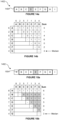
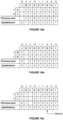
- Figure 16a illustrates a first phase, in which the data value J replaces the data value A.
- Figure 16a shows the rows of indications for data values A and J.
- index values i.e. the previous sums
- Figure 16a The identified index values (i.e. the previous sums) are shown in Figure 16a as 2, 3, 8, 0, 4, 6, 5 and 7 for data values B, C, D, E, F, G, H and I respectively. It can be seen that these sums match those shown in Figure 11 .
- the processing logic determines an index value for the data value by comparing the data value to the other data values in the current subset 1204.
- R denotes a data value being retired (e.g. data value A in the first phase shown in Figure 16a )
- N denotes a new data value of the current subset (e.g. data value J in the first phase shown in Figure 16a )
- X denotes each respective existing data value that is being kept (e.g. data values B, C, D, E, F, G, H and I in the first phase shown in Figure 16a )
- the sum values of the existing data values (X) can be updated as follows:
- the data value J has a value of 10, and when it is compared with the values of data values B, C, D, E, F, G, H and I, the indications of the comparisons between each of the existing data values (B to I) with data value A and with data value J are shown in the first two rows of the table in Figure 16a .
- the sums for data values B, C, F, G and H are decremented, whilst the sums for data values D, E and I do not change. Therefore the updated sums (i.e. the updated index values) for data values B, C, D, E, F, G, H and I are 1, 2, 8, 0, 3, 5, 4 and 7 respectively.
- the new data value J is given the index value 6, as shown in Figure 16a .
- Figure 16b illustrates a second phase, in which the data value K replaces the data value B.
- Figure 16b shows the rows of indications for data values B and K.
- the identified index values i.e. the previous sums
- the identified index values are shown in Figure 16b as 6, 2, 8, 0, 3, 5, 4 and 7 for data values J, C, D, E, F, G, H and I respectively. It can be seen that these sums match those shown as updated sums in Figure 16a .
- the data value K has a value of 2, and when it is compared with the values of data values J, C, D, E, F, G, H and I, the indications of the comparisons between each of the existing data values (J and C to I) with data value B and with data value K are shown in the first two rows of the table in Figure 16b .
- the sums for all of the existing data values J, C, D, E, F, G, H and I are not changed. Therefore the updated sums (i.e. the updated index values) for data values J, C, D, E, F, G, H and I are 6, 2, 8, 0, 3, 5, 4 and 7 respectively.
- Figure 16c illustrates a third phase, in which the data value L replaces the data value C.
- Figure 16c shows the rows of indications for data values C and L.
- the identified index values i.e. the previous sums
- the identified index values are shown in Figure 16c as 6, 1, 8, 0, 3, 5, 4 and 7 for data values J, K, D, E, F, G, H and I respectively. It can be seen that these sums match those shown as updated sums in Figure 16b .
- the data value L has a value of 11, and when it is compared with the values of data values J, K, D, E, F, G, H and I, the indications of the comparisons between each of the existing data values (J, K and D to I) with data value C and with data value L are shown in the first two rows of the table in Figure 16c .
- the sums for data values J, F, G and H are decremented, whilst the sums for data values K, D, E and I do not change. Therefore the updated sums (i.e. the updated index values) for data values J, K, D, E, F, G, H and I are 5, 1, 8, 0, 2, 4, 3 and 7 respectively.
- the examples described herein involve determining median values in a rolling manner for different data values from a stream of data values, such that the intermediate data used for determining the median value of a first subset of the received data values is stored and can be used for determining the median value of a second subset of the received data values which partially overlaps with the first subset.
- the median determining units described herein are shown in Figures 6 and 7 as comprising a number of functional blocks. This is schematic only and is not intended to define a strict division between different logic elements of such entities. Each functional block may be provided in any suitable manner. It is to be understood that intermediate values described herein as being formed by a median determining unit need not be physically generated by the median determining unit at any point and may merely represent logical values which conveniently describe the processing performed by the median determining unit between its input and output.
- the median determining units described herein may be embodied in hardware on an integrated circuit.
- the median determining units described herein may be configured to perform any of the methods described herein.
- any of the functions, methods, techniques or components described above can be implemented in software, firmware, hardware (e.g., fixed logic circuitry), or any combination thereof.
- the terms “module,” “functionality,” “component”, “element”, “unit”, “block” and “logic” may be used herein to generally represent software, firmware, hardware, or any combination thereof.
- the module, functionality, component, element, unit, block or logic represents program code that performs the specified tasks when executed on a processor.
- a computer-readable storage medium examples include a random-access memory (RAM), read-only memory (ROM), an optical disc, flash memory, hard disk memory, and other memory devices that may use magnetic, optical, and other techniques to store instructions or other data and that can be accessed by a machine.
- RAM random-access memory
- ROM read-only memory
- optical disc optical disc
- flash memory hard disk memory
- hard disk memory and other memory devices that may use magnetic, optical, and other techniques to store instructions or other data and that can be accessed by a machine.
- Computer program code and computer readable instructions refer to any kind of executable code for processors, including code expressed in a machine language, an interpreted language or a scripting language.
- Executable code includes binary code, machine code, bytecode, code defining an integrated circuit (such as a hardware description language or netlist), and code expressed in a programming language code such as C, Java (RTM) or OpenCL (RTM).
- Executable code may be, for example, any kind of software, firmware, script, module or library which, when suitably executed, processed, interpreted, compiled, executed at a virtual machine or other software environment, cause a processor of the computer system at which the executable code is supported to perform the tasks specified by the code.
- a processor, computer, or computer system may be any kind of device, machine or dedicated circuit, or collection or portion thereof, with processing capability such that it can execute instructions.
- a processor may be any kind of general purpose or dedicated processor, such as a CPU, GPU, System-on-chip, state machine, media processor, an application-specific integrated circuit (ASIC), a programmable logic array, a field-programmable gate array (FPGA), or the like.
- a computer or computer system may comprise one or more processors.
- HDL hardware description language
- An integrated circuit definition dataset may be, for example, an integrated circuit description.
- a method of manufacturing at an integrated circuit manufacturing system, a median determining unit or data processing system as described herein. Furthermore, there may be provided an integrated circuit definition dataset that, when processed in an integrated circuit manufacturing system, causes the method of manufacturing a median determining unit or data processing system to be performed.
- An integrated circuit definition dataset may be in the form of computer code, for example as a netlist, code for configuring a programmable chip, as a hardware description language defining an integrated circuit at any level, including as register transfer level (RTL) code, as high-level circuit representations such as Verilog or VHDL, and as low-level circuit representations such as OASIS (RTM) and GDSII.
- RTL register transfer level
- RTM OASIS
- GDSII GDSI
Landscapes
- Engineering & Computer Science (AREA)
- Physics & Mathematics (AREA)
- General Physics & Mathematics (AREA)
- Theoretical Computer Science (AREA)
- Data Mining & Analysis (AREA)
- Computational Mathematics (AREA)
- Mathematical Analysis (AREA)
- Mathematical Optimization (AREA)
- Pure & Applied Mathematics (AREA)
- Mathematical Physics (AREA)
- General Engineering & Computer Science (AREA)
- Algebra (AREA)
- Software Systems (AREA)
- Databases & Information Systems (AREA)
- Probability & Statistics with Applications (AREA)
- Operations Research (AREA)
- Life Sciences & Earth Sciences (AREA)
- Evolutionary Biology (AREA)
- Bioinformatics & Computational Biology (AREA)
- Bioinformatics & Cheminformatics (AREA)
- Signal Processing (AREA)
- Image Processing (AREA)
- Computer Hardware Design (AREA)
- Facsimile Image Signal Circuits (AREA)
Applications Claiming Priority (2)
| Application Number | Priority Date | Filing Date | Title |
|---|---|---|---|
| GB1622135.0A GB2558271B (en) | 2016-12-23 | 2016-12-23 | Median determination |
| EP17204566.8A EP3340067B1 (de) | 2016-12-23 | 2017-11-30 | Mittelwertbestimmung |
Related Parent Applications (2)
| Application Number | Title | Priority Date | Filing Date |
|---|---|---|---|
| EP17204566.8A Division EP3340067B1 (de) | 2016-12-23 | 2017-11-30 | Mittelwertbestimmung |
| EP17204566.8A Division-Into EP3340067B1 (de) | 2016-12-23 | 2017-11-30 | Mittelwertbestimmung |
Publications (2)
| Publication Number | Publication Date |
|---|---|
| EP4524878A2 true EP4524878A2 (de) | 2025-03-19 |
| EP4524878A3 EP4524878A3 (de) | 2025-06-11 |
Family
ID=58360618
Family Applications (2)
| Application Number | Title | Priority Date | Filing Date |
|---|---|---|---|
| EP17204566.8A Active EP3340067B1 (de) | 2016-12-23 | 2017-11-30 | Mittelwertbestimmung |
| EP25155515.7A Pending EP4524878A3 (de) | 2016-12-23 | 2017-11-30 | Median-bestimmung |
Family Applications Before (1)
| Application Number | Title | Priority Date | Filing Date |
|---|---|---|---|
| EP17204566.8A Active EP3340067B1 (de) | 2016-12-23 | 2017-11-30 | Mittelwertbestimmung |
Country Status (4)
| Country | Link |
|---|---|
| US (4) | US10474730B2 (de) |
| EP (2) | EP3340067B1 (de) |
| CN (1) | CN108242051A (de) |
| GB (1) | GB2558271B (de) |
Families Citing this family (8)
| Publication number | Priority date | Publication date | Assignee | Title |
|---|---|---|---|---|
| CN104394411B (zh) * | 2014-11-28 | 2018-01-26 | 上海集成电路研发中心有限公司 | 中值滤波装置及方法 |
| US10192162B2 (en) | 2015-05-21 | 2019-01-29 | Google Llc | Vector computation unit in a neural network processor |
| US11218290B2 (en) * | 2019-02-28 | 2022-01-04 | Sap Se | Efficient cloud-based secure computation of the median using homomorphic encryption |
| US11250140B2 (en) * | 2019-02-28 | 2022-02-15 | Sap Se | Cloud-based secure computation of the median |
| FR3101719A1 (fr) * | 2019-10-08 | 2021-04-09 | Safran Electronics & Defense | Module de traitement de donnees identifiant un fractile d'un jeu de donnees |
| CN110825343B (zh) * | 2019-11-05 | 2021-12-03 | 中电科思仪科技股份有限公司 | 一种快速数据筛选方法及系统 |
| CN113392412B (zh) * | 2021-05-11 | 2022-05-24 | 杭州趣链科技有限公司 | 数据接收方法、数据发送方法及电子设备 |
| CN115167808A (zh) * | 2022-07-28 | 2022-10-11 | 山东云海国创云计算装备产业创新中心有限公司 | 一种基于数据排序的求值方法、系统、存储介质及设备 |
Family Cites Families (6)
| Publication number | Priority date | Publication date | Assignee | Title |
|---|---|---|---|---|
| JP2001167262A (ja) * | 1999-12-07 | 2001-06-22 | Canon Inc | 信号処理装置 |
| DE10254606B4 (de) * | 2002-11-22 | 2006-06-29 | Siemens Ag | Verfahren und Vorrichtung zur schnellen Verarbeitung von Messdaten mit einer Vielzahl unabhängiger Stichproben |
| JP2004334545A (ja) * | 2003-05-08 | 2004-11-25 | Olympus Corp | フィルタ回路 |
| US8321490B2 (en) * | 2005-07-28 | 2012-11-27 | Analog Devices, Inc. | Instruction-based parallel median filtering |
| US8751990B2 (en) * | 2008-12-19 | 2014-06-10 | L3 Communications Integrated Systems, L.P. | System for determining median values of video data |
| US10755386B2 (en) * | 2016-06-30 | 2020-08-25 | Intel Corporation | Median filtering of images using directed search |
-
2016
- 2016-12-23 GB GB1622135.0A patent/GB2558271B/en active Active
-
2017
- 2017-11-30 EP EP17204566.8A patent/EP3340067B1/de active Active
- 2017-11-30 EP EP25155515.7A patent/EP4524878A3/de active Pending
- 2017-12-22 US US15/852,197 patent/US10474730B2/en active Active
- 2017-12-22 CN CN201711408367.7A patent/CN108242051A/zh active Pending
-
2019
- 2019-10-02 US US16/590,635 patent/US10908877B2/en active Active
-
2021
- 2021-01-08 US US17/145,087 patent/US11630640B2/en active Active
-
2023
- 2023-04-17 US US18/135,715 patent/US20230305802A1/en active Pending
Also Published As
| Publication number | Publication date |
|---|---|
| CN108242051A (zh) | 2018-07-03 |
| US20200034402A1 (en) | 2020-01-30 |
| GB2558271B (en) | 2021-09-08 |
| US10908877B2 (en) | 2021-02-02 |
| GB201622135D0 (en) | 2017-02-08 |
| US20230305802A1 (en) | 2023-09-28 |
| US11630640B2 (en) | 2023-04-18 |
| EP4524878A3 (de) | 2025-06-11 |
| GB2558271A (en) | 2018-07-11 |
| US20210132903A1 (en) | 2021-05-06 |
| EP3340067B1 (de) | 2025-03-26 |
| US20180181539A1 (en) | 2018-06-28 |
| EP3340067A1 (de) | 2018-06-27 |
| US10474730B2 (en) | 2019-11-12 |
Similar Documents
| Publication | Publication Date | Title |
|---|---|---|
| US20230305802A1 (en) | Median Value Determination in a Data Processing System | |
| US11157592B2 (en) | Hardware implementation of convolutional layer of deep neural network | |
| US20200175358A1 (en) | Convolutional neural network based data processing apparatus, method for controlling the same, and storage medium storing program | |
| US12405804B2 (en) | Hardware unit for performing matrix multiplication with clock gating | |
| CN110050267A (zh) | 用于数据管理的系统和方法 | |
| US20230221924A1 (en) | Apparatus and Method for Processing Floating-Point Numbers | |
| US20250224921A1 (en) | Apparatus and Method for Processing Floating-Point Numbers | |
| Bacis et al. | A pipelined and scalable dataflow implementation of convolutional neural networks on FPGA | |
| EP3460669A1 (de) | Sortieren von speicheradressanforderungen für den parallelen speicherzugriff | |
| US10755386B2 (en) | Median filtering of images using directed search | |
| JP2016045721A (ja) | データ格納方法、三値内積演算回路、それを備えた半導体装置、及び、三値内積演算処理プログラム | |
| GB2587760A (en) | Median determination | |
| GB2587590A (en) | Median determination | |
| GB2587591A (en) | Median determination | |
| GB2549928A (en) | Sorting numbers in hardware | |
| CN109255771B (zh) | 图像滤波方法及装置 | |
| US20240192918A1 (en) | Sorting | |
| US20240094988A1 (en) | Method and apparatus with multi-bit accumulation | |
| GB2625271A (en) | Sorting | |
| Selvaganesh et al. | FPGA Implementation of Low Latency and Highly Accurate Median Filter Architecture for Image Processing Applications |
Legal Events
| Date | Code | Title | Description |
|---|---|---|---|
| PUAI | Public reference made under article 153(3) epc to a published international application that has entered the european phase |
Free format text: ORIGINAL CODE: 0009012 |
|
| STAA | Information on the status of an ep patent application or granted ep patent |
Free format text: STATUS: THE APPLICATION HAS BEEN PUBLISHED |
|
| AC | Divisional application: reference to earlier application |
Ref document number: 3340067 Country of ref document: EP Kind code of ref document: P |
|
| AK | Designated contracting states |
Kind code of ref document: A2 Designated state(s): AL AT BE BG CH CY CZ DE DK EE ES FI FR GB GR HR HU IE IS IT LI LT LU LV MC MK MT NL NO PL PT RO RS SE SI SK SM TR |
|
| P01 | Opt-out of the competence of the unified patent court (upc) registered |
Free format text: CASE NUMBER: APP_14369/2025 Effective date: 20250324 |
|
| REG | Reference to a national code |
Ref country code: DE Ref legal event code: R079 Free format text: PREVIOUS MAIN CLASS: G06T0005200000 Ipc: G06F0017180000 |
|
| PUAL | Search report despatched |
Free format text: ORIGINAL CODE: 0009013 |
|
| AK | Designated contracting states |
Kind code of ref document: A3 Designated state(s): AL AT BE BG CH CY CZ DE DK EE ES FI FR GB GR HR HU IE IS IT LI LT LU LV MC MK MT NL NO PL PT RO RS SE SI SK SM TR |
|
| RIC1 | Information provided on ipc code assigned before grant |
Ipc: G06T 5/20 20060101ALI20250506BHEP Ipc: G06T 5/00 20240101ALI20250506BHEP Ipc: G06F 17/18 20060101AFI20250506BHEP |
|
| STAA | Information on the status of an ep patent application or granted ep patent |
Free format text: STATUS: REQUEST FOR EXAMINATION WAS MADE |
|
| 17P | Request for examination filed |
Effective date: 20251204 |