EP4530363A1 - Procédé de chauffage d'une plaque d'acier, procédé de production d'une plaque d'acier plaquée, four de chauffage à feu direct, et équipement de galvanisation par immersion à chaud en continu - Google Patents
Procédé de chauffage d'une plaque d'acier, procédé de production d'une plaque d'acier plaquée, four de chauffage à feu direct, et équipement de galvanisation par immersion à chaud en continu Download PDFInfo
- Publication number
- EP4530363A1 EP4530363A1 EP23839544.6A EP23839544A EP4530363A1 EP 4530363 A1 EP4530363 A1 EP 4530363A1 EP 23839544 A EP23839544 A EP 23839544A EP 4530363 A1 EP4530363 A1 EP 4530363A1
- Authority
- EP
- European Patent Office
- Prior art keywords
- steel sheet
- zone
- oxidation zone
- slit
- burner
- Prior art date
- Legal status (The legal status is an assumption and is not a legal conclusion. Google has not performed a legal analysis and makes no representation as to the accuracy of the status listed.)
- Pending
Links
Images

Classifications
-
- F—MECHANICAL ENGINEERING; LIGHTING; HEATING; WEAPONS; BLASTING
- F23—COMBUSTION APPARATUS; COMBUSTION PROCESSES
- F23D—BURNERS
- F23D99/00—Subject matter not provided for in other groups of this subclass
- F23D99/002—Burners specially adapted for specific applications
- F23D99/004—Burners specially adapted for specific applications for use in particular heating operations
-
- C—CHEMISTRY; METALLURGY
- C21—METALLURGY OF IRON
- C21D—MODIFYING THE PHYSICAL STRUCTURE OF FERROUS METALS; GENERAL DEVICES FOR HEAT TREATMENT OF FERROUS OR NON-FERROUS METALS OR ALLOYS; MAKING METAL MALLEABLE, e.g. BY DECARBURISATION OR TEMPERING
- C21D8/00—Modifying the physical properties of ferrous metals or ferrous alloys by deformation combined with, or followed by, heat treatment
- C21D8/02—Modifying the physical properties of ferrous metals or ferrous alloys by deformation combined with, or followed by, heat treatment during manufacturing of plates or strips
- C21D8/0247—Modifying the physical properties of ferrous metals or ferrous alloys by deformation combined with, or followed by, heat treatment during manufacturing of plates or strips characterised by the heat treatment
-
- C—CHEMISTRY; METALLURGY
- C21—METALLURGY OF IRON
- C21D—MODIFYING THE PHYSICAL STRUCTURE OF FERROUS METALS; GENERAL DEVICES FOR HEAT TREATMENT OF FERROUS OR NON-FERROUS METALS OR ALLOYS; MAKING METAL MALLEABLE, e.g. BY DECARBURISATION OR TEMPERING
- C21D1/00—General methods or devices for heat treatment, e.g. annealing, hardening, quenching or tempering
- C21D1/34—Methods of heating
- C21D1/52—Methods of heating with flames
-
- C—CHEMISTRY; METALLURGY
- C21—METALLURGY OF IRON
- C21D—MODIFYING THE PHYSICAL STRUCTURE OF FERROUS METALS; GENERAL DEVICES FOR HEAT TREATMENT OF FERROUS OR NON-FERROUS METALS OR ALLOYS; MAKING METAL MALLEABLE, e.g. BY DECARBURISATION OR TEMPERING
- C21D1/00—General methods or devices for heat treatment, e.g. annealing, hardening, quenching or tempering
- C21D1/74—Methods of treatment in inert gas, controlled atmosphere, vacuum or pulverulent material
-
- C—CHEMISTRY; METALLURGY
- C21—METALLURGY OF IRON
- C21D—MODIFYING THE PHYSICAL STRUCTURE OF FERROUS METALS; GENERAL DEVICES FOR HEAT TREATMENT OF FERROUS OR NON-FERROUS METALS OR ALLOYS; MAKING METAL MALLEABLE, e.g. BY DECARBURISATION OR TEMPERING
- C21D8/00—Modifying the physical properties of ferrous metals or ferrous alloys by deformation combined with, or followed by, heat treatment
-
- C—CHEMISTRY; METALLURGY
- C21—METALLURGY OF IRON
- C21D—MODIFYING THE PHYSICAL STRUCTURE OF FERROUS METALS; GENERAL DEVICES FOR HEAT TREATMENT OF FERROUS OR NON-FERROUS METALS OR ALLOYS; MAKING METAL MALLEABLE, e.g. BY DECARBURISATION OR TEMPERING
- C21D8/00—Modifying the physical properties of ferrous metals or ferrous alloys by deformation combined with, or followed by, heat treatment
- C21D8/02—Modifying the physical properties of ferrous metals or ferrous alloys by deformation combined with, or followed by, heat treatment during manufacturing of plates or strips
-
- C—CHEMISTRY; METALLURGY
- C21—METALLURGY OF IRON
- C21D—MODIFYING THE PHYSICAL STRUCTURE OF FERROUS METALS; GENERAL DEVICES FOR HEAT TREATMENT OF FERROUS OR NON-FERROUS METALS OR ALLOYS; MAKING METAL MALLEABLE, e.g. BY DECARBURISATION OR TEMPERING
- C21D9/00—Heat treatment, e.g. annealing, hardening, quenching or tempering, adapted for particular articles; Furnaces therefor
- C21D9/005—Furnaces in which the charge is moving up or down
-
- C—CHEMISTRY; METALLURGY
- C21—METALLURGY OF IRON
- C21D—MODIFYING THE PHYSICAL STRUCTURE OF FERROUS METALS; GENERAL DEVICES FOR HEAT TREATMENT OF FERROUS OR NON-FERROUS METALS OR ALLOYS; MAKING METAL MALLEABLE, e.g. BY DECARBURISATION OR TEMPERING
- C21D9/00—Heat treatment, e.g. annealing, hardening, quenching or tempering, adapted for particular articles; Furnaces therefor
- C21D9/46—Heat treatment, e.g. annealing, hardening, quenching or tempering, adapted for particular articles; Furnaces therefor for sheet metals
-
- C—CHEMISTRY; METALLURGY
- C21—METALLURGY OF IRON
- C21D—MODIFYING THE PHYSICAL STRUCTURE OF FERROUS METALS; GENERAL DEVICES FOR HEAT TREATMENT OF FERROUS OR NON-FERROUS METALS OR ALLOYS; MAKING METAL MALLEABLE, e.g. BY DECARBURISATION OR TEMPERING
- C21D9/00—Heat treatment, e.g. annealing, hardening, quenching or tempering, adapted for particular articles; Furnaces therefor
- C21D9/52—Heat treatment, e.g. annealing, hardening, quenching or tempering, adapted for particular articles; Furnaces therefor for wires; for strips ; for rods of unlimited length
- C21D9/54—Furnaces for treating strips or wire
- C21D9/56—Continuous furnaces for strip or wire
-
- C—CHEMISTRY; METALLURGY
- C21—METALLURGY OF IRON
- C21D—MODIFYING THE PHYSICAL STRUCTURE OF FERROUS METALS; GENERAL DEVICES FOR HEAT TREATMENT OF FERROUS OR NON-FERROUS METALS OR ALLOYS; MAKING METAL MALLEABLE, e.g. BY DECARBURISATION OR TEMPERING
- C21D9/00—Heat treatment, e.g. annealing, hardening, quenching or tempering, adapted for particular articles; Furnaces therefor
- C21D9/52—Heat treatment, e.g. annealing, hardening, quenching or tempering, adapted for particular articles; Furnaces therefor for wires; for strips ; for rods of unlimited length
- C21D9/54—Furnaces for treating strips or wire
- C21D9/56—Continuous furnaces for strip or wire
- C21D9/561—Continuous furnaces for strip or wire with a controlled atmosphere or vacuum
-
- C—CHEMISTRY; METALLURGY
- C22—METALLURGY; FERROUS OR NON-FERROUS ALLOYS; TREATMENT OF ALLOYS OR NON-FERROUS METALS
- C22C—ALLOYS
- C22C38/00—Ferrous alloys, e.g. steel alloys
-
- C—CHEMISTRY; METALLURGY
- C23—COATING METALLIC MATERIAL; COATING MATERIAL WITH METALLIC MATERIAL; CHEMICAL SURFACE TREATMENT; DIFFUSION TREATMENT OF METALLIC MATERIAL; COATING BY VACUUM EVAPORATION, BY SPUTTERING, BY ION IMPLANTATION OR BY CHEMICAL VAPOUR DEPOSITION, IN GENERAL; INHIBITING CORROSION OF METALLIC MATERIAL OR INCRUSTATION IN GENERAL
- C23C—COATING METALLIC MATERIAL; COATING MATERIAL WITH METALLIC MATERIAL; SURFACE TREATMENT OF METALLIC MATERIAL BY DIFFUSION INTO THE SURFACE, BY CHEMICAL CONVERSION OR SUBSTITUTION; COATING BY VACUUM EVAPORATION, BY SPUTTERING, BY ION IMPLANTATION OR BY CHEMICAL VAPOUR DEPOSITION, IN GENERAL
- C23C2/00—Hot-dipping or immersion processes for applying the coating material in the molten state without affecting the shape; Apparatus therefor
- C23C2/003—Apparatus
- C23C2/0038—Apparatus characterised by the pre-treatment chambers located immediately upstream of the bath or occurring locally before the dipping process
-
- C—CHEMISTRY; METALLURGY
- C23—COATING METALLIC MATERIAL; COATING MATERIAL WITH METALLIC MATERIAL; CHEMICAL SURFACE TREATMENT; DIFFUSION TREATMENT OF METALLIC MATERIAL; COATING BY VACUUM EVAPORATION, BY SPUTTERING, BY ION IMPLANTATION OR BY CHEMICAL VAPOUR DEPOSITION, IN GENERAL; INHIBITING CORROSION OF METALLIC MATERIAL OR INCRUSTATION IN GENERAL
- C23C—COATING METALLIC MATERIAL; COATING MATERIAL WITH METALLIC MATERIAL; SURFACE TREATMENT OF METALLIC MATERIAL BY DIFFUSION INTO THE SURFACE, BY CHEMICAL CONVERSION OR SUBSTITUTION; COATING BY VACUUM EVAPORATION, BY SPUTTERING, BY ION IMPLANTATION OR BY CHEMICAL VAPOUR DEPOSITION, IN GENERAL
- C23C2/00—Hot-dipping or immersion processes for applying the coating material in the molten state without affecting the shape; Apparatus therefor
- C23C2/02—Pretreatment of the material to be coated, e.g. for coating on selected surface areas
-
- C—CHEMISTRY; METALLURGY
- C23—COATING METALLIC MATERIAL; COATING MATERIAL WITH METALLIC MATERIAL; CHEMICAL SURFACE TREATMENT; DIFFUSION TREATMENT OF METALLIC MATERIAL; COATING BY VACUUM EVAPORATION, BY SPUTTERING, BY ION IMPLANTATION OR BY CHEMICAL VAPOUR DEPOSITION, IN GENERAL; INHIBITING CORROSION OF METALLIC MATERIAL OR INCRUSTATION IN GENERAL
- C23C—COATING METALLIC MATERIAL; COATING MATERIAL WITH METALLIC MATERIAL; SURFACE TREATMENT OF METALLIC MATERIAL BY DIFFUSION INTO THE SURFACE, BY CHEMICAL CONVERSION OR SUBSTITUTION; COATING BY VACUUM EVAPORATION, BY SPUTTERING, BY ION IMPLANTATION OR BY CHEMICAL VAPOUR DEPOSITION, IN GENERAL
- C23C2/00—Hot-dipping or immersion processes for applying the coating material in the molten state without affecting the shape; Apparatus therefor
- C23C2/02—Pretreatment of the material to be coated, e.g. for coating on selected surface areas
- C23C2/022—Pretreatment of the material to be coated, e.g. for coating on selected surface areas by heating
- C23C2/0222—Pretreatment of the material to be coated, e.g. for coating on selected surface areas by heating in a reactive atmosphere, e.g. oxidising or reducing atmosphere
-
- C—CHEMISTRY; METALLURGY
- C23—COATING METALLIC MATERIAL; COATING MATERIAL WITH METALLIC MATERIAL; CHEMICAL SURFACE TREATMENT; DIFFUSION TREATMENT OF METALLIC MATERIAL; COATING BY VACUUM EVAPORATION, BY SPUTTERING, BY ION IMPLANTATION OR BY CHEMICAL VAPOUR DEPOSITION, IN GENERAL; INHIBITING CORROSION OF METALLIC MATERIAL OR INCRUSTATION IN GENERAL
- C23C—COATING METALLIC MATERIAL; COATING MATERIAL WITH METALLIC MATERIAL; SURFACE TREATMENT OF METALLIC MATERIAL BY DIFFUSION INTO THE SURFACE, BY CHEMICAL CONVERSION OR SUBSTITUTION; COATING BY VACUUM EVAPORATION, BY SPUTTERING, BY ION IMPLANTATION OR BY CHEMICAL VAPOUR DEPOSITION, IN GENERAL
- C23C2/00—Hot-dipping or immersion processes for applying the coating material in the molten state without affecting the shape; Apparatus therefor
- C23C2/04—Hot-dipping or immersion processes for applying the coating material in the molten state without affecting the shape; Apparatus therefor characterised by the coating material
- C23C2/06—Zinc or cadmium or alloys based thereon
-
- C—CHEMISTRY; METALLURGY
- C23—COATING METALLIC MATERIAL; COATING MATERIAL WITH METALLIC MATERIAL; CHEMICAL SURFACE TREATMENT; DIFFUSION TREATMENT OF METALLIC MATERIAL; COATING BY VACUUM EVAPORATION, BY SPUTTERING, BY ION IMPLANTATION OR BY CHEMICAL VAPOUR DEPOSITION, IN GENERAL; INHIBITING CORROSION OF METALLIC MATERIAL OR INCRUSTATION IN GENERAL
- C23C—COATING METALLIC MATERIAL; COATING MATERIAL WITH METALLIC MATERIAL; SURFACE TREATMENT OF METALLIC MATERIAL BY DIFFUSION INTO THE SURFACE, BY CHEMICAL CONVERSION OR SUBSTITUTION; COATING BY VACUUM EVAPORATION, BY SPUTTERING, BY ION IMPLANTATION OR BY CHEMICAL VAPOUR DEPOSITION, IN GENERAL
- C23C2/00—Hot-dipping or immersion processes for applying the coating material in the molten state without affecting the shape; Apparatus therefor
- C23C2/34—Hot-dipping or immersion processes for applying the coating material in the molten state without affecting the shape; Apparatus therefor characterised by the shape of the material to be treated
- C23C2/36—Elongated material
- C23C2/40—Plates; Strips
-
- C—CHEMISTRY; METALLURGY
- C25—ELECTROLYTIC OR ELECTROPHORETIC PROCESSES; APPARATUS THEREFOR
- C25D—PROCESSES FOR THE ELECTROLYTIC OR ELECTROPHORETIC PRODUCTION OF COATINGS; ELECTROFORMING; APPARATUS THEREFOR
- C25D5/00—Electroplating characterised by the process; Pretreatment or after-treatment of workpieces
- C25D5/34—Pretreatment of metallic surfaces to be electroplated
- C25D5/36—Pretreatment of metallic surfaces to be electroplated of iron or steel
-
- C—CHEMISTRY; METALLURGY
- C25—ELECTROLYTIC OR ELECTROPHORETIC PROCESSES; APPARATUS THEREFOR
- C25D—PROCESSES FOR THE ELECTROLYTIC OR ELECTROPHORETIC PRODUCTION OF COATINGS; ELECTROFORMING; APPARATUS THEREFOR
- C25D7/00—Electroplating characterised by the article coated
- C25D7/06—Wires; Strips; Foils
- C25D7/0614—Strips or foils
-
- F—MECHANICAL ENGINEERING; LIGHTING; HEATING; WEAPONS; BLASTING
- F23—COMBUSTION APPARATUS; COMBUSTION PROCESSES
- F23D—BURNERS
- F23D14/00—Burners for combustion of a gas, e.g. of a gas stored under pressure as a liquid
- F23D14/46—Details
- F23D14/48—Nozzles
- F23D14/58—Nozzles characterised by the shape or arrangement of the outlet or outlets from the nozzle, e.g. of annular configuration
- F23D14/583—Nozzles characterised by the shape or arrangement of the outlet or outlets from the nozzle, e.g. of annular configuration of elongated shape, e.g. slits
-
- F—MECHANICAL ENGINEERING; LIGHTING; HEATING; WEAPONS; BLASTING
- F23—COMBUSTION APPARATUS; COMBUSTION PROCESSES
- F23N—REGULATING OR CONTROLLING COMBUSTION
- F23N3/00—Regulating air supply or draught
-
- C—CHEMISTRY; METALLURGY
- C22—METALLURGY; FERROUS OR NON-FERROUS ALLOYS; TREATMENT OF ALLOYS OR NON-FERROUS METALS
- C22C—ALLOYS
- C22C38/00—Ferrous alloys, e.g. steel alloys
- C22C38/02—Ferrous alloys, e.g. steel alloys containing silicon
-
- C—CHEMISTRY; METALLURGY
- C22—METALLURGY; FERROUS OR NON-FERROUS ALLOYS; TREATMENT OF ALLOYS OR NON-FERROUS METALS
- C22C—ALLOYS
- C22C38/00—Ferrous alloys, e.g. steel alloys
- C22C38/04—Ferrous alloys, e.g. steel alloys containing manganese
-
- C—CHEMISTRY; METALLURGY
- C22—METALLURGY; FERROUS OR NON-FERROUS ALLOYS; TREATMENT OF ALLOYS OR NON-FERROUS METALS
- C22C—ALLOYS
- C22C38/00—Ferrous alloys, e.g. steel alloys
- C22C38/12—Ferrous alloys, e.g. steel alloys containing tungsten, tantalum, molybdenum, vanadium, or niobium
-
- C—CHEMISTRY; METALLURGY
- C23—COATING METALLIC MATERIAL; COATING MATERIAL WITH METALLIC MATERIAL; CHEMICAL SURFACE TREATMENT; DIFFUSION TREATMENT OF METALLIC MATERIAL; COATING BY VACUUM EVAPORATION, BY SPUTTERING, BY ION IMPLANTATION OR BY CHEMICAL VAPOUR DEPOSITION, IN GENERAL; INHIBITING CORROSION OF METALLIC MATERIAL OR INCRUSTATION IN GENERAL
- C23C—COATING METALLIC MATERIAL; COATING MATERIAL WITH METALLIC MATERIAL; SURFACE TREATMENT OF METALLIC MATERIAL BY DIFFUSION INTO THE SURFACE, BY CHEMICAL CONVERSION OR SUBSTITUTION; COATING BY VACUUM EVAPORATION, BY SPUTTERING, BY ION IMPLANTATION OR BY CHEMICAL VAPOUR DEPOSITION, IN GENERAL
- C23C2/00—Hot-dipping or immersion processes for applying the coating material in the molten state without affecting the shape; Apparatus therefor
- C23C2/02—Pretreatment of the material to be coated, e.g. for coating on selected surface areas
- C23C2/022—Pretreatment of the material to be coated, e.g. for coating on selected surface areas by heating
- C23C2/0224—Two or more thermal pretreatments
-
- C—CHEMISTRY; METALLURGY
- C23—COATING METALLIC MATERIAL; COATING MATERIAL WITH METALLIC MATERIAL; CHEMICAL SURFACE TREATMENT; DIFFUSION TREATMENT OF METALLIC MATERIAL; COATING BY VACUUM EVAPORATION, BY SPUTTERING, BY ION IMPLANTATION OR BY CHEMICAL VAPOUR DEPOSITION, IN GENERAL; INHIBITING CORROSION OF METALLIC MATERIAL OR INCRUSTATION IN GENERAL
- C23C—COATING METALLIC MATERIAL; COATING MATERIAL WITH METALLIC MATERIAL; SURFACE TREATMENT OF METALLIC MATERIAL BY DIFFUSION INTO THE SURFACE, BY CHEMICAL CONVERSION OR SUBSTITUTION; COATING BY VACUUM EVAPORATION, BY SPUTTERING, BY ION IMPLANTATION OR BY CHEMICAL VAPOUR DEPOSITION, IN GENERAL
- C23C2/00—Hot-dipping or immersion processes for applying the coating material in the molten state without affecting the shape; Apparatus therefor
- C23C2/26—After-treatment
- C23C2/28—Thermal after-treatment, e.g. treatment in oil bath
Definitions
- the present invention relates to a method for heating a steel sheet, a method for producing a coated steel sheet, a direct fired furnace, and a continuous hot-dip galvanizing facility using a direct fired furnace.
- Solid-solution strengthening elements such as Si, Mn, P, and Al are often added to increase the tensile strength of steel sheets.
- Si offers advantages in that the cost for addition is low compared to other elements and that the strength can be increased without degrading the ductility of the steel.
- Si-containing steel is considered promising as high tensile strength steel sheets.
- the following problems arise when a large amount of Si is contained in the steel.
- a high tensile strength steel sheet is annealed in a 600°C to 900°C temperature range in a reducing atmosphere in a step immediately preceding a coating step such as a hot-dip galvanizing step.
- Si is more easily oxidizable than Fe, Si concentrates in the steel sheet surface during this process. As a result, Si oxides form in the steel sheet surface and extensively degrade wettability with zinc, thereby causing bare spot.
- the concentration of Si in the surface extensively delays alloying in the alloying process following the hot-dip galvanization even if a galvanized coating has adhered, resulting in degraded productivity.
- Patent Literature 1 has proposed a precoating method that involves performing, in advance, an electroplating process on a steel sheet (raw material sheet) to be coated so as to form an Fe coating.
- Patent Literatures 2 and 3 have proposed an oxidation-reduction method that involves heating, in advance, a steel sheet in an oxidizing atmosphere to form an Fe oxide film on the surface thereof and then performing annealing and coating in a reducing furnace.
- an electroplating facility needs to be installed on the entry side with respect to the annealing furnace in a continuous hot-dip galvanizing facility, and this implementation is difficult in view of the space and the facility investment cost.
- the latter oxidation-reduction method is applicable to a conventional non-oxidizing furnace (NOF)- or direct fired furnace (DFF)-system galvanizing line by adjusting the combustion atmosphere.
- NOF non-oxidizing furnace
- DFF direct fired furnace
- Patent Literature 6 has proposed a method of using slit burners in a horizontal furnace to achieve uniformity in the sheet width direction, in which these slit burners have a burner nozzle exit shape parallel to the steel sheet width direction.
- slit burners are installed in an oxidizing furnace placed after a non-oxidizing furnace, the oxidizing furnace atmosphere flows into the non-oxidizing furnace since the furnace is of a horizontal type, thereby creating sheet temperature variation and nonuniformity in the Fe oxide film, and thus the effect of making flames uniform in the width direction by using slit burners is not obtained.
- the thickness of the oxide film is still nonuniform due to the conventional burner nozzle shape and arrangement even when the atmosphere in the furnace during combustion is adjusted. Furthermore, even with slit burners, an Fe oxide film is nonuniformly formed when a horizontal furnace that sequentially includes a non-oxidizing furnace, an oxidizing furnace, and a reducing furnace is used in combination. Thus, the use of slit burners in the oxidizing furnace does not eliminate the nonuniformity.
- the present invention has been made in view of the aforementioned problems and an object thereof is to produce a galvanized steel sheet with stable quality free of bare spot by a relatively simple method suitable for practical applications.
- the gist of the present invention made to solve the aforementioned problems includes the following features.
- an excellent galvanized steel sheet having beautiful surface appearance free of bare spot is obtained.
- the present invention is particularly effective when a high-Si-content steel sheet, which is particularly difficult to galvanize, is used as the base material, and is useful as a method for improving the coating quality in the production of high-Si-content galvanized steel sheets.
- a direct fired furnace that heats a steel sheet by using direct firing burners has high heat efficiency and is thus characterized by its ability to heat steel sheets to a particular temperature at a low cost.
- a direct fired furnace it is necessary to control the temperature of the steel sheet and, when high tensile strength steel such as high-Si steel is to be hot-dip galvanized, to control the atmosphere of the direct firing burners to an oxidizing atmosphere so as to ensure formation of an appropriate oxide film (Fe oxides) on the steel sheet surface.
- the coatability of high-Si steel can be improved by obtaining an appropriate amount of Fe oxides and then performing reduction annealing to internally oxidize Si.
- the present invention has conceived of a method of controlling the thickness of the Fe oxide film uniformly in the travelling direction and width direction by using slit burners instead of circular burners.
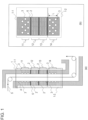
- Fig. 1 illustrates one embodiment of a direct fired furnace (DFF) installed in an annealing facility of a continuous hot-dip galvanizing facility according to an embodiment of the present invention.
- the type of the annealing facility is preferably a vertical furnace.
- this also provides an advantage in that the atmosphere in the heating zone and the atmosphere in the soaking zone can be easily separated. Conveying in a vertical direction means that the sheet is conveyed in a perpendicular direction.
- Fig. 1 (a) is a vertical sectional view of a direct fired furnace, and (b) is a front view of an arrangement example of direct firing burners installed in walls of the direct fired furnace.
- DFF direct fired furnace
- 1-1 denotes an oxidation zone of the DFF
- 1-2 denotes a reduction zone of the DFF
- 2 denotes a flame injection port associated with a slit burner
- 3 denotes a flame injection port associated with a circular burner
- S denotes a steel sheet (including a steel strip)
- 4 denotes a radiation thermometer
- 5 denotes a flame
- 6 denotes an exhaust port
- L denotes the length of a steel sheet S heated region heated by a burner group 14 in the reduction zone from the burner most upstream to the burner most downstream in the steel strip S travelling direction
- 11 denotes a burner group in the oxidation zone
- 12 denotes a burner group in the oxidation zone
- 13 denotes a burner
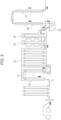
- Fig. 2 illustrates one example of a continuous hot-dip galvanizing facility. From the entry side of the facility, there are provided a preheating zone 20, a heating zone 21, a soaking zone 22, cooling zones 23 and 24, a coating bath (zinc pot) 25, and, if necessary, an alloying zone 26. A cooling zone 27 may be provided after the alloying zone 26.
- the heating furnace of the present application is applied to a part of the continuous hot-dip galvanizing facility, the steel sheet to be heated does not have to be a cut sheet and may have a steel strip (coil) shape.
- the steel sheet is not particularly limited, a cold rolled steel sheet is often used.
- the direct fired furnace 1 of the present invention is assumed as a heating furnace to be introduced in the heating zone 21 in the continuous hot-dip galvanizing facility.
- the direct fired furnace 1 is constituted by the oxidation zone 1-1 and the reduction zone 1-2, and the oxidation zone 1-1 is constituted by three burner groups (zones) 11 to 13 in the steel sheet travelling direction.
- circular burners are installed in the burner group 11 in the oxidation zone, and the flame injection ports thereof are denoted by 3 in the drawings whereas slit burners are installed in the (oxidation zone) burner groups 12 and 13, and the flame injection ports thereof are denoted by 2 in the drawings.
- the reduction zone has only one burner group (reduction zone burner group) 14, and circular burners are installed therein.
- the flame injection ports of the circular burners are denoted by reference sign 3 in the drawings.
- the combustion rate and the air ratio of the burners can be independently controlled for each burner group.
- the burner groups 11 to 13 in the oxidation zone are combusted under the conditions that give a combustion rate equal to or higher than a predetermined threshold.
- each burner group is not limited. It is practical to divide the entire direct fired furnace into two to five groups and to control each as a group.
- the slit burners may be provided not only in the oxidation zone but also in both the oxidation zone 1-1 and the reduction zone 1-2.
- the slit burners are arranged to face the steel sheet surfaces in the width direction of the steel sheet S passing through the oxidation zone 1-1. Moreover, in order to uniformly heat the steel sheet S without variation in the width direction, the slit burners are arranged to extend in the width direction of the steel sheet so that the flames 5 are injected toward the entire width of the steel sheet S. Furthermore, in order to comply with production of steel sheets S with various widths, the flame injection amount can be controlled for each of four regions divided in the width direction. Although the number of divided regions here is 4, the number is not limited to 4, and there may be cases in which no division is necessary depending on the width of the steel sheet and the flame injection structures of the slit burners. Meanwhile, the circular burners are dispersedly arranged to face the steel sheet surfaces.
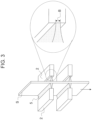
- Fig. 3 is a diagram conceptually illustrating the state of an actual steel sheet being combusted and heated with slit burners of the present invention, and in the description below, the slit burners are described by referring to what is illustrated in the drawing.
- a slit burner refers to a burner having a burner flame injection port having an elongated rectangular shape that has a long opening portion in the width direction of the steel sheet S with respect to the length (also referred to as a slit gap B) of the opening in the steel sheet S travelling direction, and the specific dimensions thereof are not particularly limited.
- the length of the opening portion in the steel sheet S travelling direction that is, the short side
- B the length of the opening portion in the width direction, that is, the long side
- a burner that injects a slit-shaped flame such as a burner having such a thin elongated rectangular flame injection port, is generally referred to as a "slit burner".
- the injection width of the flame 5 can be controlled by dividing the injection port in the width direction, and this can be used to adjust the injection width of the flame 5 according to the width of the subject steel sheet.
- the arrangement intervals of the tandem pattern are not particularly limited; however, creating intervals of about 3B to 10B reduces interference of the flames 5 and the temperature variation.
- the Fe oxide film is generated in the range where the sheet temperature reaches 400°C or higher, it is preferable to use at least one slit burner in this range of the oxidation zone 1-1 where the sheet temperature reaches this range. It is yet more preferable to use slit burners in the range of 450°C or higher. Meanwhile, since the oxidation amount rapidly increases at high temperatures such as a temperature higher than 650°C, slit burners are preferably used in places where the sheet temperature is 650°C or lower. The temperature is preferably 600°C or lower and more preferably 550°C or lower.
- the sheet temperature of the steel sheet S passing through the DFF 1 can be predicted and monitored by performing calculation in advance from the steel type, the sheet thickness, the sheet width, the line speed, the air ratio, the combustion rate, etc.
- the slit burners are preferably used on the downstream side in the sheet passing direction in the oxidation zone 1-1 where the sheet temperature is high. Slit burners may be applied to all of the burners in the oxidation zone 1-1; however, the slit gap B of the slit burner exit is narrower than that of circular burners, and regular maintenance is necessary due to clogging of foreign matter such as fragments of burner tiles and deformation of the slit caused by the high temperature of the flame 5.
- conventional circular burners may be disposed on the upstream side in the oxidation zone 1-1 where the sheet temperature is low and slit burners may be disposed on the downstream side.
- a direct firing heating system in which flames perpendicularly collide with the steel sheet is preferable from the viewpoint of the heating efficiency.
- the arrangement of the flame injection ports 2 associated with the slit burners may be shifted, in other words, may be offset, in the steel sheet S travelling direction between the front and rear surfaces of the steel sheet S. Offset prevents the flames 5 extending beyond the steel sheet S edges from interfering with one another. Thus, it is possible to more uniformly heat the steel sheet S than when offset is not made.
- the offset amount is in the range of about B to 3B. At an excessively large offset amount, the heating temperature may differ between the front surface and the rear surface.
- burners are arranged in the vertical direction, and flames become unstable due to interference of the flames injected from the burners on the downstream side (the furnace lower side) and the combustion gas, thereby degrading the stability and the temperature uniformity in the width and longitudinal directions of the steel sheet.
- the interference of the flames and the combustion gas can be moderated by forming a staggered pattern; however, in the case of slit burners, interference from the downstream side is inevitable since there is no break in the flame in the width direction.
- slit-shaped exhaust ports are preferably provided in the section where the slit burners are installed, and interference of the flames and the combustion gas tends to be mitigated by providing slit-shaped exhaust ports.
- One set of rear and front exhaust ports is preferably installed at least in each connecting portion between the zones.
- the exhaust port is preferably installed under the slit burner, and the combustion exhaust gas is suctioned from the exhaust port.
- combustion exhaust gas refers to high-temperature gas that is generated as a result of the reaction between the fuel and air and that contains, as main components, carbon dioxide, which is a reaction product, and nitrogen contained in water vapor and air as well as trace components such as unreacted excess fuel components, oxygen, and reaction intermediates.
- an exhaust port may be installed between individual slit burners constituting each zone.
- the burner combustion rate is a value obtained by dividing the amount of the fuel gas actually introduced into the burner by the amount of the burner fuel gas at the maximum combustion load, and when the burner is combusted at the maximum combustion load, the combustion rate is 100%.
- the combustion rate of the burner is not particularly limited; however, when the combustion load of the burner is low, a stable combustion state is no longer obtained and thus the combustion rate is preferably equal to or higher than the threshold described below.
- the predetermined threshold of the combustion rate is the ratio of the amount of the fuel gas at the lower limit of the combustion load at which the stable combustion state can be maintained relative to the amount of the fuel gas at the maximum combustion load.
- the threshold of the combustion rate differs depending on the burner structure, etc., and can be easily determined by performing a combustion test, for example. Normally, the threshold is about 30%.
- the air ratio is preferably less than 1.00. More preferably, the air ratio is 0.95 or less and most preferably 0.90 or less.
- the burners arranged to face the surface of the steel sheet S in the oxidation zone 1-1 may be divided into two or more burner groups in the steel sheet S travelling direction so that the combustion rate and the air ratio can be independently controlled.
- the steel sheet S oxidized and reduced in the direct fired furnace 1 is then reduction-annealed in the RT furnace, cooled, and dipped in a hot-dip galvanizing bath to be hot-dip galvanized, and then subjected to an alloying treatment as necessary.
- the process of the reduction annealing and thereafter may be a typical process.
- the coating method is not particularly limited, and electrogalvanizing may be performed instead of the hot-dip galvanizing.
- the hot-dip galvanized steel sheet to be produced by the present invention is effective when large amounts of metal elements, such as Si, more easily oxidizable than Fe are contained. Specifically, it is prominently effective in producing a high-Si-content hot-dip galvanized steel sheet containing 0.1 to 3.0 mass% of Si.
- An annealing furnace (RT furnace), a cooling zone, a hot-dip galvanizing facility, an alloying treatment facility, etc., are placed downstream of the direct fired furnace 1.
- a preheating furnace is sometimes placed upstream of the direct fired furnace 1.
- a test was conducted by using a CGL equipped with a direct fired furnace (DFF) 1 having heating burners organized into four burner groups (11 to 14): three burner groups (11 to 13) disposed on the upstream side in the steel strip S travelling direction and constituting an oxidation zone 1-1 and the last one burner group (14) constituting a reduction zone 1-2. Furthermore, the test was conducted for two cases: (A) the case where the air ratio and the combustion rate were individually controlled for each burner group in the oxidation zone 1-1 and (B) the case where the burner groups 11 to 13 in the oxidation zone were collectively controlled by using the same conditions. Here, the air ratio and the combustion rate in the reduction zone were controlled separately from the oxidation zone.
- Fig. 1 illustrates one example of the burner arrangement.
- the steel chemical composition of the steel strip S used in the test is indicated in Table 2.
- the roll mark defect (pickup) caused by excessive oxidation was evaluated, and, for the coating appearance, quality deviation in the steel sheet travelling direction and width direction and temperature deviation in the steel sheet travelling direction were evaluated.
- the ratings A and B indicate pass, and the rating C indicates fail.
- the coating appearance was evaluated by measuring the variation in the Fe concentration (alloying rate) in the coating in the steel sheet surface after the alloying treatment with respect to the target value.
- the Fe concentration was measured by the same technique as the method disclosed in Patent Literature 8 below, that is, the method of calculating the Fe concentration from the change in the diffraction peak angle of the alloy phase constituting the coating layer by X-ray diffractometry.
- Patent Literature 8 Japanese Patent No. 5962615
- the ratings A and B indicate pass, and the rating C indicates fail.
- a 1000 mm-long sample was taken in the width direction from each of three selected places in the travelling direction, that is, the tip portion, the center portion, and the end portion of the steel strip S, and evaluated for the roll mark and the coating appearance at the width center portion thereof, and the obtained results were used to evaluate the quality in the travelling direction and the width direction.
- a width ⁇ 1000 mm sample was taken from the center portion of the steel strip S, and, in this sample, five points, i.e., the center point in the width direction, the 1/4-width and 3/4-width points, and two end points, were evaluated for the roll mark and the coating appearance. The obtained results were used to evaluate the quality in the width direction.
- ⁇ Only the rating A was given in the evaluation of roll mark and coatability under the same conditions.
- a sample that is evaluated as pass in the present invention is the one that was not rated C for any of the roll mark defect and the coating appearance but was rated ⁇ , ⁇ , and/or ⁇ in both the width direction and the travelling direction.
- a sample that was rated ⁇ or higher in both the width direction and the travelling direction was rated pass ( ⁇ ) and a sample that included the rating ⁇ was rated fail ( ⁇ ).
- Condition Nos. 1 to 8 and 15 were produced under the condition that the line speed of the steel strip S was 60 mpm.
- Condition 2 is the case in which slit burners were used in the burner groups 11 to 13 in contrast to the circular burners in condition 1.
- the combustion state of the burners was unstable as with condition 1, but since the slit burners were used, improvements were made for both the roll mark defect and the coating appearance, and the quality variation slightly improved in both the width direction and the travelling direction.
- Condition 3 is the case in which the air ratio and the combustion rate could be controlled for each of the burner groups in contrast to conditions 1 and 2 in which the burner groups 11 and 13 were collectively controlled. In this manner, only the necessary combustion burners (in this case, only the burner group 13) can be operated. However, since the operated burner group 13 was circular burners in condition 3, combustion variation was likely to occur, and the surface quality tended to be poor compared to condition 1.
- Condition 5 is the case in which slit burners were used under the same control as condition 4 but the air ratio of the burner group 13 decreased to 0.90. In this example, although uniformity was obtained in the width direction and the travelling direction compared to condition 3, many defects appeared and the sample was rated fail.
- Condition 6 is the case in which the air ratio of the burner group 13 was excessive, that is, 1.65, compared to condition 5. The extent of the defects was reduced, and the sample was rated pass.
- Condition 7 is the case in which the air ratio in the reduction zone of the burner group 14 was as high as 1.00 compared to condition 4. In this case also, the uniformity was relatively satisfactory as with condition 5, but many defects appeared and the sample was rated fail.
- Condition 8 is the case in which the air ratio in the reduction zone was low compared to condition 7. The extent of the defects was reduced compared to condition 7, and the sample was rated pass.
- Conditions 9 and 10 were examples in which production was carried out under the condition that the line speed of the steel strip S was 90 mpm, and in both examples, the air ratio and the combustion rate were controlled for each burner group.
- condition 10 only slit burners were used in the oxidation zone, and the surface quality was better than in condition 9.
- Conditions 11 to 13 were examples in which production was carried out under the condition that the line speed of the steel strip S was 120 mpm. In any of these conditions, slit burners were used in the oxidation zone.
- condition 11 burner groups were collectively controlled instead of separately; however, since slit burners were used, the surface quality was rated pass as with condition 2 despite the use of circular burners in some part.
- Condition 12 is an example according to the present invention in which the surface quality was better than that in condition 11 since the control was carried out for each burner group.
- Condition 13 is an example in which slit burners were used not only in the oxidation zone but also in the reduction zone. As a result, the surface quality improved further.
- Condition 14 is an example in which slit burners were used in a horizontal annealing furnace operated as an oxidation zone. Since the furnace was a horizontal furnace, the line speed was decreased compared to the example according to the present invention, and the production was carried out at 30 mpm. Although slit burners were used in the oxidation zone and the excessive oxidation defects and coating appearance were rated pass, the mechanism could not convey the steel sheet in a vertical direction and was not equipped with exhaust ports; thus, minor bare spot and alloying nonuniformity occurred in the width direction and the longitudinal direction since the exhaust gas partly flowed into the upstream non-oxidizing furnace.
- Condition 15 is an example in which the operation was carried out under the same conditions as condition 2 but the exhaust ports installed between the zones were closed (equivalent to the state where no exhaust ports were provided) and the combustion gas was not suctioned. As a result, interference between the flames degraded stability and increased defects compared to condition 2; however, the surface quality was rated pass.
Landscapes
- Chemical & Material Sciences (AREA)
- Engineering & Computer Science (AREA)
- Mechanical Engineering (AREA)
- Organic Chemistry (AREA)
- Materials Engineering (AREA)
- Metallurgy (AREA)
- Physics & Mathematics (AREA)
- Thermal Sciences (AREA)
- Crystallography & Structural Chemistry (AREA)
- Chemical Kinetics & Catalysis (AREA)
- Combustion & Propulsion (AREA)
- General Engineering & Computer Science (AREA)
- Electrochemistry (AREA)
- Heat Treatment Of Strip Materials And Filament Materials (AREA)
- Coating With Molten Metal (AREA)
Applications Claiming Priority (2)
| Application Number | Priority Date | Filing Date | Title |
|---|---|---|---|
| JP2022111549 | 2022-07-12 | ||
| PCT/JP2023/024887 WO2024014372A1 (fr) | 2022-07-12 | 2023-07-05 | Procédé de chauffage d'une plaque d'acier, procédé de production d'une plaque d'acier plaquée, four de chauffage à feu direct, et équipement de galvanisation par immersion à chaud en continu |
Publications (2)
| Publication Number | Publication Date |
|---|---|
| EP4530363A1 true EP4530363A1 (fr) | 2025-04-02 |
| EP4530363A4 EP4530363A4 (fr) | 2025-08-20 |
Family
ID=89536677
Family Applications (1)
| Application Number | Title | Priority Date | Filing Date |
|---|---|---|---|
| EP23839544.6A Pending EP4530363A4 (fr) | 2022-07-12 | 2023-07-05 | Procédé de chauffage d'une plaque d'acier, procédé de production d'une plaque d'acier plaquée, four de chauffage à feu direct, et équipement de galvanisation par immersion à chaud en continu |
Country Status (6)
| Country | Link |
|---|---|
| US (1) | US20250388989A1 (fr) |
| EP (1) | EP4530363A4 (fr) |
| JP (1) | JP7622869B2 (fr) |
| CN (1) | CN119604633A (fr) |
| MX (1) | MX2025000317A (fr) |
| WO (1) | WO2024014372A1 (fr) |
Cited By (1)
| Publication number | Priority date | Publication date | Assignee | Title |
|---|---|---|---|---|
| EP4520843A4 (fr) * | 2022-07-12 | 2025-11-05 | Jfe Steel Corp | Procédé de chauffage d'une plaque d'acier, procédé de fabrication d'une plaque d'acier plaquée, four de chauffage à feu direct, et installation de galvanisation par immersion à chaud en continu |
Family Cites Families (14)
| Publication number | Priority date | Publication date | Assignee | Title |
|---|---|---|---|---|
| JPS6229820A (ja) | 1985-04-26 | 1987-02-07 | Nippon Kokan Kk <Nkk> | 直火還元加熱バ−ナ |
| JPH0257639A (ja) * | 1988-08-22 | 1990-02-27 | Kobe Steel Ltd | 薄鋼板の連続加熱方法 |
| JPH037339A (ja) | 1989-06-02 | 1991-01-14 | Aica Kogyo Co Ltd | 化粧板の製造法 |
| JP2587724B2 (ja) | 1990-11-30 | 1997-03-05 | 新日本製鐵株式会社 | めっき密着性の良好な高Si含有高張力溶融亜鉛めっき鋼板の製造方法 |
| JP3255765B2 (ja) | 1993-07-14 | 2002-02-12 | 川崎製鉄株式会社 | 高張力溶融または合金化溶融亜鉛めっき鋼板の製造方法 |
| JPH0959753A (ja) | 1995-08-24 | 1997-03-04 | Sumitomo Metal Ind Ltd | 合金化溶融亜鉛めっき鋼板の製造方法 |
| JP3907656B2 (ja) * | 2004-12-21 | 2007-04-18 | 株式会社神戸製鋼所 | 溶融亜鉛めっき方法 |
| KR100892815B1 (ko) * | 2004-12-21 | 2009-04-10 | 가부시키가이샤 고베 세이코쇼 | 용융 아연 도금 방법 및 용융 아연 도금 설비 |
| JP3889019B2 (ja) | 2005-03-31 | 2007-03-07 | 株式会社神戸製鋼所 | 溶融亜鉛めっき鋼板の製造方法 |
| JP4718381B2 (ja) | 2006-06-21 | 2011-07-06 | 株式会社神戸製鋼所 | 溶融亜鉛めっき設備 |
| JP2008144264A (ja) | 2006-11-16 | 2008-06-26 | Jfe Steel Kk | 高強度溶融亜鉛めっき鋼板及び高強度合金化溶融亜鉛めっき鋼板の製造方法 |
| JP7111059B2 (ja) | 2019-05-23 | 2022-08-02 | Jfeスチール株式会社 | 還元性雰囲気炉の露点制御方法および還元性雰囲気炉、ならびに冷延鋼板の製造方法および溶融亜鉛めっき鋼板の製造方法 |
| EP4108793B1 (fr) | 2020-02-21 | 2025-06-04 | JFE Steel Corporation | Procédé pour la production de tôle d'acier galvanisée par immersion à chaud à haute résistance |
| JP7243668B2 (ja) | 2020-03-18 | 2023-03-22 | Jfeスチール株式会社 | 冷延鋼板および溶融亜鉛めっき鋼板の製造方法 |
-
2023
- 2023-07-05 JP JP2023555775A patent/JP7622869B2/ja active Active
- 2023-07-05 CN CN202380051708.7A patent/CN119604633A/zh active Pending
- 2023-07-05 US US18/879,379 patent/US20250388989A1/en active Pending
- 2023-07-05 WO PCT/JP2023/024887 patent/WO2024014372A1/fr not_active Ceased
- 2023-07-05 EP EP23839544.6A patent/EP4530363A4/fr active Pending
-
2025
- 2025-01-07 MX MX2025000317A patent/MX2025000317A/es unknown
Cited By (1)
| Publication number | Priority date | Publication date | Assignee | Title |
|---|---|---|---|---|
| EP4520843A4 (fr) * | 2022-07-12 | 2025-11-05 | Jfe Steel Corp | Procédé de chauffage d'une plaque d'acier, procédé de fabrication d'une plaque d'acier plaquée, four de chauffage à feu direct, et installation de galvanisation par immersion à chaud en continu |
Also Published As
| Publication number | Publication date |
|---|---|
| WO2024014372A1 (fr) | 2024-01-18 |
| JPWO2024014372A1 (fr) | 2024-01-18 |
| CN119604633A (zh) | 2025-03-11 |
| EP4530363A4 (fr) | 2025-08-20 |
| MX2025000317A (es) | 2025-02-10 |
| US20250388989A1 (en) | 2025-12-25 |
| JP7622869B2 (ja) | 2025-01-28 |
Similar Documents
| Publication | Publication Date | Title |
|---|---|---|
| EP4108793B1 (fr) | Procédé pour la production de tôle d'acier galvanisée par immersion à chaud à haute résistance | |
| EP1829983B1 (fr) | Procédé et installation pour zingage par trempage à chaud | |
| EP1936000B1 (fr) | Procédé et appareil de recuit et trempage à chaud en continu pour tôles en acier contenant du silicium | |
| JP6455544B2 (ja) | 溶融亜鉛めっき鋼板の製造方法 | |
| JP6607339B1 (ja) | 溶融亜鉛めっき鋼板の製造方法及び連続溶融亜鉛めっき装置 | |
| JP6131919B2 (ja) | 合金化溶融亜鉛めっき鋼板の製造方法 | |
| JP2010202959A (ja) | 連続溶融亜鉛めっき装置および溶融亜鉛めっき鋼板の製造方法 | |
| EP3369836B1 (fr) | Procédé de fabrication de tôle d'acier galvanisée par trempage à chaud | |
| JP7111059B2 (ja) | 還元性雰囲気炉の露点制御方法および還元性雰囲気炉、ならびに冷延鋼板の製造方法および溶融亜鉛めっき鋼板の製造方法 | |
| US20250388989A1 (en) | Method for heating steel sheet, method for producing coated steel sheet, direct fired furnace, and continuous hot-dip galvanizing facility | |
| JP7243668B2 (ja) | 冷延鋼板および溶融亜鉛めっき鋼板の製造方法 | |
| JP6740973B2 (ja) | 溶融亜鉛めっき鋼板の製造方法 | |
| EP4310207A1 (fr) | Procédé de régulation de point de rosée d'un four de recuit continu, procédé de recuit continu pour tôles d'acier, procédé de production de tôle d'acier, four de recuit continu, installation de galvanisation par immersion à chaud continue et installation de galvanisation par immersion à chaud alliée | |
| CN101057004B (zh) | 熔融镀锌方法 | |
| EP4520843A1 (fr) | Procédé de chauffage d'une plaque d'acier, procédé de fabrication d'une plaque d'acier plaquée, four de chauffage à feu direct, et installation de galvanisation par immersion à chaud en continu | |
| JP3889019B2 (ja) | 溶融亜鉛めっき鋼板の製造方法 | |
| CN117616146A (zh) | 热镀锌钢板的制造方法 | |
| JP6696495B2 (ja) | 溶融亜鉛めっき鋼板の製造方法 | |
| JP5729008B2 (ja) | 溶融亜鉛めっき鋼板の製造方法 | |
| CN117604425A (zh) | 一种热轧薄板坯无头轧制原料生产超厚锌层产品工艺 | |
| JPH06212385A (ja) | 高Si含有高張力溶融亜鉛めっき鋼板および合金化溶融亜鉛めっき鋼板の製造方法 |
Legal Events
| Date | Code | Title | Description |
|---|---|---|---|
| STAA | Information on the status of an ep patent application or granted ep patent |
Free format text: STATUS: THE INTERNATIONAL PUBLICATION HAS BEEN MADE |
|
| PUAI | Public reference made under article 153(3) epc to a published international application that has entered the european phase |
Free format text: ORIGINAL CODE: 0009012 |
|
| STAA | Information on the status of an ep patent application or granted ep patent |
Free format text: STATUS: REQUEST FOR EXAMINATION WAS MADE |
|
| 17P | Request for examination filed |
Effective date: 20241206 |
|
| AK | Designated contracting states |
Kind code of ref document: A1 Designated state(s): AL AT BE BG CH CY CZ DE DK EE ES FI FR GB GR HR HU IE IS IT LI LT LU LV MC ME MK MT NL NO PL PT RO RS SE SI SK SM TR |
|
| A4 | Supplementary search report drawn up and despatched |
Effective date: 20250718 |
|
| RIC1 | Information provided on ipc code assigned before grant |
Ipc: C21D 9/46 20060101AFI20250718BHEP Ipc: C21D 9/56 20060101ALI20250718BHEP Ipc: C25D 5/36 20060101ALI20250718BHEP Ipc: C22C 38/00 20060101ALI20250718BHEP Ipc: C22C 38/12 20060101ALI20250718BHEP Ipc: C22C 38/26 20060101ALI20250718BHEP Ipc: C23C 2/02 20060101ALI20250718BHEP Ipc: C23C 2/06 20060101ALI20250718BHEP Ipc: C23C 2/28 20060101ALI20250718BHEP Ipc: C23C 2/40 20060101ALI20250718BHEP Ipc: F23N 5/00 20060101ALI20250718BHEP Ipc: C21D 1/52 20060101ALI20250718BHEP Ipc: C21D 1/74 20060101ALI20250718BHEP Ipc: C21D 8/02 20060101ALI20250718BHEP Ipc: C22C 38/04 20060101ALI20250718BHEP Ipc: C23C 2/00 20060101ALI20250718BHEP Ipc: F23D 99/00 20100101ALI20250718BHEP Ipc: F23N 3/00 20060101ALI20250718BHEP Ipc: C21D 11/00 20060101ALI20250718BHEP Ipc: C21D 9/00 20060101ALI20250718BHEP Ipc: C22C 38/02 20060101ALI20250718BHEP |
|
| DAV | Request for validation of the european patent (deleted) | ||
| DAX | Request for extension of the european patent (deleted) |