EP4531021A1 - Procédés et systèmes pour fournir des temps d'arrivée estimés conditionnels - Google Patents
Procédés et systèmes pour fournir des temps d'arrivée estimés conditionnels Download PDFInfo
- Publication number
- EP4531021A1 EP4531021A1 EP24197825.3A EP24197825A EP4531021A1 EP 4531021 A1 EP4531021 A1 EP 4531021A1 EP 24197825 A EP24197825 A EP 24197825A EP 4531021 A1 EP4531021 A1 EP 4531021A1
- Authority
- EP
- European Patent Office
- Prior art keywords
- aircraft
- route
- sequencing
- lateral trajectory
- merge point
- Prior art date
- Legal status (The legal status is an assumption and is not a legal conclusion. Google has not performed a legal analysis and makes no representation as to the accuracy of the status listed.)
- Pending
Links
Images

Classifications
-
- G—PHYSICS
- G08—SIGNALLING
- G08G—TRAFFIC CONTROL SYSTEMS
- G08G5/00—Traffic control systems for aircraft
- G08G5/20—Arrangements for acquiring, generating, sharing or displaying traffic information
- G08G5/21—Arrangements for acquiring, generating, sharing or displaying traffic information located onboard the aircraft
-
- G—PHYSICS
- G08—SIGNALLING
- G08G—TRAFFIC CONTROL SYSTEMS
- G08G5/00—Traffic control systems for aircraft
- G08G5/20—Arrangements for acquiring, generating, sharing or displaying traffic information
- G08G5/22—Arrangements for acquiring, generating, sharing or displaying traffic information located on the ground
-
- G—PHYSICS
- G08—SIGNALLING
- G08G—TRAFFIC CONTROL SYSTEMS
- G08G5/00—Traffic control systems for aircraft
- G08G5/20—Arrangements for acquiring, generating, sharing or displaying traffic information
- G08G5/26—Transmission of traffic-related information between aircraft and ground stations
-
- G—PHYSICS
- G08—SIGNALLING
- G08G—TRAFFIC CONTROL SYSTEMS
- G08G5/00—Traffic control systems for aircraft
- G08G5/20—Arrangements for acquiring, generating, sharing or displaying traffic information
- G08G5/26—Transmission of traffic-related information between aircraft and ground stations
- G08G5/265—Transmission of traffic-related information between aircraft and ground stations for managing air traffic control [ATC] clearance
-
- G—PHYSICS
- G08—SIGNALLING
- G08G—TRAFFIC CONTROL SYSTEMS
- G08G5/00—Traffic control systems for aircraft
- G08G5/30—Flight plan management
- G08G5/34—Flight plan management for flight plan modification
-
- G—PHYSICS
- G08—SIGNALLING
- G08G—TRAFFIC CONTROL SYSTEMS
- G08G5/00—Traffic control systems for aircraft
- G08G5/50—Navigation or guidance aids
- G08G5/54—Navigation or guidance aids for approach or landing
-
- G—PHYSICS
- G08—SIGNALLING
- G08G—TRAFFIC CONTROL SYSTEMS
- G08G5/00—Traffic control systems for aircraft
- G08G5/70—Arrangements for monitoring traffic-related situations or conditions
- G08G5/72—Arrangements for monitoring traffic-related situations or conditions for monitoring traffic
- G08G5/727—Arrangements for monitoring traffic-related situations or conditions for monitoring traffic from a ground station
Definitions
- the subject matter described herein relates generally to vehicle systems, and more particularly, embodiments of the subject matter relate to aircraft systems and related displays for providing conditional estimated arrival times for alternative trajectories.
- Aircraft are typically operated in accordance with predefined routes or procedures, particularly in the vicinity of an airport or within other congested airspaces.
- Air traffic control is typically responsible for managing traffic flow using these predefined routes or procedures and instructing aircraft to deviate from a particular route or procedure to achieve desired separation distances, aircraft sequencing, resolve potential conflicts between aircraft, and/or the like.
- the ATC may instruct an aircraft to execute a holding procedure or otherwise fly a holding pattern to delay a particular aircraft.
- radar vectoring may be utilized by ATC for separation, safety, or other reasons.
- point merge procedures Due to the increased ATC workload associated with radar vectoring and the undesirable fuel burn associated with holding, point merge procedures have been developed that include navigational legs that inbound aircraft fly prior to receiving a clearance from ATC to achieve the desired sequencing without reliance on radar vectoring or holding patterns.
- both pilots and ATC may lack situational awareness with respect to the potential options or ranges of times for arrival while flying (or prior to flying) a sequencing leg of a point merge procedure. Accordingly, it is desirable to improve situational awareness and reduce workload for ATC and pilots in connection with executing a point merge procedure.
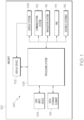
- a system includes a monitoring computing system associated with an air traffic controller (ATC) external to an aircraft, a flight management system (FMS) to maintain a flight plan that includes a sequencing route between arrival and a merge point, and a processing system coupled to the FMS to provide a projected profile broadcasting service that is configurable to identify a first geographic location associated with the merge point for an approach to an airport associated with the flight plan for the aircraft, determine an alternative lateral trajectory for the aircraft from a second geographic location along the sequencing route to the merge point, determine a conditional estimated arrival time for the aircraft at the merge point based at least in part on the alternative lateral trajectory, and transmit a message including the conditional estimated arrival time for the aircraft to the monitoring computing system over a network.
- ATC air traffic controller
- FMS flight management system
- a processing system coupled to the FMS to provide a projected profile broadcasting service that is configurable to identify a first geographic location associated with the merge point for an approach to an airport associated with the flight plan for the aircraft, determine an alternative lateral trajectory for the aircraft from
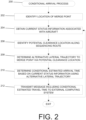
- the projected profile broadcasting service calculates or otherwise determines an estimated amount of time required for the aircraft 120 to travel along the alternative lateral trajectory and corresponding vertical trajectory to arrive at the merge point in a manner that satisfies any applicable altitude, speed, or other constraints associated with the merge point.
- the conditional arrival process 200 transmits or otherwise provides a message including the conditional ETA to an external computing system (task 212).
- the projected profile broadcasting service appends or otherwise incorporates the conditional estimated arrival time to an ADS-C EPP broadcast message that includes a route prediction and corresponding future trajectory information determined by the FMS 114, including, for example, planned, predicted or otherwise anticipated horizontal and/or vertical speeds, altitudes, aircraft weight, fuel remaining, and/or the like for future waypoints along the planned route corresponding to the current flight plan. That said, in other implementations, the projected profile broadcasting service may generate a separate standalone broadcast message that includes the conditional estimated arrival time.
- FIG. 3 depicts an exemplary navigational map 300 suitable for presentation on a navigational map graphical user interface (GUI) display on a display device at an external computing system or onboard an aircraft (e.g., display device 102) to provide graphical indicia of a potential alternative lateral trajectory en route to a merge point 330 associated with a point merge procedure associated with an airport 304.
- GUI navigational map graphical user interface
- the planned lateral trajectory of the aircraft 302 depicted on the navigational map 300 includes a remaining portion of an arrival route segment 306 (or phase) that terminates at a waypoint 310 that functions as the initial waypoint of the sequencing route 308 defined for arriving aircraft approaching the destination airport 304 from the south.
- the sequencing route 308 begins at the initial waypoint 310 and traverses a sequence of waypoints 312, 314, 316, 318, 320 that define a substantially arcuate lateral trajectory before proceeding to the merge point 330, which may be realized as the initial approach fix for an approach procedure that defines the vertical and/or lateral trajectory to be flown from the merge point 330 on approach to the desired or planned runway for landing at the destination airport 304.
- the projected profile broadcasting service at the aircraft 120 analyzes the current flight plan to identify the geographic location of the merge point 330 along with the waypoints 310, 312, 314, 316, 318, 320 defining the sequencing route 308 of the point merge procedure associated with the current flight plan.
- the projected profile broadcasting service Prior to the ownship aircraft 120 traversing or reaching the initial waypoint 310 of the point merge procedure, the projected profile broadcasting service identifies the initial waypoint 310 of the point merge procedure as the next waypoint down path of the current aircraft location that is capable of functioning as a potential clearance location along the sequencing route 308 and constructs an alternative lateral trajectory 332 from the initial potential clearance waypoint 310 direct to the merge point 330 after completion of the arrival route segment 306.
- the projected profile broadcasting service utilizes the current geographic location of the aircraft 120, the current heading of the aircraft 120, the current speed of the aircraft 120, the current altitude of the aircraft 120, and potentially other current state information of the aircraft 120 to calculate or otherwise determine a first estimated amount of travel time required for the aircraft 120 to traverse the remaining portion of the arrival route segment 306 and arrive at the potential clearance waypoint 310, and then calculates or otherwise determines a second estimated amount of travel time required for the aircraft 120 to traverse the alternative lateral trajectory 332 and reach the merge point 330 from the potential clearance waypoint 310 based on the planned or anticipated speed, altitude, heading and/or other anticipated status information for the aircraft 120 upon reaching the potential clearance waypoint 310.
- the first and second estimated amounts of travel time are added to the current time to arrive at a conditional ETA for the aircraft 120 assuming a direct to clearance were issued by the ATC at or before the aircraft 120 traversing the next potential clearance waypoint 312.
- conditional ETA may be included in an EPP broadcast message transmitted by the aircraft 120 to an external computing system associated with the ATC to provide information identifying the conditional ETA for an earlier "direct to" clearance in addition to the down path route predictions for the planned trajectory traversing the entirety of the sequencing route 308 prior to proceeding direct to the merge point 330 (e.g., planned arrival times for each of the sequencing route waypoints 312, 314, 316, 318, 320).
- a graphical representation of the potential alternative lateral trajectory 332 and its associated conditional ETA may be rendered or otherwise provided on the navigational map 300 depicted on a navigational map GLTI display on the display device 102 onboard the aircraft 120 to provide the pilot with situational awareness of the potential alternative lateral trajectory 332 and corresponding ETA concurrently to providing a graphical representation of the flight plan 340 that traverses the entirety of the sequencing route 308 and the planned ETA for the merge point 330 in the absence of an early "direct to" clearance.
- both the ATC and the pilot may be apprised of the potential range of ETAs for the aircraft 120 to facilitate negotiation of an earlier clearance or otherwise assist the ATC in sequencing different aircraft en route to the common destination airport 304.
- the projected profile broadcasting service After traversing the initial potential early clearance waypoint 310, the projected profile broadcasting service identifies the next down path waypoint 312 of the sequencing route 308 as the updated potential early clearance location and constructs an updated alternative lateral trajectory 334 from the updated potential clearance waypoint 312 direct to the merge point 330 based on the current location of the aircraft 120 along the sequencing leg defined by the respective waypoint 312.
- the projected profile broadcasting service utilizes the current geographic location and other current state information for the aircraft 120 to calculate or otherwise determine a first estimated amount of travel time required for the aircraft 120 to traverse the remaining portion of the sequencing leg defined by the initial pair of waypoints 310, 312 and a second estimated amount of travel time required for the aircraft 120 to turn and proceed direct to the merge point 330 along the constructed alternative lateral trajectory 334.
- the next EPP message broadcast by the projected profile broadcasting service may include the updated conditional ETA associated with the updated alternative lateral trajectory 334 to update and maintain situational awareness for the ATC and the pilot with respect to the current range of potential ETAs for the aircraft 120 substantially in real-time as the aircraft 120 travels along the sequencing route 308.
- the projected profile broadcasting service dynamically determines updated alternative lateral trajectories 336, 338 and dynamically updates the conditional ETAs that are transmitted or otherwise broadcast to external computing systems to reflect the current geographic location of the aircraft 120 substantially in real-time.
- the ATC may be continually apprised of the range of potential options or times for when a particular aircraft 120 may be sequenced to arrive at the merge point 330.
- the pilot, co-pilot or other operator of the aircraft 120 may utilize the graphical indicia of the conditional ETA, the next potential clearance location and/or the alternative lateral trajectory to initiate communications with ATC to attempt to negotiate a short arrival or early clearance to the merge point 330.
- a pilot or other operator of an aircraft 120 generally prefers to avoid flying the entirety of the sequencing route 308 to achieve an earlier arrival and reduced fuel consumption.
- the ATC may better determine whether flying the entirety of the sequencing route 308 (or the entirety of the EPP) is necessary or desirable for purposes of managing separation and otherwise sequencing aircraft en route to the merge point 330.
- the ATC may transmit or otherwise provide a corresponding "direct to" clearance instruction to the aircraft 120 that identifies the aircraft 120 should proceed direct en route to the merge point 330.
- the pilot or other operator of the aircraft 120 may update the flight plan or otherwise configure the FMS 114 to include the alternative lateral trajectory in the current flight in lieu of the remaining portion of the sequencing route 308, for example, by automatically removing one or more down path waypoints 312, 314, 316, 318, 320 of the sequencing route 308 from the flight plan. Thereafter, the FMS 114 may automatically operate the aircraft 120 to autonomously fly the alternative lateral trajectory direct to the merge point 330 rather than continuing along the sequencing route 308.
- exemplary means “serving as an example, instance, or illustration.” Thus, any embodiment described herein as “exemplary” is not necessarily to be construed as preferred or advantageous over other embodiments. All of the embodiments described herein are exemplary embodiments provided to enable persons skilled in the art to make or use the invention and not to limit the scope of the invention which is defined by the claims.
- Skilled artisans may implement the described functionality in varying ways for each particular application, but such implementation decisions should not be interpreted as causing a departure from the scope of the present invention.
- an embodiment of a system or a component may employ various integrated circuit components, e.g., memory elements, digital signal processing elements, logic elements, look-up tables, or the like, which may carry out a variety of functions under the control of one or more microprocessors or other control devices.
- integrated circuit components e.g., memory elements, digital signal processing elements, logic elements, look-up tables, or the like, which may carry out a variety of functions under the control of one or more microprocessors or other control devices.
- DSP digital signal processor
- ASIC application specific integrated circuit
- FPGA field programmable gate array
- a general-purpose processor may be a microprocessor, but in the alternative, the processor may be any conventional processor, controller, microcontroller, or state machine.
- a processor may also be implemented as a combination of computing devices, e.g., a combination of a DSP and a microprocessor, a plurality of microprocessors, one or more microprocessors in conjunction with a DSP core, or any other such configuration.
- a software module may reside in RAM memory, flash memory, ROM memory, EPROM memory, EEPROM memory, registers, hard disk, a removable disk, a CD-ROM, or any other form of non-transitory storage medium known in the art.
- An exemplary storage medium is coupled to the processor such that the processor can read information from, and write information to, the storage medium.
- the storage medium may be integral to the processor.
- the processor and the storage medium may reside in an ASIC.
- the computer data signal may include any signal that can propagate over a transmission medium such as electronic network channels, optical fibers, air, electromagnetic paths, or RF links.
- the code segments may be downloaded via computer networks such as the Internet, an intranet, a LAN, or the like.
- modules Some of the functional units described in this specification have been referred to as "modules" in order to more particularly emphasize their implementation independence.
- functionality referred to herein as a module may be implemented wholly, or partially, as a hardware circuit comprising custom VLSI circuits or gate arrays, off-the-shelf semiconductors such as logic chips, transistors, or other discrete components.
- a module may also be implemented in programmable hardware devices such as field programmable gate arrays, programmable array logic, programmable logic devices, or the like. Modules may also be implemented in software for execution by various types of processors.
- An identified module of executable code may, for instance, comprise one or more physical or logical modules of computer instructions that may, for instance, be organized as an object, procedure, or function.
- the executables of an identified module need not be physically located together, but may comprise disparate instructions stored in different locations that, when joined logically together, comprise the module and achieve the stated purpose for the module.
- a module of executable code may be a single instruction, or many instructions, and may even be distributed over several different code segments, among different programs, and across several memory devices.
- operational data may be embodied in any suitable form and organized within any suitable type of data structure. The operational data may be collected as a single data set, or may be distributed over different locations including over different storage devices, and may exist, at least partially, merely as electronic signals on a system or network.
- Coupled means that one element/node/feature is directly or indirectly joined to (or directly or indirectly communicates with) another element/node/feature, and not necessarily mechanically.
- two elements may be coupled to each other physically, electronically, logically, or in any other manner, through one or more additional elements.
- drawings may depict one exemplary arrangement of elements directly connected to one another, additional intervening elements, devices, features, or components may be present in an embodiment of the depicted subject matter.
- certain terminology may also be used herein for the purpose of reference only, and thus are not intended to be limiting.
Landscapes
- Engineering & Computer Science (AREA)
- Aviation & Aerospace Engineering (AREA)
- Physics & Mathematics (AREA)
- General Physics & Mathematics (AREA)
- Traffic Control Systems (AREA)
Applications Claiming Priority (2)
| Application Number | Priority Date | Filing Date | Title |
|---|---|---|---|
| IN202311064533 | 2023-09-26 | ||
| US18/509,645 US12609036B2 (en) | 2023-09-26 | 2023-11-15 | Methods and systems for providing conditional estimated arrival times |
Publications (1)
| Publication Number | Publication Date |
|---|---|
| EP4531021A1 true EP4531021A1 (fr) | 2025-04-02 |
Family
ID=92633957
Family Applications (1)
| Application Number | Title | Priority Date | Filing Date |
|---|---|---|---|
| EP24197825.3A Pending EP4531021A1 (fr) | 2023-09-26 | 2024-09-02 | Procédés et systèmes pour fournir des temps d'arrivée estimés conditionnels |
Country Status (1)
| Country | Link |
|---|---|
| EP (1) | EP4531021A1 (fr) |
Citations (1)
| Publication number | Priority date | Publication date | Assignee | Title |
|---|---|---|---|---|
| US9355566B2 (en) * | 2013-09-13 | 2016-05-31 | The Boeing Company | Systems and methods for controlling aircraft arrivals at a waypoint |
-
2024
- 2024-09-02 EP EP24197825.3A patent/EP4531021A1/fr active Pending
Patent Citations (1)
| Publication number | Priority date | Publication date | Assignee | Title |
|---|---|---|---|---|
| US9355566B2 (en) * | 2013-09-13 | 2016-05-31 | The Boeing Company | Systems and methods for controlling aircraft arrivals at a waypoint |
Similar Documents
| Publication | Publication Date | Title |
|---|---|---|
| US11270593B2 (en) | Advisory method and system for flight trajectory optimization | |
| EP3048424B1 (fr) | Procédés et systèmes pour affichage d'informations de prévisions météorologiques sur la base d'un itinéraire | |
| US11688291B2 (en) | Cockpit display systems and methods for displaying taxiing route on airport moving map | |
| CN105280025B (zh) | 用于提供供机场离场和到达程序使用的飞行器显示的飞行器显示系统和方法 | |
| US8280618B2 (en) | Methods and systems for inputting taxi instructions | |
| US12431025B2 (en) | Contextual transcription augmentation methods and systems | |
| US20220388674A1 (en) | Methods and systems for alerting dynamic changes in flight rules | |
| KR102467524B1 (ko) | 항적데이터를 이용한 비행 계획 추정방법 | |
| EP3926607A1 (fr) | Procédés, systèmes et appareils permettant d'identifier et d'indiquer les procédures d'approche au point de visée de piste secondaire (srap) | |
| US11749127B2 (en) | System and method to provide progressive taxi instructions and alerts on cockpit display | |
| EP3862999B1 (fr) | Détermination de piste basée sur une arrivée reçue à partir d'un système de contrôle de trafic | |
| US12609036B2 (en) | Methods and systems for providing conditional estimated arrival times | |
| EP4531021A1 (fr) | Procédés et systèmes pour fournir des temps d'arrivée estimés conditionnels | |
| EP4099301B1 (fr) | Procédés et systèmes pour alerter des changements dynamiques dans des règles de vol | |
| US12197715B2 (en) | Methods and systems for automated contextual navigation of GUI displays | |
| US10565886B2 (en) | Systems and methods for predicting loss of separation events | |
| EP4145421B1 (fr) | Systèmes et procédés de transcription et d'analyse de messages diffusés dans un aéronef | |
| EP3961602B1 (fr) | Système et procédé pour fournir des instructions et alertes progressives sur un affichage de poste de pilotage | |
| US20260120582A1 (en) | Methods and systems for aerial vehicle passing assistance | |
| EP4679403A1 (fr) | Procédés de séquençage de plan de vol pour des autorisations directes | |
| EP4737860A1 (fr) | Procédés et systèmes d'aide au passage de véhicules | |
| EP4660586A1 (fr) | Système et procédé de génération d'une trajectoire verticale conforme aux contraintes d'altitude pour une jambe manuelle d'un plan de vol | |
| US20250378760A1 (en) | System and method of generating an altitude constraint-compliant vertical trajectory for a manual leg of a flight plan | |
| EP4657198A1 (fr) | Procédés et systèmes de récupération de zone autonome | |
| EP4455854B1 (fr) | Procédés et systèmes de navigation contextuelle automatisée d'affichages gui |
Legal Events
| Date | Code | Title | Description |
|---|---|---|---|
| PUAI | Public reference made under article 153(3) epc to a published international application that has entered the european phase |
Free format text: ORIGINAL CODE: 0009012 |
|
| STAA | Information on the status of an ep patent application or granted ep patent |
Free format text: STATUS: THE APPLICATION HAS BEEN PUBLISHED |
|
| AK | Designated contracting states |
Kind code of ref document: A1 Designated state(s): AL AT BE BG CH CY CZ DE DK EE ES FI FR GB GR HR HU IE IS IT LI LT LU LV MC ME MK MT NL NO PL PT RO RS SE SI SK SM TR |
|
| P01 | Opt-out of the competence of the unified patent court (upc) registered |
Free format text: CASE NUMBER: APP_31464/2025 Effective date: 20250630 |
|
| STAA | Information on the status of an ep patent application or granted ep patent |
Free format text: STATUS: REQUEST FOR EXAMINATION WAS MADE |
|
| 17P | Request for examination filed |
Effective date: 20250925 |
|
| GRAP | Despatch of communication of intention to grant a patent |
Free format text: ORIGINAL CODE: EPIDOSNIGR1 |
|
| RIC1 | Information provided on ipc code assigned before grant |
Ipc: G08G 5/21 20250101AFI20251209BHEP Ipc: G08G 5/22 20250101ALI20251209BHEP Ipc: G08G 5/26 20250101ALI20251209BHEP Ipc: G08G 5/265 20250101ALI20251209BHEP Ipc: G08G 5/34 20250101ALI20251209BHEP Ipc: G08G 5/54 20250101ALI20251209BHEP Ipc: G08G 5/72 20250101ALI20251209BHEP |
|
| STAA | Information on the status of an ep patent application or granted ep patent |
Free format text: STATUS: GRANT OF PATENT IS INTENDED |
|
| INTG | Intention to grant announced |
Effective date: 20260114 |
|
| GRAS | Grant fee paid |
Free format text: ORIGINAL CODE: EPIDOSNIGR3 |
|
| GRAA | (expected) grant |
Free format text: ORIGINAL CODE: 0009210 |
|
| STAA | Information on the status of an ep patent application or granted ep patent |
Free format text: STATUS: THE PATENT HAS BEEN GRANTED |