EP4549657A2 - Procédé de construction d'un bunker de golf et bunker de golf réalisé a partir de ce procédé - Google Patents
Procédé de construction d'un bunker de golf et bunker de golf réalisé a partir de ce procédé Download PDFInfo
- Publication number
- EP4549657A2 EP4549657A2 EP24207329.4A EP24207329A EP4549657A2 EP 4549657 A2 EP4549657 A2 EP 4549657A2 EP 24207329 A EP24207329 A EP 24207329A EP 4549657 A2 EP4549657 A2 EP 4549657A2
- Authority
- EP
- European Patent Office
- Prior art keywords
- particles
- predetermined amount
- underlying layer
- golf course
- bunker
- Prior art date
- Legal status (The legal status is an assumption and is not a legal conclusion. Google has not performed a legal analysis and makes no representation as to the accuracy of the status listed.)
- Pending
Links
Images





Classifications
-
- E—FIXED CONSTRUCTIONS
- E01—CONSTRUCTION OF ROADS, RAILWAYS, OR BRIDGES
- E01C—CONSTRUCTION OF, OR SURFACES FOR, ROADS, SPORTS GROUNDS, OR THE LIKE; MACHINES OR AUXILIARY TOOLS FOR CONSTRUCTION OR REPAIR
- E01C13/00—Pavings or foundations specially adapted for playgrounds or sports grounds; Drainage, irrigation or heating of sports grounds
- E01C13/02—Foundations, e.g. with drainage or heating arrangements
-
- A—HUMAN NECESSITIES
- A63—SPORTS; GAMES; AMUSEMENTS
- A63C—SKATES; SKIS; ROLLER SKATES; DESIGN OR LAYOUT OF COURTS, RINKS OR THE LIKE
- A63C19/00—Design or layout of playing courts, rinks, bowling greens or areas for water-skiing; Covers therefor
- A63C19/003—Golf courses
-
- A—HUMAN NECESSITIES
- A63—SPORTS; GAMES; AMUSEMENTS
- A63B—APPARATUS FOR PHYSICAL TRAINING, GYMNASTICS, SWIMMING, CLIMBING, OR FENCING; BALL GAMES; TRAINING EQUIPMENT
- A63B69/00—Training appliances or apparatus for special sports
- A63B69/36—Training appliances or apparatus for special sports for golf
- A63B69/3691—Golf practising terrains
Definitions
- the present invention relates to the golf courses field and in particular it relates to a method for the construction of a golf course "bunker”.
- the invention also relates to a golf course bunker obtained by the aforementioned method.
- the bunkers are obstacles provided in a golf course which can have a size, a shape and can be present in a number which differs from course to course. Normally, the bunkers can have a surface which goes from about 25 m 2 to a size of several hundred square metres. A single golf hole can have no bunker, or can have more than 20 bunkers.
- a bunker forms a depression more or less accentuated with respect to the neighbouring land and is usually provided with a covering layer of sand.
- the bunker can have a covering layer of different type, for example a layer of gravel, or another inert material, or can be provided with a covering layer of grass.
- the bunkers are placed along the golf path, on the courses, and near the green, and mainly have the aim of increasing the difficulty of the game for the golfers, because when the ball falls within this obstacle is more difficult to, and is necessary to use special golf clubs and to hit the ball with a technique which is not always easy to perform.
- the golf rules provide that a ball fallen into a bunker must be played within the bunker same, because this is an integral part of the course. For this reason, it is of fundamental importance that they are kept in perfect efficiency. Therefore, it is fundamental that the edges of the bunker are always well defined, that there the drainage is always fully functional and that the sand, or the gravel, is always raked and cleaned, in order to guarantee that the same is free of weeds and waste of different type such as stones, mud and other material which could compromise the stroke of the golfer or the correct functioning of the bunker same, for example due to an obstruction, or compromising the drainage capacity. It is not a coincidence that the correct maintenance of these particular surfaces is among the most difficult to carry out.
- the research is oriented to identify systems which allow to rationalise the management of the same.
- an underlying layer is present in a determined material.
- a layer of cement normally a drainage cement.
- the cement in addition to have a high hardness, has also a structural limit which makes it necessary to construct underlying layers with thickness greater than 50 mm or even more.
- a drawback of the prior art bunkers is that many golfers, in the attempt to bring the ball out from the bunker, can hit the underlying layer or a big stone, or the layer of cement, or simply a compact layer of soil, especially in the case of covering layer with a small thickness, and to suffer a backlash which, in addition to damaging the head of the golf club, can also cause trauma to the player's wrist.
- the bunker can widen and the sand, or another material which forms the covering layer, can be dragged away and is, therefore, necessary to restore the same with new material, with great waste of time, energies and money.
- a further drawback of the golf course bunkers of prior art with an underlying layer of cement is the difficulty of dismantling the same, for example, if the Company managing the plant wishes to change the path by modifying one or more holes.
- an object of the present invention to provide a method for the construction of golf course bunkers that is able to overcome the aforementioned drawbacks of the prior art bunkers.
- the particular technical solution adopted by the present invention to provide the aforementioned underlying layer of a golf course bunker allows to obtain a product with a high elasticity and, therefore, able to easily adapt itself to the conformation of the ground which forms the basis of the bunker.
- the ratio R by weight between said predetermined amount of said particles of mineral material and said predetermined amount of said elastomeric material is comprised between 10:1 and 2:1, advantageously between 8:1 and 4:1.
- the aforementioned particles of elastomeric material can have a first predetermined size d1. More in particular, the aforementioned first predetermined size d1 can be comprised between 1 mm and 12 mm, advantageously between 2 mm and 12 mm, preferably between 2 mm and 8 mm.
- the aforementioned particles of loose material can comprise, furthermore, a predetermined amount of particles of inert material.
- the aforementioned mineral material can comprise fragments, or particles of rock, or gravel.
- the aforementioned particles of the aforementioned mineral material can have a second predetermined size d2.
- the aforementioned second predetermined size of the particles of mineral material can be comprised between 1 mm and 12 mm, advantageously between 2 mm and 12 mm, preferably between 2 mm and 8 mm, for example comprised between 3 mm and 6 mm.
- the aforementioned mineral material can be rock, preferably calcareous rock, or a similar material, obtained by crushing, in such a way to increase the draining action exerted by the same towards irrigation and rain water.
- the aforementioned determined height H of the underlying layer can be comprised between 15 mm and 45 mm, advantageously comprised between 20 mm and 40 mm, preferably comprised between 20 mm and 30 mm, for example comprised between 24 mm and 30 mm.
- the ratio by weight between the predetermined amount of the particles of inert material and the predetermined amount of the particles of elastomeric material can be 5:1, or 4:1.
- the aforementioned elastomeric material can be selected among:
- the aforementioned binder can be a polyurethane resin, or a vinyl resin, or an acrylic resin, or an epoxy resin, or a combination thereof.
- the aforementioned resin for example the aforementioned polyurethane resin, can be a resin with elastic properties.
- a preliminary step can be provided for arranging a tarpaulin or a mat at the aforementioned predetermined area of the golf course delimited by a perimetral edge.
- the underlying layer is positioned above the aforementioned tarpaulin.
- the aforementioned tarpaulin can be made of an impermeable material, in such a way to help the rain and/or irrigation water to flow towards the drainage channels once that this has gone beyond the underlying layer of the bunker.
- the aforementioned tarpaulin can be made of a plastic material, for example polyethylene, preferably low density polyethylene, or LDPE.
- a step can be, furthermore, provided for grassing said perimetral edge.
- a golf course bunkers comprises:
- the ratio by weight R between the predetermined amount of said particles of mineral material and said predetermined amount of said elastomeric material can be comprised between 10:1 and 2:1, advantageously between 8:1 and 2:1, preferably between 8:1 and 3:1, for example between 8:1 and 4:1.
- the aforementioned covering layer can be formed by sand, in particular siliceous sand, or da particles of an inert material having a predetermined size, in particular gravel, or a different mineral material.
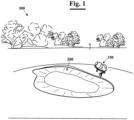
- a method, according to the invention, for the construction of a golf course bunker 100 provides a mixing step, in particular in situ, for example by a concrete mixer 150, or another device for mixing predetermined amount of particles of at least a loose material with at least a predetermined amount of a binder, in particular arranged to amalgamate and keep together the aforementioned particles.
- the aforementioned particles of loose material comprise a predetermined amount of particles 10 of an elastomeric material and a predetermined amount of particles 20 of an inert material, in particular a mineral material.
- the most by weight of the particles of the aforementioned loose material is constituted by particles of inert material 20, preferably mineral material.
- the ratio by weight between the predetermined amount of the particles of inert material, in particular mineral material 20, and the predetermined amount of the particles of elastomeric material 10 can be comprised between 10 a 1 and 2 a 1, advantageously between 8 a 1 and 3 a 1, preferably between 8 a 1 and 4 a 1. More in particular, the aforementioned ratio by weight R can be 8 a 1, advantageously 7 to 1, preferably 6 to 1. Preferably, the ratio by weight between the predetermined amount of the particles of mineral material 20 and the predetermined amount of the elastomeric material 10 can be 5 to 1.
- the elastomeric material 10 can be made of EPDM rubber, or ethylene propylene diene monomer, or made of SBR rubber, or butadiene and styrene copolymer, or can be obtained by mixing together determined amount of these 2 typologies of rubber.
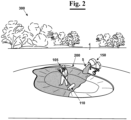
- a step follows diagrammatically shown in figure 2 , follows of distributing the aforementioned mixture 5 on the surface of a predetermined area 200 of the golf course, in particular an area 200 at which a depression is present.
- the aforementioned step of distributing the mixture 5 can be carried out by hands by one or more workers 105, for example by manual roller compactors 110, or can be carried out by at least a roll mounted on a machine of known type.
- the more or less homogeneous layer of the aforementioned mixture is, then, it is left to dry for a determined period of time in such a way to obtain an underlying layer 1 having a determined height H, diagrammatically shown in figure 3 .
- the height H of the underlying layer 1 can be comprised between 15 mm and 45 mm, advantageously comprised between 20 mm and 40 mm, for example comprised between 25 mm and 30 mm.
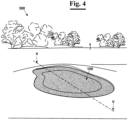
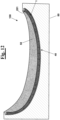
- a step follows for obtaining a covering layer 120 above the aforementioned underlying layer 1 obtaining the bunker 100, as diagrammatically shown in figure 4 .
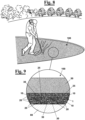
- a bunker 100 comprises an underlying layer 1 comprising particles of elastomeric material 10 and particles of an inert material, preferably a mineral material, such as a rock, in particular at least a calcareous rock, gravel, and similar materials, kept together by binder 30.
- the underlying layer 1 can be laid on the ground 80 shaping it appropriately to its shape in a simple and quick way thanks to the elasticity of which the underlying layer 1 same is provided of.
- the covering layer 50 is made, for example by distributing sand, preferably siliceous sand, or gravel, or loose inert material of another type.
- sand preferably siliceous sand, or gravel
- loose inert material of another type in an alternative embodiment of the invention not shown in figure for simplicity, in the aforementioned covering layer 50 can be caused to root at least a vegetable species obtaining a natural turf, or mixed natural and artificial.
- the aforementioned particles 20 of inert material can be a natural aggregate deriving from grinding calcareous rocks.
- an underlying layer 1 comprising a predetermined amount of particles of the aforementioned elastomeric material 10, in particular having a first predetermined size d1, and a predetermined amount of particles 20 of the aforementioned inert material, in particular a mineral material, for example rock, or stone, advantageously having a second predetermined size d2.
- the particles of elastomeric material 10 and the particles of inert material 20 can be preliminary mixed to each other in such a way to form a starting mixture. This latter is, then, further mixed, in situ, with the binder 30 to be amalgamate and kept together as described above.
- Both the first predetermined size d1 and the second predetermined size d2 of the particles can be comprised between 1 mm and 14 mm, advantageously between 1 mm and 12 mm, preferably between 2 mm and 12 mm, more preferably between 2 mm and 8 mm, for example between 3 mm and 6 mm.
- the particles of mineral material 20 can be washed rounded particles of fragments of rock, or stone.
- the aforementioned particles of mineral material 20, in particular rock can derive from a grinding process in such a way that the aforementioned particles are provided with jagged edges. This latter embodiment allows to obtain an underlying layer 1, according to the invention, with a greater drainage capacity with regard to the irrigation and rain water.
- the aforementioned mixture consists of the aforementioned particles of elastomeric material 10, the aforementioned particles of mineral material 20 and the aforementioned binder 30.
- the particles of loose material comprise, furthermore, particles 25 of at least another material, for example an inert material, for example another mineral material.
- the particles of loose material used in the mixture have a size comprised between 1 mm and 14 mm, more in particular between 2 mm and 12 mm, advantageously between 2 mm and 10 mm, preferably between 3 mm and 8 mm, for example between 6 mm and 8 mm.
- the binder 30 used to amalgamate and to keep together the particles which are present in the mixture 5 described above with reference both to the figures 4 and 5 , and to the figures 6 and 7 , and to the figures 8 and 9 , can be a polyurethane resin, or an epoxy resin, or alternatively a polyurethane resin, or an acrylic resin, or a combination of at least 2 of these resins.
- the aforementioned polyurethane resin is a resin based on diphenylmethane 4,4'-diisocyanate.
- the particular technical solution adopted to obtain the underlying layer 1 of the bunker 100 and more precisely the presence of the particles of elastomeric material 10 and the aforementioned resin 30 provides high elasticity to the layer of composite material.
- Another advantage of the present invention is the possibility to make an underlying layer 1 with a height H less than the height of the prior art underlying layers, that means 50 mm or even higher.
- the presence also of particles of inert material, in particular mineral material 20 mainly has the further advantage to make the underlying layer 1, according to the present invention, greatly drainage avoiding problems of floods in case of severe and sudden weather phenomena, or abundant irrigation such those that are, normally, carried out in the hottest periods of the year and that can cause the material to come out, in particular the material of the covering layer 50, normally sand, or gravel, dal bunker 100 with the need to restore the same and to carry out extraordinary maintenance operations.
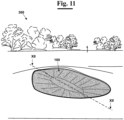
- an embodiment of a golf course bunker 100 300 comprises a preliminary step of positioning a tarpaulin, or mat, 40 at the aforementioned predetermined area 200 of the golf course 300.
- the area 200 in particular a lowered area, is delimited by a perimetral edge 201 and intended to house the aforementioned bunker 100.
- a step follows of distributing above the tarpaulin 40 of the aforementioned mixture 5 obtained as described above with reference to the figures from 1 to 14, in such a way to obtain the aforementioned underlying layer 1, and of constructing the covering layer 50, in particular by distributing above the underlying layer 1 of sand, or gravel, or another inert material, up to obtain a layer having a determined height.
- the aforementioned tarpaulin 40 can be made of an impermeable material, in such a way to help the rain and/or irrigation water to flow towards the collecting and drainage channels of the water, not shown in the figure for clarity reasons, that can be, for example, made at a peripheral position, after that the same has gone beyond the underlying layer 1 of bunker 100.
- the aforementioned tarpaulin 40 can be made of a plastic material, for example polyethylene, preferably low density polyethylene, or LDPE.
- a step can be, furthermore, provided for grassing the perimetral edge 201 and, in case, near the same.
- preliminary steps can be provided of making the water drainage system and, therefore, of positioning ducts and wells, according to procedures adopted also in the state of the art and, therefore, known to a skilled person in the field, and, for this reason, not here described in detail.
- a preliminary step can be provided of obtaining a drainage layer, for example made of gravel, or other drainage material, before positioning the tarpaulin 40 on the same.
- a drainage layer for example made of gravel, or other drainage material
Landscapes
- Engineering & Computer Science (AREA)
- Architecture (AREA)
- Civil Engineering (AREA)
- Structural Engineering (AREA)
- Road Paving Structures (AREA)
Applications Claiming Priority (1)
| Application Number | Priority Date | Filing Date | Title |
|---|---|---|---|
| IT102023000022683A IT202300022683A1 (it) | 2023-10-30 | 2023-10-30 | Metodo per realizzare un bunker per campi da golf e bunker per campi da golf cosi’ ottenuto |
Publications (2)
| Publication Number | Publication Date |
|---|---|
| EP4549657A2 true EP4549657A2 (fr) | 2025-05-07 |
| EP4549657A3 EP4549657A3 (fr) | 2025-06-25 |
Family
ID=89474874
Family Applications (1)
| Application Number | Title | Priority Date | Filing Date |
|---|---|---|---|
| EP24207329.4A Pending EP4549657A3 (fr) | 2023-10-30 | 2024-10-17 | Procédé de construction d'un bunker de golf et bunker de golf réalisé a partir de ce procédé |
Country Status (2)
| Country | Link |
|---|---|
| EP (1) | EP4549657A3 (fr) |
| IT (1) | IT202300022683A1 (fr) |
Citations (2)
| Publication number | Priority date | Publication date | Assignee | Title |
|---|---|---|---|---|
| WO2012046014A1 (fr) | 2010-10-08 | 2012-04-12 | Blinder Bunker Liner Limited | Couche poreuse destinée à un bunker de golf |
| FR3049964A1 (fr) | 2016-04-07 | 2017-10-13 | Denis Joandel | Procede de realisation ou de renovation d'un bunker pour terrain de golf et le bunker resultant du procede |
Family Cites Families (3)
| Publication number | Priority date | Publication date | Assignee | Title |
|---|---|---|---|---|
| JPS6028961B2 (ja) * | 1978-09-30 | 1985-07-08 | 日瀝化学工業株式会社 | 弾力性舗装の施工法 |
| US8062143B1 (en) * | 2009-09-17 | 2011-11-22 | Daniel Meersman | Golf course sand bunker construction and its associated method of production |
| GB202114568D0 (en) * | 2021-10-12 | 2021-11-24 | Ecobunker Ltd | Golf course bunker |
-
2023
- 2023-10-30 IT IT102023000022683A patent/IT202300022683A1/it unknown
-
2024
- 2024-10-17 EP EP24207329.4A patent/EP4549657A3/fr active Pending
Patent Citations (2)
| Publication number | Priority date | Publication date | Assignee | Title |
|---|---|---|---|---|
| WO2012046014A1 (fr) | 2010-10-08 | 2012-04-12 | Blinder Bunker Liner Limited | Couche poreuse destinée à un bunker de golf |
| FR3049964A1 (fr) | 2016-04-07 | 2017-10-13 | Denis Joandel | Procede de realisation ou de renovation d'un bunker pour terrain de golf et le bunker resultant du procede |
Also Published As
| Publication number | Publication date |
|---|---|
| EP4549657A3 (fr) | 2025-06-25 |
| IT202300022683A1 (it) | 2025-04-30 |
Similar Documents
| Publication | Publication Date | Title |
|---|---|---|
| EP2494109B1 (fr) | Gazon mixte | |
| US8062143B1 (en) | Golf course sand bunker construction and its associated method of production | |
| EP2038032B1 (fr) | Fosse de sable avec ensemble de revêtement | |
| EP3256645B1 (fr) | Gazon artificiel | |
| EP4549657A2 (fr) | Procédé de construction d'un bunker de golf et bunker de golf réalisé a partir de ce procédé | |
| RU2096551C1 (ru) | Спортивная площадка | |
| CN110629731B (zh) | 一种基于地貌-侵蚀-措施高适配的覆沙砒砂岩粗泥沙控制的综合治理方法 | |
| US7399145B2 (en) | Multi-layer liner assembly for a sand trap | |
| US4923329A (en) | Draining method and a machine for implementing same | |
| CN111962355A (zh) | 一种天然草与人造草的混织草坪的建植方法 | |
| WO1995019101A1 (fr) | Procede de production de gazon et manipulation de celui-ci | |
| JP4232960B2 (ja) | 埋設固化層緑化工法 | |
| JP2890181B2 (ja) | 芝生グランドの床土構造 | |
| Edminster et al. | Streambank erosion control on the Winooski River, Vermont | |
| RU2148121C1 (ru) | Способ строительства дренажной системы культурного газона | |
| EP1842963A1 (fr) | Pelouse avec une surface en gazon artificiel, couche inférieure et fondation | |
| CN223937181U (zh) | 一种城市规划设计生态坡 | |
| CN210507484U (zh) | 一种片岩边坡修复用保护装置 | |
| JPS60123603A (ja) | 人造芝生グリ−ンの下地構造 | |
| CN115928528A (zh) | 一种针对草坪软基础结构的施工方法 | |
| McIntyre et al. | Turfgrass construction materials and methods | |
| LOWE et al. | Managing Bunkers | |
| Roe et al. | Soil erosion control | |
| JPS63125703A (ja) | 人工芝及びこれを利用したゴルフ用パツテインググリ−ン | |
| McCarty et al. | Soil Drainage |
Legal Events
| Date | Code | Title | Description |
|---|---|---|---|
| PUAI | Public reference made under article 153(3) epc to a published international application that has entered the european phase |
Free format text: ORIGINAL CODE: 0009012 |
|
| STAA | Information on the status of an ep patent application or granted ep patent |
Free format text: STATUS: THE APPLICATION HAS BEEN PUBLISHED |
|
| AK | Designated contracting states |
Kind code of ref document: A2 Designated state(s): AL AT BE BG CH CY CZ DE DK EE ES FI FR GB GR HR HU IE IS IT LI LT LU LV MC ME MK MT NL NO PL PT RO RS SE SI SK SM TR |
|
| PUAL | Search report despatched |
Free format text: ORIGINAL CODE: 0009013 |
|
| AK | Designated contracting states |
Kind code of ref document: A3 Designated state(s): AL AT BE BG CH CY CZ DE DK EE ES FI FR GB GR HR HU IE IS IT LI LT LU LV MC ME MK MT NL NO PL PT RO RS SE SI SK SM TR |
|
| RIC1 | Information provided on ipc code assigned before grant |
Ipc: A63B 69/36 20060101ALN20250521BHEP Ipc: E01C 13/02 20060101AFI20250521BHEP |
|
| STAA | Information on the status of an ep patent application or granted ep patent |
Free format text: STATUS: REQUEST FOR EXAMINATION WAS MADE |
|
| 17P | Request for examination filed |
Effective date: 20251216 |