EP4549685A1 - Dispositif de serrage pour serrure de cadre de tuyau - Google Patents
Dispositif de serrage pour serrure de cadre de tuyau Download PDFInfo
- Publication number
- EP4549685A1 EP4549685A1 EP24210450.3A EP24210450A EP4549685A1 EP 4549685 A1 EP4549685 A1 EP 4549685A1 EP 24210450 A EP24210450 A EP 24210450A EP 4549685 A1 EP4549685 A1 EP 4549685A1
- Authority
- EP
- European Patent Office
- Prior art keywords
- lock
- fastening element
- clamping bolt
- tubular frame
- mortise lock
- Prior art date
- Legal status (The legal status is an assumption and is not a legal conclusion. Google has not performed a legal analysis and makes no representation as to the accuracy of the status listed.)
- Pending
Links
Images



Classifications
-
- E—FIXED CONSTRUCTIONS
- E05—LOCKS; KEYS; WINDOW OR DOOR FITTINGS; SAFES
- E05B—LOCKS; ACCESSORIES THEREFOR; HANDCUFFS
- E05B63/00—Locks or fastenings with special structural characteristics
- E05B63/08—Mortise locks
-
- E—FIXED CONSTRUCTIONS
- E05—LOCKS; KEYS; WINDOW OR DOOR FITTINGS; SAFES
- E05B—LOCKS; ACCESSORIES THEREFOR; HANDCUFFS
- E05B9/00—Lock casings or latch-mechanism casings ; Fastening locks or fasteners or parts thereof to the wing
- E05B9/08—Fastening locks or fasteners or parts thereof, e.g. the casings of latch-bolt locks or cylinder locks to the wing
Definitions
- the invention relates to a mortise lock which can be fastened in particular to a part such as a tubular frame, with a faceplate fastened to a lock case and a fastening element arranged on the lock case.
- a mortise lock of the type described above is known from the prior art, for example from DE 20 2007 009 890 U1 .
- mortise locks are screwed to the door rebate or to a narrow side of the door leaf using a faceplate-side screw connection.
- the mortise lock is also held in place in the door's lock pocket when installed by a fitting attached to the door leaf, which supports the door handle and/or the locking cylinder.
- the additional screw connection of the faceplate to the door rebate also prevents the mortise lock from rattling.
- the faceplate usually has a mounting hole in each end section through which a screw can be screwed into a thread in the door rebate or into the material of the door leaf. The length of the faceplate and the distance between the mounting holes are not uniform.
- the invention is therefore based on the object of specifying measures by which the fastening of a mortise lock to the door is simplified, in particular by which different mortise locks can be attached to different parts, in particular tubular frames, in a simple manner.
- the fastening element can be inserted into a recess formed in the lock case. In the stored position, the fastening element can be completely inserted into the recess.
- the fastening element can be pivotably mounted relative to the face plate. In order for the part, such as the tubular frame, to be clamped between the fastening element and the face plate in the clamping position, the fastening element is spaced from the rear of the face plate in the recess in the lock case.
- the distance between the fastening element and the face plate can therefore correspond to at least slightly more than the material thickness of the part such as the tubular frame or a projection arranged within the part or the tubular frame, which the fastening element can engage behind in the clamping position.
- the fastening element By actuating the actuating element, the fastening element can be moved from the stored position to the extended position. In the extended position, the fastening element is at least partially extended out of the lock case.
- the actuating element can have a threaded shaft and can be, for example, a screw, such as a Phillips or slotted screw, with the fastening element being screwed through a hole in the forend into an internal thread formed by the fastening element.
- the threaded connection can be a stiff thread connection, for example, a self-locking thread connection. This leads to rotation of the fastening element about the screw axis when the screw is turned.
- the fastening element is moved out of the recess in the lock case into the extended position by turning the screw.
- the fastening element can be moved by the actuating element into a pivoting end position and, in particular, dragged along. In the pivoting end position, the fastening element can rest against a stop shoulder.
- the stop shoulder can be formed, for example, by the lock case, for example, by a lock cover or a lock base, or can be attached to the lock case.
- the stop shoulder can be an edge of a cutout forming the recess in one broad side of the lock case.
- the fastening element can be designed in the form of a bolt, for example, as a clamping bolt.
- the fastening element can also have another elongated shape, such as an elliptical shape.
- the fastening element can also be square or circular.
- it can be a cuboid-shaped metal body with a threaded hole in its center.
- the threaded hole can also be arranged offset from the center along the longitudinal or transverse axis of the cuboid-shaped metal body. Accordingly, the fastening element can extend, for example, pivot out of the lock case on both sides or only on one side.
- the fastening element is designed such that, in the pivoting end position, it protrudes at least partially beyond the edge of one or both broad sides of the faceplate and, in the stored position, lies completely within the recess of the lock case.
- the fastening element in which the fastening element is designed as a clamping bolt, the length of the clamping bolt is longer than the distance between the edges of the broad sides of the faceplate.
- the width of the clamping bolt is smaller than the distance between the lock base and the lock cover.
- the clamping bolt By rotating the actuating element, the clamping bolt can be rotated through a fixed angle around a rotation axis running parallel to the surface normal of a wide side surface of the face plate.
- the angle of rotation through which the clamping bolt is rotated until it reaches the pivoting end position can be, for example, 90°. Further rotation of the screw causes the clamping bolt to remain in this pivoting end position and slide along a flank of the stop shoulder toward the face plate into the clamping position.
- the tubular frame can be clamped between the fastening element and the faceplate in the clamped position.
- the clamping bolt can engage behind the edge of a window in the lock pocket.
- the clamping bolt can also engage behind another projection located in the tubular frame or lock pocket. The edge or projection is clamped between the clamping bolt and the faceplate in the clamped position. The tubular frame is clamped so tightly that rattling of the mortise lock is prevented.
- the invention relates not only to the mortise lock attachable to a part such as a tubular frame, but also to a mortise lock attached to a part or tubular frame, which is characterized by a fastening element designed as described above that can be displaced from the lock case.
- the tubular frame is preferably made of metal.
- the fastening element can also be made of metal or another material with a correspondingly high stability.
- the fastening element can also be moved out of the stored position into the extended position by actuating the actuating element in another way, for example by means of a pre-tensioned spring element which is relaxed in the first phase by actuating the actuating element.
- the actuating element can be a push-button switch which interacts with the pre-tensioned spring element in such a way that pressing the push-button switch in the first phase causes the spring element to relax, whereby the fastening element moves out of the lock case from the stored position into the extended position.
- a screw arranged on the push-button switch can be screwed into the thread of the fastening element. screwed in, whereby the actuating element is shifted toward the face plate into the clamping position. A stiff or self-locking thread is therefore not necessary in this embodiment.
- the mortise lock essentially consists of a lock case 1 and a faceplate 2 attached to the narrow side of the lock case 1.
- the lock case has a lock cover 25 and a parallel one at a distance t (see Fig. 4 ) extending lock base 26.
- the face plate 2 can be fastened to the lock case 1 with fastening screws.
- the face plate 2 has a front side 27 and a Rear side 28, as well as adjacent longitudinal edges 29, 29' running parallel to each other at a distance s.
- the mullion forms windows 5, 6 (see Fig. 1, 2 ), into which a latch 3 and a bolt 4 each engage, filling the shape.
- the windows 5, 6 serve to fix the position of latch 3 and bolt 4.
- the face plate 2 can optionally have a fastening opening 18 at each end, with which the face plate 2 or the mortise lock can be fastened to a rebate-side lock pocket of a tubular frame door.
- screws are screwed through the fastening openings 18, which engage in threads arranged in the door rebate.
- the mortise lock according to the invention further comprises a two-armed clamping bolt 8, which is fastened to the face plate 2 by a screw 9, which passes through an opening 11 of the face plate 2.
- the screw 9 is screwed into a thread arranged in the clamping bolt 8.
- the thread engagement is preferably stiff or self-locking.
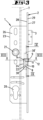
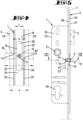
- the clamping bolt 8 can be Figures 1 , 3 , 4 and 8 shown in the safekeeping position in a Figures 2 , 4 (dash-dotted), 5, 6, and 9, in which it is displaced from both sides of the lock case 1. End sections 30, 30' of the clamping bolt 8 protrude beyond the longitudinal edges 29, 29' of the face plate 2.
- the end sections 30, 30' of the clamping bolt 8 form support surfaces for edge surfaces 17, 17' of a tubular frame 7.
- the clamping bolt 8 is shown in a storage position in which it lies completely in a recess 10 formed by the lock case 1.
- the recess 10 has window openings 22 and 22' formed by the lock cover 25 and the lock base 26, respectively, through which the clamping bolt 8 can be displaced from the recess 10.
- the clamping bolt 8 is located from the The rear side 28 of the faceplate 2 is spaced apart in the recess 10.
- This distance can be varied by the length of the threaded shaft of the screw 9 screwed into the thread of the clamping bolt 8, whereby the distance between the lower edge 24 of the window openings 22, 22' and the lock back 23 must be adjusted accordingly to ensure that the clamping bolt 8 can be moved out of the lock case 1.
- the distance between the clamping bolt 8 and the rear side 28 of the faceplate 2 can be adjusted in this way to the material thickness of the tubular frame 7.
- the window openings 22, 22' of the recess 10 are, as in Figure 4 as can be seen, are arranged offset from one another in the longitudinal direction of the face plate 2.
- the width b of the clamping bolt 8 is smaller than the distance t between the lock cover 25 and the lock base 26, so that the clamping bolt 8 lies in the recess 10 at a distance from the lock cover 25 and the lock base 26.
- the clamping bolt 8 can be moved to the storage position shown by turning the screw 9 in the Figure 2 , 4 (dash-dotted line), 5, 6 and 9.
- the clamping bolt 8 is rotated about a longitudinal central axis 12 and assumes a pivoting end position in which it is oriented at an angle of 90° to the longitudinal axis of the face plate 2, resting against a bearing shoulder 14 formed by the lock case 1.
- the angle can also be less than 90°.
- the clamping bolt 8 can also assume a transport securing position (not shown), in which, for example, the inner sides of the lower edges 24 of the window openings 22, 22' form contact flanks, on which the clamping bolt can be inserted into the recess 10 of the lock case 1 along the longitudinal side
- the clamping bolt 8 can be moved from this transport locking position into the storage position.
- the screw 9 is turned, for example, using a screwdriver (not shown), into the thread formed by the clamping bolt 8, whereby the clamping bolt 8 slides towards the face plate 2 along the contact flanks until it reaches the position shown in Figure 1 , 3 , 4 and 8 shown custody position is transferred.
- the contact shoulder 14 prevents rotation of the clamping bolt 8 about the screw's axis of rotation upon further rotation of the screw 9.
- each of the two end sections of the clamping bolt rests against a contact shoulder 14 in the pivoting end position (dash-dotted line, see Fig. 4 ).
- the contact shoulder 14 is formed by a flank of each of the two window openings 22, 22' of the recess 10.
- the offset arrangement of the window openings 22, 22' also prevents the clamping bolt 8 from pivoting out of the lock case 1 when the screw 9 is turned in the opposite direction, i.e. when the clamping bolt 8 is moved back from the extended position into the storage position, but instead strikes the inside of the lock housing walls.
- Figure 6 shows the clamping bolt 8 in the storage position resting against the contact shoulder 14 formed by the lock cover 25.
- the clamping bolt 8 is slid along the flank of the recess 10 in the direction of the face plate 2 by further turning the screw 9 until it reaches the position shown in the Figures 7 and 10
- the end sections 30, 30' of the clamping bar 8 each engage behind a peripheral edge surface 17, 17' of a part to which the mortise lock is to be attached, such as a tubular frame 7, so that the peripheral edge surfaces 17, 17' are clamped between the clamping bolt 8 and the rear side 28 of the face plate 2.
- the face plate 2 is connected to the tubular frame 7 in a rattle-proof manner—in the exemplary embodiment.
- the mortise lock can also be used in other tubular frame models.
- a projection can be arranged inside the tubular frame 7, behind which the clamping bolt 8 engages in the clamped position. This does not have to be a tubular part. It can also be, for example, a plate-like part with a corresponding insertion slot.
- Figure 11 shows a sectional view of another embodiment, in which the clamping bolt 8 is shown in the pivoting end position.
- the single-armed clamping bolt 8 is displaceable about a rotation axis 12 arranged in one of the end sections 30.
- the lock case 1 forms only a window opening 22', from which the end section 30' opposite the end section 30 is displaced out of the lock case 1.
- the clamping bolt 8 rests against the bearing shoulder 14 formed by the window opening 22'.
- the mortise lock described above is installed according to the following procedure.
- the mortise lock is inserted into a lock pocket of a tubular frame 7 of a tubular frame door.
- the face plate 2 rests on the outer side of the edge surfaces 17, 17' of the tubular frame 7 (see Fig. 8 ).
- the clamping bolt 8 is moved from the Figure 8 shown storage position by turning the screw 9 into the position shown Figure 9
- the screw 9 is displaced to the extended position shown.
- a screwdriver (not shown), for example, can be used to turn the screw 9.
- the screw 9 does not rotate in the thread formed by the clamping bolt 8, but rather drags the clamping bolt 8 along until it strikes the contact shoulder 14, assuming the pivoting end position.
- the clamping position shown can be released, for example, using a screwdriver.
- the screw 9 is then turned in the opposite direction. Due to the stiff threaded connection, the screw 9 drags the clamping bolt 8 with it during this rotation, thereby moving it from the pivoting end position back into the storage position.
- the clamping bolt 8 is dragged along until the end sections 30, 30' of the clamping bolt 8 are at the window openings 22, 22' rest against the opposite inner walls of the lock cover 25 and the lock base 26, respectively.
- the clamping bolt 8 remains in this position and the screw 9 is unscrewed from the thread. In doing so, the clamping bolt 8 is displaced toward the rear side 23 of the lock case 1.
- the mortise lock is then removed from the lock pocket of the tubular frame door.
- the invention may provide measures (not shown) for axially securing the screw 9 in the countersunk opening 11 formed by the face plate 2, but allowing it to rotate.
- the edge of the countersunk opening 11 may be caulked.
- measures may be provided to prevent the thread of the screw 9 from completely unscrewing from the internal thread formed by the clamping bolt 8; for example, the end portion of the thread of the screw 9 may be caulked.
- the embodiments illustrated in the drawings relate to mortise locks with a mortise opening 20 for a locking cylinder.
- the invention also relates to mortise locks designed as warded locks or bit locks.
- the mortise lock can also have several clamping bolts 8 which can be moved out of the lock case 1 simultaneously or independently of one another using one or more actuating elements 9.
- a mortise lock which is characterized in that the fastening element 8 can be brought in a first phase by actuating an actuating element 9 caught on the face plate 2 from a storage position into an extended position, in which the fastening element 8 is guided out of the lock case 1 and in a second phase can be displaced into a clamping position by further actuating the actuating element 9 in the direction of the face plate 2.
- a mortise lock which is characterized in that in the clamping position the tubular frame 7 can be clamped between the fastening element 8 and the face plate 2.
- a mortise lock which is characterized in that the fastening element 8, in the storage position, lies in a recess 10 formed by the lock case 1.
- a mortise lock which is characterized in that the actuating element 9 is a screw which projects through a bore 11 in the face plate 2 and is connected by a self-locking threaded connection to the fastening element 8 designed as a pivoting element, wherein the fastening element 8 can be brought into a pivoting end position by turning the screw 9.
- a mortise lock characterized in that the fastening element 8 is a clamping bolt which is rotatable about a longitudinal central axis 12 or a an axis 13 assigned to an end section can be displaced out of the lock case 1 by actuating the actuating element 9.
- a mortise lock which is characterized in that the clamping bolt 8 in the extended position rests against a stop shoulder 14 formed by the lock case 1.
- a mortise lock which is characterized in that the clamping bolt 8 can be displaced into the clamping position by sliding along a flank of the stop shoulder 14 in the direction of the face plate 2.
- a mortise lock which is characterized in that in the clamping position the clamping bolt 8, lying in a lock pocket 15 of the tubular frame 7, engages behind an edge 17 of a window 16 of the lock pocket 15.
- a mortise lock which is characterized in that the clamping bolt 8 can be pivoted from the storage position into the extended position by a fixed angle, in particular a 90° angle, about the rotation axis 12, 13 of the screw 9.
- a method for fastening a mortise lock which is characterized in that the fastening element 8 is brought in a first phase by actuating the actuating element 9 assigned to the face plate 2 from a storage position into an extended position, in which the fastening element 8 is guided out of the lock case 1 and in a second Phase is shifted into a clamping position by further actuation of the actuating element 9 in the direction of the face plate 2.
Landscapes
- Engineering & Computer Science (AREA)
- Mechanical Engineering (AREA)
- Structural Engineering (AREA)
- Connection Of Plates (AREA)
- Clamps And Clips (AREA)
Applications Claiming Priority (1)
| Application Number | Priority Date | Filing Date | Title |
|---|---|---|---|
| DE102023130644.8A DE102023130644A1 (de) | 2023-11-06 | 2023-11-06 | Klemmvorrichtung für Rohrrahmenschloss |
Publications (1)
| Publication Number | Publication Date |
|---|---|
| EP4549685A1 true EP4549685A1 (fr) | 2025-05-07 |
Family
ID=93379051
Family Applications (1)
| Application Number | Title | Priority Date | Filing Date |
|---|---|---|---|
| EP24210450.3A Pending EP4549685A1 (fr) | 2023-11-06 | 2024-11-04 | Dispositif de serrage pour serrure de cadre de tuyau |
Country Status (2)
| Country | Link |
|---|---|
| EP (1) | EP4549685A1 (fr) |
| DE (1) | DE102023130644A1 (fr) |
Citations (6)
| Publication number | Priority date | Publication date | Assignee | Title |
|---|---|---|---|---|
| DE2449741A1 (de) * | 1974-10-19 | 1976-04-22 | Fliether Fa Karl | Schlossbefestigung in rohrrahmentueren |
| FR2808832A1 (fr) * | 2000-05-10 | 2001-11-16 | Charles Prunet | Ferrure de verrouillage d'ouvrant coulissant a bride rotative quart de tour, procede de montage et ouvrant equipe d'une telle ferrure |
| DE202007009890U1 (de) | 2007-07-16 | 2008-11-20 | Ceslocks Gmbh | Montagehilfsvorrichtung für ein Einsteckschloss sowie Einsteckschloss |
| ES2313856B2 (es) * | 2008-07-22 | 2009-09-28 | Antonio Coll Morla | Dispositivo de cierre para cerramientos. |
| EP3153645B1 (fr) * | 2015-10-06 | 2019-10-30 | Locinox | Dispositif de verrouillage de porte conçu pour être monté sur un élément tubulaire |
| DE102019202183B3 (de) * | 2019-02-19 | 2020-05-28 | Geze Gmbh | System für eine Tür oder ein Fenster |
-
2023
- 2023-11-06 DE DE102023130644.8A patent/DE102023130644A1/de active Pending
-
2024
- 2024-11-04 EP EP24210450.3A patent/EP4549685A1/fr active Pending
Patent Citations (6)
| Publication number | Priority date | Publication date | Assignee | Title |
|---|---|---|---|---|
| DE2449741A1 (de) * | 1974-10-19 | 1976-04-22 | Fliether Fa Karl | Schlossbefestigung in rohrrahmentueren |
| FR2808832A1 (fr) * | 2000-05-10 | 2001-11-16 | Charles Prunet | Ferrure de verrouillage d'ouvrant coulissant a bride rotative quart de tour, procede de montage et ouvrant equipe d'une telle ferrure |
| DE202007009890U1 (de) | 2007-07-16 | 2008-11-20 | Ceslocks Gmbh | Montagehilfsvorrichtung für ein Einsteckschloss sowie Einsteckschloss |
| ES2313856B2 (es) * | 2008-07-22 | 2009-09-28 | Antonio Coll Morla | Dispositivo de cierre para cerramientos. |
| EP3153645B1 (fr) * | 2015-10-06 | 2019-10-30 | Locinox | Dispositif de verrouillage de porte conçu pour être monté sur un élément tubulaire |
| DE102019202183B3 (de) * | 2019-02-19 | 2020-05-28 | Geze Gmbh | System für eine Tür oder ein Fenster |
Also Published As
| Publication number | Publication date |
|---|---|
| DE102023130644A1 (de) | 2025-05-08 |
Similar Documents
| Publication | Publication Date | Title |
|---|---|---|
| DE29820711U1 (de) | Drehriegelverschluß mit Zugeinrichtung | |
| EP2163716B1 (fr) | Verrou pour une porte coulissante | |
| EP2211004A1 (fr) | Dispositif de verrouillage | |
| EP3266967B1 (fr) | Fermeture à crémone | |
| EP0281519A2 (fr) | Dispositif de fixation d'une serrure cylindrique | |
| EP0175049B1 (fr) | Tourniquet susceptible d'être manoeuvré par une clé à tube | |
| EP4438836B1 (fr) | Système de fermeture et porte ou fenêtre dotée d'un tel système de fermeture | |
| EP1072745A1 (fr) | Ferrure de verrouillage pour fenêtres ou portes | |
| DE69805903T2 (de) | Beschlag mit einstellbarem Riegel für Schiebeflügel | |
| DE29722488U1 (de) | Vorreiberverschluß für dickwandige Türen, Klappen o.dgl. | |
| DE3204931A1 (de) | Drehbetaetigungshandhabe fuer tueren, fenster oder dergleichen | |
| EP0036141B1 (fr) | Dispositif d'arrêt actionné par une clé | |
| EP4549685A1 (fr) | Dispositif de serrage pour serrure de cadre de tuyau | |
| CH416362A (de) | Eingelassenes Türschloss | |
| DE102008036151A1 (de) | Scharnierband mit einer Unterkonstruktion zur Befestigung an einem Türblatt | |
| DE9207012U1 (de) | Zusatzverriegelung für Fenster, Türen o.dgl. | |
| EP2514892B1 (fr) | Système de fixation d'une partie de ferrure | |
| DE102018101285A1 (de) | Eckverbinder | |
| EP0036480A1 (fr) | Ferrure pour portes entièrement vitrées | |
| DE202019105897U1 (de) | Drückerlagerung mit einem Tür- oder Fensterdrücker | |
| DE202011005241U1 (de) | Stangenführung | |
| DE102019128244A1 (de) | Anordnung mit einem Rahmen und einem mit Hilfe von Bändern an dem Rahmen angebrachten Flügel | |
| DE29803239U1 (de) | Türschließvorrichtung | |
| DE10156632C1 (de) | Türschloss, insbesondere Einsteckschloss | |
| DE102017009348B4 (de) | Fenster- & Türsicherung zur nachträglichen Sicherung für mindestens einen Flügel, eines Fensters oder einer Tür |
Legal Events
| Date | Code | Title | Description |
|---|---|---|---|
| PUAI | Public reference made under article 153(3) epc to a published international application that has entered the european phase |
Free format text: ORIGINAL CODE: 0009012 |
|
| STAA | Information on the status of an ep patent application or granted ep patent |
Free format text: STATUS: THE APPLICATION HAS BEEN PUBLISHED |
|
| AK | Designated contracting states |
Kind code of ref document: A1 Designated state(s): AL AT BE BG CH CY CZ DE DK EE ES FI FR GB GR HR HU IE IS IT LI LT LU LV MC ME MK MT NL NO PL PT RO RS SE SI SK SM TR |
|
| STAA | Information on the status of an ep patent application or granted ep patent |
Free format text: STATUS: REQUEST FOR EXAMINATION WAS MADE |
|
| 17P | Request for examination filed |
Effective date: 20251020 |