EP4553916A1 - Lithiumsekundärbatterie, herstellungsverfahren für negativelektrodenaktivmaterial und herstellungsverfahren für lithiumsekundärbatterie - Google Patents
Lithiumsekundärbatterie, herstellungsverfahren für negativelektrodenaktivmaterial und herstellungsverfahren für lithiumsekundärbatterie Download PDFInfo
- Publication number
- EP4553916A1 EP4553916A1 EP24208461.4A EP24208461A EP4553916A1 EP 4553916 A1 EP4553916 A1 EP 4553916A1 EP 24208461 A EP24208461 A EP 24208461A EP 4553916 A1 EP4553916 A1 EP 4553916A1
- Authority
- EP
- European Patent Office
- Prior art keywords
- negative electrode
- active material
- electrode active
- carbon
- based negative
- Prior art date
- Legal status (The legal status is an assumption and is not a legal conclusion. Google has not performed a legal analysis and makes no representation as to the accuracy of the status listed.)
- Pending
Links
Images



Classifications
-
- H—ELECTRICITY
- H01—ELECTRIC ELEMENTS
- H01M—PROCESSES OR MEANS, e.g. BATTERIES, FOR THE DIRECT CONVERSION OF CHEMICAL ENERGY INTO ELECTRICAL ENERGY
- H01M4/00—Electrodes
- H01M4/02—Electrodes composed of, or comprising, active material
- H01M4/36—Selection of substances as active materials, active masses, active liquids
- H01M4/362—Composites
- H01M4/366—Composites as layered products
-
- C—CHEMISTRY; METALLURGY
- C01—INORGANIC CHEMISTRY
- C01B—NON-METALLIC ELEMENTS; COMPOUNDS THEREOF; METALLOIDS OR COMPOUNDS THEREOF NOT COVERED BY SUBCLASS C01C
- C01B32/00—Carbon; Compounds thereof
- C01B32/20—Graphite
- C01B32/21—After-treatment
-
- H—ELECTRICITY
- H01—ELECTRIC ELEMENTS
- H01M—PROCESSES OR MEANS, e.g. BATTERIES, FOR THE DIRECT CONVERSION OF CHEMICAL ENERGY INTO ELECTRICAL ENERGY
- H01M10/00—Secondary cells; Manufacture thereof
- H01M10/05—Accumulators with non-aqueous electrolyte
- H01M10/052—Li-accumulators
-
- H—ELECTRICITY
- H01—ELECTRIC ELEMENTS
- H01M—PROCESSES OR MEANS, e.g. BATTERIES, FOR THE DIRECT CONVERSION OF CHEMICAL ENERGY INTO ELECTRICAL ENERGY
- H01M10/00—Secondary cells; Manufacture thereof
- H01M10/05—Accumulators with non-aqueous electrolyte
- H01M10/052—Li-accumulators
- H01M10/0525—Rocking-chair batteries, i.e. batteries with lithium insertion or intercalation in both electrodes; Lithium-ion batteries
-
- H—ELECTRICITY
- H01—ELECTRIC ELEMENTS
- H01M—PROCESSES OR MEANS, e.g. BATTERIES, FOR THE DIRECT CONVERSION OF CHEMICAL ENERGY INTO ELECTRICAL ENERGY
- H01M10/00—Secondary cells; Manufacture thereof
- H01M10/05—Accumulators with non-aqueous electrolyte
- H01M10/056—Accumulators with non-aqueous electrolyte characterised by the materials used as electrolytes, e.g. mixed inorganic/organic electrolytes
- H01M10/0564—Accumulators with non-aqueous electrolyte characterised by the materials used as electrolytes, e.g. mixed inorganic/organic electrolytes the electrolyte being constituted of organic materials only
- H01M10/0566—Liquid materials
- H01M10/0569—Liquid materials characterised by the solvents
-
- H—ELECTRICITY
- H01—ELECTRIC ELEMENTS
- H01M—PROCESSES OR MEANS, e.g. BATTERIES, FOR THE DIRECT CONVERSION OF CHEMICAL ENERGY INTO ELECTRICAL ENERGY
- H01M4/00—Electrodes
- H01M4/02—Electrodes composed of, or comprising, active material
- H01M4/13—Electrodes for accumulators with non-aqueous electrolyte, e.g. for lithium-accumulators; Processes of manufacture thereof
- H01M4/133—Electrodes based on carbonaceous material, e.g. graphite-intercalation compounds or CFx
-
- H—ELECTRICITY
- H01—ELECTRIC ELEMENTS
- H01M—PROCESSES OR MEANS, e.g. BATTERIES, FOR THE DIRECT CONVERSION OF CHEMICAL ENERGY INTO ELECTRICAL ENERGY
- H01M4/00—Electrodes
- H01M4/02—Electrodes composed of, or comprising, active material
- H01M4/13—Electrodes for accumulators with non-aqueous electrolyte, e.g. for lithium-accumulators; Processes of manufacture thereof
- H01M4/139—Processes of manufacture
- H01M4/1393—Processes of manufacture of electrodes based on carbonaceous material, e.g. graphite-intercalation compounds or CFx
-
- H—ELECTRICITY
- H01—ELECTRIC ELEMENTS
- H01M—PROCESSES OR MEANS, e.g. BATTERIES, FOR THE DIRECT CONVERSION OF CHEMICAL ENERGY INTO ELECTRICAL ENERGY
- H01M4/00—Electrodes
- H01M4/02—Electrodes composed of, or comprising, active material
- H01M4/36—Selection of substances as active materials, active masses, active liquids
- H01M4/58—Selection of substances as active materials, active masses, active liquids of inorganic compounds other than oxides or hydroxides, e.g. sulfides, selenides, tellurides, halogenides or LiCoFy; of polyanionic structures, e.g. phosphates, silicates or borates
- H01M4/583—Carbonaceous material, e.g. graphite-intercalation compounds or CFx
-
- H—ELECTRICITY
- H01—ELECTRIC ELEMENTS
- H01M—PROCESSES OR MEANS, e.g. BATTERIES, FOR THE DIRECT CONVERSION OF CHEMICAL ENERGY INTO ELECTRICAL ENERGY
- H01M4/00—Electrodes
- H01M4/02—Electrodes composed of, or comprising, active material
- H01M4/36—Selection of substances as active materials, active masses, active liquids
- H01M4/58—Selection of substances as active materials, active masses, active liquids of inorganic compounds other than oxides or hydroxides, e.g. sulfides, selenides, tellurides, halogenides or LiCoFy; of polyanionic structures, e.g. phosphates, silicates or borates
- H01M4/583—Carbonaceous material, e.g. graphite-intercalation compounds or CFx
- H01M4/587—Carbonaceous material, e.g. graphite-intercalation compounds or CFx for inserting or intercalating light metals
-
- H—ELECTRICITY
- H01—ELECTRIC ELEMENTS
- H01M—PROCESSES OR MEANS, e.g. BATTERIES, FOR THE DIRECT CONVERSION OF CHEMICAL ENERGY INTO ELECTRICAL ENERGY
- H01M10/00—Secondary cells; Manufacture thereof
- H01M10/05—Accumulators with non-aqueous electrolyte
- H01M10/056—Accumulators with non-aqueous electrolyte characterised by the materials used as electrolytes, e.g. mixed inorganic/organic electrolytes
- H01M10/0564—Accumulators with non-aqueous electrolyte characterised by the materials used as electrolytes, e.g. mixed inorganic/organic electrolytes the electrolyte being constituted of organic materials only
- H01M10/0566—Liquid materials
- H01M10/0567—Liquid materials characterised by the additives
-
- H—ELECTRICITY
- H01—ELECTRIC ELEMENTS
- H01M—PROCESSES OR MEANS, e.g. BATTERIES, FOR THE DIRECT CONVERSION OF CHEMICAL ENERGY INTO ELECTRICAL ENERGY
- H01M4/00—Electrodes
- H01M4/02—Electrodes composed of, or comprising, active material
- H01M2004/026—Electrodes composed of, or comprising, active material characterised by the polarity
- H01M2004/027—Negative electrodes
-
- H—ELECTRICITY
- H01—ELECTRIC ELEMENTS
- H01M—PROCESSES OR MEANS, e.g. BATTERIES, FOR THE DIRECT CONVERSION OF CHEMICAL ENERGY INTO ELECTRICAL ENERGY
- H01M2300/00—Electrolytes
- H01M2300/0017—Non-aqueous electrolytes
- H01M2300/0025—Organic electrolyte
- H01M2300/0028—Organic electrolyte characterised by the solvent
-
- Y—GENERAL TAGGING OF NEW TECHNOLOGICAL DEVELOPMENTS; GENERAL TAGGING OF CROSS-SECTIONAL TECHNOLOGIES SPANNING OVER SEVERAL SECTIONS OF THE IPC; TECHNICAL SUBJECTS COVERED BY FORMER USPC CROSS-REFERENCE ART COLLECTIONS [XRACs] AND DIGESTS
- Y02—TECHNOLOGIES OR APPLICATIONS FOR MITIGATION OR ADAPTATION AGAINST CLIMATE CHANGE
- Y02E—REDUCTION OF GREENHOUSE GAS [GHG] EMISSIONS, RELATED TO ENERGY GENERATION, TRANSMISSION OR DISTRIBUTION
- Y02E60/00—Enabling technologies; Technologies with a potential or indirect contribution to GHG emissions mitigation
- Y02E60/10—Energy storage using batteries
-
- Y—GENERAL TAGGING OF NEW TECHNOLOGICAL DEVELOPMENTS; GENERAL TAGGING OF CROSS-SECTIONAL TECHNOLOGIES SPANNING OVER SEVERAL SECTIONS OF THE IPC; TECHNICAL SUBJECTS COVERED BY FORMER USPC CROSS-REFERENCE ART COLLECTIONS [XRACs] AND DIGESTS
- Y02—TECHNOLOGIES OR APPLICATIONS FOR MITIGATION OR ADAPTATION AGAINST CLIMATE CHANGE
- Y02P—CLIMATE CHANGE MITIGATION TECHNOLOGIES IN THE PRODUCTION OR PROCESSING OF GOODS
- Y02P70/00—Climate change mitigation technologies in the production process for final industrial or consumer products
- Y02P70/50—Manufacturing or production processes characterised by the final manufactured product
Definitions
- Embodiments of the present disclosure relate to a lithium secondary battery, a manufacturing method of a negative electrode active material, and a manufacturing method a lithium secondary battery.
- a lithium secondary battery includes a positive electrode, a negative electrode, and a separator disposed therebetween, and a positive electrode and a negative electrode are each provided with an active material which lithium ions may be inserted to and extracted from.
- a two-/three-component electrolyte based on ethylene carbonate (EC) is used as an electrolyte for lithium secondary batteries.
- EC ethylene carbonate
- EC has a high melting point, so its use temperature is limited, and it may bring about significant deterioration of battery performance at low temperatures.
- propylene carbonate (PC) is mixed and used for the purpose of improving low-temperature performance, but when PC is used together in an electrolyte, there is a problem that, rather than forming a stable solid electrolyte interphase (SEI) film on the surface of a carbon-based negative electrode active material, the carbon-based negative electrode active material, particularly, the interlayer of graphite is destroyed by exfoliation.
- SEI solid electrolyte interphase
- Embodiments of the present disclosure may provide a lithium secondary battery that has excellent low-temperature performance and can prevent destruction of an negative electrode active material, a manufacturing method of a negative electrode active material, and a manufacturing method of a lithium secondary battery.
- a lithium secondary battery according to one embodiment of the present disclosure can be widely applied in the field of electric vehicles, battery charging stations, and green technology, such solar power generation, and wind power generation using batteries.
- a lithium secondary battery includes: a positive electrode; a negative electrode including a carbon-based negative electrode active material coated with a reduced graphene oxide (r-GO); and an electrolyte including a propylene carbonate (PC)-based compound.
- the electrolyte may further include a lithium salt.
- the carbon-based negative electrode active material coated with the r-GO may have a core-shell structure consisting of a core including a carbon-based negative electrode active material and a shell including an r-GO.
- the carbon-based negative electrode active material may include a negative electrode active material of a plate type structure.
- the carbon-based negative electrode active material may include artificial graphite, natural graphite, or a combination thereof.
- the carbon-based negative electrode active material may include an edge-plane, and the r-GO surrounds the edge-plane of the carbon-based negative electrode active material.
- the carbon-based negative electrode active material may include nitrogen.
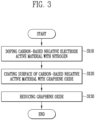
- a manufacturing method of a negative electrode active material includes: doping a carbon-based negative electrode active material with nitrogen; coating a surface of the carbon-based negative active material with a graphene oxide; and reducing the graphene oxide.
- the doping a carbon-based negative electrode active material with nitrogen may include heat-treating the carbon-based negative electrode active material under an atmosphere in which ammonia gas flows.
- the coating a surface of the carbon-based negative electrode active material with a graphene oxide may include: dispersing the carbon-based negative electrode active material in a solvent; and injecting the graphene oxide into a solvent in which the carbon-based negative electrode active material is dispersed.
- the graphene oxide may be applied onto the surface of the carbon-based negative electrode active material by electrostatic attraction.
- the reducing the graphene oxide may include heat-treating the carbon-based negative electrode active material coated with the graphene oxide under an atmosphere in which ammonia gas flows.
- a manufacturing method of a lithium secondary battery includes: preparing a carbon-based negative electrode active material coated with a reduced graphene oxide (r-GO); manufacturing an electrode assembly including a positive electrode and a negative electrode including the negative electrode active material; and injecting an electrolyte including a PC-based compound into an accommodating space where the electrode assembly is accommodated therein.
- r-GO reduced graphene oxide
- the preparing a carbon-based negative electrode active material coated with an r-GO may include: doping a carbon-based negative electrode active material with nitrogen; coating a surface of the carbon-based negative active material with a graphene oxide; and reducing the graphene oxide.
- a lithium secondary battery that has excellent low-temperature performance and can prevent destruction of an negative electrode active material, a manufacturing method of a negative electrode active material, and a manufacturing method of a lithium secondary battery may be provided.
- a lithium secondary battery including: a positive electrode; a negative electrode including a carbon-based negative electrode active material coated with a reduced graphene oxide (r-GO); and an electrolyte including a PC-based compound.
- the lithium secondary battery provided in one aspect of the present disclosure will be described by components.
- the lithium secondary battery provided in one aspect of the present disclosure includes a positive electrode.
- a positive electrode may include a positive electrode current collector and a positive electrode active material layer disposed on the positive electrode current collector.
- the positive electrode active material layer may be formed on at least one surface of the positive electrode current collector. In other words, the positive electrode active material layer may be formed on one surface of the positive electrode current collector, or may be formed on both surfaces of the positive electrode current collector.
- a positive electrode active material layer may include a positive electrode active material.
- a positive electrode active material may be a material which lithium ions may be inserted to or extracted from, and in one embodiment, an positive electrode active material may be a lithium metal oxide.
- a positive electrode active material may be one of a lithium manganese-based oxide, a lithium nickel-based oxide, a lithium cobalt-based oxide, a lithium nickel manganese-based oxide, a lithium nickel cobalt aluminum-based oxide, a lithium iron phosphate-based compound, a lithium manganese phosphate-based compound, a lithium cobalt phosphate-based compound, and a lithium vanadium phosphate-based compound, and is not necessarily limited to a specific example.
- FIG. 1 shows a diagram for explaining a negative electrode active material according to one embodiment of the present disclosure.
- a lithium secondary battery provided in one aspect of the present disclosure includes a negative electrode.
- a negative electrode may include a negative electrode current collector and a negative electrode active material layer.
- a negative electrode current collector is not particularly limited as long as it is conductive without causing chemical changes in a secondary battery.
- copper, stainless steel, aluminum, nickel, titanium, calcined carbon, copper or stainless steel surface-treated with carbon, nickel, titanium, silver, or the like, an aluminum-cadmium alloy, or the like may be used.
- fine irregularities may be formed on the surface to strengthen the bonding power of a negative electrode active material, and it may be used in various forms such as films, sheets, foils, nets, porous materials, foams, and non-woven fabrics.
- a negative electrode active material layer may be formed on at least one surface of a negative electrode current collector.
- a negative electrode active material layer may be formed on one surface of a negative electrode current collector or on both surfaces of the negative electrode current collector.
- a negative electrode active material layer may include a negative electrode active material.
- a negative electrode active material may include a carbon-based negative electrode active material, and the surface of a carbon-based negative electrode active material may include a reduced graphene oxide (r-GO).
- r-GO reduced graphene oxide
- FIG. 1 the structure of a negative electrode active material according to an embodiment of the present disclosure may be understood.
- a negative electrode active material may have a core-shell structure consisting of a carbon-based negative electrode active material core 11 and an r-GO shell 12.
- the carbon-based negative electrode active material coated with the r-GO may have a core-shell structure consisting of a core including a carbon-based negative electrode active material 11 and a shell including an r-GO 12.
- a carbon-based negative electrode active material 11 may include one or more selected from the group consisting of artificial graphite, natural graphite, hard carbon, soft carbon, carbon black, acetylene black, Ketjen Black, Super P, and graphene.
- a carbon-based negative electrode active material 11 may include a negative electrode active material with a plate-type structure.
- the carbon-based negative electrode active material may include artificial graphite, natural graphite, or a combination thereof.
- a graphite-based negative electrode active material for example, it may include one or more selected from the group consisting of artificial graphite and natural graphite, but is not limited thereto.
- the carbon-based negative electrode active material 11 when a carbon-based negative electrode active material 11 has a platelike structure, the carbon-based negative electrode active material may include an edge-plane, and the r-GO may surround the edge-plane of the carbon-based negative electrode active material, thereby preventing the exfoliation of the negative electrode active material due to a PC-based compound.
- the carbon-based negative electrode active material may include nitrogen.
- a negative electrode active material may include a nitrogen element, and specifically, a carbon-based negative electrode active material 11 may be doped with a nitrogen element, and accordingly, a graphene oxide may be applied onto a surface of the carbon-based negative electrode active material using electrostatic attraction.
- a negative electrode active material layer may further include a binder.
- a binder may be a material that improves the adhesion between a negative electrode current collector and a negative electrode active material and/or the adhesion between negative electrode active materials.
- a binder may include one or more selected from the group consisting of styrene-butadiene rubber (SBR)-based binders, carboxymethyl cellulose (CMC), polyacrylic acid-based binders, poly(3,4-ethylenedioxythiophene) (PEDOT)-based binders, polyvinylidenefluoride (PVDF), poly(vinylidene fluoride-co-hexafluoropropylene copolymers, polyacrylonitrile, polymethylmethacrylate, acrylonitrile butadiene rubber (NBR), and polybutadiene rubber (BR), but is not limited to specific examples.
- SBR styrene-butadiene rubber
- CMC carboxymethyl cellulose
- a negative electrode active material layer may include a conductive material that can provide conductivity to a negative electrode.
- a conductive material may include, for example, one or more selected from the group consisting of metal-based conductive materials, carbon-based conductive materials, and conductive polymers.
- Metallic conductive materials may be, for example, metal powder or metal fibers of copper, nickel, aluminum, silver, or the like; conductive whiskers such as zinc oxide and potassium titanate; or a conductive metal oxide such as titanium oxide.
- a carbon-based conductive material may be, for example, graphite, carbon black, graphene, or carbon nanotubes.
- a conductive polymer may be, for example, a polyphenylene derivative.
- a negative electrode active material layer may optionally include a thickener.
- a thickener may improve the problem of cracks generated on the surface of a negative electrode by strengthening the cohesion of a binder.
- a thickener may include, for example, one or more selected from the group consisting of carboxymethyl cellulose, methyl cellulose, hydroxypropyl cellulose, methyl hydroxypropyl cellulose, ethyl hydroxyethyl cellulose, methyl ethyl hydroxyethyl cellulose, and cellulose gum.
- a lithium secondary battery provided in one aspect of the present disclosure may include an electrolyte, and specifically, the electrolyte may include an electrolyte solution.
- the electrolyte may include a PC-based compound, where the PC-based compound may be substituted or unsubstituted propylene carbonate. Specifically, the PC-based compound may be (unsubstituted) propylene carbonate.
- the electrolyte may be a non-aqueous electrolyte solution, and PC may be included as a solvent in the electrolyte solution. In an embodiment, the electrolyte may further include a lithium salt.
- the lithium secondary battery provided in one aspect of the present disclosure may have excellent low-temperature properties.
- a lithium secondary battery provided in one aspect of the present disclosure may further include a separator.
- a separator may be interposed between a negative electrode and a positive electrode.
- a separator is formed to prevent electrical short-circuiting between a negative electrode and a positive electrode and to generate a flow of ions.
- a separator may include a porous polymer film or a porous non-woven fabric.
- the porous polymer film may be formed to be a single layer or a multilayer including a polyolefin-based polymer such as an ethylene polymer, a propylene polymer, an ethylene/butene copolymer, an ethylene/hexene copolymer, and an ethylene/methacrylate copolymer.
- the porous nonwoven fabric may include glass fibers with a high melting point and polyethylene terephthalate fibers.
- a separator may be a highly heat-resistant separator (ceramic coated separator; CCS) including ceramic.
- a lithium secondary battery provided in one aspect of the present disclosure may include an electrode assembly, and the electrode assembly may be manufactured by performing winding, lamination, folding, or zigzag stacking processes with the negative electrode, positive electrode, and separator.
- an electrode assembly may be provided together with an electrolyte solution to manufacture a secondary battery according to the present disclosure.
- a secondary battery may be any one of a cylindrical type using a can, a prismatic type, a pouch type, or a coin type, but is not limited thereto.
- a manufacturing method of a negative electrode active material including: doping a carbon-based negative electrode active material with nitrogen; coating a surface of the carbon-based negative active material with a graphene oxide; and reducing the graphene oxide.
- a manufacturing method of a lithium secondary battery including: preparing a carbon-based negative electrode active material coated with an r-GO; manufacturing an electrode assembly using a positive electrode and a negative electrode including the negative electrode active material; and injecting an electrolyte including a propylene carbonate-based compound into an accommodating space where the electrode assembly is accommodated therein.
- the negative electrode active material carbon-based negative electrode active material, r-GO, positive electrode, negative electrode, PC-based compound, electrolyte, and the like are the same as each specifically described above.
- FIG. 2 shows a flowchart for explaining a manufacturing method of a lithium secondary battery according to one embodiment of the present disclosure.
- FIG. 3 shows a flowchart for explaining a manufacturing method of a negative electrode active material according to one embodiment of the present disclosure.
- a negative electrode active material may be prepared through S100 operation.
- a negative electrode active material may be a carbon-based negative active material coated with an r-GO.
- the doping a carbon-based negative electrode active material with nitrogen may include heat-treating the carbon-based negative electrode active material under an atmosphere in which ammonia gas flows.
- the carbon-based negative electrode active material may be doped with nitrogen through operation S110.
- the carbon-based negative electrode active material may be doped with nitrogen by heat-treating the carbon-based negative electrode active material under an atmosphere in which ammonia gas flows.
- the nitrogen-doped carbon-based negative electrode active material may include nitrogen element.
- the coating a surface of the carbon-based negative electrode active material with a graphene oxide may include: dispersing the carbon-based negative electrode active material in a solvent; and injecting the graphene oxide into a solvent in which the carbon-based negative electrode active material is dispersed.
- a surface of the carbon-based negative electrode active material may be coated with a graphene oxide through operation S120.
- the operation of coating the surface of the carbon-based negative electrode active material with a graphene oxide may include dispersing the carbon-based negative electrode active material in a solvent; and injecting the graphene oxide into a solvent in which the carbon-based negative electrode active material is dispersed.
- the solvent may be water, but is not limited thereto.
- the carbon-based negative electrode active material may be a carbon-based negative electrode active material doped with nitrogen through the S110 operation.
- graphene oxide may be applied onto the surface of the carbon-based negative electrode active material by electrostatic attraction.
- the graphene oxide may be applied onto the surface of the carbon-based negative electrode active material by electrostatic attraction.
- the nitrogen element doped into the carbon-based negative active material may have + polarity, while a hydroxyl group and a carboxyl group included in the graphene oxide may have - polarity. Therefore, a part of the graphene oxide with - polarity is bonded to a part of the nitrogen-doped carbon-based negative electrode active material with + polarity by electrostatic attraction, so that the graphene oxide may be applied onto the surface of the carbon-based negative electrode active material.
- the graphene oxide applied onto the surface of the carbon-based negative electrode active material may be reduced through operation S130.
- the graphene oxide may be reduced by heat-treating the carbon-based negative electrode active material coated with a graphene oxide under an atmosphere in which hydrogen gas flows. Accordingly, at least a part of the graphene oxide applied onto the surface of the carbon-based negative electrode active material may be converted into an r-GO.
- the preparing a carbon-based negative electrode active material coated with an r-GO may include: doping a carbon-based negative electrode active material with nitrogen; coating a surface of the carbon-based negative active material with a graphene oxide; and reducing the graphene oxide.
- an electrode assembly may be manufactured through operation S200.
- an electrode assembly may include a positive electrode and a negative electrode, and may further include a separator between the positive electrode and the negative electrode.
- An electrode assembly may be manufactured by performing winding, lamination, folding, or zigzag stacking processes with the above-described negative electrode, positive electrode, and separator.
- an electrolyte including a PC-based compound into an accommodating space may be injected to an accommodating space.
- An accommodating space may be a space in which the electrode assembly manufactured through the S200 operation is accommodated.
- an accommodating space may be defined as a space inside a case of various shapes.
- an electrolyte solution may be injected into an accommodating space after an electrode assembly is disposed in the accommodating space, but it is not limited thereto.
- an electrolyte solution may be first injected into an accommodating space, and then an electrode assembly may be disposed into the accommodating space.
- an electrolyte may further include a lithium salt
- PC may be included as a solvent of a non-aqueous electrolyte solution that is an electrolyte.
- Graphite was placed in a crucible and heat-treated at 600 °C for five hours under an atmosphere in which NH 3 gas was flowing at 400 ppm. Accordingly, the surface of the heat-treated graphite was doped with nitrogen.
- the nitrogen-doped graphite and a graphene oxide were added to water at a weight ratio of 99:1, and the resulting mixture was stirred at room temperature for two hours at 400 rpm using a magnetic bar.
- the graphene oxide was evenly applied onto the surface of the nitrogen-doped graphite by electrostatic attraction between the graphene oxide dispersed in water and the nitrogen-doped graphite.
- the graphite coated with the graphene oxide obtained through filtration was added back into the crucible and heat-treated at 800 °C for eight hours under an atmosphere in which H 2 gas was flowing at 1,000 ppm. Accordingly, the graphene oxide on the graphite surface was reduced to an r-GO.
- a negative electrode active material composition was prepared by mixing the negative electrode active material of Preparation Example 1, multi-walled carbon nanotubes, carboxymethyl cellulose, and styrene butadiene rubber in water at a weight ratio of 97.1:0.4:1.2:1.3.
- the prepared negative electrode active material composition was applied to a copper thin film, which was a negative electrode current collector. Thereafter, the composition was dried under vacuum at 130 °C for one hour to manufacture a negative electrode with a negative electrode active material layer formed on the copper thin film.
- CR2032 type coin half cells using the negative electrode manufactured through the above-described process were manufactured.
- Metal lithium was used as a counter electrode
- a polyethylene (PE) separator was used as a separator
- 1.0 M LiPF 6 dissolved in a PC solvent was used as an electrolyte solution.
- a coin half-cell was manufactured in the same manner as in Example 1, except that an uncoated graphite was used instead of the negative electrode active material of Preparation Example 1.
- a coin half-cell was manufactured in the same manner as in Comparative Example 1, except that ethylene carbonate was used as a solvent of the electrolyte solution instead of PC.
- Example 1 For the half-cells of Example 1, Comparative Example 1, and Comparative Example 2, the initial efficiency was calculated by confirming the first charge/discharge capacity using an electrochemical charge/discharge device.
- Example 1 in which the negative electrode active material of Preparation Example 1 was used, even when PC was used as a solvent of the electrolyte solution, the initial efficiency level was similar to that of Comparative Example 2 in which ethylene carbonate was used as a solvent of the electrolyte solution.
- Example 1 in which the negative electrode active material graphite with its surface coated with an r-GO was used as a negative electrode active material, as in Preparation Example 1, the initial efficiency was significantly superior to that of the Comparative Example 1 in which graphite with an uncoated surface was used as a negative electrode active material.
- FIG. 4 shows a graph illustrating the capacity retention of lithium secondary batteries according to one example and comparative examples of the present disclosure.
- Example 1 For the half-cells of Example 1, Comparative Example 1, and Comparative Example 2, the capacity retention at 25 °C was evaluated using an electrochemical charge/discharge device.
- Example 1 in which the negative electrode active material of Preparation Example 1 was, even when PC was used as a solvent of the electrolyte solution, the capacity retention was similar to that of Comparative Example 2 in which ethylene carbonate was used as a solvent of the electrolyte solution.
- Example 1 in which the negative electrode active material graphite with its surface coated with an r-GO was used as a negative electrode active material, as in Preparation Example 1, the capacity retention significantly better compared to Comparative Example 1 in which graphite with an uncoated surface was used as a negative electrode active material.
- Example 1 when graphite coated with an r-GO is used as a negative electrode active material as in Example 1, even when PC is used as a solvent of the electrolyte solution, the exfoliation of the negative electrode active material due to insertion of the clusters of PC and lithium ions may be prevented. Accordingly, Example 1 could have a similar level of initial efficiency and capacity retention as Comparative Example 2 in which no clusters were generated.
- Example 1 in which propylene carbonate was used as a solvent of the electrolyte solution, would have superior low-temperature properties compared to Comparative Example 2, in which ethylene carbonate was used as a solvent of the electrolyte solution.
Landscapes
- Chemical & Material Sciences (AREA)
- General Chemical & Material Sciences (AREA)
- Electrochemistry (AREA)
- Chemical Kinetics & Catalysis (AREA)
- Engineering & Computer Science (AREA)
- Inorganic Chemistry (AREA)
- Manufacturing & Machinery (AREA)
- Composite Materials (AREA)
- Materials Engineering (AREA)
- Physics & Mathematics (AREA)
- General Physics & Mathematics (AREA)
- Condensed Matter Physics & Semiconductors (AREA)
- Organic Chemistry (AREA)
- Life Sciences & Earth Sciences (AREA)
- General Life Sciences & Earth Sciences (AREA)
- Geology (AREA)
- Battery Electrode And Active Subsutance (AREA)
Applications Claiming Priority (1)
| Application Number | Priority Date | Filing Date | Title |
|---|---|---|---|
| KR1020230152797A KR20250066812A (ko) | 2023-11-07 | 2023-11-07 | 리튬 이차전지, 음극 활물질의 제조방법 및 리튬 이차전지의 제조방법 |
Publications (1)
| Publication Number | Publication Date |
|---|---|
| EP4553916A1 true EP4553916A1 (de) | 2025-05-14 |
Family
ID=93258917
Family Applications (1)
| Application Number | Title | Priority Date | Filing Date |
|---|---|---|---|
| EP24208461.4A Pending EP4553916A1 (de) | 2023-11-07 | 2024-10-23 | Lithiumsekundärbatterie, herstellungsverfahren für negativelektrodenaktivmaterial und herstellungsverfahren für lithiumsekundärbatterie |
Country Status (4)
| Country | Link |
|---|---|
| US (1) | US20250149557A1 (de) |
| EP (1) | EP4553916A1 (de) |
| KR (1) | KR20250066812A (de) |
| CN (1) | CN119965367A (de) |
Citations (4)
| Publication number | Priority date | Publication date | Assignee | Title |
|---|---|---|---|---|
| KR101791298B1 (ko) * | 2014-08-26 | 2017-10-27 | 주식회사 엘지화학 | 이중 코팅층을 갖는 음극 활물질, 이의 제조방법 및 이를 포함하는 리튬 이차전지 |
| WO2018118800A1 (en) * | 2016-12-20 | 2018-06-28 | Nanotek Instruments, Inc. | Flexible and shape-conformal cable-type alkali metal batteries |
| KR20200104647A (ko) * | 2019-02-27 | 2020-09-04 | 에스케이이노베이션 주식회사 | 리튬 이차 전지용 양극 활물질의 제조방법 |
| KR20230124502A (ko) * | 2022-02-17 | 2023-08-25 | 대주전자재료 주식회사 | 규소-탄소 복합체, 이의 제조방법, 및 이를 포함하는 음극 활물질 및 리튬 이차전지 |
-
2023
- 2023-11-07 KR KR1020230152797A patent/KR20250066812A/ko active Pending
-
2024
- 2024-10-17 CN CN202411451641.9A patent/CN119965367A/zh active Pending
- 2024-10-23 EP EP24208461.4A patent/EP4553916A1/de active Pending
- 2024-11-04 US US18/935,788 patent/US20250149557A1/en active Pending
Patent Citations (4)
| Publication number | Priority date | Publication date | Assignee | Title |
|---|---|---|---|---|
| KR101791298B1 (ko) * | 2014-08-26 | 2017-10-27 | 주식회사 엘지화학 | 이중 코팅층을 갖는 음극 활물질, 이의 제조방법 및 이를 포함하는 리튬 이차전지 |
| WO2018118800A1 (en) * | 2016-12-20 | 2018-06-28 | Nanotek Instruments, Inc. | Flexible and shape-conformal cable-type alkali metal batteries |
| KR20200104647A (ko) * | 2019-02-27 | 2020-09-04 | 에스케이이노베이션 주식회사 | 리튬 이차 전지용 양극 활물질의 제조방법 |
| KR20230124502A (ko) * | 2022-02-17 | 2023-08-25 | 대주전자재료 주식회사 | 규소-탄소 복합체, 이의 제조방법, 및 이를 포함하는 음극 활물질 및 리튬 이차전지 |
Also Published As
| Publication number | Publication date |
|---|---|
| US20250149557A1 (en) | 2025-05-08 |
| CN119965367A (zh) | 2025-05-09 |
| KR20250066812A (ko) | 2025-05-14 |
Similar Documents
| Publication | Publication Date | Title |
|---|---|---|
| US10950846B2 (en) | Method for in situ growth of axial geometry carbon structures in electrodes | |
| CN114556611B (zh) | 负极和包含所述负极的二次电池 | |
| KR101476043B1 (ko) | 탄소-실리콘 복합체, 이의 제조방법 및 이를 포함하는 음극 활물질 | |
| JP6202106B2 (ja) | 電気デバイス | |
| CN107851795A (zh) | 锂二次电池用负极活性材料和包含其的锂二次电池用负极 | |
| KR20160149862A (ko) | 실리콘 산화물-탄소-고분자 복합체, 및 이를 포함하는 음극 활물질 | |
| CN102714305B (zh) | 正极活性物质的评价方法 | |
| WO2015111187A1 (ja) | 電気デバイス | |
| CN116235309A (zh) | 锂二次电池的制备方法和由其制备的锂二次电池 | |
| KR20170084307A (ko) | 전기 디바이스 | |
| KR101216572B1 (ko) | 양극 활물질과 이를 포함하는 리튬 이차전지, 양극 활물질의 제조방법과 이를 포함하는 리튬 이차전지의 제조방법 | |
| JP6252604B2 (ja) | 電気デバイス | |
| KR102869626B1 (ko) | 음극 및 이를 포함하는 이차전지 | |
| KR20210050348A (ko) | 음극 활물질의 제조 방법, 음극 활물질, 이를 포함하는 음극, 및 상기 음극을 포함하는 이차 전지 | |
| CN105934845A (zh) | 电器件 | |
| JP6380554B2 (ja) | 電気デバイス | |
| EP4553916A1 (de) | Lithiumsekundärbatterie, herstellungsverfahren für negativelektrodenaktivmaterial und herstellungsverfahren für lithiumsekundärbatterie | |
| WO2016098215A1 (ja) | 電気デバイス | |
| JP6962015B2 (ja) | 電気デバイス | |
| CN119742319B (zh) | 正极片及含其的电化学装置和电子设备 | |
| EP4481846A1 (de) | Negativelektrode für sekundärbatterie und herstellungsverfahren für negativelektrode für sekundärbatterie | |
| JP6252601B2 (ja) | 電気デバイス | |
| KR20190031977A (ko) | 리튬 이차 전지 및 이의 제조 방법 | |
| JP2026511812A (ja) | 正極活物質、その製造方法、およびこれを含む正極およびリチウム二次電池 | |
| KR20160051195A (ko) | 리튬 전극, 이의 제조방법 및 이를 포함하는 리튬 전지 |
Legal Events
| Date | Code | Title | Description |
|---|---|---|---|
| PUAI | Public reference made under article 153(3) epc to a published international application that has entered the european phase |
Free format text: ORIGINAL CODE: 0009012 |
|
| STAA | Information on the status of an ep patent application or granted ep patent |
Free format text: STATUS: REQUEST FOR EXAMINATION WAS MADE |
|
| 17P | Request for examination filed |
Effective date: 20241023 |
|
| AK | Designated contracting states |
Kind code of ref document: A1 Designated state(s): AL AT BE BG CH CY CZ DE DK EE ES FI FR GB GR HR HU IE IS IT LI LT LU LV MC ME MK MT NL NO PL PT RO RS SE SI SK SM TR |