EP4556674A1 - Verfahren zur steuerung eines rollladens auf basis von externen helligkeits- und temperaturbedingungen - Google Patents
Verfahren zur steuerung eines rollladens auf basis von externen helligkeits- und temperaturbedingungen Download PDFInfo
- Publication number
- EP4556674A1 EP4556674A1 EP24212411.3A EP24212411A EP4556674A1 EP 4556674 A1 EP4556674 A1 EP 4556674A1 EP 24212411 A EP24212411 A EP 24212411A EP 4556674 A1 EP4556674 A1 EP 4556674A1
- Authority
- EP
- European Patent Office
- Prior art keywords
- shutter
- control unit
- processing
- stored
- time
- Prior art date
- Legal status (The legal status is an assumption and is not a legal conclusion. Google has not performed a legal analysis and makes no representation as to the accuracy of the status listed.)
- Pending
Links
Images


Classifications
-
- E—FIXED CONSTRUCTIONS
- E06—DOORS, WINDOWS, SHUTTERS, OR ROLLER BLINDS IN GENERAL; LADDERS
- E06B—FIXED OR MOVABLE CLOSURES FOR OPENINGS IN BUILDINGS, VEHICLES, FENCES OR LIKE ENCLOSURES IN GENERAL, e.g. DOORS, WINDOWS, BLINDS, GATES
- E06B9/00—Screening or protective devices for wall or similar openings, with or without operating or securing mechanisms; Closures of similar construction
- E06B9/56—Operating, guiding or securing devices or arrangements for roll-type closures; Spring drums; Tape drums; Counterweighting arrangements therefor
- E06B9/68—Operating devices or mechanisms, e.g. with electric drive
-
- E—FIXED CONSTRUCTIONS
- E06—DOORS, WINDOWS, SHUTTERS, OR ROLLER BLINDS IN GENERAL; LADDERS
- E06B—FIXED OR MOVABLE CLOSURES FOR OPENINGS IN BUILDINGS, VEHICLES, FENCES OR LIKE ENCLOSURES IN GENERAL, e.g. DOORS, WINDOWS, BLINDS, GATES
- E06B9/00—Screening or protective devices for wall or similar openings, with or without operating or securing mechanisms; Closures of similar construction
- E06B9/56—Operating, guiding or securing devices or arrangements for roll-type closures; Spring drums; Tape drums; Counterweighting arrangements therefor
- E06B9/68—Operating devices or mechanisms, e.g. with electric drive
- E06B2009/6809—Control
- E06B2009/6818—Control using sensors
- E06B2009/6827—Control using sensors sensing light
Definitions
- the present invention relates to a method for controlling a shutter capable of obstructing an opening made in a building with a view to automated movement depending on external conditions such as brightness and temperature.
- the idea is to regulate the opening and closing of roller shutters, for example, in response to seasonal variations in light and weather, in particular with a view to increasing the energy efficiency of the building, and also to improve living comfort.
- Good management of the positioning of a shutter can in fact lead to energy savings by reducing heating needs in winter, and also promote better management of natural light for increased comfort in the premises.
- the invention relates more particularly to shutters equipped with solar motors, i.e. which are dependent on solar energy via solar panels installed in the vicinity of each shutter.
- the electric motor associated with the shutter movement mechanism is in practice powered by the output voltage of the solar panel, which is delivered to it according to the state of signals emanating from various sensors reflecting the external conditions. These sensors are connected to a processing and control unit of the motor for the purpose of automated closing/opening of the shutter according to said conditions.
- the processing unit which can be connected to a home automation system operating at the building level, collects data from sensors measuring in particular the external temperature or the quantity of solar energy, and uses them to determine the appropriate time to open or close the motorized shutter.
- Thermal control of shutters is already known, which consists of automatically regulating the opening and closing of shutters according to the outside or even inside temperature, already helping to optimize the energy efficiency of a house.
- the only parameter managed is thermal, without taking into account other environmental factors such as sunlight and the energy it carries depending on the direction of the incident light rays, and their impact on the management of the building's interior temperature.
- the interior heat of a building can increase significantly.
- the present invention in that it integrates parameters which are added to the simple measurement of temperature, offers management of the automated opening/closing of shutters which is more precise, and consequently guarantees better optimization of the thermal variations which occur inside the building.
- the invention relates to a method for controlling a shutter conventionally driven by a motor controlled by means of a processing and control unit, said motor being connected to at least one solar panel supplying the motor with energy, at least one irradiance sensor equipping the solar panel and at least one sensor of the temperature outside the building also being connected to the processing and control unit.
- a control signal for the automated opening of the shutter is sent to the motor by the processing and control unit.
- Irradiance sensors also known as solar radiation sensors, measure the intensity of solar radiation incident on a given surface at a given time. They therefore provide a measurement of the intensity of solar radiation by converting the energy light from the sun's rays into a measurable electrical signal that can be used by the processing and control unit. Measuring the open-circuit voltage of the solar panel indicates the voltage that the panel can supply under the current light conditions, knowing that this voltage decreases with temperature, and that driving an electric motor requires a known nominal voltage, the existence of which must obviously be checked at the terminals of the solar panel.
- the processing and control unit preferably includes a clock capable of delivering time information.
- the control signal for the automated opening of the shutter is only sent if the clock time is beyond a first predetermined reference time stored in the processing and control unit.
- the operation as characterized by the method of the invention then depends in addition on an outside temperature parameter and a time condition: when the temperature is low, before a certain time, the shutter is not commanded to open. In fact, in winter and depending on the time of dawn which can occur quite late in the morning, it is not desirable to open the shutter too early, since it constitutes an additional layer of thermal protection preventing the building from losing calories.
- the shutter opening control signal is sent only if the clock time is beyond a second predetermined reference time stored in the processing and control unit.
- the aforementioned temperature intervals are adjacent; that is to say, the first temperature thresholds mentioned are identical, as are the first reference time and the second reference time, which are also chosen to be identical. This is the hypothesis that is favored in the following configurations.
- the shutter opens at the same time as in the previous case where the measured temperature is lower than a single temperature threshold managed by the system.
- the first temperature threshold may be between 5°C and 15°C, and preferably be equal to 12°C.
- the second temperature threshold may be between 15°C and 22°C, and preferably be equal to 18°C.
- the predetermined irradiance threshold may be between 5 W/m 2 and 15 W/m 2 , and preferably be equal to 10 W/m 2 .
- the method for controlling a shutter according to the present invention is based on the existence of a hardware configuration comprising an electric motor for driving the shutter in both directions, when opening and closing, powered by at least one solar panel.
- a processing and control unit which is in fact the electronic central unit, manages the entire hardware system for the automation of the shutter movements.
- it includes a clock and memories for storing values and parameters, for example predetermined threshold values to be compared with the values measured from sensors, in order to trigger automated actions.
- the motor is "solar", i.e. powered by at least one solar panel capable of supplying energy to the motor.
- the processing and control unit collects signals from at least one irradiance sensor fitted to the solar panel and at least one temperature sensor placed outside the building, as well as from shutter end-of-travel sensors, in order to measure the state of the various components of the system and to infer programmed actuations, in particular and mainly relating to the movements of the shutter or the updating of operating parameters.
- the closing or opening status of the shutter is first checked in order to know the initial position from which automated actions will be undertaken. Then, the system, via the processing and control unit, collects the open-circuit voltage U v of the solar panel, i.e. the voltage present between its terminals at the time of the measurement. Finally, the processing and control unit measures the irradiance Ir of the solar panel, a measurement given by the irradiance sensor placed at the level of the solar panel(s). The processing of the measurements taken by the processing and control unit can then begin.
- the processing and control unit of the system controls a movement of the shutter by driving the motor, by a control signal for the automated opening/closing of the shutter.
- the process can be refined/optimized by managing other parameters, in particular for opening of the shutter for example in winter.
- a measurement of the temperatures outside the building can be taken into consideration, coupled with time management - and therefore potentially the presence of day and night, the alternation of which changes according to the season.
- a temperature threshold T1 is defined below and above which the system does not operate in the same way. If the measured temperature T is lower than a first temperature threshold T1 stored in the processing and control unit, the control signal for the automated opening of the shutter is only sent if an additional time condition is satisfied.
- the processing and control unit only sends a signal to open the shutter if the time H of the clock of said unit, obviously set to the time zone of the location, is beyond a first predetermined reference time H1 stored in the processing and control unit, and which is in principle chosen according to the time at which dawn occurs.
- T'1 can also be equal to T1 above, this is also the preferred configuration.
- the signal for controlling the opening of the shutter is only sent if the time H of the clock is beyond a second predetermined reference time H'1 stored.
- this second reference time H'1 is preferably identical to the first reference time H1 mentioned previously.
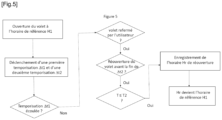
- a shutter is closed by the user after its automated opening, i.e. after time H1, it must have been closed before the expiration of a first predetermined time delay ⁇ t1 starting at the reference time H1.
- a reopening of said shutter must be triggered by the user at a later time H2 which is included in a second predetermined time delay ⁇ t2 and also begins at the reference time H1 initially stored for the automated opening of the shutter.
- the temperature T must be lower than the second temperature threshold T2.
Landscapes
- Engineering & Computer Science (AREA)
- Structural Engineering (AREA)
- Architecture (AREA)
- Civil Engineering (AREA)
- Operating, Guiding And Securing Of Roll- Type Closing Members (AREA)
Applications Claiming Priority (1)
| Application Number | Priority Date | Filing Date | Title |
|---|---|---|---|
| FR2312550A FR3155556B1 (fr) | 2023-11-16 | 2023-11-16 | Procédé de pilotage d’un volet roulant en fonction des conditions de luminosité et de température extérieures |
Publications (1)
| Publication Number | Publication Date |
|---|---|
| EP4556674A1 true EP4556674A1 (de) | 2025-05-21 |
Family
ID=90054173
Family Applications (1)
| Application Number | Title | Priority Date | Filing Date |
|---|---|---|---|
| EP24212411.3A Pending EP4556674A1 (de) | 2023-11-16 | 2024-11-12 | Verfahren zur steuerung eines rollladens auf basis von externen helligkeits- und temperaturbedingungen |
Country Status (2)
| Country | Link |
|---|---|
| EP (1) | EP4556674A1 (de) |
| FR (1) | FR3155556B1 (de) |
Citations (2)
| Publication number | Priority date | Publication date | Assignee | Title |
|---|---|---|---|---|
| CN107989520A (zh) * | 2017-12-26 | 2018-05-04 | 无锡日兆节能科技有限公司 | 智能遮阳一体化卷帘门窗 |
| FR3118643A1 (fr) * | 2021-01-05 | 2022-07-08 | Somfy Activites Sa | Dispositif d’entraînement motorisé pour un dispositif d’occultation, dispositif d’occultation et procédé de commande en fonctionnement associés |
-
2023
- 2023-11-16 FR FR2312550A patent/FR3155556B1/fr active Active
-
2024
- 2024-11-12 EP EP24212411.3A patent/EP4556674A1/de active Pending
Patent Citations (2)
| Publication number | Priority date | Publication date | Assignee | Title |
|---|---|---|---|---|
| CN107989520A (zh) * | 2017-12-26 | 2018-05-04 | 无锡日兆节能科技有限公司 | 智能遮阳一体化卷帘门窗 |
| FR3118643A1 (fr) * | 2021-01-05 | 2022-07-08 | Somfy Activites Sa | Dispositif d’entraînement motorisé pour un dispositif d’occultation, dispositif d’occultation et procédé de commande en fonctionnement associés |
Also Published As
| Publication number | Publication date |
|---|---|
| FR3155556A1 (fr) | 2025-05-23 |
| FR3155556B1 (fr) | 2025-10-31 |
Similar Documents
| Publication | Publication Date | Title |
|---|---|---|
| EP2682824B1 (de) | Verfahren und Vorrichtung zur Steuerung mindestens einer Verdunkelungsvorrichtung für mindestens ein Öffnungselement eines Gebäudeteils | |
| CN103931274A (zh) | 用于自动开启或关闭路灯的控制装置和控制方法 | |
| EP2154437B1 (de) | Regulierungsoptimierung der Gebäudeheizung auf der Basis von Wettervorhersagen | |
| EP1383982B1 (de) | Verfahren zum überwachen der tageslicht- und/oder wärmeenergiezufuhr mittels öffnungen und/oder des luftzustandes | |
| EP1054134B1 (de) | Verfahren zur Steuerung der Tätigkeit von motorisierten Verschlussystemen eines Gebäudes | |
| FR3155556A1 (fr) | Procédé de pilotage d’un volet roulant en fonction des conditions de luminosité et de température extérieures | |
| EP4592491B1 (de) | Verfahren zur automatisierten steuerung des hitzeverschlusses eines nicht solarbetriebenen fensterladens | |
| EP4592492B1 (de) | Verfahren zur automatisierten steuerung des hitzeverschlusses eines sonnenladens | |
| FR3104750A1 (fr) | Système de régulation de la température et/ou de la luminosité d’un local équipé de vitrages activables par courant électrique | |
| FR3013378A1 (fr) | Menuiserie telle qu'une fenetre ou une porte | |
| EP2682823B1 (de) | Verfahren und Vorrichtung zur Steuerung mindestens einer Verdunkelungsvorrichtung für mindestens ein Öffnungselement eines Gebäudeteils | |
| FR3009013A1 (fr) | Procede de commande d’un actionneur pour un equipement mobile | |
| CH627258A5 (de) | ||
| EP1245782A1 (de) | Motorisierter Rolladen mit einer Vorrichtung zur Erkennung eines Hindernisses | |
| EP4720791A1 (de) | Verfahren zur erkennung einer vorgegebenen zeit | |
| EP4474720B1 (de) | Verfahren und vorrichtung zur steuerung mindestens einer verdunkelungsvorrichtung | |
| EP2936256A2 (de) | Verfahren zur steuerung eines stellantriebs für ein mobiles objekt einer anlage in einem gebäude | |
| FR2509021A1 (fr) | Dispositif de selection automatique de programmes de chauffage | |
| FR3162289A1 (fr) | Procédé de gestion d’une installation domotique | |
| EP4575173A1 (de) | Algorithmus zur erkennung einer überhitzung aus einer aussentemperaturmessung | |
| EP4484695A1 (de) | Verfahren zum lernen eines beweglichen verdunkelungselements einer glasoberfläche durch ein system zum steuern der sonneneinstrahlung | |
| WO2024246453A1 (fr) | Algorithme de détection d'une surchauffe à partir d'une mesure de température intérieure | |
| EP4492622A1 (de) | Verfahren zur diagnose einer motorischen antriebseinrichtung für eine verdunkelungsvorrichtung einer schliess-, verdunkelungs- oder sonnenschutzanlage | |
| FR2999304A1 (fr) | Procede de fonctionnement d'un dispositif domotique pour la mise en œuvre d'une periode d'inhibition de la detection de crepuscule | |
| EP0018906A1 (de) | Fassadenglaselemente, insbesondere Fertigfenster |
Legal Events
| Date | Code | Title | Description |
|---|---|---|---|
| PUAI | Public reference made under article 153(3) epc to a published international application that has entered the european phase |
Free format text: ORIGINAL CODE: 0009012 |
|
| STAA | Information on the status of an ep patent application or granted ep patent |
Free format text: STATUS: THE APPLICATION HAS BEEN PUBLISHED |
|
| AK | Designated contracting states |
Kind code of ref document: A1 Designated state(s): AL AT BE BG CH CY CZ DE DK EE ES FI FR GB GR HR HU IE IS IT LI LT LU LV MC ME MK MT NL NO PL PT RO RS SE SI SK SM TR |
|
| STAA | Information on the status of an ep patent application or granted ep patent |
Free format text: STATUS: REQUEST FOR EXAMINATION WAS MADE |
|
| 17P | Request for examination filed |
Effective date: 20250801 |