EP4559527A2 - Fabrication d'un produit pharmaceutique cristallin - Google Patents
Fabrication d'un produit pharmaceutique cristallin Download PDFInfo
- Publication number
- EP4559527A2 EP4559527A2 EP25162995.2A EP25162995A EP4559527A2 EP 4559527 A2 EP4559527 A2 EP 4559527A2 EP 25162995 A EP25162995 A EP 25162995A EP 4559527 A2 EP4559527 A2 EP 4559527A2
- Authority
- EP
- European Patent Office
- Prior art keywords
- crystalline particles
- water
- solvent
- pyrazole
- pyrazol
- Prior art date
- Legal status (The legal status is an assumption and is not a legal conclusion. Google has not performed a legal analysis and makes no representation as to the accuracy of the status listed.)
- Pending
Links
Images

Classifications
-
- A—HUMAN NECESSITIES
- A61—MEDICAL OR VETERINARY SCIENCE; HYGIENE
- A61K—PREPARATIONS FOR MEDICAL, DENTAL OR TOILETRY PURPOSES
- A61K31/00—Medicinal preparations containing organic active ingredients
- A61K31/33—Heterocyclic compounds
- A61K31/395—Heterocyclic compounds having nitrogen as a ring hetero atom, e.g. guanethidine or rifamycins
- A61K31/41—Heterocyclic compounds having nitrogen as a ring hetero atom, e.g. guanethidine or rifamycins having five-membered rings with two or more ring hetero atoms, at least one of which being nitrogen, e.g. tetrazole
- A61K31/415—1,2-Diazoles
- A61K31/4155—1,2-Diazoles non condensed and containing further heterocyclic rings
-
- A—HUMAN NECESSITIES
- A61—MEDICAL OR VETERINARY SCIENCE; HYGIENE
- A61K—PREPARATIONS FOR MEDICAL, DENTAL OR TOILETRY PURPOSES
- A61K9/00—Medicinal preparations characterised by special physical form
- A61K9/14—Particulate form, e.g. powders, Processes for size reducing of pure drugs or the resulting products, Pure drug nanoparticles
-
- A—HUMAN NECESSITIES
- A61—MEDICAL OR VETERINARY SCIENCE; HYGIENE
- A61P—SPECIFIC THERAPEUTIC ACTIVITY OF CHEMICAL COMPOUNDS OR MEDICINAL PREPARATIONS
- A61P35/00—Antineoplastic agents
-
- C—CHEMISTRY; METALLURGY
- C07—ORGANIC CHEMISTRY
- C07D—HETEROCYCLIC COMPOUNDS
- C07D231/00—Heterocyclic compounds containing 1,2-diazole or hydrogenated 1,2-diazole rings
- C07D231/02—Heterocyclic compounds containing 1,2-diazole or hydrogenated 1,2-diazole rings not condensed with other rings
- C07D231/10—Heterocyclic compounds containing 1,2-diazole or hydrogenated 1,2-diazole rings not condensed with other rings having two or three double bonds between ring members or between ring members and non-ring members
- C07D231/14—Heterocyclic compounds containing 1,2-diazole or hydrogenated 1,2-diazole rings not condensed with other rings having two or three double bonds between ring members or between ring members and non-ring members with hetero atoms or with carbon atoms having three bonds to hetero atoms with at the most one bond to halogen, e.g. ester or nitrile radicals, directly attached to ring carbon atoms
-
- A—HUMAN NECESSITIES
- A61—MEDICAL OR VETERINARY SCIENCE; HYGIENE
- A61K—PREPARATIONS FOR MEDICAL, DENTAL OR TOILETRY PURPOSES
- A61K45/00—Medicinal preparations containing active ingredients not provided for in groups A61K31/00 - A61K41/00
- A61K45/06—Mixtures of active ingredients without chemical characterisation, e.g. antiphlogistics and cardiaca
-
- C—CHEMISTRY; METALLURGY
- C07—ORGANIC CHEMISTRY
- C07B—GENERAL METHODS OF ORGANIC CHEMISTRY; APPARATUS THEREFOR
- C07B2200/00—Indexing scheme relating to specific properties of organic compounds
- C07B2200/13—Crystalline forms, e.g. polymorphs
Definitions
- the present invention relates to crystalline particles of N-(( S )-1-(3-(3-chloro-4-cyanophenyl)-1H-pyrazol-1-yl)-propan-2-yl)-5-(1-hydroxyethyl)-1H-pyrazole-3-carboxamide (I) having specific surface area (SSA) in the range from about 8 to about 16 m 2 /g, preferably from about 10 to about 15 m 2 /g, and to the method for the preparation of such particles.
- SSA specific surface area
- Compound (I) is a potent androgen receptor (AR) modulator useful in the treatment of cancer, particularly AR dependent cancer such as prostate cancer, and other diseases where AR antagonism is desired.
- Compound (I) is represented by the structure:
- Compound (I) is poorly soluble in water. Poorly soluble compounds often suffer from low oral bioavailability. Enhancement of bioavailability of poorly soluble drugs is routinely attempted by micronization. Micronization, i.e. reduction of particle size to the range of only few micrometers, typically increases the dissolution rate of the poorly soluble drug through increased specific surface area (SSA). Micronized particles, however, often suffer from poor flow and dispersion properties causing drawbacks in subsequent pharmaceutical processing.
- SSA specific surface area
- a stable crystalline form of compound (I) and a method for the preparation thereof by crystallization from a mixture of acetonitrile and water has been disclosed in WO 2016/120530 .
- the method produces small irregular particles with sharp edges. Such particles are not optimal for pharmaceutical processing purposes either, for example due to poor flowability of the powder or cumbersome isolation. Therefore, there is a need for crystalline particles of compound (I) which are better suited for pharmaceutical processing.
- compound (I) can be obtained from the crystallization solvent as crystalline particles which have better properties for subsequent pharmaceutical processing.
- the obtained particles have consistent and relatively high specific surface area (SSA) in the range of 8 - 16 m 2 /g, preferably in the range of 10 - 15 m 2 /g, large volume median diameter, for example in the range of 100 - 1000 ⁇ m, and narrow particle size distribution.
- SSA specific surface area
- the particles have rounded particle shape.
- the particles having rounded particle shape are characterized by substantial lack of sharp edges.
- the particles of the present invention are easy to isolate, free flowing and exhibit reduced stickiness.
- the specific surface area (SSA) of the particles in the range of from about 8 to about 16 m 2 /g, preferably from about 10 to about 15 m 2 /g, does not significantly change even though the volume median diameter of the particles is reduced to the range of 10 - 100 ⁇ m, e.g. by milling. This ascertains consistent bioavailability regardless of the variability in particle size.
- the particles according to the present invention are particularly well suited for pharmaceutical processing.
- the present invention provides crystalline particles of N-(( S )-1-(3-(3-chloro-4-cyanophenyl)-1H-pyrazol-1-yl)-propan-2-yl)-5-(1-hydroxyethyl)-1H-pyrazole-3-carboxamide (I) having specific surface area (SSA) in the range from about 8 to about 16 m 2 /g, preferably from about 10 to about 15 m 2 /g.
- SSA specific surface area
- the present invention provides crystalline particles of N-(( S )-1-(3-(3-chloro-4-cyanophenyl)-1H-pyrazol-1-yl)-propan-2-yl)-5-(1-hydroxyethyl)-1H-pyrazole-3-carboxamide (I) having specific surface area (SSA) in the range from about 8 to about 16 m 2 /g, preferably from about 10 to about 15 m 2 /g, and a volume median diameter (Dv50) ⁇ 10 ⁇ m, preferably ⁇ 15 ⁇ m, more preferably ⁇ 20 ⁇ m.
- SSA specific surface area
- Dv50 volume median diameter
- the present invention provides crystalline particles of N-(( S )-1-(3-(3-chloro-4-cyanophenyl)-1H-pyrazol-1-yl)-propan-2-yl)-5-(1-hydroxyethyl)-1H-pyrazole-3-carboxamide (I) having specific surface area (SSA) in the range from about 8 to about 16 m 2 /g, preferably from about 10 to about 15 m 2 /g, and a volume median diameter (Dv50) between 10 - 1000 ⁇ m, preferably between 15 - 800 ⁇ m, more preferably between 20 - 750 ⁇ m.
- SSA specific surface area
- Dv50 volume median diameter
- the present invention provides crystalline particles of N-(( S )-1-(3-(3-chloro-4-cyanophenyl)-1H-pyrazol-1-yl)-propan-2-yl)-5-(1-hydroxyethyl)-1H-pyrazole-3-carboxamide (I) having specific surface area (SSA) in the range from about 8 to about 16 m 2 /g, preferably from about 10 to about 15 m 2 /g, and a volume median diameter (Dv50) between 100 - 1000 ⁇ m, preferably between 120 - 800 ⁇ m, more preferably between 150 - 750 ⁇ m.
- the crystalline particles have rounded particle shape.
- the present invention provides crystalline particles of N-(( S )-1-(3-(3-chloro-4-cyanophenyl)-1H-pyrazol-1-yl)-propan-2-yl)-5-(1-hydroxyethyl)-1H-pyrazole-3-carboxamide (I) having volume median diameter (Dv50) between 100 - 1000 ⁇ m, preferably between 120 - 800 ⁇ m, more preferably between 150 - 750 ⁇ m, and rounded particle shape.
- Dv50 volume median diameter
- the present invention provides a pharmaceutical dosage form comprising N-(( S )-1-(3-(3-chloro-4-cyanophenyl)-1H-pyrazol-1-yl)-propan-2-yl)-5-(1-hydroxyethyl)-1H-pyrazole-3-carboxamide (I) as an active ingredient, wherein the active ingredient is in the form of crystalline particles according to any of the above embodiments.
- the present invention provides a pharmaceutical dosage form, wherein the active ingredient is prepared from crystalline particles of N-(( S )-1-(3-(3-chloro-4-cyanophenyl)-1H-pyrazol-1-yl)-propan-2-yl)-5-(1-hydroxyethyl)-1H-pyrazole-3-carboxamide (I) having volume median diameter (Dv50) between 100 - 1000 ⁇ m and rounded particle shape, for example by milling said particles to provide volume median diameter (Dv50) between 10 - 100 ⁇ m.
- the present invention provides a pharmaceutical dosage form, wherein the active ingredient is prepared from crystalline particles of N-(( S )-1-(3-(3-chloro-4-cyanophenyl)-1H-pyrazol-1-yl)-propan-2-yl)-5-(1-hydroxyethyl)-1H-pyrazole-3-carboxamide (I) having specific surface area (SSA) in the range from about 8 to about 16 m 2 /g, preferably from about 10 to about 15 m 2 /g, volume median diameter (Dv50) between 100 - 1000 ⁇ m and rounded particle shape, for example by milling said particles to provide volume median diameter (Dv50) between 10 - 100 ⁇ m.
- SSA specific surface area
- the present invention provides a method for preparing crystalline particles of N-(( S )-1-(3-(3-chloro-4-cyanophenyl)-1H-pyrazol-1-yl)-propan-2-yl)-5-(1-hydroxyethyl)-1H-pyrazole-3-carboxamide (I), the method comprising the steps of
- the present invention provides crystalline particles of N-(( S )-1-(3-(3-chloro-4-cyanophenyl)-1H-pyrazol-1-yl)-propan-2-yl)-5-(1-hydroxyethyl)-1H-pyrazole-3-carboxamide (I) having volume median diameter (Dv50) between 100 - 1000 ⁇ m, preferably between 120 - 800 ⁇ m, more preferably between 150 - 750 ⁇ m, and having rounded particle shape, said particles being obtainable by a method comprising the steps of
- particles being obtainable by the above method have specific surface area (SSA) in the range from about 8 to about 16 m 2 /g, preferably from about 10 to about 15 m 2 /g.
- SSA specific surface area
- particles having rounded particle shape refers to particles according to the present invention having substantially spherical, elliptical or potato-like geometries with curved surfaces substantially lacking sharp or rough edges, such geometries and surfaces being consistent and apparent when the particles are examined under a scanning electron microscope, particularly with 50 - 100 fold magnification.
- the rounded particles according to the invention are further characterized by having mean aspect ratio higher than 0.8, preferably higher than 0.82 and/or mean HS (high sensitivity) circularity higher than 0.89, preferably higher than 0.9.
- spect ratio refers to the ratio of the shortest dimension to the longest dimension of a particle and is in the range of 0 to 1.
- high sensitivity (HS) circularity refers to a parameter which is equal to the square of the circularity where the circularity is equal to the ratio of the circumference of a circle equal to the particle's projected area to the actual circumference (perimeter) of a particle.
- high sensitivity (HS) circularity is calculated as (4 ⁇ x Area)/(Perimeter 2 ).
- the mean aspect ratio and mean high sensitivity (HS) circularity of the particles can be determined by an optical microscopy based method on a dry dispersion, such as Morphologi G3 TM particle size and particle shape analyser (Malvern Instruments).
- the sample can be prepared by using the Morphologi G3 TM integrated dry powder disperser (Malvern Instruments), for example using sample amount of 7 mm 3 and dispersion pressure of 1.0 bar.
- the automated image analysis is suitably performed without filters.
- the applied magnification depends on the particle size of the analysed powder being typically 10x.
- crystalline particles of N-(( S )-1-(3-(3-chloro-4-cyanophenyl)-1H-pyrazol-1-yl)-propan-2-yl)-5-(1-hydroxyethyl)-1H-pyrazole-3-carboxamide (I) refers to particles of compound (I) wherein compound (I) is at least partly in crystalline, including microcrystalline, form.
- the term includes particles of compound (I) wherein compound (I) is at least partly in the crystalline form I, disclosed in WO 2016/120530 .
- the X-ray powder diffraction (XRPD) pattern of crystalline form I has characteristic peaks at about 8.5, 10.4, 16.6, 16.9, and 24.3 degrees 2-theta. Accordingly, the term includes particles which show XRPD characteristic peaks at about 8.5, 10.4, 16.6, 16.9, and 24.3 degrees 2-theta.
- the particle size distribution of crystalline particles of compound (I) can be analyzed by laser light diffraction, for example using Beckman Coulter LS13320 laser diffraction particle size analyzer equipped with Tornado Dry Powder System using air as dispersion medium with measurement pressure 24"H 2 O ⁇ 2"H 2 O, sample amount 10 ml, system controlled target 5 % for obscuration and applying Fraunhofer optical model.
- the parameters considered are the volumetric diameters in ⁇ m of the 10 th , 50 th and 90 th percentiles of the particles, expressed as Dv10, Dv50 and Dv90 respectively, which are determined by assuming that the particles have a geometric shape equivalent to a sphere.
- the specific surface area (SSA) of crystalline particles of compound (I) can be analyzed using the three-point nitrogen adsorption technique based on the Brunauer, Emmett and Teller (BET) theory, for example using TriStar 3000 automated gas adsorption analyzer, (Micromeritics, Inc.).
- BET Brunauer, Emmett and Teller
- the samples are suitably vacuum dried for 20 hours at 40°C.
- the volumetric method can be used at the relative pressure range of 0.1 - 0.3 P/P 0 .
- the present invention provides a method for preparing crystalline particles of N-(( S )-1-(3-(3-chloro-4-cyanophenyl)-1H-pyrazol-1-yl)-propan-2-yl)-5-(1-hydroxyethyl)-1H-pyrazole-3-carboxamide (I), the method comprising the steps of
- the solvent to be used in step a) generally comprises ethanol and water.
- the amount of water in the solvent of step a) is about 35 - 60 %, preferably 40 - 58 %, more preferably 42 - 55 %, per weight of the solvent.
- the solvent consists essentially of ethanol and water.
- the solvent of step a) contains 35 - 60 % of water and 40 - 65 % of ethanol, preferably 40 - 58 % of water and 42 - 60 % of ethanol, more preferably 42 - 55 % of water and 45 - 58 % of ethanol, per weight of the solvent.
- the solvent of step a) contains 45 - 52 % of water and 48 - 55 % of ethanol, per weight of the solvent. According to another embodiment, the solvent of step a) contains 48 - 55 % of water and 45 - 52 % of ethanol, per weight of the solvent.
- the amount of compound (I) used in step a) is suitably about 1 - 20 %, preferably about 5 - 15 %, for example 6 - 12 %, per weight of the solvent.
- 150 - 250 kg of compound (I) is provided in 1500 - 3800 kg of ethanol-water solvent in a suitable reactor.
- the mixture is then heated with stirring, suitably to about refluxing temperature, for example to about 65 - 85 °C, until compound (I) has been dissolved.
- step c) the mixture is then cooled slowly to 20 - 35 °C while stirring mildly, typically with stirring speed less than 80 rpm.
- the cooling is carried out during at least 3 hours, preferably during about 4 to about 8 hours, optionally with seeding using crystals of compound (I).
- the seeding is suitably carried out at a temperature starting from about 75 °C and optionally again at lower temperatures.
- the seeding can be carried out once or several times when the temperature of the mixture is about 50 - 70 °C.
- the amount of seeding crystals is typically less than 0.5 % per weight of the compound (I) initially provided to the reactor.
- the seeding crystals of compound (I) can be prepared, for example, using the method described in WO 2016/120530 .
- step d) more water is added slowly to the mixture such that after the water addition the amount of water in the solvent is 55 - 80 %, preferably 58 - 78 %, more preferably 60 - 75 %, per weight of the solvent.
- the solvent consists essentially of ethanol and water.
- the solvent after step d) contains 55 - 80 % of water and 20 - 45 % of ethanol, preferably 58 - 78 % of water and 22 - 42 % of ethanol, more preferably 60 - 75 % of water and 25 - 40 % of ethanol, per weight of the solvent.
- the solvent after step d) contains 60 - 65 % of water and 35 - 40 % of ethanol, per weight of the solvent. According to another embodiment, the solvent after step d) contains 65 - 70 % of water and 30 - 35 % of ethanol, per weight of the solvent. According to still another embodiment, the solvent after step d) contains 70 - 75 % of water and 25 - 30 % of ethanol, per weight of the solvent.
- the solvent of step a) contains 48 - 55 % of water and 45 - 52 % of ethanol, per weight of the solvent, and after step d) 60 - 65 % of water and 35 - 40 % of ethanol, per weight of the solvent.
- the solvent of step a) contains 45 - 52 % of water and 48 - 55 % of ethanol, per weight of the solvent, and in step d) 70 - 75 % of water and 25 - 30 % of ethanol, per weight of the solvent.
- the addition of water is carried out during at least 1 hour, preferably during about 2 to about 10 hours, for example during about 6 to about 10 hours.
- the mixture is stirred mildly during water addition, typically with stirring speed less than 80 rpm.
- the temperature of the mixture is suitably kept within about 20 - 35 °C during the addition of water.
- steps c) and d) can be carried out simultaneously.
- water is added during the cooling step.
- the procedure of water addition can be carried out as explained above while cooling the mixture to about 20 - 35 °C including the optional seeding.
- the simultaneous cooling and water addition is suitably carried out during at least 3 hours, preferably during 4 - 10 hours.
- the mixture can be cooled further, preferably to about 10 - 30 °C, for example to 10 - 20 °C, during at least 1 hour, for example during 1 - 3 h. After the cooling the mixture is suitably stirred until the precipitation is complete.
- the precipitated crystalline particles are easy to isolate, for example by centrifuging followed by washing with water and/or ethanol.
- the isolated precipitate can be dried under reduced pressure, for example at vacuum, at a temperature which is at least 30 °C, for example 40 - 60 °C, for a period needed to complete the drying.
- the particles obtained by the above method are crystalline, have typically rounded particle shape and exhibit specific surface area (SSA) typically in the range from about 8 to about 16 m 2 /g, more typically from about 10 to about 15 m 2 /g.
- the particles obtained have generally volume median diameter (Dv50) between 100 - 1000 ⁇ m, preferably between 120 - 800 ⁇ m, more preferably between 150 - 750 ⁇ m, in particular between 180 - 700 ⁇ m, for example between 200 - 650 ⁇ m.
- Dv10 is generally greater than about 50 ⁇ m, preferably greater than about 60 ⁇ m, more preferably greater than about 70 ⁇ m, in particular between 80 - 500 ⁇ m, for example between 100 - 400 ⁇ m.
- Dv90 is generally lower than 2000 ⁇ m, preferably lower than 1500 ⁇ m, more preferably lower than 1400 ⁇ m, in particular between 300 - 1300 ⁇ m, for example between 400 - 1200 ⁇ m.
- 80 vol-% of the particles is generally between 50 - 2000 ⁇ m, preferably between 60 - 1500 ⁇ m, more preferably between 70 - 1400 ⁇ m, in particular between 80 - 1300 ⁇ m, for example between 100 - 1200 ⁇ m.
- the rounded particles obtained by the above method are typically characterized by mean aspect ratio higher than 0.8 and/or mean high sensitivity (HS) circularity higher than 0.89. More typically, the rounded particles are characterized by mean aspect ratio higher than 0.8 and mean high sensitivity (HS) circularity higher than 0.89. Still more typically, the rounded particles are characterized by mean aspect ratio higher than 0.82 and mean high sensitivity (HS) circularity higher than 0.9.
- the particles obtained by the above method have large volume median diameter, narrow particle size distribution and rounded particle shape characterized by substantial lack of sharp edges, they are easy to isolate, free flowing and exhibit reduced stickiness.
- the specific surface area (SSA) of the rounded particles obtained by the above method is in the range from about 8 to about 16 m 2 /g, preferably from about 10 to about 15 m 2 /g, and does not significantly change even though the volume median diameter (Dv50) of the particles is reduced, for example, to the range of 10 - 100 ⁇ m by milling or other suitable means. This ascertains consistent bioavailability regardless of the variability in particle size.
- the rounded particles can be milled to the particle size having Dv50, for example, in the range of 10 - 100 ⁇ m, preferably between 15 - 95 ⁇ m, typically between 20 - 90 ⁇ m, such particles being well suited in the preparation pharmaceutical dosage forms for oral administration such as tablets.
- the crystalline rounded particles of compound (I) obtained by the method of the invention can therefore be used as such or in milled form in the preparation of pharmaceutical dosage forms, such as tablets, capsules or powders together with excipients which are known in the art.
- the mixture was warmed to 65 °C and then transferred to 6.3 m 3 jacketed steel reaction vessel. The mixture was warmed to 78 °C to dissolve the mixture.
- the solution was cooled to 64 °C under nitrogen atmosphere. The solution was seeded at 64 °C under mild stirring. The solution was then cooled during 8 h to 30 °C under mild stirring. Thereafter water (2600 kg) was added during 7 - 10 h at 30 °C under mild stirring. The mixture was cooled during 2 h to 20 °C under mild stirring and then stirred further for 1 h.
- the precipitated product was isolated by centrifuge, washed with water and dried under vacuum at 40 - 60 °C to obtain 214 kg of crystalline particles with rounded particle shape.
- the carbon/celite cake was washed with a warmed (75 °C) mixture of water (970 kg) and EtOH (345 kg). The washing liquid was also added to the reaction vessel. The solution was stirred at 78 °C for 30 min and then cooled to 70 °C. Mild stirring was maintained during the rest of the process. The solution was seeded at 70 °C and then cooled during 4 h to 30 ⁇ 5 °C. Thereafter water (840 kg) was added during 6 h at 30 ⁇ 5 °C. The mixture was cooled during 2 h to 20 °C and then stirred further for 1 h. The precipitated product was isolated by centrifuge, washed with EtOH and dried under vacuum at 40 - 60 °C to obtain 190 kg of crystalline particles with rounded particle shape.
- the particle size distribution of the crystalline rounded particles of compound (I) prepared according to the present invention was determined by laser light diffraction. The determination was carried out by using Beckman Coulter LS13320 laser diffraction particle size analyzer equipped with Tornado Dry Powder System using air as dispersion medium with measurement pressure 24"H 2 O ⁇ 2"H 2 O, sample amount 10 ml, system controlled target 5 % for obscuration and applying Fraunhofer optical model. The results of the particle size analysis are shown in Fig. 1 . According to the analysis, Dv10 value of the particles is 359 ⁇ m, Dv50 is 632 ⁇ m and Dv90 is 925 ⁇ m.
- Crystalline rounded particles of compound (I) prepared according to the present invention were characterized by scanning electron microscope imaging.
- the SEM figure is shown in Fig. 2 (50 fold magnification, bar 500 ⁇ m).
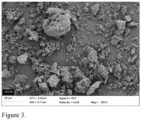
- a SEM image of the particles prepared according to Example 1 of WO 2016/120530 is shown in Fig. 3 (500 fold magnification, bar 30 ⁇ m).
- the particles prepared according to the present invention exhibit rounded particle shape with narrow particle size distribution while the particles prepared according to WO 2016/120530 are small and irregular with sharp edges.
- the specific surface area was measured using the three-point nitrogen adsorption technique based on the Brunauer, Emmett and Teller (BET) theory using TriStar 3000 automated gas adsorption analyzer (Micromeritics, Inc.). The samples were vacuum dried for 20 hours in 40 °C. The volumetric method was applied at the relative pressure range 0.1 - 0.3 P/P 0 .
- BET Brunauer, Emmett and Teller
Landscapes
- Chemical & Material Sciences (AREA)
- Organic Chemistry (AREA)
- Health & Medical Sciences (AREA)
- Animal Behavior & Ethology (AREA)
- Public Health (AREA)
- Pharmacology & Pharmacy (AREA)
- Veterinary Medicine (AREA)
- Life Sciences & Earth Sciences (AREA)
- Medicinal Chemistry (AREA)
- General Health & Medical Sciences (AREA)
- Chemical Kinetics & Catalysis (AREA)
- General Chemical & Material Sciences (AREA)
- Nuclear Medicine, Radiotherapy & Molecular Imaging (AREA)
- Epidemiology (AREA)
- Engineering & Computer Science (AREA)
- Bioinformatics & Cheminformatics (AREA)
- Pharmaceuticals Containing Other Organic And Inorganic Compounds (AREA)
- Plural Heterocyclic Compounds (AREA)
Applications Claiming Priority (3)
| Application Number | Priority Date | Filing Date | Title |
|---|---|---|---|
| FI20175202 | 2017-03-07 | ||
| EP18709661.5A EP3592732B1 (fr) | 2017-03-07 | 2018-02-27 | Fabrication d'un produit pharmaceutique cristallin |
| PCT/FI2018/050143 WO2018162793A1 (fr) | 2017-03-07 | 2018-02-27 | Fabrication d'un produit pharmaceutique cristallin |
Related Parent Applications (1)
| Application Number | Title | Priority Date | Filing Date |
|---|---|---|---|
| EP18709661.5A Division EP3592732B1 (fr) | 2017-03-07 | 2018-02-27 | Fabrication d'un produit pharmaceutique cristallin |
Publications (2)
| Publication Number | Publication Date |
|---|---|
| EP4559527A2 true EP4559527A2 (fr) | 2025-05-28 |
| EP4559527A3 EP4559527A3 (fr) | 2025-08-27 |
Family
ID=61599196
Family Applications (2)
| Application Number | Title | Priority Date | Filing Date |
|---|---|---|---|
| EP18709661.5A Active EP3592732B1 (fr) | 2017-03-07 | 2018-02-27 | Fabrication d'un produit pharmaceutique cristallin |
| EP25162995.2A Pending EP4559527A3 (fr) | 2017-03-07 | 2018-02-27 | Fabrication d'un produit pharmaceutique cristallin |
Family Applications Before (1)
| Application Number | Title | Priority Date | Filing Date |
|---|---|---|---|
| EP18709661.5A Active EP3592732B1 (fr) | 2017-03-07 | 2018-02-27 | Fabrication d'un produit pharmaceutique cristallin |
Country Status (23)
| Country | Link |
|---|---|
| US (1) | US11168058B2 (fr) |
| EP (2) | EP3592732B1 (fr) |
| JP (1) | JP7157071B2 (fr) |
| KR (3) | KR102676383B1 (fr) |
| CN (4) | CN121181479A (fr) |
| AU (1) | AU2018229817B2 (fr) |
| BR (1) | BR112019018458A2 (fr) |
| CA (2) | CA3055019C (fr) |
| CL (2) | CL2019002540A1 (fr) |
| DK (1) | DK3592732T3 (fr) |
| EA (1) | EA201992103A1 (fr) |
| ES (1) | ES3027971T3 (fr) |
| FI (1) | FI3592732T3 (fr) |
| HR (1) | HRP20250684T1 (fr) |
| HU (1) | HUE071505T2 (fr) |
| LT (1) | LT3592732T (fr) |
| MX (1) | MX2019010452A (fr) |
| PL (1) | PL3592732T3 (fr) |
| PT (1) | PT3592732T (fr) |
| RS (1) | RS66855B1 (fr) |
| SI (1) | SI3592732T1 (fr) |
| UA (1) | UA126071C2 (fr) |
| WO (1) | WO2018162793A1 (fr) |
Families Citing this family (7)
| Publication number | Priority date | Publication date | Assignee | Title |
|---|---|---|---|---|
| JP2021515040A (ja) | 2018-02-27 | 2021-06-17 | サンド・アクチエンゲゼルシヤフト | ダロルタミドの結晶形態ii |
| EP3917519A1 (fr) | 2019-01-30 | 2021-12-08 | Aragon Pharmaceuticals, Inc. | Anti-androgènes pour le traitement du cancer de la prostate métastatique sensible à la castration |
| WO2021001603A1 (fr) | 2019-07-02 | 2021-01-07 | Orion Corporation | Composition pharmaceutique de darolutamide |
| WO2022036782A1 (fr) * | 2020-08-18 | 2022-02-24 | 拜耳消费者护理股份有限公司 | Forme cristalline csvi d'un médicament antagoniste du récepteur des androgènes, son procédé de préparation et son utilisation |
| WO2022144926A1 (fr) * | 2020-12-31 | 2022-07-07 | Msn Laboratories Private Limited, R&D Center | Procédé de préparation de n-{(2s)-1-[3-(3-chloro-4-cyanophényl)-1h-pyrazol-1-yl]propan-2-yl}-5-(1-hydroxyéthyl)-1h-pyrazole-3-carboxamide amorphe |
| EP4486727B1 (fr) | 2022-02-28 | 2026-02-25 | Química Sintética, S.A. | Forme cristalline de darolutamide |
| WO2025229051A1 (fr) | 2024-05-03 | 2025-11-06 | F. Hoffmann-La Roche Ag | Utilisation d'inhibiteurs d'atr en combinaison avec un agent anti-androgène |
Citations (2)
| Publication number | Priority date | Publication date | Assignee | Title |
|---|---|---|---|---|
| WO2011051540A1 (fr) | 2009-10-27 | 2011-05-05 | Orion Corporation | Composés modulateurs de récepteurs des androgènes |
| WO2016120530A1 (fr) | 2015-01-30 | 2016-08-04 | Orion Corporation | Dérivé de carboxamide et ses diastéréomères sous une forme cristalline stable |
Family Cites Families (8)
| Publication number | Priority date | Publication date | Assignee | Title |
|---|---|---|---|---|
| WO2007049292A1 (fr) * | 2005-10-27 | 2007-05-03 | Lupin Limited | Formulation pharmaceutique de losartan |
| CA2687794C (fr) * | 2007-05-28 | 2015-01-27 | Jin Satomi | Particule de cristal de mannitol spherique |
| WO2010084515A2 (fr) | 2009-01-23 | 2010-07-29 | Glenmark Generics Limited | Procédé pour la préparation de zofénopril et ses sels pharmaceutiquement acceptables |
| US20100234469A1 (en) * | 2009-03-12 | 2010-09-16 | Medichem, S.A. | New Crystals Of A Benzoylbenzeneacetamide Derivative |
| WO2012143599A1 (fr) * | 2011-04-21 | 2012-10-26 | Orion Corporation | Carboxamides modulant les récepteurs d'androgènes |
| EP2704576A4 (fr) * | 2011-05-04 | 2014-12-10 | Merck Sharp & Dohme | Procédés pour la préparation d'inhibiteurs du virus de l'hépatite c |
| JP6716023B2 (ja) | 2016-08-26 | 2020-07-01 | クリスタル ファーマシューティカル(スーチョウ)カンパニー,リミテッド | アンドロゲン受容体拮抗薬の結晶形及びその製造方法並びに用途 |
| CN107602471B (zh) | 2017-09-22 | 2021-04-27 | 成都恒汇化成医药科技有限公司 | 一种达罗鲁胺的晶型制备方法 |
-
2018
- 2018-02-27 CN CN202511412504.9A patent/CN121181479A/zh active Pending
- 2018-02-27 WO PCT/FI2018/050143 patent/WO2018162793A1/fr not_active Ceased
- 2018-02-27 AU AU2018229817A patent/AU2018229817B2/en active Active
- 2018-02-27 KR KR1020197029193A patent/KR102676383B1/ko active Active
- 2018-02-27 HU HUE18709661A patent/HUE071505T2/hu unknown
- 2018-02-27 UA UAA201910164A patent/UA126071C2/uk unknown
- 2018-02-27 CN CN201880016135.3A patent/CN110382467B/zh active Active
- 2018-02-27 HR HRP20250684TT patent/HRP20250684T1/hr unknown
- 2018-02-27 CN CN202511412369.8A patent/CN121021396A/zh active Pending
- 2018-02-27 BR BR112019018458-9A patent/BR112019018458A2/pt not_active Application Discontinuation
- 2018-02-27 JP JP2019548560A patent/JP7157071B2/ja active Active
- 2018-02-27 US US16/491,642 patent/US11168058B2/en active Active
- 2018-02-27 CA CA3055019A patent/CA3055019C/fr active Active
- 2018-02-27 KR KR1020247018685A patent/KR20240096691A/ko not_active Ceased
- 2018-02-27 ES ES18709661T patent/ES3027971T3/es active Active
- 2018-02-27 CA CA3292509A patent/CA3292509A1/fr active Pending
- 2018-02-27 FI FIEP18709661.5T patent/FI3592732T3/fi active
- 2018-02-27 SI SI201831234T patent/SI3592732T1/sl unknown
- 2018-02-27 RS RS20250547A patent/RS66855B1/sr unknown
- 2018-02-27 PL PL18709661.5T patent/PL3592732T3/pl unknown
- 2018-02-27 CN CN202511412433.2A patent/CN121202788A/zh active Pending
- 2018-02-27 DK DK18709661.5T patent/DK3592732T3/da active
- 2018-02-27 EP EP18709661.5A patent/EP3592732B1/fr active Active
- 2018-02-27 EP EP25162995.2A patent/EP4559527A3/fr active Pending
- 2018-02-27 KR KR1020257014818A patent/KR20250065940A/ko active Pending
- 2018-02-27 LT LTEPPCT/FI2018/050143T patent/LT3592732T/lt unknown
- 2018-02-27 EA EA201992103A patent/EA201992103A1/ru unknown
- 2018-02-27 MX MX2019010452A patent/MX2019010452A/es unknown
- 2018-02-27 PT PT187096615T patent/PT3592732T/pt unknown
-
2019
- 2019-09-04 CL CL2019002540A patent/CL2019002540A1/es unknown
-
2023
- 2023-09-20 CL CL2023002780A patent/CL2023002780A1/es unknown
Patent Citations (2)
| Publication number | Priority date | Publication date | Assignee | Title |
|---|---|---|---|---|
| WO2011051540A1 (fr) | 2009-10-27 | 2011-05-05 | Orion Corporation | Composés modulateurs de récepteurs des androgènes |
| WO2016120530A1 (fr) | 2015-01-30 | 2016-08-04 | Orion Corporation | Dérivé de carboxamide et ses diastéréomères sous une forme cristalline stable |
Also Published As
Similar Documents
| Publication | Publication Date | Title |
|---|---|---|
| EP3592732B1 (fr) | Fabrication d'un produit pharmaceutique cristallin | |
| JP2013516394A (ja) | 医薬用途用の1−(1h−1,2,4−トリアゾール−1−イル)ブタン−2−オール誘導体、および前記1−(1h−1,2,4−トリアゾール−1−イル)ブタン−2−オール誘導体を調製するための、実質的に不定の結晶形状を有する1−(1h−1,2,4−トリアゾール−1−イル)ブタン−2−オール誘導体の使用 | |
| US12172996B2 (en) | Methyl {4,6-diamino-2-[5-fluoro-1-(2-fluorobenzyl)-1H-pyrazolo[3,4-b]pyridin-3-yl]pyrimidin-5-yl}carbamate active compound product having improved properties, production and formulation thereof | |
| CN113271978B (zh) | 包括基本上无定形的介孔碳酸镁的新型无定形活性药物成分 | |
| WO2012026896A1 (fr) | Particules cristallines de tacrolimus micronisé à surface modifiée et compositions pharmaceutiques associées | |
| AU2020389425A1 (en) | Oral pharmaceutical composition comprising carbamate compound and preparation method therefor | |
| HK40025958A (en) | Manufacture of a crystalline pharmaceutical product | |
| HK40025958B (en) | Manufacture of a crystalline pharmaceutical product | |
| EA041260B1 (ru) | Получение кристаллического фармацевтического продукта | |
| HK40017691A (zh) | 结晶药物产品的制备 | |
| WO2007044251A2 (fr) | Compositions pharmaceutiques | |
| HK40017691B (zh) | 结晶药物产品的制备 | |
| BR122025003584A2 (pt) | Partículas cristalinas de n-((s)-1-(3-(3-cloro-4-cianofenil)-1h-pirazol-1- il)-propan-2-il)-5-(1-hidroxietil)-1h-pirazol-3-carboxamida, formas de dosagem farmacêutica que compreendem as ditas partículas cristalinas, processo para preparar as mesmas e uso das mesmas para tratar câncer | |
| US20100255105A1 (en) | Extended release pharmaceutical composition comprising metoprolol succinate |
Legal Events
| Date | Code | Title | Description |
|---|---|---|---|
| PUAI | Public reference made under article 153(3) epc to a published international application that has entered the european phase |
Free format text: ORIGINAL CODE: 0009012 |
|
| STAA | Information on the status of an ep patent application or granted ep patent |
Free format text: STATUS: THE APPLICATION HAS BEEN PUBLISHED |
|
| AC | Divisional application: reference to earlier application |
Ref document number: 3592732 Country of ref document: EP Kind code of ref document: P |
|
| AK | Designated contracting states |
Kind code of ref document: A2 Designated state(s): AL AT BE BG CH CY CZ DE DK EE ES FI FR GB GR HR HU IE IS IT LI LT LU LV MC MK MT NL NO PL PT RO RS SE SI SK SM TR |
|
| REG | Reference to a national code |
Ref country code: DE Ref legal event code: R079 Free format text: PREVIOUS MAIN CLASS: A61P0035000000 Ipc: C07D0231140000 |
|
| PUAL | Search report despatched |
Free format text: ORIGINAL CODE: 0009013 |
|
| AK | Designated contracting states |
Kind code of ref document: A3 Designated state(s): AL AT BE BG CH CY CZ DE DK EE ES FI FR GB GR HR HU IE IS IT LI LT LU LV MC MK MT NL NO PL PT RO RS SE SI SK SM TR |
|
| RIC1 | Information provided on ipc code assigned before grant |
Ipc: C07D 231/14 20060101AFI20250722BHEP Ipc: A61K 31/4152 20060101ALI20250722BHEP Ipc: A61P 35/00 20060101ALI20250722BHEP |
|
| STAA | Information on the status of an ep patent application or granted ep patent |
Free format text: STATUS: REQUEST FOR EXAMINATION WAS MADE |
|
| 17P | Request for examination filed |
Effective date: 20260226 |
|
| RAX | Requested extension states of the european patent have changed |
Extension state: BA Payment date: 20260226 Extension state: ME Payment date: 20260226 |