EP4564035A1 - Verfahren und vorrichtung zur erkennung eines fehlers einer bleibatterie - Google Patents
Verfahren und vorrichtung zur erkennung eines fehlers einer bleibatterie Download PDFInfo
- Publication number
- EP4564035A1 EP4564035A1 EP24214690.0A EP24214690A EP4564035A1 EP 4564035 A1 EP4564035 A1 EP 4564035A1 EP 24214690 A EP24214690 A EP 24214690A EP 4564035 A1 EP4564035 A1 EP 4564035A1
- Authority
- EP
- European Patent Office
- Prior art keywords
- intrinsic
- battery
- segment
- failure
- energy
- Prior art date
- Legal status (The legal status is an assumption and is not a legal conclusion. Google has not performed a legal analysis and makes no representation as to the accuracy of the status listed.)
- Pending
Links
Images


Classifications
-
- G—PHYSICS
- G01—MEASURING; TESTING
- G01R—MEASURING ELECTRIC VARIABLES; MEASURING MAGNETIC VARIABLES
- G01R31/00—Arrangements for testing electric properties; Arrangements for locating electric faults; Arrangements for electrical testing characterised by what is being tested not provided for elsewhere
- G01R31/36—Arrangements for testing, measuring or monitoring the electrical condition of accumulators or electric batteries, e.g. capacity or state of charge [SoC]
- G01R31/392—Determining battery ageing or deterioration, e.g. state of health
-
- H—ELECTRICITY
- H01—ELECTRIC ELEMENTS
- H01M—PROCESSES OR MEANS, e.g. BATTERIES, FOR THE DIRECT CONVERSION OF CHEMICAL ENERGY INTO ELECTRICAL ENERGY
- H01M10/00—Secondary cells; Manufacture thereof
- H01M10/06—Lead-acid accumulators
-
- H—ELECTRICITY
- H01—ELECTRIC ELEMENTS
- H01M—PROCESSES OR MEANS, e.g. BATTERIES, FOR THE DIRECT CONVERSION OF CHEMICAL ENERGY INTO ELECTRICAL ENERGY
- H01M10/00—Secondary cells; Manufacture thereof
- H01M10/42—Methods or arrangements for servicing or maintenance of secondary cells or secondary half-cells
- H01M10/48—Accumulators combined with arrangements for measuring, testing or indicating the condition of cells, e.g. the level or density of the electrolyte
Definitions
- the present invention relates to the field of lead-acid battery management. More particularly, a method and a device for detecting a failure of a lead-acid battery are provided.
- Data centers are responsible for storing, processing, and transmitting large amounts of data. They are critical infrastructure in today's digital world. Data center servers must remain operational at all times, so it's imperative that they be powered by a reliable electrical system. This is why data centers typically use uninterruptible power supply (UPS) systems.
- UPS uninterruptible power supply
- Lead-acid batteries are a critical component of uninterruptible power supply systems for a data server. Batteries store energy and, in the event of fluctuations or outages in the power supplied by the electrical grid, they can provide backup power to ensure the system remains operational. Batteries play an important role in protecting equipment, improving power quality, and meeting the power requirements of data centers.
- Lead-acid batteries are widely used in these uninterruptible power supply systems due to their low cost, long service life, and high reliability. They are also well-suited for use in relatively high-temperature environments, which is crucial for data centers.
- Lead-acid batteries require regular maintenance and inspection to ensure proper operation and avoid impacting the data center.
- Charging a lead-acid battery generally occurs in two successive phases.
- CC an acronym for “Constant Current”
- CV Constant Voltage
- the current flowing through the battery during the CV phase is often referred to as "floating current.” It prevents the lead-acid battery from self-discharging.
- the patent application EP 3324197 A1 describes a method for determining the state of health of a battery cell based on a ratio between a charge variation and a current difference measured between two instants of a CV phase (constant voltage recharge phase) of a CC-CV cycle (charge cycle comprising a constant current recharge phase followed by a constant voltage recharge phase).
- the present invention aims to remedy all or part of the drawbacks of the prior art, in particular those set out above.
- the present invention finds a particularly advantageous, although in no way limiting, application in the monitoring of a lead battery of an uninterruptible power supply system of a data server. However, nothing would prevent the present invention from being applied in other fields (lead batteries are notably widely used in industry and in the equipment of railway and automobile vehicles).
- the proposed method differs significantly from conventional methods in that it is based on the analysis of the floating current during the CV phase of a battery charge cycle. At first glance, there is no evidence to suggest that this signal contains relevant information for monitoring the battery's health status.
- Empirical mode decomposition is particularly well suited to analyzing this signal. This decomposition also has the advantage of being relatively fast and not very demanding in terms of computing capacity.
- the invention may further comprise one or more of the following characteristics, taken individually or in any technically possible combination.
- the normalized total intrinsic energy is equal to a ratio between a sum of the intrinsic energies of the different components and the maximum intrinsic energy.
- the evaluation of the battery failure detection criterion comprises a comparison of the normalized total intrinsic energy with a predetermined failure threshold.
- the evaluation of the battery failure detection criterion comprises a verification whether the normalized total intrinsic energy is greater than or equal to the failure threshold for a predetermined number of consecutive segments.
- the method when a failure is detected, the method further comprises a verification whether the detected failure is linked to the environment in which the battery has evolved.
- the verification whether the detected failure is linked to the environment comprises a comparison, for a given period comprising at least one segment, of the normalized total intrinsic energy calculated for the battery for said at least one segment with a normalized total intrinsic energy calculated for at least one other battery subjected to the same environment during said period.
- the verification whether the detected failure is linked to the environment comprises a comparison, for a given period comprising at least one segment, of environmental measurements carried out during said period with a predetermined threshold.
- a failure that is not related to the environment is potentially more serious since it indicates an intrinsic failure of the battery, such as a failure related to a manufacturing defect or premature degradation of the battery.
- An intrinsic failure of the battery may require maintenance to repair or replace the faulty battery.
- the method further comprises, for each segment of the plurality of segments, an estimation of a statistical reliability of the segment, as a function of the intrinsic components of the floating current signal of the segment.
- the segment is then filtered if it is deemed unreliable.
- the statistical reliability of the segment is estimated based on an entropy calculated for a sum of the intrinsic components of the floating current signal of the segment.
- a total intrinsic energy is calculated as a sum of the intrinsic energies of the different intrinsic components of the segment, and the statistical reliability of a segment is estimated by comparing the total intrinsic energy of the segment with a predetermined energy threshold, or with the total intrinsic energies calculated for at least one previous segment.
- This filtering step allows us to exclude segments with outliers (segments deemed statistically unreliable).
- the battery is part of an uninterruptible power supply system for a data server.
- the present invention provides a device for detecting a failure of a lead-acid battery.
- the device comprises a battery management system configured to provide measurements of current flowing in the battery during a "constant voltage" phase (CV phase) of a battery charging cycle.
- the device also comprises a computing unit connected to the battery management system, said computing unit being configured to implement a method according to any one of the previously described implementation modes.
- a lead-acid battery is an electrochemical accumulator whose electrodes are made of lead and the electrolyte is a mixture of water and sulfuric acid.
- the battery may consist of one or more cells in series assembled in a single casing.
- the electrodes are usually plates or grids made of a hardened lead alloy (for example, using tin, cadmium, and strontium, at a rate of a few percent of the alloy).
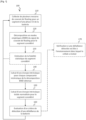
- FIG. 1 schematically represents the main steps of an example of implementation of a method 100 according to the invention for detecting a failure of a lead battery.
- the different segments correspond to a time division of the CV phase considered.
- Floating current measurements are, for example, carried out by a battery management system (BMS) connected to the battery.
- BMS battery management system
- the measurements are, for example, carried out with an acquisition frequency of between fifteen and sixty seconds in order to obtain between two hundred and eight hundred measurements per segment (in this case the duration of a segment is then between fifty and eight hundred minutes).
- nothing would prevent the measurements from being made with a different acquisition frequency, and/or with a different number of points per segment.
- it is advantageous to use a number of measurements between two hundred and eight hundred measurements per segment using a larger number of measurements does not necessarily imply a significant improvement in the method, and this results in relatively long calculation times; using a smaller number of measurements can, however, limit the performance of the method). All of the measurements collected during the collection step 110 form a floating current signal.
- step 120 the floating current signal is decomposed according to an empirical mode decomposition. It should be noted that nothing could suggest that this floating current signal could contain relevant information on the health status of the cell.
- Empirical mode decomposition consists of decomposing a signal into a sum of functions, similar to what Fourier series decomposition or wavelet decomposition does.
- One of the peculiarities of empirical mode decomposition is that the basis of functions into which the signal is decomposed is not known a priori, but is constructed adaptively based on the properties of the signal.
- Empirical mode decomposition corresponds to the first part of the Hilbert-Huang Transform (HHT).
- Empirical mode decomposition consists of decomposing a signal in the form of a sum of a residual signal and intrinsic mode functions (IMFs). In the present application, these intrinsic mode functions are also called “intrinsic components”.
- intrinsic components are not defined analytically. Rather, they are determined adaptively based on signal properties.
- r(t) corresponds to the residual signal
- N is the number of intrinsic components of the EMD decomposition
- c i ( t ) is the intrinsic component of index i.
- Each successive intrinsic component c i contains oscillations of lower frequency than the previous one.
- the residual signal corresponds to a general trend of the signal s(t).
- the empirical mode decomposition involves a series of sifting processes.
- the first sifting process takes the signal s(t) directly as input.
- the sifting process involves identifying all the local extrema of the input signal, and connecting the local maxima and local minima respectively, using cubic spline interpolation, to obtain an upper envelope and a lower envelope respectively. An average between the upper and lower envelopes can then be calculated and subtracted from the input signal. If the intermediate signal obtained (subtraction of the input signal with the average of the upper and lower envelopes) is not an intrinsic component, the sifting process is repeated on the intermediate signal (which therefore becomes the input signal for a new sifting process) until an intrinsic component is obtained. The sieving processes are repeated until the last intrinsic component is obtained, i.e., for example, until the intermediate signal becomes monotonic or has only one local extremum. The remaining signal then corresponds to the residual signal r(t).
- a stopping criterion can be defined for the sieving process. For example, the stopping criterion is satisfied if the standard deviation between the results of two successive sieving processes is less than or equal to a predetermined stopping threshold.
- the stopping threshold can typically be between 0.2 and 0.3.
- Empirical mode decomposition algorithms are available in programming libraries, for example in MATLAB or Python.
- an intrinsic energy is calculated for each intrinsic component obtained by the EMD decomposition.
- E max max i E i
- a normalized total intrinsic energy E is calculated based on the intrinsic energies E i and the maximum intrinsic energy E max .
- step 160 a battery failure detection criterion is evaluated based on the normalized total intrinsic energy E .
- the evaluation 160 of the battery failure detection criterion may in particular comprise a comparison of the normalized total intrinsic energy with a predetermined failure threshold. For example, a battery failure is detected if the normalized total intrinsic energy is greater than or equal to the failure threshold.
- the evaluation 160 of the battery failure detection criterion may also include a check whether the normalized total intrinsic energy is greater than or equal to the failure threshold for a predetermined number of consecutive segments. For example, a battery failure is detected if the normalized total intrinsic energy remains greater than or equal to the failure threshold for at least least five consecutive segments.
- the normalized total intrinsic energy value is considered to be related to the corrosion processes of the battery. Indeed, corrosion processes involve a multitude of events which, when normalized, imply a non-negligible contribution of the majority of intrinsic components (IMFs) and thus a value significantly greater than one (for example at least equal to two).
- IMFs intrinsic components
- the failure threshold can be determined empirically in the laboratory.
- the failure threshold can be specific to a particular type of battery.
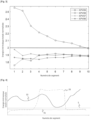
- FIG. 2 presents a graph showing the evolution over time of the normalized total intrinsic energy for seven different batteries subjected to a temperature above 50°C. This temperature corresponds to a maximum temperature threshold recommended by the battery manufacturer for normal battery operation.
- the y-axis of this graph represents the normalized total intrinsic energy value.
- the x-axis represents the segment number.
- FIG. 3 presents a graph representing the evolution over time of the normalized total intrinsic energy for four different batteries subjected to a temperature below the maximum threshold of 50°C.
- the normalized total intrinsic energy value is represented by the y-axis; the x-axis represents the segment number.
- a detected failure is related to the environment in which the battery has been operating. If the failure is environmentally related (for example, if the failure is due to an abnormal increase in temperature in the battery's location), corrective action can be taken at the battery's environmental level, and the failure will potentially have a limited impact over time. A failure that is not environmentally related is potentially more serious since it indicates an intrinsic failure of the battery, such as a failure related to a manufacturing defect or premature degradation of the battery. An intrinsic failure of the battery may require maintenance to repair or replace the faulty battery.
- method 100 may include an optional verification step 170 if a detected failure is linked to the environment in which the battery has evolved.
- This verification 170 may in particular comprise a comparison, for a given period comprising at least one segment, of the normalized total intrinsic energy calculated for the battery for said at least one segment with a normalized total intrinsic energy calculated for at least one other battery subjected to the same environment during said period. If the normalized total intrinsic energy values calculated for one or more other batteries subjected to the same environment highlight a similar abnormal development during a given period, then it is highly probable that this abnormal behavior is linked to the environment (for example because of an exceptional increase in the temperature experienced by the different batteries during this period).
- the verification 170 may comprise a comparison, for a given period comprising at least one segment, of environmental measurements carried out and stored during said period with a predetermined threshold. These may for example be measurements of the temperature experienced by the battery. If the environmental measurements highlight an abnormal change in the environment during the period considered (for example an exceptional increase in the temperature experienced by the battery during this period), then it is highly probable that a failure detected during this period is linked to the environment.
- the Figure 4 graphically represents the evolution over time of the normalized total intrinsic energy for three different batteries.
- the y-axis represents the normalized total intrinsic energy value; the x-axis represents the segment number.
- Curve 31 represents the evolution over time of the normalized total intrinsic energy for a non-failing battery subjected to a normal environment. This curve 31 remains continuously below the failure threshold S.
- Curve 32 represents the evolution over time of the normalized total intrinsic energy for a battery exhibiting an intrinsic failure (for example a design defect or premature deterioration of the battery). This curve 31 remains continuously above the failure threshold S. The method 100 according to the invention can make it possible to detect this intrinsic failure of the battery corresponding to curve 32.
- Curve 33 represents the evolution over time of the normalized total intrinsic energy for a non-failing battery subjected to an abnormal environment for a certain period of time. During this period, the battery is for example exposed to an exceptionally high temperature, which results in abnormal battery operation. As illustrated by curve 33 on the graph of the Figure 4 , the normalized total intrinsic energy of the battery is greater than the failure threshold S during the time period when the temperature is abnormally high. Outside of this time period, the normalized total intrinsic energy of the battery is less than the failure threshold S.
- the method 100 according to the invention can make it possible to detect the failure of the battery corresponding to the curve 33. The method 100 according to the invention can also make it possible to detect whether this failure is due to abnormal conditions of the environment in which the battery operates.
- measurements of abnormally high temperatures measured during the time period when the failure is detected suggest that this failure is due to abnormal conditions of the environment.
- similar abnormal behavior observed during the same time period for other batteries subjected to the same environment also suggests that this failure is due to abnormal conditions of the environment.
- the method 100 may also include an optional step 130 of estimating the statistical reliability of the segment considered, and filtering the segment if it is deemed unreliable (the segment and the associated measurements are then ignored, i.e. they are not taken into account in the evaluation 160 of the failure criterion).
- This filtering of a segment deemed unreliable makes it possible to avoid taking outlier values into account in the analysis of the battery health status.
- the statistical reliability of a segment is estimated based on the intrinsic components of the floating current signal obtained for the segment.
- the statistical reliability of the segment is estimated based on an entropy calculated for a sum of the intrinsic components of the floating current signal (for example for the sum of all the intrinsic components obtained by the EMD decomposition, or for the sum of a predefined maximum number of the first intrinsic components obtained by the EMD decomposition).
- Different entropy calculation methods can be considered, such as for example a Shannon entropy calculation, or a Kolmogorov entropy calculation.
- segments for which the calculated entropy is too low are filtered.
- a Shannon entropy threshold between 0.25 and 0.5 can in particular be considered.
- a total intrinsic energy equal to a sum of the intrinsic energies of the different intrinsic components of the segment is calculated (again, it is possible to consider the set of all intrinsic components obtained by the EMD decomposition, or only a subset of these intrinsic components).
- the statistical reliability of a segment is estimated by comparing the total intrinsic energy calculated for the segment with a predetermined energy threshold. For example, segments that have an aberrant total intrinsic energy value (greater than the energy threshold) are filtered out.
- the statistical reliability of a segment is estimated by comparing the total intrinsic energy calculated for the segment with the total intrinsic energies calculated for all or some of the previous segments (e.g., the total intrinsic energies can be compared with each other, or the total intrinsic energy of the current segment can be compared with an average value of the total intrinsic energies of previous segments). Different statistical tests can be considered for this purpose (Pierce test, Pierson test, etc.).
- FIG. 5 schematically represents a device 10 for detecting a failure of a lead battery 21.
- the device 10 comprises in particular a memory 11, a battery management system 13 and a computing unit 12 connected to the memory 11 and to the battery management system 13.
- the battery management system 13 is configured to provide current measurements made at the battery 21 during at least one segment of a CV phase of the battery.
- the calculation unit 12 is configured to implement the method 100 according to any one of the implementation modes described above.
- the device 10 may further comprise a sensor configured to measure the environment (for example a temperature sensor).
- a sensor configured to measure the environment (for example a temperature sensor).
- the battery management system 13 may also be configured to provide float current measurements of one or more other batteries 22 subjected to the same environment as the battery 21.
Landscapes
- Engineering & Computer Science (AREA)
- Manufacturing & Machinery (AREA)
- Chemical & Material Sciences (AREA)
- Chemical Kinetics & Catalysis (AREA)
- Electrochemistry (AREA)
- General Chemical & Material Sciences (AREA)
- Physics & Mathematics (AREA)
- General Physics & Mathematics (AREA)
- Secondary Cells (AREA)
Applications Claiming Priority (1)
| Application Number | Priority Date | Filing Date | Title |
|---|---|---|---|
| FR2313233A FR3155901B1 (fr) | 2023-11-29 | 2023-11-29 | Méthode et dispositif pour détecter une défaillance d’une batterie au plomb |
Publications (1)
| Publication Number | Publication Date |
|---|---|
| EP4564035A1 true EP4564035A1 (de) | 2025-06-04 |
Family
ID=90124039
Family Applications (1)
| Application Number | Title | Priority Date | Filing Date |
|---|---|---|---|
| EP24214690.0A Pending EP4564035A1 (de) | 2023-11-29 | 2024-11-22 | Verfahren und vorrichtung zur erkennung eines fehlers einer bleibatterie |
Country Status (2)
| Country | Link |
|---|---|
| EP (1) | EP4564035A1 (de) |
| FR (1) | FR3155901B1 (de) |
Citations (6)
| Publication number | Priority date | Publication date | Assignee | Title |
|---|---|---|---|---|
| JPH07183049A (ja) * | 1993-12-24 | 1995-07-21 | Shin Kobe Electric Mach Co Ltd | 蓄電池の劣化状態推定方法及び装置 |
| JPH08254573A (ja) * | 1995-03-15 | 1996-10-01 | Omron Corp | バッテリー計測装置 |
| EP3324197A1 (de) | 2016-11-22 | 2018-05-23 | Commissariat à l'Energie Atomique et aux Energies Alternatives | Verfahren zur bestimmung des zustands einer batteriezelle |
| CN109765496A (zh) * | 2018-12-20 | 2019-05-17 | 西安交通大学 | 一种基于在线电化学阻抗谱测量的电池健康状态估计方法 |
| CN110554328A (zh) * | 2019-09-27 | 2019-12-10 | 华侨大学 | 一种基于hht的蓄电池内阻测量方法和系统 |
| CN215297603U (zh) * | 2021-03-12 | 2021-12-24 | 国家计算机网络与信息安全管理中心 | 一种铅酸蓄电池状态监控系统 |
-
2023
- 2023-11-29 FR FR2313233A patent/FR3155901B1/fr active Active
-
2024
- 2024-11-22 EP EP24214690.0A patent/EP4564035A1/de active Pending
Patent Citations (6)
| Publication number | Priority date | Publication date | Assignee | Title |
|---|---|---|---|---|
| JPH07183049A (ja) * | 1993-12-24 | 1995-07-21 | Shin Kobe Electric Mach Co Ltd | 蓄電池の劣化状態推定方法及び装置 |
| JPH08254573A (ja) * | 1995-03-15 | 1996-10-01 | Omron Corp | バッテリー計測装置 |
| EP3324197A1 (de) | 2016-11-22 | 2018-05-23 | Commissariat à l'Energie Atomique et aux Energies Alternatives | Verfahren zur bestimmung des zustands einer batteriezelle |
| CN109765496A (zh) * | 2018-12-20 | 2019-05-17 | 西安交通大学 | 一种基于在线电化学阻抗谱测量的电池健康状态估计方法 |
| CN110554328A (zh) * | 2019-09-27 | 2019-12-10 | 华侨大学 | 一种基于hht的蓄电池内阻测量方法和系统 |
| CN215297603U (zh) * | 2021-03-12 | 2021-12-24 | 国家计算机网络与信息安全管理中心 | 一种铅酸蓄电池状态监控系统 |
Non-Patent Citations (1)
| Title |
|---|
| NORDEN E. HUANG ET AL.: "The empirical mode decomposition and the Hilbert spectrum for non-linear and non-stationary time series analysis", PROC. R. SOC. LOND. A, vol. 454, 1998, pages 903 - 995, XP002410420 |
Also Published As
| Publication number | Publication date |
|---|---|
| FR3155901B1 (fr) | 2025-10-17 |
| FR3155901A1 (fr) | 2025-05-30 |
Similar Documents
| Publication | Publication Date | Title |
|---|---|---|
| EP2397863B1 (de) | Verfahren zur Überwachung des Zustands einer Batterie | |
| EP4232834B1 (de) | Verfahren zur erkennung eines fehlers einer batteriemodulgruppe | |
| EP2537040A1 (de) | Verfahren zur vorort-diagnose von batterien durch elektrochemische impedanzspektroskopie | |
| FR2965360A1 (fr) | Procede de diagnostic in situ de batteries par spectroscopie d'impedance electrochimique | |
| FR2980850A1 (fr) | Procede et systeme de diagnotic de l'etat interne d'une batterie par emission acoustique. | |
| CA3175880C (fr) | Prediction de l'etat de sante d'un dispositif electrochimique par mesure de sa chute de capacite | |
| EP3824305A1 (de) | Verfahren und vorrichtung zur bestimmung einer maximalen verwendungsdauer einer batterie | |
| EP4564035A1 (de) | Verfahren und vorrichtung zur erkennung eines fehlers einer bleibatterie | |
| EP4564031A1 (de) | Verfahren und vorrichtung zur vorhersage des endes der lebensdauer einer bleibatterie | |
| FR3123992A1 (fr) | Procede d’estimation de l’etat de sante resistif d’au moins un element de stockage d’energie electrique d’une batterie electrique | |
| EP2406647A1 (de) | Verfahren zur bestimmung des ladestatus einer elektrochemischen quelle zum ziehen eines elektrofahrzeugs | |
| EP4564036A1 (de) | Verfahren und vorrichtung zur erkennung eines ausfalls einer lithium-ionen-batteriezelle | |
| EP3678255A1 (de) | Verfahren zur kalibrierung einer familie von lithium-ionen-batterieelementen, entsprechende lademethode, entsprechendes computerprogrammprodukt und entsprechende ladevorrichtung | |
| EP4187266A1 (de) | Anomalieidentifizierung in einem elektrochemischen system | |
| CA3257399A1 (fr) | Méthode et dispositif pour détecter une défaillance d’une cellule de batterie lithium-ion | |
| FR3167213A1 (fr) | Méthode et dispositif pour détecter une défaillance d’une batterie Lithium-Ion | |
| EP4723274A1 (de) | Nachweis einer lithiumablagerung in einer lithium-ionen-batteriezelle | |
| FR3167214A1 (fr) | Méthode et dispositif pour estimer un état de santé d’une batterie Lithium-Ion | |
| EP4568060A1 (de) | Verfahren und vorrichtung zur erzeugung eines digitalen reisepasses einer lithium-ionen-batteriezelle | |
| EP4551957A1 (de) | Verfahren zur erkennung einer fehlfunktionsgefahr durch ungleichgewicht einer vorrichtung zur speicherung von energie mit einem satz von ebenen elektrochemischer zellen | |
| WO2024209142A1 (fr) | Procede d'evaluation de la fiabilite de cellules d'une batterie pour vehicule | |
| FR3136114A1 (fr) | Procédé de détection d'un risque de défaillance par déséquilibre d'un dispositif de stockage d'énergie comprenant un ensemble d’étages de cellules électrochimiques | |
| FR3161036A1 (fr) | Procédé et système de surveillance d’une batterie par suivide sa tension et de son courant | |
| EP3207390B1 (de) | Verfahren zur diagnose von defekten in einem satz aus stationären batterien | |
| FR3161754A1 (fr) | Procédé de détermination de l’état de santé d’une cellule d’une batterie au moyen de son circuit d’équilibrage |
Legal Events
| Date | Code | Title | Description |
|---|---|---|---|
| PUAI | Public reference made under article 153(3) epc to a published international application that has entered the european phase |
Free format text: ORIGINAL CODE: 0009012 |
|
| STAA | Information on the status of an ep patent application or granted ep patent |
Free format text: STATUS: REQUEST FOR EXAMINATION WAS MADE |
|
| 17P | Request for examination filed |
Effective date: 20241122 |
|
| AK | Designated contracting states |
Kind code of ref document: A1 Designated state(s): AL AT BE BG CH CY CZ DE DK EE ES FI FR GB GR HR HU IE IS IT LI LT LU LV MC ME MK MT NL NO PL PT RO RS SE SI SK SM TR |