EP4570075A1 - Machine pour la fabrication d'un produit alimentaire fourré - Google Patents
Machine pour la fabrication d'un produit alimentaire fourré Download PDFInfo
- Publication number
- EP4570075A1 EP4570075A1 EP24217674.1A EP24217674A EP4570075A1 EP 4570075 A1 EP4570075 A1 EP 4570075A1 EP 24217674 A EP24217674 A EP 24217674A EP 4570075 A1 EP4570075 A1 EP 4570075A1
- Authority
- EP
- European Patent Office
- Prior art keywords
- unit
- heating
- outlet
- container
- valve
- Prior art date
- Legal status (The legal status is an assumption and is not a legal conclusion. Google has not performed a legal analysis and makes no representation as to the accuracy of the status listed.)
- Pending
Links
Images


Classifications
-
- A—HUMAN NECESSITIES
- A23—FOODS OR FOODSTUFFS; TREATMENT THEREOF, NOT COVERED BY OTHER CLASSES
- A23G—COCOA; COCOA PRODUCTS, e.g. CHOCOLATE; SUBSTITUTES FOR COCOA OR COCOA PRODUCTS; CONFECTIONERY; CHEWING GUM; ICE-CREAM; PREPARATION THEREOF
- A23G1/00—Cocoa; Cocoa products, e.g. chocolate; Substitutes therefor
- A23G1/0003—Processes of manufacture not relating to composition or compounding ingredients
- A23G1/005—Moulding, shaping, cutting or dispensing chocolate
- A23G1/0053—Processes of shaping not covered elsewhere
- A23G1/0063—Processes in which the material is shaped at least partially in a mould, in the hollows of a surface, a drum or an endless band, or by drop-by-drop casting or dispensing of the material on a surface, e.g. injection moulding or transfer moulding
- A23G1/0066—Processes for laying down material in moulds or drop-by-drop on a surface, optionally with associated heating, cooling, portioning, cutting cast-tail or anti-drip processes
-
- A—HUMAN NECESSITIES
- A23—FOODS OR FOODSTUFFS; TREATMENT THEREOF, NOT COVERED BY OTHER CLASSES
- A23G—COCOA; COCOA PRODUCTS, e.g. CHOCOLATE; SUBSTITUTES FOR COCOA OR COCOA PRODUCTS; CONFECTIONERY; CHEWING GUM; ICE-CREAM; PREPARATION THEREOF
- A23G1/00—Cocoa; Cocoa products, e.g. chocolate; Substitutes therefor
- A23G1/04—Apparatus specially adapted for manufacture or treatment of cocoa or cocoa products
- A23G1/20—Apparatus for moulding, cutting or dispensing chocolate
- A23G1/201—Apparatus not covered by groups A23G1/21 - A23G1/28
- A23G1/205—Apparatus in which the material is shaped at least partially in a mould, in the hollows of a surface, a drum or an endless band, or by drop-by-drop casting or dispensing of the material on a surface, e.g. injection moulding or transfer moulding
- A23G1/206—Apparatus for laying down material in moulds or drop-by-drop on a surface, optionally with associated heating, cooling, portioning, cutting cast-tail or anti-drip device
-
- A—HUMAN NECESSITIES
- A23—FOODS OR FOODSTUFFS; TREATMENT THEREOF, NOT COVERED BY OTHER CLASSES
- A23G—COCOA; COCOA PRODUCTS, e.g. CHOCOLATE; SUBSTITUTES FOR COCOA OR COCOA PRODUCTS; CONFECTIONERY; CHEWING GUM; ICE-CREAM; PREPARATION THEREOF
- A23G3/00—Sweetmeats; Confectionery; Marzipan; Coated or filled products
- A23G3/0002—Processes of manufacture not relating to composition and compounding ingredients
- A23G3/0063—Coating or filling sweetmeats or confectionery
- A23G3/0065—Processes for making filled articles, composite articles, multi-layered articles
- A23G3/007—Processes for making filled articles, composite articles, multi-layered articles the material being shaped at least partially in a mould, in the hollows of a surface, a drum, an endless band or by drop-by-drop casting or dispensing of the materials on a surface or an article being completed
- A23G3/0072—Processes for laying down the liquid, pasty or solid materials in moulds or drop-by-drop, on a surface or an article being completed, optionally with the associated heating, cooling, proportioning, cutting cast-tail, antidripping
-
- A—HUMAN NECESSITIES
- A23—FOODS OR FOODSTUFFS; TREATMENT THEREOF, NOT COVERED BY OTHER CLASSES
- A23G—COCOA; COCOA PRODUCTS, e.g. CHOCOLATE; SUBSTITUTES FOR COCOA OR COCOA PRODUCTS; CONFECTIONERY; CHEWING GUM; ICE-CREAM; PREPARATION THEREOF
- A23G3/00—Sweetmeats; Confectionery; Marzipan; Coated or filled products
- A23G3/02—Apparatus specially adapted for manufacture or treatment of sweetmeats or confectionery; Accessories therefor
- A23G3/0236—Shaping of liquid, paste, powder; Manufacture of moulded articles, e.g. modelling, moulding, calendering
- A23G3/0252—Apparatus in which the material is shaped at least partially in a mould, in the hollows of a surface, a drum, an endless band, or by a drop-by-drop casting or dispensing of the material on a surface, e.g. injection moulding, transfer moulding
- A23G3/0257—Apparatus for laying down material in moulds or drop-by-drop on a surface, optionally with the associated heating, cooling, portioning, cutting cast-tail, anti-drip device
-
- A—HUMAN NECESSITIES
- A23—FOODS OR FOODSTUFFS; TREATMENT THEREOF, NOT COVERED BY OTHER CLASSES
- A23G—COCOA; COCOA PRODUCTS, e.g. CHOCOLATE; SUBSTITUTES FOR COCOA OR COCOA PRODUCTS; CONFECTIONERY; CHEWING GUM; ICE-CREAM; PREPARATION THEREOF
- A23G9/00—Frozen sweets, e.g. ice confectionery, ice-cream; Mixtures therefor
- A23G9/04—Production of frozen sweets, e.g. ice-cream
- A23G9/22—Details, component parts or accessories of apparatus insofar as not peculiar to a single one of the preceding groups
-
- A—HUMAN NECESSITIES
- A23—FOODS OR FOODSTUFFS; TREATMENT THEREOF, NOT COVERED BY OTHER CLASSES
- A23G—COCOA; COCOA PRODUCTS, e.g. CHOCOLATE; SUBSTITUTES FOR COCOA OR COCOA PRODUCTS; CONFECTIONERY; CHEWING GUM; ICE-CREAM; PREPARATION THEREOF
- A23G9/00—Frozen sweets, e.g. ice confectionery, ice-cream; Mixtures therefor
- A23G9/04—Production of frozen sweets, e.g. ice-cream
- A23G9/22—Details, component parts or accessories of apparatus insofar as not peculiar to a single one of the preceding groups
- A23G9/228—Arrangement and mounting of control or safety devices
-
- A—HUMAN NECESSITIES
- A23—FOODS OR FOODSTUFFS; TREATMENT THEREOF, NOT COVERED BY OTHER CLASSES
- A23G—COCOA; COCOA PRODUCTS, e.g. CHOCOLATE; SUBSTITUTES FOR COCOA OR COCOA PRODUCTS; CONFECTIONERY; CHEWING GUM; ICE-CREAM; PREPARATION THEREOF
- A23G9/00—Frozen sweets, e.g. ice confectionery, ice-cream; Mixtures therefor
- A23G9/04—Production of frozen sweets, e.g. ice-cream
- A23G9/22—Details, component parts or accessories of apparatus insofar as not peculiar to a single one of the preceding groups
- A23G9/28—Details, component parts or accessories of apparatus insofar as not peculiar to a single one of the preceding groups for portioning or dispensing
-
- A—HUMAN NECESSITIES
- A23—FOODS OR FOODSTUFFS; TREATMENT THEREOF, NOT COVERED BY OTHER CLASSES
- A23G—COCOA; COCOA PRODUCTS, e.g. CHOCOLATE; SUBSTITUTES FOR COCOA OR COCOA PRODUCTS; CONFECTIONERY; CHEWING GUM; ICE-CREAM; PREPARATION THEREOF
- A23G9/00—Frozen sweets, e.g. ice confectionery, ice-cream; Mixtures therefor
- A23G9/04—Production of frozen sweets, e.g. ice-cream
- A23G9/22—Details, component parts or accessories of apparatus insofar as not peculiar to a single one of the preceding groups
- A23G9/28—Details, component parts or accessories of apparatus insofar as not peculiar to a single one of the preceding groups for portioning or dispensing
- A23G9/281—Details, component parts or accessories of apparatus insofar as not peculiar to a single one of the preceding groups for portioning or dispensing at the discharge end of freezing chambers
- A23G9/282—Details, component parts or accessories of apparatus insofar as not peculiar to a single one of the preceding groups for portioning or dispensing at the discharge end of freezing chambers for dispensing multi-flavour ice-creams
-
- A—HUMAN NECESSITIES
- A23—FOODS OR FOODSTUFFS; TREATMENT THEREOF, NOT COVERED BY OTHER CLASSES
- A23P—SHAPING OR WORKING OF FOODSTUFFS, NOT FULLY COVERED BY A SINGLE OTHER SUBCLASS
- A23P20/00—Coating of foodstuffs; Coatings therefor; Making laminated, multi-layered, stuffed or hollow foodstuffs
- A23P20/20—Making of laminated, multi-layered, stuffed or hollow foodstuffs, e.g. by wrapping in preformed edible dough sheets or in edible food containers
Definitions
- the present invention relates to a machine for producing a filled foodstuff product, of the type comprising:
- Machines of the type referred to above are, for example, so-called one-shot machines for producing filled foodstuff products.
- the machines of the type in question are characterized in that they produce the filled product in a single delivery step in which the material that comes to constitute the outer shell of the product and the material that comes to constitute its filling are delivered simultaneously, at least for a given interval.
- the aforesaid delivery cycle envisages a first delivery step, in which only the material of the outer shell is delivered, a second delivery step, in which the material of the outer shell and the material of the filling are delivered simultaneously, and a third delivery step, in which only the material of the outer shell is again delivered.
- Machines of the type in question are normally used for producing filled confectionery products, for example pralines.
- the European patent EP 4082352B1 filed in the name of the present applicant describes a machine of the type referred to at the start, which is provided with a cooling unit for cooling or refrigerating the first material contained in the first container.
- the machine described in the above document is hence able to dispense cold fillings for the preparation of cold or frozen foodstuff products, for example ice-creams.
- the object of the present invention is to provide a machine referred to at the start that will be versatile and will enable the production of foodstuff products of multiple types.
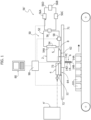
- the machine described herein designated as a whole by the reference number 10, comprises:
- the nozzle 14 comprises a first, inner, tubular duct 14C and a second, outer, tubular duct 14D, which surrounds the first duct 14C.
- the bottom end of the first duct 14C defines the first outlet 14A, whilst the opening provided between the bottom end of the first duct 14C and the bottom end of the second duct 14D defines the second outlet 14B.
- the dispensing unit 6 comprises a multiplicity of nozzles 14, preferably aligned in a direction X1.
- the number of nozzles 14 of the series may clearly vary according to the requirements of the specific applications.
- each of the two valve units 8, 12 comprises an external valve body 22, which defines, at the top, a series of openings 24 and, at the bottom, a series of openings 26 aligned with the openings 24, vertically, in respective directions Zi.
- the number of the openings 24, 26 is equal to the number of nozzles 14.
- the two series of openings 24, 26 extend in a direction X2, parallel to the direction X1.
- a cylindrical seat 28 is provided, mounted mobile in which is an open/close member 32 of corresponding shape.
- the seat 28 extends in the same direction X2 as that in which the two series of the openings 24 and 26 extend.
- the open/close member 32 is axially mobile, in translation, in the same direction X2, driven by a linear actuator 34.
- valve body 22 has a series of cylindrical chambers 36 that extend horizontally in respective directions Yi, orthogonal to the directions X1, X2, and each give out into the cylindrical seat 28, in a respective position in which a pair of the openings 24 and 26 is located.
- each chamber 36 is a piston (not illustrated), which is mobile in the direction Yi according to a reciprocating motion of translation, as will be seen in what follows.
- the open/close member 32 has on its outer surface a series of pairs of grooves 40, 42, each located in a position corresponding to a respective pair of the openings 24, 26.
- the groove 40 is to set the opening 24 in communication with the collection chamber 36
- the groove 42 is to set the collection chamber 36 in communication with the opening 26.
- the grooves 40, 42 have a limited depth that never reaches the geometrical axis of the open/close member 32.
- the grooves 40, 42 are obtained via milling in a cutting plane secant with respect to the circular profile of the cross section of the member 32.
- the grooves 40, 42 have two different orientations about the geometrical axis of the open/close member 32, preferably offset by approximately 90° with respect to one another. It will be noted that in the configuration illustrated the cutting plane by which each of the two grooves 40, 42 is defined is inclined by 45° with respect to the horizontal axis of the corresponding chamber 36 (i.e., with respect to the direction Yi in which said chamber extends).
- each of the two valve units 8 and 12 hence envisages setting the open/close member 32 in a first position in which the grooves 40 are brought into a position corresponding to the openings 24, thus setting the latter in communication with the collection chambers 36.
- the pistons inside the chambers 36 perform a stroke in the direction away from the open/close member 32 to draw in the material contained in the container 2 or 4 and deliver it into the chambers 36 themselves.
- the openings 24 operate as openings for entry of the material into the valve unit.
- the open/close member 32 is shifted into a second position in which the grooves 42 are brought into a position corresponding to the openings 26, thus setting the latter in fluid communication with the collection chambers 36.
- the pistons are again driven in a stroke in the direction opposite to the previous one, towards the open/close member 32, to push the material out of the collection chambers 36 and send it to the nozzles 14 of the dispensing unit 6.
- the openings 26 operate as outlets for the material from the valve unit.
- the first valve unit 8 operates in the way described above to take in the first material contained in the container 2 and feed it to the outlets 14A of the nozzles 14.
- the second valve unit 12 operates to take in the second material contained in the container 4 and feed it to the outlets 14B of the nozzles 14.
- the dispensing operation carried out by the machine envisages a dispensing cycle in which both of the materials contained in the two containers 2 and 4 are delivered.
- the above dispensing cycle comprises a first step in which only the first material is delivered through the individual nozzle 14, a second subsequent step in which the two materials are delivered simultaneously, and finally a last step in which only the first material is again delivered.
- a product having an outer shell formed by the first material and an internal filling formed by the second material.
- the machine 10 comprises a control unit 90 configured for governing the actuators 34 of the two valve units 8, 12 in a synchronized way to implement the dispensing process described above.
- the dispensing process described above is obtained within a cavity 101 of a mould that bestows a given shape upon the product.
- the machine 10 is configured to move the dispensing unit 6 vertically during the dispensing step.
- the dispensing unit 6 is brought into a lowered position where the nozzles 14 are set within the cavity of the mould and up against the corresponding bottom.
- the machine 10 comprises a thermal-conditioning system 50 for selectively cooling or else heating an inner surface S of the first container 2 so as to cool or heat the first material contained in the container itself.
- the thermal-conditioning system 50 is able to operate both for cooling the inner surface S of the first container 2, so as to cool the first material contained in the container itself, and for heating the same inner surface S of the first container 2, so as to heat the first material contained in the container itself.
- These two operating modes are implemented by the thermal-conditioning system 50 alternatively, in a selective way (i.e., one mode of the two modes in question is selected), for example according to the type of the product to be obtained, as will be seen in greater detail in what follows.
- the thermal-conditioning system 50 comprises a hydraulic circuit 52 in which a thermal-conditioning fluid flows, a heat-exchange unit 54, which is connected to the circuit 52 for being traversed by the thermal-conditioning fluid and is configured for setting the thermal-conditioning fluid in a condition of heat exchange with the inner surface S of the first container 2, a cooling unit 56 for cooling the thermal-conditioning fluid, and a heating unit 58 for heating the thermal-conditioning fluid.
- control unit 90 of the machine is configured for governing selectively activation of the cooling unit 56 or else activation of the heating unit 58 as a function of a signal indicating the type of product to be obtained.
- the machine described herein is able to produce indifferently products with cold fillings or else hot fillings (at least with reference to the respective production process), by simply varying the operating settings of the machine.
- the machine comprises an operator interface 80 via which an operator can select the type of product to be obtained and which is operatively connected to the control unit 90 for transmitting to the latter a signal indicating the type of product selected by the operator.
- control unit 90 governs activation of the heating unit 58 so that, during operation of the machine, the thermal-conditioning fluid is heated and this in turn heats, through the heat-exchange unit 54, the inner surface S of the container 2.
- the material contained in the container 2 will hence be heated by the inner surface S of the container 2.
- control unit 90 governs activation of the cooling unit 56 so that the thermal-conditioning fluid is cooled by the cooling unit 56 and the thermal-conditioning fluid itself in turn cools the inner surface S of the container 2 through the heat-exchange unit 54.
- the material contained in the container 2 will hence be cooled by the inner surface S of the container 2.
- the heat-exchange unit 54 may be of any known type commonly used in the sector of production of foodstuff products.
- the heat-exchange unit 54 may comprise one or more internal ducts for the passage of the thermal-conditioning fluid, which are connected to the circuit 52 and are set in a condition of heat exchange with an outer wall 54A of the heat-exchange unit 54 itself.
- the heat-exchange unit 54 is set in direct contact with the wall of the container 2 defining the inner surface S.
- the heat-exchange unit 54 may instead be associated to the container 2 so that it is the outer wall 54A itself that defines the inner surface S of the container 2.
- the thermal-conditioning fluid may be of any known type commonly used in the sector of production of foodstuff products.
- the thermal-conditioning fluid may be constituted by a mixture of water and glycol.
- the thermal-conditioning fluid may be air.
- the heating unit 58 may be of any known type commonly used in the sector of production of foodstuff products.
- the heating unit 58 may be a heating device operating via electrical resistance or else electromagnetic-induction means.
- the cooling unit may itself also be of any known type commonly used in the sector of production of foodstuff products.
- the cooling unit 56 may be the evaporator module of a refrigerating system 56' that comprises a circuit 56D, in which a refrigerant fluid flows (for example, a refrigerant gas, such as R452A), and further comprising a compressor 56A, a condenser 56B, and a lamination valve 56C.
- the system 56' is configured for subjecting the circulating fluid to a refrigerating cycle in which the evaporator module operates as cooling unit of the system 50.
- control unit 90 is configured for governing activation of the entire refrigerating system 56' - for example by governing activation of the compressor 56A - so as to render the evaporator unit operative as cooling unit of the circuit 52.
- the cooling unit 56 is instead a Peltier-cell cooling unit.
- the machine 10 further comprises a heating unit 62 for heating the valve unit 8, and a heating unit 64 for heating the valve unit 12.
- control unit 90 is configured for governing activation of the heating unit 62 as a function of the signal, referred to above, indicating the type of product to be obtained.
- control unit 90 governs activation of the heating unit 62 so that this will heat the valve unit 8, in particular its external valve body 22, which, as has been seen above, contains within it the collection chambers 26 that are to receive the first material from the container 2.
- the first material which is kept hot by the thermal-conditioning system 50 when it is inside the container 2, does not undergo any substantial lowering of temperature at the moment when it is introduced into the valve unit 8 then to be delivered by the dispensing unit 6.
- the heating unit 64 carries out exactly the same function for the valve unit 12.
- each of the two heating units 62, 64 is a heating plate 60 that is set in contact with the bottom side of the valve body 22 and has a series of openings 60A arranged aligned with the series of openings 26 made on the bottom side itself of the valve body 22.
- the through openings 60A set the series of openings 26 of the valve body 22 in fluid communication with the respective nozzles 14, notwithstanding interposition of the heating plate 60.
- the two heating plates 62 and 64 operate via electrical resistance or else electromagnetic-induction means.
- the heating plate 62 and the heating plate 64 are set at a distance apart in a direction parallel to the directions Yi and are separated from one another by way of an interstitial space V that is preferably empty.
- the interstitial space V prevents the heating plate 62 from being in any case heated indirectly, by conduction, by the heating plate 64, which is instead active for heating the valve unit 12 that is to draw in the second material from the container 4'.
- the machine may instead envisage inserted in the space V thermally insulating material, for example a sheet of expanded polypropylene, extruded polystyrene, Delrin (POM-C), or else Teflon (PTFE).
- thermally insulating material for example a sheet of expanded polypropylene, extruded polystyrene, Delrin (POM-C), or else Teflon (PTFE).
- valve unit 8 and the valve unit 12, together with the respective heating units 62, 64 associated thereto, are carried by two respective supports 71, 72, from which they project in cantilever fashion in a direction parallel to the directions Yi.
- the dispensing unit 6 is mounted on the bottom faces of the respective portions projecting in cantilever fashion of the two heating units 62, 64, and is received in a space comprised between the two supports 71, 72.
- the two supports 71, 72 form part of a vertically mobile frame of the machine 10, which is designed to bring about the movement of raising referred to above of the dispensing unit 6, envisaged during the cycle of dispensing of the two materials.
- the machine 10 comprises at least one stiffening element 73, made of a non-thermally conductive material, which connects together the two valve units 8 and 12 or else the two heating units 62 and 64 in order to stiffen the structure of this part of the machine.
Landscapes
- Engineering & Computer Science (AREA)
- Life Sciences & Earth Sciences (AREA)
- Chemical & Material Sciences (AREA)
- Food Science & Technology (AREA)
- Polymers & Plastics (AREA)
- Manufacturing & Machinery (AREA)
- Confectionery (AREA)
- General Preparation And Processing Of Foods (AREA)
Applications Claiming Priority (1)
| Application Number | Priority Date | Filing Date | Title |
|---|---|---|---|
| IT102023000026808A IT202300026808A1 (it) | 2023-12-15 | 2023-12-15 | "macchina per la produzione di un prodotto alimentare ripieno" |
Publications (1)
| Publication Number | Publication Date |
|---|---|
| EP4570075A1 true EP4570075A1 (fr) | 2025-06-18 |
Family
ID=90057235
Family Applications (1)
| Application Number | Title | Priority Date | Filing Date |
|---|---|---|---|
| EP24217674.1A Pending EP4570075A1 (fr) | 2023-12-15 | 2024-12-05 | Machine pour la fabrication d'un produit alimentaire fourré |
Country Status (2)
| Country | Link |
|---|---|
| EP (1) | EP4570075A1 (fr) |
| IT (1) | IT202300026808A1 (fr) |
Citations (4)
| Publication number | Priority date | Publication date | Assignee | Title |
|---|---|---|---|---|
| EP0931462A1 (fr) * | 1998-01-27 | 1999-07-28 | Societe Des Produits Nestle S.A. | Procédé pour la fabrication de produits réfrigérés |
| US11076614B2 (en) * | 2016-09-07 | 2021-08-03 | Ali S.P.A.-Carpigiani Group | Machine for making liquid or semi-liquid products |
| IT202100010553A1 (it) * | 2021-04-27 | 2022-10-27 | Selmi S R L | Procedimento per la produzione di un gelato su stecco |
| EP4082352A1 (fr) * | 2021-04-27 | 2022-11-02 | Selmi S.r.l. | Machine pour produire un produit alimentaire fourré |
-
2023
- 2023-12-15 IT IT102023000026808A patent/IT202300026808A1/it unknown
-
2024
- 2024-12-05 EP EP24217674.1A patent/EP4570075A1/fr active Pending
Patent Citations (5)
| Publication number | Priority date | Publication date | Assignee | Title |
|---|---|---|---|---|
| EP0931462A1 (fr) * | 1998-01-27 | 1999-07-28 | Societe Des Produits Nestle S.A. | Procédé pour la fabrication de produits réfrigérés |
| US11076614B2 (en) * | 2016-09-07 | 2021-08-03 | Ali S.P.A.-Carpigiani Group | Machine for making liquid or semi-liquid products |
| IT202100010553A1 (it) * | 2021-04-27 | 2022-10-27 | Selmi S R L | Procedimento per la produzione di un gelato su stecco |
| EP4082352A1 (fr) * | 2021-04-27 | 2022-11-02 | Selmi S.r.l. | Machine pour produire un produit alimentaire fourré |
| EP4082352B1 (fr) | 2021-04-27 | 2024-01-24 | Selmi S.r.l. | Machine pour produire un produit alimentaire fourré |
Also Published As
| Publication number | Publication date |
|---|---|
| IT202300026808A1 (it) | 2025-06-15 |
Similar Documents
| Publication | Publication Date | Title |
|---|---|---|
| US10736336B2 (en) | Method and machine for making ice cream | |
| JP4180240B2 (ja) | パターンを含む冷凍した空気入りの菓子製品、それを製造する方法および装置 | |
| EP4177547B1 (fr) | Assemblage de fabrication de glace transparente | |
| EP1821051B1 (fr) | Dispositifs de fabrication de glace rapide | |
| US11344044B2 (en) | Machine for making liquid or semi-liquid food products having a spatula driven to have first and second movements independent of one another | |
| EP3360421B1 (fr) | Machine de fabrication et de distribution d'un produit liquide ou semi-liquide | |
| CN106417874B (zh) | 用于制造液态或半液态食品的机器 | |
| US6485768B2 (en) | Method of preparing frozen confections | |
| US20100050681A1 (en) | Refrigerator having multiple icemakers | |
| EP4570075A1 (fr) | Machine pour la fabrication d'un produit alimentaire fourré | |
| JP2009530129A (ja) | コンテナを製造するための装置および方法 | |
| KR20070118204A (ko) | 성형된 식품의 제조장치 및 제조방법 | |
| EP1785682B1 (fr) | Conduite d'un réfrigérateur pour alimenter de l'air froid | |
| EP4082352B1 (fr) | Machine pour produire un produit alimentaire fourré | |
| US6205792B1 (en) | Refrigerator incorporating stirling cycle cooling and defrosting system | |
| CN118002773B (zh) | 一种铝件自动化生产的浇铸机 | |
| KR100225663B1 (ko) | 프레스 공정을 이용하여 성형 유리 제품을 제조하기 위한 방법 및 이 방법의 실시에 특히 적합한 장치 | |
| WO2016054675A1 (fr) | Système et procédé de formage d'articles moulés | |
| JP2001211831A (ja) | 冷菓製造装置 | |
| CN221397653U (zh) | 一种玻璃瓶加工用供料机 | |
| US20020172744A1 (en) | Method and apparatus for producing particles of a foodstuff | |
| JP2000331232A (ja) | 自動販売機 | |
| CN213153706U (zh) | 集成有烘烤功能的饼干加工用冷却装置 | |
| EP4454477B1 (fr) | Machine de traitement de produits alimentaires liquides ou semi-liquides | |
| EP4704589A1 (fr) | Machine de préparation et de distribution d'un granité |
Legal Events
| Date | Code | Title | Description |
|---|---|---|---|
| PUAI | Public reference made under article 153(3) epc to a published international application that has entered the european phase |
Free format text: ORIGINAL CODE: 0009012 |
|
| STAA | Information on the status of an ep patent application or granted ep patent |
Free format text: STATUS: THE APPLICATION HAS BEEN PUBLISHED |
|
| AK | Designated contracting states |
Kind code of ref document: A1 Designated state(s): AL AT BE BG CH CY CZ DE DK EE ES FI FR GB GR HR HU IE IS IT LI LT LU LV MC ME MK MT NL NO PL PT RO RS SE SI SK SM TR |
|
| STAA | Information on the status of an ep patent application or granted ep patent |
Free format text: STATUS: REQUEST FOR EXAMINATION WAS MADE |
|
| 17P | Request for examination filed |
Effective date: 20251111 |