EP4574441A1 - Appareil de traitement de feuilles - Google Patents
Appareil de traitement de feuilles Download PDFInfo
- Publication number
- EP4574441A1 EP4574441A1 EP24222289.1A EP24222289A EP4574441A1 EP 4574441 A1 EP4574441 A1 EP 4574441A1 EP 24222289 A EP24222289 A EP 24222289A EP 4574441 A1 EP4574441 A1 EP 4574441A1
- Authority
- EP
- European Patent Office
- Prior art keywords
- sheet
- printed single
- single sheet
- processing apparatus
- printed
- Prior art date
- Legal status (The legal status is an assumption and is not a legal conclusion. Google has not performed a legal analysis and makes no representation as to the accuracy of the status listed.)
- Pending
Links
Images



Classifications
-
- B—PERFORMING OPERATIONS; TRANSPORTING
- B65—CONVEYING; PACKING; STORING; HANDLING THIN OR FILAMENTARY MATERIAL
- B65H—HANDLING THIN OR FILAMENTARY MATERIAL, e.g. SHEETS, WEBS, CABLES
- B65H7/00—Controlling article feeding, separating, pile-advancing, or associated apparatus, to take account of incorrect feeding, absence of articles, or presence of faulty articles
- B65H7/02—Controlling article feeding, separating, pile-advancing, or associated apparatus, to take account of incorrect feeding, absence of articles, or presence of faulty articles by feelers or detectors
-
- B—PERFORMING OPERATIONS; TRANSPORTING
- B42—BOOKBINDING; ALBUMS; FILES; SPECIAL PRINTED MATTER
- B42C—BOOKBINDING
- B42C1/00—Collating or gathering sheets combined with processes for permanently attaching together sheets or signatures or for interposing inserts
- B42C1/12—Machines for both collating or gathering and permanently attaching together the sheets or signatures
- B42C1/125—Sheet sorters combined with binding devices
-
- B—PERFORMING OPERATIONS; TRANSPORTING
- B26—HAND CUTTING TOOLS; CUTTING; SEVERING
- B26D—CUTTING; DETAILS COMMON TO MACHINES FOR PERFORATING, PUNCHING, CUTTING-OUT, STAMPING-OUT OR SEVERING
- B26D5/00—Arrangements for operating and controlling machines or devices for cutting, cutting-out, stamping-out, punching, perforating, or severing by means other than cutting
- B26D5/20—Arrangements for operating and controlling machines or devices for cutting, cutting-out, stamping-out, punching, perforating, or severing by means other than cutting with interrelated action between the cutting member and work feed
- B26D5/30—Arrangements for operating and controlling machines or devices for cutting, cutting-out, stamping-out, punching, perforating, or severing by means other than cutting with interrelated action between the cutting member and work feed having the cutting member controlled by scanning a record carrier
- B26D5/32—Arrangements for operating and controlling machines or devices for cutting, cutting-out, stamping-out, punching, perforating, or severing by means other than cutting with interrelated action between the cutting member and work feed having the cutting member controlled by scanning a record carrier with the record carrier formed by the work itself
-
- B—PERFORMING OPERATIONS; TRANSPORTING
- B26—HAND CUTTING TOOLS; CUTTING; SEVERING
- B26D—CUTTING; DETAILS COMMON TO MACHINES FOR PERFORATING, PUNCHING, CUTTING-OUT, STAMPING-OUT OR SEVERING
- B26D7/00—Details of apparatus for cutting, cutting-out, stamping-out, punching, perforating, or severing by means other than cutting
- B26D7/01—Means for holding or positioning work
- B26D7/015—Means for holding or positioning work for sheet material or piles of sheets
-
- B—PERFORMING OPERATIONS; TRANSPORTING
- B26—HAND CUTTING TOOLS; CUTTING; SEVERING
- B26D—CUTTING; DETAILS COMMON TO MACHINES FOR PERFORATING, PUNCHING, CUTTING-OUT, STAMPING-OUT OR SEVERING
- B26D9/00—Cutting apparatus combined with punching or perforating apparatus or with dissimilar cutting apparatus
-
- B—PERFORMING OPERATIONS; TRANSPORTING
- B42—BOOKBINDING; ALBUMS; FILES; SPECIAL PRINTED MATTER
- B42C—BOOKBINDING
- B42C1/00—Collating or gathering sheets combined with processes for permanently attaching together sheets or signatures or for interposing inserts
- B42C1/12—Machines for both collating or gathering and permanently attaching together the sheets or signatures
-
- B—PERFORMING OPERATIONS; TRANSPORTING
- B42—BOOKBINDING; ALBUMS; FILES; SPECIAL PRINTED MATTER
- B42C—BOOKBINDING
- B42C19/00—Multi-step processes for making books
- B42C19/02—Multi-step processes for making books starting with single sheets
-
- B—PERFORMING OPERATIONS; TRANSPORTING
- B42—BOOKBINDING; ALBUMS; FILES; SPECIAL PRINTED MATTER
- B42C—BOOKBINDING
- B42C19/00—Multi-step processes for making books
- B42C19/08—Conveying between operating stations in machines
-
- B—PERFORMING OPERATIONS; TRANSPORTING
- B42—BOOKBINDING; ALBUMS; FILES; SPECIAL PRINTED MATTER
- B42C—BOOKBINDING
- B42C7/00—Manufacturing bookbinding cases or covers of books or loose-leaf binders
- B42C7/008—Conveying means between operation stations
-
- B—PERFORMING OPERATIONS; TRANSPORTING
- B42—BOOKBINDING; ALBUMS; FILES; SPECIAL PRINTED MATTER
- B42C—BOOKBINDING
- B42C9/00—Applying glue or adhesive peculiar to bookbinding
- B42C9/0081—Applying glue or adhesive peculiar to bookbinding applying adhesive to individual sheets for binding them together
-
- B—PERFORMING OPERATIONS; TRANSPORTING
- B65—CONVEYING; PACKING; STORING; HANDLING THIN OR FILAMENTARY MATERIAL
- B65H—HANDLING THIN OR FILAMENTARY MATERIAL, e.g. SHEETS, WEBS, CABLES
- B65H45/00—Folding thin material
- B65H45/12—Folding articles or webs with application of pressure to define or form crease lines
-
- B—PERFORMING OPERATIONS; TRANSPORTING
- B65—CONVEYING; PACKING; STORING; HANDLING THIN OR FILAMENTARY MATERIAL
- B65H—HANDLING THIN OR FILAMENTARY MATERIAL, e.g. SHEETS, WEBS, CABLES
- B65H45/00—Folding thin material
- B65H45/12—Folding articles or webs with application of pressure to define or form crease lines
- B65H45/30—Folding in combination with creasing, smoothing or application of adhesive
-
- B—PERFORMING OPERATIONS; TRANSPORTING
- B65—CONVEYING; PACKING; STORING; HANDLING THIN OR FILAMENTARY MATERIAL
- B65H—HANDLING THIN OR FILAMENTARY MATERIAL, e.g. SHEETS, WEBS, CABLES
- B65H5/00—Feeding articles separated from piles; Feeding articles to machines
- B65H5/06—Feeding articles separated from piles; Feeding articles to machines by rollers or balls, e.g. between rollers
-
- B—PERFORMING OPERATIONS; TRANSPORTING
- B65—CONVEYING; PACKING; STORING; HANDLING THIN OR FILAMENTARY MATERIAL
- B65H—HANDLING THIN OR FILAMENTARY MATERIAL, e.g. SHEETS, WEBS, CABLES
- B65H5/00—Feeding articles separated from piles; Feeding articles to machines
- B65H5/36—Article guides or smoothers, e.g. movable in operation
-
- B—PERFORMING OPERATIONS; TRANSPORTING
- B26—HAND CUTTING TOOLS; CUTTING; SEVERING
- B26D—CUTTING; DETAILS COMMON TO MACHINES FOR PERFORATING, PUNCHING, CUTTING-OUT, STAMPING-OUT OR SEVERING
- B26D2210/00—Machines or methods used for cutting special materials
-
- B—PERFORMING OPERATIONS; TRANSPORTING
- B65—CONVEYING; PACKING; STORING; HANDLING THIN OR FILAMENTARY MATERIAL
- B65H—HANDLING THIN OR FILAMENTARY MATERIAL, e.g. SHEETS, WEBS, CABLES
- B65H2301/00—Handling processes for sheets or webs
- B65H2301/30—Orientation, displacement, position of the handled material
- B65H2301/33—Modifying, selecting, changing orientation
- B65H2301/332—Turning, overturning
- B65H2301/3322—Turning, overturning according to a determined angle
-
- B—PERFORMING OPERATIONS; TRANSPORTING
- B65—CONVEYING; PACKING; STORING; HANDLING THIN OR FILAMENTARY MATERIAL
- B65H—HANDLING THIN OR FILAMENTARY MATERIAL, e.g. SHEETS, WEBS, CABLES
- B65H2301/00—Handling processes for sheets or webs
- B65H2301/40—Type of handling process
- B65H2301/43—Gathering; Associating; Assembling
- B65H2301/431—Features with regard to the collection, nature, sequence and/or the making thereof
- B65H2301/4312—Gathering material delivered from a digital printing machine
-
- B—PERFORMING OPERATIONS; TRANSPORTING
- B65—CONVEYING; PACKING; STORING; HANDLING THIN OR FILAMENTARY MATERIAL
- B65H—HANDLING THIN OR FILAMENTARY MATERIAL, e.g. SHEETS, WEBS, CABLES
- B65H2301/00—Handling processes for sheets or webs
- B65H2301/50—Auxiliary process performed during handling process
- B65H2301/51—Modifying a characteristic of handled material
- B65H2301/515—Cutting handled material
- B65H2301/5151—Cutting handled material transversally to feeding direction
-
- B—PERFORMING OPERATIONS; TRANSPORTING
- B65—CONVEYING; PACKING; STORING; HANDLING THIN OR FILAMENTARY MATERIAL
- B65H—HANDLING THIN OR FILAMENTARY MATERIAL, e.g. SHEETS, WEBS, CABLES
- B65H2301/00—Handling processes for sheets or webs
- B65H2301/50—Auxiliary process performed during handling process
- B65H2301/51—Modifying a characteristic of handled material
- B65H2301/515—Cutting handled material
- B65H2301/5152—Cutting partially, e.g. perforating
-
- B—PERFORMING OPERATIONS; TRANSPORTING
- B65—CONVEYING; PACKING; STORING; HANDLING THIN OR FILAMENTARY MATERIAL
- B65H—HANDLING THIN OR FILAMENTARY MATERIAL, e.g. SHEETS, WEBS, CABLES
- B65H2511/00—Dimensions; Position; Numbers; Identification; Occurrences
- B65H2511/10—Size; Dimensions
-
- B—PERFORMING OPERATIONS; TRANSPORTING
- B65—CONVEYING; PACKING; STORING; HANDLING THIN OR FILAMENTARY MATERIAL
- B65H—HANDLING THIN OR FILAMENTARY MATERIAL, e.g. SHEETS, WEBS, CABLES
- B65H2511/00—Dimensions; Position; Numbers; Identification; Occurrences
- B65H2511/20—Location in space
-
- B—PERFORMING OPERATIONS; TRANSPORTING
- B65—CONVEYING; PACKING; STORING; HANDLING THIN OR FILAMENTARY MATERIAL
- B65H—HANDLING THIN OR FILAMENTARY MATERIAL, e.g. SHEETS, WEBS, CABLES
- B65H2557/00—Means for control not provided for in groups B65H2551/00 - B65H2555/00
- B65H2557/30—Control systems architecture or components, e.g. electronic or pneumatic modules; Details thereof
-
- B—PERFORMING OPERATIONS; TRANSPORTING
- B65—CONVEYING; PACKING; STORING; HANDLING THIN OR FILAMENTARY MATERIAL
- B65H—HANDLING THIN OR FILAMENTARY MATERIAL, e.g. SHEETS, WEBS, CABLES
- B65H2801/00—Application field
- B65H2801/48—Bookbinding
Definitions
- the present invention relates to a sheet processing apparatus for producing book blocks from printed single sheets, a book block production apparatus comprising a sheet processing apparatus, a method of producing book blocks from printed single sheets using a book block production apparatus and a method of processing printed single sheets for producing book blocks therefrom using a sheet processing apparatus.
- Book blocks comprising stacks of printed sheets are typically manufactured in book block production lines where different processing steps like printing, cutting, folding, gluing, stacking, aligning etc. may be executed.
- Books are for example manufactured in book block production lines with digital printing on a continuous paper web, with the book production line comprising an unwinding and printing station and other kinematic components including e.g. a perforating and cutting station, a dynamic signature forming station and a collecting and pre-assembling station.
- EP 2 159 070 B2 describes for example an apparatus for producing stacks which form book blocks having an unwinding station, in which a material web to be processed is unwound from a reel, and a digital printing station, in which the material web is printed on both sides.
- a perforating station is connected behind the digital printing station, which perforating station has a perforating unit, by means of which the printed material web can be provided with one or two perforation or weakening lines.
- the perforating station is followed by a cross cutting station, in which individual printed sheets are separated from the material web by cross cutting.
- the cross cutting station is followed by a longitudinal folding station, in which the sheets are either folded once or twice.
- a stacking station is arranged behind the longitudinal folding station, in which stacking station the folded sheets are placed on one another to form a stack.
- Said stacking station has an adhesive application device, by means of which the sheets are provided with an adhesive application or a layer of adhesive before the sheets are placed on one another.
- the printed single sheets may have different formats, paper types, grammages, print surfaces, print coverage etc. Therefore, it would be desirable if the book block production line would be able to handle the different features of the printed single sheets when producing a book block therefrom.
- a sheet processing apparatus for producing pre-glued or loose-sheet book blocks from printed single sheets, comprising a conveying section for conveying a printed single sheet along a conveying direction, an input section configured to receive the printed single sheet from a digital printer or a feeder, a control system configured to generate a workflow order comprising one or more commands for processing the printed single sheet, a sheet sensor arranged at the input section and configured to detect a sheet parameter comprising at least one of position and size of the printed single sheet, a sheet rotator arranged downstream of the sheet sensor and configured to stop the printed single sheet and to rotate the printed single sheet in a plane of the printed single sheet or to convey the printed single sheet without rotation depending on a rotation command of the workflow order, a perforator arranged downstream of the sheet rotator and configured to perforate the printed single sheet along the conveying direction, and a folding device arranged downstream of the perforator and configured to fold the printed single sheet along the perforations generated by the perforator.
- the sheet processing apparatus provides the advantage that the need to place or load separate jobs for each book block production can be eliminated by using the workflow order to control the processing of the individual printed sheets.
- a plurality of workflows may be stored in a workflow storage.
- the control system generating a workflow order may access the workflow storage and select a workflow in order to generate the workflow order.
- a workflow order may be generated by the control system upon receiving of a production order by an operator. Generating a workflow order upon receiving a production order may therefore comprise selecting a workflow from a workflow storage.
- the specific workflow order may depend on the format of the printed single sheets received at the input section which can be detected by the sheet sensor. Therefore, it may not be required to separately specify in each case the format of the printed single sheets in a book block production.
- the automation of the book block production can therefore be increased since the book block production can be controlled by means of the workflow order which uses as an input the sheet parameter and/or printed single sheet information provided by the sheet sensor and/or a code reader and/or a printer signal.
- the sheet rotator may unconditionally stop and rotate the printed single sheet due to a respective command in the workflow order.
- the sheet rotator may also conditionally stop and rotate the printed single sheet depending on the format and/or orientation of the printed single sheet as detected by the sheet sensor.
- the rotation command may also comprise a command that a printed single sheet shall not be rotated. Using the sheet rotator, selective rotation of the printed single sheets can therefore be achieved.
- the sheet processing apparatus can handle different formats of the printed single sheets in a flexible fashion. For example, printed single sheets in A3-format received at the input section in a horizontal orientation where the longer edge of the printed single sheet is parallel to the conveying direction (also known as "short edge feeding") may be rotated in the sheet rotator by 90° and folded by the folding device in order to obtain a folded sheet in A4-format.
- folded sheets also known as “signatures”
- folded sheets also known as “signatures”
- the conveying section may extend along the sheet processing apparatus such that at least one of the sheet rotator, the perforator and the folding device may be arranged in the conveying section. Further, the input section may be part of the conveying section.
- the sheet processing apparatus comprises a cutter arranged downstream of the sheet rotator and configured to cut a printed single sheet transverse to the conveying direction, depending on a cutting command of the workflow order.
- the sheet processing apparatus comprises a cutter arranged upstream of the sheet rotator and configured to cut a printed single sheet transverse to the conveying direction, depending on a cutting command of the workflow order.
- a printed single sheet with a large format can be cut.
- the printed single sheet can be folded in order to obtain a folded sheet with the desired format for the book block.
- the cutting command may also comprise a command that a printed single sheet shall not be cut.
- the cutting command may be unconditional or conditional depending on the format and/or orientation of the printed single sheet as detected by the sheet sensor.
- a printed single sheet may be rotated to a desired orientation for cutting.
- a printed single sheet may alternatively be cut before rotation by arranging the cutter upstream of the sheet rotator.
- the sheet processing apparatus comprises an aligner arranged downstream of the sheet rotator and upstream of the perforator, and configured to align a printed single sheet along the conveying direction.
- a printed single sheet can be aligned to have an edge, preferably its shorter edge, parallel to the conveying direction in order to allow proper perforation parallel to the edge, preferably the shorter edge, of the printed single sheet.
- the aligner may be arranged at an aligning section of the sheet processing apparatus.
- the aligner may comprise an alignment ruler arranged at a side of the aligning section and oriented parallel to the conveying direction such that an edge of the printed single sheet may be aligned at the alignment ruler while being conveyed along the conveying direction.
- the folding device is configured to fold a printed single sheet once-only.
- the sheet processing apparatus provides the advantage that the sheet rotator and/or the cutter can process the printed single sheets in a fashion such that the desired format of the book block can be achieved by folding the printed single sheets once-only in order to obtain the required signatures.
- the folding device comprises a horizontally arranged pipe with a bended section bended towards a direction transverse to the conveying direction and emerging with a ramp from a conveying surface of the sheet processing apparatus, such that a first half of a printed single sheet is lifted by sliding onto the ramp and folded onto a second half of the printed single sheet by sliding beneath the bended section.
- the conveying surface may be the surface of the conveying section comprising lower drive rollers on which the printed single sheets lie on while being conveyed.
- the folding device may comprise one or more vacuum belts running below the printed single sheets and conveying the printed single sheets through the folding device.
- efficient folding of the printed single sheets with a fold parallel to the conveying direction can be provided without having to stop the printed single sheets for the folding action.
- the bended pipe is arranged such that the conveying motion can be exploited for folding the printed single sheets.
- complexity of the folding device can be reduced due to the bended pipe being the main additional component by means of which the folding can be executed. Due to the bended pipe, insight into the folding process by an operator may also be improved compared to prior art solutions with a folding channel and a bended metal plate covering the printed sheets while folding.
- the sheet sensor is configured to determine the size of a printed single sheet
- the control system is configured to compare the size determined by the sheet sensor with a target size of the printed single sheet of the workflow order and to determine a size deviation
- the sheet rotator and/or the aligner is configured to transversally center the printed single sheet with respect to the perforator using the determined size deviation.
- the sheet sensor may be configured to determine the length and/or width of a printed single sheet.
- a target-actual comparison can therefore be executed in order to obtain the size deviation.
- changes of format tolerances or enduring format changes can be determined.
- the target-actual comparison and the size deviation respectively may be used to determine a shrinkage of a printed single sheet which may occur due to the ink and the drying process while printing. The size deviation may lead to off-centering of the printed single sheet compared to a printed single sheet without size deviation, which may result in an off-centered fold in the folding device.
- the size deviations determined by the sheet sensor and the control system may therefore be corrected such that a centered fold in the folding device can be provided.
- the sheet sensor and the control system may provide the option to correct shrinkage effects on the printed single sheets.
- control system is configured to generate a workflow order comprising one or more commands for processing the printed single sheet using a sheet parameter detected by the sheet sensor and/or using a printer signal, wherein the workflow order is generated by loading from a workflow storage a workflow adapted to the sheet parameter and/or the printer signal.
- the control system may therefore receive the sheet parameter detected by the sheet sensor and/or a printer signal from the printer, access the workflow storage having stored a plurality of workflows, to select an applicable workflow based on the sheet parameter and/or the printer signal, and generate a workflow order therefrom.
- control system is configured to generate a workflow order comprising at least one of: a rotation command, a cutting command, a folding command.
- the workflow order may comprise further commands such as one or more of input command, perforation command, collecting command, etc.
- the sheet processing apparatus comprises a code reader arranged at the input section and configured to read sheet information from an identification tag of a printed single sheet, wherein the control system is configured to receive the sheet information from the code reader.
- the control system may generate a workflow order comprising one or more commands for processing a printed single sheet.
- the sheet information may comprise information on one or more of color, type, grammage, strength etc.
- the code reader may be part of the sheet sensor.
- the code reader is a barcode reader or a data matrix code reader.
- the identification tag of a printed single sheet may therefore contain a barcode or a data matrix code which can be read by the code reader.
- control system is configured to generate a workflow order comprising one or more commands for processing the printed single sheet using a sheet information detected by the code reader, wherein the workflow order is generated by loading from a workflow storage a workflow adapted to the sheet information.
- the control system may therefore receive the sheet information detected by the code reader, access the workflow storage having stored a plurality of workflows to select an applicable workflow based on the sheet information, and generate a workflow order therefrom.
- the sheet processing apparatus comprises an adhesive applicator arranged downstream of the folding device and configured to apply an adhesive to a printed single sheet at one or more edges of the printed single sheet or to a folded sheet at one or more edges of the folded sheet.
- a pre-glued book block of printed single sheets or folded sheets can be produced.
- Pre-gluing the book blocks provides the advantage that the conveyance and/or transfer of the book blocks to subsequent modules can be improved compared to book blocks where the printed single sheets or folded sheets are loosely stacked.
- a book block production line using pre-glued book blocks provides the advantage of increased flexibility or adaptability, respectively, compared to book production lines where complete books with covers are produced from single loose sheets.
- the adhesive applicator is configured to apply the adhesive at an edge of the printed single sheets or folded sheets, preferably an edge which is to be arranged at the spine of a book block.
- the sheet processing apparatus comprises a stacker arranged downstream of the folding device and configured to stack the printed single sheets or folded sheets with the applied adhesive to a pre-glued book block, wherein the adhesive applicator is arranged upstream of or at the stacker.
- the sheet processing apparatus comprises two or more sheet rotators each configured to stop and to rotate the printed single sheet in the plane of the printed single sheet or to convey the printed single sheet without rotation depending on a rotation command of the workflow order.
- Using two or more sheet rotators can be particularly advantageous for processing large printed single sheets which may require a sequence of processing steps such as a number of sequential rotations of the printed single sheets.
- the sheet processing apparatus may comprise two or more cutters each arranged downstream of a sheet rotator or upstream of a sheet rotator, and configured to cut the printed single sheet transverse to the conveying direction, depending on a cutting command of the workflow order.
- the plurality of sheet rotators and cutters may therefore be arranged sequentially and alternatingly. By arranging a number of sheet rotators and cutters in sequence, a large printed single sheet may run through a sequence of rotating and cutting steps until the desired format for folding is obtained.
- the present invention is also directed to a book block production apparatus comprising the sheet processing apparatus according to the present disclosure and a digital printer, wherein the digital printer is arranged upstream of the input section of the sheet processing apparatus.
- the present invention is also directed to a book block production apparatus comprising the sheet processing apparatus according to the present disclosure and a feeder configured to feed a printed single sheet, wherein the feeder is arranged upstream of the input section of the sheet processing apparatus.
- the present invention is also directed to a method of producing book blocks from printed single sheets using a book block production apparatus according to the present disclosure, the method comprising the steps of: generating by the control system a workflow order comprising one or more commands for processing a printed single sheet; receiving the printed single sheet at the input section of the sheet processing apparatus; detecting by the sheet sensor a sheet parameter comprising at least one of position and size of the printed single sheet; stopping and rotating by the sheet rotator the printed single sheet in the plane of the printed single sheet or conveying the printed single sheet without rotation depending on a rotation command of the workflow order; perforating by the perforator the printed single sheet along the conveying direction; folding by the folding device the printed single sheet along the perforations generated by the perforator.
- the printed single sheet is printed by a digital printer.
- the printed single sheet is fed by a feeder to the input section.
- the present invention is also directed to a method of processing printed single sheets for producing book blocks therefrom using a sheet processing apparatus according to the present disclosure, the method comprising the steps of: generating by the control system a workflow order comprising one or more commands for processing a printed single sheet; receiving the printed single sheet at the input section of the sheet processing apparatus; detecting by the sheet sensor a sheet parameter comprising at least one of position and size of the printed single sheet; stopping and rotating by the sheet rotator the printed single sheet in the plane of the printed single sheet or conveying the printed single sheet without rotation depending on a rotation command of the workflow order; perforating by the perforator the printed single sheet along the conveying direction; folding by the folding device the printed single sheet along the perforations generated by the perforator.
- the perforated printed single sheet is folded by a horizontally arranged pipe of the folding device with a bended section bended towards a direction transverse to the conveying direction and emerging with a ramp from a conveying surface of the sheet processing apparatus, wherein a first half of the printed single sheet is lifted by sliding onto the ramp and folded onto a second half of the printed single sheet by sliding beneath the bended section.
- FIG. 1 shows a perspective view of an embodiment of a sheet processing apparatus 10 for producing pre-glued book blocks from printed single sheets.
- the sheet processing apparatus 10 comprises a conveying section 1 for conveying the printed single sheets along a conveying direction.
- the conveying section 1 comprises at its upstream end an input section 11 for receiving the printed single sheets from a digital printer or a feeder which may be connected to the upstream end of the input section 11.
- the sheet processing apparatus 10 comprises a control system 2 configured to generate a workflow order comprising one or more commands for processing the printed single sheets.
- the control system 2 is arranged in a control cabinet arranged at a rear side of the sheet processing apparatus 10.
- the control system 2 further comprises a control panel 21 for an operator. The operator may input or select a production order using the control panel 21.
- the control system 2 may remotely be arranged and connected to the sheet processing apparatus 10.
- the conveying section 1 comprises a hood 12 which is closed during operation of the sheet processing apparatus 10.
- an adhesive applicator 3 in which the printed single sheets or folded sheets are applied with an adhesive at one or more edges.
- the adhesive applicator 3 is arranged downstream toa slope under which a tank 31 with a supply of adhesive is arranged.
- the tank 31 comprises a door for accessing the adhesive supply.
- a stacker 4 Downstream to the adhesive applicator 3, there is arranged a stacker 4 configured to stack the printed single sheets or folded sheets to pre-glued book blocks which are output at an output section 5.
- FIG. 2 shows a top view of a part of an embodiment of a sheet processing apparatus 10.
- a printed single sheet S is received at the input section 11.
- the printed single sheets S, S', S" are conveyed in a conveying direction C of the conveying section 1.
- the printed single sheet S received at the input section 11 passes a sheet sensor 13 arranged at the input section.
- the sheet sensor 13 determines a sheet parameter comprising position and/or size of the printed single sheet S without stopping the printed single sheet S.
- a sheet rotator 14 may stop and rotate the printed single sheet S or convey the printed single sheet S without rotation.
- a printed single sheet S which arrives at the sheet rotator 14 with its longer edge parallel to the conveying direction C (i.e. in short edge feeding), is stopped and rotated by the sheet rotator 14 by 90°.
- the rotated printed single sheet is denoted by S' and has its shorter edge parallel to the conveying direction C.
- the rotated printed single sheet S' is further conveyed in the conveying direction C and passes a cutter 15 where the printed single sheet S' may be cut depending on a cutting command of the workflow order. Downstream to the cutter 15, there is arranged an aligner 16 where the shorter edge of the printed single sheet S' is aligned to an alignment ruler 161.
- the aligner 16 comprises a vacuum belt 162 which has a slanted orientation towards the alignment ruler 161 such that the printed single sheet S' is imposed with a transversal conveying motion additional to the conveying motion in the conveying direction C and pushed towards the alignment ruler 161.
- the printed single sheet S' After being aligned by the aligner 16, the printed single sheet S' passes a perforator 17 where the printed single sheet S' is perforated along the conveying direction C. Downstream to the perforator, there is arranged a folding device 18 where the perforated printed single sheet S' is folded along the perforations generated by the perforator.
- the folding device 18 comprises a pipe 181 which is bended towards a direction transverse to the conveying direction and essentially in the plane of the conveying surface of the sheet processing apparatus 10. The folded sheet S" is conveyed further passing below the pipe 181.
- FIG 3 shows a perspective view of a part of an embodiment of the sheet processing apparatus 10 of Figure 2 .
- the input section 11 comprises a ramp on which a printed single sheet S are received.
- the sheet sensor 13 determines the position and/or size of the printed single sheet S passing the sheet sensor 13.
- a light curtain L is shown in Figure 3 .
- a code reader 131 which reads sheet information from a printed identification tag of the printed single sheet S.
- the code reader 131 may be, in a variant, integrated with the sheet sensor 13.
- the control system may use the sheet information determined by the code reader 131 for generating the workflow order, in addition to the position and/or size of the printed single sheet S, as determined by the sheet sensor 13.
- the sheet rotator 14 comprises a plurality of subsequently arranged pair of rollers 141 which serve to keep the printed single sheet S on lower-lying drive rollers of the conveying surface CS and to convey and stop the printed single sheet S.
- the lower-lying rollers are arranged at the conveying surface CS and below the printed single sheets.
- the printed single sheet S is stopped and rotated by rotating the rollers of a pair of lower-lying drive rollers in opposite directions. While rotating the printed single sheet, the rollers 142 arranged above the lower-lying drive rollers used for rotating the printed single sheet are lifted in order to allow rotation of the printed single sheet.
- the rotated printed single sheet is illustratively shown by the printed single sheet S' (which, in as shown in Figure 3 , is not meant to be an additional printed single sheet S' arranged below the printed single sheet S).
- the perforator 17 arranged downstream to the aligner 16 applies a perforation along the longitudinal central axis of the printed single sheet S' by means of a perforation roller 171, as can be recognized in Figure 3 .
- the horizontally arranged pipe 181 of the folding device 18 emerges with a ramp 1811 from the conveying surface CS of the folding device 18. Further, the ramp 1811 is arranged next to the longitudinal central axis of the printed single sheet S' such that a first half S'1 of the printed single sheet S' is lifted by sliding onto the ramp 1811 and folded onto a second half S'2 of the printed single sheet S' by sliding beneath the bended section 1812 when being conveyed further in the conveying direction C.
- the printed single sheet S' and, in particular, its second half S'2 is conveyed and held by one or more vacuum belts (not shown in Figure 3 ).
- the folded sheet S" is conveyed further passing below the bended section 1812 of the pipe 181.
- a press roller 182 presses on the fold of the folded sheet S" such that an accurate fold can be obtained.
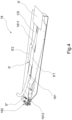
- FIG 4 shows an enlarged perspective view of the embodiment of a folding device 18 of Figure 3 .
- the folding process where the printed single sheet S' arrives from the perforator (not shown in Figure 4 ), the first half S'1 is lifted by sliding onto the ramp 1811 of the pipe 181 and folded onto the second half S'2 by sliding beneath the bended section 1812 such that a folded sheet S" is obtained, can be recognized.
- the folded sheet S" is conveyed further by passing below the bended section 1812 of the pipe 181 whereby a press roller 182 presses on the fold of the folded sheet S" such that a clean fold is obtained.
- FIG 5 shows a perspective view of a part of an embodiment of a sheet processing apparatus 10'.
- the structure of the sheet processing apparatus essentially corresponds to the embodiment of the sheet processing apparatus 10 as shown in Figure 3 .
- the sheet processing apparatus 10' comprises two sequentially arranged sheet rotators 14.1 and 14.2.
- the rotation steps are symbolized for each sheet rotator 14.1, 14.2 by two overlapping printed single sheets S, S', similar to the illustration in Figure 3 .
- the sheet processing apparatus 10' further comprises two cutters 15.1 and 15.2 which are each arranged downstream to a sheet rotator 14.1, 14.2.
- a sequence of rotating and cutting steps can be executed on a printed single sheet S.
- a printed single sheet of a B2-format fed in short edge feeding may pass the first sheet rotator 14.1 without being rotated.
- the first cutter 15.1 may then cut the B2-format printed single sheet transverse to the conveying direction such that two consecutive printed single sheets of A3-format may be obtained which are conveyed in long edge feeding to the second sheet rotator 14.2.
- the printed single sheets of A3-format may then be rotated in the second sheet rotator 14.2 and conveyed in short edge feeding to the second cutter 15.2.
- the second cutter 15.2 may then cut the printed single sheets of A3-format such that printed single sheets of A4-format are obtained.
- the printed single sheets of A4-format are conveyed further to the folding device in long-edge feeding where the printed single sheets of A4-format are folded in order to obtain signatures of A5-format.
Landscapes
- Engineering & Computer Science (AREA)
- Mechanical Engineering (AREA)
- Life Sciences & Earth Sciences (AREA)
- Forests & Forestry (AREA)
- Manufacturing & Machinery (AREA)
- Folding Of Thin Sheet-Like Materials, Special Discharging Devices, And Others (AREA)
Applications Claiming Priority (1)
| Application Number | Priority Date | Filing Date | Title |
|---|---|---|---|
| CH14572023 | 2023-12-21 |
Publications (1)
| Publication Number | Publication Date |
|---|---|
| EP4574441A1 true EP4574441A1 (fr) | 2025-06-25 |
Family
ID=89619105
Family Applications (1)
| Application Number | Title | Priority Date | Filing Date |
|---|---|---|---|
| EP24222289.1A Pending EP4574441A1 (fr) | 2023-12-21 | 2024-12-20 | Appareil de traitement de feuilles |
Country Status (4)
| Country | Link |
|---|---|
| US (1) | US20250206057A1 (fr) |
| EP (1) | EP4574441A1 (fr) |
| JP (1) | JP2025100470A (fr) |
| CN (1) | CN120191137A (fr) |
Citations (5)
| Publication number | Priority date | Publication date | Assignee | Title |
|---|---|---|---|---|
| JP2003206068A (ja) * | 2002-01-15 | 2003-07-22 | Canon Inc | シート処理装置及び画像形成装置 |
| EP2159070A1 (fr) * | 2008-08-29 | 2010-03-03 | Hunkeler AG | Procédé et dispositif de fabrication de piles de blocs de livres |
| JP5183789B2 (ja) * | 2007-06-19 | 2013-04-17 | 株式会社東芝 | 用紙後処理装置、それを使用する画像形成装置、及び用紙後処理方法 |
| JP6540102B2 (ja) * | 2015-03-03 | 2019-07-10 | コニカミノルタ株式会社 | 用紙後処理装置、画像形成装置、用紙後処理装置の制御方法、及び用紙後処理装置の制御プログラム |
| CN114555496A (zh) * | 2019-11-04 | 2022-05-27 | 柯尼格及包尔公开股份有限公司 | 具有属于进给系统的至少一个传送机构的单张纸加工机和用于使进给系统的传送机构发生相对位置改变的方法 |
-
2024
- 2024-12-11 US US18/976,886 patent/US20250206057A1/en active Pending
- 2024-12-18 CN CN202411865135.4A patent/CN120191137A/zh active Pending
- 2024-12-19 JP JP2024223776A patent/JP2025100470A/ja active Pending
- 2024-12-20 EP EP24222289.1A patent/EP4574441A1/fr active Pending
Patent Citations (6)
| Publication number | Priority date | Publication date | Assignee | Title |
|---|---|---|---|---|
| JP2003206068A (ja) * | 2002-01-15 | 2003-07-22 | Canon Inc | シート処理装置及び画像形成装置 |
| JP5183789B2 (ja) * | 2007-06-19 | 2013-04-17 | 株式会社東芝 | 用紙後処理装置、それを使用する画像形成装置、及び用紙後処理方法 |
| EP2159070A1 (fr) * | 2008-08-29 | 2010-03-03 | Hunkeler AG | Procédé et dispositif de fabrication de piles de blocs de livres |
| EP2159070B2 (fr) | 2008-08-29 | 2017-10-11 | Hunkeler AG | Procédé et dispositif de fabrication de piles de blocs de livres |
| JP6540102B2 (ja) * | 2015-03-03 | 2019-07-10 | コニカミノルタ株式会社 | 用紙後処理装置、画像形成装置、用紙後処理装置の制御方法、及び用紙後処理装置の制御プログラム |
| CN114555496A (zh) * | 2019-11-04 | 2022-05-27 | 柯尼格及包尔公开股份有限公司 | 具有属于进给系统的至少一个传送机构的单张纸加工机和用于使进给系统的传送机构发生相对位置改变的方法 |
Also Published As
| Publication number | Publication date |
|---|---|
| CN120191137A (zh) | 2025-06-24 |
| JP2025100470A (ja) | 2025-07-03 |
| US20250206057A1 (en) | 2025-06-26 |
Similar Documents
| Publication | Publication Date | Title |
|---|---|---|
| US6363851B1 (en) | Process for producing folded, bound printed products, and the printed product produced | |
| US10556458B2 (en) | Finisher, bookbinder, and imaging system | |
| JP2002193545A (ja) | 新聞を作製する方法及び装置 | |
| US20180215061A1 (en) | Corrugated cardboard plant | |
| JP2011105467A (ja) | 後処理装置および画像形成装置 | |
| US8505897B2 (en) | Z-fold signature finishing system and printer | |
| EP4574441A1 (fr) | Appareil de traitement de feuilles | |
| US20040214707A1 (en) | Method for further processing printed sheets | |
| US9346256B2 (en) | Method for producing printed products | |
| CN105905664B (zh) | 折叠装置和方法 | |
| JP4855910B2 (ja) | 製本機 | |
| JP2017064963A (ja) | シート束綴じ処理装置及びこれを備えた画像形成システム | |
| JP2009061696A (ja) | アルバム製本方法及びアルバム製本装置 | |
| JP4361472B2 (ja) | 製本装置 | |
| JP2014201433A (ja) | シート後処理装置および画像形成システム | |
| US8505898B2 (en) | Method for making a Z-fold signature | |
| US10843498B2 (en) | Automated process for the manufacture of at least one printed work from at least one sheet | |
| EP1816007B1 (fr) | Procédé et dispositif pour la fabrication de produits imprimés | |
| US20120306141A1 (en) | Z-fold signature media | |
| JP2006327012A (ja) | 可変枚数製本機 | |
| JPH08188329A (ja) | 単片印刷物の丁合方法 | |
| JP6218273B2 (ja) | 丁合機及び該丁合機を備える製本システム | |
| CN112758751B (zh) | 堆叠装置以及区分方法 | |
| JP6986417B2 (ja) | シート処理装置、シート処理方法及び画像形成システム | |
| JPH04185491A (ja) | 印刷物製造方法およびその製造装置 |
Legal Events
| Date | Code | Title | Description |
|---|---|---|---|
| PUAI | Public reference made under article 153(3) epc to a published international application that has entered the european phase |
Free format text: ORIGINAL CODE: 0009012 |
|
| STAA | Information on the status of an ep patent application or granted ep patent |
Free format text: STATUS: THE APPLICATION HAS BEEN PUBLISHED |
|
| AK | Designated contracting states |
Kind code of ref document: A1 Designated state(s): AL AT BE BG CH CY CZ DE DK EE ES FI FR GB GR HR HU IE IS IT LI LT LU LV MC ME MK MT NL NO PL PT RO RS SE SI SK SM TR |
|
| STAA | Information on the status of an ep patent application or granted ep patent |
Free format text: STATUS: REQUEST FOR EXAMINATION WAS MADE |
|
| 17P | Request for examination filed |
Effective date: 20251222 |