EP4575499A2 - Séquençage par étapes par des terminateurs réversibles non marqués ou des nucléotides naturels - Google Patents
Séquençage par étapes par des terminateurs réversibles non marqués ou des nucléotides naturels Download PDFInfo
- Publication number
- EP4575499A2 EP4575499A2 EP25160087.0A EP25160087A EP4575499A2 EP 4575499 A2 EP4575499 A2 EP 4575499A2 EP 25160087 A EP25160087 A EP 25160087A EP 4575499 A2 EP4575499 A2 EP 4575499A2
- Authority
- EP
- European Patent Office
- Prior art keywords
- affinity reagent
- affinity
- nucleobase
- antibody
- nlrt
- Prior art date
- Legal status (The legal status is an assumption and is not a legal conclusion. Google has not performed a legal analysis and makes no representation as to the accuracy of the status listed.)
- Pending
Links
Images







Classifications
-
- A—HUMAN NECESSITIES
- A61—MEDICAL OR VETERINARY SCIENCE; HYGIENE
- A61K—PREPARATIONS FOR MEDICAL, DENTAL OR TOILETRY PURPOSES
- A61K47/00—Medicinal preparations characterised by the non-active ingredients used, e.g. carriers or inert additives; Targeting or modifying agents chemically bound to the active ingredient
-
- C—CHEMISTRY; METALLURGY
- C07—ORGANIC CHEMISTRY
- C07K—PEPTIDES
- C07K16/00—Immunoglobulins [IG], e.g. monoclonal or polyclonal antibodies
- C07K16/18—Immunoglobulins [IG], e.g. monoclonal or polyclonal antibodies against material from animals or humans
- C07K16/28—Immunoglobulins [IG], e.g. monoclonal or polyclonal antibodies against material from animals or humans against receptors, cell surface antigens or cell surface determinants
- C07K16/2851—Immunoglobulins [IG], e.g. monoclonal or polyclonal antibodies against material from animals or humans against receptors, cell surface antigens or cell surface determinants against the lectin superfamily, e.g. CD23, CD72
-
- C—CHEMISTRY; METALLURGY
- C07—ORGANIC CHEMISTRY
- C07K—PEPTIDES
- C07K16/00—Immunoglobulins [IG], e.g. monoclonal or polyclonal antibodies
- C07K16/44—Immunoglobulins [IG], e.g. monoclonal or polyclonal antibodies against material not provided for elsewhere, e.g. haptens, metals, DNA, RNA, amino acids
-
- C—CHEMISTRY; METALLURGY
- C12—BIOCHEMISTRY; BEER; SPIRITS; WINE; VINEGAR; MICROBIOLOGY; ENZYMOLOGY; MUTATION OR GENETIC ENGINEERING
- C12Q—MEASURING OR TESTING PROCESSES INVOLVING ENZYMES, NUCLEIC ACIDS OR MICROORGANISMS; COMPOSITIONS OR TEST PAPERS THEREFOR; PROCESSES OF PREPARING SUCH COMPOSITIONS; CONDITION-RESPONSIVE CONTROL IN MICROBIOLOGICAL OR ENZYMOLOGICAL PROCESSES
- C12Q1/00—Measuring or testing processes involving enzymes, nucleic acids or microorganisms; Compositions therefor; Processes of preparing such compositions
- C12Q1/68—Measuring or testing processes involving enzymes, nucleic acids or microorganisms; Compositions therefor; Processes of preparing such compositions involving nucleic acids
- C12Q1/6804—Nucleic acid analysis using immunogens
-
- C—CHEMISTRY; METALLURGY
- C12—BIOCHEMISTRY; BEER; SPIRITS; WINE; VINEGAR; MICROBIOLOGY; ENZYMOLOGY; MUTATION OR GENETIC ENGINEERING
- C12Q—MEASURING OR TESTING PROCESSES INVOLVING ENZYMES, NUCLEIC ACIDS OR MICROORGANISMS; COMPOSITIONS OR TEST PAPERS THEREFOR; PROCESSES OF PREPARING SUCH COMPOSITIONS; CONDITION-RESPONSIVE CONTROL IN MICROBIOLOGICAL OR ENZYMOLOGICAL PROCESSES
- C12Q1/00—Measuring or testing processes involving enzymes, nucleic acids or microorganisms; Compositions therefor; Processes of preparing such compositions
- C12Q1/68—Measuring or testing processes involving enzymes, nucleic acids or microorganisms; Compositions therefor; Processes of preparing such compositions involving nucleic acids
- C12Q1/6869—Methods for sequencing
-
- C—CHEMISTRY; METALLURGY
- C12—BIOCHEMISTRY; BEER; SPIRITS; WINE; VINEGAR; MICROBIOLOGY; ENZYMOLOGY; MUTATION OR GENETIC ENGINEERING
- C12Q—MEASURING OR TESTING PROCESSES INVOLVING ENZYMES, NUCLEIC ACIDS OR MICROORGANISMS; COMPOSITIONS OR TEST PAPERS THEREFOR; PROCESSES OF PREPARING SUCH COMPOSITIONS; CONDITION-RESPONSIVE CONTROL IN MICROBIOLOGICAL OR ENZYMOLOGICAL PROCESSES
- C12Q1/00—Measuring or testing processes involving enzymes, nucleic acids or microorganisms; Compositions therefor; Processes of preparing such compositions
- C12Q1/68—Measuring or testing processes involving enzymes, nucleic acids or microorganisms; Compositions therefor; Processes of preparing such compositions involving nucleic acids
- C12Q1/6869—Methods for sequencing
- C12Q1/6874—Methods for sequencing involving nucleic acid arrays, e.g. sequencing by hybridisation
-
- C—CHEMISTRY; METALLURGY
- C12—BIOCHEMISTRY; BEER; SPIRITS; WINE; VINEGAR; MICROBIOLOGY; ENZYMOLOGY; MUTATION OR GENETIC ENGINEERING
- C12Q—MEASURING OR TESTING PROCESSES INVOLVING ENZYMES, NUCLEIC ACIDS OR MICROORGANISMS; COMPOSITIONS OR TEST PAPERS THEREFOR; PROCESSES OF PREPARING SUCH COMPOSITIONS; CONDITION-RESPONSIVE CONTROL IN MICROBIOLOGICAL OR ENZYMOLOGICAL PROCESSES
- C12Q1/00—Measuring or testing processes involving enzymes, nucleic acids or microorganisms; Compositions therefor; Processes of preparing such compositions
- C12Q1/68—Measuring or testing processes involving enzymes, nucleic acids or microorganisms; Compositions therefor; Processes of preparing such compositions involving nucleic acids
- C12Q1/6876—Nucleic acid products used in the analysis of nucleic acids, e.g. primers or probes
-
- C—CHEMISTRY; METALLURGY
- C07—ORGANIC CHEMISTRY
- C07K—PEPTIDES
- C07K2317/00—Immunoglobulins specific features
- C07K2317/70—Immunoglobulins specific features characterized by effect upon binding to a cell or to an antigen
- C07K2317/73—Inducing cell death, e.g. apoptosis, necrosis or inhibition of cell proliferation
Definitions
- SBS sequencing-by-synthesis
- SBS requires the controlled (i.e ., one at a time) incorporation of the correct complementary nucleotide opposite the oligonucleotide being sequenced. This allows for accurate sequencing by adding nucleotides in multiple cycles as each nucleotide residue is sequenced one at a time, thus preventing an uncontrolled series of incorporations occurring.
- RTs reversible terminator nucleotides
- each RT comprises a modified nucleotide that includes (1) a blocking group that ensures that only a single base can be added by a DNA polymerase enzyme to the 3' end of a growing DNA copy strand, and (2) a fluorescent label that can be detected by a camera.
- templates and sequencing primers are fixed to a solid support and the support is exposed to each of four DNA nucleotide analogs, each comprising a different fluorophore attached to the nitrogenous base by a cleavable linker, and a 3'-O-azidomethyl group at the 3'-OH position of deoxyribose, and DNA polymerase.
- RTs reversibly terminated dNTPs
- a label e.g., dye
- a cleavable linker resulting in a) a chemical scar left on the incorporated bases after label cleavage, b) less efficient incorporation, c) quenching, d) excited dye induced termination of extension, and reducing signal in each sequencing cycle.
- the present invention relates to methods and compositions for nucleic acid analysis and sequencing.
- an SBS sequencing method in which the last incorporated nucleotide base is identified by binding of an affinity reagent (e.g., antibody, aptamer, affimer, knottin, etc.) that recognizes the base, the sugar, a cleavable blocking group or a combination of these components in the last incorporated nucleotide.
- an affinity reagent e.g., antibody, aptamer, affimer, knottin, etc.
- the binding is directly or indirectly associated with production of a detectable signal.
- the invention provides methods of sequencing that employ non-labeled reversible terminator (NLRT) nucleotides.
- a reversible terminator (RT) nucleotide is a modified deoxynucleotide triphosphate (dNTP) or dNTP analog that contains a removable blocking group that ensures that only a single base can be added by a DNA polymerase enzyme to the 3' end of a growing DNA copy strand.
- dNTP 2'-deoxynucleoside triphosphates
- the incorporation of a dNTP (2'-deoxynucleoside triphosphates) to the 3' end of the growing strand during DNA synthesis involves the release of pyrophosphate, and when a dNTP is incorporated into a DNA strand the incorporated portion is a nucleotide monophosphate (or more precisely, a nucleotide monomer linked by phosphodiester bond(s) to one or two adjacent nucleotide monomers).
- a reversible terminator (RT) nucleotide is a modified deoxynucleotide triphosphate (dNTP) or dNTP analog that contains a removable blocking group that ensures that only a single base can be added by a DNA polymerase enzyme to the 3' end of a growing DNA copy strand.
- dNTP deoxynucleotide triphosphate
- a non-labeled RT nucleotide does not contain a detectable label.
- the nucleotide or nucleotide analogue is incorporated by a polymerase, extending the 3' end of the DNA copy strand by one base, and unincorporated nucleotides or nucleotide analogues are washed away.
- An affinity reagent is introduced that specifically recognizes and binds to an epitope(s) of the newly incorporated nucleotides or nucleotide analog. After an image is taken, the blocking group and the labeled affinity reagent are removed from the DNA, allowing the next cycle of sequencing to begin.
- the epitope recognized by the affinity reagent is formed by the incorporated nucleoside itself (that is, the base plus sugar) or the nucleoside and 3' blocking group.
- the epitope recognized by the affinity reagent is formed by the reversible terminator itself, the reversible terminator in combination with the deoxyribose, or the reversible terminator in combination with the nucleobase or nucleobase and deoxyribose.
- the present invention provides methods for sequencing a nucleic acid, comprising: (a) contacting a nucleic acid template comprising the nucleic acid, a nucleic acid primer complementary to a portion of said template, a polymerase, and an unlabeled RT of Formula I: wherein: R 1 is a 3'-O reversible blocking group; R 2 is a nucleobase selected from adenine (A), cytosine (C), guanine (G), thymine (T), and analogues thereof; and R 3 comprises or consists of one or more phosphates; under conditions wherein the primer is extended to incorporate the unlabeled RT into a sequence complementary to the nucleic acid template, thereby producing an unlabeled extension product comprising the incorporated RT; (b) contacting the unlabeled extension product with an affinity reagent under conditions wherein the affinity reagent binds specifically to the incorporated RT to produce a labeled extension product comprising the
- the nucleobase is conjugated to a cleavable linker that connects the base to a detectable label such as a fluorophore. See, e.g., US Pat. Pub. 2002/0227131 .
- R 2 is not a nucleobase conjugated to a dye or other detectable label by a linker.
- such a method further comprises (d) removing the reversible blocking group from the RT to produce a 3'-OH; and (e) removing the affinity reagent from the RT.
- such a method comprises removing the affinity reagent(s) without removing the reversible blocking group(s) and re-probing with difference affinity reagents.
- the affinity reagent may include antibodies (including binding fragments of antibodies, single chain antibodies, bispecific antibodies, and the like), aptamers, knottins, affimers, or any other known agent that binds an incorporated NLRT with a suitable specificity and affinity.
- the affinity reagent is an antibody.
- the affinity reagent is an antibody comprising detectable label that is a fluorescent label.
- R 1 is selected from the group consisting of allyl, azidomethyl, aminoalkoxyl, 2-cyanoethyl, substituted alkyl, unsubstituted alkyl, substituted alkenyl, unsubstituted alkenyl, substituted alkynyl, unsubstituted alkynyl, substituted heteroalkyl, unsubstituted heteroalkyl, substituted heteroalkenyl, unsubstituted heteroalkenyl, substituted heteroalkynyl, unsubstituted heteroalkynyl, allenyl, cis-cyanoethenyl, trans-cyanoethenyl, cis-cyanofluoroethenyl, trans-cyanofluoroethenyl, cis-trifluoromethylethenyl, trans-trifluoromethylethenyl, biscyanoethenyl, bisfluoroethenyl, c
- R 2 is a nucleobase selected from adenine (A), cytosine (C), guanine (G), and thymine (T).
- R 3 consists of or comprises one or more phosphates.
- non-labeled reversible terminator may refer to the triphosphate form of the nucleotide analog, or may refer to the incorporated NLRT.
- such a method comprises: (b) contacting the DNA array with a nucleic acid primer complementary to a portion of each of said template DNA molecules, a polymerase, and a set of unlabeled RTs of Formula I that comprises a first RT in which R 2 is A, a second RT in which R 2 is T, a third RT in which R 2 is C, and a fourth RT in which R 2 is G, under conditions in which the primer is extended to incorporate the unlabeled RTs into sequences complementary to at least some of said plurality of said template DNA molecules, thereby producing unlabeled extension products comprising the RTs; (c) contacting the unlabeled extension products with a set of affinity reagents under conditions in which the set of affinity reagents binds specifically to the incorporated RTs to produce labeled extension products comprising the RTs, wherein: (i) the set of affinity reagents comprises a first affinity reagent that binds specifically to the
- each of said first, second, third and fourth affinity reagents comprises a detectable label.
- each of said first, second, and third affinity reagents comprises a different detectable label.
- each of the first, second, and third affinity reagents comprises the same label (e.g., same fluorophore(s)) in different amounts, resulting in signals of different intensities.
- the affinity reagents bound to incorporated RTs are not directly labeled but are indirectly labeled using secondary affinity reagents.
- DNA arrays comprise: a plurality of template DNA molecules, each DNA molecule attached at a position of the array, a complementary DNA sequence base-paired with a portion of the template DNA molecule at a plurality of the positions, wherein the complementary DNA sequence comprises at its 3' end an incorporated RT; and an affinity reagent attached specifically to at least some of the RTs, the affinity reagent comprising a detectable label that identifies the RT to which it is attached.
- such a kit comprises: a plurality of the RTs, wherein each RT comprises a different nucleobase, and a plurality of affinity reagents, wherein each affinity reagent binds specifically to one of the RTs.
- the present invention provides methods and compositions for sequencing-by-synthesis (SBS) or combinatorial probe anchor sequencing (cPAS) of nucleic acids that employ unlabeled reversible terminator nucleotides.
- SBS is carried out by producing immobilized single stranded template DNAs at positions on an array.
- each immobilized single stranded template DNA is at a position with a large number of copies (e.g., amplicons) of like sequence.
- bridge PCR may be used to generate a cluster of template sequences at a position on an array (Illumina), or rolling circle replication may be used to generate a single-stranded concatemer, or DNA nanoball (DNB), with many copies of the template sequences (Complete Genomics, Inc.).
- SBS is carried out by hybridizing a primer or primers to the template DNA and extending the primer to produce an extended primer, or growing DNA strand (GDS). Extending the primer refers to addition (“incorporation" or "incorporating") of nucleotides at the 3' end of the primer DNA strand while it is hybridized to the template.
- the nucleotide incorporated at the 3' terminus is complementary to the corresponding nucleotide of the primer such that by determining the identity of the incorporated nucleotide at each sequencing cycle the nucleotide sequence of the template may be determined.
- labeled nucleotide analogs are incorporated into the GDS.
- the labeled nucleotide analogs comprise a blocking group that insures that only a single nucleotide per step can be incorporated and a dye (typically a fluorescent dye) attached via a cleavable linker to the nucleotide.
- a dye typically a fluorescent dye
- Each cycle of sequencing encompasses incorporating a labeled nucleotide analog at the end of the GDS, detecting the incorporated labeled nucleotide analog label, removing the label from the incorporated nucleotide analog, and removing the blocking group from the incorporated nucleotide analog to allow incorporation of a new labeled nucleotide analog.
- the present invention does not require labeled nucleotide analogs that include a dye attached via a cleavable linker to a base or sugar.
- a nucleotide analog when incorporated, comprises an affinity tag attached via a linker to the nucleotide.
- the affinity tag is one member of a specific binding pair (SBP).
- SBP specific binding pair
- the affinity tag is biotin.
- an affinity reagent comprising the second member of the SBP (e.g., streptavidin) and a detectable label.
- the detectable label is detected to identify the incorporated nucleotide.
- the incorporated nucleotide analog-affinity reagent complex is treated to cleave the linker and release the detectable label.
- the affinity tag is an antigen and the affinity reagent is a fluorescently labeled antibody that specifically binds the antigen.
- the present invention does not require an affinity tag and employs, in some aspects, an affinity reagent that binds the nucleobase, sugar moiety, cleavable blocking group or a combination thereof, rather than to an affinity tag.
- a non-labeled reversible terminator i.e., a nucleotide analog that includes a reversible terminator or blocking group ( N on- L abeled R eversible T erminator, or NLRT)
- N on- L abeled R eversible T erminator or NLRT
- an affinity reagent e.g., antibody
- nucleotide analog comprising a reversible blocking group is incorporated at the 3' terminus of the GDS, and after detection of the binding event, the reversible blocking group and the affinity reagent are removed, optionally in the same step.
- each cycle of sequencing includes: (i) incorporation of an NLRT comprising a blocking group by a DNA polymerase, followed by washing away unincorporated NLRT(s); (ii) contacting the incorporated nucleotide analog with an labeled affinity reagent that recognizes and specifically binds to the incorporated NLRT; (iii) detection of the binding of the affinity reagent; (iv) removal of the blocking group in a fashion that allows incorporation of an additional nucleotide analog (e.g., produces a hydroxyl group at the 3' position of a deoxyribose moiety), and (v) removal of the affinity reagent.
- an additional nucleotide analog e.g., produces a hydroxyl group at the 3' position of a deoxyribose moiety
- the affinity reagent e.g., antibody
- the affinity reagent may be directly labeled (e.g., a fluorescent labeled antibody) or may be detected indirectly (e.g., by binding of a labeled anti-affinity reagent secondary affinity reagent).
- a "labeled affinity reagent” may be directly labeled by, for example, conjugation to a fluorophore, or indirectly labeled.
- each cycle of sequencing includes: (i) incorporation of an NLRT comprising a blocking group by a DNA polymerase, optionally followed by washing away unincorporated NLRT(s); (ii) removal of the blocking group in a fashion that regenerates a hydroxyl (OH) group at the 3' positon of the deoxyribonucleotide; (iii) removing the blocking group of the allows incorporation of an additional nucleotide analog (e.g., produces a hydroxyl group at the 3' position of a deoxyribose moiety)contacting the incorporated nucleotide analog with an labeled affinity reagent that recognizes and specifically binds to the incorporated NLRT; (iii) detection of the binding of the affinity rea
- SBS involves two or more cycles of primer extension in which a nucleotide is incorporated at the 3' terminus of the extended primer.
- the present invention makes use of affinity reagents, such as antibodies, to (i) detect the nucleotide incorporated at the 3' terminus of the extended primer ("3' terminal nucleotide”) and (ii) identify the nucleobase of that 3' terminal nucleotide and distinguishing one nucleobase from another (e.g., A from G).
- each affinity reagent is designed to distinguish a 3' terminal nucleotide from other, "internal" nucleotides of the extended primer, even when the 3' terminal nucleotide and internal nucleotides comprise the same nucleobase.
- Each affinity reagent (or in some cases combination of affinity reagents) is also designed to detect properties of a 3' terminal nucleotide that identify the nucleobase associated with the 3' terminal nucleotide.
- the SBS reactions of the invention are carried out using nucleotides with 3' reversible terminator moieties.
- the incorporated 3' terminal nucleotide differs from the internal nucleotides based on the presence of the reversible terminator moiety.
- an affinity reagent that binds to a reversible terminator moiety in an extended primer is binding to (and thereby detects) the 3' terminal nucleotide, distinguishing it from internal nucleotides.
- the incorporated 3' terminal nucleotide differs from the internal nucleotides based on the presence of a free 3'-OH (hydroxyl) group which is not present on internal nucleotides.
- an affinity reagent that binds to a free 3'-OH group in an extended primer is binding to the 3' terminal nucleotide is binding to (and thereby detects) the 3' terminal nucleotide, distinguishing it from internal nucleotides.
- the free 3'-OH group is generated by cleavage of the reversible terminator in an incorporated nucleotide analog.
- the free 3'-OH group results from incorporation of a nucleotide that does not comprise a reversible terminator moiety, such as a naturally occurring nucleotide.
- the incorporated 3' terminal nucleotide differs from the internal nucleotides based on other structural differences characteristic of a 3' terminal nucleotide including, but not limited to, greater accessibility of an affinity reagent to the deoxyribose sugar of a 3' terminal nucleotide relative to deoxyribose of internal nucleotides, greater accessibility of an affinity reagent to the nucleobase of a 3' terminal nucleotide to an affinity reagent relative to deoxyribose of internal nucleotides, and other molecular and conformational differences between the 3' terminal nucleotide and internal nucleosides.
- affinity reagents are used to detect these structural differences between the 3' terminal nucleotide of an extended primer and other nucleotides.
- naturally occurring nucleotides, or nucleotide analogs comprising naturally occurring nucleobases e.g., A, T, C and G
- Affinity reagents that specifically bind to one nucleobase (e.g., A) and distinguish that nucleobase from others to which it does not bind are used to identify the nucleobase of the 3' terminal nucleotide.
- nucleotide analogs comprising modified (i.e., not naturally occurring) nucleobases are used in the sequencing reaction and incorporated into the primer extension product.
- Affinity reagents that specifically bind to one modified nucleobase (e.g., modified A) and distinguish that modified nucleobase from other modified or natural nucleobases.
- An affinity reagent that specifically binds to a modified nucleobase generally recognizes the modification, such that the binding to modified nucleobase differs from binding to a naturally occurring nucleobase without the modification.
- an affinity reagent that binds to an adenosine analog in which nitrogen at position 7 (N 7 ) is replaced by methylated carbon may not bind to the naturally occurring (unmodified) adenosine nucleobase, or may bind less avidly.
- an affinity reagent that specifically recognizes a modified moiety in this case a modified nucleobase
- the affinity reagent binds an epitope that includes the methylated-carbon. It will be understood that the affinity reagent binds other portions of the incorporated nucleotide as well.
- nucleotides with 3' reversible blocking groups are incorporated into the primer extension product.
- the blocking groups are removed at each sequencing cycle so that only the last incorporated nucleotide of the primer extension produce comprises a blocking group.
- affinity reagents that bind the blocking groups are used.
- at least two nucleotide analogs (i.e., with different nucleobases) used in the sequencing reaction comprise different blocking groups.
- a first blocking group e.g., 3'-O-azidomethyl
- a second, different blocking group e.g., 3'-O-cyanoethylene
- the specificity of the affinity reagent will identify the associated nucleobase. For example, extending the illustration above, if a 3' terminal nucleotide is recognized by an affinity reagent specific for 3'-O-cyanoethylene this indicates that the associated nucleobase is guanine or a guanine analog and the template base at this position is cytosine.
- blocking groups that differ by only a small feature may be used, and the affinity reagent binds an epitope that includes the distinguishing small feature.
- affinity reagents that recognize and specifically bind to nucleotides or nucleotide analogs based on a combination of structural features are used (e.g., an affinity reagent that recognizes a particular blocking group and a specific nucleobase with particular modifications) are used.
- nucleotides or nucleotide analogs are designed and/or selected for the property of being recognized by a specific affinity reagent.
- an affinity reagent that binds multiple structural features has the advantage of stronger and more specific affinity reagent binding.
- Nucleobase and sugar Nucleobase and sugar; 2. Nucleobase and blocking group; 3. Nucleobase and blocking group and sugar; B Differences in natural nucleobases along with modified features of nucleobase analogs (or "modified nucleobases") 1. Modified features of nucleobase analogs; 2. Modified features of nucleobase analogs and sugar; 3. Natural nucleobases, modified features of nucleobase analogs, and blocking group; 4. Natural nucleobases, modified features of nucleobase analogs, and blocking group; C Differences in natural bases combined with differences in blocking groups (in at least some NLRTs) 1. Nucleobase and variations in blocking group structure or entire blocking group; or 2.
- Nucleobase variations in blocking group structure or entire blocking group and sugar
- D Differences in blocking groups 1. Different blocking groups and/or variations in similar blocking groups; 2. Different blocking groups and/or variations in similar blocking groups, nucleobase (natural or modified); or 3. Different blocking groups and/or variations in similar blocking groups, nucleobase (natural or modified) and sugar;
- the portion of the incorporated nucleotide analog to which the labeled affinity reagent binds may include, for example and not limitation, the nucleobase and the blocking group, or the nucleobase and/or the blocking group in combination with the sugar moiety of the nucleotide analog. See Table A, below. Binding of the labeled affinity reagent may depend on the position of the target nucleotide, e.g., distinguishing between a nucleotide analog having a blocking group at the 3' terminus of the GDS, and a similar nucleotide analog (lacking the blocking group) that is located within or internal to the GDS.
- Binding of the labeled affinity reagent also depends upon the nucleobase itself, such that the affinity reagents binds to one target NLRT (e.g., NLRT-A) incorporated at the end of a GDS at one position on an array but not to other NLRTs (e.g., NLRT-C, -T, or -G) incorporated at the end of a GDS at a different position on an array.
- NLRT e.g., NLRT-A
- other NLRTs e.g., NLRT-C, -T, or -G
- the present invention has advantages over other SBS methods. Removal of the labeled affinity reagent does not leave behind a chemical "scar” resulting from groups left attached to the dNTP after cleavage of a linker. This is advantageous because such "scars” may reduce the efficiency of dNTP incorporation by polymerase.
- the affinity reagent may include multiple fluorescent moieties and provide a stronger signal than a single fluorescent dye attached to a dNTP according to commonly used methods. This approach also may cause less photodamage, since lower excitation power or shorter exposure times may be used.
- compositions and methods of the present invention also may be more economical than labeled reversible terminator (RT) methods commonly used for SBS.
- Unlabeled RTs cost less than labeled RTs. In standard SBS using labeled RTs, high concentrations of labeled RTs are used to drive the incorporation of the RT to completion, and most of the labeled RTs (70-99% or more) are not incorporated by polymerase and are washed away.
- a labeled affinity reagent in which a labeled affinity reagent is used, it may be sufficient for only a small percentage of target templates are bound by an affinity reagent that has multiple even 30% may be enough with efficiently labeled binders with multiple molecules of label to one molecule of binder; to be labeled (e.g., about 5%, or about 10%, or less than about 15%, less than about 20%, less than about 25%, or less than about 30%) in order to obtain a sufficient signal for imaging, particularly if the affinity reagent efficiently binds to the target dNTP and comprises multiple label molecules. A higher level of binding may be preferred if the affinity reagent bears only a single label molecule (e.g., 70 percent or more).
- nonlabled reversible terminator [nucleotide] As used herein, unless otherwise apparent from context, “nonlabled reversible terminator [nucleotide],” “NLRT,” “reversible terminator nucleotide,” “reversible terminator,” “RT,” and the like are all used to refer to a sequencing reagent comprising a nucleobase or analog, deoxyribose or analog, and a cleavable blocking group.
- a nonlabled reversible terminator nucleotide may refer to a dNTP (i.e., a substrate for polymerase) or a reversible terminator nucleotide incorporated to into a primer extension product, initially at the 3' terminus and, following additional incorporation cycles, if any, in an "internal" portion of the primer extension product.
- dNTP i.e., a substrate for polymerase
- dNTP includes both naturally occurring deoxyribonucleotide triphosphates and analogs thereof, including analogs with a 3'-O cleavable blocking group.
- Amplicon means the product of a polynucleotide amplification reaction, namely, a population of polynucleotides that are replicated from one or more starting sequences. Amplicons may be produced by a variety of amplification reactions, including but not limited to polymerase chain reactions (PCRs), linear polymerase reactions, nucleic acid sequence-based amplification, rolling circle amplification and like reactions (see, e.g., U.S. Pat. Nos. 4,683,195 ; 4,965,188 ; 4,683,202 ; 4,800,159 ; 5,210,015 ; 6,174,670 ; 5,399,491 ; 6,287,824 and 5,854,033 ; and U.S. Pub. No. 2006/0024711 ).
- Antigen as used herein means a compound that can be specifically bound by an antibody. Some antigens are immunogens (see, Janeway, et al., Immunobiology, 5th Edition, 2001, Garland Publishing). Some antigens are haptens that are recognized by an antibody but which do not elicit an immune response unless conjugated to a protein. Exemplary antigens include NLRTs, reversible terminator blocking groups, dNTPs, polypeptides, small molecules, lipids, or nucleic acids.
- nucleic acid or oligonucleotide is represented by a sequence of letters (upper or lower case), such as "ATGCCTG,” it will be understood that the nucleotides are in 5' to 3' order from left to right and that "A” denotes deoxyadenosine, “C” denotes deoxycytidine, “G” denotes deoxyguanosine, and “T” denotes thymidine, “I” denotes deoxyinosine, "U” denotes uridine, unless otherwise indicated or obvious from context. Unless otherwise noted the terminology and atom numbering conventions will follow those disclosed in Strachan and Read, Human Molecular Genetics 2 (Wiley-Liss, New York, 1999 ).
- Polynucleotide is used interchangeably with the term “nucleic acid” to mean DNA, RNA, and hybrid and synthetic nucleic acids and may be single-stranded or double-stranded.
- Olionucleotides are short polynucleotides of between about 6 and about 300 nucleotides in length.
- “Complementary polynucleotide” refers to a polynucleotide complementary to a target nucleic acid.
- Solid support and “support” are used interchangeably and refer to a material or group of materials having a rigid or semi-rigid surface or surfaces.
- Microarrays usually comprise at least one planar solid phase support, such as a glass microscope slide.
- the practice of the present invention may employ, unless otherwise indicated, conventional techniques and descriptions of organic chemistry, polymer technology, molecular biology (including recombinant techniques), cell biology, biochemistry, and immunology, which are within the skill of the art.
- Such conventional techniques include polymer array synthesis, hybridization, ligation, and detection of hybridization using a label. Specific illustrations of suitable techniques can be had by reference to the example herein below. However, other equivalent conventional procedures can, of course, also be used.
- Such conventional techniques and descriptions can be found in standard laboratory manuals such as Genome Analysis: A Laboratory Manual Series (Vols.
- SBS according to the invention may use non-labeled reversible terminators ("NLRT”) (e.g., a nucleotide analog with a blocking group), non-labeled naturally occuring nucleotides (e.g., dATP, dTTP, dCTP and dGTP), or non-labeled nucleotide analogs that do not include a blocking group.
- NLRT non-labeled reversible terminators
- Non-labeled reversible terminators are nucleotide analogs comprising a removable blocking group at the 3'-OH position of the deoxyribose. Although numerous reversible terminators have been described, and reversible terminators are widely used in SBS, the non-labeled reversible terminators used in accord with the present invention differ from those in commercial use because they are non-labeled and because they are used in conjunction with the affinity reagents described herein below.
- the NLRTs of the invention are non-labeled.
- non-labeled means the NLRT does not comprise a fluorescent dye.
- non-labeled means the NLRT does not comprise a chemiluminescent dye.
- non-labeled means the NLRT does not comprise a light emitting moiety.
- exemplary NLRTs have Structure I, below, prior to incorporation of the NLRT into a DNA strand.
- R 1 is a 3'-O reversible blocking group
- R 2 is, or includes, the nucleobase
- R 3 comprises at least one phosphate group or analog thereof.
- Nucleobases R 2 may be, for example, adenine (A), cytosine (C), guanine (G), thymine (T), uracil (U), or inosine (I) or analogs thereof.
- NLRTs may be referred to according to the nucleobase; for example, an NLRT that has an A nucleobase is referred to as NLRT-A.
- the corresponding NLRTs are referred to herein as "NLRT-A,” “NLRT-C,” “NLRT-G,” “NLRT-T,” “NLRT-U,” and “NLRT-I,” respectively.
- NLRT-T and NLRT-C may be referred to as NLRT-pyrimidines.
- NLRT-G and NLRT-A may be referred to as NLRT-purines.
- the RTs have Structure IV, after incorporation and removal of the reversible blocking group.
- R 6 is H and R 7 is a polynucleotide (e.g., GDS) comprising 10-1000 nucleosides linked by phosphate-sugar bonds, as defined above, or is R 3 , as defined above.
- GDS polynucleotide
- An NLRT used in the present invention can include any suitable blocking group.
- a suitable blocking group is one that may be removed by a chemical or enzymatic treatment to produce a 3'-OH group.
- a chemical treatment should not significantly degrade the template or primer extension strand.
- Various molecular moieties have been described for the 3' blocking group of reversible terminators such as a 3'-O-allyl group ( Ju et al., Proc. Natl. Acad. Sci. USA 103: 19635-19640, 2006 ), 3'-O-azidomethyl-dNTPs ( Guo et al., Proc. Natl Acad. Sci.
- RT blocking groups include -O-azidomethyl and -O-cyanoethenyl.
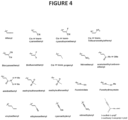
- Other exemplary RT blocking groups are shown in FIGURES 3 and 4 .
- R 1 of Formula I is a substituted or unsubstituted alkyl, substituted or unsubstituted alkenyl, substituted or unsubstituted alkynyl, substituted or unsubstituted heteroalkyl, substituted or unsubstituted heteroalkenyl, or substituted or unsubstituted heteroalkynyl.
- R 1 can be selected from the group consisting of allenyl, cis-cyanoethenyl, trans-cyanoethenyl, cis-cyanofluoroethenyl, trans-cyanofluoroethenyl, cis-trifluoromethylethenyl, trans-trifluoromethylethenyl, biscyanoethenyl, bisfluoroethenyl, cis-propenyl, trans-propenyl, nitroethenyl, acetoethenyl, methylcarbonoethenyl, amidoethenyl, methylsulfonoethenyl, methylsulfonoethyl, formimidate, formhydroxymate, vinyloethenyl, ethylenoethenyl, cyanoethylenyl, nitroethylenyl, amidoethylenylenyl, 3-ox
- R 1 is selected from the group consisting of allyl, azidomethyl, aminoalkoxyl, 2-cyanoethyl, substituted alkyl, unsubstituted alkyl, substituted alkenyl, unsubstituted alkenyl, substituted alkynyl, unsubstituted alkynyl, substituted heteroalkyl, unsubstituted heteroalkyl, substituted heteroalkenyl, unsubstituted heteroalkenyl, substituted heteroalkynyl, unsubstituted heteroalkynyl, allenyl, cis-cyanoethenyl, trans-cyanoethenyl, cis-cyanofluoroethenyl, trans-cyanofluoroethenyl, cis-trifluoromethyletheny
- alkyl As used herein, the terms “alkyl,” “alkenyl,” and “alkynyl” include straight- and branched-chain monovalent substituents. Examples include methyl, ethyl, isobutyl, 3-butynyl, and the like. Ranges of these groups useful with the compounds and methods described herein include C 1 -C 10 alkyl, C 2 -C 10 alkenyl, and C 2 -C 10 alkynyl.
- Additional ranges of these groups useful with the compounds and methods described herein include C 1 -C 8 alkyl, C 2 -C 8 alkenyl, C 2 -C 8 alkynyl, C 1 -C 8 alkyl, C 2 -C 6 alkenyl, C 2 -C 6 alkynyl, C 1 -C 4 alkyl, C 2 -C 4 alkenyl, and C 2 -C 4 alkynyl.
- Heteroalkyl “heteroalkenyl,” and “heteroalkynyl” are defined similarly as alkyl, alkenyl, and alkynyl, but can contain O, S, or N heteroatoms or combinations thereof within the backbone. Ranges of these groups useful with the compounds and methods described herein include C 1 -C 10 heteroalkyl, C 2 -C 10 heteroalkenyl, and C 2 -C 10 heteroalkynyl.
- the reversible blocking group is nitrobenzyl (C 6 H 4 (NO 2 )-CH 2 -).
- the reversible blocking group is coumarinyl (i.e., contains a coumarin moiety or a derivative thereof) wherein, e.g., any one of the CH carbons of the coumarinyl reversible blocking group is covalently attached to the 3'-O of the nucleotide analogue.
- the affinity reagents are minibodies.
- Minibodies are engineered antibody constructs comprised of the variable heavy (VH) and variable light (VL) chain domains of a native antibody fused to the hinge region and to the CH3 domain of the immunoglobulin molecule.
- Minibodies are thus small versions of whole antibodies encoded in a single protein chain which retain the antigen binding region, the CH3 domain to permit assembly into a bivalent molecule and the antibody hinge to accommodate dimerization by disulfide linkages.
- a single domain antibody (sdAb) may also be used.
- a single domain antibody, or NANOBODY (Ablynx) is an approximately antibody fragment with a single monomeric variable antibody domain. Single domain antibodies bind selectively to specific antigens and are smaller (MW 12-15 kDa) than conventional antibodies.
- NLRT-specific antibodies Methods for raising polyclonal antibodies are known and may be used to produce NLRT-specific antibodies. For one approach see Example 2 below.
- a rabbit is injected with NLRT-A (conjugated to an immunogen) to raise antibodies, and antibodies are selected to do not bind to: the same structure lacking the blocking group (e.g., having a 3'-OH), and the other NLRTs (NLRT-T, NLRT-G, and NLRT-C).
- antibody producing cells can be harvested from an animal immunized with an immunogen comprising an NLRT and fused with myeloma cells by standard somatic cell fusion procedures thus immortalizing these cells and yielding hybridoma cells.
- Such techniques are well known in the art (e.g., the hybridoma technique originally developed by Kohler and Milstein ( Kohler and Milstein Nature 256:495-497, 1975 ) as well as other techniques such as the human B-cell hybridoma technique ( Kozbor et al., 1983, Immunol.
- Hybridoma cells can be screened immunochemically for production of antibodies specifically reactive with a particular RT and the monoclonal antibodies can be isolated.
- Specific antibodies, or antibody fragments, reactive against particular antigens or molecules may also be generated by screening expression libraries encoding immunoglobulin genes, or portions thereof, expressed in bacteria with cell surface components.
- immunoglobulin genes or portions thereof, expressed in bacteria with cell surface components.
- complete Fab fragments, VH regions and FV regions can be expressed in bacteria using phage expression libraries (see for example Ward et al., Nature 341:544-546, 1989 ; Huse et al. Science 246:1275, 1989 ; and McCafferty et al. Nature 348:552-554, 1990 ).
- antibodies specific for a target NLRT are readily isolated by screening antibody phage display libraries.
- an antibody phage library is optionally screened by using to identify antibody fragments specific for a target NLRT. Methods for screening antibody phage libraries are well known in the art.
- Anti-NLRT antibodies also may be produced in a cell-free system.
- Nonlimiting exemplary cell-free systems are described, e.g., in Sitaraman et al., Methods Mol. Biol. 498: 229-44, 2009 ; Spirin, Trends Biotechnol. 22: 538-45, 2004 ; and Endo et al., Biotechnol. Adv. 21: 695-713, 2003 .
- An aptamer is an oligonucleotide or peptide molecule that binds to a specific target molecule.
- Aptamers can be classified as: (a) DNA or RNA or XNA aptamers, which consist of (usually short) strands of oligonucleotides; and (b) peptide aptamers, which consist of one (or more) short variable peptide domains, attached at both ends to a protein scaffold.
- the aptamer library is applied and allowed to bind. Weak binders are washed away and bound aptamers are eluted and amplified using PCR. Then the pool of amplified aptamers is reapplied to the targets. The process is repeated multiple times under increasing stringency until aptamers of the desired selectivity and affinity are obtained. See, e.g., Jayasena, et al., Clinical Chemistry 45:1628-1650, 1999 . Peptide aptamer selection can be made using different systems, including the yeast two-hybrid system.
- Affimers are small (12-14 kDa), highly stable proteins that bind their target molecules with specificity and affinity similar to that of antibodies. These proteins share the common tertiary structure of an alpha-helix lying on top of an anti-parallel beta-sheet. Affimer proteins display two peptide loops and an N-terminal sequence that can all be randomised to bind to desired target proteins with high affinity and specificity in a similar manner to monoclonal antibodies. Stabilisation of the two peptides by the protein scaffold constrains the possible conformations that the peptides can take, increasing the binding affinity and specificity compared to libraries of free peptides.
- Exemplary fluorescent dyes include, without limitation, acridine dyes, cyanine dyes, fluorone dyes, oxazine dyes, phenanthridine dyes, and rhodamine dyes.
- Exemplary fluorescent dyes include, without limitation, fluorescein, FITC, Texas Red, ROX, Cy3, an Alexa Fluor dye (e.g., Alexa Fluor 647 or 488), an ATTO dye (e.g., ATTO 532 or 655), and Cy5.
- Exemplary fluorescent dyes can further include dyes that are used in, or compatible with, two- or four-channel SBS chemistries and workflows.
- the assay comprises two distinct parts: first, there is a period of incubation (usually one hour) with the unlabeled primary antibody, during the antibody binds to the antigen (assuming of course that the antigen is present). Excess unbound primary antibody is then washed away and a labeled secondary reagent is added. After a period of incubation (again one hour), excess secondary reagent is washed away and the amount of label associated with the primary antibody (i.e., indirectly via the secondary reagent) is quantified.
- the label usually results in the production of a colored substance or an increase in the amount of light emitted at a certain wavelength, if the antigen is present.
- affinity affinity reagents are used that are labeled with one or the same number of molecules of a single dye yet discriminate among the four NLRTs as a result of different binding efficiencies (i.e., the average number of affinity reagents that are bound to a single spot on an array, e.g., 10% of all copies of the target DNA molecule for NLRT-A, 30% for NLRT-T, and 60% for NLRT-C (and zero percent or little detectable binding for NLRT-G).
- the targets have the same blocking group and affinity reagents are selected that have different affinities for their target.
- blocking groups may be modified with small chemical changes to tune the efficiency of binding of the same affinity reagent, thus generating base specific levels of signal.
- an unmodified blocking group may produce the highest signal (100% of signal)
- a blocking group with modification 1 may produce a lower level of signal (e.g. 50%)
- a blocking group with modification 2 may produce a still lower signal with even less (25%), etc.
- azidomethyl-dA Affinity Agent 1 color 1, low intensity (0-40%) azidomethyl-prime -dC Affinity Agent 1, color 1, high intensity (60-100%) cyanoethoxymethyl - dG Affinity Agent 2, color 2, low intensity (0-40%) cyanoethoxymethyl-prime - dT Affinity Agent 2, color 2, high intensity (60-100%)
- Affinity Agent 1, color 1, low intensity has an signal intensity close to zero and Affinity Agent 2, color 2, low intensity has a higher signal intensity (25-40%).
- the antibody could recognize two bases (a nucleotide dimer) where the downstream base is modified with the addition of a cleavable or un-cleavable group.
- the last-incorporated base is identified by the binding of two affinity reagents in combination: one affinity reagent specifically recognizes and binds to the nucleobase, and the second affinity reagent specifically recognizes and binds to the blocking group. Only when both affinity reagents bind and/or are in spatial proximity, can a determination of the identity of the terminal base be made such as when the two affinity reagents include a FRET donor-acceptor pair as their respective "labels.” Alternatively, the binding of one of the affinity reagents could lead to a conformational change that allows or enhances binding of the second affinity reagent.
- nucleoside analogues described herein can be used in a variety of sequencing methods.
- the analogues can be used in one label (sometimes called "no-label"), two-label, three-label, or four-label sequencing methods, in which unlabeled analogues are paired with affinity reagents directly or indirectly labeled according to a one-, two-, three-, or four-label scheme.
- Exemplary one-label sequencing methods include, but are not limited to, methods in which nucleoside analogues having different nucleobases (e.g., A, C, G, T) are delivered in succession and incorporation is detected by detecting the presence or absence of the same signal or label for each different nucleobase.
- nucleoside analogues having different nucleobases e.g., A, C, G, T
- incorporation is detected by detecting the presence or absence of the same signal or label for each different nucleobase.
- one-label methods are sometimes known as one-color methods because the detection signal and/or label is the same for all nucleobases, even though it may differ in intensity (or be absent) for each nucleoside analogue.
- incorporation of a nucleoside into a primer by DNA polymerase mediated template directed polymerization can be detected by detecting a pyrophosphate cleaved from the nucleoside pyrophosphate.
- Pyrophosphate can be detected using a coupled assay in which ATP sulfurylase converts pyrophosphate to ATP, in the presence of adenosine 5' phosphosulfate, which in turn acts as a substrate for luciferase-mediated conversion of luciferin to oxyluciferin, generating visible light in amounts proportional to ATP generation.
- three-label sequencing can be performed using a first RT labeled by specific binding of an first affinity reagent that includes a first label, a second RT labeled by specific binding of an second affinity reagent that includes a second label, a third RT labeled by specific binding of a third affinity reagent that includes a third label.
- the corresponding affinity reagent is omitted from the affinity reagent set, or is unlabeled, or includes a combination of two or more of the first, second, and third labels (or a mixture of affinity reagents that are labeled with a different one of the labels and that specifically bind to the fourth RT).
- the first, second and third labels are distinguishable from each other.
- each member of an affinity reagent set has a different, distinguishable detectable label, as in four-color SBS.
- one member of an affinity reagent set is unlabeled, while the other members are labeled.
- the affinity reagent set could simply exclude the unlabeled affinity reagent and include only the labeled affinity reagents.
- one affinity reagent is labeled with a first label (e.g., antiA); a second affinity reagent is labeled with a second label (e.g., antiT); a third affinity reagent is labeled with a third label (e.g., antiC); and a fourth affinity reagent is unlabeled or simply excluded from the affinity reagent set (e.g., antiG).
- a first label e.g., antiA
- a second affinity reagent is labeled with a second label
- a third affinity reagent is labeled with a third label (e.g., antiC)
- a fourth affinity reagent is unlabeled or simply excluded from the affinity reagent set (e.g., antiG).
- affinity reagent set would be useful for three-color sequencing.
- only a single detectable label is used (or a single combination of two or more labels), but differs in intensity among members of the set, such as when the affinity reagent includes differing amounts of the label (or of at least one label of a combination of two or more labels).
- a first affinity reagent e.g., antiA
- a second affinity reagent e.g., antiT
- a third affinity reagent e.g., antiC
- a fourth affinity reagent e.g., antiG is unlabeled (or the fourth affinity reagent is excluded from the affinity reagent set).
- a first affinity reagent (e.g., antiA) is labeled with a first label at a first intensity and a second label; a second affinity reagent (e.g., antiT) is labeled with the same first label but at a second intensity and the same second label; a third affinity reagent (e.g., antiC) is labeled with the same first label but at a third intensity and the same second label; and a fourth affinity reagent (e.g., antiG) is unlabeled, is labeled only with the second label, or is excluded from the affinity reagent set.
- Nucleoside analogues e.g., NLRTs
- oligo- or polynucleotides containing such nucleoside analogues or reaction products thereof can be used as a component of a reaction mixture.
- such components can be used in reaction mixtures for nucleic acid sequencing (e.g., SBS).
- Exemplary reaction mixtures include, but are not limited to, those containing (a) template nucleic acid; (b) polymerase; (c) oligonucleotide primer; (d) a 3'-O reversibly blocked nucleoside analogue, or a mixture of 3'-O reversibly blocked nucleoside analogues having structurally different nucleobases; and (e) a labeled affinity reagent.
- Exemplary sequencing reaction mixtures of the invention include, but are not limited to, arrays comprising a plurality of different template nucleic acids immobilized at different locations on the array; (b) polymerase; (c) oligonucleotide primer; (d) and one or a mixture of NLRTs.
- the template polynucleotide is DNA (e.g., cDNA, genomic DNA, transcriptome or microbiome DNA, amplification products, etc.) or RNA.
- the polynucleotide is either double stranded or single stranded.
- the template nucleic acid is immobilized on a solid surface. In some embodiments, the template nucleic acid is immobilized on a substrate (e.g., a bead, flow cell, pad, channel in a microfluidic device and the like).
- the substrate may comprise silicon, glass, gold, a polymer, PDMS, and the like.
- the template nucleic acid is immobilized or contained within a droplet (optionally immobilized on a bead or other substrate within the droplet).
- the template nucleic acid is an immobilized DNA concatemer comprising multiple copies of a target sequence.
- the template nucleic acid is represented as a DNA concatemer, such as a DNA nanoball (DNB) comprising multiple copies of a target sequence and an "adaptor sequence".
- DNB DNA nanoball
- the template is a single polynucleotide molecule.
- the template is present as a clonal population of template molecules (e.g., a clonal population produced by bridge amplification or Wildfire amplification).
- the method is not limited to a particular form of template, and the template can be any template such as, for example, a DNA concatemer, a dendrimer, a clonal population of templates (e.g., as produced by bridge amplification or Wildfire amplification) or a single polynucleotide molecule.
- a template can alternatively refer to a concatemer template, a dendrimer, a clonal population of, e.g., short linear templates, a single molecule template (e.g., in a zero-mode waveguide), and templates in other forms.
- Kits may be provided for practicing the invention. As described above, NLRTs and NLRT sets may be provided in kit form. Also as described, above, affinity reagents and affinity reagent sets may be provided in kit form. Also contemplated are kits comprising both NLRTs and NLRT sets and affinity reagents or affinity reagent sets.
- kits that include, without limitation (a) a reversible terminator nucleotide (RT) or RT set that includes one, two, three, four or more different individual RTs; (b) a corresponding affinity reagent or affinity reagent set that includes one, two, three, four or more affinity reagents, each of which is specific for one of the RTs; and (c) packaging materials and or instructions for use.
- RT reversible terminator nucleotide
- affinity reagent affinity reagent set that includes one, two, three, four or more affinity reagents, each of which is specific for one of the RTs
- packaging materials and or instructions for use include, without limitation (a) a reversible terminator nucleotide (RT) or RT set that includes one, two, three, four or more different individual RTs.
- a reversible terminator nucleotide (RT) or RT set that includes one, two, three, four or more different individual RTs
- such a kit comprises a plurality of the RTs, wherein each RT comprises a different nucleobase, and a plurality of affinity reagents, wherein each affinity reagent binds specifically to one of the RTs.
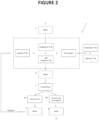
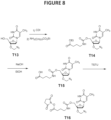
- the removal of the affinity reagent and blocking group is uncoupled, such that the affinity reagent is removed but the blocking group is not cleaved from the nucleotide sugar. This is useful when reprobing is desired. See Figure 2 , Section 9, below, and Example 11.
- a azidomethyl blocking group can be removed by treatment with phosphine (a widely used process) and an antibody affinity reagent can be removed by treatment with a low pH (e.g., 100 mM glycine pH 2.8) or high pH (e.g., 100 mM glycine pH 10), high salt, or chaotropic stripping buffer.
- a single treatment or condition can be used to remove both the NLRT and the affinity reagent (e.g., phosphine in a high salt buffer).
- removal of the blocking group results in disassociation of the affinity reagent if, for example, the blocking group is required for affinity reagent binding.
- the 3'-O reversible blocking group can be removed by enzymatic cleavage or chemical cleavage (e.g., hydrolysis).
- the conditions for removal can be selected by one of ordinary skill in the art based on the descriptions provided herein, the chemical identity of the blocking group to be cleaved, and nucleic acid chemistry principles known in the art.
- the blocking group is removed by contacting the reversibly blocked nucleoside with a reducing agent such as dithiothreitol (DTT), or a phosphine reagent such as tris(2-carboxyethyl)phosphine (TCEP), tris(hydroxymethyl)phosphine (THP), or tris(hydroxypropyl) phosphine.
- a reducing agent such as dithiothreitol (DTT), or a phosphine reagent such as tris(2-carboxyethyl)phosphine (TCEP), tris(hydroxymethyl)phosphine (THP), or tris(hydroxypropyl) phosphine.
- the blocking group is removed by washing the blocking group from the incorporated nucleotide analogue using a reducing agent such as a phosphine reagent.
- the blocking group is photolabile, and the blocking group can be removed by application of, e.g., UV
- Antibody-based affinity reagents can be removed by low pH, high pH, high or low salt, or denaturing agents such as a chaotropic stripping buffer.
- Other classes of affinity reagents e.g., aptamers
- affinity reagents such as antibodies
- affinity reagents can be removed by introducing an agent that competes with the bound epitope for affinity reagent binding, for example as illustrated in Example 10 below.
- Simultaneous removal of affinity reagents and blocking groups also may occur simultaneously may also be effected by addition of a solution comprising a blocking group cleaving component (e.g., a phosphine reagent) and an affinity reagent releasing agent (e.g., high salt).
- a blocking group cleaving component e.g., a phosphine reagent
- an affinity reagent releasing agent e.g., high salt
- Detection e.g., of a fluorescent signal
- detection can be performed either before or after removal of the blocking group as long as the labeled affinity reagent remains bound.
- small compounds are not sufficiently complex by themselves to induce an immune response or be processed in a manner that elicits production of specific antibodies.
- immunogenic carrier proteins such as keyhole limpet hemocyanin (KLH).
- Adjuvants can be mixed and injected with an immunogen to increase the intensity of the immune response.
- Carrier protein conjugation, use of adjuvants and other issues relating to preparation of samples for injection are described in this section on antibody production. Standard procedures for generating, purifying and modifying antibodies for use as antigen-specific probes may be used. See, e.g., Harlow and Lane, "Antibodies: A Laboratory Manual” (1988 ) and Harlow and Lane, "Using Antibodies: A Laboratory Manual” (1999 ).
- Epitopes An epitope is the specific site on an antigen to which an antibody binds. For very small antigens, practically the entire chemical structure may act as a single epitope. Depending on its complexity and size, an antigen may effect production of antibodies directed at numerous epitopes. Polyclonal antibodies are mixtures of serum immunoglobulins and collectively are likely to bind to multiple epitopes on the antigen.
- Bovine Serum Albumin Bovine serum albumin (BSA; 67kDa) belongs to the class of serum proteins called albumins.
- Immunization protocols are well known and only generally described here. See Example 2, below for additional descriptions.
- the concentration of the immunogen before mixing with adjuvant will ultimately determine the amount of conjugate that will be administered per injection.
- Immunization Schedule for Mice Day 0: Collect pre-immune serum from the mouse to use as a blank when performing ELISA screening after immunization. Store frozen. Inject 50 to 100 ⁇ g of immunogen (equal to 100 to 200 ⁇ L of antigen-adjuvant mixture) per mouse. Typical routes of injection include intraperitoneal (i.p.) or subcutaneous (s.c.). One or two such injections may be made per animal. Day 14: Boost with an equivalent amount of immunogen in adjuvant.
- Day 21 Test bleed and assay antibody response by ELISA. (Typically, mice are bled under anesthesia through the tail vein or the retro-orbital plexis).
- affinity chromatography also called affinity purification, whereby the protein of interest is purified by virtue of its specific binding properties to an immobilized ligand.
- Proteins and other macromolecules of interest can be purified from crude extracts or other complex mixtures by a variety of methods. Selective precipitation is perhaps the simplest method for separating one type of macromolecule from another.
- affinity chromatography also called affinity purification
- a particular ligand is chemically immobilized or “coupled” to a solid support so that when a complex mixture is passed over the column, those molecules having specific binding affinity to the ligand become bound. After other sample components are washed away, the bound molecule is stripped from the support, resulting in its purification from the original sample.
- Antibodies can be covalently modified in many ways to suit the purpose of a particular assay.
- Many immunological methods involve the use of labeled antibodies and a variety of reagents have been created to allow labeling of antibodies. Enzymes, biotin, fluorophores and radioactive isotopes are all commonly used to provide a detection signal in biological assays. Understanding the functional groups available on an antibody is the key to choosing the best method for modification, whether that be for labeling, crosslinking or covalent immobilization.
- Most antibody labeling strategies use one of three targets: (1) Primary amines (-NH2): these occur on lysine residues and the N-terminus of each polypeptide chain.
- -NH2 Primary amines
- lysines primary amines
- the lone drawback to this labeling strategy is that it occasionally causes a significant decrease in the antigen-binding activity of the antibody. The decrease may be particularly pronounced when working with monoclonal antibodies or when attempting to add a high density of labels per antibody molecule.
- four NLRTs are blocked using two blocking groups, e.g., azidomethyl-T, azidomethyl-G, cyanoethenyl-C and cyanoethenyl-A and the array is probed once with two affinity reagents (one specific for 3'-O-azidomethyl-2'-deoxyribose and the other specific for 3'-O-cyanoethenyl-2'-deoxyribose) and probed a second time with a different pair of affinity reagents (one specific for purines and one specific for pyrimidines).
- An address on an array that shows signal characteristic of 3'-O-azidomethyl-2'-deoxyribose and purine would be identified as having a guanine base, and so forth.
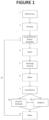
- FIGURES 1 and 2 provide additional guidance to the reader, but should not be construed as limiting.
- the blocking group will be removed (Step 8b) prior to antibody staining (Step 5).
- DNB methods result in a single stranded concatemer with many copies of the template (e.g., genomic DNA sequences and adjacent primer binding sites).
- Bridge PCR methods result in a clonal cluster of template molecules (e.g., genomic DNA sequences flanked by adaptors which may serve as primer binding sites). In bridge PCR both strands of the template nucleic acid may be present, as separate single strands.
- templates i.e., singular grammatical form
- array is used in the broadest sense and includes, unless otherwise specified, ordered arrays (meaning template binding regions are arranged in an ordered, typically rectilinear, pattern, such as a grid, spiral, or other patterns) and disordered arrays (meaning template binding regions are at random positions).
- identity of templates at any specific position (or "address") on an array may be known prior to sequencing of the templates. More often, the array is a "random array” in which the identity of a templates at a given address is not known prior to sequencing.
- array is not limited to positions on a planer surface, but can include bead arrays, droplet arrays, and the like.
- DNA sequencers that perform sequencing by synthesis are commercially available, for example, from Illumina Inc. (San Diego, CA), including MiniSeq, MiSeq, NextSeq, HiSeq, HiSeq X, and NovaSeq sequencing systems.
- Pyrosequencing detects the release of inorganic pyrophosphate (PPi) as particular nucleotides are incorporated into a nascent nucleic acid strand ( Ronaghi et al., Anal Biochem 242:84-89, 1996 ; Ronaghi, Genome Res. 11:3-11, 2001 ; Ronaghi et al., Science 281:363, 1998 ); and U.S. Pat. Nos. 6,210,891 ; 6,258,568 and 6,274,320 .
- PPi inorganic pyrophosphate
- pyrosequencing In pyrosequencing, released PPi can be detected by being converted to adenosine triphosphate (ATP) by ATP sulfurylase, and the resulting ATP can be detected via luciferase-produced photons.
- the sequencing reaction can be monitored via a luminescence detection system.
- Excitation radiation sources used for fluorescence based detection systems are not necessary for pyrosequencing procedures.
- Useful fluidic systems, detectors and procedures that can be used for application of pyrosequencing to arrays of the present disclosure are described, for example, in WIPO Pat. App. Ser. No. PCT/US11/57111 , U.S. Pat. App. Pub. No. 2005/0191698 A1 , U.S. Pat. No. 7,595,883 , and U.S. Pat. No. 7,244,559 .
- sequencing by ligation methods can be selected from those described in PCT Pat. Pub. WO 1999/019341 ; WO 2005/082098 ; WO 2006/073504 ; and Shendure et al., 2005, Science, 309: 1728-1739 .
- SBS methods can employ the ordered DNA nanoball arrays that are described, for example, in U.S. Pat. Pubs. 2010/0105052 , 2007/099208 , and US 2009/0264299 ) and PCT Pat. Pubs. WO 2007/120208 , WO 2006/073504 , and WO 2007/133831 .
- the patent and non-patent publications listed in this paragraph above are hereby incorporated by reference in their entirety for all purposes.
- sequencing is performed on ordered arrays of DNA nanoballs (DNBs).
- DNBs are produced by rolling circle replication of circular library constructs, each containing a fragment of a genome or other target nucleic acid of interest, resulting in a linear single-stranded DNA concatemer comprising multiple copies of the circular construct that collapses in aqueous solution to form a compact ball-like structure.
- the DNBs are disposed on the surface of a two-dimensional planar substrate to form a random array of single molecules.
- DNBs can be fixed directly or indirectly to the surface by a variety of techniques, including covalent attachment and non-covalent attachment.
- patterned substrates with two dimensional arrays of spots are used to produce the DNB array.
- the spots are activated to capture and hold the DNBs, while the DNBs do not remain in the areas between spots.
- a DNB on a spot will repel other DNBs, resulting in one DNB per spot.
- DNBs are three-dimensional (i.e., are not linear short pieces of DNA)
- arrays of the invention result in more DNA copies per square nanometer of binding surface than traditional DNA arrays. This three-dimensional quality further reduces the quantity of sequencing reagents required, resulting in brighter spots and more efficient imaging. Occupancy of DNB arrays often exceed 90%, but can range from 50% to 100% occupancy. Since DNBs are disposed on a surface and then stick to the activated spots in these embodiments, a high-density DNB array essentially "self-assembles" from DNBs in solution.
- the nucleotide analog includes a detectable label that identifies the nucleobase of the incorporated nucleotide analog, and therefore also identifies the base of the complementary nucleotide in the template.
- the nucleotide analog includes a fluorescent label attached to the nucleobase by a cleavable linker.
- BSA bovine serum albumin
- This example describes protocols use for immunization and antibody purfication use to produce reagents for sequencing. This protocol has been used to make polyclonal antisera with antibodies specific for NLRT-A, -T, -G, and -C with azidomethyl as the 3' blocking group.
- a 70-day immunization schedule was followed: The first immunization was Day 1; the second immunization day was Day 20; the third immunization day was Day 40; the fourth immunization day was Day 60. 5 ml of pre-immune serum was collected before the first immunization, and a 5 ml test bleed was collected after the third immunization for quality control. Finally, a total of 100 ml antiserum was collected from two rabbits after 10 days of the fourth immunization.
- Polyclonal Antibody Titer The following protocol was used to monitor the titers:
- DNA nanoball (DNB) arrays of an E. coli genomic DNA library were used in the sequencing experiments described in the Examples.
- DNBs and DNB arrays are described in, e.g., Drmanac et al., 2010, "Human genome sequencing using unchained base reads on self-assembling DNA nanoarrays," Science 327:78-81 , incorporated herein by reference.
- circular library constructs were made from fragments of E. coli genomic DNA, and the library constructs were amplified by rolling circle amplification (RCA) to produce DNBs comprising genomic DNA inserts with adjacent primer binding sites.
- RCA rolling circle amplification
- the DNBs were arrayed in a DNA sequencing flow-cell (e.g., a BGISEQ-500 flow-cell or BGISEQ-1000 flow-cell) and sequencing was carried out using a BGISEQ-500 (BGI, Shenzhen, China; see Huang et al., 2017, "A reference human genome dataset of the BGISEQ-500 sequencer” Gigascience 6:1-9 ) or a BGISEQ-1000 (BGI, Shenzhen, China).
- a DNA sequencing flow-cell e.g., a BGISEQ-500 flow-cell or BGISEQ-1000 flow-cell
- sequencing was carried out using a BGISEQ-500 (BGI, Shenzhen, China; see Huang et al., 2017, "A reference human genome dataset of the BGISEQ-500 sequencer" Gigascience 6:1-9 ) or a BGISEQ-1000 (BGI, Shenzhen, China).
- Serum-derived antibodies raised against KLH conjugates of 3'-azidomethyl-dA, 3'-azidomethyl-dC, 3'-azidomethyl-dG, or 3'-azidomethyl-dT as described in Example 2 were used in this experiment.
- Four (4) different purification preparations of anti-NLRT antbodies were prepared for each of the four bases (i.e., RT-A, RT-C, RT-G and RT-T), resulting in sixteen (16) antibody preparations denoted A1-A4, C1-C4, G1-G4, and T1-T4.
- coli genomic DNA inserts as described in Example 4, were primed and primers were extended using BG9 DNA polymerase (BGI Shenzhen, China), a polymerase eningeered to incorporate 3' modified dNTPs and four non-labeled reversible terminators with a 3'-azidomethyl blocking group (e.g., 3'-azidomethyl-dATP, -dCTP, -dGTP and -dTTP).
- the sixteen (16) antibody preparations were individually applied to speparate lanes on the DNB arrays at 10 ⁇ g/mL and incubated for at 35°C for 5 min (16 separate incubations).
- control lanes in the sequencing arrays were generated by priming the DNBs and extending the primers using all four 3'-azidomethyl dNTPs labeled by a fluorophore attached to the base via a cleavable linker Control signal values shown here are for C-AF488.
- the data including the Rho of intensities and SNS (signal-to-noise ratio) from the successful base calling report, indicates that sequencing can be performed successfully with unlabeled RTs and labeled affinity reagents that bind specifically to the RT.
- TABLES 3, 4, 5 and 6 show top signal, Rho (background and cross-talk subtracted signal), background signal ("back”) and signal-to-noise ratio (SNR) values obtained with staining of non-labeled reversible terminators on E. coli genomic DNA using directly labeled anti-azidomethyl-base antibodies and for control arrays using labeled azidomethyl-bases.
- the experiment was performed on a BGISEQ-500 flow-cell array with an E. coli genomic DNA library and scanned on a BGISEQ-500 DNA sequencer.
- TABLE 3 shows results using polyclonal antibodies against 3'-O-azidomethyl-2'-deoxyadenine.
- TABLE 4 shows results using polyclonal antibodies against 3'-O-azidomethyl-2'-deoxycytosine.
- TABLE 5 shows results using polyclonal antibodies against 3'-O-azidomethyl-2'-deoxyguanine.
- TABLE 6 shows results using polyclonal antibodies against 3'-O-azidomethyl-2'-deoxythymidine.
- An E. coli genomic DNA library was made as described in Example 2, and arrayed on a BGISEQ-500 flow-cell. Primers were added and sequencing by synthesis was performed by primer extension using unlabeled nucleotide 3'-azidomethyl reversible terminators (dATP, dCTP, dGTP, dTTP). The unlabeled 3'-blocked dNTPs were present at a concentration of 1 ⁇ M each and were incorporated using BG9 DNA at 55°C for 1 min per cycle.
- the four 3'-azidomethyl-base nucleotides were detected by contacting the array with a mixture of four directly labeled anti-3'-azidomethyl-base antibodies in the concentrations shown inTABLE 11 (range of 10-100 ⁇ g/mL) were incubated on the array at 35°C 2 X 2 min per cycle. "2 x 2" refers to incubation with antibody for two minutes, followed by further 2 minute incubation after adding additional antibody. The array was washed three times to remove any unbound antibodies. TABLE 7 shows shows the identity of fluorophore directly conjugated to each detection antibody.
- the fluorescence signal at each position on the DNB array was determined by scanning for 80 ms during laser excitation of the fluorophore. After DNB base identity was determined, the 3' blocking group was removed by reduction with THPP (13 mM) for 2 min at 35°C, allowing for the regeneration of 3'-OH group and permitting further extension of the nascent DNA strand. Removal of the 3' blocking group also resulted in disassociation of the antibody from the primer extension product.
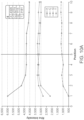
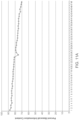
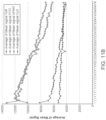
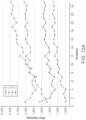
- FIGURES 12A and 12B show the Rho and signal to noise ratio (SNR) for each base at each sequencing cycle.
- SNR signal to noise ratio
- TABLES 9 and 10 show (Top signal), Rho (background and cross-talk subtracted signal), background signal and signal-to-noise ratio (SNR) values obtained with staining of non-labeled reversible terminators on E. coli genomic DNA using directly labeled anti-azidomethyl-base antibodies.
- This experiment was performed on a BGISEQ-500 flow-cell array with an E. coli genomic DNA library and scanned on a BGISEQ-500 DNA sequencer.
- Primers were hybridized onto the immobilized DNBs and extended in the presence of all four non-labeled nucleotide 3'-azidomethyl RTs (dATP, dCTP, dGTP, dTTP) at 1 ⁇ M each concentration for 2 min at 35°C using BG9 polymerase. After incorporation and washing to remove unincorporated nucleotides, the incorporated 3'-azidomethyl-base nucleotides were detected simultaneously by incubating all four labeled anti-3'-azidomethyl-base antibodies (Antibody Set 1) at the concentrations shown (e.g., "@30" means 30 ug/mL) for two sequential incubations of two minutes each at 35°C.
- Antibody Set 1 the concentrations shown (e.g., "@30" means 30 ug/mL) for two sequential incubations of two minutes each at 35°C.
- Antibody Set 2 comprises the same antibody preparations but the antibodies are labeled differently.TABLE 10 shows signal after applying Antibody Set 2. The data demonstrate that signal and SNR values are suitable for basecalling analysis independent of the identity of the directly labeled fluorophore.
- WB1 NaCl 0.75 M, sodium citrate 0.075M, Tween 20 0.05%, pH 7.0; WB2 NaCl 50 mM, Tris-HCl pH9 50 mM,Tween 20 0.05%, EDTA 1 mM. pH 9.0; SRE NaCl 400 mM, Tris HCl pH7 1000 mM, Sodium L ascorbate 100 mM, Tween 20 0.05%, pH 7.0.
- the Example describes a process in which (1) the identity of a base at a first position is determined by detecting the binding by a first primary antibody specific for the base and 3' blocking group; (2) removing the first primary antibody without removing the 3' blocking group; (3) reprobing the same position using a second primary antibody specific for the base and 3' blocking group.
- the results of these experiments are sumarized in TABLE 12.
- TABLE 12 Illustrates an improved DNA sequence identity mapping rate when two independent reads from different fluorescent color combinations (as described in Example 10) are combined for each position of the nascent sequencing-by-synthesis strand for a total of 20 positions read.
- "Odd indep” represents the initial read in “conventional colors” for each sequencing position.
- "Even indep” represents the subsequent read in “alternate colors” after removal by specific competition using the procedure outlined in TABLE 12.
- “Combo” represents the result of comparing each of the two independent reads and weighting the result to the higher intensity and therefore higher confidence value of the two reads. Results show significantly higher mapping rates and significantly lower mismatch rates when the two independent reads are combined using this technique.
Landscapes
- Chemical & Material Sciences (AREA)
- Life Sciences & Earth Sciences (AREA)
- Health & Medical Sciences (AREA)
- Organic Chemistry (AREA)
- Proteomics, Peptides & Aminoacids (AREA)
- Immunology (AREA)
- Zoology (AREA)
- Wood Science & Technology (AREA)
- Engineering & Computer Science (AREA)
- General Health & Medical Sciences (AREA)
- Molecular Biology (AREA)
- Genetics & Genomics (AREA)
- Biochemistry (AREA)
- Biophysics (AREA)
- Analytical Chemistry (AREA)
- General Engineering & Computer Science (AREA)
- Microbiology (AREA)
- Biotechnology (AREA)
- Bioinformatics & Cheminformatics (AREA)
- Physics & Mathematics (AREA)
- Medicinal Chemistry (AREA)
- Pathology (AREA)
- Epidemiology (AREA)
- Animal Behavior & Ethology (AREA)
- Public Health (AREA)
- Veterinary Medicine (AREA)
- Pharmacology & Pharmacy (AREA)
- Measuring Or Testing Involving Enzymes Or Micro-Organisms (AREA)
- Saccharide Compounds (AREA)
- Chemical Kinetics & Catalysis (AREA)
- Apparatus Associated With Microorganisms And Enzymes (AREA)
Applications Claiming Priority (5)
| Application Number | Priority Date | Filing Date | Title |
|---|---|---|---|
| US201762442263P | 2017-01-04 | 2017-01-04 | |
| US201762490511P | 2017-04-26 | 2017-04-26 | |
| EP18736171.2A EP3565905B2 (fr) | 2017-01-04 | 2018-01-04 | Séquençage d'acides nucléiques par réactifs d'affinité |
| EP22174722.3A EP4112741B1 (fr) | 2017-01-04 | 2018-01-04 | Séquençage progressif par terminateurs réversibles non étiquetés ou nucléotides naturels |
| PCT/US2018/012425 WO2018129214A1 (fr) | 2017-01-04 | 2018-01-04 | Séquençage par étapes par des terminateurs réversibles non marqués ou des nucléotides naturels |
Related Parent Applications (3)
| Application Number | Title | Priority Date | Filing Date |
|---|---|---|---|
| EP22174722.3A Division EP4112741B1 (fr) | 2017-01-04 | 2018-01-04 | Séquençage progressif par terminateurs réversibles non étiquetés ou nucléotides naturels |
| EP18736171.2A Division EP3565905B2 (fr) | 2017-01-04 | 2018-01-04 | Séquençage d'acides nucléiques par réactifs d'affinité |
| EP18736171.2A Division-Into EP3565905B2 (fr) | 2017-01-04 | 2018-01-04 | Séquençage d'acides nucléiques par réactifs d'affinité |
Publications (2)
| Publication Number | Publication Date |
|---|---|
| EP4575499A2 true EP4575499A2 (fr) | 2025-06-25 |
| EP4575499A3 EP4575499A3 (fr) | 2025-07-09 |
Family
ID=62791177
Family Applications (3)
| Application Number | Title | Priority Date | Filing Date |
|---|---|---|---|
| EP18736171.2A Active EP3565905B2 (fr) | 2017-01-04 | 2018-01-04 | Séquençage d'acides nucléiques par réactifs d'affinité |
| EP25160087.0A Pending EP4575499A3 (fr) | 2017-01-04 | 2018-01-04 | Séquençage par étapes par des terminateurs réversibles non marqués ou des nucléotides naturels |
| EP22174722.3A Active EP4112741B1 (fr) | 2017-01-04 | 2018-01-04 | Séquençage progressif par terminateurs réversibles non étiquetés ou nucléotides naturels |
Family Applications Before (1)
| Application Number | Title | Priority Date | Filing Date |
|---|---|---|---|
| EP18736171.2A Active EP3565905B2 (fr) | 2017-01-04 | 2018-01-04 | Séquençage d'acides nucléiques par réactifs d'affinité |
Family Applications After (1)
| Application Number | Title | Priority Date | Filing Date |
|---|---|---|---|
| EP22174722.3A Active EP4112741B1 (fr) | 2017-01-04 | 2018-01-04 | Séquençage progressif par terminateurs réversibles non étiquetés ou nucléotides naturels |
Country Status (18)
| Country | Link |
|---|---|
| US (3) | US10851410B2 (fr) |
| EP (3) | EP3565905B2 (fr) |
| JP (2) | JP2020508037A (fr) |
| KR (1) | KR102349259B1 (fr) |
| CN (2) | CN110418847B (fr) |
| AU (2) | AU2018205472B2 (fr) |
| BR (1) | BR112019013715B1 (fr) |
| CA (1) | CA3048486A1 (fr) |
| DK (2) | DK3565905T4 (fr) |
| ES (2) | ES3026859T3 (fr) |
| FI (2) | FI4112741T3 (fr) |
| HU (2) | HUE059673T2 (fr) |
| IL (1) | IL267836B2 (fr) |
| MX (2) | MX2019008016A (fr) |
| PL (2) | PL3565905T5 (fr) |
| PT (2) | PT4112741T (fr) |
| RS (2) | RS63419B2 (fr) |
| WO (1) | WO2018129214A1 (fr) |
Families Citing this family (59)
| Publication number | Priority date | Publication date | Assignee | Title |
|---|---|---|---|---|
| ES3026859T3 (en) | 2017-01-04 | 2025-06-12 | Mgi Tech Co Ltd | Stepwise sequencing by non-labeled reversible terminators or natural nucleotides |
| WO2019067635A1 (fr) | 2017-09-27 | 2019-04-04 | Ultima Genomics, Inc. | Procédés et systèmes de séquençage d'acides nucléiques |
| AU2018448937B2 (en) * | 2018-11-07 | 2024-08-15 | Qingdao MGI Tech Co., Ltd. | Method for sequencing polynucleotides |
| CN113272448B (zh) * | 2018-11-09 | 2025-02-07 | 深圳华大智造科技股份有限公司 | 使用未标记的核苷酸进行大规模平行测序 |
| SG11202105957YA (en) * | 2018-12-05 | 2021-07-29 | Egi Tech Shen Zhen Co Limited | Rolling circle amplification method, method for preparing sequencing library, and dna nanosphere prepared therefrom |
| US11293061B2 (en) | 2018-12-26 | 2022-04-05 | Illumina Cambridge Limited | Sequencing methods using nucleotides with 3′ AOM blocking group |
| EP3702474A1 (fr) * | 2019-02-26 | 2020-09-02 | QIAGEN GmbH | Procédé et kit de séquençage |
| BR112021022809A2 (pt) | 2019-05-15 | 2022-01-25 | Egi Tech Shen Zhen Co Ltd | Método de sequenciamento de canal único baseado em autoluminescência |
| WO2021023252A1 (fr) | 2019-08-07 | 2021-02-11 | Bgi Shenzhen Co., Ltd. | Composés contenant un ester d'acridinium et leurs procédés d'utilisation pour le séquençage monochrome à base de chimioluminescence |
| IL286668B1 (en) * | 2019-12-16 | 2026-04-01 | Illumina Cambridge Ltd | Kits and flow cells |
| AU2020407267A1 (en) * | 2019-12-18 | 2022-06-16 | F. Hoffmann-La Roche Ag | Methods of sequencing by synthesis using a consecutive labeling scheme |
| US12448648B2 (en) | 2019-12-23 | 2025-10-21 | Mgi Tech Co., Ltd. | Controlled strand-displacement for paired end sequencing |
| US12110548B2 (en) | 2020-02-03 | 2024-10-08 | 10X Genomics, Inc. | Bi-directional in situ analysis |
| CN115427586B (zh) | 2020-03-18 | 2025-03-28 | 深圳华大智造科技股份有限公司 | 大规模平行测序中的恢复阶段 |
| US11761040B2 (en) | 2020-04-20 | 2023-09-19 | Mgi Tech Co., Ltd. | DNA protection agent in DNA imaging buffer |
| CN115997030A (zh) | 2020-04-30 | 2023-04-21 | 德迈逊科技有限公司 | 用于大分子操作的装置和方法 |
| US11787831B2 (en) | 2020-06-22 | 2023-10-17 | Illumina Cambridge Limited | Nucleosides and nucleotides with 3′ acetal blocking group |
| US11981964B2 (en) | 2020-07-28 | 2024-05-14 | Illumina Cambridge Limited | Substituted coumarin dyes and uses as fluorescent labels |
| US20230366023A1 (en) * | 2020-10-09 | 2023-11-16 | Bgi Shenzhen Co., Ltd. | Methods and compositions for bioluminescence-based sequencing |
| US20230375556A1 (en) * | 2020-10-12 | 2023-11-23 | Mgi Tech Co., Ltd. | Protein detection and tracking using nucleoside tags |
| GB2599729A (en) * | 2020-10-12 | 2022-04-13 | Sumitomo Chemical Co | Method comprising light emitting marker |
| JP2023546741A (ja) | 2020-10-21 | 2023-11-07 | ビージーアイ シェンチェン | 修飾ヌクレオシド又はヌクレオチド |
| US20220195516A1 (en) | 2020-12-17 | 2022-06-23 | Illumina Cambridge Limited | Methods, systems and compositions for nucleic acid sequencing |
| US20220195517A1 (en) | 2020-12-17 | 2022-06-23 | Illumina Cambridge Limited | Long stokes shift chromenoquinoline dyes and uses in sequencing applications |
| US20220195196A1 (en) | 2020-12-17 | 2022-06-23 | Illumina Cambridge Limited | Alkylpyridinium coumarin dyes and uses in sequencing applications |
| US20220195518A1 (en) * | 2020-12-22 | 2022-06-23 | Illumina Cambridge Limited | Methods and compositions for nucleic acid sequencing |
| US20240158839A1 (en) | 2021-03-15 | 2024-05-16 | President And Fellows Of Harvard College | Methods for in situ sequencing |
| CA3214986A1 (fr) | 2021-04-01 | 2022-10-06 | Bgi Shenzhen | Analogue nucleotidique pour le sequencage |
| JP2024516191A (ja) | 2021-05-05 | 2024-04-12 | イルミナ ケンブリッジ リミテッド | ビス-ホウ素縮合複素環を含有する蛍光色素及び配列決定における使用 |
| CN113372402A (zh) * | 2021-06-15 | 2021-09-10 | 中国人民解放军军事科学院军事医学研究院 | 3’-o-可逆封闭的核苷酸及其在无模板酶促核酸合成中的应用 |
| EP4448786B1 (fr) | 2021-12-16 | 2026-02-04 | Illumina, Inc. | Procédés de clivage dirigé par métal de polynucléotides liés à une surface |
| AU2022421156A1 (en) | 2021-12-20 | 2024-01-18 | Illumina, Inc. | Periodate compositions and methods for chemical cleavage of surface-bound polynucleotides |
| EP4453243B1 (fr) | 2021-12-20 | 2026-02-11 | Illumina, Inc. | Compositions de periodate et méthodes de clivage chimique de polynucléotides liés à la surface |
| AU2023246772A1 (en) | 2022-03-29 | 2024-01-18 | Illumina Inc. | Chromenoquinoline dyes and uses in sequencing |
| CA3223037A1 (fr) | 2022-03-30 | 2023-10-05 | Oliver MILLER | Procedes de clivage chimique de polynucleotides lies a une surface |
| US20230357845A1 (en) | 2022-03-31 | 2023-11-09 | Illumina, Inc. | Compositions and methods for improving sequencing signals |
| WO2023192900A1 (fr) * | 2022-03-31 | 2023-10-05 | Illumina Singapore Pte. Ltd. | Nucléosides et nucléotides dotés d'un groupe de protection 3' vinyle utiles dans le séquençage par synthèse |
| US20240084378A1 (en) | 2022-05-11 | 2024-03-14 | 10X Genomics, Inc. | Compositions and methods for in situ sequencing |
| CN119604513A (zh) | 2022-06-28 | 2025-03-11 | 因美纳公司 | 含有稠合四环双硼杂环的荧光染料及其在测序中的用途 |
| JP2025531816A (ja) | 2022-09-09 | 2025-09-25 | ビージーアイ シェンチェン | 核酸検出におけるヘテロ芳香環化合物の使用 |
| US20250297306A1 (en) | 2022-09-28 | 2025-09-25 | Mgi Tech Co., Ltd. | Sequencing method |
| US20240140939A1 (en) | 2022-09-30 | 2024-05-02 | Illumina Cambridge Limited | Compositions and methods for reducing photo damage during sequencing |
| WO2024123866A1 (fr) | 2022-12-09 | 2024-06-13 | Illumina, Inc. | Nucléosides et nucléotides à groupes bloquants 3´ et lieurs clivables |
| CN119095982A (zh) | 2022-12-22 | 2024-12-06 | 伊路米纳有限公司 | 用于边合成边测序的钯催化剂组合物和方法 |
| WO2024137765A1 (fr) | 2022-12-22 | 2024-06-27 | Illumina, Inc. | Compositions de catalyseur de métal de transition et procédés de séquençage par synthèse |
| CN119095984A (zh) | 2022-12-27 | 2024-12-06 | 伊路米纳有限公司 | 使用3'烯丙基封端的核苷酸的测序方法 |
| WO2024206407A2 (fr) | 2023-03-29 | 2024-10-03 | Illumina, Inc. | Colorants de naphtalimide et utilisations dans séquençage d'acides nucléiques |
| EP4689181A1 (fr) | 2023-03-30 | 2026-02-11 | Illumina, Inc. | Compositions et procédés de séquençage d'acides nucléiques |
| WO2024216163A1 (fr) * | 2023-04-13 | 2024-10-17 | Esbiolab Llc | Procédés et compositions pour le séquençage d'acides nucléiques par l'utilisation de nucléotides majoritairement non marqués |
| CN119061122A (zh) * | 2023-05-30 | 2024-12-03 | 深圳市真迈生物科技有限公司 | 单分子测序方法 |
| CN116536399A (zh) * | 2023-07-07 | 2023-08-04 | 之江实验室 | 一种基于微珠测序的基因芯片编解码方法及基因芯片 |
| WO2025090596A1 (fr) | 2023-10-26 | 2025-05-01 | Illumina, Inc. | Colorants à noyau naphtalimide 4,5-substitué et utilisations dans le séquençage d'acides nucléiques |
| WO2025144716A1 (fr) | 2023-12-28 | 2025-07-03 | Illumina, Inc. | Nucléotides ayant des groupes de blocage 3'-o-glucoside clivables par voie enzymatique pour séquençage |
| US20250215494A1 (en) | 2023-12-29 | 2025-07-03 | Illumina, Inc. | Tricyclic polymethine dyes for nucleic acid sequencing |
| WO2025184226A1 (fr) | 2024-02-28 | 2025-09-04 | Illumina, Inc. | Nucléotides à coiffage terminal de phosphate |
| WO2025188906A1 (fr) | 2024-03-08 | 2025-09-12 | Illumina, Inc. | Nucléotides d'adénosine modifiés |
| WO2025230914A1 (fr) | 2024-04-29 | 2025-11-06 | Illumina, Inc. | Nucléotides avec lieurs auto-immolables déclenchés par des enzymes pour le séquençage par synthèse |
| CN118496347B (zh) * | 2024-05-30 | 2024-10-25 | 北京航空航天大学杭州创新研究院 | 一种用于抗体寡核苷酸偶联的方法 |
| WO2026000160A1 (fr) * | 2024-06-25 | 2026-01-02 | 深圳华大智造科技股份有限公司 | Colorant modifié et son utilisation |
Citations (67)
| Publication number | Priority date | Publication date | Assignee | Title |
|---|---|---|---|---|
| US3996345A (en) | 1974-08-12 | 1976-12-07 | Syva Company | Fluorescence quenching with immunological pairs in immunoassays |
| US4351760A (en) | 1979-09-07 | 1982-09-28 | Syva Company | Novel alkyl substituted fluorescent compounds and polyamino acid conjugates |
| US4683195A (en) | 1986-01-30 | 1987-07-28 | Cetus Corporation | Process for amplifying, detecting, and/or-cloning nucleic acid sequences |
| US4683202A (en) | 1985-03-28 | 1987-07-28 | Cetus Corporation | Process for amplifying nucleic acid sequences |
| US4800159A (en) | 1986-02-07 | 1989-01-24 | Cetus Corporation | Process for amplifying, detecting, and/or cloning nucleic acid sequences |
| US4965188A (en) | 1986-08-22 | 1990-10-23 | Cetus Corporation | Process for amplifying, detecting, and/or cloning nucleic acid sequences using a thermostable enzyme |
| US5188934A (en) | 1989-11-14 | 1993-02-23 | Applied Biosystems, Inc. | 4,7-dichlorofluorescein dyes as molecular probes |
| US5210015A (en) | 1990-08-06 | 1993-05-11 | Hoffman-La Roche Inc. | Homogeneous assay system using the nuclease activity of a nucleic acid polymerase |
| US5399491A (en) | 1989-07-11 | 1995-03-21 | Gen-Probe Incorporated | Nucleic acid sequence amplification methods |
| US5854033A (en) | 1995-11-21 | 1998-12-29 | Yale University | Rolling circle replication reporter systems |
| WO1999019341A1 (fr) | 1997-10-10 | 1999-04-22 | President & Fellows Of Harvard College | Amplification par replique de reseaux d'acides nucleiques |
| US6174670B1 (en) | 1996-06-04 | 2001-01-16 | University Of Utah Research Foundation | Monitoring amplification of DNA during PCR |
| US6210891B1 (en) | 1996-09-27 | 2001-04-03 | Pyrosequencing Ab | Method of sequencing DNA |
| US6232465B1 (en) | 1994-09-02 | 2001-05-15 | Andrew C. Hiatt | Compositions for enzyme catalyzed template-independent creation of phosphodiester bonds using protected nucleotides |
| US6258568B1 (en) | 1996-12-23 | 2001-07-10 | Pyrosequencing Ab | Method of sequencing DNA based on the detection of the release of pyrophosphate and enzymatic nucleotide degradation |
| US6274320B1 (en) | 1999-09-16 | 2001-08-14 | Curagen Corporation | Method of sequencing a nucleic acid |
| US6287824B1 (en) | 1998-09-15 | 2001-09-11 | Yale University | Molecular cloning using rolling circle amplification |
| US6396995B1 (en) | 1999-05-20 | 2002-05-28 | Illumina, Inc. | Method and apparatus for retaining and presenting at least one microsphere array to solutions and/or to optical imaging systems |
| US6401267B1 (en) | 1993-09-27 | 2002-06-11 | Radoje Drmanac | Methods and compositions for efficient nucleic acid sequencing |
| US20030022207A1 (en) | 1998-10-16 | 2003-01-30 | Solexa, Ltd. | Arrayed polynucleotides and their use in genome analysis |
| US20030064398A1 (en) | 2000-02-02 | 2003-04-03 | Solexa, Ltd. | Synthesis of spatially addressed molecular arrays |
| US6544732B1 (en) | 1999-05-20 | 2003-04-08 | Illumina, Inc. | Encoding and decoding of array sensors utilizing nanocrystals |
| US6787308B2 (en) | 1998-07-30 | 2004-09-07 | Solexa Ltd. | Arrayed biomolecules and their use in sequencing |
| US6828100B1 (en) | 1999-01-22 | 2004-12-07 | Biotage Ab | Method of DNA sequencing |
| US6833246B2 (en) | 1999-09-29 | 2004-12-21 | Solexa, Ltd. | Polynucleotide sequencing |
| WO2005024010A1 (fr) | 2003-09-11 | 2005-03-17 | Solexa Limited | Polymerases modifies pour l'incorporation amelioree d'analogues nucleotidiques |
| US6897023B2 (en) | 2000-09-27 | 2005-05-24 | The Molecular Sciences Institute, Inc. | Method for determining relative abundance of nucleic acid sequences |
| US6911345B2 (en) | 1999-06-28 | 2005-06-28 | California Institute Of Technology | Methods and apparatus for analyzing polynucleotide sequences |
| US20050191698A1 (en) | 1999-04-20 | 2005-09-01 | Illumina, Inc. | Nucleic acid sequencing using microsphere arrays |
| WO2005082098A2 (fr) | 2004-02-27 | 2005-09-09 | President And Fellows Of Harvard College | Sequençage in situ en fluorescence de billes par la technologie « polony » |
| US6969488B2 (en) | 1998-05-22 | 2005-11-29 | Solexa, Inc. | System and apparatus for sequential processing of analytes |
| US20060024711A1 (en) | 2004-07-02 | 2006-02-02 | Helicos Biosciences Corporation | Methods for nucleic acid amplification and sequence determination |
| WO2006073504A2 (fr) | 2004-08-04 | 2006-07-13 | President And Fellows Of Harvard College | Sequençage des oscillations dans l'anticodon |
| US7115400B1 (en) | 1998-09-30 | 2006-10-03 | Solexa Ltd. | Methods of nucleic acid amplification and sequencing |
| WO2006120433A1 (fr) | 2005-05-10 | 2006-11-16 | Solexa Limited | Polymerases ameliorees |
| US20070099208A1 (en) | 2005-06-15 | 2007-05-03 | Radoje Drmanac | Single molecule arrays for genetic and chemical analysis |
| US7244559B2 (en) | 1999-09-16 | 2007-07-17 | 454 Life Sciences Corporation | Method of sequencing a nucleic acid |
| WO2007120208A2 (fr) | 2005-11-14 | 2007-10-25 | President And Fellows Of Harvard College | Séquençage de l'adn en cercle tournant sur nanogrille |
| WO2007133831A2 (fr) | 2006-02-24 | 2007-11-22 | Callida Genomics, Inc. | Séquençage génomique à haut débit sur des puces à adn |
| US20090026082A1 (en) | 2006-12-14 | 2009-01-29 | Ion Torrent Systems Incorporated | Methods and apparatus for measuring analytes using large scale FET arrays |
| US20090127589A1 (en) | 2006-12-14 | 2009-05-21 | Ion Torrent Systems Incorporated | Methods and apparatus for measuring analytes using large scale FET arrays |
| US7595883B1 (en) | 2002-09-16 | 2009-09-29 | The Board Of Trustees Of The Leland Stanford Junior University | Biological analysis arrangement and approach therefor |
| US20090264299A1 (en) | 2006-02-24 | 2009-10-22 | Complete Genomics, Inc. | High throughput genome sequencing on DNA arrays |
| WO2009136182A1 (fr) | 2008-04-18 | 2009-11-12 | University Of Leeds | Nouvelles protéines d'échafaudage : stérine a modifiée |
| US20100105052A1 (en) | 2007-10-29 | 2010-04-29 | Complete Genomics, Inc. | Nucleic acid sequencing and process |
| US20100137143A1 (en) | 2008-10-22 | 2010-06-03 | Ion Torrent Systems Incorporated | Methods and apparatus for measuring analytes |
| US20100282617A1 (en) | 2006-12-14 | 2010-11-11 | Ion Torrent Systems Incorporated | Methods and apparatus for detecting molecular interactions using fet arrays |
| US20100311602A1 (en) | 2006-10-13 | 2010-12-09 | J. Craig Venter Institute, Inc. | Sequencing method |
| US7897344B2 (en) | 2007-11-06 | 2011-03-01 | Complete Genomics, Inc. | Methods and oligonucleotide designs for insertion of multiple adaptors into library constructs |
| US7901890B2 (en) | 2007-11-05 | 2011-03-08 | Complete Genomics, Inc. | Methods and oligonucleotide designs for insertion of multiple adaptors employing selective methylation |
| US7906285B2 (en) | 2003-02-26 | 2011-03-15 | Callida Genomics, Inc. | Random array DNA analysis by hybridization |
| US7910354B2 (en) | 2006-10-27 | 2011-03-22 | Complete Genomics, Inc. | Efficient arrays of amplified polynucleotides |
| US7960104B2 (en) | 2005-10-07 | 2011-06-14 | Callida Genomics, Inc. | Self-assembled single molecule arrays and uses thereof |
| US8063019B2 (en) | 2005-06-10 | 2011-11-22 | Medical Research Council | Scaffold polypeptides for heterologous peptide display |
| US8236499B2 (en) | 2008-03-28 | 2012-08-07 | Pacific Biosciences Of California, Inc. | Methods and compositions for nucleic acid sample preparation |
| US8298768B2 (en) | 2007-11-29 | 2012-10-30 | Complete Genomics, Inc. | Efficient shotgun sequencing methods |
| US8415099B2 (en) | 2007-11-05 | 2013-04-09 | Complete Genomics, Inc. | Efficient base determination in sequencing reactions |
| US20130338008A1 (en) | 2008-12-23 | 2013-12-19 | Illumina, Inc. | Method of making an array of nucleic acid colonies |
| US8617811B2 (en) | 2008-01-28 | 2013-12-31 | Complete Genomics, Inc. | Methods and compositions for efficient base calling in sequencing reactions |
| US8671811B2 (en) | 2011-09-30 | 2014-03-18 | Robert Bosch Gmbh | Pivoting saw system |
| US20140228223A1 (en) | 2010-05-10 | 2014-08-14 | Andreas Gnirke | High throughput paired-end sequencing of large-insert clone libraries |
| US9005565B2 (en) | 2010-06-24 | 2015-04-14 | Hamid-Reza Jahangiri-Famenini | Method and apparatus for forming graphene |
| US20150353926A1 (en) | 2014-01-16 | 2015-12-10 | Illumina Cambridge Limited | Polynucleotide modification on solid support |
| US20160130647A1 (en) | 2014-10-23 | 2016-05-12 | Complete Genomics, Inc. | Signal confinement sequencing (scs) and nucleotide analogues for signal confinement sequencing |
| WO2016133764A1 (fr) | 2015-02-17 | 2016-08-25 | Complete Genomics, Inc. | Séquençage de l'adn à l'aide d'un déplacement de brin régulé |
| US9702001B2 (en) | 2010-08-25 | 2017-07-11 | Pacific Biosciences Of California, Inc. | Scaffold-based polymerase enzyme substrates |
| US20170240961A1 (en) | 2016-02-23 | 2017-08-24 | Complete Genomics, Inc. | Affinity tag labeled nucleosides and uses |
Family Cites Families (22)
| Publication number | Priority date | Publication date | Assignee | Title |
|---|---|---|---|---|
| US2713102A (en) | 1952-06-25 | 1955-07-12 | Railroad Accessories Corp | Test terminal |
| US5053336A (en) * | 1989-07-17 | 1991-10-01 | Regents Of The University Of California | Monoclonal antibodies for the separate detection of halodeoxyuridines and method for their use |
| US6743605B1 (en) | 1998-06-24 | 2004-06-01 | Enzo Life Sciences, Inc. | Linear amplification of specific nucleic acid sequences |
| JP2001245698A (ja) * | 1999-11-22 | 2001-09-11 | Xiao Bing Wang | 核酸検出法 |
| JP3852555B2 (ja) | 2000-09-01 | 2006-11-29 | 三菱電機株式会社 | 熱制御装置、宇宙機および熱制御方法 |
| AU2001296645A1 (en) | 2000-10-06 | 2002-04-15 | The Trustees Of Columbia University In The City Of New York | Massive parallel method for decoding dna and rna |
| GB0105831D0 (en) * | 2001-03-09 | 2001-04-25 | Toumaz Technology Ltd | Method for dna sequencing utilising enzyme linked field effect transistors |
| US20030124560A1 (en) * | 2001-06-14 | 2003-07-03 | Yoshihiko Makino | Method for analyzing a target nucleic acid fragment and a kit for analyzing a target nucleic acid fragment |
| EP1395675B1 (fr) * | 2001-06-14 | 2006-01-18 | Cavidi Tech AB | Procede pour mesurer la polymerisation de l'adn et applications du procede |
| JP4500540B2 (ja) * | 2001-06-29 | 2010-07-14 | ヴェリ‐キュー,インコーポレイテッド | 化学的に合成された核酸の純度を決定し、かつ化学的に合成された核酸を精製するための方法および組成物 |
| FR2836995B1 (fr) * | 2002-03-05 | 2006-09-22 | Centre Nat Rech Scient | Utilisation de derives de nucleosides comportant un groupement citrate pour la production d'anticorps ayant une affinite pour des nucleosides triphosphorylees et leurs applications |
| CA2513899C (fr) * | 2003-01-29 | 2013-03-26 | 454 Corporation | Procede d'amplification et de sequencage d'acides nucleiques |
| ATE432365T1 (de) * | 2003-02-21 | 2009-06-15 | Geneform Technologies Ltd | Verfahren, kits und reagenzien zur nukleinsäuresequenzierung |
| EP2297344B1 (fr) * | 2008-05-16 | 2018-03-14 | Life Technologies Corporation | Procédé de marquage double pour mesurer la prolifération cellulaire |
| CA2859660C (fr) * | 2011-09-23 | 2021-02-09 | Illumina, Inc. | Procedes et compositions de sequencage d'acides nucleiques |
| GB201301178D0 (en) | 2013-01-23 | 2013-03-06 | Dynamic Biosensors Gmbh | Method for sequencing a template nucleic acid immobilized on a substrate |
| US9650406B2 (en) * | 2013-02-28 | 2017-05-16 | Centrillion Technology Holdings Corporation | Reversible terminator molecules and methods of their use |
| CN104448001A (zh) | 2014-11-14 | 2015-03-25 | 杭州博谱医药科技有限公司 | 抗5-甲基-胞嘧啶单克隆抗体及其应用 |
| CN105001292A (zh) * | 2015-07-14 | 2015-10-28 | 深圳市瀚海基因生物科技有限公司 | 一种光可断裂的荧光标记可逆终端化合物及其在dna或rna测序中的用途 |
| WO2017185026A1 (fr) † | 2016-04-22 | 2017-10-26 | Complete Genomics, Inc. | Analogues de nucléosides à blocage réversible et leur utilisation |
| EP3497236B1 (fr) | 2016-08-15 | 2021-11-03 | Omniome, Inc. | Procédé de séquençage d'acides nucléiques |
| ES3026859T3 (en) | 2017-01-04 | 2025-06-12 | Mgi Tech Co Ltd | Stepwise sequencing by non-labeled reversible terminators or natural nucleotides |
-
2018
- 2018-01-04 ES ES22174722T patent/ES3026859T3/es active Active
- 2018-01-04 HU HUE18736171A patent/HUE059673T2/hu unknown
- 2018-01-04 ES ES18736171T patent/ES2924223T5/es active Active
- 2018-01-04 PT PT221747223T patent/PT4112741T/pt unknown
- 2018-01-04 US US15/862,566 patent/US10851410B2/en active Active
- 2018-01-04 FI FIEP22174722.3T patent/FI4112741T3/fi active
- 2018-01-04 PT PT187361712T patent/PT3565905T/pt unknown
- 2018-01-04 MX MX2019008016A patent/MX2019008016A/es unknown
- 2018-01-04 PL PL18736171.2T patent/PL3565905T5/pl unknown
- 2018-01-04 EP EP18736171.2A patent/EP3565905B2/fr active Active
- 2018-01-04 WO PCT/US2018/012425 patent/WO2018129214A1/fr not_active Ceased
- 2018-01-04 CA CA3048486A patent/CA3048486A1/fr active Pending
- 2018-01-04 CN CN201880005910.5A patent/CN110418847B/zh active Active
- 2018-01-04 AU AU2018205472A patent/AU2018205472B2/en active Active
- 2018-01-04 EP EP25160087.0A patent/EP4575499A3/fr active Pending
- 2018-01-04 BR BR112019013715-7A patent/BR112019013715B1/pt active IP Right Grant
- 2018-01-04 IL IL267836A patent/IL267836B2/en unknown
- 2018-01-04 RS RS20220695A patent/RS63419B2/sr unknown
- 2018-01-04 PL PL22174722.3T patent/PL4112741T3/pl unknown
- 2018-01-04 DK DK18736171.2T patent/DK3565905T4/da active
- 2018-01-04 FI FIEP18736171.2T patent/FI3565905T4/fi active
- 2018-01-04 DK DK22174722.3T patent/DK4112741T3/da active
- 2018-01-04 HU HUE22174722A patent/HUE071446T2/hu unknown
- 2018-01-04 CN CN202510375512.4A patent/CN120485343A/zh active Pending
- 2018-01-04 EP EP22174722.3A patent/EP4112741B1/fr active Active
- 2018-01-04 KR KR1020197022620A patent/KR102349259B1/ko active Active
- 2018-01-04 JP JP2019536551A patent/JP2020508037A/ja not_active Withdrawn
- 2018-01-04 RS RS20250404A patent/RS66810B1/sr unknown
-
2019
- 2019-07-03 MX MX2024006412A patent/MX2024006412A/es unknown
-
2020
- 2020-10-29 US US17/084,482 patent/US11788138B2/en active Active
-
2021
- 2021-12-27 JP JP2021212172A patent/JP7025595B1/ja active Active
-
2023
- 2023-03-14 AU AU2023201547A patent/AU2023201547B2/en active Active
- 2023-09-07 US US18/462,652 patent/US20240117425A1/en active Pending
Patent Citations (84)
| Publication number | Priority date | Publication date | Assignee | Title |
|---|---|---|---|---|
| US3996345A (en) | 1974-08-12 | 1976-12-07 | Syva Company | Fluorescence quenching with immunological pairs in immunoassays |
| US4351760A (en) | 1979-09-07 | 1982-09-28 | Syva Company | Novel alkyl substituted fluorescent compounds and polyamino acid conjugates |
| US4683202A (en) | 1985-03-28 | 1987-07-28 | Cetus Corporation | Process for amplifying nucleic acid sequences |
| US4683202B1 (fr) | 1985-03-28 | 1990-11-27 | Cetus Corp | |
| US4683195A (en) | 1986-01-30 | 1987-07-28 | Cetus Corporation | Process for amplifying, detecting, and/or-cloning nucleic acid sequences |
| US4683195B1 (fr) | 1986-01-30 | 1990-11-27 | Cetus Corp | |
| US4800159A (en) | 1986-02-07 | 1989-01-24 | Cetus Corporation | Process for amplifying, detecting, and/or cloning nucleic acid sequences |
| US4965188A (en) | 1986-08-22 | 1990-10-23 | Cetus Corporation | Process for amplifying, detecting, and/or cloning nucleic acid sequences using a thermostable enzyme |
| US5399491A (en) | 1989-07-11 | 1995-03-21 | Gen-Probe Incorporated | Nucleic acid sequence amplification methods |
| US5188934A (en) | 1989-11-14 | 1993-02-23 | Applied Biosystems, Inc. | 4,7-dichlorofluorescein dyes as molecular probes |
| US5210015A (en) | 1990-08-06 | 1993-05-11 | Hoffman-La Roche Inc. | Homogeneous assay system using the nuclease activity of a nucleic acid polymerase |
| US7070927B2 (en) | 1993-09-27 | 2006-07-04 | University Of Chicago | Methods and compositions for efficient nucleic acid sequencing |
| US6401267B1 (en) | 1993-09-27 | 2002-06-11 | Radoje Drmanac | Methods and compositions for efficient nucleic acid sequencing |
| US6232465B1 (en) | 1994-09-02 | 2001-05-15 | Andrew C. Hiatt | Compositions for enzyme catalyzed template-independent creation of phosphodiester bonds using protected nucleotides |
| US5854033A (en) | 1995-11-21 | 1998-12-29 | Yale University | Rolling circle replication reporter systems |
| US6174670B1 (en) | 1996-06-04 | 2001-01-16 | University Of Utah Research Foundation | Monitoring amplification of DNA during PCR |
| US6210891B1 (en) | 1996-09-27 | 2001-04-03 | Pyrosequencing Ab | Method of sequencing DNA |
| US6258568B1 (en) | 1996-12-23 | 2001-07-10 | Pyrosequencing Ab | Method of sequencing DNA based on the detection of the release of pyrophosphate and enzymatic nucleotide degradation |
| WO1999019341A1 (fr) | 1997-10-10 | 1999-04-22 | President & Fellows Of Harvard College | Amplification par replique de reseaux d'acides nucleiques |
| US6969488B2 (en) | 1998-05-22 | 2005-11-29 | Solexa, Inc. | System and apparatus for sequential processing of analytes |
| US6787308B2 (en) | 1998-07-30 | 2004-09-07 | Solexa Ltd. | Arrayed biomolecules and their use in sequencing |
| US6287824B1 (en) | 1998-09-15 | 2001-09-11 | Yale University | Molecular cloning using rolling circle amplification |
| US7115400B1 (en) | 1998-09-30 | 2006-10-03 | Solexa Ltd. | Methods of nucleic acid amplification and sequencing |
| US20030022207A1 (en) | 1998-10-16 | 2003-01-30 | Solexa, Ltd. | Arrayed polynucleotides and their use in genome analysis |
| US6828100B1 (en) | 1999-01-22 | 2004-12-07 | Biotage Ab | Method of DNA sequencing |
| US20050191698A1 (en) | 1999-04-20 | 2005-09-01 | Illumina, Inc. | Nucleic acid sequencing using microsphere arrays |
| US6544732B1 (en) | 1999-05-20 | 2003-04-08 | Illumina, Inc. | Encoding and decoding of array sensors utilizing nanocrystals |
| US6396995B1 (en) | 1999-05-20 | 2002-05-28 | Illumina, Inc. | Method and apparatus for retaining and presenting at least one microsphere array to solutions and/or to optical imaging systems |
| US6911345B2 (en) | 1999-06-28 | 2005-06-28 | California Institute Of Technology | Methods and apparatus for analyzing polynucleotide sequences |
| US7244559B2 (en) | 1999-09-16 | 2007-07-17 | 454 Life Sciences Corporation | Method of sequencing a nucleic acid |
| US6274320B1 (en) | 1999-09-16 | 2001-08-14 | Curagen Corporation | Method of sequencing a nucleic acid |
| US6833246B2 (en) | 1999-09-29 | 2004-12-21 | Solexa, Ltd. | Polynucleotide sequencing |
| US20030064398A1 (en) | 2000-02-02 | 2003-04-03 | Solexa, Ltd. | Synthesis of spatially addressed molecular arrays |
| US6897023B2 (en) | 2000-09-27 | 2005-05-24 | The Molecular Sciences Institute, Inc. | Method for determining relative abundance of nucleic acid sequences |
| US7595883B1 (en) | 2002-09-16 | 2009-09-29 | The Board Of Trustees Of The Leland Stanford Junior University | Biological analysis arrangement and approach therefor |
| US8278039B2 (en) | 2003-02-26 | 2012-10-02 | Complete Genomics, Inc. | Random array DNA analysis by hybridization |
| US8105771B2 (en) | 2003-02-26 | 2012-01-31 | Callida Genomics, Inc. | Random array DNA analysis by hybridization |
| US7910304B2 (en) | 2003-02-26 | 2011-03-22 | Callida Genomics, Inc. | Random array DNA analysis by hybridization |
| US7906285B2 (en) | 2003-02-26 | 2011-03-15 | Callida Genomics, Inc. | Random array DNA analysis by hybridization |
| WO2005024010A1 (fr) | 2003-09-11 | 2005-03-17 | Solexa Limited | Polymerases modifies pour l'incorporation amelioree d'analogues nucleotidiques |
| US20070087362A1 (en) | 2004-02-27 | 2007-04-19 | President And Fellows Of Harvard College | Polony fluorescent in situ sequencing beads |
| WO2005082098A2 (fr) | 2004-02-27 | 2005-09-09 | President And Fellows Of Harvard College | Sequençage in situ en fluorescence de billes par la technologie « polony » |
| US20060024711A1 (en) | 2004-07-02 | 2006-02-02 | Helicos Biosciences Corporation | Methods for nucleic acid amplification and sequence determination |
| WO2006073504A2 (fr) | 2004-08-04 | 2006-07-13 | President And Fellows Of Harvard College | Sequençage des oscillations dans l'anticodon |
| US20070207482A1 (en) | 2004-08-04 | 2007-09-06 | President And Fellows Of Harvard College | Wobble sequencing |
| WO2006120433A1 (fr) | 2005-05-10 | 2006-11-16 | Solexa Limited | Polymerases ameliorees |
| US8063019B2 (en) | 2005-06-10 | 2011-11-22 | Medical Research Council | Scaffold polypeptides for heterologous peptide display |
| US8481491B2 (en) | 2005-06-10 | 2013-07-09 | Medical Research Council | Scaffold polypeptides for heterologous peptide display |
| US8445194B2 (en) | 2005-06-15 | 2013-05-21 | Callida Genomics, Inc. | Single molecule arrays for genetic and chemical analysis |
| US8445197B2 (en) | 2005-06-15 | 2013-05-21 | Callida Genomics, Inc. | Single molecule arrays for genetic and chemical analysis |
| US7709197B2 (en) | 2005-06-15 | 2010-05-04 | Callida Genomics, Inc. | Nucleic acid analysis by random mixtures of non-overlapping fragments |
| US8445196B2 (en) | 2005-06-15 | 2013-05-21 | Callida Genomics, Inc. | Single molecule arrays for genetic and chemical analysis |
| US20070099208A1 (en) | 2005-06-15 | 2007-05-03 | Radoje Drmanac | Single molecule arrays for genetic and chemical analysis |
| US7901891B2 (en) | 2005-06-15 | 2011-03-08 | Callida Genomics, Inc. | Nucleic acid analysis by random mixtures of non-overlapping fragments |
| US8133719B2 (en) | 2005-06-15 | 2012-03-13 | Callida Genomics, Inc. | Methods for making single molecule arrays |
| US7960104B2 (en) | 2005-10-07 | 2011-06-14 | Callida Genomics, Inc. | Self-assembled single molecule arrays and uses thereof |
| WO2007120208A2 (fr) | 2005-11-14 | 2007-10-25 | President And Fellows Of Harvard College | Séquençage de l'adn en cercle tournant sur nanogrille |
| US8440397B2 (en) | 2006-02-24 | 2013-05-14 | Callida Genomics, Inc. | High throughput genome sequencing on DNA arrays |
| US20090264299A1 (en) | 2006-02-24 | 2009-10-22 | Complete Genomics, Inc. | High throughput genome sequencing on DNA arrays |
| WO2007133831A2 (fr) | 2006-02-24 | 2007-11-22 | Callida Genomics, Inc. | Séquençage génomique à haut débit sur des puces à adn |
| US20100311602A1 (en) | 2006-10-13 | 2010-12-09 | J. Craig Venter Institute, Inc. | Sequencing method |
| US7910302B2 (en) | 2006-10-27 | 2011-03-22 | Complete Genomics, Inc. | Efficient arrays of amplified polynucleotides |
| US7910354B2 (en) | 2006-10-27 | 2011-03-22 | Complete Genomics, Inc. | Efficient arrays of amplified polynucleotides |
| US20090026082A1 (en) | 2006-12-14 | 2009-01-29 | Ion Torrent Systems Incorporated | Methods and apparatus for measuring analytes using large scale FET arrays |
| US20090127589A1 (en) | 2006-12-14 | 2009-05-21 | Ion Torrent Systems Incorporated | Methods and apparatus for measuring analytes using large scale FET arrays |
| US20100282617A1 (en) | 2006-12-14 | 2010-11-11 | Ion Torrent Systems Incorporated | Methods and apparatus for detecting molecular interactions using fet arrays |
| US20100105052A1 (en) | 2007-10-29 | 2010-04-29 | Complete Genomics, Inc. | Nucleic acid sequencing and process |
| US7901890B2 (en) | 2007-11-05 | 2011-03-08 | Complete Genomics, Inc. | Methods and oligonucleotide designs for insertion of multiple adaptors employing selective methylation |
| US8415099B2 (en) | 2007-11-05 | 2013-04-09 | Complete Genomics, Inc. | Efficient base determination in sequencing reactions |
| US7897344B2 (en) | 2007-11-06 | 2011-03-01 | Complete Genomics, Inc. | Methods and oligonucleotide designs for insertion of multiple adaptors into library constructs |
| US8298768B2 (en) | 2007-11-29 | 2012-10-30 | Complete Genomics, Inc. | Efficient shotgun sequencing methods |
| US8617811B2 (en) | 2008-01-28 | 2013-12-31 | Complete Genomics, Inc. | Methods and compositions for efficient base calling in sequencing reactions |
| US8236499B2 (en) | 2008-03-28 | 2012-08-07 | Pacific Biosciences Of California, Inc. | Methods and compositions for nucleic acid sample preparation |
| WO2009136182A1 (fr) | 2008-04-18 | 2009-11-12 | University Of Leeds | Nouvelles protéines d'échafaudage : stérine a modifiée |
| US20100137143A1 (en) | 2008-10-22 | 2010-06-03 | Ion Torrent Systems Incorporated | Methods and apparatus for measuring analytes |
| US20130338008A1 (en) | 2008-12-23 | 2013-12-19 | Illumina, Inc. | Method of making an array of nucleic acid colonies |
| US20140228223A1 (en) | 2010-05-10 | 2014-08-14 | Andreas Gnirke | High throughput paired-end sequencing of large-insert clone libraries |
| US9005565B2 (en) | 2010-06-24 | 2015-04-14 | Hamid-Reza Jahangiri-Famenini | Method and apparatus for forming graphene |
| US9702001B2 (en) | 2010-08-25 | 2017-07-11 | Pacific Biosciences Of California, Inc. | Scaffold-based polymerase enzyme substrates |
| US8671811B2 (en) | 2011-09-30 | 2014-03-18 | Robert Bosch Gmbh | Pivoting saw system |
| US20150353926A1 (en) | 2014-01-16 | 2015-12-10 | Illumina Cambridge Limited | Polynucleotide modification on solid support |
| US20160130647A1 (en) | 2014-10-23 | 2016-05-12 | Complete Genomics, Inc. | Signal confinement sequencing (scs) and nucleotide analogues for signal confinement sequencing |
| WO2016133764A1 (fr) | 2015-02-17 | 2016-08-25 | Complete Genomics, Inc. | Séquençage de l'adn à l'aide d'un déplacement de brin régulé |
| US20170240961A1 (en) | 2016-02-23 | 2017-08-24 | Complete Genomics, Inc. | Affinity tag labeled nucleosides and uses |
Non-Patent Citations (67)
| Title |
|---|
| "Indicators", 1972, PERGAMON PRESS |
| AHMAD ET AL., CLIN. DEV. IMMUNOL., vol. 2012, 2012, pages 1 |
| AL QARAGHULI: "Defining the complementarities between antibodies and haptens to refine our understanding and aid the prediction of a successful binding interaction", BMC BIOTECHNOLOGY, vol. 15, no. 1, 2015, pages 1, XP021230902, DOI: 10.1186/s12896-015-0217-x |
| BENTLEY ET AL., NATURE, vol. 456, no. 7218, 2008, pages 53 - 59 |
| BERLMAN: "Handbook of Fluorescence Spectra of Aromatic Molecules", 1971, ACADEMIC PRESS |
| BEYZAVI ET AL., ANNALS CLIN BIOCHEM, vol. 24, 1987, pages 145 - 152 |
| BRITTA ET AL.: "Generation of hapten-specific recombinant antibodies: Antibody phage display technology: A review", VET MED., vol. 50, 2005, pages 231 - 52 |
| CHARLTON ET AL.: "Isolation of anti-hapten specific antibody fragments from combinatorial libraries", METHODS MOL BIOL., vol. 178, 2002, pages 159 - 71 |
| CHEN, C.: "DNA Polymerases Drive DNA Sequencing-By-Synthesis Technologies: Both Past and Present", FRONTIERS IN MICROBIOLOGY, vol. 5, 2014, XP055174849, DOI: 10.3389/fmicb.2014.00305 |
| COLE ET AL., METHODS ENZYMOL, vol. 121, 1986, pages 140 - 67 |
| CONSTANS, A, THE SCIENTIST, vol. 17, no. 13, 2003, pages 36 |
| CRAWFORD ET AL., BRIEF FUNCT. GENOMIC PROTEOMIC, vol. 2, 2003, pages 72 - 79 |
| DESAI ET AL., ANAL BIOCHEM, vol. 294, 2001, pages 132 - 140 |
| DRMANAC ET AL.: "Human genome sequencing using unchained base reads on self-assembling DNA nanoarrays", SCIENCE, vol. 327, 2010, pages 78 - 81, XP055367869, DOI: 10.1126/science.1181498 |
| ENDO ET AL., BIOTECHNOL. ADV., vol. 21, 2003, pages 695 - 713 |
| FEHLMANN ET AL., CLIN. EPIGENETICS, vol. 8, 2016, pages 123 |
| GAIT: "Oligonucleotide Synthesis: A Practical Approach", 1984, IRL PRESS |
| GRIFFITHS: "Colour and Constitution of Organic Molecules", 1976, ACADEMIC PRESS |
| GRIMM ET AL., PROG. MOL. BIOL. TRANSL. SCI., vol. 113, 2013, pages 1 - 34 |
| GUILFORD, CONN., A LIFE TECHNOLOGIES SUBSIDIARY |
| GUO ET AL., PROC. NATL ACAD. SCI. USA, vol. 105, 2008, pages 9145 - 9150 |
| HARLOWLANE: "Antibodies: A Laboratory Manual", 1988 |
| HARLOWLANE: "Using Antibodies: A Laboratory Manual", 1999 |
| HONGTAO ET AL.: "Molecular Modeling Application on Hapten Epitope Prediction: An Enantioselective Immunoassay for Ofloxacin Optical Isomers", J. AGRIC. FOOD CHEM., vol. 62, no. 31, 2014, pages 7804 - 7812 |
| HUANG ET AL.: "A reference human genome dataset of the BGISEQ-500 sequencer", GIGASCIENCE, vol. 6, 2017, pages 1 - 9, XP093079843, DOI: 10.1093/gigascience/gix024 |
| HUSE ET AL., SCIENCE, vol. 246, 1989, pages 1275 |
| HUSTON ET AL., METHODS ENZYMOL, vol. 203, 1991, pages 46 - 88 |
| HUTTER ET AL., NUCLEOSIDES NUCLEOTIDES NUCLEIC ACIDS, vol. 29, 2010, pages 11 |
| HUTTER ET AL., NUCLEOSIDES, NUCLEOTIDES AND NUCLEIC ACIDS, vol. 29, 2010, pages 879 - 895 |
| INOUYE ET AL., BIOSCI BIOTECHNOL BIOCHEM, vol. 136, 2011, pages 568 - 571 |
| JACKSON IMMUNE RESEARCH |
| JAYASENA ET AL., CLINICAL CHEMISTRY, vol. 45, 1999, pages 1628 - 1650 |
| JU ET AL., PROC. NATL. ACAD. SCI. USA, vol. 103, 2006, pages 19635 - 19640 |
| JU, SCI. USA, vol. 103, 2006, pages 19635 - 19640 |
| KINTZINGCOCHRAN, CURR. OPIN. CHEM. BIOL., vol. 34, 2016, pages 143 - 150 |
| KNAPP ET AL., CHEM. EUR. J., vol. 17, 2011, pages 2903 - 2915 |
| KOHLERMILSTEIN, NATURE, vol. 256, 1975, pages 495 - 497 |
| KOZBOR ET AL., IMMUNOL. TODAY, vol. 4, 1983, pages 72 |
| KOZIOLKIEWICZ ET AL., FEBS LETT., vol. 434, 1998, pages 77 - 82 |
| LI, SCI. USA, vol. 100, 2003, pages 414 - 419 |
| MARGULIES ET AL., NATURE, vol. 437, 2005, pages 376 - 380 |
| MARSHALL, HISTOCHEMICAL J., vol. 7, 1975, pages 299 - 303 |
| MCCAFFERTY ET AL., NATURE, vol. 348, 1990, pages 552 - 554 |
| METZKER, NAT REV GENET., vol. 11, 2010, pages 31 - 46 |
| MOORE ET AL., DRUG DISCOVERY TODAY: TECHNOLOGIES, vol. 9, no. 1, 2012 |
| MOORECOCHRAN, METH. ENZYMOL., vol. 503, 2012, pages 223 - 51 |
| NELSONCOXLEHNINGER: "Microarrays: A Practical Approach", 2000, W. H. FREEMAN PUB. |
| OUSHIKI ET AL., ANAL. CHEM., vol. 84, 2012, pages 4404 - 4410 |
| OYAMA ET AL., ANAL CHEM, vol. 87, 2015, pages 12387 - 12395 |
| PINHEIRO, V. ET AL.: "Protein Engineering Handbook", vol. 3, article "Polymerase Engineering: From PCR and Sequencing to Synthetic Biology", pages: 279 - 302 |
| RASHIDIAN ET AL., BIOCONJUGATE CHEM., vol. 24, 2013, pages 1277 - 1294 |
| RENATUS ET AL., CHEM REV., vol. 110, no. 5, 2010, pages 2579 - 2619 |
| REVERDATTO ET AL., CURR. TOP. MED. CHEM., vol. 15, 2015, pages 1082 - 1101 |
| RONAGHI ET AL., ANAL BIOCHEM, vol. 242, 1996, pages 84 - 89 |
| RONAGHI ET AL., ANAL. BIOCHEM., vol. 242, 1996, pages 84 - 89 |
| RONAGHI ET AL., SCIENCE, vol. 281, 1998, pages 363 - 365 |
| RONAGHI, GENOME RES., vol. 11, 2001, pages 3 - 11 |
| SCHEIT: "Nucleotide Analogs", 1980, JOHN WILEY & SON |
| SHENDURE ET AL., SCIENCE, vol. 309, 2005, pages 1728 - 1739 |
| SITARAMAN ET AL., METHODS MOL. BIOL., vol. 498, 2009, pages 229 - 44 |
| SKERRAPLUCKTHUN, SCIENCE, vol. 242, 1988, pages 1038 - 1041 |
| SPIRIN, TRENDS BIOTECHNOL., vol. 22, 2004, pages 538 - 45 |
| STRYER, L.: "Genome Analysis: A Laboratory Manual Series", vol. I-IV, 1995, COLD SPRING HARBOR LABORATORY PRESS |
| UHLMAN ET AL., CHEMICAL REVIEWS, vol. 90, 1990, pages 543 - 584 |
| WANG ET AL., ANAL CHIM ACTA, vol. 435, 2001, pages 255 - 263 |
| WARD ET AL., NATURE, vol. 341, 1989, pages 544 - 546 |
| WHITE ET AL.: "Fluorescence Analysis: A Practical Approach", 1970, MARCEL DEKKER |
Also Published As
Similar Documents
| Publication | Publication Date | Title |
|---|---|---|
| US11788138B2 (en) | Nucleic acid sequencing using affinity reagents | |
| CN113272448B (zh) | 使用未标记的核苷酸进行大规模平行测序 | |
| HK40077211A (en) | Stepwise sequencing by non-labeled reversible terminators or natural nucleotides | |
| HK40077211B (en) | Stepwise sequencing by non-labeled reversible terminators or natural nucleotides | |
| HK40015111A (en) | Nucleic acid sequencing using affinity reagents | |
| HK40015111B (en) | Nucleic acid sequencing using affinity reagents | |
| CN116438446A (zh) | 使用核苷标记进行蛋白质检测和追踪 | |
| HK40015864A (en) | Nucleic acid sequencing using affinity reagents | |
| HK40015864B (zh) | 使用亲和试剂进行核酸测序 | |
| HK40050304A (en) | Massively parallel sequencing using unlabeled nucleotides | |
| US20060188958A1 (en) | Artificial enzyme and method for producing the same | |
| HK40050304B (zh) | 使用未标记的核苷酸进行大规模平行测序 | |
| Wu | Synthetic Nucleic Acid Capable of Post-Polymerization Functionalization and Evolution |
Legal Events
| Date | Code | Title | Description |
|---|---|---|---|
| PUAI | Public reference made under article 153(3) epc to a published international application that has entered the european phase |
Free format text: ORIGINAL CODE: 0009012 |
|
| STAA | Information on the status of an ep patent application or granted ep patent |
Free format text: STATUS: THE APPLICATION HAS BEEN PUBLISHED |
|
| REG | Reference to a national code |
Ref country code: DE Ref legal event code: R079 Free format text: PREVIOUS MAIN CLASS: G01N0033530000 Ipc: C12Q0001680400 |
|
| PUAL | Search report despatched |
Free format text: ORIGINAL CODE: 0009013 |
|
| AC | Divisional application: reference to earlier application |
Ref document number: 3565905 Country of ref document: EP Kind code of ref document: P Ref document number: 4112741 Country of ref document: EP Kind code of ref document: P |
|
| AK | Designated contracting states |
Kind code of ref document: A2 Designated state(s): AL AT BE BG CH CY CZ DE DK EE ES FI FR GB GR HR HU IE IS IT LI LT LU LV MC MK MT NL NO PL PT RO RS SE SI SK SM TR |
|
| AK | Designated contracting states |
Kind code of ref document: A3 Designated state(s): AL AT BE BG CH CY CZ DE DK EE ES FI FR GB GR HR HU IE IS IT LI LT LU LV MC MK MT NL NO PL PT RO RS SE SI SK SM TR |
|
| RIC1 | Information provided on ipc code assigned before grant |
Ipc: G01N 33/53 20060101ALI20250603BHEP Ipc: C07K 16/44 20060101ALI20250603BHEP Ipc: C12Q 1/6869 20180101ALI20250603BHEP Ipc: C12Q 1/6804 20180101AFI20250603BHEP |
|
| STAA | Information on the status of an ep patent application or granted ep patent |
Free format text: STATUS: REQUEST FOR EXAMINATION WAS MADE |
|
| STAA | Information on the status of an ep patent application or granted ep patent |
Free format text: STATUS: EXAMINATION IS IN PROGRESS |
|
| 17P | Request for examination filed |
Effective date: 20260106 |
|
| 17Q | First examination report despatched |
Effective date: 20260116 |
|
| RAP1 | Party data changed (applicant data changed or rights of an application transferred) |
Owner name: MGI TECH CO., LTD. |