ES2918425T3 - Conjugados de anticuerpo-fármaco - Google Patents
Conjugados de anticuerpo-fármaco Download PDFInfo
- Publication number
- ES2918425T3 ES2918425T3 ES16744147T ES16744147T ES2918425T3 ES 2918425 T3 ES2918425 T3 ES 2918425T3 ES 16744147 T ES16744147 T ES 16744147T ES 16744147 T ES16744147 T ES 16744147T ES 2918425 T3 ES2918425 T3 ES 2918425T3
- Authority
- ES
- Spain
- Prior art keywords
- mmol
- adc
- compound
- antibody
- added
- Prior art date
- Legal status (The legal status is an assumption and is not a legal conclusion. Google has not performed a legal analysis and makes no representation as to the accuracy of the status listed.)
- Active
Links
Classifications
-
- C—CHEMISTRY; METALLURGY
- C07—ORGANIC CHEMISTRY
- C07K—PEPTIDES
- C07K5/00—Peptides containing up to four amino acids in a fully defined sequence; Derivatives thereof
- C07K5/04—Peptides containing up to four amino acids in a fully defined sequence; Derivatives thereof containing only normal peptide links
- C07K5/06—Dipeptides
- C07K5/06008—Dipeptides with the first amino acid being neutral
- C07K5/06017—Dipeptides with the first amino acid being neutral and aliphatic
- C07K5/06034—Dipeptides with the first amino acid being neutral and aliphatic the side chain containing 2 to 4 carbon atoms
- C07K5/06052—Val-amino acid
-
- A—HUMAN NECESSITIES
- A61—MEDICAL OR VETERINARY SCIENCE; HYGIENE
- A61K—PREPARATIONS FOR MEDICAL, DENTAL OR TOILETRY PURPOSES
- A61K47/00—Medicinal preparations characterised by the non-active ingredients used, e.g. carriers or inert additives; Targeting or modifying agents chemically bound to the active ingredient
- A61K47/50—Medicinal preparations characterised by the non-active ingredients used, e.g. carriers or inert additives; Targeting or modifying agents chemically bound to the active ingredient the non-active ingredient being chemically bound to the active ingredient, e.g. polymer-drug conjugates
- A61K47/51—Medicinal preparations characterised by the non-active ingredients used, e.g. carriers or inert additives; Targeting or modifying agents chemically bound to the active ingredient the non-active ingredient being chemically bound to the active ingredient, e.g. polymer-drug conjugates the non-active ingredient being a modifying agent
- A61K47/68—Medicinal preparations characterised by the non-active ingredients used, e.g. carriers or inert additives; Targeting or modifying agents chemically bound to the active ingredient the non-active ingredient being chemically bound to the active ingredient, e.g. polymer-drug conjugates the non-active ingredient being a modifying agent the modifying agent being an antibody, an immunoglobulin or a fragment thereof, e.g. an Fc-fragment
- A61K47/6889—Conjugates wherein the antibody being the modifying agent and wherein the linker, binder or spacer confers particular properties to the conjugates, e.g. peptidic enzyme-labile linkers or acid-labile linkers, providing for an acid-labile immuno conjugate wherein the drug may be released from its antibody conjugated part in an acidic, e.g. tumoural or environment
-
- A—HUMAN NECESSITIES
- A61—MEDICAL OR VETERINARY SCIENCE; HYGIENE
- A61K—PREPARATIONS FOR MEDICAL, DENTAL OR TOILETRY PURPOSES
- A61K47/00—Medicinal preparations characterised by the non-active ingredients used, e.g. carriers or inert additives; Targeting or modifying agents chemically bound to the active ingredient
- A61K47/50—Medicinal preparations characterised by the non-active ingredients used, e.g. carriers or inert additives; Targeting or modifying agents chemically bound to the active ingredient the non-active ingredient being chemically bound to the active ingredient, e.g. polymer-drug conjugates
- A61K47/51—Medicinal preparations characterised by the non-active ingredients used, e.g. carriers or inert additives; Targeting or modifying agents chemically bound to the active ingredient the non-active ingredient being chemically bound to the active ingredient, e.g. polymer-drug conjugates the non-active ingredient being a modifying agent
- A61K47/68—Medicinal preparations characterised by the non-active ingredients used, e.g. carriers or inert additives; Targeting or modifying agents chemically bound to the active ingredient the non-active ingredient being chemically bound to the active ingredient, e.g. polymer-drug conjugates the non-active ingredient being a modifying agent the modifying agent being an antibody, an immunoglobulin or a fragment thereof, e.g. an Fc-fragment
- A61K47/6801—Drug-antibody or immunoglobulin conjugates defined by the pharmacologically or therapeutically active agent
- A61K47/6803—Drugs conjugated to an antibody or immunoglobulin, e.g. cisplatin-antibody conjugates
- A61K47/6811—Drugs conjugated to an antibody or immunoglobulin, e.g. cisplatin-antibody conjugates the drug being a protein or peptide, e.g. transferrin or bleomycin
-
- A—HUMAN NECESSITIES
- A61—MEDICAL OR VETERINARY SCIENCE; HYGIENE
- A61K—PREPARATIONS FOR MEDICAL, DENTAL OR TOILETRY PURPOSES
- A61K47/00—Medicinal preparations characterised by the non-active ingredients used, e.g. carriers or inert additives; Targeting or modifying agents chemically bound to the active ingredient
- A61K47/50—Medicinal preparations characterised by the non-active ingredients used, e.g. carriers or inert additives; Targeting or modifying agents chemically bound to the active ingredient the non-active ingredient being chemically bound to the active ingredient, e.g. polymer-drug conjugates
- A61K47/51—Medicinal preparations characterised by the non-active ingredients used, e.g. carriers or inert additives; Targeting or modifying agents chemically bound to the active ingredient the non-active ingredient being chemically bound to the active ingredient, e.g. polymer-drug conjugates the non-active ingredient being a modifying agent
- A61K47/68—Medicinal preparations characterised by the non-active ingredients used, e.g. carriers or inert additives; Targeting or modifying agents chemically bound to the active ingredient the non-active ingredient being chemically bound to the active ingredient, e.g. polymer-drug conjugates the non-active ingredient being a modifying agent the modifying agent being an antibody, an immunoglobulin or a fragment thereof, e.g. an Fc-fragment
- A61K47/6801—Drug-antibody or immunoglobulin conjugates defined by the pharmacologically or therapeutically active agent
- A61K47/6803—Drugs conjugated to an antibody or immunoglobulin, e.g. cisplatin-antibody conjugates
- A61K47/6811—Drugs conjugated to an antibody or immunoglobulin, e.g. cisplatin-antibody conjugates the drug being a protein or peptide, e.g. transferrin or bleomycin
- A61K47/6813—Drugs conjugated to an antibody or immunoglobulin, e.g. cisplatin-antibody conjugates the drug being a protein or peptide, e.g. transferrin or bleomycin the drug being a peptidic cytokine, e.g. an interleukin or interferon
-
- A—HUMAN NECESSITIES
- A61—MEDICAL OR VETERINARY SCIENCE; HYGIENE
- A61K—PREPARATIONS FOR MEDICAL, DENTAL OR TOILETRY PURPOSES
- A61K47/00—Medicinal preparations characterised by the non-active ingredients used, e.g. carriers or inert additives; Targeting or modifying agents chemically bound to the active ingredient
- A61K47/50—Medicinal preparations characterised by the non-active ingredients used, e.g. carriers or inert additives; Targeting or modifying agents chemically bound to the active ingredient the non-active ingredient being chemically bound to the active ingredient, e.g. polymer-drug conjugates
- A61K47/51—Medicinal preparations characterised by the non-active ingredients used, e.g. carriers or inert additives; Targeting or modifying agents chemically bound to the active ingredient the non-active ingredient being chemically bound to the active ingredient, e.g. polymer-drug conjugates the non-active ingredient being a modifying agent
- A61K47/68—Medicinal preparations characterised by the non-active ingredients used, e.g. carriers or inert additives; Targeting or modifying agents chemically bound to the active ingredient the non-active ingredient being chemically bound to the active ingredient, e.g. polymer-drug conjugates the non-active ingredient being a modifying agent the modifying agent being an antibody, an immunoglobulin or a fragment thereof, e.g. an Fc-fragment
- A61K47/6835—Medicinal preparations characterised by the non-active ingredients used, e.g. carriers or inert additives; Targeting or modifying agents chemically bound to the active ingredient the non-active ingredient being chemically bound to the active ingredient, e.g. polymer-drug conjugates the non-active ingredient being a modifying agent the modifying agent being an antibody, an immunoglobulin or a fragment thereof, e.g. an Fc-fragment the modifying agent being an antibody or an immunoglobulin bearing at least one antigen-binding site
- A61K47/6871—Medicinal preparations characterised by the non-active ingredients used, e.g. carriers or inert additives; Targeting or modifying agents chemically bound to the active ingredient the non-active ingredient being chemically bound to the active ingredient, e.g. polymer-drug conjugates the non-active ingredient being a modifying agent the modifying agent being an antibody, an immunoglobulin or a fragment thereof, e.g. an Fc-fragment the modifying agent being an antibody or an immunoglobulin bearing at least one antigen-binding site the antibody targeting an enzyme
-
- A—HUMAN NECESSITIES
- A61—MEDICAL OR VETERINARY SCIENCE; HYGIENE
- A61P—SPECIFIC THERAPEUTIC ACTIVITY OF CHEMICAL COMPOUNDS OR MEDICINAL PREPARATIONS
- A61P35/00—Antineoplastic agents
-
- C—CHEMISTRY; METALLURGY
- C07—ORGANIC CHEMISTRY
- C07K—PEPTIDES
- C07K16/00—Immunoglobulins [IG], e.g. monoclonal or polyclonal antibodies
- C07K16/18—Immunoglobulins [IG], e.g. monoclonal or polyclonal antibodies against material from animals or humans
- C07K16/32—Immunoglobulins [IG], e.g. monoclonal or polyclonal antibodies against material from animals or humans against translation products of oncogenes
Landscapes
- Health & Medical Sciences (AREA)
- Bioinformatics & Cheminformatics (AREA)
- Engineering & Computer Science (AREA)
- Chemical & Material Sciences (AREA)
- Life Sciences & Earth Sciences (AREA)
- Medicinal Chemistry (AREA)
- General Health & Medical Sciences (AREA)
- Animal Behavior & Ethology (AREA)
- Pharmacology & Pharmacy (AREA)
- Public Health (AREA)
- Veterinary Medicine (AREA)
- Immunology (AREA)
- Epidemiology (AREA)
- Organic Chemistry (AREA)
- Molecular Biology (AREA)
- Genetics & Genomics (AREA)
- Biochemistry (AREA)
- Biophysics (AREA)
- Proteomics, Peptides & Aminoacids (AREA)
- Nuclear Medicine, Radiotherapy & Molecular Imaging (AREA)
- General Chemical & Material Sciences (AREA)
- Chemical Kinetics & Catalysis (AREA)
- Oncology (AREA)
- Peptides Or Proteins (AREA)
- Medicines Containing Antibodies Or Antigens For Use As Internal Diagnostic Agents (AREA)
- Medicinal Preparation (AREA)
- Medicines That Contain Protein Lipid Enzymes And Other Medicines (AREA)
- Pharmaceuticals Containing Other Organic And Inorganic Compounds (AREA)
Abstract
Se revela un derivado de dolastatina, conjugado con un anticuerpo, que comprende un resto derivado de dolastatina de la Fórmula IV. La divulgación proporciona compuestos y conjugados, como ADC (conjugados de fármacos de anticuerpos), en el que un resto de enlace que se basa en péptidos tiene un punto de unión en su terminal C que reacciona con Cys o Lys en un anticuerpo de manera controlada. (Traducción automática con Google Translate, sin valor legal)
Description
DESCRIPCIÓN
Conjugados de anticuerpo-fármaco
Campo técnico
La presente descripción proporciona conjugados de anticuerpo-fármaco (fórmula I) que comprenden un resto derivado de dolastatina de fórmula II como el componente fármaco.
Antecedentes
Las dolastatinas, tales como el producto natural dolastatina 10, y sus derivados sintéticos la monometilauristatina E (MMAE) y monometilauristatina F (MMAF) son productos que muestran una potente propiedad antineoplásica e inhibidora de la tubulina. Debido a su alta toxicidad, el uso directo de dolastatinas como agentes terapéuticos no ha sido efectivo. En su lugar, se conjugaron con un anticuerpo para la administración dirigida para matar las células cancerosas.

Los documentos WO2013/173392 y WO2013/173393 describen conjugados de fármacos, métodos de conjugación y usos de los mismos.
Resumen
Los aspectos y realizaciones de la presente invención se exponen en las reivindicaciones.
La presente descripción proporciona un conjugado de anticuerpo-fármaco que tiene la estructura de Fórmula I:
Ab-(-L 1 — L2—D) n
(I)
o una de sus sales farmacéuticamente aceptables,
en donde:
Ab es un anticuerpo monoclonal
L1 es un conector
L2 es un ligador
D es un agente activo que tiene la estructura de fórmula II

en donde Y es O o NH, la línea ondulada indica el punto de unión,
X es -CH2N3 y
n es un número entero de 1-8.
Preferiblemente, L2 se selecciona del grupo que consiste en un aminoácido, péptido, -(CH2)n-, -(CH2CH2O)n-, Val-Cit (Citrulina, Val-Ala, Ala-Ala-Asn, o combinaciones de los mismos. Preferiblemente, -L1-L2 se selecciona del grupo que consiste en

Preferiblemente, Ab-L1-L2 se selecciona del grupo que consiste en

La presente descripción proporciona además un método para sintetizar un conjugado de anticuerpo-fármaco que tiene la estructura de Fórmula I:
Ab-(-L 1 — L 2 —d) n
(I)
o una de sus sales farmacéuticamente aceptables,
en donde:
Ab es un anticuerpo monoclonal
L1 es un conector
L2 es un ligador
D es un agente activo que tiene la estructura de fórmula II

en donde Y = O o NH, la línea ondulada indica el punto de unión
X es -CH2N3
n es un número entero de 1-8, que comprende
hacer reaccionar un compuesto de fórmula III con una Lys en un Ab
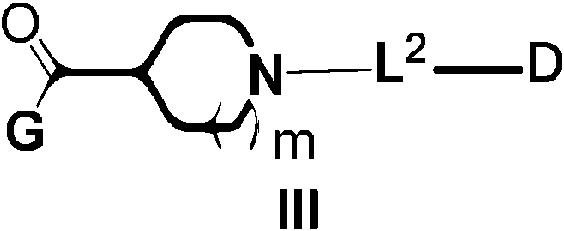
en donde G se selecciona del grupo que consiste en -F, -Cl, -Br, -I, -N3 , -OR, SR, -ONRR,
RC(=O)O- y RSO2-O-; y
R es alquilo opcionalmente sustituido o arilo opcionalmente sustituido.
m = 0 o 1.
Breve descripción de las figuras
La figura 1 muestra una dosis única de conjugado 16 administrada a ratones atímicos BALB/c (n=8) por administración intravenosa.
La figura 2 muestra una dosis única de conjugado 16 administrada a ratones atímicos BALB/c (n=8) por administración intravenosa.
La Figura 3 muestra imágenes de los ratones 35 días después del tratamiento.
La Figura 4A muestra la actividad in vitro de ADC-23 (anticuerpo anti-Her2) en un grupo de líneas de células tumorales. La figura 4B muestra la actividad in vitro de ADC-16 (anticuerpo anti-Her2) en un grupo de líneas de células tumorales. La Figura 5 muestra la eficacia in vivo de ADC-65, ADC-23 y ADC-19 en varios modelos de tumores de xenoinjerto. Las Figuras 6A y 6B muestran una dosis única de los conjugados 16 y 19 administrada a ratones atímicos BALB/c (n=8) por administración intravenosa.
Descripción detallada
La presente descripción proporciona compuestos y conjugados, tales como ADC (conjugados de anticuerpo-fármaco, por sus siglas en inglés Antibody Drug Conjugates), en los que un resto ligador que está basado en péptido tiene un punto de unión en su C terminal que reacciona con la Cys o Lys en un anticuerpo de forma controlada. Para la conjugación con Lys, por ejemplo, la DAR (relación de fármaco a anticuerpo) es 2. La DAR (relación de fármaco a anticuerpo) de la mayoría de los conjugados es 4, cuando la conjugación se producía en la Cys.
Tabla 1. Ejemplos de estructuras de restos de fármaco-ligador para la conjugación con Lys en un anticuerpo. Los compuestos 1 y 2 son compuestos de referencia.

Tabla 2. Ejemplos de estructuras de compuestos fármaco-ligador (para la conjugación con Cys) para conjugar en una región bisagra de un anticuerpo de clase IgG. Los compuestos 6-9 son compuestos de referencia.


Tabla 3. Ejemplos de estructuras de conjugados de anticuerpo (Ab)-fármaco.


Los conjugados 16, 17 y 21-24 de la Tabla 3 son conjugados de referencia. Definiciones
Las abreviaturas se definen de la siguiente manera:
Ac Acetilo
ac. Acuoso
BOC o Boc terc-Butoxicarbonilo
BrOP Hexafluorofosfato bromo-tris(dimetilamino)fosfonio
Bu n-Butilo
°C Temperatura en grados centígrados
Cit Citrulina
DCM cloruro de metileno
DEPC Cianofosfonato de dietilo
DIC Diisopropilcarbodiimida
DIEA Diisopropiletilamina
DMA W,W-Dimetilacetamida
DMF W,W-Dimetilformamida
EDC 1 -Etil-3-(3-dimetilaminopropil)carbodiimida
Et Etilo
EtOAc Acetato de etilo
Eq equivalentes
Fmoc 9-Fluorenilmetoxicarbonilo
g Gramo(s)
h Hora (horas)
HATU Hexafluorofosfato de 2-(1 H-7-azabenzotriazol-1-il)-1,1,3,3-tetrametiluronio
HOBT N-hidroxibenzotriazol
HOSu N-hidroxisuccinimida
HPLC Cromatografía líquida de alta resolución
LC/MS Cromatografía líquida-espectrometría de masas
Me Metilo
MeOH Metanol
MeCN Acetonitrilo
ml Mililitro(s)
MS espectrometría de masas
PAB p-aminobencilo
RP-HPLC HPLC de fase inversa
Ta temperatura ambiente
t-Bu terc-Butilo
TEA Trietilamina
Terc, t terciario
TFA Ácido trifluoroacético
THF Tetrahidrofurano
TLC Cromatografía de capa fina
Microlitro(s)
Procedimiento general de síntesis - Formación de un éster activado (p. ej., NHS) a partir de un ácido
Se disolvió un ácido en DCM (cloruro de metileno) y se añadió DMF (N,N'-dimetilformamida) para ayudar a la disolución si era necesario. Se añadió N-hidroxisuccinimida (1.5 eq), seguido de EDC.HCl (1-etil-3-(3-dimetilaminopropil)carbodiimida) (1.5 eq). La mezcla de reacción se agitó a temperatura ambiente durante 1 h hasta que se consumió la mayor parte del ácido. El progreso de la reacción se controló por RP-HPLC. A continuación, la mezcla se diluyó con d Cm y se lavó sucesivamente con ácido cítrico (acuoso al 10%) y salmuera. La capa orgánica se secó y se concentró a sequedad. El producto bruto se purificó opcionalmente por RP-HPLC o cromatografía en columna de gel de sílice.
Ejemplo de Referencia 1
Preparación del Compuesto 1

A una solución bruta del compuesto 47 (0.1 mmol) en THF (3 ml) se le añadió una solución de ácido piperidina-4-carboxílico (60 mg) en solución ac. sat. de NaHCO3 (1 ml). La mezcla se agitó a temperatura ambiente durante 30
min, luego se acidificó con solución ac. de HCl 1 N a pH = 4-5. La mezcla de reacción se concentró y el residuo se purificó por HPLC de fase inversa para dar el compuesto 1 como un polvo blanco después de liofilización (68 mg). MS m/z 1020.7 (M+H).
Ejemplo de referencia 2
Preparación del compuesto 2

El compuesto 52 (185 mg, 0.2 mmol) se disolvió en DCM/DMF (5/1, v/v, 5 ml). Se añadieron EDC.HCl (0.5 mmol) y HOSu (0.3 mmol). La mezcla se agitó a temperatura ambiente durante 30 min. El análisis por HPLC confirmó que se había consumido todo el compuesto 52. La reacción se diluyó con DCM (50 ml) y se lavó con salmuera. La capa orgánica se concentró a 1 ml y se diluyó con acetonitrilo/agua (6/4, v/v, 3 ml). Se añadió una solución de ácido pirrolidina-3-carboxílico (60 mg) en solución ac. sat. de NaHCO3 (1 ml) y la mezcla se agitó a temperatura ambiente durante 10 min. La reacción se acidificó con HOAc y se concentró. El producto bruto se purificó por RP-HPLC para dar el compuesto 2 (138 mg, 68%). MS m/z 1020.6 (M+H).
Ejemplo 3
Preparación del compuesto 4

Preparación del compuesto 38:
Al compuesto 37 (261 mg, 0.52 mmol) en 6 ml de DMF se le añadieron HATU (217 mg, 0.57 mmol), DIEA (362 pl, 2.08 mmol) y la amina 36 (213 mg, 0.52 mmol). La mezcla se agitó durante 30 min, luego se añadieron 400 pl de piperidina y se agitó durante 10 min. La mezcla se evaporó y se purificó por HPLC para dar el compuesto 38 (171 mg, 60%). MS m/z 548.3 (M+H).
Preparación del compuesto 40:
Al compuesto 39 (37 mg, 0.15 mmol) en 4 ml de DMF se le añadieron HATU (59 mg, 0.15 mmol), DIEA (108 pl, 0.6 mmol) y la amina 38 (102 mg, 0.15 mmol). La mezcla se agitó durante 30 min y luego se evaporó hasta sequedad. El residuo se disolvió en 2 ml de DCM, luego se añadió 1 ml de TFA y se agitó durante 10 min. La mezcla se evaporó y se purificó por HPLC para dar el compuesto 40 (94 mg, 78%). MS m/z 673.4 (M+H).
Preparación del compuesto 4:
Al compuesto 41 (85 mg, 0.12 mmol) en 2 ml de DMF se le añadieron HATU (48 mg, 0.12 mmol), DIEA (83 pl, 0.48 mmol) y la amina 40 (94 mg, 0.12 mmol). La mezcla se agitó durante 30 min, luego se añadió una solución de 90 mg
de NaOH en 1 ml de agua y se agitó durante 30 min. La mezcla se purificó por HPLC para dar el compuesto 4 (86 mg, 58%). MS m/z 1239.7 (M+H).
Ejemplo de referencia 4
Preparación del compuesto 6

Preparación del compuesto 46:
Al compuesto 41 (1000 mg, 1.67 mmol) en 20 ml de DMF se le añadieron HATU (640 mg, 1.68 mmol), DIEA (870 pl, 5.00 mmol) y la amina 45 (535 mg, 1.67 mmol). La mezcla se agitó durante 30 min, luego se evaporó y se purificó por HPLC para dar el compuesto 46 (1140 mg, 70%). MS m/z 865.5 (M+H).
Preparación del compuesto 47:
Al compuesto 46 (500 mg, 0.57 mmol) en 10 ml de DMA se le añadieron carbonato de bis(p-nitrofenilo) (210 mg, 0.69 mmol) y DIEA (35 pl, 0.2 mmol). La mezcla se agitó durante 18 h, luego se añadieron 100 ml de éter y el precipitado se recogió por filtración para dar el compuesto 47 (500 mg, 85%). MS m/z 1030.6 (M+H).
Preparación del compuesto 49:
Al compuesto 47 (125 mg, 0.12 mmol) en 4 ml de DMF se le añadieron HOBt (7 mg, 0.05 mmol), DIEA (21 pl, 0.12 mmol) y la amina 48 (40 mg, 0.12 milimoles). La mezcla se agitó durante 16 h, luego se añadieron 200 pl de piperidina y se agitó durante 10 min. La mezcla se evaporó y purificó por HPLC para dar el compuesto 49 (72 mg, 60%). MS m/z 1005.6 (M+H).
Preparación del compuesto 6:
Al compuesto 49 (30 mg, 0.027 mmol) en 2 ml de DCM se le añadieron DIEA (15 pl, 0.086 mmol), DIEA (50 pl, 0.288 mmol) y el anhídrido 50 (19 mg, 0.027 milimoles). La mezcla se agitó durante 30 min, luego se evaporó y se purificó por HPLC para dar el compuesto 6 (32 mg, 88%). MS m/z 1347.5 (M+H).
Ejemplo de referencia 5
Preparación del compuesto 7.

El compuesto 7 se sintetizó a partir del compuesto 49 (0.1 mmol) y el anhídrido 63 (0.1 mmol) como se describe para
la síntesis del compuesto 6. Rendimiento: 79%. MS m/z 1296.8 (M+H).

Ejemplo de referencia 6
Preparación del compuesto 8.
A una solución de compuesto 47 (0.1 mmol) en THF (3 ml) se añadió una solución del compuesto 64 (0.15 mmol, 67 mg) en acetonitrilo/agua (1/1, v/v, 1 ml), seguido de DIEA (50 pl). Después de 30 min, la reacción se acidificó y se concentró. El residuo se purificó por HPLC de fase inversa para dar el compuesto 8 como un sólido blanco (87 mg). MS m/z 1243.6 [M+H]+.
Ejemplo de referencia 7
Preparación del compuesto 9.

Preparación del compuesto 52:
Al compuesto 46 (120 mg, 0.12 mmol) en 3 ml de DMF se añadió K2CO3 (118 mg, 0.85 mmol) y el bromoacetato 51 (35 mg, 0.18 milimoles). La mezcla se agitó durante 16 horas y luego se evaporó. El residuo se disolvió en 2 ml de DCM, se filtró y se añadieron 2 ml de TFA. Después de 20 min, la mezcla se evaporó y se purificó por HPLC para dar el compuesto 52 (92 mg, 83%). MS m/z 923.5 (M+H).
Preparación del compuesto 53:
Al compuesto 52 (92 mg, 0,1 mmol) en 2 ml de DMF, se añadieron HATU (38 mg, 0.1 mmol), DIEA (70 pl, 0.4 mmol) y boc-hidrazina (15 mg, 0.12 mmol). La mezcla se agitó durante 30 min y luego se evaporó hasta sequedad. El residuo se disolvió en 2 ml de DCM, luego se añadió 1 ml de TFA y se agitó durante 10 min. La mezcla se evaporó y purificó por HPLC para dar el compuesto 53 (82 mg, 78%). MS m/z 937.5 (M+H).
Preparación del compuesto 9:
Al compuesto 54 (53 mg, 0.156 mmol) en 2 ml de DCM, se añadió DIC (10 mg, 0.078 mmol) y se agitó durante 10 min. Luego se añadieron DIEA (54 pl, 0.312 mmol) y la amina 53 (82 mg, 0.078 mmol) y la mezcla se agitó durante 15 min. La mezcla se evaporó y purificó por HPLC para dar el compuesto 9 (62 mg, 63%). MS m/z 1260.5 (M+H).
Ejemplo 8
Preparación del compuesto 13

Al compuesto 37 (130 mg, 0.26 mmol) en 3 ml de DMF, se añadieron HATU (110 mg, 0.29 mmol), DIEA (175 pl, 1 mmol) y la amina 36 (110 mg, 0.27 milimoles). La mezcla se agitó durante 30 min y luego se concentró hasta sequedad. A continuación, el residuo se trató con TFA/DCM (1/4, v/v, 5 ml) durante 30 min. La mezcla se evaporó y purificó por HPLC para dar el compuesto 66 (108 mg, 65%). MS m/z 670.5 (m H).
Al compuesto 41 (85 mg, 0.12 mmol) en 2 ml de DMF, se añadieron HATU (48 mg, 0.12 mmol), DIEA (83 pl, 0.48 mmol) y la amina 66 (94 mg, 0.12 milimoles). La mezcla se agitó durante 30 min, luego se añadió piperidina (0.2 ml) y se agitó durante 30 min. La mezcla se concentró y purificó por HPLC para dar el compuesto 67 (87 mg, 63%). MS m/z 1028.7 (M+H).
A una solución del compuesto 67 (57 mg, 0.05 mmol) y el ácido 68 (22 mg) en DCM/DMF (3/1, v/v, 4 ml) se añadieron PyBrOP (0.055 mmol) y DIEA (35 pl). La mezcla se agitó a temperatura ambiente durante 30 min y luego se concentró hasta aproximadamente 2 ml. El residuo se purificó por HPLC de fase inversa para dar el compuesto 13 (41 mg). MS m/z 1425.7 (M+H).
Ejemplo 9.
Este ejemplo proporciona los resultados de los ensayos de EC50 de los anticuerpos conjugados con fármacos designados medidos in vitro en las células especificadas. El anticuerpo utilizado era un anticuerpo de clase IgG anti-HER2.


Ejemplo de referencia 10
Este ejemplo muestra la eficacia in vivo del ADC 16 (un conjugado de anticuerpo anti-Her2) en un modelo de xenoinjerto subcutáneo N87. La figura 1 muestra una dosis única de conjugado 16 administrada a ratones atímicos BALB/c por administración intravenosa. Había 8 ratones en cada grupo y se estudiaron un total de 6 grupos de ratones: a 3 grupos se les inyectó T-DM1 (conjugado de trastuzumab - DM1) en diferentes dosis; a 2 grupos se les inyectó ADC 16 en diferentes dosis; y a uno control de vehículo. Todos los fármacos se administraron de la misma manera (dosis única). Una sola dosis de ADC-16 iv de 1 mg/kg o 3 mg/kg superó a T-DM1 de 3 mg/kg o 10 mg/kg respectivamente. 3 mg/kg de ADC-16 inhibieron completamente el crecimiento tumoral hasta 100 días.
Ejemplo de referencia 11
Este ejemplo muestra la seguridad in vivo del ADC 16 (un conjugado de anticuerpo anti-Her2) en un modelo de xenoinjerto subcutáneo N87. La figura 2 muestra una dosis única de conjugado 16 administrada a ratones atímicos BALB/c por administración intravenosa. Había 8 ratones en cada grupo y se estudiaron un total de 7 grupos de ratones: a 3 grupos se les inyectó T-DM1 (conjugado de trastuzumab - DM1) en diferentes dosis; a 3 grupos se les inyectó ADC 16 en diferentes dosis; y a uno control de vehículo. Todos los fármacos se administraron de la misma manera (dosis única). Una sola dosis de ADC-16 iv de 1 mg/kg, 3 mg/kg o 10 mg/kg no retrasó el aumento de peso corporal. La diferencia de los pesos corporales entre los grupos de T-DM1 y ADC-16 se debía a la diferencia de peso del tumor. La Figura 3 muestra imágenes de los ratones 35 días después del tratamiento.
Ejemplo de referencia 12
Este ejemplo (Figura 4A) muestra que ADC-23 induce una actividad antiproliferativa equivalente o más fuerte en líneas celulares de cáncer de mama, en comparación con los conjugados de MMAE. En estos estudios, todas las células se trataron con conjugados ADC-23 o de MMAE durante 3 días. La IC50 se determina como la concentración que mostraba inhibición de 50% del crecimiento celular.
Ejemplo de referencia 13
Este ejemplo (Figura 4B) muestra que ADC-16 induce una actividad antiproliferativa equivalente o más fuerte en líneas celulares de cáncer de mama, en comparación con los conjugados de MMAE. En los estudios anteriores, todas las células se trataron con conjugados ADC-16 o de MMAE durante 3 días. La IC50 se determina como la concentración que mostraba inhibición de 50% del crecimiento celular.
Ejemplo 14
Este ejemplo (Figura 5) muestra la eficacia in vivo de ADC-65, ADC-23 y ADC-19 en ratones atímicos con xenoinjerto de LoVo (colon), MDA-MB-468 (mama), BxPC-3 (pancreático), PA-1 (ovárico) y NSCLC H1975. Todos los ADC se administraron como dosis única por vía iv en las concentraciones indicadas. Los ADC ensayados superaron la MMAF en la mayoría de los casos al mismo nivel e inhibieron completamente el crecimiento tumoral con una sola dosis.
Ejemplo 15
Este ejemplo muestra la seguridad y eficacia in vivo de ADC 19 (un conjugado de anticuerpo anti-Her2) en un modelo de xenoinjerto subcutáneo N87. Las Figuras 6A y 6B muestran una dosis única de conjugado 19 administrada a ratones atímicos BALB/c por administración intravenosa. Había 8 ratones en cada grupo y se estudiaron un total de 3 grupos de ratones: a 1 grupo de ratones se le inyectó ADC 16; a 1 grupo de ratones se les inyectó ADC 19; y a uno control de vehículo. Todos los fármacos se administraron de la misma manera (dosis única). Una sola dosis de ADC-19 iv de 2 mg/kg era comparable a la de ADC-16 en la misma dosis e inhibía completamente el crecimiento tumoral hasta 49 días y no retrasó el aumento de peso corporal que fue comparable a ADC-16.
Ejemplo 16
Este ejemplo muestra el procedimiento general de conjugación para sintetizar los conjugados de anticuerpo-fármaco
16, 17, 19 y 64. A una solución de 0.5-50 mg/ml de anticuerpo en tampón a pH 6.0-9.0 con 0-30% de disolvente orgánico, se añadieron 0.1-10 eq de conjugado de fármaco-ligador activado (1 o 2 o 3 o 4 o 5 o 62) en forma de flujo continuo o en porciones. La reacción se llevó a cabo a 0-40°C durante 0.5-50 horas agitando o removiendo suavemente, vigilada por HIC-HPLC. El producto ADC bruto resultante se sometió a las etapas posteriores necesarias de desalinización, cambios de tampón/formulación y, opcionalmente, purificación, utilizando los procedimientos del estado de la técnica. El producto a Dc se caracterizó por HIC-HPLC, SEc , RP-HpLc y, opcionalmente, LC-MS.
Ejemplo 17
Este ejemplo muestra un procedimiento de conjugación general para sintetizar los conjugados de anticuerpo-fármaco 21,22, 23, 24, 28 y 65. A una solución de anticuerpo, 0.5-50 mg/ml, en un determinado tampón a pH 5.0-9.0, tal como PBS, se añadieron 0.5-100 eq de agente reductor tal como TCEP y DTT. La reducción se llevó a cabo a 0-40°C durante 0.5-40 horas agitando o removiendo suavemente y luego se eliminó el agente reductor por columna o ultrafiltración. Al anticuerpo reducido, 0.5-50 mg/ml, en un determinado tampón a pH 5.0-9.0, tal como PBS, con 0-30% de codisolvente orgánico tal como DMA, se añadieron 0.5-10 eq del reaccionante fármaco-ligador (seleccionado del compuesto 6-15 o 63). La reacción se llevó a cabo a 0-40°C durante 0.5-40 horas agitando o removiendo suavemente, vigilada por HIC-HPLC. El producto ADC bruto resultante se sometió a las etapas posteriores necesarias de desalinización, cambios de tampón/formulación y, opcionalmente, purificación, utilizando los procedimientos del estado de la técnica. El producto ADC final se caracterizó por HIC-HPLC, SEC, RP-HPLC y, opcionalmente, LC-MS.
Claims (9)
- REIVINDICACIONES1 Un conjugado de anticuerpo-fármaco (ADC) de fórmula I:Ab-(-L 1 — L 2 —d )(I)o una sal farmacéuticamente aceptable del mismo,en donde:Ab es un anticuerpo monoclonal;L1 es un conector;L2 es un ligador;D es un agente activo que tiene la estructura de Fórmula II:
 en donde Y es O o NH,X es CH2N3 yn es un número entero de 1-8.
 - 2. El ADC de la reivindicación 1, en donde L1 es:
-

- 4. El ADC de la reivindicación 1, en donde Y es NH.
- 5. El ADC de la reivindicación 1, en donde Y es O.
- 6. El ADC de la reivindicación 1, en donde L2 es un ligador seleccionado del grupo que consiste en un aminoácido, un péptido, -(CH2)n-, -(CH2CH2O V , Val-Cit, Val-Ala, Ala-Ala-Asn, o combinaciones de los mismos.
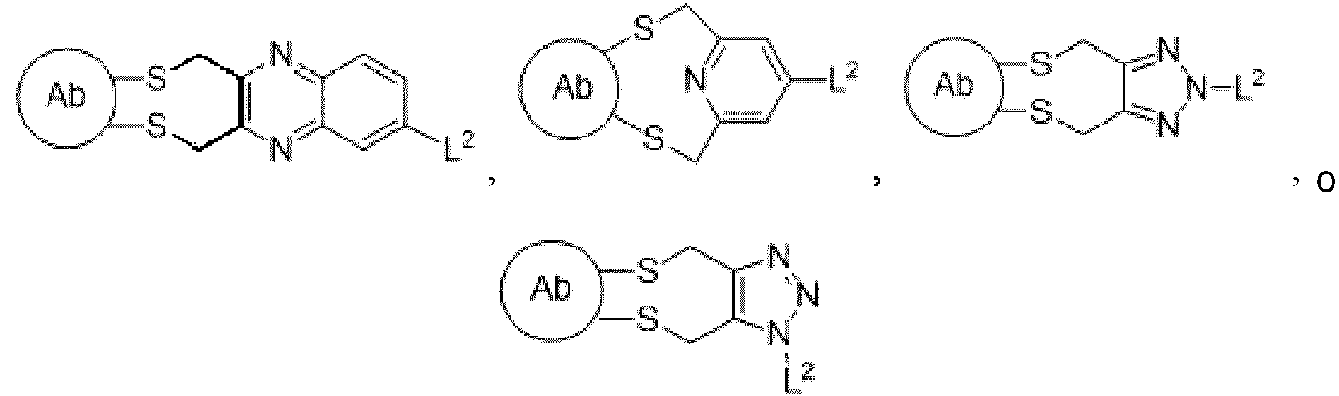
- 7. El ADC de la reivindicación 1, en donde -L1-L2, considerado junto con el Ab, es:
- 8. El ADC de la reivindicación 7, en donde -L1-L2, tomado junto con el Ab, es

- 9. El ADC de la reivindicación 1, que tiene una estructura seleccionada del grupo que consiste en:
 y sales farmacéuticamente aceptables de los mismos.
Applications Claiming Priority (2)
| Application Number | Priority Date | Filing Date | Title |
|---|---|---|---|
| US201562108894P | 2015-01-28 | 2015-01-28 | |
| PCT/US2016/015482 WO2016123412A1 (en) | 2015-01-28 | 2016-01-28 | Antibody drug conjugates |
Publications (1)
| Publication Number | Publication Date |
|---|---|
| ES2918425T3 true ES2918425T3 (es) | 2022-07-15 |
Family
ID=56544359
Family Applications (1)
| Application Number | Title | Priority Date | Filing Date |
|---|---|---|---|
| ES16744147T Active ES2918425T3 (es) | 2015-01-28 | 2016-01-28 | Conjugados de anticuerpo-fármaco |
Country Status (7)
| Country | Link |
|---|---|
| US (1) | US10590165B2 (es) |
| EP (2) | EP3250238B1 (es) |
| JP (1) | JP6871858B2 (es) |
| CN (1) | CN107849090A (es) |
| CA (1) | CA2975383C (es) |
| ES (1) | ES2918425T3 (es) |
| WO (1) | WO2016123412A1 (es) |
Families Citing this family (24)
| Publication number | Priority date | Publication date | Assignee | Title |
|---|---|---|---|---|
| CN104640572B (zh) | 2012-05-15 | 2018-04-27 | 索伦托医疗有限公司 | 药物偶联物,偶联方法,及其用途 |
| AU2014337317A1 (en) | 2013-10-15 | 2016-09-15 | Sorrento Therapeutics Inc. | Drug-conjugates with a targeting molecule and two different drugs |
| WO2015095953A1 (en) | 2013-12-27 | 2015-07-02 | The Centre For Drug Research And Development | Sulfonamide-containing linkage systems for drug conjugates |
| ES2905569T3 (es) | 2014-09-17 | 2022-04-11 | Zymeworks Inc | Compuestos citotóxicos y antimitóticos y métodos para utilizarlos |
| EP3250238B1 (en) | 2015-01-28 | 2022-06-01 | Sorrento Therapeutics, Inc. | Antibody drug conjugates |
| US20220008553A1 (en) * | 2015-11-23 | 2022-01-13 | Sichuan Kelun-Biotech Biopharmaceutical Co., Ltd. | Anti-erbb2 antibody-drug conjugate and composition thereof, preparation method therefor, and use thereof |
| CN106729743B (zh) * | 2015-11-23 | 2021-09-21 | 四川科伦博泰生物医药股份有限公司 | 抗ErbB2抗体-药物偶联物及其组合物、制备方法和应用 |
| CN107029244B (zh) | 2016-02-04 | 2021-04-27 | 浙江昭华生物医药有限公司 | 抗her2抗体-药物偶联物及其应用 |
| US10517958B2 (en) | 2016-10-04 | 2019-12-31 | Zymeworks Inc. | Compositions and methods for the treatment of platinum-drug resistant cancer |
| WO2018069851A2 (en) * | 2016-10-11 | 2018-04-19 | Sorrento Therapeutics, Inc. | C-met antibody drug conjugate |
| CN108285487B (zh) * | 2017-01-08 | 2021-02-19 | 浙江昭华生物医药有限公司 | 抗5t4抗体-药物偶联物及其应用 |
| WO2018192407A1 (zh) | 2017-04-19 | 2018-10-25 | 四川科伦博泰生物医药股份有限公司 | 细胞毒素和偶联物、其用途和制备方法 |
| EP3641831B1 (en) * | 2017-06-20 | 2024-11-06 | Sorrento Therapeutics, Inc. | Cd38 antibody drug conjugate |
| CN107744592B (zh) * | 2017-09-15 | 2020-04-28 | 四川大学 | 抗cd56抗体与海兔毒素偶联复合物及其制备方法和用途 |
| US12150944B2 (en) * | 2018-05-11 | 2024-11-26 | Sichuan Kelun-Biotech Biopharmaceutical Co., Ltd. | Use of anti-HER2 antibody-drug conjugate in cancer treatment |
| CN112341521B (zh) * | 2019-08-09 | 2024-06-25 | 上海翰森生物医药科技有限公司 | 一种小分子活性化合物及其抗体偶联物、其制备方法和医药用途 |
| FR3112547B1 (fr) * | 2020-07-20 | 2023-01-20 | Mc Saf | Composés capables de se lier à des protéines et conjugués obtenus à partir de ces composés |
| US20240181073A1 (en) * | 2021-03-03 | 2024-06-06 | Sorrento Therapeutics, Inc. | Antibody-Drug Conjugates Comprising an Anti-BCMA Antibody |
| EP4489790A1 (en) | 2022-03-10 | 2025-01-15 | Vivasor, Inc. | Antibody-drug conjugates and uses thereof |
| EP4522223A1 (en) * | 2022-05-10 | 2025-03-19 | Vivasor, Inc. | Antibody-drug conjugates comprising an anti-folr1 antibody |
| CN121969398A (zh) | 2023-04-05 | 2026-05-01 | 维硕公司 | 抗体偶联药物及其用途 |
| WO2024211235A1 (en) | 2023-04-05 | 2024-10-10 | Sorrento Therapeutics, Inc. | Antibody-drug conjugates and uses thereof |
| CN121969397A (zh) | 2023-04-05 | 2026-05-01 | 维硕公司 | 抗体偶联药物及其用途 |
| CN117683079B (zh) * | 2023-12-12 | 2025-04-04 | 九洲药业(杭州)有限公司 | 一种抗体偶联药物连接子的固相合成方法 |
Family Cites Families (36)
| Publication number | Priority date | Publication date | Assignee | Title |
|---|---|---|---|---|
| US6569834B1 (en) | 1992-12-03 | 2003-05-27 | George R. Pettit | Elucidation and synthesis of antineoplastic tetrapeptide w-aminoalkyl-amides |
| US5780588A (en) | 1993-01-26 | 1998-07-14 | Arizona Board Of Regents | Elucidation and synthesis of selected pentapeptides |
| US6214345B1 (en) | 1993-05-14 | 2001-04-10 | Bristol-Myers Squibb Co. | Lysosomal enzyme-cleavable antitumor drug conjugates |
| EP0731106B1 (en) | 1993-10-01 | 2004-11-17 | Teikoku Hormone Mfg. Co., Ltd. | Dolastatin derivatives |
| CA2427146A1 (en) | 2000-10-25 | 2002-07-18 | Mayo Foundation For Medical Education And Research | Transcobalamin binding conjugates useful for treating abnormal cellular proliferation |
| US20090068178A1 (en) | 2002-05-08 | 2009-03-12 | Genentech, Inc. | Compositions and Methods for the Treatment of Tumor of Hematopoietic Origin |
| DK1545613T3 (da) * | 2002-07-31 | 2011-11-14 | Seattle Genetics Inc | Auristatinkonjugater og deres anvendelse til behandling af cancer, en autoimmun sygdom eller en infektiøs sygdom |
| DE10254439A1 (de) | 2002-11-21 | 2004-06-03 | GESELLSCHAFT FüR BIOTECHNOLOGISCHE FORSCHUNG MBH (GBF) | Tubulysine, Herstellungsverfahren und Tubulysin-Mittel |
| US8088387B2 (en) | 2003-10-10 | 2012-01-03 | Immunogen Inc. | Method of targeting specific cell populations using cell-binding agent maytansinoid conjugates linked via a non-cleavable linker, said conjugates, and methods of making said conjugates |
| EP2478912B1 (en) | 2003-11-06 | 2016-08-31 | Seattle Genetics, Inc. | Auristatin conjugates with anti-HER2 or anti-CD22 antibodies and their use in therapy |
| US20070134243A1 (en) | 2004-12-01 | 2007-06-14 | Gazzard Lewis J | Antibody drug conjugates and methods |
| JP2008537673A (ja) | 2005-01-31 | 2008-09-25 | ジェネンテック・インコーポレーテッド | 抗ephb2抗体とその使用方法 |
| AR059900A1 (es) | 2006-03-17 | 2008-05-07 | Genentech Inc | Anticuerpos anti-tat226 e inmunoconjugados |
| EP2181101A2 (en) | 2007-07-20 | 2010-05-05 | Helmholtz-Zentrum für Infektionsforschung GmbH | Tubulysin d analogues |
| AU2009270988A1 (en) | 2008-07-15 | 2010-01-21 | Genentech, Inc. | Anthracycline derivative conjugates, process for their preparation and their use as antitumor compounds |
| EP2174947A1 (en) | 2008-09-25 | 2010-04-14 | Universität des Saarlandes | Bioactive pre-tubulysins and use thereof |
| WO2010081004A1 (en) | 2009-01-09 | 2010-07-15 | Seattle Genetics, Inc. | Weekly dosing regimens for anti-cd30 vc-pab-mmae antibody drug-conjugates |
| CN102844045A (zh) | 2010-02-08 | 2012-12-26 | 艾更斯司股份有限公司 | 结合于161p2f10b蛋白的抗体药物偶联物(adc) |
| CA2799540A1 (en) | 2010-06-08 | 2011-12-15 | Genentech, Inc. | Cysteine engineered antibodies and conjugates |
| EP2409983A1 (en) | 2010-07-19 | 2012-01-25 | Leibniz-Institut für Pflanzenbiochemie (IPB) | Tubulysin analogues |
| JP5933562B2 (ja) | 2010-09-29 | 2016-06-15 | シアトル ジェネティックス, インコーポレイテッド | N−カルボキシアルキル−アウリスタチンおよびその使用 |
| KR101897307B1 (ko) | 2010-12-02 | 2018-09-10 | 네르비아노 메디칼 사이언시스 에스.알.엘. | 모르폴리닐 안트라사이클린 유도체의 제조 방법 |
| KR102356286B1 (ko) | 2011-05-27 | 2022-02-08 | 암브룩스, 인코포레이티드 | 비-천연 아미노산 연결된 돌라스타틴 유도체를 함유하는 조성물, 이를 수반하는 방법, 및 용도 |
| CN110078789A (zh) | 2011-05-27 | 2019-08-02 | Ambrx 公司 | 含有非天然氨基酸连接的海兔毒素衍生物的组合物、涉及该海兔毒素衍生物的方法及其用途 |
| US8815226B2 (en) | 2011-06-10 | 2014-08-26 | Mersana Therapeutics, Inc. | Protein-polymer-drug conjugates |
| JP6209159B2 (ja) | 2011-06-21 | 2017-10-04 | イミュノジェン・インコーポレーテッド | ペプチドリンカーを有する新規メイタンシノイド誘導体およびその結合体 |
| RU2014124984A (ru) | 2011-12-05 | 2016-01-27 | Идженика Биотерапьютикс, Инк. | Конъюгаты антитело-лекарственное средство и родственные соединения, композиции и способы |
| CN104640572B (zh) | 2012-05-15 | 2018-04-27 | 索伦托医疗有限公司 | 药物偶联物,偶联方法,及其用途 |
| CN108727466B (zh) | 2012-06-07 | 2023-04-28 | Ambrx公司 | 前列腺特异性膜抗原抗体药物结合物 |
| KR102190832B1 (ko) | 2012-06-19 | 2020-12-15 | 암브룩스, 인코포레이티드 | 항cd70 항체 약물 컨쥬게이트 |
| CN104411337A (zh) | 2012-07-09 | 2015-03-11 | 基因泰克公司 | 包含抗cd79b抗体的免疫偶联物 |
| EP2927227A4 (en) * | 2013-01-03 | 2015-12-30 | Celltrion Inc | ANTIBODY CONCENTRATOR REMEDY CONJUGATE, METHOD OF MANUFACTURING THEREOF, AND ANTIBODY TOGETHER THEREWITH |
| AU2014337317A1 (en) * | 2013-10-15 | 2016-09-15 | Sorrento Therapeutics Inc. | Drug-conjugates with a targeting molecule and two different drugs |
| BR112017012042A2 (pt) * | 2014-12-08 | 2018-01-16 | Sorrento Therapeutics Inc | composição de conjugado anticorpo-droga e método para tratar câncer de mama |
| EP3250238B1 (en) | 2015-01-28 | 2022-06-01 | Sorrento Therapeutics, Inc. | Antibody drug conjugates |
| US20170224835A1 (en) | 2015-02-06 | 2017-08-10 | Sorrento Therapeutics, Inc. | Antibody Drug Conjugates |
-
2016
- 2016-01-28 EP EP16744147.6A patent/EP3250238B1/en active Active
- 2016-01-28 ES ES16744147T patent/ES2918425T3/es active Active
- 2016-01-28 WO PCT/US2016/015482 patent/WO2016123412A1/en not_active Ceased
- 2016-01-28 US US15/009,775 patent/US10590165B2/en active Active
- 2016-01-28 CA CA2975383A patent/CA2975383C/en active Active
- 2016-01-28 CN CN201680018919.0A patent/CN107849090A/zh active Pending
- 2016-01-28 JP JP2017540224A patent/JP6871858B2/ja active Active
- 2016-01-28 EP EP22175524.2A patent/EP4137159A1/en not_active Withdrawn
Also Published As
| Publication number | Publication date |
|---|---|
| CA2975383C (en) | 2023-09-12 |
| JP2018512376A (ja) | 2018-05-17 |
| JP6871858B2 (ja) | 2021-05-19 |
| CA2975383A1 (en) | 2016-08-04 |
| EP3250238A4 (en) | 2018-09-19 |
| WO2016123412A9 (en) | 2016-12-29 |
| US10590165B2 (en) | 2020-03-17 |
| EP3250238B1 (en) | 2022-06-01 |
| EP4137159A1 (en) | 2023-02-22 |
| EP3250238A1 (en) | 2017-12-06 |
| WO2016123412A1 (en) | 2016-08-04 |
| US20170190736A1 (en) | 2017-07-06 |
| CN107849090A (zh) | 2018-03-27 |
Similar Documents
| Publication | Publication Date | Title |
|---|---|---|
| ES2918425T3 (es) | Conjugados de anticuerpo-fármaco | |
| JP7403507B2 (ja) | 薬物としてアマトキシンの誘導体を有する抗体薬物コンジュゲート | |
| ES2987765T3 (es) | Suministro dirigido de sustancias farmacéuticas que contienen amina terciaria | |
| JP2024038168A (ja) | 生物活性分子コンジュゲート、その調製法及び使用 | |
| ES2994375T3 (en) | Hydrophilic drug-linker compounds | |
| ES2857192T3 (es) | Conjugado de mitomicina | |
| CA2976064A1 (en) | Antibody drug conjugates | |
| ES2755101T3 (es) | Nuevos compuestos y conjugados de criptoficina, su preparación y su uso terapéutico | |
| JP2023010733A (ja) | γ-アマニチンの誘導体 | |
| ES2821878T3 (es) | Conectores autoinmolativos no lineales y conjugados de los mismos | |
| CN104662000A (zh) | 药物偶联物及其偶联方法和用途 | |
| BR112020005605A2 (pt) | novos conjugados de amanitina direcionados a psma | |
| ES3040239T3 (en) | Cysteine modified antibody-drug conjugate and preparation method thereof | |
| TW202506105A (zh) | 連接子-藥物分子及抗體藥物偶聯物、其製備方法和應用 | |
| JP2024528719A (ja) | コンジュゲート化試薬及びそのコンジュゲート | |
| JP5734209B2 (ja) | プロドラッグ |