US10023751B2 - Anti-smudge and anti-graffiti compositions - Google Patents
Anti-smudge and anti-graffiti compositions Download PDFInfo
- Publication number
- US10023751B2 US10023751B2 US14/885,414 US201514885414A US10023751B2 US 10023751 B2 US10023751 B2 US 10023751B2 US 201514885414 A US201514885414 A US 201514885414A US 10023751 B2 US10023751 B2 US 10023751B2
- Authority
- US
- United States
- Prior art keywords
- pfpe
- coating
- poly
- pdms
- coatings
- Prior art date
- Legal status (The legal status is an assumption and is not a legal conclusion. Google has not performed a legal analysis and makes no representation as to the accuracy of the status listed.)
- Active
Links
- 0 C.C.[1*]P([2*])(C)=NC Chemical compound C.C.[1*]P([2*])(C)=NC 0.000 description 8
- RVNWTQIBASUOPP-UHFFFAOYSA-N C.C.C.CCC Chemical compound C.C.C.CCC RVNWTQIBASUOPP-UHFFFAOYSA-N 0.000 description 6
- MEKDPHXPVMKCON-UHFFFAOYSA-N C.CC Chemical compound C.CC MEKDPHXPVMKCON-UHFFFAOYSA-N 0.000 description 2
- DZCRRGJUFDSUFH-UHFFFAOYSA-N C.C.C.C.C.C.C.C.CC.CC(=O)Cl.CC(=O)Cl.CCC(C)(CCC(C)(CC(C)(Cl)C(=O)OCCOC)C(=O)OCCO)C(=O)OCC(F)(F)F.CCC(C)(CCC(C)(Cl)C(=O)OCCO)C(=O)OCC(F)(F)F.CCC(C)(CCC(C)(Cl)C(=O)OCCO[Si](C)(C)C)C(=O)OCC(F)(F)F.CCOC(=O)C(C)(C)Br.C[Si](C)(C)C.FC(F)(F)COC(F)(F)F.FCC(F)(F)F.O=C(F)Cl Chemical compound C.C.C.C.C.C.C.C.CC.CC(=O)Cl.CC(=O)Cl.CCC(C)(CCC(C)(CC(C)(Cl)C(=O)OCCOC)C(=O)OCCO)C(=O)OCC(F)(F)F.CCC(C)(CCC(C)(Cl)C(=O)OCCO)C(=O)OCC(F)(F)F.CCC(C)(CCC(C)(Cl)C(=O)OCCO[Si](C)(C)C)C(=O)OCC(F)(F)F.CCOC(=O)C(C)(C)Br.C[Si](C)(C)C.FC(F)(F)COC(F)(F)F.FCC(F)(F)F.O=C(F)Cl DZCRRGJUFDSUFH-UHFFFAOYSA-N 0.000 description 1
- IBZNMVDVZTZOBT-UHFFFAOYSA-N C.C.C.C.CC.CCC Chemical compound C.C.C.C.CC.CCC IBZNMVDVZTZOBT-UHFFFAOYSA-N 0.000 description 1
- FTQFOXCACQAUBA-UHFFFAOYSA-N C.C.CCCOCCCOCCCC(F)(F)F.COC(F)(COCCC(F)(F)F)C(F)(F)F.COCCOCOC(F)(F)F.CO[Si](C)(C)C.FC(F)(F)COC(F)(F)C(F)(F)C(F)(F)F.OCCCCOCOCCO Chemical compound C.C.CCCOCCCOCCCC(F)(F)F.COC(F)(COCCC(F)(F)F)C(F)(F)F.COCCOCOC(F)(F)F.CO[Si](C)(C)C.FC(F)(F)COC(F)(F)C(F)(F)C(F)(F)F.OCCCCOCOCCO FTQFOXCACQAUBA-UHFFFAOYSA-N 0.000 description 1
- IBCUMUWMPNSKIH-UHFFFAOYSA-N C.C[Si](C)(C)O[Si](C)(C)O[Si](C)(C)CCCOCC1CO1.NCCCCCN(CCN(N)CCN)CCN(CCNCCN)CCNCCN(CCN)CCN Chemical compound C.C[Si](C)(C)O[Si](C)(C)O[Si](C)(C)CCCOCC1CO1.NCCCCCN(CCN(N)CCN)CCN(CCNCCN)CCNCCN(CCN)CCN IBCUMUWMPNSKIH-UHFFFAOYSA-N 0.000 description 1
- GXNRKAPTCGJSRH-UHFFFAOYSA-N C.[H]C([H])(C1=CC=C(N=C=O)C=C1)C1=CC=C(N=C=O)C=C1.[H]C([H])(O)C([H])([H])O.[H]N(C(C)=O)C1=CC=C(C([H])([H])C2=CC=C(N([H])C(=O)OC([H])([H])C([H])([H])OC)C=C2)C=C1 Chemical compound C.[H]C([H])(C1=CC=C(N=C=O)C=C1)C1=CC=C(N=C=O)C=C1.[H]C([H])(O)C([H])([H])O.[H]N(C(C)=O)C1=CC=C(C([H])([H])C2=CC=C(N([H])C(=O)OC([H])([H])C([H])([H])OC)C=C2)C=C1 GXNRKAPTCGJSRH-UHFFFAOYSA-N 0.000 description 1
- BXRWMERNOOHAPF-UHFFFAOYSA-N C=C(OC)C(C)(C)CC(CC(CC)C(=O)OCO[Si](C)(C)C)C(=O)O.CC.CC.CC(CCO[Si](C)(C)C)C(=O)OCOC(=O)CN.CCC(C1=CC=CC=C1)C1C(=O)OC(=O)C1C(C)(C)C(OC=O)C(C)C(=O)OCC(O)OCO[Si](C)(C)C.CCC(C1=CC=CC=C1)C1C(=O)OC(=O)C1CC(OC=O)C(C)COCO[SH](C)C.CCCCOC(=O)C(C)(CC(CC)C1=CC=CC=C1)CC(C)(CC(C)(CC(C)(C)C(=O)OCCOC(=O)C(=O)OCCC[Si](C)(C)O[Si](C)(C)C)C(=O)OCCO)C(=O)OC.NCCCCCN(CCN(CCN)CCN)CCN(CCNCCN)CCNCCN(CCN)CCN.NCCCCCN(CCN(CCN)CCN)CCN(CCNCCN)CCNCCN(CCN)CCN Chemical compound C=C(OC)C(C)(C)CC(CC(CC)C(=O)OCO[Si](C)(C)C)C(=O)O.CC.CC.CC(CCO[Si](C)(C)C)C(=O)OCOC(=O)CN.CCC(C1=CC=CC=C1)C1C(=O)OC(=O)C1C(C)(C)C(OC=O)C(C)C(=O)OCC(O)OCO[Si](C)(C)C.CCC(C1=CC=CC=C1)C1C(=O)OC(=O)C1CC(OC=O)C(C)COCO[SH](C)C.CCCCOC(=O)C(C)(CC(CC)C1=CC=CC=C1)CC(C)(CC(C)(CC(C)(C)C(=O)OCCOC(=O)C(=O)OCCC[Si](C)(C)O[Si](C)(C)C)C(=O)OCCO)C(=O)OC.NCCCCCN(CCN(CCN)CCN)CCN(CCNCCN)CCNCCN(CCN)CCN.NCCCCCN(CCN(CCN)CCN)CCN(CCNCCN)CCNCCN(CCN)CCN BXRWMERNOOHAPF-UHFFFAOYSA-N 0.000 description 1
- PXWCMFMTMFAVNW-UHFFFAOYSA-N CBr.CC(=O)Cl.CC(C)(Br)C(=O)OCCO.CC(C)(Br)C(=O)OCCOC(=O)C(F)(OC(F)(F)C(F)(F)C(F)(F)F)C(F)(F)F.COC(=O)C(C)(Cl)CC(CC(C)(CC(C)(C)C(=O)OCCOC(=O)C(OC(F)(F)C(F)(F)C(F)(F)F)C(F)(F)F)C(=O)OCCO)C1=CC=CC=C1.CSC.CSC.O=C(Cl)C(OC(F)(F)C(F)(F)C(F)(F)F)C(F)(F)F Chemical compound CBr.CC(=O)Cl.CC(C)(Br)C(=O)OCCO.CC(C)(Br)C(=O)OCCOC(=O)C(F)(OC(F)(F)C(F)(F)C(F)(F)F)C(F)(F)F.COC(=O)C(C)(Cl)CC(CC(C)(CC(C)(C)C(=O)OCCOC(=O)C(OC(F)(F)C(F)(F)C(F)(F)F)C(F)(F)F)C(=O)OCCO)C1=CC=CC=C1.CSC.CSC.O=C(Cl)C(OC(F)(F)C(F)(F)C(F)(F)F)C(F)(F)F PXWCMFMTMFAVNW-UHFFFAOYSA-N 0.000 description 1
- AMXLSLGRXNVVMX-UHFFFAOYSA-N CC(OCO[N](C)(C)C)=O Chemical compound CC(OCO[N](C)(C)C)=O AMXLSLGRXNVVMX-UHFFFAOYSA-N 0.000 description 1
- UGASORRWWBUTLU-UHFFFAOYSA-N CCC(C1=CC=CC=C1)C1C(=O)OC(=O)C1C.CCC(C1=CC=CC=C1)C1C(=O)OC(=O)C1C(OC=O)C(C)C(=O)OCOCCOC.CO.CO.CO Chemical compound CCC(C1=CC=CC=C1)C1C(=O)OC(=O)C1C.CCC(C1=CC=CC=C1)C1C(=O)OC(=O)C1C(OC=O)C(C)C(=O)OCOCCOC.CO.CO.CO UGASORRWWBUTLU-UHFFFAOYSA-N 0.000 description 1
- MISJSHTWLTZQBL-DYCDLGHISA-N CCC(C1=CC=CC=C1)C1C(=O)OC(=O)C1C.CCC(C1=CC=CC=C1)C1C(=O)OC(=O)C1C(OC=O)C(C)C(=O)OCO[Si](C)(C)C.[2H]SCPO Chemical compound CCC(C1=CC=CC=C1)C1C(=O)OC(=O)C1C.CCC(C1=CC=CC=C1)C1C(=O)OC(=O)C1C(OC=O)C(C)C(=O)OCO[Si](C)(C)C.[2H]SCPO MISJSHTWLTZQBL-DYCDLGHISA-N 0.000 description 1
- LHKSXUXSQNFXOM-ZSJDYOACSA-N CCCCO[Si](C)(C)CCCOCCO.COC(=O)C(C)(Cl)CC(CC(C)(CC(C)(C)C(=O)O[Si](C)(C)OC)C(=O)OCCO)C1=CC=CC=C1.CSC.CSC.[2H]SCPBr.[2H]SCPO.[H]C(C)(Br)C(=O)Br.[H]C(C)(Br)C(=O)OCCOCCC[Si](C)(C)OCCCC Chemical compound CCCCO[Si](C)(C)CCCOCCO.COC(=O)C(C)(Cl)CC(CC(C)(CC(C)(C)C(=O)O[Si](C)(C)OC)C(=O)OCCO)C1=CC=CC=C1.CSC.CSC.[2H]SCPBr.[2H]SCPO.[H]C(C)(Br)C(=O)Br.[H]C(C)(Br)C(=O)OCCOCCC[Si](C)(C)OCCCC LHKSXUXSQNFXOM-ZSJDYOACSA-N 0.000 description 1
Images




Classifications
-
- C—CHEMISTRY; METALLURGY
- C09—DYES; PAINTS; POLISHES; NATURAL RESINS; ADHESIVES; COMPOSITIONS NOT OTHERWISE PROVIDED FOR; APPLICATIONS OF MATERIALS NOT OTHERWISE PROVIDED FOR
- C09D—COATING COMPOSITIONS, e.g. PAINTS, VARNISHES OR LACQUERS; FILLING PASTES; CHEMICAL PAINT OR INK REMOVERS; INKS; CORRECTING FLUIDS; WOODSTAINS; PASTES OR SOLIDS FOR COLOURING OR PRINTING; USE OF MATERIALS THEREFOR
- C09D5/00—Coating compositions, e.g. paints, varnishes or lacquers, characterised by their physical nature or the effects produced; Filling pastes
- C09D5/16—Antifouling paints; Underwater paints
-
- C—CHEMISTRY; METALLURGY
- C08—ORGANIC MACROMOLECULAR COMPOUNDS; THEIR PREPARATION OR CHEMICAL WORKING-UP; COMPOSITIONS BASED THEREON
- C08F—MACROMOLECULAR COMPOUNDS OBTAINED BY REACTIONS ONLY INVOLVING CARBON-TO-CARBON UNSATURATED BONDS
- C08F293/00—Macromolecular compounds obtained by polymerisation on to a macromolecule having groups capable of inducing the formation of new polymer chains bound exclusively at one or both ends of the starting macromolecule
- C08F293/005—Macromolecular compounds obtained by polymerisation on to a macromolecule having groups capable of inducing the formation of new polymer chains bound exclusively at one or both ends of the starting macromolecule using free radical "living" or "controlled" polymerisation, e.g. using a complexing agent
-
- C—CHEMISTRY; METALLURGY
- C08—ORGANIC MACROMOLECULAR COMPOUNDS; THEIR PREPARATION OR CHEMICAL WORKING-UP; COMPOSITIONS BASED THEREON
- C08G—MACROMOLECULAR COMPOUNDS OBTAINED OTHERWISE THAN BY REACTIONS ONLY INVOLVING UNSATURATED CARBON-TO-CARBON BONDS
- C08G18/00—Polymeric products of isocyanates or isothiocyanates
- C08G18/06—Polymeric products of isocyanates or isothiocyanates with compounds having active hydrogen
- C08G18/28—Polymeric products of isocyanates or isothiocyanates with compounds having active hydrogen characterised by the compounds used containing active hydrogen
- C08G18/40—High-molecular-weight compounds
- C08G18/61—Polysiloxanes
-
- C—CHEMISTRY; METALLURGY
- C08—ORGANIC MACROMOLECULAR COMPOUNDS; THEIR PREPARATION OR CHEMICAL WORKING-UP; COMPOSITIONS BASED THEREON
- C08G—MACROMOLECULAR COMPOUNDS OBTAINED OTHERWISE THAN BY REACTIONS ONLY INVOLVING UNSATURATED CARBON-TO-CARBON BONDS
- C08G18/00—Polymeric products of isocyanates or isothiocyanates
- C08G18/06—Polymeric products of isocyanates or isothiocyanates with compounds having active hydrogen
- C08G18/28—Polymeric products of isocyanates or isothiocyanates with compounds having active hydrogen characterised by the compounds used containing active hydrogen
- C08G18/40—High-molecular-weight compounds
- C08G18/62—Polymers of compounds having carbon-to-carbon double bonds
- C08G18/6216—Polymers of alpha-beta ethylenically unsaturated carboxylic acids or of derivatives thereof
- C08G18/622—Polymers of esters of alpha-beta ethylenically unsaturated carboxylic acids
- C08G18/6225—Polymers of esters of acrylic or methacrylic acid
- C08G18/6229—Polymers of hydroxy groups containing esters of acrylic or methacrylic acid with aliphatic polyalcohols
-
- C—CHEMISTRY; METALLURGY
- C08—ORGANIC MACROMOLECULAR COMPOUNDS; THEIR PREPARATION OR CHEMICAL WORKING-UP; COMPOSITIONS BASED THEREON
- C08G—MACROMOLECULAR COMPOUNDS OBTAINED OTHERWISE THAN BY REACTIONS ONLY INVOLVING UNSATURATED CARBON-TO-CARBON BONDS
- C08G18/00—Polymeric products of isocyanates or isothiocyanates
- C08G18/06—Polymeric products of isocyanates or isothiocyanates with compounds having active hydrogen
- C08G18/28—Polymeric products of isocyanates or isothiocyanates with compounds having active hydrogen characterised by the compounds used containing active hydrogen
- C08G18/40—High-molecular-weight compounds
- C08G18/62—Polymers of compounds having carbon-to-carbon double bonds
- C08G18/6295—Polymers of silicium containing compounds having carbon-to-carbon double bonds
-
- C—CHEMISTRY; METALLURGY
- C08—ORGANIC MACROMOLECULAR COMPOUNDS; THEIR PREPARATION OR CHEMICAL WORKING-UP; COMPOSITIONS BASED THEREON
- C08G—MACROMOLECULAR COMPOUNDS OBTAINED OTHERWISE THAN BY REACTIONS ONLY INVOLVING UNSATURATED CARBON-TO-CARBON BONDS
- C08G18/00—Polymeric products of isocyanates or isothiocyanates
- C08G18/06—Polymeric products of isocyanates or isothiocyanates with compounds having active hydrogen
- C08G18/70—Polymeric products of isocyanates or isothiocyanates with compounds having active hydrogen characterised by the isocyanates or isothiocyanates used
- C08G18/72—Polyisocyanates or polyisothiocyanates
- C08G18/77—Polyisocyanates or polyisothiocyanates having heteroatoms in addition to the isocyanate or isothiocyanate nitrogen and oxygen or sulfur
- C08G18/78—Nitrogen
- C08G18/79—Nitrogen characterised by the polyisocyanates used, these having groups formed by oligomerisation of isocyanates or isothiocyanates
- C08G18/791—Nitrogen characterised by the polyisocyanates used, these having groups formed by oligomerisation of isocyanates or isothiocyanates containing isocyanurate groups
- C08G18/792—Nitrogen characterised by the polyisocyanates used, these having groups formed by oligomerisation of isocyanates or isothiocyanates containing isocyanurate groups formed by oligomerisation of aliphatic and/or cycloaliphatic isocyanates or isothiocyanates
-
- C—CHEMISTRY; METALLURGY
- C08—ORGANIC MACROMOLECULAR COMPOUNDS; THEIR PREPARATION OR CHEMICAL WORKING-UP; COMPOSITIONS BASED THEREON
- C08G—MACROMOLECULAR COMPOUNDS OBTAINED OTHERWISE THAN BY REACTIONS ONLY INVOLVING UNSATURATED CARBON-TO-CARBON BONDS
- C08G18/00—Polymeric products of isocyanates or isothiocyanates
- C08G18/06—Polymeric products of isocyanates or isothiocyanates with compounds having active hydrogen
- C08G18/70—Polymeric products of isocyanates or isothiocyanates with compounds having active hydrogen characterised by the isocyanates or isothiocyanates used
- C08G18/72—Polyisocyanates or polyisothiocyanates
- C08G18/77—Polyisocyanates or polyisothiocyanates having heteroatoms in addition to the isocyanate or isothiocyanate nitrogen and oxygen or sulfur
- C08G18/78—Nitrogen
- C08G18/79—Nitrogen characterised by the polyisocyanates used, these having groups formed by oligomerisation of isocyanates or isothiocyanates
- C08G18/798—Nitrogen characterised by the polyisocyanates used, these having groups formed by oligomerisation of isocyanates or isothiocyanates containing urethdione groups
-
- C—CHEMISTRY; METALLURGY
- C08—ORGANIC MACROMOLECULAR COMPOUNDS; THEIR PREPARATION OR CHEMICAL WORKING-UP; COMPOSITIONS BASED THEREON
- C08G—MACROMOLECULAR COMPOUNDS OBTAINED OTHERWISE THAN BY REACTIONS ONLY INVOLVING UNSATURATED CARBON-TO-CARBON BONDS
- C08G18/00—Polymeric products of isocyanates or isothiocyanates
- C08G18/06—Polymeric products of isocyanates or isothiocyanates with compounds having active hydrogen
- C08G18/70—Polymeric products of isocyanates or isothiocyanates with compounds having active hydrogen characterised by the isocyanates or isothiocyanates used
- C08G18/72—Polyisocyanates or polyisothiocyanates
- C08G18/80—Masked polyisocyanates
- C08G18/8061—Masked polyisocyanates masked with compounds having only one group containing active hydrogen
- C08G18/807—Masked polyisocyanates masked with compounds having only one group containing active hydrogen with nitrogen containing compounds
- C08G18/8074—Lactams
-
- C—CHEMISTRY; METALLURGY
- C08—ORGANIC MACROMOLECULAR COMPOUNDS; THEIR PREPARATION OR CHEMICAL WORKING-UP; COMPOSITIONS BASED THEREON
- C08L—COMPOSITIONS OF MACROMOLECULAR COMPOUNDS
- C08L101/00—Compositions of unspecified macromolecular compounds
- C08L101/02—Compositions of unspecified macromolecular compounds characterised by the presence of specified groups, e.g. terminal or pendant functional groups
-
- C—CHEMISTRY; METALLURGY
- C08—ORGANIC MACROMOLECULAR COMPOUNDS; THEIR PREPARATION OR CHEMICAL WORKING-UP; COMPOSITIONS BASED THEREON
- C08L—COMPOSITIONS OF MACROMOLECULAR COMPOUNDS
- C08L63/00—Compositions of epoxy resins; Compositions of derivatives of epoxy resins
-
- C—CHEMISTRY; METALLURGY
- C09—DYES; PAINTS; POLISHES; NATURAL RESINS; ADHESIVES; COMPOSITIONS NOT OTHERWISE PROVIDED FOR; APPLICATIONS OF MATERIALS NOT OTHERWISE PROVIDED FOR
- C09D—COATING COMPOSITIONS, e.g. PAINTS, VARNISHES OR LACQUERS; FILLING PASTES; CHEMICAL PAINT OR INK REMOVERS; INKS; CORRECTING FLUIDS; WOODSTAINS; PASTES OR SOLIDS FOR COLOURING OR PRINTING; USE OF MATERIALS THEREFOR
- C09D163/00—Coating compositions based on epoxy resins; Coating compositions based on derivatives of epoxy resins
-
- C—CHEMISTRY; METALLURGY
- C09—DYES; PAINTS; POLISHES; NATURAL RESINS; ADHESIVES; COMPOSITIONS NOT OTHERWISE PROVIDED FOR; APPLICATIONS OF MATERIALS NOT OTHERWISE PROVIDED FOR
- C09D—COATING COMPOSITIONS, e.g. PAINTS, VARNISHES OR LACQUERS; FILLING PASTES; CHEMICAL PAINT OR INK REMOVERS; INKS; CORRECTING FLUIDS; WOODSTAINS; PASTES OR SOLIDS FOR COLOURING OR PRINTING; USE OF MATERIALS THEREFOR
- C09D175/00—Coating compositions based on polyureas or polyurethanes; Coating compositions based on derivatives of such polymers
- C09D175/04—Polyurethanes
-
- C—CHEMISTRY; METALLURGY
- C09—DYES; PAINTS; POLISHES; NATURAL RESINS; ADHESIVES; COMPOSITIONS NOT OTHERWISE PROVIDED FOR; APPLICATIONS OF MATERIALS NOT OTHERWISE PROVIDED FOR
- C09D—COATING COMPOSITIONS, e.g. PAINTS, VARNISHES OR LACQUERS; FILLING PASTES; CHEMICAL PAINT OR INK REMOVERS; INKS; CORRECTING FLUIDS; WOODSTAINS; PASTES OR SOLIDS FOR COLOURING OR PRINTING; USE OF MATERIALS THEREFOR
- C09D183/00—Coating compositions based on macromolecular compounds obtained by reactions forming in the main chain of the macromolecule a linkage containing silicon, with or without sulfur, nitrogen, oxygen, or carbon only; Coating compositions based on derivatives of such polymers
- C09D183/10—Block or graft copolymers containing polysiloxane sequences
-
- C—CHEMISTRY; METALLURGY
- C08—ORGANIC MACROMOLECULAR COMPOUNDS; THEIR PREPARATION OR CHEMICAL WORKING-UP; COMPOSITIONS BASED THEREON
- C08F—MACROMOLECULAR COMPOUNDS OBTAINED BY REACTIONS ONLY INVOLVING CARBON-TO-CARBON UNSATURATED BONDS
- C08F2438/00—Living radical polymerisation
- C08F2438/01—Atom Transfer Radical Polymerization [ATRP] or reverse ATRP
-
- C—CHEMISTRY; METALLURGY
- C08—ORGANIC MACROMOLECULAR COMPOUNDS; THEIR PREPARATION OR CHEMICAL WORKING-UP; COMPOSITIONS BASED THEREON
- C08G—MACROMOLECULAR COMPOUNDS OBTAINED OTHERWISE THAN BY REACTIONS ONLY INVOLVING UNSATURATED CARBON-TO-CARBON BONDS
- C08G77/00—Macromolecular compounds obtained by reactions forming a linkage containing silicon with or without sulfur, nitrogen, oxygen or carbon in the main chain of the macromolecule
- C08G77/42—Block-or graft-polymers containing polysiloxane sequences
- C08G77/442—Block-or graft-polymers containing polysiloxane sequences containing vinyl polymer sequences
-
- C—CHEMISTRY; METALLURGY
- C08—ORGANIC MACROMOLECULAR COMPOUNDS; THEIR PREPARATION OR CHEMICAL WORKING-UP; COMPOSITIONS BASED THEREON
- C08G—MACROMOLECULAR COMPOUNDS OBTAINED OTHERWISE THAN BY REACTIONS ONLY INVOLVING UNSATURATED CARBON-TO-CARBON BONDS
- C08G77/00—Macromolecular compounds obtained by reactions forming a linkage containing silicon with or without sulfur, nitrogen, oxygen or carbon in the main chain of the macromolecule
- C08G77/42—Block-or graft-polymers containing polysiloxane sequences
- C08G77/452—Block-or graft-polymers containing polysiloxane sequences containing nitrogen-containing sequences
- C08G77/458—Block-or graft-polymers containing polysiloxane sequences containing nitrogen-containing sequences containing polyurethane sequences
Definitions
- the field of the invention is coatings and adhesives. More specifically, the field is coatings that are thick enough to endure wear, applicable to many different substrates, and repel water and oil.
- Screens and surfaces of cell phones, tablets, and other hand-held electronic devices are susceptible to fingerprints and smudge deposition.
- the windows of high-rise buildings can develop stains due to dust deposition from rain or ice droplets.
- Automobile bodies and windshields become dirty from mud and dust.
- Such deposits affect the aesthetic appeal of objects and decrease our enjoyment.
- these deposits accumulate on the screens of hand-held electronic devices or windows and windshields, they deteriorate display quality and diminish one's ability to use the device or to operate the vehicle. All these issues can be alleviated with anti-smudge coatings that are also optically clear and durable.
- a typical polyurethane or epoxy coating is fairly water repellent, but does not have oil repellent properties. Accordingly, neither polyurethane nor epoxy is an amphiphobic coating.
- Polyurethanes are produced by reacting an isocyanate containing two or more isocyanate groups per molecule (R—(N ⁇ C ⁇ O)n with n ⁇ 2) with a polyol containing on average two or more hydroxy groups per molecule (R′—(OH)n with n ⁇ 2), optionally in the presence of a catalyst, see Scheme 1.
- the properties of polyurethane are greatly influenced by the types of isocyanates and polyols from which it was made.
- Epoxy coatings are produced by reacting a resin with a hardener (also called an activator), see FIG. 10 .
- Two-component polyurethane coatings have two mutually reactive components that are stored separately. One component bears hydroxyl groups. The other component bears isocyanate groups. The two different components are typically stored in pre-polymer or oligomeric form to reduce vapour pressures for safety and toxicity reasons.
- a pre-polymer is a medium molecular weight species, between a molecule and a polymer. Pre-polymers have a lower vapour pressure than its corresponding low molecular weight molecular reactive components (Gite, V. et al. Prog. Org. Coat. 2010, 68, 307).
- a crosslinked PU film or coating As shown below in a representative example of polyurethane synthesis.
- a diisocyanate and a diol are shown below.
- diisocyanate is used with a polyol crosslinking agent, which has three or more functionalities per molecule to enable formation of fully branched/crosslinked networks.
- PU can be applied to a wide range of substrates. However, traditional PU coatings do not possess anti-smudge properties.
- Epoxy coatings typically have two mutually reactive components that are stored separately. One component bears epoxide moieties. The other component bears hardeners that comprise hydroxyl, amino, amine, imine, anhydride, or carboxyl groups. When the two different components are mixed together, they produce a crosslinked film or coating. Epoxy coatings/adhesives can be applied to a wide range of substrates. However, traditional epoxy coatings do not possess anti-smudge properties.
- amphiphobic (e.g., anti-smudge) coatings that are optically clear and durable.
- An aspect of the invention provides a composition including: a major component that is a polymer that is capable of crosslinking at multiple sites to form a solid material, or a major component that is an engineering plastic; and a minor component that is a polymer having a first end that is capable of binding to the major component and having a second end that remains unbound; wherein the composition is adapted to be applied to a substrate and dried and/or cured to form a coating on the substrate, such that: the second end of at least a portion of the minor component is located at a surface of the coating; and the coating is amphiphobic.
- the minor component polymer has a glass transition temperature (Tg) in the range of about ⁇ 160° C. to 25° C.
- the major component comprises polyurethane, epoxy resin, Nylon 6, Nylon 6-6, poly(acrylate), polyamide, poly(butylene terephthalate), polycarbonate, poly(etherketone), poly(etheretherketone), polyethylene, polyethylene terephthalate), polyimide, poly(methacrylate), poly(oxymethylene), poly(phenylene sulfide), poly(phenylene oxide), polypropylene (isotactic), polysulphone, polystyrene, or a combination thereof.
- the coating is substantially transparent.
- the major component comprises polyurethane or epoxy resin.
- the minor component comprises about 0.1 wt % to about 40 wt % of the composition.
- the minor component polymer has a Tg of about 25° C.
- PFPE perfluoropolyether
- PEO polyethylene glycol) methyl ether
- PIB polyisobutylene
- PB polybutadiene
- ethylene atactic
- 1-butene ethylene
- cis-isoprene trans-isoprene
- 1-octene propylene
- vinyl propionate vinylidene chloride
- vinylidene fluoride vinylidene fluoride
- cis-chlorobutadiene trans-chlorobutadiene
- compositions further comprising biocide, embedded particles selected from silica, titanium dioxide, diatomaceous earth, alumina, TiO 2 , and/or a pigment.
- the minor component is a graft copolymer of formula (1) or a block copolymer of formula (2):
- FS is a moiety comprising PFPE, polysiloxane, PEO, PIB, PB, a polymer whose Tg is 25° C. or less as described above, or any combination thereof;
- R is a moiety that comprises a hydroxyl, amine (NH 2 ), imine (NH), carboxyl, glycidyl, isocyanato, or an anhydride functional group that is protected or unprotected;
- Mi is a monomer selected from styrene, acrylate, methacrylate, vinyl esters, acrylic acids, methacrylic acids, amine-bearing monomers, anhydride-bearing monomers, polyimine/polyamine, or polycarboxylic acid/polyanhydride;
- x is percentage of FS moieties and is from about 0.1% to about 40%;
- y is percentage of R moieties and is from about 1% to about 90%;
- n is number of repeat units.
- FS further comprises at least one moiety that links FS to R or Mi of the copolymer.
- the PFPE moiety is Demnum, Fluorlink link Diol, Fomblin Z, Krytox®, or Aflunox.
- the minor component comprises: PFPE-b-P(HEMA-S-MMA); PDMS-b-[HEMA-S-MMA]; PDMS-b-PGMA; Polyol-g-PIB; Polyol-g-PB; P(S-MMA-MAA-BMA-IBMA-VP-EGEMA-HEMA)-g-PFPE; P(TFEMA-co-HEMA)-g-PFPE; P(S-MMA-MAA-BMA-IBMA-VE-EGEMA-HEMA)-g-PDMS; P(S-alt-MA)-g-PEO 750 ; P(S-alt-MA)-g-PEO 2000 ; P(S-alt-MA)-g-PEO 5000 ; PFPE-b-P(HEMA-S-MMA); PDMS-b-[HEMA-S-MMA]; PDMS-b-PGMA; Polyol-g-PIB; Polyol-g-PB; or any combination thereof
- FS comprises polydimethylsiloxane.
- FS comprises: CH 2 ⁇ CH—CO 2 -polysiloxane; CH 2 ⁇ CH—CO 2 -PDMS; CH 2 ⁇ C(CH 3 )—CO 2 -polysiloxane; CH 2 ⁇ C(CH 3 )—CO 2 -PDMS; CH 2 ⁇ CH—CO 2 -PFPE; CH 2 ⁇ CH—CO 2 -Krytox; CH 2 ⁇ C(CH 3 )—CO 2 -PFPE; CH 2 ⁇ C(CH 3 )—CO 2 -Krytox; or CH 2 ⁇ C(CH 3 )COOCH 2 CH 2 OOCCF(CF 3 )[CF 2 —CF(CF 3 )O] i CF 3 .
- FS comprises a PFPE moiety that comprises a C 10 to C 2000 perfluoro polyether moiety.
- the minor component comprises polysiloxane, PFPE, PEO, or PIB, or any combination thereof; wherein the polysiloxane, PFPE, PEO, PIB, or any combination thereof is grafted to a polymer, wherein the polymer is selected from polyacrylate, polymethacrylate, polyacrylic acid, polymethacrylic acid, polystyrene, polyvinyl ester, polyimine/polyamine, polycarboxylic acid/polyanhydride, or any combination thereof.
- the FS moiety comprises: polyacrylate-g-polysiloxane; polymethacrylate-g-polysiloxane; poly(acrylic acid)-g-polysiloxane; poly(methacrylic acid)-g-polysiloxane; polystyrene-g-polysiloxane; poly(vinyl ester)-g-polysiloxane; polyacrylate-g-PFPE; polymethacrylate-g-PFPE; poly(acrylic acid)-g-PFPE; poly(methacrylic acid)-g-PFPE; polystyrene-g-PFPE; polyvinyl ester-g-PFPE; PEI-g-PDMS; P(S-alt-MA)-g-PDMS; polyacrylate-b-polysiloxane; polymethacrylate-b-polysiloxane; polyacrylic acid-b-polysiloxane; polyacrylic acid-b-pol
- a polyurethane-based coating composition prepared by combining: a copolymer that is a polyol, polyamine, polyimine, poly(carboxylic acid), or polyanhydride that comprises a polysiloxane, PFPE, PEO, PIB, or PB moiety; di-, tri-, or poly-isocyanate; and, optionally a polyol, polyamine, polyimine, poly(carboxylic acid), and/or polyanhydride that does not comprise a polysiloxane, PFPE, PEO, PIB, nor PB moiety; wherein the coating composition comprises about 0.1 wt % to about 40 wt % siloxane, fluorine, PEO, PIB, or PB.
- the polyol that comprises a polysiloxane, PFPE, PEO, FIB, or PB moiety is Polyol-g-PIB.
- the polyanhydride that comprises a polysiloxane, PFPE, PEO, FIB, or PB moiety is P(S-alt-MA)-g-PEO.
- Another aspect of the invention provides an epoxy-based coating composition prepared by combining a polymer comprising at least one functional moiety and at least one of a polysiloxane, PFPE, PEO, PIB, and PB moiety; an epoxy resin; and optionally a hardener; and optionally a solvent.
- the epoxy resin comprises polyglycidyl bisphenol A diglycidyl ether, bisphenol F, bisphenol S, novolac epoxy resin, aliphatic epoxy resin, glycidylamine epoxy resin, or any combination thereof.
- the polymer comprises;
- Another aspect of the invention provides a polyurethane-based coating composition prepared by combining: a copolymer that is a polyol, polyamine, polyimine, poly(carboxylic acid), or polyanhydride that comprises a polysiloxane, PFPE, PEO, PIB, or PB moiety, or a polymer having a Tg of 25° C. or less as described above.
- the invention provides a composition that comprises a major component that is a polymer having a Tg of 120° C. or higher or is an engineering plastic; and a minor component that is a polymer having a Tg of 25° C. or less as described above and having a first end that is capable of binding to the major component and having a second end that remains unbound; wherein the composition is adapted to be applied to a substrate and dried and/or cured to form a coating on the substrate, such that the second end of at least a portion of the minor component is located at a surface of the coating; and the coating is amphiphobic.
- the invention provides a method comprising applying the composition of any of the above aspects to a substrate; wherein the composition forms a coating on the substrate; wherein the coating is amphiphobic.
- Embodiment of this aspect further include drying and/or curing the composition to form the coating.
- the invention provides a polyurethane-based coating composition that comprises perfluoropolyether (PFPE) or polysiloxane, wherein coatings prepared from the coating composition are amphiphobic, clear, and wear-resistant.
- coatings of the polyurethane-based coating composition repel water and hydrophobic liquid (e.g., hexadecane).
- hydrophobic liquid e.g., hexadecane
- Embodiments of this aspect are coating compositions that are from 0.1 to 40 wt % siloxane and/or from 0.1 to 40 wt % fluorine.
- Embodiments of this aspect further comprise embedded particles and/or a biocide.
- embedded particles are silica, titanium dioxide, diatomaceous earth, alumina, TiO 2 , and/or pigments.
- a polyurethane-based coating composition is prepared by combining: a copolymer that is a polyol that comprises a polysiloxane moiety and/or a polyamine that comprises a siloxane moiety, di-, tri- or poly-isocyanate, and, optionally, a polyol and/or a polyamine that does not comprise a siloxane moiety, or a copolymer that is a polyol that comprises a PFPE moiety and/or a polyamine that comprises a PFPE moiety, di-, tri- or poly-isocyanate, and, optionally, a polyol and/or a polyamine that does not comprise a PFPE moiety, wherein the polyurethane-based coating composition has from 0.1 to 40 wt % siloxane and/or from 0.1 to 40 wt % fluorine.
- the copolymer is a graft copo
- FS is a moiety comprising PFPE, polysiloxane, or both PFPE and polysiloxane
- R is independently a moiety that comprises a hydroxyl, amino, carboxyl, glycidyl, isocyanato, or anhydride functional group that is protected or unprotected
- Mi are independently monomers selected from styrene, acrylate, methacrylate, vinyl esters, acrylic acids, methacrylic acids
- x is percentage of FS moieties and is a number from 0.1% to 40%
- y is percentage of R moieties and is a number from 1% to 90%
- n is number of repeat units.
- FS further comprises at least one moiety that links FS to the copolymer.
- FS may be linked to R or Mi of the copolymer.
- the moiety that links FS is a methylene.
- FS is a monomer that has PFPE or polysiloxane as a pendant group.
- FS comprises Demnum, Fluorolink Diol, Krytox®, Fomblin Z, or Aflunox.
- the coating composition comprises P(S-MMA-MAA-BMA-IBMA-VE-EGEMA-HEMA)-g-PFPE.
- the composition has 13.6%, 16.5%, 23%, 27%, or 35% fluoro density.
- the coating composition comprises P(TFEMA-co-HEMA)-g-PFPE. In some embodiments of this aspect, the composition has 10%, 16%, 24%, or 32% fluoro density. In certain embodiments, the coating composition comprises P(S-MMA-MAA-BMA-IBMA-VE-EGEMA-HEMA)-g-PDMS.
- the copolymer is a block copolymer of formula (2):
- FS is a moiety comprising PFPE, polysiloxane, or both PFPE and polysiloxane
- R is independently a moiety that comprises a hydroxyl, amino, carboxyl, glycidyl, isocyanato, or anhydride functional group that is protected or unprotected
- Mi are independently monomers selected from styrene, acrylate, methacrylate, vinyl esters, acrylic acids, or methacrylic acids
- y is percentage of R moieties and is a number from 1% to 90%
- n is number of repeat units.
- the polyurethane-based coating composition is polysiloxane-b-polyacrylate, polysiloxane-b-polymethacrylate, polysiloxane-b-polyacrylic acid, polysiloxane-b-polymethacrylic acid, polysiloxane-b-polystyrene, polysiloxane-b-polyvinyl ester, PFPE-b-polyacrylate, PFPE-b-polymethacrylate, PFPE-b-polyacrylic acid, PFPE-b-polymethacrylic acid, PFPE-b-polystyrene, or PFPE-b-poly(vinyl ester).
- the PFPE moiety is Demnum, Fluorolink®, Krytox®, or Aflunox.
- the coating composition comprises PFPE-b-P(HEMA-S-MMA), or PDMS-b-[HEMA-S-MMA].
- the copolymer's polysiloxane moiety is a PDMS.
- the polysiloxane has a glass transition temperature in the range of ⁇ 60° C. to ⁇ 160° C. In certain embodiments, the polysiloxane has a glass transition temperature in the range of ⁇ 40° C. to ⁇ 160° C.
- the polysiloxane has a glass transition temperature in the range from ⁇ 100° C. to ⁇ 130° C.
- the PFPE moiety is a perfluoro polyether that has a glass transition temperature in the range from ⁇ 150° C. to ⁇ 10° C.
- the PFPE moiety is a perfluoro polyether that has a glass transition temperature in the range from ⁇ 160° C. to ⁇ 10° C.
- the glass transition temperature is in the range from ⁇ 130° C. to ⁇ 50° C.
- the coating composition has a wt % siloxane from 0.1% to 40%.
- the coating composition has a wt % fluorine from 0.1% to 40%.
- the PFPE moiety is a C 10 to C 2000 perfluoro polyether moiety.
- monomers of FS include CH 2 ⁇ C(CH 3 )COOCH 2 CH 2 OOCCF(CF 3 )[CF 2 —CF(CF 3 )O] i CF 3 .
- monomers of FS comprise CH 2 ⁇ CH—CO 2 -PFPE, CH 2 ⁇ CH—CO 2 -Krytox, CH 2 ⁇ C(CH 3 )—CO 2 -PFPE, CH 2 ⁇ C(CH 3 )—CO 2 -Krytox, or CH 2 ⁇ C(CH 3 )COOCH 2 CH 2 OOCCF(CF 3 )[CF 2 —CF(CF 3 )O] i CF 3 .
- the FS moiety is polysiloxane-g-polyacrylate, polysiloxane-g-polymethacrylate, polysiloxane-g-polyacrylic acid, polysiloxane-g-polymethacrylic acid, polysiloxane-g-polystyrene, polysiloxane-g-polyvinyl ester, PFPE-g-polyacrylate, PFPE-g-polymethacrylate, PFPE-g-polyacrylic acid, PFPE-g-polymethacrylic acid, PFPE-g-polystyrene, or PFPE-g-polyvinyl ester.
- the FS moiety is polysiloxane grafted to a polymer, wherein the polymer is selected from polyacrylate, polymethacrylate, polyacrylic acid, polymethacrylic acid, polystyrene, polyvinyl ester, or a random copolymer that comprises acrylates, methacrylates, styrenes, and vinyl esters.
- Another aspect of the invention provides poly(acrylate-styrene-methacrylate-vinyl ether)-g-polysiloxane.
- Yet another aspect of the invention provides poly(acrylate-styrene-methacrylate-vinyl ether)-g-PFPE.
- protected R groups can be deprotected by heating, exposing to moisture, or exposing to irradiation.
- the invention provides a method of making a polyurethane-based coating composition comprising combining a copolymer that is a polyol that comprises a siloxane moiety and/or a polyamine that comprises a siloxane moiety, di-, tri- or poly-isocyanate, and, optionally, after allowing reaction to proceed, a polyol and/or a polyamine that do not comprise a siloxane moiety.
- the copolymer is a compound of formula (1).
- the invention provides a method of making a polyurethane-based coating composition
- a copolymer that is a polyol that comprises a fluorinated moiety and/or a polyamine that comprises a PFPE moiety, di-, tri- or poly-isocyanate, and, optionally, a polyol and/or a polyamine that do not comprise a PFPE moiety.
- the copolymer is a compound of formula (2).
- the polyurethane-based coating composition has from 1 to 40 wt % siloxane. In some embodiments, the polyurethane-based coating composition has from 1 to 40 wt % fluorine.
- the invention provides a method of using a clear, amphiphobic coating comprising the coating composition of the above aspects.
- the invention provides a method of making a clear, amphiphobic coating on a substrate, comprising combining the following to form a mixture (i) a copolymer that is a polyol that comprises a polysiloxane moiety, (ii) di-, tri- or poly-isocyanate, and, (iii) a first solvent that solvates the mixture; heating, optionally, adding (iv) a polyol that does not comprise a polysiloxane moiety, and continuing to apply heat, cooling, adding a second solvent that selectively solvates a portion of the mixture, the solvated portion being that which is not the polysiloxane moiety, removing the first solvent under reduced pressure, adding additional second solvent to form a coating solution, dispensing the coating solution onto a surface of a substrate, drying the coated substrate, curing the coating.
- a copolymer that is a polyol that comprises a polysiloxane moiety, (ii) di-, tri
- the first solvent is acetone and/or the second solvent is acetonitrile.
- curing is heating, adding a curing catalyst (e.g., a tertiary amine, Dibutyltin dilaurate), or both heating and adding a curing catalyst.
- a curing catalyst e.g., a tertiary amine, Dibutyltin dilaurate
- the invention provides a method of forming a clear amphiphobic coating on a substrate, comprising combining the following to form a mixture (i) a copolymer that is a polyol that comprises a PFPE moiety, (ii) di-, tri- or poly-isocyanate, and, optionally, adding (iii) a polyol that does not comprise a PFPE moiety, and adding a solvent that solvates a portion of the mixture, the solvated portion being that which is not the PFPE moiety to form a coating solution, applying the coating solution onto a surface of a substrate, drying the coated substrate, and curing the coating.
- the solvent is tetrahydrofuran.
- the coating solution is disposed on an applicator. In certain embodiments, the coating solution is applied in a volume of solution sufficient to form a film thickness of 0.1 to 100 microns. In some embodiments of this aspect, the dispensing the coating solution is pipetting a volume of solution sufficient to form a film thickness of 2 to 15 microns. In some embodiments of this aspect, the dispensing the coating solution is pipetting a volume of solution sufficient to form a film thickness of 5 to 10 microns. In some embodiments, the applying the coating solution comprises brushing, rolling, dip-coating, solution casting, aero-spraying, and dispensing the coating solution.
- a substrate is metal, metal oxide, ceramic, concrete, glass, masonry, stone, wood, wood composite, wood laminate, cardboard, paper, printing paper, semiconductor, plastic, rubber, leather, suede, fabric, fiber or textile.
- a fabric, fiber or textile may comprise, e.g., cotton, wool, polyester, linen, ramie, acetate, rayon, nylon, silk, jute, velvet, army fabric or vinyl.
- a fabric, fiber or textile comprises natural fibers, synthetic fibers, or a mixture thereof.
- the invention provides a polyol comprising perfluoropolyether (PFPE).
- PFPE perfluoropolyether
- the invention provides a polyol comprising polysiloxane.
- the polyol is a graft copolymer of formula (1) or a block copolymer of formula (2) as described above.
- FS further comprise at least one moiety that links FS to R or Mi of the copolymer.
- the moiety that links FS is a methylene.
- FS is a monomer that has PFPE or polysiloxane as a pendant group.
- the polyol has 13.6%, 16.5%, 23%, 27%, or 35% fluoro density.
- monomers of FS include CH 2 ⁇ CH—CO 2 -polysiloxane, CH 2 ⁇ CH—CO 2 -PDMS, CH 2 ⁇ C(CH 3 )—CO 2 -polysiloxane, or CH 2 ⁇ C(CH 3 )—CO 2 -PDMS.
- the PFPE moiety is Demnum, Fluorolink Diol, Fomblin Z, Krytox®, or Aflunox.
- the polyol's polysiloxane moiety is a PDMS.
- the polyol's polysiloxane moiety has a glass transition temperature in the range of ⁇ 160° C. to ⁇ 60° C.
- the polyol's PFPE moiety is a perfluoro polyether that has a glass transition temperature in the range from ⁇ 160° C. to ⁇ 10° C. or in the range from ⁇ 130° C. to ⁇ 50° C.
- monomers of FS include CH 2 ⁇ CH—CO 2 -PFPE, CH 2 ⁇ CH—CO 2 -Krytox, CH 2 ⁇ C(CH 3 )—CO 2 -PFPE, CH 2 ⁇ C(CH 3 )—CO 2 -Krytox, or CH 2 ⁇ C(CH 3 )COOCH 2 CH 2 OOCCF(CF 3 )[CF 2 —CF(CF 3 )O] i CF 3 .
- the FS moiety is polysiloxane grafted to a polymer, wherein the polymer is selected from polyacrylate, polymethacrylate, polyacrylic acid, polymethacrylic acid, polystyrene, polyvinyl ester, or a random copolymer that comprises acrylates, methacrylates, styrenes, and vinyl esters.
- the FS moiety is PFPE grafted to a polymer, wherein the polymer is selected from polyacrylate, polymethacrylate, polyacrylic acid, polymethacrylic acid, polystyrene, polyvinyl ester, or a random copolymer that comprises acrylates, methacrylates, styrenes, and/or vinyl esters.
- the polyol is polysiloxane-g-poly(acrylate-styrene-methacrylate-vinyl ester), polysiloxane-g-poly(styrene-methacrylate-vinyl ester), polysiloxane-g-poly(acrylate-methacrylate-vinyl ester), polysiloxane-g-poly(acrylate-styrene-vinyl ester), polysiloxane-g-poly(acrylate-styrene-methacrylate), PFPE-g-poly(acrylate-styrene-methacrylate-vinyl ester), PFPE-g-poly(styrene-methacrylate-vinyl ester), PFPE-g-poly(styrene-methacrylate-vinyl ester), PFPE-g-poly(acrylate-methacrylate-vinyl ester), PFPE-g
- FS further comprises at least one moiety that links FS to R or Mi.
- the moiety that links FS is a methylene.
- FS is a monomer that has PFPE or polysiloxane as a pendant group.
- the FS moiety is Demnum, Fluorlink Diol, Fomblin Z, Krytox®, or Aflunox.
- the copolymer's polysiloxane moiety is a PDMS.
- the polyol is PFPE-b-poly(acrylate-hydroxy (meth)acrylate, PFPE-b-poly(methacrylate-hydroxy (meth)acrylate), PFPE-b-poly(styrene-hydroxy (meth)acrylate), or PFPE-b-poly(vinyl ester-hydroxy (meth)acrylate).
- the polyol is polysiloxane-b-poly(methacrylate-hydroxy(meth)acrylate), polysiloxane-b-poly(acrylic acid-hydroxy(meth)acrylate), polysiloxane-b-poly(styrene-hydroxy(meth)acrylate), polysiloxane-b-poly(vinyl ester-hydroxy(meth)acrylate), PFPE-b-poly(acrylate-hydroxy(meth)acrylate, PFPE-b-poly(methacrylate-hydroxy(meth)acrylate), PFPE-b-poly(styrene-hydroxy(meth)acrylate), or PFPE-b-poly(vinyl ester-hydroxy (meth)acrylate).
- the polyol comprises hydroxy styrenes or vinyl alcohols.
- the invention provides a method of making a clear amphiphobic coating on a substrate, which includes combining the following solutions to form a mixture: a solution of a copolymer that is a polyol that comprises a polysiloxane moiety, in a minimum amount of a first solvent; a solution of di-, tri- or poly-isocyanate bearing protecting groups on its isocyanate moieties, in a minimum amount of a first solvent, and, optionally, a solution of a polyol that does not comprise a polysiloxane moiety, in a minimum amount of a first solvent, wherein the first solvent is not water but is substantially water-miscible, adding water to the mixture; reducing the volume so that the first solvent is substantially removed thereby forming an aqueous coating solution; dispensing the aqueous coating solution onto a surface of a substrate; drying the coated substrate; and curing the coating.
- the first solvent is a ketone (e.g., acetone, ethylmethylketone), THE, ester (e.g., ethyl acetate), or 1,2-dimethoxyethane.
- ketone e.g., acetone, ethylmethylketone
- ester e.g., ethyl acetate
- 1,2-dimethoxyethane 1,2-dimethoxyethane.
- the invention provides a method of making a clear amphiphobic coating on a substrate, comprising combining the following to form a mixture: (i) a copolymer that is a polyol that comprises a polysiloxane moiety; (ii) di-, tri- or poly-isocyanate; and (iii) a solvent that solvates the mixture, heating, optionally, adding (iv) a polyol that does not comprise a polysiloxane moiety, and continuing to apply heat, cooling, dispensing the coating solution onto a surface of a substrate, drying the coated substrate, and curing the coating.
- the solvent is ketone (e.g., acetone, ethylmethylketone), ester (e.g., ethyl acetate), or 1,2-dimethoxyethane.
- the invention provides a method of making a clear amphiphobic coating on a substrate, comprising combining the following to form a mixture: (i) a copolymer that is a polyol that comprises a polysiloxane moiety; (ii) di-, tri- or poly-isocyanate; and, (iii) a first solvent that solvates the mixture, optionally, adding (iv) a polyol that does not comprise a polysiloxane moiety, adding a second solvent that selectively solvates a portion of the mixture, the solvated portion being that which is not the polysiloxane moiety, removing the first solvent under reduced pressure, adding additional second solvent to form a coating solution, dispensing the coating solution onto a surface of a substrate, drying the coated substrate, and curing the coating.
- the first solvent is ketone (e.g., acetone, ethylmethylketone), THF, esters (e.g., ethyl acetate), or 1,2-dimethoxyethane.
- the second solvent is the second solvent is acetonitrile or dimethyl carbonate.
- the invention provides an epoxy-based coating composition that comprises polysiloxane and/or fluorinated moieties, wherein crosslinked coatings prepared from the coating composition are amphiphobic, anti-smudge, clear and wear-resistant.
- the epoxy-based coating composition is from 0.1 to 40% wt % siloxane and/or from 0.1 to 40% wt % fluorine.
- the coating composition further includes embedded particles and/or a biocide.
- the embedded particles are silica, titania, diatomaceous earth, alumina, TiO 2 , and/or pigments.
- the invention provides a coating composition prepared by combining a polymer comprising functional moieties, and polysiloxane moieties or fluorinated moieties, an epoxy resin, a hardener, and optionally a solvent.
- the hardener comprises a polyamine, a polyol, a polyimine, a poly(anhydride), a poly(carboxylic acid), a polyphenol, a polythiol, or any combination thereof, wherein poly is 2 or more than 2.
- the polyanhydride is an oligomer of styrene and maleic anhydride.
- the hardener comprises poly(oxypropylene) diamine, nonylphenol, triethanolamine and piperazine.
- the polyol is triethanolamine, an oligomer containing hydroxyl-bearing monomer units such as 2-hydroxylethyl methacrylate or 2-hydroxyethyl acrylate, glycerol, ethylene glycol, diethylene glycol, triethylene glycol, tetraethylene glycol, propylene glycol, dipropylene glycol, tripropylene glycol, 1,3-propanediol, 1,3-butanediol, 1,4-butanediol, neopentyl glycol, 1,6-hexanediol, 1,4-cyclohexanedimethanol, ethanolamine, diethanolamine, methyldiethanolamine, phenyldiethanolamine, glycerol, trimethylolpropane, 1,2,6-hexa
- the polyamine is poly(oxypropylene) diamine, poly(ethylene imine), ethylenediamine (EDA), diethylenetriamine (DETA), dipropylene triamine (DPTA), methylenetetramine (TETA), tetraethylene pentamine (TEPA), diethylamino propylamine (DEAPA), 3-dimethylaminopropylamine (DMAPA), trimethylhexamethylenediamine (TMDA), isophoronediamine (IPDA), N-aminoethyl piperazine, 3,3′-dimethyl-4,4-diaminodi-cyclohexylmethane, 4,4′-diaminodiphenylmethane (DDM), m-Phenylene diamine (MPDA), p,p′-diaminodiphenylsulphone (DDs), 2,4,6-tris-dimethylaminomethyiphenol (tris-DMP), or 1,3
- the poly(anhydride) is an oligomer of styrene and maleic anhydride, phthalic anhydride (PA), maleic anhydride (MA), methylhexahydrophthalic anhydride (MHHPA), methyltetrahydrophthalic anhydride (MTWPA), hexahydrophthalic anhydride (HHPA), trimellitic anhydride (TMA), or dodecenyl-succinic anhydride (DSA).
- PA phthalic anhydride
- MA maleic anhydride
- MHHPA methylhexahydrophthalic anhydride
- MMWPA methyltetrahydrophthalic anhydride
- HHPA methyltetrahydrophthalic anhydride
- TMA trimellitic anhydride
- DSA dodecenyl-succinic anhydride
- the epoxy resin comprises polyglycidyl bisphenol A diglycidyl ether, bisphenol F, bisphenol S, novolac epoxy resin, aliphatic epoxy resin, glycidylamine epoxy resin, and/or a combination thereof.
- the polysiloxane moieties comprise PDMS.
- fluorinated moieties comprise perfluorinated polyether or PFPE (e.g., PFPO, Demnum, Fluorolink).
- the coating has a weight percentage of PDMS in a range of 0.1 wt % to 40 wt %. In embodiments of the above aspect, the coating has a weight percentage of PDMS in a range of 1.0 and 10 wt %. In embodiments of the above aspect, the coating has a weight percentage of PDMS of 1.0%, 5.0%, 8.0% or 12%. In embodiments of the above aspect, the coating has a weight percentage of PFPE in a range of 0.1 wt % to 40 wt %. In embodiments of the above aspect, the coating has a weight percentage of PFPE (e.g., PFPO) of 1.0%, 5.0%, 8.0% and 12%.
- PFPE e.g., PFPO
- the invention provides use of a clear amphiphobic coating comprising the coating of any one of the aspects described above or embodiments thereof.
- the invention provides a method of making a coating composition comprising combining a polymer, which comprises functional moieties and siloxane moieties or fluorinated moieties, with an epoxy resin, optionally a solvent, and a hardener.
- the optional solvent is acetonitrile, dimethylformamide, tetrahydrofuran, ketone (e.g., acetone, ethylmethylketone), esters (e.g., ethyl acetate), 1,2-dimethoxyethane, acetonitrile, chloroform, or pyridine.
- the invention provides use of an amphiphobic epoxy-based composition comprising the composition of any one of the above aspects and embodiments thereof.
- the invention provides a method of forming a clear amphiphobic coating on a substrate, comprising combining the following to form a mixture: a polymer comprising functional moieties, and polysiloxane moieties or fluorinated moieties, and an epoxy resin, optionally a solvent, and a hardener; applying the coating solution onto a surface of a substrate; drying the coated substrate; and curing the coating.
- the applying the coating solution is applying a volume of solution sufficient to form a film thickness of about 1 ⁇ m to about 1 mm.
- the applying the coating solution comprises brushing, rolling, dip-coating, solution casting, aero-spraying, and dispensing the coating solution.
- the functional moieties comprise amine, imine, hydroxyl, carboxyl, and/or anhydride.
- FIG. 1 shows a graph of sliding angle vs. F wt % fluorine content for films prepared from polymer of Example 1A(i).
- FIG. 2 shows a graph of % T vs. fluorine content for films prepared from Example 1A(i) where the % T values were recorded at a wavelength of 500 nm.
- FIG. 3 graphically shows variation in the sliding angles vs. NCO/OH ratio for Example 1A(i) based FPU films. Solid lines show sliding angles measured before a rubbing test, while dotted lines denote sliding angles measured after a rubbing test. Rubbing tests were performed using a 400 g weight for 40 min at 40 rpm. The sliding angle tests were performed using 20 ⁇ L water droplets and 5 ⁇ L hexadecane droplets.
- FIG. 4 shows photographs of artificial fingerprint impressions that were applied onto (a) ordinary glass; (b) glass coated with coating of Example 1A(i); (c) glass coated with coating of Example 1A(ii); and (d) glass coated with coating of Example 1C(ii).
- FIG. 5 shows % Transmittance spectra over a range of 450-750 nm observed for (a) uncoated glass; (b) unmodified drop cast polyurethane films; (c) PFPE PU films prepared from Example 1B(i); (d) PFPE PU films prepared from Example 1A(i); (e) PFPE PU films prepared from Example 1A(ii); (f) spin coated PFPE PU film just a few nm in thickness prepared from Example 1A(i); and (g) spin coated PFPE PU film just a few nm in thickness prepared from Example 1A(ii). All spin coated samples exhibited high % T values.
- FIG. 6 shows an anti-ink test performed at the junction of uncoated glass and coated glass.
- Example 1A(i) PFPE PU after wiping which shows that the ink that was on the coated glass (left of arrow) has wiped away completely, while the ink on the uncoated glass (right of arrow) remains;
- Example 1B(i) PFPE PU after wiping which shows that the ink that was on the coated glass (left of arrow) has wiped away completely, while the ink on the uncoated glass (right of arrow) remains.
- Example 1C(i) PDMS PU film from Example 1C(i) after wiping which shows that the ink that was on the coated glass (right) has wiped away completely, while the ink on the uncoated glass (left) remains.
- FIG. 7 shows a schematic representing PFPE or PDMS modified PU films.
- FIG. 8 shows sliding angles for water and hexadecane with varying PDMS content of PDMS PU prepared from Example 1C(i).
- FIG. 9 shows time-sequence pictures of hexadecane on FPU-coated steel and wooden surfaces. In addition, images of a water droplet test performed on a FPU-coated cotton sample are also shown.
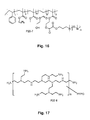
- FIG. 10 shows a schematic overview of the preparation of epoxy-based amphiphobic clear coatings.
- FIG. 11 shows structural formulae for P20-1 and P20-2, which differ in regard to n.
- FIG. 12 shows structural formulae for P20-3.
- FIG. 13 shows structural formulae for P20-4.
- FIG. 14 shows structural formulae for P20-5.
- FIG. 15 shows structural formulae for P20-6.
- FIG. 16 shows structural formulae for P20-7.
- FIG. 17 shows structural formulae for P20-8.
- FIG. 18 graphically shows the relationship between transmittance and coating thickness for PEI-g-PDMS epoxy films, which were made with a mixture of other hardeners including polyoxypropylenediamine, nonylphenol, triethanolamine and piperazine.
- FIG. 19 graphically shows the relationship between contact angle and PDMS wt %.
- FIG. 20 graphically shows the relationship between sliding angle and PDMS wt %.
- FIG. 21A unreacted PDMS (%) as determined by integration of the PDMS peak from
- FIG. 21B was plotted versus reaction time.
- FIG. 21B graphically shows GPC traces at different time points, with PS (polystyrene) as a standard reference peak. As shown at the right hand side, the amount of unreacted PDMS diminishes as the reaction progresses.
- PS polystyrene
- FIG. 22A displays ATR-IR (attenuated total reflectance infrared (ALPHA instrument available through Bruker) spectra recorded during the thermal curing of a PDMS modified epoxy resin film (specifically Bis-A) at 150° C. under the conditions of Example 39A where PEI-g-PDMS was the only hardener present.
- ATR-IR attenuated total reflectance infrared
- FIG. 22B displays ATR-IR (attenuated total reflectance infrared (ALPHA instrument available through Bruker) spectra recorded during the thermal curing of a PDMS modified epoxy resin film (specifically EDGBA or Bis-A) at 120° C. under the conditions of Example 40 where PEI-g-PDMS is mixed with a mixture of other hardeners including polyoxypropylenediamine, nonylphenol, triethanolamine and piperazine.
- ATR-IR attenuated total reflectance infrared
- FIG. 23 is a plot of Transmittance versus film thickness at 500 nm for PEI-g-PDMS modified epoxy coatings as a functions of film thickness at PDMS wt % of 2.1%, 4.0%, 7.4%, and 10.3%, for films made with no other hardeners than the PEI-g-PDMS.
- FIG. 24 a - h shows anti-graffiti properties of PEI-g-PDMS modified epoxy coatings having 4.0 wt % PDMS as well as unmodified “regular” epoxy coatings.
- FIG. 24 a shows the unmodified coating on a vertically-positioned glass slide after oil based spray Paint A has been sprayed on it.
- FIG. 24 b shows modified coating on a vertically-positioned glass slide after Paint A has been sprayed on it; notice how the paint has slid off to the bottom.
- FIG. 24 c shows the unmodified coating on a vertically-positioned glass slide after oil based spray Paint B had been sprayed on it.
- FIG. 24 a - h shows anti-graffiti properties of PEI-g-PDMS modified epoxy coatings having 4.0 wt % PDMS as well as unmodified “regular” epoxy coatings.
- FIG. 24 a shows the unmodified coating on a vertically-positioned glass slide after oil based spray
- FIG. 24 d shows modified coating on a vertically-positioned glass slide after Paint B had been sprayed on it; notice how the paint has slid off to the bottom.
- FIG. 24 e shows a glass slide bearing unmodified coating after a permanent black marker has been used to draw a black mark on it.
- FIG. 24 f shows a glass slide bearing modified coating after a permanent black marker has been used to draw a black mark on it, note that the ink does not stick and has formed little balls of ink on the surface.
- FIG. 24 g shows the same slide as 24 f when a portion of the marker mark has been wiped with a dry tissue.
- FIG. 24 h shows a glass slide bearing modified coating after a rubbing test was conducted for 18 hours, following the rubbing, a black marker has been used to draw a black mark on it, note that the coating has exhibit good durability and the ink does not stick.
- FIG. 25 shows a schematic that illustrates a matrix and surface polymers.
- unsubstituted refers to any open valence of an atom being occupied by hydrogen. Also, if an occupant of an open valence position on an atom is not specified then it is hydrogen.
- a “functional group” is a specific atom or group of atoms within a molecule that are responsible for characteristic chemical reactions. Thus functional groups are moieties within a molecule that are likely to participate in chemical reactions.
- aliphatic refers to hydrocarbon moieties that are straight chain, branched or cyclic, may be alkyl, alkenyl or alkynyl, and may be substituted or unsubstituted. “Short chain aliphatic” or “lower aliphatic” refers to C 1 to C 4 aliphatic. “Long chain aliphatic” or “higher aliphatic” refers to C 5 to C 25 aliphatic.
- an “amphiphobic” material or surface is one that is both hydrophobic and oleophobic or lipophobic.
- a material or surface is considered to be amphiphobic when drops of oil (i.e., hydrophobic liquid) and drops of water roll readily off the material or surface when the material or surface is tilted from the horizontal position at an angle of 90 degrees or less.
- oil i.e., hydrophobic liquid
- drops of water roll readily off the material or surface when the material or surface is tilted from the horizontal position at an angle of 90 degrees or less.
- the term “amphiphobic” is not limited to repelling only water and oil.
- an amphiphobic material or surface will repel not only water and oil but also other substances, such as fingerprints, salt, acid, base, bacteria, etc.
- heteroatom refers to non-hydrogen and non-carbon atoms, such as, for example, O, S, P, and N.
- polymer refers to a large molecule, or macromolecule, composed of many repeated units.
- copolymer refers to a polymer having more than one type of monomer units.
- co refers to copolymer.
- grafted copolymer refers to a copolymer with a linear backbone of one polymer and randomly distributed side chains of another polymer.
- block copolymer refers to a type of copolymer that is made up of blocks of different polymerized monomers.
- Block copolymers may be prepared by first polymerizing a first polymer from a first monomer, and then subsequently polymerizing a second monomer from the reactive end of the first polymer.
- the resultant polymer is a “diblock copolymer” because it contains two different chemical blocks. Triblocks, tetrablocks, multiblocks, etc. can also be made.
- engineing plastic refers to plastic materials that have better mechanical and/or thermal properties than the more widely used commodity plastics.
- PU polyurethane
- polyurethane refers to a polymer composed of a chain or a network of subunits joined by carbamate (urethane) links.
- Polyurethane polymers are most commonly formed by reacting an isocyanate with a polyol.
- FPU refers to a modified polyurethane that includes perfluoropolyether moieties.
- PDMSPU refers to a polyurethane that is modified and includes polydimethylsiloxane moieties.
- HDID refers to hexamethylene diisocyanate dimer
- PS refers to polystyrene
- PDMS refers to polydimethylsiloxane
- PDMS-epoxy refers to an epoxy that includes polydimethylsiloxane moieties.
- PFPO poly(perfluoroisopropylene oxide).
- PFPO-epoxy refers to an epoxy that includes poly(perfluoroisopropylene oxide) moieties.
- PFPE refers to perfluoropolyether
- examples of PFPEs include PFPO, Demnum (available from Daikin), or Fluorolink (available from Solvay.
- P1 refers to a solid powder that is P (S-MMA-MAA-BMA-iPMA-VP-HEGEMA-HEMA) having the full name as Poly(styrene-methyl methacrylate-methacrylic acid-butyl methacrylate-isopentyl methacrylate-vinyl propanoate-(2-hydroxy-ethylene glycol)ethyl methacrylate-2-hydroxyethyl methacrylate).
- P1 is a powdered solid that is obtained by adding P1-0 to a hexane and ether mixture.
- P1-0 refers to a commercially-available solution of unmodified polyol P1.
- P10 P20 and P30 refer to polymers whose structural formulae are shown in FIGS. 10-17 .
- PB polybutadiene
- PIB polyisobutylene
- PEI polyethylenimine
- PEO poly (ethylene glycol) methyl ether
- S refers to styrene
- DMF N,N-dimethylformamide
- GPC gel permeation chromatography
- MA refers to maleic anhydride
- MMA refers to methyl methacrylate
- HDID refers to dimeric hexamethylene diisocyanate.
- HEMA refers to 2-hydroxy ethyl methacrylate
- MAA refers to methacrylic acid
- BMA refers to butyl methacrylate
- iPMA refers to isopentyl methacrylate
- VP refers to vinyl propanoate
- HEGEMA refers to 2-(hydroxyl ethylene glycol)ethyl methacrylate.
- HEMA refers to 2-hydroxyethyl methacrylate
- ATRP refers to atom transfer radical polymerization
- PFPE-COOH refers to perfluoropolyether carboxylic acid.
- FEGEMA refers to PFPE grafted EGEMA.
- FEMA refers to PFPE grafted HEMA.
- P[(S-MMA-MAA-BMA-IBMA-VP-EGEMA-HEMA)-g-PFPE] refers to perfluoropolyether grafted P(S-MMA-MAA-BMA-IBMA-VE-EGEMA-HEMA).
- P[(S-MMA-MAA-BMA-IBMA-VP-EGEMA-HEMA)-g-PDMS] refers to poly(dimethyl siloxane) grafted P(S-MMA-MAA-BMA-IBMA-VE-EGEMA-HEMA).
- EMB ethyl ⁇ -bromoisobutyrate
- P(TFEMA-co-HEMA) refers to copolymer poly(trifluoroethyl methacrylate-co-2-hydroxyethyl methacrylate).
- P(HEMA-S-MMA) refers to a copolymer poly((2-hydroxyethyl methacrylate)-styrene-methyl methacrylate).
- PEI-g-PDMS refers to polyethylenimine-g-PDMS.
- P(S-alt-MA)-g-PDMS refers to Poly(styrene-alt-maleic anhydride)-g-PDMS.
- TFEMA refers to trifluoroethyl methacrylate.
- PGMA refers to poly(glycidyl methacrylate).
- % T refers to percent transmittance
- fluoro density refers to the percentage of hydroxyl side chains that have been replaced by fluorinated moieties such as PFPE.
- 13.6% fluoro density refers to a polymer wherein 86.4% of the hydroxyl groups remain, and 13.6% of the positions that were formally hydroxyl are now occupied by PFPEs.
- siloxane density refers to the percentage of hydroxyl side chains that have been replaced by siloxane such as PDMS. For example, 11.3% siloxane density refers to a polymer wherein 88.7% of the hydroxyl groups remain, and 11.3% of the positions that were formally hydroxyl are now occupied by PDMS chains.
- Embodiments of the invention provide coating compositions that are capable of forming a coating that has oil- and water-repellent properties.
- the major component of the coating is in contact with a coated substrate and forms a solid matrix that is formed, for example, by crosslinks that are formed in the curing process.
- the minor component may be found dispersed throughout the coating, at least some species of the minor component are located at the surface. This surface location of at least a portion of the minor component provides the cured coating with special properties.
- This surface layer has polymers that are only attached at one end while the other end is unbound (see FIG. 25 for an illustration). This minor component is thus bound to the matrix at one end, but its other end is unbound.
- the second component includes a polymer that has a glass transition temperature below 25° C. Due to the dynamic nature of these polymers with a relatively low Tg, these polymers are liquid-like in their nature. (In some embodiments, these polymers are inherently waxy but may become liquid-like when plasticised by moisture adsorbed from air or taken up from its environment.) Due to its fluid nature, these polymers are capable of migrating to the surface during the drying and curing processes.
- the major component that provides a solid matrix can be any engineering plastic that has a high glass transition temperature or any polymer that has a high glass transition temperature and that crosslinks to form a solid polymeric coating.
- the solid coating is transparent (i.e., clear).
- Polyurethane and epoxy are used herein as non-limiting representative examples for this major component. The inventors suggest that other polymers with a glass transition temperature that is higher than about 120° C. would also be suitable.
- Suitable major components include: engineering plastics with a glass transition temperature (Tg) or with a melting temperature (Tm) of greater than about 100° C.
- Such polymers and engineering plastics include: Polystyrene (PS), Polyvinyl chloride (PVC), Polypropylene (PP), Polyethylene (PE), Poly (acrylonitrile butadiene styrene) (ABS), Nylon 6, Nylon 6-6, Polyamides (PA), Poly(butylene terephthalate) (PBT), Polycarbonates (PC), Poly(etheretherketone) (PEEK), Poly(etherketone) (PEK), Poly(ethylene terephthalate) (PET), Polyimides, Poly(oxymethylene) plastic (POM/Acetal), Poly(phenylene sulfide) (PPS), Poly(phenylene oxide) (PPO), Polysulfone (PSU), Poly(tetrafluoroethylene) (PTFE/Teflon), Ultra-high-molecular-weight polyethylene (UHMWPE/UHMW).
- PS Polystyrene
- PVC Polyvinyl chloride
- PP Polypropylene
- Polystyrene resins with a Tm greater than about 50° C.
- POM Poly(oxymethylene)
- PET Poly(ethylene terephthalate)
- PBT Poly(butylene terephthalate)
- PTFE Polytetrafluoroethylene
- isotactic polypropylene atactic polypropylene
- High-density polyethylene or Low-density polyethylene.
- polymers that are cross-linkable such as Polyurethane, Epoxy resin, Poly acrylate, Polymethacrylate, Polystyrene, Polyimide, Polyamine, Polysulfone, Polyester, or Polycarbonate.
- a variety of polymers have been used in the examples provided herein as the minor component, which is dynamic (i.e., in motion).
- suitable polymers for the dynamic minor component have a Tg that is about 25° C. or that is less than 25° C. This Tg is significantly lower than the Tg of the matrix's major or core component.
- the dynamic quality of the minor component's species that are located at the surface confer special properties on the coating that are desirable. Such special properties include anti-smudge, anti-wetting and amphiphobicity.
- components that have been shown to provide anti-smudge, anti-wetting, and amphiphobic properties include, for example, polysiloxane, perfluorinated polyether, polyisobutylene, and polybutadiene, poly(ethylene oxide) polymers, and polypropylene oxide.
- Non-limiting examples include P(S-alt-MA)-g-PEO 750 , P(S-alt-MA)-g-PEO 2000 , P(S-alt-MA)-g-PEO 5000 , and Polyol-g-PIB.
- coatings are described herein for combinations of certain dynamic minor components with polyurethane as well as epoxy core major components. Accordingly, embodiments of the invention provide polyurethane-based coatings and adhesives and epoxy-based coatings and adhesives. Such coatings and adhesives are optically-clear, amphiphobic, and, importantly, are thick enough and durable enough to endure wear. Such coatings are suitable for a variety of surfaces and are repellent against both water- and oil-borne contaminants. On surfaces coated with this durable and optically-clear amphiphobic coating, fingerprints and smudges do not readily deposit. If they are deposited, they are readily removable due to repulsion of the coating against the contaminants.
- Coatings that include components or moieties that exhibit dynamic chain mobility at room temperature are described herein.
- dynamic component that are located at or near the surface have one end covalently linked to a crosslinked matrix while the other end is not linked and may move around.
- This chain mobility allows these chains to migrate to the surface.
- the inventors suggest that such free movement of chains (i.e., dynamic chain mobility at room temperature) prevents formation of permanent contacts between a foreign substance (e.g., rain, ink, paint, or greasy fingerprints) and the coating.
- a foreign substance e.g., rain, ink, paint, or greasy fingerprints
- a liquid foreign substance readily slides off the coated surface.
- Such water and oil repellency properties of these amphiphobic polyurethane-based and epoxy-based formulations are quantified in the working examples provided herein.
- compositions described herein are useful as coatings, paints, adhesives and many other uses that traditional polyurethane- or epoxy-based compositions are used for. For simplicity, they are referred to simply as coatings herein.
- Polysiloxane, perfluorinated polyethers, poly(ethylene oxide), polybutadiene, and polyisobutylene are used herein as representative examples for the dynamic minor component of such coatings. However, these examples should not be limiting. The inventors suggest that other polymers that have a glass transition temperature that is about 25° C. or less than 25° C. would also be suitable.
- fluoropolymers, perfluoro polymers and phosphazene polymers such as, for example,
- R is CH 3 , C 6 H 5 , OCH 3 , OCH 5 , NR 2 , Cl, Br, F, OCH 2 CF 3 , or OCH 2 C 6 H 5 .
- They also include poly ionic liquids such as, for example, Poly(1-glycidyl-3-butylimidazolium bis(trifluoromethanesulfonyl)imide).
- This technique allows the dynamic component to be sold separately as an additive (prior to drying/curing) that provides amphiphobic properties to an engineering plastic or any polymer that has a high glass transition temperature and that is capable of forming a solid polymeric coating. Details are provided in the Working Examples.
- An optically-clear, amphiphobic, and durable polyurethane-based coating composition has been prepared and its properties have been quantified.
- This composition is prepared by including a new component to the traditional PU formulation of isocyanate and polyol.
- the new component is a polyol that bears PFPE, polysiloxane, or both PFPE and polysiloxane.
- This component may be an additive to the traditional formulation or it is may be used as a replacement in the absence of “regular” or “unmodified” polyol (that is, a polyol that does not comprise PFPE or polysiloxane).
- this new coating composition is prepared by combining (i) isocyanate, and (ii) a copolymer that is a polyol that comprises PFPE, polysiloxane, or both PFPE and polysiloxane, and, optionally, further adding (iii) unmodified polyol.
- polyurethane is prepared using polyol as one of the crosslinking agents; however, it is known that polyurethane can be made using polyamine instead of polyol. That is, it can be prepared by combining diisocyanate and polyamine.
- an amphiphobic coating composition may be prepared by combining (i) diisocyanate, and (ii) a copolymer that is a polyamine that comprises PFPE, polysiloxane, or both PFPE and polysiloxane, and, optionally, further adding (iii) polyamine.
- the discussion herein focuses on a modified polyol that bears PFPE, polysiloxane, or both. However, it is possible to prepare a corresponding composition using a modified polyamine that bears PFPE, polysiloxane, or both.
- the inventors also envision using a combination of polyol and polyamine with the copolymer “(ii)”.
- a method of preparing component (ii) is described.
- This copolymer component comprises a moiety (e.g., PFPE, polysiloxane) that confers amphiphobic properties on the product coating composition.
- PFPE polysiloxane
- such moieties are characterized by having a glass transition temperature in a particular range.
- a PDMS-bearing copolymer has a glass transition temperature in the range of ⁇ 60° C. to ⁇ 150° C.
- a PFPE-bearing copolymer has a glass transition temperature in the range from ⁇ 160° C. to ⁇ 10° C.
- polyurethane-based coating composition prepared by these described methods have 1 to 40 wt % fluorine and/or 1 to 40 wt % siloxane.
- the PFPE or polysiloxane is located randomly at side chain positions along the copolymer. These approaches are discussed further below. Details regarding making clear coatings are provided in the Working Examples. Importantly, coatings have been made from solutions that include a variety of solvents. In some embodiments the coating is obtained from a solution of both a hydrophobic solvent and a water-miscible solvent. In some embodiments the hydrophobic solvent is used to solubilize the mixture, and then a water-miscible or aqueous solvent is added, and the hydrophobic solvent is removed.
- hydrophobic solvents examples include ketone such as acetone or ethylmethylketone, THF, ester such as ethyl acetate, or 1,2-dimethoxyethane.
- water-miscible solvents include acetonitrile or dimethyl carbonate.
- the resultant polyurethane-based coating is optically clear (i.e., transparent), durable, and resistant to both oil and water. Proof of such oil- and water-resistance is described herein. For example, droplets of water and droplets of oil that are in contact with such coatings simply slide off when the coated surface is at a sufficiently high tilting angle (such as 40° for hexadecane and 80° for water). After sliding off, there is no trace left behind. Another example is that when a coated surface is written upon using a permanent marker, the ink traces shrink and hardly leave a mark.
- Water-based polyurethane was also investigated and it was possible to add the dynamic component and make the resultant films amphiphobic. Notably, protecting groups were used on the polyisocyanate moieties to protect them from reacting with water. See Example 18 for details.
- Embodiments of the current invention are moieties that are incorporated into a polyurethane matrix. Such moieties exhibit dynamic chain mobility at room temperature.
- one end of such polymer chains is covalently linked to the PU matrix while the other end is not linked and may move around. This chain mobility allows these chains to migrate to the surface.
- the inventors suggest that such free movement of chains (i.e., dynamic chain mobility at room temperature) prevents formation of permanent contacts between a foreign substance (e.g., rain, ink, paint, or greasy fingerprints) and the coating. Where the coating is on a surface that is flat and is lacking solid protrusions, a liquid foreign substance readily slides off the coated surface.
- a foreign substance e.g., rain, ink, paint, or greasy fingerprints
- copolymers were investigated, one family included a fluorinated moiety and another family of copolymers included a polysiloxane moiety. Studies were conducted with mixtures of these moieties, with the result that samples having both fluorine and siloxane moieties behaved similarly to the fluorine-containing coatings with regard to sliding angle and contact angle.
- the copolymer that included fluorine was a perfluoropolyethers (PFPE).
- PFPEs perfluoropolyethers
- Krytox which has a T g of ⁇ 71° C. (see Yarbrough, J. C.
- Approach A used a PFPE-bearing or a PDMS-bearing graft copolymer.
- Approach B involved a block copolymer that included a PFPE or a PDMS block. General formulas are shown below for these approaches.
- Polysiloxane side chains that can be a part of a FS unit includes polydialkylsiloxane, where alkyl is C 1 to C 20 , such as, for example, polydimethylsiloxane, polydiarylsiloxane, and polyalkylarylsiloxane.
- Embodiments wherein the FS moiety has both PFPE and polysiloxane can exist in the form of two types of grafts incorporated into a copolymer in a statistical fashion.
- PFPE and polysiloxane moieties can co-exist in a single type of graft that is incorporated onto the copolymer.
- the PFPE moieties provide oil- and water-repellency to the resultant product.
- polysiloxane repels oil and water because of its dynamic non-wetting properties.
- Mi denotes one or more than one monomer that improves compatibility of this graft copolymer with other components of the final formulation for which it is being prepared.
- Such final formulations may be, for example, glue or paint formulations.
- Mi may be chosen to improve the mechanical, optical, and other properties of the final coating.
- R which is characterized by its functional group (e.g., hydroxyl, amino, carboxyl, glycidyl, isocyanate, or anhydride moieties) may have its functional group present in a protected form. That is, the functional groups may include protecting or blocking groups. They can include protected amino, protected isocyanate, protected carboxyl, and protected hydroxyl moieties. The functional groups are released (i.e., unprotected) upon exposure to heat, moisture or irradiation. By using blocking groups, it is possible to control the temperature or readiness of the glue curing chemistry.
- the functional groups may include protecting or blocking groups. They can include protected amino, protected isocyanate, protected carboxyl, and protected hydroxyl moieties.
- the functional groups are released (i.e., unprotected) upon exposure to heat, moisture or irradiation. By using blocking groups, it is possible to control the temperature or readiness of the glue curing chemistry.
- Approach B provides a block copolymer with a random copolymer block that has the following general formula:
- the first block is FS, which is a polymer block that comprises PFPE, polysiloxane, PEO, PIB, PB, or any combination thereof.
- FS is a polymer block that comprises PFPE, polysiloxane, PEO, PIB, PB, or any combination thereof.
- FS comprises a first polymer block that comprises PFPE moieties, and a second polymer block that comprises polysiloxane moieties.
- the second block is a random copolymer having at least two and typically three components.
- R is a monomer that comprises a reactive moiety. That is, R bears at least one functional group that is suitable to react with an isocyanate moiety.
- Such functional groups may include, for example, OH, NH 2 , epoxy, or glycidyl.
- the functional groups can also be protected versions of the afore-mentioned functional groups. Such protecting groups are released upon heating or upon exposure to moisture or upon exposure to irradiation. Such release exposes an unprotected functional group, which leads to reaction. By using these “blocking” groups, one can control the temperature at which the polymer mixture cures.
- Mi denotes one or more than one monomer that is incorporated to improve compatibility of this random copolymer with other components of the final formulation for which it is being prepared.
- Such final formulations may be, for example, glue or paint formulations.
- Mi are chosen to improve the mechanical, optical, and other properties of the final coating. Examples of Mi include acrylates, methacrylates, styrenes, and vinyl esters.
- n is number of repeat units.
- the isocyanate component should have more than two isocyanate groups per molecule so that one or more PFPE or polysiloxane chains can attach to a polyisocyanate molecule without reducing its isocyanate group number below 2.
- a copolymer that is a polyol that comprises a polysiloxane moiety, (ii) di-, tri- or poly-isocyanate, and, (iii) a first solvent (e.g., acetone) that solvates the mixture; heating, optionally, adding (iv) a polyol that does not comprise a polysiloxane moiety, and continuing to apply heat, cooling; adding a second solvent (e.g., acetonitrile, DMF, or dimethylcarbonate) that selectively solvates a portion of the mixture, the solvated portion being that which is not the polysiloxane moiety; removing the first solvent under reduced pressure; adding additional second solvent to form a coating solution; dispensing the coating solution onto a surface of a substrate; drying the coated substrate; and curing the coating.
- Curing may involve heating, adding a curing catalyst (e.g., a tertiary amine,
- a solvent e.g., tetrahydrofuran
- Item (ii) can be a product of reaction of di-, tri- or poly-isocyanate and an additive that is a copolymer that comprises a siloxane moiety (an example additive is polysiloxane-b-poly(glycidyl methacrylate))
- FIG. 1 graphically demonstrates the relationship between sliding angle and weight percentage of fluorine for PU films prepared from Example 1B(i).
- FIG. 2 graphically demonstrates the relationship between percentage transmittance versus fluorine content for PU films prepared from Example 1A(i).
- FIG. 3 graphically shows variation in the sliding angles vs. NCO/OH ratio. Solid lines show sliding angles measured before a rubbing test, while dotted lines denote sliding angles measured after a rubbing test. Rubbing tests were performed using a 400 g weight for 40 min at 40 rpm. The sliding angle tests were performed using 20 ⁇ L water droplets and 5 ⁇ L hexadecane droplets.
- FIG. 4 a - d show photographs of artificial fingerprint impressions that were applied onto (a) ordinary glass; (b) glass coated with coating of Example 1A(i); (c) glass coated with coating of Example 1A(ii); and (d) glass coated with coating of Example 1C(ii).
- FIG. 4 a shows a deep pattern on uncoated glass, indicating the easy acceptance of the smudge by uncoated glass.
- FIGS. 4 b and 4 c show dim patterns where the liquid has beaded-off into balls indicating anti-smudge properties.
- FIG. 4 d shows a pattern that is between uncoated glass ( FIG. 4 a ) and FPU coated glass ( FIGS. 4 b and 4 c ), indicating the antismudge properties that are better than ordinary glass.
- FIG. 5 demonstrates the clarity of films described herein by showing percentage transmittance versus wavelength observed for (a) uncoated glass; (b) unmodified drop cast polyurethane films; (c) PFPE PU films prepared from Example 1B(i); (d) PFPE PU films prepared from Example 1A(i); (e) PFPE PU films prepared from Example 1A(ii); (f) spin coated PFPE PU film just a few nm in thickness prepared from Example 1B(i); (g) spin coated PFPE PU film just a few nm in thickness prepared from Example 1A(i); and (h) spin coated PFPE PU film just a few nm in thickness prepared from Example 1A(ii). All spin coated samples exhibited high % T values showing clear films that are transparent.
- FIG. 6 shows an anti-ink test performed at the junction of uncoated glass and coated glass.
- Transparent anti-smudge coatings were achieved by incorporating epoxy resin with polymers having a low Tg such as, for example, polysiloxane and fluorinated moieties.
- Advantages of incorporation of such moieties into epoxy coatings include good performance regarding repulsion of oil and water, and retention of good optical clarity. Due to complications such as macro phase separation, it is not possible to simply blend polysiloxane polymers or polyfluorinated polymers into epoxy resins to prepare such coatings. Methods have been developed to overcome such challenges and are described in the Working Examples.
- An optically-clear, amphiphobic, and durable epoxy coating composition has been prepared and its properties have been quantified.
- This composition is prepared by adding a new component to the traditional epoxy formulation of epoxy resin and hardener.
- the new component is a dynamic polymer that is bound at one end and is free at the other end.
- such dynamic polymers include polydimethylsiloxane (“PDMS”) and/or PFPE.
- PDMS polydimethylsiloxane
- PFPE PFPE
- a polymer (P10′′), bearing functional moieties is reacted with a PDMS- or PFPE-bearing reactant.
- P10 bears functional groups that are any groups that are involved in epoxy resin curing, examples of such functional moieties include amine, imine, hydroxyl, carboxyl, anhydride, etc.
- PDMS or PFPE moieties are added to P10 to form a second polymer (“P20”).
- Structural formulae of representative examples of P20 polymers are shown in the Figures, and in the Working Examples.
- step 2 of FIG. 10 P20 was mixed and reacted with an excess of epoxide resin which typically bears one or more glycidyl groups to form a third polymer (“P30”), which bears epoxide moieties and either PDMS or PFPE.
- P30 a third polymer
- step 3 P30 was then mixed with a hardener (also known as an activator) and optionally solvent (or mixture of solvents).
- a hardener also known as an activator
- solvent or mixture of solvents
- the resultant mixture that included P30, hardener, and optionally a solvent was then coated on a substrate (e.g., a glass plate) and the coated film was cured after the solvent was fully evaporated.
- a substrate e.g., a glass plate
- the resulting coating was clear, durable and repelled both oil and water. Effectively, it was smudge-proof and liquid-proof. Any residue that was deposited could be readily removed, for example by wiping lightly with a dry cloth.
- Weight percentage (wt %) of PDMS/PFPE can be controlled by blending different amount of P20 into epoxy resin. Samples with PDMS/PFPO wt % of 1.0%, 5.0%, 8.0% and 12% all were shown to repel both oil and water. Coating of different thickness were tested ranging from about 1 ⁇ m to about 1 mm. It was determined that thickness did not affect the repellency.
- amphiphobic epoxy coatings described herein can be prepared using a variety of types of epoxy resins.
- An example of a suitable epoxy resin is bisphenol A diglycidyl ether epoxy resin (Bis-A).
- a hardener (also called activator) that is suitable for reaction with an epoxy resin, or a mixture of resins, comprises poly(oxypropylene)diamine, nonylphenol, triethanolamine and piperazine.
- the compositions containing piperazine are fast curing when heated to about 120° C., with a fully cured time that is usually less than three days at room temperature.
- Hardener content can be about 1 to 1 parts by volume of bisphenol A diglycidyl ether epoxy resins.
- FIG. 19 graphically shows data regarding the contact angles versus wt % of PDMS.
- amphiphobic epoxy-based coating and/or adhesive compositions that are two-pack epoxy formulations are described and exemplified herein, it is possible to have single-pack formulations. That is, the inventors envision that functional groups of the hardener could be in a protected form. Examples of such protected functional groups may include protected amino, protected hydroxyl, protected carboxyl, or protected thiol groups.
- protected form the hardener and epoxy components can be mixed and stored in one pack.
- an external stimulus such as heating or irradiation, the functional groups become deprotected and are released. Subsequently, the epoxide-ring-opening reactions occur.
- Such single-pack formulations are stable at room temperature. Curing occurs when the components are heated or irradiated.
- the inventors also envision preparation of a water-dispersible formulation for epoxy coatings.
- the epoxy part and the hardeners are dispersed in water. Ring-opening reactions take place after water has been evaporated and a pre-curing film has been formed.
- an external stimulus e.g., heat or irradiation
- These coatings have applications for the protection of hand-held electronic devices to reduce the accumulation of fingerprints and smudges. They are also useful when applied to automobile windshields or windows of high-rise buildings to reduce the need for cleaning. They can even be used as a protective overcoat or to protect internal structures in automobiles. When used as the top coat of architectural or industrial coatings in sensitive areas, they provide graffiti resistance. Such graffiti resistance can be useful for sensitive or often-targeted areas such as shipping containers, railcars, building materials (e.g., concrete, aluminum siding, glass, wood, metal, flooring, marble, stone, tile). They can also be used as the coatings for moulds (such as, for example, those used in plastic industry) to facilitate release of molded objects.
- Such oil- and water-repellent coatings can be used to facilitate cleanup or simplify production of food products. They may be used to coat the interior of oil pipelines to reduce deposition and friction.
- compositions would be useful in a paint or any other type of coating.
- the amphiphobic properties mean that surfaces coated with such coatings would display anti-smudge, and anti-graffiti properties. Greasy fingerprints would not adhere to a coated surface. If they did, the smear could be wiped away easily with a dry cloth or the like.
- Such clear anti-smudge coatings would be an asset to eyeglasses, electronic devices, windows, screens, cell phones, tablets, electronic devices, equipment that is exposed to dirt and grime, hand-held electronic devices, windows of high-rise buildings, automobile bodies, windshields.
- Amphiphobic polyurethane-based and epoxy-based films have been prepared using PFPE and PDMS. Such films, with a thickness ranging from a few nm to about 10 ⁇ m, have been prepared and showed water and oil repellent properties. Both water and hexadecane readily slide off these surfaces without leaving any traces. These films are optically clear with >90 T %.
- FPU or PDMSPU films ranging in thickness from about 500 nm to about 2 ⁇ m exhibited better transmittance properties than thicker films.
- fluorinated epoxy films and PDMS-epoxy films exhibited excellent transmittance. See, for example, in FIG.
- amphiphobic films are durable against abrasion. These films were subjected to rubbing tests against forces of 1-5 N from 800 to 4800 cycles, which did not cause any significant changes in the properties of these films. The films remained in as good shape as before the rubbing test.
- amphiphobic films were resistant against fingerprints and smudges as verified by a stamp-test using liquid that simulates finger prints.
- the coatings helped to minimize the probability of contamination of surfaces.
- amphiphobic films exhibited strong adhesion to glass surfaces. Consequently, these films can be readily applied onto these substrates and other substrates to yield durable films.
- PU coatings prepared by Approach A and using PFPE have shown excellent performance particularly at low (12% PFPE) grafting densities. This effectiveness at low grafting densities can help minimize the need for fluorinated materials.
- particles can be embedded into the polyurethane-based coating composition.
- silica particles have been successfully embedded in an example coating as described in Example 15.
- Other particles that could be embedded include silica, titanium dioxide, diatomaceous earth, alumina, TiO 2 , and/or pigments.
- biocides may prevent accumulation of organisms (e.g., bacteria, algae, fungi, mollusks, arthropods).
- an organism may comprise a microorganism.
- the microorganism may be a Gram-negative bacteria or Gram-positive bacteria.
- the coatings are applicable to fabrics and other solids other than glass to prepare optically clear, stain-resistant, and smudge-free surfaces. Also, the coating can be used for irregular geometrical solids as well as rough surfaces.
- the coatings described herein can be applied by all traditional coating methods including solution casting, brushing, aero-spraying, painting, printing, stamping, rolling, dipping, wiping, sponging, spin-coating, spraying, electrostatic spraying and/or dip-coating.
- Amphiphobic coatings may also be permanent or temporary, depending on methods used for application onto a substrate.
- curing or annealing a coating onto a substrate e.g., by heating or exposing to UV
- certain coatings applied without curing or annealing may be temporary, removable and/or short-lived, since chains that are not crosslinked or covalently attached to a substrate may be lost due to surface scratching or may be rinsed away by solvents or water.
- a variety of substrates can be coated using amphiphobic copolymers described herein, including but not limited to plastics, metal oxides, semi-conductor oxides, metals, metalloids, metal oxides, concretes, clay particles, sand particles, cement particles, saw dust, semiconductors, particles, glasses, ceramics, papers and textile fibers.
- surfaces to be coated are in the form of metal plates, metal sheets or metal ribbons.
- substrates are particles.
- amphiphobic copolymers of the invention may be coated onto particles, and the coated particles may then be used for coating another substrate.
- amphiphobic surfaces and coatings Many applications are anticipated for amphiphobic surfaces and coatings. For example, buildings (e.g., skyscrapers) with amphiphobic walls would require no or minimal cleaning. Ice would not likely form or build up on amphiphobic surfaces of power cables, which can minimize damage from freezing rain or ice storms.
- Amphiphobic coatings on metal surfaces can reduce metal rusting and corrosion.
- Amphiphobic coatings can be used to produce paper and paperboard for food-contact applications, such as pizza boxes and sandwich wraps. Amphiphobic coatings may be used to prepare glasses and ceramics that are self-cleaning, or to provide arc-resistant coatings on insulators used in electrical transmission systems where dirt or salt deposits, alone or in combination with water, can allow arcing with significant electrical energy losses.
- amphiphobic coatings can provide products and surfaces resistant to damage in freezing weather from water that has penetrated the surfaces.
- amphiphobic coatings can be used to prepare paper products and fabrics which are resistant to water and moisture, including, but not limited to: paper and fabric moisture barriers used for insulation and under shingles or roofing; cardboard tubes or pipes, for example used to cast concrete pillars (water penetrating the seams of such tubes can leave seams and other defects in the pillars that need to be fixed by grinding operations); and water-resistant paper and cardboard packaging.
- Amphiphobic coatings can be used to prepare products which are salt-water-resistant, for example for underwater applications such as ship hulls, submarines, and other marine applications.
- amphiphobic coatings described herein can be used to prepare surfaces which are anti-wetting, anti-icing, anti-corrosion, anti-rust, anti-scratching, anti-staining, anti-bacterial, abrasion resistant, anti-fingerprint marking, anti-smudging, anti-graffiti, acid-resistant, base-resistant, resistant to chemicals, resistant to organic solvents, resistant to etching and/or self-cleaning.
- Surfaces coated with copolymers described herein may resist spills, resist stains, resist soiling, release stains, have improved cleanability, have improved alkaline resistance, have improved acid resistance, have improved resistance to organic solvents, have improved resistance to chemical penetration (e.g., improved resistance to organic chemicals), have improved resistance to corrosion, and/or have improved durability compared to uncoated surfaces.
- FIGS. 24 a - h contrast unmodified “regular” epoxy coatings with a representative example modified epoxy coating, specifically PEI-g-PDMS modified epoxy coatings having 4.0 wt % PDMS.
- FIG. 24 a shows an unmodified coating on a vertically-positioned glass slide after an oil-based spray paint (“Paint A”) has been sprayed on it.
- Paint A oil-based spray paint
- FIG. 24 b which shows the modified epoxy coating on a vertically-positioned glass slide after Paint A has been sprayed on it; notice how the paint has slid off to the bottom.
- FIG. 24 c shows the unmodified coating on a vertically-positioned glass slide after oil based spray Paint B had been sprayed on it.
- FIG. 24 d shows the modified epoxy coating on a vertically-positioned glass slide after Paint B had been sprayed on it; notice how the paint has slid off to the bottom.
- FIG. 24 e shows a glass slide bearing unmodified coating after a permanent black marker has been used to draw a black mark on it, FIG.
- FIG. 24 f shows a glass slide bearing modified coating after a permanent black marker has been used to draw a black mark on it, note that the ink does not stick and has formed little balls of ink on the surface.
- FIG. 24 g shows the same slide as 24 f when a portion of the marker mark has been wiped with a dry tissue.
- FIG. 24 h shows a glass slide bearing modified coating after a rubbing test was conducted for 18 hours (see Example 6 for details), following the rubbing, a black marker has been used to draw a black mark on it, note that the coating has exhibit good durability and the ink does not stick.
- amphiphobic coatings described herein can be used to prepare plastic or glass surfaces which are smudge-resistant, scratch resistant and/or stain resistant. Such plastic and glass surfaces may be found, for example, on electronic devices.
- Electronic devices can be portable (e.g., cellular phones; smartphones (e.g., iPhoneTM, BlackberryTM); personal data assistants (PDAs); tablet devices (e.g., iPadTM); game players (e.g., PlayStation Portable (PSPTM), NintendoTM DS); laptop computers; etc.), or not portable (e.g., computer monitors; television screens; kitchen appliances; etc.).
- amphiphobic coatings described herein provide surfaces which are highly water- and oil-repellant.
- Contact angle of water and/or oil on a coated surface or material may be about 90 degrees or greater, about 100 degrees or greater, about 110 degrees or greater, about 120 degrees or greater, about 130 degrees or greater, about 150 degrees or greater, about 90 degrees, about 110 degrees, about 120 degrees, about 150 degrees, about 160 degrees, or about 170 degrees. It should be understood that contact angles cannot be greater than 180 degrees, which is the theoretical maximum angle possible.
- amphiphobic coatings described herein provide surfaces which resist adhesion of biological materials.
- anti-adherent surfaces comprising amphiphobic copolymers of the invention are provided which repel proteins, bacteria, dirt, grime, soil, fungi, viruses, microbes, yeast, fungal spores, bacterial spores, gram negative bacteria, gram positive bacteria, molds and/or algae.
- Such surfaces may also resist adherence of biological or bodily fluids such as blood, sputum, urine, feces, saliva, and/or perspiration/sweat.
- amphiphobic coatings reduce or prevent microscopic animals such as dust mites and bedbugs from colonizing in mattresses, bedding, upholstery and/or carpeting.
- Amphiphobic coatings, or particles coated with amphiphobic copolymers of the invention can be applied to any surface to which an amphiphobic copolymer of the invention can adhere, either temporarily or permanently.
- the surfaces may be flexible or rigid.
- a surface can be made from a material which is fabric, glass, metal, metalloid, metal oxide, ceramic, wood, plastic, resin, rubber, stone, concrete, a semiconductor, a particle or a combination thereof.
- surfaces may comprise metalloids (e.g., B, Si, Sb, Te and Ge).
- any glass can be employed as a substrate for amphiphobic coatings according to the invention, including, without limitation: soda lime glass, borosilicate glass, sodium borosilicate glass, aluminosilicate glass, aluminoborosilicate glass, optical glass, fiberglass, lead crystal glass, fused silica glass, germania glass, germanium selenide glass, and combinations thereof.
- any metal can be employed as a substrate for amphiphobic coatings according to the invention, including, without limitation: iron, nickel, chrome, copper, tin, zinc, lead, magnesium, manganese, aluminum, titanium silver, gold, platinum, and combinations thereof, or alloys comprising those metals.
- Metal oxides may also be present in the substrates.
- a metal forming a surface comprises steel or stainless steel.
- a metal used for a surface is chromium, is plated with chromium, or comprises chromium or a chromium coating.
- any ceramic can be employed as a substrate for amphiphobic coatings according to the invention, including, without limitation: earthenware (typically quartz and feldspar), porcelain (e.g., made from kaolin), bone china, alumina, zirconia, and terracotta.
- earthenware typically quartz and feldspar
- porcelain e.g., made from kaolin
- bone china e.g., alumina, zirconia, and terracotta.
- a glazing on a ceramic may be considered either as a ceramic or a glass.
- woods can be employed as a substrate for amphiphobic coatings according to the invention, including, without limitation, hard and soft woods.
- woods may be selected from alder, poplar, oak, maple, cherry, apple, walnut, holly, boxwood, mahogany, ebony, teak, luan, and elm.
- woods may be selected from ash, birch, pine, spruce, fir, cedar, and yew.
- any plastic or resin can be employed as a substrate for amphiphobic coatings according to the invention, including, without limitation, polyolefins (such as a polypropylene and polyethylene), polyvinylchloride plastics, polyamides, polyimides, polyamideimides, polyesters, aromatic polyesters, polycarbonates, polystyrenes, polysulfides, polysulfones, polyethersulfones, polyphenylenesulfides, phenolic resins, polyurethanes, epoxy resins, silicon resins, acrylonitrile butadiene styrene resins/plastics, methacrylic resins/plastics, acrylate resins, polyacetals, polyphenylene oxides, polymethylpentenes, melamines, alkyd resins, polyesters or unsaturated polyesters, polybutylene terephthlates, combinations thereof, and the like.
- polyolefins such as a polypropylene and polyethylene
- Any rubber can be employed as a substrate for amphiphobic coatings according to the invention, including, without limitation: natural rubber, styrene-butadiene rubber, butyl rubber, nitrile rubber, chloroprene rubber, polyurethane rubber, silicon rubber, and the like.
- any type of stone, concrete, or combination thereof can be employed as a substrate for amphiphobic coatings according to the invention, including, without limitation, igneous, sedimentary and metamorphic stone (rock).
- the stone is selected from granite, marble, limestone, hydroxylapatite, quartz, quartzite, obsidian and combinations thereof.
- Stone may also be used in the form of a conglomerate with other components such as concrete and/or epoxy to form an aggregate that may be used as a surface upon which an amphiphobic coating may be applied.
- Non-limiting examples of types of coatings which may be prepared using amphiphobic coatings and methods described herein include: fabric coatings, textile coatings, decorative coatings, transportation coatings, wood finishes, powder coatings, coil coatings, packaging finishes, general industrial finishes, automotive paint (including refinishing paint), industrial maintenance and protective coatings, marine coatings, and other industrial coatings.
- Non-limiting examples of applications of these types of coatings include: furniture (e.g., wood and metal furniture, outdoor furniture, office or commercial furniture, fixtures, casual furniture); motor vehicles; metal building components; industrial machinery and equipment; appliances (e.g., kitchen appliances, laundry appliances); aerospace equipment; packaging (e.g., interior and exterior of metal cans, flexible packaging, paper, paperboard, film and foil finishes); electrical insulation coatings; consumer electronic products (e.g., cell phones, tablet devices, MP3 players, cameras, computers, displays, monitors, televisions, hearing aids); coil coatings (e.g., coils, sheets, strips, and extrusion coatings); automotive refinishing (e.g., aftermarket repair and repainting); industrial settings (e.g., protective coatings for interior and exterior applications); routine maintenance to protect buildings (e.g., protection from corrosive chemicals, exposure to fumes, and temperature extremes) or solar panels; process industries (e.g., protection from corrosive or highly acidic chemicals); roads and bridges;
- Coatings described herein can be applied to surfaces using any means known in the art, including but not limited to, brushing, painting, printing, stamping, rolling, dipping, wiping, sponging, spin-coating, spraying, or electrostatic spraying.
- surfaces are rigid or semi-rigid, but surfaces can also be flexible, for example in the instance of wire and tapes or ribbons.
- Coatings described herein can be applied to virtually any substrate to provide amphiphobic properties. Choice of coating forms and processes for applying coatings are determined by a skilled artisan, based on factors such as chosen substrate, application, etc. Coatings may take any desired shape or form. In some embodiments, a coating completely covers a surface. In other embodiments, coatings cover only a portion of a surface, such as one or more of a top, side or bottom of an object. In one embodiment, a coating is applied as a line or strip on a substantially flat or planar surface. In such an embodiment, the line or strip may form a spill-resistant border.
- Shape, dimensions and placement of coatings on surfaces can be controlled by a variety of means including the use of masks which can control not only portions of a surface that receive a coating, but also portions of a surface that may receive prior treatments such as application of a primer layer or cleaning by abrasion or solvents.
- sand blasting or chemical treatment may be used to prepare a portion of a surface for coating, e.g., to generate desired surface roughness or to clean a surface.
- a mask resistant to those treatments would be selected (e.g., a mask such as a rigid or flexible plastic, resin, or rubber/rubberized material).
- Masking may be attached to a surface through use of adhesives, which may be applied to a mask agent, a surface, or both.
- a coating is applied to a ribbon, tape, or sheet that may then be applied to a substrate by any suitable means including adhesive applied to the substrate, the ribbon, tape, or sheet, or a combination thereof.
- Ribbons, tapes and sheets bearing an amphiphobic coating may be employed in a variety of applications, including forming spill-proof barriers on surfaces.
- Such ribbons, tapes, and sheets can be applied to any type of surface including metal, ceramic, glass, plastic, or wood surfaces, for a variety of purposes.
- coatings may be used to form a border on a surface.
- An amphiphobic “border” is a portion of a surface forming a perimeter around an area of the surface that has lower amphiphobicity than the border. Amphiphobic borders can prevent water and other liquids from spilling, spreading or flowing beyond the position of the border.
- a spill-resistant border could be prepared, for example, by applying an amphiphobic coating to a portion of a surface (with or without use of a mask), or by applying a tape or a ribbon to a surface, where one surface of the tape or ribbon is treated with an amphiphobic coating.
- a surface may be treated or primed, such as by abrasion, cleaning with solvents or application of one or more undercoatings or primers.
- surfaces may be coated with metals prior to application of a coating described herein.
- Non-limiting examples of such articles include metal plates, metal sheets, metal ribbons, wires, cables, boxes, insulators for electric equipment, roofing materials, shingles, insulation, pipes, cardboard, glass shelving, glass plates, printing paper, metal adhesive tapes, plastic adhesive tapes, paper adhesive tapes, fiber glass adhesive tapes, boats, ships, boat hulls, ship hulls, submarines, bridges, roads, buildings, motor vehicles, electronic devices, machinery, furniture, aerospace equipment, packaging, medical equipment, surgical gloves, shoe waxes, shoe polishes, floor waxes, furniture polishes, semiconductors, solar cells, solar panels, windmill blades, aircraft, helicopters, pumps, propellers, railings, and industrial equipment.
- a coated article's breathability, flexibility, softness, appearance, feel and/or hand is substantially the same as that of an uncoated article.
- a coated article has improved cleanability, durability, water-repellence, oil-repellence, soil-resistance, biological species-resistance, bodily fluid-resistance, ice-resistance, salt-resistance, salt-water-resistance, acid-resistance, base-resistance, stain-resistance, organic solvent-resistance, flame-resistance, anti-fouling properties, anti-bacteria adhesion properties, anti-virus-adhesion properties, anti-adhesion properties (e.g., anti-contaminant adhesion properties), anti-flow resistance (e.g., for underwater uses, swimming), anti-flame properties, self-cleaning properties, anti-rust properties, anti-corrosion properties, anti-etching properties, anti smudge properties, anti-fingerprint properties, and/or ability to control moisture content, compared to an uncoated article.
- highly water and oil repellent textiles can be obtained by depositing an amphiphobic coating on fibrous substrates or fabrics.
- fibrous substrates or fabrics which can bind amphiphobic block copolymers of the invention may be used.
- Fibrous substrates according to the present invention include fibers, woven and non-woven fabrics derived from natural or synthetic fibers and blends of such fibers, as well as cellulose-based papers, leather and the like. They can comprise fibers in the form of continuous or discontinuous monofilaments, multifilaments, staple fibers and/or yarns containing such filaments and/or fibers, and the like, which fibers can be of any desired composition.
- the fibers can be of natural, manmade or synthetic origin.
- Fibrous substrates of the invention are intended to include fabrics and textiles, and may be a sheet-like structure comprising fibers and/or structural elements.
- a sheet-like structure may be woven (including, e.g., velvet or a jacquard woven for home furnishings fabrics) or non-woven, knitted (including weft inserted warp knits), tufted, or stitch-bonded.
- Non-limiting examples of natural fibers include cotton, wool, silk, jute, linen, ramie, rayon and the like. Natural fibers may be cellulosic-based fabrics such as cotton, rayon, linen, ramie and jute, proteinaceous fabrics such as wool, silk, camel's hair, alpaca and other animal hairs and furs, or otherwise.
- Non-limiting examples of manmade fibers derived primarily from natural sources include regenerated cellulose rayon, cellulose acetate, cellulose triacetate, and regenerated proteins.
- polyesters including poly(ethylene glycol terephthalate)
- polyamides including nylon, such as Nylon 6 and 6,6
- acrylics polypropylenes
- olefins aramids
- azlons modacrylics
- novoloids novoloids
- nytrils spandex
- vinyl polymers and copolymers vinal, vinyon, and the like
- hybrids of such fibers and polymers Leathers and suedes are also included.
- Amphiphobic coated textiles may reject most pollutants (e.g., naturally-occurring pollutants, chemical pollutants, biological pollutants, etc.) and are not easily soiled. They may show improved properties such as water resistance, soil resistance, oil resistance, grease resistance, chemical resistance, abrasion resistance, increased strength, enhanced comfort, detergent free washing, permanent press properties such as smoothness or wrinkle resistance, durability to dry cleaning and laundering, minimal requirement for cleaning, and/or quickness of drying.
- pollutants e.g., naturally-occurring pollutants, chemical pollutants, biological pollutants, etc.
- They may show improved properties such as water resistance, soil resistance, oil resistance, grease resistance, chemical resistance, abrasion resistance, increased strength, enhanced comfort, detergent free washing, permanent press properties such as smoothness or wrinkle resistance, durability to dry cleaning and laundering, minimal requirement for cleaning, and/or quickness of drying.
- Such textiles can be used to make, for example, contamination-free canvases, tents, parachutes, backpacks, flags, handkerchiefs, tablecloths, napkins, kitchen ap
- an advantage of amphiphobic coatings provided herein is that coatings may be thin and/or do not affect desirable properties of a fabric such as breathability, flexibility, softness, and/or the feel (hand) of the fabric.
- Amphiphobic fabrics can thus be used to make clothing and apparel. For example, socks, hosiery, underwear, garments such as jackets, coats, shirts, pants, uniforms, wet suits, diving suits and bathing suits, fabrics for footwear, and shoes can be coated.
- Home furnishing fabrics for upholstery and window treatments including curtains and draperies, bedding items, bedsheets, bedspreads, comforters, blankets, pillows or pillow coverings, fabrics for outdoor furniture and equipment, car upholstery, floor coverings such as carpets, area rugs, throw rugs and mats, and fabrics for industrial textile end uses may also be coated.
- Coating of materials such as cotton may, for example, alter properties of the cotton, such as water/soil repellence or permanent press properties.
- Cotton-containing materials may be coated after procedures such as dyeing of the cotton. Cotton materials may be provided as a blend with other natural and/or synthetic materials.
- amphiphobic coatings are used on leather products, such as leather jackets, leather shoes, leather boots, and leather handbags. Amphiphobic coatings may also be used on suede products.
- HEMA-TMS was prepared by a literature method (Hirao, A. et al., Macromolecules 1986, 19, 1294). Copper(I) bromide (CuBr), copper(II) bromide (CuBr 2 ), 2,2′-bipyridine, trifluorotoluene (TFT), and methyl nonafluorobutyl ether (MFBE), ethyl ⁇ -bromoisobutyrate (EBrIB), were purchased from Sigma-Aldrich (Oakville, Ontario, Canada). EBrIB was distilled before use.
- CuBr Copper(I) bromide
- CuBr 2 copper(II) bromide
- TFT trifluorotoluene
- MFBE methyl nonafluorobutyl ether
- EBrIB ethyl ⁇ -bromoisobutyrate
- CuCl and CuBr were sequentially washed with acetic acid and with anhydrous ethanol before they were dried in an oven under vacuum for 48 h at 30° C. Purified CuBr and CuCl were stored under nitrogen. Tetrahydrofuran (THF) was purchased from Caledon Laboratories Ltd. (Georgetown, Ontario, Canada) and used without further purification, but was dried using 3.0 ⁇ acute over ( ⁇ ) ⁇ molecular sieves. Monomer 2-(perfluorooctyl)ethyl methacrylate (FOEMA) was generously provided by Clariant GmbH (Burgmün, Germany) and was distilled under vacuum before use. Acetonitrile was passed through an alumina column before use.
- FEMA perfluorooctyl)ethyl methacrylate
- HDID dimeric hexamethylene diisocyanate
- poly(dimethylsiloxane) (monoglycidyl ether terminated, Mn ⁇ 5000 g/mol)
- Poly(styrene-alt-maleic anhydride) (P(S-alt-MA), average Mn ⁇ 1,700 by GPC, maleic anhydride ⁇ 32 wt %)
- polyethylenimine (PEI branched, average Mw ⁇ 25,000 by LS, average Mn ⁇ 10,000 by GPC)
- branched polyethylenimine PEI branched, average Mw ⁇ 2000 by LS, average Mn ⁇ 1800 by GPC), 50 wt.
- HEMA 2-Hydroxyethyl methacrylate
- S styrene
- BMA butyl methacrylate
- MMA methyl methacrylate
- AlBN azobisisobutyronitrile
- Step 1 Obtaining Solid P1 (from Commercial P1 Solution)
- PFPE-COOH (5.0 g, 2.0 ⁇ 10 ⁇ 4 mol) was added into a two neck flask and dried under vacuum for 5 h at 40° C.
- the reaction flask was re-filled with nitrogen gas before oxalyl chloride (COCl) 2 (2.0 mL, 2.3 ⁇ 10 ⁇ 2 mol) added via an air-tight syringe.
- the temperature was increased to 70° C. and refluxed overnight at this temperature.
- the reaction mixture was cooled to 45° C., and placed under vacuum for at least 4 h at this temperature to remove the residual oxalyl chloride.
- the resultant PFPE-C(O)Cl was obtained as a clear viscous liquid, which was diluted with methyl nonafluorobutyl ether (MFBE) and subsequently stored under an inert atmosphere.
- MFBE methyl nonafluorobutyl ether
- reaction mixture was then diluted with THF (2 mL) and added slowly into hexane:ether (1 v/v, 45.0 mL) and subsequently centrifuged at 3900 rpm. The resultant supernatant was removed and the precipitate was dissolved in THF (3.0 mL). A hexane: ether (1:0.2 v/v 45.0 mL) solvent mixture was added to this solution drop-wise with occasional stirring using a vortex mixer. This precipitation procedure was repeated two more times.
- Table 1 presents data for five samples of Example 1A having different OH grouped end capped with PFPE, specifically, 13.6%, 16.5%, 23%, 27%, and 35% were prepared and characterized.
- Example 1A(i) was a fluoro-grafted product, which was prepared using polyol P1, and which had a fluoro density of 13.6%.
- Example 1A(ii) was a fluoro-grafted product, which was prepared using polyol P1, and which had a fluoro density of 16.5%.
- Example 1A(iii) was a fluoro-grafted product, which was prepared using polyol P1 and which had a fluoro density of 23%.
- Example 1A(iv) was a fluoro-grafted product, which was prepared using polyol P1, and which had a fluoro density of 27%.
- Example 1A(v) was a fluoro-grafted product, which was prepared using polyol P1 and which had a fluoro density of 35%.
- P(TFEMA-co-HEMA) was synthesized according to Scheme 3.
- a typical synthetic procedure is described here as an example.
- EBrIB (100.1 mg, 5.100 ⁇ 10 ⁇ 1 mmol)
- TFEMA (1.96 mL, 1.35 ⁇ 10 +1 mmol, 27 equiv.)
- HEMA-TMS (3.0 mL, 1.35 ⁇ 10 +1 mmol, 27 equiv.
- bipyridine (245 mg, 3.05 equiv.
- CuCl 55.0 mg, 1.05 equiv.
- TFT 6.5 mL
- the reaction mixture was subjected to four freeze-pump-thaw cycles before it was placed into a pre-heated oil bath at 88° C.
- the reaction was monitored by 1 H NMR spectroscopy at various intervals. Once a 90% monomer conversion was reached (after 3 h), the polymerization was terminated by purging the flask with air.
- the crude polymer solution was diluted with TFT (5.0 mL), and passed over an alumina column. This was followed by the addition of aqueous HCl (1 N) to obtain a solution with a pH of 2 as monitored with pH paper.
- the crude polymer solution was stirred for 30 min at rt and subsequently concentrated via rotary evaporation. Meanwhile, the polymer precipitated from this primarily aqueous solution.
- Table 2 presents data for three different P(TFEMA-co-HEMA) prepared by ATRP.
- P(TFEMA-co-HEMA) (0.5 g) was dissolved in 3.0 mL of THF. This was followed by the addition of PFPE-C(O)Cl (per desired degree of grafting). The reaction mixture was stirred overnight at rt. The solution was then diluted with THF (5 mL) and poured into a water:methanol mixture (3:1 v/v, 45 mL) and centrifuged at 3900 rpm for 5 min.
- the precipitate was dissolved again in THF and subsequently added dropwise into a hexane: ether (2:1 v/v, 45 mL) mixture and centrifuged at 3900 rpm for 5 min. The above precipitation procedure was repeated two more times. The vol. % of ether in the hexane:ether mixture increased with increasing grafting density.
- Table 3 presents data for four samples of grafted P[(TFEMA-co-(HEMA-g-PFPE)] having different fluoro densities, specifically, fluoro densities of 10% (Example 1B(i)); 16% (Example 1B(ii); 24%, (Example 1B(iii), and 32% (Example 1B(iv), were prepared and characterized.
- PDMS-OH (2.7 g, 0.58 mmol) was dried under vacuum for 2 h at 45° C.
- the flask was cooled to rt and oxalyl chloride (1.0 mL, 12 mmol) was added via an air-tight syringe into the reaction mixture.
- the reaction mixture was allowed to stir at rt for 12 h. Subsequently, the reaction mixture was dried under vacuum at 45° C. for 3 h, thus yielding the polymer as a clear liquid in ⁇ 100% yield.
- Example 1C(i) PDMS densities of 11.3% (Example 1C(i)); 13.5% (Example 1C(ii)); and 15.6% (Example 1C(iii)), were prepared and characterized as shown in Table 4. Two other polymers at PDMS density were also prepared.
- Example 1C(iv) (of 3.1 wt %) and Example 1C(v) (6.1 wt %) were prepared by fractionation of Examples 1C(ii) and 1C(iii), respectively. Fractionation was performed, for example, by dispersing Example 1C(ii) ( ⁇ 550 mg) in 3.0 mL pentane. Nonafluromethyl ether (2.0 mL) was added to this dispersion. The resultant mixture was centrifuged at 13000 rpm, a precipitate was obtained and was vacuum dried. The dry product (210 mg) had a PDMS grafting density of 3.1% and was referred to as Example 1C(iv).
- Example 1A(iii) and Example 1C(ii) were reacted with acetic anhydride as described below.
- Acetic anhydride in excess was then added to these polymer solutions and the reaction mixtures were stirred at room temperature for 16 h.
- a flow of N 2 gas was subsequently passed over the reaction mixture to remove the pyridine and unused acetic anhydride.
- the mixture was subsequently washed with methanol (20 ⁇ 4 mL). The samples were subsequently dried under vacuum at 40° C. overnight before further use.
- Table 5 shows the list of Example 1D polymers
- This unique class of block-random copolymer is represented by the general formula: FS- b -(RyMi 100%-y ) n where FS represents a moiety as described above and “b” denotes block.
- R represents HEMA, in this example, Mi denotes styrene and MMA.
- Step 1 Synthesis of the PFPE-Br Macroinitiator.
- PFPE-Br (0.50 g, 1.9 ⁇ 10 ⁇ 1 mmol)
- styrene 0.191 mL, 1.52 mmol, 8.0 equiv.
- HEMA-TMS 0.54 mL, 2.28 mmol, 12.0 equiv.
- MMA 0.053 mL, 0.47 mmol, 2.5 equiv.
- PDMS-OH (1.5 g, 3.2 ⁇ 10-4 moles) was dissolved in THF (2.0 mL).
- TEA 0.45 mL, 3.2 ⁇ 10 ⁇ 3 mol
- 2-bromopropionyl bromide (0.24 mL, 2.22 ⁇ 10 ⁇ 3 mol).
- This reaction was allowed to proceed for 20 h at rt.
- the resultant PDMS-Br was subsequently washed with acetonitrile (10 mL ⁇ 3) and centrifuged at 3900 rpm after each washing treatment. The bottom layer was collected and dried under vacuum for 24 h at 30° C.
- PDMS-Br (0.80 g, 1.6 ⁇ 10 ⁇ 1 mmol), styrene (0.2 mL, 1.28 mmol, 8.0 equiv.), HEMA-TMS (0.54 mL, 1.92 mmol, 12.0 equiv.), and MMA (0.052 mL, 0.4 mmol, 2.5 equiv.) were mixed together.
- Bipyridine 60 mg, 2.4 equiv.
- CuCl 17.4 mg, 1.1 equiv.
- TFT 2.0 mL
- Example 1A(i) (6.0 mg, 0.0082 mmol of OH) was dissolved in 1.3 mL of THF. To this solution was added unmodified polyol (30 mg in 0.3 mL THF, 0.029 mmol of OH), diisocynate (10.4 mg in 0.28 mL THF, 0,048 mmol). The final concentration 25.0 mg/ml in THF and NCO/OH ratio was 1.27. These solutions were then drop casted on glass slides. For consistent conditions regarding humidity, the drop casted substrate was dried by placing it in a dessicator with CaCl 2 . The dessicator had an inlet and an outlet and was purged under a gentle flow of N 2 . After ⁇ 20 min, the samples were cured overnight at 120° C. for overnight (16 h). The drop casted coating did not appear clear at first, but become clear when the THF evaporated.
- PFPE/PDMS PU are divided into two main categories based on the type of polymers used for the preparation of polyurethane films. These categories include randomly grafted copolymer formulations and block copolymer formulations wherein one of the blocks is a random copolymer block. These categories will be described in further detail below.
- Randomly grafted copolymers were obtained by grafting random copolymers with PFPE or PDMS chains. This family of polymers can be further divided into sub-categories based on the composition of the grafted polymer chains or of the backbone chain of the random copolymer.
- FS denotes PFPE
- R represents —OH groups
- M1 denote styrene
- M2 denote all remaining components of P1.
- a broad range of FPU films were prepared under different conditions using Example 1A(i), Example 1A(ii), Example 1A(iii), Example 1A(iv), and Example 1A(v). The formulations and the performance of these films are summarised in Table 7,
- Examples 1A(i), 1A(ii), 1A(iii), 1A(iv), and 1A(v) were used to generate durable amphiphobic films that were optically clear.
- the chemistry is shown in FIG. 7 and Scheme 7.
- OH reacts with NCO groups to generate urethane bonds and eventually a random network is formed called polyurethane.
- the preparation of the film involved a very simple procedure that was performed at room temperature. All reagents were mixed and subsequently dispensed onto glass slides. The samples were allowed to dry in the open air before thermal curing was performed at 120° C. For open air sample preparation, humidity played an important role. Therefore, samples prepared on highly humid days (>50%) were drop cast into an uncovered container, in order to minimize the accumulation of moisture.
- Examples 1B(i), 1B(ii), 1B(iii), and 1B(iv) are represented by the following general formula: [(FS) x (R y Mi 100%-x-y )] n where FS represents PFPE, R denotes 2-hydroxyethyl methacrylate groups, and Mi represents trifluoroethylmethyl methacrylate.
- FS represents PFPE
- R denotes 2-hydroxyethyl methacrylate groups
- Mi trifluoroethylmethyl methacrylate.
- Example 1B(i-iv) based films were prepared under different reaction conditions and their properties are summarized in Table 8.
- Example 1B(i), Example 1B(ii), Example 1B(iii), and Example 1B(iv) showed spectacular trends with respect to the film properties. These properties involved the amphiphobicity, the durability, and the optical properties of the films, and are described in Example 11.
- HDID (11.9 mg, 0.055 mmol of NCO) and Example 1C(i) (5.0 mg, 0.0064 mmol) were mixed together in 1.0 mL of acetone, and stirred at 65° C. for 60 min. This step was followed by the addition of P1 solution (38.0 mg, 0.036 mmol) and allowed to react for another 150 min.
- the solution was cooled to RT and acetonitrile (1.6 mL) was added to the polymer solution.
- the acetone was evaporated from via rotary evaporator.
- the solution in acetonitrile was diluted to 25 mg/mL as pure acetonitrile solution.
- the sample solution was drop casted and allowed for 3-4 h at RT before thermal curing in a desiccator loaded with N 2 inlet and outlet. The samples were annealed overnight at 120° C. before any characterization was performed.
- Films based on the PDMS-bearing copolymers were prepared using different amounts of the PDMS-bearing graft copolymers Examples 1C(i), 1C(ii), or 1C(iii).
- PDMSPU film formation on glass was challenging in THF, acetone and other common solvent, which are good for both PDMS and unmodified polyol. Therefore films were prepared in acetonitrile.
- the slippage phenomena was due the hydrophobic PDMS and hydrophilic glass which does not like each other and thus, the coating solution always accumulated on lower side of glass slide (downhill), as a result the prepared films were neither uniform nor showing any good properties.
- Acetonitrile was chosen for coating solutions drop casting because PDMS is insoluble in this solvent. Insoluble chain of PDMS forms core of the micelles having corona P1 chains outside. Thus upon drop casting the micelles solution of PDMS PU, PDMS does not come under immediate contact with the glass and the slip phenomena disappears. Upon drop casting from acetonitrile the films are initially not clear because of the micelles on the glass. But as the acetonitrile evaporates, PDMS chains started to relax in the absence of bad solvent (acetonitrile), and the films obtained clarity within 3-4 h at rt. Thermal curing of all samples were performed at 120° C. any PDMSPU film properties were examined.
- Example 1D Alcohol-Grafted Polymer (without any OH Reactive Group)
- Polymer example 1D(i) (4.6 mg) was initially dissolved in THF (0.5 mL). To this solution was added P1 solution (10 mg, 0.0097 mmol) and NCO (2.20 mg, 0.0104 mmol). The final concentration of the copolymer solution was 27.5 mg/mL, while the NCO/OH ratio was 1.07. The solution was stirred at 60° C. for 1 h, and this solution was subsequently drop cast or spin-coated onto glass slides to prepare films. These films were subsequently annealed for 16 h at 120° C. The properties of the films are shown in Table 11.
- Example 1D(ii) (2.9 mg) was initially dissolved in THE (0.5 mL). To this solution was added P1 (12 mg, 0.012 mmol), and NCO (3.0 mg, 0.014 mmol), yielding a NCO/OH ratio of 1.21. The solution was stirred at 60° C. for 1 h before it was cooled to room temperature and diluted with acetonitrile (2.0 mL). The final concentration of the copolymer solution was ⁇ 7.2 mg/mL. The films were subsequently prepared via drop casting or spin coating and then annealed for 16 h at 120° C.
- Example 2A In order to prepare the FPU films, Example 2A (2.1 mg, 3.4 mmol of OH) was initially dissolved in THE (0.6 mL). To this solution was added P1 solution (10 mg, 9.7 mol), and NCO (2.8 mg, 0.0132 mmol), providing a NCO/OH ratio of 1.3. The solution was stirred at 80° C. for 40 min. The films were subsequently applied dropwise onto glass slides and annealed for 16 h at 120° C. A list of mixing formulations is shown in Table 13.
- PDMS-b-P(HEMA-S-MMA) was initially dissolved in THE To this solution was added P1 solution and HDID in the ratios described in Table 15. The solution was subsequently stirred at 60° C. for 2 h. The samples were diluted so that the final solvent composition was THF:AcN at a volume ratio of 1:4. The films were subsequently prepared via drop casting or spin coating, and annealed for 16 h at 120° C.
- Percent transmittance is a good measure of the optical clarity of films.
- the % T has been shown for various samples in the range of 450-700 nm. Ordinary glass was taken as a reference with an optical transmittance of 98.8% T, while the optical transmittance of unmodified PU films was 97.7% T. The % transmittance were very high for both drop casted and spin coated samples.
- FIG. 2 shows the changes in the transmittance at various fluorine compositions.
- the films were prepared using Example 1A(i) at same total concentration, and at same NCO/OH ratios.
- the % T measurements for these samples were observed in the range of 80.5% to 96.9%.
- the % T values increased as the Fluorine content was decreased. This trend indicates that lower fluorine content is useful for producing films with high optical clarity. See Tables 7, 8, 10, 11, 12, 13, and 16 for results of optical clarity properties of the clear coatings described herein.
- FIG. 2 shows a plot of transmittance versus fluorine content.
- optical properties of the films prepared from the copolymers of Examples 1C, 2A and 2B also showed good optical properties as shown in Table 10, Table 13, and Table 16, respectively.
- Example 1B(i) Films having the lowest amount of grafted PFPE (Example 1B(i)) showed the transmittance, which reached 94% for thick films of ⁇ 400 nm. In contrast, the transmittance drastically decreased among the films with higher PFPE content, and films from Example 1B(iv) were almost opaque.
- the PDMSPU films exhibited good optical properties.
- Example 1A(ii) based (16.5% PFPE) films were prepared at various NCO/OH ratios as shown in FIG. 3 . All of the samples were prepared at rt via drop casting and thermal curing at 120° C. for 12 h at a constant final concentration of 13.2 mg/mL.
- Table 10 summarizes the durability of PDMS PU films. Drop casted films of several ⁇ m thickness were are were stable and showed little change in sliding angles after rubbing for 2400 cycles at 250 g weight. Meanwhile, for spin coated films rubbing tests were performed for 60 min at 40 rpm using a 100 g weight. One the other hand, the spin coated films showed significant decrease in their oil repellent changes after the durability test.
- the durability of the films was evaluated by measuring changes in the sliding angles of the films, as well as by changes to the structure of the film. As shown in Table 7, the durability of the films was highly dependent on the grafting densities of the PFPE chains. Polymers with low grafting densities such as Example 1A(i) (13.6% PFPE), and Example 1A(ii) (16.5% PFPE) exhibited much greater durability compared to the films prepared from Example 1A(iii), 1A(iv), or 1A(v). For example, the films generated from 1A(v) were the least stable and did not retain their structural integrity after they had been rubbed for 1 h with a 400 g weight. Meanwhile, under the same rubbing test conditions, the films prepared from Example 1A(i) and Example 1A(ii) showed negligible changes in their hexadecane-repellent properties. Meanwhile, little change was observed in their water sliding angles.
- the durability of the PDMSPU films prepared from coploymer of Example 2B was tested by via rubbing tests using a 250 g load at 40 rpm. These tests were conducted for 60 min. The films were durable and retained their amphiphobic performance. This durability was particularly noteworthy with respect to their hexadecane repellency.
- the main purpose of this invention was to develop durable anti-finger print films.
- Human skin continuously secretes sweat, which is a complex mixture of many organic and inorganic materials. Deposition of sweat can cause screens to become fuzzy and unclear, which can interfere with the operation of touchscreen devices. Therefore, the development of a solution to this problem is of key interest.
- FIG. 4 a an artificial fingerprint was stamped onto ordinary glass.
- the circular pattern left by the stamp was clearly visible on the glass, indicating that the test liquid could easily be transferred onto the glass.
- FIG. 4 b - c show impressions of the stamps left on PFPE PU films. It is very obvious that the test liquid shrank into tiny droplets on the film surfaces, suggesting that these films exhibited strong anti-fingerprint properties. It was thus apparent that the films shown in FIG. 4 b - c had greater fingerprint-resistance than the uncoated glass shown in FIG. 4 a , Meanwhile, the film shown in FIG.
- PFPE PU and PDMS PU films Another interesting property of these PFPE PU and PDMS PU films is their ink-resistance.
- a permanent marker was chosen to write on these films and the results are shown in FIG. 6 .
- the unmodified PU film did not show any ink-resistance, as shown in FIG. 6 a .
- the films prepared from Example 1A(i) and Example 1B(i) were resistant against ink as shown in FIGS. 6 b and 6 c , respectively.
- the faint lines of ink immediately shrank, as shown in FIGS. 6 b and 6 c .
- the coated films were easily cleaned and the ink could readily be wiped away. In contrast, it was difficult to remove the ink from the ordinary glass or the unmodified PU films. Therefore, the PFPE PU films undoubtedly have great potential as anti-graffiti-resistant coatings.
- Example 1A(ii) (5.2 mg) was dissolved in 0.39 ml THF.
- HDID (11.4 mg in 0.21 ml THF)
- P1 25 mg in 0.25 ml THF
- the samples solution was diluted with THF till 18 mg/mL was obtained.
- the NCO/OH ratio employed for this synthesis was 1.25.
- the solution was drop cast onto one part of a BLACKBERRY® cell phone screen. The films were allowed to cure at 38-40° C. for 12 h.
- the purpose of this experiment was to test the touch screen features to determine if a portion of the screen that was coated in an FPU coating was still able to be used to choose icon, and type on the screen-displayed keyboard. Another portion of the touch screen was not coated by FPU.
- modified PU films were produced at 5.3% fluorine content with ⁇ 10 ⁇ m thickness.
- the coated and uncoated portions of the touch screen were optically clear and indistinguishable from each other. That is, both portions displayed equal optical clarity.
- the entire touch screen, including the coated and uncoated portions, remained equally effective before and after coating.
- a keyboard was displayed on the screen and letters were selected by touching the screen. Letters were chosen from both the coated and uncoated portion. All of the touched letters were selected.
- Anti-fingerprint properties of the touch screen were tested by applying greasy fingerprints.
- the coated portion of the touch screen which initially showed greasy fingerprints, was easily cleaned by wiping with a dry cloth. After passing a dry cloth over it twice, there were no residual fingerprints or streaks at all. The fingerprints appeared completely removed from the screen. In contrast, there were residual marks on the uncoated portion of the screen after wiping with a dry cloth 3 times. These residual marks made the uncoated portion of the screen appear less optically clear (i.e., fuzzy).
- Example 1A(i) was selected where the grafting density of PFPE was only 13.6%.
- the NCO/OH ratio (1.25) and the final total concentration for all samples were kept at 20 mg/mL.
- the fluorine content was tuned by the addition of P1.
- the effects of the film composition on the water and hexadecane sliding angles are summarized in FIG. 1 .
- Example 1B(i) was used to prepare the FPU films at constant NCO/OH ratio (1.25).
- the sliding angles for water, hexadecane and diiodomethane are plotted FIG. 7 c at various fluorine content ranging from 17.6 to 3.8 wt. % F.
- an increase in F content decreased the sliding angles (enhancing the amphiphobic properties).
- the lowest sliding angles were obtained at the maximum F content where water, hexadecane and diiodomethane slides at 39.4°, 31.7° and 27.5°, respectively.
- the amphiphobicity of films prepared from copolymer of Example 2B were measured and are shown in Table 16. These films were prepared at different PDMS grafting densities of 10.1% and 15.2%. Both of these films exhibited low sliding angles when they were tested with water and hexadecane droplets. The hexadecane sliding angles were exceptionally low for example, with hexadecane sliding angles of 7° and 10° observed for films with PDMS grafting densities of 15.2% and 10.1%, respectively. Similarly, water sliding angles were very low as well for both spin coated and drop cast films. In general much better amphiphobic properties were observed for these films in comparison with those exhibited by the grafted PDMSPU-based films.
- Embodiments of the present invention are advantageous because amphiphobic coatings were achieved without using fluorinated or semi-fluorinated solvents for the preparation of the PFPE polyurethane films. That is, solvents such as THF or acetone can be used to readily prepare these amphiphobic films.
- the coating process is also very simple and facile, as no stringent reaction conditions are required.
- the reagents are mixed at room temperature in the open atmosphere (at low humidity) without requiring any complex preparation conditions. Consequently, this method is very economical.
- Example 1A(i) coating has been applied onto cotton, wooden piece and stainless steel disc by the following procedure.
- Example 1A(i) (18.0 mg, 0.0310 mmol of OH) was dissolved in 2.0 mL of THF. To this solution was added (S x -r-MMA y -r-HEMA z ) n or P1 (90 mg, 0.088 mmol of OH), diisocynate (31.2 mg, 0.146 mmol). The final concentration was raised to 138/3.5 ml (40 mg/ml), while NCO/OH was 1.24.
- Cotton swatches (2 pieces) were dipped into 1.0 mL of the above solution for 20 min at RT. The soaked cotton samples were taken out and allow to air dry for 20 min before curing at 120° C. overnight.
- Wood-piece coating 2.0 ml of the above coating solution was aero-sprayed on wooden strip (1.4′′ ⁇ 1.2′′ inches 2 ) using as home-made aero-spraying instrument. The sample was cured overnight before any measurements properties were tested.
- Example 1C(i) was used to coated cotton, wooden piece and stainless steel disc. All these samples after coating repel water, while stainless steel repel hexadecane as well. All these indicates the current clear technology is applicable to many solid substrates and thus enhances many the scope of its applications.
- Example 1A(ii) based (16.5% PFPE) films were prepared at various NCO/OH ratios as shown in FIG. 3 . All of the samples were prepared at rt via drop casting and thermal curing at 120° C. for 12 h at a constant final concentration of 13.2 mg/mL.
- Polymers with lower PFPE grafting density are displayed lower amphiphobic properties than film with higher PFPE grafting. All polymers Example 1B(i), Example 1B(ii), Example 1B(iii), and Example 1B(iv) displayed low hexadecane (oil) sliding angles, while, water sliding angles for the highest grafted polymer Example 1B(iv), 32% of OH reacted, were best.
- Example 1B(i) was used to prepare the FPU films at constant NCO/OH ratio (1.15).
- the final concentration of the polymer solution was 20 mg/ml.
- the wt. % of PFPE or F % content was gradually varied.
- PFPE content By decreasing PFPE content, the water sliding angles started to increase, while for hexadecane it first decreased and then started to increase.
- Hexadecane sliding angles started again to increase once they reached their minimum 37.5° at 6.1 wt. % of PFPE.
- fluorine content the best properties for hexadecane were obtained at 3.8 wt % of fluorine.
- silica particles Two types were used to embed silica particles in amphiphobic clear coatings.
- These particles were incorporated into an FPU matrix consisting of NCO (5.0 mg), P1 (10 mg) and Example 1A (i) (5.0 mg) in the ratio shown in Table 17.
- NCO 5.0 mg
- P1 10 mg
- Example 1A i
- the silica particles were partially dispersed into THF. This was followed by the addition of a THF solution of FPU into the partially dispersed silica particles.
- a TFT:THF (30:70, v/v) solvent mixture was used to disperse the coated silica particles into the matrix.
- the films were drop cast onto glass slides and the solvent was allowed to evaporate at room temperature. After 20 min, the samples were cured at 120° C. for 12 h before any performance tests were performed.
- Silica particles (both coated and uncoated) were successfully incorporated into FPU films, as shown in Table 17.
- FPU films incorporating silica particles films retained their amphiphobic properties even at higher particle loadings reaching 1.5 times the original mass of the FPU matrices.
- the water contact angles increased to 121°.
- the durability of the films decreased when greater amounts of silica particles were incorporated into the system.
- PFPE-bearing methacrylates or PFPE-bearing acrylates are mixed in the presence of one or a combination of monomers.
- Suitable monomers include acrylates, hydroxyl-bearing acrylates, styrenes, methacrylates, hydroxyl-bearing methacrylates, and/or vinyl esters.
- the acrylate and monomer(s) are mixed in a flask suitable for free radical polymerization either in bulk or in the presence of a solvent such as tetrahydrofuran or a mixture of tetrahydrofuran and trifluorotoluene to form a reaction mixture.
- This reaction mixture is stirred using either a mechanical or a magnetic stir bar.
- a chain transfer catalyst or chain transfer agent is added to the reaction mixture to control molecular weight.
- the flask is loaded with AIBN (or any similar initiator) and polymerization begins upon exposure to light and/or heat, depending on the type of initiator. Once the polymerization reaches a desired degree of monomer conversion, the reaction is stopped. The solid polymer product is collected by its precipitation in a poorly solvating solvent or by evaporation of a solvent.
- polysiloxane-bearing methacrylates or siloxane acrylates are mixed in the presence of one or a combination of monomers.
- Suitable monomers include acrylates, hydroxyl-bearing acrylates, styrenes, methacrylates, hydroxyl-bearing methacrylates, and/or vinyl ester.
- the siloxane methacrylates or siloxane acrylates (e.g., PDMS acrylate) and monomer(s) are mixed in a flask suitable for free radical polymerization either in bulk or in the presence of a solvent to form a reaction mixture.
- the reaction mixture is stirred using either a mechanical or a magnetic stir bar.
- a chain transfer catalyst or reagent is added to the reaction mixture to control molecular weight.
- the flask is loaded with AIBN (or any initiator) and polymerization will begins upon exposure to light and/or heat, depending on the type of initiator.
- AIBN or any initiator
- the reaction is stopped.
- the solid polymer product is collected by its precipitation in a poorly solvating solvent or by evaporation of a solvent.
- Desmodur BL 3272 MPA is a blocked (meaning protecting groups are present) Aliphatic Polyisocyanate based on hexamethylene diisocyanate and dissolved in propylene glycol monomethyl ether acetate). Once mixed together, distilled water (5.0 mL) was added to the resultant mixture. The volume was then reduced in vacuo using a rotary evaporator (Büchi) so that the acetone was substantially removed and the water remained. The resultant white emulsion-like solution was termed “coating solution”.
- the coating solution was drop cast onto a glass slide using a pipette, and the slide was held flat and was placed in a desiccator.
- the dessicator had pressurized air flowing through it via an inlet and an outlet.
- the coated slide was allowed to evaporate in the dessicator with the air flow for 4 h at room temperature. At this point, the uncured coating's appearance was not transparent.
- the coated slides were then heated so that the coating could cure for 12 h at 150° C. After heating, the coating's appearance was transparent. In tests for amphiphobic properties of coatings prepared in this manner, cured coatings had droplets of both water and hexadecane slide off the coated surface.
- Example 1C (iv) (3.0 mg, 0.006 mmol) was dissolved in acetone (1.0 mL).
- HDID (8.8 mg, 0.053 mmol of NCO) was added to the above solution, and the combined mixture was heated and stirred at 65° C. for 60 min.
- P1-0 (19.0 mg, 0.0418 mmol) was added to the mixture and stirring and heating were continued at 65° C. for an additional 150 min.
- the mixture was cooled to room temperature and dimethyl carbonate was added (3.0 mL).
- the mixture's volume was reduced by removing acetone, dimethyl carbonate and other volatile solvents in vacuo via a rotary evaporator.
- the resultant concentrated solution was adjusted to 15 mg/mL in dimethyl carbonate (DMC).
- DMC dimethyl carbonate
- This coating solution was dispensed onto glass slides and the DMC was allowed to evaporate for ⁇ 2 h at room temperature in a desiccator under an active N 2 atmosphere.
- the coated glass slides were thermally cured in an oven at 120° C. overnight.
- the PDMS PU film obtained was optically clear (97.4 ⁇ 0.1), and oil- and water-repellent. Also the film possess anti-ink properties.
- Example 1C (iv) (3.0 mg, 0.006 mmol) was dissolved in acetone (1.0 mL).
- HDID (8.8 mg, 0.053 mmol of NCO) was added to the above solution, and sample was heated and stirred at 65° C. for 60 min.
- P1-0 (19.0 mg, 0.0418 mmol) was added to the above reaction mixture and continued stirring at 65° C. for an additional 150 min.
- the solution was cooled to room temperature the final concentration was adjusted to 15 mg/mL in acetone.
- This coating solution was dispensed onto glass slides and allowed the acetone to evaporate for ⁇ 1 h in a desiccator with N 2 inlet and outlet.
- the coated glass slides were thermally cured at 120° C. overnight.
- the PDMS PU film obtained was optically clear (94.8 ⁇ 3.5) and oil- and water-repellent.
- Example 1C (iv) (6.25 mg, 0.012 mmol of OH in 0.5 mL acetone), HDID (4.4 mg, 0.026 mmol of NCO in 0.10 mL acetone), and P1-0 (4.75 mg, 0.010 mmol of OH in 0.1 mL of acetone) were mixed together in any order.
- acetonitrile 1.0 mL
- this mixture was not heated. All acetone and about half of acetonitrile were removed under vacuum using a rotary evaporator till the volume of solution was reduced to ⁇ 0.5 mL.
- Fresh acetonitrile (0.35 mL) was added to dilute the coating solution to 15 mg/mL.
- This coating solution was dispensed onto glass slides using a pipette.
- the slides were placed in a desiccator, having an N 2 atmosphere gently freshened through an inlet and out-let, for approximately 3 h.
- the acetonitrile evaporated.
- the coated slides were then thermally curried in an oven overnight in an oven at 120° C.
- the films obtained were optically clear (98.9 ⁇ 0.1), oil- and water-repellent, and ink-resistant.
- Poly(styrene-alt-maleic anhydride) P(S-alt-MA), average Mn ⁇ 1,700 by GPC, and maleic anhydride ( ⁇ 32 wt %) were placed under vacuum at 60° C. for 4 hours to remove any volatile residual.
- Poly(styrene-alt-maleic anhydride) 0.8 g
- PDMS monohydroxy terminated 2.0 g
- THF ⁇ 10.0 mL
- pyridine ⁇ 1.0 mL
- Bromide terminated PDMS was prepare through published method ( J. Mater. Chem. A, (2014), 2:8094-8102). Bromide-terminated PDMS (2.0 g), copper(I) bromide (0.060 g), copper(II) bromide (0.010 g), acetone (5.0 mL), and N,N,N′,N′,N′′-pentamethyldiethylenetriamine (70 ⁇ L) were charged into a nitrogen filled reactor, and the mixture was degassed through three freeze-pump-thaw cycles. Then degassed glycidyl methacrylate (1.8 mL) was added into the reactor. The reactor was heated to 55° C. for 3 hours.
- PEI branched polyethylenimine (PEI branched, average Mw ⁇ 25,000 by LS, average Mn ⁇ 10,000 by GPC) was placed under reduced pressure at 60° C. for 24 hours to remove any volatiles.
- PEI branched polyethylenimine The commercially available branched polyethylenimine (PEI branched, average Mw ⁇ 2000 by LS (light scattering), average Mn ⁇ 1800 by GPC, 50 wt. % in H 2 O) placed under reduced pressure using vacuum at 60° C. for 24 hours to remove the volatile residual. If precipitate was observed, it was removed by centrifugation; if not, it was used as is. Dry branched PEI (1.0 g) and PDMS monoglycidyl ether (2.0 g), chloroform ( ⁇ 10.0 mL), triethylamine ( ⁇ 2.0 mL) were charged into a reactor which was under N 2 . The mixture was heated to 60° C. and kept for 48 hours.
- PEI branched, average Mw ⁇ 2000 by LS (light scattering), average Mn ⁇ 1800 by GPC, 50 wt. % in H 2 O placed under reduced pressure using vacuum at 60° C. for 24 hours to
- reaction mixture was condensed to half of its initial volume under vacuum, and its temperature was increased to 63° C. After another 24 hours, chloroform was removed under vacuum at 60° C. for 4 hours, and viscous PEI-g-PDMS was obtained.
- Poly(dimethylsiloxane)-block-poly(2-hydroxyethyl acrylate) (PDMS-b-PHEA) was prepared using a published method (Liu G., et al. J. Mater. Chem. A, 2014, 2, 8094).
- PDMS 60 -b-HEA 20 (1.0 g), carbobenzyloxyglycine (0.300 g), 1-Ethyl-3-(3-dimethylaminopropyl)carbodiimide (0.400 g), THF (10 mL) and triethylamine (2.0 mL) were charged into a reactor. The mixture was heated to 60° C. and kept for 24 hours. After that, the crude reaction mixture was precipitated in water.
- the resultant waxy polymer was dissolved in ⁇ 5 mL trifluoroacetic acid and heated to 70° C. for 2 hours. Then trifluoroacetic acid was removed by vacuum and the waxy residue was dissolved in 5 mL of triethylamine and precipitated in excess amount of water. See FIG. 12 for structural formulae of P20-3.
- Acrylic acid (1.4 mL), methyl methacrylate (19.7 mL), azobisisobutyronitrile (AIBN, 2.5 g), acetone (300 mL) was charged into a reactor. The mixture was heated to 55° C. and kept for 24 hours. Then the reaction was condensed to ⁇ 100 mL by vacuum and precipitated in ⁇ 400 mL hexanes. The solid precipitate is poly(acrylic acid-co-methyl methacrylate) (P(AA-co-MMA)) and was dried by vacuum.
- AIBN azobisisobutyronitrile
- P(AA-co-MMA) 1.0 g
- PDMS monoglycidyl ether 1.0 g
- chloroform ⁇ 10.0 mL
- pyridine ⁇ 0.5 mL
- a commercially available poly(styrene-co-maleic anhydride) (average Mn ⁇ 1,700 by GPC, maleic anhydride ⁇ 32 wt %) was vacuumed at 60° C. for 4 hours to remove the volatile residual.
- Poly(styrene-co-maleic anhydride) (0.8 g), PDMS monohydroxy terminated (2.0 g), THF ( ⁇ 10.0 mL), pyridine ( ⁇ 1.0 mL) were charged into a reactor. The mixture was heated to 60° C. and maintained for 48 hours. After that, solvents were removed under vacuum at 60° C. for 4 hours, and viscous P20-5 was left. See FIG. 14 for structural formulae of P20-5.
- the commercially available poly(styrene-co-maleic anhydride) (average Mn ⁇ 1,700 by GPC, maleic anhydride ⁇ 32 wt %) was vacuumed at 60° C. for 4 hours to remove the volatile residual.
- Poly(styrene-co-maleic anhydride) (0.4 g), PDMS monoglycidyl ether (1.0 g), THF ( ⁇ 10.0 mL), pyridine ( ⁇ 1.0 mL) were charged into a reactor. The mixture was heated to 60° C. and maintained for 48 hours. After that, solvents were removed under vacuum at 60° C. for 4 hours, and viscous P20-6 was left. See FIG. 15 for structural formula of P20-6.
- HEMA 2-Hydroxyethyl methacrylate
- St styrene
- BMA butyl methacrylate
- MMA methyl methacrylate
- AIBN azobisisobutyronitrile
- THF 100 mL
- the mixture was heated to 70° C. and maintained for 12 hours. Then the reaction was precipitated in ⁇ 400 mL hexanes.
- the solid precipitate is Poly(HEMA-co-St-co-BMA-co-MMA) and was dried by vacuum.
- PEI branched The commercially available branched polyethylenimine (PEI branched, average Mw ⁇ 25,000 by LS, average Mn ⁇ 10,000 by GPC) was placed under reduced pressure at 60° C. for 24 hours to remove the volatile residual.
- P(S-alt-MA)-g-PEO 750 was prepared using the following procedure. This synthesis has not been optimized.
- Poly(styrene-alt-maleic anhydride) (2.0 g), PEO 750 -OH (1.4 g), anhydrous THF ( ⁇ 20.0 mL), pyridine ( ⁇ 1.0 mL) were charged into a reactor to form a mixture.
- the mixture was heated to and maintained at 60° C. for 24 hours. Approximately half of the volume of the mixture was removed by vacuum, and the temperature was increased to 80° C. and maintained for another 24 hours. Solvents were then removed under vacuum at 60° C. for 4 hours.
- the remaining product was Poly(styrene-alt-maleic anhydride)-g-PEO 750 (P(S-alt-MA)-g-PEO 750 ).
- P(S-alt-MA)-g-PEO 2000 was prepared using the following procedure. This synthesis has not been optimized.
- Commercially available Poly(styrene-alt-maleic anhydride) (“P(S-alt-MA”) was dried under vacuum at 60° C. for four hours prior to use. (This copolymer had a weight percentage of maleic anhydride of ⁇ 32 wt %.)
- Poly(styrene-alt-maleic anhydride) (2.0 g), PEO 2000 -OH (2.0 g), anhydrous THF ( ⁇ 20.0 mL), pyridine ( ⁇ 1.0 mL) were charged into a reactor to form a mixture.
- the mixture was heated to 60° C. and kept for 24 hours. Then, around half of the volume was removed by vacuum, and the temperature was increased to 80° C. and kept for another 24 hours. After that, solvents were removed in vacuum at 60° C. for 4 hours, and the remaining product was Poly(styrene-alt-maleic anhydride)-g-PEO 2000 (P(S-alt-MA)-g-PEO 2000 ).
- P(S-alt-MA)-g-PEO 5000 was prepared using the following procedure. This synthesis has not been optimized. The average Mn of P(S-alt-MA was ⁇ 1,700 as determined by GPC.
- poly(styrene-alt-maleic anhydride) was dried under vacuum at 60° C. for four hours prior to use. (This copolymer had a weight percentage of maleic anhydride of ⁇ 32 wt %.)
- poly (ethylene glycol) methyl ether was also dried prior to use under vacuum at room temperature for 4 hours.
- the mixture was heated to and maintained at 60° C. for 24 hours. Then, around half of the volume was removed by vacuum, and the temperature was increased to 80° C. and maintained for another 24 hours. Solvents were then removed in vacuum at 60° C. for 4 hours, and the remaining product was Poly(styrene-alt-maleic anhydride)-g-PEO 2000 (P(S-alt-MA)-g-PEO 2000 ).
- Polyol-g-PIB was prepared using the following procedure. This preparation has not been optimized.
- Commercially available hydroxyl terminated polyisobutylene PIB-OH, 0.20 g
- PIB-OH hydroxyl terminated polyisobutylene
- PIB-COCl acid chloride terminated polyisobutylene
- PIB-COCl was re-dissolved in ⁇ 2 mL anhydrous THF, and the solution was added into polyol (0.10 g) in anhydrous THF ( ⁇ 3 mL) solution. After 24 hours of reaction at room temperature, solvent was removed in vacuum at 60° C. for 4 hours, and Polyol-g-Polyisobutylene (Polyol-alt-PIB) was left.
- Polybutadiene-g-polyol was prepared by reacting dicarboxyl-terminated polybutadiene (“CTPB”) with oxalyl chloride, followed by esterification with methanol and polyol in sequence.
- CPB dicarboxyl-terminated polybutadiene
- PB dicarboxyl-terminated PB (0.30 g), oxalyl chloride (70 ⁇ L) and dichloromethane (3.0 mL) were mixed in a glass flask under N 2 atmosphere at room temperature. The reaction of aforementioned mixture was allowed to vigorously stir for 12 h.
- the mole ratio of the (COCl) 2 to CTPB was approximately 10 ⁇ 13.
- the mixture's volume was reduced to remove the residual oxalyl chloride, and acid chloride-terminated PB was obtained as a yellow liquid.
- Methanol (4.5 ⁇ L) was added to the flask and the contents was stirred under N 2 atmosphere at room temperature for 12 h. After reaction, one end of a PB chain was terminated by ester and the other end was acid chloride.
- the mole ratio of the MeOH to acid chloride-terminated polybutadiene was approximately 1.1-1.3.
- a resin that had more than one glycidyl group eg. Bis-A (0.10 mL, containing 0.68 mmol glycidyl groups) was mixed with an amount of a particular P20 (types of P20 and amounts are listed in Table 19) in chloroform (0.50 mL). The mixture was heated to 60° C. and the temperature was maintained for 1 hour. These samples were used in the next step (Step 3 of FIG. 10 ) without any further purification.
- a resin contains more than one glycidyl groups, eg. Bis-A (0.10 mL, containing 0.68 mmol glycidyl groups) was mixed with P20-8 in chloroform/trifluorotoluene/methoxyperfluorobutane (0.50 mL, 10/5/3 v/v/v). The mixture was heated to 40° C. and kept for 1 hour. These samples were used in the next step (Step 3 of FIG. 10 ) without any further purification.
- Bis-A eg. Bis-A (0.10 mL, containing 0.68 mmol glycidyl groups) was mixed with P20-8 in chloroform/trifluorotoluene/methoxyperfluorobutane (0.50 mL, 10/5/3 v/v/v).
- DMC dimethyl carbonate
- DMF dimethylformamide
- Different thickness of coat could be achieved by casting different amount of solution from Step 3.
- 0.20 mL of solution from Example 39A was cast on 2 ⁇ 3 area of a 1′ ⁇ 3′ glass plate, and that gave a ⁇ 7 um thick coating.
- the glass plate was put on a horizontal bench, and the solution was evenly casted on the glass plate. Around 20 min were allowed to pass for most of the solvent to evaporate. To fully evaporate the solvent(s), the coated glass plate was then placed into a drying cabinet with a dust-removed air purging system for more than 1 hour.
- the coated epoxy resin films were cured at room temperature or under heating. At room temperature in the drying cabinet, the films were solidified after 8 hours, and were fully cured after ⁇ 72 hours. At 120° C. in a heating oven, films were fully cured in 1 hour, After fully curing, the PDMS modified epoxy resin coating on the substrate was glossy and clear. When tilting the coated glass plate, hexadecane ( ⁇ 0.02 mL) and water ( ⁇ 0.05 mL) droplets rolled off the coated area. The coating was strong enough to resist scratches by fingernails.
- PEO Modified Polyurethane Coating Using P(S-alt-MA)-g-PEO 750/2000/5000 were prepared using the following procedure. This preparation has not been optimized.
- PEO-modified polyurethane coatings the following three components (i, and iii) were dissolved in butanone (2.0 mL) and DMF (0.5 mL):
- PDMS Modified Polyurethane Coating Using Polyol-alt-PIB was prepared using the following procedure. This preparation has not been optimized. To obtain PIB modified polyurethane coatings, the following three ingredients were combined and dissolved in toluene (2.0 mL):
- Different thickness of coating could be achieved by casting different amount of this solution.
- 0.20 mL of this solution when cast on a 1′ ⁇ 1′ glass plate gave a ⁇ 29 ⁇ m thick coating.
- the glass plate was put on a horizontal support surface, and the solution was evenly casted on the glass plate. Around 10 min were allowed to pass to allow most of the solvent to evaporate. To more fully evaporate the solvent(s) and cure the film, the coated glass plate was put into a drying cabinet and heated to 160° C. for 48 hours.
- the PIB modified polyurethane coating on the substrate appeared glossy and generally clear.
- oil hexadecane, ⁇ 0.02 mL
- water ⁇ 0.05 mL
- the following liquids could slide off the coatings without leaving any trace: ethanol, methanol, dodecane, DMF, and diiodomethane.
- the coatings were strong enough to resist scratching by a fingernail.
- a polyurethane coating with ⁇ 4 wt % of PDMS the following components were dissolved in chloroform or butanone (2.0 mL) to form a reaction mixture: PEI-g-PDMS (or alternatively another such additive, for example, P(S-alt-MA)-g-PDMS or PDMS-b-PGMA) (45 mg) and a poly(hexamethylene diisocyanate) (320 mg, 80 wt % in butyl acetate).
- PEI-g-PDMS or alternatively another such additive, for example, P(S-alt-MA)-g-PDMS or PDMS-b-PGMA
- the reaction mixture was heated to 60° C. for 1 h.
- Poly(hexamethylene diisocyanate (predominantly trimer) is sold under the trademarks UH80-ULTRA SYSTEM® by SHERWIN-WILLIAMS Co.] Although not wishing to be bound by theory, it is believed that in this reaction amine/imine moieties on PEI-g-PDMS (or carboxyl/anhydride moieties on P(S-alt-MA) or epoxide on PDMS-b-PGMA) reacted with poly(hexamethylene diisocyanate), and formed chains that have poly(hexamethylene diisocyanate) side chains.
- the PDMS modified-polyurethane coating on the glass substrate was glossy and transparent.
- a ⁇ 37 um thick coating with ⁇ 4 wt % of PDMS exhibited a transmittance of 99.1%.
- both hexadecane ( ⁇ 0.02 mL) droplets and water ( ⁇ 0.05 mL) droplets rolled off the coated area easily.
- the coating was strong enough to resist a fingernail scratch. See Table 20 for contact angle and sliding angle information.
- Polybutadiene-g-polyol (5 mg), polyol (17 mg), and HDID (12 mg) were placed into a glass vial and THF (2.2 mL) was added. After dissolution, the resultant solution was drop cast onto a clean glass surface. After 30 min of drying at room temperature, the coated glass was placed in an oven at 180° C. for 12 h to fully cure. A clear coating was obtained. Anti-smudge marker test and amphiphobic droplet sliding tests were conducted and showed that this coating was amphiphobic and smudge proof.
- PDMS modified Epoxy was prepared as mentioned in Example 40. It was selectively coated on regions on a 10 cm ⁇ 15 cm cast iron plate using the same method as Example 40. The coated iron plate was cured in an oven at 120° C. for 12 h. Then it was placed into a fresh water lake for one week. After this immersion week, uncoated regions appeared rusted while coated regions did not show any rust.
- FIGS. 24A-D show anti-graffiti properties of PEI-g-PDMS modified epoxy coatings containing 4.0 wt % PDMS comparing with unmodified epoxy coatings. Paints used included two commercially available oil-based paints that listed acetone, toluene, propane, butane, ethyl 3-ethoxypropionate, dimethyl carbonate as their solvent, according to their manual. All the modified and unmodified coated glass slides for use in the test were placed vertically and were sprayed with a similar amount of the paints. On modified coatings, the spray paints could not stick well and shrank into small patches or were dragged to the bottom by gravity. In contrast, the spray paints fully covered the unmodified coatings. The results show the potential of the modified coatings described herein for anti-graffiti applications.
- FIGS. 24E-G show that PEI-g-PDMS modification introduces ink repellency.
- a black permanent marker was dragged across the coatings, a uniform dark pattern was left on the unmodified sample ( FIG. 24E ).
- the ink on the modified coating contracted into a faint patchy trace ( FIG. 24F ).
- the patchy trace was readily removed by one wipe with a tissue after the ink dried ( FIG. 24G ).
- the black ink on the unmodified sample could not be wiped off in this way.
- PEI-g-PDMS modified coating inhibited ink deposition and facilitated ink removal. The results show the potential of the modified coatings described herein for anti-graffiti applications.
- a coating sample containing 7.4 wt % PDMS was prepared (using the first procedure wherein there was no additional hardener used) and applied to glass plates and was cured. The coated surface was then rubbed with a cotton-fabric-wrapped probe under the pressure of 5.8 ⁇ 10 3 Pa for 18.0 hours at 40 rpm for a total 4.32 ⁇ 10 4 cycles. After rubbing, the static contact angles of water and hexadecane droplets (5 ⁇ L) decreased from (101 ⁇ 1°) and (35 ⁇ 2°) to (100 ⁇ 1°) and (33 ⁇ 3°). After the rubbing test, the coating still exhibited good ink repellency ( FIG. 24H ).
- Example 1A copolymers Grafting density PFPE- (% OH capped by Polymer P1 C(O)Cl PFPE)
- Example 0.20 g (0.72 mmol - 0.23 g (0.12 mmol) 13.6% 1A (i) OH groups)
- Example 1B copolymers Grafting P(TFEMA-co- density Polymer HEMA) (1) PFPE-C(O)Cl (theoretical)
- Example 1B (i) 300 mg (1.00 mmol 0.24 g (0.10 mmol) 10% of OH)
- Example 1C copolymers PDMS Grafting density (% of OH capped PDMS- with Polymer P1 O 2 C 2 (O)Cl PDMS)
- Example 1C 0.42 g (1.5 mmol) 0.77 g (0.168 mmol) 11.2%
- Example 1D 80 mg
- Example 1A iii) 0.3 mL (2.3 mmol)
- Example 1D ii) 36 mg
- Example 1C ii) 0.3 mL (2.3 mmol)
- Example 1A PU-based films Hexadecane % T Example (SA, and Polymer NCO P1 1A NCO/OH Water (SA) 5 ⁇ L) (Conc).
- Example 2.5 mg 3.0 mg 6.0 mg 0.012/0.0090 49°, 20 ⁇ L 42° (42°) 85% 1A(ii) (0.012 mmol) (0.0029 mmol) (0.0060 mmol) 1.33 (75°, 20
- Example 1C(ii) A 10 mg 21 mg 14 mg 0.047/0.0364 1:4 22.5 mg/mL (0.047) (0.0204 mmol) (0.015 mmol) 1.3
- B 5.6 mg 20 mg 5.5 mg .026/.025 1:1 34.5 mg/mL (0.026 mmol) (0.019 mmol) (0.0057 mmol) 1.05
- Example 1C(iii) A 10 mg 21 mg 16 mg 0.047/0.033 1:4 23.5 mg/mL (0.047 mmol) (0.020 mmol) (0.013 mmol) 1.42
- Example 1C (i) — — Water (SA) 40° (15 ⁇ L) (60°, 78° (20 ⁇ L), (56, — — 15 ⁇ L) 25 ⁇ L) Hexadecane (SA, 3-5° (6-8°) 18° (elongated — — 5 ⁇ L) drop) (21° tailing) % Transmittance 92-96% 98% — — Anti-Ink Good Good — —
- Example 1C (ii) — — — — Water (SA) — 80° (20 ⁇ L) 81° (20 ⁇ L) (60, 85° (20 ⁇ L) (54°, 25 ⁇ L) 25 ⁇ L) (NA) Hexadecane (SA) — ⁇ 35° (63° Wet 55° elongated (elongated droplets) droplets) (NA)
- AcN denotes Acetonitrile Spin coating was performed at 2000 rpm, time 30 s, acceleration 500 rpm. Rubbing tests were performed for 60 min at 40 rpm using a 100 g weight. % T at a wavelength of 500 nm.
- the sliding angle (SA) values in regular font represent the SAs (in °) measured before the rubbing tests, while the values in bold font represent the SA measured (in °) after the rubbing test.
- Example 1D (i) Based Films Spin Coating Spin Coating (two Properties Drop casting (single layer) layers) Water (SA) 75° (20 ⁇ L), (NA) 67° (20 ⁇ L), 65° (20 ⁇ L), (NA) (NA) Hexadecane 70° (5 ⁇ L), (NA) 40° (5 ⁇ L), (NA) 38° (5 ⁇ L), (NA) Optical Clarity 15 87 85 (% T) Mechanical Film completely Film Film destroyed Durability destroyed destroyed Spin coating conditions: 2000 rpm, 30 s duration, acceleration of 500 rpm. % T at a wavelength of 500 nm. Rubbing test: 20 min at 40 rpm using 250 g weight. NA indicates that the droplet either wet the surface or did not slide. Sliding angles reported in bold represent values observed after the rubbing test.
- the volumes of the water and hexadecane droplets were 20 and 5 ⁇ L, respectively, except where mentioned. *Represents sample have some weak spots where hexadecane pinned to the surface. Note example 1A(i) was used for PU modification.
- Example PEI-g-PDMS modified PU Films (Example 43) Water Contact Hexadecane Water Sliding Hexadecane PDMS Angle Contact Angle Sliding wt % (5 ⁇ L) Angle (5 ⁇ L) (15 ⁇ L) Angle (5 ⁇ L) 4% 102.3° 33.4° 38° 5° 8% 102.5° 33.7° 34° 4.5°
Landscapes
- Chemical & Material Sciences (AREA)
- Organic Chemistry (AREA)
- Chemical Kinetics & Catalysis (AREA)
- Health & Medical Sciences (AREA)
- Medicinal Chemistry (AREA)
- Polymers & Plastics (AREA)
- Life Sciences & Earth Sciences (AREA)
- Engineering & Computer Science (AREA)
- Materials Engineering (AREA)
- Wood Science & Technology (AREA)
- Paints Or Removers (AREA)
Priority Applications (3)
| Application Number | Priority Date | Filing Date | Title |
|---|---|---|---|
| US14/885,414 US10023751B2 (en) | 2014-10-16 | 2015-10-16 | Anti-smudge and anti-graffiti compositions |
| US16/017,337 US10899936B2 (en) | 2014-10-16 | 2018-06-25 | Anti-smudge and anti-graffiti compositions |
| US17/105,581 US11512207B2 (en) | 2014-10-16 | 2020-11-26 | Anti-smudge and anti-graffiti compositions |
Applications Claiming Priority (5)
| Application Number | Priority Date | Filing Date | Title |
|---|---|---|---|
| US201462064773P | 2014-10-16 | 2014-10-16 | |
| US201462081278P | 2014-11-18 | 2014-11-18 | |
| US201562137550P | 2015-03-24 | 2015-03-24 | |
| US201562193878P | 2015-07-17 | 2015-07-17 | |
| US14/885,414 US10023751B2 (en) | 2014-10-16 | 2015-10-16 | Anti-smudge and anti-graffiti compositions |
Related Child Applications (1)
| Application Number | Title | Priority Date | Filing Date |
|---|---|---|---|
| US16/017,337 Continuation US10899936B2 (en) | 2014-10-16 | 2018-06-25 | Anti-smudge and anti-graffiti compositions |
Publications (2)
| Publication Number | Publication Date |
|---|---|
| US20160200937A1 US20160200937A1 (en) | 2016-07-14 |
| US10023751B2 true US10023751B2 (en) | 2018-07-17 |
Family
ID=55745927
Family Applications (3)
| Application Number | Title | Priority Date | Filing Date |
|---|---|---|---|
| US14/885,414 Active US10023751B2 (en) | 2014-10-16 | 2015-10-16 | Anti-smudge and anti-graffiti compositions |
| US16/017,337 Active US10899936B2 (en) | 2014-10-16 | 2018-06-25 | Anti-smudge and anti-graffiti compositions |
| US17/105,581 Active 2036-06-08 US11512207B2 (en) | 2014-10-16 | 2020-11-26 | Anti-smudge and anti-graffiti compositions |
Family Applications After (2)
| Application Number | Title | Priority Date | Filing Date |
|---|---|---|---|
| US16/017,337 Active US10899936B2 (en) | 2014-10-16 | 2018-06-25 | Anti-smudge and anti-graffiti compositions |
| US17/105,581 Active 2036-06-08 US11512207B2 (en) | 2014-10-16 | 2020-11-26 | Anti-smudge and anti-graffiti compositions |
Country Status (6)
| Country | Link |
|---|---|
| US (3) | US10023751B2 (fr) |
| EP (1) | EP3207100A4 (fr) |
| JP (1) | JP6757317B2 (fr) |
| BR (1) | BR112017007702A2 (fr) |
| CA (1) | CA2964415A1 (fr) |
| WO (1) | WO2016058104A1 (fr) |
Cited By (6)
| Publication number | Priority date | Publication date | Assignee | Title |
|---|---|---|---|---|
| US20190077972A1 (en) * | 2014-10-16 | 2019-03-14 | Queen's University At Kingston | Anti-smudge and Anti-graffiti Compositions |
| US10315140B2 (en) | 2016-08-16 | 2019-06-11 | Donaldson Company, Inc. | Hydrocarbon fluid-water separation |
| US11286350B2 (en) | 2018-12-10 | 2022-03-29 | Samsung Electronics Co., Ltd. | Compositions, films comprising cured products of the same, stacked structures comprising the films, and display devices |
| US11921259B2 (en) | 2019-04-17 | 2024-03-05 | Apple Inc. | Oleophobic coatings for glass structures in electronic devices |
| US12017161B2 (en) | 2018-02-15 | 2024-06-25 | Donaldson Company, Inc. | Filter media configurations |
| US12558639B2 (en) | 2018-02-15 | 2026-02-24 | Donaldson Company, Inc. | Filter element configurations |
Families Citing this family (47)
| Publication number | Priority date | Publication date | Assignee | Title |
|---|---|---|---|---|
| TWI713498B (zh) * | 2015-03-24 | 2020-12-21 | 美商羅門哈斯公司 | 核-殼水性乳膠 |
| JP6992756B2 (ja) * | 2016-09-06 | 2022-01-13 | Agc株式会社 | 生物付着防止塗料 |
| US10768553B2 (en) | 2017-04-18 | 2020-09-08 | Hp Indigo B.V. | Layers for resistance to adhesion of ink |
| WO2019006559A1 (fr) * | 2017-07-06 | 2019-01-10 | Queen's University At Kingston | Compositions antimaculage et anti-graffiti durcissables aux uv |
| KR102161030B1 (ko) * | 2017-09-29 | 2020-10-05 | 주식회사 엘지화학 | 열가소성 수지 조성물 및 이로부터 제조된 열가소성 수지 성형품 |
| US11118003B2 (en) | 2017-11-15 | 2021-09-14 | Board Of Trustees Of Michigan State University | Omniphobic polyurethane compositions, related articles, and related methods |
| CN108084401B (zh) * | 2017-12-29 | 2020-10-09 | 广州五行材料科技有限公司 | 一种可辐射固化水性含氟聚氨酯丙烯酸酯的表面活性剂及其制备方法和应用 |
| JP7695660B2 (ja) * | 2018-04-12 | 2025-06-19 | ダイキン工業株式会社 | 撥液剤 |
| US20210040348A1 (en) | 2018-04-13 | 2021-02-11 | Board Of Trustees Of Michigan State University | Methods for forming omniphobic thermoset compositions and related articles |
| EP3786243B1 (fr) * | 2018-04-26 | 2023-04-12 | Panasonic Intellectual Property Management Co., Ltd. | Composition de revêtement antisalissure, élément optique et dispositif d'éclairage |
| US11364589B2 (en) * | 2018-07-12 | 2022-06-21 | Boa-Franc, S.E.N.C. | Method of making wood flooring boards |
| EP3830626B1 (fr) * | 2018-08-01 | 2024-05-01 | Diapath S.p.A. | Procédé de préparation d'échantillons biologiques, cytologiques, histologiques et autopsiques et composition pour le montage de lames de microscope |
| WO2020041409A1 (fr) | 2018-08-21 | 2020-02-27 | Board Of Trustees Of Michigan State University | Revêtements omniphobes biodégradables, articles associés et procédés associés |
| KR101969326B1 (ko) * | 2018-09-21 | 2019-04-17 | 민경기술 주식회사 | 2액형 중방식 도료 조성물 및 이를 사용한 친환경 보수보강 시공방법 |
| CN109504238B (zh) * | 2018-11-23 | 2021-06-08 | 华南理工大学 | 一种单组份自固化无铬锌铝防腐涂料及制备与应用 |
| US11396574B2 (en) | 2019-01-02 | 2022-07-26 | Board Of Trustees Of Michigan State University | Self-healing, self-cleaning omniphobic composition, related articles and related methods |
| WO2020160089A1 (fr) | 2019-01-31 | 2020-08-06 | Board Of Trustees Of Michigan State University | Composition stratifiée autocicatrisante, articles et procédés associés |
| US11135617B2 (en) | 2019-02-13 | 2021-10-05 | Board Of Trustees Of Michigan State University | Omniphobically coated fluid channels and related methods |
| WO2020247355A1 (fr) * | 2019-06-03 | 2020-12-10 | Board Of Trustees Of Michigan State University | Revêtements hautes-barrières et omniphobes biodégradables, articles associés et procédés associés |
| US12111101B2 (en) | 2019-06-05 | 2024-10-08 | Conocophillips Company | Two-stage heavies removal in lng processing |
| US11746176B2 (en) | 2019-07-05 | 2023-09-05 | Board Of Trustees Of Michigan State University | Omniphobic compatibilizers for clear coatings, related articles, and related methods |
| CN110396348A (zh) * | 2019-07-12 | 2019-11-01 | 成都新柯力化工科技有限公司 | 一种净化汽车尾气的道路用涂料及制备方法 |
| CN110358071B (zh) * | 2019-07-15 | 2022-08-19 | 佳化化学科技发展(上海)有限公司 | 一种嵌段共聚物、化纤油剂及其制备方法和应用 |
| AU2020342391A1 (en) * | 2019-09-06 | 2022-03-10 | The Willamette Valley Company, LLC | Two-component urethane for the repair of wood and wood products and the methods of using same |
| CN112521557A (zh) * | 2019-09-17 | 2021-03-19 | 大金氟化工(中国)有限公司 | 改性聚合物、组合物、涂膜和层积体 |
| US11675440B2 (en) * | 2019-09-30 | 2023-06-13 | Microsoft Technology Licensing, Llc | Solvent free textile coating |
| US11239710B2 (en) | 2019-09-30 | 2022-02-01 | Microsoft Technology Licensing, Llc | Charging system including orientation control |
| EP4045859A4 (fr) | 2019-10-17 | 2023-11-15 | ConocoPhillips Company | Unité autonome d'élimination de produits lourds haute pression pour traitement de gnl |
| CN110819093B (zh) * | 2019-11-08 | 2021-10-12 | 珠海格力绿色再生资源有限公司 | 一种免喷涂材料及其制备方法 |
| WO2021127229A1 (fr) | 2019-12-20 | 2021-06-24 | Board Of Trustees Of Michigan State University | Compositions omniphobes avec des additifs de nanocharges, articles associés, et procédés associés |
| CN111073510B (zh) * | 2019-12-31 | 2021-02-19 | 浙江大学 | 一种疏水疏油自清洁材料及其制备方法和应用 |
| US20230211375A1 (en) * | 2020-04-15 | 2023-07-06 | Hewlett-Packard Development Company, L.P. | Coated substrates for electronic devices |
| CN111621182B (zh) * | 2020-05-27 | 2021-11-16 | 中国船舶重工集团公司第七二五研究所 | 一种污损释放型防污漆配套用连接涂料及其制备方法 |
| CN111849286B (zh) * | 2020-07-30 | 2021-11-05 | 辽宁宝瑞科技有限公司 | 一种抑菌型耐指纹涂层药剂、其制备方法及应用 |
| CN112079982B (zh) * | 2020-09-21 | 2022-04-15 | 浙江华峰合成树脂有限公司 | 一种超柔仿蛋白质耐水解聚氨酯树脂及制备 |
| GB2603487A (en) * | 2021-02-04 | 2022-08-10 | Stewart Callum | Composition |
| CN113249010B (zh) * | 2021-05-18 | 2022-02-08 | 深圳优易材料科技有限公司 | 一种降低飞灰粘附的涂层及其制备方法和应用 |
| DE102021121926A1 (de) * | 2021-08-24 | 2023-03-02 | Scheidel Gmbh & Co Kg | Graffiti-Schutz |
| CN114085593A (zh) * | 2021-12-02 | 2022-02-25 | 三棵树(上海)新材料研究有限公司 | 耐涂鸦可用于多基材的水性罩面清漆及其制备方法 |
| CN114195922B (zh) * | 2021-12-17 | 2022-08-23 | 东北林业大学 | 一种聚丁二烯基柔性快速光固化树脂的制备方法 |
| JP7788285B2 (ja) * | 2022-01-18 | 2025-12-18 | 株式会社日立ハイテク | 防汚性部材および防汚性部材の製造方法 |
| KR102464980B1 (ko) * | 2022-02-18 | 2022-11-09 | 박정임 | 온도 자동 조절 기능이 구비된 제모용 왁스 용융장치 |
| CN114672203A (zh) * | 2022-05-10 | 2022-06-28 | 南京宇越水性涂料技术有限公司 | 一种用于汽车后市场的水性保险杠底漆及其使用方法 |
| CN115182070B (zh) * | 2022-07-07 | 2023-02-24 | 广东樱基森实业有限公司 | 一种抗菌透气面料及其制备工艺 |
| CN116903254B (zh) * | 2023-07-24 | 2024-03-08 | 吉林省一米阳光医疗器械科技有限公司 | 一种防生物附着功能玻璃陶瓷材料及其制备方法与应用 |
| EP4632019A1 (fr) * | 2024-04-12 | 2025-10-15 | TMG - Tecidos Plastificados e Outros Revestimentos para a Indústria Automóvel, S.A. | Composition de revêtement pour cuir artificiel, procédés et utilisations associés |
| CN118684843B (zh) * | 2024-07-04 | 2024-11-19 | 广东鸿氟科技有限公司 | 一种全氟聚醚嵌段共聚物及其制备方法与应用 |
Citations (12)
| Publication number | Priority date | Publication date | Assignee | Title |
|---|---|---|---|---|
| CA110441A (fr) | 1908-01-23 | 1908-02-25 | Thomas Paton Mason | Boite de montre |
| US3246048A (en) * | 1962-09-14 | 1966-04-12 | Dow Corning | Organosiloxane-polyether urethanes |
| EP0242227A2 (fr) * | 1986-04-17 | 1987-10-21 | Minnesota Mining And Manufacturing Company | Matériau élastomère de protection neutronique |
| EP0277816A1 (fr) | 1987-02-04 | 1988-08-10 | Chisso Corporation | Polysiloxane contenant des groupes hydroxyliques et polyuréthane modifié avec ce silicone |
| US4902767A (en) * | 1987-05-28 | 1990-02-20 | Lord Corporation | High slip urethane-siloxane coatings |
| CA1310441C (fr) | 1987-05-28 | 1992-11-17 | Lipa Roitman | Produits de reaction de silicone reactive, de polyol et d'isocyanate, copolymeres urethane-siloxane et compositions de revetement, de prepolymere a base deces composes |
| WO1999016800A2 (fr) | 1997-09-29 | 1999-04-08 | The Dow Chemical Company | Compositions liquides d'urethane utilisees en tant que revetement pour des textiles |
| CA2369990A1 (fr) | 1999-01-08 | 2000-07-13 | Nederlandse Organisatie Voor Toegepast-Natuurwetenschappelijk Onderzoek Tno | Composition pour la fabrication de revetements presentant une energie superficielle basse, de tels revetements et leur procede de fabrication |
| US6225434B1 (en) * | 1997-08-01 | 2001-05-01 | Ppg Industries Ohio, Inc. | Film-forming compositions having improved scratch resistance |
| CA2483878A1 (fr) | 2002-05-03 | 2003-11-13 | Sigmakalon Services B.V. | Compositions a base de resine d'organopolysiloxane modifiee epoxydique destinees a des revetements protecteurs |
| US20040192835A1 (en) * | 2002-02-27 | 2004-09-30 | Norbert Steidl | Aqueous fluoromodified polyurethane system for anti-graffiti and anti-soiling coatings |
| CA2833046A1 (fr) | 2011-04-12 | 2012-10-18 | Queen's University At Kingston | Copolymeres sequences amphiphobes et leurs applications |
Family Cites Families (14)
| Publication number | Priority date | Publication date | Assignee | Title |
|---|---|---|---|---|
| FR2462822A1 (fr) * | 1979-08-01 | 1981-02-13 | Feldmann Michel | Convertisseur analogique-numerique utilisant un dispositif a transfert de charges |
| JPS6327563A (ja) * | 1986-07-21 | 1988-02-05 | Nippon Oil & Fats Co Ltd | プライマ−組成物 |
| SG45373A1 (en) * | 1992-06-26 | 1998-01-16 | Minnesota Mining & Mfg | Polyurethane/polyurea elastomers |
| WO1996000754A1 (fr) * | 1994-06-30 | 1996-01-11 | Minnesota Mining And Manufacturing Company | Materiaux d'etancheite elastomeres en polyurethanes/uree |
| JPH10428A (ja) * | 1996-06-17 | 1998-01-06 | Okura Ind Co Ltd | 耐汚染性化粧板の製造方法 |
| JP4168472B2 (ja) * | 1998-02-23 | 2008-10-22 | チッソ株式会社 | コーティング剤 |
| JP2002114941A (ja) * | 2000-07-31 | 2002-04-16 | Nippon Paint Co Ltd | 撥水性塗料用硬化性樹脂組成物及び塗装物 |
| JP3388450B1 (ja) * | 2002-01-11 | 2003-03-24 | 株式会社メンテック | 抄紙機用汚染防止剤、及びそれを使用した汚染防止方法 |
| DE102004059378A1 (de) * | 2004-12-09 | 2006-06-22 | Consortium für elektrochemische Industrie GmbH | Alpha-Aminomethyl-alkoxysilane mit hoher Reaktivität und verbesserter Stabilität |
| JP4862992B2 (ja) * | 2006-04-14 | 2012-01-25 | 信越化学工業株式会社 | 防汚性付与剤、防汚性コーティング剤組成物、防汚性被膜及びその被覆物品 |
| US7989074B2 (en) * | 2006-06-09 | 2011-08-02 | Ndsu Research Foundation | Thermoset siloxane-urethane fouling release coatings |
| WO2012058657A2 (fr) * | 2010-10-29 | 2012-05-03 | Hardcoat Surfaces Llc | Revêtement très dur à faible énergie de surface |
| EP2721109A4 (fr) * | 2011-06-17 | 2015-04-15 | Ndsu Res Foundation | Silicones fonctionnalisés par des chaînes latérales de poly(oxyde d'alkylène) |
| JP6757317B2 (ja) * | 2014-10-16 | 2020-09-16 | クィーンズ ユニバーシティー アット キングストン | 汚れ防止および落書き防止組成物 |
-
2015
- 2015-10-16 JP JP2017520340A patent/JP6757317B2/ja not_active Expired - Fee Related
- 2015-10-16 WO PCT/CA2015/051043 patent/WO2016058104A1/fr not_active Ceased
- 2015-10-16 BR BR112017007702A patent/BR112017007702A2/pt not_active Application Discontinuation
- 2015-10-16 EP EP15851383.8A patent/EP3207100A4/fr not_active Withdrawn
- 2015-10-16 US US14/885,414 patent/US10023751B2/en active Active
- 2015-10-16 CA CA2964415A patent/CA2964415A1/fr not_active Abandoned
-
2018
- 2018-06-25 US US16/017,337 patent/US10899936B2/en active Active
-
2020
- 2020-11-26 US US17/105,581 patent/US11512207B2/en active Active
Patent Citations (13)
| Publication number | Priority date | Publication date | Assignee | Title |
|---|---|---|---|---|
| CA110441A (fr) | 1908-01-23 | 1908-02-25 | Thomas Paton Mason | Boite de montre |
| US3246048A (en) * | 1962-09-14 | 1966-04-12 | Dow Corning | Organosiloxane-polyether urethanes |
| EP0242227A2 (fr) * | 1986-04-17 | 1987-10-21 | Minnesota Mining And Manufacturing Company | Matériau élastomère de protection neutronique |
| EP0277816A1 (fr) | 1987-02-04 | 1988-08-10 | Chisso Corporation | Polysiloxane contenant des groupes hydroxyliques et polyuréthane modifié avec ce silicone |
| US4902767A (en) * | 1987-05-28 | 1990-02-20 | Lord Corporation | High slip urethane-siloxane coatings |
| CA1310441C (fr) | 1987-05-28 | 1992-11-17 | Lipa Roitman | Produits de reaction de silicone reactive, de polyol et d'isocyanate, copolymeres urethane-siloxane et compositions de revetement, de prepolymere a base deces composes |
| US6225434B1 (en) * | 1997-08-01 | 2001-05-01 | Ppg Industries Ohio, Inc. | Film-forming compositions having improved scratch resistance |
| WO1999016800A2 (fr) | 1997-09-29 | 1999-04-08 | The Dow Chemical Company | Compositions liquides d'urethane utilisees en tant que revetement pour des textiles |
| US6531228B1 (en) * | 1997-09-29 | 2003-03-11 | Dow Global Technologies Inc. | Liquid urethane compositions for textile coatings |
| CA2369990A1 (fr) | 1999-01-08 | 2000-07-13 | Nederlandse Organisatie Voor Toegepast-Natuurwetenschappelijk Onderzoek Tno | Composition pour la fabrication de revetements presentant une energie superficielle basse, de tels revetements et leur procede de fabrication |
| US20040192835A1 (en) * | 2002-02-27 | 2004-09-30 | Norbert Steidl | Aqueous fluoromodified polyurethane system for anti-graffiti and anti-soiling coatings |
| CA2483878A1 (fr) | 2002-05-03 | 2003-11-13 | Sigmakalon Services B.V. | Compositions a base de resine d'organopolysiloxane modifiee epoxydique destinees a des revetements protecteurs |
| CA2833046A1 (fr) | 2011-04-12 | 2012-10-18 | Queen's University At Kingston | Copolymeres sequences amphiphobes et leurs applications |
Non-Patent Citations (3)
| Title |
|---|
| International Search Report for PCT/CA2015/051043 filed on Oct. 16, 2015, dated Jan. 25, 2016, 5 pgs. |
| Nagel, C. et al., "New Silicone Structures", European Coatings Journal, pp. 32-39, (2010). |
| Written Opinion for PCT/CA2015/051043 filed on Oct. 16, 2015, dated Jan. 25, 2016, 10 pgs. |
Cited By (10)
| Publication number | Priority date | Publication date | Assignee | Title |
|---|---|---|---|---|
| US20190077972A1 (en) * | 2014-10-16 | 2019-03-14 | Queen's University At Kingston | Anti-smudge and Anti-graffiti Compositions |
| US10899936B2 (en) * | 2014-10-16 | 2021-01-26 | Queen's University At Kingston | Anti-smudge and anti-graffiti compositions |
| US10315140B2 (en) | 2016-08-16 | 2019-06-11 | Donaldson Company, Inc. | Hydrocarbon fluid-water separation |
| US11207623B2 (en) | 2016-08-16 | 2021-12-28 | Donaldson Company, Inc. | Hydrocarbon fluid-water separation |
| US11806650B2 (en) | 2016-08-16 | 2023-11-07 | Donaldson Company, Inc. | Hydrocarbon fluid-water separation |
| US12515153B2 (en) | 2016-08-16 | 2026-01-06 | Donaldson Company, Inc. | Hydrocarbon fluid-water separation |
| US12017161B2 (en) | 2018-02-15 | 2024-06-25 | Donaldson Company, Inc. | Filter media configurations |
| US12558639B2 (en) | 2018-02-15 | 2026-02-24 | Donaldson Company, Inc. | Filter element configurations |
| US11286350B2 (en) | 2018-12-10 | 2022-03-29 | Samsung Electronics Co., Ltd. | Compositions, films comprising cured products of the same, stacked structures comprising the films, and display devices |
| US11921259B2 (en) | 2019-04-17 | 2024-03-05 | Apple Inc. | Oleophobic coatings for glass structures in electronic devices |
Also Published As
| Publication number | Publication date |
|---|---|
| CA2964415A1 (fr) | 2016-04-21 |
| EP3207100A1 (fr) | 2017-08-23 |
| JP2017534724A (ja) | 2017-11-24 |
| EP3207100A4 (fr) | 2018-11-21 |
| US10899936B2 (en) | 2021-01-26 |
| US11512207B2 (en) | 2022-11-29 |
| US20160200937A1 (en) | 2016-07-14 |
| JP6757317B2 (ja) | 2020-09-16 |
| US20190077972A1 (en) | 2019-03-14 |
| US20210189152A1 (en) | 2021-06-24 |
| BR112017007702A2 (pt) | 2017-12-19 |
| WO2016058104A1 (fr) | 2016-04-21 |
Similar Documents
| Publication | Publication Date | Title |
|---|---|---|
| US11512207B2 (en) | Anti-smudge and anti-graffiti compositions | |
| Luo et al. | Anti-smudge and self-cleaning characteristics of waterborne polyurethane coating and its construction | |
| US11814470B2 (en) | Omniphobic polyurethane compositions, related articles, and related methods | |
| US11053337B2 (en) | Omniphobic polyurethane compositions, related articles, and related methods | |
| US11396574B2 (en) | Self-healing, self-cleaning omniphobic composition, related articles and related methods | |
| Huang et al. | Water-based anti-smudge NP-GLIDE polyurethane coatings | |
| US20120264884A1 (en) | Amphiphobic Surfaces from Block Copolymers | |
| Xiong et al. | A dual-crosslinking strategy for waterborne polyurethane coatings to achieve outstanding anti-smudge and anti-corrosion properties | |
| US20120296029A1 (en) | Fluorine-containing multifunctional microspheres and uses thereof | |
| Li et al. | Water-based acrylate copolymer/silica hybrids for facile preparation of robust and durable superhydrophobic coatings | |
| US12351731B2 (en) | Methods for forming omniphobic thermoset compositions and related articles | |
| TWI254734B (en) | Coating composition | |
| US11802204B2 (en) | Thermoset omniphobic compositions with improved barrier properties, related articles, and related methods | |
| CN104080861A (zh) | 包含水性聚合物分散体、交联剂和聚环氧烷的酸或盐的防雾涂料 | |
| BRPI0620006A2 (pt) | processo para revestir substratos flexìveis e rìgidos, composição de revestimento, processo para revestimento de substratos, copolìmeros a1 e a2 fluorados curáveis, dispersão aquosa, processo para fabricação do copolìmero a2, uso de copolìmero a fluorado curável, substrato obtido pelo processo, substrato revestido | |
| JP5753181B2 (ja) | 防汚性付与皮革 | |
| Yang et al. | A facile approach to fabricate omniphobic and robust polyurethane coatings for anti-smudge, anti-ink | |
| Jiang et al. | Surface microphase separation and water-induced reconstruction of fluorinated amphiphilic copolymer coatings for soil release fabrics | |
| Han et al. | Environmentally friendly fluorine-free anti-fouling polyurea coatings with excellent abrasion resistance | |
| Bao et al. | Liquid-like surface of waterborne polyurethane as a dual-function anti-smudge and anti-corrosion coating | |
| Zhang et al. | A perfluorosiloxane modified epoxy-acrylic hybrid resin with excellent anti-graffiti and anti-smudge performance | |
| JPH03182573A (ja) | コーティング用組成物 | |
| Lai | Hard and Wear-resistant Omniphobic Ladderlike Polysilsesquioxane Coatings for Anti-smudge and Ice-Shedding Applications | |
| CN119751808A (zh) | 一种多功能水性聚氨酯涂覆液及其制备方法和应用 |
Legal Events
| Date | Code | Title | Description |
|---|---|---|---|
| AS | Assignment |
Owner name: QUEEN'S UNIVERSITY AT KINGSTON, CANADA Free format text: ASSIGNMENT OF ASSIGNORS INTEREST;ASSIGNORS:HU, HENG;LIU, GUOJUN;RABNAWAZ, MUHAMMAD;SIGNING DATES FROM 20151120 TO 20160114;REEL/FRAME:038123/0304 |
|
| STCF | Information on status: patent grant |
Free format text: PATENTED CASE |
|
| MAFP | Maintenance fee payment |
Free format text: PAYMENT OF MAINTENANCE FEE, 4TH YR, SMALL ENTITY (ORIGINAL EVENT CODE: M2551); ENTITY STATUS OF PATENT OWNER: SMALL ENTITY Year of fee payment: 4 |
|
| AS | Assignment |
Owner name: LIU, GUOJUN, CANADA Free format text: ASSIGNMENT OF ASSIGNORS INTEREST;ASSIGNOR:QUEEN'S UNIVERSITY AT KINGSTON;REEL/FRAME:073421/0416 Effective date: 20260109 Owner name: HU, HENG, CANADA Free format text: ASSIGNMENT OF ASSIGNORS INTEREST;ASSIGNOR:QUEEN'S UNIVERSITY AT KINGSTON;REEL/FRAME:073421/0416 Effective date: 20260109 |
|
| MAFP | Maintenance fee payment |
Free format text: PAYMENT OF MAINTENANCE FEE, 8TH YR, SMALL ENTITY (ORIGINAL EVENT CODE: M2552); ENTITY STATUS OF PATENT OWNER: SMALL ENTITY Year of fee payment: 8 |