US4620300A - Digital signal detecting and compensating circuit with adjustable window signal - Google Patents
Digital signal detecting and compensating circuit with adjustable window signal Download PDFInfo
- Publication number
- US4620300A US4620300A US06/784,699 US78469985A US4620300A US 4620300 A US4620300 A US 4620300A US 78469985 A US78469985 A US 78469985A US 4620300 A US4620300 A US 4620300A
- Authority
- US
- United States
- Prior art keywords
- signals
- circuit
- signal
- frame synchronizing
- window
- Prior art date
- Legal status (The legal status is an assumption and is not a legal conclusion. Google has not performed a legal analysis and makes no representation as to the accuracy of the status listed.)
- Ceased
Links
Images




Classifications
-
- H—ELECTRICITY
- H01—ELECTRIC ELEMENTS
- H01F—MAGNETS; INDUCTANCES; TRANSFORMERS; SELECTION OF MATERIALS FOR THEIR MAGNETIC PROPERTIES
- H01F27/00—Details of transformers or inductances, in general
- H01F27/02—Casings
- H01F27/027—Casings specially adapted for combination of signal type inductors or transformers with electronic circuits, e.g. mounting on printed circuit boards
-
- G—PHYSICS
- G11—INFORMATION STORAGE
- G11B—INFORMATION STORAGE BASED ON RELATIVE MOVEMENT BETWEEN RECORD CARRIER AND TRANSDUCER
- G11B19/00—Driving, starting, stopping record carriers not specifically of filamentary or web form, or of supports therefor; Control thereof; Control of operating function ; Driving both disc and head
- G11B19/20—Driving; Starting; Stopping; Control thereof
- G11B19/24—Arrangements for providing constant relative speed between record carrier and head
-
- G—PHYSICS
- G11—INFORMATION STORAGE
- G11B—INFORMATION STORAGE BASED ON RELATIVE MOVEMENT BETWEEN RECORD CARRIER AND TRANSDUCER
- G11B20/00—Signal processing not specific to the method of recording or reproducing; Circuits therefor
- G11B20/10—Digital recording or reproducing
- G11B20/10527—Audio or video recording; Data buffering arrangements
-
- G—PHYSICS
- G11—INFORMATION STORAGE
- G11B—INFORMATION STORAGE BASED ON RELATIVE MOVEMENT BETWEEN RECORD CARRIER AND TRANSDUCER
- G11B20/00—Signal processing not specific to the method of recording or reproducing; Circuits therefor
- G11B20/10—Digital recording or reproducing
- G11B20/12—Formatting, e.g. arrangement of data block or words on the record carriers
-
- G—PHYSICS
- G11—INFORMATION STORAGE
- G11B—INFORMATION STORAGE BASED ON RELATIVE MOVEMENT BETWEEN RECORD CARRIER AND TRANSDUCER
- G11B20/00—Signal processing not specific to the method of recording or reproducing; Circuits therefor
- G11B20/10—Digital recording or reproducing
- G11B20/18—Error detection or correction; Testing, e.g. of drop-outs
-
- G—PHYSICS
- G11—INFORMATION STORAGE
- G11B—INFORMATION STORAGE BASED ON RELATIVE MOVEMENT BETWEEN RECORD CARRIER AND TRANSDUCER
- G11B27/00—Editing; Indexing; Addressing; Timing or synchronising; Monitoring; Measuring tape travel
- G11B27/10—Indexing; Addressing; Timing or synchronising; Measuring tape travel
- G11B27/19—Indexing; Addressing; Timing or synchronising; Measuring tape travel by using information detectable on the record carrier
- G11B27/28—Indexing; Addressing; Timing or synchronising; Measuring tape travel by using information detectable on the record carrier by using information signals recorded by the same method as the main recording
- G11B27/30—Indexing; Addressing; Timing or synchronising; Measuring tape travel by using information detectable on the record carrier by using information signals recorded by the same method as the main recording on the same track as the main recording
-
- H—ELECTRICITY
- H04—ELECTRIC COMMUNICATION TECHNIQUE
- H04N—PICTORIAL COMMUNICATION, e.g. TELEVISION
- H04N3/00—Scanning details of television systems; Combination thereof with generation of supply voltages
- H04N3/10—Scanning details of television systems; Combination thereof with generation of supply voltages by means not exclusively optical-mechanical
- H04N3/16—Scanning details of television systems; Combination thereof with generation of supply voltages by means not exclusively optical-mechanical by deflecting electron beam in cathode-ray tube, e.g. scanning corrections
-
- G—PHYSICS
- G11—INFORMATION STORAGE
- G11B—INFORMATION STORAGE BASED ON RELATIVE MOVEMENT BETWEEN RECORD CARRIER AND TRANSDUCER
- G11B2220/00—Record carriers by type
- G11B2220/20—Disc-shaped record carriers
Definitions
- This invention relates to devices for reproducing a digital signal, and more particularly, to a frame synchronizing signal detecting and compensating circuit for use in a reproducing apparatus which generates a digital signal separated into frames.
- An audio signal can be digitally recorded on a disc by a pulse code demodulation (PCM) system.
- the audio PCM signal is recorded on a base band which is not the carrier modulation system (and can be, for example, amplitude modulation, frequency modulation, or the like.)
- a run length limited code has been used to record the audio PCM signal on the disc.
- a minimum transition interval T min extends between two pieces data in order to enhance the efficiency of the recording (where T min is the minimum number of consecutive bits of the same type.)
- a maximum transition interval T max between two data pieces is shortened so that the self clocking action performed by the reproducing apparatus is more easily performed (where T max is the maximum number of consecutive bits of the same type).
- the digital signal is frequently separated into a number of blocks or frames so that error correction and other processing can be easily performed.
- each block of data is individually processed in the conversion to analog data.
- the length of one data block is made equal to one frame period.
- Each data block is provided at its start point with a frame or block synchronizing signal.
- a bit pattern not used in the run length limited code is ordinarily selected as the frame synchronizing signal for ease of detection.
- One prior art system takes advantage of the fact that the modulation output of two maximum transition intervals T max do not occur in the normal modulation method, and uses as the frame synchronizing signal a bit pattern of two successive maximum transition intervals T max . With respect to a run length limited code, this means that the frame synchronizing signal is formed by a first interval of continuous "1"s during the first maximum transition interval T max , followed by a second interval of continuous "0"s during the next maximum transition interval T max .
- the frame synchronizing signal is not always properly detected and processed. Accordingly, a compensating circuit which compensates for an improperly detected and/or processed frame synchronizing signal is generally provided in the reproducing apparatus.
- the compensating circuit in the reproducing apparatus must accommodate a number of different kinds of errors.
- a frame synchronizing signal can be omitted or "dropped" by a scratch or the like formed on the surface of the disc.
- a pulse form which closely resembles the frame synchronizing signal can occur in a reproduced signal.
- Such a digital signal can be erroneously identified as a frame synchronizing signal, with the result that subsequent data processing operations are erroneously performed.
- the frame synchronizing signal might not be detected. It is preferable for the frame synchronizing signal to be immediately identified upon the completion of the search mode, so that the audio signal can be correctly reproduced in the normal playback mode.
- the frame period for the digital data can vary.
- a majority logic circuit is also used to identify the frame synchronizing signals. In such a majority logic circuit, when a doubtful frame synchronizing pulse occurs repeatedly at the same position in each frame period, the doubtful frame synchronizing pulses cannot be removed.
- Reproducing apparatuses for digitally recorded signals generally employ a control circuit to control the rotational speed of the disc.
- a velocity control circuit controls large fluctuations in the speed of the disc.
- a phase control circuit controls minor fluctuations in the speed of the disc since it has a limited lock range. The phase control circuit thus cannot be locked into operation until the speed of the disc is approximately set by the velocity control circuit. Accordingly, the speed of the disc must be ascertained before the phase control circuit is switched into operation with the velocity control circuit.
- a detecting and compensating circuit in an apparatus for reproducing a digital signal separated by frame synchronizing signals into frames, each having a predetermined frame period comprises detecting means for detecting the frame synchronizing signals and generating respective detection signals in response thereto, gating means receiving the detection signals for gating the latter in response to gating signals, and windowing means for generating window signals of a predetermined length in response to the detection signals and for supplying the window signals as the gating signals to the gating means.
- FIG. 1 is a block diagram illustrating a prior art compensating circuit for frame synchronizing signals in a digital signal
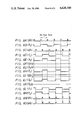
- FIGS. 2A to 2F are time charts illustrating the operation of the compensating circuit of FIG. 1 when supplied with a digital signal having a short period and drop outs of the frame synchronizing signal;
- FIGS. 3A to 3F are time charts illustrating the operation of the compensating circuit of FIG. 1 when supplied with a digital signal having a long period and drop outs of the frame synchronizing signal;
- FIGS. 4A to 4F are time charts illustrating the operation of the compensating circuit of FIG. 1 when supplied with a digital signal having a doubtful frame synchronizing signal and with a drop out of the frame synchronizing signal, and when supplied with a digital signal from a reproducing apparatus when it is operated in a search mode;
- FIG. 5 is a block diagram illustrating a rotational speed control system used in an apparatus for reproducing a digital signal
- FIGS. 6A to 6O are waveform diagram illustrating the operation of the system of FIG. 5;
- FIG. 7 is a block diagram illustrating a frame synchronizing signal detecting and compensating circuit in accord with the present invention.
- FIGS. 8A to 8E are time charts illustrating the operation of the circuit of FIG. 7 when supplied with a digital signal having a short period and drop outs of the frame synchronizing signal;
- FIGS. 9A to 9E are time charts illustrating the operation of the circuit of FIG. 7 when supplied with a digital signal having a long period and drop outs of the frame synchronizing signal.
- FIGS. 10A to 10E are time charts illustrating the operation of the circuit of FIG. 7 when supplied with a digital signal having a doubtful frame synchronizing signal, a drop out of the frame synchronizing signal, and when supplied with a digital signal from a reproducing apparatus operated in a search mode.
- a reproduced digital data signal is supplied to an input terminal 1 and a shift register 2.
- Shift register 2 has shift stages for n bits corresponding to the length of a frame synchronizing signal.
- Data having n parallel bits are supplied by shift register 2 to a frame synchronizing signal detection circuit or detector 3.
- the frame synchronizing signal in the reproduced digital data signal is identified in frame synchronizing signal detector 3 when the bit pattern of the frame synchronizing signal coincides with a predetermined bit pattern.
- the data from shift register 2 are also supplied to a memory unit 4 which stores therein one block or frame period of data.
- the data stored in memory unit 4 is then supplied to a shift register 5 and is delayed by one frame period.
- Shift register 5 is similar to shift register 2, and has shift stages for n bits so that parallel data of n bits are delivered from shift register 5 to a second frame synchronizing signal detection circuit or detector 6 wherein the frame synchronizing signal is detected again (just as in frame synchronizing signal detector 3).
- the data from shift register 5 is also supplied to a second memory unit 7 which is similar to memory unit 4 and stores one block of data therein. Data stored in memory unit 7 is delayed by one frame period and supplied to a shift register 8.
- Shift register 8 is similar to shift registers 2 and 5 so that parallel data of n bits are supplied to a third frame synchronizing signal detection circuit or detector 9 wherein the frame synchronizing signal is detected when it is delayed by two frame periods with respect to the reproduced digital data.
- Frame synchronizing signal detection signals F 0 , F 1 , and F 2 generated, respectively, by frame synchronizing signal detectors 3, 6 and 9, are supplied to a majority logic circuit 10.
- Majority logic circuit 10 supplied an output signal F A when two or more of the three frame synchronizing signal detection signals F 0 , F 1 , and F 2 coincide.
- frame synchronizing signal detectors 3, 6, and 9 produce frame synchronizing signals F 0 , F 1 and F 2 at coincident frame cycles or periods.
- majority logic circuit 10 produces output signal F A for each frame period.
- Clock generator 13 supplies clock pulses CP to a clock terminal of a counter 11.
- Counter 11 produces a carry pulse F C in response to the clock pulses CP counted during one frame period. Accordingly, carry pulse F C has a period corresponding to the frame period of the reproduced digital signal.
- Counter 11 produces a signal for each frame period even when majority logic circuit 10 does not generate output signal F A , the frame synchronizing signal detection signal with the correct period. If Majority logic circuit 10 produces a frame synchronizing signal detection signal with the correct period, counter 11 is reset thereby so that the phase of carry pulse F C coincides with the detected frame synchronizing signal.
- Carry pulse F C is supplied to one input terminal of an OR gate 12. Output signal F A is supplied to another input terminal of OR gate 12. OR gate 12 produces a frame synchronizing signal detection signal F G if the frame synchronizing signal from majority circuit 10 is correct. Carry pulse F C from counter 11 is supplied through OR gate 12 to output terminal 14 as signal F G when the frame synchronizing signal is not generated by majority circuit 10 due, for example, to a drop out.
- a digitally recorded signal on a disc must be synchronized in a bit-wise fashion with a clock signal in the reproducing apparatus for the reproduction to be performed.
- a cycle slip phenomenon can occur in which the frame synchronizing signal from one cycle period is dropped and/or changed in position.
- the frequency of a variable frequency oscillator in a phase locked loop (PLL) circuit and the time constant of a low-pass filter are selected so that a time error caused by the cycle slip phenomenon is kept to about ⁇ 1 or 2 bits.
- the period between the third and fourth frame synchronizing signals is shortened due to the cycle slip phenomenon, while the seventh and eighth frame synchronizing signals disappear due to drop outs.
- the periods identified by the X marks in FIGS. 2A to 2F indicate periods having erroneous lengths.
- output signal F A from majority logic circuit 10 is generated at the timing of the fourth frame synchronizing signal since frame synchronizing signal detection signal F 1 from frame synchronizing signal detector 6 has the same phase as frame synchronizing signal detection signal F 2 from frame synchronizing signal detector 9.
- Output signal F A from majority logic circuit 10 is generated at the timing of the fifth frame synchronizing signal since frame synchronizing signal detection signals F 0 and F 1 are in phase.
- Counter 11 is reset by output signal F A from majority logic circuit 10 and produces carry pulse F C , as shown in FIG. 2E. Counter 11 does not generate signal F C in the fifth frame period because the period between the fourth and fifth signals is shorter than the normal frame period. Thus, counter 11 is reset by output signal F A before it generates carry pulse F C .
- Output signal F A from majority logic circuit 10 and carry pulse F C from counter 11 are supplied to OR gate 12 which supplies output signal F G as the frame synchronizing signal detection signal, as shown in FIG. 2F.
- the frame synchronizing signal for the drop out period is produced by carry pulse F C with a frame period derived from counter 11.
- FIGS. 3A to 3F illustrate a digital signal in which cycle slip occurs between the third and fourth frame synchronizing signals and the length of the period accordingly becomes longer than one frame period, and in which drop outs occur in the seventh and eighth frame periods.
- FIG. 3F illustrates frame synchronizing signal detection signal F G supplied at output terminal 14.
- FIGS. 4A to 4F illustrate a digital signal in which the noise therein is mixed with the frame synchronizing signal to form a doubtful frame synchronizing signal.
- FIGS. 4A to 4F also illustrate the digital signal from a reproducing apparatus operated in the search mode wherein the frame synchronizing signals are not detected by the frame synchronizing signal detectors 3, 6, 9.
- the doubtful frame synchronizing signal does not overlap at the same position in frame synchronizing signal detection signals F 0 , F 1 and F 2 , so that majority logic circuit 10 produces output signal F A (as shown in FIG. 4D) without the doubtful frame synchronizing pulse.
- the circuit of FIG. 1 suffers from significant drawbacks.
- a cycle slip which occurs in the reproduced digital signal is normally about ⁇ 1 or 2 bits, and is quite small when compared with the length of the frame period.
- a safe region must be provided before and after the frame synchronizing signal so that it can be accurately detected.
- the pattern for the frame synchronizing signal is not a pattern which ordinarily occurs in the modulation system so that as long as a drop out and a doubtful frame synchronizing signal are not mixed, the probability of the same pattern randomly occurring in the digital signal is approximately zero.
- an audio pulse coded modulation (PMC) signal can be recorded on a disc.
- the PCM signal is recorded with a constant angular velocity.
- the PCM signal is recorded with a constant linear velocity. Recordings made with a constant linear velocity are preferable to recordings made with a constant angular velocity because the recording density for such recordings can be increased. In such an instance, the disc on which the recording is made must be reproduced at a constant linear velocity.
- One known method for controlling disc rotation at a constant linear velocity detects the position of a pick-up device by a potentiometer. Since the disc must rotate faster as the pick-up device moves away from the center of the disc, the output signal from the potentiometer is fed to a divider circuit to generate speed control information from the position of the pick-up device.
- a potentiometer and a divider circuit for generating the speed control signals are both expensive and complicated.
- the disc is rotated at a constant linear velocity by detecting a reproduced signal from the disc.
- the length of time for a transition interval is measured and compared with a standard reference value.
- the speed of the disc is then changed according to the comparison.
- a minimum transition interval T min and a maximum transition interval T max in the reproduced signal assume predetermined reference values. Therefore, if the maximum transition interval T max or the minimum transition interval T min in the reproduced signal deviates from the reference value, the rotational speed can be controlled to reduce or eliminate the deviation, so that the disc rotates at a constant linear velocity.
- a velocity control circuit can be operated so that successive maximum transition intervals T max , which are the frame synchronizing signals, assume a predetermined value.
- a PCM audio disc reproducing apparatus includes a velocity control system 100, a phase control system 200, and a frame synchronizing signal detecting and compensating circuit 300 in accord with the present invention.
- Frame synchronizing signal detecting and compensating circuit 300 generates a detection signal in response to a frame synchronizing signal and compensates for drop outs, cycle slips, or the like.
- Compensating circuit 300 also generates a signal which determines whether the operation of phase control system 200 is added to velocity control system 100.
- an optional pick-up device 101 generates a signal which is supplied to a wave shaping circuit 102.
- the output signal from optical pick-up device 101 can be blunted or rounded.
- a sinusoidal wave may be generated in response to data bits of "1" and "0".
- Wave shaping circuit 102 reshapes the signal from optical pick-up device 101 and delivers a substantially square wave in response to the blunted input wave.
- a counter 103 detects the maximum transition interval T max .
- a clock pulse CP having a frequency of, for example, about 34.6 MHz and generated by an oscillator 104 is supplied to a clock terminal CK of counter 103.
- An output signal SP from wave shaping circuit 102 is supplied to a clear terminal CL of counter 103 through a NAND gate 105 and an AND gate 107 whereby counter 103 is cleared at the falling or trailing edge of output signal SP.
- Output signal SP is supplied to an inverter 108 which supplies an output signal SP to a clear terminal CL of counter 103 by way of a NAND gate 106 and AND gate 107 whereby counter 103 is also cleared at the rising or leading edge of output signal SP.
- Counter 103 thus counts the number of clock pulses CP during the respective position and negative polarity transition intervals of output signal SP.
- counter 103 When output signal SP has a transition interval in which the number of clock pulses CP counted therein exceeds a predetermined number N (where N is a value counted during maximum transition interval T max ), counter 103 generates output signals of "1" at its Q output terminals.
- the output signals from the Q terminals of counter 103 are supplied to a NAND gate 109 which then generates an output signal N 0 having a value of "0" when the output signals from counter 103 are "1".
- Output signal N 0 is supplied to an enable terminal EN of counter 103, so that counter 103 stops the counting operation. Since output signal N 0 is also supplied to NAND gates 105 and 106, NAND gates 105 and 106 are turned off. Counter 103 cannot be cleared by a reproduced digital signal thereafter.
- Output signal N 0 from NAND gate 109 is latched to a D-type flip-flop circuit 110 in response to the rising edge of a signal SFX.
- a quartz oscillator 111 supplies an output clock pulse to frequency divider 112 which divides the output clock pulses to generate signal SFX.
- signal SFX has a frame period of 1/7.35 kHz.
- counter 103 detects whether the maximum transition interval T max in the output signal SP is longer or shorter than a reference value for each frame period.
- the output signal from counter 103 is latched to D-type flip-flop circuit 110 after being supplied to NAND gate 109. If counter 103 detects that any one of the transition intervals of output signal SP is longer than the reference value for one frame period, output signal N 0 from NAND gate 109 becomes "0". When the respective transition intervals of output signal SP are shorter than the reference value, output signal N 0 from NAND gate 109 becomes "1".
- the output signal before the detection of the maximum transition interval T max is stored in D-type flip-flop circuit 110 during the succeeding frame period.
- a charge and discharge circuit 120 includes a capacitor 121 for charge and discharge, a positive current source 122 and a negative current source 123.
- a switching circuit 124 is switched on so that a charging current i v+ is supplied to capacitor 121 from positive current source 122.
- a switching circuit 125 is switched on so that capacitor 121 permits a discharging current i v- to flow through negative current source 123.
- capacitor 121 is charged and discharged in response to the output signals from D-type flip-flop circuit 110.
- the voltage developed across capacitor 121 is supplied to an inverting input terminal of an operational amplifier 130 which operates as a comparator.
- a positive DC voltage ES is supplied to a non-inverting input terminal of operational amplifier 130.
- a difference output signal from operational amplifier 130 is supplied to a motor driving circuit (not shown) for rotating the disc.
- a diode 126 (with a cathode connected to ground) is connected in parallel to capacitor 121 to prevent the motor from rotating in a reverse direction.
- a potential at a point P in FIG. 5 is a positive voltage and exceeds reference voltage ES
- the output signal from operational amplifier 130 approaches a negative voltage so that the motor would begin to rotate in a reverse direction.
- diode 126 is connected between point P and ground, it is switched on. Hence, the potential at point P does not become positive, and the motor does not rotate in a reverse direction.
- signal SFX has a reference frame period which is produced by dividing the frequency of the output signals from quartz oscillator 111 in frequency divider 112.
- Signal SFX can form a constant phase relationship with a signal SFG which is syrnchronized with the frame synchronizing signal SF detected in the reproduced signal by frame synchronizing signal detecting and compensating circuit 300.
- the lock frequency for phase control system 200 is a function of the oscillation frequency generated by quartz oscillator 111.
- the oscillation frequency of quartz oscillator 111 is selected so that when the maximum transition interval T max is the reference value and the velocity control is stable, phase control system 200 is locked.
- Signal SFX is supplied to a flip-flop circuit 210 which generates a signal F 1 which is inverted at the leading edge of signal SFX.
- a signal SFG having a frame period derived from frame synchronizing signal detecting and compensating circuit 300, is supplied to a flip-flop circuit 202 which generates a signal F 2 which is inverted at the leading edge of signal SFG.
- Signals F 1 and F 2 are supplied to input terminals of an AND gate 203 which generates an output signal A 1 indicative of the difference in phase between output signals F 1 and F 2 .
- Output signal A 1 is supplied to the input terminals of AND gates 205 and 206.
- Signal F 2 from the Q output terminal of flip-flop 202 is supplied to a D terminal of a D-type flip-flop circuit 204.
- Signal F 1 from the Q terminal of a D-type flip-flop 210 is supplied to clock terminal CK of flip-flop circuit 204.
- An output signal UD from the Q output terminal of flip-flop 204 is supplied to one input terminal of an AND gate 205.
- Output signal UD is also supplied to an inverter 207 which supplies its output to an AND gate 206.
- AND gate 205 supplies an output signal A 2 to a charge and discharge circuit 210.
- AND gate 206 supplies an output signal A 3 to charge and discharge circuit 210.
- Charge and discharge circuit 210 generates a phase control voltage in response to output signals A 2 and A 3 and includes a capacitor 211 for charge and discharge, a positive current source 212, and a negative current source 213.
- a switching circuit 214 is switched on so that positive current source 212 permits a charging current i p+ to flow to capacitor 211.
- a switching circuit 215 is switched on so that capacitor 211 permits a discharging circuit i p- to flow through negative current source 213.
- AND gate 206 produces a signal having a width dependent on the phase deviation which is shown in FIG. 6H and identified as output signal A 3 .
- Switching circuit 215 is switched on to allow a discharging current i p- to flow from capacitor 211 whereby the voltage thereacross decreases.
- the voltage across capacitor 211 is added to the output voltage from charge and discharge circuit 120 in velocity control system 100 and then supplied to the inverting input terminal of operational amplifier 130 where it controls the speed of the motor.
- charge and discharge circuit 120 has a time constant T V and charge and discharge circuit 210 has a time constant T P .
- Time constants T V and T P are selected whereby:
- velocity control circuit 100 controls large changes in the rotational speed of the disc
- phase control circuit 200 controls small changes in the rotational speed of the disc. It is to be appreciated that the disc rotates with minimal wow and flutter because of the circuit arrangement of the present invention.
- Signal SFG generates a phase control signal and is derived from frame synchronizing signal detecting and compensating circuit 300 by frequency dividing an output signal of a PLL circuit which is synchronized with the clock component in the reproduced digital signal.
- the PLL circuit of frame synchronizing signal detecting and compensating circuit 300 has a limited lock range so that until the rotational speed of the disc is approximately equal to a predetermined linear velocity, the phase control system 200 cannot be brought into operation. It is to be appreciated that the rotational speed of the disc cannot be locked in phase with the output signal from quartz oscillator 111 following a large fluctuation in the linear velocity of the disc which can occur when the pick-up device scans the disc. Accordingly, phase control system 200 is disabled until the linear velocity of the disc becomes substantially constant.
- a clock pulse is synchronized with the clock component in the reproduced digital signal and the bit pattern resulting therefrom is compared with the bit pattern from the frame synchronizing signal in the reproduced digital signal.
- the output signal from the PLL circuit as described above is used for the clock pulse. Accordingly, when the linear velocity has not reached the predetermined speed, the PLL circuit is not locked in phase with the reproduced clock signal and the frame synchronizing signal cannot be reliably detected.
- Frame synchronizing signal detecting and compensating circuit 300 thus includes a supervisory circuit which keeps a close watch on whether the frame synchronizing signal is reliably detected.
- Output signal SL (derived from frame synchronizing signal detecting and compensating circuit 300) is at a high level when the frame synchronizing signal is not reliably detected, as described hereinbelow.
- Output signal SL is supplied to AND gates 205, 206 through an inverter 208 so that until the linear velocity of the disc reaches a predetermined value, AND gates 205 and 206 are turned off by output signal SL, thereby inhibiting the operation of phase control system 200.
- FIG. 7 illustrates one embodiment of a frame synchronizing signal detecting and compensating circuit 300 in accord with the present invention.
- Signal SP such as digital data or the like, from wave shaping circuit 102 (see FIG. 5) is supplied to an input terminal 301 and thence, to a frame synchronizing signal detection circuit or detector 302.
- a clock pulse CP is synchronized with the reproduced signal derived from a clock generator 308 which includes a PLL circuit and is supplied to detector 302.
- Detector 302 generates a frame synchronizing signal detection signal SFO by detecting a signal having a bit pattern which is the same as the frame synchronizing signal in the reproduced signal as described hereinbefore.
- Frame synchronizing signal detection signal SFO is supplied to a protecting circuit 303 which mutes frame synchronizing detection signal SFO to prevent noise from being erroneously detected as a frame synchronizing signal.
- Protecting circuit 303 is most commonly utilized in the period during playback when the position of the pick-up device jumps and there is no reproduced signal. Protecting circuit 303 may be eliminated from the circuit of FIG. 7 and the circuit will operate as herein described.
- Frame synchronizing signal detection signal SFO is supplied through protecting circuit 303 to a gate circuit 304.
- a window pulse PW supplied from an OR gate 305 functions as a gate signal for gate circuit 304.
- window pulse P has a pulse width of 2 m bits (m bits ⁇ the position at which a normal frame synchronizing signal occurs). In one example, m can be equal to three.
- gate circuit 304 supplies a detection signal SFW to an OR gate 306. Detection signal SFW is also supplied to a clear terminal CL of a counter 307.
- a clock pulse CP is supplied to a clock terminal of counter 307.
- Clock pulse CP is synchronized with the clock component of the reproduced signal and is derived from a clock generator 308 equipped with a PLL circuit so that counter 307 generates a carry pulse SFC for each frame period.
- Carry pulse SFC is synchronized with the reproduced signal which results from dividing the frequency of lock pulse CP and is supplied to one input terminal of OR gate 306.
- OR gate 306 supplies a frame synchronizing signal detection signal SFG, as described more fully hereinbelow, to an output terminal 317.
- Window pulse PW is generated in response to the count value from counter 307.
- the count value "n" in counter 307 which corresponds to the frame period, is reduced by a number corresponding to m bits of the maximum value of a cycle slip (for example, 3 bits)
- the reduced count number n-m is detected by an "n-m” detector 309 and a flip-flop circuit 310 is accordingly set.
- the count value of counter 307 corresponds to m bits, such count number is detected in an "m” detector 311 so that flip-flop circuit 310 is set.
- flip-flop circuit 310 Since counter 307 is cleared by detection signal SFW, flip-flop circuit 310 generates a window signal which rises at a position m bits before the frame synchronizing signal occurs and which falls m bits after the trailing edge of the frame synchronizing signal.
- the window signal is supplied to one input terminal of OR gate 305 and comprises window pulse PW for gate circuit 304.
- Gate circuit 304 does not generate detection signal SFW when the phase of the frame synchronizing signal significantly deviates from carry pulse SFC.
- a supervisory circuit (explained more fully hereinbelow) detects the phase displacement between the frame synchronizing signal and carry pulse SFC and forces counter 307 to make the frame synchronizing signal coincide in phase with carry pulse SFC.
- Supervisory counter 312 comprises in part the above-described supervisory circuit. Detection signal SFW is supplied to a load terminal LD of supervisory counter 312 to preset the counter value therein. An output signal from "m" detector 311 is supplied to a clock terminal of supervisory counter 312 when the count value from counter 307 corresponds to m bits.
- "m" detector 311 Since counter 307 counts the number of clock pulses CP at all times, "m" detector 311 generates a signal at each frame period which is supplied to and counted by supervisory counter 312. Gate circuit 304 generates detection signal SFW which is supplied to load terminal LD of supervisory counter 312 so that supervisory counter 312 is preset. It is to be appreciated that the count value in supervisory counter 312 does not increment more than the preset value plus one. When gate circuit 304 does not generate detection signal SFW, supervisory counter 312 counts the output signal from "m” detector 311 so that the count value therein increments. When the count value of supervisory counter 312 reaches a predetermined value (for example, eight), supervisory counter 312 generates an output signal SL which rises to a high level.
- a predetermined value for example, eight
- output signal SL is supplied to an enable terminal EN of supervisory counter 312, the counting operation of supervisory counter 312 stops.
- Output signal SL from supervisory counter 312 is also supplied to gate circuit 304 as window pulse PW via OR gate 305. In other words, the gate signal remains at a high level to keep gate circuit 304 in an open state.
- supervisory counter 312 When gate circuit 304 generates detection signal SFW, supervisory counter 312 is placed into a load state again whereby output signal SL drops to a low level and supervisory counter 312 returns to a count enable state.
- supervisory counter 312 detects such deviation and permits counter 307 to be cleared whereby the phase of carry pulse SFC is made to coincide with the frame synchronizing signal in the reproduced signal.
- supervisory counter 312 can be a preset type or an ordinary clear-type counter.
- the width of window pulse PW and the preset value for supervisory counter 312 are controlled in accord with the operating mode of the reproducing apparatus and the state of the reproduced signal so that the compensating circuit will operate most efficiently.
- the width of window pulse PW is such that it will gate the frame synchronizing signal detection signal even when a cycle slip occurs.
- the frame synchronizing signal can be within ⁇ 3 bits of the position where it is expected to be detected.
- the width of ⁇ 3 bits is generally acceptable in a normal playback mode when the data error in the reproduced signal is random.
- the amount of cycle slip increases since the amount of the phase deviation between the reproduced signal and the clock signal accumulates.
- the width of window pulse PW must be correctly widened.
- Supervisory counter 312 corrects phase deviations between window pulse PW and frame synchronizing signal detection signal SFO.
- the phase of window pulse PW is correct even if detection signal SFW disappears as a result of a drop out or the like. If the supervisory circuit operates under such conditions, the width of window pulse PW is substantially increased. Noise, such as a doubtful frame synchronizing signal and the like, cannot be eliminated, however. Accordingly, the number of frames required to be detected before output signal SL rises to the high level is relatively large, for example, sixteen. It is to be appreciated that the number of frames required to raise output signal SL to the high level is the same as the number of output signals generated by "m" detector 311.
- output signal SL rises to a high level shortly after the frame synchronizing signal is no longer detected.
- output signal SL rises to a high level after three frame periods.
- supervisory counter 312 raises output signal SL to a high level immediately after the frame synchronizing signal disappears.
- the rotational speed of the disc is controlled when the reproduced signal disappears so that the width of window pulse PW is increased to its maximum.
- the supervisory circuit in accord with the present invention includes an RF detector 313 which detects the presence of a reproduced signal and supplies a detected output signal to a controller 316.
- a system controller 314 supplies a signal to controller 316 which indicates the operating mode of the reproducing apparatus.
- An error correction circuit 315 detects errors in the reproduced signal and supplies a signal indicative of the errors to controller 316.
- Controller 316 supplies control signals to "n-m” detector 309 and "m” detector 311 to vary the count value corresponding to the "m" bits.
- the value of m and the corresponding width of window pulse PW vary in accord with the errors detected in the digital signal by error correction circuit 315.
- Controller 316 supplies an output signal to vary the preset value of supervisory counter 312 in accord with the operating mode of the reproducing apparatus and the presence of a reproduced signal detected by RF detector 313.
- FIGS. 8A to 8E the digital signal supplied to the circuit of FIG. 7 has a frame period which is shorter than a normal frame period because of a cycle slip, and also has drop outs in the seventh and eighth frames.
- FIG. 8A illustrates frame synchronizing signal detection signal SFO from frame synchronizing signal detector 302.
- FIG. 8B illustrates window pulse PW generated by flip-flop circuit 310.
- FIG. 8C illustrates detection signal SFW generated by gate circuit 304.
- FIG. 8D illustrates carry pulse SFC generated by counter 307.
- FIG. 8E illustrates frame synchronizing signal detection signal SFG generated by OR gate 306.
- the amount of cycle slip is small when there are a large number of random errors in the reproduced signal and a relatively small number of burst errors.
- the amount of cycle slip is much greater when there are many burst errors.
- the width of window pulse PW varies according to the number of errors in the signal so that the detection signal for the frame synchronizing signal is substantially certainly contained within the width of window pulse PW even considering the cycle slip.
- Gate circuit 304 generates detection signal SFW to clear counter 307 before carry pulse SFC is generated so that the width of window pulse PW is narrowed. Accordingly, carry pulse SFC is dropped during the period where the cycle slip occurs, as shown in FIG. 8D.
- the digital signal supplied to the circuit of FIG. 7 contains a cycle slip and drop outs in the seventh and eighth periods.
- the period length exceeds the normal frame period because of the cycle slip.
- Detection signal SFW from gate circuit 304 clears counter 307 after counter 307 has generated carry pulse SFC so that the timing of carry pulse SFC differs from the normal timing.
- frame synchronizing signal detection signal SFG supplied at input terminal 317 has double frame synchronization signals as a result of the cycle slip.
- the digital signal supplied to the circuit of FIG. 7 includes a doubtful frame synchronizing signal mixed with the frame synchronizing signal, and a drop out in the fourth period.
- the reproducing apparatus is operated in a search mode to access the beginning of an audio signal, during which time frame synchronizing signal detection signal SFO drops out.
- the doubtful frame synchronizing signal does not fall within the width of window pulse PW so that the doubtful frame synchronizing signal is eliminated, and gate circuit 304 delivers a correctly timed detection signal SFW.
- gate circuit 304 does not generate a detection signal SFW in response to output signal SL from supervisory counter 312.
- supervisory counter 312 generates output signal SL when three frame synchronizing signals have been omitted.
- Gate circuit 304 is thus opened by output signal SL, as indicated in FIG. 10F.
- gate circuit 304 When the reproducing apparatus is operated in the normal playback mode, after operation in the search mode, gate circuit 304 generates detection signal SFW which places supervisory counter 312 into the load mode and clears counter 307. Carry pulse SFC becomes discontinuous just after the search mode is terminated, as illustrated in FIG. 10D, but is correctly synchronized shortly thereafter.
- frame synchronizing signal detecting and compensating circuit 300 produces frame synchronizing signal detection signal SFG even when a drop out in the digital signal occurs.
- Frame synchronizing signal detecting and compensating circuit 300 also produces output signal SL to indicate whether the frame synchronizing signal has been reliably detected. As explained above, output signal SL determines whether phase control system 200 is added to velocity control system 100.
- a frame synchronizing signal detecting and compensating circuit in accord with the present invention does not require a memory with a large capacity or the like.
- the compensating circuit in accord with the present invention also compensates for a dropped frame synchronizing signal when the reproducing apparatus is operated in the playback mode.
- the compensating circuit in accord with the present invention further prevents an incorrect or arbitrary addition of the phase control system to the velocity control system used in determining the rotational speed of the disc since the phase control system is added to the velocity control system in response to a signal from a supervisory circuit which keeps watch on whether the frame synchronizing signal is reliably detected.
- the supervisory circuit operates immediately when the reproducing apparatus is operated in the playback mode and also in response to the state of the reproduced signal. Accordingly, the speed control system for the reproducing apparatus can be correctly operated since the output signal from the supervisory circuit is used to control the addition of the phase control system to the velocity control system.
- the present invention is not limited to a reproducing apparatus for a pulse coded modulation audio disc, but can be applied to any apparatus which reproduces a digital signal recorded in the base band and which, upon reproduction, has a frame or block synchronizing signal.
Landscapes
- Engineering & Computer Science (AREA)
- Signal Processing (AREA)
- Multimedia (AREA)
- Power Engineering (AREA)
- Synchronisation In Digital Transmission Systems (AREA)
- Mobile Radio Communication Systems (AREA)
- Time-Division Multiplex Systems (AREA)
- Signal Processing For Digital Recording And Reproducing (AREA)
Applications Claiming Priority (4)
| Application Number | Priority Date | Filing Date | Title |
|---|---|---|---|
| JP56197189A JPS5898813A (ja) | 1981-12-08 | 1981-12-08 | デジタル信号の再生装置 |
| JP56-197189 | 1981-12-08 | ||
| JP56198814A JPS58100206A (ja) | 1981-12-10 | 1981-12-10 | デジタル信号の再生装置 |
| JP56-198814 | 1981-12-10 |
Related Parent Applications (1)
| Application Number | Title | Priority Date | Filing Date |
|---|---|---|---|
| US06443902 Continuation | 1982-11-23 |
Related Child Applications (1)
| Application Number | Title | Priority Date | Filing Date |
|---|---|---|---|
| US07/222,537 Reissue USRE33665E (en) | 1981-12-08 | 1988-07-21 | Digital signal detecting and compensating circuit with adjustable window signal |
Publications (1)
| Publication Number | Publication Date |
|---|---|
| US4620300A true US4620300A (en) | 1986-10-28 |
Family
ID=26510221
Family Applications (2)
| Application Number | Title | Priority Date | Filing Date |
|---|---|---|---|
| US06/784,699 Ceased US4620300A (en) | 1981-12-08 | 1985-10-03 | Digital signal detecting and compensating circuit with adjustable window signal |
| US07/222,537 Expired - Lifetime USRE33665E (en) | 1981-12-08 | 1988-07-21 | Digital signal detecting and compensating circuit with adjustable window signal |
Family Applications After (1)
| Application Number | Title | Priority Date | Filing Date |
|---|---|---|---|
| US07/222,537 Expired - Lifetime USRE33665E (en) | 1981-12-08 | 1988-07-21 | Digital signal detecting and compensating circuit with adjustable window signal |
Country Status (7)
| Country | Link |
|---|---|
| US (2) | US4620300A (de) |
| EP (1) | EP0081757B1 (de) |
| AT (1) | ATE77509T1 (de) |
| CA (1) | CA1212729A (de) |
| DE (1) | DE3280405T2 (de) |
| HK (1) | HK81295A (de) |
| SG (1) | SG28393G (de) |
Cited By (32)
| Publication number | Priority date | Publication date | Assignee | Title |
|---|---|---|---|---|
| US4716578A (en) * | 1986-09-29 | 1987-12-29 | Northern Telecom Limited | Circuit and method for the recovery of data from a digital data stream |
| US4766602A (en) * | 1986-02-27 | 1988-08-23 | Sony Corporation | Synchronizing signal decoding |
| US4799207A (en) * | 1985-08-14 | 1989-01-17 | Staar, S.A. | Apparatus and method for maintaining progression of recovery of recorded information |
| US4805046A (en) * | 1985-10-28 | 1989-02-14 | Matsushita Electric Industrial Co., Ltd. | Information recording and reproducing apparatus using sectors divided into a plurality of frames and having means for proper storage of the frame data |
| US4851932A (en) * | 1988-01-29 | 1989-07-25 | Storage Technology Corporation | Adaptive compensation circuit for moving data storage media |
| US4947264A (en) * | 1985-10-07 | 1990-08-07 | Yamaha Corporation | Synchronizing circuit for a video disc playback device |
| US4972444A (en) * | 1988-07-14 | 1990-11-20 | International Business Machines Corporation | Digital phase-locked device and method |
| US4979192A (en) * | 1987-12-23 | 1990-12-18 | Sony Corporation | Circuit for detecting a synchronizing signal |
| US5005190A (en) * | 1987-11-30 | 1991-04-02 | Nec Home Electronics Ltd. | Window system synchronizing protective circuit |
| US5223991A (en) * | 1990-04-26 | 1993-06-29 | Sony Corporation | Digital video tape recorder |
| US5276714A (en) * | 1991-01-29 | 1994-01-04 | Sanyo Electric Co., Ltd. | Broadcast/non-broadcast MUSE signal sound decoder with a variable protection period |
| US5319679A (en) * | 1992-12-09 | 1994-06-07 | Datum Systems | Method and apparatus for recovering data from a radio signal |
| US5363360A (en) * | 1993-09-27 | 1994-11-08 | Eastman Kodak Company | Method and apparatus for detecting and processing synchronization marks extracted from a prerecorded wobbled groove on a compact disk |
| US5444685A (en) * | 1991-12-16 | 1995-08-22 | Advanced Micro Devices, Inc. | Sector mark pattern detection for optical data disk controller |
| US5446715A (en) * | 1990-08-03 | 1995-08-29 | Canon Kabushiki Kaisha | Circuit for detecting a synchronous signal included in an information signal |
| US5502699A (en) * | 1993-05-14 | 1996-03-26 | Sony Corporation | Disc reproduction apparatus |
| US5627694A (en) * | 1992-02-19 | 1997-05-06 | Mitsubishi Denki Kabushiki Kaisha | Recording/reproducing apparatus for recording and reproducing multiple kinds of digital signals having different data amounts per unit time |
| US5677935A (en) * | 1995-01-11 | 1997-10-14 | Matsuhita Electric Industrial Co., Ltd. | Sync detecting method and sync detecting circuit |
| US5703854A (en) * | 1994-06-29 | 1997-12-30 | Sony Corporation | Disc recording/reproduction apparatus and method for resetting an address control circuit to maximize an address margin of the memory |
| US5986986A (en) * | 1996-10-02 | 1999-11-16 | Sony Corporation | Method for regenerating synchronizing signal by judging whether or not the extracted synchronizing signal includes the second and third window signals |
| US6101055A (en) * | 1994-12-01 | 2000-08-08 | International Business Machines Corporation | Trigger pattern detection method and apparatus |
| US6236631B1 (en) * | 1997-12-08 | 2001-05-22 | Matsushita Electric Industrial Co., Ltd. | Frame number detection for signals produced from optical disk |
| EP0920019A3 (de) * | 1997-11-21 | 2001-08-29 | Samsung Electronics Co., Ltd. | Verfahren zur Unterdrückung von einem anormalen Synchronisationssignal |
| US6408034B1 (en) * | 1997-04-22 | 2002-06-18 | Silicon Laboratories, Inc. | Framed delta sigma data with unlikely delta sigma data patterns |
| US6441691B1 (en) * | 2001-03-09 | 2002-08-27 | Ericsson Inc. | PLL cycle slip compensation |
| US20020172111A1 (en) * | 2001-05-15 | 2002-11-21 | Chao-Long Tsai | Circuit for protecting synchronizing patterns |
| US6529456B2 (en) * | 1995-03-08 | 2003-03-04 | Matsushita Electric Industrial Co., Ltd. | Disk reproducing device, a disk reproducing method, a disk rotation control method, and a regenerative clock signal generating device |
| US6731624B1 (en) * | 1999-03-01 | 2004-05-04 | Sony Corporation | Sync signal detection method and radio communication system |
| US6856660B1 (en) * | 1996-10-11 | 2005-02-15 | Hitachi, Ltd. | Signal processing method and apparatus and disk device using the method and apparatus |
| US6980617B1 (en) * | 2000-11-15 | 2005-12-27 | Advantest Corporation | Reception data synchronizing apparatus and method, and recording medium with recorded reception data synchronizing program |
| US7089475B1 (en) | 2003-03-26 | 2006-08-08 | Silicon Laboratories Inc. | Error correction of data across an isolation barrier |
| US20070103805A1 (en) * | 2003-11-18 | 2007-05-10 | Sony Corporation | Reproduction device and method, recording medium, and program |
Families Citing this family (20)
| Publication number | Priority date | Publication date | Assignee | Title |
|---|---|---|---|---|
| JPS60164980A (ja) * | 1984-02-06 | 1985-08-28 | Mitsubishi Electric Corp | 光デイスク制御装置 |
| EP0300581A3 (en) * | 1984-02-08 | 1989-04-12 | Laser Magnetic Storage International Company | Amorphous pip protection apparatus for use in an optical recording apparatus |
| US4882721A (en) * | 1984-02-08 | 1989-11-21 | Laser Magnetic Storage International Company | Offset for protection against amorphous pips |
| US5416760A (en) * | 1991-12-16 | 1995-05-16 | Advanced Micro Devices, Inc. | Recovery of data from optical data disk sectors having missing or defective synchronization information |
| US5341403A (en) * | 1992-01-27 | 1994-08-23 | Analog Devices, Incorporated | Means to avoid data distortion in clock-synchronized signal sampling |
| KR950002722B1 (ko) * | 1992-09-16 | 1995-03-24 | 주식회사금성사 | 직렬-병렬 데이타 변환장치 |
| US5371763A (en) * | 1992-11-13 | 1994-12-06 | At&T Corp. | Packet mode digital data receiver |
| CA2106439A1 (en) * | 1992-11-13 | 1994-05-14 | Yusuke Ota | Burst mode digital data receiver |
| US5627846A (en) * | 1995-04-19 | 1997-05-06 | Eastman Kodak Company | Drop-out location detection circuit |
| US5615223A (en) * | 1995-04-19 | 1997-03-25 | Eastman Kodak Company | PPM decoder utilizing drop-out location information |
| US5737371A (en) * | 1995-12-06 | 1998-04-07 | International Business Machines Corporation | Realignment of data stream from an optical disk |
| JP3311616B2 (ja) | 1996-11-22 | 2002-08-05 | 三洋電機株式会社 | 再生回路 |
| JP3042607B2 (ja) * | 1997-06-13 | 2000-05-15 | 日本電気株式会社 | 同期検出回路 |
| JPH11273249A (ja) * | 1998-03-20 | 1999-10-08 | Pioneer Electron Corp | 記録タイミング設定方法及び記録タイミング設定装置並びに情報記録方法及び情報記録装置 |
| JPH11306697A (ja) * | 1998-04-27 | 1999-11-05 | Toshiba Corp | 光ディスク装置 |
| US6137248A (en) | 1999-05-06 | 2000-10-24 | Dana Corporation | Sensing load and/or speed changes in a switched reluctance motor through current chopping |
| US6763229B2 (en) * | 2001-05-02 | 2004-07-13 | Koninklijke Philips Electronics N.V. | Timing recovery switching for an adaptive digital broadband beamforming (antenna diversity) for ATSC terrestrial DTV based on segment sync detection |
| US8050157B1 (en) * | 2007-12-20 | 2011-11-01 | Marvell International Ltd. | Timing recovery for optical disc drive high frequency modulation |
| US8000193B1 (en) * | 2007-12-20 | 2011-08-16 | Marvell International Ltd. | Timing recovery for optical disc drive high frequency modulation |
| US8958276B1 (en) | 2012-10-31 | 2015-02-17 | Marvell International Ltd. | Optical disc drive high frequency modulation signal detection |
Citations (17)
| Publication number | Priority date | Publication date | Assignee | Title |
|---|---|---|---|---|
| DE1816041A1 (de) * | 1968-12-20 | 1970-06-25 | Telefunken Patent | Magnetbandgeraet zur Aufzeichnung und/oder Wiedergabe von Fernsehsignalen |
| US3573359A (en) * | 1968-05-06 | 1971-04-06 | Ampex | Video tape apparatus having sync signal control dropout compensation |
| US3602828A (en) * | 1969-10-27 | 1971-08-31 | Ibm | Self-clocking detection system |
| US3789380A (en) * | 1972-02-18 | 1974-01-29 | Ibm | Digital recording at twice nyquist bandwidth |
| DE2257817A1 (de) * | 1972-11-25 | 1974-05-30 | Hubertus Wentzell | Aufzeichnungs- und wiedergabeverfahren fuer platten-informationstraeger |
| US4106058A (en) * | 1976-04-23 | 1978-08-08 | Thomson-Brandt | Data disc optical reader containing a device for automatic data access |
| US4109236A (en) * | 1977-06-17 | 1978-08-22 | Honeywell Information Systems Inc. | Apparatus for digital data recovery from mass storage devices |
| US4141046A (en) * | 1977-09-14 | 1979-02-20 | Exxon Research & Engineering Co. | Floppy disc data separator for use with single density encoding |
| DE3004799A1 (de) * | 1979-02-08 | 1980-10-23 | Matsushita Electric Ind Co Ltd | Synchronsignal-erkennungsschaltung |
| US4275466A (en) * | 1978-12-12 | 1981-06-23 | Sony Corporation | Block sync signal extracting apparatus |
| US4281356A (en) * | 1979-11-28 | 1981-07-28 | R. C. Sanders Technology Systems, Inc. | Magnetic disk memory |
| US4313136A (en) * | 1979-02-13 | 1982-01-26 | Olympus Optical Co., Ltd. | Synchronizing signal separation system |
| GB2079994A (en) * | 1980-06-20 | 1982-01-27 | Sony Corp | Methods of digital data error correction |
| US4338683A (en) * | 1979-11-15 | 1982-07-06 | Sony Corporation | Videodisc player with constant turntable velocity |
| US4353130A (en) * | 1980-06-16 | 1982-10-05 | U.S. Philips Corporation | Device for processing serial information which includes synchronization words |
| US4357707A (en) * | 1979-04-11 | 1982-11-02 | Pertec Computer Corporation | Digital phase lock loop for flexible disk data recovery system |
| US4425646A (en) * | 1980-07-11 | 1984-01-10 | Tokyo Shibaura Denki Kabushiki Kaisha | Input data synchronizing circuit |
-
1982
- 1982-11-23 CA CA000416127A patent/CA1212729A/en not_active Expired
- 1982-12-02 EP EP82111144A patent/EP0081757B1/de not_active Expired - Lifetime
- 1982-12-02 SG SG1995906616A patent/SG28393G/en unknown
- 1982-12-02 DE DE8282111144T patent/DE3280405T2/de not_active Expired - Lifetime
- 1982-12-02 AT AT82111144T patent/ATE77509T1/de not_active IP Right Cessation
-
1985
- 1985-10-03 US US06/784,699 patent/US4620300A/en not_active Ceased
-
1988
- 1988-07-21 US US07/222,537 patent/USRE33665E/en not_active Expired - Lifetime
-
1995
- 1995-05-25 HK HK81295A patent/HK81295A/en not_active IP Right Cessation
Patent Citations (17)
| Publication number | Priority date | Publication date | Assignee | Title |
|---|---|---|---|---|
| US3573359A (en) * | 1968-05-06 | 1971-04-06 | Ampex | Video tape apparatus having sync signal control dropout compensation |
| DE1816041A1 (de) * | 1968-12-20 | 1970-06-25 | Telefunken Patent | Magnetbandgeraet zur Aufzeichnung und/oder Wiedergabe von Fernsehsignalen |
| US3602828A (en) * | 1969-10-27 | 1971-08-31 | Ibm | Self-clocking detection system |
| US3789380A (en) * | 1972-02-18 | 1974-01-29 | Ibm | Digital recording at twice nyquist bandwidth |
| DE2257817A1 (de) * | 1972-11-25 | 1974-05-30 | Hubertus Wentzell | Aufzeichnungs- und wiedergabeverfahren fuer platten-informationstraeger |
| US4106058A (en) * | 1976-04-23 | 1978-08-08 | Thomson-Brandt | Data disc optical reader containing a device for automatic data access |
| US4109236A (en) * | 1977-06-17 | 1978-08-22 | Honeywell Information Systems Inc. | Apparatus for digital data recovery from mass storage devices |
| US4141046A (en) * | 1977-09-14 | 1979-02-20 | Exxon Research & Engineering Co. | Floppy disc data separator for use with single density encoding |
| US4275466A (en) * | 1978-12-12 | 1981-06-23 | Sony Corporation | Block sync signal extracting apparatus |
| DE3004799A1 (de) * | 1979-02-08 | 1980-10-23 | Matsushita Electric Ind Co Ltd | Synchronsignal-erkennungsschaltung |
| US4313136A (en) * | 1979-02-13 | 1982-01-26 | Olympus Optical Co., Ltd. | Synchronizing signal separation system |
| US4357707A (en) * | 1979-04-11 | 1982-11-02 | Pertec Computer Corporation | Digital phase lock loop for flexible disk data recovery system |
| US4338683A (en) * | 1979-11-15 | 1982-07-06 | Sony Corporation | Videodisc player with constant turntable velocity |
| US4281356A (en) * | 1979-11-28 | 1981-07-28 | R. C. Sanders Technology Systems, Inc. | Magnetic disk memory |
| US4353130A (en) * | 1980-06-16 | 1982-10-05 | U.S. Philips Corporation | Device for processing serial information which includes synchronization words |
| GB2079994A (en) * | 1980-06-20 | 1982-01-27 | Sony Corp | Methods of digital data error correction |
| US4425646A (en) * | 1980-07-11 | 1984-01-10 | Tokyo Shibaura Denki Kabushiki Kaisha | Input data synchronizing circuit |
Non-Patent Citations (2)
| Title |
|---|
| European Search Report of E.P. 0081757 1 sheet. * |
| European Search Report of E.P. 0081757 1-sheet. |
Cited By (38)
| Publication number | Priority date | Publication date | Assignee | Title |
|---|---|---|---|---|
| US4799207A (en) * | 1985-08-14 | 1989-01-17 | Staar, S.A. | Apparatus and method for maintaining progression of recovery of recorded information |
| US4947264A (en) * | 1985-10-07 | 1990-08-07 | Yamaha Corporation | Synchronizing circuit for a video disc playback device |
| US4805046A (en) * | 1985-10-28 | 1989-02-14 | Matsushita Electric Industrial Co., Ltd. | Information recording and reproducing apparatus using sectors divided into a plurality of frames and having means for proper storage of the frame data |
| US4766602A (en) * | 1986-02-27 | 1988-08-23 | Sony Corporation | Synchronizing signal decoding |
| US4716578A (en) * | 1986-09-29 | 1987-12-29 | Northern Telecom Limited | Circuit and method for the recovery of data from a digital data stream |
| US5005190A (en) * | 1987-11-30 | 1991-04-02 | Nec Home Electronics Ltd. | Window system synchronizing protective circuit |
| US4979192A (en) * | 1987-12-23 | 1990-12-18 | Sony Corporation | Circuit for detecting a synchronizing signal |
| US4851932A (en) * | 1988-01-29 | 1989-07-25 | Storage Technology Corporation | Adaptive compensation circuit for moving data storage media |
| US4972444A (en) * | 1988-07-14 | 1990-11-20 | International Business Machines Corporation | Digital phase-locked device and method |
| US5223991A (en) * | 1990-04-26 | 1993-06-29 | Sony Corporation | Digital video tape recorder |
| US5446715A (en) * | 1990-08-03 | 1995-08-29 | Canon Kabushiki Kaisha | Circuit for detecting a synchronous signal included in an information signal |
| US5276714A (en) * | 1991-01-29 | 1994-01-04 | Sanyo Electric Co., Ltd. | Broadcast/non-broadcast MUSE signal sound decoder with a variable protection period |
| US5444685A (en) * | 1991-12-16 | 1995-08-22 | Advanced Micro Devices, Inc. | Sector mark pattern detection for optical data disk controller |
| US5627694A (en) * | 1992-02-19 | 1997-05-06 | Mitsubishi Denki Kabushiki Kaisha | Recording/reproducing apparatus for recording and reproducing multiple kinds of digital signals having different data amounts per unit time |
| US5319679A (en) * | 1992-12-09 | 1994-06-07 | Datum Systems | Method and apparatus for recovering data from a radio signal |
| US5502699A (en) * | 1993-05-14 | 1996-03-26 | Sony Corporation | Disc reproduction apparatus |
| US5363360A (en) * | 1993-09-27 | 1994-11-08 | Eastman Kodak Company | Method and apparatus for detecting and processing synchronization marks extracted from a prerecorded wobbled groove on a compact disk |
| US5703854A (en) * | 1994-06-29 | 1997-12-30 | Sony Corporation | Disc recording/reproduction apparatus and method for resetting an address control circuit to maximize an address margin of the memory |
| US6101055A (en) * | 1994-12-01 | 2000-08-08 | International Business Machines Corporation | Trigger pattern detection method and apparatus |
| US6259574B1 (en) * | 1994-12-01 | 2001-07-10 | International Business Machines Corporation | Trigger pattern detection method and apparatus |
| US5677935A (en) * | 1995-01-11 | 1997-10-14 | Matsuhita Electric Industrial Co., Ltd. | Sync detecting method and sync detecting circuit |
| US6529456B2 (en) * | 1995-03-08 | 2003-03-04 | Matsushita Electric Industrial Co., Ltd. | Disk reproducing device, a disk reproducing method, a disk rotation control method, and a regenerative clock signal generating device |
| US5986986A (en) * | 1996-10-02 | 1999-11-16 | Sony Corporation | Method for regenerating synchronizing signal by judging whether or not the extracted synchronizing signal includes the second and third window signals |
| US6856660B1 (en) * | 1996-10-11 | 2005-02-15 | Hitachi, Ltd. | Signal processing method and apparatus and disk device using the method and apparatus |
| US20050117871A1 (en) * | 1996-10-11 | 2005-06-02 | Yoshiju Watanabe | Signal processing method and apparatus and disk device using the method and apparatus |
| US6408034B1 (en) * | 1997-04-22 | 2002-06-18 | Silicon Laboratories, Inc. | Framed delta sigma data with unlikely delta sigma data patterns |
| EP0920019A3 (de) * | 1997-11-21 | 2001-08-29 | Samsung Electronics Co., Ltd. | Verfahren zur Unterdrückung von einem anormalen Synchronisationssignal |
| US6236631B1 (en) * | 1997-12-08 | 2001-05-22 | Matsushita Electric Industrial Co., Ltd. | Frame number detection for signals produced from optical disk |
| US6731624B1 (en) * | 1999-03-01 | 2004-05-04 | Sony Corporation | Sync signal detection method and radio communication system |
| US7672413B2 (en) * | 1999-11-15 | 2010-03-02 | Advantest Corporation | Reception data synchronizing apparatus and method, and recording medium with recorded reception data synchronizing program |
| US6980617B1 (en) * | 2000-11-15 | 2005-12-27 | Advantest Corporation | Reception data synchronizing apparatus and method, and recording medium with recorded reception data synchronizing program |
| WO2002073806A3 (en) * | 2001-03-09 | 2004-02-19 | Ericsson Inc | Pll cycle slip compensation |
| US6441691B1 (en) * | 2001-03-09 | 2002-08-27 | Ericsson Inc. | PLL cycle slip compensation |
| US6928038B2 (en) * | 2001-05-15 | 2005-08-09 | Media Tek Inc. | Circuit for protecting synchronizing patterns |
| US20020172111A1 (en) * | 2001-05-15 | 2002-11-21 | Chao-Long Tsai | Circuit for protecting synchronizing patterns |
| US7089475B1 (en) | 2003-03-26 | 2006-08-08 | Silicon Laboratories Inc. | Error correction of data across an isolation barrier |
| US20070103805A1 (en) * | 2003-11-18 | 2007-05-10 | Sony Corporation | Reproduction device and method, recording medium, and program |
| US7663831B2 (en) * | 2003-11-18 | 2010-02-16 | Sony Corporation | Reproduction device and method, recording medium, and program |
Also Published As
| Publication number | Publication date |
|---|---|
| DE3280405T2 (de) | 1992-12-10 |
| EP0081757B1 (de) | 1992-06-17 |
| HK81295A (en) | 1995-06-01 |
| USRE33665E (en) | 1991-08-13 |
| EP0081757A1 (de) | 1983-06-22 |
| ATE77509T1 (de) | 1992-07-15 |
| CA1212729A (en) | 1986-10-14 |
| SG28393G (en) | 1995-09-01 |
| DE3280405D1 (de) | 1992-07-23 |
Similar Documents
| Publication | Publication Date | Title |
|---|---|---|
| US4620300A (en) | Digital signal detecting and compensating circuit with adjustable window signal | |
| US4679181A (en) | Method for detecting an error in loading a recording disc | |
| US4562549A (en) | Digital player using a pulse width detector | |
| EP0075948B1 (de) | Vorrichtung zum Regeln der Abtastgeschwindigkeit | |
| EP0872838B1 (de) | Plattenrotationssteuerung | |
| US4466089A (en) | Information signal reproducing apparatus | |
| US4481615A (en) | Motor controlling circuit of reproducing apparatus and method of controlling | |
| EP0169479B1 (de) | Verfahren und Vorrichtung zum automatischen Spurnachlauf für magnetisches Aufzeichnungs- und Wiedergabegerät | |
| US4543650A (en) | Servo system including velocity and phase servo circuits for digital audio record disc reproducing apparatus | |
| EP0763825B1 (de) | Gerät zur Datenermittlung | |
| US4647828A (en) | Servo system | |
| JPS5864671A (ja) | デイスク再生装置 | |
| EP0103028A1 (de) | Schaltung zur geschwindigkeitskontrolle eines motors | |
| JPS5883365A (ja) | デイスク・プレ−ヤ | |
| JPH03711B2 (de) | ||
| JPH0777058B2 (ja) | 記録ディスクの回転制御方式 | |
| JPH0381219B2 (de) | ||
| KR940007622B1 (ko) | 고속 서어치시 드럼회전 방향절환 제어회로 | |
| KR0157560B1 (ko) | 스핀들모터의 초기 가동시정수제어장치 | |
| JP2659999B2 (ja) | ヘリカルスキャン方式のテープ再生装置 | |
| JPH0553026B2 (de) | ||
| JPH0568021B2 (de) | ||
| JPH0515161U (ja) | 情報記録媒体の回転制御装置 | |
| JPH0766621B2 (ja) | モ−タ制御回路 |
Legal Events
| Date | Code | Title | Description |
|---|---|---|---|
| STCF | Information on status: patent grant |
Free format text: PATENTED CASE |
|
| RF | Reissue application filed |
Effective date: 19880721 |
|
| FEPP | Fee payment procedure |
Free format text: PAYOR NUMBER ASSIGNED (ORIGINAL EVENT CODE: ASPN); ENTITY STATUS OF PATENT OWNER: LARGE ENTITY |
|
| FPAY | Fee payment |
Year of fee payment: 4 |