US4722862A - Magnetic recording medium - Google Patents
Magnetic recording medium Download PDFInfo
- Publication number
- US4722862A US4722862A US06/850,614 US85061486A US4722862A US 4722862 A US4722862 A US 4722862A US 85061486 A US85061486 A US 85061486A US 4722862 A US4722862 A US 4722862A
- Authority
- US
- United States
- Prior art keywords
- magnetic
- magnetic recording
- powder
- ferromagnetic
- value
- Prior art date
- Legal status (The legal status is an assumption and is not a legal conclusion. Google has not performed a legal analysis and makes no representation as to the accuracy of the status listed.)
- Expired - Lifetime
Links
- 230000005291 magnetic effect Effects 0.000 title claims abstract description 211
- 239000000843 powder Substances 0.000 claims abstract description 130
- 230000005294 ferromagnetic effect Effects 0.000 claims abstract description 110
- 230000004907 flux Effects 0.000 claims abstract description 42
- 239000011230 binding agent Substances 0.000 claims abstract description 10
- 229910052751 metal Inorganic materials 0.000 claims description 42
- 239000002184 metal Substances 0.000 claims description 42
- 229910017344 Fe2 O3 Inorganic materials 0.000 claims description 28
- UQSXHKLRYXJYBZ-UHFFFAOYSA-N Iron oxide Chemical compound [Fe]=O UQSXHKLRYXJYBZ-UHFFFAOYSA-N 0.000 claims description 27
- 229910000859 α-Fe Inorganic materials 0.000 claims description 5
- 229910017368 Fe3 O4 Inorganic materials 0.000 claims description 4
- AYTAKQFHWFYBMA-UHFFFAOYSA-N chromium dioxide Chemical compound O=[Cr]=O AYTAKQFHWFYBMA-UHFFFAOYSA-N 0.000 claims description 4
- 238000000034 method Methods 0.000 description 62
- 239000010410 layer Substances 0.000 description 40
- 238000006243 chemical reaction Methods 0.000 description 29
- 239000003973 paint Substances 0.000 description 28
- 238000010079 rubber tapping Methods 0.000 description 22
- HEMHJVSKTPXQMS-UHFFFAOYSA-M Sodium hydroxide Chemical compound [OH-].[Na+] HEMHJVSKTPXQMS-UHFFFAOYSA-M 0.000 description 21
- 238000002360 preparation method Methods 0.000 description 21
- 239000000203 mixture Substances 0.000 description 19
- 229920005989 resin Polymers 0.000 description 19
- 239000011347 resin Substances 0.000 description 19
- 238000000576 coating method Methods 0.000 description 15
- 238000005259 measurement Methods 0.000 description 13
- 229910006496 α-Fe2 O3 Inorganic materials 0.000 description 13
- 229910006540 α-FeOOH Inorganic materials 0.000 description 12
- 239000000243 solution Substances 0.000 description 10
- 238000003756 stirring Methods 0.000 description 10
- ZWEHNKRNPOVVGH-UHFFFAOYSA-N 2-Butanone Chemical compound CCC(C)=O ZWEHNKRNPOVVGH-UHFFFAOYSA-N 0.000 description 9
- 230000005415 magnetization Effects 0.000 description 9
- 239000011541 reaction mixture Substances 0.000 description 9
- XLYOFNOQVPJJNP-UHFFFAOYSA-N water Substances O XLYOFNOQVPJJNP-UHFFFAOYSA-N 0.000 description 9
- 229910001868 water Inorganic materials 0.000 description 9
- IJGRMHOSHXDMSA-UHFFFAOYSA-N Atomic nitrogen Chemical group N#N IJGRMHOSHXDMSA-UHFFFAOYSA-N 0.000 description 8
- 239000007864 aqueous solution Substances 0.000 description 8
- WSFSSNUMVMOOMR-UHFFFAOYSA-N Formaldehyde Chemical compound O=C WSFSSNUMVMOOMR-UHFFFAOYSA-N 0.000 description 6
- UFHFLCQGNIYNRP-UHFFFAOYSA-N Hydrogen Chemical compound [H][H] UFHFLCQGNIYNRP-UHFFFAOYSA-N 0.000 description 6
- 239000011248 coating agent Substances 0.000 description 6
- JHIVVAPYMSGYDF-UHFFFAOYSA-N cyclohexanone Chemical compound O=C1CCCCC1 JHIVVAPYMSGYDF-UHFFFAOYSA-N 0.000 description 6
- 229910001873 dinitrogen Inorganic materials 0.000 description 6
- 230000003068 static effect Effects 0.000 description 6
- 239000008235 industrial water Substances 0.000 description 5
- 150000002500 ions Chemical class 0.000 description 5
- 238000002156 mixing Methods 0.000 description 5
- 238000006116 polymerization reaction Methods 0.000 description 5
- 229920005749 polyurethane resin Polymers 0.000 description 5
- BZHJMEDXRYGGRV-UHFFFAOYSA-N Vinyl chloride Chemical compound ClC=C BZHJMEDXRYGGRV-UHFFFAOYSA-N 0.000 description 4
- 239000012298 atmosphere Substances 0.000 description 4
- 239000006229 carbon black Substances 0.000 description 4
- 239000011162 core material Substances 0.000 description 4
- 239000006185 dispersion Substances 0.000 description 4
- 238000009499 grossing Methods 0.000 description 4
- 239000002245 particle Substances 0.000 description 4
- 229920000139 polyethylene terephthalate Polymers 0.000 description 4
- -1 polyethylene terephthalate Polymers 0.000 description 4
- 239000005056 polyisocyanate Substances 0.000 description 4
- 229920001228 polyisocyanate Polymers 0.000 description 4
- 239000002904 solvent Substances 0.000 description 4
- 239000000725 suspension Substances 0.000 description 4
- 229920005992 thermoplastic resin Polymers 0.000 description 4
- 238000005406 washing Methods 0.000 description 4
- 229910006299 γ-FeOOH Inorganic materials 0.000 description 4
- XEEYBQQBJWHFJM-UHFFFAOYSA-N Iron Chemical compound [Fe] XEEYBQQBJWHFJM-UHFFFAOYSA-N 0.000 description 3
- ISWSIDIOOBJBQZ-UHFFFAOYSA-N Phenol Chemical compound OC1=CC=CC=C1 ISWSIDIOOBJBQZ-UHFFFAOYSA-N 0.000 description 3
- 229920000180 alkyd Polymers 0.000 description 3
- 239000011324 bead Substances 0.000 description 3
- 229910052804 chromium Inorganic materials 0.000 description 3
- 239000011651 chromium Substances 0.000 description 3
- 229920001577 copolymer Polymers 0.000 description 3
- 238000009826 distribution Methods 0.000 description 3
- 230000002349 favourable effect Effects 0.000 description 3
- 239000011888 foil Substances 0.000 description 3
- 239000011521 glass Substances 0.000 description 3
- 239000011148 porous material Substances 0.000 description 3
- 229920001187 thermosetting polymer Polymers 0.000 description 3
- WRIDQFICGBMAFQ-UHFFFAOYSA-N (E)-8-Octadecenoic acid Natural products CCCCCCCCCC=CCCCCCCC(O)=O WRIDQFICGBMAFQ-UHFFFAOYSA-N 0.000 description 2
- LQJBNNIYVWPHFW-UHFFFAOYSA-N 20:1omega9c fatty acid Natural products CCCCCCCCCCC=CCCCCCCCC(O)=O LQJBNNIYVWPHFW-UHFFFAOYSA-N 0.000 description 2
- QSBYPNXLFMSGKH-UHFFFAOYSA-N 9-Heptadecensaeure Natural products CCCCCCCC=CCCCCCCCC(O)=O QSBYPNXLFMSGKH-UHFFFAOYSA-N 0.000 description 2
- PNEYBMLMFCGWSK-UHFFFAOYSA-N Alumina Chemical compound [O-2].[O-2].[O-2].[Al+3].[Al+3] PNEYBMLMFCGWSK-UHFFFAOYSA-N 0.000 description 2
- VYZAMTAEIAYCRO-UHFFFAOYSA-N Chromium Chemical group [Cr] VYZAMTAEIAYCRO-UHFFFAOYSA-N 0.000 description 2
- 229910021577 Iron(II) chloride Inorganic materials 0.000 description 2
- ZQPPMHVWECSIRJ-UHFFFAOYSA-N Oleic acid Natural products CCCCCCCCC=CCCCCCCCC(O)=O ZQPPMHVWECSIRJ-UHFFFAOYSA-N 0.000 description 2
- 239000005642 Oleic acid Substances 0.000 description 2
- XTXRWKRVRITETP-UHFFFAOYSA-N Vinyl acetate Chemical compound CC(=O)OC=C XTXRWKRVRITETP-UHFFFAOYSA-N 0.000 description 2
- 229910052782 aluminium Inorganic materials 0.000 description 2
- 229910052787 antimony Inorganic materials 0.000 description 2
- 238000003490 calendering Methods 0.000 description 2
- 229940044175 cobalt sulfate Drugs 0.000 description 2
- 229910000361 cobalt sulfate Inorganic materials 0.000 description 2
- KTVIXTQDYHMGHF-UHFFFAOYSA-L cobalt(2+) sulfate Chemical compound [Co+2].[O-]S([O-])(=O)=O KTVIXTQDYHMGHF-UHFFFAOYSA-L 0.000 description 2
- 238000007796 conventional method Methods 0.000 description 2
- 239000013078 crystal Substances 0.000 description 2
- 239000004205 dimethyl polysiloxane Substances 0.000 description 2
- 235000013870 dimethyl polysiloxane Nutrition 0.000 description 2
- 238000004880 explosion Methods 0.000 description 2
- 238000010438 heat treatment Methods 0.000 description 2
- NMCUIPGRVMDVDB-UHFFFAOYSA-L iron dichloride Chemical compound Cl[Fe]Cl NMCUIPGRVMDVDB-UHFFFAOYSA-L 0.000 description 2
- QXJSBBXBKPUZAA-UHFFFAOYSA-N isooleic acid Natural products CCCCCCCC=CCCCCCCCCC(O)=O QXJSBBXBKPUZAA-UHFFFAOYSA-N 0.000 description 2
- ZQPPMHVWECSIRJ-KTKRTIGZSA-N oleic acid Chemical compound CCCCCCCC\C=C/CCCCCCCC(O)=O ZQPPMHVWECSIRJ-KTKRTIGZSA-N 0.000 description 2
- 229920000435 poly(dimethylsiloxane) Polymers 0.000 description 2
- 238000003825 pressing Methods 0.000 description 2
- 238000010926 purge Methods 0.000 description 2
- 239000004576 sand Substances 0.000 description 2
- 239000007787 solid Substances 0.000 description 2
- 239000007858 starting material Substances 0.000 description 2
- 229910052718 tin Inorganic materials 0.000 description 2
- QMMJWQMCMRUYTG-UHFFFAOYSA-N 1,2,4,5-tetrachloro-3-(trifluoromethyl)benzene Chemical compound FC(F)(F)C1=C(Cl)C(Cl)=CC(Cl)=C1Cl QMMJWQMCMRUYTG-UHFFFAOYSA-N 0.000 description 1
- KXGFMDJXCMQABM-UHFFFAOYSA-N 2-methoxy-6-methylphenol Chemical compound [CH]OC1=CC=CC([CH])=C1O KXGFMDJXCMQABM-UHFFFAOYSA-N 0.000 description 1
- 239000004925 Acrylic resin Substances 0.000 description 1
- 229920000178 Acrylic resin Polymers 0.000 description 1
- BMTAFVWTTFSTOG-UHFFFAOYSA-N Butylate Chemical compound CCSC(=O)N(CC(C)C)CC(C)C BMTAFVWTTFSTOG-UHFFFAOYSA-N 0.000 description 1
- 101100394497 Caenorhabditis elegans toe-1 gene Proteins 0.000 description 1
- 229910052684 Cerium Inorganic materials 0.000 description 1
- 229910020630 Co Ni Inorganic materials 0.000 description 1
- 229910002440 Co–Ni Inorganic materials 0.000 description 1
- 229910019830 Cr2 O3 Inorganic materials 0.000 description 1
- 229910017061 Fe Co Inorganic materials 0.000 description 1
- 229910015189 FeOx Inorganic materials 0.000 description 1
- 229910021578 Iron(III) chloride Inorganic materials 0.000 description 1
- 229910001030 Iron–nickel alloy Inorganic materials 0.000 description 1
- 239000004640 Melamine resin Substances 0.000 description 1
- 229920000877 Melamine resin Polymers 0.000 description 1
- 229910052779 Neodymium Inorganic materials 0.000 description 1
- 229910003271 Ni-Fe Inorganic materials 0.000 description 1
- CTQNGGLPUBDAKN-UHFFFAOYSA-N O-Xylene Chemical compound CC1=CC=CC=C1C CTQNGGLPUBDAKN-UHFFFAOYSA-N 0.000 description 1
- 240000007594 Oryza sativa Species 0.000 description 1
- 235000007164 Oryza sativa Nutrition 0.000 description 1
- 239000004952 Polyamide Substances 0.000 description 1
- 239000004962 Polyamide-imide Substances 0.000 description 1
- 239000004642 Polyimide Substances 0.000 description 1
- 239000004721 Polyphenylene oxide Substances 0.000 description 1
- 239000004743 Polypropylene Substances 0.000 description 1
- 229910052777 Praseodymium Inorganic materials 0.000 description 1
- 229920001807 Urea-formaldehyde Polymers 0.000 description 1
- 238000007259 addition reaction Methods 0.000 description 1
- 239000000654 additive Substances 0.000 description 1
- 239000012790 adhesive layer Substances 0.000 description 1
- 239000012670 alkaline solution Substances 0.000 description 1
- 229910045601 alloy Inorganic materials 0.000 description 1
- 239000000956 alloy Substances 0.000 description 1
- JZQOJFLIJNRDHK-CMDGGOBGSA-N alpha-irone Chemical compound CC1CC=C(C)C(\C=C\C(C)=O)C1(C)C JZQOJFLIJNRDHK-CMDGGOBGSA-N 0.000 description 1
- XAGFODPZIPBFFR-UHFFFAOYSA-N aluminium Chemical compound [Al] XAGFODPZIPBFFR-UHFFFAOYSA-N 0.000 description 1
- 239000002216 antistatic agent Substances 0.000 description 1
- 230000015572 biosynthetic process Effects 0.000 description 1
- 229910052797 bismuth Inorganic materials 0.000 description 1
- 229910052796 boron Inorganic materials 0.000 description 1
- QHIWVLPBUQWDMQ-UHFFFAOYSA-N butyl prop-2-enoate;methyl 2-methylprop-2-enoate;prop-2-enoic acid Chemical compound OC(=O)C=C.COC(=O)C(C)=C.CCCCOC(=O)C=C QHIWVLPBUQWDMQ-UHFFFAOYSA-N 0.000 description 1
- 239000001913 cellulose Substances 0.000 description 1
- 229920002678 cellulose Polymers 0.000 description 1
- 235000013339 cereals Nutrition 0.000 description 1
- 239000003795 chemical substances by application Substances 0.000 description 1
- 229920006026 co-polymeric resin Polymers 0.000 description 1
- 229910017052 cobalt Inorganic materials 0.000 description 1
- 239000010941 cobalt Substances 0.000 description 1
- GUTLYIVDDKVIGB-UHFFFAOYSA-N cobalt atom Chemical compound [Co] GUTLYIVDDKVIGB-UHFFFAOYSA-N 0.000 description 1
- 150000001875 compounds Chemical class 0.000 description 1
- 238000006482 condensation reaction Methods 0.000 description 1
- 238000001816 cooling Methods 0.000 description 1
- 229910052802 copper Inorganic materials 0.000 description 1
- 239000002270 dispersing agent Substances 0.000 description 1
- 238000001035 drying Methods 0.000 description 1
- 238000005516 engineering process Methods 0.000 description 1
- 239000003822 epoxy resin Substances 0.000 description 1
- PROZFBRPPCAADD-UHFFFAOYSA-N ethenyl but-3-enoate Chemical compound C=CCC(=O)OC=C PROZFBRPPCAADD-UHFFFAOYSA-N 0.000 description 1
- 235000019256 formaldehyde Nutrition 0.000 description 1
- 229920005546 furfural resin Polymers 0.000 description 1
- 229910052737 gold Inorganic materials 0.000 description 1
- 239000001257 hydrogen Substances 0.000 description 1
- 229910052739 hydrogen Inorganic materials 0.000 description 1
- XLYOFNOQVPJJNP-UHFFFAOYSA-M hydroxide Chemical compound [OH-] XLYOFNOQVPJJNP-UHFFFAOYSA-M 0.000 description 1
- 230000000977 initiatory effect Effects 0.000 description 1
- 238000002347 injection Methods 0.000 description 1
- 239000007924 injection Substances 0.000 description 1
- 229910052742 iron Inorganic materials 0.000 description 1
- 159000000014 iron salts Chemical class 0.000 description 1
- RBTARNINKXHZNM-UHFFFAOYSA-K iron trichloride Chemical compound Cl[Fe](Cl)Cl RBTARNINKXHZNM-UHFFFAOYSA-K 0.000 description 1
- 239000012948 isocyanate Substances 0.000 description 1
- 150000002513 isocyanates Chemical class 0.000 description 1
- 238000004898 kneading Methods 0.000 description 1
- 229910052746 lanthanum Inorganic materials 0.000 description 1
- 229910052745 lead Inorganic materials 0.000 description 1
- 229910052748 manganese Inorganic materials 0.000 description 1
- 239000000463 material Substances 0.000 description 1
- 229910052753 mercury Inorganic materials 0.000 description 1
- 229910001092 metal group alloy Inorganic materials 0.000 description 1
- 229910044991 metal oxide Inorganic materials 0.000 description 1
- 150000004706 metal oxides Chemical class 0.000 description 1
- 229910052750 molybdenum Inorganic materials 0.000 description 1
- 229910052759 nickel Inorganic materials 0.000 description 1
- 229910052757 nitrogen Inorganic materials 0.000 description 1
- 229920003986 novolac Polymers 0.000 description 1
- 238000012856 packing Methods 0.000 description 1
- 229910052763 palladium Inorganic materials 0.000 description 1
- 229920001568 phenolic resin Polymers 0.000 description 1
- 239000005011 phenolic resin Substances 0.000 description 1
- 229920003207 poly(ethylene-2,6-naphthalate) Polymers 0.000 description 1
- 229920002647 polyamide Polymers 0.000 description 1
- 229920006122 polyamide resin Polymers 0.000 description 1
- 229920002312 polyamide-imide Polymers 0.000 description 1
- 229920000515 polycarbonate Polymers 0.000 description 1
- 239000004417 polycarbonate Substances 0.000 description 1
- 229920000647 polyepoxide Polymers 0.000 description 1
- 229920000570 polyether Polymers 0.000 description 1
- 239000011112 polyethylene naphthalate Substances 0.000 description 1
- 239000005020 polyethylene terephthalate Substances 0.000 description 1
- 229920001721 polyimide Polymers 0.000 description 1
- 229920001155 polypropylene Polymers 0.000 description 1
- 229920005990 polystyrene resin Polymers 0.000 description 1
- 229920002620 polyvinyl fluoride Polymers 0.000 description 1
- 229920003987 resole Polymers 0.000 description 1
- 229910052702 rhenium Inorganic materials 0.000 description 1
- 229910052703 rhodium Inorganic materials 0.000 description 1
- 235000009566 rice Nutrition 0.000 description 1
- 229920006395 saturated elastomer Polymers 0.000 description 1
- 229910052706 scandium Inorganic materials 0.000 description 1
- 229910052710 silicon Inorganic materials 0.000 description 1
- 229910052709 silver Inorganic materials 0.000 description 1
- 239000010935 stainless steel Substances 0.000 description 1
- 229910001220 stainless steel Inorganic materials 0.000 description 1
- 229920003048 styrene butadiene rubber Polymers 0.000 description 1
- 229910052717 sulfur Inorganic materials 0.000 description 1
- 229920003051 synthetic elastomer Polymers 0.000 description 1
- 239000005061 synthetic rubber Substances 0.000 description 1
- 229910052715 tantalum Inorganic materials 0.000 description 1
- 229910052714 tellurium Inorganic materials 0.000 description 1
- 229910052719 titanium Inorganic materials 0.000 description 1
- 229910052721 tungsten Inorganic materials 0.000 description 1
- 229920006337 unsaturated polyester resin Polymers 0.000 description 1
- 229910052720 vanadium Inorganic materials 0.000 description 1
- 229920002554 vinyl polymer Polymers 0.000 description 1
- 239000008096 xylene Substances 0.000 description 1
- 229910052727 yttrium Inorganic materials 0.000 description 1
- 229910052725 zinc Inorganic materials 0.000 description 1
Images


Classifications
-
- G—PHYSICS
- G11—INFORMATION STORAGE
- G11B—INFORMATION STORAGE BASED ON RELATIVE MOVEMENT BETWEEN RECORD CARRIER AND TRANSDUCER
- G11B5/00—Recording by magnetisation or demagnetisation of a record carrier; Reproducing by magnetic means; Record carriers therefor
- G11B5/62—Record carriers characterised by the selection of the material
- G11B5/68—Record carriers characterised by the selection of the material comprising one or more layers of magnetisable material homogeneously mixed with a bonding agent
- G11B5/70—Record carriers characterised by the selection of the material comprising one or more layers of magnetisable material homogeneously mixed with a bonding agent on a base layer
- G11B5/706—Record carriers characterised by the selection of the material comprising one or more layers of magnetisable material homogeneously mixed with a bonding agent on a base layer characterised by the composition of the magnetic material
- G11B5/70626—Record carriers characterised by the selection of the material comprising one or more layers of magnetisable material homogeneously mixed with a bonding agent on a base layer characterised by the composition of the magnetic material containing non-metallic substances
- G11B5/70642—Record carriers characterised by the selection of the material comprising one or more layers of magnetisable material homogeneously mixed with a bonding agent on a base layer characterised by the composition of the magnetic material containing non-metallic substances iron oxides
-
- G—PHYSICS
- G11—INFORMATION STORAGE
- G11B—INFORMATION STORAGE BASED ON RELATIVE MOVEMENT BETWEEN RECORD CARRIER AND TRANSDUCER
- G11B5/00—Recording by magnetisation or demagnetisation of a record carrier; Reproducing by magnetic means; Record carriers therefor
- G11B5/62—Record carriers characterised by the selection of the material
- G11B5/68—Record carriers characterised by the selection of the material comprising one or more layers of magnetisable material homogeneously mixed with a bonding agent
- G11B5/70—Record carriers characterised by the selection of the material comprising one or more layers of magnetisable material homogeneously mixed with a bonding agent on a base layer
-
- Y—GENERAL TAGGING OF NEW TECHNOLOGICAL DEVELOPMENTS; GENERAL TAGGING OF CROSS-SECTIONAL TECHNOLOGIES SPANNING OVER SEVERAL SECTIONS OF THE IPC; TECHNICAL SUBJECTS COVERED BY FORMER USPC CROSS-REFERENCE ART COLLECTIONS [XRACs] AND DIGESTS
- Y10—TECHNICAL SUBJECTS COVERED BY FORMER USPC
- Y10S—TECHNICAL SUBJECTS COVERED BY FORMER USPC CROSS-REFERENCE ART COLLECTIONS [XRACs] AND DIGESTS
- Y10S428/00—Stock material or miscellaneous articles
- Y10S428/90—Magnetic feature
-
- Y—GENERAL TAGGING OF NEW TECHNOLOGICAL DEVELOPMENTS; GENERAL TAGGING OF CROSS-SECTIONAL TECHNOLOGIES SPANNING OVER SEVERAL SECTIONS OF THE IPC; TECHNICAL SUBJECTS COVERED BY FORMER USPC CROSS-REFERENCE ART COLLECTIONS [XRACs] AND DIGESTS
- Y10—TECHNICAL SUBJECTS COVERED BY FORMER USPC
- Y10T—TECHNICAL SUBJECTS COVERED BY FORMER US CLASSIFICATION
- Y10T428/00—Stock material or miscellaneous articles
- Y10T428/25—Web or sheet containing structurally defined element or component and including a second component containing structurally defined particles
-
- Y—GENERAL TAGGING OF NEW TECHNOLOGICAL DEVELOPMENTS; GENERAL TAGGING OF CROSS-SECTIONAL TECHNOLOGIES SPANNING OVER SEVERAL SECTIONS OF THE IPC; TECHNICAL SUBJECTS COVERED BY FORMER USPC CROSS-REFERENCE ART COLLECTIONS [XRACs] AND DIGESTS
- Y10—TECHNICAL SUBJECTS COVERED BY FORMER USPC
- Y10T—TECHNICAL SUBJECTS COVERED BY FORMER US CLASSIFICATION
- Y10T428/00—Stock material or miscellaneous articles
- Y10T428/25—Web or sheet containing structurally defined element or component and including a second component containing structurally defined particles
- Y10T428/256—Heavy metal or aluminum or compound thereof
- Y10T428/257—Iron oxide or aluminum oxide
Definitions
- This invention relates to a new magnetic recording medium having improved electromagnetic conversion characteristics.
- An audio cassette tape specifically for recording music is required particularly to have excellent electromagnetic conversion characteristics.
- the audio cassette tape for recording music ought to be high not only in the maximum distorted power output at 315 Hz (hereinafter referred to as MOL 315) but also in the maximum power output at 10 KHz (hereinafter referred to as SOL 10K) and further ought to be low in bias noise (hereinafter referred to as BN).
- a magnetic recording medium such as audio tape or video tape is under requirement to improve electromagnetic conversion characteristics thereof.
- the previously proposed measures for the improvement of the electromagnetic conversion characteristics are still under restrictions.
- the residual magnetic flux density can be increased only up to a certain limit defined by nature of the ferromagnetic powder. Accordingly, the improvement of the electromagnetic conversion characteristics based on the improvement of the residual magnetic flux density is under restriction.
- Hc coercive force
- MOL 315 lowers. Therefore, the coercive force has to be adjusted to give a satisfactory balance between MOL 315 and SOL 10K.
- the increase of coercive force only is not satisfactory to give a magnetic recording medium having electromagnetic conversion characteristics in the whole area from a low frequency range to a high frequency range.
- a measure of balancing the residual magnetic flux density and the coercive force is not satisfactorily effective to enhance effective value of the recording bias.
- the prior arts hardly provide a magnetic recording medium having satisfactorily high MOL 315 value and SOL 10K value.
- An object of the present invention is to provide a novel magnetic recording medium.
- Another object of the invention is to provide a novel magnetic recording medium improved in the electromagnetic conversion characteristics.
- a magnetic recording medium comprising a nonmagnetic support and a magnetic recording layer provided on said support, said magnetic recording layer comprising a ferromagnetic powder dispersed in a binder, in which
- H 1 in terms of oersted which is a value of external magnetic field determined when a magnetic flux density of a magnetic hysteresis curve determined in the direction of orientation of the ferromagnetic powder in the magnetic recording layer in the fourth quadrant is equivalent to one-third of the maximum magnetic flux densiy of said magnetic hysteresis curve in the third quadrant;
- H 2 in terms of oersted which is a value of external magnetic field determined when a magnetic flux density of said magnetic hysteresis curve in the first quadrant is equivalent to one thirds of the maximum magnetic flux densiy of said magnetic hysteresis curve in the first quadrant;
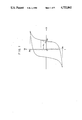
- FIG. 1 illustrates a magnetic hysteresis curve of a general magnetic recording medium.
- FIG. 2 shows a relationship between ⁇ and Br of a magnetic recording medium of the present invention.
- FIG. 2-a shows a relationship between ⁇ and Br of a magnetic recording medium of the present invention using a ferromagnetic iron oxide powder.
- FIG. 2-b shows a relationship between ⁇ and Br of a magnetic recording medium of the present invention using a ferromagnetic modified powder.
- FIG. 2-c shows a relationship between ⁇ and Br of a magnetic recording medium of the present invention using a ferromagnetic metal powder.
- the present invention is based on the discovery that a magnetic recording medium having prominently improved electromagnetic conversion characteristics is produced by making the magnetic recording layer to have the specific values for the H 1 , H 2 , coercive force, and residual magnetic flux density.
- the magnetic recording medium of the invention provides improved electromagnetic conversion characteristics which cannot be provided by the conventional magnetic recording medium produced simply upon balancing the residual magnetic flux density and the coercive force of the magnetic recording layer.
- a magnetic recording medium of the invention comprises a nonmagnetic support and a magnetic recording layer provided on the support.
- the magnetic recording layer comprises a ferromagnetic powder dispersed in a binder. Accordingly, as far as the basic constitution of the magnetic recording medium is concerned, the magnetic recording medium of the invention is not substantially different from the conventional one.
- the characteristic feature of the magnetic recording medium of the invention resides in the specific relationship among the values of the following H 1 , H 2 , Hc and Br.
- FIG. 1 shows a typical magnetic hysteresis curve of a general magnetic recording medium.
- the magnetic recording medium shows a hysteresis when the magnetic flux is measured in the direction of orientation of the ferromagnetic powder in the magnetic recording layer.
- the typical hysteresis can be given in a graph (ordinate: magnetic flux density (B), abscissa: external magnetic field) in the form of a magnetic hysteresis curve as is shown in FIG. 1. As is seen, the magnetic hysteresis curve has the maximum magnetic flux density (Bs) in the first quadrant.
- the magnetic recording medium of the invention gives a magnetic hysteresis curve similar to that illustrated in FIG. 1.
- the values for H 1 , H 2 and Hc shown in FIG. 1 are specifically related to the residual magnetic density Br (in terms of gauss) according to the following inequality (I):
- H 1 in terms of oersted is a value of external magnetic field determined when a magnetic flux density of a magnetic hysteresis curve determined in the direction of orientation of the ferromagnetic powder in the magnetic recording layer in the fourth quadrant is equivalent to one-thirds of the maximum magnetic flux densiy of said magnetic hysteresis curve in the third quadrant;
- H 2 in terms of oersted is a value of external magnetic field determined when a magnetic flux density of said magnetic hysteresis curve in the first quadrant is equivalent to one-third of the maximum magnetic flux densiy of said magnetic hysteresis curve in the first quadrant;
- Hc in terms of oersted is a coercive force of the magnetic recording layer
- Br in terms of gauss is a residual magnetic flux density of the magnetic recording layer.
- the residual magnetic flux density (Br) can be determined at an external magnetic field of 1,000 Oe (normal position or position I) for a magnetic recording medium using a ferromagnetic iron oxide powder.
- an external magnetic field of 2,000 Oe chromium position or position II
- an external magnetic field of 5,000 Oe metal position or position IV
- FIG. 2 The areas represented by the inequality (III) are illustrated in FIG. 2, FIG. 2-a, FIG. 2-b, and FIG. 2-c with oblique lines.
- the conventional magnetic recording media have the ⁇ values in the B-1 area above the straight line.
- Ex-1 to Ex-4 indicate the values of the magnetic recording media of the invention using ferromagnetic iron oxide powder which are described in the hereinafter-given Examples 1 to 4.
- c-1 and c-2 are the ⁇ values of the commercially available magnetic recording media using the ferromagnetic iron oxide powder.
- Ex-5 to Ex-8 indicate the ⁇ values of the magnetic recording media of the invention using ferromagnetic modified powder such as ferromagnetic Co-containing ion oxide powder which are described in the hereinafter-given Examples 5 to 8.
- ferromagnetic modified powder such as ferromagnetic Co-containing ion oxide powder which are described in the hereinafter-given Examples 5 to 8.
- c-3 and c-4 are the ⁇ values of the commercially available magnetic recording media using the ferromagnetic modified powder.
- Ex-9 to Ex-12 indicate the ⁇ values of the magnetic recording media of the invention using ferromagnetic metal powder which are described in Examples 9 to 12.
- c-5 and c-6 indicate the ⁇ values of the commercially available magnetic recording medium using the ferromagnetic metal powder.
- the ⁇ value of the magnetic recording meduim of the invention preferably is in the range variable depending on the nature of the ferromagnetic powder.
- the ⁇ value of the medium using the ferromagnetic iron oxide powder preferably ranges from 0.80 to 1.70, and more preferably ranges from 1.40 to 1.77.
- the area satisfying the preferred range is indicated in FIG. 2-a by A-2.
- the ⁇ value of the medium using the ferromagnetic modified powder preferably ranges from 0.80 to 1.75, and more preferably ranges from 1.40 to 1.75.
- the area satisfying the preferred range is indicated in FIG. 2-b by A-3.
- the ⁇ value of the medium using the ferromagnetic iron metal powder preferably ranges from 1.20 to 2.45, and more preferably ranges from 1.40 to 2.45.
- the area satisfying the preferred range is indicated in FIG. 2-c by A-4.
- the audio tapes according to the invention using the ferromagnetic iron oxide powder, modified powder and metal powder give high output power for MOL 315 and SOL 10K and low bias noise in the measurements in the normal position (Position I), chromium position (Position II), and metal position (Position IV), respectively.
- the vido tapes according to the invention give high vide output power and high S/N ratios for both the luminance signal and color signal.
- the magnetic recording medium of the invention shows such improved electromagnetic conversion characteristics is not exactly known. It is supposed that increase of effective value of the recording bias brought about by increase of the coercive force and enhanced uniformness of the dispersed ferromagnetic powder and decrease of self-demagnetization brought about by reduction of the difference between H 2 and H 1 are combined to give the favorable improvement to the magnetic recording meduim of the invention.
- the magnetic recording medium of the invention which has the basic structure composed of a nonmagnetic support and a magnetic recording layer can be prepared, for example, by the following procedure.
- Material of the nonmagnetic support is not particularly limited and can be selected, for example, from polyethylene terephthalate, polypropylene, polycarbonate, polyethylene naphthalate, polyamide, polyamideimide, polyimide and metallic foils such as aluminum foil and stainless steel foil.
- the thickness of the support generally is in the range of 3-50 ⁇ m, preferably in the range of 5-30 ⁇ m.
- the magnetic recording layer is generally provided on one surface of the support.
- An exposed surface of the support may be provided with a back layer (backing layer).
- the ferromagnetic metal powder to be contained in the magnetic recording layer of the magnetic recording medium according to the invention may be a ferromagnetic iron oxide powder, a ferromagnetic modified powder, or a ferromagnetic metal.
- Examples of the ferromagnetic iron oxide powder include ⁇ -Fe 2 O 3 , ⁇ -FeO x (1.33 ⁇ 1.5), and Fe 3 O 4 .
- ferromagnetic modified powder examples include ferromagnetic Co-containing iron oxide powder, Ba-containing ferrite, Sr-containing ferrite, and noniron metal oxide such as CrO 2 containing Sn, Sb, Te or the like.
- ferromagnetic metal powder there can be mentioned a ferromagnetic alloy powder containing a metal component of at least 75 wt. % in which at least 80 wt. % of the metal component comprises at least one ferromagnetic metal or metal alloy (e.g., Fe, Co, Ni, Fe-Co, Fe-Ni, Co-Ni, or Co-Ni-Fe) and the remaining metal component, if present, comprises other atom(s) (e.g., Al, Si, S, Sc, Ti, V, Cr, Mn, Cu, Zn, Y, Mo, Rh, Pd, Ag, Sn, Sb, Te, Ba, Ta, W, Re, Au, Hg, Pb, Bi, La, Ce, Pr, Nd, B, or P).
- ferromagnetic metal or metal alloy e.g., Fe, Co, Ni, Fe-Co, Fe-Ni, Co-Ni, or Co-Ni-Fe
- the remaining metal component if present, comprises other
- the ferromagnetic metal component may contain a small amount of water hydroxide, or oxide.
- These ferromagnetic metal powders are already known, and be prepared by known methods.
- the ferromagnetic metal powder employable in the invention can be obtained by first preparing a ferromagnetic metal powder according to the known method, then adjusting the saturation magnetic moment and finally classifying the resulting powder based on the powder size.
- the shape of the ferromagnetic powder employable in the invention is needle shape, grain shape, dice shape, rice shape or plate shape.
- the needle shaped ferromagnetic powder preferably has a length of 0.5-0.002 ⁇ m, a width of 0.3-0.01 ⁇ m, and an aspect ratio of 1:5-1:20.
- the ferromagnetic powder preferably shows high tapping density for increasing the concentration of the powder in the recording layer to enhance the squareness ratio.
- the needle-shaped ferromagnetic powder of the iron oxide type and the modified type preferably have a tapping density of not less than 1.0 g/cm 3
- the needle-shaped ferromagnetic metal powder preferably has a tapping density of not less than 0.9 g/cm 3
- the ferromagnetic powder preferably has various improved characteristics with respect to BET specific surface area, saturation magnetization, coercive force, and the like.
- the ferromagnetic powder having such improved features can be prepared by a process which is similar to the known process for the preparation of the conventional ferromagnetic powder, but is modified with respect to the reaction conditions so as to enhance the above-described features such as the coercive force, tapping density, etc.
- the coercive force of a magnetic recording layer is known to be almost proportional to the coercive force of the ferromagnetic powder contained therein. Accordingly, the increase of the coercive force of the magnetic recording layer is accomplished by the increase of the coercive force of the ferromagnetic powder.
- the coercive force of the ferromagnetic powder can be enhanced by narrowing the particle size distribution of the powder through controlling the reaction conditions for the preparation.
- the tapping density can be increased by applying to the ferromagnetic powder a static pressure. More detailed conditions are described below.
- the starting materials such as FeCl 3 , NaOH and water(solvent) are so selected as to be highly pure.
- fluctuation of the reaction temperature in the reaction for the preparation of ⁇ -FeOOH is controlled within ⁇ 1° C.
- the mixing procedure for initiating the reaction is preferably performed to rapidly give a higly uniformed mixture by means of a high power mixing means such as a ultrasonic vibrator in combination of use of a reaction vessel equipped with a great number of nozzles for injection of the solutions therein. This is effective to reduce non-uniformness of the concentration of the reaction solution, the nonuniformness of the concentration causing the variation of the particle size of the needle-shaped ⁇ -FeOOH.
- the resulting needle-shaped ⁇ -FeOOH crystals are then fired preferably at a controlled temperature with flactuation within ⁇ 2° C.
- the fired crystals are subsequently reduced in hydrogen gas at a controlled temperature with flactuation within ⁇ 5° C.
- the desired needle-shaped ⁇ -Fe 2 O 3 powder having a particle size within a narrow range can be produced.
- a needle-shaped ⁇ -Fe 2 O 3 powder produced from iron salts in an aqueous alkaline solution is, at least in portion, under aggromerated conditions. It has been confirmed that the aggromerated powder is not favorable for preparing a ferromagnetic powder of high quality.
- the aggrmerated powder can be isolated to give a less aggromerated powder by applying to the powder a high pressure such as 1,000 kg/cm 2 using a static press. Thus isolated powder increases in the tapping density.
- a needle-shaped ⁇ -Fe 2 O 3 having been not subjected to such static pressing treatment shows a tapping density of less than 1 g/cm 3 while a needle-shaped ⁇ -Fe 2 O 3 has a tapping density of more than 1 g/cm 3 after being subjected to such static pressing treatment.
- a needle-shaped ⁇ -Fe 2 O 3 powder having a BET specific surface area of not less than 28 m 2 /g, a saturation magnetization ( ⁇ s) of not less than 72 emu/g and a tapping density of not less than 1.0 g/cm 3 . Further, a magnetic recording layer containing this ferromagnetic powder can show a coercive force of not less than 350 civild.
- a needle-shaped ⁇ -Fe 2 O 3 which is to be used as a core material of the Co-containing one is first produced to have a narrow Hc range according to the process stated above. Further, non-uniformness of the distribution of cobalt atmos coated over the needle-shaped ⁇ -Fe 2 O 3 is reduced by controlling the reaction conditions for the cobalt-coating, for instance, by way of reducing flactuations of the reaction temperature, purity of the starting materials, and the concentration of the reaction mixture. According to this process, the particle size distribution is also made narrow. Further, the tapping density can be increased in the same manner as above, by reducing the aggromeration using a static press.
- a needle-shaped Co-containing ⁇ -Fe 2 O 3 powder having a BET specific surface area of not less than 28 m 2 /g, a saturation magnetization ( ⁇ s) of not less than 77 emu/g and a tapping density of not less than 1.0 g/cm 3 .
- a magnetic recording layer containing this ferromagnetic powder can show a coercive force of not less than 640 Malawid.
- the needle-shaped ⁇ -FeOOH having the preferred features prepared as in the above can be reduced at a reducing temperature with flactuation within ⁇ 5° C. to give a ferromagnetic metal powder having the favorable features.
- the tapping density can be increased in the same manner as above, by reducing the aggromeration of the obtained powders using a static press.
- a needle-shaped ferromagnetic metal powder having a BET specific surface area of not less than 42 m 2 /g, a saturation magnetization ( ⁇ s) of not less than 147 emu/g and a tapping density of not less than 0.9 g/cm 3 . Further, a magnetic recording layer containing this ferromagnetic powder can show a coercive force of not less than 1,000 Maud.
- the binder employable in the formation of the magnetic recording layer of the invention can be selected from known resins such as thermoplastic resins, thermosetting resins, and reactive resins. These resins can be employed singly or in combination.
- the thermoplastic resin employable in the invention generally has a mean molecular weight of 10,000-200,000 and a polymerization degree of approx. 200-2,000.
- the thermoplastic resin include vinyl chloride/vinyl vinyl acetate copolymer resins, acrylic resins, cellulose derivative resins, a variety of thermoplastic resins of synthetic rubber type, polyurethane resins, polyvinyl fluoride resins, polyamide resins, polyvinyl butylate resins, styrene/butadiene copolymer resins and polystyrene resins.
- thermosetting resin or the reactive resin employable in the invention generally has a mean molecular weight of not more than 200,000 in the state of a component of a coating dispersion, and the molecular weight of those resins becomes infinity after being coated through condensation reaction or addition reaction.
- Preferably employable thermosetting resin is one which is does not soften or melt under heating in the course of hardening.
- Such resins include phenol/formalin/novolak resin, phenol/formalin/resol resin, phenol/furfural resin, xylene/formalin resin, urea resin, melamine resin, drying oil alkyd resin, phenolic resin modified alkyd resin, maleic resin modified alkyd resin, unsaturated polyester resin, a mixture of epoxy resin and hardening agent, isocyanate polyether humid-setting resin, a mixture of polyisocyanate and polyurethane resin, and a mixture of polyisocyanate prepolymer and a resin having active hydrogen. If a mixture of the above-mentioned vinyl chloride/vinyl acetate copolymer and a polyurethane resin is used with polyisocyanate compound as a binder, the magnetic recording layer of the invention can be more hardened.
- the amount of the binder is generally in the range of 10 to 100 parts by weight, preferably in the range of 15 to 50 parts by weight, per 100 parts by weight of the ferromagnetic metal powder.
- the magnetic recording layer of the magnetic recording medium according to the invention contains generally a nonmagnetic inorganic powder preferably having a Mohs' scale of hardness of not less than 6 in an amount of 1-15 %, more specifically 1-10%, by weight based on the amount of the ferromagnetic metal powder.
- the nonmagnetic inorganic powder having a Mohs' scale of hardness of not less than 6 include cromic oxide (e.g. Cr 2 O 3 ), ⁇ -alumina and ⁇ -iron oxide (e.g. Fe 2 O 3 ).
- a nonmagnetic inorganic powder having a Mohs' scale of hardness of not less than 8 such as cromic oxide and ⁇ -alumina.
- the nonmagnetic inorganic powder preferably has a mean diameter in the range of 0.2-0.8 ⁇ m, more preferably 0.3-0.5 ⁇ m.
- the magnetic recording layer preferably contains carbon black.
- the magnetic recording medium of the present invention can be produced by the following procedure.
- the above-described ferromagnetic metal powder and a binder, and optionally a nonmagnetic inorganic powder, carbon black, lublicants, etc. are kneaded with an appropriate solvent to prepare a magnetic paint (or dispersion).
- the solvent employable in the invention is a known solvent used for the preparation of the conventional magnetic paint such as methyl ethyl ketone and cyclohexanone.
- the kneading procedure can be carried out by the conventional method using apparatus employed for the preparation of the magnetic paint.
- additives such as a dispersing agent and an antistatic agent can be also employed in combination with the above-described components.
- the magnetic paint prepared as above is applied onto one or both surfaces of the nonmagnetic support.
- a magnetic recording layer is formed by applying the magnetic paint directly on the nonmagnetic support, but it is also possible to provide an adhesive layer or a subbing layer between the magnetic paint layer and the nonmagnetic support.
- the applying procedure can be performed according to the conventional method.
- the magnetic recording layer provided on the surfaces of the nonmagnetic support has a thickness (thickness in dry state) generally in the range of approx. 0.5-10 ⁇ m, preferably in the range of 1.5-7.0 ⁇ m.
- the procedure for the preparation of the magnetic paint be performed carefully so as to obviate breakage of the ferromagnetic powder.
- the aggremeration of the ferromagnetic powder in the magnetic paint is well obviated, for example, by stirring sufficiently stirring the magnetic paint until the coating procedure is started.
- a smoothing process is further carried out.
- the magnetic recording medium being been subjected to the process such as the smoothing process is subsequently cut to give a medium in the form of disk or continuous tape.
- the reaction mixture (i.e., suspension) was then stirred at a temperature of 10° C. ⁇ 0.3° C. for 12 hours.
- the needle-shaped ⁇ -FeOOH was collected over a filter and washed with a pure water until the ion concentration in the washings reached a level of less than 50 ppm.
- the collected ⁇ -FeOOH was then dried in an oven at 100° C.
- the dried needle-shaped ⁇ -FeOOH (1,500 g) was oxidized in a 150 l-fluidized-bed furnace by introducing air (kept at 500° C. ⁇ 2° C.) at a rate of 400 l/min. for 2 hrs. Thus, a needle-shaped ⁇ -Fe 2 O 3 was obtained.
- the resulting needle-shaped ⁇ -Fe 2 O 3 was pressed statically at 1,000 kg/cm 2 to increase the tapping density.
- the obtained needle-shaped ⁇ -Fe 2 O 3 powder had a BET specific surface area of 30 m 2 /g, a saturation magnetization ( ⁇ s) of 74 emu/g, a coercive force of 380 Oe, a tapping density of 1.05 g/cm 3 and an aspect ratio of 12/1.
- Needle-shaped ⁇ -Fe 2 O 3 1,000 g.
- Vinyl chloride/vinyl acetate/vinyl alcohol copolymer (92: 2: 6, polymerization degree: approx. 400): 150 g.
- Polyester-polyurethane resin (number average molecular weight: approx. 10,000): 50 g.
- Oleic acid 20 g.
- Dimethylpolysiloxane (polymerization degree: approx. 60): 10 g.
- Methyl ethyl ketone 1,200 g.
- the above-mentioned composition was introduced together with 4 kg. of glass beads (diameter: 0.5 mm) into a 5 l-batch type sand grinder, and the mixing was conducted at a linear speed of 500 m/s for 5 hours. The mixture was then filtered over a filter (mean pore sized: 0.5 ⁇ m) to give a magnetic paint.
- the magnetic paint was coated on a polyethylene terephtalate film (thickness: 7 ⁇ m) to give a coated film of 5 ⁇ m (as dry film).
- the coated film was subjected to orienting procedure using an explosion proof air-core solenoid at 2,000 gauss, while the film was still wet, and then was dried.
- the magnetic paint layer was calendered at a linear speed of 500 kg/cm at 100° C. and the resulting composited film was slit to give a tape of 3.81 mm width.
- the obtained tape was encased in a case to prepare an audio cassette tape.
- Example 1 The procedures of Example 1 were repeated except that the coating method was changed to the following method, to give an audio cassette tape.
- the magnetic paint was coated on a polyethylene terephtalate film (thickness: 7 ⁇ m) to give a coated film of 5 ⁇ m (as dry film).
- the coated film was once subjected to orienting procedure using an air-core solenoid at 2,000 gauss, while the film was still wet, and then was dried.
- Example 1 The procedures of Example 1 were repeated except that the process of the preparation of the magnetic paint was changed to the following method, to give an audio cassette tape.
- Example 2 The same composition as in Example 1 was introduced together with 10 kg. of glass beads (diameter: 10 mm) into a 10 l-ball mill, and the mixing was conducted at 20 rpm for 48 hours. The mixture was then filtered over a filter(mean pore sized: 0.5 ⁇ m) to give a magnetic paint.
- Example 1 The procedures of Example 1 were repeated except that the coating method employed in Example 2 was adopted and the process of the preparation of the magnetic paint employed in Example 3 was adopted, to give an audio cassette tape.
- Example 1 The procedures of Example 1 were repeated except that the ferromagnetic powder was replaced with that obtained in the following process, to give an audio cassette tape.
- the reaction mixture (i.e., suspension) was then stirred at a temperature of 10° C. ⁇ 0.3° C. for 12 hours.
- the needle-shaped ⁇ -FeOOH was collected over a filter and washed with an industrial water until the ion concentration in the washings reached a level of less than 200 ppm.
- the collected ⁇ -FeOOH was then dried in an oven at 100° C.
- the dried needle-shaped ⁇ -FeOOH (1,500 g) was oxidized in a 30 l-rotary oven by introducing air (kept at 500° C. ⁇ 5° C.) at a rate of 12 l/min. for 2 hrs.
- air kept at 500° C. ⁇ 5° C.
- a needle-shaped ⁇ -Fe 2 O 3 was obtained.
- the obtained needle-shaped ⁇ -Fe 2 O 3 powder had a BET specific surface area of 27 m 2 /g, a saturation magnetization ( ⁇ s) of 71 emu/g, a coercive force of 370 Oe, a tapping density of 0.72 g/cm 3 and an aspect ratio of 11/1.
- Comparison Example 1 The procedures of Comparison Example 1 were repeated except that the coating method was changed to that used in Example 2, to give an audio cassette tape.
- the audio cassette tapes obtained in Examples 1-4 and Comparison Examples 1-2 were measured with respect to the residual magnetic flux density (Br), ⁇ value, H 1 value, H 2 value, MOL 315, SOL 10K, and BN.
- the measured values together with the corecive force (Hc) of the resulting magnetic recording layer are set forth in Table 1.
- the relationships between the ⁇ value and Br of these audio tapes are illustrated in FIG. 2-a, by Ex 1-Ex 4 and c-1 and c-2.
- the residual flux density is determined in the direction along the oriented ferromagnetic powder at an external magnetic field of 1,000 Oe, by means of VSM-III (available from Toe1 Industry Co., Ltd. Japan).
- the residual flux density is determined at an external magnetic field of 2,000 Oe the ferromagnetic Co-containing powder, and an external magnetic field of 5,000 Oe for ferromagnetic metal powder.
- the coercive force is a value of the external magnetic field where the magnetic flux density is 0 gauss in the hysteresis curve.
- This value (Oe) is a value of external magnetic field determined when a magnetic flux density of the magnetic hysteresis curve in the fourth quadrant is equivalent to one-third of the maximum magnetic flux densiy of said magnetic hysteresis curve in the third quadrant;
- This value (Oe) is a value of external magnetic field determined when a magnetic flux density of the magnetic hysteresis curve in the first quadrant is equivalent to one-third of the maximum magnetic flux densiy of the magnetic hysteresis curve in the first quadrant;
- This value is calculated by the forementioned formula (II) using the Hc value and the value of H 1 -H 2 .
- This value is determined from the maximum output power (distortion ratio: 3%) at 315 Hz in comparison with that of the reference tape.
- the value is expressed in terms of a relative value based on the value (shifted to 0 dB) given by the reference tape prepared in each of the comparison examples.
- the measurement of the output power is done by means of a ZX-9 type cassette deck (available from Nakamichi Co., Ltd., Japan).
- This value is determined from the saturated output power at 10 KHz in comparison with that of the reference tape.
- the value is expressed in terms of a relative value based on the value (shifted to 0 dB) given by the reference tape prepared in each of the comparison examples.
- the measurement of the output power is done by means of a ZX-9 type cassette deck (available from Nakamichi Co., Ltd., Japan).
- the value is determined by correcting the bias noise level of a cassette tape (determined based on that of the reference tape) using JISA curve.
- the value is expressed in terms of a relative value based on the value (shifted to 0 dB) given by the reference tape prepared in each of the comparison examples.
- the measurement of the output power is done by means of a ZX-9 type cassette deck (available from Nakamichi Co., Ltd., Japan).
- Example 1 The procedures of Example 1 were repeated except that the ferromagnetic powder was replaced with that obtained in the following process, to give an audio cassette tape.
- Example 2 Into the same reaction vessel as in Example 1 was introduced 12.5 l of an aqueous solution containing 0.38 mol of cobalt sulfate (purity: 99.9%) in a pure water. To the solution was added 1 kg of the needle-shaped ⁇ -Fe 2 O 3 prepared in Example 1. To the resulting mixture was introduced a nitrogen gas to purge the air. The mixture was stirred by means of the ultrasonic stirring means to finely disperse the needle-shaped ⁇ -Fe 2 O 3 .
- the reaction mixture (i.e., suspension) was then stirred at a temperature of 93° C. ⁇ 0.5° C. for 3 hours.
- the solid was collected over a filter and washed with a pure water until the ion concentration in the washings reached a level of less than 50 ppm.
- the collected needle-shaped Co- ⁇ -Fe 2 O 3 was then dried in an oven at 100° C.
- the resulting needle-shaped Co- ⁇ -Fe 2 O 3 was pressed statically at 1,000 kg/cm 2 to increase the tapping density.
- the obtained needle-shaped Co- ⁇ -Fe 2 O 3 powder had a BET specific surface area of 28 m 2 /g, a saturation magnetization ( ⁇ s) of 80 emu/g, a coercive force of 650 Oe, a tapping density of 1.03 g/cm 3 and an aspect ratio of 12/1.
- Example 2 The procedures of Example 2 were repeated except for using the needle-shaped Co- ⁇ -Fe 2 O 3 powder of Example 5 as ferromagnetic powder, to obtain an audio cassette tape.
- Example 3 The procedures of Example 3 were repeated except for using the needle-shaped Co- ⁇ -Fe 2 O 3 powder of Example 5 as ferromagnetic powder, to obtain an audio cassette tape.
- Example 4 The procedures of Example 4 were repeated except for using the needle-shaped Co- ⁇ -Fe 2 O 3 powder of Example 5 as ferromagnetic powder, to obtain an audio cassette tape.
- Example 1 The procedures of Example 1 were repeated except that the ferromagnetic powder was replaced with that obtained in the following process, to give an audio cassette tape.
- the reaction mixture i.e., suspension
- the solid was collected over a filter and washed with a pure water until the ion concentration in the washings reached a level of less than 200 ppm.
- the collected needle-shaped Co- ⁇ -Fe 2 O 3 was then dried in an oven at 100° C.
- the obtained needle-shaped Co- ⁇ -Fe 2 O 3 powder had a BET specific surface area of 27 m 2 /g, a saturation magnetion ( ⁇ s) of 76 emu/g, a coercive force of 630 Oe, a tapping density of 0.68 g/cm 3 and an aspect ratio of 11/1.
- Comparison Example 3 The procedures of Comparison Example 3 were repeated except that the coating method was changed to that used in Example 2, to give an audio cassette tape.
- the audio cassette tapes obtained in Examples 5-8 and Comparison Examples 3-4 were measured with respect to the residual magnetic flux density (Br), ⁇ value, H 1 value, H 2 value, MOL 315, SOL 10K, and BN.
- the measured values together with the coercive force (Hc) of the resulting magnetic recording layer are set forth in Table 2.
- the relationships between the ⁇ value and Br of these audio tapes are illustrated in FIG. 2-b, by Ex 5-Ex 8 and c-3 and c-4.
- Example 1 The procedures of Example 1 were repeated except that the ferromagnetic powder was replaced with the ferromagnetic metal powder obtained in the following process, to give an audio cassette tape.
- the needle-shaped ⁇ -FeOOH (1,500 g.) prepared as an intermediate in the process of the preparation of the needle-shaped ⁇ -Fe 2 O 3 in Example 1 was introduced into a 150 l-fluidized bed furnace. To the furnace was introduced a hydrogen gas at 500° C. ⁇ 5° C. at a flow rate of 500 l/min. for 10 hours for reducing the ⁇ -FeOOH. Thus, the desired needle-shaped ferromagnetic metal powder was obtained.
- the resulting needle-shaped ferromagnetic metal powder was pressed statically at 1,000 kg/cm 2 to increase the tapping density.
- the obtained needle-shaped ferromagnetic metal powder had a BET specific surface area of 42 m 2 /g., a saturation magnetization ( ⁇ s) of 147 emu/g, a coercive force of 1,250 Oe, a tapping density of 0.92 g/cm 3 and an aspect ratio of 12/1.
- Example 2 The procedures of Example 2 were repeated except for using the needle-shaped ferromagnetic metal powder of Example 9 as ferromagnetic powder, to obtain an audio cassette tape.
- Example 3 The procedures of Example 3 were repeated except for using the needle-shaped ferromagnetic metal powder of Example 9 as ferromagnetic powder, to obtain an audio cassette tape.
- Example 4 The procedures of Example 4 were repeated except for using the needle-shaped ferromagnetic metal powder of Example 9 as ferromagnetic powder, to obtain an audio cassette tape.
- Example 1 The procedures of Example 1 were repeated except that the ferromagnetic powder was replaced with the ferromagnetic metal powder obtained in the following process, to give an audio cassette tape.
- the needle-shaped ⁇ -FeOOH (1,500 g.) prepared as an intermediate in the process of the preparation of the needle-shaped ⁇ -Fe 2 O 3 in Comparison Example 1 was introduced into a 20 l-rotary electronic oven. To the oven was introduced a hydrogen gas at 500° C. ⁇ 10° C. at a flow rate of 24 l/min. for 10 hours, with rotation at 20 rpm, for reducing the ⁇ -FeOOH. Thus, a needle-shaped ferromagnetic metal powder was obtained.
- the obtained needle-shaped ferromagnetic metal powder had a BET specific surface area of 41 m 2 /g, a saturation magnetization ( ⁇ s) of 132 emu/g, a coercive force of 1,260 Oe, a tapping density of 0.52 g/cm 3 and an aspect ratio of 11/1.
- Comparison Example 5 The procedures of Comparison Example 5 were repeated except that the coating method was changed to that used in Example 2, to give an audio cassette tape.
- the audio cassette tapes obtained in Examples 9-12 and Comparison Examples 5-6 were measured with respect to the residual magnetic flux density (Br), ⁇ value, H 1 value, H 2 value, MOL 315, SOL 10K, and BN.
- the measured values together with the coercive force (Hc) of the resulting magnetic recording layer are set forth in Table 3.
- the relationships between the ⁇ value and Br of these audio tapes are illustrated in FIG. 2-c, by Ex 9-Ex 12 and c-5 and c-6.
- Needle-shaped Co- ⁇ -Fe 2 O 3 (prepared in Example 5): 1,000 g.
- Vinyl chloride/vinyl acetate/vinyl alcohol copolymer (92: 2: 6, polymerization degree: approx. 400): 150 g.
- Polyester-polyurethane resin (number average molecular weight: approx. 10,000): 75 g.
- Butyl stearate 10 g.
- Oleic acid 20 g.
- Dimethylpolysiloxane (polymerization degree: approx. 60): 10 g.
- Methyl ethyl ketone 1,200 g.
- the above-mentioned composition was introduced together with 4 kg. of glass beads (diameter: 0.5 mm) into a 5 l-batch type sand grinder, and the mixing was conducted at a linear speed of 500 m/s for 5 hours. 100 g. of polyisocyanate (Desmodure L-75, tradename) was added to the mixture. The resulting mixture was further mixed for another 20 min. and then filtered over a filter (mean pore sized: 0.3 ⁇ m) to give a magnetic paint.
- a filter mean pore sized: 0.3 ⁇ m
- the magnetic paint was coated on a polyethylene terephtalate film (thickness: 14 ⁇ m) to give a coated film of 5 ⁇ m (as dry film).
- the coated film was subjected to orienting procedure using an explosion proof air-core solenoid at 2,000 gauss, while the film was still wet, and then was dried.
- the magnetic paint layer was calendered at a linear speed of 500 kg/cm at 100° C. and the resulting composited film was slit to give a tape of 1/2 inch width.
- the obtained tape was encased in a case to prepare a VHS-tape video cassette tape.
- Example 13 The procedures of Example 13 were repeated except that the coating method was changed to that used in Example 2, to give a video cassette tape.
- Example 13 The procedures of Example 13 were repeated except that the Co- ⁇ -Fe 2 O 3 obtained in Comparison Example 3 was changed to that used in Example 2, to give a video cassette tape.
- Comparison Example 7 The procedures of Comparison Example 7 were repeated except that the coating method was changed to that used in Example 2, to give a video cassette tape.
- the video cassette tapes obtained in Examples 13 and 14 and Comparison Examples 7 and 8 were measured with respect to a video output power (VS), Y ⁇ S/N ratio, and C ⁇ S/N ratio, in addition to the subjects given hereinbefore.
- the measurement was done by the following methods.
- Vs Video Output Power
- the video output power is determined at 4 MHz in comparison with that of the reference tape.
- the value is expressed in terms of a relative value based on the value (shifted to 0 dB) given by the reference tape prepared in each of the comparison examples.
- the measurement of the output power is done by means of an NV-870 HD-type Output Level Measurement Device (Matsushita Electric Industrial Co., Ltd., Japan) using a senduct head as the magnetic head.
- This value is determined by measuring an S/N ratio of a luminance signal at 4 MHz in comparison with that of the reference tape. The value is expressed in terms of a relative value based on the value (shifted to 0 dB) given by the reference tape prepared in each of the comparison examples. The measurement was done using the same device as described in the (1) above.
- This value is determined by measuring an S/N ratio of a color signal at 4 MHz in comparsion with that of the reference tape. The value is expressed in terms of a relative value based on the value (shifted to 0 dB) given by the reference tape prepared in each of the comparison examples. The measurement was done using the same device as described in the (1) above.
- Example 13 The procedures of Example 13 were repeated except that the ferromagnetic metal powder obtained in Example 9 was employed, to give a video cassette tape.
- Example 15 The procedures of Example 15 were repeated except that the coating method was changed to that used in Example 2, to give a video cassette tape.
- Example 15 The procedures of Example 15 were repeated except that the ferromagnetic metal powder obtained in Comparison Example 5 was employed, to give a video cassette tape.
- Comparison Example 9 The procedures of Comparison Example 9 were repeated except that the coating method was changed to that used in Example 2, to give a video cassette tape.
- the video cassette tapes obtained in Examples 15 and 16 and Comparison Examples 9 and 10 were measured with respect to a video output power (VS), Y ⁇ S/N ratio, and C ⁇ S/N ratio, in addition to the subjects given hereinbefore.
- the measurement was done by the following methods.
Landscapes
- Magnetic Record Carriers (AREA)
- Paints Or Removers (AREA)
- Hard Magnetic Materials (AREA)
Applications Claiming Priority (2)
| Application Number | Priority Date | Filing Date | Title |
|---|---|---|---|
| JP60078032A JPH0719353B2 (ja) | 1985-04-11 | 1985-04-11 | 磁気記録媒体 |
| JP60-78032 | 1985-04-11 |
Publications (1)
| Publication Number | Publication Date |
|---|---|
| US4722862A true US4722862A (en) | 1988-02-02 |
Family
ID=13650469
Family Applications (1)
| Application Number | Title | Priority Date | Filing Date |
|---|---|---|---|
| US06/850,614 Expired - Lifetime US4722862A (en) | 1985-04-11 | 1986-04-11 | Magnetic recording medium |
Country Status (2)
| Country | Link |
|---|---|
| US (1) | US4722862A (ja) |
| JP (1) | JPH0719353B2 (ja) |
Cited By (2)
| Publication number | Priority date | Publication date | Assignee | Title |
|---|---|---|---|---|
| US4939045A (en) * | 1987-03-23 | 1990-07-03 | Hitachi, Ltd. | Magnetic recording medium |
| US5895708A (en) * | 1996-06-06 | 1999-04-20 | Sony Corporation | Magnetic recording medium |
Families Citing this family (1)
| Publication number | Priority date | Publication date | Assignee | Title |
|---|---|---|---|---|
| JP6535857B2 (ja) * | 2015-03-16 | 2019-07-03 | 国立大学法人 岡山大学 | γ−酸化鉄の製造方法 |
Citations (3)
| Publication number | Priority date | Publication date | Assignee | Title |
|---|---|---|---|---|
| US4135016A (en) * | 1976-03-10 | 1979-01-16 | Fuji Photo Film Co., Ltd. | Magnetic recording material |
| US4135031A (en) * | 1976-02-24 | 1979-01-16 | Fuji Photo Film Co., Ltd. | Magnetic recording substance |
| US4439486A (en) * | 1981-03-12 | 1984-03-27 | Fuji Photo Film Co., Ltd. | Magnetic recording medium |
-
1985
- 1985-04-11 JP JP60078032A patent/JPH0719353B2/ja not_active Expired - Fee Related
-
1986
- 1986-04-11 US US06/850,614 patent/US4722862A/en not_active Expired - Lifetime
Patent Citations (3)
| Publication number | Priority date | Publication date | Assignee | Title |
|---|---|---|---|---|
| US4135031A (en) * | 1976-02-24 | 1979-01-16 | Fuji Photo Film Co., Ltd. | Magnetic recording substance |
| US4135016A (en) * | 1976-03-10 | 1979-01-16 | Fuji Photo Film Co., Ltd. | Magnetic recording material |
| US4439486A (en) * | 1981-03-12 | 1984-03-27 | Fuji Photo Film Co., Ltd. | Magnetic recording medium |
Cited By (2)
| Publication number | Priority date | Publication date | Assignee | Title |
|---|---|---|---|---|
| US4939045A (en) * | 1987-03-23 | 1990-07-03 | Hitachi, Ltd. | Magnetic recording medium |
| US5895708A (en) * | 1996-06-06 | 1999-04-20 | Sony Corporation | Magnetic recording medium |
Also Published As
| Publication number | Publication date |
|---|---|
| JPS61236018A (ja) | 1986-10-21 |
| JPH0719353B2 (ja) | 1995-03-06 |
Similar Documents
| Publication | Publication Date | Title |
|---|---|---|
| US4654260A (en) | Magnetic recording medium | |
| US4465737A (en) | Magnetic recording medium | |
| US4486496A (en) | Magnetic recording medium | |
| US4455345A (en) | Magnetic recording medium | |
| US4442159A (en) | Magnetic recording medium | |
| JPS6314410B2 (ja) | ||
| JP2644322B2 (ja) | 磁気記録媒体 | |
| US4980230A (en) | Magnetic recording medium | |
| US4828916A (en) | Plate-like magnetoplumbite type ferrite particles for magnetic recording and magnetic recording media using the same | |
| US5082733A (en) | Magnetic recording medium containing magnetic particles surface treated with a glycidyl compound | |
| US4714654A (en) | Magnetic recording medium | |
| US4500599A (en) | Magnetic recording medium | |
| JPH03256223A (ja) | 磁気転写方法 | |
| US5120604A (en) | Acicular magnetic iron oxide particles and magnetic recording media using such particles | |
| JP2802518B2 (ja) | 磁気記録媒体 | |
| US4968557A (en) | Magnetic recording medium | |
| US5989703A (en) | Iron oxide magnetic powder and magnetic recording medium using the same | |
| JPH0719353B2 (ja) | 磁気記録媒体 | |
| JPH04251434A (ja) | 磁気記録媒体 | |
| JP2989874B2 (ja) | 磁気記録媒体 | |
| JP3021173B2 (ja) | ビデオテ―プ | |
| US5814394A (en) | Magnetic recording medium | |
| JP3012190B2 (ja) | 磁気記録媒体 | |
| JPS59129935A (ja) | 磁気記録媒体 | |
| JPS6116024A (ja) | 磁気記録媒体 |
Legal Events
| Date | Code | Title | Description |
|---|---|---|---|
| AS | Assignment |
Owner name: FUJI PHOTO FILM CO., LTD., 210, NAKANUMA, MINAMI-A Free format text: ASSIGNMENT OF ASSIGNORS INTEREST.;ASSIGNORS:OGAWA, HIROSHI;YAMAZAKI, NOBUO;TAMAI, YASUO;REEL/FRAME:004614/0638 Effective date: 19860604 |
|
| STCF | Information on status: patent grant |
Free format text: PATENTED CASE |
|
| FEPP | Fee payment procedure |
Free format text: PAYOR NUMBER ASSIGNED (ORIGINAL EVENT CODE: ASPN); ENTITY STATUS OF PATENT OWNER: LARGE ENTITY |
|
| FPAY | Fee payment |
Year of fee payment: 4 |
|
| FPAY | Fee payment |
Year of fee payment: 8 |
|
| FPAY | Fee payment |
Year of fee payment: 12 |