US5039714A - Rubber-modified polystyrene resin composition - Google Patents
Rubber-modified polystyrene resin composition Download PDFInfo
- Publication number
- US5039714A US5039714A US07/335,373 US33537389A US5039714A US 5039714 A US5039714 A US 5039714A US 33537389 A US33537389 A US 33537389A US 5039714 A US5039714 A US 5039714A
- Authority
- US
- United States
- Prior art keywords
- rubber
- composition
- weight
- modified polystyrene
- component
- Prior art date
- Legal status (The legal status is an assumption and is not a legal conclusion. Google has not performed a legal analysis and makes no representation as to the accuracy of the status listed.)
- Expired - Lifetime
Links
- 239000011342 resin composition Substances 0.000 title description 28
- 229920005990 polystyrene resin Polymers 0.000 title description 11
- 239000002245 particle Substances 0.000 claims abstract description 106
- 239000004793 Polystyrene Substances 0.000 claims abstract description 84
- 229920002223 polystyrene Polymers 0.000 claims abstract description 84
- 239000000203 mixture Substances 0.000 claims abstract description 47
- -1 polydimethylsiloxane Polymers 0.000 claims abstract description 39
- 235000014113 dietary fatty acids Nutrition 0.000 claims abstract description 17
- 239000000194 fatty acid Substances 0.000 claims abstract description 17
- 229930195729 fatty acid Natural products 0.000 claims abstract description 17
- 150000004665 fatty acids Chemical class 0.000 claims abstract description 17
- 239000002480 mineral oil Substances 0.000 claims abstract description 14
- 229920000642 polymer Polymers 0.000 claims abstract description 13
- 235000010446 mineral oil Nutrition 0.000 claims abstract description 12
- 150000003839 salts Chemical class 0.000 claims abstract description 10
- 150000001408 amides Chemical class 0.000 claims abstract description 9
- 239000005062 Polybutadiene Substances 0.000 claims description 22
- 229920002857 polybutadiene Polymers 0.000 claims description 22
- 238000009826 distribution Methods 0.000 claims description 3
- 230000001413 cellular effect Effects 0.000 claims description 2
- 239000004205 dimethyl polysiloxane Substances 0.000 abstract description 35
- 229920000435 poly(dimethylsiloxane) Polymers 0.000 abstract description 35
- 235000013870 dimethyl polysiloxane Nutrition 0.000 description 34
- 229920001971 elastomer Polymers 0.000 description 29
- 239000005060 rubber Substances 0.000 description 29
- PPBRXRYQALVLMV-UHFFFAOYSA-N Styrene Chemical compound C=CC1=CC=CC=C1 PPBRXRYQALVLMV-UHFFFAOYSA-N 0.000 description 24
- 230000000704 physical effect Effects 0.000 description 18
- 238000002156 mixing Methods 0.000 description 13
- 238000000034 method Methods 0.000 description 9
- 229920005989 resin Polymers 0.000 description 9
- 239000011347 resin Substances 0.000 description 9
- 238000005259 measurement Methods 0.000 description 8
- XOOUIPVCVHRTMJ-UHFFFAOYSA-L zinc stearate Chemical compound [Zn+2].CCCCCCCCCCCCCCCCCC([O-])=O.CCCCCCCCCCCCCCCCCC([O-])=O XOOUIPVCVHRTMJ-UHFFFAOYSA-L 0.000 description 7
- 239000000654 additive Substances 0.000 description 6
- 230000000379 polymerizing effect Effects 0.000 description 6
- 241001237745 Salamis Species 0.000 description 5
- 239000000178 monomer Substances 0.000 description 5
- 235000015175 salami Nutrition 0.000 description 5
- 150000003440 styrenes Chemical class 0.000 description 4
- 229920000122 acrylonitrile butadiene styrene Polymers 0.000 description 3
- 239000000470 constituent Substances 0.000 description 3
- 238000004519 manufacturing process Methods 0.000 description 3
- 238000003756 stirring Methods 0.000 description 3
- KAKZBPTYRLMSJV-UHFFFAOYSA-N Butadiene Chemical compound C=CC=C KAKZBPTYRLMSJV-UHFFFAOYSA-N 0.000 description 2
- 125000003118 aryl group Chemical group 0.000 description 2
- 239000003795 chemical substances by application Substances 0.000 description 2
- KPUWHANPEXNPJT-UHFFFAOYSA-N disiloxane Chemical class [SiH3]O[SiH3] KPUWHANPEXNPJT-UHFFFAOYSA-N 0.000 description 2
- 230000002708 enhancing effect Effects 0.000 description 2
- HQKMJHAJHXVSDF-UHFFFAOYSA-L magnesium stearate Chemical compound [Mg+2].CCCCCCCCCCCCCCCCCC([O-])=O.CCCCCCCCCCCCCCCCCC([O-])=O HQKMJHAJHXVSDF-UHFFFAOYSA-L 0.000 description 2
- 239000008188 pellet Substances 0.000 description 2
- 239000004033 plastic Substances 0.000 description 2
- 229920003023 plastic Polymers 0.000 description 2
- 239000004014 plasticizer Substances 0.000 description 2
- 238000006116 polymerization reaction Methods 0.000 description 2
- 229920001296 polysiloxane Polymers 0.000 description 2
- 229920003048 styrene butadiene rubber Polymers 0.000 description 2
- OEVVKKAVYQFQNV-UHFFFAOYSA-N 1-ethenyl-2,4-dimethylbenzene Chemical compound CC1=CC=C(C=C)C(C)=C1 OEVVKKAVYQFQNV-UHFFFAOYSA-N 0.000 description 1
- NVZWEEGUWXZOKI-UHFFFAOYSA-N 1-ethenyl-2-methylbenzene Chemical compound CC1=CC=CC=C1C=C NVZWEEGUWXZOKI-UHFFFAOYSA-N 0.000 description 1
- JZHGRUMIRATHIU-UHFFFAOYSA-N 1-ethenyl-3-methylbenzene Chemical compound CC1=CC=CC(C=C)=C1 JZHGRUMIRATHIU-UHFFFAOYSA-N 0.000 description 1
- QEDJMOONZLUIMC-UHFFFAOYSA-N 1-tert-butyl-4-ethenylbenzene Chemical compound CC(C)(C)C1=CC=C(C=C)C=C1 QEDJMOONZLUIMC-UHFFFAOYSA-N 0.000 description 1
- VZSRBBMJRBPUNF-UHFFFAOYSA-N 2-(2,3-dihydro-1H-inden-2-ylamino)-N-[3-oxo-3-(2,4,6,7-tetrahydrotriazolo[4,5-c]pyridin-5-yl)propyl]pyrimidine-5-carboxamide Chemical compound C1C(CC2=CC=CC=C12)NC1=NC=C(C=N1)C(=O)NCCC(N1CC2=C(CC1)NN=N2)=O VZSRBBMJRBPUNF-UHFFFAOYSA-N 0.000 description 1
- DWKNOLCXIFYNFV-HSZRJFAPSA-N 2-[[(2r)-1-[1-[(4-chloro-3-methylphenyl)methyl]piperidin-4-yl]-5-oxopyrrolidine-2-carbonyl]amino]-n,n,6-trimethylpyridine-4-carboxamide Chemical compound CN(C)C(=O)C1=CC(C)=NC(NC(=O)[C@@H]2N(C(=O)CC2)C2CCN(CC=3C=C(C)C(Cl)=CC=3)CC2)=C1 DWKNOLCXIFYNFV-HSZRJFAPSA-N 0.000 description 1
- JLBJTVDPSNHSKJ-UHFFFAOYSA-N 4-Methylstyrene Chemical compound CC1=CC=C(C=C)C=C1 JLBJTVDPSNHSKJ-UHFFFAOYSA-N 0.000 description 1
- MWHHJYUHCZWSLS-UHFFFAOYSA-N FC=1C=C(C=CC1C1=C2CNC(C2=C(C=C1)C=1NC(=CN1)C)=O)NC(=O)NC1=C(C=C(C=C1F)F)F Chemical compound FC=1C=C(C=CC1C1=C2CNC(C2=C(C=C1)C=1NC(=CN1)C)=O)NC(=O)NC1=C(C=C(C=C1F)F)F MWHHJYUHCZWSLS-UHFFFAOYSA-N 0.000 description 1
- 239000005063 High cis polybutadiene Substances 0.000 description 1
- 239000005064 Low cis polybutadiene Substances 0.000 description 1
- 101100386054 Saccharomyces cerevisiae (strain ATCC 204508 / S288c) CYS3 gene Proteins 0.000 description 1
- 230000000996 additive effect Effects 0.000 description 1
- 125000000217 alkyl group Chemical group 0.000 description 1
- XYLMUPLGERFSHI-UHFFFAOYSA-N alpha-Methylstyrene Chemical class CC(=C)C1=CC=CC=C1 XYLMUPLGERFSHI-UHFFFAOYSA-N 0.000 description 1
- 229940053200 antiepileptics fatty acid derivative Drugs 0.000 description 1
- 239000002216 antistatic agent Substances 0.000 description 1
- 230000005540 biological transmission Effects 0.000 description 1
- 230000015572 biosynthetic process Effects 0.000 description 1
- 229920001400 block copolymer Polymers 0.000 description 1
- 238000012662 bulk polymerization Methods 0.000 description 1
- MPMBRWOOISTHJV-UHFFFAOYSA-N but-1-enylbenzene Chemical compound CCC=CC1=CC=CC=C1 MPMBRWOOISTHJV-UHFFFAOYSA-N 0.000 description 1
- CJZGTCYPCWQAJB-UHFFFAOYSA-L calcium stearate Chemical compound [Ca+2].CCCCCCCCCCCCCCCCCC([O-])=O.CCCCCCCCCCCCCCCCCC([O-])=O CJZGTCYPCWQAJB-UHFFFAOYSA-L 0.000 description 1
- 235000013539 calcium stearate Nutrition 0.000 description 1
- 239000008116 calcium stearate Substances 0.000 description 1
- 210000003850 cellular structure Anatomy 0.000 description 1
- 238000004040 coloring Methods 0.000 description 1
- 230000003247 decreasing effect Effects 0.000 description 1
- 239000000975 dye Substances 0.000 description 1
- 238000011156 evaluation Methods 0.000 description 1
- 230000002349 favourable effect Effects 0.000 description 1
- 239000000945 filler Substances 0.000 description 1
- 239000011521 glass Substances 0.000 description 1
- 238000002347 injection Methods 0.000 description 1
- 239000007924 injection Substances 0.000 description 1
- 235000019359 magnesium stearate Nutrition 0.000 description 1
- 239000000463 material Substances 0.000 description 1
- 239000011159 matrix material Substances 0.000 description 1
- 238000002844 melting Methods 0.000 description 1
- 230000008018 melting Effects 0.000 description 1
- 238000000465 moulding Methods 0.000 description 1
- MMSLOZQEMPDGPI-UHFFFAOYSA-N p-Mentha-1,3,5,8-tetraene Chemical class CC(=C)C1=CC=C(C)C=C1 MMSLOZQEMPDGPI-UHFFFAOYSA-N 0.000 description 1
- 238000010422 painting Methods 0.000 description 1
- 239000000049 pigment Substances 0.000 description 1
- 230000019612 pigmentation Effects 0.000 description 1
- 239000000243 solution Substances 0.000 description 1
- 101150035983 str1 gene Proteins 0.000 description 1
- 239000000126 substance Substances 0.000 description 1
- 238000010557 suspension polymerization reaction Methods 0.000 description 1
- 239000010913 used oil Substances 0.000 description 1
Images

Classifications
-
- C—CHEMISTRY; METALLURGY
- C08—ORGANIC MACROMOLECULAR COMPOUNDS; THEIR PREPARATION OR CHEMICAL WORKING-UP; COMPOSITIONS BASED THEREON
- C08L—COMPOSITIONS OF MACROMOLECULAR COMPOUNDS
- C08L51/00—Compositions of graft polymers in which the grafted component is obtained by reactions only involving carbon-to-carbon unsaturated bonds; Compositions of derivatives of such polymers
- C08L51/04—Compositions of graft polymers in which the grafted component is obtained by reactions only involving carbon-to-carbon unsaturated bonds; Compositions of derivatives of such polymers grafted on to rubbers
Definitions
- This invention relates to an impact-resistant polystyrene resin composition offering a well-balanced combination of impact strength and gloss.
- Rubber-modified polystyrene has widely been used in components of domestic electric appliances and other like appliances. However, this material is inferior to the conventional ABS resin in relation to gloss and impact strength of finished products. Another drawback has been its poor colorability. Recently, there has been a growing demand for rubber-modified polystyrene that would compare favorably with ABS resin from the standpoint of cost and applicability to the thin-walled products.
- the resin composition of the present invention excels in gloss, impact strength, and rigidity.
- the resin composition of the present invention enables the production of injection-molded products, extruded sheets, and vacuum-formed products with high impact strength and good gloss, which are comparable to those obtained by using expensive ABS resin.
- it can be of considerable value as an economical resin.
- Rubber-modified polystyrene has been widely used in the industry for a long period of time. Normally the rubber particle size dispersed is polystyrene matrix is about 1.0-5.0 microns. Recently, to achieve high gloss in molded products, rubber-modified polystyrenes with a smaller rubber particle size have been developed and introduced to the market. However, products with 1.0 micron or less in rubber particle size is characterized with a substantially low impact strength, and for this reason, desirable resins have not yet been obtained from these products.
- a composition comprised of a blend of rubber-modified polystyrene containing rubber particles less than 1.0 micron in particle size and those containing larger rubber particles, have been disclosed in existing literature, such as Japanese Patent Publication B46-41467, Japanese Patent Publication B59-1519, U.S. Pat. No. 4,146,589, U.S. Pat. No. 4,214,056, and U.S. Pat. No. 4,493,922.
- the large particles used in these prior art were of 2 microns or greater.
- the object of the present invention is to provide a low-cost rubber-modified polystyrene resin with a well-balanced combination of properties such as good surface gloss in molded products, high impact strength, and high rigidity, as noted above.
- This objective can be attained even more effectively through the addition of a specific amount of polydimethylsiloxane to the rubber-modified polystyrene with the above-noted special microstructure.
- the objective can be attained even more effectively through the further addition of specific amounts of a mineral oil, metallic salts of higher fatty acids, or amides of higher fatty acids.
- this invention concerns a polystyrene resin composition offering excellent gloss and impact strength, characterized in that, in this impact-resistant polystyrene resin composition, elastomeric polymers are dispersed in particle form in the rubber-modified polystyrene of said composition, such that the dispersed particles have a particle size distribution consisting of two peaks, a small particle component and a large particle component; such that the small-particle component has a mean particle diameter of 0.1-0.6 microns and consists of single-occlusion-structure particles, while the large-particle size component has a mean particle diameter of 0.7-1.9 microns and consists of cellular (or "salami”) structure particles.
- the rubber-modified polystyrene under this invention can be manufactured by a bulk polymerization or bulk suspension polymerization process, in which aromatic monovinyl monomers are polymerized in the presence of elastomeric polymers.
- the rubber-modified polystyrene having a special microstructure, which is a special feature of this invention, can be produced through appropriate control of mixing during the polymerization process or under conditions of stirring during the formation of rubber particles.
- the aromatic monovinyl monomers employed in this invention include the following: styrene and o-methylstyrene, p-methylstyrene, m-methylstyrene, 2,4-dimethylstyrene, ethylstyrene, p-tert-butylstyrene, and other nuclear alkyl substituted styrenes; ⁇ -methylstyrene; ⁇ -methyl-p-methylstyrene, and related alpha-alkyl substituted styrenes.
- elastomeric polymers polybutadiene and styrene-polybutadiene copolymers can be used.
- a polybutadiene high-cis polybutadiene containing high concentrations of the cis isomer or low-cis polybutadiene containing low concentrations of the cis isomer can be used.
- the rubber-modified polystyrene having a rubber particle distribution consisting of two rubber particle size peaks which is essential in the invention, can be manufactured by separately preparing rubber-modified polystyrene containing small rubber particles and rubber-modified polystyrene containing large rubber particles, and by blending the two in an extruder. Alternatively, it can be manufactured by mixing polymeric solutions small rubber particle and large rubber particle in a polymerization reactor.
- the small-particle component should have a mean particle size of 0.1-0.6 micron, and preferably 0.2-0.5 micron.
- a mean particle size less than 0.1 micron will result in reduced impact strength; a mean particle size greater than 0.6 micron will result in low surface gloss, large gloss gradient, in molded products.
- the small-particle rubber must have a single-occlusion structure (also referred to as the "shell-core" form); otherwise, the product will be of inferior balance of gloss and impact strength.
- Such small rubber particles having a single-occlusion structure can be manufactured by polymerizing styrene in the presence of polybutadiene or block copolymers of styrene and butadiene.
- the large-particle component have a mean particle size of 0.7-1.9 microns, preferably 1.0-1.8 microns, more preferably 1.0-1.5 micron.
- a means particle diameter of less than 0.7 micron would result in lower impact strength; likewise, a mean particle diameter greater than 1.9 micron would result in lower surface gloss and large gloss gradient of the molded products especially at a low mold temperature.
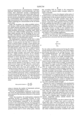
- mean particle size refers to a mean particle size as determined by photographing rubber-modified polystyrene under a transmission electron microscope through the use of the ultra-thin slicing method, measuring the diameters of 1,000 elastomeric polymer particles in the photograph, and calculating the mean particle size according to the following formula: ##EQU1## where ni denotes the number of elastomeric polymer particles of particle diameter s, Di.
- polybutadiene component in this invention means the polybutadiene segment(s) which constitutes a part(s) of the elastomeric polymers of the present invention.
- the small-particle component represents 20-95%, or preferably 50-90%, or even more, preferably 60-90%, by weight of the total weight of the polybutadiene component of the elastomeric polymer in the composition; likewise, the large-particle component represents 5-80%, or preferably 10-50%, or even more, preferably 10-40%, by weight.
- a small-particle component of less than 20% by weight in the composition would result in lower surface gloss, whereas that exceeding 95% by weight in the composition would result in reduced impact strength, neither of which is desirable.
- the rubber-modified polystyrene used to attain object of this invention should not contain any substantial amount of rubber particles larger than 2 micron.
- the condition "not containing any substantial amount” means that rubber particles 2 micron or larger in size constitute less than 20%, by weight, of the polybutadiene component of the elastomeric polymers or preferably, less than 5% by weight.
- rubber particle having 2 micron or larger in size constitute more than 20% by weight, the composition will have an increased gloss gradient and lower gloss in molded products made at a low molding temperature.
- the polydimethylsiloxane used must have a structural unit that can be expressed as ##STR1##
- the organic polysiloxane described in the existing literature, other than polydimethylsiloxane will yield desirable resin compositions.
- the polydimethylsiloxane should have a viscosity of 10-10,000 centistokes at 25° C., which is a relatively low molecular weight range.
- the content of polydimethylsiloxane in the impact-resistant polystyrene resin composition should be in the range of 0.005-0.8% by weight. A content less than 0.005% by weight would make it difficult to obtain high impact strength; whereas a content in excess of 0.8% by weight would reduce colorability and harm secondary processing (chemical binding, printing, and painting) of molded resin products. While the cause of reduced colorability and secondary processing properties when the amount of additives are increased is not well understood, it is suspected that this is related to a poor miscibility of polydimethylsiloxane in the rubber-modified polystyrene. For this reason, elaborate control of the polydimethylsiloxane content is essential from the standpoint of obtaining polystyrene resin composition with a desirable impact strength.
- Mineral oil is used in conjunction with polydimethyl siloxane for the purpose of realizing the objectives of this invention more effectively.
- Said mineral oil is commonly used oil, such as a plasticizer of polystyrene, with no particular restrictions as to viscosity or other parameters.
- the metallic salts of higher fatty acids and amides of higher fatty acids employed in this invention are those fatty acid derivatives, of common use such as those used as slipping agent. Examples include zinc stearate, magnesium stearate, calcium stearate, and ethylene-bis-stearylamide.
- the above mineral oils and/or metallic salts of higher fatty acids or amides of higher fatty acids when used together with the above polydimethylsiloxane, and added to the above rubber-modified polystyrene with a special microstructure, can significantly enhance the impact strength.
- the rubber modified polystyrene contained only small rubber particle, addition of additives such as polydimethylsiloxane and metallic salts of high fatty acids yields little improvement in impact strength.
- Desirable physical properties can be obtained through the combination, described in this invention, of special microstructures and additives.
- Any mineral oil used in conjunction with polydimethylsiloxane in an impact-resistant polystyrene composition should constitute 0.25-4.0% by weight; a content less than 0.25% by weight would contribute little toward enhancing the impact strength, and a content in excess of 4.0% by weight would result in lower heat distortion temperature as well as poor colorability.
- Any metallic salt of a higher fatty acid and/or amide of a higher fatty acid used in conjunction with polydimethylsiloxane in an impact-resistant polystyrene composition should be at least 0.1%, but no more than 0.5%, by weight; a content less than 0.1% by weight would contribute little toward enhancing the impact strength. Beyond 0.5% by weight, impact strength will not improve any more than would be expected from the added amount of said additives.
- the mixing method of the aforementioned polydimethylsiloxane or mineral oil, metallic salts of higher fatty acids, or amides of higher fatty acids to the above-mentioned rubber-modified polystyrene having a special microstructure It is possible to add polydimethylsiloxane, for example, by polymerizing styrene monomer mixed with polydimethylsiloxane; also, it is possible to add polydimethylsiloxane by melting and blending rubber-modified polystyrene and polydimethylsiloxane through the use of an extruder.
- the resin composition of this invention excels in an overall balance of properties, such as impact strength, gloss and rigidity.
- the resin composition obtained by combination of rubber-modified polystyrene possessing a special microstructure and polydimethylsiloxane, or the resin constituents obtained by combination of rubber-modified polystyrene possessing a special microstructure, polydimethylsiloxane, and mineral oil (or metallic salts of higher fatty acids or amides of higher fatty acids) exhibit a significantly improved impact strength over the conventional rubber-modified polystyrene.
- the resin of this invention can be used as molded products in electronics and in daily goods. It gives especially favorable results in molded products in which bright color is of prime importance.
- Izod impact strength ASTM D256.
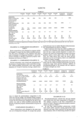
- the rubber-modified polystyrene (A) and the rubber-modified polystyrene (B) are mixed in the ratios shown in Table 1.
- the mixtures were melted and blended in an extruder to obtain the resin composition.
- the gloss, Izod impact strength, flexural modulus of the resin composition were evaluated. Results are shown in Table 1.
- Rubber-modified polystyrene (A) containing small-diameter rubber particles and rubber-modified polystyrene (B) containing large-diameter rubber particles in appropriate ratios produces a composition offering excellent gloss, especially a high gloss value in the end-gate part, as well as high impact strength.
- Styrene monomers were mixed in the presence of polybutadiene, by controlling the stirring force.
- This process yield 3 kinds of rubber-modified polystyrene (B), with mean particle diameters of 0.6 micron, 0.9 micron, and 2.7 microns, having a salami structure, and in which the polybutadiene content was 12% by weight.
- the physical properties of the resulting compositions were evaluated as those obtained in Example 1, as shown in Table 2.
- rubber-modified polystyrene to be combined with rubber-modified polystyrene (A) has a mean particle diameter of greater than 1.9 microns, it produces an undesirable result, that is, a large gloss gradient (with a low gloss value at the end-gate part). Also, a mean particle diameter of less than 0.5 micron gives the undesirably low impact strength.
- Example 3 rubber-modified polystyrene (A) was replaced with a rubber-modified polystyrene having a salami structure with a mean particle diameter of 0.7 micron, and with a polybutadiene component, in the resin, constituting 9% by weight; and similar evaluations were conducted.
- the results are shown in Table 2. The results indicate undesirably large gloss gradient.
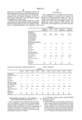
- the rubber-modified polystyrene (A) and the rubber-modified polystyrene (B) are mixed to produce resin compositions similar to Examples 2 and 3. Their physical properties were measured. The results are shown in Table 3. The products exhibit superior impact strength, and especially high gloss values at the end-gate part.
- Example 5 The same procedures were used as in Example 5, except that 0.08 part by weight of polydimethylsiloxane, of which viscosity is 500 centistokes, was added to 100 parts by weight in total of rubber-modified polystyrene (A) and rubber-modified polystyrene (B). Results of physical property measurements of these compositions are given in Table 3. Compared with Example 5, the results show significant improvements in impact strength, in addition to superior gloss.
- Example 7 The same procedures were employed as in Example 7, except that rubber-modified polystyrene (A) and rubber-modified polystyrene (B) were mixed in the same ratio as the ratio used in Example 6. Results of physical property measurements of these constituents are given in Table 3. Compared with Example 6, the results show significant improvements in impact strength, in addition to superior gloss.
- Resin compositions were obtained by mixing 0.05 part by weight of polydimethylsiloxane with 100 parts by weight each of the polystyrene (B) and polystyrene (A) used in Example 7, and physical properties of the products were measured. Results are shown in Table 3. Addition of polydimethylsiloxane to polystyrene (A) alone does not yield products with high impact strength. Similarly, polystyrene (B) alone does not yield products with a high gloss value.
- Resin compositions were obtained in a manner similar to Example 8, except that the rubber-modified polystyrene (B) used in Example 8 was replaced with those used in Example 4, Comparison Example 3, and Comparison Example 4. Results of physical property measurements are shown in Table 4.
- Styrene monomers were mixed and polymerized in the presence of polybutadiene under controlled stirring.
- Resin compositions were obtained in the same manner as in Example 8, except that the polystyrene obtained by the above procedure was used as rubber-modified polystyrene (B). Results of physical property measurements are given in Table 4.
- Table 4 indicates that when the rubber-modified polystyrene to be combined with rubber-modified polystyrene (A) has a mean particle diameter in excess of 2 microns, the result is an undesirable increase in the gloss gradient (with a lower gloss value at the end gate). Also, the Table shows that when the mean particle diameter is as low as 0.6 micron, there is an undesirable decrease in impact strength.
- the rubber-modified polystyrene as such small particles and large particles contains appropriate amounts of both mineral oil and zinc stearate, in addition to polydimethylsiloxane, the composition with substantially high impact strength (Example 23).
- Resin compositions were obtained in the same manner as in Example 16, except that zinc stearate was replaced by ethylene-bis-stearyl amide, such that its content in the compositions was adjusted to 0.5% by weight.
- the results were: Izod impact strength: 10.2 Kg.cm/cm; flexural modulus: 21,200 Kg/cm 2 ; and Gloss; 97% at the end-gate part and 99% at the gate part.
Landscapes
- Chemical & Material Sciences (AREA)
- Health & Medical Sciences (AREA)
- Chemical Kinetics & Catalysis (AREA)
- Medicinal Chemistry (AREA)
- Polymers & Plastics (AREA)
- Organic Chemistry (AREA)
- Compositions Of Macromolecular Compounds (AREA)
- Graft Or Block Polymers (AREA)
Applications Claiming Priority (5)
| Application Number | Priority Date | Filing Date | Title |
|---|---|---|---|
| JP63087305A JPH01261444A (ja) | 1988-04-11 | 1988-04-11 | 光沢と耐衝撃性に優れたポリスチレン樹脂組成物 |
| JP63-87305 | 1988-04-11 | ||
| JP63-102769 | 1988-04-27 | ||
| JP63102769A JPH01275649A (ja) | 1988-04-27 | 1988-04-27 | 光沢と耐衝撃性に優れたゴム変性ポリスチレン樹脂組成物 |
| SG113094A SG113094G (en) | 1988-04-11 | 1994-08-13 | Rubber-modified polystyrene resin composition |
Publications (1)
| Publication Number | Publication Date |
|---|---|
| US5039714A true US5039714A (en) | 1991-08-13 |
Family
ID=27305475
Family Applications (1)
| Application Number | Title | Priority Date | Filing Date |
|---|---|---|---|
| US07/335,373 Expired - Lifetime US5039714A (en) | 1988-04-11 | 1989-04-10 | Rubber-modified polystyrene resin composition |
Country Status (4)
| Country | Link |
|---|---|
| US (1) | US5039714A (de) |
| EP (1) | EP0337569B2 (de) |
| CA (1) | CA1335524C (de) |
| SG (1) | SG113094G (de) |
Cited By (15)
| Publication number | Priority date | Publication date | Assignee | Title |
|---|---|---|---|---|
| US5294656A (en) * | 1992-03-10 | 1994-03-15 | Sumitomo Chemical Company, Limited | Rubber modified styrene based resin composition |
| US5362436A (en) * | 1993-06-22 | 1994-11-08 | The Dow Chemical Company | Polystyrene foam sheet useful for forming deep drawn articles, a process to produce those articles, and the deep drawn articles |
| US5428106A (en) * | 1993-09-02 | 1995-06-27 | The Dow Chemical Company | Rubber modified polystyrene |
| US5488081A (en) * | 1993-11-04 | 1996-01-30 | Lord Corporation | Highly damped organic elastomer composition |
| US5504139A (en) * | 1992-07-08 | 1996-04-02 | Kawasaki Chemical Holding Co., Inc. | Toughened polymeric compositions and methods of improving friction and wear properties of tribological systems |
| US5510419A (en) * | 1994-09-16 | 1996-04-23 | National Rubber Technology Inc. | Polymer-modified rubber composition |
| WO1996017016A1 (en) * | 1994-11-30 | 1996-06-06 | Chevron Chemical Company | Styrenic polymer resins achieving improved gloss and impact resistance |
| US5902845A (en) * | 1995-03-01 | 1999-05-11 | Sumitomo Chemical Company, Limited | Rubber-modified styrenic resin composition and its molded article |
| US5985997A (en) * | 1997-05-23 | 1999-11-16 | Chevron Chemical Company | In situ process for making a bimodal HIPS having both high gloss and high impact strength |
| US6011117A (en) * | 1997-02-11 | 2000-01-04 | Basf Corporation | High gloss, high impact polystyrene composition |
| US6160052A (en) * | 1995-10-31 | 2000-12-12 | Nippon Steel Chemical Co., Ltd. | Rubber-modified aromatic vinyl resin composition and process for the production thereof |
| US6380305B1 (en) * | 1997-12-19 | 2002-04-30 | Basf Corporation | High impact resistant, high gloss, and high environmental stress crack resistant polymeric compositions |
| US6737453B2 (en) * | 1999-12-09 | 2004-05-18 | Techno Polymer Co., Ltd. | Flame retardant thermoplastic resin composition |
| US6887938B2 (en) | 2003-02-04 | 2005-05-03 | General Electric Company | Compositions containing polyphenylene ether and/or polystyrene having improved tribological properties and methods for improving tribological properties of polyphenylene ether and/or polystyrene compositions |
| US20070149686A1 (en) * | 2003-07-11 | 2007-06-28 | Polimeri Europa S.P.A. | Rubber-reinforced vinyl aromatic polymers |
Families Citing this family (2)
| Publication number | Priority date | Publication date | Assignee | Title |
|---|---|---|---|---|
| KR100443211B1 (ko) | 2001-10-19 | 2004-08-04 | 제일모직주식회사 | 고광택 및 고내충격성을 갖는 고무변성 폴리스티렌수지조성물의 제조방법 |
| EP2230260A1 (de) | 2009-03-10 | 2010-09-22 | Total Petrochemicals Research Feluy | Gummimodifizierte monovinylaromatische Polymerzusammensetzung |
Citations (7)
| Publication number | Priority date | Publication date | Assignee | Title |
|---|---|---|---|---|
| JPS553494A (en) * | 1978-06-23 | 1980-01-11 | Bayer Ag | Abs polymer having high notchhshock strength |
| JPS57172948A (en) * | 1981-04-17 | 1982-10-25 | Mitsui Toatsu Chem Inc | Rubber-modified styrene resin composition |
| JPS57187346A (en) * | 1981-05-14 | 1982-11-18 | Mitsui Toatsu Chem Inc | Improved rubber-modified styrene resin composition |
| JPS57187345A (en) * | 1981-05-12 | 1982-11-18 | Mitsui Toatsu Chem Inc | Rubber-modified styrene resin composition |
| US4493922A (en) * | 1980-09-20 | 1985-01-15 | Basf Aktiengesellschaft | Impact-resistant thermoplastic molding material |
| JPS61183339A (ja) * | 1985-02-12 | 1986-08-16 | Asahi Chem Ind Co Ltd | 改良されたゴム変性ポリスチレン組成物 |
| JPS61183341A (ja) * | 1985-02-12 | 1986-08-16 | Asahi Chem Ind Co Ltd | ゴム補強ポリスチレン組成物 |
-
1989
- 1989-04-07 CA CA000595991A patent/CA1335524C/en not_active Expired - Fee Related
- 1989-04-10 US US07/335,373 patent/US5039714A/en not_active Expired - Lifetime
- 1989-04-10 EP EP89200897A patent/EP0337569B2/de not_active Expired - Lifetime
-
1994
- 1994-08-13 SG SG113094A patent/SG113094G/en unknown
Patent Citations (7)
| Publication number | Priority date | Publication date | Assignee | Title |
|---|---|---|---|---|
| JPS553494A (en) * | 1978-06-23 | 1980-01-11 | Bayer Ag | Abs polymer having high notchhshock strength |
| US4493922A (en) * | 1980-09-20 | 1985-01-15 | Basf Aktiengesellschaft | Impact-resistant thermoplastic molding material |
| JPS57172948A (en) * | 1981-04-17 | 1982-10-25 | Mitsui Toatsu Chem Inc | Rubber-modified styrene resin composition |
| JPS57187345A (en) * | 1981-05-12 | 1982-11-18 | Mitsui Toatsu Chem Inc | Rubber-modified styrene resin composition |
| JPS57187346A (en) * | 1981-05-14 | 1982-11-18 | Mitsui Toatsu Chem Inc | Improved rubber-modified styrene resin composition |
| JPS61183339A (ja) * | 1985-02-12 | 1986-08-16 | Asahi Chem Ind Co Ltd | 改良されたゴム変性ポリスチレン組成物 |
| JPS61183341A (ja) * | 1985-02-12 | 1986-08-16 | Asahi Chem Ind Co Ltd | ゴム補強ポリスチレン組成物 |
Non-Patent Citations (4)
| Title |
|---|
| "Modern Plastics", 11/72, pp. 114-115. |
| "Plastics Age", 1974, vol. 20, May, p. 107. |
| Modern Plastics , 11/72, pp. 114 115. * |
| Plastics Age , 1974, vol. 20, May, p. 107. * |
Cited By (23)
| Publication number | Priority date | Publication date | Assignee | Title |
|---|---|---|---|---|
| US5294656A (en) * | 1992-03-10 | 1994-03-15 | Sumitomo Chemical Company, Limited | Rubber modified styrene based resin composition |
| US5504139A (en) * | 1992-07-08 | 1996-04-02 | Kawasaki Chemical Holding Co., Inc. | Toughened polymeric compositions and methods of improving friction and wear properties of tribological systems |
| US5750620A (en) * | 1992-07-08 | 1998-05-12 | Kawasaki Chemical Holding Co., Inc. | Toughened polymeric compositions and methods of improving friction and wear properties of tribological systems |
| AP569A (en) * | 1993-06-22 | 1996-11-25 | Solo Cup Co | Polystyrene foam sheet and process of making same. |
| US5362436A (en) * | 1993-06-22 | 1994-11-08 | The Dow Chemical Company | Polystyrene foam sheet useful for forming deep drawn articles, a process to produce those articles, and the deep drawn articles |
| US5364696A (en) * | 1993-06-22 | 1994-11-15 | The Dow Chemical Company | Polystyrene foam sheet useful for forming deep drawn articles, a process to produce those articles, and the deep drawn articles |
| WO1995000320A1 (en) * | 1993-06-22 | 1995-01-05 | The Dow Chemical Company | Polystyrene foam sheet and process of making same |
| RU2133671C1 (ru) * | 1993-06-22 | 1999-07-27 | Дзе Дау Кемикал Компани | Вспененный лист полистирола, способ термоформования глубоко вытянутых изделий из вспененного термопласта и глубоко вытянутое изделие, выполненное из вспененного листа термопласта |
| US5428106A (en) * | 1993-09-02 | 1995-06-27 | The Dow Chemical Company | Rubber modified polystyrene |
| US5491195A (en) * | 1993-09-02 | 1996-02-13 | The Dow Chemical Company | Rubber modified polystyrene |
| US5488081A (en) * | 1993-11-04 | 1996-01-30 | Lord Corporation | Highly damped organic elastomer composition |
| US5510419A (en) * | 1994-09-16 | 1996-04-23 | National Rubber Technology Inc. | Polymer-modified rubber composition |
| US5633318A (en) * | 1994-11-30 | 1997-05-27 | Chevron Chemical Company | Sytrenic polymer resins achieving improved gloss and impact resistance |
| WO1996017016A1 (en) * | 1994-11-30 | 1996-06-06 | Chevron Chemical Company | Styrenic polymer resins achieving improved gloss and impact resistance |
| US5902845A (en) * | 1995-03-01 | 1999-05-11 | Sumitomo Chemical Company, Limited | Rubber-modified styrenic resin composition and its molded article |
| US6160052A (en) * | 1995-10-31 | 2000-12-12 | Nippon Steel Chemical Co., Ltd. | Rubber-modified aromatic vinyl resin composition and process for the production thereof |
| US6011117A (en) * | 1997-02-11 | 2000-01-04 | Basf Corporation | High gloss, high impact polystyrene composition |
| US5985997A (en) * | 1997-05-23 | 1999-11-16 | Chevron Chemical Company | In situ process for making a bimodal HIPS having both high gloss and high impact strength |
| US6380305B1 (en) * | 1997-12-19 | 2002-04-30 | Basf Corporation | High impact resistant, high gloss, and high environmental stress crack resistant polymeric compositions |
| US6737453B2 (en) * | 1999-12-09 | 2004-05-18 | Techno Polymer Co., Ltd. | Flame retardant thermoplastic resin composition |
| US6887938B2 (en) | 2003-02-04 | 2005-05-03 | General Electric Company | Compositions containing polyphenylene ether and/or polystyrene having improved tribological properties and methods for improving tribological properties of polyphenylene ether and/or polystyrene compositions |
| US20070149686A1 (en) * | 2003-07-11 | 2007-06-28 | Polimeri Europa S.P.A. | Rubber-reinforced vinyl aromatic polymers |
| US7906576B2 (en) * | 2003-07-11 | 2011-03-15 | Polimeri Europa S.P.A. | Rubber-reinforced vinyl aromatic polymers |
Also Published As
| Publication number | Publication date |
|---|---|
| EP0337569B2 (de) | 1996-09-11 |
| CA1335524C (en) | 1995-05-09 |
| EP0337569A1 (de) | 1989-10-18 |
| SG113094G (en) | 1995-03-17 |
| EP0337569B1 (de) | 1993-02-10 |
Similar Documents
| Publication | Publication Date | Title |
|---|---|---|
| EP0337569B1 (de) | Kautschukmodifizierte Polystyrolharzzusammensetzung | |
| EP2157129B1 (de) | Thermoplastische Acrylnitril-Butadien-Styrol-Harzzusammensetzung mit ausgezeichneter Freigabefähigkeit und Färbbarkeit | |
| US8232342B2 (en) | Transparent ABS resin composition having excellent impact strength and flowability | |
| CA1137670A (en) | Abs-polymers of high notched impact strength | |
| CA2376451C (en) | Thermoplastic molding compounds | |
| JPH0463099B2 (de) | ||
| JPH0456061B2 (de) | ||
| KR100574324B1 (ko) | 내충격성 및 자연색상이 우수한 열가소성 수지의 제조방법 | |
| US5294656A (en) | Rubber modified styrene based resin composition | |
| US4870131A (en) | Low gloss molding composition | |
| JPH01318060A (ja) | 耐衝撃性熱可塑性樹脂組成物 | |
| JPH0423661B2 (de) | ||
| JP2002509970A (ja) | 高い貫通抵抗力および良好な帯電防止性能を有する熱可塑性成形材料 | |
| JPH0525897B2 (de) | ||
| US4895891A (en) | Mat, elastic-thermoplastic moulding compounds | |
| KR920001046B1 (ko) | 고무-변성된 폴리스티렌 수지 조성물 | |
| JPS6351460B2 (de) | ||
| HK31894A (en) | Rubber-modified polystyrene resin composition | |
| JPS6326774B2 (de) | ||
| JPH0376338B2 (de) | ||
| JPH0511142B2 (de) | ||
| JPH0518348B2 (de) | ||
| JPS60130613A (ja) | ゴム変性された芳香族モノビニル重合体樹脂組成物 | |
| JPS62220538A (ja) | 高光沢ゴム変性ポリスチレン組成物 | |
| KR100376279B1 (ko) | 성형성이 개선된 내충격, 내열 저광택성 수지조성물 |
Legal Events
| Date | Code | Title | Description |
|---|---|---|---|
| AS | Assignment |
Owner name: ASAHI KASEI KOGYO KABUSHIKI KAISHA, 2-6, DOJIMAHAM Free format text: ASSIGNMENT OF ASSIGNORS INTEREST.;ASSIGNORS:KASAHARA, HIDEO;SAKAMOTO, MASASHI;ISHIKAWA, HIROAKI;AND OTHERS;REEL/FRAME:005062/0113 Effective date: 19890328 |
|
| STCF | Information on status: patent grant |
Free format text: PATENTED CASE |
|
| FEPP | Fee payment procedure |
Free format text: PAYOR NUMBER ASSIGNED (ORIGINAL EVENT CODE: ASPN); ENTITY STATUS OF PATENT OWNER: LARGE ENTITY |
|
| CC | Certificate of correction | ||
| FPAY | Fee payment |
Year of fee payment: 4 |
|
| FPAY | Fee payment |
Year of fee payment: 8 |
|
| FPAY | Fee payment |
Year of fee payment: 12 |