US5831084A - Oxytitanium phthalocyanine crystal - Google Patents
Oxytitanium phthalocyanine crystal Download PDFInfo
- Publication number
- US5831084A US5831084A US08/864,976 US86497697A US5831084A US 5831084 A US5831084 A US 5831084A US 86497697 A US86497697 A US 86497697A US 5831084 A US5831084 A US 5831084A
- Authority
- US
- United States
- Prior art keywords
- oxytitanium phthalocyanine
- crystal
- phthalocyanine crystal
- photoreceptor
- charge
- Prior art date
- Legal status (The legal status is an assumption and is not a legal conclusion. Google has not performed a legal analysis and makes no representation as to the accuracy of the status listed.)
- Expired - Lifetime
Links
Images




Classifications
-
- C—CHEMISTRY; METALLURGY
- C09—DYES; PAINTS; POLISHES; NATURAL RESINS; ADHESIVES; COMPOSITIONS NOT OTHERWISE PROVIDED FOR; APPLICATIONS OF MATERIALS NOT OTHERWISE PROVIDED FOR
- C09B—ORGANIC DYES OR CLOSELY-RELATED COMPOUNDS FOR PRODUCING DYES, e.g. PIGMENTS; MORDANTS; LAKES
- C09B47/00—Porphines; Azaporphines
-
- G—PHYSICS
- G03—PHOTOGRAPHY; CINEMATOGRAPHY; ANALOGOUS TECHNIQUES USING WAVES OTHER THAN OPTICAL WAVES; ELECTROGRAPHY; HOLOGRAPHY
- G03G—ELECTROGRAPHY; ELECTROPHOTOGRAPHY; MAGNETOGRAPHY
- G03G5/00—Recording-members for original recording by exposure, e.g. to light, to heat or to electrons; Manufacture thereof; Selection of materials therefor
- G03G5/02—Charge-receiving layers
- G03G5/04—Photoconductive layers; Charge-generation layers or charge-transporting layers; Additives therefor; Binders therefor
- G03G5/06—Photoconductive layers; Charge-generation layers or charge-transporting layers; Additives therefor; Binders therefor characterised by the photoconductive material being organic
- G03G5/0664—Dyes
- G03G5/0696—Phthalocyanines
-
- C—CHEMISTRY; METALLURGY
- C09—DYES; PAINTS; POLISHES; NATURAL RESINS; ADHESIVES; COMPOSITIONS NOT OTHERWISE PROVIDED FOR; APPLICATIONS OF MATERIALS NOT OTHERWISE PROVIDED FOR
- C09B—ORGANIC DYES OR CLOSELY-RELATED COMPOUNDS FOR PRODUCING DYES, e.g. PIGMENTS; MORDANTS; LAKES
- C09B67/00—Influencing the physical, e.g. the dyeing or printing properties of dyestuffs without chemical reactions, e.g. by treating with solvents grinding or grinding assistants, coating of pigments or dyes; Process features in the making of dyestuff preparations; Dyestuff preparations of a special physical nature, e.g. tablets, films
- C09B67/0001—Post-treatment of organic pigments or dyes
- C09B67/0014—Influencing the physical properties by treatment with a liquid, e.g. solvents
-
- C—CHEMISTRY; METALLURGY
- C09—DYES; PAINTS; POLISHES; NATURAL RESINS; ADHESIVES; COMPOSITIONS NOT OTHERWISE PROVIDED FOR; APPLICATIONS OF MATERIALS NOT OTHERWISE PROVIDED FOR
- C09B—ORGANIC DYES OR CLOSELY-RELATED COMPOUNDS FOR PRODUCING DYES, e.g. PIGMENTS; MORDANTS; LAKES
- C09B67/00—Influencing the physical, e.g. the dyeing or printing properties of dyestuffs without chemical reactions, e.g. by treating with solvents grinding or grinding assistants, coating of pigments or dyes; Process features in the making of dyestuff preparations; Dyestuff preparations of a special physical nature, e.g. tablets, films
- C09B67/0025—Crystal modifications; Special X-ray patterns
- C09B67/0026—Crystal modifications; Special X-ray patterns of phthalocyanine pigments
Definitions
- the present invention relates a oxytitanium phthalocyanine crystal and, more particularly, to a oxytitanium phthalocyanine crystal suitable for use in a photoreceptor for electrophotography.
- Phthalocyanine has large thermal and chemical stability and is relatively easily synthesized so that it is used in a wide variety of fields such as coloring pigments for paint, ink and resin, as well as catalysts, photoreceptors for electrophotography, solar batteries, sensors etc.
- a printer using an electrophotographic technique remarkably developed recently. It generally employs a semiconductor laser as a light source. Photoreceptors having sufficient sensitivity to the wavelengths of semiconductor lasers currently used, around 790 nm, are actively developed.
- the sensitivity of the photoreceptor for electrophotography depends on the charge-generation materials in the photoreceptor.
- the photoreceptor containing phthalocyanine charge-generation material often have an excellent sensitivities to those wavelengths.
- Phthalocyanines have a large variety of crystal structures depending on small differences in the condition of the fabrication process and have large differences in the photosensitivity depending on the crystal structures.
- oxytitanium phthalocyanine which exhibits an excellent photosensitivity to light having wavelength around 790 nm
- phthalocyanine When phthalocyanine is used in a variety of applications, especially, in the photoreceptor for electrophotography, it is most likely that the phthalocyanine is used as a thin film.
- the thin film made of phthalocyanine is generally formed by vacuum deposition method or by coating method. In the case of coating method, phthalocyanine amine is used with binder resin.
- the coating of the dispersed phthalocyanine is preferred and widely used due to the simple process and a low cost.
- the dispersed-phthalocyanine film is inferior to the vacuum deposited phthalocyanine film in uniformity of the film due to its structure.
- phthalocyanine and a phthalocyanine derivative having electron-withdrawing group are admixed to an organic acid and precipitated by water or a bad solvent to obtain a phthalocyanine composite having small grain size and a narrow distribution thereof.
- the present invention also provides a method for manufacturing the same and a photoreceptor made therefrom.
- the oxytitanium phthalocyanine crystal thus manufactured exhibited, in measurement of Bragg angle 2 ⁇ 0.2° by CuK ⁇ characteristic X-ray diffraction, strong peaks at approximately 9.6° , 24.2° and 27.3° and weak and broad peaks at approximately 11.6°, 13.5°, 14.3° and 18.1°.
- the oxytitanium phthalocyanine crystal can be obtained by stirring non-crystal grains of oxytitanium phthalocyanine in triether organic solvent.
- the present invention also provides a photoreceptor which incorporates the oxytitanium phthalocyanine crystal as described above in a coating layer overlying an electric conductive substrate.
- FIG. 1 is a typical X-ray diffraction pattern of T-1000 oxytitanium phthalocyanine crystal
- FIGS. 2 to 9 are sectional views each of a photoreceptor according to an embodiment of the present invention.
- FIG. 10 is an example of an X-ray diffraction pattern of a non-crystal oxytitanium phthalocyanine grains used in the present invention.
- FIG. 11 is another X-ray diffraction pattern of an oxytitanium phthalocyanine crystal manufactured by the process according to a first embodiment of the present invention.
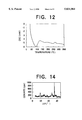
- FIG. 12 is a result of differential scanning calorimetry of the oxytitanium phthalocyanine crystal manufactured by the process according to the first embodiment of the present invention.
- FIG. 13 is a SEM photograph of the oxytitanium phthalocyanine crystal manufacture by the process according to the first embodiment of the present invention.
- FIG. 14 is an X-ray diffraction pattern of the oxytitanium phthalocyanine crystal manufactured by a process according to a process according to a second embodiment of the present invention.
- FIG. 15 is a result of differential scanning calorimetry of the oxytitanium phthalocyanine crystal manufactured by the process according to the second embodiment of the present invention.
- FIG. 16 is a SEM photograph of the oxytitanium phthalocyanine crystal manufactured by the process according to the second embodiment of the present invention.
- FIG. 17 is an X-ray diffraction pattern of the oxytitanium phthalocyanine crystal manufactured by the process according to a first comparative example
- FIG. 18 is a result of differential scanning calorimetry of the oxytitanium phthalocyanine crystal manufactured by the process according to the first comparative example.
- FIG. 19 is a SEM photograph of the oxytitanium phthalocyanine crystal manufactured by the process according to the first comparative example.
- the oxytitanium phthalocyanine crystal according to the present invention has a chemical structure as follows: ##STR1##
- the oxytitanium phthalocyanine having the structure as recited above can be easily prepared by known methods.
- the method may be as follows, but not limited thereto in manufacture of the oxytitanium phthalocyanine crystal according to the present invention.
- titanium tetrachloride is reacted with orthophthalodinitrile in an organic solvent to prepare dichlorotitanium phthalocyanine.
- organic solvents for this purpose include an organic solvent having a high boiling point and inactive to reaction, such as nitrobenzene, quinoline, ⁇ -chloronaphthalene, ⁇ -chloronaphthalene, ⁇ -methylnaphthalene, methoxynaphthalene, diphenylmethane, diphenylethane, ethyleneglycoldialkylether, diethyleneglycoldialkylether, triethyleneglycoldialkylether etc.
- Reaction proceeds, preferably at 150° C. to 300° C., and more preferably at 200° C. to 250° C.
- the coarse oxytitanium phthalocyanine thus prepared is washed with a solvent, such as ⁇ -chloronaphthalene, trichlorobenzene, dichlorobenzene, N-methylpyrrolidone, and N,N-dimethylformamide. Then, it is washed with a solvent such as methanol or ethanol and hydrogenated by hot water to prepare blue oxytitanium phthalocyanine.
- a solvent such as ⁇ -chloronaphthalene, trichlorobenzene, dichlorobenzene, N-methylpyrrolidone, and N,N-dimethylformamide.
- the non-crystal grains of oxytitanium phthalocyanine as used in the present invention are prepared by acid-pasting, dry milling, or wet milling of oxytitanium phthalocyanine, but not limited thereto.
- the non-crystal grains may be in any form such as a dried state or in the form of water paste.
- triether organic solvent examples are diethyleneglycoldimethylether, diethyleneglycoldiethylether, diethyleneglycoldibutylether, dipropyleneglycoldimethylether, dipropyreneglycoldiethylether, 2,5-dimethoxytetrahydrofuran, 2,5-diethoxytetrahydrofuran, 2,5-dimethoxy-2,5-dihydrotetrahydrofuran, and 2,5-diethoxy-2,5-dihydrotetrahydrofuran, but not limited thereto.
- the triether organic solvent as used herein should have three ether bonds in a molecule, and can be used alone or in combination of two or more of them. Moreover, mixture of these solvents and water may also be used.
- the oxytitanium phthalocyanine crystal has, in a Bragg angle 2 ⁇ 0.2° by CuK ⁇ characteristic X-ray diffraction, strong peaks at 9.6°, 24.2° and 27.3° and weak and broad peaks at 11.6°, 13.5°, 14.3° and 18.1° and referred to as T-1000 type.
- the oxytitanium phthalocyanine crystal can be obtained by stirring non-crystal fine grains of oxytitanium phthalocyanine described above in a beaker in the presence of a triether solvent by using a stirrer such as a stirring paddle, stirring screw and a stirring motor.
- X-ray diffraction pattern of the oxytitanium phthalocyanine crystal is shown in FIG. 1.
- the weight ratio of the triether organic solvent and oxytitanium phthalocyanine may be arbitrary, and is preferably between 10:1 and 200:1. Smaller amount of solvent increases the viscosity of the dispersed system to be treated so that a uniform treatment is difficult. On the other hand, a larger amount of solvent reduces the amount of oxytitanium phthalocyanine treated in a volume to thereby reduce productivity.
- the oxytitanium phthalocyanine crystal thus obtained is superior in the photo-conductivity so that it can be suitably used in a photoreceptor for electrophotography, solar battery, sensor and switching device.
- the photoreceptor for electrophotography is manufactured by consecutively laminating a blocking layer, a charge-generation layer and a charge-transport layer on a conductive substrate.
- a blocking layer may be such that the blocking layer, charge-transport layer and charge-generation layer are consecutively laminated on the substrate, or a charge-generation material and a charge-transport material are dispersed in a binder resin which is applied onto the blocking layer.
- the blocking layer may be omitted if desired.
- an overcoat layer or protective layer may be formed as a top layer.
- a resultant charge-generation layer By coating the oxytitanium phthalocyanine crystal which is suitable as a charge-generation material according to the present invention onto a substrate together with a binder resin, a resultant charge-generation layer exhibits a high photosensitivity to a longer wavelength and achieves a small residual potential and a small dark decay.
- This coating is effected by a spin-coater, applicator, spray-coater, bar-coater, dip-coater, doctor blade, roller-coater, curtain-coater, bead-coater, slide-hopper etc., which are well-known in the art.
- the drying of the coated layer is preferably effected in a thermally drying process at a temperature between 40° C. and 300° C., more preferably between 60° C. and 200° C., for a time period between two minutes and ten hours, more preferably between ten minutes and six hours, in an ambience of a still air or blow air.
- the solvent for dispersion of the oxytitanium phthalocyanine crystal depends on the kind of resin used. And the solvent should not ill-affect the blocking layer as described later in the coating step.
- the solvent for dispersion of oxytitanium phthalocyanine crystal may be preferably selected from: triethers such as diethyleneglycoldimethylether, diethyleneglycoldiethylether, diethyleneglycoldibutylether, dipropyleneglycoldimethylether, dipropyreneglycoldiethylether, 2,5-dimethoxytetrahydrofuran, 2,5-diethoxytetrahydrofuran, 2,5-dimethoxy-2,5-dihydrofuran, and 2,5-diethoxy-2,5-dihydrofuran; aromatic hydrocarbons such as benzene, toluene, xylene, ligroine, monochlorobenzene, and dichlorobenzene; ketones such as acetone, methylehtylketone, methylisobutylketone, and cyclohexanone; alcohols such as methanol, ethanol, and isopropanol
- the charge generation layer has a thickness preferably between 0.01 ⁇ m and 10 ⁇ m, and more preferably between 0.1 ⁇ m and 3 ⁇ m.
- Plasticizers, charge-acceptor or charge-donor may be used together with binders if desired.
- the charge-transport material used in a charge-transport layer may be selected from inorganic material such as selenium (Se) ,cadmium sulfide (CdS),zinc oxide (ZnO), amorphous silicon (a-Si), and organic compounds such as diarylalkane derivatives, stilbene compounds, triphenylamine derivatives, hydrazone compounds, but not limited thereto.
- inorganic material such as selenium (Se) ,cadmium sulfide (CdS),zinc oxide (ZnO), amorphous silicon (a-Si), and organic compounds such as diarylalkane derivatives, stilbene compounds, triphenylamine derivatives, hydrazone compounds, but not limited thereto.
- Binder resins for obtaining the charge-transport layer in coating process can be selected from a variety of known insulator resins generally used in the art. Or otherwise, the binder resin may be selected from organic photoconductive polymers such as polyvinylcarbazole resin, polyvinyl anthracene resin, and polyvinylpyrene resin.
- the binder resin may be selected from insulator resins such as polyvinyl butyral resin, polyallyrate resin, polycarbonate resin, polyester resin, polyester carbonate resin, phenoxy resin, polyvinyl acetate, acrylic resin, polyacrylamide resin, polyamide resin, polyvinyl pyridine resin, cellulose resin, urethane resin, epoxy resin, silicon resin, polystyrene resin, polyether resin, polythioether resin, polyketone resin, polyvinyl chloride resin, vinyl chloride-vinyl acetate copolymer, polyvinyl acetal resin, polyacrylonitrile resin, phenol resin, melamine resin, casein, polyvinyl alcohol resin, polyvinyl pyrrolidone resin, polysilane, but not limited thereto.
- the amount of resins contained in the charge-transport layer is preferably between 99% and 0% by weight, more preferably between 70% and 30% by weight. Those resins may be used alone or in combination of two or more of them.
- the solvent for the charge-transport material depends on the resins and is preferably selected from the materials which do not ill-affect in the coating step the blocking layer or charge-generation layer.
- the solvent may be preferably selected from: aromatic hydrocarbons such as benzene, toluene, xylene, ligroine, monochlorobenzene, and dichlorobenzene; ketones such as acetone, methylethylketone, and cyclohexanone; alcohols such as methanol, ethanol, and isopropanol; esters such as ethyl acetate and methylcellosolve; aliphatic halogenated hydrocarbon such as carbon tetrachloride, chloroform, dichloromethane, dichloroethane, and trichloroethylene; ethers such as tetrahydrofuran and dioxane; amides such as N,N-dimethylformamide and N,N-dimethylacetoamide; and surfoxide such as dimethylsurfoxide, but not limited thereto.
- aromatic hydrocarbons such as benzene, toluene, xylene, l
- the charge-transport layer in the photoreceptor for electrophotography should have a thickness preferably between 5 ⁇ m and 0 ⁇ m, and more preferably 10 ⁇ m and 30 ⁇ m. UV absorber, antioxidant, electron acceptor, and plasticizer may be added into the charge-transport layer if desired.
- the blocking layer may be made of a binder resin or a metallic oxide.
- Materials for the binder resin in the blocking layer may be any of them generally used in the art.
- the materials for the binder resin include alcohol-soluble polyamides such as nylon 6, nylon 66, nylon 11, nylon 610, nylon copolymers, alkoxymethylated nylon; cellulose resin such as casein, polyvinyl alcohol resin, ethyleneacrylic acid copolymer, vinyl chloride-vinyl acetate-maleic acid copolymer, epoxy resin, gelatin, polyurethane resin, polyvinyl butyral resin, nitrocellulose, and carboxymethyl cellulose. These compound may be used alone or in combination of two or more of them. An electron acceptor or electron donor may be added therein if desired.
- the binder resin is coated similarly to the case of charge-transport layer or charge-generation layer.
- the blocking layer should have a thickness preferably between 0.01 ⁇ m and 20 ⁇ m, and more preferably between 0.2 ⁇ m and 10 ⁇ m.
- the metal oxides for the blocking layer may be any of them generally used in the art, such as aluminum or titanium oxide.
- the form of the metal oxide blocking layer may be a film dispersed in the binder resin or oxide film formed on the surface of a conductive substrate. Further, the blocking layer itself may be omitted.
- the photoreceptor for electrophotography can be used not only for a copying machine, printer and facsimile, but also for electrophotographic makeup, photoelectric conversion elements for a solar battery or electroluminescence device and materials for an optical disk.
- the photoreceptor for electrophotography according to the present invention may be used in any form such as a plate, cylinder or film as used in a conventional photoreceptor for electrophotography.
- the photoreceptor according to the present invention may be formed in any of the structures shown in FIGS. 2 to 9.
- the photoreceptor comprises a electric conductive substrate 11, on which a photoreceptor laminate 14 including a charge-generation layer 12 containing a charge-generation material as a main component and a charge-transport layer 13 containing a charge-transport material as a main component.
- the photoreceptors shown in these figures are similar to those shown in FIGS. 2 and 3, respectively, except for a blocking layer 15, which is formed on the conductive substrate 11.
- the two-layer structure of the photoreceptor laminate 14 shown in FIGS. 2 to 5 has an excellent characteristic and is most suited for electrophotography.
- the photoreceptors shown in these figures are similar to those shown in FIGS. 2 and 4, respectively, except for the single layer structure of the photoreceptor layer 16.
- the photoreceptor layer 16 contains a charge-transport material as a main component and a charge-generation material dispersed in the single layer 16.
- the photoreceptors shown in FIGS. 8 and 9 are similar to those shown in FIGS. 2 and 5, respectively, except for a protective layer or overcoat layer 18 formed on the photoreceptor laminate 14.
- the oxytitanium phthalocyanine crystal according to the present invention may be used in combination with another charge-generation material if desired.
- Samples for the oxytitanium phthalocyanine crystal according to the present invention were manufactured and tested for their characteristics together with comparative Samples as follows.
- the sulfuric acid solution thus obtained was so slowly admixed with 2000 parts by weight water maintained below 18° C. that the temperature of the whole liquid was maintained below 20° C. Resultant blue crystal was taken out by filtration and neutralized by washing with water.
- the results of measurement by CuK ⁇ characteristic X-ray diffraction are shown in FIG. 10.
- the oxytitanium phthalocyanine thus obtained was in an amorphous state, as illustrated in the figure.
- the oxytitanium phthalocyanine crystal which was taken out from the beaker as a solid ingredient in the dispersed liquid and dried, exhibited strong peaks at 9.6°, 24.2° and 27.3°, and weak and broad peaks at 11.6°, 13.5°, 14.3° and 18.1° in Bragg angle 2 ⁇ 0.2° by CuK ⁇ characteristic X-ray diffraction.
- the differential scanning calorimetry for the oxytitanium phthalocyanine crystal showed an exothermic peak of 1.1 J(joule)/g at around 266° C. due to crystal structure transform. A SEM observation manifested that a maximum grain size of the crystals was 0.4 ⁇ m.
- FIGS. 11, 12 and 13 show the results of the measurements by CuK ⁇ characteristic X-ray diffraction, differential scanning calorimetry and SEM photography, respectively, for the oxytitanium phthalocyanine crystal of Sample #1.
- oxytitanium phthalocyanine crystal was obtained similarly to Sample #1 except for the triether solvent used for dispersion, which was dimethoxytetrahydrofuran for Sample #2.
- the oxytitanium phthalocyanine crystal which was taken out from the beaker as a solid ingredient in the dispersed liquid and dried, exhibited strong peaks at 9.6°, 24.2° and 27.3° and weak and broad peaks at 11.6°, 13.5°, 14.30° and 18.1°. in Bragg angle 2 ⁇ 0.2° by CuK ⁇ characteristic X-ray diffraction.
- the differential scanning calorimetry for the oxytitanium phthalocyanine crystal showed an exothermic peak of 1.1 J(joule) /g at around 266° C.
- FIGS. 14, 15 and 16 show the results for the CuK ⁇ characteristic X-ray diffraction, differential scanning calorimetry and SEM photography, respectively, for the oxytitanium phthalocyanine crystal of Sample #2.
- Comparative Sample of oxytitanium phthalocyanine crystal was obtained by adding tetrahydrofuran to 2 gram of the blue non-crystal oxytitanium phthalocyanine. The total volume was 200 ml.
- the oxytitanium phthalocyanine crystal which was stirred for 30 minutes, kept for a week, taken out as a solid ingredient in the dispersed liquid and dried, exhibited strong peaks at 9.6°, 14.3°, 24.2° and 27.3° and weak and broad peaks at 11.6°, 13.5°, 18.1° in Bragg angle 2 ⁇ 0.2° by CuK ⁇ characteristic X-ray diffraction.
- FIGS. 17, 18 and 19 show the results of the CuK ⁇ characteristic X-ray diffraction, differential scanning calorimetry and SEM photography, respectively, for the oxytitanium phthalocyanine crystal of Comparative Sample #1.
- Table 1 shows measurement in grain size and temperature of crystal structure transform for Samples #1 and #2 and Comparative Sample #1.
- a 0.2- ⁇ m thick undercoat layer made of methoxymethylated nylon (from Unichika corp., T-8) was formed on an aluminum substrate.
- 1.68 parts by weight oxytitanium phthalocyanine crystal from Sample #1, 1.12 parts by weight polyvinylbutyral (from Sekisui Chemical corp. BX-1) and 97.2 parts by weight diethyleneglicoldimethylether are admixed and coated onto the undercoat layer, followed by drying at 100° C. for 60 minute to form a 0.2 ⁇ m thick charge-generation layer.
- dichloroethane solution containing 1,1-bis(4-diethylaminophenyl)-4,4-diphenyl-1,3-butadiene and polycarbonate from Mitsubishi Gas Chemical corp. Yupilon Z-200
- a ratio of 0.8:1 was coated and dried at 80° C. for 60 minutes to form a 20 ⁇ m-thick charge-transfer layer, thereby obtaining a photoreceptor for electrophotography.
- Another photoreceptor was prepared similarly to Embodiment 1 except for a charge-generation layer, which was formed by admixing 2.1 parts by weight oxytitanium phthalocyanine crystal from Sample #2, 1.4 parts by weight polyvinylbutyral (from Sekisui Chemical corp. BX-1) and 96.5 parts by weight dimethoxytetrahydrofuran and applying the same.
- a charge-generation layer which was formed by admixing 2.1 parts by weight oxytitanium phthalocyanine crystal from Sample #2, 1.4 parts by weight polyvinylbutyral (from Sekisui Chemical corp. BX-1) and 96.5 parts by weight dimethoxytetrahydrofuran and applying the same.
- Another photoreceptor was prepared similarly to Embodiment 1 except for a charge-transport layer, which was formed by application of a dichloroethane solution containing 1-(4-bis(phenylmethyl)aminophenyl)-1-(4-diethylaminophenyl)-4,4-diphenyl-1,3-butadiene and polycarbonate (from Mitsubishi Gas Chemical Yupilon Z-200) at a ratio of 0.8:1 and applying the same.
- a dichloroethane solution containing 1-(4-bis(phenylmethyl)aminophenyl)-1-(4-diethylaminophenyl)-4,4-diphenyl-1,3-butadiene and polycarbonate (from Mitsubishi Gas Chemical Yupilon Z-200) at a ratio of 0.8:1 and applying the same.
- Another photoreceptor was prepared similarly to Embodiment 3 except for a charge-generation layer, which was formed by admixing 2.1 parts by weight oxytitanium phthalocyanine crystal from Sample #2, 1.4 parts by weight polyvinylbutyral (from Sekisui Chemical corp. BX-1) and 96.5 parts by weight dimethoxytetrahydrofuran, and applying the same.
- a charge-generation layer which was formed by admixing 2.1 parts by weight oxytitanium phthalocyanine crystal from Sample #2, 1.4 parts by weight polyvinylbutyral (from Sekisui Chemical corp. BX-1) and 96.5 parts by weight dimethoxytetrahydrofuran, and applying the same.
- Another photoreceptor was prepared similarly to Embodiment 1 except for a charge-transport layer, which was formed by applying a dichloroethane solution containing benzaldehyde-4-(bis(phenylmethyl)amnino)-2-methyl-diphenylhydrazone and polycarbonate at a ratio of 0.8:1 and applying the same.
- Another photoreceptor was prepared similarly to Embodiment 5 except for a charge-generation layer, which was formed by admixing 2.1 parts by weight oxytitanium phthalocyanine crystal from Sample #2, 1.4 parts by weight polyvinylbutyral (from Sekisui Chemical corp. BX-1) and 96.5 parts by weight dimethoxytetrahydrofuran, and applying the same.
- a charge-generation layer which was formed by admixing 2.1 parts by weight oxytitanium phthalocyanine crystal from Sample #2, 1.4 parts by weight polyvinylbutyral (from Sekisui Chemical corp. BX-1) and 96.5 parts by weight dimethoxytetrahydrofuran, and applying the same.
- Another photoreceptor was prepared similarly to Embodiment 1 except for a charge-transport layer, which was formed by applying a dichloroethane solution containing benzaldehyde-4-(bis(phenylmethyl)amnino)-2-methyl-diphenylhydrazone and 1,1-bis(4-diethylaminophyenyl)-4,4-diphenyl-1,3-butadiene and polycarbonate at a ratio of 0.4:0.4:1 and applying the same.
- Another photoreceptor was prepared similarly to Embodiment 7 except for a charge-generation layer, which was formed by admixing 2.1 parts by weight oxytitanium phthalocyanine crystal from Sample #2, 1.4 parts by weight polyvinylbutyral (from Sekisui Chemical corp. BX-1) and 96.5 parts by weight dimethoxytetrahydrofuran, and applying the same.
- a charge-generation layer which was formed by admixing 2.1 parts by weight oxytitanium phthalocyanine crystal from Sample #2, 1.4 parts by weight polyvinylbutyral (from Sekisui Chemical corp. BX-1) and 96.5 parts by weight dimethoxytetrahydrofuran, and applying the same.
- Another photoreceptor was prepared similarly to Embodiment 1 except for a charge-transport layer, which was formed by applying a dichloroethane solution containing benzaldehyde-4-(bis(phenylmethyl)amnino)-2-methyl-diphenylhydrazone and 1-(4bis(phenylmethyl)aminophenyl)-1-(4-diethylaminophyenyl)-4,4-diphenyl-1,3-butadiene and polycarbonate (from Mitsubishi Gas Chemical corp. Yupilon Z-200) at a ratio of 0.4:0.4:1 and applying the same.
- a charge-transport layer which was formed by applying a dichloroethane solution containing benzaldehyde-4-(bis(phenylmethyl)amnino)-2-methyl-diphenylhydrazone and 1-(4bis(phenylmethyl)aminophenyl)-1-(4-diethylaminophyenyl)-4,4-diphen
- Another photoreceptor was prepared similarly to Embodiment 9 except for a charge-generation layer, which was formed by admixing 2.1 parts by weight oxytitanium phthalocyanine crystal from Sample #2, 1.4 parts by weight polyvinylbutyral (from Sekisui Chemical corp. BX-1) and 96.5 parts by weight dimethoxytetrahydrofuran, and applying the same.
- a charge-generation layer which was formed by admixing 2.1 parts by weight oxytitanium phthalocyanine crystal from Sample #2, 1.4 parts by weight polyvinylbutyral (from Sekisui Chemical corp. BX-1) and 96.5 parts by weight dimethoxytetrahydrofuran, and applying the same.
- Another photoreceptor was prepared similarly to Embodiment 1 except for a charge-transport layer, which was formed by applying a dichloroethane solution containing benzaldehyde-4-(bis(phenylmethyl)amnino)-2-methyl-diphenylhydrazone, and 1-(4-bis(phenylmethyl)aminophenyl)-1-(4-diethylaminophyenyl)-4,4-diphenyl-1,3-butadiene, and 1,1-bis(4-diethylaminophyenyl)-4,4-diphenyl-1,3-butadiene and polycarbonate (from Mitsyubishi Gas Chemical corp. Yupilon Z-200) at a ratio of 0.3:0.3:0.2:1 and applying the same.
- a charge-transport layer which was formed by applying a dichloroethane solution containing benzaldehyde-4-(bis(phenylmethyl)amnino)-2-methyl-dipheny
- Another photoreceptor was prepared similarly to Embodiment 11 except for a charge-generation layer, which was formed by admixing 2.1 parts by weight oxytitanium phthalocyanine crystal from Sample #2, 1.4 parts by weight polyvinylbutyral (from Sekisui Chemical corp. BX-1) and 96.5 parts by weight dimethoxytetrahydrofuran, and applying the same.
- a charge-generation layer which was formed by admixing 2.1 parts by weight oxytitanium phthalocyanine crystal from Sample #2, 1.4 parts by weight polyvinylbutyral (from Sekisui Chemical corp. BX-1) and 96.5 parts by weight dimethoxytetrahydrofuran, and applying the same.
- Another photoreceptor was prepared similarly to Embodiment 1 except for a charge-generation layer, which was formed by admixing 1.8 parts by weight oxytitanium phthalocyanine crystal from Comparative Sample #1, 1.2 parts by weight polyvinylbutyral (from Sekisui Chemical corp. BX-1) and 97 parts by weight dimethoxytetrahydrofuran, and applying the same.
- a charge-generation layer which was formed by admixing 1.8 parts by weight oxytitanium phthalocyanine crystal from Comparative Sample #1, 1.2 parts by weight polyvinylbutyral (from Sekisui Chemical corp. BX-1) and 97 parts by weight dimethoxytetrahydrofuran, and applying the same.
- Another photoreceptor was prepared similarly to Embodiment 3 except for a charge-generation layer, which was formed by admixing 1.8 parts by weight oxytitanium phthalocyanine crystal from Comparative Sample #1, 1.2 parts by weight polyvinylbutyral (from Sekisui Chemical corp. BX-1) and 97 parts by weight dimethoxytetrahydrofuran, and applying the same.
- a charge-generation layer which was formed by admixing 1.8 parts by weight oxytitanium phthalocyanine crystal from Comparative Sample #1, 1.2 parts by weight polyvinylbutyral (from Sekisui Chemical corp. BX-1) and 97 parts by weight dimethoxytetrahydrofuran, and applying the same.
- Another photoreceptor was prepared similarly to Embodiment 5 except for a charge-generation layer, which was formed by admixing 1.8 parts by weight oxytitanium phthalocyanine crystal from Comparative Sample #1, 1.2 parts by weight polyvinylbutyral (from Sekisui Chemical corp. BX-1) and 97 parts by weight dimethoxytetrahydrofuran, and applying the same.
- a charge-generation layer which was formed by admixing 1.8 parts by weight oxytitanium phthalocyanine crystal from Comparative Sample #1, 1.2 parts by weight polyvinylbutyral (from Sekisui Chemical corp. BX-1) and 97 parts by weight dimethoxytetrahydrofuran, and applying the same.
- Another photoreceptor was prepared similarly to Embodiment 7 except for a charge-generation layer, which was formed by admixing 1.8 parts by weight oxytitanium phthalocyanine crystal from Comparative Sample #1, 1.2 parts by weight polyvinylbutyral (from Sekisui Chemical corp. BX-1) and 97 parts by weight dimethoxytetrahydrofuran, and applying the same.
- a charge-generation layer which was formed by admixing 1.8 parts by weight oxytitanium phthalocyanine crystal from Comparative Sample #1, 1.2 parts by weight polyvinylbutyral (from Sekisui Chemical corp. BX-1) and 97 parts by weight dimethoxytetrahydrofuran, and applying the same.
- Another photoreceptor was prepared similarly to Embodiment 9 except for a charge-generation layer, which was formed by admixing 1.8 parts by weight oxytitanium phthalocyanine crystal from Comparative Sample #1, 1.2 parts by weight polyvinylbutyral (from Sekisui Chemical corp. BX-1) and 97 parts by weight dimethoxytetrahydrofuran, and applying the same.
- a charge-generation layer which was formed by admixing 1.8 parts by weight oxytitanium phthalocyanine crystal from Comparative Sample #1, 1.2 parts by weight polyvinylbutyral (from Sekisui Chemical corp. BX-1) and 97 parts by weight dimethoxytetrahydrofuran, and applying the same.
- Another photoreceptor was prepared similarly to Embodiment 11 except for a charge-generation layer, which was formed by admixing 1.8 parts by weight oxytitanium phthalocyanine crystal from Comparative Sample #1, 1.2 parts by weight polyvinylbutyral (from Sekisui Chemical corp. BX-1) and 97 parts by weight dimethoxytetrahydrofuran, and applying the same.
- a charge-generation layer which was formed by admixing 1.8 parts by weight oxytitanium phthalocyanine crystal from Comparative Sample #1, 1.2 parts by weight polyvinylbutyral (from Sekisui Chemical corp. BX-1) and 97 parts by weight dimethoxytetrahydrofuran, and applying the same.
- the photoreceptors of Embodiments and Comparative examples as described above are measured for characteristics in electrophotography by using an electrostatic printing tester, wherein the photoreceptors are first charged by a -5 kV corona discharger, followed by subjecting to dark decay for 3 seconds and exposure of white light at 5 lux for 5 seconds. During the exposure, time interval for decay of the surface potential down to a half the initial potential was measured, which is shown in Table 2 as a photosensitivity (lux ⁇ second)
Landscapes
- Chemical & Material Sciences (AREA)
- Organic Chemistry (AREA)
- Chemical Kinetics & Catalysis (AREA)
- Physics & Mathematics (AREA)
- General Physics & Mathematics (AREA)
- Photoreceptors In Electrophotography (AREA)
- Nitrogen Condensed Heterocyclic Rings (AREA)
Applications Claiming Priority (2)
| Application Number | Priority Date | Filing Date | Title |
|---|---|---|---|
| JP8-135430 | 1996-05-29 | ||
| JP8135430A JP2907121B2 (ja) | 1996-05-29 | 1996-05-29 | オキシチタニウムフタロシアニン結晶、その製造方法およびそれを用いた電子写真感光体 |
Publications (1)
| Publication Number | Publication Date |
|---|---|
| US5831084A true US5831084A (en) | 1998-11-03 |
Family
ID=15151549
Family Applications (1)
| Application Number | Title | Priority Date | Filing Date |
|---|---|---|---|
| US08/864,976 Expired - Lifetime US5831084A (en) | 1996-05-29 | 1997-05-28 | Oxytitanium phthalocyanine crystal |
Country Status (6)
| Country | Link |
|---|---|
| US (1) | US5831084A (fr) |
| EP (1) | EP0810267B1 (fr) |
| JP (1) | JP2907121B2 (fr) |
| KR (1) | KR100203312B1 (fr) |
| CA (1) | CA2206327C (fr) |
| DE (1) | DE69708381T2 (fr) |
Cited By (2)
| Publication number | Priority date | Publication date | Assignee | Title |
|---|---|---|---|---|
| US6528645B1 (en) * | 1999-10-14 | 2003-03-04 | Kyocera Mita Corporation | Titanyl phthalocyanine crystal and production method of the same, and electrophotosensitive material and production method of the same |
| US20150205217A1 (en) * | 2012-07-31 | 2015-07-23 | Mitsubishi Chemical Corporation | Electrophotographic photoreceptor, electrophotographic photoreceptor cartridge, image-forming apparatus, and triarylamine compound |
Families Citing this family (4)
| Publication number | Priority date | Publication date | Assignee | Title |
|---|---|---|---|---|
| AU6299598A (en) * | 1998-03-05 | 1999-09-20 | Zeneca Limited | Titanyl phthalocyanine and its use |
| US7057034B2 (en) | 2002-08-28 | 2006-06-06 | Kyocera Mita Corporation | Titanyl phthalocyanine crystal and production method of the same, and electrophotosensitive material |
| JP4887716B2 (ja) * | 2004-10-04 | 2012-02-29 | 三菱化学株式会社 | オキシチタニウムフタロシアニン組成物、電子写真感光体、および該感光体を用いた画像形成装置 |
| US7947417B2 (en) | 2004-11-18 | 2011-05-24 | Xerox Corporation | Processes for the preparation of high sensitivity titanium phthalocyanines photogenerating pigments |
Citations (5)
| Publication number | Priority date | Publication date | Assignee | Title |
|---|---|---|---|---|
| US4664997A (en) * | 1985-01-25 | 1987-05-12 | Mitsubishi Chemical Industries, Ltd. | Crystalline oxytitanium phthalocyanine and photoreceptor for use in electrophotography |
| US5132197A (en) * | 1989-07-21 | 1992-07-21 | Canon Kabushiki Kaisha | Oxytitanium phthalocyanine, process for producing same and electrophotosensitive member using same |
| JPH04211460A (ja) * | 1990-02-26 | 1992-08-03 | Canon Inc | オキシチタニウムフタロシアニン結晶の製造方法 |
| JPH0572773A (ja) * | 1991-09-13 | 1993-03-26 | Mitsubishi Petrochem Co Ltd | フタロシアニン系光導電性組成物の製造方法 |
| US5432278A (en) * | 1990-10-24 | 1995-07-11 | Canon Kabushiki Kaisha | Process for producing crystalline oxytitanium phthalocyanine |
Family Cites Families (3)
| Publication number | Priority date | Publication date | Assignee | Title |
|---|---|---|---|---|
| DE3823363C2 (de) * | 1987-07-10 | 2000-05-25 | Konishiroku Photo Ind | Elektrofotografisches Aufzeichnungsmaterial und Verfahren zu seiner Herstellung |
| JP2873627B2 (ja) * | 1990-12-26 | 1999-03-24 | コニカ株式会社 | チタニルフタロシアニン結晶の製造方法 |
| JP2801426B2 (ja) * | 1991-04-24 | 1998-09-21 | キヤノン株式会社 | オキシチタニウムフタロシアニン、その製造方法およびそれを用いた電子写真感光体 |
-
1996
- 1996-05-29 JP JP8135430A patent/JP2907121B2/ja not_active Expired - Fee Related
-
1997
- 1997-05-28 CA CA002206327A patent/CA2206327C/fr not_active Expired - Fee Related
- 1997-05-28 EP EP97108599A patent/EP0810267B1/fr not_active Expired - Lifetime
- 1997-05-28 DE DE69708381T patent/DE69708381T2/de not_active Expired - Fee Related
- 1997-05-28 US US08/864,976 patent/US5831084A/en not_active Expired - Lifetime
- 1997-05-29 KR KR1019970021695A patent/KR100203312B1/ko not_active Expired - Fee Related
Patent Citations (5)
| Publication number | Priority date | Publication date | Assignee | Title |
|---|---|---|---|---|
| US4664997A (en) * | 1985-01-25 | 1987-05-12 | Mitsubishi Chemical Industries, Ltd. | Crystalline oxytitanium phthalocyanine and photoreceptor for use in electrophotography |
| US5132197A (en) * | 1989-07-21 | 1992-07-21 | Canon Kabushiki Kaisha | Oxytitanium phthalocyanine, process for producing same and electrophotosensitive member using same |
| JPH04211460A (ja) * | 1990-02-26 | 1992-08-03 | Canon Inc | オキシチタニウムフタロシアニン結晶の製造方法 |
| US5432278A (en) * | 1990-10-24 | 1995-07-11 | Canon Kabushiki Kaisha | Process for producing crystalline oxytitanium phthalocyanine |
| JPH0572773A (ja) * | 1991-09-13 | 1993-03-26 | Mitsubishi Petrochem Co Ltd | フタロシアニン系光導電性組成物の製造方法 |
Cited By (3)
| Publication number | Priority date | Publication date | Assignee | Title |
|---|---|---|---|---|
| US6528645B1 (en) * | 1999-10-14 | 2003-03-04 | Kyocera Mita Corporation | Titanyl phthalocyanine crystal and production method of the same, and electrophotosensitive material and production method of the same |
| US20150205217A1 (en) * | 2012-07-31 | 2015-07-23 | Mitsubishi Chemical Corporation | Electrophotographic photoreceptor, electrophotographic photoreceptor cartridge, image-forming apparatus, and triarylamine compound |
| US9507284B2 (en) * | 2012-07-31 | 2016-11-29 | Mitsubishi Chemical Corporation | Electrophotographic photoreceptor, electrophotographic photoreceptor cartridge, image-forming apparatus, and triarylamine compound |
Also Published As
| Publication number | Publication date |
|---|---|
| CA2206327A1 (fr) | 1997-11-29 |
| EP0810267B1 (fr) | 2001-11-21 |
| DE69708381D1 (de) | 2002-01-03 |
| KR100203312B1 (ko) | 1999-06-15 |
| CA2206327C (fr) | 2001-07-03 |
| KR970074868A (ko) | 1997-12-10 |
| JP2907121B2 (ja) | 1999-06-21 |
| EP0810267A3 (fr) | 1998-12-30 |
| DE69708381T2 (de) | 2002-05-23 |
| EP0810267A2 (fr) | 1997-12-03 |
| JPH09316354A (ja) | 1997-12-09 |
Similar Documents
| Publication | Publication Date | Title |
|---|---|---|
| CA1264978A (fr) | Photorecepteur bicouche pour l'emploi en electrophotographie | |
| JP2657836B2 (ja) | 電子写真感光体 | |
| US5322755A (en) | Imaging members with mixed binders | |
| US5626999A (en) | Phthalocyanine composition, process for preparing the same and electrophotographic photoreceptor using the same | |
| US5831084A (en) | Oxytitanium phthalocyanine crystal | |
| EP0498641B1 (fr) | Photorécepteur électrophotographique | |
| JPH04221962A (ja) | 電子写真感光体 | |
| US5312705A (en) | Photosensitive materials for electrophotography having a double-layer structure of a charge generation layer and a charge transport layer | |
| JP2973055B2 (ja) | チタニルフタロシアニン結晶分散液 | |
| JP2861220B2 (ja) | 電子写真感光体 | |
| JP2899833B2 (ja) | 塗布液 | |
| JP3268464B2 (ja) | チタニルフタロシアニン結晶分散液 | |
| JP3230179B2 (ja) | 電子写真感光体 | |
| JP3099149B2 (ja) | 電子写真感光体 | |
| JP2805896B2 (ja) | 電子写真感光体 | |
| JPH04371962A (ja) | 電子写真感光体 | |
| JP2657839B2 (ja) | 電子写真感光体 | |
| JP2990757B2 (ja) | 電子写真感光体 | |
| JPH01247464A (ja) | ε型亜鉛フタロシアニン化合物およびそれを用いた電子写真感光体 | |
| JP2990758B2 (ja) | 電子写真感光体 | |
| JPH0477906B2 (fr) | ||
| JPH02289657A (ja) | ε型コバルトフタロシアニン化合物およびそれを用いた電子写真感光体 | |
| JPH0511469A (ja) | 電子写真感光体 | |
| JPH05271565A (ja) | オキソチタニルフタロシアニン組成物、その製造方法およびそれを用いた電子写真感光体 | |
| JPH0511472A (ja) | 電子写真感光体 |
Legal Events
| Date | Code | Title | Description |
|---|---|---|---|
| AS | Assignment |
Owner name: NEC CORPORATION, JAPAN Free format text: ASSIGNMENT OF ASSIGNORS INTEREST;ASSIGNORS:TOGUCHI, SATORU;HIRANO, AKIRA;REEL/FRAME:008598/0993 Effective date: 19970519 |
|
| STCF | Information on status: patent grant |
Free format text: PATENTED CASE |
|
| CC | Certificate of correction | ||
| FPAY | Fee payment |
Year of fee payment: 4 |
|
| FPAY | Fee payment |
Year of fee payment: 8 |
|
| REMI | Maintenance fee reminder mailed | ||
| FPAY | Fee payment |
Year of fee payment: 12 |
|
| SULP | Surcharge for late payment |
Year of fee payment: 11 |