US7286683B2 - Container identification and tracking system - Google Patents
Container identification and tracking system Download PDFInfo
- Publication number
- US7286683B2 US7286683B2 US10/417,233 US41723303A US7286683B2 US 7286683 B2 US7286683 B2 US 7286683B2 US 41723303 A US41723303 A US 41723303A US 7286683 B2 US7286683 B2 US 7286683B2
- Authority
- US
- United States
- Prior art keywords
- container
- camera
- control system
- capturing
- crane
- Prior art date
- Legal status (The legal status is an assumption and is not a legal conclusion. Google has not performed a legal analysis and makes no representation as to the accuracy of the status listed.)
- Expired - Fee Related, expires
Links
Images




Classifications
-
- H—ELECTRICITY
- H04—ELECTRIC COMMUNICATION TECHNIQUE
- H04N—PICTORIAL COMMUNICATION, e.g. TELEVISION
- H04N7/00—Television systems
- H04N7/18—Closed-circuit television [CCTV] systems, i.e. systems in which the video signal is not broadcast
- H04N7/188—Capturing isolated or intermittent images triggered by the occurrence of a predetermined event, e.g. an object reaching a predetermined position
-
- B—PERFORMING OPERATIONS; TRANSPORTING
- B66—HOISTING; LIFTING; HAULING
- B66C—CRANES; LOAD-ENGAGING ELEMENTS OR DEVICES FOR CRANES, CAPSTANS, WINCHES, OR TACKLES
- B66C13/00—Other constructional features or details
- B66C13/18—Control systems or devices
- B66C13/46—Position indicators for suspended loads or for crane elements
-
- B—PERFORMING OPERATIONS; TRANSPORTING
- B66—HOISTING; LIFTING; HAULING
- B66C—CRANES; LOAD-ENGAGING ELEMENTS OR DEVICES FOR CRANES, CAPSTANS, WINCHES, OR TACKLES
- B66C19/00—Cranes comprising trolleys or crabs running on fixed or movable bridges or gantries
- B66C19/002—Container cranes
Definitions
- the present invention relates to a system for automatically identification of cargo containers in a loading or unloading situation, preferable at port areas and especially for capturing and/or analyzing images of at least a part of a cargo container.
- ID For containers being loaded/unloaded to or from a ship or a train, such ID are read and handled manually by an operator and entered manually into a computer system for controlling operations in the cargo container terminal.
- Truck travel direction and final position while being loaded or unloaded is also unpredictable. Other trucks may as well be passing the truck being served by the crane and may then be blocking the side view of the container.
- the container ID should always be checked when the crane finished the job and the time should be logged and related to the crane or ship/train position, linked to the container ID and returned to the terminal logistics via a printer, a data log, a network, a radio link or a display.
- a camera for checking the container ID must have correct view angle or zoom into a certain area of the container in order to capture images that can be analyzed by an OCR system.
- the container passes the camera level at different distances, between i.e. 3-26 meters, from the location of the cameras which means that the cameras, quick and accurate, has to zoom in the ID area of the container or in special cases the whole container.
- the capturing of the images has normally also to be done on moving containers, as there is no time for stops or delays in the job cycle.
- Container handling systems that automate the information about the containers are earlier known.
- Such a system is described i.e. by JP 10181885, which automate the transmission of the cargo work information of a container transporter from the entrance of a container terminal to the exit of the same.
- a data carrier holds information of the container such as its specification and identification number, the store position of it etc.
- the method is unspecific but includes in general a reading device arranged on a transfer crane and which reading device transmits the data to a display that can be read by the driver of the crane so the driver is informed where the container should be loaded/located.
- the purpose of our invention is not to transmit data to the driver of the crane but to capture an image of and analyze the container ID and link this to the information generated by the crane control system.
- EP 0887120 describes a system for identifying containers handled by a container handling apparatus. Each container has an identifying pattern and a camera generates an image that is analyzed. However this system is aimed at inspection of molded containers such as glass bottles or jars in order to find defective products. The purpose and the design of this system are therefore completely different from the present invention.
- EP 0862132 describes a system for recognizing an identification code such as a licensing plate and particular adapted for situations where visual disorders can occur such as that the plate may be partially covered by the frame that holds the plate or simply at least partly covered by dirt from the roads.
- the purpose of this invention is to improve the reliability of the analysis of the identification pattern. Our invention is focused on the image capturing process, how this is performed and our invention is also used in a different situation.
- the object of the invention is to provide a system and a method for identification of a container, by automatically capturing and/or analyzing images of at least a part of the container that is handled by a crane, preferable at port areas, comprising at least one camera, a camera control system and a crane control system.
- a system for automatically capturing and/or analyzing images of at least a part of a container that is handled by a crane is provided by that the camera control system is arranged to receive information generated in, and/or transmitted from, the crane control system thereby controlling at least one of the functions of the camera or cameras in order to capture one or more images of at least a part of the container.
- a method for identifying and tracking a container handled by a crane in a container terminal includes the step of
- FIG. 1 is an overview of a system according to the invention showing a rail-mounted crane loading containers from a truck, located between the legs of the crane, to a container ship.
- FIG. 2 is a similar view as FIG. 1 but where a truck is located behind the crane, in the backreach area of the crane.
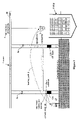
- FIG. 3 shows more in detail a side view of a container lifted by a spreader from a truck up to the camera level.
- FIG. 4 shows a side view of a container identification marking area, where it is located on the container and the camera image area required for ID identification.
- FIG. 5 illustrates schematically a side view of the different positions possible where a container identification ID marking area may appear in the loading area of a crane.
- FIG. 6 shows, from above, the crane loading area, the locations of the different cameras, the different possible positions where containers to be loaded/unloaded can be located, as well as the centerline of the trolley.
- FIG. 7 shows a block diagram of a single crane system.
- FIG. 8 shows a block diagram of a multiple crane system with a central OCR unit for more than one crane.
- FIG. 9 shows a flowchart over a normal case of the system work cycle.
- FIG. 10 shows a flowchart over the ID marking analysis and examples of false move cases and special cases of handling OCR response to a selected image.
- FIG. 1 shows a rail-mounted container crane 1 located on a quay 2 .
- a truck 4 with a container 5 is indicated and along the quay 2 a ship 6 for containers 5 is berthed.
- the crane 1 is, by help of a trolley 7 and a spreader 8 , loading a container 5 from the truck 4 onto the ship 6 and the loading path 9 of the spreader 8 and container 5 is indicated with a curved arrow.
- the trolley 7 of the crane 1 is able to move in two directions on a rail 10 along a trolley centerline 11 (see FIG. 6 ).
- the crane 1 has two sill beams 12 a,b on which at least one, preferably three, cameras 13 a - f are arranged on each sill beam 12 .
- the cameras 13 can be any type of video cameras or digital cameras or similar and are arranged in such a way that their lens axis or optical center are essentially horizontal and/or parallel to a camera level 14 and/or the center line of the spreader 8 . Of course it may be possible to locate the cameras 13 in a different angle for special purposes.
- the cameras 13 are arranged on the crane 1 at a distance from each other, corresponding to the difference in locations where the container 5 marking areas 18 of different container 5 sizes may appear.
- the camera level 14 is located on a certain distance above the upper surface 15 of the quay 2 , preferably about 6 meters above the surface/ground. Where the ID marking area 18 of a container 5 , during loading/unloading, passes this camera level 14 is defined as the cross point.
- the cameras 13 are controlled by a camera control system CCR.
- the cameras 13 located on both sill beams 12 are directed inwards, i.e. into the center of the loading area 16 of the crane 1 , in order to make it possible for the cameras 13 to face both sides of containers 5 being handled by the crane 1 .
- the camera control system CCR is arranged to determine the relevant zoom position of each activated camera 13 out of information of the spreader ( 8 ) position transmitted from the crane control system CCS when an anti-sway control is used as part of the CCS Crane Automation 25 .
- the containers 5 are loaded or unloaded from the backreach area 17 of the crane 1 , behind (to the left of) the rear sill beam 12 a .
- the cameras 13 are in this case located on the landside sill beam 12 a and directed towards the backreach area 17 . Only one-sided image recording is possible in this case. Otherwise the procedure is unchanged.
- Containers 5 that are handled by cranes 1 in a container terminal can be of different sizes.
- the length of the containers 5 can typically be 20′ or 40′ and the spreader 8 is adjusted by the driver and/or the crane drive system to the different sizes in order to be able to connect to and lift the containers 5 .
- the spreader 8 also can be adjusted to lift two 20′ containers at the same time.
- Each container 5 has a marking area 18 ( FIG. 4 ) comprising a unique ID, i.e. a number or similar, not shown.
- the marking area 18 is located at a certain position of both long sides of the container 5 according to ISO 6346 .
- the marking area 18 is located in the upper right corner of the container 5 and the center of the marking area 18 is approximately 95 cm from the top and 132 cm from the right corner of the container 5 .
- FIG. 5 shows examples of where these ID marking areas 18 a - c of the containers 5 may appear in the front of the cameras considering that there are containers 5 with different sizes.
- the marking area 18 is always related to the height of the spreader underside above ground, also called “hoist position”. Therefore, the marking area 18 appears at the camera level 14 at the same hoist position and is not dependent on the container height which can vary from 8 up to 9_feet, typically 8_ or 9_feet.
- images are captured of each marking area 18 a - c by a separate camera 13 a - c.
- each camera 13 is located in parallel lines 19 a - c each coincide with one of three possible positions of a container ID marking area 18 .
- the correct camera 13 a - f (i.e. that camera 13 that is located on the position where the container will pass) on each side, is activated depending on the position of the spreader 8 width information of which is known/generated in advance by the crane drive system and crane control system CCS.
- the containers 5 can appear on varying distances from the cameras 13 (and on different lines 19 a - c ) and the exact zoom position, i.e.
- the distance from the camera 13 to the container 5 side surface 30 is known and defined by the information of the trolley 7 or spreader 8 position. This information or these data are transmitted to the camera control system CCR, i.e. when the container 5 is arriving to or is approaching the camera level 14 from above or from below.
- the camera view must cover the marking area 18 and has typically 5 to 42 degrees horizontal view working angle.
- the final capture procedure of the image of the containers ID marking area 18 is determined and activated/started by the spreader height position relative to the camera level 14 .
- the container ID marking 18 passes a certain level (at a certain distance from the camera level 14 , about 5 to 7 meters, preferably 6 meters, above ground) and approaches the camera level 14 the correct cameras 13 are activated/started and images are captured and stored.
- a limited number of images preferably about 10 images
- An OCR evaluation unit 20 are arranged to analyze the images captured and identify the containers 8 ID.
- the CCR and CCS units is connected to each other via a link 28 in such a way that the information (data and logistic signals) from the crane drive system can be exchanged between the two units.
- the CCR is arranged to activate/start the correct camera or cameras 13 a - f , normally only two at a time, one on each sill beam 12 a,b , depending on the position of the spreader width (e.g. 20′, 2 ⁇ 20′ or 40′) which is detected or known in advance by the crane control system CCS and the spreader width thereby determines where the marking area 18 of the container 5 will appear in the loading area 16 of the crane in front the cameras 13 a - c .
- the information of the spreader width is transferred from the crane control system CCS to the camera control system CCR.
- the exact zoom position i.e. the distance 29 from the cameras 13 to the container side surface 30 , is defined by the trolley 7 position (or the spreader 8 position if an anti-sway system is used by the crane 1 ). These data is transmitted to the camera control system CCR with an update interval of typically 200 ms. The height and hoisting speed of the spreader 8 is also transmitted to the camera control system CCR with an update interval of 50 to 200 ms, typically 200 ms. At every update, the CCR system calculates the Expected Time of Arrival (ETA) of the container ID marking area 18 to reach the height of the camera level 14 , from above or from below, by dividing the remaining hoisting distance to the camera level 14 with the prevailing hoisting speed.
- ETA Expected Time of Arrival
- the CCR system changes the zoom position of the selected camera 13 to a value determined by the trolley 7 (or spreader 8 ) position. As the value changes, the zoom of the camera 13 will follow the changes until the image capturing procedure has stopped (see below), after which the zoom function of the camera 13 will rest.
- the time frame for capturing of images for OCR analysis is determined by the spreaders 8 vertical movements. This will enable CCR to determine when to start and when to stop the capturing of images.
- Capturing of images from the selected camera 13 is started, at the latest, when the ETA value reaches between one and two times of the update interval for the hoist position. Capturing is stopped after that the container target marking area 18 has surely passed beyond (above or below depending on the direction of the movement) the camera level 14 , by comparing the updated hoist position value to the value of the camera level 14 .
- a limited number of images about 5 to 20, typically 10 at a high hoist speed, have been captured, out of which one image at a time can be selected and transmitted to the OCR unit 20 for analysis, until the container ID is identified as correct with a high degree of reliability.
- the ID (i.e. a number) is then sent to the Control & Interface unit 26 and stored on the CCR Database 21 .
- the ID may also be sent back to the CCS unit and also to the Terminal Landside System.
- the hoist speed is very low while the target marking area 18 is passing the camera level 14 , the number of images may go beyond 20 before CCR stops the capturing, in order to ensure that the ID is captured correctly and completely.
- the OCR evaluation unit 20 has a capacity of finding the ID number of an image in about 50 to 500 ms, typically 100 ms. By using an OCR evaluation unit 20 that is faster than the camera capturing speed, i.e. maximum 25 images/second, it is possible to eliminate the saving of images and send the image information to the OCR unit 20 immediately after being captured. In this way, the stopping of zoom and image capture is determined by the correct and reliable ID number being identified/analyzed.
- the capturing of images is made while the container has been hoisted from a truck or the ground, and while the target marking area 18 is passing the camera level 14 .
- the height of the spreader 8 underside relative to ground is then between 6 to 8 meters, preferably around 7.2 meters. Preferably, this will occur before the trolley 7 starts moving. Limited trolley 7 movements can be tolerated during image capturing, since the zoom position is quickly moved (a short distance) to compensate for a short spreader 8 distance change.
- the hoist velocity is in this moment typically 0.5 meter per second, but higher speeds can be tolerated by matching the camera 13 exposure time to the higher speed.
- FIG. 7 shows the crane 1 with related equipment and the landside, and how the communication between the units is arranged.
- a landside computer can work as a control station where images are manually controlled to determine cases where readability is low. Such a control station can also work as a long time storage of images from one or more cranes 1 , where they can be recovered later for verification.
- the crane side equipment seen is CCR and CCS and how they are communicating with each other.
- CCS has a Crane Interface link 24 to the Main Crane Controller 22 , which can be linked to any existing Crane Automation unit 25 , such as Ship data and cell positions on the ship 6 . Speed and position data is sent from the Crane Drives 23 to the Main Crane Controller 22 .
- the Control & Interface 26 influences the Image Capture unit 27 of camera signals by using video grabber electronics.
- CCR will command the video grabber memory to send images to OCR evaluation unit 20 for analysis.
- the OCR evaluation unit 20 will respond to CCR after analysis of each image is completed. The cycle will continue until OCR evaluation unit 20 reports the container ID of the image with the highest reliability.
- FIG. 7 The system described by FIG. 7 can be modified for a terminal where several cranes 1 are equipped with the present invention. This is described in FIG. 8 .
- a landside communication line i.e. a fiber optics line
- a central OCR evaluation unit 20 By using a landside communication line, i.e. a fiber optics line, connected to a central OCR evaluation unit 20 , the image analysis of multiple cranes can be managed. Since the OCR analysis works relatively fast, and the images of the container ID are relatively few, this is a more cost effective alternative. Image capturing and storage is then centralized to one computer carrying the OCR software. In this way up to 10 cranes 1 can be managed by the same OCR evaluation unit 20 . A faster OCR or more than one centralized OCR can be arranged to manage a very large terminal.
- the success of finding the ID with all characters clearly and sharply present depends on the correct container target marking area 18 height when the image capturing starts and stops. Due to hoist wire rope stretching/elongation over time, and especially for new installed wire ropes, the ideal container 5 height position for starting and stopping the capturing of images for analysis will slowly change.
- the CCR is arranged to automatically create a wire rope stretching/elongation compensation by applying a correction value. The CCR will find out which one of the images, counted from the beginning of the capturing procedure, that results in the best (most correct and good) analyse of the container ID. When the image number becomes too large, a correction value is applied that recalibrates the container height value that initiates the starting and stopping of the recording of images. Thus, an automatic wire rope stretching/elongation compensating mechanism is created.
- the correct image capture is affected by any, of mechanical or electrical origin, deviation between the camera level 14 and the true slope of the optical lens axis of the cameras 13 , after being permanently installed. If such deviation appears, it can be entered by initial calibration during first startup as a linear capture height correction factor relative to the trolley 7 position (or actual distance from the camera lens to the target marking area 18 ). In this way, CCR will compensate automatically the height of start and stop of image capturing. This correction factor is entered for each individual camera 13 in the system.
- the camera control system (CCR) is accordingly arranged to automatically create a correction, if a camera ( 13 ) lens axis is not essentially parallel to the camera level ( 14 ), and that recalibrates the container height value that initiates the starting and stopping of the capturing of images.
- each camera 13 can be equipped with an autofocus setting mechanism using i.e. a laser beam, ultra sound or other known method of distance measurement to define the correct zoom value prior to capturing of images.
- one or more lamps are arranged in such a way that the container ID marking area 18 is illuminated.
- the camera control system CCR is arranged with a communication link, cables or a radio link, to each camera 13 and data including the position of each cameras diaphragm and exposure time used is transferred to the camera control system CCR.
- a request for the illumination to be switched on, or off, is generated when the preset limits are reached.
- One image from each side of the container is stored for manual/visual verification of the container marking area 18 .
- These images can be attached to the immediate job report transmission or later recalled for visual viewing.
- a manual/visual determination of a container ID that may be partly unreadable due to environmentally distortion, partially covered by dirt, corroded, variations in character types, the background of the numbers, light conditions etc, will increase the overall reliability of the container tracking and “job complete” report. This possibility facilitates a robust and reliable tracking system.
- One of the cameras 13 a - f that is not, for the moment, used for ID analyzing and recording can be zoomed out to an angle of view that will capture the entire container 5 side to side. Two more images are in this way stored or sent to the interface for transmission to the port central unit. A manual/visual verification of the container 5 status is thereby created for later use in case of damage control.
- the container 5 After being lifted, the container 5 is moved to a different point opposite to the quayside position.
- the automation has logged the position of pick-up, the position of release, the time of release and it has received the real container ID.
- the information is regarded as “job complete” for transmission to the output media, normally a network to port logistics.
- a printer, a display, a radio communication can alternatively be used as output.
- this information can be coordinated with a job instruction from the port logistics to determine whether there is a difference in the job performed to the instruction, including the handling of a container with an unexpected ID.
- the “job complete” report will contain position data related to the crane or the ship (as Bay, Cell and Height parameters/values). Generally, the system works independent of the mode of crane operation (auto-pos or manual).
- the camera control system CCR uses the following signal values/parameters transferred from the crane control system CCS:
- the camera control system CCR transmits the following signal values/parameters to the crane control system CCS:
- the present invention has a number of possibilities and advantages.
- the target container 5 can be moving during the image capturing procedure, which means that there is a small or no delay at all in the container handling cycle.
- Several trucks 4 can be located within the loading area 16 or passing the loading area 16 without blocking the image capturing, analyzing or recording.
- the trucks 4 can be freely positioned for loading/unloading as the camera zoom-position is updated online.
- Stationary cameras 13 a - f is mounted on the sill beams 12 a,b via stable fixing foundations giving a system that is reliable and easy to access for service.
- the system can handle all types of standardized containers 5 such as 20′, 2 ⁇ 20′, 40′, 42′ or 45′. Other sizes can also be used and if necessary more cameras 13 can be included in the system or the cameras 13 can be relocated.
- a method according to the invention may also include the steps of recording/storing the time and position of disconnecting the detected container from the spreader and detecting the completion of load/unload cycle to/from a ship, linking this information to other data above, and transmitting it to the terminal logistics.
- CCR Camera control system
- CCS crane control system
- Information/data generated by the camera control system (CCR) is transmitted to the crane control system (CCS), which is arranged to use that information as part of a container tracking and job order handling.
- the camera control system (CCR) is also arranged to transmit the information of the container ID and a value of the reliability of the ID analysis as well as a measurement error code, defined by a series of different errors, to the crane control system (CCS).
- At least one camera ( 13 ) is also arranged to capture images of the entire container ( 5 ) in order to determine the presence of possible external container damages.
- the “job complete” can also be linked to ID image presentation or compared to expected result.
Landscapes
- Engineering & Computer Science (AREA)
- Mechanical Engineering (AREA)
- Automation & Control Theory (AREA)
- Multimedia (AREA)
- Signal Processing (AREA)
- Control And Safety Of Cranes (AREA)
- Load-Engaging Elements For Cranes (AREA)
- Character Discrimination (AREA)
Priority Applications (5)
| Application Number | Priority Date | Filing Date | Title |
|---|---|---|---|
| AU2003290493A AU2003290493A1 (en) | 2002-12-31 | 2003-12-22 | A system and a method for container identification |
| HK06105677.3A HK1085715B (en) | 2002-12-31 | 2003-12-22 | A container crane and a method for container identification |
| PCT/SE2003/002082 WO2004058623A1 (en) | 2002-12-31 | 2003-12-22 | A system and a method for container identification |
| AT03783030T ATE509881T1 (de) | 2002-12-31 | 2003-12-22 | Kontainerkran und verfahren zur identifizierung von behältern |
| EP03783030A EP1594791B1 (de) | 2002-12-31 | 2003-12-22 | Kontainerkran und verfahren zur identifizierung von behältern |
Applications Claiming Priority (2)
| Application Number | Priority Date | Filing Date | Title |
|---|---|---|---|
| SE0203906-3 | 2002-12-31 | ||
| SE0203906A SE0203906D0 (sv) | 2002-12-31 | 2002-12-31 | Container character recognition system |
Publications (2)
| Publication Number | Publication Date |
|---|---|
| US20040126015A1 US20040126015A1 (en) | 2004-07-01 |
| US7286683B2 true US7286683B2 (en) | 2007-10-23 |
Family
ID=20290051
Family Applications (1)
| Application Number | Title | Priority Date | Filing Date |
|---|---|---|---|
| US10/417,233 Expired - Fee Related US7286683B2 (en) | 2002-12-31 | 2003-04-17 | Container identification and tracking system |
Country Status (4)
| Country | Link |
|---|---|
| US (1) | US7286683B2 (de) |
| CN (1) | CN100406371C (de) |
| AT (1) | ATE509881T1 (de) |
| SE (1) | SE0203906D0 (de) |
Cited By (11)
| Publication number | Priority date | Publication date | Assignee | Title |
|---|---|---|---|---|
| US20100030370A1 (en) * | 2004-05-14 | 2010-02-04 | King Henry S | Method and apparatus for making status reporting devices for container handlers |
| US20110133888A1 (en) * | 2009-08-17 | 2011-06-09 | Timothy Dirk Stevens | Contextually aware monitoring of assets |
| US8314704B2 (en) | 2009-08-28 | 2012-11-20 | Deal Magic, Inc. | Asset tracking using alternative sources of position fix data |
| US8334773B2 (en) | 2009-08-28 | 2012-12-18 | Deal Magic, Inc. | Asset monitoring and tracking system |
| US8432274B2 (en) | 2009-07-31 | 2013-04-30 | Deal Magic, Inc. | Contextual based determination of accuracy of position fixes |
| US8456302B2 (en) | 2009-07-14 | 2013-06-04 | Savi Technology, Inc. | Wireless tracking and monitoring electronic seal |
| US8593280B2 (en) | 2009-07-14 | 2013-11-26 | Savi Technology, Inc. | Security seal |
| US20160110625A1 (en) * | 2014-10-21 | 2016-04-21 | University Of Louisiana At Lafayette | Method for near-realtime workspace mapping |
| US9613332B2 (en) | 2014-07-31 | 2017-04-04 | Blue Point Tec LLC | Devices, systems and methods for tracking and auditing shipment items |
| US20220135379A1 (en) * | 2020-11-03 | 2022-05-05 | Institute For Information Industry | Cargo container image capturing method and system applied to bridge crane |
| US20230176580A1 (en) * | 2021-10-18 | 2023-06-08 | Institute For Information Industry | Vehicle positioning system and vehicle positioning method for container yard vehicle |
Families Citing this family (44)
| Publication number | Priority date | Publication date | Assignee | Title |
|---|---|---|---|---|
| DE10224312A1 (de) * | 2002-05-31 | 2004-12-02 | Siemens Ag | Verfahren zur Automatisierung des Be- und Entladens von Containerschiffen in Containerterminals und entsprechende Kranautomatisierungsanlage |
| US20050173364A1 (en) * | 2002-07-25 | 2005-08-11 | Siemens Aktiengesellschaft | Method for operating a container crane |
| US7508956B2 (en) * | 2003-06-04 | 2009-03-24 | Aps Technology Group, Inc. | Systems and methods for monitoring and tracking movement and location of shipping containers and vehicles using a vision based system |
| US20060268122A1 (en) * | 2003-09-01 | 2006-11-30 | Mariko Iwasaki | Camera having transmission function, mobile telephone device, and image data acquiring/transmitting program |
| US7898415B2 (en) * | 2004-05-14 | 2011-03-01 | Paceco Corp. | Method and apparatus using radio-location tags to report status for a container handler |
| IL162921A0 (en) | 2004-07-08 | 2005-11-20 | Hi Tech Solutions Ltd | Character recognition system and method |
| US7693757B2 (en) * | 2006-09-21 | 2010-04-06 | International Business Machines Corporation | System and method for performing inventory using a mobile inventory robot |
| US7922085B2 (en) * | 2007-04-13 | 2011-04-12 | Aps Technology Group, Inc. | System, method, apparatus, and computer program product for monitoring the transfer of cargo to and from a transporter |
| WO2009052854A1 (en) * | 2007-10-22 | 2009-04-30 | Abb Ab | Device, method and system for recording inspection data about a freight container |
| EP2215585A4 (de) * | 2007-10-30 | 2012-08-08 | Paceco Corp | Verfahren und vorrichtungen zur verarbeitung von containerbildern und/oder zum identifizieren von codes für vorderende-ladevorrichtungen oder containermanipulatoren, die eisenbahnwagen versorgen |
| GB0803644D0 (en) * | 2008-02-28 | 2008-04-02 | Rapiscan Security Products Inc | Scanning systems |
| EP2196953B1 (de) * | 2008-12-12 | 2020-04-08 | Siemens Aktiengesellschaft | Verfahren, Steuerungsprogramm und System zur Identifikation eines Containers in einer Containerkrananlage |
| DK2563706T3 (en) * | 2010-04-29 | 2015-10-26 | Nat Oilwell Varco Lp | Videometric systems and methods for off-shore and oil well drilling |
| US20120051643A1 (en) * | 2010-08-25 | 2012-03-01 | E. I. Systems, Inc. | Method and system for capturing and inventoring railcar identification numbers |
| CN102849384B (zh) * | 2011-06-29 | 2014-09-03 | 深南电路有限公司 | 钢板分类收集系统 |
| EP2730532A1 (de) | 2012-11-09 | 2014-05-14 | CAMCO Technologies NV | Behälterabtastsystem |
| CN103569868B (zh) * | 2013-10-31 | 2015-06-17 | 中联重科股份有限公司 | 起重机械吊具对准装置、吊具对准方法及起重机械 |
| FI20155171L (fi) * | 2015-03-13 | 2016-09-14 | Conexbird Oy | Kontin tarkastusjärjestely, -menetelmä, -laitteisto ja -ohjelmisto |
| CN104724606B (zh) * | 2015-03-18 | 2017-01-25 | 苏州盈兴信息技术有限公司 | 一种生产物料贮运作业图像自动跟踪装置和方法 |
| CN105303555B (zh) * | 2015-09-18 | 2017-12-05 | 浙江工业大学 | 一种基于双目视觉的集卡定位与引导的方法及其系统 |
| DK179592B1 (en) * | 2016-03-21 | 2019-02-22 | Apm Terminals Management Bv | Communication device for a container handling equipment device and communication method |
| DK179085B1 (en) * | 2016-03-21 | 2017-10-16 | Apm Terminals Man Bv | Container handling equipment controller arrangement |
| CN106097329B (zh) * | 2016-06-07 | 2018-11-13 | 浙江工业大学 | 一种基于边缘检测的集装箱轮廓定位方法 |
| CN106097332B (zh) * | 2016-06-07 | 2018-09-21 | 浙江工业大学 | 一种基于角点检测的集装箱轮廓定位方法 |
| WO2018066236A1 (ja) * | 2016-10-07 | 2018-04-12 | 村田機械株式会社 | 自動倉庫 |
| FI3321226T3 (fi) * | 2016-11-11 | 2023-06-01 | Abb Schweiz Ag | Konttinosturin ohjausjärjestelmä, joka käsittää kameran |
| JP6648909B2 (ja) * | 2017-03-31 | 2020-02-14 | 株式会社三井E&Sマシナリー | コンテナターミナル及びその運用方法 |
| US10546384B2 (en) * | 2017-07-21 | 2020-01-28 | Blackberry Limited | Method and system for mapping to facilitate dispatching |
| US12398024B2 (en) * | 2018-02-02 | 2025-08-26 | Digital Logistics As | Cargo detection and tracking |
| CN108776808A (zh) * | 2018-05-25 | 2018-11-09 | 北京百度网讯科技有限公司 | 一种用于检测钢包溶蚀缺陷的方法和装置 |
| CN108639956A (zh) * | 2018-06-27 | 2018-10-12 | 上海沪东集装箱码头有限公司 | 基于视觉检测技术的集装箱起重机智能预警系统及方法 |
| CN112912332B (zh) * | 2018-10-16 | 2023-08-01 | 株式会社多田野 | 起重机装置 |
| CN111832345B (zh) * | 2019-04-17 | 2024-05-28 | 杭州海康威视数字技术股份有限公司 | 集装箱监控方法、装置及设备、存储介质 |
| US11847606B2 (en) | 2019-04-30 | 2023-12-19 | Blackberry Limited | System and method for cargo transportation unit tracking and monitoring device verification |
| CN110135439B (zh) * | 2019-05-09 | 2021-05-04 | 上海木木聚枞机器人科技有限公司 | 一种自动识别货架的方法及装置、移动机器人 |
| EP3760570B1 (de) | 2019-07-05 | 2022-04-27 | CAMCO Technologies NV | Behälterabtastsystem mit waschstation |
| FI130196B (en) * | 2019-10-04 | 2023-04-17 | Cargotec Finland Oy | GRIPPER POSITION CONTROL |
| JP7288231B2 (ja) * | 2020-11-30 | 2023-06-07 | 日本製鉄株式会社 | トラッキング装置、トラッキング方法、およびプログラム |
| CN112733985A (zh) * | 2021-01-27 | 2021-04-30 | 昆山善思光电科技有限公司 | 一种自动识别大小料盘的方法 |
| CN114229302B (zh) * | 2021-12-28 | 2024-08-20 | 江苏智库智能科技有限公司 | 四向穿梭车立体库仓库管理系统仿真模拟方法 |
| CN114275236B (zh) * | 2022-01-13 | 2023-02-28 | 上海柠喆机械科技有限公司 | 一种控制搬运盛装近似圆形或椭圆形产品的托盘的装置的方法 |
| CN114814990B (zh) * | 2022-05-06 | 2023-08-11 | 自然资源部第一海洋研究所 | 一种海湾纳潮量预报与监测装置及其工作方法 |
| CN115480281A (zh) * | 2022-09-05 | 2022-12-16 | 南京融才交通科技研究院有限公司 | 一种基于机器视觉的集装箱装卸集卡自动定位系统及方法 |
| CN116074616B (zh) * | 2023-04-06 | 2023-06-20 | 上海知率智能科技有限公司 | 集装箱图像采集系统 |
Citations (17)
| Publication number | Priority date | Publication date | Assignee | Title |
|---|---|---|---|---|
| US3762754A (en) * | 1971-09-13 | 1973-10-02 | Clark Equipment Co | Universal coupling means for container handling |
| US5142658A (en) * | 1991-10-18 | 1992-08-25 | Daniel H. Wagner Associates, Inc. | Container chassis positioning system |
| US5455875A (en) * | 1992-12-15 | 1995-10-03 | International Business Machines Corporation | System and method for correction of optical character recognition with display of image segments according to character data |
| WO1996007929A1 (de) | 1994-09-09 | 1996-03-14 | Siemens Aktiengesellschaft | Anordnung zur automatischen positionserfassung eines container-transportfahrzeuges |
| EP0822158A1 (de) | 1996-07-26 | 1998-02-04 | Preussag Noell Gesellschaft mit beschränkter Haftung | Einrichtung zum automatischen Positionieren eines von zwei gegeneinander beweglichen Objekten |
| JPH10181885A (ja) | 1996-12-19 | 1998-07-07 | Mitsui Eng & Shipbuild Co Ltd | コンテナ管理装置 |
| EP0862132A2 (de) | 1997-03-01 | 1998-09-02 | Institute of Systems Science | Robustes Identifikationenkodenerkennungssystem |
| EP0887120A1 (de) | 1997-06-24 | 1998-12-30 | Inex Vision Systems, Inc. | System und Verfahren zur Identifikation eines Behälters |
| JPH11325841A (ja) * | 1998-05-12 | 1999-11-26 | Nkk Corp | ワイヤロープの診断装置 |
| US6028970A (en) * | 1997-10-14 | 2000-02-22 | At&T Corp | Method and apparatus for enhancing optical character recognition |
| EP1043262A1 (de) | 1999-04-09 | 2000-10-11 | NFM Technologies | Verfahren zum Laden eines Containers auf die Plattform eines Transportmittels und Einrichtung zum Lagern und Fördern von Containern |
| US6161887A (en) * | 1997-08-26 | 2000-12-19 | Mitsubishi Heavy Industries, Ltd. | Spreader for multistage container stacking |
| US6587586B1 (en) * | 1997-06-12 | 2003-07-01 | Siemens Corporate Research, Inc. | Extracting textual information from a video sequence |
| US20030156199A1 (en) * | 2001-12-14 | 2003-08-21 | Mitsuyoshi Shindo | Image processing apparatus and method, recording medium, and program |
| US20040103101A1 (en) * | 2002-11-25 | 2004-05-27 | Eastman Kodak Company | Method and system for detecting a geometrically transformed copy of an image |
| US6768931B2 (en) * | 2000-08-04 | 2004-07-27 | Paceco Corp. | Method and apparatus for quay container crane-based automated optical container code recognition with positional identification |
| US6819778B2 (en) * | 2000-03-30 | 2004-11-16 | Nec Corporation | Method and system for tracking a fast moving object |
Family Cites Families (2)
| Publication number | Priority date | Publication date | Assignee | Title |
|---|---|---|---|---|
| US4644151A (en) * | 1985-04-05 | 1987-02-17 | Owens-Illinois, Inc. | Identification of a molded container with its mold of origin |
| US5969810A (en) * | 1998-05-14 | 1999-10-19 | Owens-Brockway Glass Container Inc. | Optical inspection of transparent containers using two cameras and a single light source |
-
2002
- 2002-12-31 SE SE0203906A patent/SE0203906D0/xx unknown
-
2003
- 2003-04-17 US US10/417,233 patent/US7286683B2/en not_active Expired - Fee Related
- 2003-12-22 AT AT03783030T patent/ATE509881T1/de not_active IP Right Cessation
- 2003-12-22 CN CNB2003801099207A patent/CN100406371C/zh not_active Expired - Fee Related
Patent Citations (17)
| Publication number | Priority date | Publication date | Assignee | Title |
|---|---|---|---|---|
| US3762754A (en) * | 1971-09-13 | 1973-10-02 | Clark Equipment Co | Universal coupling means for container handling |
| US5142658A (en) * | 1991-10-18 | 1992-08-25 | Daniel H. Wagner Associates, Inc. | Container chassis positioning system |
| US5455875A (en) * | 1992-12-15 | 1995-10-03 | International Business Machines Corporation | System and method for correction of optical character recognition with display of image segments according to character data |
| WO1996007929A1 (de) | 1994-09-09 | 1996-03-14 | Siemens Aktiengesellschaft | Anordnung zur automatischen positionserfassung eines container-transportfahrzeuges |
| EP0822158A1 (de) | 1996-07-26 | 1998-02-04 | Preussag Noell Gesellschaft mit beschränkter Haftung | Einrichtung zum automatischen Positionieren eines von zwei gegeneinander beweglichen Objekten |
| JPH10181885A (ja) | 1996-12-19 | 1998-07-07 | Mitsui Eng & Shipbuild Co Ltd | コンテナ管理装置 |
| EP0862132A2 (de) | 1997-03-01 | 1998-09-02 | Institute of Systems Science | Robustes Identifikationenkodenerkennungssystem |
| US6587586B1 (en) * | 1997-06-12 | 2003-07-01 | Siemens Corporate Research, Inc. | Extracting textual information from a video sequence |
| EP0887120A1 (de) | 1997-06-24 | 1998-12-30 | Inex Vision Systems, Inc. | System und Verfahren zur Identifikation eines Behälters |
| US6161887A (en) * | 1997-08-26 | 2000-12-19 | Mitsubishi Heavy Industries, Ltd. | Spreader for multistage container stacking |
| US6028970A (en) * | 1997-10-14 | 2000-02-22 | At&T Corp | Method and apparatus for enhancing optical character recognition |
| JPH11325841A (ja) * | 1998-05-12 | 1999-11-26 | Nkk Corp | ワイヤロープの診断装置 |
| EP1043262A1 (de) | 1999-04-09 | 2000-10-11 | NFM Technologies | Verfahren zum Laden eines Containers auf die Plattform eines Transportmittels und Einrichtung zum Lagern und Fördern von Containern |
| US6819778B2 (en) * | 2000-03-30 | 2004-11-16 | Nec Corporation | Method and system for tracking a fast moving object |
| US6768931B2 (en) * | 2000-08-04 | 2004-07-27 | Paceco Corp. | Method and apparatus for quay container crane-based automated optical container code recognition with positional identification |
| US20030156199A1 (en) * | 2001-12-14 | 2003-08-21 | Mitsuyoshi Shindo | Image processing apparatus and method, recording medium, and program |
| US20040103101A1 (en) * | 2002-11-25 | 2004-05-27 | Eastman Kodak Company | Method and system for detecting a geometrically transformed copy of an image |
Cited By (18)
| Publication number | Priority date | Publication date | Assignee | Title |
|---|---|---|---|---|
| US8188865B2 (en) * | 2004-05-14 | 2012-05-29 | Paceco Corp. | Apparatus for a status reporting device for container handler |
| US20100030370A1 (en) * | 2004-05-14 | 2010-02-04 | King Henry S | Method and apparatus for making status reporting devices for container handlers |
| US8525671B2 (en) | 2004-05-14 | 2013-09-03 | Paceco Corp. | Method and apparatus for making status reporting devices for container handlers |
| US8593280B2 (en) | 2009-07-14 | 2013-11-26 | Savi Technology, Inc. | Security seal |
| US8456302B2 (en) | 2009-07-14 | 2013-06-04 | Savi Technology, Inc. | Wireless tracking and monitoring electronic seal |
| US9142107B2 (en) | 2009-07-14 | 2015-09-22 | Deal Magic Inc. | Wireless tracking and monitoring electronic seal |
| US8432274B2 (en) | 2009-07-31 | 2013-04-30 | Deal Magic, Inc. | Contextual based determination of accuracy of position fixes |
| US20110133888A1 (en) * | 2009-08-17 | 2011-06-09 | Timothy Dirk Stevens | Contextually aware monitoring of assets |
| US9177282B2 (en) * | 2009-08-17 | 2015-11-03 | Deal Magic Inc. | Contextually aware monitoring of assets |
| US8334773B2 (en) | 2009-08-28 | 2012-12-18 | Deal Magic, Inc. | Asset monitoring and tracking system |
| US8514082B2 (en) | 2009-08-28 | 2013-08-20 | Deal Magic, Inc. | Asset monitoring and tracking system |
| US8314704B2 (en) | 2009-08-28 | 2012-11-20 | Deal Magic, Inc. | Asset tracking using alternative sources of position fix data |
| US9613332B2 (en) | 2014-07-31 | 2017-04-04 | Blue Point Tec LLC | Devices, systems and methods for tracking and auditing shipment items |
| US9892378B2 (en) | 2014-07-31 | 2018-02-13 | BluePoint Mobile Solutoins, Inc. | Devices, systems and methods for tracking and auditing shipment items |
| US20160110625A1 (en) * | 2014-10-21 | 2016-04-21 | University Of Louisiana At Lafayette | Method for near-realtime workspace mapping |
| US9818198B2 (en) * | 2014-10-21 | 2017-11-14 | University Of Louisiana At Lafayette | Method for near-realtime workspace mapping |
| US20220135379A1 (en) * | 2020-11-03 | 2022-05-05 | Institute For Information Industry | Cargo container image capturing method and system applied to bridge crane |
| US20230176580A1 (en) * | 2021-10-18 | 2023-06-08 | Institute For Information Industry | Vehicle positioning system and vehicle positioning method for container yard vehicle |
Also Published As
| Publication number | Publication date |
|---|---|
| SE0203906D0 (sv) | 2002-12-31 |
| ATE509881T1 (de) | 2011-06-15 |
| US20040126015A1 (en) | 2004-07-01 |
| CN100406371C (zh) | 2008-07-30 |
| HK1085715A1 (en) | 2006-09-01 |
| CN1753830A (zh) | 2006-03-29 |
Similar Documents
| Publication | Publication Date | Title |
|---|---|---|
| US7286683B2 (en) | Container identification and tracking system | |
| US7508956B2 (en) | Systems and methods for monitoring and tracking movement and location of shipping containers and vehicles using a vision based system | |
| KR100658649B1 (ko) | 컨테이너를 자동으로 로딩 및 언로딩시키는 광학 장치 | |
| AU2010238448B2 (en) | System for the identification and/or location determination of a container handling machine | |
| EP1594791B1 (de) | Kontainerkran und verfahren zur identifizierung von behältern | |
| US10850923B2 (en) | Transporter and transporting method | |
| US7123132B2 (en) | Chassis alignment system | |
| CN110758473B (zh) | 一种铁水联运轨道车辆跟踪定位方法及系统 | |
| US10926960B2 (en) | Overhead conveyance vehicle | |
| JPWO1996030288A1 (ja) | コンテナの荷役装置および管理システム | |
| CN109641729B (zh) | 锁定设备的探测 | |
| EP3699135B1 (de) | Sensorwagen und entsprechender containerkran | |
| JP6547211B2 (ja) | コンテナヤードおよびコンテナヤードの制御方法 | |
| KR101321167B1 (ko) | 샤시 정렬 시스템 | |
| HK1085715B (en) | A container crane and a method for container identification | |
| KR101992098B1 (ko) | 샤시 위치 안내 시스템 및 방법 | |
| KR100276276B1 (ko) | 무인 자동화 창고 시스템 | |
| JPH01176795A (ja) | クレーンの位置検出並びに制御装置 | |
| CN113188639B (zh) | 一种计量系统 | |
| US20050131574A1 (en) | Method and apparatus for quay container crane-based automated optical container code recognition with positional identification | |
| CN117755988A (zh) | 用于检测自动运输系统上的吊具的设备和方法 | |
| JPH0781879A (ja) | 物体位置検出システム |
Legal Events
| Date | Code | Title | Description |
|---|---|---|---|
| AS | Assignment |
Owner name: ABB AB, SWEDEN Free format text: ASSIGNMENT OF ASSIGNORS INTEREST;ASSIGNOR:HADELL, PER ANDERS;REEL/FRAME:014415/0196 Effective date: 20030613 |
|
| FEPP | Fee payment procedure |
Free format text: PAYOR NUMBER ASSIGNED (ORIGINAL EVENT CODE: ASPN); ENTITY STATUS OF PATENT OWNER: LARGE ENTITY |
|
| FPAY | Fee payment |
Year of fee payment: 4 |
|
| REMI | Maintenance fee reminder mailed | ||
| LAPS | Lapse for failure to pay maintenance fees | ||
| STCH | Information on status: patent discontinuation |
Free format text: PATENT EXPIRED DUE TO NONPAYMENT OF MAINTENANCE FEES UNDER 37 CFR 1.362 |
|
| STCH | Information on status: patent discontinuation |
Free format text: PATENT EXPIRED DUE TO NONPAYMENT OF MAINTENANCE FEES UNDER 37 CFR 1.362 |
|
| FP | Lapsed due to failure to pay maintenance fee |
Effective date: 20151023 |