US8846580B2 - Diagnostic nanosensor and its use in medicine - Google Patents
Diagnostic nanosensor and its use in medicine Download PDFInfo
- Publication number
- US8846580B2 US8846580B2 US11/917,032 US91703206A US8846580B2 US 8846580 B2 US8846580 B2 US 8846580B2 US 91703206 A US91703206 A US 91703206A US 8846580 B2 US8846580 B2 US 8846580B2
- Authority
- US
- United States
- Prior art keywords
- nanostructures
- bio
- interactive material
- organic
- nanosensor
- Prior art date
- Legal status (The legal status is an assumption and is not a legal conclusion. Google has not performed a legal analysis and makes no representation as to the accuracy of the status listed.)
- Active, expires
Links
Images


Classifications
-
- G—PHYSICS
- G01—MEASURING; TESTING
- G01N—INVESTIGATING OR ANALYSING MATERIALS BY DETERMINING THEIR CHEMICAL OR PHYSICAL PROPERTIES
- G01N33/00—Investigating or analysing materials by specific methods not covered by groups G01N1/00 - G01N31/00
- G01N33/48—Biological material, e.g. blood, urine; Haemocytometers
- G01N33/50—Chemical analysis of biological material, e.g. blood, urine; Testing involving biospecific ligand binding methods; Immunological testing
- G01N33/53—Immunoassay; Biospecific binding assay; Materials therefor
- G01N33/543—Immunoassay; Biospecific binding assay; Materials therefor with an insoluble carrier for immobilising immunochemicals
- G01N33/54366—Apparatus specially adapted for solid-phase testing
- G01N33/54373—Apparatus specially adapted for solid-phase testing involving physiochemical end-point determination, e.g. wave-guides, FETS, gratings
-
- B—PERFORMING OPERATIONS; TRANSPORTING
- B82—NANOTECHNOLOGY
- B82Y—SPECIFIC USES OR APPLICATIONS OF NANOSTRUCTURES; MEASUREMENT OR ANALYSIS OF NANOSTRUCTURES; MANUFACTURE OR TREATMENT OF NANOSTRUCTURES
- B82Y15/00—Nanotechnology for interacting, sensing or actuating, e.g. quantum dots as markers in protein assays or molecular motors
-
- B—PERFORMING OPERATIONS; TRANSPORTING
- B82—NANOTECHNOLOGY
- B82Y—SPECIFIC USES OR APPLICATIONS OF NANOSTRUCTURES; MEASUREMENT OR ANALYSIS OF NANOSTRUCTURES; MANUFACTURE OR TREATMENT OF NANOSTRUCTURES
- B82Y25/00—Nanomagnetism, e.g. magnetoimpedance, anisotropic magnetoresistance, giant magnetoresistance or tunneling magnetoresistance
-
- B—PERFORMING OPERATIONS; TRANSPORTING
- B82—NANOTECHNOLOGY
- B82Y—SPECIFIC USES OR APPLICATIONS OF NANOSTRUCTURES; MEASUREMENT OR ANALYSIS OF NANOSTRUCTURES; MANUFACTURE OR TREATMENT OF NANOSTRUCTURES
- B82Y30/00—Nanotechnology for materials or surface science, e.g. nanocomposites
-
- B—PERFORMING OPERATIONS; TRANSPORTING
- B82—NANOTECHNOLOGY
- B82Y—SPECIFIC USES OR APPLICATIONS OF NANOSTRUCTURES; MEASUREMENT OR ANALYSIS OF NANOSTRUCTURES; MANUFACTURE OR TREATMENT OF NANOSTRUCTURES
- B82Y5/00—Nanobiotechnology or nanomedicine, e.g. protein engineering or drug delivery
-
- G—PHYSICS
- G01—MEASURING; TESTING
- G01N—INVESTIGATING OR ANALYSING MATERIALS BY DETERMINING THEIR CHEMICAL OR PHYSICAL PROPERTIES
- G01N21/00—Investigating or analysing materials by the use of optical means, i.e. using sub-millimetre waves, infrared, visible or ultraviolet light
- G01N21/17—Systems in which incident light is modified in accordance with the properties of the material investigated
- G01N21/55—Specular reflectivity
- G01N21/552—Attenuated total reflection
- G01N21/553—Attenuated total reflection and using surface plasmons
- G01N21/554—Attenuated total reflection and using surface plasmons detecting the surface plasmon resonance of nanostructured metals, e.g. localised surface plasmon resonance
-
- G—PHYSICS
- G01—MEASURING; TESTING
- G01N—INVESTIGATING OR ANALYSING MATERIALS BY DETERMINING THEIR CHEMICAL OR PHYSICAL PROPERTIES
- G01N21/00—Investigating or analysing materials by the use of optical means, i.e. using sub-millimetre waves, infrared, visible or ultraviolet light
- G01N21/62—Systems in which the material investigated is excited whereby it emits light or causes a change in wavelength of the incident light
- G01N21/63—Systems in which the material investigated is excited whereby it emits light or causes a change in wavelength of the incident light optically excited
- G01N21/64—Fluorescence; Phosphorescence
- G01N21/6489—Photoluminescence of semiconductors
-
- G—PHYSICS
- G01—MEASURING; TESTING
- G01N—INVESTIGATING OR ANALYSING MATERIALS BY DETERMINING THEIR CHEMICAL OR PHYSICAL PROPERTIES
- G01N21/00—Investigating or analysing materials by the use of optical means, i.e. using sub-millimetre waves, infrared, visible or ultraviolet light
- G01N21/17—Systems in which incident light is modified in accordance with the properties of the material investigated
- G01N21/25—Colour; Spectral properties, i.e. comparison of effect of material on the light at two or more different wavelengths or wavelength bands
- G01N2021/258—Surface plasmon spectroscopy, e.g. micro- or nanoparticles in suspension
-
- Y—GENERAL TAGGING OF NEW TECHNOLOGICAL DEVELOPMENTS; GENERAL TAGGING OF CROSS-SECTIONAL TECHNOLOGIES SPANNING OVER SEVERAL SECTIONS OF THE IPC; TECHNICAL SUBJECTS COVERED BY FORMER USPC CROSS-REFERENCE ART COLLECTIONS [XRACs] AND DIGESTS
- Y10—TECHNICAL SUBJECTS COVERED BY FORMER USPC
- Y10S—TECHNICAL SUBJECTS COVERED BY FORMER USPC CROSS-REFERENCE ART COLLECTIONS [XRACs] AND DIGESTS
- Y10S977/00—Nanotechnology
- Y10S977/84—Manufacture, treatment, or detection of nanostructure
- Y10S977/882—Assembling of separate components, e.g. by attaching
-
- Y—GENERAL TAGGING OF NEW TECHNOLOGICAL DEVELOPMENTS; GENERAL TAGGING OF CROSS-SECTIONAL TECHNOLOGIES SPANNING OVER SEVERAL SECTIONS OF THE IPC; TECHNICAL SUBJECTS COVERED BY FORMER USPC CROSS-REFERENCE ART COLLECTIONS [XRACs] AND DIGESTS
- Y10—TECHNICAL SUBJECTS COVERED BY FORMER USPC
- Y10S—TECHNICAL SUBJECTS COVERED BY FORMER USPC CROSS-REFERENCE ART COLLECTIONS [XRACs] AND DIGESTS
- Y10S977/00—Nanotechnology
- Y10S977/84—Manufacture, treatment, or detection of nanostructure
- Y10S977/89—Deposition of materials, e.g. coating, cvd, or ald
- Y10S977/891—Vapor phase deposition
-
- Y—GENERAL TAGGING OF NEW TECHNOLOGICAL DEVELOPMENTS; GENERAL TAGGING OF CROSS-SECTIONAL TECHNOLOGIES SPANNING OVER SEVERAL SECTIONS OF THE IPC; TECHNICAL SUBJECTS COVERED BY FORMER USPC CROSS-REFERENCE ART COLLECTIONS [XRACs] AND DIGESTS
- Y10—TECHNICAL SUBJECTS COVERED BY FORMER USPC
- Y10S—TECHNICAL SUBJECTS COVERED BY FORMER USPC CROSS-REFERENCE ART COLLECTIONS [XRACs] AND DIGESTS
- Y10S977/00—Nanotechnology
- Y10S977/902—Specified use of nanostructure
- Y10S977/932—Specified use of nanostructure for electronic or optoelectronic application
- Y10S977/953—Detector using nanostructure
- Y10S977/957—Of chemical property or presence
-
- Y—GENERAL TAGGING OF NEW TECHNOLOGICAL DEVELOPMENTS; GENERAL TAGGING OF CROSS-SECTIONAL TECHNOLOGIES SPANNING OVER SEVERAL SECTIONS OF THE IPC; TECHNICAL SUBJECTS COVERED BY FORMER USPC CROSS-REFERENCE ART COLLECTIONS [XRACs] AND DIGESTS
- Y10—TECHNICAL SUBJECTS COVERED BY FORMER USPC
- Y10S—TECHNICAL SUBJECTS COVERED BY FORMER USPC CROSS-REFERENCE ART COLLECTIONS [XRACs] AND DIGESTS
- Y10S977/00—Nanotechnology
- Y10S977/902—Specified use of nanostructure
- Y10S977/932—Specified use of nanostructure for electronic or optoelectronic application
- Y10S977/953—Detector using nanostructure
- Y10S977/957—Of chemical property or presence
- Y10S977/958—Of biomolecule property
-
- Y—GENERAL TAGGING OF NEW TECHNOLOGICAL DEVELOPMENTS; GENERAL TAGGING OF CROSS-SECTIONAL TECHNOLOGIES SPANNING OVER SEVERAL SECTIONS OF THE IPC; TECHNICAL SUBJECTS COVERED BY FORMER USPC CROSS-REFERENCE ART COLLECTIONS [XRACs] AND DIGESTS
- Y10—TECHNICAL SUBJECTS COVERED BY FORMER USPC
- Y10S—TECHNICAL SUBJECTS COVERED BY FORMER USPC CROSS-REFERENCE ART COLLECTIONS [XRACs] AND DIGESTS
- Y10S977/00—Nanotechnology
- Y10S977/902—Specified use of nanostructure
- Y10S977/932—Specified use of nanostructure for electronic or optoelectronic application
- Y10S977/953—Detector using nanostructure
- Y10S977/957—Of chemical property or presence
- Y10S977/958—Of biomolecule property
- Y10S977/959—Of disease state
Definitions
- This invention relates generally to biosensor technology, and pertains more particularly to novel multifunctional biosensors based on ordered arrays of metallic, semiconductors and magnetic nano-islands for medical, biological, biochemical, chemical and environmental applications.
- biosensors have important applications in medicine, in biological and biochemical research, as well as for environmental monitoring and protection and in food industry.
- nanoparticle technology has been used to build chemical sensors and biosensors for detecting various analytes from contaminants in air to the presence of particular DNA segments in blood and other samples.
- Encapsulated metal nanoparticles could be functionalized with different kind of ligands to give a chemical sensor that uses changes in the electrical characteristics of the metal nanoparticle and thus could function as an electronic nose for gas phase or electronic tongue for liquid phase as described for example in the US 2005/0142030.
- WO 2004/086044 discloses that silver nanoparticles or gold nanoparticles could serve as nanosensors in one or the other way if appropriately sized and functionalized.
- LSPR localized surface plasmon resonance
- metal nanoparticles as described in the above mentioned documents are their production via wet chemical synthesis. This type of production disables the precise control on size and shape of the particle and does not permit even immobilization of particles on substrates.
- Lithography as technique for the production of nanostructured surfaces exist in various types.
- One type of lithography is electron beam lithography and has been used for example in FR 2 860 872 to create a distribution of circular or ellipsoidal “plots” on a two dimensional surface, or to it.
- a grat disadvantage of this technique is that it is very cost-intensive.
- Electrodeposition of nanoparticles on nanotubes or wires as described in US 2005/0157445 gives miniaturized electrical devices but need conductive elements.
- nanoparticles can be functionalized with bio-organic interactive material that due to their specificity interact selectively with other molecules.
- they can be “programmed” to recognize and selectively bind molecules, other nanoparticles (semiconductors) or a suitably patterned substrate surface like the cellular outer membrane.
- nano-transducers based on noble metal nanoislands through resonant excitations of the collective oscillations of the conduction electrons on the nanoislands, the so-called surface plasmon resonances. This phenomenon can be coupled to the binding event between receptors and their targets.
- Highly improved electrical conductivity of these nano-transducers translate into unprecedented sensitivity and enable the design of novel sensing devices for the detection of pathogens and toxins of concern, to homeland security, food safety, environmental quality, and public health.
- noble metallic nanoislands results in increased signal transduction of the binding event between bio-organic interactive material and their target substances and lead to an increase in sensitivity of the nano-biosensor in terms of lower limit and dynamic range of detection.
- the present invention provides surface-confined noble-metallic nanotriangles that are distributed in hexagonal geometry, and the dimension of this hexagonal geometry can be varied by means of nanosphere lithography (NSL).
- NSL nanosphere lithography
- the signal transduction mechanism of the diagnostic nanosensor according to the invention is based on its sensitivity to local refractive index changes as a function of periodic, size- and shape-controlled, surface-confined noble-metallic nanostructures.
- the nanosensor according to the invention due to periodic distribution is demonstrated to be sufficiently sensitive for the detection of ultra-low levels of biomarkers in physiological fluids. Further, the nanosensor shows minimal nonspecific interactions after bioconjugation, and allows for the analysis of biological species in a surfactant-free environment. This is extremely important because the absence of a surfactant allows for biological species to be analysed in their native state.
- a highly periodic array of metallic nanoislands acting as nanotranducers forms a new integral structure called a “Diagnostic-Nanosensor”.
- This “Diagnostic-Nanosensor” is deposited on a device that could have a form like a needle or wire or tube or chip and made out of transparent (glass, sapphire) or non-transparent material (silicon substrates, stainless steel, biocompatible polymers).
- the “Diagnostic-Nanosensor” is made by using nanosphere lithography (NSL) to create metallic nanoislands. This technique allows the total control of size and shape of the functional part of the nanosensor.
- NSL nanosphere lithography
- the surface plasmon band is due to collective electron oscillation around the surface mode of the particles.
- Ag nanoparticles have a strong absorption around 390 nm while Au nanoparticles have the plasmon band around 520 nm.
- the peak position and bandwidth of the surface plasmon absorption are related to the size and shape.
- gold nanorods however the absorption spectrum changes dramatically and a bimodal spectrum can be detected with peak position dependent on the aspect ratio of the nanorods.
- the subsequent modification of nanostructured surfaces of a catheter or spring wire with bio-organic interactive material is presented as an example in FIG. 10 .
- This step and especially the binding of DNA, other molecules or cells on the particles surfaces leads to a change in the dielectric constant of this system and can easily be detected by the optical method.
- the Diagnostic Nanosensor achieves nanometer scale spatial resolution and therefore provides accurate real-time information regarding not only the concentration of a specific analyte of organic or inorganic nature but also its spatial distribution.
- the operation of sensors made with nanowires, nanotubes, or nano-contacts is based mostly on the reversible change in the optical and electronic properties
- the sensitivity and specification of the Diagnostic-Nanosensor according to the invention is based on quantum size effect and can be occur with the decreasing the size of nanoparticles according to the invention.
- the “Diagnostic-Nanosensor” of this invention may be used to detect biological materials, such as proteins, carbohydrates, or nucleic acids or cells as well as non-biological materials, such as synthetic polymers or non organic nanoparticles.
- biological materials such as proteins, carbohydrates, or nucleic acids or cells
- non-biological materials such as synthetic polymers or non organic nanoparticles.
- the “Diagnostic-Nanosensor” could be used under in vivo as well as in vitro conditions.
- the present invention takes into account the funktionalization the surface-confined noble-metallic nanostructures with long chain heterobifunctional cross-linkers.
- the cross-linkers enable a stable bioconjugation of the surface-confined noble-metallic nanostructures with specific antibodies.
- the nanosensor due to its periodic distribution is demonstrated to be sufficiently sensitive for the detection of ultra-low levels of biomarkers in physiological fluids. Further, the nanosensor shows minimal nonspecific interactions after bioconjugation, and allows for the analysis of biological species in a surfactant-free environment. This is extremely important because the absence of a surfactant allows for biological species to be analysed in their native state.
- nanoscale materials are insatiable for producing new detection and diagnostic devices. On the nanometer length scale, materials exhibit new properties such quantum size confinement. Their surface properties become increasingly important. Nanoparticles made of metals (gold, silver, etc), semiconductors (CdS, CdTe, CdSe, Si, etc) or (superpara-) magnetic particles form an ideal platform for functionalized nanoscale materials.
- the particles size can be varied from some of nanometer to 100 nm. The small particle size implies high sensitivity and selectivity if they could further functionalized by the precise deposition of bio-organic interactive material for the binding of a given analyte.
- the “Diagnostic-Nanosensor” is made by using nanosphere lithography (NSL) to create metallic nanoislands. This technique allows the total control of size and shape of the functional part of the nanosensor down to sizes below 10 nm. Subsequent depositions of bio-organic interactive material on the nanostructures give a sandwich device for interacting with organic or inorganic targets. Because the sensitivity and specification of any biosensor depends on the size of a given sensor unit, the invention descript here allows sensitivities far below the pmol range.
- NSL nanosphere lithography
- the Diagnostic-Nanosensor according to the invention is based on quantum size effect and can be tuned with decreasing the size of utilized nanoparticles that are deposited on various support materials and are subsequently functionalized with bio-organic interactive material to give a sandwich device for interacting with organic or inorganic targets.
- the “Diagnostic Nanosensor” gives a molecular/cell select catheter that could be applied for in vivo diagnostic purposes.
- the “Diagnostic Nanosensor” according to the invention is for the direct detection and isolation of rare molecules or cells out of the peripheral blood or the body. This application technique enables diagnostic procedures that were not possible before: prenatal diagnoses of chromosomal aberration using foetal trophoblasts present in maternal circulation; cancer diagnoses and monitoring of cancer therapy based on the detection of disseminated cancer cells in the body.
- the “Diagnostic Nanosensor” allows detection of a resultant interaction between the bio-organic interactive material and the target substance by measuring the collective oscillations of the conduction electrons on the nanoislands, the so called surface plasmon resonance, or detection of optical properties from semiconductors particles (luminescence), or the super-paramagnetic properties by magnetic particles.
- detection methods enable the use of the “Diagnostic Nanosensor” according to the invention on scene, i.e. without the infrastructure of a laboratory.
- the “Diagnostic Nanosensor” could be used at the bedside, in the operating theatre, in the ambulance, and on battle field.
- the method for producing the diagnostic-nanosensor comprises two separate but interrelated procedures:
- NSL nanoparticles or nanospheres lithography
- the two and three-dimensional (2-D, 3-D) ordered particles will be used as a mask for the following deposition of various amounts of different metals (Au, Ag, Pt) or semiconductors (CdS, CdTe, CdSe). After the evaporation process the liftoff of the mask will be performed.
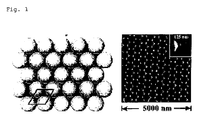
- the metallic 2-D ( FIG. 1 b ) or 3-D varying particle arrays permit the control of the distance between the nanoparticles as well as their cubic, hexagonal or more complicated ordering. The amount of the deposited materials through the mask can determine directly their optical and electronic properties.
- the production of periodic arrays of nanostructures involves the following steps:
- bio-organic interactive material is bound to array surfaces using various strategies. These strategies include standard streptavidin-biotin interaction as shown in FIG. 7 . It also includes the direct binding of (monoclonal) antibodies like IgG or fragments there of to the array surface via adhesion or electrostatic interaction. In addition, covalent linkage of target-specific molecular structures like antibodies or fragments there of, oligomers made of nucleic acids, or peptide or glycopeptides could be performed using linker technology as described in the detailed example below. The latter technique allows the precise binding of target specific molecules to nanoislands giving nanometer scale spatial resolution and therefore provides accurate real-time information regarding not only the concentration of a specific analyte but also its spatial distribution.
- the “Diagnostic-Nanosensor” is for medical application, for biological and biochemical research, as well as for environmental monitoring and protection and food safety. Concerning medical application, the “Diagnostic-Nanosensor” is assembled as a device for (1) in vivo and (2) in vitro use.
- the “Diagnostic Nanosensor” is assembled on spring wire giving a molecular or cell select catheter to obtain rare molecular or cellular components directly out of the circulation or the body in general ( FIG. 9 ).
- the “Diagnostic-Nanosensor” assembled on e.g. spring wires gives a cell or molecular select catheter which is useful for prenatal diagnosis of chromosomal aberrations, cancer diagnosis and the monitoring of chronic diseases like cancer, metabolic, infectious, allergic and inflammatory diseases.
- This device is applied as descript below.
- the “Diagnostic Nanosensor” is for the isolation of rare cells out of the peripheral blood, e.g. trophoblasts.
- Trophoblasts are foetal cells that appear in maternal blood around the 7 th gestational week at a concentration of about 1-2 per ml.
- the cell select catheter equipped with a monoclonal antibody that is directed against cellular but not soluble HLA-G binds specifically circulating trophoblasts in maternal blood.
- the number of bound cells to the cell select catheter depends on the retention period in the maternal circulation and the actual cell concentration. Appropriate numbers of trophoblasts for prenatal diagnoses of chromosomal aberration and other genetic defects could be collected after a retention period of 30 ⁇ 15 minutes in vivo. After replacing of the catheter the tip of the catheter with the attached cells is placed into a collector tube for transport to specialized laboratories.
- the “Diagnostic Nanosensor” is assembled on planar and transparent support to give a “lab on a chip” allowing quantitative and qualitative determination of targets by measuring the plasmon resonance frequencies on the nanostructured surfaces or luminescence or magnetic properties depending on the material that is deposited onto the support using nanosphere lithography.
- the “Diagnostic-Nanosensor” is for “on scene” diagnostic procedures (e.g. at the bedside, in the operating theatre, the ambulance, or the battle field) that should be used as described below.
- nanosized metallic particles show different optical absorption spectra depending on size.
- the surface plasmon band is due to collective electron oscillation around the surface of the particles.
- Ag (Silver) nanoparticles have plasmon band around 390 nm while Au nanoparticles have the plasmon band around 520 nm.
- the pick position, intensity and bandwidth of the surface plasmon absorption are directly related to size, morphology (shape), and surface functionality of the particles (see FIGS. 11 & 12 ).
- the two-dimensional ordering of latex particles as a basis for nanosphere lithography (NSL) has been used by us and others in the past 1 , 2 , 3 , 4 , 5 , 6 , 7 , 8 .
- NSL nanosphere lithography
- the evaporation or sputtering of different materials through a latex particle mask enabled the production of lattices of triangular islands on various substrates, the shape of the islands being determined by the shape of the aperture between the spheres in the mask.
- the size of the aperture between the spheres depends on the size of the beads in the monolayer. To overcome this limitation, we annealed the monolayer to downsize the apertures in the mask from an initial 200 nm to 30 nm.
- a piece of silicon, stainless steal, glass or sapphire substrate (1 cm 2 ) could be used for the deposition of polystyrene (PS) latex particles.
- PS polystyrene
- the amount of solution that could be distributed to cover the whole water surface with a hexagonal close packed (hcp) monolayer is limited by the size of the Petri dish and the diameter of the spheres. About 70% of this amount of solution is applied to the surface of the water, which left some places for stress relaxation and avoided the formation of cracks in the lattice during the next steps of the preparation.
- the monolayer has the biggest crystals of about 2 cm 2 , with very irregular shapes.
- gentle waves are applied to the liquid medium by slow and careful vessel tilting. After this treatment, crystals of about 25 cm 2 are created that show clear diffraction colors.
- the monolayer is deposited on a substrate by slow water evaporation.
- annealing of masks is performed.
- the monolayer of 540-nm PS latex nanospheres on a conductive Si substrate is immersed in a mixture (25 mL) of water/ethanol/acetone (3:1:1).
- Microwave heating is used up to the boiling temperature of the mixture, then additional microwave pulses are applied with duration of 3 s and period of 28 s.
- the increasing number of pulses causes gradual mask annealing and a decrease of the size of the apertures.
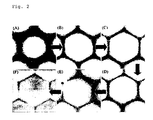
- the dependence of aperture morphology on number of pulses is presented in FIG. 2 .
- the liquid environment of the sample ensured very homogeneous annealing—the feature sizes become uniform over the whole area of the sample.
- the control of the aperture size was very good and reproducible.
- Metal deposition is carried out by evaporation using an e-beam evaporator.
- the evaporation system is modified to ensure control over the evaporation angle (è) and the sample rotation at the same time ( FIG. 4 ).
- FIG. 3 An annealed mask with 30-nm apertures ( FIG. 3 ) is used for the fabrication of Co magnetic nanoparticles or Au nanoparticles in a honeycomb lattice.
- a layer of Co or Au is evaporated (10 nm at 0.01 nms ⁇ 1 ) with the sample placed perpendicular to the evaporation beam.
- the result for Co particles is presented in FIG. 5 .
- the SPDP reagents produce disulfide-containing linkages that may be cleaved later with reducing agents such as dithiothreitol (DTT).
- DTT dithiothreitol
- the amine-reactive portion of SPDP reagents is the N-hydroxysuccinimide (NHS) ester. Reactions are most commonly performed in phosphate, carbonate/bicarbonate, or borate buffers at pH 7-8. Other buffers may be used provided they do not contain primary amines (or thiols or disulfide reducing reagent).
- the rate of reaction and degradation by hydrolysis increases with increasing pH; for example, the half-life of the NHS ester is several hours at pH 7 and less than 10 minutes at pH 9.
- NHS-ester reagents like SPDP and LC-SPDP have limited aqueous solubility and must be dissolved in organic solvent before adding them to a reaction mixture.
- Sulfo-NHS-ester reagents like Sulfo-LCSPDP are water-soluble and may be added directly to aqueous reaction mixtures.
- the sulfhydryl reactive portion of SPDP reagents is the 2-pyridyldithio group, which reacts optimally with sulfhydryls between pH 7 and 8.
- the reaction results in displacement of a pyridine-2-thione group, the concentration of which may be determined by measuring the absorbance at 343 nm.
- Reaction buffers must be free of thiols and disulfide reducing agents until quenching or reduction of the 2-pyridyl disulfide is desired.
- Two basic strategies may be used to form cleavable cross-links between proteins with SPDP reagents, depending whether one or neither protein already possesses sulfhydryl groups (—SH) in addition to primary amines.
- FIG. 1 Schematic illustration (a) and typical AFM image (b) of gold nanoparticles after evaporation process and liftoff of the mask
- FIG. 2 A 540-nm PS latex mask annealed in 25 mL of water/EtOH/acetone mixture
- FIG. 3 SEM image of the annealed 540-nm PS latex mask with sizes of all apertures below 50 nm.
- FIG. 4 Diagram of the modified evaporation system: 1) sample holder, 2) evaporation source, 3) crucible, 4) water cooling system,
- ⁇ is the evaporation angle and ⁇ is the rotation angle of the sample.
- FIG. 5 Ordered spherical Co nanoparticles evaporated through an annealed 540-nm PS latex mask. The diameter of a single particle is approximately 30 nm.
- FIG. 6 SEM picture of ordered Fe nanorings evaporated through an annealed 540-nm PS latex mask.
- the outer diameter of the single ring is 150 nm and the width of the ring is 20-30 nm.
- FIG. 7 Graphic presentation of how DNA or cellular structures are detected by specific antibodies. Antibodies are cross linked through streptavidin-biotin to Au-nanoparticles. Au-nanoparticles decorate the nanostructured surface of a catheter or spring wire or stent. This technique is the first nano-sandwich approach for the production of a Diagnostic Nanosensor.
- FIG. 8 IgG molecules covalently tethered to Au nanoislands through SPDP linker.
- the diameter of a single dot is 12 nm, corresponding to the average molecular weight of IgG (150 kD).
- FIG. 9 Diagnostic nanosensors assembled on spring wire to give a cell or molecular select catheter.
- FIG. 10 Cell select catheter in place. A spring wire with diagnostic nanosensors assembled on its surface is put into a peripheral vein through a standard venous line. After appropriate incubation time the cell select catheter is replaced with rare molecules or cells of interest attached to its surface for further laboratory analyses.
- FIG. 11 Influence of particle size on plasmon resonance. Different size of the mask (380, 540, 980, or 1710 nm) gives correspondent nanoparticle depositions on transparent substrate that generate typical spectra.
- FIG. 12 Typical example of spectrum changes of the plasmon resonance after deposition of bio-interactive material (avidin in this case) on nanostructured arrays.
Landscapes
- Chemical & Material Sciences (AREA)
- Engineering & Computer Science (AREA)
- Health & Medical Sciences (AREA)
- Nanotechnology (AREA)
- Life Sciences & Earth Sciences (AREA)
- Immunology (AREA)
- General Health & Medical Sciences (AREA)
- General Physics & Mathematics (AREA)
- Molecular Biology (AREA)
- Physics & Mathematics (AREA)
- Crystallography & Structural Chemistry (AREA)
- Pathology (AREA)
- Analytical Chemistry (AREA)
- Biochemistry (AREA)
- Urology & Nephrology (AREA)
- Hematology (AREA)
- Biomedical Technology (AREA)
- Medicinal Chemistry (AREA)
- Biotechnology (AREA)
- General Engineering & Computer Science (AREA)
- Condensed Matter Physics & Semiconductors (AREA)
- Biophysics (AREA)
- Microbiology (AREA)
- Medical Informatics (AREA)
- Pharmacology & Pharmacy (AREA)
- Cell Biology (AREA)
- Food Science & Technology (AREA)
- Composite Materials (AREA)
- Bioinformatics & Cheminformatics (AREA)
- Materials Engineering (AREA)
- Nuclear Medicine, Radiotherapy & Molecular Imaging (AREA)
- Investigating Or Analysing Materials By Optical Means (AREA)
- Apparatus Associated With Microorganisms And Enzymes (AREA)
- Investigating, Analyzing Materials By Fluorescence Or Luminescence (AREA)
- Investigating Or Analyzing Materials By The Use Of Magnetic Means (AREA)
- Medicines Containing Antibodies Or Antigens For Use As Internal Diagnostic Agents (AREA)
Priority Applications (1)
| Application Number | Priority Date | Filing Date | Title |
|---|---|---|---|
| US11/917,032 US8846580B2 (en) | 2005-06-10 | 2006-06-09 | Diagnostic nanosensor and its use in medicine |
Applications Claiming Priority (9)
| Application Number | Priority Date | Filing Date | Title |
|---|---|---|---|
| EP05090170.1 | 2005-06-10 | ||
| EP05090170 | 2005-06-10 | ||
| EP05090170 | 2005-06-10 | ||
| EP06090012A EP1811302B1 (de) | 2006-01-19 | 2006-01-19 | Diagnostischer Nanosensor und seine Verwendung |
| EP06090012.3 | 2006-01-19 | ||
| EP06090012 | 2006-01-19 | ||
| US74465206P | 2006-04-11 | 2006-04-11 | |
| US11/917,032 US8846580B2 (en) | 2005-06-10 | 2006-06-09 | Diagnostic nanosensor and its use in medicine |
| PCT/EP2006/005760 WO2006131400A1 (en) | 2005-06-10 | 2006-06-09 | Diagnostic-nanosensor and its use in medicine |
Publications (2)
| Publication Number | Publication Date |
|---|---|
| US20090131274A1 US20090131274A1 (en) | 2009-05-21 |
| US8846580B2 true US8846580B2 (en) | 2014-09-30 |
Family
ID=56290830
Family Applications (2)
| Application Number | Title | Priority Date | Filing Date |
|---|---|---|---|
| US11/917,032 Active 2030-01-24 US8846580B2 (en) | 2005-06-10 | 2006-06-09 | Diagnostic nanosensor and its use in medicine |
| US11/733,834 Active 2027-10-02 US8197756B2 (en) | 2005-06-10 | 2007-04-11 | Diagnostic-nanosensor and its use in medicine |
Family Applications After (1)
| Application Number | Title | Priority Date | Filing Date |
|---|---|---|---|
| US11/733,834 Active 2027-10-02 US8197756B2 (en) | 2005-06-10 | 2007-04-11 | Diagnostic-nanosensor and its use in medicine |
Country Status (8)
| Country | Link |
|---|---|
| US (2) | US8846580B2 (de) |
| EP (1) | EP1907848B1 (de) |
| CN (1) | CN101305280B (de) |
| AT (1) | ATE519110T1 (de) |
| AU (1) | AU2006256859B2 (de) |
| BR (1) | BRPI0611821A2 (de) |
| CA (1) | CA2609573A1 (de) |
| WO (1) | WO2006131400A1 (de) |
Cited By (4)
| Publication number | Priority date | Publication date | Assignee | Title |
|---|---|---|---|---|
| US9750952B2 (en) | 2010-10-19 | 2017-09-05 | Ogeno Gmbh | Magnetic instrument for the homing of therapeutic cells and the elimination of excess therapeutic cells |
| US10352931B2 (en) | 2013-08-27 | 2019-07-16 | Gilupi Gmbh | Diagnostic device for the detection of disease related target structures |
| US10987037B2 (en) | 2003-12-22 | 2021-04-27 | John Wayne Cancer Institute | Method and apparatus for in vivo surveillance of circulating biological components |
| US11160542B2 (en) | 2016-06-09 | 2021-11-02 | Haimachek, Inc. | Collector for detection and reversible capturing of cells from body fluids in vivo |
Families Citing this family (38)
| Publication number | Priority date | Publication date | Assignee | Title |
|---|---|---|---|---|
| US8629770B2 (en) * | 2004-11-29 | 2014-01-14 | Gregory J. Hummer | Sensor for container monitoring system |
| CN101305280B (zh) | 2005-06-10 | 2012-10-10 | 吉卢比有限公司 | 诊断纳米传感器及其在医学中的用途 |
| GB2447696A (en) * | 2007-03-23 | 2008-09-24 | Univ Exeter | Photonic biosensor arrays |
| US20080280374A1 (en) * | 2007-05-08 | 2008-11-13 | General Electric Company | Methods and systems for detecting biological and chemical materials on a submicron structured substrate |
| EP2215464B1 (de) * | 2007-11-20 | 2015-10-07 | Technion Research & Development Foundation Ltd. | Sensor Sytem, Verwendung eines Sensors und Nachweisverfahren basierend auf kubischen Nanopartikeln mit organischer Beschichtung |
| IL190475A0 (en) | 2008-03-27 | 2009-02-11 | Technion Res & Dev Foundation | Chemical sensors based on cubic nanoparticles capped with organic coating for detecting explosives |
| DE102008027095A1 (de) * | 2008-06-06 | 2009-12-17 | Siemens Aktiengesellschaft | Interventionsvorrichtung zur Sammlung von biologischem Material und Verfahren zu ihrer Herstellung |
| JP5470391B2 (ja) * | 2008-09-08 | 2014-04-16 | オゲノ ゲーエムベーハー | 試料材料の濃縮用の生検器具 |
| US20130324478A1 (en) | 2008-09-08 | 2013-12-05 | Laurence Faure | Pharmacodiagnosis Test Targeting Oncology and Neurodegeneration |
| WO2010034484A1 (en) | 2008-09-23 | 2010-04-01 | Gilupi Gmbh | Diagnostic analyte collection device based on flexible polymers with biological surface modification and microfluidic functionality |
| US9132445B2 (en) | 2009-03-05 | 2015-09-15 | Max-Planck-Gesellschaft Zur Foerderung Der Wissenschaften E.V. | Highly ordered arrays of nanoholes in metallic films and methods for producing the same |
| CN102341524B (zh) * | 2009-03-05 | 2013-10-16 | 马克思-普朗克科学促进协会 | 金属膜中高度有序的纳米孔阵列及其制作方法 |
| CA2765540A1 (en) * | 2009-06-17 | 2010-12-23 | Gilupi Gmbh | Detection device for in vivo and/or in vitro enrichment of sample material |
| WO2011047671A1 (de) | 2009-10-20 | 2011-04-28 | Ogeno Gmbh | Biopsie-instrument umfassend ein magnetisches element |
| US8039292B2 (en) | 2009-11-18 | 2011-10-18 | International Business Machines Corporation | Holey electrode grids for photovoltaic cells with subwavelength and superwavelength feature sizes |
| DE102010011560B4 (de) * | 2010-03-16 | 2021-09-16 | Gilupi Gmbh | Biodetektor |
| DE102010025608A1 (de) * | 2010-06-30 | 2012-01-05 | Osram Opto Semiconductors Gmbh | Optoelektronisches Bauteil |
| KR101835293B1 (ko) * | 2010-09-03 | 2018-03-06 | 테트라썬, 아이엔씨. | 광학코팅의 부분적 리프트-오프에 의한 광기전력 장치의 미세라인 금속화 |
| EP2751134A1 (de) | 2011-03-18 | 2014-07-09 | Laurence Faure | Tests für die onkologie und neuroonkologie |
| FR2985164B1 (fr) * | 2011-12-29 | 2015-02-27 | Commissariat Energie Atomique | Dispositif et procede de prelevement et analyse d'especes biologiques ou biochimiques. |
| US9592001B2 (en) | 2012-07-29 | 2017-03-14 | Hewlett-Packard Development Company, L.P. | Implantable nanosensor |
| DE102012017026A1 (de) * | 2012-08-28 | 2014-03-06 | Forschungszentrum Jülich GmbH | Sensor für NADP(H) und Entwicklung von Alkoholdehydrogenasen |
| DE102012112299A1 (de) * | 2012-12-14 | 2014-06-18 | Leibniz-Institut Für Neue Materialien Gemeinnützige Gesellschaft Mit Beschränkter Haftung | Metall-Nanopartikel-Arrays und Herstellung von Metall-Nanopartikel-Arrays |
| EP2781909B1 (de) * | 2013-03-19 | 2021-09-29 | King Saud University | Oberflächenplasmonenbasierte Nanostrukturen, die als Nanosensor zum Erfassen chemischer oder biologischer Stoffe und Systeme zum Erfassen chemischer oder biologischer Stoffe geeignet sind |
| TWI498541B (zh) * | 2013-05-30 | 2015-09-01 | Univ Nat Cheng Kung | 具不對稱週期粒子排列之定域化表面電漿共振檢測系統 |
| CN103837676B (zh) * | 2014-03-20 | 2016-08-17 | 苏州纳达生物科技有限公司 | 一种金属纳米岛载体及其制备方法和在免疫检测中的应用 |
| CN104370270B (zh) * | 2014-11-20 | 2016-05-25 | 中国科学院上海微系统与信息技术研究所 | 一种精确定位制备氧化硅纳米岛阵列的方法 |
| EP3051273A1 (de) * | 2015-02-02 | 2016-08-03 | Nokia Technologies OY | Mechanischer Verformungssensor basierend auf plasmonische Nanopartikeln |
| US9673341B2 (en) | 2015-05-08 | 2017-06-06 | Tetrasun, Inc. | Photovoltaic devices with fine-line metallization and methods for manufacture |
| US10319687B1 (en) | 2018-03-12 | 2019-06-11 | Honeywell International Inc. | Soluble sensor node and method of manufacture |
| CN110095616A (zh) * | 2019-05-23 | 2019-08-06 | 重庆医科大学 | 一种基于钴纳米材料/核酸适配体的复合探针荧光“开-关-开”策略检测脑钠肽的方法 |
| CN112240877B (zh) * | 2019-07-16 | 2024-11-22 | 香港城市大学 | 衬底上形成具有间隙等离子体纳米材料的方法、传感器 |
| CN112386399B (zh) * | 2019-08-12 | 2023-05-09 | 湖南早晨纳米机器人有限公司 | 一种纳米手术机器人以及制作方法 |
| CN110596064A (zh) * | 2019-09-25 | 2019-12-20 | 宁波赫柏生物科技有限公司 | 一种利用表面等离子体热效应分区加热的生物芯片 |
| CN111636065B (zh) * | 2020-05-15 | 2022-06-07 | 扬州大学 | 银三角环纳米颗粒阵列/单层石墨烯薄膜复合材料及其制备方法 |
| DE102020115332A1 (de) | 2020-06-09 | 2021-12-09 | Forschungszentrum Jülich GmbH | Biomarkersensorbasierende detektion krankheitsspezifischer biomarker |
| EP4196788A1 (de) | 2020-08-14 | 2023-06-21 | Idris Oncology B.V. | Verfahren zum aufbringen einer hyaluronsäure enthaltenden beschichtung auf die oberfläche einer medizinischen probe |
| AU2021324051A1 (en) | 2020-08-14 | 2023-02-09 | Idris Oncology B.V. | A process for applying a coating comprising one or more polysaccharides with binding affinity for bioanalytes onto the surface of a medical sampling device, and the medical sampling device for capture of bioanalytes provided with the coating |
Citations (9)
| Publication number | Priority date | Publication date | Assignee | Title |
|---|---|---|---|---|
| US20040005723A1 (en) | 2002-04-02 | 2004-01-08 | Nanosys, Inc. | Methods of making, positioning and orienting nanostructures, nanostructure arrays and nanostructure devices |
| WO2004003535A1 (en) | 2002-06-27 | 2004-01-08 | Nanosys Inc. | Planar nanowire based sensor elements, devices, systems and methods for using and making same |
| US20040180379A1 (en) * | 2002-08-30 | 2004-09-16 | Northwestern University | Surface-enhanced raman nanobiosensor |
| WO2004086044A1 (en) | 2003-03-28 | 2004-10-07 | The Provost, Fellows And Scholars Of The College Of The Holy And Undivided Trinity Of Queen Elizabeth Near Dublin | Sensor for detecting an analyte using silver nanoparticles |
| WO2005031299A2 (en) | 2003-05-14 | 2005-04-07 | Nantero, Inc. | Sensor platform using a non-horizontally oriented nanotube element |
| WO2005033335A2 (fr) | 2003-10-09 | 2005-04-14 | Commissariat A L'energie Atomique | Micro-capteurs et nano-capteurs d’especes chimiques et biologiques a plasmons de surface |
| WO2005059952A2 (en) | 2003-07-28 | 2005-06-30 | The Regents Of The University Of California | Langmuir-blodgett nanostructure monolayers |
| WO2005114298A2 (en) | 2004-05-19 | 2005-12-01 | Vp Holding, Llc | Optical sensor with layered plasmon structure for enhanced detection of chemical groups by sers |
| US20080213130A1 (en) | 2005-06-10 | 2008-09-04 | Gilupi Gmbh | Diagnostic-nanosensor and its use in medicine |
Family Cites Families (1)
| Publication number | Priority date | Publication date | Assignee | Title |
|---|---|---|---|---|
| US6025202A (en) * | 1995-02-09 | 2000-02-15 | The Penn State Research Foundation | Self-assembled metal colloid monolayers and detection methods therewith |
-
2006
- 2006-06-09 CN CN2006800204055A patent/CN101305280B/zh active Active
- 2006-06-09 EP EP06743163A patent/EP1907848B1/de active Active
- 2006-06-09 WO PCT/EP2006/005760 patent/WO2006131400A1/en not_active Ceased
- 2006-06-09 CA CA002609573A patent/CA2609573A1/en not_active Abandoned
- 2006-06-09 AT AT06743163T patent/ATE519110T1/de not_active IP Right Cessation
- 2006-06-09 US US11/917,032 patent/US8846580B2/en active Active
- 2006-06-09 BR BRPI0611821-6A patent/BRPI0611821A2/pt not_active IP Right Cessation
- 2006-06-09 AU AU2006256859A patent/AU2006256859B2/en not_active Ceased
-
2007
- 2007-04-11 US US11/733,834 patent/US8197756B2/en active Active
Patent Citations (11)
| Publication number | Priority date | Publication date | Assignee | Title |
|---|---|---|---|---|
| US20040005723A1 (en) | 2002-04-02 | 2004-01-08 | Nanosys, Inc. | Methods of making, positioning and orienting nanostructures, nanostructure arrays and nanostructure devices |
| WO2004003535A1 (en) | 2002-06-27 | 2004-01-08 | Nanosys Inc. | Planar nanowire based sensor elements, devices, systems and methods for using and making same |
| US20040180379A1 (en) * | 2002-08-30 | 2004-09-16 | Northwestern University | Surface-enhanced raman nanobiosensor |
| WO2004086044A1 (en) | 2003-03-28 | 2004-10-07 | The Provost, Fellows And Scholars Of The College Of The Holy And Undivided Trinity Of Queen Elizabeth Near Dublin | Sensor for detecting an analyte using silver nanoparticles |
| WO2005031299A2 (en) | 2003-05-14 | 2005-04-07 | Nantero, Inc. | Sensor platform using a non-horizontally oriented nanotube element |
| WO2005059952A2 (en) | 2003-07-28 | 2005-06-30 | The Regents Of The University Of California | Langmuir-blodgett nanostructure monolayers |
| WO2005033335A2 (fr) | 2003-10-09 | 2005-04-14 | Commissariat A L'energie Atomique | Micro-capteurs et nano-capteurs d’especes chimiques et biologiques a plasmons de surface |
| US20070115474A1 (en) | 2003-10-09 | 2007-05-24 | Commissariat A L'energie | Microsensors and nanosensors for chemical and biological species with surface plasmons |
| WO2005114298A2 (en) | 2004-05-19 | 2005-12-01 | Vp Holding, Llc | Optical sensor with layered plasmon structure for enhanced detection of chemical groups by sers |
| US20080213130A1 (en) | 2005-06-10 | 2008-09-04 | Gilupi Gmbh | Diagnostic-nanosensor and its use in medicine |
| US20090131274A1 (en) | 2005-06-10 | 2009-05-21 | Gilupi Gmbh | Diagnostic nanosensor and its use in medicine |
Non-Patent Citations (4)
| Title |
|---|
| A. Kosiorek et al., Fabrication of Nanoscale Rings, Dots, and Rods by Combining Shadow Nanosphere Lithography and Annealed Polystyrene Nanosphere Masks, 1 Small 439-444 (2005). * |
| C. Vericat et al., Thiol-Capped Gold: From Planar to Irregular Surfaces, 20 J. Phys.: Condens. Matter 184004 (2008). * |
| G. Raschke et al., Biomolecular Recognition Based on Single Gold Nanoparticle Light Scattering, 7 Nano Lett. 935-938 (2003). * |
| I.-S Park and N. Kim, Thiolated Salmonella Antibody Immobilization Onto the Gold Surface of Piezoelectric Quartz Crystal, 13 Biosens. Bioelectron. 1091-1097 (1998). * |
Cited By (4)
| Publication number | Priority date | Publication date | Assignee | Title |
|---|---|---|---|---|
| US10987037B2 (en) | 2003-12-22 | 2021-04-27 | John Wayne Cancer Institute | Method and apparatus for in vivo surveillance of circulating biological components |
| US9750952B2 (en) | 2010-10-19 | 2017-09-05 | Ogeno Gmbh | Magnetic instrument for the homing of therapeutic cells and the elimination of excess therapeutic cells |
| US10352931B2 (en) | 2013-08-27 | 2019-07-16 | Gilupi Gmbh | Diagnostic device for the detection of disease related target structures |
| US11160542B2 (en) | 2016-06-09 | 2021-11-02 | Haimachek, Inc. | Collector for detection and reversible capturing of cells from body fluids in vivo |
Also Published As
| Publication number | Publication date |
|---|---|
| AU2006256859B2 (en) | 2012-05-31 |
| CA2609573A1 (en) | 2006-12-14 |
| US20090131274A1 (en) | 2009-05-21 |
| BRPI0611821A2 (pt) | 2011-12-20 |
| CN101305280B (zh) | 2012-10-10 |
| WO2006131400A1 (en) | 2006-12-14 |
| AU2006256859A1 (en) | 2006-12-14 |
| EP1907848A1 (de) | 2008-04-09 |
| US20080213130A1 (en) | 2008-09-04 |
| EP1907848B1 (de) | 2011-08-03 |
| US8197756B2 (en) | 2012-06-12 |
| ATE519110T1 (de) | 2011-08-15 |
| CN101305280A (zh) | 2008-11-12 |
| AU2006256859A2 (en) | 2008-05-01 |
Similar Documents
| Publication | Publication Date | Title |
|---|---|---|
| US8846580B2 (en) | Diagnostic nanosensor and its use in medicine | |
| Liang et al. | Carbon-based SERS biosensor: From substrate design to sensing and bioapplication | |
| Zeng et al. | A review on functionalized gold nanoparticles for biosensing applications | |
| Riboh et al. | A nanoscale optical biosensor: real-time immunoassay in physiological buffer enabled by improved nanoparticle adhesion | |
| JP7793564B2 (ja) | プラズモン特異的結合パートナーアッセイにおけるシグナル増幅 | |
| Frasconi et al. | Multifunctional Au nanoparticle dendrimer-based surface plasmon resonance biosensor and its application for improved insulin detection | |
| Fateixa et al. | Hybrid nanostructures for SERS: materials development and chemical detection | |
| Chen et al. | Inflection point of the localized surface plasmon resonance peak: a general method to improve the sensitivity | |
| Han et al. | Label-free detection in biological applications of surface-enhanced Raman scattering | |
| Zeng et al. | Nanomaterials enhanced surface plasmon resonance for biological and chemical sensing applications | |
| JP4787938B2 (ja) | 銀ナノ粒子を用いた検体検出用センサ | |
| Caro et al. | Silver nanoparticles: sensing and imaging applications | |
| Anker et al. | Biosensing with plasmonic nanosensors | |
| Zhang et al. | Synthesis, properties, and optical applications of noble metal nanoparticle-biomolecule conjugates | |
| KR102365091B1 (ko) | 표면 증강 라만 산란용 라만 활성 나노입자 및 이의 제조방법 | |
| Mannelli et al. | Recent advances in analytical and bioanalysis applications of noble metal nanorods | |
| Beeram et al. | Effect of protein binding coverage, location, and distance on the localized surface plasmon resonance response of purified Au nanoplates grown directly on surfaces | |
| Kalaivani et al. | Plasmon-tuned silver colloids for SERRS analysis of methemoglobin with preserved nativity | |
| Combs et al. | Label-free raman mapping of surface distribution of protein A and IgG biomolecules | |
| EP1811302B1 (de) | Diagnostischer Nanosensor und seine Verwendung | |
| Zhao et al. | Micro‐/Nanomaterials for Surface‐Enhanced Optical Biosensing | |
| Huang et al. | A localized surface plasmon resonance biosensor based on integrated controllable Au2S/AuAgS-coated gold nanorods composite | |
| JP2005156387A (ja) | 光ファイバ | |
| Nehl et al. | Plasmon resonant molecular sensing with single gold nanostars | |
| Chakraborty et al. | Morphology-Dependent Biosensing of Metallic Nanoparticles |
Legal Events
| Date | Code | Title | Description |
|---|---|---|---|
| AS | Assignment |
Owner name: GILUPI GMBH, GERMANY Free format text: ASSIGNMENT OF ASSIGNORS INTEREST;ASSIGNORS:PISON, ULRICH;GIERSIG, MICHAEL;SCHAEFER, ALEX;REEL/FRAME:021687/0496 Effective date: 20080720 |
|
| STCF | Information on status: patent grant |
Free format text: PATENTED CASE |
|
| MAFP | Maintenance fee payment |
Free format text: PAYMENT OF MAINTENANCE FEE, 4TH YEAR, LARGE ENTITY (ORIGINAL EVENT CODE: M1551) Year of fee payment: 4 |
|
| MAFP | Maintenance fee payment |
Free format text: PAYMENT OF MAINTENANCE FEE, 8TH YEAR, LARGE ENTITY (ORIGINAL EVENT CODE: M1552); ENTITY STATUS OF PATENT OWNER: LARGE ENTITY Year of fee payment: 8 |
|
| MAFP | Maintenance fee payment |
Free format text: PAYMENT OF MAINTENANCE FEE, 12TH YEAR, LARGE ENTITY (ORIGINAL EVENT CODE: M1553); ENTITY STATUS OF PATENT OWNER: LARGE ENTITY Year of fee payment: 12 |