USH179H - Polybutylene - Google Patents
Polybutylene Download PDFInfo
- Publication number
- USH179H USH179H US06/675,669 US67566984A USH179H US H179 H USH179 H US H179H US 67566984 A US67566984 A US 67566984A US H179 H USH179 H US H179H
- Authority
- US
- United States
- Prior art keywords
- polybutylene
- butene
- elastomeric
- procatalyst
- catalyst
- Prior art date
- Legal status (The legal status is an assumption and is not a legal conclusion. Google has not performed a legal analysis and makes no representation as to the accuracy of the status listed.)
- Abandoned
Links
- -1 Polybutylene Polymers 0.000 title claims abstract description 119
- 229920001748 polybutylene Polymers 0.000 title abstract description 106
- VXNZUUAINFGPBY-UHFFFAOYSA-N 1-Butene Chemical compound CCC=C VXNZUUAINFGPBY-UHFFFAOYSA-N 0.000 claims abstract description 68
- RTZKZFJDLAIYFH-UHFFFAOYSA-N Diethyl ether Chemical compound CCOCC RTZKZFJDLAIYFH-UHFFFAOYSA-N 0.000 claims description 57
- 239000003054 catalyst Substances 0.000 claims description 54
- 238000000034 method Methods 0.000 claims description 34
- 239000000203 mixture Substances 0.000 claims description 19
- 238000004519 manufacturing process Methods 0.000 claims description 18
- 239000010936 titanium Substances 0.000 claims description 15
- 239000003795 chemical substances by application Substances 0.000 claims description 13
- 230000008569 process Effects 0.000 claims description 11
- 229910052782 aluminium Inorganic materials 0.000 claims description 10
- 229910052719 titanium Inorganic materials 0.000 claims description 9
- RTAQQCXQSZGOHL-UHFFFAOYSA-N Titanium Chemical compound [Ti] RTAQQCXQSZGOHL-UHFFFAOYSA-N 0.000 claims description 7
- 238000002441 X-ray diffraction Methods 0.000 claims description 5
- 230000007547 defect Effects 0.000 claims description 5
- 229920001519 homopolymer Polymers 0.000 claims description 5
- 238000002844 melting Methods 0.000 claims description 5
- 230000008018 melting Effects 0.000 claims description 5
- 238000010992 reflux Methods 0.000 claims description 5
- XAGFODPZIPBFFR-UHFFFAOYSA-N aluminium Chemical compound [Al] XAGFODPZIPBFFR-UHFFFAOYSA-N 0.000 claims description 4
- 239000007788 liquid Substances 0.000 claims description 4
- 239000004215 Carbon black (E152) Substances 0.000 claims description 3
- 229930195733 hydrocarbon Natural products 0.000 claims description 3
- 150000002430 hydrocarbons Chemical class 0.000 claims description 3
- 238000010528 free radical solution polymerization reaction Methods 0.000 claims description 2
- 229910052749 magnesium Inorganic materials 0.000 claims description 2
- 239000011777 magnesium Substances 0.000 claims description 2
- 239000007810 chemical reaction solvent Substances 0.000 claims 1
- 239000002685 polymerization catalyst Substances 0.000 claims 1
- 125000000383 tetramethylene group Chemical group [H]C([H])([*:1])C([H])([H])C([H])([H])C([H])([H])[*:2] 0.000 claims 1
- 229920000642 polymer Polymers 0.000 abstract description 62
- 238000006116 polymerization reaction Methods 0.000 abstract description 27
- 229920000915 polyvinyl chloride Polymers 0.000 abstract description 21
- 239000004800 polyvinyl chloride Substances 0.000 abstract description 20
- 229920001971 elastomer Polymers 0.000 abstract description 12
- 229920002725 thermoplastic elastomer Polymers 0.000 abstract description 7
- 239000004014 plasticizer Substances 0.000 abstract description 6
- 229920002554 vinyl polymer Polymers 0.000 abstract description 5
- 239000000945 filler Substances 0.000 abstract description 4
- 239000004606 Fillers/Extenders Substances 0.000 abstract description 3
- 239000005060 rubber Substances 0.000 abstract description 2
- IMNFDUFMRHMDMM-UHFFFAOYSA-N N-Heptane Chemical compound CCCCCCC IMNFDUFMRHMDMM-UHFFFAOYSA-N 0.000 description 36
- 239000000047 product Substances 0.000 description 36
- VOITXYVAKOUIBA-UHFFFAOYSA-N triethylaluminium Chemical compound CC[Al](CC)CC VOITXYVAKOUIBA-UHFFFAOYSA-N 0.000 description 22
- 229920000098 polyolefin Polymers 0.000 description 13
- 239000000806 elastomer Substances 0.000 description 10
- 230000035882 stress Effects 0.000 description 10
- 239000012967 coordination catalyst Substances 0.000 description 9
- 239000004743 Polypropylene Substances 0.000 description 8
- 238000000605 extraction Methods 0.000 description 8
- 229920001155 polypropylene Polymers 0.000 description 8
- 239000007787 solid Substances 0.000 description 8
- 239000000126 substance Substances 0.000 description 8
- TWRXJAOTZQYOKJ-UHFFFAOYSA-L Magnesium chloride Chemical compound [Mg+2].[Cl-].[Cl-] TWRXJAOTZQYOKJ-UHFFFAOYSA-L 0.000 description 7
- 229910010062 TiCl3 Inorganic materials 0.000 description 7
- 239000013078 crystal Substances 0.000 description 7
- 230000000694 effects Effects 0.000 description 7
- QQONPFPTGQHPMA-UHFFFAOYSA-N propylene Natural products CC=C QQONPFPTGQHPMA-UHFFFAOYSA-N 0.000 description 7
- 125000004805 propylene group Chemical group [H]C([H])([H])C([H])([*:1])C([H])([H])[*:2] 0.000 description 7
- 229920001169 thermoplastic Polymers 0.000 description 7
- 239000004416 thermosoftening plastic Substances 0.000 description 7
- YONPGGFAJWQGJC-UHFFFAOYSA-K titanium(iii) chloride Chemical compound Cl[Ti](Cl)Cl YONPGGFAJWQGJC-UHFFFAOYSA-K 0.000 description 7
- 229920001400 block copolymer Polymers 0.000 description 6
- 238000006243 chemical reaction Methods 0.000 description 6
- 239000012632 extractable Substances 0.000 description 6
- 238000001953 recrystallisation Methods 0.000 description 6
- 230000000052 comparative effect Effects 0.000 description 5
- 238000013016 damping Methods 0.000 description 5
- 239000000178 monomer Substances 0.000 description 5
- 230000000704 physical effect Effects 0.000 description 5
- PPBRXRYQALVLMV-UHFFFAOYSA-N Styrene Chemical compound C=CC1=CC=CC=C1 PPBRXRYQALVLMV-UHFFFAOYSA-N 0.000 description 4
- 238000009835 boiling Methods 0.000 description 4
- 238000001460 carbon-13 nuclear magnetic resonance spectrum Methods 0.000 description 4
- MTZQAGJQAFMTAQ-UHFFFAOYSA-N ethyl benzoate Chemical compound CCOC(=O)C1=CC=CC=C1 MTZQAGJQAFMTAQ-UHFFFAOYSA-N 0.000 description 4
- 229920001580 isotactic polymer Polymers 0.000 description 4
- 229910001629 magnesium chloride Inorganic materials 0.000 description 4
- YMWUJEATGCHHMB-UHFFFAOYSA-N Dichloromethane Chemical compound ClCCl YMWUJEATGCHHMB-UHFFFAOYSA-N 0.000 description 3
- 244000043261 Hevea brasiliensis Species 0.000 description 3
- UFHFLCQGNIYNRP-UHFFFAOYSA-N Hydrogen Chemical compound [H][H] UFHFLCQGNIYNRP-UHFFFAOYSA-N 0.000 description 3
- 238000005481 NMR spectroscopy Methods 0.000 description 3
- 229920012485 Plasticized Polyvinyl chloride Polymers 0.000 description 3
- 229910003074 TiCl4 Inorganic materials 0.000 description 3
- 238000000748 compression moulding Methods 0.000 description 3
- 229920001577 copolymer Polymers 0.000 description 3
- 230000000875 corresponding effect Effects 0.000 description 3
- 239000000706 filtrate Substances 0.000 description 3
- 238000001640 fractional crystallisation Methods 0.000 description 3
- 238000010438 heat treatment Methods 0.000 description 3
- 239000001257 hydrogen Substances 0.000 description 3
- 229910052739 hydrogen Inorganic materials 0.000 description 3
- 229920003052 natural elastomer Polymers 0.000 description 3
- 229920001194 natural rubber Polymers 0.000 description 3
- 238000002360 preparation method Methods 0.000 description 3
- 239000002002 slurry Substances 0.000 description 3
- 238000000638 solvent extraction Methods 0.000 description 3
- 239000000725 suspension Substances 0.000 description 3
- XJDNKRIXUMDJCW-UHFFFAOYSA-J titanium tetrachloride Chemical compound Cl[Ti](Cl)(Cl)Cl XJDNKRIXUMDJCW-UHFFFAOYSA-J 0.000 description 3
- 229910052723 transition metal Inorganic materials 0.000 description 3
- 150000003624 transition metals Chemical class 0.000 description 3
- XLYOFNOQVPJJNP-UHFFFAOYSA-N water Substances O XLYOFNOQVPJJNP-UHFFFAOYSA-N 0.000 description 3
- 239000004711 α-olefin Substances 0.000 description 3
- VTYYLEPIZMXCLO-UHFFFAOYSA-L Calcium carbonate Chemical compound [Ca+2].[O-]C([O-])=O VTYYLEPIZMXCLO-UHFFFAOYSA-L 0.000 description 2
- VGGSQFUCUMXWEO-UHFFFAOYSA-N Ethene Chemical compound C=C VGGSQFUCUMXWEO-UHFFFAOYSA-N 0.000 description 2
- FHUODBDRWMIBQP-UHFFFAOYSA-N Ethyl p-anisate Chemical compound CCOC(=O)C1=CC=C(OC)C=C1 FHUODBDRWMIBQP-UHFFFAOYSA-N 0.000 description 2
- 239000005977 Ethylene Substances 0.000 description 2
- 239000008037 PVC plasticizer Substances 0.000 description 2
- BZHJMEDXRYGGRV-UHFFFAOYSA-N Vinyl chloride Chemical compound ClC=C BZHJMEDXRYGGRV-UHFFFAOYSA-N 0.000 description 2
- 238000006653 Ziegler-Natta catalysis Methods 0.000 description 2
- VSCWAEJMTAWNJL-UHFFFAOYSA-K aluminium trichloride Chemical compound Cl[Al](Cl)Cl VSCWAEJMTAWNJL-UHFFFAOYSA-K 0.000 description 2
- 125000004432 carbon atom Chemical group C* 0.000 description 2
- 230000008859 change Effects 0.000 description 2
- 239000007795 chemical reaction product Substances 0.000 description 2
- 239000003426 co-catalyst Substances 0.000 description 2
- 239000002131 composite material Substances 0.000 description 2
- 150000001875 compounds Chemical class 0.000 description 2
- 230000006835 compression Effects 0.000 description 2
- 238000007906 compression Methods 0.000 description 2
- 238000001816 cooling Methods 0.000 description 2
- 238000005336 cracking Methods 0.000 description 2
- 150000001993 dienes Chemical class 0.000 description 2
- HBGGXOJOCNVPFY-UHFFFAOYSA-N diisononyl phthalate Chemical compound CC(C)CCCCCCOC(=O)C1=CC=CC=C1C(=O)OCCCCCCC(C)C HBGGXOJOCNVPFY-UHFFFAOYSA-N 0.000 description 2
- 238000009826 distribution Methods 0.000 description 2
- 230000009977 dual effect Effects 0.000 description 2
- 229920001198 elastomeric copolymer Polymers 0.000 description 2
- 238000005516 engineering process Methods 0.000 description 2
- 230000006353 environmental stress Effects 0.000 description 2
- 229910052736 halogen Inorganic materials 0.000 description 2
- 150000002367 halogens Chemical class 0.000 description 2
- 230000036541 health Effects 0.000 description 2
- 239000000463 material Substances 0.000 description 2
- 239000000155 melt Substances 0.000 description 2
- 229910052751 metal Inorganic materials 0.000 description 2
- 239000002184 metal Substances 0.000 description 2
- 238000002156 mixing Methods 0.000 description 2
- 230000004048 modification Effects 0.000 description 2
- 238000012986 modification Methods 0.000 description 2
- 150000002902 organometallic compounds Chemical class 0.000 description 2
- 239000002244 precipitate Substances 0.000 description 2
- 238000001556 precipitation Methods 0.000 description 2
- 210000002966 serum Anatomy 0.000 description 2
- 239000002904 solvent Substances 0.000 description 2
- 239000011950 stereoregulating catalyst Substances 0.000 description 2
- 239000003203 stereoselective catalyst Substances 0.000 description 2
- 230000009466 transformation Effects 0.000 description 2
- TYCQLNBCQSJWGJ-UHFFFAOYSA-N 2,6,6-trichlorocyclohexa-1,3-diene Chemical compound ClC1=CC(Cl)(Cl)CC=C1 TYCQLNBCQSJWGJ-UHFFFAOYSA-N 0.000 description 1
- NLZUEZXRPGMBCV-UHFFFAOYSA-N Butylhydroxytoluene Chemical compound CC1=CC(C(C)(C)C)=C(O)C(C(C)(C)C)=C1 NLZUEZXRPGMBCV-UHFFFAOYSA-N 0.000 description 1
- MQIUGAXCHLFZKX-UHFFFAOYSA-N Di-n-octyl phthalate Natural products CCCCCCCCOC(=O)C1=CC=CC=C1C(=O)OCCCCCCCC MQIUGAXCHLFZKX-UHFFFAOYSA-N 0.000 description 1
- 229920002943 EPDM rubber Polymers 0.000 description 1
- LFQSCWFLJHTTHZ-UHFFFAOYSA-N Ethanol Chemical compound CCO LFQSCWFLJHTTHZ-UHFFFAOYSA-N 0.000 description 1
- FYYHWMGAXLPEAU-UHFFFAOYSA-N Magnesium Chemical compound [Mg] FYYHWMGAXLPEAU-UHFFFAOYSA-N 0.000 description 1
- 239000005062 Polybutadiene Substances 0.000 description 1
- 239000004721 Polyphenylene oxide Substances 0.000 description 1
- 238000000944 Soxhlet extraction Methods 0.000 description 1
- 239000004433 Thermoplastic polyurethane Substances 0.000 description 1
- 229910021552 Vanadium(IV) chloride Inorganic materials 0.000 description 1
- 206010047289 Ventricular extrasystoles Diseases 0.000 description 1
- 239000011954 Ziegler–Natta catalyst Substances 0.000 description 1
- 238000002835 absorbance Methods 0.000 description 1
- 230000009102 absorption Effects 0.000 description 1
- 238000010521 absorption reaction Methods 0.000 description 1
- 230000009471 action Effects 0.000 description 1
- 239000000654 additive Substances 0.000 description 1
- 230000032683 aging Effects 0.000 description 1
- 238000013019 agitation Methods 0.000 description 1
- 150000001336 alkenes Chemical class 0.000 description 1
- 125000003118 aryl group Chemical group 0.000 description 1
- 238000000498 ball milling Methods 0.000 description 1
- BJQHLKABXJIVAM-UHFFFAOYSA-N bis(2-ethylhexyl) phthalate Chemical compound CCCCC(CC)COC(=O)C1=CC=CC=C1C(=O)OCC(CC)CCCC BJQHLKABXJIVAM-UHFFFAOYSA-N 0.000 description 1
- 235000010354 butylated hydroxytoluene Nutrition 0.000 description 1
- 229910000019 calcium carbonate Inorganic materials 0.000 description 1
- 239000003153 chemical reaction reagent Substances 0.000 description 1
- 239000013065 commercial product Substances 0.000 description 1
- 238000002425 crystallisation Methods 0.000 description 1
- 230000001186 cumulative effect Effects 0.000 description 1
- 230000003247 decreasing effect Effects 0.000 description 1
- 238000007872 degassing Methods 0.000 description 1
- 230000006866 deterioration Effects 0.000 description 1
- 230000002708 enhancing effect Effects 0.000 description 1
- 230000007613 environmental effect Effects 0.000 description 1
- 238000001704 evaporation Methods 0.000 description 1
- 230000008020 evaporation Effects 0.000 description 1
- 230000001747 exhibiting effect Effects 0.000 description 1
- 235000012438 extruded product Nutrition 0.000 description 1
- 239000000835 fiber Substances 0.000 description 1
- 238000005194 fractionation Methods 0.000 description 1
- 238000005227 gel permeation chromatography Methods 0.000 description 1
- 229920001903 high density polyethylene Polymers 0.000 description 1
- 239000004700 high-density polyethylene Substances 0.000 description 1
- 238000005984 hydrogenation reaction Methods 0.000 description 1
- 230000002706 hydrostatic effect Effects 0.000 description 1
- 229910052500 inorganic mineral Inorganic materials 0.000 description 1
- 230000003993 interaction Effects 0.000 description 1
- 238000005259 measurement Methods 0.000 description 1
- 230000007246 mechanism Effects 0.000 description 1
- 238000003801 milling Methods 0.000 description 1
- 239000011707 mineral Substances 0.000 description 1
- 239000002480 mineral oil Substances 0.000 description 1
- 239000012184 mineral wax Substances 0.000 description 1
- 150000005673 monoalkenes Chemical class 0.000 description 1
- JRZJOMJEPLMPRA-UHFFFAOYSA-N olefin Natural products CCCCCCCC=C JRZJOMJEPLMPRA-UHFFFAOYSA-N 0.000 description 1
- 238000004806 packaging method and process Methods 0.000 description 1
- 239000008188 pellet Substances 0.000 description 1
- 230000000737 periodic effect Effects 0.000 description 1
- 239000003208 petroleum Substances 0.000 description 1
- 239000000049 pigment Substances 0.000 description 1
- 229920003023 plastic Polymers 0.000 description 1
- 239000004033 plastic Substances 0.000 description 1
- 229920002857 polybutadiene Polymers 0.000 description 1
- 229920001083 polybutene Polymers 0.000 description 1
- 229920000570 polyether Polymers 0.000 description 1
- 229920005996 polystyrene-poly(ethylene-butylene)-polystyrene Polymers 0.000 description 1
- 238000012545 processing Methods 0.000 description 1
- 238000011027 product recovery Methods 0.000 description 1
- 239000012429 reaction media Substances 0.000 description 1
- 239000011541 reaction mixture Substances 0.000 description 1
- 238000011084 recovery Methods 0.000 description 1
- 230000002441 reversible effect Effects 0.000 description 1
- 230000000630 rising effect Effects 0.000 description 1
- 230000035939 shock Effects 0.000 description 1
- 239000011949 solid catalyst Substances 0.000 description 1
- 241000894007 species Species 0.000 description 1
- 238000001228 spectrum Methods 0.000 description 1
- 239000003381 stabilizer Substances 0.000 description 1
- 238000010561 standard procedure Methods 0.000 description 1
- 230000001629 suppression Effects 0.000 description 1
- 238000012360 testing method Methods 0.000 description 1
- 229920002397 thermoplastic olefin Polymers 0.000 description 1
- 229920002803 thermoplastic polyurethane Polymers 0.000 description 1
- 229920005992 thermoplastic resin Polymers 0.000 description 1
- JTJFQBNJBPPZRI-UHFFFAOYSA-J vanadium tetrachloride Chemical compound Cl[V](Cl)(Cl)Cl JTJFQBNJBPPZRI-UHFFFAOYSA-J 0.000 description 1
Images



Classifications
-
- C—CHEMISTRY; METALLURGY
- C08—ORGANIC MACROMOLECULAR COMPOUNDS; THEIR PREPARATION OR CHEMICAL WORKING-UP; COMPOSITIONS BASED THEREON
- C08L—COMPOSITIONS OF MACROMOLECULAR COMPOUNDS
- C08L23/00—Compositions of homopolymers or copolymers of unsaturated aliphatic hydrocarbons having only one carbon-to-carbon double bond; Compositions of derivatives of such polymers
- C08L23/02—Compositions of homopolymers or copolymers of unsaturated aliphatic hydrocarbons having only one carbon-to-carbon double bond; Compositions of derivatives of such polymers not modified by chemical after-treatment
- C08L23/18—Homopolymers or copolymers of hydrocarbons having four or more carbon atoms
- C08L23/20—Homopolymers or copolymers of hydrocarbons having four or more carbon atoms having four to nine carbon atoms
-
- C—CHEMISTRY; METALLURGY
- C08—ORGANIC MACROMOLECULAR COMPOUNDS; THEIR PREPARATION OR CHEMICAL WORKING-UP; COMPOSITIONS BASED THEREON
- C08F—MACROMOLECULAR COMPOUNDS OBTAINED BY REACTIONS ONLY INVOLVING CARBON-TO-CARBON UNSATURATED BONDS
- C08F10/00—Homopolymers and copolymers of unsaturated aliphatic hydrocarbons having only one carbon-to-carbon double bond
- C08F10/04—Monomers containing three or four carbon atoms
- C08F10/08—Butenes
-
- C—CHEMISTRY; METALLURGY
- C08—ORGANIC MACROMOLECULAR COMPOUNDS; THEIR PREPARATION OR CHEMICAL WORKING-UP; COMPOSITIONS BASED THEREON
- C08F—MACROMOLECULAR COMPOUNDS OBTAINED BY REACTIONS ONLY INVOLVING CARBON-TO-CARBON UNSATURATED BONDS
- C08F110/00—Homopolymers of unsaturated aliphatic hydrocarbons having only one carbon-to-carbon double bond
- C08F110/04—Monomers containing three or four carbon atoms
- C08F110/08—Butenes
Definitions
- This invention relates to novel polymer of 1-butene.
- Isotactic polybutylene is the subject of U.S. Pat. No. 3,435,017 of Natta et al. The properties and preparation of isotactic polybutylene are described, for example, in "Encyclopedia of Chemical Technology", edited by Kirk-Othmer, 2nd Ed.,
- Conventional polybutylene is produced by contact of 1-butene with coordination catalysts which are generally referred to as Ziegler-Natta catalysts.
- coordination catalysts which are generally referred to as Ziegler-Natta catalysts.
- such catalysts are the products of contacting a compound of a transition metal of Group IV of the Periodic Table of Elements or of some other transition metals with an organometallic compound of a metal of Groups I-III.
- transition metal-containing components which are typically solid, are referred to as “procatalysts", the organometallic compounds as “co-catalysts”, and any additional stereoregulating compounds as “selectivity control agents”, abbreviated "SCA”.
- catalysts systems typically comprise a support of magnesium chloride, which may have been activated such as by ball milling, combined with TiCl 4 and an electron donor--typically an aromatic ester such as ethyl benzoate.
- the co-catlayst is again an aluminum alkyl, typically an aluminum trialkyl.
- an electron donor is employed as selectivity control agent.
- the cocatalyst may be complexed with the selectivity control agent in whole or in part, prior to being combined with the procatalyst.
- the purpose of the selectivity control agents is to increase the stereoregulating activity of the catalysts.
- Typical selectivity control agents are aromatic esters such as p-ethyl anisate. Numerous variants of these systems have been disclosed in the patent literature. These catalyst systems, referred to herein as supported coordination catalysts systems, are known to be substantially more active in the production of polypropylene than the most active TiCl 3 -based catalyst systems of the prior art.
- Isotacticity refers to the molecular structure of olefin polymer molecules.
- the isotactic structure in polyolefins is one in which all the assymetric carbon atoms have the same steric configuration.
- the isotactic structure of polybutylene is illustrated and discussed in U.S. Pat. No. 3,435,017 to Natta et al. High isotacticity of conventional polymers of butene-1 or of propylene is associated with high crystallinity of the polymers.
- the crystallinity of conventional butene-1-homopolymers is typically in the range from 50 to 55%.
- Their isotacticity, determined by ether extraction, is typically in the range from 97.5% to 99.5%.
- syndiotactic Another highly stereoregular form of polyolefins is known as "syndiotactic". In the syndiotactic structure, alternate assymetric carbon atoms have opposite steric configuration. Syndiotactic polybutylene is described by Natta et al. in Atti Acad. Naz. Lincei, Cl. Sci. Fis, Mat. Nat., Rend. [8 28, 4523 (1960)]. The polymer is an amorphous solid. It was prepared by hydrogenation of syndiotactic polybutadiene. Syndiotactic polyolefins are difficult to produce and are not at present of commercial interest.
- conventional polybutylene Due to its crystallinity, conventional polybutylene exhibits significant stiffness, tensile strength, hardness, and other physical properties characteristics of such polymers as high density polyethylene and isotactic polypropylene. It also shares such other properties of these polyolefins as chemical inertness and dielectric properties.
- outstanding properties of conventional isotactic polybutylene are toughness, resistance to creep and resistance to environmental stress cracking.
- the exceptional toughness makes it desirable for the production of film for packaging, since films of conventional polybutylene are significantly stronger than films of other common polyolefins of the same thickness.
- Elastomeric polybutylene recovered as a small fraction of a product made with poorly stereoregulating catalysts is known from U.S. Pat. No. 3,435,017 to Natta et al.
- Another elastomeric polybutylene, having an isotacticity of no more than 50% and produced with a catalyst having poor stereoregulating activity is the subject of U.S. Pat. No. 4,298,722 to Collette et al.
- the catalysts are compositions which are now known to have poor or very poor stereoregulating ability.
- Example 4 of the patent a polymer of butene-1, produced with a catalyst prepared from vanadium tetrachloride and triethylaluminum, was extracted with hot ether and the residue of the ether extraction was then extracted with methylene chloride to obtain an extract, corresponding to 6% of the residue of the first extraction, which was said to have high reversible elasticity.
- U.S. Pat. No. 4,298,722 to Collette et al. is directed to production of an elastomeric polybutene-1 which is made with a poorly stereoregulating catalyst and has an ether solubles content of at least 30% and isotacticity not exceeding 50%.
- the reaction products illustrated by example, listed in Table 3 of the patent, had ether solubles contents of 38-56% (determined before milling) and isotacticities of 23-46%.
- European Published Application No. 2522 published June 27, 1979, of Phillips Petroleum Company, is directed to the polymerization of butene-1 to form a polybutylene having the properties of conventional isotactic polybutylene.
- the patent describes a modified catalyst preparation and a particular slurry polymerization process.
- Japanese Kokai Patent No. 54/85293 published July 6, 1979, applied for in Japan on Dec. 21, 1977 by Mitsui Petrochemical Industries Company, is directed to the production of certain copolymers of butene-1 with another alpha monoolefin, having more than 60 but no more than 98% weight butene-1 content and preferably 70-90% butene-1 content and 30-10% propylene. These copolymers are said to have physical characteristics comparable to polyvinyl chloride.
- This invention is directed to a product of the polymerization of butene-1 which has high stereochemical order but nevertheless has low crystallinity and has properties of a thermoplastic elastomer.
- the polymer product of this invention is the total product, or substantially the total product, of homopolymerization of butene-1 over highly stereoregulating coordination catalysts.
- the butene-1 polymers of this invention are referred to herein as elastomeric polybutylene.
- This product is characterized by an abrupt and discontinuous change in mechanical properties compared to conventional istoactic polybutylene.
- the properties of the latter are those of conventional thermoplastics while the product of this invention is elastomeric. This reflects a change from a level of crystallinity where the crystalline portion of the polymer dominates mechanical properties to a level where the amorphous phase dominates mechanical properties.
- the polymer product of this invention behaves like a physically crosslinked elastomer, i.e., it behaves as if its elastomeric amorphous phase is bound together through a network of crystalline domains. Its elastomeric qualities lie between those of plasticized vinyl polymers and conventional vulcanized rubbers.
- the butene-1 polymers of this invention may be compounded with extenders and fillers for use as molded or extruded elastomeric products.
- the butene-1 polymers of this invention are also useful for those uses where flexible vinyl polymers, such as highly plasticized poly(vinylchloride) (PVC), have heretofore been employed. Unlike PVC, they do not require the use of plasticizers to achieve and retain the desired flexibility. They also do not have the disadvantages of potential health and safety problems associated with vinyl chloride monomer, with burning of PVC and with PVC plasticizers.
- the elastomeric polybutylenes of this invention possess an unusual combination of properties, compared to other thermoplastic elastomeric polymers, in that they combine the resilience and flexibility typical of elastomers with the surface hardness characteristic of thermoplastic polyolefins such as conventional polybutylene.
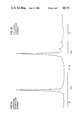
- FIG. 1 of the drawing shows 13 C NMR spectra of conventional polybutylene and of elastomeric polybutylene of this invention.
- FIGS. 1A and 1B are expansions of the peak at about 28 ppm, showing the fine structure in greater detail.
- FIG. 2 is a graph of damping curves of elastomeric polybutylene of this invention, PVC and natural rubber.
- FIG. 3 is a plot of tensile yield strength v. ether solubles for elastomeric polybutylene and conventional polybutylene.
- FIG. 4 is a plot of hardness v. flexibility as measured by Young's modulus, for elastomeric polybutylene, PVC and conventional elastomers.
- FIG. 5 is a stress relaxation plot for elastomeric polybutylene and for PVCs of different plasticizer contents.
- FIG. 6 is a plot of data of a recrystallization procedure comparing elastomeric polybutylene of this invention with polybutylene of relatively low stereoregulativity.
- Conventional polybutylene as produced in polymerization with effective Ziegler-Natta type coordination catalysts, typically has an isotactic content greater than 92%, as determined by extraction with boiling diethyl ether. It typically exhibits a crystallinity of the order of 50-60% by X-ray diffraction analysis and has the tensile strength and stiffness characteristic of highly crystalline thermoplastics.
- the polybutylene products of this invention also are highly stereoregular.
- the polybutylene of this invention nevertheless exhibits crystallinity in the range of only 25-40% by X-ray diffraction analysis. Even though it has high steric order, the polybutylene of this invention exhibits physical properties characteristic of thermoplastic elastomers, such as the well known commercial block copolymers based on styrene and diolefins or complex blends of polypropylene with elastomeric copolymers of ethylene and propylene.
- the elastomeric polybutylene of this invention is a total product of the homopolymerization of butene-1, characterized by the following properties:
- the total unextracted reaction product contains no more than 8%, and still more preferably no more than 5% of ether soluble components.
- the total polymerization products may be used without extraction or after extraction of all or a portion of the small ether soluble fraction, which owes its solubility to a combination of low steric regularity and low molecular weight.
- Products of this invention having ether solubles contents close to the upper permissible limit may exhibit some degree of surface adhesion or stickiness. For some uses, e.g., as film or sheet, this may make it desirable to extract some or all of the other soluble portion. For other uses, e.g., for blending with other polymers, the presence of a small ether-soluble component may not be objectionable.
- Products having ether solubles content in the preferred lower ranges do not exhibit significant surface adhesion or stickiness even though they contain a large proportion of polymer soluble in boiling n-heptane, whereas polybutylenes produced with a relatively non-stereoregulating conventional coordination catalyst, which also exhibit relatively low crystallinity and are also relatively flexible compared to conventional polybutylene, exhibit high surface adhesion, resulting from a large fraction of low steric regularity.
- a prominent feature of our elastomeric polybutylene is its substantially suppressed level of crystallinity compared to conventional polybutylenes.
- a companion feature of our elastomeric polybutylene one which makes it unique among the large number of polyolefins produced with stereoselective catalysts, is the fact that this suppression of crystallinity is achieved without the corresponding large increase in amount of easily extractable polymer (soluble in refluxing ethyl ether) which results when the crystallinity enhancing features of a conventional Ziegler-Natta polymerization system are removed or reduced. This is shown by the dramatically different correlation between extractable polymer concentration and tensile strength shown by our elastomeric polybutylene compared to conventional polybutylene as illustrated in FIG.
- Another distinguishing feature of our elastomeric polybutylene is its 13 C NMR spectrum.
- the 13 C NMR method provides detailed information about the configuration and conformation of short sections of polymer chains.
- a comparison of 13 C NMR spectra of conventional polybutylenes with those of the products of this invention indicates a significant difference between the products, even though they both have a very high degree of steric order. The difference shows up as a higher proportion of polymer comprised of short sequences of frequent tactic inversion alternating with longer isotactic sequences. This indicates for the products of this invention a structure of short average isotactic sequences, which contrasts strikingly with the long average isotactic sequences of conventional polybutylene.
- the enchained tactic defect structure which alternates in a stereoblock structure with isotactic sequences in elastomeric polybutene-1 is responsible for the fine structure associated with the major 13 C NMR absorptions of polybutene-1. As evident in FIG. 1 and 1B, this fine structure is much more prominent in the spectrum of elastomeric polybutene-1 than it is in conventional polybutylene (1A). Integrated intensities of the absorbances in the 26 to 28 ppm region show 15% tactic defect structure associated with very short tactic inversion sequences ( ⁇ 5 monomer units) and 9% alternating (syndiotactic) tactic inversions in sequences ⁇ 5 monomer units.
- typical conventional polybutylene has only 6% defect structure and 2% alternating or syndiotactic sequence stereostructure. It is the larger amount of the net defect structure, enchained in not readily extractable molecules, that accounts for the elastomeric character of our new form of polybutylene.
- the products of this invention are mixtures of molecules differing from each other to some extent in structure and in molecular weight.
- the compositions and structures of such products are to some extent a function of the specific catalyst compositions and reactions conditions employed in their production.
- the elastomeric polybutylene of this invention may be produced having a wide range of molecular weights.
- Number average molecular weights (M n ) may be from 20,000 to 300,000 and weight average molecular weights (M w ) from 150,000 to 2,200,000.
- a characteristic of the products of this invention is a narrow molecular weight distribution, as indicated by the ratio of M w /M n (Q-value) which is typically of the order of 70 to 75% w or less of the Q-value of conventional polybutylene.
- Both conventional and elastomeric isotactic polybutylene are unique compared to other commercial polyolefins in that they are capable of existing in several crystalline modifications which can be isolated in almost pure form.
- Conventional isotactic polybutylene typically first solidifies from the melt in the crystal form known as Type II.
- Type II is unstable with respect to Type I and converts to Type I at a rate depending on a variety of factors, such as molecular weight, tacticity, temperature, pressure, and mechanical shock. Properties of the several crystal forms of conventional isotactic polybutylene are well known. The transformation of Type II to Type I has a marked effect on the physical properties. Density, rigidity and strength are increased.
- our elastomeric polybutylene crystallizes from the metal in the form of crystal Type II, which transforms to crystal Type I over a period of hours or days, depending on environmental conditions.
- FIG. 2 of the drawing shows damping curves of a typical plasticized PVC, of vulcanized natural rubber, and of a typical elastomeric polybutylene. Damping curves were determined by a free vibration torsion pendulum. Since the damping effect varies with the softness of the product it is accepted practice to recalculate damping curves for a product of uniform Shore Hardness.
- the curves in FIG. 1 are normalized for product of 75 Shore Hardness, method a (1 second). The ordinate is amplitude and the abscissa is time in centiseconds.
- the elastomeric polybutylene is shown to be more elastomeric than plasticized PVC, but less so than natural rubber.
- FIG. 3 is a plot of tensile yield strength in pounds per square inch versus ether solubles content in percent by weight; it illustrates the difference between the elastomeric polybutylene of this invention and conventional polybutylene.
- Area A represents a range of values measured on elastomeric polybutylene of this invention.
- Line I represents an average curve for these values.
- Line II represents average values of conventional polybutylenes.
- FIG. 4 illustrates how polybutylene of this invention differs uniquely from conventional elastomers in exhibiting a greatly superior surface hardness at a given flexibility. It is a plot of hardness versus Young's modulus. Hardness is plotted as Shore Hardness, Method A, 10 seconds. Curve I is an average curve representative of commercial PVC, containing varying amounts of plasticizer to achieve varying degrees of flexibility. Area A represents a range of values for uncompounded elastomeric polybutylene of this invention. Curve II is an average curve of values obtained with different compounded elastomers, both vulcanized SBR and thermoplastic block copolymers, which are identified on the drawing.
- uncompounded polybutylene of this invention has certain properties where are close to those of compounded PVC, as shown in FIG. 4, it also has uniquely advantageous properties compared to PVC. This is illustrated in FIG. 5.
- FIG. 5 relates to stress relaxation.
- Curve I is measured on a polybutylene according to this invention and curves II, II' and II" on samples of commercial PVC containing different amounts of plasticizer and having nominal hardness values of 40, 65 and 95, respectively.
- the stress relaxation test is conducted by stretching a specimen to 300% of elongation and observing the decrease in stress as a function of time.
- the abscissa is a logarithmic scale of time in seconds and the ordinate is the percent of the initial stress at a given time.
- elastomeric polybutylene of this invention has a relatively low rate of stress relaxation. This property is particularly desirable in products to be used for seals, gaskets and the like.
- Table 2 provides a comparison of representative properties of s sample of uncompounded elastomeric polybutylene of this invention with typical commercial PVC and elastomers.
- the elastomeric polybutylene was prepared as in Example 6.
- fractional crystallization Method A The unique composition of elastomeric polybutylene of this invention, contrasted with conventional polybutylene which has been prepared at conditions leading to lower average isotacticity is demonstrated by fractional crystallization of the whole polymer from n-heptane.
- the method is regarded as representing a fractionation with respect to crystallizability of the polymer which in turn is believed to be determined by the distribution of isotactic sequences and tactic inversions in the polymer molecules.
- the procedure, referred to herein as fractional crystallization Method A is carried out as follows:
- Crystallization method A carried out on conventional polybutylene, showed less than 4% soluble in the first recrystallization and essentially none in the later recrystallizations.
- the heterotactic fraction is non-crystallizable or only very slightly crystallizable and can be separated from the isotactic portion of the whole polymer by solvent extraction, e.g., in boiling n-heptane, as typically employed for polypropylene, or in boiling diethyl ether, typically employed for polybutylene.
- the amount of extractable polymer is the most commonly used indication of the selectivity of the catalyst and the isotactic purity of the polymer.
- Selectivity control agents which are employed in many commercial Ziegler-Natta systems to control isotacticity and hence crystallinity are regarded as preferentially deactivating non-selective catalyst sites.
- isoztactic /k inversion is large, and/or where the time spent by a dual mode site in the inversion or syndiotactic mode is small. Such is the predominant situation in conventional Ziegler-Natta catalysis; the stereoblocks will be shorter for catalyst where these situations are reversed.
- the preferred catalyst to be employed for production of elastomeric polybutylene of this invention is one in which the solid component comprises a support of magnesium chloride in an active form, combined with an electron donor and titanium halide; typically the components are MgCl 2 , TiCl 4 and an aromatic ester, e.g., ethyl benzoate or p-ethyl toluate.
- This solid component is combined with an aluminum alkyl, typically a trialkylaluminum such as triethyl aluminum and a selectivity control agent, typically ethyl anisate.
- Numerous variants of these catalysts are described in recent patents, such as U.S. Pat. Nos. 4,051,313; 4,115,319; 4,224,181; 4,235,984 and 4,250,287.
- Preferred to date are catalysts prepared as described in European Patent Applications 19,312 and 19,330, both published Nov. 26, 1980.
- the conditions under which the polymerization is conducted can also affect the type of polymer produced.
- all three catalyst components are pre-mixed before being introduced into the polymerization zone, and the procatalyst and cocatalyst are combined before the electron donor is combined with the catalyst mixture.
- the polymerization is preferably conducted as a solution polymerization process, using butene-1 as the reaction medium. However, it may be conducted in liquid butene-1 at conditions under which the polymer is produced as a solid in a so-called slurry polymerization.
- the polymerization may be carried out in batch or continuous modes.
- Suitable ratios of the several catalyst components are as follows:
- the interaction of procatalyst, cocatalyst, selectivity control agent and hydrogen in the production of isotactic polymers is basically the same in the production of elastomeric polybutylene as it is in the production of other istoactic polyolefins.
- the molar ratio of cocatalyst to titanium is preferably not above 100 and should not exceed about 150. At ratios approaching and exceeding 150, the polymer product gradually becomes less elastomeric and more nearly like conventional polybutylene.
- the catalysts employed in the production of elastomeric polybutylene may be of sufficiently high activity that no product deashing step is required. If catalyst residues are to be deactivated and removed, this may be accomplished by conventional means employed in cleanup of olefin polymers produced over such catalysts, e.g, by contact with an alcohol, followed by extraction with water.
- the elastomeric polybutylene of this invention which combines the chemical properties of polybutylene with physical characteristics resembling those of plasticized PVC and of thermoplastic elastomers, is expected to find many uses.
- Unblended produces of this invention are relatively homogeneous materials of excellent chemical resistance as well as physiacl toughness.
- Polybutylene of this invention has been converted into films, including heavy gauge film useful for bagging of industrial powdered goods. It is also useful for conversion into stretchable plastic fibers and filaments.
- the products of this invention can be compounded and processed similarly to conventional hydrocarbon elastomers, e.g., by blending with other polymers such as polypropylene, with extenders such as mineral oils and waxes, and with fillers such as calcium carbonate, for use as molded or extruded products in various applications for which hydrocarbon elastomers are conventionally employed.
- butene-1 polymers of this invention are also useful for those uses where flexible vinyl polymers, such as highly plasticized poly(vinylchloride) (PVC), have heretofore been employed, including conversion into sheets and tubing for a variety of uses. Unlike PVC, they do not require the use of plasticizers to achieve and retain the desired flexibility. They do not have the disadvantages of potential health and safety problems associated with vinyl chloride monomer, with burning of PVC and with PVC plasticizers.
- PVC poly(vinylchloride)
- the butene-1 polymers of this invention share the chemical properties of conventional isotactic polybutylene. Additives relying on chemical action, such as stabilizers against deterioration due to heat or light, can be expected to have the same effectiveness in the polybutylene of this invention as in conventional polybutylene.
- the elastomeric polybutylene may also be modified by addition of fillers or pigments.
- the specimens were about 25 mil thick, prepared by compression molding at 350° F. and aged 7 days at room temperature for conversion to crystal form I.
- specimens were prepared by compression molding at 350°-400° F. and subjected to accelerated aging at room temperature for 10 minutes under 30,000 psi hydrostatic pressure for conversion to crystal form I.
- ether extractables For determination of ether extractables, a 2.5 gram film specimen or a similar amount of polymer crumb or extruded pellets is extracted in a Soxhlet extraction apparatus with 100 ml refluxing diethyl ether for 3 hours.
- the plot of stress v. strain of elastomers does not show the decrease of stress which defines the yield point for true thermoplastic resins. Rather, the curve shows a rise at an initial slope, a continued rise at a lesser slope, and a final rise to the break point, which may again be at an increased slope.
- the slope of the initial rise expresses as psi, is Young's modulus.
- the slope of the next, more gradually rising part of the curve, is referred to as modulus of chain extension. The point at which these two slope lines intersect is taken as defining the yield stress.
- the procatalyst was combined with other components as a suspension in n-heptane, containing 0.03 mmol Ti/per ml.
- the cocatalyst was triethyl aluminum (TEA) employed as a 25% wt. solution in n-heptane.
- the electron donor was p-ethyl anisate (PEA), employed as the neat liquid.
- the catalyst components were combined in a serum vial in a dry box, and injected into the reactor. Unless otherwise stated, the time elapsed while the components were combined and injected into the reactor was no more than three minutes.
- Example 1 PEA was added to TEA at room temperature and allowed to react for 10 minutes. This mixture and the procatalyst were separately injected into the reactor.
- Example 4 is preferred for production of SSPB.
- the method of Examples 2 and 5 is also satisfactory.
- Comparative Example 1 the order of addition was: TEA added to PEA; mixture added to procatalyst. This resulted in a total polymer having an excessively high content of ether soluble polymer.
- Comparative Example 2 in Table 3 shows physical properties of a commercial butene-1 polymer, produced with a commercial TiCl 3 type Ziegler-Natta catalyst.
- Comparative Example 3 in Table 3 was carried out in laboratory equipment of the same mode as that in Examples 1-5, but using a commercial TiCl 3 procatalyst.
- the catalyst components were used as described above, that is, the procatalyst was used as 0.03 mmol Ti per liter suspension in n-heptane, TEA as 25% wt. solution in n-heptane, and PEA added next.
- the procedure was essentially as described above, except that large amounts were employed.
- the autoclave contained about 50 pounds of carefully dried butene-1. 211 mmoles of hydrogen was added.
- the catalyst mixture was prepared by adding the procatalyst to the TEA and adding the resulting suspension to the PEA in 5 ml n-heptane. The total catalyst mixture was injected into the butene-1 in the autoclave, which was at 150° and held at that temperature, with agitation, for one hour.
- Elastomeric polybutylene prepared as in Example 6 was converted by compression molding into a film of approximately 25 mil thickness.
- the film had the following properties;
Landscapes
- Chemical & Material Sciences (AREA)
- Health & Medical Sciences (AREA)
- Chemical Kinetics & Catalysis (AREA)
- Medicinal Chemistry (AREA)
- Polymers & Plastics (AREA)
- Organic Chemistry (AREA)
- Transition And Organic Metals Composition Catalysts For Addition Polymerization (AREA)
- Addition Polymer Or Copolymer, Post-Treatments, Or Chemical Modifications (AREA)
Priority Applications (3)
| Application Number | Priority Date | Filing Date | Title |
|---|---|---|---|
| US06/675,669 USH179H (en) | 1984-11-28 | 1984-11-28 | Polybutylene |
| EP85308586A EP0186968A2 (de) | 1984-11-28 | 1985-11-26 | Polybuten und Verfahren zur Herstellung derselben |
| AU50449/85A AU5044985A (en) | 1984-11-28 | 1985-11-28 | Ziegler 1-butene polymers |
Applications Claiming Priority (1)
| Application Number | Priority Date | Filing Date | Title |
|---|---|---|---|
| US06/675,669 USH179H (en) | 1984-11-28 | 1984-11-28 | Polybutylene |
Related Parent Applications (1)
| Application Number | Title | Priority Date | Filing Date |
|---|---|---|---|
| US06517499 Continuation-In-Part | 1983-07-26 |
Publications (1)
| Publication Number | Publication Date |
|---|---|
| USH179H true USH179H (en) | 1986-12-02 |
Family
ID=24711504
Family Applications (1)
| Application Number | Title | Priority Date | Filing Date |
|---|---|---|---|
| US06/675,669 Abandoned USH179H (en) | 1984-11-28 | 1984-11-28 | Polybutylene |
Country Status (3)
| Country | Link |
|---|---|
| US (1) | USH179H (de) |
| EP (1) | EP0186968A2 (de) |
| AU (1) | AU5044985A (de) |
Cited By (11)
| Publication number | Priority date | Publication date | Assignee | Title |
|---|---|---|---|---|
| US4971936A (en) * | 1989-07-10 | 1990-11-20 | Shell Oil Company | Catalyst component for making primarily isotactic elastomeric polypropylene or polybutene |
| USH1583H (en) * | 1993-06-01 | 1996-08-06 | Shell Oil Company | Elastomeric polybutylene polymer |
| US20040115381A1 (en) * | 2002-12-12 | 2004-06-17 | Chevron Phillips Chemical Company, Lp | Method for manufacturing articles with materials containing tapered polymers |
| US20040204552A1 (en) * | 2000-08-22 | 2004-10-14 | Idemitsu Petrochemical Co., Ltd. | 1-Butene polymer and molded product consisting of the polymer |
| US20080139762A1 (en) * | 2004-07-13 | 2008-06-12 | Basell Polyolefine Gmbh | Metallocene Compounds, Ligands Used in Their Preparation, Preparation of 1-Butene Polymers and 1-Butene Polymers Therefrom |
| US9441090B1 (en) | 2015-03-12 | 2016-09-13 | Chevron Phillips Chemical Company Lp | Methods for controlling hardness of styrene-butadiene block copolymers |
| US9540475B2 (en) | 2015-03-12 | 2017-01-10 | Chevron Phillips Chemical Company Lp | Styrene-butadiene block copolymers for tubing applications |
| US9598524B1 (en) | 2015-09-18 | 2017-03-21 | Chevron Phillips Chemical Company Lp | Styrene-butadiene block copolymers with a terminal butadiene block for tubing applications |
| US9738781B2 (en) | 2015-09-03 | 2017-08-22 | Ineos Styrolution Group Gmbh | Blends of styrene-butadiene block copolymer with styrenic thermoplastic elastomers for tubing applications |
| US9828455B2 (en) | 2016-02-24 | 2017-11-28 | Ineos Styrolution Group Gmbh | Styrene-butadiene block copolymers with an internal butadiene block for tubing applications |
| US10023676B2 (en) | 2016-02-24 | 2018-07-17 | Ineos Styrolution Group Gmbh | Styrene-butadiene block copolymers with an internal butadiene block for tubing applications |
Families Citing this family (3)
| Publication number | Priority date | Publication date | Assignee | Title |
|---|---|---|---|---|
| JP5567764B2 (ja) * | 2004-10-18 | 2014-08-06 | バーゼル・ポリオレフィン・イタリア・ソチエタ・ア・レスポンサビリタ・リミタータ | 低アイソタクチシティを有するブテン−1(コ)ポリマー |
| CA2584395A1 (en) | 2004-10-18 | 2006-04-27 | Basell Poliolefine Italia S.R.L. | Butene-1 (co)polymers having low isotacticity |
| ATE501183T1 (de) | 2004-10-21 | 2011-03-15 | Basell Polyolefine Gmbh | 1-buten-polymer und herstellungsverfahren dafür |
Citations (13)
| Publication number | Priority date | Publication date | Assignee | Title |
|---|---|---|---|---|
| US3175999A (en) | 1954-06-08 | 1965-03-30 | Mintecatini Societa Generale P | Block polymers of alpha-olefines, processes for producing the same, and mixtures thereof with isotactic polyolefines |
| US3362940A (en) | 1965-05-06 | 1968-01-09 | Mobil Oil Corp | Stereoregular polymerization of 1-olefins in monomer solution |
| US3385817A (en) | 1965-12-27 | 1968-05-28 | Petro Tex Chem Corp | Isotactic poly (butene-1) filled with carbon black |
| GB1335887A (en) | 1970-10-29 | 1973-10-31 | Montedison Spa | Polymerization of alpha-olefins |
| US3894120A (en) | 1972-11-04 | 1975-07-08 | Huels Chemische Werke Ag | Thermoplastic molding compound comprising a blend of isotactic polybutenes |
| US4048419A (en) | 1973-04-14 | 1977-09-13 | Chemische Werke Huls Aktiengesellschaft | Process for the production of partially crystalline polybutene-1 |
| US4107414A (en) | 1971-06-25 | 1978-08-15 | Montecatini Edison S.P.A. | Process for the stereoregular polymerization of alpha olefins |
| US4107413A (en) | 1971-06-25 | 1978-08-15 | Montedison S.P.A. | Process for the stereoregular polymerization of alpha olefins |
| US4218551A (en) | 1972-09-29 | 1980-08-19 | Chemische Werke Huls Aktiengesellschaft | Process for the production of polybutene-1 formable into transparent films |
| US4287328A (en) | 1978-12-01 | 1981-09-01 | Chisso Corporation | Method for producing α-olefin polymers |
| US4294948A (en) | 1977-03-04 | 1981-10-13 | Mitsui Petrochemical Industries Ltd. | Process for preparing olefin polymers or copolymers, and catalyst for use in said process |
| US4298722A (en) | 1980-03-11 | 1981-11-03 | E. I. Du Pont De Nemours And Company | Fractionable, elastomeric poly (1-butene) |
| US4321345A (en) | 1978-08-31 | 1982-03-23 | Chisso Corporation | Method for producing α-olefin polymers |
-
1984
- 1984-11-28 US US06/675,669 patent/USH179H/en not_active Abandoned
-
1985
- 1985-11-26 EP EP85308586A patent/EP0186968A2/de not_active Withdrawn
- 1985-11-28 AU AU50449/85A patent/AU5044985A/en not_active Abandoned
Patent Citations (13)
| Publication number | Priority date | Publication date | Assignee | Title |
|---|---|---|---|---|
| US3175999A (en) | 1954-06-08 | 1965-03-30 | Mintecatini Societa Generale P | Block polymers of alpha-olefines, processes for producing the same, and mixtures thereof with isotactic polyolefines |
| US3362940A (en) | 1965-05-06 | 1968-01-09 | Mobil Oil Corp | Stereoregular polymerization of 1-olefins in monomer solution |
| US3385817A (en) | 1965-12-27 | 1968-05-28 | Petro Tex Chem Corp | Isotactic poly (butene-1) filled with carbon black |
| GB1335887A (en) | 1970-10-29 | 1973-10-31 | Montedison Spa | Polymerization of alpha-olefins |
| US4107414A (en) | 1971-06-25 | 1978-08-15 | Montecatini Edison S.P.A. | Process for the stereoregular polymerization of alpha olefins |
| US4107413A (en) | 1971-06-25 | 1978-08-15 | Montedison S.P.A. | Process for the stereoregular polymerization of alpha olefins |
| US4218551A (en) | 1972-09-29 | 1980-08-19 | Chemische Werke Huls Aktiengesellschaft | Process for the production of polybutene-1 formable into transparent films |
| US3894120A (en) | 1972-11-04 | 1975-07-08 | Huels Chemische Werke Ag | Thermoplastic molding compound comprising a blend of isotactic polybutenes |
| US4048419A (en) | 1973-04-14 | 1977-09-13 | Chemische Werke Huls Aktiengesellschaft | Process for the production of partially crystalline polybutene-1 |
| US4294948A (en) | 1977-03-04 | 1981-10-13 | Mitsui Petrochemical Industries Ltd. | Process for preparing olefin polymers or copolymers, and catalyst for use in said process |
| US4321345A (en) | 1978-08-31 | 1982-03-23 | Chisso Corporation | Method for producing α-olefin polymers |
| US4287328A (en) | 1978-12-01 | 1981-09-01 | Chisso Corporation | Method for producing α-olefin polymers |
| US4298722A (en) | 1980-03-11 | 1981-11-03 | E. I. Du Pont De Nemours And Company | Fractionable, elastomeric poly (1-butene) |
Cited By (14)
| Publication number | Priority date | Publication date | Assignee | Title |
|---|---|---|---|---|
| US4971936A (en) * | 1989-07-10 | 1990-11-20 | Shell Oil Company | Catalyst component for making primarily isotactic elastomeric polypropylene or polybutene |
| WO1991000875A1 (en) * | 1989-07-10 | 1991-01-24 | Shell Oil Company | Catalyst component for making primarily isotactic elastomeric polypropylene or polybutene |
| USH1583H (en) * | 1993-06-01 | 1996-08-06 | Shell Oil Company | Elastomeric polybutylene polymer |
| US20040204552A1 (en) * | 2000-08-22 | 2004-10-14 | Idemitsu Petrochemical Co., Ltd. | 1-Butene polymer and molded product consisting of the polymer |
| US7067604B2 (en) * | 2000-08-22 | 2006-06-27 | Idemitsu Kosan Co., Ltd. | 1-butene polymer and molded product consisting of the polymer |
| US20040115381A1 (en) * | 2002-12-12 | 2004-06-17 | Chevron Phillips Chemical Company, Lp | Method for manufacturing articles with materials containing tapered polymers |
| US20080139762A1 (en) * | 2004-07-13 | 2008-06-12 | Basell Polyolefine Gmbh | Metallocene Compounds, Ligands Used in Their Preparation, Preparation of 1-Butene Polymers and 1-Butene Polymers Therefrom |
| US8003743B2 (en) * | 2004-07-13 | 2011-08-23 | Basell Poliolefine Italia, s.r.l. | Metallocene compounds, ligands used in their preparation, preparation of 1-butene polymers and 1-butene polymers therefrom |
| US9441090B1 (en) | 2015-03-12 | 2016-09-13 | Chevron Phillips Chemical Company Lp | Methods for controlling hardness of styrene-butadiene block copolymers |
| US9540475B2 (en) | 2015-03-12 | 2017-01-10 | Chevron Phillips Chemical Company Lp | Styrene-butadiene block copolymers for tubing applications |
| US9738781B2 (en) | 2015-09-03 | 2017-08-22 | Ineos Styrolution Group Gmbh | Blends of styrene-butadiene block copolymer with styrenic thermoplastic elastomers for tubing applications |
| US9598524B1 (en) | 2015-09-18 | 2017-03-21 | Chevron Phillips Chemical Company Lp | Styrene-butadiene block copolymers with a terminal butadiene block for tubing applications |
| US9828455B2 (en) | 2016-02-24 | 2017-11-28 | Ineos Styrolution Group Gmbh | Styrene-butadiene block copolymers with an internal butadiene block for tubing applications |
| US10023676B2 (en) | 2016-02-24 | 2018-07-17 | Ineos Styrolution Group Gmbh | Styrene-butadiene block copolymers with an internal butadiene block for tubing applications |
Also Published As
| Publication number | Publication date |
|---|---|
| AU5044985A (en) | 1986-06-05 |
| EP0186968A2 (de) | 1986-07-09 |
Similar Documents
| Publication | Publication Date | Title |
|---|---|---|
| US4950720A (en) | Modified polypropylene, process for making and article made from the same | |
| US5326639A (en) | Thermoplastic olefin polymer and method of preparing same | |
| EP0368577B1 (de) | Kristallines Polypropylen und daraus gefertigte Zusammensetzungen | |
| EP0822945B1 (de) | Verfahren zur herstellung von statistischen copolymerisaten des propylens und daraus enthaltende produkte | |
| US5948839A (en) | Polymer compositions and cast films | |
| US5296548A (en) | Compositions of crystalline propylene polymers having a low seal temperature | |
| JP5670495B2 (ja) | 新規なブテン−1(コ)ポリマーおよびその製造方法 | |
| US7776986B2 (en) | Butene-1 (Co)Polymers having low isotacticity | |
| US3318976A (en) | Production of modified polyolefin | |
| EP0186968A2 (de) | Polybuten und Verfahren zur Herstellung derselben | |
| US4298721A (en) | Thermoplastic rubbers and process for preparing same | |
| DE69219917T2 (de) | Hochkristallines Polypropylen zur Filmherstellung | |
| JP2889674B2 (ja) | 広い分子量分布の生成物を製造するためのシラン変性支持ポリオレフィン触媒 | |
| US4340704A (en) | Thermoplastic rubbers and process for preparing same | |
| RU2083611C1 (ru) | Термопластичная полиолефиновая композиция, способ ее получения | |
| EP0081787B1 (de) | Polybuten-1 | |
| US4975492A (en) | Butene-1 copolymer composition | |
| US3622552A (en) | Process for producing crystalline olefin polymers and catalyst compositions therefor | |
| CA1192349A (en) | Polybutylene | |
| JPH0867710A (ja) | オレフィン重合体の製造法 | |
| JPS6043848B2 (ja) | 軟質樹脂およびその製法 | |
| JPS58108215A (ja) | ポリブチレン | |
| KR101740750B1 (ko) | 1-부텐의 중합체의 제조 방법 | |
| EP0512851A2 (de) | Kristalline Poly-4-methyl-1-Pentenzusammensetzung | |
| BRPI0516359B1 (pt) | Homo or copolymers of butene-1, polymer composition, process for the preparation of butene-1 copolymer and process for the crosslinking of homo or copolymers of butene-1 |
Legal Events
| Date | Code | Title | Description |
|---|---|---|---|
| STCF | Information on status: patent grant |
Free format text: PATENTED CASE |