WO1992017544A1 - Legierungen aus cycloolefinpolymeren und polyaryletherketonen - Google Patents
Legierungen aus cycloolefinpolymeren und polyaryletherketonen Download PDFInfo
- Publication number
- WO1992017544A1 WO1992017544A1 PCT/EP1992/000629 EP9200629W WO9217544A1 WO 1992017544 A1 WO1992017544 A1 WO 1992017544A1 EP 9200629 W EP9200629 W EP 9200629W WO 9217544 A1 WO9217544 A1 WO 9217544A1
- Authority
- WO
- WIPO (PCT)
- Prior art keywords
- alloy according
- polyaryl ether
- structural units
- cycloolefin
- polymer
- Prior art date
- Legal status (The legal status is an assumption and is not a legal conclusion. Google has not performed a legal analysis and makes no representation as to the accuracy of the status listed.)
- Ceased
Links
- RABCENDFNLJKOP-UHFFFAOYSA-N CCCCc(cc1)ccc1[NH+](c(cc1)ccc1[NH+](c1ccc(C)cc1)[O-])[O-] Chemical compound CCCCc(cc1)ccc1[NH+](c(cc1)ccc1[NH+](c1ccc(C)cc1)[O-])[O-] RABCENDFNLJKOP-UHFFFAOYSA-N 0.000 description 1
- ODLMAHJVESYWTB-UHFFFAOYSA-N CCCc1ccccc1 Chemical compound CCCc1ccccc1 ODLMAHJVESYWTB-UHFFFAOYSA-N 0.000 description 1
- XFSGCVZOMZYKKU-UHFFFAOYSA-N O=NC1CCCCCC1 Chemical compound O=NC1CCCCCC1 XFSGCVZOMZYKKU-UHFFFAOYSA-N 0.000 description 1
- CYECSKUNKSNXJD-UHFFFAOYSA-N O=[C-]c1ccccc1 Chemical compound O=[C-]c1ccccc1 CYECSKUNKSNXJD-UHFFFAOYSA-N 0.000 description 1
Classifications
-
- C—CHEMISTRY; METALLURGY
- C08—ORGANIC MACROMOLECULAR COMPOUNDS; THEIR PREPARATION OR CHEMICAL WORKING-UP; COMPOSITIONS BASED THEREON
- C08L—COMPOSITIONS OF MACROMOLECULAR COMPOUNDS
- C08L71/00—Compositions of polyethers obtained by reactions forming an ether link in the main chain; Compositions of derivatives of such polymers
-
- C—CHEMISTRY; METALLURGY
- C08—ORGANIC MACROMOLECULAR COMPOUNDS; THEIR PREPARATION OR CHEMICAL WORKING-UP; COMPOSITIONS BASED THEREON
- C08L—COMPOSITIONS OF MACROMOLECULAR COMPOUNDS
- C08L65/00—Compositions of macromolecular compounds obtained by reactions forming a carbon-to-carbon link in the main chain; Compositions of derivatives of such polymers
-
- Y—GENERAL TAGGING OF NEW TECHNOLOGICAL DEVELOPMENTS; GENERAL TAGGING OF CROSS-SECTIONAL TECHNOLOGIES SPANNING OVER SEVERAL SECTIONS OF THE IPC; TECHNICAL SUBJECTS COVERED BY FORMER USPC CROSS-REFERENCE ART COLLECTIONS [XRACs] AND DIGESTS
- Y10—TECHNICAL SUBJECTS COVERED BY FORMER USPC
- Y10S—TECHNICAL SUBJECTS COVERED BY FORMER USPC CROSS-REFERENCE ART COLLECTIONS [XRACs] AND DIGESTS
- Y10S526/00—Synthetic resins or natural rubbers -- part of the class 520 series
- Y10S526/943—Polymerization with metallocene catalysts
Definitions
- cycloolefin polymers have been the subject of many publications in recent times. It is known that these olefins can be polymerized using various catalysts. Depending on the catalyst, the polymerization proceeds via ring opening (US-A-3557072, US-A-4178424) or with opening of the double bond (EP-A-156464, EP-A-283164, EP-A-291208, EP-A -291970, DE-A-3922546).
- Cycloolefin homo- and copolymers are a class of polymers with an outstanding level of properties. Among other things, they excel from high heat resistance, hydrolytic stability, low water absorption, weather resistance and transparency. However, the processability at high temperatures and shear forces is limited by oxidative and thermal processes. Additives such as antioxidants and thermal stabilizers are used to increase the thermal processing range. High levels of additives can lead to a strong negative impact on mechanical properties such as the modulus of elasticity and the tensile strength. Additives can thus act as plasticizers, whereby the shear modulus is also reduced over a wide temperature range.
- the flowability of the polymer can be improved by flow improvers such as PE waxes.
- flow improvers such as PE waxes.
- Polyaryl ether ketones are also well known, as evidenced by the large number of publications on synthesis and properties: US-A-3953400; US-A-3956240; US-A-4247682; US-A-4320224; US-A-4339568; Polymer 22: 1096-1103 (1981); Polymer 24 (1983), 953-958.
- Polyaryl ether ketones are also a valuable class of polymers, which are characterized, among other things, by good impact strength and high thermal resistance. Some polyaryl ether ketones are highly crystalline and show melting temperatures of well over 300 ° C, others are amorphous.
- Amorphous and partially crystalline polyaryl ether ketones with different molecular weights can be obtained by electrophilic aromatic substitution (US-A-3065205; US-A-3956240) or nucleophilic aromatic substitution (J. Polymer Sei., 1967, A-1, 5, 2415-2427; US -A-4107837; US-A-4175175, DE-B-1545106, CA-A-847963, DE-A-2803873).
- (B) is at least one polyaryl ether ketone, (A) being present in amounts of 1 to 99% by weight and (B) being in amounts of 99 to 1% by weight and the amounts of (A) and (B) being relative add up to 100% by weight in relation to the total alloy.
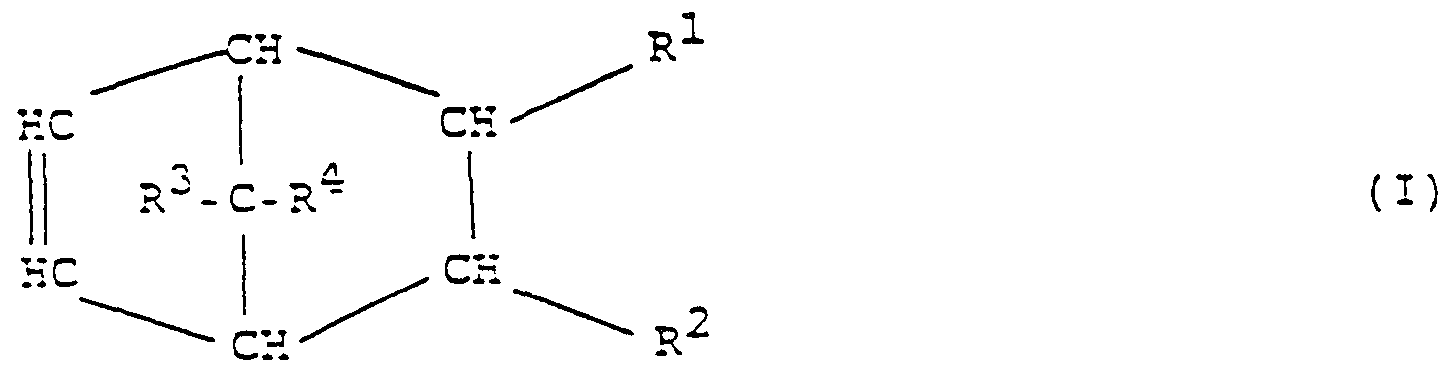
- Cycloolefin polymers (A) suitable for the alloys according to the invention contain structural units which are derived from at least one monomer of the formulas I to VI or VII
- R 1 , R 2 , R 3 , R 4 , R 5 , R 6 , R 7 and R 8 are the same or different and represent a hydrogen atom or a C 1 -C 8 alkyl radical, the same radicals in the different formulas can have different meanings and n is an integer from 2 to 10.
- the cycloolefin polymers (A) can contain further structural units which are derived from at least one acyclic 1-olefin of the formula VIII
- R 9 , R 10 , R 11 and R 12 are identical or different and denote a hydrogen atom or a C 1 -C 8 -alkyl radical.
- Preferred comonomers are ethylene or propylene.
- Copolymers of polycyclic olefins of the formulas I or III and the acyclic olefins of the formula VIII are used in particular.
- Particularly preferred cycloolefins are norbornene and tetracyclododecene, which are characterized by C -.- C. j -Alkyl can be substituted, ethylene-norbornene copolymers being of particular importance.
- monocyclic olefins of formula VII cyclopentene, which may be substituted, is preferred.
- Mixtures of two or more olefins of the respective type are also to be understood as polycyclic olefins, monocyclic olefins and open-chain olefins. This means that cycloolefin homopolymers and copolymers such as bi-, ter- and multipolymers can be used.
- the cycloolefin polymerizations which proceed with the opening of the double bond can either be homogeneous, which means that the catalyst system is soluble in the polymerization medium (DE-A-3 922 546, EP-A-0 203 799), or can be catalyzed using a conventional Ziegler catalyst system (DD -A-222 317, DD-A-239 409).
- cycloolefin homo- and copolymers which contain structural units derived from monomers of the formulas I to VI or VII are preferred with the aid of a homogeneous catalyst consisting of a metallocene, the central atom of which is a metal from the group consisting of titanium, zirconium, hafnium, vanadium, niobium and Tantalum, which forms a sandwich structure with two bridged mono- or polynuclear ligands, and an aluminoxane.
- the bridged metallocenes are prepared according to a known reaction scheme (cf. J. Organomet. Chem. 288 (1985) 63-67 and EP-A-320 762).
- the aluminoxane which acts as a cocatalyst, can be obtained by various methods (cf. S. Pasynkiewicz, Polyhedron 9 (1990) 429).
- the structure as well as the synthesis of this catalyst and the suitable conditions for the polymerization of these cycloolefins are described in detail in DE-A-3 922 546 and in an earlier priority, not previously published patent application (DE-A-4 036 264).
- Cycloolefin polymers with a viscosity number greater than 20 cm 3 / g and a glass transition temperature between 100 and 200 ° C. are preferably used.
- the alloys can also contain cycloolefin polymers which have been polymerized with ring opening in the presence of, for example, catalysts containing tungsten, molybdenum, rhodium or rhenium.
- the cycloolefin polymers obtained in this way have double bonds which can be removed by hydrogenation (US Pat. Nos. 3,557,072 and 4,178,424).
- the cycloolefin polymers used for the alloys according to the invention can also be obtained by grafting with at least one monomer selected from the group consisting of (a) ⁇ , ⁇ -unsaturated carboxylic acids and / or their derivatives, (b) styrenes, (c) organic silicone components contain an olefinic unsaturated bond and a hydrolyzable group and (d) unsaturated epoxy components, be modified.
- the modified cycloolefin polymers obtained have excellent properties similar to the unmodified cycloolefin polymers. In addition, they have a particularly good adhesion to metals and synthetic polymers. The good compatibility with other polymers should be emphasized.
- Polyaryl ether ketones (B) suitable for the alloys according to the invention are composed of at least one structural unit of the formula IX
- R 1 and R 2 are identical or different and are halogen, preferably bromine, C.-C alkyl or ⁇ alkoxy, preferably C, -. C 4 alkyl or alkoxy, aryl, preferably phenyl, or aryloxy groups, k and n are identical or different and are generally integers zero, 1, 2, 3 or 4, preferably zero, 1 or 2, in particular zero or 2 and D is a cycloalkylidene group or a group selected from the following bivalent groups: D 1
- the molar ratio of the monomers containing -X- or -Y- is generally 0.95 to 1.05 to 1.00, preferably 1: 1.
- this molar ratio is generally 1 0001 to 1 0600 to 1, preferably 1 0020 to 1 0500 to 1 and in particular 1 0040 to 1 0500 to 1.
- the polymers listed can be homopolycondensates, which therefore contain only one unit of the type -X- and one unit of the type -Y- per recurring unit, or copolycondensates which contain two or more different units of the type -X- and / or two or contain several different units of type -Y-.
- -X- is preferably selected from X 1 and X 2 and X is particularly preferred.
- 2 -Y- is preferably selected from Y ⁇ Y 2, Y 3, Y is particularly preferable.
- 3 -b- is preferably D 2 , D 3 , D 4 , D 5 , D 6 , D 7 , D 8 , D 9 , D 10 or a cycloalkylidene group.
- D 4 , D 5 , D 9 , D 10 or a cycloalkylidene group are particularly preferred.
- -Y- is preferably Y 1 or Y 2 and n is zero, 1 or 2, in particular zero.
- -X- is also preferably selected from X 1 and X 2
- X is particularly preferred.
- 2 -Y- is preferably Y 1 and / or a radical selected from Y 2 to Y 8 .
- the combination Y 1 and Y 3 is particularly preferred.
- Amorphous polyaryl ether ketones differ from the partially crystalline polyaryl ether ketones, both in the alloys according to the invention can be used in that they have no melting point, but only a glass transition temperature of at least 140 ° C, preferably at least 155 ° C.
- Homo- and copolycondensates which preferably contain X 2 and / or X 3 can also be used for the alloys of the invention.
- Preferred copolycondensates are a combination of X 2 and X 3 , where -Y- is Y 1 and n is zero.
- linear aromatic polyaryl ether ketones which are composed of at least one of the structural units (IX) and whose radical -Y- represents at least one radical Y 6 or Y 7 , which may also contain units of the radical Y 3 , in which -D- the group D 4 is used.
- Such polyaryl ether ketones have a glass transition temperature of at least 170 ° C, preferably at least 185 ° C.
- the indane-containing polyaryl ether ketones preferably have the structure
- the indices r and s generally have values above 10, the molecular weights resulting from the monomer ratios and expressed in the inherent viscosities of the polymers. Due to the small excess of the dihalo compounds used, the polyaryl ether ketones have Halogen atoms (shark), generally chlorine and preferably fluorine, on the chain ends.
- polymer mixtures can also be used, consisting of two or more of the homopolycondensates mentioned above, one or more of the homopolycondensates mentioned and one or more of the copolycondensates mentioned or two or more of the copolycondensates mentioned.
- polyaryl ether ketones (B) are prepared under the usual conditions by the methods already mentioned, which are also described, for example, in High Performance Polymers, 1989, Vol. 1 (1), 41-59 and in Polymer, 29 (1988), 358-369 to be discribed.
- the semi-crystalline polyaryl ether ketones have inherent viscosities, determined according to DIN 51562, as a measure of their molecular weight, measured in a solution of 0.1 g of the polymer in 100 ml of 96% sulfuric acid at 25 ° C., of generally 0.2 to 2 5 dl / g, preferably 0.4 to 2.5 dl / g and in particular 0.4 to 2.0 dl / g.
- the inherent viscosity of the amorphous polyaryl ether ketones measured in a solution of 0.1 g of the polymer in 100 ml of chloroform at 25 ° C., is in the generally at 0.2 to 2.5 dl / g, preferably at 0.4 to 1.5 dl / g.
- the indane-containing polyaryl ether ketones have a viscosity of at least 0.3 dl / g.
- the alloys according to the invention preferably contain 3 to 97% by weight and particularly preferably 5 to 95% by weight of the cycloolefin polymers (A) and preferably 97 to 3% by weight and particularly preferably 95 to 5% by weight of the polyaryl ether ketones (B), where the proportions of components A and B, relative to the total alloy, add up to 100% by weight.
- the alloys according to the invention can contain one or more cycloolefin polymers and one or more polyaryl ether ketones as well as modified cycloolefin polymers, modified polyaryl ether ketones and graft copolymers.
- the alloys according to the invention are manufactured and processed by standard methods known for thermoplastics, such as e.g. by kneading, extrusion or injection molding.
- the alloys according to the invention can contain additives, for example thermal stabilizers, UV stabilizers, antistatic agents, flame retardants, plasticizers, dyes, pigments, inorganic and organic fillers, i.e. in particular also reinforcing additives such as glass, carbon or high-modulus fibers.
- additives for example thermal stabilizers, UV stabilizers, antistatic agents, flame retardants, plasticizers, dyes, pigments, inorganic and organic fillers, i.e. in particular also reinforcing additives such as glass, carbon or high-modulus fibers.
- the alloys can be used particularly advantageously as a matrix material for composite materials. They are also suitable for the production of moldings by the injection molding or extrusion process, for example in the form of plates, fibers, films and tubes.
- the pink residue was washed with 20 cm 3 CH 2 CI 2 , dried in an oil pump vacuum and extracted with 120 cm 3 toluene. After stripping off the solvent and drying in an oil pump vacuum, 0.55 g of the zircon complex was obtained in the form of a pink-red crystal powder.
- a clean and dry 75 dm 3 polymerization reactor with stirrer was purged with nitrogen and then with ethylene and filled with 22,000 g of melted norbornene (Nb). The reactor was then brought to a temperature of 70 ° C. with stirring and 6 bar of ethylene were injected.
- the filtered polymer was then mixed with a mixture of two parts of 3-normal hydrochloric acid and one part of ethanol and stirred for 2 hours.
- the polymer was then filtered off again, washed neutral with water and dried at 80 ° C. and 0.2 bar for 15 hours. A product amount of 4400 g was obtained.
- COC A2 was prepared analogously to that of COC A1, with some of the conditions summarized in Table 1 being changed.
- Metallocene A rac-dimethylsilyl-bis- (1-indenyl) zirconium dichloride
- VZ Viscosity numbers determined according to DIN 53728 M w , M n : GPC 150-C ALC Millipore Waters Chromatograph
- B1 contains 70 mol% of structural units a and 30 mol% of structural units b and B3 40 mol% of structural units a and 60 mol% of structural units b.
- the inherent viscosity of B1 measured in 96% sulfuric acid at 25 ° C, is 0.45 dl / g.
- the polymers described above were first dried (130 ° C., 24 h, vacuum) and then in different weight ratios in a measuring kneader (from HAAKE (Karlsruhe), Rheocord System 40 / Rheomix 600) or measuring extruder (from HAAKE (Karlsruhe) , Rheocord System 90 / Rheomex TW 100) kneaded or extruded under protective gas (Ar).
- the ground or granulated alloys obtained were dried (130 ° C., 24 h, vacuum) and then pressed into sheets (120 ⁇ 1 mm) (vacuum press: Polystat 200 S, from Schwabenthan (Berlin)).
- the ground or granulated alloys were introduced into a suitable mold in the press preheated to 335 ° C., a vacuum was drawn and the mixture was melted for 10 minutes. At the above temperature, a pressure of 100 bar was reached, the mixture was left for 5 minutes and cooled to room temperature within 10 minutes. The melt press plates obtained were examined for their physical properties.
- DSC-7 differential scanning calorimeter (DSC-7) from Perkin-Elmer (Überlingen) for measuring, for example, glass levels, melting points and heat of fusion.
- Thrust module damping and linear expansion.
- a tensile strain testing machine (type: Instron 4302) from Instron
- the water content was determined in accordance with ASTM D 4019-81.
- the cycloolefin copolymer (A1) and the partially crystalline polyaryl ether ketone (B1) were kneaded together in various weight ratios after intensive drying under an argon atmosphere.
- the table below shows the thermal properties of the alloys.
- the cycloolefin copolymer (A1) and the amorphous polyaryl ether ketone (B2) were kneaded together in various weight ratios after intensive drying under an argon atmosphere.
- the table below shows the thermal properties of the alloys.
- the cycloolefin copolymer (A1) and the amorphous polyaryl ether ketone (B2) were kneaded together in various weight ratios after intensive drying under an argon atmosphere and then ground.
- the ground products were dried intensively and the water absorption was determined after storage, 564 h at 23 ° C. and 85% relative humidity.
- the cycloolefin copolymer (A1) and the amorphous polyaryl ether ketone (B2) were kneaded together in various weight ratios after intensive drying under an argon atmosphere and then ground. After intensive drying, the ground products were used to measure the flowability.
- the cycloolefin copolymer (A1) and the amorphous polyaryl ether ketone (B3) were kneaded together in various weight ratios after intensive drying under an argon atmosphere.
- the table below shows the thermal properties of the alloys.
- the cycloolefin copolymer (A2) and the amorphous polyaryl ether ketone (B4) were mixed in different weight ratios intensive drying, extruded and granulated together under an argon atmosphere.
- the table below shows the thermal properties of the alloys.
- the cycloolefin copolymer (A2) and the amorphous polyaryl ether ketone (B4) were extruded and granulated together in various weight ratios after intensive drying under an argon atmosphere. After intensive drying, the granules were then pressed into press plates.
- the table below shows the mechanical data of the alloys.
Landscapes
- Chemical & Material Sciences (AREA)
- Health & Medical Sciences (AREA)
- Chemical Kinetics & Catalysis (AREA)
- Medicinal Chemistry (AREA)
- Polymers & Plastics (AREA)
- Organic Chemistry (AREA)
- Compositions Of Macromolecular Compounds (AREA)
- Manufacture Of Macromolecular Shaped Articles (AREA)
Abstract
Description


Claims


Priority Applications (2)
| Application Number | Priority Date | Filing Date | Title |
|---|---|---|---|
| JP4506710A JPH06506012A (ja) | 1991-04-06 | 1992-03-21 | シクロオレフィンポリマーとポリアリールエーテルケトンのアロイ |
| US08/117,016 US5376725A (en) | 1991-04-06 | 1992-03-21 | Alloys of cycloolefin polymers and polyaryl ether ketones |
Applications Claiming Priority (2)
| Application Number | Priority Date | Filing Date | Title |
|---|---|---|---|
| DEP4111197.4 | 1991-04-06 | ||
| DE4111197A DE4111197A1 (de) | 1991-04-06 | 1991-04-06 | Legierungen aus cycloolefinpolymeren und polyaryletherketonen |
Publications (1)
| Publication Number | Publication Date |
|---|---|
| WO1992017544A1 true WO1992017544A1 (de) | 1992-10-15 |
Family
ID=6428983
Family Applications (1)
| Application Number | Title | Priority Date | Filing Date |
|---|---|---|---|
| PCT/EP1992/000629 Ceased WO1992017544A1 (de) | 1991-04-06 | 1992-03-21 | Legierungen aus cycloolefinpolymeren und polyaryletherketonen |
Country Status (5)
| Country | Link |
|---|---|
| US (1) | US5376725A (de) |
| EP (1) | EP0579628A1 (de) |
| JP (1) | JPH06506012A (de) |
| DE (1) | DE4111197A1 (de) |
| WO (1) | WO1992017544A1 (de) |
Families Citing this family (2)
| Publication number | Priority date | Publication date | Assignee | Title |
|---|---|---|---|---|
| FI945959L (fi) * | 1993-12-21 | 1995-06-22 | Hoechst Ag | Metalloseenejä ja niiden käyttö katalyytteinä |
| US6117943A (en) * | 1998-03-05 | 2000-09-12 | The Dow Chemical Company | Compositions containing a polyarylene ether and a dispersible reactive solvent and articles prepared therefrom |
Citations (2)
| Publication number | Priority date | Publication date | Assignee | Title |
|---|---|---|---|---|
| EP0229470A1 (de) * | 1985-11-25 | 1987-07-22 | E.I. Du Pont De Nemours And Company | Verzweigte Copolyätherketone |
| EP0363578A2 (de) * | 1988-09-14 | 1990-04-18 | General Electric Company | Polymermischung, die Polyphenylenether und Polyoctenylen enthält, und damit hergestellte Gegenstände |
Family Cites Families (1)
| Publication number | Priority date | Publication date | Assignee | Title |
|---|---|---|---|---|
| US4948856A (en) * | 1987-05-22 | 1990-08-14 | B. F. Goodrich Company | Homogeneous addition copolymers of ethylene and cycloolefin monomers and method for producing same |
-
1991
- 1991-04-06 DE DE4111197A patent/DE4111197A1/de not_active Withdrawn
-
1992
- 1992-03-21 JP JP4506710A patent/JPH06506012A/ja active Pending
- 1992-03-21 EP EP92907067A patent/EP0579628A1/de not_active Withdrawn
- 1992-03-21 WO PCT/EP1992/000629 patent/WO1992017544A1/de not_active Ceased
- 1992-03-21 US US08/117,016 patent/US5376725A/en not_active Expired - Fee Related
Patent Citations (2)
| Publication number | Priority date | Publication date | Assignee | Title |
|---|---|---|---|---|
| EP0229470A1 (de) * | 1985-11-25 | 1987-07-22 | E.I. Du Pont De Nemours And Company | Verzweigte Copolyätherketone |
| EP0363578A2 (de) * | 1988-09-14 | 1990-04-18 | General Electric Company | Polymermischung, die Polyphenylenether und Polyoctenylen enthält, und damit hergestellte Gegenstände |
Also Published As
| Publication number | Publication date |
|---|---|
| DE4111197A1 (de) | 1992-10-08 |
| JPH06506012A (ja) | 1994-07-07 |
| US5376725A (en) | 1994-12-27 |
| EP0579628A1 (de) | 1994-01-26 |
Similar Documents
| Publication | Publication Date | Title |
|---|---|---|
| EP0407870B1 (de) | Verfahren zur Herstellung von Cycloolefinpolymeren | |
| EP0566988B1 (de) | Polymerlegierungen aus Cycloolefinpolymeren und Polyolefinen | |
| EP0485893B1 (de) | Massepolymerisation mit speziellen Metallocenkatalysatoren zur Herstellung von Cycloolefinpolymeren | |
| EP0501370B1 (de) | Verfahren zur Herstellung von Cycloolefin(co)polymeren mit enger Molekulargewichtsverteilung | |
| EP0610851B1 (de) | Verfahren zur Herstellung von Cycloolefincopolymeren | |
| EP0729977B1 (de) | Metallocen und Katalysator | |
| DE3751694T2 (de) | Metallocen-katalysatorsysteme für die Polymersation von Olefinen, mit einer Silizium-Hydrocarbyl-Brücke. | |
| EP0433986B1 (de) | Verfahren zur Herstellung einer Polypropylen-Formmasse | |
| EP0608760A2 (de) | Faserverstärktes Cycloolefincopolymer-Material, Verfahren zu seiner Herstellung und Formkörper aus dem Material | |
| DE3916555A1 (de) | Verfahren zur herstellung von ethylenpolymeren | |
| EP0868440B1 (de) | Verfahren zur herstellung von ethylen-copolymerisaten unter hochdruck | |
| EP0692503A1 (de) | Cycloolefinpolymere | |
| EP0560090B1 (de) | Cycloolefinblockcopolymere und Verfahren zu ihrer Herstellung | |
| EP0588208A2 (de) | Polyolefin-Formmasse mit breitem Schmelzbereich, Verfahren zu ihrer Herstellung und ihre Verwendung | |
| DE1795738A1 (de) | Polypentenamere, deren doppelbindungen im wesentlichen cis-konfiguration aufweisen | |
| EP0692502A1 (de) | Cycloolefinpolymere | |
| EP0864593A1 (de) | Kammpolymere via Metallocenkatalyse | |
| DE4240784A1 (de) | Glasfaserverstärktes Cycloolefinpolymer-Material und Verfahren zu seiner Herstellung | |
| EP0433987A2 (de) | Verfahren zur Herstellung eines syndiotaktischen Propylen-Copolymers | |
| DE69617434T2 (de) | Polymerisation crystalliner copolymere aus olefinen und zyklischen olefinen | |
| DE4213219A1 (de) | Polymerlegierungen aus Cycloolefinpolymeren und Polyolefinen | |
| WO1992016585A1 (de) | Legierungen aus cycloolefinpolymeren und flüssigkristallinen polyestern | |
| EP0579628A1 (de) | Legierungen aus cycloolefinpolymeren und polyaryletherketonen | |
| EP0530767A2 (de) | Polymerlegierungen aus Cycloolefinpolymeren und Polyacetalen | |
| EP0700406B1 (de) | Statistische copolymerisate des propylens |
Legal Events
| Date | Code | Title | Description |
|---|---|---|---|
| AK | Designated states |
Kind code of ref document: A1 Designated state(s): JP KR US |
|
| AL | Designated countries for regional patents |
Kind code of ref document: A1 Designated state(s): AT BE CH DE DK ES FR GB GR IT LU MC NL SE |
|
| DFPE | Request for preliminary examination filed prior to expiration of 19th month from priority date (pct application filed before 20040101) | ||
| WWE | Wipo information: entry into national phase |
Ref document number: 1992907067 Country of ref document: EP |
|
| WWE | Wipo information: entry into national phase |
Ref document number: 08117016 Country of ref document: US |
|
| WWP | Wipo information: published in national office |
Ref document number: 1992907067 Country of ref document: EP |
|
| WWW | Wipo information: withdrawn in national office |
Ref document number: 1992907067 Country of ref document: EP |