WO1994018254A1 - Polyisocyanate, polyisocyanate bloc et composition de revetement - Google Patents
Polyisocyanate, polyisocyanate bloc et composition de revetement Download PDFInfo
- Publication number
- WO1994018254A1 WO1994018254A1 PCT/JP1994/000185 JP9400185W WO9418254A1 WO 1994018254 A1 WO1994018254 A1 WO 1994018254A1 JP 9400185 W JP9400185 W JP 9400185W WO 9418254 A1 WO9418254 A1 WO 9418254A1
- Authority
- WO
- WIPO (PCT)
- Prior art keywords
- polyisocyanate
- block
- curing agent
- compound
- thermosetting
- Prior art date
- Legal status (The legal status is an assumption and is not a legal conclusion. Google has not performed a legal analysis and makes no representation as to the accuracy of the status listed.)
- Ceased
Links
Classifications
-
- C—CHEMISTRY; METALLURGY
- C08—ORGANIC MACROMOLECULAR COMPOUNDS; THEIR PREPARATION OR CHEMICAL WORKING-UP; COMPOSITIONS BASED THEREON
- C08G—MACROMOLECULAR COMPOUNDS OBTAINED OTHERWISE THAN BY REACTIONS ONLY INVOLVING UNSATURATED CARBON-TO-CARBON BONDS
- C08G18/00—Polymeric products of isocyanates or isothiocyanates
- C08G18/06—Polymeric products of isocyanates or isothiocyanates with compounds having active hydrogen
- C08G18/70—Polymeric products of isocyanates or isothiocyanates with compounds having active hydrogen characterised by the isocyanates or isothiocyanates used
- C08G18/72—Polyisocyanates or polyisothiocyanates
- C08G18/80—Masked polyisocyanates
- C08G18/8061—Masked polyisocyanates masked with compounds having only one group containing active hydrogen
-
- C—CHEMISTRY; METALLURGY
- C08—ORGANIC MACROMOLECULAR COMPOUNDS; THEIR PREPARATION OR CHEMICAL WORKING-UP; COMPOSITIONS BASED THEREON
- C08G—MACROMOLECULAR COMPOUNDS OBTAINED OTHERWISE THAN BY REACTIONS ONLY INVOLVING UNSATURATED CARBON-TO-CARBON BONDS
- C08G18/00—Polymeric products of isocyanates or isothiocyanates
- C08G18/06—Polymeric products of isocyanates or isothiocyanates with compounds having active hydrogen
- C08G18/08—Processes
- C08G18/10—Prepolymer processes involving reaction of isocyanates or isothiocyanates with compounds having active hydrogen in a first reaction step
-
- C—CHEMISTRY; METALLURGY
- C08—ORGANIC MACROMOLECULAR COMPOUNDS; THEIR PREPARATION OR CHEMICAL WORKING-UP; COMPOSITIONS BASED THEREON
- C08G—MACROMOLECULAR COMPOUNDS OBTAINED OTHERWISE THAN BY REACTIONS ONLY INVOLVING UNSATURATED CARBON-TO-CARBON BONDS
- C08G18/00—Polymeric products of isocyanates or isothiocyanates
- C08G18/06—Polymeric products of isocyanates or isothiocyanates with compounds having active hydrogen
- C08G18/28—Polymeric products of isocyanates or isothiocyanates with compounds having active hydrogen characterised by the compounds used containing active hydrogen
- C08G18/40—High-molecular-weight compounds
- C08G18/42—Polycondensates having carboxylic or carbonic ester groups in the main chain
- C08G18/4266—Polycondensates having carboxylic or carbonic ester groups in the main chain prepared from hydroxycarboxylic acids and/or lactones
- C08G18/4269—Lactones
- C08G18/4277—Caprolactone and/or substituted caprolactone
-
- C—CHEMISTRY; METALLURGY
- C08—ORGANIC MACROMOLECULAR COMPOUNDS; THEIR PREPARATION OR CHEMICAL WORKING-UP; COMPOSITIONS BASED THEREON
- C08G—MACROMOLECULAR COMPOUNDS OBTAINED OTHERWISE THAN BY REACTIONS ONLY INVOLVING UNSATURATED CARBON-TO-CARBON BONDS
- C08G18/00—Polymeric products of isocyanates or isothiocyanates
- C08G18/06—Polymeric products of isocyanates or isothiocyanates with compounds having active hydrogen
- C08G18/70—Polymeric products of isocyanates or isothiocyanates with compounds having active hydrogen characterised by the isocyanates or isothiocyanates used
- C08G18/72—Polyisocyanates or polyisothiocyanates
- C08G18/77—Polyisocyanates or polyisothiocyanates having heteroatoms in addition to the isocyanate or isothiocyanate nitrogen and oxygen or sulfur
- C08G18/78—Nitrogen
- C08G18/79—Nitrogen characterised by the polyisocyanates used, these having groups formed by oligomerisation of isocyanates or isothiocyanates
- C08G18/791—Nitrogen characterised by the polyisocyanates used, these having groups formed by oligomerisation of isocyanates or isothiocyanates containing isocyanurate groups
- C08G18/792—Nitrogen characterised by the polyisocyanates used, these having groups formed by oligomerisation of isocyanates or isothiocyanates containing isocyanurate groups formed by oligomerisation of aliphatic and/or cycloaliphatic isocyanates or isothiocyanates
-
- C—CHEMISTRY; METALLURGY
- C08—ORGANIC MACROMOLECULAR COMPOUNDS; THEIR PREPARATION OR CHEMICAL WORKING-UP; COMPOSITIONS BASED THEREON
- C08G—MACROMOLECULAR COMPOUNDS OBTAINED OTHERWISE THAN BY REACTIONS ONLY INVOLVING UNSATURATED CARBON-TO-CARBON BONDS
- C08G18/00—Polymeric products of isocyanates or isothiocyanates
- C08G18/06—Polymeric products of isocyanates or isothiocyanates with compounds having active hydrogen
- C08G18/70—Polymeric products of isocyanates or isothiocyanates with compounds having active hydrogen characterised by the isocyanates or isothiocyanates used
- C08G18/72—Polyisocyanates or polyisothiocyanates
- C08G18/80—Masked polyisocyanates
- C08G18/8003—Masked polyisocyanates masked with compounds having at least two groups containing active hydrogen
- C08G18/8006—Masked polyisocyanates masked with compounds having at least two groups containing active hydrogen with compounds of C08G18/32
- C08G18/8009—Masked polyisocyanates masked with compounds having at least two groups containing active hydrogen with compounds of C08G18/32 with compounds of C08G18/3203
- C08G18/8022—Masked polyisocyanates masked with compounds having at least two groups containing active hydrogen with compounds of C08G18/32 with compounds of C08G18/3203 with polyols having at least three hydroxy groups
- C08G18/8025—Masked aliphatic or cycloaliphatic polyisocyanates
Definitions
- the present invention relates to a novel polysocyanate, a block polyisocyanate, and a thermosetting curing agent composition and a coating composition using the same.
- polyurethane resin paint has very good abrasion resistance
- polyurethane resin paints which use non-yellowing polysocyanate as a curing agent, have even better weather resistance, and the demand for them is on the rise.
- polyurethane resin paints are two-part, so their use is extremely inconvenient.
- ordinary polyurethane resin paints consist of two components, polyol and polyisocyanoate, which need to be stored separately and mixed at the time of painting. Also, once mixed, the paint gels in a short time and can no longer be used. ⁇ This can be found in automobiles, home appliances, office equipment, and architectural temples.
- Pre-painted steel sheets such as spray-painted, date-painted, roll-painted and electrodeposited paints, are applied to metal products, plastic molded products, etc. -Lines such as meter and post-code This makes it extremely difficult to automate applications such as the field of paint coating or the use of adhesives containing polysocyanates, adhesives, and sealing agents.
- the above crosslinking reaction requires a high baking temperature, for example, 150 to 200 ° C.
- the high baking temperature not only increases the energy cost, but also increases the air pollution associated with it, and also has a fatal drawback for coating materials that are vulnerable to heat, such as plastics. It becomes.
- the reduction of the baking temperature by the method of adding these specific heavy metal additives is insufficient.
- the baking temperature of 120 ° C on the low temperature side of automotive coatings is satisfied. Scratches limit the use of the block ecological.
- the coating film formed by the conventional block isocyanate at a high baking temperature for example, at 160 ° C, is yellowed, and the appearance of the coating film is remarkable. It had been impaired.
- the purpose of the present invention is to obtain an aliphatic or fatty acid having excellent weather resistance and capable of low yellowing of the coating film by low-temperature baking at 120 ° C and high-temperature baking at 160 ° C.
- An object of the present invention is to provide a product and a coating composition using the same.
- the present invention provides (1) 1) reacting at least one kind of aliphatic / alicyclic diisocyanate with a polyhydric alcohol; Or 2) in the presence of the alcohol, by the cyclic trimerization reaction of the diiso cyanate ⁇ retan-modified isocyanurate (2) the average number of functional groups is 4.5 to 10 and (3) substantially aliphatic or alicyclic diisocyanate Viscosity at 25 ° C in the absence of monomers and solvents.Polyisocia, 5,000 to 100,000 mPas A heat dissociable block in which the isolating group of the polyisocyanate is protected by a heat dissociable blocking agent; It is also intended to provide a thermosetting curing agent composition and a thermosetting one-pack coating composition containing the block polyisocyanate.
- the diisocyanate used as a raw material in the present invention is an aliphatic or alicyclic diisocyanate.
- the aliphatic diisocyanate one having 4 to 30 carbon atoms is preferable, and as the alicyclic diisocyanate, one having 8 to 30 carbon atoms is preferable.
- examples include oxane, 4,4'-cyclohexyl methacrylate and isocyanate. More preferably, the aliphatic isocyanate has 4 to 20 carbon atoms, and the alicyclic diisocyanate has 8 to 20 carbon atoms.
- HMDI 1,6-hexamethylbenzene isocyanate
- IPDI j. a sociate
- the hyperbranched polyisocyanate of the present invention obtained by using the diisocyanate can be obtained by simply reacting the diisocyanate with a trivalent or higher-valent alcohol. More preferably, after reacting the diisocyanate with the polyhydric alcohol, a cyclic trimerization reaction of the isocyanate is carried out, in other words, the isocyanate.
- a urethane-modified isonuclear polyisocyanate obtained by the nucleation reaction is more preferable.
- USP 5,077,988 includes geology made from geo-nore and ⁇ -force prolactones, US Pat. No.
- polyester polyol containing 1,2-hydroxystearic acid as a component discloses a polyester polyol containing 1,2-hydroxystearic acid as a component
- Japanese Patent Application Laid-Open No. 1-297424 discloses a diol and a diol.
- polyester polyols obtained from triols and carboxylic acids are described in US Pat. No. 4,604,418, such as technology using polyols with a functionality of 2-3. are described, but in any of the specifications, The description of the highly branched polysocyanates having a high average number of functional groups at the time of the specification and the blocks thereof are also described in the one-pack type coating compositions and the hardeners. There is no indication as to its excellent low temperature hardenability.
- the polyhydric alcohol is preferably a trivalent or higher valent alcohol
- the low molecular weight polyhydric alcohol is, for example, trimethylolpropanol.
- Glycerin, 1, 1, ⁇ — Trimethylo-norephtane, 1, 2, 7 — Trimetic mouth-to-leptane, pentaerythritol, etc. is there.
- the high molecular weight polyhydric alcohol include aliphatic hydrocarbon polyols, polyether polyols, polyester polyols, and epoxy resins.
- aliphatic hydrocarbon polyols include, for example, terminal hydroxylated polybutadiene and hydrogenated products thereof.
- the polyether polyols include, for example, polyhydric alcohols such as glycerin and propylene glycol, alone or in a mixture, and ethylenoxide. , Polyetherpolyols, polytetramethylethylene glycols obtained by adding an alkylenoxide such as propylenoxide, alone or in a mixture, and the like.
- Polyester polyols obtained by reacting polyalkylene oxide with polyfunctional compounds such as ethylamine and ethanolamine And so-called polymer polyols obtained by polymerizing acrylamide and the like using these polymers as a medium.
- Polyester polyols include, for example, succinic acid, adipic acid, sebacic acid, dimer acid, maleic anhydride, phthalic anhydride, and isophthalic acid.
- a mixture of dibasic acids selected from the group consisting of carboxylic acids such as phthalic acid and terephthalic acid, alone or in a mixture with ethylene glycol and propylene Selected from the following groups: corn glycol, polyethylene glycol, neopentine glycol, trimethylolpropane, glycerin, etc.
- Polyesterpolyol resins obtained by the condensation reaction of a polyhydric alcohol alone or with a mixture and, for example, a large amount of ⁇ -force prolactone. Polyols such as polylactones such as those obtained by ring-opening polymerization using alcohols It is below.
- Epoxy resins include, for example, novolak type, ⁇ -methylpyrochrome type, cyclic oxylane type, glycidyl monoether type, and glycol ether type. , Aliphatic unsaturated compound epoxy type, epoxylated fatty acid ester type, polyvalent carboxylic acid ester type, aminoglycidyl type, halogenogenic type, resorcinol Epoxy resins such as molds.
- Preferred among these polyols are the above-mentioned low molecular weight polyhydric alcohols and those having 2 to 6 hydroxyl groups in one molecule, and more preferably 3 to 5 hydroxyl groups.
- the amount of the polyol used is 3 to 50 parts by weight, preferably 5 to 30 parts by weight, based on 100 parts by weight of diisocyanate.
- the urethanization reaction between the diisocyanate and the above-mentioned polyolefin may be carried out before the isocyanate reaction or the isocyanate reaction. It can be performed at the same time as the Letoich reaction.
- a catalyst is usually used for the isocyanuration reaction.
- the catalysts used here are generally preferred to be basic, for example, trimethinole hydroxyammmonium, trietinole hydroxyammonium. Quaternary ammonium such as dimethyl, tetramethylethanol and tetraethylammonium, and their organic weak acid salts, alkyl carboxylic acids such as acetic acid and carboxylic acid Aminosilyl group-containing compounds such as tin, zinc, lead, etc., alkyl metal salts, sodium, potassium, etc., metal alcoholates, hexamethyl disilazane, etc. and so on.
- the catalyst concentration is usually selected from the range of 10 ppm to 1.0% by weight based on the amount of the isocyanate compound depending on the progress of the reaction. If it is less than 1 Oppm, the reaction rate is low, and if it exceeds 1.0% by weight, the product may be adversely affected.
- the reaction may or may not use a solvent. If a solvent is used, a solvent that is inert to the isoanalyte group should be used.
- the reaction temperature is usually from 20 to 160 ° C, preferably from 40 to 130 ° C.
- the end point of the reaction depends on the polyhydric alcohol used.
- the yield is 30% or more and 75% or less. If it is less than 30%, the range of the number of functional groups of the present invention cannot be obtained. Obtaining yields in excess of 75% can be substantially difficult.
- the reaction is stopped by deactivating the catalyst with, for example, sulfonic acid, phosphoric acid, phosphate ester, or the like.
- the viscosity of the hyperbranched isocyanate without solvent at 25 ° C is 50,000 to 100,000 OmPas. If the viscosity exceeds 100,000 OmPas, the coating film appearance may be adversely affected, and if the viscosity is less than 500 OmPas, the lithosphere of the present invention may be adversely affected. It is not possible to obtain a range of the average number of functional groups.
- the average number of functional groups in the polyisocyanate is the average number of functional groups in one molecule of the polyisocyanate.
- the number average molecular weight of the polyisocyanate and the parts by weight of the isocyanate functional group contained in 1 part by weight thereof (hereinafter referred to as the “isoananat concentration”). It can be calculated using the following general formula (1).
- the average number of functional groups of the block polyisocyanate is calculated from that of the block polyisocyanate, which is a precursor of the block polyisocynate. Same as the average number of functional groups calculated as above The same value.
- Aliphatic polyisocyanates that are generally commercially available, such as Desmodur N, Sumigyunoure N 350, Colonet HX, Duranane
- the average number of functional groups of each of the isocyanates such as Port 24A and Duranate TPA is about 3.2 to 4.2.
- European Patent Application Publication No. JP-A-1546678 describes a specific polyisocyanate structure, and based on that structure, the polyisocyanate 1
- the number of isocyanate groups per molecule is 3 to 6.
- the average number of functional groups is 4.5-10. If the average number of functional groups is less than 4.5, the curability in low-temperature baking will be poor, and if it exceeds 10, the compatibility will decrease.
- the preferred average number of functional groups is 5-8.
- Examples of the blocking agent of the present invention for obtaining a thermally dissociable block isocyanate include, for example, X-nor, active methylene, and mercaptan. Amides, acid amides, acid imides, imidazoles, ureas, oximes, amides, imines, and bisulfites. These may be used alone or as a mixture. Examples of more specific blocking agents are shown below.
- Pheno-nore system pheno-nore, creso-no-no-e, eno-no-no-no-no-re, eno-no-no-no-no-no-le Knoll, styrene hydrogen, oxybenzoic acid ester, etc.
- Acid amides acetoanilide, acetate amide, ⁇ -force pro- gram, (5—relo-lactam, f-birrolac) Tam, etc.
- Acid imids succinic acid imid, maleic acid imid, etc.
- Imidazolone type Imidazol, 2-methylimidazole, etc.
- Urea system urea, thiourea, ethylene urea, etc.
- Oxim system formanole doxime, acetal doxime, acetoxome, methylechirke Tokens, cyclohexanones, etc.
- Amines diphenylamine, aniline, carbazole, etc.
- Phenols, oximides, and acid amides are preferred.Noninolefenol, styrene phenol, oxybenzoate, Preferred are acetoxime, methilechi noroketoxime, and ⁇ -force program.
- thermodissociable block polyisocyanate By reacting the above-mentioned blocking agent with a highly branched polyisocyanate, a thermodissociable block polyisocyanate can be obtained.
- the reaction between the isocyanate and the blocking agent can be carried out with or without the presence of a solvent. If a solvent is used, it is necessary to use a solvent that is inert to the cyano group.
- an organic metal salt such as tin, zinc, or lead, or a tertiary amine may be used as a catalyst.
- the reaction can generally be carried out at temperatures between 20 ° C and 150 ° C However, it is preferably 0 to 100 ° C. When the temperature exceeds 50 ° C., side reactions may occur. On the other hand, when the temperature is lower than 120 ° C., the reaction rate decreases, which is disadvantageous.
- the curing agent composition is capable of obtaining low yellowing of a coating film during baking in addition to low-temperature curability, and is used in the curing agent composition of the present invention.
- the compound having a carbazole group represented by 1) or a semicarbazide group represented by the following structural formula (2) will be described.
- R and R may be the same or different alkyl groups or substituted alkyl groups, and and R 2 may be the same ring
- R and R 2 represent the same or different alkyl groups or substituted alkyl groups, and R and R 2 may constitute the same ring.
- US Pat. No. 5,216,077 describes a hydrazide compound as one component of a coating composition containing a block polyisocyanoate.
- a thermodissociation-blocking polysocyanate obtained from the hyperbranched polyisocyanate of the present invention.
- the coating composition has poor curability at low temperatures.
- the compound having a carbazolyl group represented by the structural formula (1) used in the present invention is, for example, a carboxylic acid such as acetic acid, propionic acid, butyric acid or valeric acid.
- a semicarbazide group represented by the structural formula (2) is obtained by an ester exchange reaction between an ester ester and N, N-disubstituted hydrazine.
- N, N—di-substituted hydrazine examples include N, N—dimethylmethyl hydrazine, N, N—diethyl hydrazine, N, N—dipropyl Hydrazin, N, N—Diisopropylhydrazine, N, N—Distearinolehydrazine, N—Methylinole N—Echinolene Drazin, N-methyl-N-isopropynolehydrazine, N-methyl-N-benzyl-hydrazine, N, N-di ( ⁇ - (Hydroxyethyl)-hydrazine, etc., but the total number of carbon atoms is preferably up to about 20.
- the ratio of hydrazine residues will increase, and the ratio will increase for stabilization. Not only is the amount required, but also the compatibility with the polyvalent hydroxyl compound may be reduced.
- it is a hydrazine substituted with an alkyl group having 4 or less carbon atoms.
- Particularly preferred is N, N-dimethylhydrazine.
- the isocyanate compounds include, for example,]], 4-tetramethyl range isocyanate, 1,5—pentamethyl range isocyanate , HMDI, 2,2,4 (or 2,4,4) — Trimethylene 1, 6 — Hexamethylethylene isocyanate, Rishijinisosia Nato, IPDI, 1, 3—Vis (Isocyanate methyl) -cyclohexane, 4, 4'—Jinkrohexisomethod Aliphatic or cycloaliphatic diisomers, such as cycyanates, xylylene lithocyanates, tetramethyl quinolene benzene isocyanates Cyanate, 4, 4'-diphenyl isothiocyanate, 1,4,4-diphenylisonatate, 2, 4-trile NG Aromatic diisocyanates such as naarts, naphthalene isocyanates, and polyis derived from these diisocyanates SOCIANATE, n — But
- the polyisocyanates derived from the isocyanate include an isocyanate-modified polyisocyanate and a bullet-modified denatured port. Lithuania , Urethane-modified polysocyanate ⁇ , such as the high-branch polysolynate shown above
- isocyanate compounds preferably aliphatic or cycloaliphatic diisocyanates and the polyisocyanates derived therefrom It is. Two or more of these disocyanate compounds may be used in combination.
- O Use a polyisocyanate as a disocyanate. Some of the groups may form a semicarbazide group, or all may form a semicarbazide group. If only a portion forms a semi-carbazide group, the remaining isocyanate groups may form a blocky cyanate with the blocking agent.
- the reaction between the isocyanate compound and the N, N-disubstituted hydrazine can be performed with or without a solvent.
- a solvent it is necessary to use a solvent that is inert to the cis-acid.
- the reaction can be carried out generally at 20 to 150 ° C, but preferably at 100 ° C. If the temperature exceeds 150 ° C, side reactions may occur. When ⁇ is reached, the reaction rate decreases, which is disadvantageous.
- the reaction between isocyanate and N, N-disubstituted hydrazine and the reaction between isocyanate and bromine The order of the reaction with the detergent is not particularly limited.
- the compound containing a rubazoyl group or a compound containing a semicarbazide group is a heat-dissociable block polyisocyanoate 10
- 0.01 to 20 parts by weight is added to 0 parts by weight. Good More preferably, it is 0.05 to 10 parts by weight. If the amount is less than this, the effect is insufficient, and if it is more than this, good coating physical properties may not be obtained.
- any divalent tin compound may be used, including organic compounds and inorganic compounds.
- the divalent organotin compounds include stannous carbonate compounds, stannous sulfonates, stannous alkyl compounds, and stannous alkyl ether compounds. No.
- stannous carbonate compounds examples include stannous formate
- stannous sulfonate examples include, for example, stannous sulfamate.
- Alkyl stannous tin includes, for example, getyl tin, di-n-propyl tin, di-isopropyl tin, di-n-butyl tin, di-so-butyl tin, di-n-butoxy Use tin and dilute tin.
- Alkyl ether stannous compounds include jet tin, di-n-propyl tin, di-isopropyl tin, di-n-propyl tin, di-isopropyl tin, and the like.
- Examples of the inorganic compounds of divalent tin include, for example, stannous chloride, stannous bromide, stannous iodide, stannous hydroxide, stannous sulfide, tin hydrogen phosphate, and diphosphate. Examples include tin hydrogen, stannous sulfate, and stannous oxide.
- it is stannous organo, and more preferably, stannous carbonate.
- the amount of the additive is 0.01 to 20 parts by weight, preferably 0.1 to 10 parts by weight, based on 100 parts by weight of the heat dissociable block polyisocyanate. 0 parts by weight.
- dialkyl phosphite esters for example, dilaurino aldehyde phosphine ester
- diphosphorous dialkyl esters such as triphosphorous acid trialkyl esters such as diphenylhydrid genphosphite [9]
- triethylphosphite tris (2-ethylenphenyl) phosphite, tridodecinolephosphite, triethylphosphine Lith (tridecyl) phosphite, tristealyl phosphite
- Sub-areas such as items, tri-rails, tri-folios, bis (tridecyl) penta-erythrites, tri-folios, etc.
- the phosphoric acid triesters include, for example, triphenyl phosphate phosphite, tris (noninolefen phenol) phosphorite, and the like.
- Trialkyl phosphoryl esters include, for example, diphenylmono (2-ethylhexyl) phos- phor.
- the heat dissociable block polyisocyanate or curing agent composition of the present invention thus obtained is used as a curing agent component together with a polyvalent hydroxyl compound to form a coating.
- a polyvalent hydroxyl compound to form a coating.
- the polyhydric hydroxyl group compound include aliphatic hydrocarbon polyols, polyether polyols, polyester terpolyols, epoxy resins, and fluoropolyols. And acrylpolyols.
- polyether polyols include, for example, polyhydric alcohols such as glycerin-propylene glycol, alone or in a mixture, and ethylene oxide.
- polyetherpolyols polytetramethylethylene glycols obtained by adding an alkylenoxide such as propylene oxide alone or in a mixture.
- poly (terpanol) ones obtained by reacting polyalkylene oxide with polyfunctional compounds such as ethylamine, ethanolamines, etc. It includes so-called polymer polyols obtained by polymerizing acrylamide or the like using these polymers as a medium.
- Polyester polyols include, for example, succinic acid, adipic acid, sebacic acid, dimeric acid, maleic anhydride, phthalic anhydride, and isophthalic anhydride.
- a mixture of dibasic acids selected from the group of carboxylic acids such as phthalic acid and terephthalic acid, alone or in a mixture with ethylene glycol, propylene glycol
- Polyhydric alcohol selected from the group consisting of alcohol, diethyl alcohol, neopentinoglycone, trimethylolpropane, and glycerin.
- Epoxy resins include, for example, novolak type, ⁇ -methyl chloro type, cyclic oxilane type, glycidyl ether type, glycol ether type, fat Epoxy-type, epoxylated fatty acid ester type, polyvalent carboxylate type, aminoglycidyl type, halogenated type, resorcy Epoxy resins such as epoxy resins and resins obtained by modifying these epoxy resins with amino compounds, polyamide compounds, and the like.
- fluorine polyols examples include those disclosed in, for example, US Pat. No. 4,345,057 and European Patent Application Publication No. 180962.
- Copolymers such as phenolic olefins, cyclohexyl phenols, vinyl phthalates, hydroxy phenols, vinyl phenols, vinyl esters, etc. and so on.
- acrylic polyols a polymerizable monomer having one or more active hydrogens in one molecule and another monomer copolymerizable with it can be copolymerized. It is obtained by Polymerizable monomers having one or more active hydrogens in one molecule include, for example, acrylinoleic acid-2—hydroxyshetyl, acrylinoleic acid 1-2—hydroxy Cipropinole, acrylinoleic acid _ 2 — acrylic acid esters having active hydrogen such as hydroxybutyl, etc.
- Meta Methacrylic acid esters with active hydrogens such as crylinoleic acid 2 — hydroxypropynoleuric acid, methacrylinoleic acid 2 — hydroxypeptide Or glyceryl monoester of methacrylate or monoester of methacrylate, trimethylol monoester.
- (Meth) acrylic acid ester having polyvalent active hydrogen such as acrylonitrile monoester or methacrylonitrile monoester It includes a single substance selected from a group such as tellurium or a mixture thereof.
- Other monomers copolymerizable therewith are, for example, methyl acrylate, ethyl acrylate, ethyl isocyanate, and the like.
- unsaturated carboxylic acids such as acrylic acid, methacrylonic acid, maleic acid, and itaconic acid, acrylamide, N— Unsaturated amides such as methyl phenol urea amide, diacetone acrylate urea amide, and polystyrene, vinyl phenol, vinyl acetate, and vinyl acetate
- unsaturated carboxylic acids such as acrylic acid, methacrylonic acid, maleic acid, and itaconic acid
- acrylamide N— Unsaturated amides such as methyl phenol urea amide, diacetone acrylate urea amide, and polystyrene, vinyl phenol, vinyl acetate, and vinyl acetate
- a single or a mixture thereof selected from a group of other polymerizable monomers such as lonitrinole may be used in the copolymerization.
- USP 5 239 028, Japanese Patent Application Laid-Open No. 3-6273 It is possible to use, for example, an acrylic polyol resin obtained by copolymerizing a polymerizable ultraviolet-stable monomer exemplified in a gazette or the like.
- polyols particularly preferred are those having a hydroxyl value of 10 to 30 O mg KOH / g ⁇ , preferably 20 to 200 mg K 0 H, as described above. / g, number average molecular weight of 300 to 60,000, preferably 50,000 to 40,000, polyacryl or polyester .
- the hydroxyl value is less than 10, a coating film having a low cross-linking density is formed, and the desired mechanical properties of the coating film cannot be obtained.
- the hydroxyl value exceeds 300, the coating film becomes flexible. A coating film with insufficient properties is formed, which is not preferable. If the number average molecular weight is out of the above range, a good coating film cannot be formed.
- the acid value is from 0 to 200 mg KOH / g. If the acid value exceeds 20 Omg KOHZg, the water resistance of the coating film decreases, which is not preferable.
- the blocked isocyanate group in the heat dissociable block polysocyanate of the coating composition of the present invention and polyol which is a polyvalent hydroxyl group compound is determined by the required physical properties of the coating film, and is usually used in the range of 0.5 to 1.5.
- a melamine resin can be used in combination for the purpose of diversifying the properties of the coating film.
- Hexamethyloxymethylol is a melamine resin.
- Butylated melamin and butylated melamin are examples ⁇
- various solvents and additives can be used depending on the application and purpose.
- the solvent include hydrocarbons such as benzene, toluene, xylene, cyclohexane, mineral alcohol, naphtha, and acetylene.
- Ketones such as tontone, methylethylketone, methylisobutylketone, ethinole acetate, mono-n-butyl acetate, and esters such as cellulose n-butyl acetate, butanol
- it can be selected from alcohols, such as oleoresin, isopropyl alcohol, etc., and used as appropriate. These solvents may be used alone or in combination of two or more.
- a curing accelerator for example, an organometallic compound such as tin, zinc, or lead, an antioxidant, for example, hindered phenol, or an ultraviolet ray absorbing agent.
- Pigments such as benzotriazole, benzophenone, etc., for example, titanium oxide, carbon black, indigo, quinacridone, Metal powder pigments, such as pearl amide, may be added with rheological control agents, for example, hydroxylamine cellulose, urea compounds, etc. .
- the coating composition thus adjusted can be used by any of the commonly used coating methods such as spraying, dipping, rolling, and electrodeposition.
- the polysocyanate of the present invention and its blocky sardine are more excellent in compatibility with polyols and the like than the conventional ones, and the curing agent composition is Not only low-temperature curability, but also yellowing resistance has been improved. Excellent in weather resistance and the like.
- the curing agent composition is used in applications such as adhesives, adhesives, and sealing agents, and the coating material using the above-mentioned block or the curing agent composition is used in automobiles.
- the evaluation was performed as follows.
- the number average molecular weight is the number average molecular weight based on polystyrene by gel permeation chromatographic measurement using the following apparatus.
- Viscosity measurement It was measured at 25 ° C using an Emira type rotational viscometer.
- 1.5 or more is represented by x, 1 or more and less than 1.5 is represented by ⁇ , 0.7 or more and less than 1 is represented by ⁇ , and less than 0.7 is represented by ⁇ .
- a coating film with a thickness of 50 applied to a transparent glass plate with a thickness of 1 mm was measured with a Suga Test Machine Co., Ltd. "Fully automatic direct-reading haze computer HGM-2DP". did. Less than 0.5 is represented by X, and 0.5 or more is represented by X.
- the coating having a film thickness of 50 applied on the white tile was measured at an angle of 60 ° using an “SM color computer” manufactured by Suga Test Instruments Co., Ltd. 95% or more was represented by ⁇ , and less than 95% was represented by X.
- Table 1 also shows the physical properties of the obtained highly branched polyisocyanate.
- Example 2 Using the same apparatus as in Example 1, it was produced under the reaction conditions shown in Table 1. Table 1 also shows the physical properties of the obtained product. Without the use of polyvalent alcohol, the highly branched polyisocynate of the present invention could not be obtained.
- Example 1 (Production of thermodissociable block polyisocyanoate)
- Example 2 A nitrogen atmosphere was placed inside the 4-cell flask equipped with a stirrer, thermometer, reflux condenser, nitrogen blow-in pipe, and dropping funnel, and the highly branched poly obtained in Example 1 was used. 100 parts by weight of cyanate and 35 parts by weight of xylene are charged, and the methylethylketoxin is infrared-spectrally charged so that the reaction temperature does not exceed 50 ° C. The solution was dropped until the characteristic absorption of the isoanalyte disappeared to obtain a heat dissociable block polyisocyananate solution having a solid content of 80% by weight.
- a heat dissociable block polymer having a solid content of 80% by weight was prepared in the same manner as in Example 11 except that the hyperbranched polyisocyanonate obtained in Examples 2 to 9 was used. I got an ISONATE.
- HMDI polyisocyanate "Duranate TPA 100" (trade name of Asahi Kasei Kogyo Co., Ltd., average number of functional groups is 3.2, viscosity 140m)
- the procedure was the same as in Example 11 except that Pa ⁇ s (25 ° C.) was used, to obtain a block polysoocyanate solution having a solid content of 80% by weight.
- HMDI-based polyisocyanate “Sumisule N350” (trade name of Sumitomo Bayer Urethane, the average number of functional groups in the isocyanate is 3 3 and a viscosity of 250 171 to 3'5 ° C at 25 ° C), except that the solid content was 80% by weight. G solution was obtained. Comparative Example 5 (Manufacture of block polyiso cyanate)
- HMDI-based polyisocyanate to colony HX (trade name of Nippon Polyurethane, average number of functional groups is 3.4, viscosity ZOOO m P a's ZZS DC) was used in the same manner as in Example 11 to obtain a block polyisocyanate solution having a solid content of 80% by weight.
- a block polyisocyanate solution having a solid content of 80% by weight was prepared in the same manner as in Example 11 except that the polyisocyanate obtained in Comparative Example 1 was used. Obtained.
- Example 11 The same procedure as in Example 11 was carried out, except that Juju N-75 "(trade name of NOKEEL, average number of functional groups: 4.0) was used. A block polyisocyanoate solution of 80% by weight was obtained.
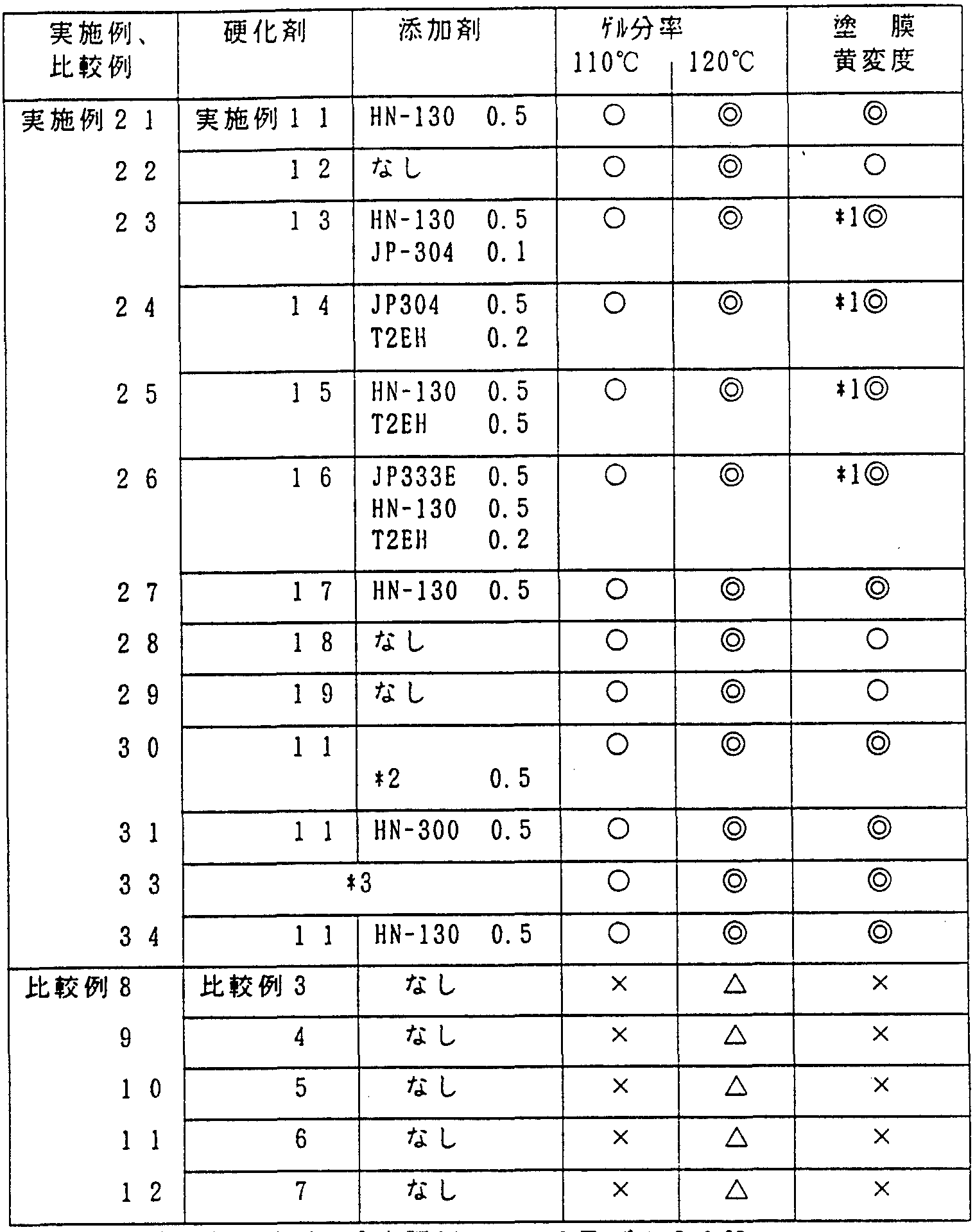
- thermodissociable block polyisocyanoate and acrylpolyol obtained in the above (a trade name of Dainippon Ink Acrylic A) -800 1) was added so that the ratio of block isocyanate / hydroxyl group (equivalent) was as high as 1.0, and the compound containing semicarbazide group (Nippon Hibiki) Trade name HN-130; available from HMDI and N, N-dimethylhydrazine) and dibutyltin dilaurate, respectively.
- Example 22 to 29 The procedure was performed in the same manner as in Example 21 except that the thermodissociable block polyisocyanoate obtained in Examples 12 to 19 was used and the results are shown in Table 2. Table 2 shows the measurement results of the obtained coating film properties.
- Example 21 was carried out in the same manner as in Example 21 except that the compound obtained in Example 20 was used as the semicarbazide group-containing compound.
- Table 2 shows the measurement results of the obtained coating film properties.
- Example 3 A nitrogen atmosphere was set in the 4-fluoroscopper equipped with a stirrer, thermometer, reflux cooling pipe, nitrogen blowing pipe, and drip port, and the highly branched poly obtained in Example 1 was used. 100 parts by weight of isocyanate were charged, and 0.5 parts by weight of N, N-dimethylhydrohydrazine and quinethylene were added so that the reaction temperature did not exceed 50 ° C. Add 35 parts by weight of the mixture dropwise. After 30 minutes from the end of the dropping, the absorption of the characteristic of the infrared spectrum isocyanate unit was carried out so that the reaction temperature would not exceed 50 minutes. The solution was dropped until it disappeared to obtain a thermodissociable block polyisocyananate solution containing a semicarbazide group having a solid content of 80% by weight.
- Example 3 3 A nitrogen atmosphere was set in the 4-fluoroscopper equipped with a stirrer, thermometer, reflux cooling pipe, nitrogen blowing pipe, and drip port, and the highly branched poly obtained in Example
- the heat dissociable block polyisocyanoate and the heat dissociable block containing the semicarbazide group obtained in Example 32 as a compound containing a semicarbazide group were obtained.
- the procedure was performed in the same manner as in Example 21 except that a cupoliisocyanate was used.
- Table 2 shows the measurement results of the obtained coating film properties.
- Polyester Polyol brand name of Sumitomo Bayer Urethane Co., Ltd., Desmophen 670, solid
- Table 2 shows the measurement results of the obtained coating film properties.
- Baking temperature of coating film 1) Evaluation of gel fraction 110 and 120 ° C
- the coating film gloss was 95% or more, and the coating haze was less than 0.5.
- J ⁇ -304, JP 333 ⁇ The quotient of phosphites from Johoku Chemical Industry ⁇
- the polysocyanate of the present invention and its blocky terrestrial are more excellent in compatibility with polyols and the like than conventional ones, and the curing agent composition is Further, not only low-temperature curability but also yellowing resistance are improved, and paints using them are excellent in weather resistance and the like in addition to the above properties.
- the curing agent composition is used in applications such as adhesives, adhesives, and sealing agents, and the coating material using the above-mentioned block or the curing agent composition is used in automobiles.
- Top and middle coat paints, anti-chipping paints, paints for automotive parts, pre-metals for metal products such as home appliances and office equipment, fire-resistant steel plates, paints for construction materials, plastics It can be used for applications such as paints for coatings, adhesion promoters, sealing agents, and electrodeposition paints, and is industrially useful.
Landscapes
- Chemical & Material Sciences (AREA)
- Health & Medical Sciences (AREA)
- Chemical Kinetics & Catalysis (AREA)
- Medicinal Chemistry (AREA)
- Polymers & Plastics (AREA)
- Organic Chemistry (AREA)
- Polyurethanes Or Polyureas (AREA)
- Paints Or Removers (AREA)
- Adhesives Or Adhesive Processes (AREA)
Description


Claims
Priority Applications (3)
| Application Number | Priority Date | Filing Date | Title |
|---|---|---|---|
| DE69417979T DE69417979T2 (de) | 1993-02-12 | 1994-02-08 | Polyisocyanat, blockiertes polyisocyanat und beschichtungszusammensetzung |
| EP94905864A EP0646608B1 (en) | 1993-02-12 | 1994-02-08 | Polyisocyanate, blocked polyisocyanate and coating composition |
| KR1019940702320A KR0177852B1 (ko) | 1993-02-12 | 1994-02-08 | 폴리이소시아네이트, 블록 폴리이소시아네이트, 및 도료 조성물 |
Applications Claiming Priority (2)
| Application Number | Priority Date | Filing Date | Title |
|---|---|---|---|
| JP2415193 | 1993-02-12 | ||
| JP5/24151 | 1993-02-12 |
Publications (1)
| Publication Number | Publication Date |
|---|---|
| WO1994018254A1 true WO1994018254A1 (fr) | 1994-08-18 |
Family
ID=12130344
Family Applications (1)
| Application Number | Title | Priority Date | Filing Date |
|---|---|---|---|
| PCT/JP1994/000185 Ceased WO1994018254A1 (fr) | 1993-02-12 | 1994-02-08 | Polyisocyanate, polyisocyanate bloc et composition de revetement |
Country Status (4)
| Country | Link |
|---|---|
| EP (1) | EP0646608B1 (ja) |
| KR (1) | KR0177852B1 (ja) |
| DE (1) | DE69417979T2 (ja) |
| WO (1) | WO1994018254A1 (ja) |
Cited By (1)
| Publication number | Priority date | Publication date | Assignee | Title |
|---|---|---|---|---|
| JP2005179622A (ja) * | 2003-12-15 | 2005-07-07 | Kyodo Chem Co Ltd | アクリル系接着剤組成物 |
Families Citing this family (11)
| Publication number | Priority date | Publication date | Assignee | Title |
|---|---|---|---|---|
| JP3712295B2 (ja) * | 1996-04-12 | 2005-11-02 | 旭化成ケミカルズ株式会社 | ブロックポリイソシアネート組成物及びそれを用いた一液性熱硬化組成物 |
| DE10040223C2 (de) * | 2000-08-17 | 2002-12-05 | Basf Coatings Ag | Strukturviskose, von organischen Lösemitteln und externen Emulgatoren freie Pulverklarlack-Slurry, Verfahren zu ihrer Herstellung und ihre Verwendung |
| DE10041634C2 (de) | 2000-08-24 | 2002-10-17 | Basf Coatings Ag | Wäßrige Dispersion und ihre Verwendung zur Herstellung von thermisch und mit aktinischer Strahlung härtbaren Beschichtungsstoffen, Klebstoffen und Dichtungsmassen |
| DE10139262C1 (de) | 2001-08-09 | 2003-01-02 | Basf Coatings Ag | Rheologiehilfsmittel, Verfahren zu seiner Herstellung und seine Verwendung |
| DE10243667A1 (de) * | 2002-09-20 | 2004-04-01 | Bayer Ag | Polyisocyanatharze |
| DE102004056849A1 (de) | 2004-11-25 | 2006-06-08 | Bayer Materialscience Ag | Neue Polyisocyanatgemische, ein Verfahren zu ihrer Herstellung und ihre Verwendung als Härterkomponente in Polyurethanlacken |
| DE102005045150A1 (de) | 2005-09-22 | 2007-04-05 | Basf Coatings Ag | Verwendung von Phosphonsäurediestern und Diphosphonsäurediestern sowie thermisch härtbare Gemische, enthaltend Phosphonsäurediester und Diphosphonsäurediester |
| DE102005045228A1 (de) | 2005-09-22 | 2007-04-05 | Basf Coatings Ag | Verwendung von Phosphonsäurediestern und Diphosphonsäurediestern sowie silangruppenhaltige, härtbare Gemische, enthaltend Phosphonsäurediester und Diphosphonsäurediester |
| DE102005053661A1 (de) | 2005-11-10 | 2007-05-16 | Basf Coatings Ag | Reparaturfolien und ihre Verwendung |
| DE102006024823A1 (de) | 2006-05-29 | 2007-12-06 | Basf Coatings Ag | Verwendung von härtbaren Gemischen, enthaltend silangruppenhaltige Verbindungen sowie Phosphonsäurediester oder Diphosphonsäurediester, als Haftvermittler |
| DE102007014720A1 (de) | 2007-03-23 | 2008-09-25 | Basf Coatings Japan Ltd., Yokohama | Phosphonat-haltiges Zweikomponenten-Lacksystem, dessen Herstellung und Verwendung |
Citations (13)
| Publication number | Priority date | Publication date | Assignee | Title |
|---|---|---|---|---|
| JPS5463134A (en) * | 1977-02-23 | 1979-05-21 | Bayer Ag | Powder coating material |
| DE3004876A1 (de) * | 1980-02-09 | 1981-08-20 | Chemische Werke Hüls AG, 4370 Marl | Blockierte polyisocyanate mit hoher reaktionsfaehigkeit, ihre herstellung und verwendung |
| JPS5747321A (en) * | 1980-09-03 | 1982-03-18 | Nippon Polyurethan Kogyo Kk | Preparation of aliphatic isocyanurate compound |
| JPS5922916A (ja) * | 1982-07-29 | 1984-02-06 | Nippon Polyurethan Kogyo Kk | 脂肪族ポリイソシアヌレ−ト重合体の製造方法 |
| JPS6142523A (ja) * | 1984-08-03 | 1986-03-01 | Mitsui Toatsu Chem Inc | ヘキサメチレンイソシアヌラ−ト化合物の製造方法 |
| JPS6172012A (ja) * | 1984-09-18 | 1986-04-14 | Dainippon Ink & Chem Inc | ポリイソシアネ−トの製造方法 |
| JPS6172013A (ja) * | 1984-09-18 | 1986-04-14 | Dainippon Ink & Chem Inc | 樹脂組成物 |
| JPS6253975A (ja) * | 1985-09-03 | 1987-03-09 | Mitsubishi Chem Ind Ltd | ブロツク化ポリイソシアヌレ−ト |
| JPS62215619A (ja) * | 1986-03-17 | 1987-09-22 | Dainippon Ink & Chem Inc | 樹脂組成物 |
| JPS6393770A (ja) * | 1986-10-09 | 1988-04-25 | Asahi Chem Ind Co Ltd | イソシアヌレ−ト化合物の製造方法 |
| JPS6396178A (ja) * | 1986-10-13 | 1988-04-27 | Asahi Chem Ind Co Ltd | イソシアヌレ−ト化合物の新規な製造方法 |
| JPS6433115A (en) * | 1987-04-03 | 1989-02-03 | Asahi Chemical Ind | Polyisocyanate and curing agent |
| JPH02110123A (ja) * | 1988-10-19 | 1990-04-23 | Asahi Chem Ind Co Ltd | ポリイソシアナートの製法 |
Family Cites Families (3)
| Publication number | Priority date | Publication date | Assignee | Title |
|---|---|---|---|---|
| FR1411633A (fr) * | 1963-10-17 | 1965-09-17 | Bayer Ag | Procédé de préparation d'isocyanates d'uréthane sans inconvénients physiologiques |
| GB1412432A (en) * | 1972-03-15 | 1975-11-05 | Ici Ltd | Polyurethane coating compositions |
| US4855383A (en) * | 1988-09-23 | 1989-08-08 | Ashland Oil, Inc. | In situ quaternary ammonium catalyst formation for curing polymeric isocyanates |
-
1994
- 1994-02-08 DE DE69417979T patent/DE69417979T2/de not_active Expired - Lifetime
- 1994-02-08 KR KR1019940702320A patent/KR0177852B1/ko not_active Expired - Lifetime
- 1994-02-08 EP EP94905864A patent/EP0646608B1/en not_active Expired - Lifetime
- 1994-02-08 WO PCT/JP1994/000185 patent/WO1994018254A1/ja not_active Ceased
Patent Citations (13)
| Publication number | Priority date | Publication date | Assignee | Title |
|---|---|---|---|---|
| JPS5463134A (en) * | 1977-02-23 | 1979-05-21 | Bayer Ag | Powder coating material |
| DE3004876A1 (de) * | 1980-02-09 | 1981-08-20 | Chemische Werke Hüls AG, 4370 Marl | Blockierte polyisocyanate mit hoher reaktionsfaehigkeit, ihre herstellung und verwendung |
| JPS5747321A (en) * | 1980-09-03 | 1982-03-18 | Nippon Polyurethan Kogyo Kk | Preparation of aliphatic isocyanurate compound |
| JPS5922916A (ja) * | 1982-07-29 | 1984-02-06 | Nippon Polyurethan Kogyo Kk | 脂肪族ポリイソシアヌレ−ト重合体の製造方法 |
| JPS6142523A (ja) * | 1984-08-03 | 1986-03-01 | Mitsui Toatsu Chem Inc | ヘキサメチレンイソシアヌラ−ト化合物の製造方法 |
| JPS6172012A (ja) * | 1984-09-18 | 1986-04-14 | Dainippon Ink & Chem Inc | ポリイソシアネ−トの製造方法 |
| JPS6172013A (ja) * | 1984-09-18 | 1986-04-14 | Dainippon Ink & Chem Inc | 樹脂組成物 |
| JPS6253975A (ja) * | 1985-09-03 | 1987-03-09 | Mitsubishi Chem Ind Ltd | ブロツク化ポリイソシアヌレ−ト |
| JPS62215619A (ja) * | 1986-03-17 | 1987-09-22 | Dainippon Ink & Chem Inc | 樹脂組成物 |
| JPS6393770A (ja) * | 1986-10-09 | 1988-04-25 | Asahi Chem Ind Co Ltd | イソシアヌレ−ト化合物の製造方法 |
| JPS6396178A (ja) * | 1986-10-13 | 1988-04-27 | Asahi Chem Ind Co Ltd | イソシアヌレ−ト化合物の新規な製造方法 |
| JPS6433115A (en) * | 1987-04-03 | 1989-02-03 | Asahi Chemical Ind | Polyisocyanate and curing agent |
| JPH02110123A (ja) * | 1988-10-19 | 1990-04-23 | Asahi Chem Ind Co Ltd | ポリイソシアナートの製法 |
Non-Patent Citations (1)
| Title |
|---|
| See also references of EP0646608A4 * |
Cited By (1)
| Publication number | Priority date | Publication date | Assignee | Title |
|---|---|---|---|---|
| JP2005179622A (ja) * | 2003-12-15 | 2005-07-07 | Kyodo Chem Co Ltd | アクリル系接着剤組成物 |
Also Published As
| Publication number | Publication date |
|---|---|
| EP0646608A1 (en) | 1995-04-05 |
| EP0646608A4 (en) | 1995-08-09 |
| DE69417979D1 (de) | 1999-05-27 |
| KR0177852B1 (ko) | 1999-05-15 |
| EP0646608B1 (en) | 1999-04-21 |
| DE69417979T2 (de) | 1999-12-16 |
Similar Documents
| Publication | Publication Date | Title |
|---|---|---|
| JP5178200B2 (ja) | 高架橋性、低粘度ポリイソシアネート組成物及びそれを含む塗料組成物 | |
| CN107922584B (zh) | 封端多异氰酸酯组合物、单液型涂覆组合物、涂膜、及涂装物品 | |
| US6274693B1 (en) | Method for producing a two-layer coating and suitable enamel therefor | |
| US5817732A (en) | Blocked polyisocyanate and coating composition | |
| JP2006335954A (ja) | ブロックポリイソシアネート組成物および一液型コーティング組成物 | |
| WO1997031961A1 (en) | Novel blocked polyisocyanate and uses thereof | |
| KR101250703B1 (ko) | 차단된 이소시아네이트 및 코팅 조성물에서의 이들의 용도 | |
| JP2013224350A (ja) | ポリイソシアネート組成物及びそれを含有する塗料組成物 | |
| JPH09278865A (ja) | ブロックポリイソシアネート組成物及びそれを用いた一液性熱硬化組成物 | |
| JP5542301B2 (ja) | コーティング組成物 | |
| US6881786B2 (en) | One-component, waterborne film-forming composition | |
| CN111662430A (zh) | 封端多异氰酸酯组合物、水系涂料组合物及涂膜 | |
| KR0176256B1 (ko) | 스토빙래커 결합제 조성물 및 이로부터 피복물을 제조하는 방법 | |
| KR0177852B1 (ko) | 폴리이소시아네이트, 블록 폴리이소시아네이트, 및 도료 조성물 | |
| EP3362499B1 (en) | Systems and methods for forming polyurethanes | |
| JP6765276B2 (ja) | ブロックイソシアネート組成物、一液型塗料組成物及び塗膜 | |
| JPH08225630A (ja) | ブロックポリイソシアネート、組成物、及び一液型熱硬化性組成物 | |
| JPH08302280A (ja) | 低温硬化性1液塗料組成物 | |
| JP2000290493A (ja) | ブロックポリイソシアネート組成物 | |
| CN119013325A (zh) | 封端异氰酸酯组合物、涂料组合物和涂膜 | |
| JP3403478B2 (ja) | 新規なウレタン系塗料用組成物 | |
| JP3468563B2 (ja) | 硬化剤組成物及び一液性塗料組成物 | |
| JP2983039B2 (ja) | 二液型ウレタン塗料用樹脂組成物 | |
| JPH1161039A (ja) | 低着色一液性塗料組成物及びプレコートメタル | |
| JP3506494B2 (ja) | 硬化剤組成物及び一液性塗料組成物 |
Legal Events
| Date | Code | Title | Description |
|---|---|---|---|
| WWE | Wipo information: entry into national phase |
Ref document number: 1994905864 Country of ref document: EP |
|
| ENP | Entry into the national phase |
Ref country code: US Ref document number: 1994 244961 Date of ref document: 19940614 Kind code of ref document: A Format of ref document f/p: F |
|
| AK | Designated states |
Kind code of ref document: A1 Designated state(s): KR US |
|
| AL | Designated countries for regional patents |
Kind code of ref document: A1 Designated state(s): AT BE CH DE DK ES FR GB GR IE IT LU MC NL PT SE |
|
| 121 | Ep: the epo has been informed by wipo that ep was designated in this application | ||
| WWP | Wipo information: published in national office |
Ref document number: 1994905864 Country of ref document: EP |
|
| WWG | Wipo information: grant in national office |
Ref document number: 1994905864 Country of ref document: EP |