WO1994019410A1 - Composition de resine - Google Patents

Composition de resine Download PDF

Info

Publication number
WO1994019410A1
WO1994019410A1 PCT/JP1994/000232 JP9400232W WO9419410A1 WO 1994019410 A1 WO1994019410 A1 WO 1994019410A1 JP 9400232 W JP9400232 W JP 9400232W WO 9419410 A1 WO9419410 A1 WO 9419410A1
Authority
WO
WIPO (PCT)
Prior art keywords
mol
aromatic
formula
repeating unit
copolymer
Prior art date
Legal status (The legal status is an assumption and is not a legal conclusion. Google has not performed a legal analysis and makes no representation as to the accuracy of the status listed.)
Ceased
Application number
PCT/JP1994/000232
Other languages
English (en)
French (fr)
Inventor
Takao Kawaki
Akikazu Amagai
Toshiaki Yamada
Hidefumi Harada
Hajime Ban
Yuji Takeda
Koji Yamamoto
Current Assignee (The listed assignees may be inaccurate. Google has not performed a legal analysis and makes no representation or warranty as to the accuracy of the list.)
Mitsubishi Gas Chemical Co Inc
Original Assignee
Mitsubishi Gas Chemical Co Inc
Priority date (The priority date is an assumption and is not a legal conclusion. Google has not performed a legal analysis and makes no representation as to the accuracy of the date listed.)
Filing date
Publication date
Priority claimed from JP5028091A external-priority patent/JPH06240123A/ja
Priority claimed from JP2809293A external-priority patent/JPH06240124A/ja
Priority claimed from JP02809093A external-priority patent/JP3199085B2/ja
Priority claimed from JP9811993A external-priority patent/JPH06306281A/ja
Priority claimed from JP9812193A external-priority patent/JPH06306283A/ja
Priority claimed from JP9812093A external-priority patent/JPH06306282A/ja
Priority claimed from JP17160693A external-priority patent/JPH0726140A/ja
Priority to US08/318,833 priority Critical patent/US5543474A/en
Priority to EP94907055A priority patent/EP0637613B1/en
Priority to DE69426177T priority patent/DE69426177T2/de
Application filed by Mitsubishi Gas Chemical Co Inc filed Critical Mitsubishi Gas Chemical Co Inc
Publication of WO1994019410A1 publication Critical patent/WO1994019410A1/ja
Anticipated expiration legal-status Critical
Ceased legal-status Critical Current

Links

Classifications

    • CCHEMISTRY; METALLURGY
    • C08ORGANIC MACROMOLECULAR COMPOUNDS; THEIR PREPARATION OR CHEMICAL WORKING-UP; COMPOSITIONS BASED THEREON
    • C08LCOMPOSITIONS OF MACROMOLECULAR COMPOUNDS
    • C08L67/00Compositions of polyesters obtained by reactions forming a carboxylic ester link in the main chain; Compositions of derivatives of such polymers
    • C08L67/02Polyesters derived from dicarboxylic acids and dihydroxy compounds
    • CCHEMISTRY; METALLURGY
    • C08ORGANIC MACROMOLECULAR COMPOUNDS; THEIR PREPARATION OR CHEMICAL WORKING-UP; COMPOSITIONS BASED THEREON
    • C08LCOMPOSITIONS OF MACROMOLECULAR COMPOUNDS
    • C08L79/00Compositions of macromolecular compounds obtained by reactions forming in the main chain of the macromolecule a linkage containing nitrogen with or without oxygen or carbon only, not provided for in groups C08L61/00 - C08L77/00
    • C08L79/04Polycondensates having nitrogen-containing heterocyclic rings in the main chain; Polyhydrazides; Polyamide acids or similar polyimide precursors
    • C08L79/08Polyimides; Polyester-imides; Polyamide-imides; Polyamide acids or similar polyimide precursors
    • CCHEMISTRY; METALLURGY
    • C08ORGANIC MACROMOLECULAR COMPOUNDS; THEIR PREPARATION OR CHEMICAL WORKING-UP; COMPOSITIONS BASED THEREON
    • C08LCOMPOSITIONS OF MACROMOLECULAR COMPOUNDS
    • C08L81/00Compositions of macromolecular compounds obtained by reactions forming in the main chain of the macromolecule a linkage containing sulfur with or without nitrogen, oxygen or carbon only; Compositions of polysulfones; Compositions of derivatives of such polymers
    • C08L81/02Polythioethers; Polythioether-ethers

Definitions

  • the present invention relates to a novel resin composition having excellent heat resistance, mechanical strength, and melt moldability.
  • Aromatic polyamide resin is a plastic material having excellent heat resistance, mechanical strength, electrical properties, and chemical resistance, and has been conventionally used as a varnish, film, and the like.
  • Aromatic polyamide imide resin is prepared from aromatic tricarboxylic acid anhydride and diisocyanate in a solvent, and aromatic tricarboxylic anhydride is prepared from halide and diamine in a solvent. Is typical.
  • polyamide imide resins produced by these methods are inferior in melt moldability even when used suitably for the preparation of varnishes, cast films, etc., and are therefore used in melt molding, including injection molding. Not suitable for
  • U.S. Pat. No. 4,313,868 has the following repeating polyamide unit (I) and repeating polyamide unit ( ⁇ ),
  • R represents a divalent aromatic hydrocarbon La radical as or one 0, methylene, One CO-, about 6 to about 2 0 carbon atoms - is selected from the group consisting of - S o 2 A divalent hydrocarbon directly bonded to a group or bonded to the group by a stable linkage, and X is a divalent aromatic radical.
  • Polyamideimide copolymers for injection molding with a molar ratio of units (I) to units ( ⁇ ) of 80:20 to 20:80 have been proposed.
  • This polyamide imide copolymer has improved melt moldability compared to a polyamide imide resin that does not contain a repeating unit ( ⁇ ). Force to flow during melt molding is lower than that of polyamide imide resin. Since the temperature is close to the decomposition temperature when the polymer is melted, good molding processing has not been achieved.
  • Japanese Patent Laid-Open No. 59-8755 discloses that
  • the above (a) polyamide imide resin has the general formula (III)
  • -(IV) Is an aromatic polymer which may have less than 70 mol% of a polyamide unit represented by the following formula:
  • Ar in the formula (1 ⁇ ) is a trivalent aromatic group containing at least one carbon 6-membered ring
  • R in the formulas ( ⁇ ) and (IV) is a divalent aromatic and / or aliphatic
  • Ar ′ in the formula (IV) is a divalent aromatic group or aliphatic 3 ⁇ 4C ”containing at least one carbon 6-membered ring
  • (C) at least one resin selected from a polyphenylene resin, a polyamide resin and an aromatic polyester resin used in the molding material proposed in the publication is included in the molding material before imparting good fluidity. It is described in the publication that it is contained.
  • An object of the present invention is to provide a novel resin composition containing a polyamide resin and a polyester resin as main components.
  • Another object of the present invention is to provide a novel resin composition containing a polyamide imide resin and a polyphenylene sulfide resin as main components.
  • Another object of the present invention is to provide a novel resin composition containing a polyamide imide resin and a liquid crystal polymer as main components.
  • Another object of the present invention is to provide a resin composition having a good balance of heat resistance, mechanical properties and fluidity.
  • the repeating unit represented by the formula (1) is 5 to 95 mol%
  • Ar represents a trivalent aromatic group containing at least one carbon six-membered ring
  • a ri represents a divalent aromatic group containing at least one carbon six-membered ring
  • R 2 in the general formula (3) represents a divalent aliphatic group
  • R represents a divalent aromatic group or an aliphatic group. Indicates a group
  • the aromatic polyamide-imide copolymer (A) comprises an aromatic tricarboxylic anhydride and an aromatic tricarboxylic acid anhydride.
  • the polymerization reaction of at least one of aliphatic dicarboxylic acid and aliphatic dicarboxylic acid with a diisocyanate compound is carried out in a plurality of steps, and the first step is carried out in a temperature range of 50 to 110 ° C.
  • the resin composition is characterized in that the resin composition is prepared by being performed in a temperature range of more than 101 ° C and not more than 200 ° C after the second step.
  • the repeating unit represented by the above formula (1) is represented by 10 to 30 mol%
  • the repeating unit represented by the above formula (2) and the repeating unit represented by the above formula (3) Aromatic polyamide imide copolymer (A) containing at least 70 to 90 mol% of any of the repeating units, provided that the total of these three repeating units is 100 mol%.
  • the weight ratio ((A) / (B)) of the aromatic polyamide imide copolymer (A) and the polyester resin (B) is 95Z5 or more.
  • the repeating unit represented by the formula (1) is 5 to 95 mol%
  • the repeating unit represented by the formula (2) and the repeating unit represented by the formula (3) are represented by the following formulas.
  • Aromatic polyamideimide copolymer (A) containing at least 5 to 95 mol% of any of the repeating units to be prepared, provided that the total of these three repeating units is 100 mol%.
  • the weight ratio ((A) / (B)) of the aromatic polyamide imide copolymer (A) and the polyester resin (B) is 10Z90.
  • a resin composition characterized by being less than 50Z50 is provided.
  • the repeating unit represented by the formula (1) is 5 to 95 mol%
  • the repeating unit represented by the formula (2) and the formula (3) are represented by the following formulas: Aromatic polyamideimide copolymer (A) containing at least 5 to 95 mol% of any of the repeating units, provided that these three repeating units are used.
  • a polyphenylene sulfide resin (C) and the weight ratio of the aromatic polyamide imide copolymer (A) to the polyphenylene sulfide resin (C) (A) / (C)) is 955 to 9595, and the aromatic polyamide imide copolymer (A) is an aromatic tricarboxylic anhydride and an aromatic dicarboxylic acid and
  • the polymerization reaction of at least one of the aliphatic dicarboxylic acids with the diisocyanate compound is carried out in multiple steps, the first step being carried out in a temperature range of 50 to 110 ° C, and There is provided a resin composition characterized by being prepared by performing the second and subsequent steps in a temperature range from more than 110 to 200 ° C.
  • a repeating unit represented by the formula (1), 10 to 30 mol%, a repeating unit represented by the formula (2), and a repeating unit represented by the formula (3) Aromatic polyamideimide copolymer (A) containing at least 70 to 90 mol% of any of the repeating units, provided that the total amount of these three repeating units is 100 mol%. And a weight ratio of the aromatic polyamide imide copolymer (A) and the polyphenylene sulfide resin (C), which comprises the polyphenylene sulfide resin (C). ) resin composition, which is a 95 / / 5-5 95 are provided.
  • the repeating unit represented by the above formula (1) is 5 to 95 mol%
  • the repeating unit represented by the above formula (2) and the above formula (3) An aromatic polyamideimide copolymer (A) containing at least 5 to 95 mol% of any of the repeating units, provided that the total of these three repeating units is 100 mol%;
  • a weight ratio of the aromatic polyamide imide copolymer (A) and the polyphenylene sulfide resin (C) ((A) / (C)) is 10 or more and less than 50 and less than 50Z50.
  • the repeating unit represented by the formula (1) is 5 to 95 mol%
  • the repeating unit represented by the formula (2) and the formula (3) Aromatic polyamideimide copolymer (A) containing at least 5 to 95 mol% of any of the repeating units represented, provided that the total of these three repeating units is 100 mol%.
  • a weight ratio (A) of the aromatic polyamideimide copolymer (A) and the thermoplastic resin (D) comprising a thermoplastic resin (D) capable of forming an anisotropic molten phase. / (D)) is 9 ⁇ , ⁇ .
  • the present invention provides, as a comprehensive concept, a resin composition comprising an aromatic polyamide imide copolymer ( ⁇ ) and a polyester resin ( ⁇ ), and an aromatic polyamide imide copolymer ( ⁇ ).
  • a resin composition comprising a polyphenylene sulfide resin (C) and a resin composition comprising an aromatic polyamide imide copolymer ( ⁇ ) and a thermoplastic resin (D) capable of forming an anisotropic molten phase including.
  • the aromatic polyamide imide copolymer ( ⁇ ) used in the resin composition of the present invention includes a repeating unit represented by the general formula (1) (hereinafter, also referred to as a repeating unit (1)) and The repeating unit represented by the formula (2) (hereinafter, also referred to as a repeating unit (2)) and the repeating unit represented by the general formula (3) (hereinafter, also referred to as a repeating unit (3)) ) Consists of at least one of the repeating units.
  • the content of the repeating unit (1) is 5 to 95 mol. %
  • the content of the repeating unit (2) and / or the repeating unit (3) is 5 to 95 mol%.
  • the content of the repeating unit (1) is from 10 to 70 mol%, the content of the repeating unit (2) and / or the repeating unit (3) is from 30 to 90 mol%, more preferably, The content of the repeating unit (1) is 10 to 50 mol%, and the content of the repeating unit (2) and / or the repeating unit (3) is 50 to 90 mol%.
  • the repeating unit ( The content of 1) is 10 to 30 mol%, and the content of the repeating unit (2) and / or the repeating unit (3) is 70 to 90 mol%.
  • the aromatic polyamide imide copolymer contains at least 1 mol% of both the repeating unit (2) and the repeating unit (3).
  • the resin composition of the present invention comprises an aromatic polyamide imide resin (A) and a polyphenylene sulfide resin (C), and the aromatic polyamide imide resin (A) has a repeating unit (2).
  • the content of the repeating unit (1) is preferably 50 to 95 mol%
  • the content of the repeating unit (3) is preferably 5 to 50 mol%
  • the content of the repeating unit (1) is preferably
  • the content of the repeating unit (3) is more preferably 60 to 95 mol%
  • the content of the repeating unit (3) is more preferably 5 to 40 mol%, particularly preferably 70 to 90 mol%.
  • the content of the unit (3) is 10 to 30 mol%.
  • the aromatic polyamideimide copolymer (A) preferably consists essentially of repeating units (1), (2) and // or (3).
  • the total amount of the repeating units (1), (2) and (3) is preferably at least 90 mol%, particularly preferably at least 95 mol%, of all units.
  • Ar is a trivalent aromatic group containing at least one carbon 6-membered ring, and preferably has 6 to 13 carbon atoms.
  • the following groups can be exemplified as specific examples of A r.
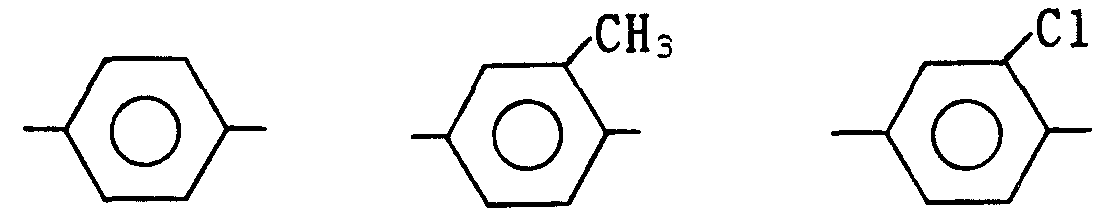
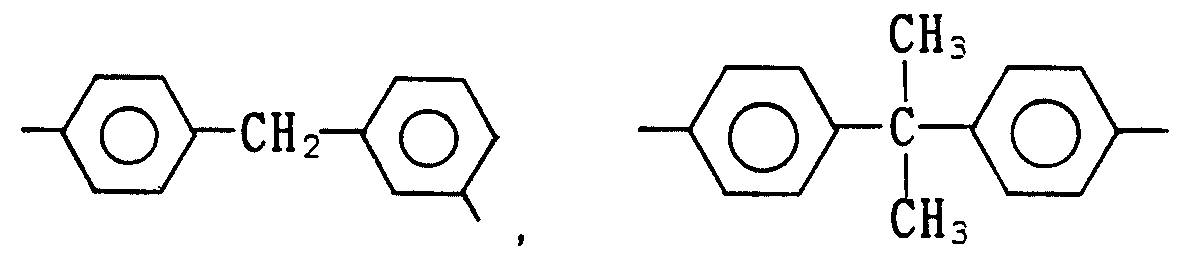
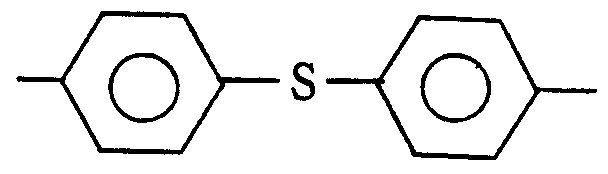
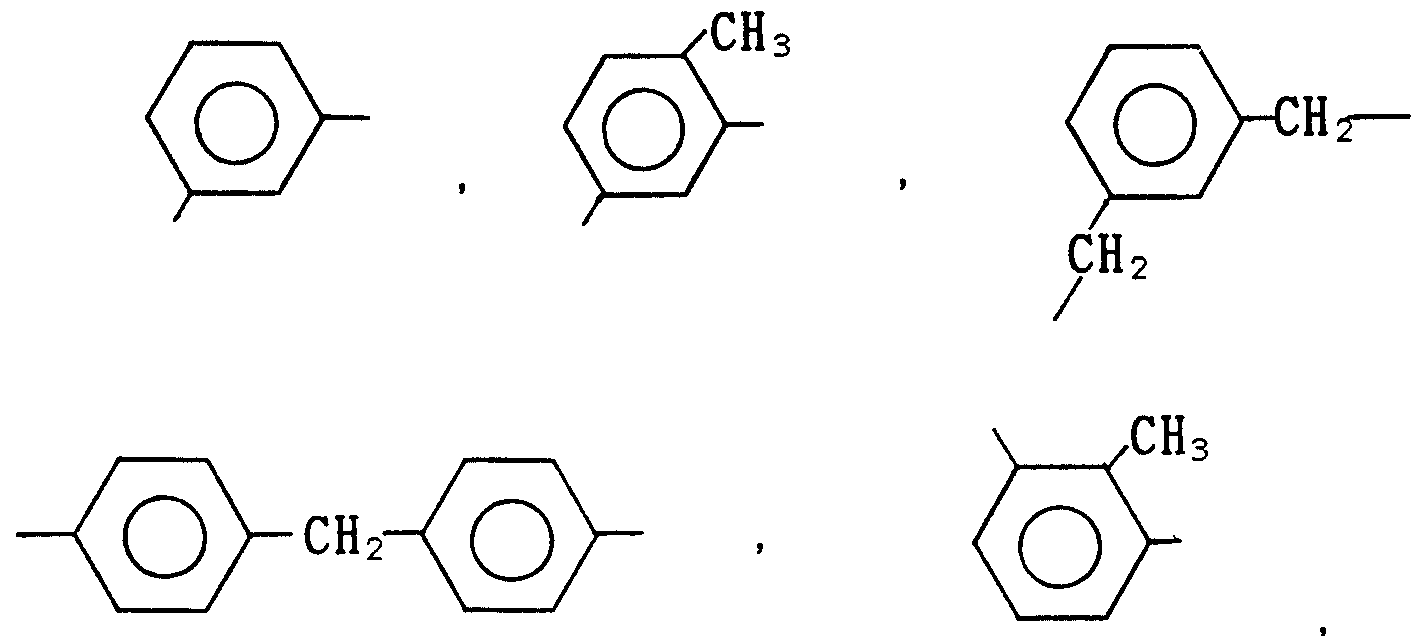
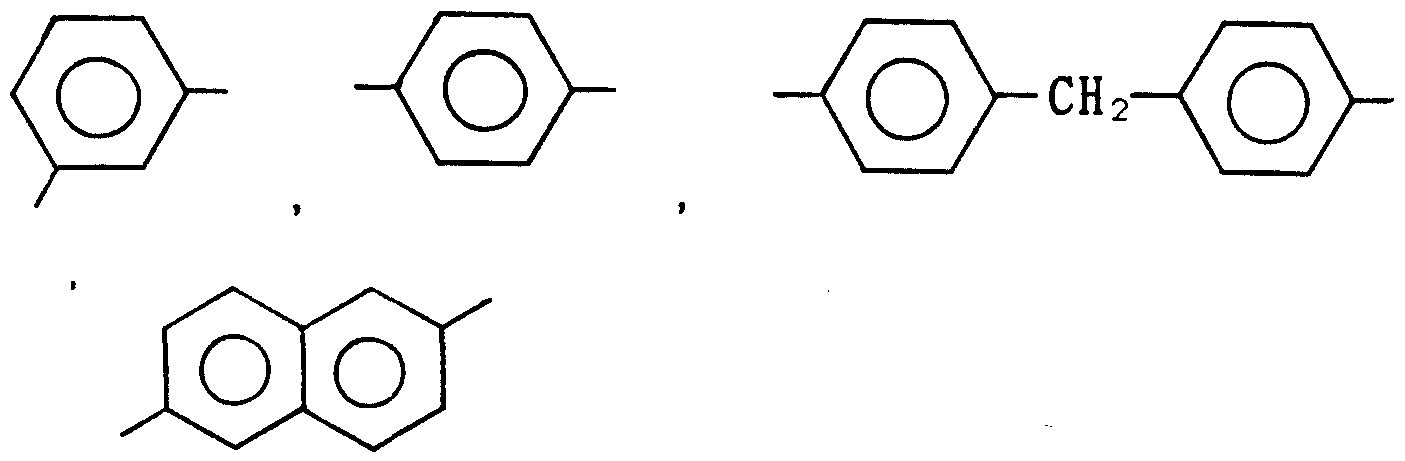
  • R is a divalent aromatic group, preferably a divalent aromatic group having 6 to 15 carbon atoms or a divalent aliphatic group, preferably It is an aliphatic group having 2 to 12 carbon atoms.
  • R in the general formulas (1), (2) and (3) can be different or the same.
  • R examples include the following divalent groups c CH; ⁇
  • Ar in the general formula (2) is a divalent aromatic group containing at least one carbon 6-membered ring, preferably a divalent aromatic group having 6 to 13 carbon atoms.
  • a r include the following divalent groups.
  • n is an integer from 2 to 20
  • the degree of polymerization of the aromatic polyamideimide copolymer (A) is expressed in terms of reduced viscosity, measured in dimethylformamide solvent at a temperature of 30 ° C and a concentration of lgZd, from 0.1 to 2.0 d £. g is preferred, more preferably 0.1-1.0 d g, most preferably 0.2-0.7 d 91
  • the aromatic polyamide imide copolymer (A) is a random copolymer in which the repeating unit (1) and the repeating unit (2) and / or the repeating unit (3) are substantially randomly arranged.
  • the copolymer may be an alternating copolymer in which units are alternately arranged, or a block copolymer in which each of these units is combined to form a block chain and these block chains are combined.
  • the aromatic polyamideimide copolymer (A) can be produced by any one of the following methods (a), (b) and (c).
  • the method described in (b) is problematic in that halogens remain in the aromatic polyamide imide copolymer (A) and heating at a high temperature to form an imido ring. Manufacturing complexity.
  • the method described in (c) also has a manufacturing complexity of heating at a high temperature to form an imido ring. Therefore, the method described in (a) is most preferable.
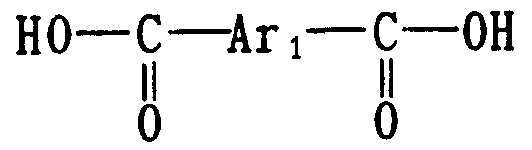
  • Aromatic tricarboxylic acid anhydrides, aromatic dicarboxylic acids, and fatty acids as raw materials used in producing the aromatic polyimide copolymer (A) by the method (a) described above.
  • the aromatic dicarboxylic acids and the dissociate compounds are as follows.
  • Aromatic dicarboxylic acid (Where Ar is as defined in the above general formula (1).) Aromatic dicarboxylic acid
  • An aromatic polyamide-imide copolymer (A) can be prepared by dissolving a predetermined amount of the above-mentioned starting material in a solvent and subsequently performing a polymerization reaction.
  • the temperature of the polymerization reaction is preferably from 50 to 200, more preferably from 80 to 180, and particularly preferably from 80 to 170C. When the temperature is in the above-mentioned temperature range, the aromatic polyamide imide copolymer (A) having an appropriate degree of polymerization and not inhibiting the melt moldability of the resin composition of the present invention can be obtained.
  • the polymerization reaction is performed in multiple steps, preferably in two or three steps, and the temperature is increased for each step to produce a more preferred aromatic polyamide-imide copolymer (A) be able to. That is, the polymerization reaction is performed in a temperature range of 50 to 110 in the first step and in a temperature range of more than 110 to 200 ° C in the second and subsequent steps, so that the polyamide is excellent in melt moldability and tough.
  • a dimide copolymer (A) can be produced.
  • the obtained copolymer (A) has substantially no complicated three-dimensional structure.
  • the temperature of each step can be set at any value within the above-mentioned temperature range. For example, within the temperature range, the temperature may be raised, or the temperature may be constant, or the combination of the temperature rise and the constant temperature may be used. Most preferred is a method in which the polymerization reaction is carried out at 20 to 80 ° C higher than the previous step, and the temperature of each step is kept constant.
  • a solvent that can be used for the polymerization reaction a solvent having solubility in the resulting polyamide and a polar solvent having no solvent property can be used. Specific examples of solvents having solubility in polyamide include N-methylbiopenidone, dimethylformamide, dimethylacetamide, dimethylsulfoxide, dimethylsulfolane, and the like.
  • Examples thereof include tetramethylene sulfone, diphenyl sulfone, and butyrolactone.
  • Examples of polar solvents that have no solubility in polyamideimide include nitrobenzene, nitrotoluene, acetonitrile, benzonitrile, acetophenone, nitromethane, dichlorobenzene, and dichlorobenzene. Anisol and the like.
  • a solvent having solubility in polyamideimide and a polar solvent having no solubility may be mixed and used.
  • preferred solvents are those having solubility in polyamideimide.
  • These solvents are preferably used under the condition that the ratio of the raw material to the solvent is 0.1 to 4 mol / liter (raw material Z solvent).
  • various conventionally known catalysts for generating an amide group by a reaction between an isocyanate group and a carboxyl group can be used.
  • the amount of the copolymer (A) should be limited to a necessary minimum, and need not be used.
  • Specific examples of the catalyst include pyridine, quilinone, isoquinoline, trimethylamine, triethylamine, tributylamine, ⁇ , ⁇ -ethylethylamine, avicoline, ⁇ -methylmorpholine, and ⁇ -ethylmorpholine.
  • Metal salts of weak acids such as heavy metal salts and alkali metal salts
  • the catalyst In conducting the polymerization reaction, it is desirable that substantially no water be present in the mixture containing the raw materials, the solvent, and in some cases, the catalyst.
  • the water abundance is preferably up to 5 OO ppm, and up to ⁇ ⁇ ⁇ ⁇ pm is more preferred, especially up to 50 ppm. Excessive water impairs the melt moldability of the copolymer (A).
  • the copolymer is made up of alcohols such as methanol and isopropyl alcohol, ketones such as acetate and methylethylketone, and aliphatic and aromatic hydrocarbons such as hebutane and toluene.
  • alcohols such as methanol and isopropyl alcohol
  • ketones such as acetate and methylethylketone
  • aliphatic and aromatic hydrocarbons such as hebutane and toluene.
  • the polymerization solvent can be recovered by distillation. Further, after distilling off the solvent to a certain extent, a product containing a small amount of the solvent is supplied to the extruder, and the solvent is removed under reduced pressure from a vent port provided in the extruder, and the product is collected. This is preferable because aromatic polyamide can be recovered by conversion to aromatic polyamide.
  • the polyester resin (B) used in the resin composition of the present invention is a thermoplastic resin having an ester bond in the main chain of the molecule.
  • Specific examples of the polyester resin (B) include polycondensates obtained from dicarboxylic acids or derivatives thereof and dihydric alcohols or dihydric phenol compounds; dicarboxylic acids or derivatives thereof and cyclic ether compounds. Polymer; a polycondensate obtained from a metal salt of a dicarboxylic acid and a dihalogen compound; and a ring-opening polymer of a cyclic ester compound.
  • the dicarboxylic acid derivative is an acid anhydride, an ester, an acid halide or the like.
  • the dicarboxylic acids can be aliphatic or aromatic.
  • Aromatic dicarboxylic acids include, for example, terephthalic acid, isophthalic acid, phthalic acid, chlorophthalic acid, nitrophthalic acid, p-carboxylphenylacetic acid, p-phenylenediacetic acid, m-phenylenediglycolic acid, ⁇ - Phenylenediglycolic acid, diphenyldiacetic acid, diphenyl-p, p'-dicarboxylic acid, diphenylether 1 p, p'-dicarboxylic acid, diphenyl m, m'-dicarboxylic acid, diphenyl 4 4 * 1 Diacetic acid, diphenylmethane-p, p'-dicarboxylic acid, diphenic acid Luethane-1 p, p 'Dicarboxylic acid stilbene dicarboxylic acid, diphenylbutane-1 p, p'-dicarboxylic acid, benzophenone 1-4,
  • Examples of the aliphatic dicarboxylic acid include oxalic acid, succinic acid, adibic acid, corkic acid, mazelaic acid, sebacic acid, dodecanedicarboxylic acid, pendecandicarboxylic acid, maleic acid, fumaric acid, and the like.
  • Examples of preferred dicarboxylic acids are aromatic dicarboxylic acids, more preferably terephthalic acid, isophthalic acid, naphthalene-1,2,6-dicarboxylic acid.
  • dihydric alcohols examples include eletin glycol, propane 1.2-diol, propane 1.1,3-diol, butane 1.1,3-diol, butane 1.1,4-diol, 2,2-dimethylpropane 1.1,3- Dionolle, cis-2-butene-1,4-diol, trans-2-butene1-1,4-diol, tetramethylene glycol, pentamethylene glycol, hexamethylene glycol, heptamethylene glycol, octamethylene glycol And decamethylene glycol.
  • dihydric alcohols include ethylene glycol, propylene-1-1.2-diol, propane-1,3-diol, butan-1,3-diol, and butan-1,4-diol. ' More preferably, ethylene glycol and butane-1,1-diol can be mentioned.
  • the divalent phenolic compounds include hydroquinone, resorcinol, 4,4'-dihydroxydiphenyl, bis (4-hydroxyphenyl) methane, 2,2-bis (4-hydroxyphenyl) propane, 1,1 1-bis (4-hydroxyphenyl) cyclohexane, bis (4-hydroxyphenyl) ether, bis (4-hydroxyphenyl) sulfone, bis (4-hydroxyphenyl) sulfide, bis (4-hydroxyphenyl) phenyl Ton, 4-hydroxyphenol 3—hydroxyphenol ketone and the like.
  • Examples of the cyclic ether compound include ethylene oxide and propylene oxide.
  • Examples of the cyclic ester compound include £ -caprolactone and (—valerolaclone.
  • the dihalogen compound to be reacted with the metal salt of dicarboxylic acid is a divalent alcohol or a divalent phenol compound, which has a hydroxyl group such as chlorine or bromine. It is a compound substituted with a halogen atom.
  • the polyester used in the resin composition of the present invention is produced from the above-mentioned raw materials by a method known per se, such as a transesterification method, a direct esterification method, or an interfacial polycondensation method.
  • the preferred polyester resin (B) used for suitably maintaining the balance between the melt molding method and the heat resistance of the resin composition of the present invention uses aromatic dicarboxylic acid or a derivative thereof and a dihydric alcohol as raw materials. It is a crystalline aromatic polyester.
  • aromatic polyesters include polyalkylene terephthalates such as polyethylene terephthalate and polybutylene terephthalate (where alkylene is preferably one having 2 to 6 carbon atoms), and polyethylene terephthalate.
  • 6 naphthalene dicarboxylate
  • polybutylene-1,2,6 polyalkylene-1,2,6-naphthalenedicarboxylate such as naphthylene dicarboxylate (where alkylene preferably has 2 to 6 carbon atoms) And may be preferably used.
  • polyester resins (B) are polyethylene terephthalate and polybutylene terephthalate.
  • the weight average molecular weight of the polyester resin (B) is preferably, for example, not less than 20,000,000.
  • the mixing ratio of the aromatic polyamide imide copolymer (A) and the polyester resin (B) is ⁇ , ⁇ ⁇ ⁇ ⁇ in weight ratio ((A) / (B)), preferably 1 0 90 to 70, more preferably ⁇ ⁇ ⁇ ⁇ ⁇ ⁇ ⁇ ⁇ , most preferably 10/90 or more and less than 550. With such a mixing ratio, the resin composition of the present invention is excellent in the balance between fluidity and heat resistance.
  • the resin composition of the aromatic polyamide imide copolymer ( ⁇ ) and the polyester resin ( ⁇ ) is produced by melt-kneading the respective components.
  • the melt-kneading temperature is preferably from 200 to 400 ° C. Is 230 to 380 ° C. Melt kneading can be carried out using an extruder, Niego, Banbury, mixer, roll, etc., and it is preferable to use a twin screw extruder.
  • the polyester resin (B) may be a resin that can form an anisotropic molten phase, or a resin that cannot form an anisotropic molten phase and can form only an isotropic molten phase. There may be.
  • polyfuylene sulfide resin (C) has the following formula:
  • polysulfide resin (C) As a polymerization method for obtaining the polyphenylene sulfide resin (C), various methods known per se can be employed. For example, sodium sulfate and p-dichlorobenzene are combined with N-retylvirolidone and dimethylacetate. A method in which the reaction is carried out in an amide group-containing solvent such as an amide—a sulfone group-containing solvent such as sulfolane is preferable. At this time, it is preferable to add an alkali metal carboxylate such as sodium acetate or lithium acetate in order to adjust the degree of polymerization.
  • an alkali metal carboxylate such as sodium acetate or lithium acetate in order to adjust the degree of polymerization.
  • Polyphenylene sulfide resin has relatively low molecular weight
  • Japanese Patent Publication No. 45-33668 and a linear high molecular weight substance (for example, Japanese Patent Publication No. 52-12240 (US.P.39 19 177, US.P.4016145) Response)) exists.
  • Those having a relatively low molecular weight can be used as the polyfuylene resin (C) of the present invention after being heated to high molecular weight by heating in an oxygen atmosphere or in the presence of a crosslinking agent such as peroxide.
  • a linear high molecular weight polyphenylene sulfide resin can be preferably used as the polyphenylene resin (C).
  • the melt viscosity of the polyphenylene sulfide resin (C) is 300 to 100 ° C.
  • Preferred melt viscosities are from 300 to 30.000 boys, more preferably from 300 to: L 000 boys and most preferably from 500 to 8,000 boys.
  • the polyphenylene sulfide resin (C) may contain units other than the p-phenylene sulfide group in the above formula, such as m-phenylene sulfide group, biphenylene group; amino group, carboxyl group, and ⁇ -phenylene group.
  • Polyphenylene sulfide resin (C) can contain one SH group at the terminal of the polymer chain.
  • the composition of the resin composition of the present invention and the conditions for kneading the aromatic polyimide resin (A) and the polyphenylene sulfide resin (C) are appropriately selected, and 10 mg equivalent per 1 kg of resin is selected.
  • a preferred resin composition may be obtained by using the polyphenylene sulfide resin (C) having preferably one O SH equivalent or more of one SH group at the polymer terminal.
  • a method for introducing one SH group a method known per se can be used. For example, in the final stage of polyphenylene sulfide resin production, treatment with hydrochloric acid, acetic acid, etc., or purification of polyphenylene sulfide resin with an acetate solution of hydrochloric acid, acetic acid, etc., can be used. An SH group can be introduced into the terminal.
  • the mixing ratio of the aromatic polyamide imide resin (A) and the polyphenylene sulfide resin (C) is 955 to 5Z95 by weight ((A) / (C)), preferably 10Z90 to 7030. More preferably, it is from 10Z90 to 50Z50, and most preferably from 20 to 50-50. With such an amount ratio, the resin composition of the present invention is excellent in balance between fluidity and heat resistance.
  • the resin composition of the aromatic polyamide imide (A) and the polyphenylene sulfide resin (C) is produced by melt-kneading each component.
  • the melting and kneading temperature is 250-400. (Preferably 280 to 400.
  • C. Melt kneading can be carried out using an extruder, a Niego, a Banbury mixer, a roll, or the like, and it is preferable to use a twin screw extruder.
  • the molten phase of diene sulfide resin (C) is isotropic.
  • An anisotropic molten phase is formed as a thermoplastic resin (D) (hereinafter sometimes referred to as a liquid crystal polymer (D)) capable of forming an anisotropic molten phase, which is another resin used in the resin composition of the present invention.
  • a thermoplastic resin (hereinafter sometimes referred to as a liquid crystal polymer (D)) capable of forming an anisotropic molten phase, which is another resin used in the resin composition of the present invention.
  • Aromatic polyester Liquid crystal aromatic polyester
  • Aromatic polyester ester capable of forming anisotropic molten phase Liquid crystal aromatic polyester imid
  • Aromatic polyester amide capable of forming anisotropic molten phase Liquid crystal aromatic polyester
  • a polycarbonate capable of forming an anisotropic molten phase (liquid crystal polycarbonate).
  • liquid crystal polymer (D) used in the present invention the following formula (4): X—Ar 2 —C— (4)
  • Ar 2 contains at least one carbon 6-membered ring
  • liquid crystal aromatic polyester or a liquid crystal aromatic polyester amide substantially consisting of a repeating unit represented by the following formula (hereinafter, also referred to as a repeating unit (4)).
  • Ar 2 is preferably paraphenylene or Z and 2,6-naphthylene, and a liquid crystal polymer containing any of them is more preferable. Further, a liquid crystal polymer in which paraffinylene occupies 10 to 90 mol% based on the total amount of parafuzenylene and 2,6-naphthylene is more preferable.
  • liquid crystal polymer (D) used in the present invention include, together with the repeating unit (4), a repeating unit represented by the following formulas (5), (6) and (7).
  • R 2 is an agreement as defined in the above formula (3).
  • X is a divalent group represented by 10— or 1 NH—
  • Ar 7 represents a divalent aromatic group containing at least one carbon 6-membered ring.
  • R 3 is the same as defined in the above formula (3).
  • Ar 7 in the formula (8) is a divalent aromatic containing at least one carbon 6-membered ring as described above. And specific examples thereof include the same divalent aromatic groups as those specifically exemplified for R in the above formula (3). ⁇
  • Preferred specific examples of Ar 7 include the following divalent groups.
  • Ar 7 include the following divalent groups.
  • R 3 in the formula (9) agrees with the definition of the divalent general formula (3), and a preferred specific example is represented by the following formula. CH 2) m
  • m is an integer of 2 to 20, more preferably an integer of 2 to 12, and particularly preferably
  • the repeating unit (4) preferably accounts for 5 to 80 mol%, more preferably 10 to 70 mol%, based on the total amount of all units. Further, when the copolymerized liquid crystal polymer contains the repeating unit (6) together with the repeating unit (5), the repeating unit (6) is 1 to 90 mol% based on the total amount of the repeating units (5) and (6). Preferably, it accounts for 5 to 60 mol%. When the copolymer liquid crystal polymer contains the repeating unit (7) together with the repeating unit (5), the content of the repeating unit (7) is from 1 to 90 mol%, especially from the total amount of the repeating units (5) and (7). Preferably accounts for 5 to 60 mol%.
  • X of the repeating unit (4) is —0—
  • the repeating unit (8) is NH— and the X is NH—
  • a liquid crystal polyester amide is preferable.
  • More preferred liquid crystal polymers (D) include types ⁇ , X, Y and Z in the following table. Table: Preferred Liquid Crystal Polymer Type Repeat Unit
  • liquid crystal polymer of type X should be construed as consisting essentially of repeating units (4), (5) and (9).
  • type W type W
  • type Y and type Z are preferred, and particularly preferred are type Y and type z, with type z being the most preferred.
  • a r 3 is Parafue two alkylene or Z Contact and 2 of A r 2 and repeating units of the repeating unit (4) (5), a 6-naphthylene, A of the repeating unit (7) r 6 is a divalent group having the following structure,
  • Ar 7 of the repeating unit (8) is a divalent group having the above structure or a parabenylene.
  • Liquid crystal polymer (D) has different forces depending on its structure. For example, the logarithmic viscosity (bentafluorophenol solvent, 60. C temperature, 0.16 g / d concentration), which is a measure of its molecular weight, is about 0.3 d or more. It is preferable that The liquid crystal polymer (D) is preferably capable of being melt-molded.
  • liquid crystal polymer (D) described above can be produced by a method known per se.
  • Typical methods for producing liquid crystal polyester include, for example, the methods described in the following (a) and (b).
  • a liquid crystal polyester amide can be produced in the same manner.
  • the method (a) is preferred in that the polycondensation reaction proceeds without a catalyst.
  • the liquid crystal polyester belonging to the type Y is obtained by subjecting a polyester obtained by a polycondensation reaction between an aliphatic diol represented by polyethylene terephthalate and an aromatic dicarboxylic acid to a transesterification reaction of an acetate ester of an aromatic hydroxy acid. Can be manufactured.
  • the mixing ratio of the aromatic polyamideimide copolymer (A) and the thermoplastic resin (D) capable of forming an anisotropic molten phase is 5Z95 to 95Z5 in weight ratio ((A) / (D)). It is preferably from 10 to 90 to less than 80 Z20, more preferably from 10 to 90 and less than 7030, most preferably from 10 to 50 and less than 50Z50.
  • the resin composition of the present invention has a good balance in fluidity, heat resistance and mechanical properties, and Less anisotropy.
  • the temperature of the melt-kneading is from 250 to 40.
  • the temperature is 0 ° C, preferably 280 to 400 ° C, and an extruder, a kneader, a Banbury mixer, a roll, or the like can be used as a melt kneading apparatus.
  • the preferred device is a twin screw extruder.
  • various additives such as fillers, pigments, plasticizers, stabilizers, ultraviolet absorbers, flame retardants, flame retardant assistants, other resins, Tomato and the like can be appropriately blended.
  • fillers examples include glass beads, wollastonite, my strength, talc, kaolin, silicon dioxide, clay, asbestos, charcoal, magnesium hydroxide, silica, diatomaceous earth, graphite, and power bora.
  • Mineral fillers such as glass fiber, milled fiber, calcium titanate fiber, boron fiber, gaiso carbide fiber, brass, aluminum, zinc, and other metal fibers.
  • Organic fibers such as carbon fiber and aramide fiber; and flakes of aluminum and zinc.
  • the filler is preferably used in a proportion of 1 to 70% by weight of the whole composition.
  • Preferred fillers are milled fiber, glass fiber and carbon fiber. Those obtained by treating these with an epoxy-based, amino-based, urethane-based, or the like silane coupling agent are also preferably used.
  • Examples of the pigment include titanium oxide, zinc sulfide, zinc oxide and the like.
  • Lubricants include metal oils such as mineral oil, silicon oil, ethylene wax, polypropylene wax, sodium stearate and lithium, metal salts such as sodium, lithium and zinc montanic acid, and montanic acid. Amides, esters and the like can be exemplified as typical examples.
  • flame retardants are triphenyl phosphate, tricresyl Phosphoric acid esters exemplified by phosphites; exemplified by decab-mouth mobiphenyl, pentabromotoluene, decabromobiphenyl ether, hexabromobenzene, brominated polystyrene, brominated epoxy resin, brominated phenoxy resin, etc. Brominated compounds; nitrogen-containing compounds such as melamin derivatives; and nitrogen-containing phosphorus compounds such as cyclic phosphazene compounds and phosphazene polymers.
  • Flame retardant aids may be used, examples of which include compounds of antimony, boron, zinc or iron.
  • additives include stabilizers such as sterically hindered funinol and phosphite compounds; ultraviolet absorbers exemplified by oxalate diamide compounds and sterically hindered amine compounds. I can give it.
  • Examples of other resins that can be blended include epoxy resins and phenoxy resins manufactured from divalent phenols such as ebichlorohydrin and 2,2-bis (4-hydroxyphenyl) broban; phenoxy resins; nylon-16, nylon 1-10, Nylon 1-12, Nylon 1-6,6, Nylon — MXD.6, Nylon 1-6,6, Nylon 1-6, T, Nylon 1-6, I and other aliphatic and aromatic crystals Polyamides; Aliphatic and aromatic amorphous polyamides; Hydroquinone, resorcinol, 4,4'dihydroxydiphenyl, bis (4-hydroxyphenyl) methane, 2,2-bis (4-) (Hydroxyphenyl) propane, 1,1-bis (4-hydroxyphenyl) cyclohexane, bis (4-hydroxyphenyl) ether, bis (4-hydroxyphenyl) sul At least one divalent selected from the group consisting of carbon, bis (4-hydroxyphenyl) sulfide, bis (4-
  • elastomers include high-melting-point hard segments mainly composed of the above-mentioned alkylene terephthalate unit composed of dihydric alcohol and terephthalic acid, and poly (ethylene oxide) glycol and poly (ethylene oxide).
  • poly (Propylene oxide) Representative of block copolymers of polyesters such as glycol or soft segment consisting of aliphatic polyester produced from aliphatic dicarboxylic acid and dihydric alcohol.
  • Polyester elastomers typically, Toyobo Co., Ltd.'s Pelprene and Dupont's High Trell); hard segments such as Nylon 11 and Nylon 12; and Polyester Or a polyamide elastomer represented by a soft-segment block copolymer of polyester ( Typical products include grill amides manufactured by EMSCHEMIE); various types of polyethylene, such as low-density, high-density, ultra-high molecular weight, linear low-density, etc .; polypropylene; EP elastomer, a copolymer of ethylene and propylene.
  • EPDM elastomer which is a copolymer of ethylene, propylene and rubornenes, cyclopentenes, non-conjugated gens such as 1,4-hexadiene; ⁇ -olefins such as ethylene, propylene, butene-11 And glycidyl acrylate, glycidyl methacrylate and other ⁇ , ⁇ monounsaturated acid glycidyl esters copolymer elastomers; ethylene, propylene, butene-11 and other ⁇ -olefins Copolymer elastomers with unsaturated esters such as vinyl acetate, vinyl propionate, methyl acrylate and methyl methacrylate Tomah one;
  • the above Poriechireren Examples of polypropylene, EP, EPDM, ⁇ - ⁇ -olefin copolymer, ⁇ - ⁇ -unsaturated dicarboxylic anhydride exemplified by maleic anhydr
  • the resin composition of the present invention described above can form an aromatic polyamide-imide copolymer (A) and a polyester resin (B), a polyphenylene sulfide resin (B) or an anisotropic molten phase.
  • the resin composition of any combination of the resin (D) has a good balance in fluidity, heat resistance, and mechanical strength.
  • the resin composition of the present invention has a good balance in various physical properties, and can be suitably used for applications such as electronic and electric parts and automobile engine-related parts that require heat resistance.
  • composition of the present invention is excellent in heat resistance in spite of the small imide structure contained in the aromatic polyamide imide copolymer (A) used in the present invention.
  • a resin composition comprising an aromatic polyamide resin (A) and a liquid crystal polymer (D) can provide a composition having an excellent elastic modulus by blending a small amount of a liquid crystal polymer. It is promising for use in electronic components such as connectors, connectors and automotive engine components.
  • the temperature of the contents was raised to 100 ° C. over 20 minutes from room temperature, and polymerization was carried out at this temperature for 4 hours. Thereafter, the temperature was raised to 115 ° C. over a period of 15 minutes, polymerization was continued for 4 hours while maintaining this temperature, and polymerization was further performed at 160 for 2 hours.
  • the polymer solution was added dropwise to a 2-fold volume of methanol with N-methylpyrrolidone under vigorous stirring. The precipitated polymer was filtered off with suction, further re distributed washed well behind another in methanol for 1 0 hours drying under reduced pressure at 20 O e C, to obtain a polyamide Doi mi de powder. 30 of this in dimethylformamide solution (concentration 1. OgZd). The measured reduced viscosity at C was 0.38 dZg. The glass transition temperature was measured by differential scanning calorimetry (DSC). The results are shown in Table 1 together with other synthesis examples.
  • Table 1 shows the compositions and physical properties of the polymers synthesized in Synthesis Examples 1 to 6 described above.
  • melt formability was measured by a Koka type flow tester at a melt flow of 270 ° (:, 30 kg / cm 2 stress. The results are shown in Table 2.
  • melt moldability was determined by 2 70, 60 k gZc m 2 melt flow under stress Re Koka type flow tester values, results are shown in Table 3.
  • Aromatic was prepared in two polyamide Doi Mi de copolymer 3 0 wt% and PBT 3 0 wt% Oyobi, 4 0% by weight of glass fibers 2 8 O e C using a twin-screw extruder Shiretsu toy dani. A test piece was injection-molded from the obtained pellet in the same manner as in Example 5, the heat distortion temperature and the bending strength were measured, and the melt flow value was measured. The results are shown in Table 3.
  • Example 7 was repeated, except that the aromatic polyamide imide copolymer of Example 7 was replaced with the aromatic polyamide imide copolymer of Synthesis Example 5. The results are shown in Table 3.
  • Example 7 was repeated, except that PBT was replaced by PET. The results are shown in Table 3.
  • Example 9 The procedure was repeated, except that the aromatic polyamide imide copolymer of Example 8 was replaced with the aromatic polyamide imide copolymer of Synthesis Example 1. The results are shown in Table 3.
  • the reduced viscosity at 30 e C of this compound was 0.42 d Zg was measured by dimethylformamidine de solution (concentration l .O gZd).
  • the glass transition temperature was measured by the differential scanning calorimetry (DSC) method. The results are shown in Table 1 together with other synthesis examples.
  • Table 4 shows the composition and physical properties of the polymers synthesized in Synthesis Examples 11 to 17.
  • melt formability was measured at a temperature of 270 ° (30 kg / cm 2 stress using a Koka type flow tester). The results are shown in Table 5.
  • Example 11 The aromatic polyamide imide copolymer of Example 11 was replaced with the aromatic polyamide imide copolymers of Synthesis Examples 12 to 15 and repeated. The results are shown in Table 5.
  • Example 11 The aromatic polyamide imide copolymer of Example 11 was replaced with the aromatic polyamide imide copolymer or aromatic polyamide of Synthesis Examples 16 to 17 and repeated. The results are shown in Table 5.
  • Synthesis Example 1 Aromatic prepared in 2 made of Polyamide I Mi De copolymer 40 wt% and PBT 50 wt% Oyobi, 10 wt% PC kneaded at 2 80 e C using a biaxial extruder pellet It has become. A test piece having a thickness of 1Z8 inch was injection molded from the obtained beret. The heat distortion temperature of 1 8.6 kg Zc m 2 Stress purpose heat resistance evaluation from the test piece, also the mechanical strength was measured bending strength.
  • melt formability was measured by a Koka type flow tester at a melt flow of 27 O e C and a stress of 60 kg / cm 2. The results are shown in Table 6.
  • Example 17 was repeated with the aromatic polyamide imide copolymer of Example 17 replaced by the aromatic polyamide imide copolymer of Synthesis Example 16. The results are not shown in Table 6;
  • Example 18 The aromatic polyamide imide copolymer of Example 18 was replaced with the aromatic polyamide imide copolymer of Synthesis Example 16 and repeated. The results are shown in Table 6.
  • Example 18 Example 18 was repeated, except that PBT was replaced with PET. The results are shown in Table 6.
  • the polymer solution was added dropwise to a 2-fold volume of N-methylvinylidolone with vigorous stirring.
  • the precipitated polymer was filtered off with suction, further redispersed in methanol, washed well and separated, and dried under reduced pressure at 200 ° C. for 15 hours to obtain a polyamide imide powder.
  • 30 of this in dimethylformamide solution (concentration 1.0 gZd £).
  • the measured reduced viscosity at C was 0.30 dZg.
  • Table 7 shows the composition and physical properties of the polymers synthesized in Synthesis Examples 21 to 31 described above.
  • melt formability was 270
  • melt flow value under a stress of 30 kgZcm 2 was measured by a Koka type flow tester. The results are shown in Table 8.
  • Example 21 Synthetic Examples 22 to 2 The procedure was repeated with the substitution of the aromatic polyamideimide copolymer of No. 8. The results are shown in Table 8.
  • Example 21 was repeated except that the aromatic polyamide imide copolymer of Example 21 was replaced with the aromatic polyamide imide copolymer or the aromatic polyamide of Synthesis Examples 29 to 31. The results are shown in Table 8.
  • Example 29 was repeated in place of the aromatic polyamide imide copolymer of Synthesis Example 29. The results are shown in Table 9.
  • Example 30 was repeated in place of the aromatic polyamide imide copolymer of Synthesis Example 29. The results are shown in Table 9.
  • Example 3 1 is a diagrammatic representation of Example 3
  • Example 31 was repeated in place of the aromatic polyamide amide copolymer of Synthesis Example 29. The results are shown in Table 9.
  • Example 11 Example 11 was repeated with PBT replaced by PET. The results are shown in Table 9.
  • Example 32 was repeated in place of the aromatic polyamideimide copolymers of Synthesis Examples 24 and 25. The results are shown in Table 9.
  • Example 32 was repeated in place of the aromatic polyamide imide copolymer of Synthesis Example 29. The results are shown in Table 9.
  • Acid chloride ”; trimellitic anhydride!]
  • Light 'isophthalic acid dye' light D-acid 'acid dye Table 8 Polyamide heat denaturation Bending Melting type Inversion temperature Strength Flow value
  • the precipitated polymer was filtered off with suction, further redispersed in methanol, washed well and separated, and dried under reduced pressure at 200 ° C. for 10 hours to obtain a polyamideimide powder.
  • This in dimethylformamide solution concentration 1.0 gZd.
  • the measured reduced viscosity at C was 0.27 d £ Zg.
  • melt formability was measured at 350, 60 kg, and a melt flow value under a stress of 2 cm 2 using a Koka type flow tester. The results are shown in Table 10.
  • Example 41 was repeated changing the compounding ratio. The results are shown in Table 10.
  • Example 42 The aromatic polyamide imide copolymer of Example 42 was replaced with the aromatic polyamide imide copolymer of Synthesis Examples 42 to 43, and the procedure was repeated. The results are shown in Table 10.
  • Synthesis Example 41 25 parts by weight of the aromatic polyamide imide copolymer produced in 1 and 35 parts by weight of PPS and 40 parts by weight of glass fiber were melt-kneaded with a twin screw extruder at 350. Pelletized. From the obtained pellet, a test piece having a thickness of 1 to 4 inches was injection-molded. For the purpose of heat resistance evaluation, the heat deformation temperature at 18.6 kcm 2 stress and the flexural modulus at 200 were measured from this test piece.
  • melt formability was measured by a Koka type flow tester under the conditions of 350 and 60 kg Z cm 2 stress. The results are shown in Table 12.
  • Example 7 was repeated, except that the aromatic polyamideimide copolymers of Synthesis Examples 42 to 43 were used. The results are shown in Table 12.
  • Example 48 The aromatic polyamide imide copolymer of Example 8 was replaced with the aromatic polyamide imide copolymer of Synthesis Examples 44 to 45 and repeated. The results are shown in Table 13. Table 10
  • N-methylvirolidone having a water content of 20 ppm were charged into the same reactor as in Synthesis Example 51. To this were added 210.6 g of trimellitic anhydride chloride (20 mol% based on the total number of moles of all monomer components) and 304.5 g of isophthalic dichloride (30 mol% of the same). Then, 305.4 g (50 mol%) of m-toluene diamine was added. Initially, polymerization was carried out at room temperature to 40 for 15 hours.
  • the temperature was raised to 1 50 e C After this, the temperature in maintained as-polymerized continued for 7 hours, the polymerization was completed after the polymer solution was diluted to 2-fold by the addition of N- Mechirubirori Don, which N- Mechirubi The solution was added dropwise with vigorous stirring into methanol twice the volume of mouth lidone. The precipitated polymer was filtered off with suction, further redispersed in methanol, washed well, separated and dried under reduced pressure at 200 to obtain a polyamideimide powder. The obtained polyamide imide powder was heat-treated at 250 C for 24 hours. The reduced viscosity at 30 ° C of a dimethylformamide solution (concentration 1.0OgZd) was measured to be 0.26 d £ Zg.
  • the precipitated polymer is filtered off with suction, further redispersed in methanol, washed well, separated at 200 ° C. After drying under reduced pressure for 10 hours, a polyamide imide powder was obtained.
  • the reduced viscosity of this in a dimethylformamide solution (concentration: 1.0 g / d) at 30 was 0.27 dZg.
  • the polymer solution was added dropwise to methanol twice the volume of N-methylbilidone under vigorous stirring.
  • the precipitated polymer was filtered off with suction, further redispersed in methanol, washed well and separated, and dried under reduced pressure at 200 counts for 10 hours to obtain a polyamideimide powder.
  • melt moldability was determined by 350 e C, 60 k gZc m 2 Koka type flow tester scratch melt flow Re value of stress under results shown in Table 15 Then o
  • Example 51 was repeated changing the compounding ratio. The results are shown in Table 15.
  • melt flow Re value of 350, under 60 k gZc m 2 stress melt moldability was measured by a Koka type flow tester, the results were shown in Table 1-7.
  • Example 58 The aromatic polyamide imide copolymer of Example 58 was replaced with the aromatic polyamide imide copolymer of Synthesis Examples 53 to 54, and the procedure was repeated. The results are shown in Table 17.
  • N-methylpyrrolidone having a water content of 20 ppm was charged into the same reactor as in Synthesis Example 61. To this, 210.6 g (20 mol% based on the total number of moles of all monomer components) of trimellitic anhydride chloride and 304.5 g (30 mol% of disophthalic acid dichloride) were added. Then, 305.4 g (50 mol) of m-toluene diamine was added. Initially, polymerization was performed at room temperature for 40 hours for 15 hours. Thereafter, the temperature was raised to 150, and the polymerization was continued for 7 hours while maintaining the temperature.
  • the polymer solution was diluted twice by adding N-methylpyrrolidone, and this was diluted with N-methylpyrrolidone. It was added dropwise to a double volume of methanol with vigorous stirring. The precipitated polymer was filtered off with suction, further redispersed in methanol, washed well, separated and dried under reduced pressure at 200 to obtain a polyamideimide powder.
  • the obtained polyamide imide powder was heat-treated at 250 ° C for 24 hours. 30 of this in dimethylformamide solution (concentration 1.O gZd). The measured reduced viscosity at C was 0.26 d £ Zg.
  • the polymer solution was added dropwise to methanol twice as much as N-methylvirolidone with vigorous stirring.
  • the precipitated polymer is filtered off with suction, re-dispersed in methanol, washed well and separated afterwards. After drying under reduced pressure for 10 hours, a polyamide imide powder was obtained. 30 of this in dimethylformamide solution (concentration 1.0OgZdI). The measured reduced viscosity at C was 0.27 df / g.
  • the polymer solution was added dropwise to a 2-fold volume of N-methylvinylidone under strong stirring.
  • the precipitated polymer was filtered off with suction, re-dispersed in methanol, washed well, separated after filtration, and dried under reduced pressure at 200 rpm for 10 hours to obtain a polyamide imide powder. (Concentration 1.0OgZd ⁇ ), the reduced viscosity of this product was measured at 30 ° C. Was O .S O d f Zg.
  • the internal water content was 50 ppm Initially, it took 20 minutes from the room temperature to reach the content temperature of 100, and the polymerization was carried out at this temperature for 70 minutes, followed by 15 minutes and 145 ° The temperature was raised to C, and the polymerization was continued for 4 hours while maintaining the temperature.
  • the polymer solution was dropped into methanol having a two-fold solution of N-methylpyrrolidone with vigorous stirring. The precipitated polymer is filtered off with suction, and The mixture was washed well, separated after washing, and dried under reduced pressure at 200 counts for 10 hours to obtain a polyamide imide powder.
  • the reduced viscosity of the dimethylformamide solution at a concentration of 1.0 g / d £) at 30 ° C was measured to be 0.35 dZg.
  • Table 18 shows the results of Synthesis Examples 61 to 67 described above.
  • melt moldability 35 O a molten stream Re value under 60 k gZc m 2 stress was measured by a Koka type flow tester, the results were shown in Table 1-9.
  • Example 61 was repeated with the mixing ratio changed. The results are shown in Table 2.
  • melt formability was measured at 350 ° C. and a melt flow value of 60 kg Z cm 2 with a Koka type flow tester. The results are shown in Table 21.
  • Example 68 The aromatic polyamide imide copolymer of Example 8 was replaced with the aromatic polyamide imide copolymer of Synthesis Examples 63 to 64 and repeated. The results are shown in Table 21.
  • Example 68 The aromatic polyamide imide copolymer of Example 68 was replaced with the aromatic polyamide imide copolymer of Synthesis Example 65 and repeated. The results are shown in Table 21.
  • Example 66 The aromatic polyamide imide copolymer of Example 68 was replaced with the aromatic polyamide of Synthesis Example 66 and repeated. The results are shown in Table 21.
  • Example 68 The aromatic polyamide imide copolymer of Example 68 was replaced with the aliphatic polyamide of Synthesis Example 67 to repeat the procedure. The results are shown in Table 21.
  • Flexural modulus is an example of a resin composition using c liquid crystal polymer (D) measured at 200 ° C.
  • the polymer solution was added dropwise to methanol twice the volume of N-methylvirolidone with vigorous stirring.
  • the precipitated polymer was filtered off with suction, further redispersed in methanol, washed well and separated, and dried under reduced pressure at 200 ° C for 15 hours to obtain a polyamide imide powder.
  • the reduced viscosity of this solution in dimethylformamide solution (at a concentration of 1.0 g, d at 30 ° C) was 0.27 d / g.
  • Example 81 3 liters of N-methylpyrrolidone with a water content of 15 ppm
  • Example 81 The same reactor as in Example 1 was charged. To this were added 480.1 (50 mol%) of isophthalic acid, and then 503.3 g (50 mol%) of 2,4-tolylene diisocyanate. The water content in the system when isophthalic acid was added was 5 O pm. Initially, the temperature of the contents was set to 100 ° C. over 20 minutes from room temperature, and polymerization was performed at this temperature for 70 minutes. Then 1 5 minutes. The takes heated to 1 1 5 e C, the polymerization while keeping this temperature for 4 hours continuing to.
  • the polymer solution was dropped into methanol twice the volume of N-methylvirolidone with vigorous stirring.
  • the precipitated polymer was filtered off by suction, re-dispersed in methanol, washed well, and separated. Drying under reduced pressure at C gave a polyamide powder. 30 of this in dimethylformamide solution (concentration 1.0 gZd). The measured reduction viscosity at C was 0.30 d / g.
  • the polymerization was continued for 4 hours while maintaining the temperature After the polymerization was completed, the polymer solution was dropped into methanol twice the volume of N-methylvirolidone with vigorous stirring. It was redispersed in methanol, washed well, separated after filtration, and dried under reduced pressure at 200 ° C. to obtain a polyamide powder. The measured reduced viscosity at C was 0.35 dZg.
  • p-Acetoxybenzoic acid 108 1 g (60 mol%), 1,4 diacetoxybenzene 388 g (20 mol%), 4,4 'diphene Luster-bis (N-trimethyl tomid) 110 g (2 mol%) and 2,6-naphthalenedicarboxylic acid 389 g (18 mol%) were stirred with a stirrer, thermometer, Charged into 5 reactors equipped with a pressure gauge, nitrogen gas inlet tube, distillation head, etc., purged with nitrogen gas three times, and then, while gently stirring, flowing a small amount of nitrogen gas into the reactor. The temperature rose to 200.
  • the pressure in the reactor was gradually reduced to 320 T for 1 hour at 300 ° C while maintaining a vacuum of 0.5 T rr.
  • the polymerization was completed by stirring at 30 ° C. for 30 minutes and at 340 ° C. for 30 minutes.
  • Table 22 shows the results of Synthesis Examples 81 to 94.
  • melt formability was measured by a Koka type flow tester at a melt flow of 3 10 and 20 kgZcm 2 stress. The results are shown in Table 23.
  • Example 81 was repeated with the composition in Table 23. The results are shown in Table 23. Comparative Example 8 1
  • the liquid crystal polyester of Synthesis Example 90 was injection molded, and the flexural modulus, strength, heat distortion temperature, and melt flow value were measured in the same manner as in Example 81. The results are shown in Table 24.
  • Example 81 The aromatic polyamide imide copolymer of Examples 1 to 85 was replaced with the aromatic polyamide imide copolymer of Synthesis Example 87 and repeated. The results are shown in Table 23.
  • Example 82 The aromatic polyamide imide copolymer of Example 2 was replaced with the aromatic polyamide imide copolymer of Synthesis Example 82 and repeated. The results are shown in Table 24.
  • Example 82 The aromatic polyamide imide copolymer of Example 8 was replaced with the aromatic polyamide imide copolymer of Synthesis Example 83 and repeated. The results are shown in Table 24.
  • Example 82 The aromatic polyamide imide copolymer of Example 8 was replaced with the aromatic polyamide imide copolymer of Synthesis Example 84 and repeated. The results are shown in Table 24.
  • Example 82 The aromatic polyamide imide copolymer of Example 8 was replaced with the aromatic polyamide imide copolymer of Synthesis Example 85 and repeated. The results are shown in Table 24.
  • Example 9 The aromatic polyamide imide copolymer of Example 2 was synthesized in Synthesis Example 86, The procedure was repeated with the substitution of the aromatic polyamide of 88, 89. The results are shown in Table 24.
  • Example 92 The liquid crystal polyester of Example 2 was replaced with the liquid crystal polyester of Synthesis Example 91 and repeated. The results are shown in Table 25.
  • Example 92 The liquid crystal polyester of Example 92 was replaced with the liquid crystal polyester of Synthesis Example 92, and the process was repeated. The results are shown in Table 25.
  • Example 82 The liquid crystal polyester of Example 2 was replaced with the liquid crystal polyester of Synthesis Example 93, and the process was repeated. The results are shown in Table 25.
  • Example 82 The liquid crystal polyester of Example 2 was replaced with the liquid crystal polyester of Synthesis Example 94, and the process was repeated. The results are shown in Table 25.
  • Example 90 The aromatic polyamide imide copolymer of Example 90 was replaced with the aromatic polyamide of Synthesis Example 87, and the process was repeated. The results are shown in Table 25.
  • Example 91 The aromatic polyamide imide copolymer of Example 1 was replaced with the aromatic polyamide of Synthesis Example 87 and repeated. The results are shown in Table 25.
  • Example 9 The aromatic polyamide imide copolymer of Example 2 was replaced with the aromatic polyamide of Synthesis Example 87 and repeated. The results are shown in Table 25.
  • Example 93 The aromatic polyamide imide copolymer of Example 3 was replaced with the aromatic polyamide of Synthesis Example 87 and repeated. The results are shown in Table 25.

Landscapes

  • Chemical & Material Sciences (AREA)
  • Health & Medical Sciences (AREA)
  • Chemical Kinetics & Catalysis (AREA)
  • Medicinal Chemistry (AREA)
  • Polymers & Plastics (AREA)
  • Organic Chemistry (AREA)
  • Compositions Of Macromolecular Compounds (AREA)
  • Macromolecular Compounds Obtained By Forming Nitrogen-Containing Linkages In General (AREA)
  • Polyurethanes Or Polyureas (AREA)

Description

明 細 書
樹脂組成物
技術分野
本発明は耐熱性、 機械的強度および溶融成形性に優れた新規な樹 脂組成物に係わる。 技術背景
芳香族ポリアミ ドィ ミ ド樹脂は、 耐熱性、 機械的強度、 電気特性、 耐薬品性に優れたブラスチック材料であり、 従来、 ワニス、 フィル ム等として使用されてきた。 芳香族ポリアミ ドイ ミ ド樹脂は、 芳香 族ト リ力ルボン酸無水物とジイソシァネー トより溶媒中で製造する 方法、 芳香族ト リカルボン酸無水物ハライ ドとジァ ミ ンから溶媒中 で製造する方法が代表的である。 しかしながら、 これらの方法によ り製造されたポリアミ ドイ ミ ド樹脂は、 ワニス、 キャス トフィ ルム 等の調製に好適に使用されても、 溶融成形性に劣るため射出成形を 含めて溶融成形への使用には不適である。
米国特許第 4 , 3 1 3 , 8 6 8号明細書では、 下記の繰り返しポリ アミ ドイ ミ ド単位 ( I ) および繰り返しポリアミ ド単位 ( Π ) を有 し、
)
Figure imgf000003_0001
(ここで、 Rは炭素数約 6〜約 2 0の二価の芳香族炭化水素ラ ジカルであるかまたは一 0—、 メチレン、 一 C O—、 - S o 2 - からなる群から選択される基と直接結合しているかあるいは該 基と安定なリ ンケージにより結合している二価の炭化水素であ り、 Xは二価の芳香族ラジカルである。 )
単位 ( I ) 対単位 (Π ) のモル比が 8 0 : 2 0〜2 0 : 8 0の射出 成形用のポリアミ ドイ ミ ド共重合体が提案されている。
このポリアミ ドイ ミ ド共重合体は繰り返し単位 (Π ) を含まない ポリアミ ドイ ミ ド樹脂し比べると溶融成形性は改良されてはいる力 溶融成形する際の流動開始時間はポリア ミ ドイ ミ ド共重合体の溶融 時の分解温度に近いので、 良好な成形加工が達成されないでいる。 特開昭 5 9 - 8 7 5 5号公報には、
( a ) ポリアミ ドイ ミ ド樹脂 3 0〜9 0重量%、
( b ) グラフアイ トおよび または二硫化モリブデン 1 0〜 7 0重 量%、 および
( c ) ポリアミ ドイ ミ ド樹脂より も流動性の優れたポリフヱ二レン スルフィ ド樹脂、 ポリアミ ド樹脂および芳香族ポリエステル樹脂か ら選ばれた少なく とも 1種 0〜3 0重量%
が緊密に配合された耐摩耗性樹脂成形材料が提案されている。
上記 ( a ) ポリアミ ドィ ミ ド樹脂は一般式 (III )
Figure imgf000004_0001
で表わされる繰り返し単位を 3 0〜 0 0モル%有し、 下記一般式 ( IV ) - ( I V)
Figure imgf000005_0001
で表わされるポリアミ ド単位を 7 0モル%未満有することのあり得 る芳香族重合体である。 ここで式 (1Π ) の A rは少なく とも一つの 炭素 6員環を含む 3価の芳香族基であり、 式 (ΙΠ ) および式 (IV) の Rは 2価の芳香族および/または脂肪族基であり、 式 (IV ) の A r 'は少なく とも一つの炭素 6員環を含む 2価の芳香基または脂肪族 ¾ C"、ある o
該公報に提案されている成形材料に用いられる ( c ) ポリフユ二 レン樹脂、 ポリア ミ ド樹脂および芳香族ポリエステル樹脂から選ば れる少なく とも 1種の樹脂は良流動性付与前として該成形材料中に 含有されると該公報中に記載されている。
しかしながら、 該公報は、 本発明を開示ないし示唆することはな い。 発明の開示
本発明の目的は、 ポリアミ ドィ ミ ド樹脂とポリエステル樹脂を主 要成分とする新規な樹脂組成物を提供することである。
本発明の他の目的はポリアミ ドィ ミ ド樹脂とポリフエ二レンスル フィ ド樹脂を主要成分とする新規な樹脂組成物を提供することであ る。
本発明の他の目的はポリアミ ドイ ミ ド樹脂と液晶ポリマーを主要 成分とする新規な樹脂組成物を提供することである。
本発明の別の目的は、 耐熱性、 機械的特性および流動性にバラン スの良い樹脂組成物を提供することである。
本発明によれば下記の樹脂組成物が提供されて、 上記の本発明の 目的が達成される。 すなわち、 本発明によれば、 第 1に式 (1 ) で表わされる繰り返 し単位を 5〜95モル%、 並びに式 (2) で表わされる繰り返し単 位および式 ( 3 ) で表わされる繰り返し単位のうちの少なく ともい ずれかの繰り返し単位を 5〜95モル%含有する芳香族ポリア ミ ド ィ ミ ド共重合体 (A) 、 但しこれら 3個の繰り返し単位の合計を 1 00モル%とする、
Figure imgf000006_0001
[一般式 (1 ) において A rは少なく とも一つの炭素 6員環を含む 3価の芳香族基を示し、 一般式 (2) において A r iは少なく とも一 つの炭素 6員環を含む 2価の芳香族基を示し、 一般式 (3) におい て R 2は 2価の脂肪族基を示し、 一般式 (1)、 (2) および (3) において Rは 2価の芳香族基または脂肪族基を示す]
およびポリエステル樹脂 (B) からなり、 該芳香族ポリア ミ ドィ ミ ド共重合体 (A) と該ポリエステル樹脂 (B) の重量比 ( (A) / (B) ) が 95 5〜 5/95であり、 しかも該芳香族ポリア ミ ド イ ミ ド共重合体 (A) は、 芳香族ト リカルボン酸無水物並びに芳香 族ジカルボン酸および脂肪族ジカルボン酸のうちの少なく ともいず れかのジカルボン酸とジイソシァネー ト化合物との重合反応が複数 ステツプで行われ、 最初のステッブでは 50〜 1 10 °Cの温度範囲 で反応が行われ、 そして第 2ステップ以降は 101°C超 200 °C以 下の温度範囲で行われて調製されたものであることを特徴とする樹 脂組成物が提供される。
さらに本発明によれば、 第 2に前記式 (1 ) で表わされる繰り返 し単位を 10〜30モル%、 並びに前記式 (2) で表わされる繰り 返し単位および前記式 (3) で表わされる繰り返し単位のうちの少 なく ともいずれかの繰り返し単位を 70〜90モル%含有する芳香 族ポリア ミ ドイ ミ ド共重合体 (A) 、 但しこれら 3個の繰り返し単 位の合計を 100モル%とする、 およびポリエステル樹脂 (B) か らなり、 かつ該芳香族ポリアミ ドィ ミ ド共重合体 (A) と該ポリエ ステル樹脂 (B) の重量比 ( (A) / (B) ) が 95Z5〜5Z9 5であることを特徴とする樹脂組成物が提供される。
さらに本発明によれば、 第 3に前記式 (1) で表わされる繰り返 し単位を 5〜95モル%、 並びに前記式 (2) で表わされる繰り返 し単位および前記式 (3) で表わされる繰り返し単位のうちの少な く ともいずれかの繰り返し単位を 5〜95モル%含有する芳香族ポ アミ ドイ ミ ド共重合体 (A)、 但しこれら 3個の繰り返し単位の合 計を 100モル%とする、 およびポリエステル樹脂 (B) からなり、 かつ該芳香族ポリアミ ドィ ミ ド共重合体 (A) と該ポリエステル樹 脂 (B) との重量比 ( (A) / (B) ) が 10Z90以上 50Z5 0未満であることを特徴とする樹脂組成物が提供される。
さらに本発明によれば、 第 4に、 前記式 (1) で表わされる繰り 返し単位を 5〜95モル%、 並びに前記式 (2) で表わされる繰り 返し単位および前記式 (3) で表わされる繰り返し単位のうちの少 なく ともいずれかの繰り返し単位を 5〜 95モル%含有する芳香族 ポリアミ ドイ ミ ド共重合体 (A) 、 但しこれら 3個の繰り返し単位 の合計量を 1 00モル%とする、 およびポリフエ二レンスルフィ ド 樹脂 (C) からなり、 該芳香族ポリアミ ドィ ミ ド共重合体 (A) と 該ポリフニ二レンスルフィ ド樹脂 (C) の重量比 ( (A) / (C) ) が 95 5〜5ノ95であり、 しかも該芳香族ポリア ミ ドイ ミ ド共 重合体 (A) は、 芳香族ト リカルボン酸無水物並びに芳香族ジカル ボン酸および脂肪族ジカルボン酸のうちの少なく ともいずれかのジ カルボン酸とジイソシァネー ト化合物との重合反応が複数ステップ で行われ、 最初のステツプでは 50〜 1 10 °Cの温度範囲で反応が 行われ、 そして第 2ステップ以降は 1 1 0 超 200°C以下の温度 範囲で行われて調製されたものであることを特徴とする樹脂組成物 が提供される。
さらに本発明によれば、 第 5に、 前記式 (1) で表わされる繰り 返し単位 10〜30モル%、 並びに前記式 (2) で表わされる繰り 返し単位および前記式 (3) で表わされる繰り返し単位のうちの少 なく ともいずれかの繰り返し単位を 70〜90モル%含有する芳香 族ポリアミ ドイ ミ ド共重合体 (A) 、 但しこれら 3個の繰り返し単 位の合計量を 1 00モル%とする、 およびポリフヱニレンスルフィ ド樹脂 (C) からなり、 かつ該芳香族ポリアミ ドイ ミ ド共重合体 (A) と該ポリフエ二レンスルフィ ド樹脂 (C) の重量比 ( (A) (じ) ) が95//5〜5 95であることを特徴とする樹脂組成 物が提供される。
さらに本発明によれば、 第 6に、 前記式 (1) で表わされる繰り 返し単位を 5〜95モル%、 並びに前記式 (2) で表わされる繰り 返し単位および前記式 (3) で表わされる繰り返し単位のうちの少 なく ともいずれかの繰り返し単位を 5~ 95モル%含有する芳香族 ポリアミ ドイ ミ ド共重合体 (A) 、 但しこれら 3個の繰り返し単位 の合計を 100モル%とする、 およびポリフエ二レンスルフィ ド樹 脂 (C) からなり、 かつ該芳香族ポリアミ ドィ ミ ド共重合体 (A) と該ポ リ フエ二レンスルフィ ド樹脂 (C) との重量比 ( (A) / (C) ) が 1 0ノ 90以上 50Z50未満であることを特徴とする 樹脂組成物が提供される。
さ らに本発明によれば、 第 7に、 前記式 (1) で表わされる繰り 返し単位を 5〜95モル%、 並びに前記式 (2) で表わされる繰り 返し単位および前記式 (3) で表わされる繰り返し単位のうちの少 なく ともいずれかの繰り返し単位を 5〜95モル%含有する芳香族 ポリアミ ドイ ミ ド共重合体 (A) 、 但しこれら 3個の繰り返し単位 の合計を 100モル%とする、 および異方性溶融相を成形し得る熱 可塑性樹脂 (D) からなり、 該芳香族ポリアミ ドイ ミ ド共重合体 (A) と該熱可塑性樹脂 (D) との重量比 ( (A) / (D) ) が 9 δ,δ δΖθ δであることを特徴とする樹脂組成物が提供される。 以下、 本発明を詳述するが、 それにより本発明の目的、 利点およ び効果が明らかとなろう。
発明を実施するための最良の態様
本発明は、 包括的な概念として、 芳香族ポリアミ ドイ ミ ド共重合 体 (Α) とポリエステル樹脂 (Β) とからなる樹脂組成物、 芳香族 ポリア ミ ドィ ミ ド共重合体 (Α) とポリフエ二レンスルフィ ド樹脂 (C) とからなる樹脂組成物並びに芳香族ポリアミ ドイ ミ ド共重合 体 (Α) と異方性溶融相を成形し得る熱可塑性樹脂 (D) とからな る樹脂組成物を含む。
本発明の樹脂組成物に用いられる芳香族ポリアミ ドイ ミ ド共重合 体 (Α) は、 前記一般式 (1) で表わされる繰り返し単位 (以下、 繰り返し単位 (1) と称することもある) 並びに一般式 (2) で表 わされる繰り返し単位 (以下、 繰り返し単位 (2) と称することも ある) および一般式 (3) で表わされる繰り返し単位 (以下、 繰り 返し単位 (3) と称することもある) のうちの少なく ともいずれか の繰り返し単位からなる。
繰り返し単位 (1) 、 (2) および (3) の含有量の合計を 10 0モル%としたとき、 繰り返し単位 (1 ) の含有量は 5〜 95モル %であり、 繰り返し単位 (2) および/または繰り返し単位 (3) の含有量は 5〜 95モル%である。
好ま しくは、 繰り返し単位 ( 1 ) の含有量は 1 0〜 70モル%、 繰り返し単位 (2) および または繰り返し単位 (3) の含有量は 30〜 9 0モル%であり、 より好ま しく は、 繰り返し単位 ( 1 ) の 含有量は 10〜50モル%、 繰り返し単位 (2) および または繰 り返し単位 (3) の含有量は 50〜90モル%であり、 特に好まし くは、 繰り返し単位 (1) の含有量は 1 0〜 30モル%、 繰り返し 単位 (2) および または繰り返し単位 (3) の含有量は 70〜9 0モル%である。 、 また、 繰り返し単位 (2) および繰り返し単位 (3 ) のいずれをも 1モル%以上、 芳香族ポリア ミ ドイ ミ ド共重合 体が含有することが好ま しい。
但し、 本発明の樹脂組成物が芳香族ポリアミ ドイ ミ ド樹脂 (A) とポリフエ二レンスルフィ ド樹脂 (C) からなり、 そして芳香族ポ リアミ ドイ ミ ド樹脂 (A) が繰り返し単位 (2) を含まない場合は、 繰り返し単位 ( 1 ) の含有量が 50〜 95モル%、 繰り返し単位 (3) の含有量が 5〜 50モル%であることが好ま しく、 繰り返し 単位 (1 ) の含有量が 60〜95モル%、 繰り返し単位 (3) の含 有量が 5〜40モル%であることがより好ましく、 特に好ま しくは 繰り返し単位 (1 ) の含有量は 70〜90モル%であり、 繰り返し 単位 (3) の含有量は 10〜30モル%である。
芳香族ポリアミ ドイ ミ ド共重合体 (A) は、 実質的に繰り返し単 位 ( 1 ) 、 ( 2 ) および //または ( 3 ) のみからなることが好まし い。 繰り返し単位 (1 ) 、 (2) および (3) の合計量は全単位の 90モル%以上であることが好ましく、 特に好ま しく は 95モル% 以上である。
一般式 (1 ) において、 A rは少なく とも一つの炭素 6員環を含 む 3価の芳香族基であり、 炭素数 6〜1 3のものが好ましい。 A r の具体例として下記の基を例示することができる。
Figure imgf000011_0001
これらのうち好ま しいものは、 下記に示したものである <
Figure imgf000011_0002
一般式 (1 ) 、 (2) および (3) の Rは 2価の芳香族基、 好ま しく は炭素数 6〜15の 2価の芳香族基または 2価の脂肪族基、 好 ましくは炭素数 2〜1 2の脂肪族基である。 一般式 ( 1 )、 (2) および (3) における各 Rは異なることもできるし、 同一であるこ ともできる。
上記の Rの具体例として、 下記の 2価の基を挙げることができる c
Figure imgf000011_0003
Figure imgf000011_0004
Figure imgf000011_0005
CH; 〇
Figure imgf000012_0001
Figure imgf000012_0002
Figure imgf000012_0003
Figure imgf000012_0004
Figure imgf000012_0005
CH2-< O V- CH:
Figure imgf000012_0006
Figure imgf000013_0001
— (CH2)— ( n = 2〜 12の整数)
これらの中で好ましい具体例として、 下記の基を挙げることがで ) 0
Figure imgf000013_0002
Figure imgf000013_0003
Figure imgf000013_0004
0>-s-
Figure imgf000013_0005
:
Figure imgf000014_0001
上記の中で特に好ま しい具体例は下記の基である <
Figure imgf000014_0002
、〇 -
Rの最も好ま しい具体例は下記の基である <
Figure imgf000014_0003
一般式 (2 ) の A r は少なく とも一つの炭素 6員環を含む 2価の 芳香族基、 好ま しくは炭素数 6〜 1 3の 2価の芳香族基である。
A r の具体例として下記の 2価の基を挙げることができる。
Figure imgf000015_0001
〇x〇
Figure imgf000015_0002
Figure imgf000015_0003
Figure imgf000015_0004
これらのうち、 好ま しい具体例は下記の基である,
Figure imgf000016_0001
特に好ましい A r ,の具体例と して下記の基を挙げることができる,
Figure imgf000016_0002
一般式 (3 ) の は、 2価の脂肪族基であり、 好ま しく は炭素数 2〜20の 2価の脂肪族基である。 の具体例として下記式
Figure imgf000016_0003
ここで、 mは 2〜20の整数である、
で表わされる直鎖状のアルキレン基をあげることができ、 特に mが 4〜 12の整数である直鎖状のアルキレン基が好ましい具体例であ る。
芳香族ポリアミ ドイ ミ ド共重合体 (A) の重合度は、 ジメチルホ ルムアミ ド溶媒中、 30°Cの温度および濃度 l gZd で測定され た還元粘度で表示して、 0 · 1〜 2.0 d £ gが好ま しく、 より好 ましく は 0.1〜1.0 d ノ g、 最も好ま しくは 0.2〜0.7 d 91
- 15 -
/gである。
芳香族ポリアミ ドィ ミ ド共重合体 (A) は、 繰り返し単位 ( 1) と繰り返し単位 (2) および/または繰り返し単位 ( 3) とが実質 的にランダムに配列したランダム共重合体、 これらの単位が交互に 配列した交互共重合体、 あるいはこれらの単位のそれぞれが結合し . てブロック鎖を形成し、 これらブロック鎖が結合しているブロック 共重合体であることができる。
芳香族ポリアミ ドイ ミ ド共重合体 (A) は、 下記の (a ) 、 (b ) および ( c) に記載するいずれかの方法で製造することができる。
(a) 芳香族ト リカルボン酸無水物並びに芳香族ジカルボン酸お よび または脂肪族ジカルボン酸とジィソシァネ一 ト化合物とをァ ミ ド基含有溶媒あるいはアミ ド基非含有溶媒中で反応させて該共重 合体 (A) を製造する方法。
(b) 芳香族トリカルボン酸無水物ハライ ド並びに芳香族ジカル ボン酸ジハライ ドおよび または脂肪酸ジカルボン酸ジハライ ドと ジァ ミ ン化合物とを前記溶媒中で反応させて該共重合体 (A) を製 造する方法。
( c ) 芳香族ト リカルボン酸無水物並びに芳香族ジカルボン酸お よび/または脂肪族ジカルボン酸とジァミ ン化合物とを燐酸、 亜燐 酸エステルなどで例示される重縮合触媒の存在下に反応させて反応 させる方法。
上記の方法の中で、 (b) に記載される方法は、 芳香族ポリアミ ドィ ミ ド共重合体 (A) 中にハロゲンが残存する問題およびィ ミ ド 環を形成するために高温で加熱するという製造上の煩雑さがある。
(c) に記載される方法もイ ミ ド環を形成するために高温で加熱す るという製造上の煩雑さがある。 従って、 (a) に記載された方法 が最も好ましい。
以下、 (a) 法に従って、 芳香族ポリアミ ドィ ミ ド共重合体を製 造する方法について説明する。 芳香族ポリ Ύミ ドィ ミ ド共重合体 (A) を前記 ( a ) 法で製造す る際に用いにられる原料と しての芳香族ト リカルボン酸無水物、 芳 香族ジカルボン酸、 脂肪族ジカルボン酸およびジィソシシァネー ト 化合物は下記のとおりである。 芳香族トリカルボン酸無水物
Figure imgf000018_0001
(ここで、 A rは前記一般式 (1 ) で定義されたとおりである。 ) 芳番族ジカルボン酸
Figure imgf000018_0002
(ここで、 A r aは前記一般式 (2) で定義されたとおりである。 ) 脂肪族ジカルボン酸
Figure imgf000018_0003
(ここで、 は前記一般式 (2 ) で定義されたとおりである。 ) ジイソシァネー ト化合物
0=C=N— R— N=C==0
(ここで、 Rは一般式 ( 1 ) 〜 ( 3) で定義されたとおりである。 ) 反応にあたって、 酸成分 (芳香族トリカルボン酸無水物、 芳香族 ジカルボン酸および脂肪族ジカルボン酸) のモル数を Q、 ジイソシ ァネ一 ト化合物のモル数を Pと したとき、 0.9 < QZP < 1 .1、 特には 0.99く QZPく 1 .0 1を充足することが好ましい。
前述した出発原料の所定量を溶媒に溶解して、 引き続き重合反応 を行うことにより、 芳香族ポリァミ ドィ ミ ド共重合体 (A) を調製 することができる。 重合反応の温度は 50〜 200 であることが 好ま しく、 より好ましくは 80 ~ 1 80てであり、 特に好ま しくは 80〜1 70 Cである。 上記温度範囲であることにより、 重合度が 適切で、 本発明の樹脂組成物の溶融成形性を阻うことの無い芳香族 ポリアミ ドィ ミ ド共重合体 (A) を得ることができる。
重合反応を複数ステッブ、 好ま しくは 2個または 3個のステップ に分けて行い、 各ステツブ毎に温度を上昇させることにより一層好 ましい芳香族ポリアミ ドイ ミ ド共重合体 (A) を製造することがで きる。 すなわち、 第 1ステップを 50〜1 1 0 の温度範囲と し、 第 2ステップ以降を 1 1 0 超 200°C以下の温度範囲として重合 反応を行うことにより、 溶融成形性に優れかつ強靱なポリアミ ドィ ミ ド共重合体 (A) が製造され得る。
このように重合反応を複数ステップに分けて行うことにより、 最 初の反応ステップでアミ ド基の生成を終了させることができ、 引き 続く より高温での反応ステップをィ ミ ドと生成させることができる ので、 得られる共重合体 (A) は複雑な三次元構造を実質的に有さ ない。
各ステツブの温度は、 前述した温度範囲内であればどのようにで も設定することができる。 例えば、 その温度範囲で、 昇温してもよ く、 定温としてもよく、 さらには昇温することと定温とすることを 組み合わせてもよい。 最も好ま しいのは、 一つ前のステップに対し て 20〜80°C高く して重合反応を行い、 各ステップの温度を定温 とする方法である。 重合反応に用いることができる溶媒と して、 生成するポリア ミ ド ィ ミ ドに溶解性を有する溶媒および溶媒性を有しない極性溶媒を用 いることができる。 ポリア ミ ドィ ミ ドに溶解性を有する溶媒と して は、 具体的に N—メチルビ口リ ドン、 ジリメチルホルムア ミ ド、 ジ メチルァセ トア ミ ド、 ジメチルスルフォキシ ド、 ジメチルスルホラ ン、 テ トラメチレンスルホン、 ジフエニルスルフォ ン、 ァ 一ブチロ ラク トンなどを挙げることができる。 ポリアミ ドイ ミ ドに溶解性を 有しない極性溶媒としては、 具体的に二 トロベンゼン、 ニ トロ トル ェン、 ァセ トニ ト リル、 ベンゾニ ト リル、 ァセ トフエノ ン、 ニ トロ メタン、 ジクロロベンゼン、 ァニソ一ル等を挙げることができる。 ポリアミ ドイ ミ ドに溶解性を有する溶媒と溶解性を有しない極性溶 媒とを混合して使用してもさしつかえない。 前記した内、 好ま しい 溶媒はポリアミ ドイ ミ ドに溶解性を有する溶媒である。
またこれらの溶媒は、 原料の溶媒に対する割合が 0 . 1〜4モル リ ツ トル (原料 Z溶媒) になる条件で使用するのが好ましい。
重合反応には、 イソシァネー ト基とカルボキシル基の反応により ァミ ド基を生成するための従来公知の各種触媒を使用することがで きる。 共重合体 (A ) の溶融成形性および加工性を損なわないため には、 その使用量は必要最小限に制限されるべきであり、 勿論使用 しなく ともよい。 触媒の具体例として、 ピリ ジン、 キリノ ン、 イソ キノ リ ン、 ト リメチルァ ミ ン、 ト リェチルァ ミ ン、 ト リブチルアミ ン、 Ν , Ν —ジェチルァ ミ ン、 ァービコリ ン、 Ν—メチルモルホリ ン、 Ν—ェチルモルホリ ン、 ト リエチレンジァ ミ ン、 1 , 8 —ジァザビシ クロ [ 5 , 4 , 0 ] ゥンデセン一 7等の第三級ァミ ン、 酢酸コバル、 ナフテン酸コバル ト、 ォレイ ン酸ナ ト リ ウム、 等の弱酸の金属塩 (重金属塩およびアル力リ金属塩等) をあげることができる。
重合反応を行うにあたって、 原料、 溶媒および場合によっては触 媒を含む混合物中には実質的に水が存在しないことが望ま しい。 水 の存在量は最大 5 O O p p mとすることが好ましく、 最大 Ι Ο Ο ρ p mがより好ま しく、 特に好ま しく は最大 5 0 p p mである。 水の 過剰存在は該共重合体 (A ) の溶融成形性を損う。
重合反応終了後、 メ タノール、 イ ソプロピルアルコール等のアル コール類、 アセ ト ン、 メチルェチルケ ト ン等のケ ト ン類、 へブタン、 トルエン等の脂肪族、 芳香族炭化水素類により共重合体 (A ) を沈 澱せしめて引き続き、 洗浄することにより芳香族ポリアミ ドイ ミ ド 共重合体 (A ) が回収される。 別の方法として、 重合溶媒を蒸留に より留出することによって回収することができる。 さらには、 ある 程度該溶媒を留出した後、 少量溶媒を含む生成物を押出機に供給し、 押出機に設置されたベン ト口から減圧下に溶媒を除去すると共に生 成物をべレツ ト化して芳香族ポリア ミ ドィ ミ ドを回収することがで き、 好適である。
本発明の樹脂組成物に用いられるポリエステル樹脂 (B ) は、 分 子の主鎖にエステル結合を有する熱可塑性樹脂である。 ポリエステ ル樹脂 (B ) の具体例として、 ジカルボン酸またはその誘導体と、 2価のアルコールまたは 2価のフヱノール化合物から得られる重縮 合物 ; ジカルボン酸たまは、 その誘導体と環状エーテル化合物とか ら得られる重合体 ; ジカルボン酸の金属塩とジハロゲン化合物とか ら得られる重縮合物; 環状エステル化合物の開環重合物等が挙げら れる。 ここで、 ジカルボン酸の誘導体は、 酸無水物、 エステル、 酸 ハラィ ド等である。
ジカルボン酸は脂肪族または芳香族であることができる。
芳香族ジカルボン酸としては、 例えばテレフタル酸、 イソフタル 酸、 フタル酸、 クロルフタル酸、 ニトロフタル酸、 p—カルボキシ ルフエ二ル酢酸、 p—フエ二レンジ酢酸、 m—フエ二レンジグリコ —ル酸、 ρ—フエ二レンジグリ コール酸、 ジフヱニルジ酢酸、 ジフ ェニルー p , p '—ジカルボン酸、 ジフエニルエーテル一 p , p '—ジ カルボン酸、 ジフエ二ルー m , m '—ジカルボン酸、 ジフエ二ルー 4 4 *一ジ酢酸、 ジフヱニルメ タン一 p , p '—ジカルボン酸、 ジフエ二 ルェタ ン一 p , p 'ジカルボン酸ースチルベンジカルボン酸、 ジフエ ニルブタン一 p , p '—ジカルボン酸、 ベンゾフエノ ン一 4, 4 'ージ カルボン酸、 ナフタリ ン一 1 , 4—ジカルボン酸、 ナフタ リ ン一 1 , 5—ジカルボン酸、 ナフタ リ ン一 2 , 6—ジカルボン酸、 ナフタ リ ン 一 2 , 7—ジカルボン酸、 p—カルボキシフエノキシ酢酸、 p—カル ボキシフエノキシブチル酸、 1 .2—ジフエノキシプロパン一 p . p 'ージカルボン酸、 1 , 3—ジフエノキシプロパン一 p , p '—ジカル ボン酸、 1 , 4ージフエノキシブタン一 ρ, ρ '—ジカルボン酸、 1 , 5—ジフエノキシベンタン一 Ρ ,Ρ '—ジカルボン酸、 1 ,6—ジフエ ノキシへキサン一 ρ, ρ '—ジカルボン酸、 ρ— (ρ—カルボキシフ エノキシ) 安息香酸、 1 , 2—ビス ( 2—メ トキシフエノキシ) 一ェ タン一 ρ ,ρ '—ジカルボン酸、 1 , 3—ビス (2—メ トキシフエノキ シ) 一プロバン一 ρ . ρ '—ジカルボン酸等を挙げることができる。 脂肪族ジカルボン酸としては、 例えば、 蓚酸、 琥珀酸、 アジビン 酸、 コルク酸、 マゼライ ン酸、 セバシン酸、 ドデカンジカルボン酸、 ゥンデカ ンジカルボン酸、 マレイ ン酸、 フマル酸等が挙げられる。 好ま しいジカルボン酸の例は、 芳香族ジカルボン酸であり、 さ らに 好ま しく は、 テレフタル酸、 イ ソフタル酸、 ナフタ リ ン一 2 , 6—ジ カルボン酸である。
2価アルコールとしては、 エレチングリ コール、 プロパン一 1.2 ージオール、 プロパン一 1 , 3—ジオール、 ブタン一 1 , 3—ジォー ル、 ブタ ン一 1 , 4ージオール、 2, 2—ジメチルプロパン一 1 , 3— ジォーノレ、 c i s— 2—ブテン一 1 ,4ージオール、 t r a n s— 2 ーブテン一 1 , 4ージオール、 テ トラメチレングリ コール、 ベンタメ チレングリ コール、 へキサメチレングリ コール、 ヘプタメチレング リ コール、 ォクタメチレングリ コール、 デカメチレングリ コール等 が挙げられる。 好ましい 2価のアルコールの例は、 エチレングリ コ ール、 プロノヽ 'ン一 1.2—ジオール、 プロパン一 1 , 3—ジオール、 ブタ ンー 1 , 3—ジオール、 ブタ ン一 1 , 4ージオールを挙げること ' ができ、 さらに好ま しく は、 エチレングリ コール、 ブタン一 1 , 4 一 ジオールを挙げることができる。
2価フエノール化合物と しては、 ハイ ドロキノ ン、 レゾルシン、 4 , 4 'ージヒ ドロキシジフエニル、 ビス ( 4ーヒ ドロキシフエニル) メタン、 2 , 2 —ビス ( 4ーヒ ドロキシフエニル) プロパン、 1 , 1 一ビス ( 4ーヒ ドロキシフエニル) シクロへキサン、 ビス (4ーヒ ドロキシフエニル) エーテル、 ビス (4ーヒ ドロキシフエニル) ス ノレフォ ン、 ビス ( 4ーヒ ドロキシフエニル) スルフィ ド、 ビス ( 4 —ヒ ドロキシフエニル) ケ トン、 4ーヒ ドロキシフエ二ルー 3 —ヒ ドロキシフエ二ルケ ト ン等を挙げることができる。
環状エーテル化合物としては、 エチレンオキサイ ド、 プロピレン ォキサイ ド等を挙げることができる。 環状エステル化合物と しては、 £一カブロラク トン、 ( —バレロラクロンを挙げることができる。 ジカルボン酸金属塩と反応させるジハロゲン化合物は、 2価アル コールまたは 2価フヱノール化合物の水酸基を塩素、 臭素などのハ ロゲン原子で置換した化合物である。
本発明の樹脂組成物に使用されるポリエステルは、 以上の原料を 使用し、 例えばエステル交換法、 直接エステル化法、 界面重縮合法 などのそれ自体公知の方法によって製造される。
本発明の樹脂組成物について溶融成形法と耐熱性のバランスを好 適に保っために用いられる好ましいポリエステル樹脂 (B ) は、 芳 香族ジカルボン酸およびこれの誘導体と 2価のアルコールを原料と する結晶性の芳香族ポリエステルである。 そのような芳香族ポリェ ステルと して、 ポリエチレンテレフタレー ト、 ポリブチレンテレフ 夕レー トなどのポリアルキレンテレフタ レー ト (ここでアルキレン は炭素数 2〜 6のものが好ま しい) 、 ポリエチレン一 2 , 6 —ナフタ レンジカルボキシレー ト、 ポリブチレン一 2 , 6 —ナフ夕レンジカル ボキシレー トなどのポリアルキレン一 2 , 6 —ナフタレンジカルボキ シレー ト (ここで、 アルキレンは炭素数 2〜 6のものが好ましい) を挙げることができ、 好ま しく用いられ得る。
最も好ましいポリエステル樹脂 (B) はポリエチレンテレフタレ ー トおよびポリブチレンテレフ夕レートである。
ポリエステル樹脂 ( B) の重量平均分子量は、 例えば 2 0 , 0 00 以上であることが好ま しい。
芳香族ポリアミ ドイ ミ ド共重合体 (A) とポリエステル樹脂 (B) との配合割合は、 重量比 ( (A) / (B) ) で δ ,θ δ θ δ Ζδ であり、 好ま しく は 1 0 90〜7 0 3 0であり、 より好ま しく は Ι ΟΖΘ Ο ^β δΖ δ δであり、 最も好ま しく は 1 0/ 9 0以上 5 0 5 0未満である。 このような配合割合であることにより、 本 発明の樹脂組成物の流動性および耐熱性のバランスにおいて優れる。 芳香族ポリアミ ドィ ミ ド共重合体 (Α) とポリエステル樹脂 (Β) との樹脂組成物は各成分を溶融混練して製造される、 溶融混練の温 度は 2 0 0〜40 0 、 好ましくは 2 3 0〜 3 8 0 °Cである。 溶融 混練は、 押出機、 ニーグー、 バンバリ一、 ミキサー、 ロールなどを 用いて行うことができ、 2軸押出機を用いるのが好ま しい。
なお、 ポリエステル樹脂 (B) は、 異方性の溶融相を成形し得る ものであってもよいし、 異方性の溶融相を成形できず等方性の溶融 相のみを形成し得るものてあってもよい。
本発明の樹脂組成物に用いられる別の樹脂であるポリフユ二レン スルフィ ド樹脂 (C) は下記式
Figure imgf000024_0001
で示される繰り返し単位 (P—フヱニレンスルフィ ド基) を 7 0モ ル%以上、 より好ましくは 90モル%以上、 最も好ま しく は、 実質 的に 1 0 0モル%含む重合体である。
ポリフヱニレンスルフィ ド樹脂 ( C) を得る重合方法としてはそ れ自体公知の種々の方法を採用し得る。 例えば、 硫酸ナト リウムと p—ジクロルベンゼンとを N—レチルビロリ ドン、 ジメチルァセト アミ ドなどのアミ ド基含有溶媒ゃスルホランなどのスルホン基含有 溶媒中で反応させる方法が好適である。 この際、 重合度を調節する ために酢酸ナ トリ ウム、 酢酸リチウムなどのアル力リ金属カルボン 酸塩を添加することは好ま しい方法である。
ポリフユ二レンスルフィ ド樹脂は、 製法により比較的低分子量体
(例えは、 特公昭 45 - 3 36 8号公報) と線状の高分子量体 (例 えば、 特公昭 52— 1 2240号公報 (U.S .P .39 19 1 77, U.S .P .4016 145に対応) ) が存在する。 比較的低分子量の ものは、 酸素雰囲気下、 あるいは過酸化物等の架橋剤の存在下に加 熱することにより高分子量化して本発明のポリフユ二レン樹脂 (C) として使うことができる。 線状の高分子量ポリフヱ二レンスルフィ ド樹脂は、 勿論ポリフエ二レン樹脂 (C) として好ま しく用いるこ とができる。
ポリフヱ二レンスルフィ ド樹脂 (C) の溶融粘度は、 300°Cで 100〜 100.000ボイズのもが使用される。 好ま しい溶融粘度 は 300〜 30.000ボイズであり、 より好ましくは 300〜: L 0 000ボイズであり、 最も好ま しく は 500〜 8 , 000ボイズであ る。
ポリフヱニレンスルフィ ド樹脂 (C) が、 前記式の p—フユニレ ンスルフィ ド基以外に含むことができる単位として、 m—フエニレ ンスルフイ ド基、 ビフエ二レン基; アミ ノ基、 カルボキシル基、 ァ ルキル基、 ニトロ基、 フユニル基または Zおよびアルコキシ基置換 フエ二レンスルフィ ド基 ; エーテル基を含む 2価の基 ; スルフォン 基を含む 2価の基 ;下記式で表わされる 3価の基
Figure imgf000025_0001
などを挙げることができる。 これらの単位はポリフエ二レンスルフ ィ ド樹脂 (C) の結晶性に大きな影響与えない範囲でポリフエニレ ンスルフィ ド樹脂 (C) 中に存在することができる。 これらの単位 の含有量は 30モル%未満、 好ま しくは 10モル%未満である。 ポリフニ二レンスルフィ ド樹脂 (C) は、 高分子鎖末端に一 SH 基を含むことができる。 本発明の樹脂組成物の組成および芳香族ポ リア ミ ドイ ミ ド樹脂 (A) とポリフエ二レンスルフィ ド樹脂 (C) とを混練するときの条件などを適切に選択し、 樹脂 l k g当り 10 mg当量以上、 好ましく は 2 Omg当量以上の一 SH基を高分子末 端に有するポリフヱニレンスルフィ ド樹脂 (C) を用いることによ り好ま しい樹脂組成物が得られる場合がある。
一 S H基を導入する方法としては、 それ自体公知方法を用いるこ とができる。 例えばポリフヱニレンスルフィ ド樹脂製造の最後の段 階で塩酸、 酢酸等の処理するかあるいは精製されたポリフヱ二レン スルフィ ド樹脂を塩酸、 酢酸等のアセ ト ン溶液などで処理するなど によって簡単に S H基を末端に導入することができる。
芳香族ポリアミ ドイ ミ ド樹脂 (A) とポリフエ二レンスルフィ ド 樹脂 (C) との配合割合は、 重量比 ( (A) / (C) ) で 95 5 〜5Z95、 好ま しく は 1 0Z90〜70 30、 より好ま しくは 10Z90〜50Z50、 最も好ま しく は 20ノ 80〜 50 50 である。 このような量割合であることにより本発明の樹脂組成物は 流動性および耐熱性のバランスにおいて優れる。
芳香族ポリア ミ ドイ ミ ド (A) とポリフヱニレンスルフィ ド樹脂 (C) との樹脂組成物は、 各成分を溶融混練して製造される。 溶融 混練の温度は 250〜 400。 (、 好ましくは 280〜 400。Cであ る。 溶融混練は押出機、 ニーグー、 バンバリ一ミキサー、 ロールな どを用いて行うことができ、 2軸押出機を用いるのが好ま しい。 なお、 ポリフエ二レンスルフィ ド樹脂 (C) の溶融相は等方性で め
本発明の樹脂組成物に用いられる別の樹脂である異方性溶融相を 形成しうる熱可塑性樹脂 (D) (以下液晶ポリマー (D) と称する こともある) として異方性溶融相を形成し得る芳香族ポリエステル (液晶芳香族ポリエステル)、 異方溶融相を成形し得る芳香族ポリ エステルイ ミ ド (液晶芳香族ポリエステルイ ミ ド) 、 異方溶融相を 形成し得る芳香族ポリエステルアミ ド (液晶芳香族ポリエステルァ ミ ド) および異方溶融相を形成し得るポリカーボネー ト (液晶ポリ カーボネー ト) を挙げることができる。
本発明で用いられる液晶ポリマ一 (D) の好ま しい代表例と して 下記式 (4) 一 X— Ar2— C― (4)
(ここで、 A r2は少なく とも一つの炭素 6員環を含む
2価の芳香族基であり、 Xは一 0—または一 NH— で示される 2価の基である)
で示される繰り返し単位 (以下、 繰り返し単位 (4) と称すること もある、 以下同じ) から実質的になる液晶芳香族ポリエステルまた は液晶芳香族ポリエステルァミ ドを挙げることができる。
上記液晶ポリマ一において、 A r 2はパラフエ二レンまたは Zおよ び 2 , 6—ナフチレンであることが好ましく、 いずれをも含む液晶ポ リマーがより好ま しい。 そして、 パラフエ二レンと 2 , 6—ナフチレ ンの合計量に対してバラフヱ二レンが 1 0〜90モル%占める液晶 ポリマーが一層好ましい。
本発明で用いられる液晶ポリマー (D) の別の好ま しい代表例と しては、 前記の繰り返し単位 (4) と共に、 下記式 (5) 、 (6) および (7) で示される繰り返し単位の群から選ばれる少なく とも 1種並びに下記式 (8) および (9) の群から選ばれる少なく とも 1種を主要成分と して含有する共重合液晶ポリマーである。
(5)
Figure imgf000027_0001
(ここで、 A r 3は前記式 (2) で定義された A r ,と
好ま しい態様を含めて同意である。 )
C— Ar4—— 0— R2— 0— Ar4— C- (6)
(ここで、 A r 4は前記式 (4) で定義された A r 2
好ま しい態様を含めて同意であり、 R2は前記式 (3) で定義された と同意である。 )
Figure imgf000028_0001
(ここで、 A r 5は前記式 (1) で定義された A rと
好ま しい態様を含めて同意であり、 A r 6は前記式 (2) で定義された A r と好ま しい態様も含めて同意である。 )
X— Ar7— 0 (8)
(ここで、 Xは一 0—または一 N H—で示される 2価の 基であり、 A r7は少なく とも一つの炭素 6員環を含む 2価の芳香族基を示す。 )
0— R 0- (9)
(ここで、 R3は前記式 (3) で定義された と同意である。 ) - 式 ( 8 ) の A r 7は前述のとおり、 少なく とも 1つの炭素 6員環を 含む 2価の芳香基であり、 具体例としては前記式 (3) の Rについ て具体的に例示した 2価の芳香族基と同じものを挙げることができ る <
A r 7の好ま しい具体例と して下記の 2価の基を挙げることができ る'
Figure imgf000029_0001
Figure imgf000029_0002
〇 0-
Figure imgf000029_0003
Figure imgf000029_0004
A r7の特に好ま しい具体例として下記の 2価の基を挙げることが できる。
Figure imgf000029_0005
Figure imgf000030_0001
式 (9) の R3は前述のとおり、 2価の一般式 (3) で定義された と同意であり、 好ま しい具体例は下記式で示されるものである。 C H 2 ) m
(ここで、 mは 2〜 20の整数であり、 2〜 12の 整数であることがより好ましく、 特に好ま しく は
2〜 6の整数である。 ) 前述の共重合液晶ポリマーにおいては、 繰り返し単位 ( 5 ) 、 (6 ) および (7) の合計量と繰り返し単位 (8) および (9) の 合計量は実施的に等モルである。
この共重合液晶ポリマーは、 繰り返し単位 (4) が全単位の合計 量に対して 5〜 80モル%を占めることが好ましく、 10〜 70モ ル%を占めることがより好ましい。 さらに共重合液晶ポリマーが繰 り返し単位 (5) と共に繰り返し単位 (6) を含む場合、 繰り返し 単位 (5) と (6) の合計量に対して繰り返し単位 (6) が 1〜9 0モル%、 特には 5〜60モル%占めることが好ま しい。 また共重 合液晶ポリマーが繰り返し単位 (5) と共に繰り返し単位 (7) を 含む場合、 繰り返し単位 (5) と (7) の合計量に対して繰り返し 単位 ( 7 ) が 1〜 90モル%、 特には 5〜 60モル%占めることが 好ま しい。
以上例示した液晶ポリマー (D) のなかで、 繰り返し単位 (4) の Xが— 0—であり、 繰り返し単位 (8) が存在する場合はその X がー 0—である液晶ポリエステル並びに繰り返し単位 (4) の が 一 NH—であり、 繰り返し単位 (8) が存在する場合はその Xが NH—である液晶ポリエステルアミ ドが好ま しい。
より好ましい液晶ポリマ一 (D) として下記表のタイブ\¥、 X、 Yおよび Zを挙げることができる。 表 : 好ましい液晶ポリマー タイプ 繰り返し単位
W (4)
X (4) 、 (5) および (9)
Y (4) 、 (5)、 (6) および (8)
Z (4) 、 (5)、 (7) および (8)
上記表において、 例えばタイプ Xの液晶ポリマ一は繰り返し単位 (4) 、 (5 ) および (9) から実質的になると解釈されるべきで あ o
これらのなかで、 タイブW、 タイプ Yおよびタイプ Zがー層好ま しく、 特に好ましいものはタイプ Yおよびタイプ zであり、 タイプ zが最も好ま しい。
上記タイプ Zの液晶ポリマーにおいて、 繰り返し単位 (4) の A r2および繰り返し単位 (5) の A r 3はパラフエ二レンまたは Zお よび 2 , 6—ナフチレンであり、 繰り返し単位 (7) の A r 6は下記 構造の 2価の基であり、
Figure imgf000031_0001
そして、 繰り返し単位 (8) の A r7が上記構造の二価の基である力、 またはバラフヱ二レンであることが好ま しい。 液晶ポリマ一 (D) は、 その構造によっても異なる力 例えばそ の分子量の目安である対数粘度 (ベンタフルオロフェノール溶媒、 60。Cの温度、 0.16 g/d の濃度で測定) が約 0.3 d 以上であることが好ま しい。 また、 液晶ポリマー (D) は溶融成形 可能であることが好ま しい。
上述した液晶ポリマー (D) は、 それ自体公知の方法によって製 造可能である。 代表的な液晶ポリエステルの製法としては、 例えば 次の (a) および (b) に記載される方法が挙げられる。 液晶ポリ エステルアミ ドについても同様にして製造可能である。
( a) ジカルボン酸、 芳香族ジヒ ドロキシ化合物の酢酸エステル および芳香族ヒ ドロキシ酸の酢酸エステルから重縮合反応により製 造する方法。
( b ) ジカルボン酸のジフヱニルエステル、 芳香族ジヒ ドロキシ 化合物および芳香族ヒ ドロキシ酸のフユニルエステルから重縮合反 応により製造する方法。
とりわけ、 (a) の方法が無触媒で重縮合反応が進行する点で好 ましい方法である。
また、 上記タイプ Yに属する液晶ポリエステルは、 ポリエチレン テレフタレー トに代表される脂肪族ジオールと芳香族ジカルボン酸 の重縮合反応により得られるポリエステルと芳香族ヒ ドロキシ酸の 酢酸エステルをエステル交換反応することにより製造することがで きる。
芳香族ポリアミ ドイ ミ ド共重合体 (A) と異方性溶融相を形成し うる熱可塑性樹脂 (D) との配合割合は、 重量比 ( (A) / (D) ) で 5Z95〜95Z5、 好ましくは 10ノ 90以上 80 Z 20未満、 より好ま しく は 1 0 90以上 70 30未満、 最も好ま しく は 1 OZ90以上 50Z5 0未満である。
配合割合が上記範囲であることにより本発明の樹脂組成物は流動 性、 耐熱性および機械的特性においてバランスが良好であり、 物性 の異方性が少ない。
芳香族ポリアミ ドイ ミ ド共重合体 (A ) と液晶ポリマ一 (D ) と を溶融混合して本発明の樹脂組成物を調製する際において、 溶融混 .練の温度は 2 5 0 〜 4 0 0 °C、 好ま しく は 2 8 0〜 4 0 0 °Cであり、 溶融混練装置として押出機、 ニーダ一、 バンバリ一ミキサー、 ロー ルなどを用いることができる。 好ま しい装置は二軸押出機である。 本発明の樹脂組成物のいずれにも、 所望に応じて、 充塡材、 顔料、 可塑剤、 安定剤、 紫外線吸収剤、 難燃剤、 難燃助剤の各種の添加剤、 他の樹脂、 エラス トマ一などが適宜配合され得る。
充塡材の例としては、 ガラスビーズ、 ウォラス トナイ ト、 マイ力、 タルク、 カオリ ン、 二酸化珪素、 クレー、 アスベス ト、 炭カル、 水 酸化マグネシウム、 シリカ、 ケイソゥ土、 グラフアイ ト、 力一ボラ ンダム、 二硫化モリブデンで示される鉱物質充塡材 ; ガラス繊維、 ミルドファイバ一、 チタン酸カ リ ウム繊維、 ボロン繊維、 炭化ゲイ ソ繊維、 黄銅、 アルミニウム、 亜鉛などの金属の繊維等の無機繊維 ;炭素繊維、 ァラ ミ ド繊維に代表される有機繊維 ; アルミニウムや —亜鉛のフレークをあげることができる。 充塡材は組成物全体の 1 〜 7 0重量%の割合で使うことが好ま しい。
好ましい充塡材は、 ミルドファイバー、 ガラス繊維、 炭素繊維て ある。 これらをエポキシ系、 アミ ノ系、 ウレタン系等のシランカツ プリ ング剤で処理したものも好適に使用される。
顔料としては、 酸化チタン、 硫化亜鉛、 酸化亜鉛等が例示され得 る。
滑剤と しては、 鉱油、 シリコンオイル、 エチレンワックス、 ポリ プロピレンワ ックス、 ステアリ ン酸のナ ト リ ウム、 リチウムなどの 金属塩、 モンタン酸のナト リウム、 リチウム、 亜鉛などの金属塩、 モンタン酸のアミ ド、 エステルなどが代表的なものと して例示され 得る。
難燃剤の例としては、 ト リフエニルホスフェー ト、 トリクレジル ホスフヱ一 卜で例示される リ ン酸エステル類 ; デカブ口モビフ ェニル、 ペンタブロモ トルエン、 デカブロモビフエニルエーテル、 へキサブロモベンゼン、 ブロム化ポリスチレン、 ブロム化エポキシ 樹脂、 ブロム化フエノキシ樹脂などで例示される臭素化化合物 ; メ ラ ミ ン誘導体などの含窒素化合物 ; 環状ホスファゼン化合物、 ホス ファゼンポリマーなどの含窒素リ ン化合物などをあげることができ る。
難燃助剤が使用されてもよく、 その例としてはアンチモン、 ほう 素、 亜鉛あるいは鉄の化合物などがあげられる。
さらにその他の添加剤として、 立体障害性フニノール、 ホスファ ィ ト系化合物のごとき安定剤; しゅう酸ジァ ミ ド系化合物、 立体障 害性ァミ ン系化合物で例示される紫外線吸収剤などがをあげること ができる。
配合することのできる他の樹脂の例としては、 ェビクロルヒ ドリ ンと 2 , 2—ビス ( 4ーヒ ドロキシフエニル) ブロバン等の 2価フエ ノールより製造されるエポキシ樹脂、 フエノキシ樹脂 ; ナイロン一 6、 ナイロン一 1 0、 ナイロン一 1 2、 ナイ ロン一 6 , 6、 ナイ ロン — M X D . 6、 ナイロン一 4 , 6、 ナイロ ン一 6 , T、 ナイロン一 6 , I等の脂肪族、 芳香族の結晶性ポリアミ ド類 ;脂肪族、 芳香族の非 晶性ポリアミ ド類; ヒ ドロキノ ン、 レゾルシン、 4 , 4 ' ージヒ ドロ キシジフエニル、 ビス ( 4ーヒ ドロキシフエニル) メ タン、 2 , 2— ビス ( 4ーヒ ドロキシフエニル) プロパン、 1 , 1一ビス ( 4ーヒ ド ロキシフエニル) シクロへキサン、 ビス ( 4ーヒ ドロキシフエニル) エーテル、 ビス ( 4ーヒ ドロキシフエニル) スルフォ ン、 ビス (4 ーヒ ドロキシフエニル) スルフィ ド、 ビス ( 4ーヒ ドロキシフエ二 ル) ケ ト ンおよび 4ーヒ ドロキシフエ二ルー 3—ヒ ドロキシフエ二 ルケ トンから選択される少なく とも 1種の二価フェノールとホスゲ ン、 ジフェニルカーボネー トあるいはジメチルカーボネー トとを反 応して製造されるポリカ一ボネー ト類; 二価フユノールとホスゲン、 ジフヱ二ルカ一ボネ一 トあるいはジメチルカーボネー ト、 さ らには ジカルボン酸あるいはその誘導体とを反応して製造されるポリエス テルカーボネー ト類; 2 , 6 —ジメチルフエノールの酸化力 ップリ ン グ重合により得られるポリ フエ二レンエーテル ; ポリスルフォ ン、 ポリエ一テルスルフォ ン、 ポリエーテルイ ミ ド、 ポリチォェ一テル . ケ ト ン、 ポリエーテルケ ト ン、 ポリエーテルエーテルケ ト ン等の芳 香族樹脂などを例示することができる。
エラス トマ一の例と しては、 前述の二価のアルコールとテレフタ ル酸からなるアルキレンテレフタレー ト単位を主体とする高融点ハ ー ドセグメ ン ト とポリ (エチレンォキサイ ド) グリ コール、 ポリ (プロピレンオキサイ ド) グリ コール等のポリエ一テルグリ コール もしく は脂肪族ジカルボン酸と二価のアルコールから製造される脂 肪族ポリエステルからなるソフ トセグメ ン トとのブロ ック共重合体 に代表されるポリエステルエラス トマ一 (代表的商品としては東洋 紡 (株) 製ペルプレン、 デュポン社製ハイ ト レルがあげられる) ; ナイ ロン 1 1およびナイロン 1 2等のハー ドセグメ ン トと、 ポリエ 一テルも しく はポリエステルのソフ トセグメ ン トのブロック共重合 体で代表されるポリア ミ ドエラス トマー (代表的商品としては E M S C H E M I E社製グリルア ミ ドがあげられる) ; 低密度、 高密 度、 超高分子量、 直鎖低密度等の各種ポリエチレン ; ポリプロピレ ン ; エチレンとプロビレンの共重合体である E Pエラス トマ一 ; ェ チレン、 プロピレンおよびルボルネン類、 シクロペン夕ジェン類、 1 , 4一へキサジェン等の非共役ジェンの共重合体である E P D Mェ ラス トマー ; エチレン、 プロピレン、 ブテン一 1等の α—ォレフィ ンとグリ シジルァク リ レー ト、 グリ シジルメ タク リ レー 卜等の α、 ^一不飽和酸のグリ シジルエステルとの共重合体エラス トマ一 ; ェ チレン、 プロピレン、 ブテン一 1等の α—ォレフイ ンと酢酸ビニル、 プロピオン酸ビニル、 アク リル酸メチル、 メ タク リル酸メチル等の 不飽和エステルとの共重合体エラス トマ一 ; 上記のポリエチレレン、 ポリプロ ピレン、 E P、 E P D M、 α—才レフイ ン共重合体エラス トマ一の無水マレイン酸で例示される α、 β一不飽和ジカルボン酸 無水物グラフ ト変性体あるいはグリ シジルメ タク リ レー 卜で例示さ れる a、 —不飽和酸のグリ シジルエステルグラフ ト変性体 ; スチ レン等のビニル芳香族化合物の重合体鎖からなる Αブロックとブ夕 ジェン、 ィソプレン等のジェン成分の重合体鎖からなる Bブロック よりなる、 A— B—A、 A— B型エラス トマ一状ブロック共重合体 ; Bプロックが水添された A— B— A、 A— B型エラストマ一状ブ ロック共重合体さらには、 無水マレイン酸で示される a、 ^一不飽 和ジカルボン酸無水物あるいはグリ シジルメ タク リ レー 卜で例示さ れる a、 ^一不飽和酸のグリ シジルエステルによりグラフ ト変性さ れた A— B— A、 A— B型エラス トマ一状ブロック共重合体および 同様にグラフ ト変性され、 B成分が水添された A— B— A、 A— B 型エラス トマ一状ブロック共重合体; ポリスルフイ ドゴム、 シリコ ンゴムなどが例示され得る。
以上詳述した本発明の樹脂組成物は、 芳香族ポリア ミ ドイ ミ ド共 重合体 (A ) とポリエステル樹脂 (B ) 、 ポリフエ二レンスルフィ ド樹脂 (B ) あるいは異方性溶融相を形成し得る樹脂 (D ) のいず れの組み合わせの樹脂組成物であっても、 流動性、 耐熱性および機 械的強度においてバランスが良い。
すなわち、 芳香族ポリアミ ドイ ミ ド共重合体 (A ) が本来有する 耐熱性および機械的強度は若干犠牲となるものの、 他の樹脂との混 合により、 樹脂 (A ) の本質的欠陥である流動性が改善されて溶融 成形可能である。 従って、 本発明の樹脂組成物は各物性においてバ ランスが良く、 耐熱性が必要である電子 ·電気部品、 自動車ェンジ ン関係の部品などの用途に好適に用いることができる。
特に本発明の組成物は、 本発明で用いる芳香族ポリアミ ドイ ミ ド 共重合体 (A ) 中含まれるイ ミ ド構造が少ない割には耐熱性に優れ ることが指摘され得る。 また、 芳香族ポリア ミ ドィ ミ ド樹脂 (A) と液晶ポリマー (D) とからなる樹脂組成物は、 少量の液晶ポリマーの配合により優れた 弾性率の組成物を得ることができ、 リ レー、 コネクターなどの電子 部品および自動車エンジン部品の用途に有望である。
以下、 本発明を実施例により具体的に説明する。
ポリエステル樹脂 (B) を用いた樹脂組成物の例
合成例 1
水分含有量 1 5 p p mの N—メチルピロリ ドン 3リ ッ トルを、 5 リ ツ トルの攪拌機、 温度計、 先端に塩化カルシウムを充塡した乾燥 管を装着した還流冷却器を備えた反応器に仕込んだ。 ここに無水ト リメ リ ッ ト酸 1 55.5 g (全モノマー成分のモル数の和に対し 1 4モル%)、 アジビン酸 304.1 g (同 36モル%)、 次いで 2 4ー トルイ レンジイソシァネー ト 503.3 g (同 50モル%) を 加えた。 無水トリメ リ ッ ト酸とアジビン酸添加時の系内水分は 30 p pmであった。 最初、 室温から 20分を要して内容物温度を 10 0°Cとし、 この温度で 4時間重合を行った。 この後 1 5分を要して 1 1 5°Cに昇温し、 この温度に保ったまま重合を 4時間継続し、 さ らに 1 60 で 2時間重合を行った。 重合終了後ポリマー溶液を N 一メチルピロリ ドンの 2倍容のメ夕ノール中に強力な攪拌下に滴下 した。 析出したポリマーを吸引ろ別し、 さらにメタノール中に再分 散させてよく洗浄後ろ別し、 20 OeCで 1 0時間減圧乾燥を行い、 ポリアミ ドイ ミ ド粉末を得た。 ジメチルホルムァミ ド溶液 (濃度 1. O gZd ) でこのものの 30。Cにおける還元粘度を測定したとこ ろ 0.38 d Zgであった。 またガラス転移点温度を、 デフア レン シャルスキャ ンニングカロリメ トリー (D S C) 法により測定した。 結果は、 他の合成例とともに表 1に示した。
合成例 2
水分含有量 1 5 p p mの N—メチルビ口リ ドン 3 リ ッ トルを、 5 リ ッ トルの攪拌機、 温度計、 先端に塩化カルシウムを充塡した乾燥 管を装着した還流冷却器を備えた反応器に仕込んだ。 ここに無水卜 -リメ リ ッ ト酸 222. l g (全モノマー成分のモル数の和に対し 2 0モル%) 、 アジビン酸 253.2 g (同 30モル%) を 5リ ッ ト ルの攪拌機、 温度計、 先端に塩化カルシウムを充塡した乾燥管を装 着した還流冷却器を備えた反応器に仕込んだ。 次いで 2.4— トルイ レンジイ ソシァネー ト 503.3 g (同 50モル%) を加えた。 こ の後、 合成例 2と同様に重合、 処理を行い、 ポリアミ ドイ ミ ド粉末 を得た。 ジメチルホルムアミ ド溶液 (濃度 1.0 g/d ) でこのも のの 30。(:における還元粘度を測定したところ 0.36 d /gであ つた。
合成例 3
水分含有量 15 p ρ mの N—メチルビ口リ ドン 3リ ッ トルを、 合 成例 1と同一の反応器に仕込んだ。 ここに無水ト リメ リ ッ ト酸 3
33.1 g (全モノマー成分のモル数の和に対し 30モル%) 、 アジ ビン酸 168.9 g (同 20モル%) 、 次いで 2 , 4 -トルイ レン ジイソシァネー ト 503.3 g (同 50モル%) を加えた。 この後、 合成例 1と同様に重合、 処理をおこない、 ポリアミ ドイ ミ ド粉末を 得た。 ジメチルホルムァミ ド溶液 (濃度 l .O g^d :) でこのもの の 30eCにおける還元粘度を測定したところ 0.33 d Zgであつ ナ:。
合成例 4
水分含有量 15 p p mの N—メチルビ口リ ドン 3リ ッ トルを、 合 成例 1と同一の反応器に仕込んだ。 ここに無水ト リメ リ ッ ト酸 4
44.2 g (全モノマー成分のモル数の和に対し 40モル%) 、 アジ ビン酸 84.4 g (同 10モル%) 、 次いで 2, 4ー トルイ レンジ イソシァネー ト 503.3 g (同 50モル%) を加えた。 この後、 合成例 1と同様に重合、 処理をおこない、 ポリアミ ドィ ミ ド粉末を 得た。 ジメチルホルムァミ ド溶液 (濃度 1.0 gZd ) でこのもの の 30°Cにおける還元粘度を測定したところ 0.32 d ノ gであつ た。
合成例 5
水分含有量 1 5 p p mの N—メチルピロリ ドン 3 リ ッ トルを、 合 成例 1と同一の反応器に仕込んだ。 ここに無水ト リメ リ ッ ト酸 5 55.3 g (全モノマー成分のモル数の和に対し 50モル%) 、 次い で 2 , 4— トルイ レンジイソシァネー ト 503.3 g (同 50モル %) を加えた。 無水ト リメ リ ッ ト酸添加時の系内水分は 25 p p m であつた。 無水ト リメ リ ッ ト酸添加時の系内水分は 25 p p mであ つた。 この後、 合成例 1と同様に重合、 処理をおこない、 ポリアミ ドイ ミ ド粉末を得た。 ジメチルホルムアミ ド溶液 (濃度 1 .0 g d I ) でこのものの 30°Cにおける還元粘度を測定したところ 0.30 d Zgであった。
合成例 6
水分含有量 1 5 ρ p mの N—メチルピロリ ドン 3リ ッ トルを、 合 成例 1と同一の反応器に仕込んだ。 ここにアジピン酸 422.3 g (全モノマー成分のモル数の和に対し 50モル%) 、 次いで 2 ,4— トルイ レンジイソシァネー ト 503.3 g (同 50モル%) を加え た。 アジビン酸添加時の系内水分は 50 p p mであった。 この後、 合成例 1と同様に重合、 処理をおこない、 ポリアミ ドィ ミ ド粉末を 得た。 ジメチルホルムアミ ド溶液 (濃度 1.0 d :) でこのもの の 30°Cにおける還元粘度を測定したところ 0.35 d gであつ た。
以上の合成例 1〜6で合成した重合体の組成および物性を表 1に 示す。
実施例 1
合成例 1で製造した芳香族ポリアミ ドイ ミ ド共重合体 50重量% とポ リ ブチレンテレフタ レー ト (以後 P B T略す、 三菱レーヨ ン (株) 製 N 1 1 00 C) 50重量%を 2軸押出機を用いて 28 OeC で溶融混練しペレッ ト化した。 得られたベレッ トより、 1 8イ ン チ厚の試験片を射出成形した。 この試験片より耐熱性評価を目的と して 1 8.6 k g/ cm2応力の熱変形温度を、 また機械的強度につ いては曲げ強度を測定した。
さらに、 溶融成形性は 2 70 ° (:、 30 k g/c m2応力下の溶融流 れ値を高化式フローテスターにより測定した、 結果は、 表 2に示し た。
実施例 2〜4
実施例 1の芳香族ポリアミ ドィ ミ ド共重合体を合成例 2〜 4の芳 香族ポリアミ ドイ ミ ド共重合体に替えて繰り返した。 結果は、 表 2 に示した。
比較例 1〜2
実施例 1の芳香族ポリアミ ドイ ミ ド共重合体を合成例 5〜 6の芳 香族ポリアミ ドイ ミ ド共重合体あるいは芳香族ポリァ ミ ドに替えて 繰り返した。 結果は、 表 2に示した。
実施例 5
合成例 2で製造した芳香族ポリアミ ドィ ミ ド共重合体 40重量% と P B T 50重量%ぉよび、 ビスフエノール A型ポリカーボネート (以下 P Cと略する、 三菱瓦斯化学 (株) 製ユービロン E 2000) 10重量%を 2軸押出機を用いて 280 °Cで溶融混練しベレツ 卜化 した。 得られたベレッ トより、 1 Z 8イ ンチ厚の試験片を射出成形 した。 この試験片より耐熱性評価を目的として 1 8.6 k g c m2 応力の熱変形温度を、 また機械的強度は曲げ強度を測定した。
さらに、 溶融成形性は 2 70 、 60 k gZc m2応力下の溶融流 れ値を高化式フローテスターにより測定した、 結果は、 表 3に示し た。
比較例 3
実施例 5の芳香族ポリァミ ドィ ミ ド共重合体を合成例 5の芳香族 ポリアミ ドイ ミ ド共重合体に替えて繰り返した。 結果は、 表 3に示 した。 実施例 6
合成例 2で製造した芳香族ポリアミ ドイ ミ ド共重合体 2 0重量% とポリエチレンテレフタレート (以後 P E Tと略する、 日本ュ二べ ッ ト (株) 製 R T 5 4 3 ) 3 0重量%ぉよび、 P C 1 0重量%さら にガラス繊維 (以下ガラス繊維または G Fと略する、 旭ファイバー グラス (株) 製チョッブドス トラン ド、 0 3 J A F T 5 4 0 ) 4 0 重量%を 2軸押出機を用いて 2 8 0てで溶融混練しペレツ ト化した。 得られたペレツ トより、 実施例 5と同様にして試験片を射出成形し、 '熱変形温度、 曲げ強度を測定し、 さらに、 溶融流れ値を測定した、 結果は、 表 3に示した。
比較例 4
実施例 6の芳香族ポリア ミ ドイ ミ ド共重合体を合成例 5の芳香族 ポリアミ ドィ ミ ド共重合体に替えて繰り返した。 結果は、 表 3に示 した。
実施例 7
合成例 2で製造した芳香族ポリアミ ドイ ミ ド共重合体 3 0重量% と P B T 3 0重量%ぉよび、 ガラス繊維 4 0重量%を 2軸押出機を 用いて 2 8 O eCで溶融混練しベレツ トイ匕した。 得られたペレツ トょ り、 実施例 5 と同様にして試験片を射出成形し、 熱変形温度、 曲げ 強度を測定し、 さらに、 溶融流れ値を測定した。 結果は、 表 3に示 した。
比較例 5
実施例 7の芳香族ポリアミ ドィ ミ ド共重合体を合成例 5の芳香族 ポリアミ ドイ ミ ド共重合体に替えて繰り返した。 結果は、 表 3に示 した。
実施例 8
実施例 7の P B Tを P E Tに替えて繰り返した。 結果は、 表 3に 示した。
実施例 9 実施例 8の芳香族ポリアミ ドイ ミ ド共重合体を合成例 1の芳香族 ポリアミ ドィ ミ ド共重合体に替えて繰り返した。 結果は、 表 3に示 した。
比較例 6
実施例 9の芳香族ポリアミ ドィ ミ ド共重合体を合成例 5の芳香族 ポリアミ ドイ ミ ド共重合体に替えて繰り返した。 結果は、 表 3に示 した。
Figure imgf000042_0001
TMA ; 無水ト リメ リ ッ ト酸
ADA ; アジピン酸
TD I ; 2 , 4— トルイ レ ン ジイ ソ シァネー ト 表 2 了ミト'イミに ホ リエステル 熱変性 曲げ 溶融 觀 觀 温度 強度 流れ値 , ヽ
( C) ( Pa) (cc/sec) 実施例 1 合成例 1 P B T 178 87 0.07
50 50
実施例 2 合成例 2 P B T 186 84 0.08
50 50
実施例 3 合成例 3 P B T 180 80 0.10
50 50
実施例 4 合成例 4 P B T 180 75 0.11
50 50
比較例 1 合成例 5 P B T 180 48 0.13
50 50
比較例 2 合成例 6 P B T 159 43 0.11
50 50
表 3
Figure imgf000044_0001
合成例 1 1
水分含有量 1 5 p p mの N メチルピロ リ ドン 3 リ ッ トルを、 5 リ ツ トルの攪拌機、 温度計、 先端に塩化カルシウムを充塡した乾燥 管を装着した還流冷却器を備えた反応器に仕込んだ。 ここに無水ト リメ リ ッ ト酸 155.5 g (全モノマ一成分のモル数の和に対し 1 4モル%) 、 イソフタル酸 345.7 g (同 36モル%) 、 次いで 2 , 4— トルイ レンジイ ソシァネー ト 503.3 g (同 50モル%) を加えた。 無水ト リメ リ ッ ト酸とイソフタル酸添加時の系内水分は 30 p pmであった。 最初、 室温から 20分を要して内容物温度を 100 とし、 この温度で 4時間重合を行った。 この後 1 5分を要 して 1 15eCに昇温し、. この温度に保ったまま重合を 4時間継続し、 さらに 1 60 で 2時間重合を行った。 重合終了後ポリマー溶液を N—メチルビロリ ドンの 2倍容のメタノール中に強力な攪拌下に滴 下した。 析出したポリマーを吸引ろ別し、 さらにメタノール中に再 分散させて、 よく洗浄後ろ別し、 200 °Cで 10時間減圧乾燥を行 い、 ポリアミ ドイ ミ ド粉末を得た。 ジメチルホルムアミ ド溶液 (濃 度 l .O gZd ) でこのものの 30eCにおける還元粘度を測定した ところ 0.42 d Zgであった。 またガラス転移点温度を、 デファ レンシャルスキャ ンニングカロ リメ トリ一 (DS C) 法により測定 した。 結果は、 他の合成例とともに表 1に示した。
合成例 1 2
水分含有量 15 p p mの N—メチルビロリ ドン 3リ ッ トルを、 5 リ ツ トルの攪拌機、 温度計、 先端に塩化カルシウムを充塡した乾燥 管を装着した還流冷却器を備えた反応器に仕込んだ。 ここに無水ト リメ リ ッ ト酸 222.1 g (全モノマー成分のモル数の和に対し 2 0モル%) 、 ィソフタル酸 288.1 g (同 30モル%) を 5リ ツ トルの攪拌機、 温度計、 先端に塩化カルシウムを充塡した乾燥管を 装着した還流冷却器を備えた反応器に仕込んだ。 次いで 2 , 4—トル ィ レンジイソシァネー ト 503.3 g (同 50モル%) を加えた。 この後、 合成例 1と同様に重合、 処理を行い、 ポリア ミ ドイ ミ ド粉 末を得た。 ジメチルホルムアミ ド溶液 (濃度 1.0 gZd ) でこの ものの 30°Cにおける還元粘度を測定したところ O . O d f Zgで あつた
合成例 1 3
水分含有量 20 p p mの N—メチルピロリ ドン 3 リ ッ トルを、 合 成例 1 1 と同一の反応器に仕込んだ。 ここに無水ト リ メ リ ッ ト酸ク 口ライ ド 2 1 0.6 g (全モノマ一成分のモル数の和に対し 20モ ル%) 、 イソフタル酸クロライ ド 304.5 g (同 30モル%) 、 次いで m— トルイ レンジァ ミ ン 305.4 g (同 50モル%) を加 えた。 この後、 合成例 1 1と同様に重合、 処理をおこない、 ポリア ミ ドィ ミ ド粉末を得た。 得られたポリアミ ドィ ミ ド粉末を 250°C で 24時間熱処理を行った。 ジメチルホルムアミ ド溶液 (濃度 1.0 g/ d ί ) でこのものの 30°Cにおける還元粘度を測定したところ 0.26 d / gであった。
合成例 1 4
水分含有量 1 5 p p mの N—メチルビ口リ ドン 3 リ ッ トルを、 合 成例 1 1と同一の反応器に仕込んだ。 ここに無水トリメ リ ッ ト酸
33 3.1 g (全モノマー成分のモル数の和に対し 30モル%) 、 ィ ソフタル酸 1 9 2. O g (同 20モル%) 、 次いで 2 , 4— トルイ レンジイソシァネート 503.3 g (同 50モル%) を加えた。 こ の後、 合成例 1 1と同様に重合、 処理をおこない、 ポリア ミ ドイ ミ ド粉末を得た。 ジメチルホルムアミ ド溶液 (濃度 1.0 gZd ) で このものの 30 °Cにおける還元粘度を測定したところ 0.3 3 d であった。
合成例 1 5
水分含有量 1 5 p p mの N—メチルピロリ ドン 3リ ッ トルを、 実 施例 1と同一の反応器に仕込んだ。 ここに無水ト リメ リ ッ ト酸 4
44.2 g (全モノマ一成分のモル数の和に対し 40モル%) 、 イソ フタル酸 96. O g (同 1 0モル%) 、 次いで 2 , 4— トルイ レン ジイソシァネー ト 503.3 g (同 50モル%) を加えた。 この後、 合成例 1と同様に重合、 処理をおこない、 ポリアミ ドィ ミ ド粉末を 得た。 ジメチルホルムア ミ ド溶液 (濃度 1 .0 gZ d £ ) でこのもの の 3 0°Cにおける還元粘度を測定したところ 0.3 2 d Zgであった c 合成例 1 6
水分含有量 1 5 p p mの N—メチルピロリ ドン 3 リ ッ トルを、 合 成例 1 1 と同一の反応器に仕込んだ。 ここに無水ト リメ リ ッ ト酸 55 5.3 g (全モノマー成分のモル数の和に対し 5 0モル%) 、 次 いで 2 , 4— トルイ レンジイソシァネー ト 5 03 .3 g (同 5 0モ ル%) を加えた。 無水ト リメ リ ッ ト酸添加時の系内水分は 2 5 p p mであつた。 無水トリメ リ ッ ト酸添加時の系内水分は 25 p p mで あった。 この後、 合成例 1 1と同様に重合、 処理をおこない、 ポリ アミ ドイ ミ ド粉末を得た。 ジメチルホルムァミ ド溶液 (濃度 1 .0 g / ά i ) でこのものの 3 0。Cにおける還元粘度を測定したところ 0. 3 0 d £ Zgであった。
合成例 1 7
水分含有量 1 5 p p mの N—メチルピロリ ドン 3 リ ッ トルを、 合 成例 1 1 と同一の反応器に仕込んだ。 ここにイソフタル酸 4 80. 1 g (全モノマー成分のモル数の和に対し 5 0モル%) 、 次いで 2 , 4ー トルイレンジイソシァネー ト 50 3.3 g (同 5 0モル%) を 加えた。 系内水分は 5 0 p pmであった。 この後、 合成例 1 と同様 に重合、 処理をおこない、 ポリアミ ドイ ミ ド粉末を得た。 ジメ 5 3 チルホルムア ミ ド溶液 (濃度 1 . O gZd ) でこのものの 3 0 °Cに おける還元粘度を測定したところ 0.30 d /gであった。
合成例 1 1〜 1 7で合成した重合体の組成および物性を表 4に示 した。
実施例 1 1
合成例 1 1で製造した芳香族ポリアミ ドィ ミ ド共重合体 5 0重量 %と P B T 5 0重量%を 2軸押出機を用いて 2 8 0 で溶融混練し ベレッ ト化した。 得られたベレッ トより、 1 8ィンチ厚の試験片 を射出成形した。 この試験片より耐熱性評価を目的として 1 8 .6 k gZ c m2応力の熱変形温度を、 また機械的強度は曲げ強度を測定し た。
さらに、 溶融成形性は 270 ° (、 30 k g/c m2応力下の溶融流 れ値を高化式フローテスタ一により測定した、 結果は、 表 5に示し 'た。
実施例 1 2〜 15
実施例 1 1の芳香族ポリアミ ドィ ミ ド共重合体を合成例 1 2〜1 5の芳香族ポリア ミ ドィ ミ ド共重合体に替えて繰り返した。 結果は、 表 5に示した。
比較例 1 1〜 12
実施例 1 1の芳香族ポリアミ ドィ ミ ド共重合体を合成例 1 6〜1 7の芳香族ポリア ミ ドィ ミ ド共重合体あるいは芳香族ポリアミ ドに 替えて繰り返した。 結果は、 表 5に示した。
実施例 1 6
合成例 1 2で製造した芳香族ポリアミ ドィ ミ ド共重合体 40重量 %と P B T 50重量%ぉよび、 P C 10重量%を 2軸押出機を用い て 2 80 eCで溶融混練しペレッ ト化した。 得られたベレツ トより、 1Z8イ ンチ厚の試験片を射出成形した。 この試験片より耐熱性評 価を目的として 1 8.6 k g Zc m 2応力の熱変形温度を、 また機械 的強度は曲げ強度を測定した。
さらに、 溶融成形性は 27 OeC、 60 k g/c m2応力下の溶融流 れ値を高化式フローテスターにより測定した、 結果は、 表 6に示し た。
比較例 1 3
実施例 16の芳香族ポリアミ ドイ ミ ド共重合体を合成例 1 6の芳 香族ポリアミ ドイ ミ ド共重合体に替えて繰り返した。 結果は、 表 6 に示した。
実施例 1 7
合成例 1 2で製造した芳香族ポリアミ ドィ ミ ド共重合体 20重量 %と P E T 3 0重量%ぉよび、 P C I 0重量%さらにガラス繊維 4 0重量%を 2軸押出機を用いて 2 8 0 で溶融混練しペレツ ト化し た。 得られたペレツ トより、 実施例 1 6と同様にして試験片を射出 成形し、 熱変形温度、 曲げ強度を測定し、 さらに、 溶融流れ値を測 定した、 結果は、 表 6に示した。
比較例 1 4
実施例 1 7の芳香族ポリァミ ドィ ミ ド共重合体を合成例 1 6の芳 香族ポリアミ ドイ ミ ド共重合体に替えて繰り返した。 結果は、 表 6 に不し;こ。
実施例 1 8
合成例 1 2で製造した芳香族ポリアミ ドィ ミ ド共重合体 3 0重量 %と P B T 3 0重量%ぉよび、 ガラス繊維 4 0重量%を 2軸押出機 を用いて 2 8 0 °Cで溶融混練しペレツ ト化した。 得られたペレツ ト より、 実施例 1 6と同様にして試験片を射出成形し、 熱変形温度、 曲げ強度を測定し、 さらに、 溶融流れ値を測定した、 結果は、 表 6 に示した。
比較例 1 5
実施例 1 8の芳香族ポリアミ ドイ ミ ド共重合体を合成例 1 6の芳 香族ポリアミ ドイ ミ ド共重合体に替えて繰り返した。 結果は、 表 6 に示した。
実施例 1 9
実施例 1 8の P B Tを P E Tに替えて繰り返した。 結果は、 表 6 に示した。
比較例 1 6
実施例 1 9の芳香族ポリアミ ドイ ミ ド共重合体を合成例 1 6の芳 香族ポリアミ ドイ ミ ド共重合体に替えて繰り返した。 結果は、 表 6 に示した。 表 3
Figure imgf000050_0001
TMA ; 無水トリメリット酸
I P A ; イソフタル酸
T D I ; 2 ,4 -トル仆ンシ'イソシァ本-ト
m -T D A ; m—トル仆ンシ'ァミン
酸クロライド ; 無水トリメリット酸ク πライト 7イソ 7タル酸シ'クロライト'
表 5 アミにイミド ホ。リエステル 熱変性 曲げ 溶融 誦 翻 温度 強度 流れ値
(°C) (MPa) (.cc/sec) 実施例 11 合成例 11 P B T 197 93 0.09
50 50
実施例 12 合成例 12 P B T 200 91 0.10
50 50
実施例 13 合成例 13 P B T 200 90 0.12
50 50
実施例 14 合成例 14 P B T 182 78 0.11
50 50
実施例 15 合成例 15 P B T 182 65 0.10
50 50
比較例 11 合成例 16 P B T 180 48 0.13
50 50
比較例 12 合成例 17 P B T 192 43 0.11
表 6
Figure imgf000052_0001
合成例 2 1
水分含有量 1 5 p p mの N —メチルピロリ ドン 3 リ ッ トルを、 5 リ ツ トルの攪拌機、 温度計、 先端に塩化カルシウムを充填した乾燥 管を装着した還流冷却器を備えた反応器に仕込んだ。 ここに無水ト リメ リ ッ ト酸 2 22 .1 g (全モソマー成分のモル数の和に対し 2 0モル%) 、 イソフタル酸 2 40.1 g (同 25モル%) 、 アジピ ン酸 4 2.2 g (同 5モル%) 、 次いで 2 , 4— ト リ レンジイ ソシ ァネー ト 5 0 3 .3 g (同 50モル%) を加えた。 無水ト リメ リ ッ ト酸とイソフタル酸、 ァジビン酸添加時の系内水分は 30 p p mで あった。 最初、 室温から 2 0分を要して内容物温度を 1 0 OeCとし、 この温度で 4時間重合を行った。 この後 1 5分を要して 1 1 5 °Cに 昇温し、 この温度に保ったまま重合を 4時間継続し、 さらに 1 60 'じで 2時間重合を行った。 重合終了後ポリマー溶液を N—メチルビ ロ リ ドンの 2倍容のメタノール中に強力な攪拌下に滴下した。 析出 したポリマーを吸引ろ別し、 さらにメタノール中に再分散させてよ く洗浄後ろ別し、 20 OeCで 1 0時間減圧乾燥を行い、 ポリア ミ ド ィ ミ ド粉末を得た。 ジメチルホルムアミ ド溶液 (濃度 1.0 gZd I ) でこのものの 3 0。Cにおける還元粘度を測定したところ 0.4 3 d £ であった。 またガラス転移点温度を、 デフア レンシャルスキヤ ンニングカロリメ トリー (D S C) 法により測定した。 結果は、 他 の合成例とともに表 7に示した。
合成例 2 2
水分含有量 2 0 p p mの N—メチルピロリ ドン 3 リ ッ トルを、 5 リ ツ トルの攪拌機、 温度計、 先端に塩化カルシウムを充塡した乾燥 管を装着した還流冷却器を備えた反応器に仕込んだ。 ここに無水ト リメ リ ッ ト酸クロライ ド 2 1 0.6 g (全モノマー成分のモル数の 和に対し 2 0モル% )、 イソフタル酸ジクロライ ド 2 5 3.8 g (同 2 5モル%) 、 アジピン酸ジクロライ ド 45 .8 g (同 5モル%) を 5 リ ッ トルの攪拌機、 温度計、 先端に塩化カルシウムを充塡した 乾燥管を装着した還流冷却器を備えた反応器に仕込んだ。 次いで m ー トルイ レンジァミ ン 3 05 .4 g (同 5 0モル%) を加えた。 最 初、 室温から 40 で 1 5時間重合を行った。 この後 1 5 0 °Cに昇 温し、 この温度に保ったまま重合を 7時間継続した、 重合終了後ポ リマー溶液を N—メチルピロリ ドンを加えて 2倍に希釈し、 これを N—メチルピロリ ドンの 2倍容のメ タノール中に強力な攪拌下に滴 下した。 析出したポリマーを吸引ろ別し、 さらにメタノール中に再 分散させてよく洗浄後ろ別し 200 で減圧乾燥を行い、 ポリアミ ドィ ミ ド粉末を得た。 得られたポリアミ ドィ ミ ド粉末を 250 °Cで 24時間熱処理した。 ジメチルホルムァミ ド溶液 (濃度 1 .0 g,d ί ) でこのものの 30°Cにおける還元粘度を測定したところ 0.28 d Z gであった。
合成例 23
水分含有量 1 5 p p mの N—メチルビロリ ドン 3リ ッ トルを、 合 成例 2 1と同一の反応器に仕込んだ。 ここに無水ト リメ リ ッ ト酸 222.1 g (全モノマー成分のモル数の和に対し 20モル%) 、 ィ -ソフタル酸 1 92.1 g (同 20モル%) 、 アジビン酸 84.4 g (同 1 0モル%) 、 次いで 2, 4一トリ レンジイソシァネー ト 5 03.3 g (同 50モル%) を加えた。 この後、 合成例 21と同様に 重合、 処理をおこない、 ポリアミ ドイ ミ ド粉末を得た。 ジメチルホ ルムアミ ド溶液 (濃度 1.0 g/d £ ) でこのものの 30。Cにおける 還元粘度を測定したところ 0.40 d gであった。
合成例 24
水分含有量 1 5 p p mの N—メチルビ口リ ドン 3リ ッ トルを、 合 成例 21と同一の反応器に仕込んだ。 ここに無水トリメ リ ッ ト酸 22 2.1 g (全モノマー成分のモル数の和に対し 20モル%)、 ィ ソフタル酸 96.0 g (同 10モル%) 、 アジビン酸 1 6 8.9 g (同 20モル%) 、 次いで 2 , 4—トリ レンジイソシァネー ト 5 03.3 g (同 50モル%) を加えた。 この後、 合成例 21と同様に 重合、 処理をおこない、 ポリアミ ドイ ミ ド粉末を得た。 ジメチルホ ルムア ミ ド溶液 (濃度 l .O g/d ) でこのものの 30。Cにおける 還元粘度を測定したところ 0.36 d Zgであった。 合成例 25
水分含有量 15 p p mの N—メチルピロリ ドン 3リ ッ トルを、 合 成例 21と同一の反応器に仕込んだ。 ここに無水ト リメ リ ッ ト酸 138.8 g (全モノマー成分のモル数の和に対し 12.5モル%) 、 イソフタル酸 288.1 g (同 30モル%) 、 アジビン酸 63. 3 g (同 7.5モル%) 、 次いで 2 , 4— トルイレンジイソシァネー ト 503.3 g (同 50モル を加えた。 この後、 合成例 21と 同様に重合、 処理をおこない、 ポリアミ ドイ ミ ド粉末を得た。 ジメ チルホルムア ミ ド溶液 (濃度 1.0 g/d ) でこのものの 30。Cに おける還元粘度を測定したところ 0.S S d f Zgであった。
合成例 26
水分含有量 15 p p mの N—メチルビ口リ ドン 3リ ッ トルを、 合 成例 21と同一の反応器に仕込んだ。 ここに無水ト リメ リ ッ ト酸 55.3 g (全モノマー成分のモル数の和に対し 5モル%) 、 イソフ タル酸 336. l g (同 35モル%) 、 アジピン酸 84.4 g (同 10モル%) 、 次いで 2 , 4— ト リ レンジイソシァネー ト 50 3.3 g (同 50モル%) を加えた。 この後、 合成例 21と同様に重 合、 処理をおこない、 ポリアミ ドイ ミ ド粉末を得た。 ジメチルホル ムァミ ド溶液 (濃度 1.0 g Zd ) でこのものの 30。Cにおける還 元粘度を測定したところ 0.S G d Zgであった。
合成例 27
水分含有量 15 p p mの N—メチルピロリ ドン 3リ ッ トルを、 実 施例 21と同一の反応器に仕込んだ。 ここに無水トリメ リ ッ ト酸 333.1 g (全モノマー成分のモル数の和に対し 30モル%) 、 ィ ソフタル酸 144. O g (同 15モル%) 、 アジビン酸 42.2 g (同 5モル%) 、 次いで 2 , 4— ト リ レンジイソシァネー ト 50 3.3 g (同 50モル%) を加えた。 この後、 合成例 21と同様に重 合、 処理をおこない、 ポリアミ ドイ ミ ド粉末を得た。 ジメチルホル ムァ ミ ド溶液 (濃度 1.0 g d ) でこのものの 30。Cにおける還 元粘度を測定したところ 0 .35 d /gであった。
合成例 2 8
水分含有量 1 5 p p mの N—メチルピロリ ドン 3 リ ッ トルを、 合 成例 2 1 と同一の反応器に仕込んだ。 ここに無水ト リメ リ ッ ト酸 44 4.2 g (全モノマー成分のモル数の和に対し 4 0モル%) 、 ィ ソフタル酸 4 8 .0 g (同 5モル%) 、 アジピン酸 4 2 .2 g (同 5モル%) 、 次いで 2 , 4— ト リ レンジイソシァネー ト 5 03 . 3 g (同 50モル%) を加えた。 この後、 合成例 2 1 と同様に重合、 処理をおこない、 ポリアミ ドイ ミ ド粉末を得た。 ジメチルホルムァ ミ ド溶液 (濃度 1 .0 g / d ) でこのものの 3 0。Cにおける還元粘 度を測定したところ 0.3 5 d Zgであった。
合成例 2 9
水分含有量 1 5 p p mの N—メチルビロリ ドン 3 リ ッ トルを、 合 成例 2 1 と同一の反応器に仕込んだ。 ここに無水ト リメ リ ッ ト酸 55 5.3 g (全モノマー成分のモル数の和に対し 5 0モル%) 、 次 いで 2, 4一 ト リ レンジイ ソシァネー ト 5 0 3.3 g (同 5 0モル %) を加えた。 無水ト リメ リ ッ ト酸添加時の系内水分は 2 5 p p m であった。 最初、 室温から 20分を要して内容物温度を 9 0てとし、 この温度で 7 0分間重合を行った。 この後 1 5分を要して 1 1 5°C に昇温し、 この温度に保ったまま重合を 4時間継続した。 重合終了 後ポリマー溶液を N—メチルビロリ ドンの 2倍容のメ 夕ノール中に 強力な攪拌下に滴下した。 析出したポリマーを吸引ろ別し、 さらに メタノール中に再分散させてよく洗浄後ろ別し、 2 0 0°Cで 1 5時 間減圧乾燥を行い、 ポリアミ ドイ ミ ド粉末を得た。 ジメチルホルム アミ ド溶液 (濃度 1 .0 gZd £ ) でこのものの 3 0。Cにおける還元 粘度を測定したところ 0.3 0 d Z gであった。
合成例 3 0
水分含有量 1 5 p p mの N—メチルビ口リ ドン 3 リ ッ トルを、 合 成例 2 1 と同一の反応器に仕込んだ。 ここにイソフタル酸 4 80. 1 (全モノマー成分のモル数の和に対し 5 0モル%) 、 次いで 2 , 4一 ト リ レンジイソシァネート 5 0 3 .3 g (同 5 0モル%) を加 えた。 イソフタル酸添加時の系内水分は 5 0 p p mであった。 この 後、 合成例と同様に重合、 処理を行い、 ポリアミ ド粉末を得た。 ジ メチルホルムァ ミ ド溶液 (濃度 l . O gZ d f ) でこのものの 3 0。C における還元粘度を測定したところ 0.3 0 d iZgであった。
合成例 3 1
水分含有量 1 5 p p mの N—メチルビ口リ ドン 3 リ ッ トルを、 合 成例 2 1 と同一の反応器に仕込んだ。 ここにアジビン酸 4 2 2.3 g (全モノマー成分のモル数の和に対し 5 0モル%) 、 次いで 2 , 4 一ト リ レンジイソシァネー ト 5 0 3.3 g (同 5 0モル%) を加え た。 アジビン酸添加時の系内水分は 5 0 p p mであった。 この後、 合成例 1 と同様に重合、 処理を行い、 ポリアミ ド粉末を得た。 ジメ チルホルムア ミ ド溶液 (濃度 l . O gZd ) でこのものの 3 0。Cに おける還元粘度を測定したところ 0 .3 5 d であった。
以上の合成例 2 1〜 3 1で合成した重合体の組成および物性を表 7に示す。
実施例 2 1
合成例 2 1で製造した芳香族ポリアミ ドィ ミ ド共重合体 5 0重量 %と P B T 5 0重量%を 2軸押出機を用いて 2 8 0てで溶融混練し ペレッ ト化した。 得られたベレッ トより、 1ノ8イ ンチ厚の試験片 を射出成形した。 この試験片より耐熱性評価を目的として 1 8 .6 k c m2応力の熱変形温度を、 また機械的強度は曲げ強度を測定し た。
さ らに、 溶融成形性は 2 70て、 3 0 k gZc m2応力下の溶融流 れ値を高化式フローテスターにより測定した、 結果は、 表 8に示し た。
実施例 2 2〜 2 8
実施例 2 1の芳香族ポリアミ ドィ ミ ド共重合体を合成例 2 2〜 2 8の芳香族ポリアミ ドイ ミ ド共重合体に替えて繰り返した。 結果は、 表 8に示した。
比較例 2 1〜23
実施例 21の芳香族ポリアミ ドィ ミ ド共重合体を合成例 29〜3 1の芳香族ポリァ ミ ドィ ミ ド共重合体あるいは芳香族ポリァミ ドに 替えて実施例 21を繰り返した。 結果は、 表 8に示した。
実施例 29
合成例 23で製造した芳香族ポリアミ ドィ ミ ド共重合体 40重量 %と P B T 50重量%ぉよび、 P C 10重量%を 2軸押出機を用い て 2 80。Cで溶融混練しペレツ ト化した。 得られたペレッ トより、 1ノ 8ィ ンチ厚の試験片を射出成形した。 この試験片より耐熱性評 価を目的として 1 8.6 k gZc m 2応力の熱変形温度を、 また機械 的強度は曲げ強度を測定した。
さらに、 溶融成形性は 270 、 60 k gZc m2応力下の溶融流 れ値を高化式フローテスターにより測定した、 結果は、 表 9に示し 比較例 29
実施例 29を合成例 29の芳香族ポリアミ ドイ ミ ド共重合体に替 えて繰り返した。 結果は、 表 9に示した。
実施例 30
合成例 23で製造した芳香族ポリアミ ドィ ミ ド共重合体 20重量 %と P E T 30重量%ぉよび、 P C 10重量%、 さらにガラス繊維 40重量%を 2軸押出機を用いて 28 OeCで溶融混練しベレツ ト化 した。 得られたペレツ トより、 実施例 29と同様にして試験片を射 出成形し、 熱変形温度、 曲げ強度を測定し、 さらに、 溶融流れ値を 測定した、 結果は、 表 9に示した。
比較例 3 0
実施例 30を合成例 29の芳香族ポリアミ ドィ ミ ド共重合体に替 えて繰り返した。 結果は、 表 9に示した。 実施例 3 1
合成例 2 3で製造した芳香族ポリアミ ドィ ミ ド共重合体 3 0重量 %と P B T 3 0重量%ぉよび、 ガラス繊維 4 0重量%を 2軸押出機 を用いて 2 8 0。Cで溶融混練しペレッ ト化した。 得られたペレッ ト より、 実施例 2 9 と同様にして試験片を射出成形し、 熱変形温度、 曲げ強度を測定し、 さらに、 溶融流れ値を測定した、 結果は、 表 9 に示した。
比較例 3 1
実施例 3 1を合成例 2 9の芳香族ポリアミ ドィ ミ ド共重合体に替 えて繰り返した。 結果は、 表 9に示した。
実施例 3 2
実施例 1 1を P B Tを P E Tに替えて繰り返した。 結果は、 表 9 に示した。
実施例 3 3〜3 4
実施例 3 2を合成例 2 4、 2 5の芳香族ポリアミ ドイ ミ ド共重合 体に替えて繰り返した。 結果は、 表 9に示した。
比較例 3 2
実施例 3 2を合成例 2 9の芳香族ポリアミ ドィ ミ ド共重合体に替 えて繰り返した。 結果は、 表 9に示した。
表 7
Figure imgf000060_0001
TMA ; 無水トリメリット酸
I P A ; イソフタル酸
A DA ; ァシ ' ン酸
T D I ; 2 , 4 -トリレンシ'イソシァネ-ト
m - T D A ; メタト; Mレンシ'ァミン
酸ク Πライト" ; 無水トリメリット酸ク!]ライト' イソフタル酸シ 'ク Dライ Z ァシ' ン酸シ " ク Dライド 表 8 アミドイミに ホ' リエステル 熱変性 曲げ 溶融 種類 翻 温度 強度 流れ値
(°C) (MP a) (cc/sec) 実施例 21 合成例 21 Ρ Β Τ 200 93 0.08
50 50
実施例 22 合成例 22 Ρ Β Τ 197 100 0.09
50 50
実施例 23 合成例 23 Ρ Β Τ 203 98 0.07
50 50
実施例 24 合成例 24 Ρ Β Τ 200 90 0.08
50 50
実施例 25 合成例 25 Ρ Β Τ 204 98 0.10
50 50
実施例 26 合成例 26 Ρ Β Τ 190 85 0.08
50 50
実施例 27 合成例 27 Ρ Β Τ 184 82 0.09
50 50
実施例 28 合成例 28 Ρ Β Τ 180 73 0.09
50 50
比較例 21 合成例 29 Ρ Β Τ 180 48 0.13
50 50
比較例 22 合成例 30 Ρ Β Τ 192 43 0.11
50 50
比較例 23 合成例 31 Ρ Β Τ 159 38 0.09
50 50 表 9
Figure imgf000062_0001
ポリフユ二レンスルフィ ド樹脂 (C) を用いた樹脂組成物の例 合成例 4 1
水分含有量 60 p p mの N—メチルピロ リ ドン 3リ ッ トルを、 5 リ ツ トルの攪拌機、 温度計、 先端に塩化カルシウムを充塡した乾燥 管を装着した還流冷却器を備えた反応器に仕込んだ。 ここに無水卜 リメ リ ッ ト酸 444.2 g (全モノマ一成分のモル数の和に対し 4 0モル%) 、 アジビン酸 84.5 g (同 1 0モル%) 、 次いで 2 , 4一 ト リ レンジイ ソシァネー ト 503.3 g (同 50モル%) を加 えた。 無水ト リメ リ ッ ト酸とアジビン酸添加時の系内水分は 80 p pmであった。 最初、 室温から 20分を要して内容物温度を 1 00 °Cと し、 この温度で 4時間重合を行った。 この後、 1 5分を要して 160°Cに昇温し、 この温度に保ったまま重合を 4時間継続した。 重合終了後ポリマー溶液を N—メチルビロリ ドンの 2倍容のメタノ ール中に強力な攪拌下に滴下した。 析出したポリマ一を吸引ろ別し、 さらにメタノール中に再分散させてよく洗浄後ろ別し、 20 CTCで 10時間減圧乾燥を行い、 ポリアミ ドイ ミ ド粉末を得た。 ジメチル ホルムア ミ ド溶液 (濃度 l .O g/d f ) でこのものの 30。Cにおけ る還元粘度を測定したところ 0.32 d gであった。 またガラス 転移点温度を、 デフア レンシャルスキヤ ンニングカ口 リ メ ト リー (D S C) 法により測定した。 結果は、 他の合成例とともに表 10 に示した。
合成例 42
水分含有量 40 p p mの N—メチルビロリ ドン 3リ ツ トルを合成 例 4 1と同様の反応器に仕込んだ。 ここに無水ト リメ リ ッ ト酸 3 33.1 (全モノマ一成分のモル数の和に対し 30モル%) 、 アジ ピン酸 16 8.8 g (同 20モル%) を加えた。 次いで m— トルイ レンジァ ミ ン 305.4 g (同 50モル%) を加えた。 この後、 合 成例 41と同様に重合および処理を行い、 ポリア ミ ドイ ミ ド粉末を 得た。 ジメチルホルムア ミ ド溶液 (濃度 1. O gZ d :) でこのもの の 3 0 における還元粘度を測定したところ 0.34 d Zgであつ た。
合成例 4 3
水分含有量 30 p p mの N—メチルビ口リ ドン 3 リ ッ トルを、 合 成例 4 1 と同様の反応器に仕込んだ。 こ こに無水ト リメ リ ッ ト酸 22 2.1 g (全モノマー成分のモル数の和に対し 20モル%)、 ァ ジビン酸 253.2 g (同 30モル%) 、 次いで 2 ,4— トリ レン ジイソシァネー ト 503.3 g (同 50モル%) を加えた。 この後、 合成例 1と同様に重合、 処理をおこない、 ポリア ミ ドイ ミ ド粉末を 得た。 ジメチルホルムアミ ド溶液 (濃度 1.0 gZd ) でこのもの の 30てにおける還元粘度を測定したところ O .A O d Zgであつ た。
合成例 44
水分含有量 30 p p mの N—メチルピロリ ドン 3リ ッ トルを、 合 成例 41と同一の反応器に仕込んだ。 ここに無水ト リメ リ ッ ト酸
555.3 g (全モノマー成分のモル数の和に対し 50モル%)、 次 いで 2 , 4— トルイ レンジイ ソシァネー ト 503.3 g (同 50モ ル%) を加えた。 無水トリメ リ ッ ト酸添加時の系内水分は 25 p p mであった。 最初、 室温から 20分を要して内容物温度を 90 と し、 この温度で 50分間重合を行った。 この後、 1 5分を要して 1 15てに昇温し、 この温度に保ったまま重合を 4時間継続した。 重 合終了後ポリマー溶液を N—メチルビロリ ドンの 2倍容のメタノ一 ル中に強力な攪拌下に滴下した。 析出したポリマーを吸引ろ別し、 さらにメ タノール中に再分散させてよく洗浄後ろ別し、 200 °Cで 10時間減圧乾燥を行い、 ポリアミ ドイ ミ ド粉末を得た。 ジメチル ホルムア ミ ド溶液 (濃度 1 .0 gZd ) でこのものの 30。Cにおけ る還元粘度を測定したところ 0.27 d £Zgであった。
合成例 45
水分含有量 1 5 p p mの N—メチルピロリ ドン 3リ ッ トルを、 合 成例 41と同一の反応器に仕込んだ。 こ こにアジピン酸 42 2.3 g (全モノマー成分のモル数の和に対し 50モル%)、 次いで 2,4 一ト リ レンジイソシァネー ト 503.3 g (同 50モル%) を加え た。 アジビン酸添加時の系内水分は 50 p p mであった。 最初、 室 温から 20分を要して内容物温度を 100てとし、 この温度で 70 分間重合を行った。 この後、 1 5分を要して 145eCに昇温し、 こ の温度に保ったまま重合を 4時間継続した。 重合終了後ポリマ一溶 液を N—メチルビロリ ドンの 2倍容のメタノール中に強力な攪拌下 に滴下した。 析出したポリマーを吸引ろ別し、 さらにメタノール中 に再分散させてよく洗浄後ろ別し、 200 eCで 1 0時間減圧乾燥を 行い、 ポリアミ ドイ ミ ド粉末を得た。 ジメ チルホルムア ミ ド溶液 (濃度 1 .0 gZd ) でこのものの 30 °Cにおける還元粘度を測定 したところ 0.35 ά & / gであった 0
合成例 41〜 45の結果を表 10に示す。
実施例 4 1
合成例 41で製造した芳香族ポリアミ ドイ ミ ド共重合体 30重量 部とポリフヱニレンスルフィ ド樹脂 (以後 P P Sと略する、 トープ レン (株) 製 T一 4、 300°Cにおける溶融粘度が 2000ボイズ) 70重量部を 2軸押出機を用いて 340 で溶融混練しペレツ ト化 した。 得られたペレッ トより、 1 4イ ンチ厚の試験片を射出成形 した。 この試験片より耐熱性評価を目的として 1 8.6 k g c m2 応力の熱変形温度を、 また機械的強度は曲げ強度を測定した。
さらに、 溶融成形性は 350 、 60 k g,c m2応力下の溶融流 れ値を高化式フローテスターにより測定した、 結果は、 表 1 0に示 した。
実施例 42〜 44
実施例 41を、 配合量比を替えて繰り返した。 結果は、 表 1 0に 示した。
実施例 45〜 46 実施例 4 2の芳香族ポリアミ ドィ ミ ド共重合体を合成例 4 2〜 4 3の芳香族ポリア ミ ドィ ミ ド共重合体に替えて繰り返した。 結果は、 表 1 0に示した。
比較例 4 1〜 4 6
実施例 4 1〜 4 3の芳香族ポリア ミ ドイ ミ ド共重合体を合成例 4 5〜 4 6の芳香族ポリアミ ドイ ミ ド共重合体に替えて繰り返した。 結果は、 表 1 1に示した。
実施例 4 7
合成例 4 1で製造した芳香族ポリァミ ドィ ミ ド共重合体 2 5重量 部と P P S 3 5重量部および、 ガラス繊維 4 0重量部を 2軸押出機 を用いて 3 5 0 で溶融混練しペレッ ト化した。 得られたペレッ ト より、 1ノ4イ ンチ厚の試験片を射出成形した。 この試験片より耐 熱性評価を目的と して 1 8 . 6 k c m 2応力の熱変形温度を、 ま た 2 0 0でにおける曲げ弾性率を測定した。
さらに、 溶融成形性は 3 5 0 、 6 0 k g Z c m 2応力下の溶融流 れ値を高化式フローテスターにより測定した、 結果は、 表 1 2に示 した。
実施例 4 8〜 4 9
実施例 7を合成例 4 2〜 4 3の芳香族ポリアミ ドイ ミ ド共重合体 に替えて繰り返した。 結果は、 表 1 2に示した。
比較例 4 7〜 4 8
実施例 4 8の芳香族ポリアミ ドイ ミ ド共重合体を合成例 4 4〜 4 5の芳香族ポリアミ ドイ ミ ド共重合体に替えて繰り返した。 結果は、 表 1 3に示した。 表 1 0
Figure imgf000067_0001
ΤΜΑ ; 無水トリメ リ ッ ト酸
ADA ; アジビン酸
TD I ; 2 , 4— トリ レンジイソシァネー ト
アミ イミ P P S 熱変形 曲げ 溶融流れ値 温度 強度 X 1 0 -1 讓 (。C) (MPa) (cc/sec)
(重量%) 実施例 41 合成例 41 70 156 130 >10
30
実施例 42 合成例 41 50 222 164 6.6
50
実施例 43 合成例 41 30 243 160 1.2
70
実施例 44 合成例 41 25 246 160 1.0
75
実施例 45 合成例 42 50 196 165 7.4
50
実施例 46 合成例 43 50 175 166 7.7
50
表 1 2 アミにイミ P P S 熱変形 曲げ 溶融流れ値
1 o - 1
(重 ) (删 (°C) (MPa) (cc/sec) 比較例 41 合成例 44 70 170 120 7.0 比較例 42 合成例 44 50 230 140 3.0
0U
比較例 43 合成例 44 30 248 130 0.6
70
比較例 44 合成例 45 70 107 110 >10
30
比較例 45 合成例 45 50 125 90 6.2
50
比較例 46 合成例 45 30 143 80 1.1
70
表 1 3
Figure imgf000070_0001
註) 曲げ弾性率は 2 0 0 にて測定した 合成例 5 1
水分含有量 4 0 p p mの N—メチルビ口リ ドン 3 リ ッ トルを、 5 リ ツ トルの攪拌機、 温度計、 先端に塩化カルシウムを充塡した乾燥 管を装着した還流冷却器を備えた反応器に仕込んだ。 ここに無水ト リメ リ ッ ト酸 2 2 2 .1 g (全モノマー成分のモル数の和に対し 2 0モル%) 、 イソフタル酸 2 8 8 .1 g (同 3 0モル%) 、 次いで 2 , 4一 ト リ レンジイソシァネー ト 5 0 3 .3 g (同 5 0モル%) を加えた。 無水ト リメ リ ッ ト酸とィソフタル酸添加時の系内水分は 3 0 p p mであった。 最初、 室温から 2 0分を要して内容物温度を 1 0 0°Cとし、 この温度で 4時間重合を行った。 この後、 1 5分を 要して 1 60°Cに昇温し、 この温度に保ったまま重合を 4時間継続 した。 重合終了後ポリマー溶液を N—メチルピロリ ドンの 2倍容の メ夕ノール中に強力な攪拌下に滴下した。 析出したポリマ一を吸引 ろ別し、 さらにメ タノール中に再分散させてよく洗浄後ろ別し、 2 00 Cで 10時間減圧乾燥を行い、 ポリアミ ドイ ミ ド粉末を得た。 ジメ チルホルムア ミ ド溶液 (濃度 1.0 gZd £) でこのものの 30 °Cにおける還元粘度を測定したところ 0.40 d Zgであった。 ま たガラス転移点温度を、 デフア レンシャルスキャ ンニングカロリメ トリー (D S C) 法により測定した。 結果は、 他の合成例とともに 表 1 4に示した。
合成例 52
水分含有量 20 p p mの N—メチルビロリ ドン 3 リ ッ トルを合成 例 5 1と同様の反応器に仕込んだ。 ここに無水ト リメ リ ッ ト酸クロ ライ ド 21 0.6 g (全モノマー成分のモル数の和に対し 20モル %) 、 イソフタル酸ジクロライ ド 304.5 g (同 30モル%) を 加えた。 次いで m— トルイ レンジァミ ン 305.4 g (同 50モル %) を加えた。 最初、 室温から 40 で 15時間重合を行った。 こ の後 1 50eCに昇温し、 この温度に保ったまま重合を 7時間継続し た、 重合終了後ポリマー溶液を N—メチルビロリ ドンを加えて 2倍 に希釈し、 これを N—メチルビ口リ ドンの 2倍容のメ タノール中に 強力な攪拌下に滴下した。 析出したポリマーを吸引ろ別し、 さらに メタノール中に再分散させてよく洗浄後ろ別し 200 で減圧乾燥 を行い、 ポリアミ ドィ ミ ド粉末を得た。 得られたポリアミ ドイ ミ ド 粉末を 250 Cで 24時間熱処理した。 ジメチルホルムァ ミ ド溶液 (濃度 1 .O gZd :) でこのものの 30°Cにおける還元粘度を測定 したところ 0.26 d £Zgであった。
合成例 5 3
水分含有量 40 p p mの N—メチルピロリ ドン 3 リ ッ トルを、 合 成例 51と同様の反応器に仕込んだ。 ここに無水ト リ メ リ ッ ト酸 333.1 g (全モノマー成分のモル数の和に対し 30モル%) 、 ィ ソフタル酸 192.0 g (同 20モル%) 、 次いで 2 ,4— ト リ レ ンジイ ソ シァネー ト 503.3 g (同 50モル%) を加えた。 この 後、 合成例 51と同様に重合、 処理をおこない、 ポリアミ ドイ ミ ド 粉末を得た。 ジメチルホルムアミ ド溶液 (濃度 1.0 gZd ) でこ のものの 30 °Cにおける還元粘度を測定したところ 0.35 d Zg であつた 0
合成例 54
水分含有量 30 p p mの N—メチルピロリ ドン 3リ ッ トルを、 合 成例 51と同一の反応器に仕込んだ。 ここに無水ト リメ リ ッ ト酸
444.2 g (全モノマー成分のモル数の和に対し 40モル%) 、 ィ ソフタル酸 96.0 g (同 10モル%) 、 次いで 2,4—ト リ レン ジイ ソシァネー ト 503.3 g (同 50モル%) を加えた。 この後、 合成例 51と同様に重合、 処理をおこない、 ポリアミ ドィ ミ ド粉末 を得た。 ジメチルホルムアミ ド溶液 (濃度 1.0 gZd でこのも のの 30°Cにおける還元粘度を測定したところ 0.30 dZgであつ た。
合成例 55
水分含有量 30 p p mの N—メチルピロリ ドン 3リ ッ トルを、 合 成例 51と同一の反応器に仕込んだ。 ここに無水トリ メ リ ッ ト酸
555.3 g (全モノマー成分のモル数の和に対し 50モル%)、 次 いで 2 , 4— トルイ レンジイソシァネー ト 503.3 g (同 50モ ル%) を加えた。 無水トリメ リ ッ ト酸添加時の系内水分は 25 p p mであった。 最初、 室温から 20分を要して内容物温度を 90°C とし、 この温度で 50分間重合を行った。 この後、 15分を要して 115 に昇温し、 この温度に保ったまま重合を 4時間継続した。 重合終了後ポリマ一溶液を N—メチルビロリ ドンの 2倍容のメタノ ール中に強力な攪拌下に滴下した。 析出したポリマーを吸引ろ別し、 さらにメ タノール中に再分散させてよく洗浄後ろ別し、 200 °Cで 10時間減圧乾燥を行い、 ポリアミ ドイ ミ ド粉末を得た。 ジメチ ルホルムアミ ド溶液 (濃度 1.0 g / d ) でこのものの 30 にお ける還元粘度を測定したところ 0.27 d Zgであった。
合成例 56
水分含有量 15 p p mの N—メチルビロリ ドン 3リ ッ トルを、 合 . 成例 51と同一の反応器に仕込んだ。 ここにイソフタル酸 480. 1 (全モノマー成分のモル数の和に対し 50モル%)、 次いで 2 , 4一ト リ レンジイ ソシァネー ト 503.3 g (同 50モル%) を加 えた。 イソフタル酸添加時の系内水分は 50 p p mであった。 最初、 室温から 20分を要して内容物温度を 100てとし、 この温度で 7 0分間重合を行った。 この後、 15分を要して 1 15eCに昇温し、 この温度に保ったまま重合を 4時間継続した。 重合終了後ポリマー 溶液を N—メチルビ口リ ドンの 2倍容のメタノール中に強力な攪拌 下に滴下した。 析出したポリマーを吸引ろ別し、 さらにメタノール 中に再分散させてよく洗浄後ろ別し、 200てで 10時間減圧乾燥 を行い、 ポリアミ ドイ ミ ド粉末を得た。 ジメチルホルムアミ ド溶液 (濃度 1.O gZd ί ) でこのものの 30てにおける還元粘度を測定 したところ 0.30 d /gであった。
合成例 51〜56の結果を表 14に示した。
実施例 51
合成例 51で製造した芳香族ポリアミ ドイ ミ ド共重合体 30重量 部とポリフユ二レンスルフィ ド樹脂 (以後 P P Sと略する、 トーブ レン (株) 製 T一 4、 300°Cにおける溶融粘度が 2000ボイズ) 70重量部を 2軸押出機を用いて 340°Cで溶融混練しペレツ ト化 した。 得られたベレッ トより、 1/4イ ンチ厚の試験片を射出成形 した。 この試験片より耐熱性評価を目的として 1 8.6 k gZc m 2応力の熱変形温度を、 また機械的強度は曲げ強度を測定した。
さらに、 溶融成形性は 350 eC、 60 k gZc m2応力下の溶融流 れ値を高化式フローテスタ一により測定した、 結果は、 表 15に示 し o
実施例 5 2-54
実施例 51を、 配合量比を替えて繰り返した。 結果は、 表 1 5に 示した。
実施例 55〜57
実施例 52の芳香族ポリアミ ドィ ミ ド共重合体を合成例 52〜5 4の芳香族ポリア ミ ドイ ミ ド共重合体に替えて繰り返した。 結果は、 表 1 5に示した。
比較例 5 1〜56
実施例 51〜5 3の芳香族ポリアミ ドイ ミ ド共重合体を合成例 5 5〜56の芳香族ポリアミ ドィ ミ ド共重合体に替えて繰り返した。 結果は、 表 1 6に示した。
実施例 58
合成例 51で製造した芳香族ポリアミ ドィ ミ ド共重合体 25重量 部と P P S 35重量部および、 ガラス繊維 (以下ガラス繊維または G Fと略する、 旭ファイバーグラス (株) 製チョ ップドス トランド、 03 J A FT 540) 40重量部を 2軸押出機を用いて 350 °Cで 溶融混練しペレツ 卜化した。 得られたベレッ トより、 1Z4イ ンチ 厚の試験片を射出成形した。 この試験片より耐熱性評価を目的とし て 1 8.6 k g c m2応力の熱変形温度を、 また 200てにおける 曲げ弾性率を測定した。
さらに、 溶融成形性は 350 、 60 k gZc m2応力下の溶融流 れ値を高化式フローテスターにより測定した、 結果は、 表 1 7に示 した。
実施例 5 9〜 60
実施例 58の芳香族ポリアミ ドィ ミ ド共重合体を合成例 5 3〜54の芳香族ポリア ミ ドィ ミ ド共重合体に替えて繰り返した。 結果は、 表 1 7に示した。
比較例 5 7〜 58 実施例 58の芳香族ポリアミ ドィ ミ ド共重合体を合成例 55〜5 の芳香族ポリア ミ ドィ ミ ド共重合体に替えて繰り返した。 結果は、 1 7に示した。 表 1 4
Figure imgf000075_0001
TMA ; 無水トリメリット酸
I P A ; ィ'ノフタル酸
T D I ; 2 , 4 -トリレンシ'イソシァ本-ト
m-T DA ; メタトル仆ンシ'ァミン
酸ク πライト' ; 無水トリメリット酸ク πライト' イソフタル酸シ 'ク Dライド 表 15 アミにイミに P P S 熱変形 曲げ 溶融流れ値 mis. 1 強度 X 丄 U 1
(重量 %) (議 CO (MPa) (cc/sec; 実施例 51 合成例 51 70 168 130 >10
30
実施例 52 合成例 51 50 230 160 6.2
50
実施例 53 合成例 51 30 252 150 1.0
70
実施例 54 合成例 51 25 253 135 0.05
75
実施例 55 合成例 52 50 230 155 6.8
50
実施例 56 合成例 53 50 230 157 4.7
50
実施例 57 合成例 54 50 230 150 3.8
50
表 1 6 アミにイミ P P S 熱変形 曲げ 溶融流れ値
、ノ 1 舰 /又 強度 X 1 0 1
(應) (重量%) (°C) (MPa) (cc/sec) 比較例 51 合成例 55 70 170 120 7.0
30
比較例 52 合成例 55 50 230 140 3.0 r
DO
比較例 53 合成例 55 30 248 130 0.6
70
比較例 54 合成例 56 70 140 120 7.4
30
比較例 55 合成例 56 50 207 100 3.8
50
比較例 56 合成例 56 30 220 80 0.8
70
表 1 7
Figure imgf000078_0001
註) 曲げ弾性率は 2 0 0 °Cにて測定した c 合成例 6 1
水分含有量 4 0 p p mの N—メチルピロリ ドン 3 リ ッ トルを、 5 リ ツ トルの攪拌機、 温度計、 先端に塩化カルシウムを充塡した乾燥 管を装着した還流冷却器を備えた反応器に仕込んだ。 ここに無水ト リメ リ ッ ト酸 2 2 2 .1 g (全モノマー成分のモル数の和に対し 2 0モル%) 、 イソフタル酸 2 8 8 .1 g (同 3 0モル%) 、 次いで 2, 4— ト リ レンジイソシァネー ト 5 0 3 .3 g (同 5 0モル%) を加えた。 無水ト リメ リ ッ 卜酸とィソフタル酸添加時の系内水分は 3 0 p p mであった。 最初、 室温から 2 0分を要して内容物温度を 1 0 0°Cとし、 この温度で 4時間重合を行った。 この後、 1 5分を ' 要して 160eCに昇温し、 この温度に保ったまま重合を 4時間継続 した。 重合終了後ポリマ一溶液を N—メチルビロリ ドンの 2倍容の メ夕ノール中に強力な攪拌下に滴下した。 析出したポリマーを吸引 ろ別し、 さらにメ タノール中に再分散させてよく洗浄後ろ別し、 2 0 OeCで 10時間減圧乾燥を行い、 ポリアミ ドイ ミ ド粉末を得た。 ジメチルホルムア ミ ド溶液 (濃度 1.0 gZd £) でこのものの 30 °Cにおける還元粘度を測定したところ 0.40 d Zgであった。 ま たガラス転移点温度を、 デフア レンシャルスキャンニングカロリメ トリー (DS C) 法により測定した。 結果は、 他の合成例とともに 表 1 8に示した。
合成例 62
水分含有量 20 p p mの N—メチルピロリ ドン 3リ ッ トルを合成 例 61と同様の反応器に仕込んだ。 ここに無水ト リメ リ ッ ト酸クロ ライ ド 210.6 g (全モノマー成分のモル数の和に対し 20モル %) 、 ィソフタル酸ジクロライ ド 304.5 g (同 30モル%) を 加えた。 次いで m— トルイ レンジァ ミ ン 305.4 g (同 50モル ) を加えた。 最初、 室温から 40てで 15時間重合を行った。 こ の後 150 に昇温し、 この温度に保ったまま重合を 7時間継続し た、 重合終了後ポリマー溶液を N—メチルビロリ ドンを加えて 2倍 に希釈し、 これを N—メチルピロリ ドンの 2倍容のメ タノール中に 強力な攪拌下に滴下した。 析出したポリマーを吸引ろ別し、 さらに メタノール中に再分散させてよく洗浄後ろ別し 200 で減圧乾燥 を行い、 ポリアミ ドィ ミ ド粉末を得た。 得られたポリアミ ドイ ミ ド 粉末を 250 °Cで 24時間熱処理した。 ジメチルホルムア ミ ド溶液 (濃度 1.O gZd ) でこのものの 30。Cにおける還元粘度を測定 したところ 0.26 d £Zgであった。
合成例 63
水分含有量 40 p p mの N—メチルピロリ ドン 3リ ッ トルを、 合 成例 1と同様の反応器に仕込んだ。 ここに無水ト リメ リ ッ ト酸 3 33.1 (全モノマー成分のモル数の和に対し 30モル%) 、 イソ フタル酸 192.0 g (同 20モル%) 、 次いで 2.4—ト リ レン ジイ ソシァネー ト 503.3 g (同 50モル%) を加えた。 この後、 合成例 1と同様に重合、 処理をおこない、 ポリア ミ ドイ ミ ド粉末を 得た。 ジメチルホルムア ミ ド溶液 (濃度 1.0 gZd ) でこのもの の 30 °Cにおける還元粘度を測定したところ 0.35 d Zgであつ た。
合成例 64
水分含有量 30 p p mの N—メチルビ口リ ドン 3リ ッ トルを、 合 成例 61と同一の反応器に仕込んだ。 ここに無水ト リメ リ ッ ト酸
444.2 g (全モノマー成分のモル数の和に対し 40モル%)、 ィ ソフタル酸 96.0 g (同 10モル%) 、 次いで 2 ,4— ト リ レン ジイ ソシァネー ト 503.3 g (同 50モル%) を加えた。 この後、 合成例 1と同様に重合、 処理をおこない、 ポリアミ ドィ ミ ド粉末を 得た。 ジメチルホルムア ミ ド溶液 (濃度 1.0 gZd £ ) でこのもの の 30。Cにおける還元粘度を測定したところ 0.30 d £Zgであつ 合成例 65
水分含有量 30 p p mの N—メチルビ口リ ドン 3リ ッ トルを、 合 成例 61と同一の反応器に仕込んだ。 ここに無水トリメ リ ッ ト酸 555.3 g (全モノマー成分のモル数の和に対し 50モル%)、 次 いで 2.4—トルイ レンジイ ソシァネー ト 503.3 g (同 50モ ル%) を加えた。 無水トリメ リ ッ ト酸添加時の系内水分は 25 p p mであった。 最初、 室温から 20分を要して内容物温度を 90 と し、 この温度で 50分間重合を行った。 この後、 15分を要して 1 15 に昇温し、 この温度に保ったまま重合を 4時間継続した。 重 合終了後ポリマー溶液を N—メチルビロリ ドンの 2倍容のメタノ一 ル中に強力な攪拌下に滴下した。 析出したポリマーを吸引ろ別し、 さらにメタノ一ル中に再分散させてよく洗浄後ろ別し、 200 で 1 0時間減圧乾燥を行い、 ポリアミ ドイ ミ ド粉末を得た。 ジメチル ホルムァ ミ ド溶液 (濃度 1 .O gZd I ) でこのものの 30。Cにおけ る還元粘度を測定したところ 0.27 d f /gであった。
合成例 66
水分含有量 1 5 p p mの N—メチルピロリ ドン 3 リ ッ トルを、 合 成例 6 1と同一の反応器に仕込んだ。 ここにイソフタル酸 480. 1 g (全モノマー成分のモル数の和に対し 50モル 、 次いで 2 , 4一 ト リ レンジイ ソシァネー ト 503.3 g (同 50モル%) を加 えた。 イソフタル酸添加時の系内水分は 50 p pmであった。 最初、 室温から 20分を要して内容物温度を 1 00°Cと し、 この温度で 7 0分間重合を行った。 この後、 15分を要して 1 15°Cに昇温し、 この温度に保ったまま重合を 4時間継続した。 重合終了後ポリマー 溶液を N—メチルビロリ ドンの 2倍容のメ夕ノール中に強力な攪拌 下に滴下した。 析出したポリマーを吸引ろ別し、 さらにメ タノール 中に再分散させてよく洗浄後ろ別し、 200てで 1 0時間減圧乾燥 を行い、 ポリアミ ドイ ミ ド粉末を得た。 ジメチルホルムア ミ ド溶液 (濃度 1 .O gZd ί ) でこのものの 30°Cにおける還元粘度を測定 したところ O .S O d f Zgであった。
合成例 67
水分含有量 15 p p mの N—メチルビ口リ ドン 3リ ッ トルを、 合 成例 6 1と同一の反応器に仕込んだ。 ここにアジピン酸 422.3 g (全モノマー成分のモル数の和に対し 50モル%) 、 次いで 2 , 4 一ト リ レンジイソシァネー ト 503.3 g (同 50モル を加え た。 ァシビン酸添加時の系内水分は 50 p p mであった。 最初、 室 温から 20分を要して内容物温度を 100てとし、 この温度で 70 分間重合を行った。 この後、 1 5分を要して 145°Cに昇温し、 こ の温度に保ったまま重合を 4時間継続した。 重合終了後ポリマ一溶 液を N—メチルピロリ ドンの 2倍溶のメ タノ一ル中に強力な攪拌下 に滴下した。 析出したポリマーを吸引ろ別し、 さらにメタノール中 に再分散させてよく洗浄後ろ別し、 200てで 1 0時間減圧乾燥を 行い、 ポリアミ ドイ ミ ド粉末を得た。 ジメチルホルムア ミ ド溶液 (濃度 1 .0 g/d £ ) でこのものの 30°Cにおける還元粘度を測定 したところ 0.35 d Zgであった。
以上の合成例 6 1〜67の結果を表 1 8に示す。
実施例 6 2
合成例 61で製造した芳香族ポリアミ ドイ ミ ド共重合体 30重量 部と P P S 70重量部を 2軸押出機を用いて 340 で溶融混練し ペレツ トイ匕した。 得られたペレッ トより、 1ノ4ィ ンチ厚の試験片 を射出成形した。 この試験片より耐熱性評価を目的と して 1 8.6 k c m2応力の熱変形温度を、 また機械的強度は曲げ強度を測定し た。
さらに、 溶融成形性は 35 O :、 60 k gZc m2応力下の溶融流 れ値を高化式フローテスターにより測定した、 結果は、 表 1 9に示 した。
実施例 62〜 64
実施例 61を配合量比を替えて繰り返した。 結果は、 表 2に示し た。
実施例 65〜67
実施例 62の芳香族ポリアミ ドィ ミ ド共重合体を合成例 6 2〜6 4の芳香族ポリアミ ドィ ミ ド共重合体に替えて繰り返した。 結果は、 表 20に示した。
比較例 6 1〜69
実施例 61〜 6 3を合成例 65〜 67の芳香族ポリアミ ドイ ミ ド 共重合体に替えて繰り返した。 結果は、 表 20に示した。
実施例 6 8
合成例 61で製造した芳香族ポリアミ ドィ ミ ド共重合体 25重量 部と P P S 35重量部および、 ガラス繊維 40重量部を 2軸押出機 を用いて 350°Cで溶融混練しペレッ ト化した。 得られたペレッ ト より、 1ノ4インチ厚の試験片を射出成形した。 この試験片より耐 熱性評価を目的と して 1 8 . 6 k g / c m 2応力の熱変形温度を、 ま た 2 0 0てにおける曲げ弾性率を測定した。
さらに、 溶融成形性は 3 5 0 °C、 6 0 k g Z c m 2応力下の溶融流 れ値を高化式フローテスタ一により測定した、 結果は、 表 2 1に示 した。
実施例 6 9〜7 0
実施例 6 8の芳香族ポリアミ ドィ ミ ド共重合体を合成例 6 3〜6 4の芳香族ポリア ミ ドイ ミ ド共重合体に替えて繰り返した。 結果は、 表 2 1に示した。
比較例 7 0
実施例 6 8の芳香族ポリアミ ドィ ミ ド共重合体を合成例 6 5の芳 香族ポリアミ ドイ ミ ド共重合体に替えて繰り返した。 結果は表 2 1 に示した。
比較例 7 1
実施例 6 8の芳香族ポリアミ ドイ ミ ド共重合体を合成例 6 6の芳 香族ポリアミ ドに替えて繰り返した。 結果は、 表 2 1に示した。
比較例 1 2
実施例 6 8の芳香族ポリアミ ドィ ミ ド共重合体を合成例 6 7の脂 肪族ポリァミ ドに替えて繰り返した。 結果は、 表 2 1に示した。
表 1 8
Figure imgf000084_0001
TMA ; 無水トリメリット酸
I P A ; イソフタル酸
A D A ; ァシ' ί'ン酸
T D I ; 2 , 4 -トリレンシ'イソシ了ネ-ト
m— T D A ; メタトル仆ンシ'ァミン
酸ク πライ ; 無水トリメリクト酸ク πライト' / ィ' /フタル酸シ ' クロライ ァシ' ン酸シ' クロライド
表 1 9 アミ ドイ ミ ド P P S 熱変形 曲げ 溶融流れ値 種類 温度 強度 X 10 -1
(謂 (。C) (MPa) (cc/sec) 実施例 61 合成例 61 70 166 130 >10
30
実施例 62 合成例 61 50 230 170 7.2
50
実施例 63 合成例 61 30 250 150 1.3
70
実施例 64 合成例 61 25 253 - 0.7
75
実施例 65 合成例 62 50 225 160 7.8
50
実施例 66 合成例 63 50 230 150 6.8
50
実施例 67 合成例 64 50 230 150 5.4
50
表 20 アミ ドイ ミ ド P P S 熱変形 曲げ 溶融流れ値 温度 強度 X 1 0 -1
(讓 (°C) (MPa) (cc/sec) 比較例 61 合成例 65 70 170 120 7.0
30
比較例 62 合成例 65 50 230 140 3.0
50
比較例 63 合成例 65 30 248 130 0.6
70
比較例 64 合成例 66 70 140 120 7.4
30
比較例 65 合成例 66 50 207 100 3.8
50
比較例 66 合成例 66 30 220 80 0.8
70
比較例 67 合成例 67 70 107 110 >10
30
比較例 68 合成例 67 50 125 90 6.2
50
比較例 69 合成例 67 30 143 80 1.1
70 表 2 1
Figure imgf000087_0001
註) 曲げ弾性率は 2 0 0°Cにて測定した c 液晶ポリマ一 (D ) を用いた樹脂組成物の例
合成例 8 1
水分含有量 4 0 p p mの N メチルピロリ ドン 3 リ ッ トルを、 5 リ ッ トルの攪拌機、 温度計、 先端に塩化カルシウムを充塡した乾燥 管を装着した還流冷却器を備えた反応器に仕込んだ。 ここに無水ト リメ リ ッ ト酸 2 2 2 . l g ( 2 0モル%) 、 イソフタル酸 1 9 2 1 ( 2 0モル%) 、 アジピン酸 8 4 .4 g ( 1 0モル%) 、 次い で 2 , 4 ト リ レンジイ ソシァネー ト 5 0 3 .3 g ( 5 0モル%) を加えた。 無水ト リメ リ ッ ト酸とイソフタル酸、 ァジピン酸添加時 の系内水分は 50 p p mであった。 最初、 室温から 20分を要して 内容物温度を 1 00°Cとし、 この温度で 4時間間重合を行った。 こ の後 1 5分を要して 1 60eCに昇温し、 この温度に保ったまま重合 を 4時間継続した。 重合終了後ポリマー溶液を N—メチルピロリ ド ンの 2倍容のメタノール中に強力な攪捽下に滴下した。 析出したポ リマーを吸引ろ別し、 さらにメタノール中に再分散させてよく洗浄 後ろ別し、 20 OeCで 1 0時間減圧乾燥を行い、 ポリアミ ドイ ミ ド 粉末を得た。 ジメチルホルムァ ミ ド溶液 (濃度 1.0 g/d £ ) でこ のものの 30 °Cにおける還元粘度を測定したところ 0.40 d Zg であった。 またガラス転移点温度を、 デフア レンシャルスキャ ン二 ングカロリメ ト リー (D S C) 法により測定した。 結果は、 他の合 成例とともに表 22に示した。
合成例 82
水分含有量 20 p p mの N—メチルピロリ ドン 3リ ッ トルを、 5 リ ツ トルの攪拌機、 温度計、 先端に塩化カルシウムを充塡した乾燥 管を装着した還流冷却器を備えた反応器に仕込んだ。 ここに無水ト リメ リ ッ ト酸クロライ ド 21 0.6 g (20モル%) 、 イソフタル 酸ジクロライ ド 203. O g (20モル%) 、 アジピン酸ジク ロラ イ ド 9 1.6 g (1 0モル%) を 5リ ツ トルの攪拌機、 温度計、 先端 に塩化カルシゥムを充塡した乾燥管を装着した還流冷却器を備えた 反応器に仕込んだ。 次いで m— トルイ レンジァ ミ ン 305.4 g (50モル%) を加えた。 最初、 室温から 40eCで 1 5時間重合を 行った。 この後 1 50 に昇温し、 この温度に保ったまま重合を 7 時間継続した、 重合終了後ポリマー溶液を N—メチルビ口リ ドンを 加えて 2倍に希釈し、 これを N—メチルピロリ ドンの 2倍容のメタ ノール中に強力な攪拌下に滴下した。 析出したポリマーを吸引ろ別 し、 さらにメ タノール中に再分散させてよく洗浄後ろ別し 200°C で減圧乾燥を行い、 ポリアミ ドイ ミ ド粉末を得た。 得られたポリア ミ ドィ ミ ド粉末を 240°Cで 24時間熱処理した。 ジメチルホルム ァ ミ ド溶液 (濃度 1.0 gZd ) でこのものの 30 °Cにおける還元 粘度を測定したところ 0.30 d Zgであった。
合成例 8 3
水分含有量 40 p p mの N—メチルビ口リ ドン 3 リ ッ トルを、 合 成例 8 1 と同一の反応器に仕込んだ。 ここに無水ト リメ リ ッ ト酸
222.1 g (20モル%) 、 イ ソフタル酸 28 8. l g (30モ ル%) 、 次いで 2.4— ト リ レンジイ ソ シァネー ト 503.3 g
(50モル%) を加えた。 この後、 合成例 1と同様に重合、 処理を おこない、 ポリアミ ドイ ミ ド粉末を得た。 ジメチルホルムアミ ド溶 液 (濃度 1.0 g/d ) でこのものの 30°Cにおける還元粘度を測 定したところ 0.40 d Zgであった。
合成例 84
水分含有量 40 p p mの N—メチルピロリ ドン 3リ ッ トルを、 合 成例 8 1と同一の反応器に仕込んだ。 ここに無水トリメ リ ッ ト酸
33 3.1 g (30モル%) 、 イ ソフタル酸 144. O g (1 5モ ル%) 、 アジビン酸 42.2 g (5モル%) 、 次いで 2,4一 トリ レンジイ ソシァネー ト 503.3 g (50モル%) を加えた。 この 後、 合成例 1と同様に重合、 処理をおこない、 ポリア ミ ドィ ミ ド粉 末を得た。 ジメチルホルムアミ ド溶液 (濃度 1.0 gZd i ) でこの ものの 30°Cにおける還元粘度を測定したところ 0.35 d Zgで あつ JZo
合成例 85
水分含有量 30 p p mの N—メチルピロリ ドン 3 リ ッ トルを、 合 成例 8 1と同一の反応器に仕込んだ。 ここに無水トリメ リ ッ ト酸 33 3.1 g (30モル%) 、 イ ソフタル酸 19 2. O g (20モ ル%) 、 次いで 2 , 4— ト リ レンジイ ソ シァネー ト 50 3.3 g (50モル%) を加えた。 この後、 合成例 1と同様に重合、 処理を おこない、 ポリアミ ドイ ミ ド粉末を得た。 ジメチルホルムアミ ド溶 液 (濃度 1.0 g / d £ ) でこのものの 30。Cにおける還元粘度を測 定したところ 0.3 3 d / gであった。
合成例 86
水分含有量 40 p p mの N—メチルビ口リ ドン 3リ ッ トルを、 合 成例 8 1と同一の反応器に仕込んだ。 ここに無水ドリメ リ ッ ト酸 166.6 g (15モル%) 、 イソフタル酸 48. O g (5モル%) 、 アジビン酸 253.2 g ( 30モル%) 、 次いで 2.4— ト リ レン ジイソシァネー ト 503.3 g ( 50モル%) を加えた。 この後、 合成例 1 と同様に重合、 処理をおこない、 ポリア ミ ドイ ミ ド粉末を 得た。 ジメチルホルムア ミ ド溶液 (濃度 1.0 gZ d £ ) でこのもの の 3 OeCにおける還元粘度を測定したところ 0.35 d であつ た。
合成例 87
水分含有量 30 p p mの N—メチルビ口リ ドン 3リ ッ トルを、 合 成例 8 1と同一の反応器に仕込んだ。 ここに無水トリメ リ ッ ト酸 555.3 g (50モル%) 、 次いで 2 , 4— トリ レンジイ ソシァネ ート 503.3 g (50モル%) を加えた。 無水ト リメ リ ッ ト酸添 加時の系内水分は 25 p p mであった。 最初、 室温から 20分を要 して内容物温度を 90°Cとし、 この温度で 50分間重合を行った。 この後 1 5分を要して 1 1 5 に昇温し、 この温度に保ったまま重 合を 4時間継続した。 重合終了後ポリマー溶液を N—メチルビロリ ドンの 2倍容のメタノール中に強力な攪拌下に滴下した。 析出した ポリマーを吸引ろ別し、 さらにメタノール中に再分散させてよく洗 浄後ろ別し、 200°Cで 1 5時間減圧乾燥を行い、 ポリア ミ ドイ ミ ド粉末を得た。 ジメチルホルムアミ ド溶液 (濃度 1.0 g,d で このものの 30°Cにおける還元粘度を測定したところ 0.2 7 d / gであった。
合成例 8 8
水分含有量 1 5 p p mの N—メチルピロリ ドン 3リ ッ トルを、 合 成例 8 1 と同一の反応器に仕込んだ。 ここにイソフタル酸 480. 1 (50モル%) 、 次いで 2 , 4— ト リ レンジイ ソシァネー ト 5 03.3 g (50モル%) を加えた。 イソフタル酸添加時の系内水分 は 5 O p pmであった。 最初、 室温から 20分を要して内容物温度 を 1 00°Cとし、 この温度で 70分間重合を行った。 この後 1 5分 . を要して 1 1 5eCに昇温し、 この温度に保ったまま重合を 4時間継 続した。 重合終了後ポリマー溶液を N—メチルビロリ ドンの 2倍容 のメタノール中に強力な攪拌下に滴下した。 析出したポリマーを吸 引ろ別し、 さらにメタノール中に再分散させてよく洗浄後ろ別し、 200。Cで減圧乾燥を行い、 ポリアミ ド粉末を得た。 ジメ チルホル ムァミ ド溶液 (濃度 1 .O gZd ) でこのものの 30。Cにおける還 元粘度を測定したところ 0.30 d /gであった。
合成例 89
水分含有量 1 5 p p mの N—メチルビ口リ ドン 3リ ッ トルを、 合 成例 8 1と同一の反応器に仕込んだ。 ここにアジビン酸 422.3 g (50モル%) 、 次いで 2,4一 ト リ レンジイソシァネー ト 50 3.3 g (50モル を加えた。 アジビン酸添加時の系内水分は 5 O p pmであった。 最初、 室温から 20分を要して内容物温度を 1 00°Cとし、 この温度で 70分間重合を行った。 この後 1 5分を要 して 1 45°Cに昇温し、 この温度に保ったまま重合を 4時間継続し た。 重合終了後ポリマー溶液を N—メチルビロリ ドンの 2倍容のメ タノール中に強力な攪拌下に滴下した。 析出したポリマーを吸引ろ 別し、 さらにメタノール中に再分散させてよく洗浄後ろ別し、 20 0°Cで減圧乾燥を行い、 ポリアミ ド粉末を得た。 ジメチルホルムァ ミ ド溶液 (濃度 1 .0 g/d ) でこのものの 30 °Cにおける 還元粘度を測定したところ 0.35 d Zgであった。
合成例 90
p—ァセトキシ安息香酸 1 08 1 g (60モル%) 、 1 ,4ージ ァセ トキシベンゼン 388 g (20モル%) 、 4 ,4' ージフエ二 ルェ一テル一ビス (N— ト リ メ リ ッ トイ ミ ド) 1 1 0 g ( 2モル %) および 2 , 6—ナフタ レンジカルボン酸 38 9 g (1 8モル%) を攪拌機、 温度計、 圧力計、 窒素ガス導入管、 蒸留へッ ド等を装着 した 5 の反応器に仕込み、 窒素ガスで 3回パージした後、 ゆるや かに攪拌しながら反応器内に少量の窒素ガスを流しながら 200て まで昇温した。
200 °Cに到達後、 攪拌速度を上げ、 24 CTCで 1時間、 260 °Cで 1時間、 280<>(:で1時間、 300 eCで 2時間反応させた。
次いで、 反応器内を少しずつ減圧にし 0.5 T 0 r rの真空に保ち つつ 300°Cで 1時間、 320。Cで 30分、 340°Cで 30分間攪 拌し重合を完了させた。
ペン夕フルォロフエノール中 0.1 6 g Z d の濃度で 60。Cで測 定した対数粘度は、 3.99 d £ Zgであった。
合成例 9 1
p—ァセ トキシ安息香酸 1 080 g (60モル%) 、 1.4—ジ ァセ トキシベンゼン 38 8 g (20モル%) 、 1 ,6—ビス (フエ ノキシ) へキサン一 4 , 4' ージカルボン酸 35 8 g (1 0モル%) および 2 , 6—ナフタレンジカルボン酸 2 1 6 g (1 0モル%) を 合成例 9と同一の 5 ίの反応器に仕込み、 合成例 9と同様にして、 240 で3.5時間、 260°Cで 2時間、 280°Cで 1.5時間反 応させた。
次いで、 反応器内を少しずつ減圧にし 0.5 T 0 r rの真空に保ち つつ 280°Cで 3.5時間、 300 Cで 3時間攪拌し重合を完了させ た。
ペンタフルォ口フエノール中 O . l G gZd f の濃度で 6 0。Cで測 定した対数粘度は、 2.56 d £ /gであった。
合成例 92
p—ァセトキシ安息香酸 1 08 1 g (50モル%) 、 6—ァセ トキシー 2—ナフ トェ酸 1 3 80 g ( 50モル%) を合成例 9と 同一の 5 の反応器に仕込み、 合成例 89と同様にして反応し、 重 合を完了ざせた。
合成例 9 3
p—ァセトキシ安息香酸 1 08 1 g (60モル%) 、 1 , 4ージ ァセ トキシベンゼン 38 8 g (20モル%) 、 2 , 6—ナフタ レン ジカルボン酸 43 2 g (20モル%) を合成例 89と同一の 5 の 反応器に仕込み、 合成例 89と同様にして反応し、 重合を完了させ た。
ぺンタフルォ口フエノール中 0.1 G g/d ίの濃度で 6 0。( で測 定した対数粘度は、 5.42 d ノ gであった。
合成例 94
p—ァセ トキシ安息香酸 1 08 1 g (60モル%) 、 ポリェチ レンテレフタレー ト 768 g (40モル%) を合成例 89と同一の 5 の反応器に仕込み、 合成例 89と同様にして反応し、 重合を完 了させた。
合成例 81〜94の結果を表 22に示す。
実施例 8 1
合成例 81で製造した芳香族ポリアミ ドィ ミ ド共重合体 25重量 %と合成例 90で製造した液晶ポリエステル 75重量%を 2軸押出 機を用いて 320°Cで溶融混練しペレッ ト化した。 得られたペレツ トより、 1 8イ ンチ厚の試験片を射出成形した。 この試験片より 耐熱性評価を目的として 1 8.6 k gZc m2応力の熱変形温度を、 また機械的特性は曲げ弾性率および強度を測定した。
さらに、 溶融成形性は 3 10 、 20 k gZ c m2応力下の溶融流 れ値を高化式フローテスターにより測定した、 結果は、 表 23に示 した。
実施例 8 2〜 85
実施例 81を表 23の組成で繰り返した。 結果は、 表 2 3に示し た。 比較例 8 1
合成例 8 1の芳香族ポリアミ ドイ ミ ド共重合体を 3 5 0 °Cで圧縮 成形し曲げ弾性率を測定した。 結果は、 表 2 2に示した。
比較例 8 2
合成例 9 0の液晶ポリエステルを射出成形し曲げ弾性率、 強度、 熱変形温度、 および溶融流れ値を実施例 8 1 と同様に測定した。 結 果は、 表 2 4に示した。
比較例 8 3〜 8 7
実施例 8 1〜 8 5の芳香族ポリアミ ドイ ミ ド共重合体を合成例 8 7の芳香族ポリアミ ドイ ミ ド共重合体に替えて繰り返した。 結果は、 表 2 3に示した。
実施例 8 6
実施例 8 2の芳香族ポリアミ ドィ ミ ド共重合体を合成例 8 2の芳 香族ポリアミ ドイ ミ ド共重合体に替えて繰り返した。 結果は、 表 2 4に示した。
実施例 8 7
実施例 8 2の芳香族ポリアミ ドイ ミ ド共重合体を合成例 8 3の芳 香族ポリアミ ドイ ミ ド共重合体に替えて繰り返した。 結果は、 表 2 4に示した。
実施例 8 8
実施例 8 2の芳香族ポリアミ ドイ ミ ド共重合体を合成例 8 4の芳 香族ポリアミ ドイ ミ ド共重合体に替えて繰り返した。 結果は、 表 2 4に示した。
実施例 8 9
実施例 8 2の芳香族ポリアミ ドイ ミ ド共重合体を合成例 8 5の芳 香族ポリアミ ドイ ミ ド共重合体に替えて繰り返した。 結果は、 表 2 4に示した。
比較例 8 8〜 9 0
実施例 9 2の芳香族ポリアミ ドィ ミ ド共重合体を各々合成例 8 6 , 8 8、 8 9の芳香族ポリアミ ドに替えて繰り返した。 結果は、 表 2 4に示した。
実施例 9 0
実施例 9 2の液晶ポリエステルを合成例 9 1の液晶ポリエステル に替えて繰り返した。 結果は、 表 2 5に示した。
実施例 9 1
実施例 9 2の液晶ポリエステルを合成例 9 2の液晶ポリエステル に替えて繰り返した。 結果は、 表 2 5に示した。
実施例 9 2
実施例 8 2の液晶ポリエステルを合成例 9 3の液晶ポリエステル に替えて繰り返した。 結果は、 表 2 5に示した。
実施例 9 3
実施例 8 2の液晶ポリエステルを合成例 9 4の液晶ポリエステル に替えて繰り返した。 結果は、 表 2 5に示した。
比較例 9 1
実施例 9 0の芳香族ポリアミ ドィ ミ ド共重合体を合成例 8 7の芳 香族ポリアミ ドに替えて繰り返した。 結果は、 表 2 5に示した。
比較例 9 2
実施例 9 1の芳香族ポリアミ ドィ ミ ド共重合体を合成例 8 7の芳 香族ポリアミ ドに替えて繰り返した。 結果は、 表 2 5に示した。
比較例 9 3
実施例 9 2の芳香族ポリアミ ドィ ミ ド共重合体を合成例 8 7の芳 香族ポリアミ ドに替えて繰り返した。 結果は、 表 2 5に示した。
比較例 9 4
実施例 9 3の芳香族ポリアミ ドィ ミ ド共重合体を合成例 8 7の芳 香族ポリアミ ドに替えて繰り返した。 結果は、 表 2 5に示した。
実施例 9 4
合成例 8 1で製造した芳香族ポリアミ ドイ ミ ド共重合体 4 0重量 %と合成例 9 0で製造した液晶ポリエステル 6 0重量%を 2軸押出 機を用いて 3 2 0てで溶融混練しペレッ ト化した。 得られたベレッ 卜より、 縦 1 0 c m、 横 1 0 c mで 3 mm厚の正方形の試験片を射 出成形した。 この試験片より樹脂の流れ方向と、 流れに直角方向の 試験片を切り出し、 異方性評価を目的と して、 両方向の曲げ弾性率 を測定した。 結果は、 表 2 6に示した。
比較例 9 5
実施例 94の芳香族ポリアミ ドイ ミ ド共重合体を合成例 8 7の芳 香族ポリアミ ドに替えて繰り返した。 結果は、 表 2 6に示した。 表 2 2
Figure imgf000096_0001
T M A 無水トリ ット酸
I P A イソフタル酸
A D A ァシ'ヒ'ン酸
T D I ; 22 ,, 44 --トリレンシ'イソ' -ト
m— T D A ; メタトル仆ンシ'アミン
酸ク πライド ; 無水トリメリ'?ト酸ク πライド Zィソフタル酸シ'ク πライド
ァシ' ン酸シ"クロライト' 表 2 3
Figure imgf000097_0001
表 24
P A I L C P 弾性率 強度 H D T Q値
(重量%) (重量%) (GPa) (MPa) CO (cc/ 、 o c cレノ ) 宝 ¾ίΒ柳 R β 40 R Ufl 1 πη ?07
\口 -ϊ V1}ひ ノ (^ 例
宝 1 fi
夫 i ίίffΒ翩 7 A
i リ 0 ' n .11 1 ΠΠ 9丄 U 0 n? 口 ο οノ 、口 3 υノ
^ tfc /5ι| Q 0
夫腿 1^(J o o en 4 Q qn o 19
V.口 Χ» T 'J 04ノ \□ ΗΛ v'J 3 υノ
Φ RfcB /5ι!)| 0。 Q
失 3 Λ (\ C Λ 1 o
(合成例 85) (合成例 90)
比較例 88 40 60 3.2 50 167 0.02
(合成例 86) (合成例 90)
比較例 89 40 60 3.7 60 180 0.02
(合成例 88) (合成例 90)
比較例 90 40 60 3.0 40 163 0.03
(合成例 89) (合成例 90)
表 25
P A I L C P 弾性率 強度 H D T Q値
(重量%) (重量%) (GPa) ( Pa) (。C) (cc/ sec) 実施例 9 Λ0 40 60 4.7 70 o 25e5 Λ
実施例 91 40 60 5.3 80 203 0.03
(合成例 81) (合成例 92)
実施例 92 40 60 5.2 70 258 0.007
(合成例 81) (合成例 93)
実施例 93 40 60 5.2 80 116 0.04
(合成例 81) (合成例 94)
比較例 91 40 60 3.5 40 233 0.03
(合成例 87) (合成例 91)
比較例 92 40 60 4.3 50 182 0.02
(合成例 87) (合成例 92)
比較例 93 40 60 4.2 50 237 o
(合成例 87) (合成例 93)
比較例 94 40 60 4.3 40 87 0.02
(合成例 87) (合成例 94)
表 2 6 弾性率 (G P a ) 流れ方向 流れに直角方向 実施例 94 5.1 4.2 比較例 95 4.2 2.5

Claims

式 (1) で表わされる繰り返し単位を 5〜95モル%、 並びに 式 (2) で表わされる繰り返し単位および式 (3) で表わされ る繰り返し単位のうちの少なく ともいずれかの繰り返し単位を 5〜 95モル%含有する芳香族ポリア ミ ドイ ミ ド共重合体 (A) 但しこれら 3個の繰り返し単位の合計を 100モル%とする、 請
Figure imgf000101_0001
[—般式 (1) において A rは少なく とも一つの炭素 6員環を 含む 3価の芳香族基を示し、 一般式 (2) において A は少な く とも一つの炭素 6員環を含む 2価の芳香族基を示し、 一般式 (3) において R は 2価の脂肪族基を示し、 一般式 (1 )、 (2) および (3) において Rは 2価の芳香族基または脂肪族 基を示す。 ]
およびポリエステル樹脂 (B) からなり、 該芳香族ポリエステ ルァ ミ ドィ ミ ド共重合体 (A) と該ポリエステル樹脂 (B) の 重量比 ( (A) / ( B ) ) が 95 5〜5 95であり、 し力、 も該芳香族ポリア ミ ドイ ミ ド共重合体 ( A) は、 芳香族ト リ力 ルボン酸無水物並びに芳香族ジカルボン酸および脂肪族ジカル ボン酸のうちの少なく ともいずれかのジカルボン酸とジイ シァ ネー ト化合物との重合反応が複数ステップで行われ、 最初のス テツブでは 50〜 1 1 OeCの温度範囲で重合反応が行われ、 そ して第 2ステップ以降は 1 1 0て超 20 OeC以下の温度範囲で 重合反応が行われて調製されたものであることを特徴とする樹 脂組成物。
2. 芳香族ポリァ ミ ドィミ ド共重合体 (A) に含まれる式 ( 1 ) で 表わされる繰り返し単位が、 上記 3個の繰り返し単位の合計量 を 1 00モル%としたとき、 1 0〜70モル%である請求項 1 に記載の樹脂組成物。
3. 芳香族ポリアミ ドイ ミ ド共重合体 (A) に含まれる式 ( 1 ) で 表わされる繰り返し単位が 10〜50モル%である請求項 2に 記載の樹脂組成物。
4. 芳香族ポリアミ ドイ ミ ド共重合体 (A) の還元粘度 (ジメチル ホルムァ ミ ド溶媒中、 30。 (、 濃度 1 gZd £で測定) が 0 · 1〜2.0 d Zgである請求項 1に記載の樹脂組成物。
5. 芳香族ポリアミ ドイ ミ ド共重合体 (A) を調製する重合反応を 2個または 3個のステップで行う請求項 1に記載の樹脂組成物。
6. 最初のステツブで重合反応温度を 50〜 1 1 OeCとしアミ ド基 の生成を終了させ、 次のステップで最初のステップの重合反応 温度より も 20〜8 OeC高く して重合反応を行う請求項 5に記 載の樹脂組成物。
7. ポリエステル樹脂がポリアルキレンテレフタ レー トまたはポリ アルキレン一 2 , 6—ナフタ レンジカルボキシレー トである請求 項 1に記載の樹脂組成物。
8. 芳香族ポリアミ ドイ ミ ド共重合体 (A) とポリエステル樹脂 (B) との配合割合は重量比 ( (A) / (B) ) で 1 0 90 〜70 30である請求項 1に記載の樹脂組成物。
9. 式 ( 1) で表わされる繰り返し単位を 1 0〜 30モル%、 並び に式 (2) で表わされる繰り返し単位および式 (3) で表わさ れる繰り返し単位のうちの少なく ともいずれかの繰り返し単位 を 70〜90モル%含有する芳香族ポリアミ ドィ ミ ド共重合体
(A) 、 但しこれら 3個の繰り返し単位の合計を 100モル% とする、
Figure imgf000103_0001
[一般式 (1 ) において A rは少なく とも一つの炭素 6員環を 含む 3価の芳香族基を示し、 一般式 (2) において A は少な く とも一つの炭素 6員環を含む 2価の芳香族基を示し、 一般式 ュ5 (3) において は 2価の脂肪族基を示し、 一般式 ( 1 ) 、
(2) および (3) において Rは 2価の芳香族基または脂肪族 基を示す。 ]
およびポリエステル樹脂 (B) からなり、 かつ該芳香族ポリア ミ ドイ ミ ド共重合体 (A) と該ポリエステル樹脂 (B) の重量 比 ( (A) / (B) ) が 95/5〜5/95であることを特徴 とする樹脂組成物。
10. 式 ( 1) で表わされる繰り返し単位を 5〜95モル%、 並びに 式 (2) で表わされる繰り返し単位および式 (3) で表わされ る繰り返し単位のうちの少なく ともいずれかの繰り返し単位を 5〜 95モル%含有する芳香族ポリアミ ドイ ミ ド共重合体 (A) 但しこれら 3個の繰り返し単位を 1 00モル%とする、
Figure imgf000104_0001
[一般式 ( 1 ) において A rは少なく とも一つの炭素 6員環を 含む 3価の芳香族基を示し、 一般式 (2) において A は少な く とも一つの炭素 6員環を含む 2価の芳香族基を示し、 一般式 (3) において Riは 2価の脂肪族基を示し、 一般式 ( 1 ) 、
(2) および (3) において Rは 2価の芳香族基または脂肪族 基を示す。 ]
およびポリエステル樹脂 (B) からなり、 かつ該芳香族ポリア ミ ドイ ミ ド共重合体 (A) と該ポリエステル樹脂 (B) との重 量比 ( (A) / (B) ) が 1 0/90以上 50Z50未満であ ることを特徴とする樹脂組成物。
11 式 (1) で表わされる繰り返し単位を 5〜9 5モル%、 並びに 式 (2) で表わされる繰り返し単位および式 (3) で表わされ る繰り返し単位のうちの少なく ともいずれかの繰り返し単位を 5〜 95モル%含有する芳香族ポリアミ ドイ ミ ド共重合体 (A) 但しこれら 3個の繰り返し単位の合計を 100モル%とする、
Figure imgf000105_0001
[一般式 (1 ) において A rは少なく とも一つの炭素 6員環を 含む芳香族基を示し、 一般式 (2) において A r は少なく とも 一つの炭素 6員環を含む 2価の芳香族基を示し、 一般式 (3)5 において は 2価の脂肪族基を示し、 一般式 (1 ) 、 (2) お よび (3) において Rは 2価の芳香族基または脂肪族基を示す。 およびポリフユ二レンスルフィ ド樹脂 (C) からなり、 該芳香 族ポリアミ ドイ ミ ド共重合体 (Α) と該ポリフユ二レンスルフ ィ ド樹脂 (C) の重量比が 95/5〜 5 95であり、 しかも 該芳香族ポリアミ ドイ ミ ド共重合体 (A) は、 芳香族ト リカル ボン酸無水物並びに芳香族ジ力ルポン酸および脂肪族ジ力ルポ ン酸のうちの少なく ともいずれかのジカルボン酸とジイシァネ — ト化合物との重合反応が複数ステップで行われ、 最初のステ ッブでは 50〜 1 10 の温度範囲で重合反応が行われ、 そし て第 2ステツブ以降は 110て超 200て以下の温度範囲で重 合反応が行われて調製されたものであることを特徴とする樹脂 組成物。
12. 芳香族ポリアミ ドイ ミ ド共重合体 (A) に含まれる式 (1 ) で 表わされる繰り返し単位が、 上記 3個の繰り返し単位の合計量 を 1 00モル%としたとき、 10〜70モル%である請求項 1 1に記載の樹脂組成物。
13. 芳香族ポリアミ ドイ ミ ド共重合体 (A) に含まれる式 ( 1 ) で 表わされる繰り返し単位が 10〜50モル%である請求項 12 に記載の樹脂組成物。
14. 芳香族ポリアミ ドイ ミ ド共重合体 (A) の還元粘度 (ジメチル ホルムア ミ ド溶媒中、 30°C、 濃度 1 gZd £で測定) が 0. 1〜 2.0 d /gである請求項 11に記載の樹脂組成物。
15. 芳香族ポリアミ ドイ ミ ド共重合体 (A) を調製する重合反応を
2個または 3個のステップで行う請求項 11に記載の樹脂組成 物。
16. 最初のステツブで重合反応温度を 50〜 11 OeCとしアミ ド基 の生成を終了させ、 次のステップで最初のステップの重合反応 温度より も 20〜80°C高く して重合反応を行う請求項 1 1に 記載の樹脂組成物。
17. ポリフエ二レン樹脂 (C) が下記式
Figure imgf000106_0001
で示される繰り返し単位 (P—フヱニレンスルフィ ド基) を 7 0モル%以上含む請求項 1 1に記載の樹脂組成物。
18. ポリフヱニレン樹脂 (C) の溶融粘度が 300 °Cで 1 00~1 00 ,000ボイズである請求項 1 1に記載の樹脂組成物。 19. 芳香族ポリア ミ ドィ ミ ド共重合体 (A) が式 (2) で表わされ る繰り返し単位を含まず、 しかも式 (1 ) および式 (2) で表 わされる繰り返し単位の合計量 100モル%に対して式 (1) で表わされる繰り返し単位を 50~95モル%含む請求項 1 1 に記載の樹脂組成物。
20. 式 (1) で表わされる繰り返し単位を 1 0〜30モル%、 並び に式 (2) で表わされる繰り返し単位および式 (3) で表わさ れる繰り返し単位のうちの少なく ともいずれかの繰り返し単位 を 70〜90モル%含有する芳香族ポリアミ ドィ ミ ド共重合体 (A) 、 但しこれら 3個の繰り返し単位の合計を 100モル% とする、
Figure imgf000107_0001
[一般式 (1 ) において A rは少なく とも一つの炭素 6員環を 含む 3価の芳香族基を示し、 一般式 (2) において A r iは少な く とも一つの炭素 6員環を含む 2価の芳香族基を示し、 一般式 (3) において は 2価の脂肪族基を示し、 一般式 (1)、 (2) および (3) において Rは 2価の芳香族基または脂肪族 基を示す。 ]
およびポリフヱニレンスルフィ ド樹脂 (C) からなり、 かつ該 芳香族ポリアミ ドイ ミ ド共重合体 (A) と該ポリフエ二レンス ルフィ ド樹脂 (C) との重量比 ( (A) / (C) ) が 95 Z5 〜5ノ 95であることを特徴とるす樹脂組成物。
式 (1) で表わされる繰り返し単位を 5〜95モル%、 並びに 式 (2) で表わされる繰り返し単位および式 (3) で表わされ る繰り返し単位のうちの少なく ともいずれかの繰り返し単位を 5〜 95モル%含有する芳香族ポリアミ ドイ ミ ド共重合体 (A) 但しこれらの 3個の繰り返し単位の合計を 100モル%とする、
Figure imgf000108_0001
[一般式 ( 1 ) において A rは少なく とも一つの炭素 6員環を 含む 3価の芳香族基を示し、 一般式 ( 2 ) において A r は少な く とも一つの炭素 6員環を含む 2価の芳香族基を示し、 一般式
( 3 ) において は 2価の脂肪族基を示し、 一般式 ( 1 ) 、 ( 2 ) および (3 ) において Rは 2価の芳香族基または脂肪族 基を示す。 ]
およびポリフエ二レンスルフィ ド樹脂 (C) からなり、 かつ該 芳香族ポリアミ ドイ ミ ド共重合体 (A) と該ポリフユ二レンス ルフィ ド樹脂 (C) との重量比 ( (A) (C) ) が 1 0ノ 9 0以上 5 0 50未満であることを特徴とする樹脂組成物。
22. 式 ( 1 ) で表わされる繰り返し単位を 5 ~9 5モル%、 並びに 式 ( 2) で表わされる繰り返し単位および式 ( 3 ) で表わされ る繰り返し単位のうちの少なく ともいずれかの繰り返し単位を 5〜95モル%含有する芳香族ポリアミ ドィ ミ ド共重合体 (A) 但しこれら 3個の繰り返し単位の合計を 1 0 0モル%とする、
Figure imgf000109_0001
[一般式 ( 1 ) において A rは少なく とも一つの炭素 6員環を 含む 3価の芳香族基を示し、 一般式 (2) において A r の少な く とも一つの炭素 6員環を含む 2価の芳香族基を示し、 一般式 (3) において R】は 2価の脂肪族基を示し、 一般式 ( 1 ) 、 (2) および (3) において Rは 2価の芳香族基または脂肪族 基を示す。 ]
および異方性溶融相を形成し得る熱可塑性樹脂 (D) からなり、 該芳香族ポリアミ ドイ ミ ド共重合体 (A) と該熱可塑性樹脂 (D) との重量比 ( (A) / (D) ) が 95 5〜5 95で あることを特徴とする樹脂組成物。
23. 芳香族ポリア ミ ドイ ミ ド共重合体 (A) は、 芳香族ト リカルボ ン酸無水物並びに芳香族ジ力ルボン酸および脂肪族ジ力ルボン 酸のうちの少なく ともいずれかのジカルボン酸ジィシァネート 化合物との重合反応が複数ステップで行われ、 最初のステップ では 50〜1 10°Cの温度範囲で重合反応が行われ、 そして第 2ステップ以降は 1 1 0°C超 200 C以下の温度範囲で重合反 応が行われて調製されたものである請求項 22に記載の樹脂組 成物。
24. 芳香族ポリアミ ドイ ミ ド共重合体 (A) に含まれる式 ( 1 ) で 表わされる繰り返し単位が、 上記 3個の繰り返し単位の合計量 を 1 00モル%としたとき、 1 0〜70モル%である請求項 2
22に記載の樹脂組成物。
25. 芳香族ポリアミ ドィ ミ ド共重合体 (A) に含まれる式 (1 ) で 表わされる繰り返し単位が 10〜50モル%である請求項 24 に記載の樹脂組成物。
26. 芳香族ポリァミ ドィ ミ ド共重合体 (A) の還元粘度 (ジメ チル ホルムァミ ド溶媒中、 30°C、 濃度 1 gZd で測定) が 0. 1〜 2.0 d である請求項 22に記載の樹脂組成物。
27. 芳香族ポリアミ ドイ ミ ド共重合体 (A) を調製する重合反応を 2個のまたは 3個のステツブで行う請求項 2 3に記載の樹脂組 成物。
28. 最初のステップで重合反応温度を 5 0 ~ 1 1 0てとしアミ ド基 の生成を終了させ、 次のステツブで最初のステツプの重合反応 温度より も 2 0〜8 0 °C高く して重合反応を行う請求項 2 7に 記載の樹脂組成物。
29. 熱可塑性樹脂 (D) が下記式 ( 4)
22に記 および
Figure imgf000111_0001
(ここで A r 3は少なく とも一つの炭素 6員環を
含む 2価の芳香族基を示す)
- C ~ ΑΓ4 ~ 0— R2 ~ 0— Ar— C (6)
(ここで、 A r 4は少なく とも一つの炭素 6員環を
P 含む 2価の芳香族基であり、 R2は 2価の脂肪族
環である) (7)
Figure imgf000112_0001
(ここで、 A r 5は少なく とも一つの炭素 6員環を 含む 3価の芳香族基を示し、 A r 6は少なく とも 一つの炭素 6員環を含む 2価の芳香族基を示す) で示される繰り返し単位の群から選ばれる少なく とも 1種並び に下記式 (8) および (9)
-X— Ar7— 0- ocl (8)
(ここで、 Xは一 0—または一 NH—で示される 2価の基であり、 A r 7は少なく とも一つの炭素
6員環を含む 2価の芳香族基を示す)
0— R3— 0 (9)
(ここで、 R3は 2価の脂肪族基である)
で示される繰り返し単位の群から選ばれる少なく とも 1-種を含 む重合体である請求項 29に記載の樹脂組成物。
31. 芳香族ポリアミ ドイ ミ ド共重合体 (A) と異方性溶融相を形成 し得る熱可塑性樹脂 (D) の重量比 ( (A) / (D) ) が 10 90以上 80/20未満である請求項 22に記載の樹脂組成 物。
PCT/JP1994/000232 1993-02-17 1994-02-16 Composition de resine Ceased WO1994019410A1 (fr)

Priority Applications (3)

Application Number Priority Date Filing Date Title
DE69426177T DE69426177T2 (de) 1993-02-17 1994-02-16 Harzzusammensetzung
EP94907055A EP0637613B1 (en) 1993-02-17 1994-02-16 Resin composition
US08/318,833 US5543474A (en) 1993-02-17 1994-02-16 Resin composition

Applications Claiming Priority (14)

Application Number Priority Date Filing Date Title
JP5028091A JPH06240123A (ja) 1993-02-17 1993-02-17 樹脂組成物
JP5/28091 1993-02-17
JP02809093A JP3199085B2 (ja) 1993-02-17 1993-02-17 樹脂組成物
JP5/28092 1993-02-17
JP5/28090 1993-02-17
JP2809293A JPH06240124A (ja) 1993-02-17 1993-02-17 樹脂組成物
JP5/98120 1993-04-23
JP5/98121 1993-04-23
JP5/98119 1993-04-23
JP9812193A JPH06306283A (ja) 1993-04-23 1993-04-23 樹脂組成物
JP9811993A JPH06306281A (ja) 1993-04-23 1993-04-23 樹脂組成物
JP9812093A JPH06306282A (ja) 1993-04-23 1993-04-23 樹脂組成物
JP17160693A JPH0726140A (ja) 1993-07-12 1993-07-12 ポリアミドイミド樹脂組成物
JP5/171606 1993-07-12

Publications (1)

Publication Number Publication Date
WO1994019410A1 true WO1994019410A1 (fr) 1994-09-01

Family

ID=27564162

Family Applications (1)

Application Number Title Priority Date Filing Date
PCT/JP1994/000232 Ceased WO1994019410A1 (fr) 1993-02-17 1994-02-16 Composition de resine

Country Status (4)

Country Link
US (1) US5543474A (ja)
EP (1) EP0637613B1 (ja)
DE (1) DE69426177T2 (ja)
WO (1) WO1994019410A1 (ja)

Families Citing this family (15)

* Cited by examiner, † Cited by third party
Publication number Priority date Publication date Assignee Title
JP4782273B2 (ja) * 2000-07-28 2011-09-28 上野製薬株式会社 芳香族ジカルボン酸組成物およびそれを用いた液晶ポリエステル樹脂
DE10057678A1 (de) * 2000-11-21 2002-05-29 Thueringisches Inst Textil Verfahren zur Herstellung von schmelzfähigen Polyestern
US6734262B2 (en) 2002-01-07 2004-05-11 General Electric Company Methods of forming conductive thermoplastic polyetherimide polyester compositions and articles formed thereby
DE10313207A1 (de) * 2003-03-25 2004-10-07 Basf Ag Reinigung oder Aufarbeitung von Ionischen Flüssigkeiten mit adsorptiven Trennverfahren
US7354988B2 (en) 2003-08-12 2008-04-08 General Electric Company Electrically conductive compositions and method of manufacture thereof
US7026432B2 (en) 2003-08-12 2006-04-11 General Electric Company Electrically conductive compositions and method of manufacture thereof
US7309727B2 (en) 2003-09-29 2007-12-18 General Electric Company Conductive thermoplastic compositions, methods of manufacture and articles derived from such compositions
US7147384B2 (en) * 2004-03-26 2006-12-12 3M Innovative Properties Company Small form factor optical connector with thermoplastic adhesive
US7462656B2 (en) 2005-02-15 2008-12-09 Sabic Innovative Plastics Ip B.V. Electrically conductive compositions and method of manufacture thereof
WO2008007710A1 (fr) * 2006-07-12 2008-01-17 Gunze Limited Film multicouche thermorétractable et étiquette thermorétractable
JP6051160B2 (ja) 2011-09-05 2016-12-27 グンゼ株式会社 熱収縮性多層フィルム及び熱収縮性ラベル
WO2016031056A1 (ja) 2014-08-29 2016-03-03 グンゼ株式会社 熱収縮性多層フィルム及び熱収縮性ラベル
KR101854771B1 (ko) * 2016-06-30 2018-05-04 주식회사 엘지화학 폴리이미드계 블록 공중합체 및 이를 포함하는 폴리이미드계 필름
KR102053932B1 (ko) 2016-09-13 2019-12-09 주식회사 엘지화학 폴리이미드계 블록 공중합체 및 이를 포함하는 폴리이미드계 필름
JP7312931B2 (ja) * 2016-09-28 2023-07-24 東特塗料株式会社 電気絶縁電線

Citations (5)

* Cited by examiner, † Cited by third party
Publication number Priority date Publication date Assignee Title
JPS5521462A (en) * 1978-08-04 1980-02-15 Toray Ind Inc Polyamide-imide resin composition
JPS57195766A (en) * 1981-05-29 1982-12-01 Toray Ind Inc Production of wear-resistant resin composition
JPS60231758A (ja) * 1984-05-01 1985-11-18 Toray Ind Inc 熱可塑性芳香族ポリアミド樹脂組成物
JPH03277660A (ja) * 1989-09-26 1991-12-09 Sekisui Chem Co Ltd エンジニアリングプラスチックス組成物及びそれを用いた成形品
JPH04236263A (ja) * 1991-01-21 1992-08-25 Mitsubishi Gas Chem Co Inc 耐熱性樹脂組成物

Family Cites Families (5)

* Cited by examiner, † Cited by third party
Publication number Priority date Publication date Assignee Title
WO1980000349A1 (fr) * 1978-08-04 1980-03-06 Toray Industries Composition de resine de moulage a resistance thermique
US4313868A (en) * 1980-04-30 1982-02-02 Standard Oil Company (Indiana) Glass filled polyamide-imide phthalamide copolymer
FR2503723B1 (fr) * 1981-04-08 1986-10-24 Hitachi Chemical Co Ltd Composition de resine resistante a la chaleur et fils isoles avec cette composition
JPS598755A (ja) * 1982-07-06 1984-01-18 Toray Ind Inc 耐摩耗性樹脂成形材料の製造方法
JPH03181560A (ja) * 1989-12-11 1991-08-07 Mitsubishi Petrochem Co Ltd 芳香族ポリ(アミド/イミド)樹脂組成物

Patent Citations (5)

* Cited by examiner, † Cited by third party
Publication number Priority date Publication date Assignee Title
JPS5521462A (en) * 1978-08-04 1980-02-15 Toray Ind Inc Polyamide-imide resin composition
JPS57195766A (en) * 1981-05-29 1982-12-01 Toray Ind Inc Production of wear-resistant resin composition
JPS60231758A (ja) * 1984-05-01 1985-11-18 Toray Ind Inc 熱可塑性芳香族ポリアミド樹脂組成物
JPH03277660A (ja) * 1989-09-26 1991-12-09 Sekisui Chem Co Ltd エンジニアリングプラスチックス組成物及びそれを用いた成形品
JPH04236263A (ja) * 1991-01-21 1992-08-25 Mitsubishi Gas Chem Co Inc 耐熱性樹脂組成物

Non-Patent Citations (1)

* Cited by examiner, † Cited by third party
Title
See also references of EP0637613A4 *

Also Published As

Publication number Publication date
EP0637613A1 (en) 1995-02-08
EP0637613A4 (en) 1995-06-14
DE69426177D1 (de) 2000-11-30
EP0637613B1 (en) 2000-10-25
US5543474A (en) 1996-08-06
DE69426177T2 (de) 2001-05-17

Similar Documents

Publication Publication Date Title
KR101527422B1 (ko) 강화 폴리에스테르 조성물, 제조방법, 및 그의 물품
WO1994019410A1 (fr) Composition de resine
KR20110098651A (ko) 액정 폴리머 조성물 및 그의 성형품
US20060217500A1 (en) Copolymer containing one or more amide segments
JP3512040B2 (ja) 樹脂組成物
EP4437043B1 (en) Compositions comprising polyarylene(ether)sulfones
EP4028450B1 (en) Polyamide-imide polymer and process for its manufacture
JP3199085B2 (ja) 樹脂組成物
JPH0892472A (ja) 樹脂組成物
JP3470727B2 (ja) 樹脂組成物
JP3183307B2 (ja) 成形材料原料用芳香族ポリアミドイミド共重合体
JPH06240124A (ja) 樹脂組成物
JP3034601B2 (ja) ポリエステルグラフト化ポリアミド、その製造法およびこれを用いた熱可塑性樹脂組成物
JPH07242805A (ja) 樹脂組成物
JPH06306281A (ja) 樹脂組成物
JP4665411B2 (ja) 熱可塑性樹脂組成物
JPH03149226A (ja) ポリアミド―ポリカ―ボネートブロックコポリマー
JPH06240123A (ja) 樹脂組成物
JPH07228758A (ja) 樹脂組成物
JPH06306283A (ja) 樹脂組成物
JP2947884B2 (ja) 芳香族ポリエステルアミド
JPH0726140A (ja) ポリアミドイミド樹脂組成物
JP3307488B2 (ja) 樹脂組成物
JPH06306282A (ja) 樹脂組成物
JPH07228760A (ja) ポリアミドイミド樹脂組成物

Legal Events

Date Code Title Description
AK Designated states

Kind code of ref document: A1

Designated state(s): US

AL Designated countries for regional patents

Kind code of ref document: A1

Designated state(s): AT BE CH DE DK ES FR GB GR IE IT LU MC NL PT SE

WWE Wipo information: entry into national phase

Ref document number: 08318833

Country of ref document: US

WWE Wipo information: entry into national phase

Ref document number: 1994907055

Country of ref document: EP

121 Ep: the epo has been informed by wipo that ep was designated in this application
WWP Wipo information: published in national office

Ref document number: 1994907055

Country of ref document: EP

WWG Wipo information: grant in national office

Ref document number: 1994907055

Country of ref document: EP