WO1996028519A1 - Pressure-sensitive adhesive composition and pressure-sensitive adhesive sheets made therefrom, and sealants, reinforcing sheets and pressure-sensitive adhesive sheets for printing produced therefrom - Google Patents
Pressure-sensitive adhesive composition and pressure-sensitive adhesive sheets made therefrom, and sealants, reinforcing sheets and pressure-sensitive adhesive sheets for printing produced therefrom Download PDFInfo
- Publication number
- WO1996028519A1 WO1996028519A1 PCT/JP1996/000695 JP9600695W WO9628519A1 WO 1996028519 A1 WO1996028519 A1 WO 1996028519A1 JP 9600695 W JP9600695 W JP 9600695W WO 9628519 A1 WO9628519 A1 WO 9628519A1
- Authority
- WO
- WIPO (PCT)
- Prior art keywords
- pressure
- sensitive adhesive
- adhesive composition
- adhesive
- parts
- Prior art date
- Legal status (The legal status is an assumption and is not a legal conclusion. Google has not performed a legal analysis and makes no representation as to the accuracy of the status listed.)
- Ceased
Links
Classifications
-
- C—CHEMISTRY; METALLURGY
- C09—DYES; PAINTS; POLISHES; NATURAL RESINS; ADHESIVES; COMPOSITIONS NOT OTHERWISE PROVIDED FOR; APPLICATIONS OF MATERIALS NOT OTHERWISE PROVIDED FOR
- C09J—ADHESIVES; NON-MECHANICAL ASPECTS OF ADHESIVE PROCESSES IN GENERAL; ADHESIVE PROCESSES NOT PROVIDED FOR ELSEWHERE; USE OF MATERIALS AS ADHESIVES
- C09J167/00—Adhesives based on polyesters obtained by reactions forming a carboxylic ester link in the main chain; Adhesives based on derivatives of such polymers
- C09J167/02—Polyesters derived from dicarboxylic acids and dihydroxy compounds
-
- C—CHEMISTRY; METALLURGY
- C09—DYES; PAINTS; POLISHES; NATURAL RESINS; ADHESIVES; COMPOSITIONS NOT OTHERWISE PROVIDED FOR; APPLICATIONS OF MATERIALS NOT OTHERWISE PROVIDED FOR
- C09J—ADHESIVES; NON-MECHANICAL ASPECTS OF ADHESIVE PROCESSES IN GENERAL; ADHESIVE PROCESSES NOT PROVIDED FOR ELSEWHERE; USE OF MATERIALS AS ADHESIVES
- C09J169/00—Adhesives based on polycarbonates; Adhesives based on derivatives of polycarbonates
-
- B—PERFORMING OPERATIONS; TRANSPORTING
- B32—LAYERED PRODUCTS
- B32B—LAYERED PRODUCTS, i.e. PRODUCTS BUILT-UP OF STRATA OF FLAT OR NON-FLAT, e.g. CELLULAR OR HONEYCOMB, FORM
- B32B27/00—Layered products comprising a layer of synthetic resin
-
- B—PERFORMING OPERATIONS; TRANSPORTING
- B32—LAYERED PRODUCTS
- B32B—LAYERED PRODUCTS, i.e. PRODUCTS BUILT-UP OF STRATA OF FLAT OR NON-FLAT, e.g. CELLULAR OR HONEYCOMB, FORM
- B32B27/00—Layered products comprising a layer of synthetic resin
- B32B27/32—Layered products comprising a layer of synthetic resin comprising polyolefins
-
- Y—GENERAL TAGGING OF NEW TECHNOLOGICAL DEVELOPMENTS; GENERAL TAGGING OF CROSS-SECTIONAL TECHNOLOGIES SPANNING OVER SEVERAL SECTIONS OF THE IPC; TECHNICAL SUBJECTS COVERED BY FORMER USPC CROSS-REFERENCE ART COLLECTIONS [XRACs] AND DIGESTS
- Y10—TECHNICAL SUBJECTS COVERED BY FORMER USPC
- Y10T—TECHNICAL SUBJECTS COVERED BY FORMER US CLASSIFICATION
- Y10T428/00—Stock material or miscellaneous articles
- Y10T428/14—Layer or component removable to expose adhesive
- Y10T428/1462—Polymer derived from material having at least one acrylic or alkacrylic group or the nitrile or amide derivative thereof [e.g., acrylamide, acrylate ester, etc.]
-
- Y—GENERAL TAGGING OF NEW TECHNOLOGICAL DEVELOPMENTS; GENERAL TAGGING OF CROSS-SECTIONAL TECHNOLOGIES SPANNING OVER SEVERAL SECTIONS OF THE IPC; TECHNICAL SUBJECTS COVERED BY FORMER USPC CROSS-REFERENCE ART COLLECTIONS [XRACs] AND DIGESTS
- Y10—TECHNICAL SUBJECTS COVERED BY FORMER USPC
- Y10T—TECHNICAL SUBJECTS COVERED BY FORMER US CLASSIFICATION
- Y10T428/00—Stock material or miscellaneous articles
- Y10T428/249921—Web or sheet containing structurally defined element or component
- Y10T428/249953—Composite having voids in a component [e.g., porous, cellular, etc.]
-
- Y—GENERAL TAGGING OF NEW TECHNOLOGICAL DEVELOPMENTS; GENERAL TAGGING OF CROSS-SECTIONAL TECHNOLOGIES SPANNING OVER SEVERAL SECTIONS OF THE IPC; TECHNICAL SUBJECTS COVERED BY FORMER USPC CROSS-REFERENCE ART COLLECTIONS [XRACs] AND DIGESTS
- Y10—TECHNICAL SUBJECTS COVERED BY FORMER USPC
- Y10T—TECHNICAL SUBJECTS COVERED BY FORMER US CLASSIFICATION
- Y10T428/00—Stock material or miscellaneous articles
- Y10T428/28—Web or sheet containing structurally defined element or component and having an adhesive outermost layer
-
- Y—GENERAL TAGGING OF NEW TECHNOLOGICAL DEVELOPMENTS; GENERAL TAGGING OF CROSS-SECTIONAL TECHNOLOGIES SPANNING OVER SEVERAL SECTIONS OF THE IPC; TECHNICAL SUBJECTS COVERED BY FORMER USPC CROSS-REFERENCE ART COLLECTIONS [XRACs] AND DIGESTS
- Y10—TECHNICAL SUBJECTS COVERED BY FORMER USPC
- Y10T—TECHNICAL SUBJECTS COVERED BY FORMER US CLASSIFICATION
- Y10T428/00—Stock material or miscellaneous articles
- Y10T428/28—Web or sheet containing structurally defined element or component and having an adhesive outermost layer
- Y10T428/2852—Adhesive compositions
-
- Y—GENERAL TAGGING OF NEW TECHNOLOGICAL DEVELOPMENTS; GENERAL TAGGING OF CROSS-SECTIONAL TECHNOLOGIES SPANNING OVER SEVERAL SECTIONS OF THE IPC; TECHNICAL SUBJECTS COVERED BY FORMER USPC CROSS-REFERENCE ART COLLECTIONS [XRACs] AND DIGESTS
- Y10—TECHNICAL SUBJECTS COVERED BY FORMER USPC
- Y10T—TECHNICAL SUBJECTS COVERED BY FORMER US CLASSIFICATION
- Y10T428/00—Stock material or miscellaneous articles
- Y10T428/28—Web or sheet containing structurally defined element or component and having an adhesive outermost layer
- Y10T428/2852—Adhesive compositions
- Y10T428/2861—Adhesive compositions having readily strippable combined with readily readhearable properties [e.g., stick-ons, etc.]
-
- Y—GENERAL TAGGING OF NEW TECHNOLOGICAL DEVELOPMENTS; GENERAL TAGGING OF CROSS-SECTIONAL TECHNOLOGIES SPANNING OVER SEVERAL SECTIONS OF THE IPC; TECHNICAL SUBJECTS COVERED BY FORMER USPC CROSS-REFERENCE ART COLLECTIONS [XRACs] AND DIGESTS
- Y10—TECHNICAL SUBJECTS COVERED BY FORMER USPC
- Y10T—TECHNICAL SUBJECTS COVERED BY FORMER US CLASSIFICATION
- Y10T428/00—Stock material or miscellaneous articles
- Y10T428/28—Web or sheet containing structurally defined element or component and having an adhesive outermost layer
- Y10T428/2852—Adhesive compositions
- Y10T428/2878—Adhesive compositions including addition polymer from unsaturated monomer
- Y10T428/2891—Adhesive compositions including addition polymer from unsaturated monomer including addition polymer from alpha-beta unsaturated carboxylic acid [e.g., acrylic acid, methacrylic acid, etc.] Or derivative thereof
Definitions
- the present invention relates to a non-adhesive or low-adhesive (tack-free) pressure-sensitive adhesive composition at room temperature, pressure-sensitive adhesive sheets in the form of sheets or tapes, a sealing material using these, a reinforcing sheet, And an adhesive sheet for printing.
- the adhesive has a storage modulus at room temperature [G '] of 1X, as described in D. Satas, Adhesive Ae, 31 (9), 28 (1988). 1 0 about 6 dy ne / cm 2 or at less. If the storage modulus at room temperature increases, the adhesive becomes too hard and does not adhere. This is because, as in the case of a food wrap film, the adhesive and the adherend are sufficiently micro-contacted in the bonding process so that they do not show adhesiveness even if they are adhered visually (optically). This is because they will not.
- an object of the present invention is to provide a pressure-sensitive adhesive composition which exhibits excellent adhesiveness while being highly elastic and tack-free at around room temperature, and thus can achieve both adhesive workability and adhesiveness.
- the objective is to provide the above-mentioned pressure-sensitive adhesive composition and its pressure-sensitive adhesive sheet which are excellent in durability and heat resistance.
- the above-mentioned pressure-sensitive adhesive is also excellent in self-adhesion And a pressure-sensitive adhesive sheet.
- Another object of the present invention is to provide the above-mentioned pressure-sensitive adhesive composition exhibiting good adhesion to various adherends, and having excellent creep properties and long-term durability, and pressure-sensitive adhesive sheets thereof.
- Another object of the present invention is to provide the above-mentioned pressure-sensitive adhesive composition which satisfies the shochu creep property and adhesiveness in a high temperature range and has excellent impact resistance at a low temperature, and pressure-sensitive adhesive sheets thereof.
- another object of the present invention is to use a release liner that has not been subjected to silicone treatment, and to use the release liner suitable for computer equipment or the like in which the content of silicone tends to be a problem, in particular, the release property of the liner.
- An object of the present invention is to provide the above-mentioned pressure-sensitive adhesive sheets which are excellent and exhibit good adhesive strength.
- the present invention provides a pressure-sensitive adhesive sheet suitable for use in computer equipment and the like as a pressure-sensitive adhesive sheet that can be wound into a roll without using a release liner and contains substantially no silicone compound.
- One purpose is to provide a class.
- the present inventors have selected a polymer for forming a pressure-sensitive adhesive, and by cross-linking this polymer, it is possible to obtain a pressure-sensitive adhesive composition having specific values of storage modulus and adhesion at room temperature. Has high elasticity and good adhesiveness while being free of stickiness, and when the solvent-insoluble content of the polymer is specified, in addition to durability such as heat resistance and weather resistance, self-adhesion is also excellent. It has been found that an adhesive composition can be obtained.
- the present invention relates to a pressure-sensitive adhesive composition having a storage elastic modulus [G ′] at room temperature of 2 ⁇ 10 6 dyne / cm 2 or more and an adhesive force at room temperature or 1 kg / 20 mm width or more.
- G ′ storage elastic modulus
- R is a linear or branched hydrocarbon group having 2 to 20 carbon atoms
- a pressure-sensitive adhesive composition comprising a polymer having a polycarbonate structure having a repeating unit represented by the formula:
- a diol that requires polycarbonate A polyester having a weight-average molecular weight of 10,000 or more synthesized from a component and a dicarboxylic acid component having a dicarboxylic acid having a molecular skeleton of an aliphatic or alicyclic hydrocarbon group having 2 to 20 carbon atoms.
- the present invention relates to a pressure-sensitive adhesive composition
- a pressure-sensitive adhesive composition comprising: Further, the present invention can provide the pressure-sensitive adhesive composition having the above-mentioned constitution, wherein the solvent-insoluble content is 1 to 30% by weight and the self-adhesive force is 2.0 KgZ 20 mm width or more.
- the present inventors have shown that when the above-mentioned polymer having a polycarbonate structure and a specific acryl-based polymer are combined, they exhibit good adhesive properties to various adherends, It has been found that a pressure-sensitive adhesive composition having excellent durability can be obtained. That is, the present invention is, in together and Borima with Helsingborg carbonate structure, including a glass transition temperature of one 1 0 e C following acrylic polymer in a ratio of the total amount in 1 0-9 0% by weight of the Borima An adhesive composition can be provided.
- the present inventors have found that, when the above-mentioned polycarbonate having a polycarbonate structure is combined with a specific resin, an adhesive having excellent creep resistance and adhesiveness in a high temperature range and excellent impact resistance at a low temperature is obtained. It has been found that an agent composition is obtained. That is, the present invention is to provide Borima with Helsingborg carbonate structure, to provide a pressure-sensitive adhesive composition comprising a softening point 8 0 e C or more resins at a ratio of the total amount in 1 0-5 0% by weight of the polymer Can be.
- the present invention provides pressure-sensitive adhesive sheets in which the above-mentioned various kinds of pressure-sensitive adhesive compositions are in the form of a sheet or a tape, that is, pressure-sensitive adhesive sheets having a layer made of the above-mentioned various kinds of pressure-sensitive adhesive compositions. it can.
- a release liner is usually adhered to the narrowing surface.
- the present inventors have proposed a release liner made of polyethylene film, polypropylene film, or the like, which has not been subjected to silicone treatment. In other words, it is possible to obtain a liner sheet which is excellent in the releasability of the liner due to the characteristics of the above-mentioned detergent composition and which exhibits good adhesive strength.
- the present invention provides a pressure-sensitive adhesive sheet having a layer composed of the pressure-sensitive adhesive composition having the above-described various configurations, and a release liner that has not been subjected to silicone treatment on its occupying surface.
- Release liner or boli It is a polyolefin-based film made of ethylene, polypropylene, ethylene-propylene copolymer or a mixture thereof, or a film whose surface is processed with the same polyolefin as described above. It is possible to provide pressure-sensitive adhesive sheets having a width of 50 g or less.
- the present inventors when providing the pressure-sensitive adhesive composition of the above various configurations on one surface of the substrate, if at least the back side of the substrate is composed of a polyolefin such as polyethylene or polypropylene, the pressure-sensitive adhesive composition It has been found that pressure-sensitive adhesive sheets having good releasability between the layer composed of and the back surface of the base material and capable of being wound into a roll without interposing a release liner are obtained. That is, since the pressure-sensitive adhesive sheets do not have a release liner and do not need to be subjected to a silicone release treatment on the back surface of the substrate, the pressure-sensitive adhesive sheets containing substantially no silicone compound contain silicone. Can be used for computer equipment that is likely to cause problems.
- the storage modulus (G ′) at room temperature is 2 ⁇ 10 ⁇ dyne / cm 2 or more, preferably 3 ⁇ 10 6 dyne / cm 2 or more, particularly preferably 5 ⁇ 1 It is not less than 0 6 dyne / cm 2 and usually not more than 5 x 10 7 dyne / cm 2 , does not show high tack as an adhesive, and therefore hardly adheres in a short time of about several seconds. Therefore, in a short time, it can be peeled off and used again, and the bonding position can be corrected without damaging the adherend. Also, since they do not adhere in a short period of time, adhesive sheets and the like do not adhere to the processing blade during cutting, and do not contaminate the blade.
- the pressure-sensitive adhesive composition of the present invention has a high elasticity and tack-free, but has an adhesion at room temperature of 1 KgZ 20 or more, preferably 1.5 Kg / 20 mm or more, Usually, it is less than 10 KgZ20.It has a unique and useful property that it can be raised without the need for complicated steps such as heat treatment and exhibits adhesive strength. On the other hand, an excellent effect is achieved in which it is possible to achieve both the adhesion workability and the adhesion, which were difficult with the conventional binding agent composition.
- the pressure-sensitive adhesive composition of the present invention is not particularly limited in terms of composition as long as it has the above-mentioned storage modulus [G '] and the above-mentioned adhesive strength.
- polyisomers are used for the polymer for forming the pressure-sensitive adhesive.
- a crosslinking agent such as a nitrate compound is added to carry out a crosslinking treatment, and the above-mentioned storage elastic modulus [G ′] and adhesive force set according to the selection of the polymer and the degree of the crosslinking treatment are preferably used.
- a polymer having a polycarbonate structure is represented by the following formula:
- R is a linear or branched hydrocarbon group having 2 to 20 carbon atoms.
- the polymers include polyesters synthesized from polycarbonate diol (or a derivative thereof) and dicarbonic acid (or a derivative thereof), polyesters synthesized from a polycarbonate dicarboxylic acid and a diol, and polycarbonate diols.
- Polyurethane synthesized from carboxylic acid and difocyanate, and among them, polyester synthesized from polycarbonate diol and dicarboxylic acid is particularly preferable.
- This type of polyester is composed of a diol component essentially comprising a polycarbonate diol and a dicarboxylic acid component essentially requiring a dicarboxylic acid having a molecular skeleton of an aliphatic or alicyclic hydrocarbon group having 2 to 20 carbon atoms. It has a weight average molecular weight of 10,000 or more, preferably 30,000 or more, particularly preferably 50,000 or more (usually up to 300,000) to be synthesized.
- the polycarboxylic diol used herein has the following formula:
- R is a linear or branched hydrocarbon group having 2 to 20 carbon atoms.
- the diol has a repeating unit represented by the following formula. Above, preferably 900 or more (usually up to 10,000).
- Examples of such polycarbonate dial include polyhexamethylene carbonate diol, poly (3-methylpentenecarbonate) diol, polypropylene carbonate diol, and the like, and a mixture thereof or a copolymer thereof.
- diol component examples include, in addition to the above-mentioned polyethylene glycol, if necessary, linear diols such as ethylene glycol, propylene glycol, butanediol, hexanediol, octanediol, decanediol, and octadecanediol. Or a component such as a diol in a divided technique. These other joules are used in an amount of not more than 50% by weight, preferably not more than 30% by weight of the whole diol component. In addition, in order to increase the molecular weight of the polymer, a small amount of a tri- or more functional diol component may be added.
- linear diols such as ethylene glycol, propylene glycol, butanediol, hexanediol, octanediol, decanediol, and octadecanediol.
- the dicarboxylic acid component has a molecular skeleton of an aliphatic or alicyclic hydrocarbon group having 2 to 20 carbon atoms. It may be. Specifically, succinic acid, methylsuccinic acid, adipic acid, pimelic acid, azelaic acid, sebacic acid, 1,12-dodecandioic acid, 1,14-tetradecandioic acid, tetrahydrofuric acid, Endmethylene tetrahydrophthalic acid, acid anhydrides and lower alkyl esters thereof, and the like can be mentioned.
- the dicarboxylic acid component it is preferable to use a dicarboxylic acid having a molecular skeleton of an aliphatic or alicyclic hydrocarbon group having 2 to 20 carbon atoms alone, but in some cases, together with the dicarboxylic acid A dicarboxylic acid having an aromatic hydrocarbon group as a molecular skeleton may be appropriately mixed and used.
- the amount of the dicarboxylic acid having an aromatic hydrocarbon group as a molecular skeleton is preferably a small amount of 50% by weight or less, particularly preferably 30% by weight or less of the whole dicarboxylic acid component.
- trifunctional or higher polyvalent A small amount of a carboxylic acid component can be added.
- the polyester can be obtained by subjecting the diol component and the dicarboxylic acid component to an esterification reaction according to a conventional method using no catalyst or an appropriate catalyst. At this time, an equimolar reaction between the diol component and the dicarboxylic acid component is desirable, but either of them may be used in excess to promote the esterification reaction.
- the polyester thus obtained preferably has the above-mentioned molecular weight. This is because if the molecular weight is too low, the highly cross-linked adhesive will have a high cross-linking density and have a very hard property, or if the cross-linking density is set low, the molecular weight of the uncross-linked component will be low. Therefore, it is not preferable in terms of heat resistance.
- a polymer having a polycarbonate structure such as a polyester
- a crosslinking treatment by an appropriate means, so that the storage elastic modulus at room temperature [G ′] and the adhesive force at which the adhesive force falls within the above ranges.
- Agent composition The crosslinking means may be arbitrary, but a polyfunctional compound such as a polyisocyanate compound, an epoxy compound, an aziridine compound, a metal chelate compound, or a metal alkoxide compound is used as a crosslinking agent. It is common to crosslink by reacting with a hydroxyl group or a carboxyl group).
- a polyisocyanate compound is particularly preferred.
- polyisocynate compounds examples include lower aliphatic polyisocynates such as ethylene diisocyanate, petylene diisocyanate, hexamethylene diisocyanate, cyclopentylene diisocyanate, cyclohexylene diisocyanate, and the like.
- Alicyclic polyisocyanates such as isophorone diisocyanate, aromatic polyisosocyanates such as 2,4-tolylene diisocyanate, 4,4 diphenylmethane diisocyanate, and xylylene diisocyanate Nates and the like.
- polyfunctional compounds are used alone or in a mixture of two or more.
- the amount used depends on the balance with the polymer to be cross-linked and on the intended use of the adhesive composition. Therefore, it is appropriately selected.
- a pressure-sensitive adhesive composition is obtained in which the solvent-insoluble content of the polymer is 10 to 90% by weight, preferably 15 to 80% by weight, and more preferably 20 to 70% by weight. If the solvent-insoluble content of the polymer is too small, the cohesive force of the adhesive will be insufficient, and sufficient elasticity, heat resistance and durability will not be obtained.
- a polyfunctional monomer is blended as a cross-linking agent with the polymer, and this is cross-linked with an electron beam or the like.
- the polyfunctional monomers include ethylene glycol di (meth) acrylate, pentaerythritol tri (meth) acrylate, tetramethylolmethanetetra (meth) acrylate, and trimethylolpropane tri (meth) acrylate.
- the amount of these polyfunctional monomers to be used is such that the amount of the polyfunctional monomer per 100 parts by weight of the polymer is 1 such that the solvent-insoluble content of the polymer after crosslinking with an electron beam or the like has the same value as described above.
- the amount is preferably 5 to 5 parts by weight, preferably 2 to 4 parts by weight.
- the pressure-sensitive adhesive composition of the present invention uses a polymer having the above-mentioned polycarbonate structure as a base polymer, and is usually a cross-linked structure obtained by the above-mentioned means. And various additives such as inorganic or organic fillers, powders such as metal powders and pigments, particulates, foils, anti-aging agents, plasticizers, etc. Can be arbitrarily included.
- the pressure-sensitive adhesive composition of the present invention has a high elastic modulus and exhibits high adhesive strength while being tack-free at room temperature, but further has a solvent-insoluble content of 1 to 30% by weight, more preferably When set in the range of 2 to 15% by weight, in addition to durability such as heat resistance and weather resistance, excellent self-adhesiveness is exhibited. That is, in the present invention, it is possible to provide a pressure-sensitive adhesive composition having a self-adhesive force of not less than 2.0 KgZ 2 O rai width, preferably from 2.5 to 10 KgZ 20.
- the pressure-sensitive adhesive composition of the present invention has substantially no tackiness by mainly comprising a polymer having a specific polycarbonate structure and framing it to a specific level.
- the present invention relates to the pressure-sensitive adhesive composition.
- the present invention relates to pressure-sensitive adhesive sheets having a layer made of the pressure-sensitive adhesive composition having the above-mentioned structure on one or both surfaces of a substrate.
- such a polymer having a polycarbonate structure such as a polyester is crosslinked to a specific level, so that substantially no tack is exhibited (it is non-rigid or slightly sticky at room temperature).
- a pressure-sensitive adhesive composition having good self-adhesiveness and excellent releasability.
- the degree of crosslinking is preferably such that the solvent-insoluble content is 60 to 95% by weight, particularly preferably 65 to 90% by weight. If the solvent-insoluble content is less than 60% by weight, sufficient releasability cannot be obtained, and it exceeds 95% by weight. And the self-adhesive strength becomes low, and neither is preferable.
- cross-linking method and the cross-linking agent are the same as described above, and one of these cross-linking agents can be used alone or in a mixture of two or more.
- the amount used is appropriately selected depending on the balance with the polymer to be crosslinked.
- the proportion of the crosslinking agent is preferably about 2 to 100 parts by weight with respect to 100 parts by weight of polymer, and by using such a proportion, the solvent-insoluble content falls within the above range. Can be obtained.
- a method may be employed in which a polyfunctional monomer similar to the above is added as a substantial cross-linking agent and cross-linking is performed with an electron beam or the like.
- the amount of these polyfunctional monomers to be used is appropriately selected depending on the balance with the polymer to be crosslinked and the purpose of use as the pressure-sensitive adhesive composition.
- the ratio of the polyfunctional monomer is preferably at least 3 parts by weight (usually up to about 10 parts by weight) with respect to 100 parts by weight of the polymer. An adhesive composition within the above range can be obtained.
- the binding agent composition of the present invention is obtained by subjecting the above polymer to a crosslinking treatment as described above, and has a self-adhesive force of at least 100 g / 20 image width, preferably at least 150 g / 20 ⁇ width. More preferably, the width is more than 200 mm (usually up to 1,500 gZ20), and the separation force or less than 2,000 gZ20 sleep width, preferably 1,8 0 gZ20 mm width or less, more preferably 1,500 g / 20 m2 or less (usually up to 100 gZ20 m2).
- a self-adhesive force of at least 100 g / 20 image width, preferably at least 150 g / 20 ⁇ width. More preferably, the width is more than 200 mm (usually up to 1,500 gZ20), and the separation force or less than 2,000 gZ20 sleep width, preferably 1,8 0 gZ20 mm width or less, more preferably 1,500 g / 20 m2
- self-adhesive force refers to an initial peeling force when the adhesive surfaces are adhered to each other, as described in Examples described later. It shows the above-mentioned peeling force (self-adhesion force) after standing.
- an acrylic polymer having a glass transition temperature of ⁇ 10 or less, 10 to 90 wt When used in a proportion of 15 to 85% by weight, in addition to the properties described above, it exhibits good adhesion to various adherends and has a creep. An adhesive composition having excellent properties and long-term durability can be obtained.
- acrylic pressure-sensitive adhesives that do not contain tackifiers have poor adhesion to plastics
- acrylic or natural rubber pressure-sensitive adhesives that contain tackifiers have adhesion to plastics.
- the pressure-sensitive adhesive composition of the present invention avoids such problems and has excellent adhesiveness to various adherends, particularly plastics such as polycarbonate and acrylic resin, and further has creep properties and long-term durability. It is possible to provide an adhesive having excellent properties. .
- the acrylic polymer used here is a polymer of a monomer containing 50 to 100% by weight of a (meth) acrylate having an alkyl group having 4 to 14 carbon atoms, and has a glass transition temperature. Is preferably 10 eC or less, particularly 15 eC or less (usually up to about 90 C). If the glass transition temperature is higher than 110, the initial adhesive strength is poor, which is not preferable.
- Examples of the acrylate having an alkyl group having 4 to 14 carbon atoms e.g., butyl), y-butyl, isoamyl, hexyl, heptyl, 2-ethylhexyl, isooctyl, isononyl
- alkyl groups of (meth) acrylic acid having an alkyl group such as a group, a lauryl group or an isomiristyl group.
- the acrylic polymer and the polymer having a polycarbonate structure are separately synthesized, and then both are mixed in a liquid or bulk form to form an adhesive.
- a composition is prepared. However, depending on the case, it may be prepared by a method of polymerizing one polymer in the other, or by a method of polymerizing both at the same time.
- the amount of the acrylic polymer used is such that the proportion of the total amount of the acrylic polymer and the polymer having a polycarbonate structure is within the above range.
- the content of the acrylic polymer is less than 10% by weight, the initial adhesiveness is low, and when it exceeds 90% by weight, the adhesiveness to plastic is low.
- the above-mentioned acrylic polymer and the polymer having a polycarbonate structure may be crosslinked by one or both of them, or the solvent-insoluble content of the entire polymer may be 10 to 90% by weight. , Preferably 'is 15-85% by weight, more preferably 20-80% by weight of $ S It is better to make it. If the solvent-insoluble content is low, the creep properties and long-term durability are inferior, and if it is too high, the initial adhesiveness is inferior.
- a resin having a softening point of 80 ° C. or higher is used in an amount of 10 to 50% by weight, preferably 13 to 45% by weight, based on the total amount of the above polymer and More preferably, when used in a proportion of 15 to 35% by weight, in addition to the above-mentioned characteristics, satisfactory creep resistance and adhesion in a high temperature range and excellent impact resistance at a low temperature are obtained.
- An adhesive composition can be obtained.
- Japanese Patent Publication No. 56-13040 a pressure-sensitive adhesive composition to which a heat-meltable resin is added is known.
- This has advantages such as simpler processing and no heat resistance required for the adherend, compared to thermosetting types that require a heat treatment of 100'C or more.
- thermosetting types that require a heat treatment of 100'C or more.
- Japanese Patent Publication No. 2-501146 discloses a hot-melt resin in which an ataryl-based graft polymer having a polymer having a high glass transition temperature in a side chain is added. This satisfies the creep resistance and adhesion at high temperatures, but has a problem of poor shock resistance at low temperatures.
- the pressure-sensitive adhesive composition of the present invention does not have such a problem, and satisfies the cleave resistance and adhesiveness in a high-temperature range and has excellent impact resistance at a low temperature.
- a composition can be provided.
- the resin used here has a softening point of at least 80 ° C, preferably at least 90 ° C, more preferably at least 100 ° C, and usually at most 150. If the softening point is lower than 80 ° C, the creep resistance and the adhesive strength at high temperatures are undesirably reduced.
- resins include terpene, rosin, alkylphenol, terpene phenol, rosinphenol, cumarone-indene, aromatic petroleum, and aliphatic petroleum. If this type of resin accounts for less than 10% by weight of the total amount of the polymer having a polycarbonate structure, the shear adhesive strength will decrease, and if it exceeds 50% by weight, the impact resistance at low temperatures will be reduced. Inferior.
- the solvent-insoluble content after crosslinking treatment containing this resin is within the IS range of 10 to 90% by weight, preferably 15 to 85% by weight, and more preferably 20 to 80% by weight. Is good. If the solvent-insoluble content is too low, the durability will be poor, and if it is too high, the adhesiveness will be poor.
- the pressure-sensitive adhesive sheets of the present invention are obtained by bonding the pressure-sensitive adhesive compositions of the above various compositions to a sheet-shaped tape It has at least a layer composed of the pressure-sensitive adhesive composition having the above-described configuration.
- a layer composed of the pressure-sensitive adhesive composition having the above-described configuration.
- So-called double-sided pressure-sensitive adhesive sheets without substrate which are usually coated so that the thickness is about 10 to 150 m, and further laminated with the above-mentioned included.
- a multilayer structure may be formed using another adhesive composition.
- a plastic film such as a polyester film, a porous material such as paper or nonwoven fabric, or a base material made of gold foil or the like is used.
- the layer composed of the pressure-sensitive adhesive composition of Example 1 is applied so that the thickness after drying is usually about 10 to 150 m on one side, and the pressure-sensitive adhesive layer is carried on a substrate, and is separated from the pressure-sensitive adhesive surface.
- a single-sided or double-sided sheet with a substrate, which is obtained by laminating a liner, can be obtained.
- a multilayer structure may be formed by using another adhesive composition.
- the crosslinking treatment of a polymer having a polycarbonate structure is carried out during or after the above-mentioned step of producing the pressure-sensitive adhesive sheets. It can be applied as appropriate.
- a non-silicon-treated release liner such as a polyethylene film or a polypropylene film as a material liner to be bonded to the pressure-sensitive adhesive surface.
- the contact force of this liner is not more than 200 g / 50 national width, preferably not more than 100 g_50 mm width, more preferably not more than 50 g.
- a very good separation property of not more than g / 50 mm width (usually up to 1 g Z50 country width) can be obtained, and the above-mentioned good adhesive strength can be maintained.
- the release force will be more than 500 g / 50 sq.m.
- the use of a siliconized release liner was inevitable.
- the release force is set to 200 g / 50 mm width or less using a release liner that has not been subjected to silicone treatment. Same as the adhesive tape products of the siliconized release liner used Can be handled. For this reason, it is not necessary to change the equipment, work procedures, and the like that accompany the change of the above-mentioned separation liner from the siliconized treatment liner.
- the pressure-sensitive adhesive sheets of the present invention it is possible to produce pressure-sensitive adhesive sheets containing no silicone by using a polyethylene film or a polypropylene film as the release liner, and as a result, the content of silicone is reduced.
- Adhesive sheets suitable for computer equipment and the like, which are likely to cause problems, can be provided.
- the release liner is a simple film material such as polyethylene and polypropylene, it is possible to obtain an effect of being excellent in recyclability of plastic, which has been a particular problem in recent years.
- Examples of the release liner not subjected to silicone treatment used in the present invention include a polyolefin-based film made of polyethylene, polypropylene, an ethylene-propylene copolymer (block or random copolymer) or a mixture thereof, or a surface similar to the above. And a film processed with polyethylene, polypropylene, an ethylene-propylene copolymer (block or random copolymer) or a mixture thereof. Examples of the latter film whose surface is processed include a laminate of paper or another film with the above-mentioned polyolefin-based film.
- Adhesive sheets composed of a polyolefin made of polyethylene, polypropylene, ethylene-propylene copolymer (block or random copolymer) or a mixture thereof can also be obtained.
- This kind of pressure-sensitive adhesive sheet is characterized in that the back side of the base material is not subjected to silicone treatment, or that the peelability between the layer composed of the pressure-sensitive adhesive composition and the back side of the base material is good. It is possible to wind in the shape of a lip without interposing.
- the back side of the base material is not subjected to silicone treatment, or that the peelability between the layer composed of the pressure-sensitive adhesive composition and the back side of the base material is good. It is possible to wind in the shape of a lip without interposing.
- it can be advantageously used as an adhesive sheet substantially free of a silicone compound for computer equipment and the like.
- anchoring properties between the layer composed of the adhesive composition and the substrate can be ensured, not only the back side of the substrate but also the entire substrate is the same as described above. May be composed of the same polyolefin.
- the present invention mainly provides a hard disk drive (hereinafter referred to as an HDD) having a layer of a pressure-sensitive adhesive composition on a seal substrate, and other personal computers, word processors, and personal digital assistance.
- HDD hard disk drive
- PDA Personal information equipment
- Components such as HDDs, personal computers, word processors, PDAs, and mobile phones are used in a wide variety of ways.
- One known means of joining these components is to use an adhesive product such as adhesive tape.
- an adhesive product such as adhesive tape.
- a sealing material that has been subjected to adhesive processing that is, a sealing material in which a layer of an adhesive composition is provided on a foamed base material or a base material having moisture-proof effect Packing material
- the adhesive composition of this type of sealing material exhibit high adhesiveness and cohesiveness, and recently, performance such as low volatility is also required.
- a release liner is usually adhered to the adhesive surface to protect the adhesive surface and to improve the handleability during storage and use.
- the back surface of the sealing base material made of a foam base material or a base material having a moisture-proof effect is separated to improve the separation between the adhesive surface and the back surface, and a separation liner is interposed. It may be wound in a roll without performing.
- the present inventors have conducted intensive studies on the above object, and as a result, when a pressure-sensitive adhesive composition containing a specific polymer having a polycarbonate structure is provided on a seal base material, a silicone treatment such as a polyethylene film is performed. It is possible to use a non-silicone treated liner or a backing material made of polyethylene or other non-silicone-sealed base material. It was found that the intended sealing material having a high sealing effect was obtained, and that this would avoid problems such as corrosion inside the HDD due to the generation of siloxane gas and malfunctions. Reached.
- the present invention provides the following formula in the same manner as described above on a sealing substrate composed of a foamed substrate ⁇ a substrate having a moisture-proof effect;
- R is a linear or branched hydrocarbon group having 2 to 20 carbon atoms
- It is a characteristic of the sealing material in particular, it is separated by using the force of bonding a release liner without silicone treatment on the adhesive surface, or by using a seal base material without silicone treatment on the back side.
- the present invention relates to the above-mentioned sealing material which is wound in a roll shape without interposing a liner, and mainly provides the above-mentioned sealing material as a bonding material for HDDs or the like.
- sealing base material used in the present invention various known materials can be used as long as they have a desired sealing function and do not substantially contain a silicone compound in a material component.
- a typical example of the sealing base material is a sheet or foam of various synthetic resins or synthetic rubbers such as polyurethane, styrene-butylene copolymer rubber (hereinafter, referred to as SBR), or these. This is a material having an elastic effect, such as a laminated body in which a synthetic resin film is laminated.
- the thickness of such a sealing base material varies depending on whether it is a sheet, a foam, or a tower, and is about 0.3 to 2.0 mm. Is good.
- the other one of the sealing base material is a metal foil such as aluminum or a fluororesin film, or a composite (a metal foil laminated on a synthetic resin film such as a polyester film) provided with a metal layer such as an aluminum film. Or a material obtained by vapor-depositing a metal), or a material having a moisture-proof effect, such as a composite in which a fluororesin layer is coated on a synthetic resin film similar to the above.
- the thickness of such a sealing substrate is preferably a force that greatly varies depending on whether it is a metal foil, a fluororesin film, or a composite, and is generally about 10 to 200 m.
- the fluororesin constituting the fluororesin film / fluororesin layer includes polytetrafluoroethylene (hereinafter, referred to as PTFE), tetrafluoroethylene-perfluoroalkylvinylether copolymer (hereinafter, referred to as PFA).
- PTFE polytetrafluoroethylene
- PFA tetrafluoroethylene-perfluoroalkylvinylether copolymer
- FEP Tetrafluoroethylene-hexafluoropropylene copolymer
- EZTFE ethylene-tetrafluoroethylene copolymer
- PVDF polyvinylidene fluoride
- PCTFE Polyfluoroethylene trifluoroethylene
- EZCTFE ethylene monochlorotrifluoroethylene copolymer
- EZCTFE tetrafluoroethylene-perfluorodimethyl dioxotool copolymer
- PVF Bolibinil Fluoride
- the sealing material of the present invention is obtained by applying a layer made of the above-mentioned pressure-sensitive adhesive composition on the above-mentioned sealing base material so that the thickness after drying is usually about 10 to 150 zm.
- the pressure-sensitive adhesive layer is carried on a seal base material.
- the layer composed of the pressure-sensitive adhesive composition may be applied not only on one side of the base material but also on both sides if necessary. Further, in order to improve the adhesive properties, a multilayer structure may be formed using another adhesive composition.
- a release liner that has not been subjected to a silicone treatment is attached to such a sealing material on the adhesive surface, that is, the surface of the layer made of the adhesive composition.
- the release liner include a polyolefin film made of polyethylene, polypropylene, an ethylene-propylene copolymer (block or random copolymer) or a mixture thereof, and a polyolefin having the same surface or the same as the above, ie, polyethylene, polypropylene. , Ethylene-propylene copolymer (block or random copolymer) or a film processed with a mixture thereof, etc.
- the film thus produced also includes a laminate of paper or other film and the above-mentioned polyolefin-based film.
- the thickness of — is usually about 20 to 200 m.
- the separation force of the composite liner is 200 g / 5 Omm width or less, preferably 100 g Z50% width or less, and more preferably 50 g or less.
- the sealing material of the present invention enables the production of a sealing material containing no silicone by using a polyethylene film or a polypropylene film as the release liner. It is particularly useful as a bonding material for HDDs, etc., where gas generation is a problem.
- the release liner is a simple film material such as polyethylene or polypropylene, the recyclability of plastic, which has been a particular problem in recent years, is excellent.
- the release liner of the release liner can be set to a width of 200 g Z50 mm or less. ⁇ ⁇ ⁇ ⁇ Can be handled in the same way as seal materials using release liners. As a result, there is obtained an advantage that it is not necessary to change a device, a working procedure, and the like accompanying the change from the silicone-treated release liner to the release liner of the present invention.
- a layer made of the above-mentioned pressure-sensitive adhesive composition is provided on one side of a sealing base material as a so-called linerless sealing material without using such a release liner, Can be made into a sealing material that is wound in a mouth-like shape without a silicone treatment, and with a release liner interposed therebetween.
- the back side of the seal substrate is made of polyethylene, polypropylene, ethylene-propylene copolymer or a polyolefin made of a mixture of these, without interposing a release liner.
- This sealing material has good separation properties from its own back surface even though it does not have a separation liner and the back surface of the sealing base material is not subjected to separation treatment with a silicone compound.
- the same value as in the case of using a liner can be set, and the same adhesive strength can be maintained. For this reason, it is used as a sealing material substantially free of silicone compounds as a bonding material for HDD or the like, which is the same application as the case where the above-mentioned silicone liner not subjected to silicone treatment is used.
- the third invention relates to a reinforcing sheet comprising an insulating base material and an adhesive layer used to reinforce the end portion of the tape electric wire.
- tape wires In recent years, with the spread of office automation equipment and the development of LANs, multi-core cables called “tape wires" (or “flat cables”) have become widely used.
- This type of tape electric wire has a structure in which a predetermined number (two or more) of conductors are arranged in parallel in an insulating layer at intervals.
- the insulating layer is removed at the terminal to expose the conductive wire, and a reinforcing sheet is adhered to the exposed portion.
- the reinforcing sheet include, for example, Japanese Utility Model Laid-Open No. Sho 61-93939, Japanese Patent Application Laid-Open No. 3-283333, Japanese Patent Application Laid-Open No. Japanese Patent Application Laid-Open Nos. Hei 6-26049 and Hei 6-260250 are known.
- These reinforcing sheets have a structure in which an insulating layer (polyester film) at the end of the tape wire and an adhesive layer for bonding to the conductive wire are provided on one side of an insulating base material serving as a reinforcing layer.
- this adhesive layer has a structure such as a streak coating and a double coating, in which an adhesive suitable for each adherend is selected in order to firmly adhere to each of the insulating layer and the conductor.
- the components of the adhesive include thermoplastic copolymer polyester resin, epoxy group-containing ethylene copolymer, vinyl aromatic hydrocarbon polymer, acrylate polymer, rubber-like substance, ethylene polymer, and the like.
- thermoplastic copolymers are considered in consideration of the balance properties of the tape wire insulation layer (polyester film) and adhesion to the conductor and adhesion to the insulation base material (reinforcement layer). Polyester resins are widely used.
- the conventional reinforcing sheet using the thermoplastic copolymer resin as an adhesive layer usually has insufficient adhesion at room temperature (10 to 5 (TC) or insufficient room temperature).
- the adhesive strength was good at low temperature, the adhesive strength at low temperature atmosphere (less than 10 eC, especially less than 0 e ) or high temperature atmosphere (more than 50 ° C and less than 80 ° C) was insufficient.
- the present invention provides a reinforcing sheet comprising an insulating base material and an adhesive layer for reinforcing a terminal portion of a tape wire, which has excellent adhesiveness to a tape wire even in a low-temperature environment. It is intended to provide.
- the present inventors have conducted various studies on the material composition of the adhesive layer provided on one surface of the insulating base material in order to achieve the above object, and as a result, by using the above specific polyester as a base polymer, The inventor has found that by appropriately cross-linking the base polymer, a reinforcing sheet having excellent adhesion to the tape wire can be obtained in an environment from room temperature to low temperature, and the present invention has been completed.
- the present invention is a sheet for reinforcing a terminal portion of a tape wire having a structure in which conductive wires are arranged at intervals in an insulating layer, and includes the above specific polyester on one surface of an insulating base material
- the present invention relates to a tape wire reinforcing sheet provided with a pressure-sensitive adhesive layer, and more particularly, the above-mentioned reinforcing method, wherein the above-mentioned polyester is further crosslinked, and the solvent-insoluble content of the pressure-sensitive adhesive layer is 15% by weight or more.
- a sheet can be provided.
- the insulating base material any material can be used as long as it effectively functions as a reinforcing layer at the end of the tape wire.
- the thickness of a polyester film or the like is usually 50 to 350.
- a plastic film of about m or a porous material such as paper or nonwoven fabric is used.
- the pressure-sensitive adhesive layer provided on one surface of the insulating base material has a thickness of usually about 10 to 150 zm.
- the above-mentioned specific polyester was used as a base polymer to exhibit good adhesiveness to the constituent insulating layers and conductors, especially to exhibit good adhesiveness even in a low-temperature environment of about 0 ° C or less.
- a tongue composition is used.
- the components constituting such a specific polyester, the crosslinking method, the crosslinking agent, and the like are the same as those described above, and the amount of the polyfunctional compound used as the crosslinking agent depends on the amount of the polymer to be crosslinked. It is appropriately selected according to the balance with the ester. Generally, about 0.5 part by weight or more, preferably about 1 to 4 parts by weight, per 100 parts by weight of the polyester is blended, and the crosslinking treatment is preferably performed. Thereby, a pressure-sensitive adhesive composition having a solvent-insoluble content of 15% by weight or more, preferably 20% by weight or more (usually up to 70% by weight) is obtained. If the solvent-insoluble content of the pressure-sensitive adhesive composition is less than 15% by weight, the cohesive strength will be insufficient and sufficient adhesiveness will not be obtained.
- the amount of the polyfunctional compound to be used is appropriately selected depending on the balance with the polyester to be crosslinked. Generally, about 0.5 part by weight or more, preferably about 1 to 4 parts by weight, per 100 parts by weight of the polyester is blended, and the crosslinking treatment is preferably performed. Thereby, a pressure-sensitive adhesive composition having a solvent-insoluble content of 15% by weight or more, preferably 20% by weight or more (usually up to 70% by weight) is obtained. If the solvent-insoluble content of the pressure-sensitive adhesive composition is less than 15% by weight, the cohesive strength is insufficient, and sufficient adhesiveness cannot be obtained.
- crosslinking means there is a method in which the same polyfunctional monomer as described above is blended with a polyester as a crosslinking agent, and this is crosslinked with an electron beam or the like.
- the amount of the polyfunctional monomer to be used is preferably about 1 part by weight or more per 100 parts by weight of the polyester so that the solvent-insoluble content of the adhesive composition after crosslinking with an electron beam or the like becomes the above value. Preferably, it is about 2 to 4 parts by weight.
- the pressure-sensitive adhesive layer provided on one side of the insulating substrate has a thickness of usually about 10 to 150 / m. Demonstrates good adhesion to insulating layers and conductors that make up, especially low-temperature atmosphere of less than 10 to normal temperature atmosphere of 10 to 5 O'C and high-temperature atmosphere of more than 50 to 80 and below Also in the above, a material composed of a specific pressure-sensitive adhesive composition described below is used as a material exhibiting good adhesive strength.
- the specific adhesive composition is, as described above, a polymer having a polycarbonate structure and a resin having a softening point of 80 ° C. or higher in an amount of 10 to 50% by weight based on the total amount of the above polymer and the resin. Those containing in proportion are preferred.
- the content of this resin is 10 to 50% by weight, preferably 13 to 45% by weight, and more preferably 15 to 35% by weight. If the resin content exceeds 50% by weight, the impact resistance at low temperatures decreases, and if it is less than 10% by weight, the shear adhesive strength decreases. Until ⁇ It is difficult to exhibit good adhesive strength over a wide temperature range.
- the pressure-sensitive adhesive composition used here contains a polymer having a poly-bonate structure and a specific resin in the above ratio, and preferably has a solvent-insoluble content of 10 to 90% by weight, more preferably 1 to 90% by weight.
- the content is preferably set in the range of 5 to 85% by weight, more preferably 20 to 80% by weight. If the solvent insoluble content is too low, the durability will be poor, and if it is too high, the adhesiveness will be poor.
- the pressure-sensitive adhesive composition includes, as commonly used additives, for example, a crosslinking agent such as an epoxy compound disocyanate compound, a filler such as glass fiber or metal powder, a pigment, a colorant, and a plasticizer. You may not.
- the insulation layer is removed to expose the conductors, and then the reinforcing sheet is placed on this exposed part.
- the terminal portion may be reinforced by bonding using the adhesive force of the pressure-sensitive adhesive layer.
- the fourth invention relates to a pressure-sensitive adhesive sheet for printing.
- a plastic component having adhesiveness to the base material for example, Using an ink ribbon coated with an ink containing the same or similar resin) and a colorant (such as an organic or inorganic dye or pigment), the ink on the ink ribbon is applied to a generally known thermal transfer printer.
- the ink can be adhered to the back surface by physical means such as fusion or welding, and printing can be performed.
- the substrate is porous from the viewpoint of ink adhesion, and if the substrate has concealing properties, printing can be clearly recognized in relation to contrast.
- the means for making the porous material is not particularly limited, but it can be obtained by, for example, imparting distortion to the substrate by a stretching operation and generating fine cracks. Since the function is added, the concealing property is also improved.
- the masking ability is based on the strength obtained by blending It may be composed of a multi-layer, a polyolefin layer on the back side, and an opaque material such as paper as a support layer between the adhesive layer and the adhesive layer.
- the weight average molecular weight of the polymer is a value in terms of polystyrene determined by gel permeation chromatography.
- a tolylene diisocyanate adduct of trimethylolpropane as a crosslinking agent [Nippon Polyurethane Co., Ltd. 1.5 parts (solid content) was added to obtain an adhesive composition.
- the pressure-sensitive adhesive composition was applied on PET film having a thickness of 38 m by abrique-evening, and it was 130. After drying at 5 ° C. for 5 minutes, a pressure-sensitive adhesive layer having a thickness of 50 ⁇ m was formed, followed by aging for 5 days in an atmosphere of 50 ° C. as an after-cure to prepare a pressure-sensitive adhesive tape. Further, in the same manner as described above, a binding agent layer having a thickness of 50 zm was formed on release paper for storage elastic modulus measurement.
- crosslinking agent instead of coronate L, 2.5 parts (solid content) of hexamethylene diisocyanate adduct of trimethylolpropane [Coronate HL manufactured by Nippon Polyurethane Co., Ltd.] was added. In the same manner as in Example 1-2, an adhesive tape was produced. In the same manner as above, a pressure-sensitive adhesive layer having a thickness of 50 / m was formed on release paper for storage elastic modulus measurement.
- Polycarbonate diol [PL ACCEL CD 220 PL manufactured by Daicel Chemical Industries, Ltd .; hydroxyl value 56.1 KOHmg / g3 25 in a four-necked separable flask equipped with a stirrer, thermometer and water separation tube.
- 0 g (hydroxyl group: 0.25 equivalent), 12.6 g of sebacic acid and 11.8 g of azelaic acid (total acid group: 0.25 equivalent), 62 mg of DBT ⁇ as a catalyst and reaction water presence of a small amount of toluene as a discharging solvent, the temperature was raised to 1 8 0 e C while stirring was initiated and maintained at this temperature.
- an adhesive layer having a thickness of 50 / m was formed. Further, as an after cure, aging was performed for 5 days in an atmosphere of TC to prepare an adhesive tape. In the same manner as described above, a 50 m-thick pressure-sensitive adhesive layer was formed on release paper for storage modulus measurement.
- This pressure-sensitive adhesive composition is applied on a PET film having a thickness of 38 ⁇ m using an applicator, and dried at 130 ° C. for 5 minutes to form a pressure-sensitive adhesive layer having a thickness of 50 zm. Then, aging was performed for 5 days in an atmosphere of 50 ° C. as an after cure to prepare an adhesive tape. In the same manner as described above, a 50 m-thick pressure-sensitive adhesive layer was formed on a ⁇ paper for storage elastic modulus measurement.
- Example 1-(1 to 4) For each of the pressure-sensitive adhesive tapes of Example 1-(1 to 4) and Comparative Example 1-(2), the storage elastic modulus at 130 e C, room temperature (23 ° C.) and 80 ° C. And the adhesive strength at room temperature (23 °) (180 ° separation adhesive strength) were examined by the following method. The results of these measurements were as shown in Table 1-1.
- the storage elastic modulus [G '] refers to the shear storage elastic modulus of the pressure-sensitive adhesive composition, and is an elastic component that stores externally applied energy as strain energy.
- the measurement is performed at a frequency of 1 Hz using a parallel plate jig with a sample thickness of about 1.5 mm and a diameter of 7.9 using a rheometric RDS-II dynamic viscoelasticity measuring device. The method was performed.
- Example 1 -2 1.6 1 0 7 9.6 x 10 6 5.1 x 1 0 6 2.1
- Example 1-3 1.8 x 1 0 7 1.5 x 1 0 7 1.1 x 1 0 7 1 1.8
- Example 1 -1.8! X 1 0 7 1.2 1 0 7 9.1 1 0 ⁇ 2.0 Comparative Example 1 -1 5.2 1 0 7 1.1 x 1 0 6 3. 4 1 0 5 1.3 Comparative Example 1-2 to 9 1 0 9 2.
- the thumb was touched to the surface of the adhesive tape, pressed for a short time (about 1 second), separated, and evaluated by the resistance felt on the thumb at that time.
- Comparative Example 1-2 None> 1 20 From the results in Tables 11 and 12 above, each of the pressure-sensitive adhesive tapes of Example 11 (1 to 4) of the present invention was obtained in Comparative Example 11 (1 to 4). It can be seen that the adhesive tape is high in elasticity and tack-free, but has a high adhesive strength, and is satisfactory in terms of heat resistance, as compared with the tape in 2).
- Example 2-1
- polycarbonate dial (PLACCEL CD 210PL, Daicel Chemical Industries, Ltd., hydroxyl value 15.0 KOHmg / g) 200 g (hydroxyl group: 0.1 equivalent), anhydrous 20.5 1 g of succinic acid (acid group: 0.41 equivalent), 102 mg of DBTO as a catalyst were charged, and stirring was started in the presence of a small amount of toluene as a solvent for discharging reaction water. The temperature was raised to 180 and maintained at this temperature. After a while, water separation was observed, and the reaction began to proceed. The reaction was continued for about 27 hours to obtain a polyester having a weight average molecular weight of 56,000.
- polyester After diluting the polyester with toluene to a solid concentration of 50% by weight, per 100 parts (solid content) of polyester is used as a crosslinking agent with a tolylene diisocyanate adduct of trimethylolpropane [Nihon Polyurethanes, Ltd. ). 1.5 parts (solid content) were added to prepare an adhesive composition. This is applied on a PET film of thickness 3 or 8 by Apriquet and dried at 130 ° C for 5 minutes. A pressure-sensitive adhesive layer of up to 50 mm was formed, and aging was performed for 5 days in an atmosphere of 50 ° C. as an after cure to prepare a pressure-sensitive adhesive tape.
- Example 2-3 In a four-separable flask equipped with a stirrer, a thermometer, and a water separation tube, add a polycarbonate carbonate [PLACCEL CD 220 PL manufactured by Daicel Chemical Industries, Ltd., hydroxyl value 56.1 KOHmgZg] 250 g (hydroxyl group: 0 25 equivalents), 25.28 g of sebacic acid (acid group: 0.25 equivalents), 62 mg of DBTO as a catalyst, and stirring in the presence of a small amount of toluene as a solvent for discharging the reaction water. The temperature was raised to 80 ° C and maintained at this temperature. After a while, the outflow of water was recognized and the reaction started to progress. Around the reaction for about 25 hours, a polyester having a weight average molecular weight of 72,000 was obtained.
- PLACCEL CD 220 PL manufactured by Daicel Chemical Industries, Ltd. hydroxyl value 56.1 KOHmgZg] 250 g (hydroxyl group: 0 25
- Example 2-(1 to 4) For each of the pressure-sensitive adhesive tapes of Example 2-(1 to 4) above, the solvent-insoluble content of polyester, adhesive strength, and heat resistance were measured. The results of these measurements were as shown in Table 2-1 below. The solvent insoluble content and the adhesive strength were measured by the following methods, and the heat resistance was measured by the above method.
- the adhesive tape is stuck on a polycarbonate plate or an acrylic plate (polymethyl methacrylate) as an adherend.
- a sticking time of 30 minutes a peeling speed of 300 o
- the 80 ° peel adhesion was measured.
- each of the pressure-sensitive adhesive tapes using the pressure-sensitive adhesive composition of Example 2-(1-4) of the present invention has a good adhesive strength.
- the heat resistance is also much better.
- a stirrer, a thermometer, and a water separation tube were attached to a four-separable flask, and a polycarbonate carbonate [PLACCEL CD 210PL manufactured by Daicel Chemical Industries, Ltd., hydroxyl value: 15.0 KO HmgZ g] 200.0 g (hydroxyl group: 0.410 equivalents), succinic anhydride 20.5 1 g (acid group: 0.410 equivalents), 102 mg of DBTO as a catalyst, and tt
- the temperature was raised to 180 ° C while stirring was not started, and was maintained at this temperature. After a while Water effluent separation was observed and the reaction began to proceed. The reaction was continued for about 30 hours to obtain a polyester having a weight average molecular weight of 65,000.
- This polyester was diluted with toluene to a solid concentration of 40% by weight.
- An adhesive layer having a thickness of 0 ⁇ m was formed. Still ⁇ full evening one curing one, subjected to aging for two days in 5 0 e C atmosphere to obtain a pressure-sensitive adhesive tape.
- a four-separable flask was equipped with a mixer, a thermometer and a water separation tube.
- the polycarbonate carbonate [PLACCEL CD210PL manufactured by Daicel Chemical Co., Ltd., hydroxyl value: 15.0 KOHmg / g) 250.0 g (hydroxyl group: 0.512 equivalents), adipic acid 37.44 g (acid group: 0.512 equivalents), 127 mg of DBT ⁇ ⁇ ⁇ as a catalyst,
- the temperature was raised to 18 O'C while stirring was started, and the temperature was maintained. After a while, water separation was observed, and the reaction began to proceed. The reaction was continued for about 35 hours to obtain a polyester having a weight average molecular weight of 80,000.
- This polyester was diluted with toluene to a solid concentration of 40% by weight.
- 1 part (solid content) of diphenylmethanediisocyanate as a cross-linking agent was added to a hexamethylenediisosylone adduct of trimethyl methylpropane.
- 0.5 parts (solid content) of “Coroneto HL” manufactured by Nippon Polyurethane Co., Ltd.] was added to obtain a solution of the adhesive composition.
- This solution was applied on a PET film having a thickness of 38 using an applicator, and dried at 130 ° C. for 5 minutes to form a binding layer having a thickness of 50 m. Further, as an after cure, aging was carried out for two days in an atmosphere of 50 ° C to prepare an adhesion tape.
- a stirrer, a thermometer and a water separation tube were attached to the four-necked seven-parallel flask, and a polycarbonate carbonate diol [PLACCEL CD 22 0 manufactured by Daicel Chemical Industries, Ltd.
- This polyester was diluted with toluene to a solid concentration of 40% by weight.
- 0.8 part (solid content) of diphenylmethanediisocyanate as a cross-linking agent, and a hexamethylene diisocyanate adduct of trimethylolpropane [Japan 0.2 parts (solid content) of “Coronet HLJ” manufactured by Polyurethane Co., Ltd. was added to form a solution of the adhesive composition, and the solution was applied to a thickness of 38 m using an applicator. And dried at 130 ° C for 5 minutes to form a 50 ⁇ m-thick pressure-sensitive adhesive layer.After-curing for 2 days in a 50'C atmosphere Aging was performed to produce an adhesive tape.
- Example 3-3 To 100 parts of the polyester (solid content) obtained in Example 3-3, 3 parts of 1,6 hexanediol diacrylate was added as a substantial cross-linking agent, and a solution of the pressure-sensitive adhesive composition was added. did. This solution was applied to a 38-m-thick PET film all over the applicator and dried at 10 O'C for 5 minutes to form a 50-m-thick adhesive layer. Was. Furthermore, an electron beam was irradiated for 3 Mard to prepare an adhesive tape.
- Example 3-3 To 100 parts of the polyester (solid content) obtained in Example 3-3, a hexamethylene diisosinate adduct of trimethylolpropane as a substantial crosslinking agent [Coronate manufactured by Nippon Polyurethane Co., Ltd.] HL "] 2 parts (solid content) to obtain a solution of the pressure-sensitive adhesive composition.
- This adhesive composition solution was applied on a PET film having a thickness of 38 by Abrique overnight and dried at 13 O'C for 5 minutes to form an adhesive layer having a thickness of 50 m. did. Further, as an after cure, aging was performed for 2 days in a 50 ° C atmosphere to prepare an adhesive tape.
- Ratio 15 cases 3-1 The polyester solution obtained in Example 3-3 was applied on a PET film having a thickness of 38 ⁇ m by an abrixator, dried at 130 ° C. for 5 minutes, and dried to a thickness of 50 ⁇ m. m of the pressure-sensitive adhesive layer was formed. Further, aging was performed for 2 days in an atmosphere at 50 ° C. to produce an adhesive tape.
- Styrene-Ibrene-Styrene block polymer (“Califlex TR111” manufactured by Shell Chemical Co., Ltd.) 100 parts, petroleum resin 50 parts, phenolic anti-aging agent 1 part, toluene 15 0 parts to give a solution of the pressure-sensitive adhesive composition.
- This solution was applied on a PET film with a thickness of 38 // ⁇ ⁇ ⁇ by Apliquet overnight and dried at 100 ° C for 3 minutes to form an adhesive layer with a thickness of 50 m. did. Further, aging was performed for two days in an atmosphere at 50 to produce an adhesive tape.
- the adhesive tape was adhered to a stainless steel plate (SUS304) as an adherend, allowed to stand at an atmosphere temperature of 80 ° C for 7 days, separated by hand, and checked for contamination.
- the evaluation criteria were: ⁇ : no adhesive residue, ⁇ : partial adhesive residue (area ratio less than 5%), X: adhesive residue (area ratio 5 or more).
- the adhesive tape was stuck on a stainless steel plate (SUS304) as an adherend, exposed to the outdoors (south, 30) for 30 days, then separated by hand to check for contamination. .
- the evaluation criteria were as follows: ⁇ : no adhesive residue, ⁇ : adhesive residue (less than 5% of area ratio) in part,>: Glue applied (5% or more area ratio).
- the pressure-sensitive adhesive tape of Example 31 (1 to 4) using the pressure-sensitive adhesive composition of the present invention has good self-adhesive power while being tack-free at room temperature. This indicates that the heat resistance and the weather resistance are excellent and the durability is good.
- the adhesive tapes of Reference Example 3-1 and Comparative Example 3 (1, 2) have poor self-adhesive strength or poor durability such as heat resistance and weather resistance.
- PL ACC EL CD22 from Daicel Chemical Industries, Ltd. is used as a polycarbonate diol in an anti-IT container equipped with a thermometer, stirrer, and water separation tube.
- 0 PL (hydroxyl value 56.1 KO Hmg / g) 100 parts, sebacic acid 10.1 parts, DBTO as catalyst 0.25 parts, toluene present as reaction water discharge solvent
- the temperature was raised to 180 ° C with stirring. After a while, a runoff of water was observed. By carrying out the reaction for about 24 hours, a solution of a polyester polymer B having a weight average molecular weight of 60,000 was obtained.
- the solution of the acryl-based polymer A and the solution of the polyester-based polymer B were mixed so that 80 parts of the acryl-based polymer A would be 20 parts of the polyester-based polymer B, and further triturated.
- Toluene disocyanate adduct of methylol propane (2 parts) was added and mixed to prepare a solution of the pressure-sensitive adhesive composition.
- a solution of this pressure-sensitive adhesive composition was applied to one side of a 38-m-thick polyester film so that the thickness after drying was 50, and dried at 120 for 2 minutes.
- To make adhesive tape Further, a sample for measuring the solvent-insoluble content was prepared by applying the same method as described above to one side of the polyester film subjected to the release treatment.
- Example 41 A solution of the acrylic polymer A and a solution of the polyester polymer B obtained in 11 were mixed so that 50 parts of the acrylic polymer A and 50 parts of the polyester polymer B were mixed. Then, 2 parts of a tolylene succinate adduct of trimethylolpropane was further added and mixed to prepare a solution of the pressure-sensitive adhesive composition. Using this solution, an adhesive tape was produced in the same manner as in Example 41-11. In the same manner as in Example 4-11, a sample for measuring a solvent-insoluble content was produced.
- a solution of the acryl-based polymer A and a solution of the polyester-based polymer B obtained in Example 4-1 were mixed so that 20 parts of the acryl-based polymer A and 80 parts of the polyester-based polymer B were mixed. Then, 2 parts of a tolylenediocyanate adduct of trimethylolpropane was further added and mixed to prepare a solution of the pressure-sensitive adhesive composition. Using this solution, an adhesive tape was produced in the same manner as in Example 41-11. In the same manner as in Example 4-11, a sample for measuring a solvent-insoluble content was produced.
- the solution of the polyester-based polymer B obtained in Example 4-1 was applied on a separation tray, After drying at 80 ° C. for 1 hour, a solid content of the polyester polymer B was obtained.
- This solids content of 40 parts was mixed with a monomer mixture consisting of 48 parts of 2-ethylhexyl acrylate, 12 parts of acryloylmorpholine and 0.06 parts of 2-hydroxyethyl acrylate (the mixture of this mixture).
- the glass transition temperature of the copolymer was dissolved to a 4 0 e C), which further 2, 2-dimethyl Tokishi 2- phenylpropyl ⁇ Seto Hue non 0.1 parts of trimethylolpropane Bruno. 2 parts of the tolylene succinate adduct of the compound were added and mixed.
- This mixture was applied to one side of a 38-m-thick polyester film so that the thickness after irradiation with ultraviolet light was 50; m, and then the mixture was irradiated with ultraviolet light to obtain the monomer mixture.
- a coating film was applied to one surface of the polyester film subjected to the release treatment in the same manner as described above, and irradiated with ultraviolet rays to prepare a sample for measuring a solvent-insoluble component.
- Example 4-1 To the solution of the poly (ester polymer) B obtained in Example 4-1 was added and mixed 2 parts of a tolylene diisocyanate adduct of trimethylolpropane per 100 parts of the poly (ester polymer) B, and the mixture was mixed. was prepared. Using this solution, an adhesive tape was produced in the same manner as in Example 411. In the same manner as in Example 4-11, a sample for measuring a solvent-insoluble content was produced.
- Example 4 To the solution of acryl-based polymer A obtained in 11-1, 2 parts of adduct of trimethylolpropane with tolylene diisocyanate per 100 parts of attaryl-based polymer A were added and mixed, and the adhesive composition was obtained. Was prepared. Using this solution, an adhesive tape was produced in the same manner as in Example 41-11. A sample for measuring the solvent-insoluble content was prepared in the same manner as in Example 4-1.
- Example 4-1 In a solution of the acryl-based polymer A obtained in Example 4-1 were added polycarbonate diol [PLACCELCD 220 PL, Daicel Chemical Industries, Ltd .; 20 parts of 1 KO Hmg / g] and 2 parts of a tolylene diisocyanate adduct of trimethylolpropane were added and mixed to prepare a; solution of the adhesive composition. Using this solution of the pressure-sensitive adhesive composition, the following Example 4-1 In the same manner as in the above, an adhesive tape was produced. In the same manner as in Example 4-11, a sample for measuring a solvent-insoluble content was produced.
- Example 41 The adhesive force and the holding force of each of the adhesive tapes produced in Example 41 (1 to 4), Reference Example 411, and Comparative Example 41 (1, 2) were measured by the following methods.
- the measurement results are shown in Table 4-1 below together with the solvent-insoluble content of the pressure-sensitive adhesive composition measured by the above method.
- ⁇ X, J '' in the solvent-insoluble shelf indicates the measurement results when toluene was used as the solvent
- ⁇ X 2 '' indicates the measurement results when ethyl acetate was used as the solvent.
- a 10mm wide adhesive tape is stuck to the phenolic resin plate with an adhesive area of 10 stiffness ⁇ 20mm, and after 20 minutes, 8 (leave it on the TC for 20 minutes, then drop the phenolic resin plate A uniform load of 500 g was applied to the free end, and the falling time (min) of the adhesive tape at 80 ° C and the displacement distance (mm) after 120 minutes were measured.
- the adhesive tape of Example 41 (1-4) has a large adhesive strength to various adherends, especially plastics such as borica monocarbonate and acryl resin, and has a high holding power. It is clear that the strength is great and the durability is excellent.
- PLACCEL CD220PL manufactured by Daicel Chemical Industries, Ltd. (hydroxyl value 56.1 KOHmg / g) ) 100 parts, 0.1 parts of sebacic acid, 0.1 parts of dibutyltin oxide, and 25 parts of 18 O'C with stirring in the presence of toluene as a solvent for discharging reaction water The temperature rose. After a while, a runoff of water was observed. By subjecting the mixture to a reaction for about 24 hours, an aqueous solution of a polyester polymer having a weight average molecular weight of 60,000 was obtained.
- the solution of the O-polyester-based ffi-combined solution has a solidification point 30 parts of a terpene phenol resin at 15 ° C and 2 parts of a hexamethylenediisocyanate adduct of trimethylolpropane were added and mixed to prepare a hot-adhesive composition solution.
- a solution of the hot-adhesive composition was applied to one side of a 38 m-thick Bolister film so that the thickness after drying would be 50 m, and the resulting solution was heated at 120 for 2 minutes.
- an adhesive tape for holding force measurement was prepared.
- An adhesive tape for measuring shear adhesive strength and impact resistance was produced by applying the same method as described above to one surface of the release-treated polyethylene film.
- Example 5-1 In the same manner as in Example 5-1 except that 20 parts of a rosin phenol resin having a softening point of 145 was used instead of 30 parts of a terpene phenol resin having a softening point of 115 ° C, A solution of the hot-press adhesive composition was prepared, and this solution was used to prepare a pressure-sensitive adhesive tape for holding force measurement and for measuring shear adhesion and impact resistance.
- the heat was obtained in the same manner as in Example 5-1 except that 30 parts of a terpene phenol resin having a softening point of 115 was replaced with 50 parts of a coumarone-indene resin having a softening point of 120.
- a pressure-sensitive adhesive composition solution was prepared, and the solution was used to prepare a pressure-sensitive adhesive tape for holding force measurement and for measuring shear adhesive strength and impact resistance.
- Example 5-1 To the solution of the polyester polymer obtained in Example 5-1 was added 2 parts of a tolylene diisocyanate adduct of trimethylolpropane per 100 parts of the solid content. A solution of the adhesive composition was prepared. Next, a pressure-sensitive adhesive tape for holding force measurement and for measuring shear adhesive strength and impact resistance was produced in the same manner as in Example 5-1 using the solution of the hot-adhesive composition.
- Example 5-1 In the same manner as in Example 5-1 except that 30 parts of a terpene phenol resin having a softening point of 50 was used instead of 30 parts of a terpene phenol resin having a softening point of 115 ° C, A solution of the pressure-sensitive adhesive composition was prepared, and this solution was used to prepare a pressure-sensitive adhesive tape for holding force measurement and for measuring shear adhesion and impact resistance.
- Example 5-1 In a reaction vessel equipped with a cooling pipe, a nitrogen inlet pipe, a thermometer and a stirrer, 50 parts of ethyl sulphate and 50 parts of toluene were used as solvents, and 50 parts of 2-ethylhexyl acrylate and n-butyl acrylate were used. 45 5 parts, acrylic acid 4.9 parts, acrylic acid 2-hydroxysethyl 0.1 part, 2,2'-azobisisobutyronitrile 0.1 part, and polymerize in nitrogen gas stream As a result, an acryl-based polymer solution having a weight average molecular weight of 700,000 was obtained.
- This acrylic polymer solution had a softening point of 115 per 100 parts of the solid content. 30 parts of terpene phenolic resin C and 2 parts of hexamethylenediisocyanate adduct of trimethylolpropane were added. The mixture was mixed to prepare a solution of the hot-dip adhesive composition. Next, using this solution, pressure-sensitive adhesive tapes for measurement of holding force and for measurement of shear adhesive strength and shochu impact were prepared in the same manner as in Example 5-1.
- Adhesive tape of the country is stuck between 0.5 sleep x 2 0 sq. X 100 0 aluminum plate and 2.0 hidden X 20 ⁇ X 100 ⁇ PC board, 1 2 O'C, 5 Kg / cm 2 , Bonded for 2 minutes, left for 2 hours, and apply the force required for shearing at room temperature (23 ° C, under air Kiri ⁇ of 6 5% RH) and high temperature (8 0 e C), it was measured.
- a 10 o'clock X 10 mm adhesive table is applied between the 2 o'clock x 60 o'clock x 60 o'clock PC board and the 0.5 mm>: 50 o ⁇ >: 50 mm SUS 304 plate.
- each of the adhesive tabs of Example 5-(1 to 3) has a holding power (creep resistance) at a high temperature (80 ° C) and a shear adhesive strength at a normal temperature and a high temperature. It is evident that it satisfies the above conditions and has excellent impact resistance at low temperatures (0 e C).
- a stirrer, a thermometer, and a water separation tube were attached to the four-separable flask, and “PLACCEL CD 210 PL j, manufactured by Daicel Chemical Industries, Ltd., hydroxyl value: 11.5. 0 KO Hmg / g] 20.0 g (hydroxyl group: 0.41 equivalent), succinic anhydride 2 0.518 (acid group: 0.41 equivalent), DBTO as catalyst 10 2 mg was charged, and in the presence of a small amount of toluene as a reaction water discharge solvent, stirring was started and the temperature was raised to 180 ° C., and the temperature was maintained at this temperature. The reaction was continued for about 27 hours to obtain a polyester having a weight average molecular weight of 56.0000.
- the polyester was diluted with toluene to a solid concentration of 50% by weight. This bolje
- This polyester was diluted with toluene to a solid concentration of 50% by weight.
- boron ester solid content
- 1.5 parts of a tolylene dipropionate adduct of trimethylolpropane (“Coroneto L” manufactured by Nippon Polyurethane Co., Ltd.) was used as a crosslinking agent. (Solid content) to give an adhesive composition.
- This pressure-sensitive adhesive composition was applied to a 38-m-thick PET film by Abrique overnight, and dried at 13 O'C for 5 minutes to form a 50-m-thick pressure-sensitive adhesive layer. Formed.
- a polypropylene film having a thickness of 40 m was bonded to the adhesive surface to produce an adhesive sheet.
- a polyester of 74,000 was obtained.
- This polyester was diluted with toluene to a solid concentration of 50% by weight.
- boron ester solid content
- 1.5 parts of a hexamethylene diisocyanate adduct of trimethylolpropane [f coronate HL manufactured by Nippon Polyurethane Co., Ltd.] was used as a crosslinking agent. (Solid content) was added to obtain an adhesive composition.
- This adhesive composition was applied on a PET film having a thickness of 38 ⁇ m by Apliquet overnight, and dried at 130 ° C. for 5 minutes to form an adhesive layer having a thickness of 50 m. Was formed.
- a 40 m thick blend film of polyethylene and polypropylene was bonded to the adhesive surface to produce an adhesive sheet.
- the polyester of Example 6-3 was diluted with toluene to a solid concentration of 50% by weight.
- To 100 parts (solid content) of this polyester 2.0 parts (solid) of a hexamethylene diisocyanate adduct of trimethylolpropane ( ⁇ Coronate HLj manufactured by Nippon Polyurethane Co., Ltd.) was used as a crosslinking agent. Min) was added to obtain an adhesive composition.
- This adhesive composition was applied on a polyethylene film having a thickness of 60 m by Abrique overnight, and then 8 (dried for 10 minutes with TC to obtain an adhesive having a thickness of 50 im). Further, a polyethylene film having a thickness of 60 ⁇ m was adhered to this adhesive surface to produce a double-sided adhesive sheet without a base material.
- This polyester was diluted with toluene to a solid concentration of 50% by weight.
- boron ester solid content
- This polyester was diluted with toluene to a solid concentration of 50% by weight.
- a hexamethylene diisocyanate adduct of trimethylolpropane (“Coroneto HL” manufactured by Nippon Polyurethane Co., Ltd.) was used as a crosslinking agent.
- 0 part (solid content) was added to obtain an adhesive composition.
- This adhesive composition was applied on a PET film with a thickness of 38 m by Apliquet overnight and dried at 130 ° C for 5 minutes to form a 50 / m-thick adhesive layer. Was formed. Furthermore, a 60-m-thick polyethylene film was bonded to this adhesive surface to produce an adhesive sheet.
- Example 6-7 A stirrer, a thermometer, and a water separation tube were attached to the four-separable flask.
- Polycarbonate diol [PLACCEL CD 220 ?, manufactured by Daicel Chemical Industries, Ltd., hydroxyl value: 56.1 KOHmg / g] 2 18g and octanediol 24.2 g (total hydroxyl groups: 0.55 equivalents), succinic anhydride 27.9 g (acid groups: 0.56 equivalents), 6 Omg of DBTO as catalyst
- the temperature was raised to 18 O'C while stirring was started, and the temperature was maintained at this temperature. After a while, the outflow and separation of water were observed, and the reaction began to proceed. The reaction was continued for about 22 hours to obtain a polyester having a weight average molecular weight of 24,000.
- This polyester was diluted with toluene to a solid concentration of 50% by weight.
- boron ester solid content
- 3.0 parts of a hexamethylene diisocyanate adduct of trimethylolpropane (“Coronate HL” manufactured by Nippon Polyurethane Co., Ltd.) was used as a crosslinking agent. (Solid content) to obtain an adhesive composition.
- This adhesive composition is applied on a 38 ⁇ m-thick PET film by means of Apriquet, dried at 130 ° C for 5 minutes to form a 50-m-thick glue layer. did. Furthermore, a 60-m-thick polyethylene film was bonded to this adhesive surface to produce an adhesive sheet.
- a stirrer, a thermometer, and a water separation tube were attached to a four-separable flask, and Bori-ri-bonate diol (“PLACCEL CD220 PL” manufactured by Daicel Chemical Industries, Ltd., hydroxyl value: 55.4 KOHmg / g) 3 15.0 g (hydroxyl group: 0.31 equivalent) and 16.3 g of succinic anhydride (acid group: 0.33 equivalent) were charged, and in the presence of a small amount of toluene as a solvent for discharging reaction water.
- the temperature was raised to 180 ° C while stirring was started, and maintained at this temperature. After a while, water separation was observed, and the reaction began to proceed. The reaction was continued for about 40 hours to obtain polyester having a weight average molecular weight of 39,000.
- This polyester was diluted with toluene to a solid concentration of 50% by weight.
- a crosslinking agent hexamethylene diisocyanate adduct of trimethylolpropane (“Coronate HLj” manufactured by Nippon Polyurethane Co., Ltd.) was added to 4.
- 0 part (solid content) was added to obtain an adhesive composition.
- a polyethylene film having a thickness of 60 / zm was bonded to the adhesive surface to prepare an adhesive sheet.
- the viscous Chakuzai composition, the applique Isseki one, and coated fabric is 3 8 m on a PET film having a thickness of 1 2 0 and dried 5 minutes at e C, thickness 5 0 zm of adhesive A layer was formed. Further, a 40-m-thick blend film of polyethylene and polypropylene having a thickness of 40 ⁇ m was attached to the adhesive surface to produce an adhesive sheet.
- release liner from adhesive sheet was tested by Instron Separation was performed at a separation speed of 30 OmmZ using an experimental machine, and the separation force was measured at a separation angle of 180 degrees.
- Example 6-4 did not have a substrate, it was measured by backing a PET film having a thickness of 38 ⁇ m.
- Example 6-6 1 0 2, 3 0 0
- Example 6-8 25 1, 7 0 0 Comparative Example 6-1 9 0 0 1, 1 0 0
- the polyester was diluted with toluene to a solid concentration of 40% by weight.
- 3 parts of hexamethylene diisocyanate adduct of trimethylolpropane (“Coroneto HL” manufactured by Nippon Polyurethane Co., Ltd.) was used as a crosslinking agent. (Solid content) was added to obtain an adhesive solution.
- This adhesive solution was applied to a 38-m-thick polyethylene terephthalate film (hereinafter referred to as PET film) by abrasion overnight, dried at 130 for 5 minutes, and then dried.
- An adhesive layer having a thickness of 30 ⁇ m was formed. Furthermore, as Afuta one curing one, subjected to aging for two days in Kiri ⁇ gas of 5 0 e C, to prepare a pressure-sensitive adhesive tape.
- a stirrer, a thermometer, and a water separation tube were attached to a four-separable flask, and the polycarbonate diol [PLACCEL CD 210 PL J, Daicel Chemical Co., Ltd., hydroxyl value: 15.0 KOHmg / g) 25 0.0 g (hydroxyl group: 0.512 equivalents), adipic acid 37.4 4 g (acid group: 0.512 equivalents), 127 mg of DBT ⁇ as a catalyst and reaction water
- the temperature was raised to 180 ° C while stirring was started, and the temperature was maintained at this temperature.
- a polyester having a weight average molecular weight of 72.00 was obtained.
- the polyester was diluted with toluene to a solid concentration of 40% by weight.
- a hexamethylene diisocyanate adduct of trimethylolpropane was used as a cross-linking agent ["Coroneto" manufactured by Nippon Polyurethane Co., Ltd. HL ”] was added to obtain an adhesive solution.
- This was applied on a PET film having a thickness of 38; / m by an applicator and dried at 130 C for 5 minutes to form a 30-m-thick adhesive layer. Further, as an after cure, aging was performed for 2 days in an atmosphere of 50 to prepare an adhesive tape.
- a stirrer, a thermometer, and a water separation tube were attached to a four-separable flask, and a polycarbonate diol (“PLACCEL CD 220?” Manufactured by Daicel Chemical Industries, Ltd., hydroxyl value: 56.1) KOHmg / g) 25 0.0 g (hydroxyl group: 0.25 equivalent), 25.28 g sebacic acid (acid group: 0.25 equivalent), 62 mg of DBTO as a catalyst, and used as solvent for reaction water discharge
- the temperature was raised to 180 ° C. while stirring was started, and maintained at this temperature. After a while, separation of water was observed, and the reaction began to proceed. The reaction was continued for about 20 hours to obtain a polyester having a weight average molecular weight of 55,000.
- This polyester was diluted with toluene to a solid concentration of 50% by weight. 100 parts of this boron ester (solid content) was compared with 3 parts of hexamethylene diisocyanate trimer (isoneannulate) (“Coronate HX” manufactured by Nippon Polyurethane Co., Ltd.) as a cross-linking agent. ) was added to obtain an adhesive solution.
- This, Ri by the Aburike Isseki one was coated on a PET film having a thickness of force 3 8 m, 1 3 0 and dried 5 minutes at e C, thickness forming the pressure-sensitive adhesive layer of 3 0 ⁇ M did. Further, as an after cure, aging was performed in 50 atmospheres for 2 days to prepare an adhesive tape.
- Example 7-3 To 100 parts (solid content) of the polyester obtained in Example 7-3, diphenyl tandiisocyanate [“Millionate MT” manufactured by Nippon Polyurethane Co., Ltd.] was used as a crosslinking agent. j] 2 parts (solid content) was added to obtain an adhesive solution. This adhesive solution was applied to a 38-m-thick PET film by an applicator. After drying at C for 5 minutes, an adhesive layer having a thickness of 30 zm was formed. Further, as an after cure, aging was performed for two days in an atmosphere at 50 ° C to produce an adhesive tape. Comparative Example 7-2
- Styrene-Isoprene-Styrene block polymer (Califlex TR 1107 manufactured by Shell Chemical) 100 parts, petroleum resin 50 parts, phenolic anti-aging agent 1 part, toluene 150 parts To give an adhesive solution. This was applied on a PET film with a thickness of 38 m by Apliquet overnight and dried at 100 ° C for 3 minutes to form a 30-zm-thick adhesive layer. A tape was made.
- the solvent insoluble content was measured in the same manner as in ⁇ Measurement of solvent insoluble content> in Example 2-4.
- the measuring method of the self-adhesion force was the same as in ⁇ Measurement of self-adhesion force> of Comparative Example 3-2. Measurement of removability>
- the polyester was diluted with toluene to a solid concentration of 50% by weight.
- a boron ester solid content
- 1.0 part of a hexamethylene diisocyanate adduct of trimethylolpropane (Coronate HL” manufactured by Nippon Polyurethane Co., Ltd.) was used as a crosslinking agent. (Solid content) was added to obtain an adhesive composition.
- This pressure-sensitive adhesive composition was applied on a polyurethane foam having a thickness of 1.2 cm by an applicator, dried at 130 ° C. for 3 minutes, and a pressure-sensitive adhesive layer having a thickness of 50 ⁇ m was formed. Formed. Further, a 100-m-thick polyethylene film was bonded to the surface of the pressure-sensitive adhesive layer to prepare a sealing material.
- a stirrer, a thermometer, and a water separation tube were attached to a four-rose separable flask, and a polycarbonate carbonate [PLACCEL CD210 PLJ, manufactured by Daicel Chemical Co., Ltd., hydroxyl value: 15.0 KOHmg / g 25 0.0 g (hydroxyl groups: 0.512 equivalents), 51.8 g sebacic acid (acid groups: 0.512 equivalents), 127 mg of DBTO as a catalyst, and reaction water discharge solvent
- the temperature was raised to 180 e C while stirring was started, and the temperature was maintained at this temperature.After a while, the outflow and separation of water were observed, and the reaction started to proceed. By continuing the time reaction, a polyester having a weight average molecular weight of 60,000 was obtained.
- This polyester was diluted with toluene to a solid concentration of 50% by weight.
- boron ester solid content
- This was applied on an SBR foam having a thickness of 0.3 by Abrique overnight, and dried for 5 minutes at 130 to form an adhesive layer having a thickness of 50 ⁇ . Further, a polyethylene film having a thickness of 60 m was attached to the surface of the pressure-sensitive adhesive layer to prepare a sealing material.
- a stirrer, a thermometer and a water separation tube were attached to the four rosepable flasks, and the polycarbonate diol [PLACCEL CD 220 PL manufactured by Daicel Chemical Industries, Ltd., hydroxyl value: 56.1 KOHmg / g) 25 0.0 g (Hydroxy group: 0.26 equivalent Amount), 26.8 g of sebacic acid (acid group: 0.26 equivalent), and 62 mg of DBTO as a catalyst, and stirring was started in the presence of a small amount of toluene as a solvent for discharging the reaction water. The temperature was raised to 180 ° C and maintained at this temperature. After a while, water separation was observed and the reaction began to proceed. The reaction was continued for about 31 hours to obtain a polyester having a weight average molecular weight of 74,000.
- the polyester was diluted with toluene to a solid concentration of 50% by weight.
- To 100 parts of this boron ester (solid content) was added 1.5 parts of a hexamethylene diisocyanate adduct of trimethylolpropane (“Coroneto HL” manufactured by Nippon Polyurethane Co., Ltd.) as a crosslinking agent. (Solid content) to give an adhesive composition.
- the pressure-sensitive adhesive composition, the applique Isseki one, thickness 0. was applied to 5 ⁇ of Helsingborg urethane sheet, 1 3 0 and dried 5 minutes at e C, thickness 5 0 m of the pressure-sensitive adhesive A layer was formed. Further, a 100-zm-thick blend film of polyethylene and polypropylene was attached to the surface of the pressure-sensitive adhesive layer to produce a sealing material.
- the polyester of Example 8-3 was diluted with toluene to a solid concentration of 50% by weight.
- This adhesive composition was applied to a 1.2 mm thick polyurethane foam by Apliquet overnight, dried at 80 ° C for 10 minutes, and dried to a thickness of 50 / m. An agent layer was formed. Further, a polyethylene film having a thickness of 60 was adhered to the surface of the adhesive layer to produce a sealing material.
- a monomer mixture of 92 parts of butyl acrylate and 8 parts of acrylic acid was used, and a mixed solution obtained by adding 150 parts of toluene and 0.1 part of absbisisobutyronitrile to this monomer mixture in a nitrogen atmosphere.
- the solution was polymerized at 60 ° C for about 7 hours to obtain a polymer solution.
- To 100 parts (solid content) of this polymer 2.0 parts (solid) of a cross-linking agent with a trimethylo-tetrapropane tolylene diisocyanate adduct (“Coronate L” manufactured by Nippon Polyurethane Co., Ltd.) was added. Min) was added to obtain an adhesive composition.
- the adhesive composition is applied to a 1.2 mm thick polyurethane foam by an abrixer and dried at 120 ° C for 5 minutes to form a 50 m thick adhesive layer. Formed. Further, a blended film of polyethylene and polypropylene having a thickness of 50 ⁇ m was bonded to the surface of the pressure-sensitive adhesive layer to produce a sealing material.
- the pressure-sensitive adhesive composition the applique Isseki one, the thickness was coated on a 1.2 land of Helsingborg urethane foam, 1 0 0 and dried 5 minutes at e C, thickness 5 0 m of the pressure-sensitive adhesive A layer was formed. Further, a polyethylene film having a thickness of 60 ⁇ m was attached to the surface of the pressure-sensitive adhesive layer to produce a sealing material.
- the peeling liner was separated from the sealing material at a tensile speed of 300 o / min in an atmosphere of 23, 65% RH, and the peeling force was measured.
- Table 8-1 The peeling liner was separated from the sealing material at a tensile speed of 300 o / min in an atmosphere of 23, 65% RH, and the peeling force was measured.
- each of the sealing materials of Examples 8-1 to 4 of the present invention uses a silicone liner that has not been subjected to a silicone treatment. However, it shows a small peeling force that does not hinder the peeling operation, and has a large adhesive force that is practically desired. On the other hand, it can be seen that the sealing materials of Comparative Examples 8-1 and 8 have a large adhesive force, but the release force of the release liner is too large, which hinders the release operation.
- the sealing materials of Examples 8-1 to 4 of the present invention not only the separation liner but also the sealing base material and the layer of the adhesive composition do not contain a silicone compound.
- a siloxane gas no siloxane gas is generated inside the HDD, which does not cause corrosion or malfunction inside the HDD or head crash, and the original sealing function based on the seal base material, that is, It was confirmed that the sealing function based on the elasticity effect of the foam-like material or the like can be better exhibited in combination with the above-mentioned good adhesive strength.
- the pressure-sensitive adhesive composition obtained in Example 8-1 was applied on a minimum sheet having a thickness of 80 m using an abricator, dried at 130 ° C. for 3 minutes, and dried to a thickness of 5 m. 0 u rn Was formed. Further, a polyethylene film having a thickness of 100 / zm was bonded to the surface of the pressure-sensitive adhesive layer to produce a sealing material.
- the pressure-sensitive adhesive composition obtained in Example 8-2 was applied to an aluminum laminate sheet having a thickness of 80 m (a metallic aluminum film was applied to a 50 / m-thick polyethylene terephthalate film) by an application method. m), and dried at 130 ° C. for 5 minutes to form a pressure-sensitive adhesive layer having a thickness of 50 im. Furthermore, a polyethylene film having a thickness of 100 / m was attached to the surface of the pressure-sensitive adhesive layer to prepare a sealing material.
- the pressure-sensitive adhesive composition obtained in Example 8-3 was applied on a fluorocarbon resin (PTFE) sheet having a thickness of 100 m by Abrique overnight, and dried at 130 for 5 minutes. An adhesive layer having a thickness of 50 m was formed. Further, a polyethylene film having a thickness of 100 was bonded to the surface of the pressure-sensitive adhesive layer to prepare a sealing material.
- PTFE fluorocarbon resin
- the pressure-sensitive adhesive composition obtained in Example 8-4 was coated with a fluororesin coating sheet having a thickness of 55 / m (a polyethylene terephthalate film having a thickness of 50 m) by an abrique overnight.
- the sheet was coated with a fluororesin (PTFE) to a thickness of 5 m], and dried at 80 ° C for 10 minutes to form an adhesive layer having a thickness of 5. Further, a 100-zm-thick polyethylene film was adhered to the surface of the pressure-sensitive adhesive layer to produce a sealing material.
- PTFE fluororesin
- the pressure-sensitive adhesive composition obtained in Comparative Example 8-1 was applied on an aluminum sheet having a thickness of 50 m by an applicator all over, dried at 120 ° C. for 5 minutes, and dried. A 50 ⁇ m pressure-sensitive adhesive layer was formed. Further, a 130-m-thick release paper (silicone-treated) was attached to the surface of the pressure-sensitive adhesive layer to produce a sealing material.
- Example 8 one obtained in the pressure-sensitive adhesive composition, a Aburike one coater, polyethylene ethylene terephthalate of thickness or 5 0 Aim evening was applied onto acetate film and dried 1 30 e C on 3 minutes
- Example 8 of the Invention The seal materials using the silicone-treated release liner, despite the use of the release liner without the silicone treatment, As in the case of (Comparative Example 8-3), it shows a small release force that does not hinder the release operation, and has a practically desired large adhesive force.
- each of the sealing materials of Examples 8-5 to 8 of the present invention did not contain a silicone compound in the release liner, and moreover, the composition of the sealing material and the sealing material Since the material layer also does not contain a silicone compound, when it is used as a bonding material for HDDs, siloxane gas is not generated inside the HDD, which may cause corrosion, malfunction or head crash inside the HDD. Absent.
- the sealing material of Comparative Examples 8-4 was used. The moisture-proof effect was much higher than that, and it was confirmed that the sealing function based on the moisture-proof effect could be better exhibited in combination with the above-mentioned good adhesive strength.
- a reinforcing sheet was produced in the same manner as in Example 9-11, except that the thickness of the adhesive layer was changed to 20 zm.
- Example 9 except that the amount of the trimerol adduct of hexamethylene diisonone of trimethylolpropane as a cross-linking agent [Coronate HL manufactured by Nippon Polyurethane Co., Ltd.] was changed to 5 parts.
- an adhesive composition was prepared, and a reinforcing sheet having a thickness of the adhesive layer of 50 m was prepared from this.
- Example 9-3 In the same manner as in Example 9-3, except that the thickness of the adhesive ⁇ was changed to 20 m, A heavy duty sheet was produced.
- a reinforcing sheet was produced in the same manner as in Comparative Example 9-1 except that the thickness of the adhesive layer was changed to 20 / m.
- the method for measuring the solvent-insoluble content was the same as that in Example 2-4.
- the reinforcing sheets of Examples 9-1 to 1-4 of the present invention each include an insulating layer (polyester film) and a conductive wire (tin plating) constituting a tape electric wire. It can be seen that the adhesive shows excellent adhesion to the conductive wire under both normal temperature and low temperature atmospheres.
- this polyester-based polymer was added 30 parts of a terpene phenol resin having a softening point of 115 ° C per 100 parts of the solid content thereof, and an adduct 2 of trimethylolpropane and hexanemethylenediisocyanate. was added and mixed to prepare an adhesive solution. Next, this adhesive solution is applied to one side of a polyester film having a thickness of 188 m so that the thickness after drying becomes 50 m, and dried at 12 O'C for 2 minutes. A sheet for reinforcement was produced.
- Example 10-1 In the same manner as in Example 10-1, except that 30 parts of a terpene phenol resin having a softening point of 115 ° C. was replaced with 20 parts of a rosin phenol resin having a softening point of 144 ° C. An adhesive solution was prepared, and a reinforcing sheet was prepared using this solution.
- Example 10 2 parts of an adduct of trimethylolpropane and tolylene diisocyanate per 100 parts of the solid content were added to the solution of the polyester polymer obtained in Example 1-1, mixed, and adhered. An agent solution was prepared. Next, a reinforcing sheet was produced in the same manner as in Example 1 using this adhesive solution.
- Example 10-1 In the same manner as in Example 10-1 except that 30 parts of a terpene phenol resin having a softening point of 50 ° C. was used instead of 30 parts of a terpene phenol resin having a softening point of 115 ° C., An adhesive solution was prepared, and a reinforcing sheet was prepared using this solution.
- the solution of this acrylic polymer has a softening point of 1 15 per 100 parts of its solids.
- Example 10-1 Using this solution, a reinforcing sheet was produced in the same manner as in Example 10-1. In each of the reinforcing sheets of Example 10-1 to 3 and Comparative Example 10-1 to 3 described above, the atmosphere of 0, 25, and 80 ° C was obtained in the following manner. At the same time, the adhesive strength to the tin plating conductor constituting the tape wire and the adhesive strength to the insulating layer (polyester film) were measured. The results are as shown in Table 10-1 below.
- Polyethylene containing 0.4 part of an antioxidant (viscosity average molecular weight 300,000) was extruded at a thickness of 2.0 m onto a 50 / m-thick 80 g basis paper with a thickness of 2.0 m. Then, a tape base material was obtained.
- Example 1-1 The adhesive composition obtained in Example 1-1 was uniformly applied to the back surface of the tape substrate by a doctor blade method, and dried to form a 20 m-thick adhesive layer. An adhesive tape was obtained.
- the pressure-sensitive adhesive composition obtained in Example 1-1 was uniformly coated by a doctor blade method on a polyethylene film having a viscosity average molecular weight of 500,000 and a thickness of 5 m, and dried to be applied. An agent layer was formed. A commercially available thermosensitive coloring paper was laminated on the adhesive tape to obtain a base layer of the adhesive tape for printing.
- the other portions formed an adhesive layer according to Example 11-1.
- the printing pattern was formed by a thermal printer.
- Example 1 1 1 1 The tapes for printing obtained in 1 to 3 were evaluated for tape rewinding property, running property with a thermal transfer printer, printability, and usability as a label. Industrial applicability
- a pressure-sensitive adhesive composition having excellent properties and pressure-sensitive adhesive sheets can be provided.
- a polymer having a polycarbonate structure as a base polymer and subjecting it to a cross-linking treatment with a cross-linking agent or the like, the above-mentioned pressure-sensitive adhesive composition having excellent characteristics such as heat resistance and durability can be obtained.
- the product can be further developed in various fields as an agent product.
- the present invention provides a pressure-sensitive adhesive composition and a pressure-sensitive adhesive sheet which exhibit excellent self-adhesiveness in addition to properties such as heat resistance and durability by appropriately crosslinking a polymer having a polycarbonate structure. Can be provided.
- a specific polymer having a polycarbonate structure is used as a main component and is crosslinked to a specific level, so that substantially no tack is exhibited, but excellent self-adhesion is achieved.
- a pressure-sensitive adhesive composition having excellent releasability and pressure-sensitive adhesive sheets.
- an acrylic polymer having a glass transition temperature of 110 or less together with a polymer having a polycarbonate structure it exhibits extremely good adhesion properties to various adherends
- An adhesive composition excellent in characteristics and long-term durability and an adhesive sheet thereof can be provided.
- a resin with a softening point of 8 O'C or higher together with the above-mentioned polymer it satisfies the cleave resistance and adhesiveness in the high temperature range, and also has excellent impact resistance at low temperatures.
- An adhesive composition and an adhesive sheet thereof can be provided.
- a release liner which is not subjected to a silicone treatment such as a polyethylene film or a polypropylene film is applied to a layer made of the pressure-sensitive adhesive composition having the above-mentioned composition using a polymer having a polycarbonate structure.
- the adhesive sheet it is possible to provide a pressure-sensitive adhesive sheet having a good adhesive property without containing silicone and exhibiting a large adhesive strength. It can be used very advantageously as an adhesive sheet suitable for applications such as convenience store equipment where the content tends to be a problem.
- a layer made of the pressure-sensitive adhesive composition of each of the above constitutions using a polymer having a brilliance-bonate structure is provided on one surface of the base material, and at least the back side of the base material is made of polyethylene or polyethylene.
- a polyolefin such as propylene
- adhesive sheets that are substantially free of silicone compounds it is used in electronic equipment and It can be advantageously used as an adhesive sheet suitable for applications such as computer equipment in which the content of nitrogen is a problem.
- a release liner that has not been subjected to silicone treatment can be used, and the back side of the seal base material can be used.
- Original seal function that has good separation properties to the back of the release liner and exhibits high adhesive strength, suitable for HDDs that do not require silicone treatment and contains essentially no silicone compound.
- An excellent sealing material can be provided.
- the present invention uses a specific polyester having a carbonate structure as a base polymer as the pressure-sensitive adhesive layer provided on one surface of the insulating base material, so that it can be used not only in a room temperature atmosphere but also in a low temperature environment of about 0 or less.
- a specific polyester and a specific resin together by using a specific polyester and a specific resin together, a reinforcing sheet with excellent adhesion to the tape wire (insulating layer and conductive wire) can be obtained not only at room temperature but also at low and high temperatures. Can be provided.
- the present invention provides a printing pressure-sensitive adhesive sheet which is excellent in tape rewinding property, running property with a thermal transfer printer, printability, and ease of use as a label by using a specific pressure-sensitive adhesive sheet as a printing pressure-sensitive adhesive sheet. Can be provided.
Landscapes
- Chemical & Material Sciences (AREA)
- Organic Chemistry (AREA)
- Chemical Kinetics & Catalysis (AREA)
- Adhesives Or Adhesive Processes (AREA)
- Adhesive Tapes (AREA)
Description


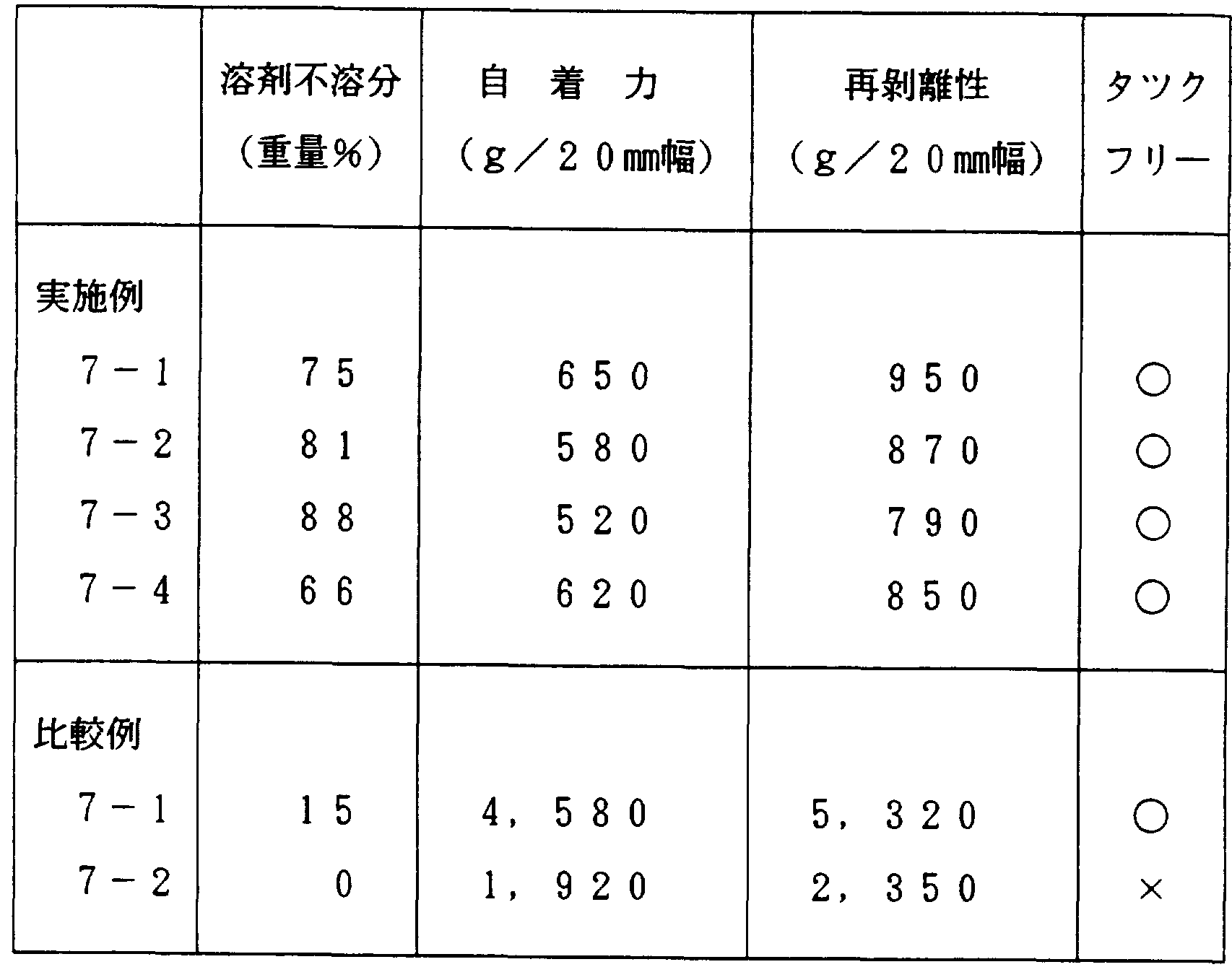


Claims
Priority Applications (3)
| Application Number | Priority Date | Filing Date | Title |
|---|---|---|---|
| US08/913,449 US6218006B1 (en) | 1995-03-15 | 1996-03-15 | Pressure-sensitive adhesive composition and pressure-sensitive adhesive sheets made therefrom, and sealants, reinforcing sheets and pressure-sensitive adhesive sheets for printing produced therefrom |
| EP96906065A EP0816462B1 (en) | 1995-03-15 | 1996-03-15 | Pressure-sensitive adhesive composition and pressure-sensitive adhesive sheets made therefrom, and sealants, reinforcing sheets and pressure-sensitive adhesive sheets for printing produced therefrom |
| DE69635799T DE69635799T2 (de) | 1995-03-15 | 1996-03-15 | Druckempfindliche klebstoffzusammensetzung und daraus hergestellte druckempfindliche klebefolien und dichtungsmasse, versträrkungsfolien und druckempfindliche klebefolien zum drucken |
Applications Claiming Priority (22)
| Application Number | Priority Date | Filing Date | Title |
|---|---|---|---|
| JP7/84846 | 1995-03-15 | ||
| JP8484695 | 1995-03-15 | ||
| JP7/212425 | 1995-07-28 | ||
| JP21242595 | 1995-07-28 | ||
| JP23332195 | 1995-08-17 | ||
| JP7/233321 | 1995-08-17 | ||
| JP7262275A JPH0976444A (ja) | 1995-09-15 | 1995-09-15 | テ―プ電線端末部補強用シ―ト |
| JP7/262276 | 1995-09-15 | ||
| JP26227695 | 1995-09-15 | ||
| JP7/262275 | 1995-09-15 | ||
| JP7/319884 | 1995-12-08 | ||
| JP7319884A JPH09157605A (ja) | 1995-12-08 | 1995-12-08 | テ―プ電線端末部補強用シ―ト |
| JP8/7943 | 1996-01-22 | ||
| JP8/7944 | 1996-01-22 | ||
| JP794396 | 1996-01-22 | ||
| JP794496 | 1996-01-22 | ||
| JP8/33792 | 1996-02-21 | ||
| JP03379296A JP4099220B2 (ja) | 1995-03-15 | 1996-02-21 | 粘着シート類 |
| JP04231096A JP4109710B2 (ja) | 1996-02-29 | 1996-02-29 | シ―ル材 |
| JP8/42310 | 1996-02-29 | ||
| JP8/44406 | 1996-03-01 | ||
| JP04440696A JP4044627B2 (ja) | 1996-03-01 | 1996-03-01 | 粘着シート類 |
Related Child Applications (2)
| Application Number | Title | Priority Date | Filing Date |
|---|---|---|---|
| US08/913,449 A-371-Of-International US6218006B1 (en) | 1995-03-15 | 1996-03-15 | Pressure-sensitive adhesive composition and pressure-sensitive adhesive sheets made therefrom, and sealants, reinforcing sheets and pressure-sensitive adhesive sheets for printing produced therefrom |
| US09/772,982 Division US6440553B2 (en) | 1995-03-15 | 2001-01-31 | Printable pressure-sensitive adhesive sheet and sealing material containing same |
Publications (1)
| Publication Number | Publication Date |
|---|---|
| WO1996028519A1 true WO1996028519A1 (en) | 1996-09-19 |
Family
ID=27581781
Family Applications (1)
| Application Number | Title | Priority Date | Filing Date |
|---|---|---|---|
| PCT/JP1996/000695 Ceased WO1996028519A1 (en) | 1995-03-15 | 1996-03-15 | Pressure-sensitive adhesive composition and pressure-sensitive adhesive sheets made therefrom, and sealants, reinforcing sheets and pressure-sensitive adhesive sheets for printing produced therefrom |
Country Status (5)
| Country | Link |
|---|---|
| US (2) | US6218006B1 (ja) |
| EP (1) | EP0816462B1 (ja) |
| KR (1) | KR19980702971A (ja) |
| CN (1) | CN1091790C (ja) |
| WO (1) | WO1996028519A1 (ja) |
Cited By (4)
| Publication number | Priority date | Publication date | Assignee | Title |
|---|---|---|---|---|
| US5945559A (en) * | 1996-05-24 | 1999-08-31 | Takasago International Corporation | Process for producing 3-oxocarboxylic acid esters |
| JP2002038111A (ja) * | 2000-04-28 | 2002-02-06 | Lintec Corp | 粘着シートおよび貼着体 |
| JP2002194314A (ja) * | 2000-12-27 | 2002-07-10 | Nitto Denko Corp | 粘着剤組成物とその粘着シート |
| JP5276244B2 (ja) * | 2000-03-03 | 2013-08-28 | リンテック株式会社 | 貼着体 |
Families Citing this family (52)
| Publication number | Priority date | Publication date | Assignee | Title |
|---|---|---|---|---|
| US5988279A (en) * | 1997-11-05 | 1999-11-23 | Fritz Industries, Inc. | Method for control of fluid loss and gas migration in well cementing |
| JPH11297237A (ja) * | 1998-04-03 | 1999-10-29 | Nitto Denko Corp | ブラウン管の防爆構造及びその防爆テープ |
| US6182572B1 (en) * | 1998-08-29 | 2001-02-06 | Malessa Partners, L.L.C. | Method and apparatus for producing multiple cut business forms |
| AU2003266469B2 (en) * | 1998-12-15 | 2007-08-02 | Avery Dennison Corporation | Label adhesives and constructions exhibiting low adhesive residue in printers |
| AU2364900A (en) * | 1998-12-15 | 2000-07-03 | Avery Dennison Corporation | Label adhesives and constructions exhibiting low adhesive residue in printers |
| US6485825B1 (en) * | 1999-03-18 | 2002-11-26 | Sekisui Chemical Co., Ltd. | Pressure-sensitive adhesive tape or sheet and process for producing the same |
| JP4548679B2 (ja) * | 1999-10-08 | 2010-09-22 | 大日本印刷株式会社 | 体積ホログラム積層体における粘着剤層用粘着剤 |
| US6805953B2 (en) | 2000-02-09 | 2004-10-19 | Nitto Denko Corporation | Waterstop sealing material |
| US20040041356A1 (en) * | 2000-05-12 | 2004-03-04 | Aviation Devices And Electronic Components, Llc. | Gasket material having a PTFE core and a method of making a using the same |
| US20030049409A1 (en) * | 2000-05-20 | 2003-03-13 | Andreas Wieck | Use of a high density paper support as a support strip in a cover material for an adhesive tape |
| JP5100925B2 (ja) * | 2000-11-09 | 2012-12-19 | 日東電工株式会社 | シート材、ならびにそれを有する感圧性接着シート |
| CN1214391C (zh) * | 2001-04-23 | 2005-08-10 | 日东电工株式会社 | 用于硬盘驱动器的压敏粘性标签 |
| US20040219193A1 (en) * | 2001-08-31 | 2004-11-04 | Hidetoshi Abe | Adhesive composition and low temperature applicable adhesive sheet |
| WO2005022609A1 (ja) * | 2003-09-01 | 2005-03-10 | Mitsui Chemicals, Inc. | 粘着フィルムおよびそれを用いたメタル製膜方法 |
| ES2428032T3 (es) * | 2003-09-30 | 2013-11-05 | The Boeing Company | Revestimiento de aplique protector y uso del mismo |
| JP4860114B2 (ja) | 2004-03-02 | 2012-01-25 | 日東電工株式会社 | 熱硬化型粘接着テープ又はシート、及びその製造方法 |
| JP4059265B2 (ja) * | 2005-06-08 | 2008-03-12 | オンキヨー株式会社 | スピーカー用部材およびその製造方法 |
| US7544407B1 (en) * | 2005-09-17 | 2009-06-09 | The Boeing Company | Pressure sensitive adhesive suitable for aircraft exterior applications |
| US8398306B2 (en) | 2005-11-07 | 2013-03-19 | Kraft Foods Global Brands Llc | Flexible package with internal, resealable closure feature |
| US20080135159A1 (en) * | 2006-12-12 | 2008-06-12 | 3M Innovative Properties Company | Stretch releasing pressure-sensitive adhesive articles and methods of using the same |
| US9232808B2 (en) | 2007-06-29 | 2016-01-12 | Kraft Foods Group Brands Llc | Processed cheese without emulsifying salts |
| ES2358232T3 (es) * | 2007-08-13 | 2011-05-06 | Tesa Se | Agente de separación a base de bloques múltiples de copolímeros de etileno. |
| US20090148674A1 (en) * | 2007-12-09 | 2009-06-11 | Ult Technology Co., Ltd. | In mold film with a 2d/3d pattern |
| DE102008023758A1 (de) | 2008-05-09 | 2009-11-12 | Tesa Se | Haftklebebänder zur Verklebung von Druckplatten |
| RU2497679C2 (ru) | 2008-10-02 | 2013-11-10 | Милан Инк. | Способ получения многослойного клеящегося ламинированного материала |
| IT1394350B1 (it) | 2009-05-06 | 2012-06-06 | Milano Politecnico | Braccio in materiale composito e relativo procedimento di realizzazione |
| KR102114534B1 (ko) * | 2009-10-21 | 2020-05-22 | 미츠비시 가스 가가쿠 가부시키가이샤 | 기능성 시트 및 그것을 이용한 렌즈 |
| JP5390356B2 (ja) * | 2009-12-03 | 2014-01-15 | 日東電工株式会社 | 粘着シート |
| MX2012009795A (es) | 2010-02-26 | 2012-09-12 | Kraft Foods Global Brands Llc | Envase susceptible de volver a cerrarse usando adhesivo de baja pegajosidad. |
| NZ591354A (en) | 2010-02-26 | 2012-09-28 | Kraft Foods Global Brands Llc | A low-tack, UV-cured pressure sensitive acrylic ester based adhesive for reclosable packaging |
| JP2012140844A (ja) * | 2010-12-16 | 2012-07-26 | Nitto Denko Corp | 防水ねじ、シール材、構造体設置方法および構造体設置構造 |
| US20140017466A1 (en) * | 2010-12-31 | 2014-01-16 | 3M Innovative Properties Company | Double-sided adhesive tape having improved reworkability |
| KR101946065B1 (ko) * | 2010-12-31 | 2019-04-17 | 쓰리엠 이노베이티브 프로퍼티즈 캄파니 | 재작업성이 향상된 양면 점착 테이프 |
| US8764929B2 (en) * | 2011-03-22 | 2014-07-01 | The Boeing Company | Method of promoting adhesion and bonding of structures and structures produced thereby |
| WO2012157701A1 (ja) * | 2011-05-18 | 2012-11-22 | 戸田工業株式会社 | 導電性塗膜の製造方法及び導電性塗膜 |
| US20140342531A1 (en) * | 2011-12-06 | 2014-11-20 | Lintec Corporation | Adhesive Sheet for Semiconductor Wafer Processing, Method for Processing of Semiconductor Wafer Using Sheet |
| WO2013084703A1 (ja) * | 2011-12-08 | 2013-06-13 | 日東電工株式会社 | 防水ねじ、シール材、構造体設置方法および構造体設置構造 |
| JP5989434B2 (ja) * | 2012-07-18 | 2016-09-07 | 日東電工株式会社 | 表面保護シート |
| JP5989432B2 (ja) * | 2012-07-18 | 2016-09-07 | 日東電工株式会社 | 塗膜保護シート |
| JP5989433B2 (ja) * | 2012-07-18 | 2016-09-07 | 日東電工株式会社 | 表面保護シート |
| WO2014188840A1 (ja) * | 2013-05-24 | 2014-11-27 | ニッタ株式会社 | 感温性粘着剤 |
| DE102013221847A1 (de) * | 2013-08-01 | 2015-02-05 | Tesa Se | Verfahren zum Formen eines Körpers in einer Form |
| JP6687997B2 (ja) | 2013-12-20 | 2020-04-28 | 日東電工株式会社 | 粘着剤組成物、粘着剤層、粘着テープ、及び、両面粘着テープ |
| WO2016014225A1 (en) * | 2014-07-25 | 2016-01-28 | 3M Innovative Properties Company | Optically clear pressure sensitive adhesive article |
| JP2016130294A (ja) * | 2015-01-15 | 2016-07-21 | 日東電工株式会社 | 粘着シート、粘着シートの利用方法及び精密電子機器 |
| KR102623652B1 (ko) * | 2015-10-13 | 2024-01-10 | 린텍 가부시키가이샤 | 점착 시트 |
| SG11202003310XA (en) | 2017-10-12 | 2020-05-28 | Avery Dennison Corp | Low outgassing clean adhesive |
| WO2020075063A1 (en) * | 2018-10-11 | 2020-04-16 | 3M Innovative Properties Company | Adhesive composition comprising a block copolymer having a polyvinyl aromatic block and poly(vinyl aromatic/isoprene) block, articles, and methods of bonding |
| WO2020121999A1 (ja) * | 2018-12-13 | 2020-06-18 | 日東電工株式会社 | 粘着剤組成物および粘着シート |
| US20220017789A1 (en) * | 2018-12-13 | 2022-01-20 | Nitto Denko Corporation | Pressure-sensitive adhesive composition and pressure-sensitive adhesive sheet |
| CN112985952B (zh) * | 2021-02-20 | 2022-09-20 | 山东骏腾医疗科技有限公司 | 一种病理封片材料 |
| JP7802456B2 (ja) * | 2021-03-08 | 2026-01-20 | 日東電工株式会社 | 光学用粘着剤組成物 |
Citations (3)
| Publication number | Priority date | Publication date | Assignee | Title |
|---|---|---|---|---|
| JPH03243679A (ja) * | 1990-02-19 | 1991-10-30 | Sekisui Chem Co Ltd | アクリル系粘着剤組成物及び粘着テープ、ラベル、シート |
| JPH04342785A (ja) * | 1991-05-21 | 1992-11-30 | Kuraray Co Ltd | ポリエステルカーボネート系ポリウレタン接着剤 |
| JPH06234821A (ja) * | 1993-11-30 | 1994-08-23 | Nippon Zeon Co Ltd | 粘着剤組成物 |
Family Cites Families (6)
| Publication number | Priority date | Publication date | Assignee | Title |
|---|---|---|---|---|
| NL7414491A (nl) * | 1973-11-09 | 1975-05-13 | Bayer Ag | Als bindmiddel voor kleefstoffen geschikte mengsels, alsmede de toepassing daarvan. |
| JPH0653794B2 (ja) * | 1987-07-21 | 1994-07-20 | 東亞合成化学工業株式会社 | ポリカーボネートジオールのウレタン化反応性低減化処理方法 |
| US5229207A (en) | 1990-04-24 | 1993-07-20 | Minnesota Mining And Manufacturing Company | Film composite having repositionable adhesive by which it can become permanently bonded to a plasticized substrate |
| JP2970963B2 (ja) * | 1991-08-14 | 1999-11-02 | 日東電工株式会社 | 剥離性感圧接着剤及びその粘着部材 |
| IT1251489B (it) * | 1991-09-17 | 1995-05-15 | Enichem Sintesi | Policarbonati dioloterminati |
| CN1078985A (zh) * | 1993-01-19 | 1993-12-01 | 沈鸿雁 | 瓷砖单面胶 |
-
1996
- 1996-03-15 WO PCT/JP1996/000695 patent/WO1996028519A1/ja not_active Ceased
- 1996-03-15 CN CN96193887A patent/CN1091790C/zh not_active Expired - Fee Related
- 1996-03-15 US US08/913,449 patent/US6218006B1/en not_active Expired - Lifetime
- 1996-03-15 KR KR1019970706379A patent/KR19980702971A/ko not_active Ceased
- 1996-03-15 EP EP96906065A patent/EP0816462B1/en not_active Expired - Lifetime
-
2001
- 2001-01-31 US US09/772,982 patent/US6440553B2/en not_active Expired - Lifetime
Patent Citations (3)
| Publication number | Priority date | Publication date | Assignee | Title |
|---|---|---|---|---|
| JPH03243679A (ja) * | 1990-02-19 | 1991-10-30 | Sekisui Chem Co Ltd | アクリル系粘着剤組成物及び粘着テープ、ラベル、シート |
| JPH04342785A (ja) * | 1991-05-21 | 1992-11-30 | Kuraray Co Ltd | ポリエステルカーボネート系ポリウレタン接着剤 |
| JPH06234821A (ja) * | 1993-11-30 | 1994-08-23 | Nippon Zeon Co Ltd | 粘着剤組成物 |
Non-Patent Citations (1)
| Title |
|---|
| See also references of EP0816462A4 * |
Cited By (4)
| Publication number | Priority date | Publication date | Assignee | Title |
|---|---|---|---|---|
| US5945559A (en) * | 1996-05-24 | 1999-08-31 | Takasago International Corporation | Process for producing 3-oxocarboxylic acid esters |
| JP5276244B2 (ja) * | 2000-03-03 | 2013-08-28 | リンテック株式会社 | 貼着体 |
| JP2002038111A (ja) * | 2000-04-28 | 2002-02-06 | Lintec Corp | 粘着シートおよび貼着体 |
| JP2002194314A (ja) * | 2000-12-27 | 2002-07-10 | Nitto Denko Corp | 粘着剤組成物とその粘着シート |
Also Published As
| Publication number | Publication date |
|---|---|
| KR19980702971A (ko) | 1998-09-05 |
| US6440553B2 (en) | 2002-08-27 |
| EP0816462B1 (en) | 2006-02-08 |
| EP0816462A4 (en) | 1998-11-25 |
| US20010021451A1 (en) | 2001-09-13 |
| US6218006B1 (en) | 2001-04-17 |
| CN1091790C (zh) | 2002-10-02 |
| EP0816462A1 (en) | 1998-01-07 |
| CN1184497A (zh) | 1998-06-10 |
Similar Documents
| Publication | Publication Date | Title |
|---|---|---|
| US6440553B2 (en) | Printable pressure-sensitive adhesive sheet and sealing material containing same | |
| EP2520630B1 (en) | Polyester adhesive composition | |
| JP5509079B2 (ja) | 粘着シート | |
| JP4099220B2 (ja) | 粘着シート類 | |
| JP3886225B2 (ja) | 両面粘着シ―ト類 | |
| EP0902071B1 (en) | Thermosetting pressure-sensitive adhesive and adhesive sheets made by using the same | |
| WO2011055827A1 (ja) | 粘着剤組成物 | |
| JPH09310059A (ja) | 粘着剤組成物とその粘着シ―ト類 | |
| JP3819547B2 (ja) | 両面粘着シ―ト類 | |
| JP4911811B2 (ja) | 熱活性接着剤および光架橋性熱活性接着剤 | |
| JP4781514B2 (ja) | 接着剤組成物および接着シート | |
| JP4109710B2 (ja) | シ―ル材 | |
| JP4570836B2 (ja) | 接着剤組成物 | |
| JP4044627B2 (ja) | 粘着シート類 | |
| JPH06145611A (ja) | 研磨材固定用テープ | |
| JPH10293946A (ja) | 光記録媒体 | |
| JP2005154782A (ja) | 粘着シート類 | |
| JPH1129754A (ja) | 両面粘着シ―ト類 | |
| JP2002146301A (ja) | 粘着シート | |
| JP4731052B2 (ja) | 剥離ライナーを有さない両面粘着シート | |
| JP2004099792A (ja) | 粘着剤組成物及び粘着シート類 | |
| JP2003321652A (ja) | 感圧接着用硬化性組成物およびこれを硬化させた感圧接着剤 | |
| JP2008138220A (ja) | 粘着シート類 | |
| JPH10152655A (ja) | 被覆保護用粘着シ―ト類と被覆保護方法 | |
| JP2003213237A (ja) | 接着剤組成物 |
Legal Events
| Date | Code | Title | Description |
|---|---|---|---|
| WWE | Wipo information: entry into national phase |
Ref document number: 96193887.0 Country of ref document: CN |
|
| AK | Designated states |
Kind code of ref document: A1 Designated state(s): CN KR US |
|
| AL | Designated countries for regional patents |
Kind code of ref document: A1 Designated state(s): DE FR GB IT |
|
| DFPE | Request for preliminary examination filed prior to expiration of 19th month from priority date (pct application filed before 20040101) | ||
| 121 | Ep: the epo has been informed by wipo that ep was designated in this application | ||
| WWE | Wipo information: entry into national phase |
Ref document number: 1019970706379 Country of ref document: KR |
|
| WWE | Wipo information: entry into national phase |
Ref document number: 1996906065 Country of ref document: EP Ref document number: 08913449 Country of ref document: US |
|
| WWP | Wipo information: published in national office |
Ref document number: 1996906065 Country of ref document: EP |
|
| WWP | Wipo information: published in national office |
Ref document number: 1019970706379 Country of ref document: KR |
|
| WWR | Wipo information: refused in national office |
Ref document number: 1019970706379 Country of ref document: KR |
|
| WWG | Wipo information: grant in national office |
Ref document number: 1996906065 Country of ref document: EP |